Friendsgiving

By Mary


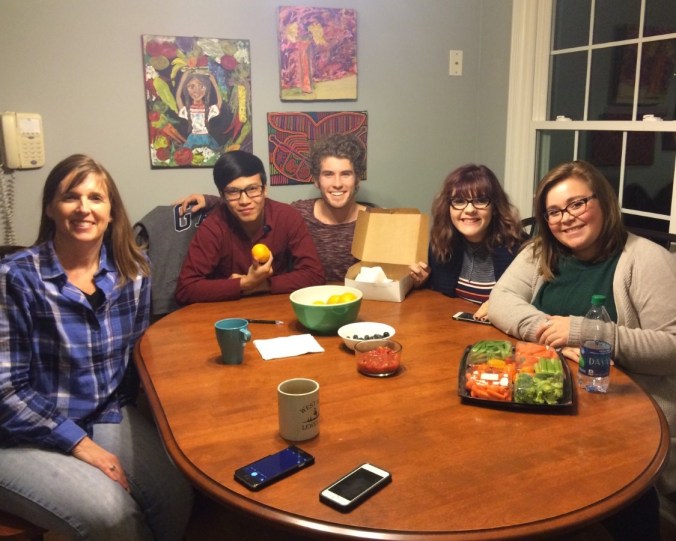
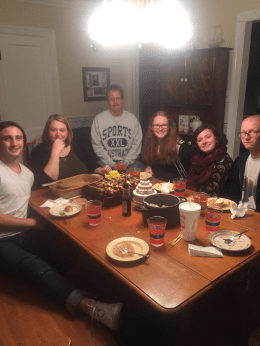
We had dinner around a kitchen table at kktmy friend’s apartment. The people that were there included, Andrew, Keaton, Kat, Gabby, Tori, Hayley, Ashlyn, Tatro, and myself. For my descriptions of these people, I thought that it would be best to not only use what they had to say about themselves, but also things I notice or appreciate about them. Andrew is a gentleman. He is compassionate and is genuinely interested in what you have to say whether he agrees with it or not. He is a goofy guy that loves being around good people, and wants to do something with his life. Even though I do not know him that well, I was able to pick up on those things about him very easily. Keaton’s description of herself is how I would describe her as well. She is extremely passionate and dedicated to doing the right thing, she always tries to stay positive and open minded, and she likes to look at the world from multiple different perspectives and learn from different situations. Kat is artistic in everything she does. She has a very bright, outgoing personality. She wants to use her art in art therapy or something else that is helpful. Gabby sells herself short. She gives without asking for anything in return. She instinctively takes care of those around her and has one of he kindest hearts that I know. Tori is a very loyal friend. She is unapologetically herself and brightens up a room when she’s in it. She is honest and will tell you what you need to hear. I do not know Ashlyn and Hayley that well. Ashlyn is carefree and enjoys being around people. She thinks for herself and is very independent. Hayley has a kind heart and cares about other people. She is a little soft spoken, but was insightful when she had something to say.

I think that we had a diverse group. We are all the same race, but we come from very different backgrounds and have different views on politics, life, and on the topics we discussed at dinner. Each person provided some type of dish. Since it is close to Thanksgiving, we had a “friendsgiving” and everyone made/brought something so we would have variety and enough for everyone to eat. We wanted to have a group of people that would give diverse answers and give us a different insight into issues. Everyone that was there respects the opinions of others even if they do not share the same view. I think that the discussion we had left everyone thinking of the points the other side had to make. I would say that I was able to understand a viewpoint that was different from mine.

Our discussion started with the obvious question of, “What does citizenship mean to you?” This question took them a moment to answer because it is not one that you get every day. Keaton had the response that I paid attention to the most. She said that citizenship means having freedom, but to a certain extent. It means being a part of a greater good and working to give back to your country in whatever way you can. Other people chimed in and added some more to what it meant to them. Some meant having a voice in society and being a productive member. Andrew said it simply meant doing your part in society and being good to others. This kind of lead to the question of, “What kind of person do you want to be?” One of the answers that multiple people said is that they want to be someone that people look up to and respect. They want to lead by example, and make a lasting impression on other people. Someone that everyone wants to be around and that radiates positivity. I felt that these answers and the conversation was going to the “Does your religious or spiritual identity relate to how you think we should treat other people? Does it relate to how you see yourself as a citizen?” I worded it differently because of the nature of the conversation, but it had the same meaning. A couple of us there are unreligious, so I agreed with their viewpoints. They felt that religion should not be the reason you are good to people or treat them well. That we are all human beings that deserve respect and kindness regardless of who you are. The religious people agreed with what was being said, but their faith compelled them to treat others well. Most were some form of Christianity and all used the bible as their main form of references. They said that the bible teaches you how to treat people and that being in the church environment made them feel like they were around positive influences that helped them figure it out. From here, I felt that the next question on the list, “Do you think we have any obligations to other people in our country? In our community?” was the logical transition. One answer was that we do have an obligation to respect and support people within the community even if they are different from us. With this question, the election was kind of brought up. It is still a sensitive topic, but one that I do not think I have really discussed with my friends yet. For a few of us, the election was still a wound that we were trying to make sense of, and for others they were happy with the results. The people that voted for Trump said that they wanted change. He was going to fix the economy and fix trade deals. Those of us that did not vote for him said that he was a vile person. He instilled hatred into millions of people and made discrimination okay. Someone that was against Trump said that as president, he was obligated to protect all Americans and not only middle and upper class white people. This conversation went on for a while, but we were all able to agree that regardless of what we believe, the repercussions of the election are tragic and it is sad that people have to be scared to live in their own country. It was interesting how they brought the conversation back to the questions that I was asking. I brought up, “How to we live better together?” because I felt it was appropriate for where we were at in the conversation. Gabby said that we should be there for each other regardless of what we think, and that now more than ever is when people should respect everyone.

Tatro and I were not able to get through all of the questions because the conversations we were having were quality. I think that this might have been the first time that the I have had such in depth conversations casually with friends. It was refreshing to be able to talk to friends about things that actually matter. I learned that regardless of your religion, who you vote for, or what your beliefs are, we tend to gravitate towards being kind and good to each other. I would say that we have learned to be aware and understof what someone else is thinking, feeling, or going through. It was interesting to see an understanding being made when someone gave an answer or made a statement about something that went against what they thought. Sometimes, I would even disagree with someone, but was able to think about it through their perspective. They are my friends and I was able to still associate that with them. What we all realized is that even though you are different from someone, we are all people too and deserve to be treated with respect. My central idea that this all related to, and one I have already mentioned, is “How do we live better together?”. I felt that this conversation and dinner centered on this because of the recent election and events that have followed. This experience was something very enjoyable and eye opening about my friends.

My Kentucky Kitchen Table

By Callie

When I first heard about the assignment, I was anxious at the thought of having dinner with people whom I did not know. As a relatively quiet person, I was nervous about the idea, but it turned out to be a great experience.

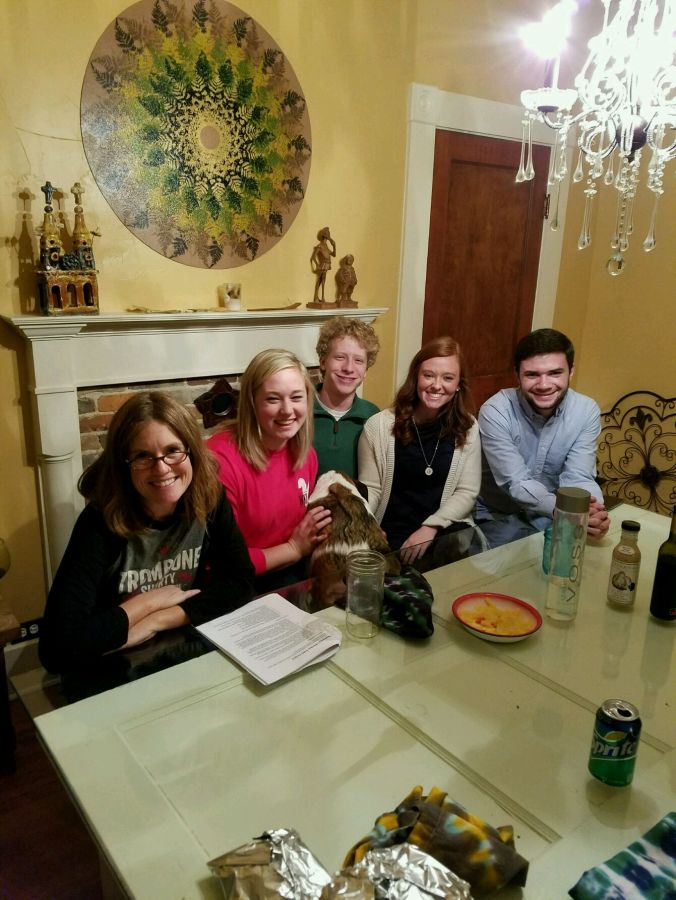
For this assignment, I was paired with Jamie. Her friend Shelby opened her apartment to us for the night.  The night’s menu consisted of spaghetti with marinara and alfredo sauces made by Jamie and Isaac, bruschetta made by Shelby, cookies from Karla, and French toast that I made. There was a total of six people in attendance, only two of which I knew beforehand. In attendance was Jamie, her friends Shelby, Thomas, and Isaac, me (Callie), and my friend Karla.

Everyone in attendance was a member of the Honors College here at WKU. However, Karla and I were the only freshmen, while the others were all seniors. Jamie is a psychology major from Lawrenceburg, KY. Shelby is also a psychology major from Lawrenceburg. Thomas is from Mayfield, KY and is a biology student. Isaac is studying meteorology and is from Aurora, IN. Karla is also a psychology student and is from both Shelbyville, KY and Los Angeles County, CA. I am a business student from Dunmor, KY. Another aspect that makes this group diverse is religion. Karla and Callie are Christian, Thomas was raised Catholic but no longer practices the religion, while Jamie and Isaac identify as being LGBT and practice no religion.

Throughout the discussion, Jamie and I would take turns asking questions to keep the conversation going. At times we would get off topic by sharing personal stories as we discovered different things that we had in common with each other. These connections allowed us to relate to each other and connect our similar experiences. These topics included H4 and living in Minton Hall. We discussed that H4 allowed us to meet many new people, many of which we would not have taken the time to meet otherwise. While each person’s experiences took place in different years, overall we shared similar opinions and circumstances. We covered topics including citizenship, social issues, diversity, religion, the kind of person we want to be, and many more.

We began the discussion with the question: What do you think are the best things about our world today? The answers were light-hearted and included food, puppies, warm weather, and friendship. The following question required more serious answers: Beyond voting, paying taxes, and following laws, what does citizenship mean to you? Many of the answers conveyed a similar message of truly caring for others and taking a stand for your beliefs. Isaac suggested that citizen should involve being politically engaged outside of voting and interacting with your local government. Others suggested being engaged with others and championing for a cause. These responses can be related to the class question of: How do we live well together? As we got off topic talking about out different experiences through the years, we came to the consensus that communication is key to living well with others. For example, Thomas and Isaac were roommates for several years and coming into college they had never met each other before. They agreed that talking things out allowed them to overcome their differences and become friends.

One of my favorite questions asked was: Have you ever had a conversation with someone from a really different background than yourself? I found it interesting to hear everyone’s personal account of their interactions with diverse people. We discovered that because of these interactions our worldviews have been expanded. Many of us grew up in small towns with little diversity, and as a result, our experiences with diversity have had a lasting impression on us and our worldviews. Isaac discussed how the ability to travel has shaped who is he as a person. Shelby told about her experiences staying in Europe with an Italian family where only one person spoke English. She found it interesting that they would listen to American music even though they were unable to understand it. Thomas spoke about his internship at the National Institute of Health, during which he lived in a house with an older woman from India and worked alongside people from all over the world. He found it exciting and educational to learn about other diversities in this way. Jamie explained that in elementary school she had friends who were Chinese and Japanese. She told that her best friend was a Bosnian refugee whose parents did not speak English. I told of my experiences at GSP where I met people from varying backgrounds, cultures, and religions. I found this time especially exciting, as it was my first real experience with diversity. Karla is from Hispanic dissent and grew up bilingual. She discussed that she was among the small diversity in her dominantly white neighborhood.

Overall, I found this experience worthwhile and enriching. Going into the assignment I was afraid that we would not be able to keep the conversation going considering I had never met the majority of the people in attendance. However, this was not the case at all. Through discussion we discovered many things that we had common with each other, which made the night flow more smoothly. The environment was very welcoming and it seemed there was no subject that was off-limits. I enjoyed hearing each person’s experiences and concerns. I was reminded of the fact that you cannot judge a book by its cover. While the majority of us came from small towns, we all were very different. Each of us held our own set of experiences, opinions, interests, and beliefs. Part of citizenship is living and interacting with others. In order for us to do so successfully, we must understand where each person is coming from and why they hold the positions that they do. Through this deliberation, I was able to get a glimpse of what the world could be like if we took the time to talk to those around us on a daily basis.

KY Kitchen Table

By Rachel

I hosted my Kentucky Kitchen Table in my hometown of Bowling Green. I was lucky enough to manage to pull together a ragtag dinner group consisting of some distant cousins that I don’t remember being related to, an uncle, my dad, and the lawyer in charge of my grandads estate. Most of these poor souls just wanted to come to my grandparents house for a meeting and to sign some documents but had the misfortune of mentioning dinner and me deciding that my project was way more important than their ability to evacuate. We pulled together an oddly good meal consisting of ribs and chicken that where both of the farm fresh variety (slaughtered and put in a deep freeze till the grandkids forget it had a name) along with homemade cornbread, baked beans, and lemonade as a group (minus Pete who would rather watch football and left the kitchen). We decided to eat at the dining table in the sunroom surrounded by our prickly cacti friends and settled in for a good long meal.

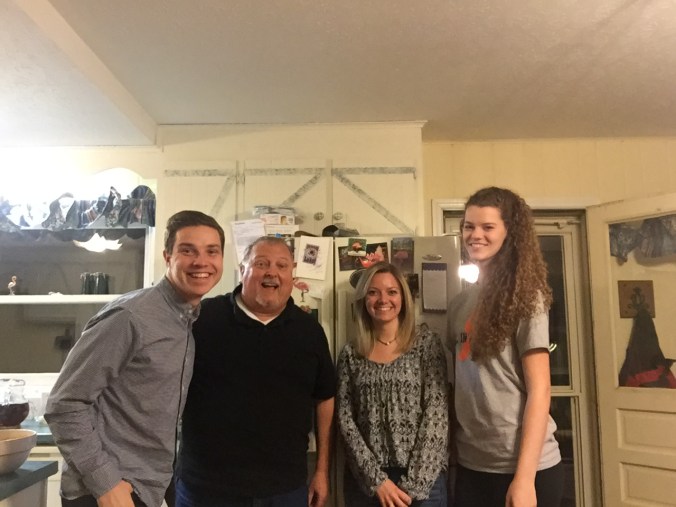
The captives of the evening were my uncle Pete, my dad Paul, distant cousins Taylor, Terrah, and Graham (no that’s not a typo, my last name is Graham and his first name is Graham) and lawyer extraordinaire Tracy. While the group may not look that diverse on the outside we represent a wide demographic of ages, backgrounds, and belief systems. Pete who has lived a rough life and at 40 looks closer to 65 never went to college and now has seizures so he can no longer work on power lines like he used to so he’s been forced into retirement. My dad went to Western and then vet school and is now a veterinarian/farmer/archery coach. Taylor went to Louisville for college and now has a full time job there where she coordinates fundraisers. Graham was a professional archer from 18-23 but lost most his most of his vision in his dominant eye in a gun explosion and is now a welder. Terrah is a nurse and extremely religious (to the point she sent me a bible in the mail less than a week after this dinner/first meeting). Last but not least Tracy who has a law degree but decides to use it to do everything a lawyer does minus going into an actual courtroom and has 2 jack russell terriers that get stuck in groundhog holes.

As I started off the discussion I attempted to make it clear that this project is about insightful discussion and not starting brawls at the dinner table and thankfully everyone seemed to grasp the concept except for Pete who immediately started laughing about “those butthurt liberals” and immediately killed most of my hope for this to end with no hurt feeling and open minds. Once Pete got it together we started in on what citizenship means to each of us and we unsurprisingly ended up split up in our beliefs by age group with Taylor and I speaking more about being a part of a society who accepts you, Terrah and Graham talking more on their freedoms and their rights and how you are a citizen when your country let’s you be your own person while still protecting protects you and providing guidance almost like a parent would do, and Pete, Paul, and Tracy made their beliefs known that citizenship to them means feeling safe, loving your country and being willing to do anything in its name because it is your home. Luckily we all agreed on something, some people in the group brought up that no matter the background of a person, if they truly feel like an American and are only here with good intentions that they should be treated like citizens and not outcasts at least by the public. I was truly surprised that Pete agreed and I feel that he probably likes the idea of a utopian society but wouldn’t truly practice this due to the fact that I’ve heard one too many jokes about muslims come out of his mouth over the years but I guess he gets the benefit of the doubt for now.

After this I directed the conversation towards what kind of person everyone wants to be and what they do to try to become this ideal. All of the men ended up described their ideal way of being as being caring, friendly, useful people, and being able to protect their loved ones which reminded me of the paper we read on younger people not being able to really discuss morals because they were never taught any. This situation was kind of reversed from the article where I felt like the men weren’t taught how to truly express themselves but had words put in their mouths to spew out whenever they are told to. The guys had this preconceived notion of what a real man is from hearing it their whole lives and it was honestly disappointing to get such a generic answer. I do however feel that if any one of my younger male friends had been there he would have felt much more comfortable opening up. The ladies of the group however were not afraid to speak their minds and get into specifics. They brought to the table a collective desire to be able to give more of their time to their families and spend less time caught up in themselves. Terrah brought up her desire to be able to be there for everyone and that if anyone of her friends from church or otherwise ever needed anything at all that she could be there in a split second to do anything for them because not enough people take the time to care about others.

This lead into a discussion of religion and Terrah’s various mission trips. Out of all of us I was the only person who wasn’t a practicing christian which lead to a few overzealous minutes of preaching by Terrah but eventually managed to get turned back around to the relative zone of living better together. Everyone agreed that religion is a moral code and that not practicing one doesn’t make someone a bad person, it just means that they have to make their own limits and define good and bad for themselves. Graham brought up that community service is one of the best things a church does as it allows people to actually get together and make a difference and due to the sense of community and obligation to their group people tend to make more of an effort to help. Terrah brought up that the last 2 mission trips her church planned kept getting put off due to the snare of preparation and ended up happening 5 months after the originally scheduled dates. She shared that she;s not going on another trip as she believes they accomplished nothing because they brought shoes, toys, and toothpaste to an area that had way more pressing issues such as disease and how to get water than worrying about brushing their teeth. Taylor also brought up that on a mission trip that she went on where the kids got toothpaste that was mint flavored that the kids would end up eating the toothpaste like it’s candy and get ill because they had never seen it before. The article to hell with good intentions really hit home here and made me realize that the human race is basically just wandering around with its hands over its eyes convinced it is a gift from god bestowing greatness wherever it may go refusing to look at the reality that it’s poisoning everything it touches. After this the discussion took a quick turn to the official reason for everyone’s visit to Bowling Green and the discussion was promptly left at the table.

This project was surprisingly more comfortable than I had originally expected especially considering that half my group where stranger to me. After doing this project I have to believe that most people are inherently good and have good intentions but don’t necessarily know how to properly execute them. Since I know Pete as usually being very brash and his relatively cooperative and accepting attitude I must imagine that being taken out of your comfort zone and the preconceived notions of those closest to you gives you time to reflect and process what your beliefs as an individual are without the hive mind. This has also helped me realize how different we can be on the surface but the our souls share a like mind of love and acceptance.

ky-kitchen-table

Where Love Resides

By Brent

My Kentucky Kitchen Table project provided me a way to feel more connected to Bowling Green and get closer to a few of my peers, as well as fellow citizens. For our project, Hillary, Rachel, and I went over to Jennifer’s house for dinner. I also brought a friend, named Tan, who is from Vietnam and is studying at WKU. Our conversation lasted for about three hours and felt unexpectedly natural. No conversation topic felt like it was off limits. 
My partners for this project were phenomenal. When you first meet Hillary, you know that above all, she cares. She cares about how you are and what you believe in. She is naturally inquisitive and passionate. Her love for art and beauty is apparent in the way she lives and it rubs off on the people that she meets. Rachel, an English literature major, has a way with words and her humor is not only witty, but it is insightful as well. She tells a story of love and she preaches equality by her actions. Jennifer is a compassionate soul who lives intentionally and spends her time doing what she loves, which is pouring into the lives of immigrants and Refugees in the greater Bowling Green area. She is a mother, a wife, and a devoted member of society. She asks deep questions and listens with intention. She loves others with few bounds and is an inspiration to many. Tan is an inquisitive and passionate man. His self-prescribed nickname, “Crazy,” fits him well only because he is willing to take big risks and is able to overcome his fears very quickly. Tan has enjoyed the United States very much and hopes to get a business degree in order to start his own business when he returns to Vietnam.  
Our conversation went down many different paths. We began by answering what we thought it meant to be a citizen. Generally, we all agreed that being a good citizen means being involved with as many different types of people and groups as possible. As citizens, it is our job not to run away when things get hard. We are supposed to join together and use our voice to support our beliefs and lift other people up. I really liked Jennifer’s perspective on her life as a citizen because she focused on ways that she sees herself training her two boys on how to be good people and citizens. She also mentioned that being around like-minded people can be a good place to brainstorm, but, in the end, it is better to put yourself out into the world in order to gain a bigger perspective on what it means to live well with others.  
We also talked about the role that loving people plays in being a bigger part of society. We mentioned many simple acts, like being kind to a cashier or being patient at the DMV that go a long way. We all tell a story with the way we live our lives and it is important that that story builds other people up and recognizes everyone’s humanity. We decided that it is important to be humble and recognize that we will never know anyone’s full story. For example, we don’t know what it is like to be born into a country that has been in civil war for over eighty years. We don’t understand the hate that many immigrants and refugees face. So, rather than letting those differences scare us, it is important to face them fiercely and fight for equity.  
I learned a lot from our conversation, but I would say that my biggest takeaway was that it is important for me to meet people who are starkly different from me and be in community with them. I have so much to learn from other people, and I will never be done learning. We talked a lot about how having a face to put to an issue can be powerful for a lot of people. For example, if you have a friend that is a refugee or immigrant, you will naturally want to support laws and legislation that will protect their rights. I also think that I have a responsibility to make sure that more people reach out into the community to make those sorts of personal connection with people who are different from them.  
I also learned from Tan as I watched him interact with the difficult and theoretical conversations we were having. While he didn’t understand all of what we were saying, or why we were saying it, he knew it meant a lot to us and he respected that very much. I was humbled by his willingness to want to learn about other cultures and hear about how people see things like the recent election or holidays. I learned from him that listening is a gift and taking a risk in order connect with people is always worth it, at least for the experience.  
I think that our dinner and this project relate to our class in a few ways. Primarily, I saw that most of our conversation had to do with the idea of a crossing a bridge. We talked about how things are and where we want them to be, but most importantly, ways we thought we could get there. For example, we talked about how communities often respond to tragedy by throwing money and resources at a given problem. This raises issues because it leaves people disconnected and removed from the deeper causes that might be contributing the problems. We decided we wanted communities to be more involved so that when something happens, people know the needs of the victims they are helping and have an idea what their life is like prior to whatever incident might take place. Additionally, we mentioned that people have to become more connected with others who are different from them, spend time in the community, and break down stereotypes. This seems like a lot to ask, but it has to happen for us to be able to move forward as a society. I think that another way our conversation connected to the course was that we talked about how the power of patience is necessary to solve all of the issues we wanted to tackle. It was evident that Jennifer is an extremely patient person and her loves shine through in that way. She will wait on the phone for translators and lawyers to make sure that her friends, many of whom are refugees, aren’t getting taken advantage of and are getting the care and support they deserve. Even during out meal, she was checking up on a friend who was in the hospital for having an appendix removed. I think that, through her, I see how being patient is an act of love, and love makes us the best citizens that we can be. Overall, the experience allowed me to understand the importance of talking about change with people in the community because it made me feel like I had more people on my team and are willing to fight alongside me for what we believe is right.
thumbnail_img_2104

A Lesson on Engagement, Connection, and Planning

By Rachael

thumbnail_img_2104

Disclaimer: we almost forgot to take a photo, so there was much more food prior to consumption and clean-up. But the modeling of the pie and fruit by Brent and Tan is much better than the table full of food would’ve been anyway.

So because I am from Bowling Green, I originally planned to do my Kentucky Kitchen Table here with family and a few friends or distant relatives for diversity sake. However, that plan went awry. I won’t bore you with all the details (because they are boring and quite anticlimactic), but I ended up rather late in the game without a table. Luckily for me, I’ve met some really wonderful people in this class (looking at you Hilarie and Brent), and they kindly let me crash their dinner. And even though it was very last minute and totally not my plan, as is often the case, the spontaneity and the detour made it all the better.

I’ll get to all that good stuff in a moment, but first, an introduction. As implied by the term “crash,” I did not go in knowing who all would be attending this little soiree. (Just kidding, I looked up that word so I could see how to spell it, and it’s defined as a “fancy evening affair”; our evening was neither fancy nor grand enough to be called an “affair,” but nevertheless.) I obviously knew Hilarie and Brent from class: Hilarie from connecting outside of class because of overlapping friends and common interests and Brent from the social issue paper.

However, there was a lot that I didn’t know about them. For starters, Hilarie is a double major and a double minor. Who knew? And also, how impressive is that? Goodness. Hilarie is not much of a pie person; I know this because I brought an apple and a fudge pie (courtesy our great local bakery Riley’s Bakery). Luckily, she does enjoy ice cream (courtesy of our great local ice cream shop, hangout, and farm Chaney’s Dairy Barn), which made me feel better about my experience earlier in the day when I walked out of the shop, alone, with loads of sweets. (Cute.) Other than the pie thing, Hilarie is a girl much after my own heart—a singer, a social justice discusser, a feminist, and a constant thinker—and has so many talents and assets, not the least of which is her incredible brain and the thoughts that come from it. I so enjoyed getting to hear more of her ideas that night. She is also very gifted in choosing (and applying) excellent, bold shades of lipstick and rocking reddish, purpleish, silverish hair like no one else I’ve seen. She is also a great balance to my proclivity for sweets; she provided our table with homemade organic turkey sandwiches and a veggie tray. Hilarie is a small-town girl (Middlesboro, Kentucky being that exact small town) with pride and purpose because of her roots. If I could pick a few people who I’d like to mold myself after to be when I grow up, Hilarie would be one of those people.

Next is Brent. Brent has ferociously curly hair, which he just cut much shorter right before our dinner! (It looks very nice, Brent; don’t feel sad.) Brent is a Nursing major, something I had either known and forgotten or had never known at all; either way, I am fascinated and extremely impressed. He aspires to one day be part of Doctors Without Borders—color me more impressed. Brent also deeply enjoys chocolate pie, which is why we had fudge pie…also just because fudge pie is delicious. Brent and I have a very fun friendship, in which he makes jokes that I don’t get until later and irks me by “playing” sexist. Hilarious. In return, I like to step on his masculinity by constantly asserting myself in the conversation, laugh too hard at my own jokes, and tell him that no, he could not be on SNL. (Sorry, buddy.) Brent is from Nashville, Tennessee and spent this past summer in Taiwan—another surprise! He is a talented thinker, compassionate human, and I enjoyed hearing his insights and learning more about him at dinner. If I could pick a few people to model my hair after, Brent would be one of those people.

Brent brought along his friend Tan, who is an international student from Vietnam. He is 22 years old, has gorgeous, thick, jet-black hair, and you pronounce his name “Tahn.” He speaks extremely good English (a million times better than my Vietnamese would be, goodness); he is an interesting person outside of how well he speaks (I will get to this momentarily), but I just think it’s really impressive and something we take for granted, as most of us never have to/want to really learn another language. Tan is currently working on his English so that he can pursue a degree in Business. He originally wanted to be a Math teacher because he really enjoys the subject, but he has since changed his mind and decided he wants to pursue business, which, coincidentally, is what both of his parents do. He said he would still like to be able to teach at some point but for the moment is really interested in learning business, working for a company, and eventually starting his own business.

Tan is a pretty quiet guy, or at least was this evening; I suppose it’s a little silly of me to assume one night is the epitome of what a person is. (From some of the nights I’ve had, I would really hope that’s not the case.) Tan was really interested in the number of holidays here and the ways in which we celebrate them. He asked a lot of questions about Thanksgiving and told us that in his country they really only celebrate New Year and even that is different because it’s celebrated in February. I asked him what his parents thought of him coming over here and he said they were very worried about him changing a lot or being corrupted somehow, but that they spoke every day—despite the 11 hour time difference. Tan’s curiosity, bright smile, and eagerness to learn are infectious, and his presence was a real asset at the table.

And finally, there was Jen. Jen was our host for the evening who provided the cozy environment and necessary kitchen table. Jen is a social justice warrior who would never call herself that. Jen works and fights for people. Period. She works very closely with the refugees in Bowling Green in numerous capacities. One of my favorite moments of the evening was Jen talking about “doing good” without doing it for praise or even “because it’s the right thing to do”; for her “doing good” is just basic humanity and shouldn’t have any further thought; it should just be inherent. And I really loved this concept of thoughtful actions done thoughtlessly. I’d never framed it that way, and it was something really special.

Jen was born just outside of Philly and has lived many places, including Texas where one of her boys was born, much to her chagrin. Jen is married to a Political Science professor at WKU, and they have two children—one of whom is in Gatton Academy here. Jen was also a Political Science major in college but has pursued many different careers throughout her 40 some-odd-long life. She is currently working for Pearson as a writer and editor—something very much after my own heart. Jen is an incredibly intelligent, kind without agenda, and insightful beyond what a three-hour long dinner conversation could fully display.

As I am typing this out, I realize I am over 1100 words in and just finishing my “introduction.” And I am chuckling to myself at a couple of things. One, it’s hilarious how much I can pour into something when I’m not even trying to. And two, in direct relation to one, I didn’t even have to think about all the stuff I’ve written. I just remembered it. I have roughly an hour and a half of recordings from that night (I didn’t record our whole conversation because we would shuffle to get tea or something), but I have yet to refer to them once. I’m amazed and stunned at what I can remember when I’m actually listening, when I create an intention behind my listening, when my listening has motivation. This is also sad, obviously, that a looming grade is what has to pressure me to actively engage. And not even engage in conversation by speaking myself but simply by engaging my listening. There’s such a difference there: between being present for a conversation and being actively engaged in it; neither of those options require you to speak, but the first you could so easily not actually be present or engaged.

And I think, because of all this self-revelation I’m having in the moment, that that’s one of my biggest take-aways from this experience: just what it means to listen and to engage. I thought I was good at that already, but seeing how much I can pour out now simply because I was a willing, engaged vessel then shows me that there’s so much I miss. Maybe I already knew that Hilarie had two majors and two minors. Maybe I already knew that Brent was a Nursing major. Maybe I didn’t know either of those things. And that’s not my point. I’m just sort of here typing this, looking somewhat deranged I’m sure, nodding to myself and marveling at how much I would’ve missed if I hadn’t been actively involved that night—if I’d been on my phone or hyper-aware of the time or just unfocused. And what I’m realizing right now is just how powerful that engagement, that listening, is—in all situations. Think of how much smoother and more intelligently our political debates (among politicians and among ourselves) would go! Think of how much harder it would be to dismiss, dislike, or even hate people if we listened first—if we were actively engaged in hearing others. What would that look like?

This is something we even talked about a lot during our time together, but it’s just so moving right now as I sit here and reflect on how much I know about these strangers and semi-acquaintances, on how connected to them I feel now. What if that kind of connection could extend to all people? To the refugees who Jen works so closely with? To the homeless person on the corner? To the girl who sits next to you in class? What if we defaulted to connection, humanity, and engagement? What would our world look like?

And I really thought I would go into all the political conversation and the stories about the refugees Jen told us and how we each described what citizenship means to us, but I’m realizing that like my first plan for this project, that plan for this post needs to change. Because yes, we did have very cool, like-minded conversation about politics in America and the beauty in telling stories and how we all knew this was like-minded political conversation and that the real conversation and engagement needed to happen with people outside of this table and mindset. We had three hours of really cool, smart story swapping and idea sharing. But it was the actual engagement—the sitting down at the kitchen table, totally disarmed, drinking tea, just chatting, and listening—that was the most powerful and important for me. And that’s what is going to make this experience one of my, unexpectedly, best nights of the semester and moments of this course. (Cheesy, cheesy, cheesy, but genuine.)

So, all that said, I’ll just wrap up with some “thank you’s.” Thank you to the darling Hilarie and Brent. Thank you for letting me crash your evening. Thank you for being open and sharing your passions. Thank you, Tan, for coming to a random event and for sharing your experience with us. Thank you for coming to WKU and for being brave enough to take on our crazy, scary, awesome America all by yourself. Thank you, Jen, for being so gracious and for being such a warrior for people—because it should be our default setting to help, and it should be something done without fanfare. And thank you, Dr. Gish, for making this experience happen by assigning this project. I am a vocal and open but quite introverted person and would never have done this had it not been for this assignment. And I’m so glad I got to! So yeah, thank you to everyone for just giving me a chance to engage and remember what it’s like to be at peace in the midst of spontaneity. Thank you all for reminding me that fresh plans are often so much better than “planned” plans. (So much cheese.) (So much sincerity.)

Mark’s Kentucky Kitchen Table Dinner

For my Kentucky Kitchen Table project, I invited over a few of my friends from the forensics team and their roommates. We had a great dinner consisting of pulled pork, salad, spicy baked white beans, cilantro lime brown rice, and bread. The people who were at the dinner were as follows. Bailey is a junior at WKU who is a member of the forensics team and brought the pulled pork. Eli is a freshman at WKU brought the rice and is roommates with one of my teammates Alex. Eli is also a member of the forensics team. Alex is also a freshman at WKU who is on the forensics team and he brought the spicy beans because he is a vegan. Alec is roommates with my friend Bailey and he is a junior from Lexington Kentucky. I originally planned to have my other teammates bring some of their floor-mates but they had cancelled at the last minute.

While the group wasn’t as diverse as it could have been, I do think that the group was representative of great geographic diversity. In fact, every single person who attended the dinner was from a different area. The group represented people from Blaine (Minnesota), Englewood (FL), Lexington (Kentucky), Albany (Georgia), and Newton (Kansas). Bailey and I are also first generation college students with family lineage going back to grandparents and/or parents who immigrated to the United States from Europe.

As dinner got under way the first thing that was brought up was the obvious, the results of the election. The majority of the people around the table had a general disgust with the election overall, which is how the conversation started. All parties involved decided that both Donald Trump and Hillary Clinton have been the two weakest candidates since we have been able to vote. Realizing that a Trump victory was an inevitability, much of the discussion was centered around the idea of why we believe that Trump had to use such bigoted and discriminatory framings to advance his policies. While none of us agreed with the policies that Trump was implementing, we all agreed that there could be some policies better formulated by Trump. One such suggestion was creating a system that vets all immigrants instead of just targeting Muslims by establishing a registry. We agreed obviously it is important to know the background of people who are going to reside within this country, but we all though that it should be easier to get citizenship.
Moving on from the political discussions, we began to talk about our family heritage. Eli, Alex, and Alec grew up with families who have lived in the United States for the last few generations. However, both Bailey and I had the unique experience of coming from families who are very diverse in their background and come from Europe. One thing that Bailey and I noticed was different was the size of our families. When we have family get-togethers, it is normal to have 30-40 people over at our house. However, the other members in our group came from very small families who weren’t very close. Both Bailey and I realized that we know our fourth cousins like they are our siblings, but the rest of the group really didn’t know their extended family very well or at all. However, everyone at the dinner came from families who are not extraordinarily wealthy. Baily and I learned to be frugal from the older generations of our families, but the rest of the group grew up in rural areas in families that know how to save money and spend frugally. I thought that is was quite interesting that even though our lineage came from very different backgrounds, there are some societal indicators that pass down traits through generations. In this instance, families who have come from humble upbringings teach future generations to be frugal with the money that they make.

The final theme that we discussed at our dinner was religion. For the people in the group, both Eli and I identify as being Roman Catholic. Alec identifies as Lutheran. Both Alex and Bailey stated that they did not believe in any higher power or God. This conversation got a bit personal but eventually centered around the idea of how religion can be used as a powerful tool in society. Many people in the past have used religion in harmful ways to extort money out of people for their personal gain. But, on the other hand we realized that the moral underpinnings of a variety of religions and moral codes all like on the same principles of being a good person and ensuring that you not only benefit yourself but also those around you.

Everyone at the end of the meal said what they thought citizenship means to them. In light of the recent political climate, many people in the group were slightly hesitant to identify as being proud of our nation. However, people said that being a citizen of this country goes beyond the bounds of the person our country elects in the white house. In fact, the group agreed that if you are unhappy with the political situation in the country it is your obligation to speak up and vote to incite change. Thus, we concluded that a citizen is someone who always stands up for their best interests and the best interests of everyone in this country. As a bunch of white males, we will never personally feel the ramifications of Trump’s immigration policies for the Latino or Muslim population. However, as citizens of this country we have an obligation to speak out and protect those around us. That is how we can truly “make America great again”.

I really enjoyed my Kentucky Kitchen table. In fact, this project had very pronounced connections to the class which preaches about a sense of community. A strong community will always strive for seeking out ways to live better together. While we didn’t agree on every issue that we discussed, there was always a middle ground that was found. This is because everyone in the group put forth their ideas in a reasonable and calm way. As a result, we kind of engaged in a deliberation that brought us together instead of polarizing us. This project has taught me that there is no way to live better together as a community than getting to know the people who surround you. And even though many of the members of this group were on the forensics team with me, I learned so much about my fellow teammates, especially the freshman. This just goes to show that talking to the people around you can bring you all closer together.

img_2772

MARK ALLSEITS KKT DINNER

Homemade Pizzas and Pleasant Conversation

kktBy Conner

To begin, my group no doubt had the best Kentucky Kitchen Table. Before even arriving at the house, I was able to provide Ally and Jacob a ride to the location. We made a quick dash into the local Walmart for a last-minute purchase of a pizza topping: Jacob- mushrooms, Ally- pepperoni, myself- pineapple, then began our journey to Christian’s beautiful home. During the approximate 20 minute drive, we had a nice conversation on the prior week’s election results, some of us celebratory, others mournful. We also discussed Jacob’s recent surgery to remove his gallbladder. I’m sure I asked him an excessive number of questions being a pre-med student.

When we arrived at Christian’s house after a beautiful ride through sun-setting Franklin with only one missed turn, the house looked… worn. However, with one step in the back door, I was in awe. Christian described the house to be over a hundred years, a simple explanation for a rougher exterior. However, the fruits of her 11 years of labor were extremely obvious with the interior. Her home looked like something out of “Home Design.” It was beautifully restored, retaining an antique feel with a modern touch, a perfect representation of Christian’s aesthetic I would later discover. We were greeted by not only Christian, her partner Chuck, and Madeline, but two very pretty, very personal canines.

We received a brief tour of the house to begin, only increasing my amazement with its beauty. Conversation then started off with slight hesitation, but we all quickly warmed up. As Christian is WKU’s Sustainability Coordinator, a lot of conversation revolved around sustainability. Jacob discussed a project he is working on looking into renewable energy sources. I then brought up some of the recent successes of the WKU Student Government Association’s Sustainability Committee led by my friend Savannah Molyneaux. As a senator, I had the privilege to hear about things such as the implementation of reusable containers in Fresh and the beginning elimination of bags at Subway. We then discussed more exciting legislation such as the resolution to eliminate Styrofoam on campus, as well as establishing the Sustainability Committee as an SGA permanent committee  The passion Christian spoke about all of these efforts was as awing as the place she called home. As we all chatted, we began the exciting task of making homemade pizzas. This act promoted a great sense of group bonding before ever even taking a seat around a table to eat. We didn’t take the act lightly however, engaging in the promising practice of deliberation to weigh toppings and values. At first I worried we would become caught in the “snare of preparation”, but luckily our growing hunger prompted us to action. We yielded astounding results.

When we finally set down around a table, we were fortunately already familiar with one another. Through conversation at the table, I best learned about each individual. We began with the required question-Beyond voting, paying taxes, and following laws, what does citizenship mean to you? Chuck started with a description of citizenship in the terms of our military members. Their sacrifice and the safety that him and other Americans feel in their home country is the best example. Ally then took a stab at citizenship. In her eyes, American citizenship was being able to practice what you believe, in her case Christianity. She described the persecution Christians face in some other countries for simply trying to practice and spread what they believe. Madeline followed with a response similar to Ally’s, focusing again on the freedoms we are privileged to have in the United States. Christian then, in my perspective, stole the show with a story of three women in Bowling Green who were simply challenging the status quo. One such individual was contradicting the way we view homeless individuals. For example, the idea that some individuals feel uncomfortable with the idea of home ownership. She hit heavy on the aspect of meeting marginalized people where they are instead of trying to tell them what they need. Jacob was next, and discussed a community aspect of citizenship similar to mine . I had the chance to round out the question. I focused on a more universal citizenship over American specifics. I described citizenship as people contributing what they’re best at in order to form an efficient community. The varying responses in even this one question represented the diversity of the group. The only other specific question we had time to focus on was “what we think are the best things about the world today?” There was a near group consensus that the best part about today’s world was technology that brings the whole world together. In other words, the increasing globalization is moving us towards a worldly community. We determined this is a beneficial thing for understanding and peace, as long as we are retaining pieces of cultures and the western world is not crushing others.

After everyone had finished their meals, Jacob and Chuck went in to the living room for a brief time to watch the football game. Ally, Madeline, Christian, and I stayed in the dining room. We discussed gun rights as earlier Ally had explained a story in which she had wielded a firearm in order to deter a man trying to steal a trailer from her house. Ally and Madeline seemed to side more on the protection of the second amendment, while I was more for the limiting of firearms for greater public safety. While little opinion change occurred, mostly due to the brevity of the conversation, we all agreed on Christian’s statement of wanting to keep guns out of the hands of the wrong people, such as through more extensive background checks and closing loopholes. We successfully found common ground, an important part of working together.

When Jacob and Chuck reentered the room, we all began to clean up and work towards the conclusion of our night together. Ms. Ryan packaged up leftover pizza and gave us each a jar of the amazing vegan pumpkin chocolate chip cookies she had prepared. Madeline had to quickly leave in order to get back for cheer. We all thanked Chuck and Christian for hosting us and Ally, Jacob, and I loaded into the car to drive home.

In summary, we had a very diverse group. Ally and Madeline had similar views and identified with the same religion, but varied in their extent of expression. Ally was much more outspoken, while Madeline was more reserved. Jacob was also very verbal and always added interesting ideas. Christian and Chuck were the most interesting pairing. Chuck, as former U.S. Marine, had a very patriotic, national view, while Christian focused on small, standout community action. The most valuable thing I took away from my KKT was from Christian’s citizenship stories. Connecting it to the bridge we discuss in class, the way we get from where we are to where we want to be, however defined, is by rethinking how we look at a situation. As with wicked problems, the proposed solutions evolve from what perspective we take. In order to formulate the best solution, we must consider them all, requiring a new situation analysis which is outside the mainstream. Overall, my KKT experience far exceeded expectations.

A New Experience: My Kentucky Kitchen Table Project

By Abigail

IMG_4885.JPG

For my Kentucky Kitchen Table Project, I had the opportunity to travel to a home in Bowling Green, Kentucky that I had never been to before. The host was a very friendly man, named Nate, who was very open to sharing personal stories and what it means to live in society today. Nate is a retired school teacher and is currently preaching at a local Christian church in Bowling Green, Kentucky. His wife Nancy has passed away but he is very close with his son, daughter-in-law, and grandchildren, whom he visits quite regularly in Florida. He is very outgoing and not afraid at all to tell embarrassing stories about himself or tell of many experiences he has faced. Also seated at the dinner table were two of my classmates from Citizen and Self. Zachary, a sophomore at Western Kentucky University, is from Louisville, Kentucky and is majoring in English. He told of his experiences as a swimmer in Louisville, Kentucky and his new involvement with Greek life on campus. Cate is a freshman at Western Kentucky University who is also majoring in English. She told of her experiences as a volleyball player in high school and of her job working at a local barbeque restaurant in her hometown: Glasgow, Kentucky. However, she is not involved with a Greek organization on campus.

When we first arrived at Nate’s house, we sat down at his dinner table and began getting to know one another better. We each described our adjustments to living on campus, and shared our backgrounds with one another. Nate talked about his experiences as a college student at Western Kentucky University and also at University of Kentucky and told us many stories about him and his wife. He also talked about how close he is with his neighbors and how they have a Fourth of July party every year full of fun and fireworks. Zach also discussed his closeness with his neighbors and how his parents host a neighborhood Bible study. I talked about how my neighborhood road is named after my last name because everyone who used to live there was related.

We then went and filled our plates with the delicious food that each person had contributed to the table. Nate cooked a full course meal including chicken, spaghetti, salad, rolls, green beans, and corn. Zachary, Cate, and I were responsible for bringing the deserts which consisted of chocolate chip cookies, rice crispy treats, and chocolate cupcakes. Nate said that he loves to cook and used to cook all the time when his wife Nancy was living, but it is so difficult now to cook for only one. Since Bowling Green, Kentucky is home to a wide variety of restaurants, Nate states that he likes to eat out a lot. We then directed the conversation to community and citizenship, and we began asking many questions that helped guide the discussion. We first asked him what citizenship meant to him. He said that citizenship means protecting, voting, paying taxes, and following laws. He also mentioned how he recognized that although there is a separation between church and state, he wishes that everyone would act morally by caring for one another. He believes that people have to be taught to care. Coming from a teacher’s standpoint, he used to see kids all the time who had feelings but did not see the responsibility to act on those feelings and care for others. His idea of citizenship and the act of caring for one another showed that his religious or spiritual identity, Christianity, related to how he thinks we should treat other people. He thinks that no matter what religious affiliation you are associated with, whether it be Buddhism, Christianity, or Islam, a person is expected to care. Nate shared his story of how he first became a preacher at the church he attends. He said he originally began on the minister supply list, a list including fill-in preachers when the main preacher is sick or in the hospital. However, his main preacher was fired and Nate was called to take his place. Willingly, he decided to do so and has been there ever since. He has been preaching for ten years. As we were on the subject of religion and its role in democracy, we went around the dinner table and shared our denominations. We are all Christians but I am a member of a Church of Christ, Cate attends a Baptist church, Zachary is non-denominational, and Nate preaches at a Christian church: Disciples of Christ.

Another topic that we discussed was the social issue that Nate holds closest to his heart. He said that working with the LGBTQ community has meant more to him than anything. His experience as a school teacher showed him that many who sexually identify as this were picked on and ridiculed. He said that his room was a safe space for them to go to and that they knew that. He said that many of them would come in his room during lunchtime and eat with him, that way they would not be bullied.

Lastly, we talked of the presidential election and the uproar it has caused on social media and in society. I told Nate about the discussion we had in our Citizen and Self class about the election and although some agreed with the decision made, and others opposed it, the students were still very respectful of others feelings. Nate told us that the reason why everyone was able to accept the differences in the room was because we had built relationships with one another and arguing over the election would hinder or hurt those relationships. He talked about the importance of connections and finding common ground. His advice for people running for office in our country is to learn to love your opposition. Although disagreements will occur, it is essential to love and respect the person that you are disagreeing with. Whenever we refuse to love and respect those we are disagreeing with, we have lost our humanity.

By doing this project, I learned a lot about other people’s views of our world today and how important it is to discuss with others the most prominent affairs affecting our country. Essentially, living well together involves understanding where others are coming from and being open-minded to other perspectives. It is not only about sharing your beliefs but it is about really listening and understanding others also. While sitting at the dinner table, it was very interesting to hear Nate’s take on the world. Nate is a man who lives in the same city as me, but I would have never had the opportunity to meet with him if it was not for connections and this project. Although I was very nervous when coming into the situation, I am glad that I went as I now see it as a great activity that really ties into the whole basis of the Citizen and Self class: understanding how we live and work well with others. I would definitely recommend this project to other students because although every individual at the kitchen table came from diverse backgrounds, we each brought something new to the table and was able to talk through our differences.

Blue Dog Democrats and Microfiches: My Kentucky Kitchen Table Project

By Erik

img_5899

This fall, I had the pleasure of hosting my Kentucky Kitchen Table in my own dining room.  Since I have lived in Bowling Green, Kentucky my whole life, it was a convenient ten-minute drive from campus for me and John Mark, the cohost of the project.  Around the table (from left to right) was John Mark, a junior in the Honors College at WKU who is majoring in creative writing; DeAnn, John Mark’s mother, a very sweet woman who works as a physical therapist and is from Roanoke, Virginia; Rick R., my father, who works as a cognitive behavioral therapist, is infamous for his cheesy “dad jokes,” and is from Minnesota; Rick T., an accountant, history buff, and talker of all things politics who is from Carroll county and had lived in Franklin, Kentucky for many years; Kathy, my mother, who works as a marriage and family therapist, has the kindest of hearts, and is from Tennessee; and myself, a freshman in the Honors College at WKU who is majoring in chemistry and biology.

As the night began, we all gathered around the table and each enjoyed a big bowl of chili or two, making a few brief comments about my dogs who were loudly pleading for liberation from the bedroom in which they were locked in for the night.  Since the 2016 presidential election was earlier in the week, I knew political talk was inevitable, but I was excited to hear the various opinions that our guests had brought to the table, nevertheless.

Like most Kentucky Kitchen Table projects, we started out by discussing what it truly means to be a citizen, apart from voting and paying taxes.  The common response to this question was along the lines of how you should offer help to those who are in need, and how you should respectfully voice your opinions to the community when the opportunities arise.  In other words, you should be open to serving the community in hopes of making it a better place to live.  Connecting these ideas to the class, I presented the idea of how Thomas Jefferson highly valued town meetings because it was the healthiest way that the community could discuss societal issues.  After we explored many different answers, Rick T. posed his own question in response:  where has civility gone in today’s society?  His explanation to the question was composed of his experiences throughout his life, telling us about his noticing of society beginning to shift toward a lack of respect for one another’s opinions.  John Mark followed by talking about how people’s ideas are so polarized from each other, which oftentimes leads to people arguing with a closed mind, thus neglecting the idea of seeking a common ground to settle upon.

Switching the mood of the conversation, I asked those around the table what they thought some of the best things in today’s society were.  Those who were quick to answer listed off things such as technology, medicine, education, transportation, and the growth of capitalism and freedom.  DeAnn, reminiscing about old technology, asked me and John Mark if we happened to know about microfiches.   As we shook our heads no, DeAnn and Rick T. both took the opportunity to explain to us how troublesome it used to be to have to use a microfiche to research information for a school paper since all of your work had to be done at the library.  In contrast, the point was made about how our generation is fortunate enough to live in the age of technology, and how we are always roughly five clicks away from finding the answer to a myriad of questions online.  Being the philosopher that Rick T. is, he once again smoothly made his way into the conversation and posed another great question:  is the convenience of technology always a good thing?  We made the conclusion that in moderation, it is a good thing.  Rick R. talked about how thousands of years ago, people relied on each other for both safety and social interaction, and in contrast, people now just hunker down in the comfort of their home because technology and social media provides people with a sense of social connectedness.  This is one of the largest reasons that keeps us from getting to know our neighbors, and many of us are guilty of it.

Finally, with the election fresh on our minds, I posed the question, “what is some advice that you would give to the president-elect?”  A mutual agreement amongst everyone at the table was that the best piece of advice to is to tell him that the government is an institution, not a person.  This piece of advice would be good to tell the president-elect so that he may humble himself, and it is also a good piece of advice for those who are troubled by the thought of Mr. Trump in office.  Rick T. took this opportunity to access the perpetual history vault in his noggin to compare this situation to one seen earlier in American history: Ronald Reagan’s presidency.  Rick T. explained how Reagan was viewed as unfit for the presidency because he was a “stupid actor,” but went on to hold his own because of the smart individuals that he surrounded himself with in office – something that I think most of us hope Mr. Trump will do.  Also, one of the biggest revelations that occurred at the table was when Rick T. stated that he was a Blue Dog Democrat.  As a look of confusion emerged from many of our faces, Rick T. quickly explained that it was a term used for democrats who hold conservative views on many issues.  After Rick T. dropped this bomb on us, I personally began to question my stances on political issues and sift through the views that I can consider bipartisan.  As for DeAnn, she learned that her political views best matched up with Rick T.’s, considering herself a newly-found Blue Dog Democrat.

In closing, I came into this project expecting the night to be short, boring, and full of expected answers; however, I was shocked at how insightful and enjoyable the night turned out to be.  I am very thankful that I was required to complete this project, and I would absolutely do it again.  From the time I asked the first question of the night, to the time we cleaned up the dining room table, two, almost three hours had sped by.  Never in my life had I perceived the saying, “everyone has something to bring to the table,” as being so accurate.  If you ever have the chance to organize your own Kentucky Kitchen Table, I highly encourage you to, for you may walk away from the night with a different perspective on society, or maybe even discover that you are a Blue Dog Democrat, who knows…

By Kelby

Kentucky Kitchen Table .png

For my Kentucky Kitchen Table project, I hosted a hometown dinner. Instead of me being the one who invited the guest I let my sister decide who would be invited. I thought that letting her decide who should be there would put an interesting spin on how the project works. All the guests were younger than me which I expected to give a different perspective than what I would have gotten if I had invited people the same age as me here in Bowling Green. I had the dinner at my home in Louisville. My mother very graciously made my family’s favorite dinner for every one that was there.  This was to make sure that guests would not have to provide anything and would be able to just enjoy the evening.

Kylee, my sister, invited three of her friends that I had only met briefly in passing. The one girl invited was her friend Cate, who is her coworker at the library. They both work as clerks. Cate is a very liberal person and does not hesitate to share her views on anything, especially things that involve politics. Cate’s brother Bob was also invited. He has a lot of political views, but is often not as vocal about them as Cate. The last person she invited was her friend Brandon. He is an out gay man who she met through friends at school. My sister and my parents, Jon and Misty, were also there. My entire family is very conservative. My father is a southern Baptist preacher and my parents raised me and my sister very religiously.

When I talked to Kylee before the meal she said that Cate, Bob, and Brandon were very excited to meet our family and to participate in this project. The only thing that she mentioned in a negative way was that Brandon was not sure how my parents would react to him. I was interested to see how things unfolded. Knowing my parents, I know that while they have very strong views they are also very welcoming of anyone they meet. They like to get to know people’s stories. I knew that there would not be any issues even though there were would be several different views and beliefs presented that night.

This dinner happened to fall right around the same time as my sister’s birthday, so the conversations that took place early on were directed around that. We soon drifted into other subjects and had some very deep, meaningful conversations about current events. It became clear that there were several different opinions in the room. Everyone did a really good job of listening to others’ opinions and sharing their own viewpoints without chastising or belittling the other people in the room. We were able to have very good conversations and really learn about why people believe what they believe.

The way the conversation went reminded me of the reading How We Talk Matters. In that article we discussed the trend of people not listening to others when they talk about social or political issues and almost yelling and forcing their views on others. We also talked about how this trend is hurting society because no one will take the time to listen to others to gain an understanding about what they believe. This was not at all the case with this project. Everyone who was present really seemed interested in what others there had to say and were willing to think about things differently.

One of my favorite moments of the night actually happened after dinner was over. Cate, Bob, and Brandon stuck around after the meal and we all played Apples to Apples. At first it was just me, my sister, and her friends, the younger crowd. My parents were loading the dishes into the dishwasher and tidying up the kitchen. Toward the middle of the game my dad decided that he wanted to join in play. You could tell that Kylee’s friends were not sure how this was going to go and were afraid the fun we were having was about to be dampened by a middle age father wanting to play. They soon realized that my father was not easily offended, had a good sense of humor, and would play along with most anything that was happening. We spent a good part of the night playing different games and I think that was much more fun than the dinner itself was.

I think that this just goes to show that sometimes people defy your expectations. Sometimes you can find common ground in the funniest places with people you think may not except your way of life or agree with what you believe. I believe if more people realized this we would all be able to live better together, which is a key theme to this class. Also, the fact that my sister is such good friends with people who obviously believe very differently than her, shows that people can live in harmony if they are willing to work together and respect each other’s differences.

Overall this project was pretty fun. It was originally kind of hard to organize, and I had to change plans a several times for it to work out. An unexpected bonus, I believe that I gained three new friends out of it. It is so funny how you can hit it off with different people even if you think that you will probably only be acquaintances. Brandon and I ended up getting along really well and have stayed in contact since the project. To me, this new friendship is greater than any grade I might get for this project. I am glad that something that will hopefully last for a long time can blossom from an assignment that I wasn’t sure would be very fun. I hope that everyone else’s project went as well as mine did and I hope that classes in future semesters enjoy it as much as I did.