Making Home in a Dorm: a Kentucky Kitchen Table Story

By Baylee

When I was first introduced to this project, I was apprehensive. I thought “how in the world am I going to pull this off?” However, I’ve always been a little creative, and overall I’d say our Kentucky Kitchen Table was one of the most inventive things I’ve ever contributed to.

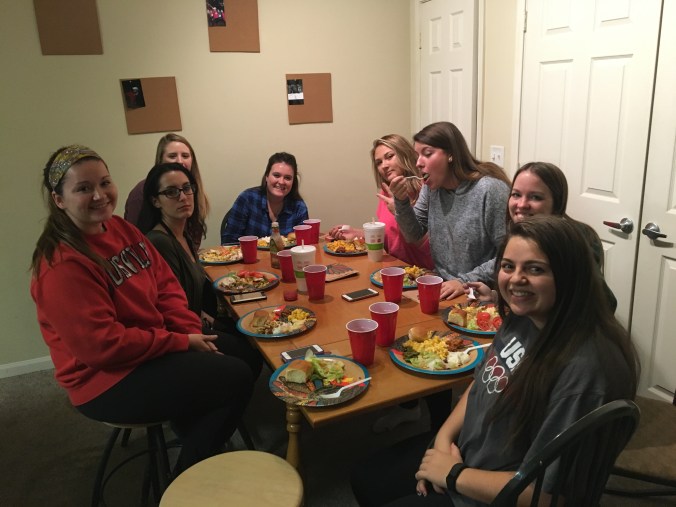
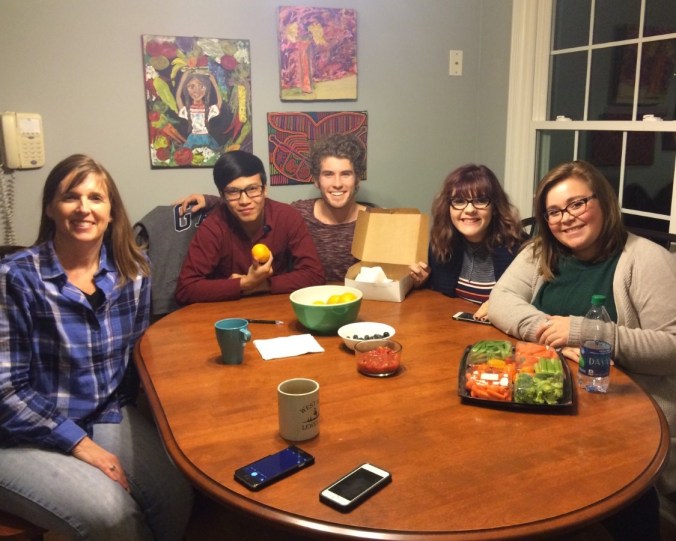
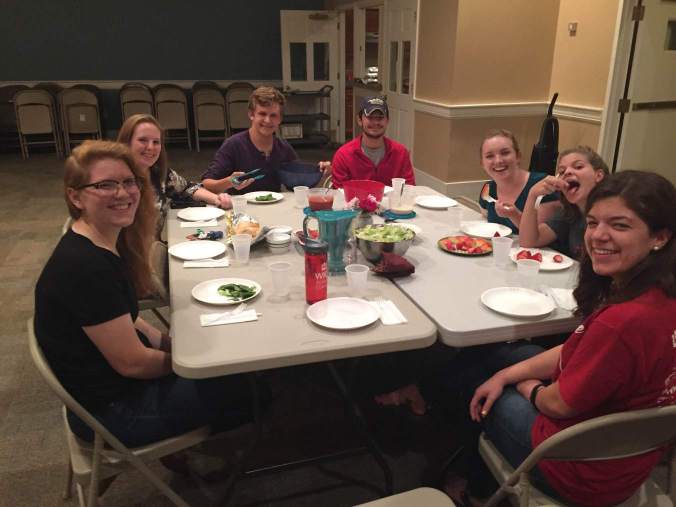
For starters, my KKT was original in that I teamed up with my friends Katy and Katelyn to attempt a non-cafeteria, non-fast food, wholesome dinner at Western Kentucky University. I’d have to say that the preparation for Kentucky Kitchen Table was one of my favorite parts. We experienced different forms of diversity through the entire project, even from the start when we planned our components around one of our guest’s vegan diet, which I had never done before (vegan food is actually not bad). Before starting the project, I was closely acquainted to both Katy and Katelyn, but through the grocery shopping and frantic cooking I became closer with both girls as I learned more about their different personalities and backgrounds (even Katy’s love of “You’re so Vain” by Carly Simon). First, we had some challenges because of our group decision to stay on campus. We needed a kitchen table! And a kitchen! Luckily, the organization Christian Student Fellowship, which Katy and I are involved in, was kind enough to let us borrow their table in their house where they hold non-denominational worship Tuesday and Sunday nights for students. For our kitchen, we utilized the kitchen in Minton Hall, where we all live here on campus. The kitchen had to be the most difficult obstacle, because it is smaller than most walk-in closets. However, we beat the heat coming from the stove and managed to produce a wonderful meal together. We decided on pasta with a choice of marinara or alfredo sauce. To complement our main dish, we included a salad and garlic bread. We ended the meal with delicious brownies that Katelyn made.

One of the premier parts of our dinner were the guests. We each invited a few friends, which totaled to eight people. I invited my friend Seth, Katy brought Theresa and Tucker, and Katelyn brought Anne and Jill. All of our attendants were students at WKU, with varying majors and reasons for coming to Bowling Green. Although the group lacked apparent diversity, we were all from various upbringings and had different, unique personality traits. One of the most unique, however, was our guest Yujen. Better known on campus as “Loud Asian”, Yujen joined our table halfway through dinner when he heard us from upstairs at the Christian Student Fellowship house. Although his presence was brief, because he enjoyed our dorm-made pasta so much that he polished his plate in less than fifteen minutes, we enjoyed hearing about his passion for martial arts and the state of California. Yujen added additional diversity to our group, as well as a conversation burst upon his exit. After he departed, our group began to discuss our different views of Yujen’s frequent presence on campus, as well as some of his antics which he is locally famous for.

Yujen was not the only topic of discussion at our table. Initially, conversation was one of my main concerns for our group. However, from the start of our dinner my previous assumptions that things would be awkward were blown away with jokes and opinions frequenting the table. I particularly enjoyed this, because I like to be very social and liked learning about our guest’s unique characteristics. For example, I listened while Seth shared the reasons for getting a large chest tattoo, and Theresa’s passion for the clarinet, which she plays in the Big Red Marching Band. I also thought it was interesting hearing about everyone’s hometowns. Every guest at our table originated from Kentucky, with the exception of Katelyn and myself, who call Tennessee home. Tucker and Anne are both from Frankfort, and Seth and Theresa went to the same high school. Although these guests shared a few aspects of the places they reside, they had very different opinions when asked about some of the details like neighbors and favorite things about their hometown. As we got into other details of our lives, including both campus and back home, I began to gain an appreciation for the prevalent diversity appearing at our table. This began to clear things up for me as to why we did this project in Honors Citizen and Self. I realized that openly sharing our different opinions and interests which made us unique in a comfortable, welcoming environment simultaneously united us as we all were desperate to find out more about one another.

As we began to shift to less superficial topics, Katy, Katelyn, and I presented our required question “Beyond voting, paying taxes, and following laws, what does citizenship mean to you?”. Seth, being the light-hearted guy he is, responded with a firm “Murica” which we all responded to with laughs and giggles. However, after we calmed our enjoyment, Anne offered an excellent response which received approving nods in agreement from the rest of our table. She responded to our question by sharing that to her, being a citizen means being able to freely express opinions and views openly, thus utilizing the freedoms and rights we are granted as citizens and unifying us under these rights. Anne’s response resonated with me, and made the meaning and relevance of Kentucky’s Kitchen Table all the more apparent to me. I realized that despite our guest’s differences, not all in appearance, we were able to unite under the fact that we were free to share our various backgrounds and thoughts at a simple dinner.

After our plates were clean and our bellies full, Katy, Katelyn, and I said goodbye to Jill, Anne, Theresa, Seth, and Tucker. As we washed up the dishes and packed what few leftovers we had, we reflected on our dinner and agreed that this project was an excellent example of healthy deliberation and how our guest were willing to contribute to making a great dinner, just as we as citizens strive to contribute to making a better world.
kkt

Kentucky’s Kitchen Table Project

By Coreyimg_4079

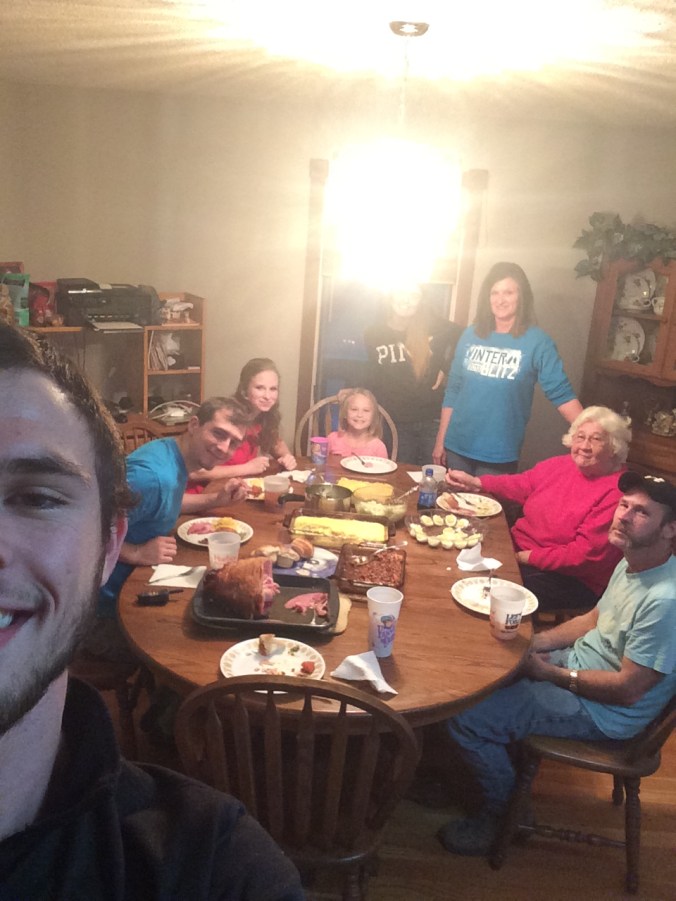
I will start off by saying that I greatly enjoyed this Kentucky Kitchen Table project. It allowed me to connect with some local people in my community and share some of our life experiences. I had dinner with eight people from various backgrounds. Luke is a man from Indiana who I was introduced to through a friend for this project. He is a mechanical engineering major. He is a funny guy, who has a very similar sense of humor to mine. We got along well from the beginning, and he was a great addition to the kitchen table. He wanted to be described as a kid from a small town who has never had anything given to him. Everything he has came from his own hard work. For the required question concerning what citizenship means, Luke said that citizenship means that you get out and participate in society. You work hard every single day, and try your best to make your dreams come true. You make money and spend money, and that’s how society works.

Kayla is a graduate from WKU, and has a degree in civil engineering. She is my sister, and she is an academically brilliant student graduating with an almost perfect GPA and Honors. She now has a full time job in civil engineering. Kayla wanted to be described as not your typical girl. She works in what some consider a man’s field, and has never been interested in most of the “girly” things. When I asked Kayla what citizenship meant to her, she had a similar answer to Luke saying that you must participate in society. She believes that citizenship means treating everyone with respect.

Mallory is my girlfriend, but she comes from a very different background than me, which provided even more diversity to the table. She also attends WKU and is majoring in Civil Engineering. She comes from the “cross town rival” independent school and was raised up in a more subdivided area. Citizenship means accepting everyone as they are to Mallory. She says that even if you do not agree with the way someone thinks or feels you should still accept them as they are.

Kiersten is my little sister and she was without a doubt the most interesting character at the kitchen table. She is one of the sassiest little girls I have ever known, and extremely smart. Whenever I asked Kiersten how she wanted to be described, she said she wanted to be described as a princess which is not in the least bit surprising.

Elaine comes from a background of only having enough to make ends meet. All through her life she has not had a surplus of money so she is very economically wise and very responsible. When I asked her about what citizenship means to her she had a very simple answer. She said that being a citizen means to contribute to society and make sure that you treat everyone with an equal amount of respect because everyone is made equal in God’s eyes.

Marietta is an elderly woman who has not had it easy from what I can gather. Recently her husband of many years passed away due to an ongoing illness. She said that one of her sons was in prison, and that another had a long fight with drug addiction that he recently conquered. The easiest word that I can find to describe this woman is tough, because she has had a lot of tough times in her life and she has always come through it. Marietta said that citizenship means loving this country and fighting for what you believe in.

The final guest I had at my kitchen table was a man named Kevin who was told a few years ago that he would never walk again. He was involved in a horrible four-wheeler accident that broke several of his vertebrae along with other injuries. He was rushed to UK hospital where he underwent immediate surgery, and at the conclusion of the surgery he was told he would never walk again. Yet, here he was walking into my house to have dinner. Kevin wanted to be described as a fighter because he said it seemed like he was always the under dog. When I asked Kevin what he thought citizenship meant, he said that citizenship meant trying your best to help others out around you.

Throughout the dinner we had a lot of small talk conversations about how everyone was doing and we all shared a little background about ourselves to begin with. Then, since I had been hunting the morning of the kitchen table project, I was asked if I had gotten a deer yet, and we spent a few minutes exchanging our best deer hunting stories with one another. One of the most well responded to questions I asked was: “Did you ever have meals around the table with your family or neighbors growing up?” This question seemed to almost be universally answered as a yes except for Luke. Luke said that his dad worked a lot as he was growing up, and that he didn’t really get to spend time just sitting down and eating dinner with his family. Both Kevin and Elaine responded yes to this question. They thought that it was a normal thing for a family to sit down at the dinner table and have a home-cooked dinner together almost every single night. It was something that they had done ever since they could remember, and couldn’t imagine what life would’ve been without that. Elaine said she felt that this dinner together made the family stronger, and made them get along better.

I honestly learned a lot at this short dinner filled full of conversation and good food. It can really open your eyes to the changing generations, and the differing views between every person no matter how similar they are. This reminds me very strongly of the idea of deliberation and the book Citizen by Claudia Rankine. As I sat at the kitchen table, I was very aware of the differing view points surrounding the table, yet we could all talk about our beliefs and views without offending anyone. That is the goal of deliberation and democracy is to understand everyone’s views and come together to form a better society. Finally, it reminded me of the book Citizen by Claudia Rankine because of the fact that everyone at the table mentioned at some point or another that no matter the skin color or views or ideas we all need to accept one another regardless of the circumstances, and that is very important.

Overall, I truly enjoyed this Kentucky Kitchen Table Project, and would suggest it to anyone. It opens your eyes to the way generations are changing, and how everyone has differing view points no matter if you’re from the same state, city, or household. It was a great experience and I’m glad I was able to participate.

Payton’s Kentucky Kitchen Table

Friendsgiving was the first thought I had when I learned about this assignment. All throughout high school my friends and I would have dinner together during Thanksgiving Break and sit around talking. We looked forward to it every year; sadly, we were not all going to be able to get back together this year due to some of us traveling. However, Friendsgiving was not lost. I was invited to have a Friendsgiving by one of the older members in my sorority, Kelcie, to come to her apartment and I was super excited!

My favorite part about getting together to eat at an actual table is the home-cooked meal that comes with it. There were nine people who were invited (including me) and we all were to bring food. I knew what I was going to bring immediately— mac and cheese! It is one of my absolute favorite foods. Also on the menu were rolls, mashed potatoes, green beans, chicken, dressing, and many different casseroles. And don’t think I forgot about the dessert! We had enough pies to feed a small army!

When I arrived at the apartment I was immediately greeted by Kelcie when I walked in the door. She introduced me to the other girls who lived in the apartment with her: Abby, Kristen, and Morgan. One of Kelcie’s friends, Sydney, also came by for dinner. After her came the three girls from my sorority: Abbi, Anna, and Loretta. I knew this was going to make for an interesting table conversation because we all have different personalities.

I’ll start by giving a little background information on everyone. Sydney, Loretta, Kelcie, Anna, and myself are all from Louisville. Abbi grew up in Lexington, Morgan is from Paducah, and both Abby and Kristen are from Frankfort. Sydney is not a very talkative person, but if you ask her why she prefers not to talk so much she’ll respond by saying that she just likes to listen to what other people have to say. Loretta wants to be described as a humorous, sarcastic human being (as you can tell by her face in the picture). Kelcie is a very loud and, as she likes to say, energetic person. Morgan and Anna remind me of each other in the sense that they both are motherly figures. Abbi preferred that I referred to her as a “fun-loving” kind of girl. Kristen wanted to be described as having a bright personality and Abby is also a bit shy, but she warmed up towards the middle of the dinner. Even though we were all girls, we came from different parts of Kentucky, from different social classes, and from different home lives.

So as we all sat around the table with our plates stacked with the food, I said that we needed to take a group picture. While the majority of us knew we were going to smile normally, of course I was asked if we “had to” smile. I responded that they could make any face that they wanted. So I was left with Loretta “mean-mugging”, Morgan throwing up a peace sign, and Kelcie in the middle of eating a forkful of food. Abbi wasn’t pictured because she was actually taking the picture.

I decided to break the ice with the table since I still didn’t know all of the girls. We started with the question, “Did you ever have meals around the table with your family or neighbors growing up? Did you like that? Why or why not?” We were from all different places in Kentucky so I thought that it would provide for a lot of different answers and reasons.

I thought that Sydney’s answer really coincided with her personality. She had meals around the table growing up and she liked it because it was a way to see how the rest of her family members’ days were going. She is the kind of person who likes to hear what other people have to say and this goes along with wanting to hear how her family’s day went. I related this to the part of the class about deliberative arguments. If she were to participate in one, she would be able to listen to everyone’s point of view before she would speak and give hers. She is a good example of how we can live better together because she is more likely to listen to someone than to argue with them and make the situation worse.

Abby’s answer was not similar to Sydney’s. Abby came from a low-income household. Both of her parents worked long hours and it was a fend-for-yourself situation in her house when it came to dinner. She said that it would have been nice to have sit down dinners every night or at least three or four times a night. The only time that her family would have a sit down dinner was on holidays or once a month. I was wondering if this had something to do with her shy personality in which she didn’t talk very much.

When it came to the question “what does citizenship mean to you?” I received a range of answers. Anna, one of the motherly figures in the group, said that she views citizenship as helping others around you and making sure that your fellow citizens are doing just as well as your family members. Come to find out, Anna volunteered at a soup kitchen in the rough part of Louisville. She would make dinner for the children living there that otherwise would not get a dinner and then afterwards would help them finish their homework. To her, volunteering to help these children was her way of making sure that they were treated (as close as they could be) like her family. Kelcie’s answer took more of a patriotic perspective; she thinks that citizenship is maintaining the virtues that our country values, and not asking what our country can do for us, but what we can do for our county. When it came down to Loretta, she added a little humor to the table and responded with, and I quote, “Citizenship means doing exactly what Queen Loretta wants, no matter what.” And with that, the table erupted in laughter.

Obviously, Loretta’s answer is the opposite of what citizenship is. However, I thought it was cool how no one at the table (except for Abbi and myself) had taken this Citizen and Self class, and they had an idea of what citizenship was besides the basic voting, paying taxes, and following laws answer. Each one of these women had a different meaning to them; even though we all had different opinions, we accepted what each other thought. I think that was the best part about this assignment because it tied together what this class is all about. I didn’t even know everyone as we sat around this kitchen table. I didn’t have to feel obligated to accept what everyone said just because we were friends— because we weren’t all friends. But the fact that we all accepted each other’s opinions, beliefs, and stories is how democracy should be.

This assignment has led me to actually want to eat around a kitchen table more often. At first, I wasn’t sure how a kitchen table dinner could be any different from just eating at a table in DSU. However, know I can understand and appreciate the intimacy and a certain level of quietness that the kitchen table brings. I look forward to appreciating many more kitchen table dinners in my future.

IMG_1101.JPGFrom left to right: Sydney, Loretta, Kristen, Abby, Morgan, Kelcie, Anna, Payton (me)

Not pictured: Abbi

A Kentucky Kitchen Table in Mount Hermon

By Mikayla

My Kentucky Kitchen table was hosted at my parent’s house in Mount Hermon, KY. Those attending were my father, my mother, my sister, John, and myself. My father, Craig, has lived in Mount Hermon his entire life. He is a third-generation farmer, a volunteer firefighter, and a carpenter. My mother, Christy, is originally from Indianapolis and moved here with her family while she was a child. She lived in Vernon, KY until she and my father married in 1992. She is the center coordinator at the Barren County Health Department. My sister, Maddie, is a senior in high school. She serves as secretary in her high school’s FFA chapter and plans to pursue a degree in agriculture at WKU. John is from a small area called Hestand, KY. He works in carpentry with my dad and this was his first time meeting the rest of our family. My mom, sister, and I decided to cook the entire meal consisting of roast, mashed potatoes, green beans, rolls, and gravy. John provided the sweet tea for the meal.

Although this group of people did not seem very diverse, we discovered diversity in our experiences, regions, political identities, and religious identities. My family is a stable, two-parent household while we learned that John comes from a family with divorced parents. His parents separated as he was beginning high school in 2007, his father passed away just last year, his older brother joined the air force and now lives in North Dakota, and he has some contact with his mother who lives in northern Kentucky. Another difference noted during our conversation was that we were used to homecooked meals gathered around the kitchen table every night while both of John’s parents seldom cooked. We were also diverse in the regions we originated from, with my mother most notably originating from Indiana, while the rest of us originate from different, small, rural neighborhoods in Kentucky. We also differed in our political identities. John identifies as a democrat while my family and myself identify as republican. This difference brought a unique conversation to the table as we discussed why everyone identified as they did. John believed more in the democratic platform than the republican platform, even though he was still on the fence regarding abortion because of his religious beliefs while my family and I were extremely conservative. This prompted us to talk about the results of the recent election and how we felt about the president-elect. John was quick to say that he did not vote for Trump, but was willing to give him the benefit of the doubt as his post-election speeches and mannerisms were more acceptable as opposed to his pre-election actions. He also clarified that he was by no means a Hillary Clinton fan either, but decided to vote for her as he believed that she was more qualified than Trump because of her experience. My family and I admitted to being Trump supporters and were glad when we received the news that he had won. All of us talked about the shock that we all had when Trump won the election, as none of us believed that he would win. Additionally, we were different in relation to our religious beliefs. Although we all were in the broad spectrum that is Christianity, John identifies with the Baptist denomination while my family and I identify as Church of Christ. This prompted a discussion that identified some differences between the two: primarily, the “once saved, always saved” concept and the idea of being saved before baptism. Other than these two differences, we noted that they were very similar in their other teachings.

After these initial, introductory conversations ended, I began to prompt with discussion-based questions. First, the question, “What does citizenship mean to you?” was asked. After initial silence, John began the conversation and stated that he believed an important component of citizenship was being understanding and respectful of others. He continuously mentioned that, although we may come from entirely different backgrounds and have different morals/beliefs, we must be respectful of everyone’s right to think and act differently and be both understanding and welcoming of those differences. We all agreed and my dad continued by stating that he also believes providing helping hands to those around you was an important function of citizenship. He related this to firefighting: he volunteers his time to help others in the community and explains that there are multiple ways to do this, such as helping your neighbors landscape or something as simple as a phone call to see how someone is doing. The next prompted question was “What is the thing you love most about living where you do?”. My sister jumped in by sharing that she loved how close-knit our little community was. If someone was sick, then we all knew about it and contributed in whatever way we could. If someone was faced with a disaster, then everyone contributed. Living in such a small, close-knit community made it seem more like a large family. My mom also mentioned that she never had to worry about the neighbors or having too much traffic around the house, especially while we were growing up. If she and dad were both at work, then she could easily find a babysitter with a neighbor. She also mentioned that she never worried about us wandering around alone because she knew every neighbor and the traffic around the area was minimal.

The conversation throughout the entire dinner flowed very smoothly between these multiple topics as we were all very open to the discussion, even during touchy subjects like politics and religion, and required very minimal “conversation starter” questions. Thus, I learned that diversity exists even when you least expect it to and I learned key components of citizenship and democracy. We discussed various topics evenly and openly, regardless of our differing backgrounds and identities, much like how a true democracy should function. Our conversations more accurately represented a proper deliberation, in the sense that we each spoke of our differences, compared them, and then brought our ideas and beliefs together once everyone had spoken. All in all, it was a very beneficial dinner that resulted in new ideas of citizenship as it relates to democracy and a better understanding of how experience is epistemologically significant.


Goat Cheese Caramel and Good Conversation

idk

On Tuesday, November 2, 2016, a group of people gathered around a kitchen table on Kenton St. in Bowling Green, KY. This does not seem too odd, but half the guests were college students that were used to meals in dining halls and food courts.

There was Tyler and Kaylin, both freshman in the honors college. There was also Alison, a professor for the TESL (Teaching English as a Second Language) who hosted the event. Another professor, Leila, also joined us. She teaches for the honors college and also teaches Citizen and Self.

I was walking towards Kenton St. when I ran into Tyler and Kaylin on my way. We listened as google maps told us where to make turns, and eventually ended up at our address. The house had two different doors, and after a bit of debate we walked to the side of the house and knew we had found our place once we saw Alison and Leila through the window.

After brief introductions from both professors and Alison’s dog Hazel, we were put to work to prepare for dinner. Kaylin chopped cabbage, and Tyler and myself set the four-person table for five. Light conversation was made as the meal was finished up.

Finally, the tacos were served. As a college student where most meals consist of some sort of fried food with no vegetables, seeing a table with cabbage and avocados had me already happy to be there. We served ourselves and sat down to enjoy the meal.

Conversation continued to be very light, and I discovered that Alison actually was one of my sorority big’s professor. Alison had actually taught that class before our meal, but I later learned my big had actually skipped that night.

We talked about how Alison actually found her passion as a teacher on a whim. She had an opportunity to go to Japan, and instead of following her traditional plan, she chose to take the opportunity and go. She found a love for Asian cultures, but more importantly a love for wanting to teach English as a second language.

We continued having conversation, and then Kaylin remembered we had to at least ask one specific question. “Beyond voting, what does citizenship mean to you?” Leila, who actually taught the class made the comment that she should actually have a good answer for this question. Alison talked about empathy. She said that being a good citizen means recognizing that everyone is going through something. You need to take a step back and ask yourself why is this person acting the way they are. Are they having a bad day? It is about recognizing we are all people and we are all going through different things.

I cannot tell you exactly how we got on the topic of dress code, but we did. In my high school, it was announced over the intercom to check for any dress code violations, and as you walked down the halls teachers stared at you looking for something wrong. Tyler had a very similar experience. Teachers at her high school would sit at the doors and check outfits as they walked in. Alison and Leila were shocked by our experiences, and recognized how uncomfortable these situations made us. Leila also brought up how it must have been harder during a time where we are learning to accept our bodies and our personalities.

We talked a little more going through a slew of topics before having desserts. We had these crunchy waffles with Nutella and this caramel made with goat milk. I love goat cheese, so the caramel was very good. Alison offered to make some tea, and we started talking about traveling. Alison told me about all these places I should go see when I study abroad next semester. We also discussed places we need to visit in Bowling Green. It was interesting how many areas of Bowling Green I still haven’t explored.

When I looked at my phone, I realized it was 7:45 and we had been there for almost two hours. Originally, I had scheduled a committee meeting for 8:00, because I had assumed the meal would only last for about an hour. Alison had just finished steeping some green and brown rice tea, so I texted my committee that I would be running a few minutes behind. I was not ready to leave. I was really enjoying myself and the real conversation. I stayed long enough to finish my tea before I rushed to DSU, where I turned a 15-minute walk into 8 minutes.

As I was practically jogging back going through backyards trying to make it to my meeting, I realized how nice it is sometimes to just sit down and talk about real things. By real things, I don’t mean talking about base things about how class is stressful or which professor handed out another assignment. We got to share our experiences. I think part of human nature is wanting to share experiences and connecting on those levels.

It kind of reminded of the shipyard project: a mix of types of people coming together and sharing their experiences. This is one of those things that may not create the biggest change in the world, but allows people to connect on a level that is much more internal. It allows us to make connections with people that we may not think we have a lot in common with. Sharing your experience is both therapeutic and important to being a human.

In the class we ask ourselves how do we live better together. I think it starts with understanding the human experience. To understand that, you have to share and listen to the experiences of others. It is from there we can draw our conclusions on what we change and make better in our lives and the lives of others. If you don’t understand it, there is no way you can fix it.

I personally loved this assignment. It was nice to step outside of my normal routine and eat at a kitchen table.

A Hectic Kitchen Table | 11/05/16

By Hannah

In anticipation for this project I reached out to two friends about a week and a half prior to the date I had in mind in hopes that one would host and both would participate. Bailey agreed to host and bring her cousins fiancé, Whitnie, who I didn’t know and Kalie agreed to bring two friends I didn’t know. I was going to bring my boyfriend Gage to the dinner since neither Kalie nor Bailey knew him that well. Monday before my Kentucky Kitchen Table was planned, Kalie called me to say she wasn’t able to attend anymore. I reached out to another friend, Jaley, to see if she was available for the 5th and she said she would check and get back to me. On Tuesday, she let me know she couldn’t attend. At this point I started to get a bit stressed. After debating over who to ask next, I decided to add some “diversity” to my group by asking a former high school teacher of mine, Mr. Grubbs, to attend. I texted him and explained what KKT was and he agreed to come and to bring his brother who I hadn’t met, IF he didn’t get tickets to the UK football game on Saturday. I agreed to his conditions and carried on with the planning. I decided on Thursday that in the of case Mr. Grubbs was able to get tickets, I would ask another friend of mine, Zach, to participate. He luckily had an open spot in his schedule and would be able to come. On Friday, Bailey and I had worked out the menu. I would make a lasagna and bring a cheesecake, she would have a salad and rolls made, and Gage would make a peanut butter pie. Mr. Grubbs had contacted me to let me know he wasn’t able to secure football tickets and so he would be able to attend. Going to bed that night I felt really good about how smoothly tomorrow was going to go.

Boy, was I wrong.

I woke up to a text from Zach explaining that his parents were making him volunteer at something at his church that weekend and how he had done his very best to get out of it, but they were making him go. I understood and told him it wasn’t a biggie. (Later that evening I saw pictures of him canoeing with friends, but that’s none of my business.) Now I wasn’t worried about replacing him because we already had enough people as it was. Fast forward to about 5 that evening. Gage and I had arrived at Bailey’s about an hour prior. The lasagna was in the oven and we were just sitting around chatting. I had Bailey text Mr. Grubbs to remind him of the time to be here. He still had an hour, given I had planned for it to start at 6, but I thought a friendly reminder wouldn’t do any harm. He replied about 10 minutes later explain how he was in Lexington waiting to pick up his wife from the airport. Lexington is about 90 minutes away from Somerset and her flight hadn’t even landed yet. My stress went from around a normal 3 to an extreme panic 10. Bailey told him not to worry about coming since he would probably be about 2 hours late. Gage, Bailey, and myself began desperately scrolling through our contact list to find someone who might possibly not have plans in 30 minutes. We called around 10 people before Bailey landed on her friend Andrea.

Andrea is a nice girl and I know her some just from going to school with her for a few years. Andrea was happy to attend the dinner, but there was one thing holding her back: She was on a date. Thankfully, she was able to convince her date, Josh, to take a detour to Bailey’s before they finished there evening at a friend’s bonfire. (Spoiler Alert: Andrea told her date the next day she had more fun at my dinner than any part of their date.) Once

Whitnie, Andrea, and Josh arrived we all sat down at the table for dinner. I felt a wave of relief wash over me as I looked around at all the faces I knew, kinda knew, and were strangers. I began the night by explaining what the purpose of the dinner was and what Citizen and Self was. Everyone eagerly participated in all conversations. I think my favorite discussion we had was about what eating with our families were like growing up versus now. Whitnie, for example, talked about how they would always have nightly dinners which she dreaded years ago, but now that they no longer had them she really yearned for that kind of connection again. While Josh, still had nightly family dinners and even occasionally would have neighbors over to eat with them. Although racially we were not a diverse group and the age difference ended up being around 5 years, there was a big diversity in the social class which was evident when we discussed the question about jobs and working. I won’t be specific but, some people talked how they never saw how having a job through school has a necessity, but more of a hobby. To juxtapose, a few people at the table explained how a job was expected of them and how it was not only their contribution to society, but to their family.

Overall, I really enjoyed having dinner with a group of people who didn’t necessarily match up or connect in every way. I learned a lot about everyone and had a fun time being with people in such an unconventional way. If it hadn’t been for Kentucky Kitchen Table, I can guarantee this group would have never shared a meal together. Honestly, I learned more than just about this small groups view on citizenship and the values they hold. I learned not to always trust people will be there even when you ask and they agree. Not only that, but over planning is always a good idea. Despite the craziness that occurred leading up to the meal, I would definitely do this again, but hopefully with more reliable friends.

Friendsgiving

By Mary


We had dinner around a kitchen table at kktmy friend’s apartment. The people that were there included, Andrew, Keaton, Kat, Gabby, Tori, Hayley, Ashlyn, Tatro, and myself. For my descriptions of these people, I thought that it would be best to not only use what they had to say about themselves, but also things I notice or appreciate about them. Andrew is a gentleman. He is compassionate and is genuinely interested in what you have to say whether he agrees with it or not. He is a goofy guy that loves being around good people, and wants to do something with his life. Even though I do not know him that well, I was able to pick up on those things about him very easily. Keaton’s description of herself is how I would describe her as well. She is extremely passionate and dedicated to doing the right thing, she always tries to stay positive and open minded, and she likes to look at the world from multiple different perspectives and learn from different situations. Kat is artistic in everything she does. She has a very bright, outgoing personality. She wants to use her art in art therapy or something else that is helpful. Gabby sells herself short. She gives without asking for anything in return. She instinctively takes care of those around her and has one of he kindest hearts that I know. Tori is a very loyal friend. She is unapologetically herself and brightens up a room when she’s in it. She is honest and will tell you what you need to hear. I do not know Ashlyn and Hayley that well. Ashlyn is carefree and enjoys being around people. She thinks for herself and is very independent. Hayley has a kind heart and cares about other people. She is a little soft spoken, but was insightful when she had something to say.

I think that we had a diverse group. We are all the same race, but we come from very different backgrounds and have different views on politics, life, and on the topics we discussed at dinner. Each person provided some type of dish. Since it is close to Thanksgiving, we had a “friendsgiving” and everyone made/brought something so we would have variety and enough for everyone to eat. We wanted to have a group of people that would give diverse answers and give us a different insight into issues. Everyone that was there respects the opinions of others even if they do not share the same view. I think that the discussion we had left everyone thinking of the points the other side had to make. I would say that I was able to understand a viewpoint that was different from mine.

Our discussion started with the obvious question of, “What does citizenship mean to you?” This question took them a moment to answer because it is not one that you get every day. Keaton had the response that I paid attention to the most. She said that citizenship means having freedom, but to a certain extent. It means being a part of a greater good and working to give back to your country in whatever way you can. Other people chimed in and added some more to what it meant to them. Some meant having a voice in society and being a productive member. Andrew said it simply meant doing your part in society and being good to others. This kind of lead to the question of, “What kind of person do you want to be?” One of the answers that multiple people said is that they want to be someone that people look up to and respect. They want to lead by example, and make a lasting impression on other people. Someone that everyone wants to be around and that radiates positivity. I felt that these answers and the conversation was going to the “Does your religious or spiritual identity relate to how you think we should treat other people? Does it relate to how you see yourself as a citizen?” I worded it differently because of the nature of the conversation, but it had the same meaning. A couple of us there are unreligious, so I agreed with their viewpoints. They felt that religion should not be the reason you are good to people or treat them well. That we are all human beings that deserve respect and kindness regardless of who you are. The religious people agreed with what was being said, but their faith compelled them to treat others well. Most were some form of Christianity and all used the bible as their main form of references. They said that the bible teaches you how to treat people and that being in the church environment made them feel like they were around positive influences that helped them figure it out. From here, I felt that the next question on the list, “Do you think we have any obligations to other people in our country? In our community?” was the logical transition. One answer was that we do have an obligation to respect and support people within the community even if they are different from us. With this question, the election was kind of brought up. It is still a sensitive topic, but one that I do not think I have really discussed with my friends yet. For a few of us, the election was still a wound that we were trying to make sense of, and for others they were happy with the results. The people that voted for Trump said that they wanted change. He was going to fix the economy and fix trade deals. Those of us that did not vote for him said that he was a vile person. He instilled hatred into millions of people and made discrimination okay. Someone that was against Trump said that as president, he was obligated to protect all Americans and not only middle and upper class white people. This conversation went on for a while, but we were all able to agree that regardless of what we believe, the repercussions of the election are tragic and it is sad that people have to be scared to live in their own country. It was interesting how they brought the conversation back to the questions that I was asking. I brought up, “How to we live better together?” because I felt it was appropriate for where we were at in the conversation. Gabby said that we should be there for each other regardless of what we think, and that now more than ever is when people should respect everyone.

Tatro and I were not able to get through all of the questions because the conversations we were having were quality. I think that this might have been the first time that the I have had such in depth conversations casually with friends. It was refreshing to be able to talk to friends about things that actually matter. I learned that regardless of your religion, who you vote for, or what your beliefs are, we tend to gravitate towards being kind and good to each other. I would say that we have learned to be aware and understof what someone else is thinking, feeling, or going through. It was interesting to see an understanding being made when someone gave an answer or made a statement about something that went against what they thought. Sometimes, I would even disagree with someone, but was able to think about it through their perspective. They are my friends and I was able to still associate that with them. What we all realized is that even though you are different from someone, we are all people too and deserve to be treated with respect. My central idea that this all related to, and one I have already mentioned, is “How do we live better together?”. I felt that this conversation and dinner centered on this because of the recent election and events that have followed. This experience was something very enjoyable and eye opening about my friends.

My Kentucky Kitchen Table

By Callie

When I first heard about the assignment, I was anxious at the thought of having dinner with people whom I did not know. As a relatively quiet person, I was nervous about the idea, but it turned out to be a great experience.

For this assignment, I was paired with Jamie. Her friend Shelby opened her apartment to us for the night.  The night’s menu consisted of spaghetti with marinara and alfredo sauces made by Jamie and Isaac, bruschetta made by Shelby, cookies from Karla, and French toast that I made. There was a total of six people in attendance, only two of which I knew beforehand. In attendance was Jamie, her friends Shelby, Thomas, and Isaac, me (Callie), and my friend Karla.

Everyone in attendance was a member of the Honors College here at WKU. However, Karla and I were the only freshmen, while the others were all seniors. Jamie is a psychology major from Lawrenceburg, KY. Shelby is also a psychology major from Lawrenceburg. Thomas is from Mayfield, KY and is a biology student. Isaac is studying meteorology and is from Aurora, IN. Karla is also a psychology student and is from both Shelbyville, KY and Los Angeles County, CA. I am a business student from Dunmor, KY. Another aspect that makes this group diverse is religion. Karla and Callie are Christian, Thomas was raised Catholic but no longer practices the religion, while Jamie and Isaac identify as being LGBT and practice no religion.

Throughout the discussion, Jamie and I would take turns asking questions to keep the conversation going. At times we would get off topic by sharing personal stories as we discovered different things that we had in common with each other. These connections allowed us to relate to each other and connect our similar experiences. These topics included H4 and living in Minton Hall. We discussed that H4 allowed us to meet many new people, many of which we would not have taken the time to meet otherwise. While each person’s experiences took place in different years, overall we shared similar opinions and circumstances. We covered topics including citizenship, social issues, diversity, religion, the kind of person we want to be, and many more.

We began the discussion with the question: What do you think are the best things about our world today? The answers were light-hearted and included food, puppies, warm weather, and friendship. The following question required more serious answers: Beyond voting, paying taxes, and following laws, what does citizenship mean to you? Many of the answers conveyed a similar message of truly caring for others and taking a stand for your beliefs. Isaac suggested that citizen should involve being politically engaged outside of voting and interacting with your local government. Others suggested being engaged with others and championing for a cause. These responses can be related to the class question of: How do we live well together? As we got off topic talking about out different experiences through the years, we came to the consensus that communication is key to living well with others. For example, Thomas and Isaac were roommates for several years and coming into college they had never met each other before. They agreed that talking things out allowed them to overcome their differences and become friends.

One of my favorite questions asked was: Have you ever had a conversation with someone from a really different background than yourself? I found it interesting to hear everyone’s personal account of their interactions with diverse people. We discovered that because of these interactions our worldviews have been expanded. Many of us grew up in small towns with little diversity, and as a result, our experiences with diversity have had a lasting impression on us and our worldviews. Isaac discussed how the ability to travel has shaped who is he as a person. Shelby told about her experiences staying in Europe with an Italian family where only one person spoke English. She found it interesting that they would listen to American music even though they were unable to understand it. Thomas spoke about his internship at the National Institute of Health, during which he lived in a house with an older woman from India and worked alongside people from all over the world. He found it exciting and educational to learn about other diversities in this way. Jamie explained that in elementary school she had friends who were Chinese and Japanese. She told that her best friend was a Bosnian refugee whose parents did not speak English. I told of my experiences at GSP where I met people from varying backgrounds, cultures, and religions. I found this time especially exciting, as it was my first real experience with diversity. Karla is from Hispanic dissent and grew up bilingual. She discussed that she was among the small diversity in her dominantly white neighborhood.

Overall, I found this experience worthwhile and enriching. Going into the assignment I was afraid that we would not be able to keep the conversation going considering I had never met the majority of the people in attendance. However, this was not the case at all. Through discussion we discovered many things that we had common with each other, which made the night flow more smoothly. The environment was very welcoming and it seemed there was no subject that was off-limits. I enjoyed hearing each person’s experiences and concerns. I was reminded of the fact that you cannot judge a book by its cover. While the majority of us came from small towns, we all were very different. Each of us held our own set of experiences, opinions, interests, and beliefs. Part of citizenship is living and interacting with others. In order for us to do so successfully, we must understand where each person is coming from and why they hold the positions that they do. Through this deliberation, I was able to get a glimpse of what the world could be like if we took the time to talk to those around us on a daily basis.

KY Kitchen Table

By Rachel

I hosted my Kentucky Kitchen Table in my hometown of Bowling Green. I was lucky enough to manage to pull together a ragtag dinner group consisting of some distant cousins that I don’t remember being related to, an uncle, my dad, and the lawyer in charge of my grandads estate. Most of these poor souls just wanted to come to my grandparents house for a meeting and to sign some documents but had the misfortune of mentioning dinner and me deciding that my project was way more important than their ability to evacuate. We pulled together an oddly good meal consisting of ribs and chicken that where both of the farm fresh variety (slaughtered and put in a deep freeze till the grandkids forget it had a name) along with homemade cornbread, baked beans, and lemonade as a group (minus Pete who would rather watch football and left the kitchen). We decided to eat at the dining table in the sunroom surrounded by our prickly cacti friends and settled in for a good long meal.

The captives of the evening were my uncle Pete, my dad Paul, distant cousins Taylor, Terrah, and Graham (no that’s not a typo, my last name is Graham and his first name is Graham) and lawyer extraordinaire Tracy. While the group may not look that diverse on the outside we represent a wide demographic of ages, backgrounds, and belief systems. Pete who has lived a rough life and at 40 looks closer to 65 never went to college and now has seizures so he can no longer work on power lines like he used to so he’s been forced into retirement. My dad went to Western and then vet school and is now a veterinarian/farmer/archery coach. Taylor went to Louisville for college and now has a full time job there where she coordinates fundraisers. Graham was a professional archer from 18-23 but lost most his most of his vision in his dominant eye in a gun explosion and is now a welder. Terrah is a nurse and extremely religious (to the point she sent me a bible in the mail less than a week after this dinner/first meeting). Last but not least Tracy who has a law degree but decides to use it to do everything a lawyer does minus going into an actual courtroom and has 2 jack russell terriers that get stuck in groundhog holes.

As I started off the discussion I attempted to make it clear that this project is about insightful discussion and not starting brawls at the dinner table and thankfully everyone seemed to grasp the concept except for Pete who immediately started laughing about “those butthurt liberals” and immediately killed most of my hope for this to end with no hurt feeling and open minds. Once Pete got it together we started in on what citizenship means to each of us and we unsurprisingly ended up split up in our beliefs by age group with Taylor and I speaking more about being a part of a society who accepts you, Terrah and Graham talking more on their freedoms and their rights and how you are a citizen when your country let’s you be your own person while still protecting protects you and providing guidance almost like a parent would do, and Pete, Paul, and Tracy made their beliefs known that citizenship to them means feeling safe, loving your country and being willing to do anything in its name because it is your home. Luckily we all agreed on something, some people in the group brought up that no matter the background of a person, if they truly feel like an American and are only here with good intentions that they should be treated like citizens and not outcasts at least by the public. I was truly surprised that Pete agreed and I feel that he probably likes the idea of a utopian society but wouldn’t truly practice this due to the fact that I’ve heard one too many jokes about muslims come out of his mouth over the years but I guess he gets the benefit of the doubt for now.

After this I directed the conversation towards what kind of person everyone wants to be and what they do to try to become this ideal. All of the men ended up described their ideal way of being as being caring, friendly, useful people, and being able to protect their loved ones which reminded me of the paper we read on younger people not being able to really discuss morals because they were never taught any. This situation was kind of reversed from the article where I felt like the men weren’t taught how to truly express themselves but had words put in their mouths to spew out whenever they are told to. The guys had this preconceived notion of what a real man is from hearing it their whole lives and it was honestly disappointing to get such a generic answer. I do however feel that if any one of my younger male friends had been there he would have felt much more comfortable opening up. The ladies of the group however were not afraid to speak their minds and get into specifics. They brought to the table a collective desire to be able to give more of their time to their families and spend less time caught up in themselves. Terrah brought up her desire to be able to be there for everyone and that if anyone of her friends from church or otherwise ever needed anything at all that she could be there in a split second to do anything for them because not enough people take the time to care about others.

This lead into a discussion of religion and Terrah’s various mission trips. Out of all of us I was the only person who wasn’t a practicing christian which lead to a few overzealous minutes of preaching by Terrah but eventually managed to get turned back around to the relative zone of living better together. Everyone agreed that religion is a moral code and that not practicing one doesn’t make someone a bad person, it just means that they have to make their own limits and define good and bad for themselves. Graham brought up that community service is one of the best things a church does as it allows people to actually get together and make a difference and due to the sense of community and obligation to their group people tend to make more of an effort to help. Terrah brought up that the last 2 mission trips her church planned kept getting put off due to the snare of preparation and ended up happening 5 months after the originally scheduled dates. She shared that she;s not going on another trip as she believes they accomplished nothing because they brought shoes, toys, and toothpaste to an area that had way more pressing issues such as disease and how to get water than worrying about brushing their teeth. Taylor also brought up that on a mission trip that she went on where the kids got toothpaste that was mint flavored that the kids would end up eating the toothpaste like it’s candy and get ill because they had never seen it before. The article to hell with good intentions really hit home here and made me realize that the human race is basically just wandering around with its hands over its eyes convinced it is a gift from god bestowing greatness wherever it may go refusing to look at the reality that it’s poisoning everything it touches. After this the discussion took a quick turn to the official reason for everyone’s visit to Bowling Green and the discussion was promptly left at the table.

This project was surprisingly more comfortable than I had originally expected especially considering that half my group where stranger to me. After doing this project I have to believe that most people are inherently good and have good intentions but don’t necessarily know how to properly execute them. Since I know Pete as usually being very brash and his relatively cooperative and accepting attitude I must imagine that being taken out of your comfort zone and the preconceived notions of those closest to you gives you time to reflect and process what your beliefs as an individual are without the hive mind. This has also helped me realize how different we can be on the surface but the our souls share a like mind of love and acceptance.

ky-kitchen-table

Where Love Resides

By Brent

My Kentucky Kitchen Table project provided me a way to feel more connected to Bowling Green and get closer to a few of my peers, as well as fellow citizens. For our project, Hillary, Rachel, and I went over to Jennifer’s house for dinner. I also brought a friend, named Tan, who is from Vietnam and is studying at WKU. Our conversation lasted for about three hours and felt unexpectedly natural. No conversation topic felt like it was off limits. 
My partners for this project were phenomenal. When you first meet Hillary, you know that above all, she cares. She cares about how you are and what you believe in. She is naturally inquisitive and passionate. Her love for art and beauty is apparent in the way she lives and it rubs off on the people that she meets. Rachel, an English literature major, has a way with words and her humor is not only witty, but it is insightful as well. She tells a story of love and she preaches equality by her actions. Jennifer is a compassionate soul who lives intentionally and spends her time doing what she loves, which is pouring into the lives of immigrants and Refugees in the greater Bowling Green area. She is a mother, a wife, and a devoted member of society. She asks deep questions and listens with intention. She loves others with few bounds and is an inspiration to many. Tan is an inquisitive and passionate man. His self-prescribed nickname, “Crazy,” fits him well only because he is willing to take big risks and is able to overcome his fears very quickly. Tan has enjoyed the United States very much and hopes to get a business degree in order to start his own business when he returns to Vietnam.  
Our conversation went down many different paths. We began by answering what we thought it meant to be a citizen. Generally, we all agreed that being a good citizen means being involved with as many different types of people and groups as possible. As citizens, it is our job not to run away when things get hard. We are supposed to join together and use our voice to support our beliefs and lift other people up. I really liked Jennifer’s perspective on her life as a citizen because she focused on ways that she sees herself training her two boys on how to be good people and citizens. She also mentioned that being around like-minded people can be a good place to brainstorm, but, in the end, it is better to put yourself out into the world in order to gain a bigger perspective on what it means to live well with others.  
We also talked about the role that loving people plays in being a bigger part of society. We mentioned many simple acts, like being kind to a cashier or being patient at the DMV that go a long way. We all tell a story with the way we live our lives and it is important that that story builds other people up and recognizes everyone’s humanity. We decided that it is important to be humble and recognize that we will never know anyone’s full story. For example, we don’t know what it is like to be born into a country that has been in civil war for over eighty years. We don’t understand the hate that many immigrants and refugees face. So, rather than letting those differences scare us, it is important to face them fiercely and fight for equity.  
I learned a lot from our conversation, but I would say that my biggest takeaway was that it is important for me to meet people who are starkly different from me and be in community with them. I have so much to learn from other people, and I will never be done learning. We talked a lot about how having a face to put to an issue can be powerful for a lot of people. For example, if you have a friend that is a refugee or immigrant, you will naturally want to support laws and legislation that will protect their rights. I also think that I have a responsibility to make sure that more people reach out into the community to make those sorts of personal connection with people who are different from them.  
I also learned from Tan as I watched him interact with the difficult and theoretical conversations we were having. While he didn’t understand all of what we were saying, or why we were saying it, he knew it meant a lot to us and he respected that very much. I was humbled by his willingness to want to learn about other cultures and hear about how people see things like the recent election or holidays. I learned from him that listening is a gift and taking a risk in order connect with people is always worth it, at least for the experience.  
I think that our dinner and this project relate to our class in a few ways. Primarily, I saw that most of our conversation had to do with the idea of a crossing a bridge. We talked about how things are and where we want them to be, but most importantly, ways we thought we could get there. For example, we talked about how communities often respond to tragedy by throwing money and resources at a given problem. This raises issues because it leaves people disconnected and removed from the deeper causes that might be contributing the problems. We decided we wanted communities to be more involved so that when something happens, people know the needs of the victims they are helping and have an idea what their life is like prior to whatever incident might take place. Additionally, we mentioned that people have to become more connected with others who are different from them, spend time in the community, and break down stereotypes. This seems like a lot to ask, but it has to happen for us to be able to move forward as a society. I think that another way our conversation connected to the course was that we talked about how the power of patience is necessary to solve all of the issues we wanted to tackle. It was evident that Jennifer is an extremely patient person and her loves shine through in that way. She will wait on the phone for translators and lawyers to make sure that her friends, many of whom are refugees, aren’t getting taken advantage of and are getting the care and support they deserve. Even during out meal, she was checking up on a friend who was in the hospital for having an appendix removed. I think that, through her, I see how being patient is an act of love, and love makes us the best citizens that we can be. Overall, the experience allowed me to understand the importance of talking about change with people in the community because it made me feel like I had more people on my team and are willing to fight alongside me for what we believe is right.
thumbnail_img_2104