Kentucky Kitchen Table: An American Staple

By Nathan

The Setting

It was a beautiful Sunday afternoon in Stanton, Kentucky, a small town nestled at the foothills of the Appalachian Mountains.  My family had just arrived at our home after attending our small church, in which we are currently making decisions of whether or not we want to remain in the specific denomination that we himg_3385ave been in for the past century or so, due to the very liberal approach the denomination is now taking.

We come in to our kitchen and decide the final details of our meal.  We decide to open up the dining room, which is typically only used for holiday or birthday meals.  We have invited a family who has recently moved into our community, though they have been involved in our community for over a decade.  We prepared a cookout style meal, with both families providing fresh vegetables for the burgers.

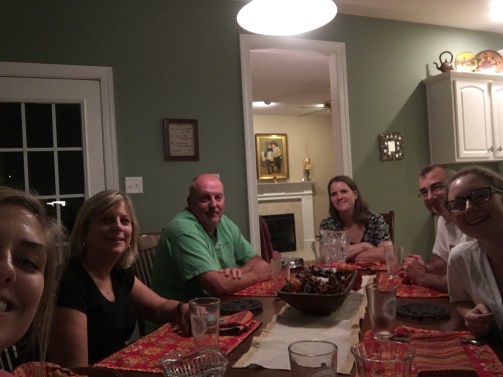
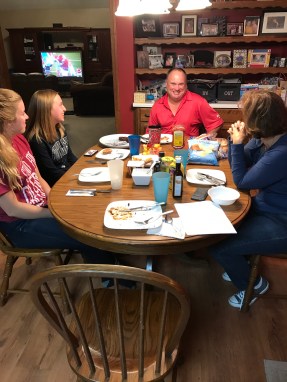
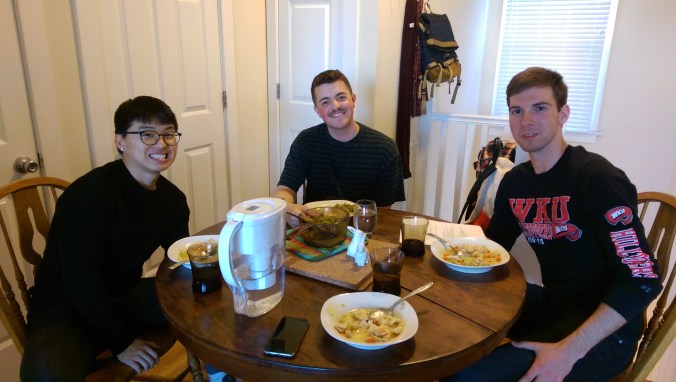
We casually sit around the table in no particular order.  One of my best friends, Zach, sits next to my older brother Matt.  They are both in college at different universities, one large and one small.  My father, Troy, sits next to Zach.  Troy is well-known in our community, being practically everyoIMG_3390.jpgne’s doctor, though he is only a physician’s assistant.  On the other side of the table, my mother, Deana, sits next to Martina, who is a guidance counselor at our town’s only high school.  Deana used to be a physical therapist, but is now working in the school system.  Rick sits next to his wife, Martina.  Rick was formerly working in a factory as a manager, but is now in the Alternative School, teaching kids who were removed from the high school and middle school.  He is also a coach for the high school football team.  The room was open, the lighting was natural, and the conversation came in the same way.
The Meal

My goodness, it was a good meal.

Citizenship

I began the conversation by asking what citizenship means to them, beyond voting and paying taxes.  This mostly garnered the same general response: being a citizen is giving back to the community, helping the community in a way that you see it necessary.  Rick said that people some of the people he works with don’t have any sense of duty or responsibility. They feel like the government is there to support them.  People sometimes live with the mindset of doing what you need to get by, and forgo being a productive member of society.  Troy mentioned that there are generally two basic types of people in a community, people who contribute and people who take, meaning that some people consciously put time and money into the community while others sit back and reap the rewards.  With that in mind, though, we all take away from what communities offer, whether it is intentional or not.  Kids going through school are taking away, usually without giving their fair share back.  Anyone who lives in the protection of the military is taking from society.  With these in mind, Matt adds that it is then your duty as a citizen to give back.

Careers

My next question dealt with their careers, and whether the desire to be a citizen impacted that career path.  Martina claimed that she always wanted to teach, to help people and to give to people.  She saw that becoming a counselor would maximize her potential to give to a community, but she never imagined how rewarding that profession would be for her.  She sees every type of student, from first-time college students to first-time high school graduates, and having a touch on people’s lives in that sense is the rewarding part. *8:30*

Rick then told a winding story of his career path.  Basically, he began in a factory in his hometown.  The factory was very family-oriented, making sure that priorities were kept straight, and that workers were being treated right.  For this reason, he loved the company.  Eventually, his company was bought by a bank, and as most banks are, the bank was very money-motivated.  The company he once loved lost sight of the values it was built upon, and the work was draining; the only thing that mattered was profit.  Eventually, Rick left and went back to school in search of making a difference.  He became a teacher, and now works with kids that have had disciplinary issue.  Here, he is able to have a direct influence on the kids that may need it the most.

Troy and Deana both added that any job could be turned into serving the public, if you make a conscious effort to do so.  Their thought was that if you focus your job on providing for people that need the work to provide for their families, then you could see a factory job (such as Rick’s) as serving the community through providing opportunity.  Reflecting on that outlook, though, a self-centered attitude in a role that should contribute heavily to the community could have a reverse effect and negatively impact the people it touches (think a teacher who doesn’t invest in students).  Thus, we somewhat concluded that any job can have social impact with a certain context, though there are some careers where you can have a much larger impact on the future generation.

Community

I asked the table if they would rather live in place that had a focus on family or community.  Most people responded that they would rather have communities building each other up as a whole than serving their own family first, which is very interesting.  There are several takes on how you could answer this question, an infinite number of variables as well as an infinite amount of outcomes.  One way to look at it is if you, as a parent, build up a community as your primary focus, your family will learn from your example.  At the same time, you do not want to neglect your family.  We did not go deep into this conversation at the table, but the influences were felt throughout the remainder of the meal.

Extracurricular

I recalled a story we read about in class about the Shipyard Project.  As the northeastern town was split between an artistic community and a blue-collar community, ours is split by drug abuse.  Statistically, Powell County is one of the worst counties in the state for drug abuse of all kinds in one of the worst states in the nation for drug abuse.  We have a problem, and you can see the effects on our community as a whole.  Rick, Martina and Deana are all working in the school system, Troy works closely with all the students (especially athletes) and Zach, Matt and I have all been through the school system in the past 3 years.  We all agreed that there is a split in the community, and the school.  I specifically asked Rick, since he is the head football coach’s right-hand man, if he thought football serves as a joining activity in a way similar to how the Shipyard Dance unified that community.  He said he saw potential for it, but doesn’t see that yet.  Kids are greatly affected by their parent’s participation.  Though transportation can be provided for students who wish to participate, it is difficult, and often there’s no motivation from the students.

For the students who do get involved, though, the results are spectacular.  Martina tells of an after-school Zumba program that she dabbled in last year, saying that several students really enjoyed the activity and looked forward to Zumba.  Most of these kids are kids that otherwise are not involved in any activities outside of academics.  I also brought up our high school’s soccer team, which has been started within the past 4 years and is already competing for regional championships.  Of the 40 kids on the team, soccer is the only extracurricular activity that 26 of them participate in.   On the subject of new start-ups, Martina brings up several new clubs in the school, like Card Club and FCCLA.  As a counselor, she sees that kids long to be a part of something, some kind of community that they can really dive into and find an identity in.

Closing

As a final question, I asked if the members at the table grew up having family dinners around the table.  Deana grew up always eating together, as she lived within yards of her extended family.  She also finally admitted that she, too, preferred Kraft Mac & Cheese over her grandma’s homemade macaroni.  Martina said her family made it a point to eat together at home every night, maybe getting a burger from a local joint and taking it home once a month.  Rick grew up on a farm with all of his aunts, uncles, cousins, grandparents and great-grandparents.  Every day, they would all work on the farm, congregate in a house for lunch and then meet in a different one for dinner.  Troy was much like Zach, Matt and myself, in that we were always busy, resulting in plenty of dinners with our brothers but not necessarily with parents during sports seasons, resulting in an amazing bond between the brothers.  The ones who grew up eating meals with their families recollect extraordinary memories from the systematic tradition.  Deana says that you never know how special it is to have dinner around a table with your family.  We decided after the meal was finished to have dinner together more often.

Reflections

I look back on my own memories, growing up at the high school football field with my brothers, having our own feasts around a table at China Wok.  We had always had our meals at home from the good doings of mother.  On Monday nights, Ma would feed us.  It never failed that we would surely either have a breakfast-dinner or a pot roast with potatoes and carrots.  Some of my fondest memories came centered around food.  I find it odd how much of a staple in American culture food has become, it seems like we have holidays just for food.  It does something amazing for us, as families and as groups.  People come together to provide an essential of life, providing for one another.  There is a certain kind of service, yet in some situations it can become a competition between cooks.  For some reason, when we gather around a table to eat more than we should, and we open up.  Being at the table, we listen to each other, we acknowledge one another in a way that is nearly impossible in our daily routines.  Maybe simply being around the table with people outside of just our families would help us understand our world better, thus helping our society get where we want to go.  We could understand how to bridge the gaps in our community, we just need to sit together and open up.
Real Food

By Caroline

img_8033

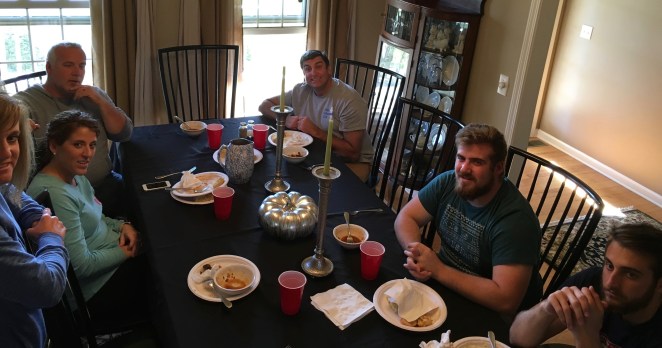
In November, I went to my friend Allie’s house in Bowling Green to talk to her family and some family friends about democracy and their role in today’s world. Our table consisted of Trent, Allie’s dad, who works in sales, is strongly opinionated, and is good at persuading others; Lee, Allie’s mom, who works at a church in Bowling Green and is very nurturing and accepting; Becky, a family friend, who works in the business world and is quiet and compassionate; Ed, Becky’s husband, who is a high school English teacher and is very passionate and involved; and myself & Allie, both freshmen in the Honors College at Western Kentucky University. I am studying public relations and she is studying middle grade education. I was the only one from outside of Bowling Green; I’m from Louisville.

We had green beans, mashed potatoes, grilled chicken, rolls, and salad, with angel cake, ice cream, and caramel sauce for dessert. This has by far been the best food I have had since I have been here. It was something I eat frequently at home, and I was so excited for this meal. Allie’s mom even packed us some to take back to our dorms and I am still so grateful.

We started the conversation by asking beyond voting, paying taxes, and following laws, what does citizenship mean to you? The answer started generically, suggesting that as citizens we must attempt to do the morally right and kind thing, but grew more specific with examples. Becky and Lee explained a project their church leads each year with Room In the Inn, a homeless shelter in Bowling Green. The members of the church offer their time and resources to the shelter in the winter months, learning a lot about themselves as well as the people around them. They explained that this project helps them earn to be more accepting of others and not being quick to judge.

Room In the Inn has allowed them to build relationships with the people at the shelter; one in particular, Ernest. Becky explained that through Room In the Inn, some of the people who volunteered were able to get Ernest a job at the White Squirrel Brewery in Bowling Green as a dishwasher. Although this didn’t seem like much, it has allowed Ernest to build those connections with the White Squirrel employer, as well as customers that come through. This also allowed him to save money to go to a home or apartment of his own, instead of staying at the Room In the Inn shelter.

Our next question was what do you think are the best things about our world today? The answer that was most prominent was technology, but was discussed in two different ways: science technology and more social media type technology. Trent was more so impressed with the advancements in medicine. He felt as though the way we understand our world in a more scientific way has grew tremendously. On a slightly different note, Lee felt as though the way social media has grown over the past years has made us a smaller community, making it easier to communicate and understand one another. She explained that even though we feel more connected to one another, we still have some work to do when it comes to better understanding and accepting others.

Our third question was what is the thing you love most about living where you do? Becky said she enjoyed the fact that Bowling Green was big enough to where there is always something to do; there’s always new things to explore and people to talk to. But, she also enjoyed that it was small enough to be involved in the community and know a good amount of people around her. Ed enjoyed that the economy would always be stable here to an extent. He explained that the Corvette plant always offers jobs because there will almost always be people who buy those cars.

Our next question was do you see your job as serving a greater purpose? Ed responded quickly with yes because he is a teacher and he influences younger minds everyday. Lee also agreed, since she works at a church, she feels good about being able to serve others. The table agreed that Ed had the upper hand in serving a greater purpose, as they felt as though the influence he had on future generations was much stronger.

The next question we asked was what advice would you give to people running for office in our country? We felt like this was a very appropriate and very relevant questions, as the presidential election was less than a week away. The answers started simple and not very political. Be nice. Be a respectful person. Lee explained that we have strayed away from basic kindness towards one another, especially in the past few debates. She explained that rather than picking out what the opponent is doing wrong or tearing down their character, they should building upon the policies they want to implement. Ed wished that people running for office today be a statesman, not a politician. He feels as though the people running need to do this for the people and for the better of the community or group he/she is representing, not solely for a career or focused on reelection, and wants power brought back to the states. Trent thought those running should be informed before being opinionated. This was something the whole table agreed upon for the general population, but especially for those running for office.

The final question we asked was what social issue is closest to your heart and why? Becky answered first with animal abuse. She explained there’s no reason to abuse animals, as they can’t defend themselves and aren’t doing tremendous amount of harm. Lee said homelessness, relating back to some of the things she experienced at Room In the Inn. She explained sometimes they aren’t making enough money to pay for housing even with a job. We explained to her that this is something we discussed in class and that this is a wicked problem.

This really helped me learn how a sample of people originally from Bowling Green viewed not only national problems, but ones within their own community. As someone coming from a larger city, it was hard for me to understand some of the opinions people from Bowling Green had, as the culture here is much different. This gave me a deeper understanding as well as more of an appreciating for the things Bowling Green has to offer.

I think ending the conversation on a connection to something we learned in class really helped Allie’s parents and friends better understand not only what we learned in class, but why we asked some of the things we did. By discussing them, I think it was easier for me to identify the parts of homelessness that makes it identify with a wicked problem.

I really enjoyed this activity overall, especially the food.

Hometown Barbeque

By August

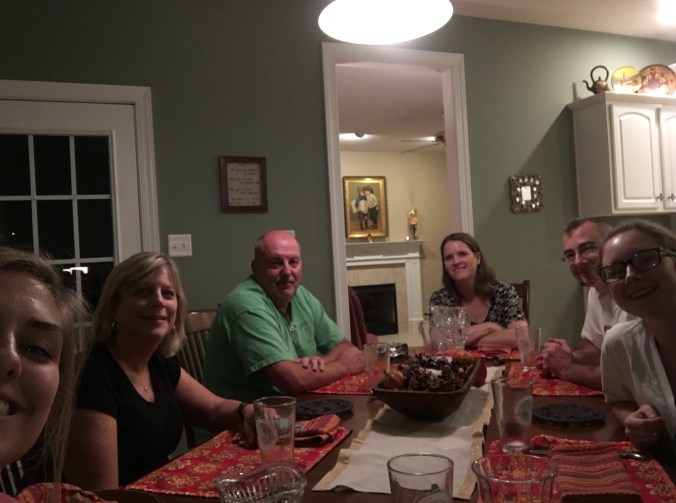
I originally intended for my Kentucky Kitchen Table to be located in my grandmother’s dining room at her home in Southern Indiana, but it was such a nice day that I cannot blame everyone for wanting to sit outside! So we sat out on my grandmother’s patio and had dinner and conversation. My first guests included my grandmother Sharon and grandfather Omar, both of whom grew up in poverty. My grandfather lived in a shack with no running water, and my grandmother and her 11 siblings moved constantly from tiny rental to tiny rental. They overcame the cycle of poverty together and now live a very comfortable life. My next guests were my parents. My father Steve is a veteran and my mother Shonda was his wife while he served. They are both middle class and live comfortably. After that were both of my siblings, both of whom brought a friend I had not met. My brother Steven brought his girlfriend Ava, both of whom are sophomores in high school, and my sister Alexia brought her friend Kalie and my sister is a senior and her friend is a junior in high school. My grandmother invited my Great Aunt Fran whom I see very little, as well as my cousin Jackie and her boyfriend Matt and his children Jade and Logan whom I had not met. My Great Aunt Fran has seen poverty and divorce and still struggles financially because she has a physical disability that hinders her from working. My cousin and her boyfriend work paycheck to paycheck. I had four more guests who are not pictured, which were my Aunt Teresa and Uncle Jerry and their two grandchildren, who have an Indian father. Their father Ben and mother Crystal, my cousins, wanted to come but they were in India on vacation! My guests differed greatly in their socioeconomic class, their age, political identity, and a little bit in ethnicity. Many were related to me, but I was sure to choose relatives I rarely see and who were diverse in opinion, as well as to mix in guests I had never met.

For our food we had a barbecue. Because several of my guests struggle financially, and because my grandmother lives to entertain, she provided all the food. The dinner just so happened to be two days before the presidential election, which really highlighted the diversity of opinion. We started out with everyone being able to say that they had at least some family dinners with their families as children. Everyone wanted to live in a community that was inclusive and economically prosperous, but they all differed in how to get there. One of the clearest things was the diversity of thought between age groups. For example, my grandmother and grandfather view citizenship very personally. My grandmother worries about her family, keeps her home beautiful, and speaks to her neighbors, but does not have a strong sense of civic duty. My sister Alexia on the other hand, views citizenship as an act. For example, she talked about her opinions on the presidential election and the canvassing she was doing for her candidate. She has less of a burden for her own family and more of a burden for voting for the right political candidates to fix societal issues. With the presidential election so close, we talked about a lot of social issues and I worked really hard to keep the conversation from getting too heated, as I had the far right, far left, and moderates represented. Using the bridge metaphor, we could not agree on where we were as citizens or a nation, where we wanted to be, or how to get there because of social issues like abortion and transgender bathrooms that polarized us.  We could agree on small things, like playing our part to alleviate poverty and ensure that we have clean air in the future. With all the polarization at my table, I felt like it related to our reading about Morgellons where the author did not necessarily believe those that had Morgellons but empathized with them and tried to understand them. I spent my dinner observing and learning and empathizing with different opinions.  

The whole time I was trying to figure out how we could live better together. With people from all different walks of life represented at my table, how do we mix this diversity in a way that everyone has more say over their own lives? I arrived at the answer of empathy, not as an ultimate answer, but as a starting point. For example, my grandparents are aged in years and still have an issue with interracial marriage. They do not feel this is racism. I feel that it is, but I also know how their life experiences and upbringing have shaped them and I am able to empathize with them and try to understand their point of view. When my cousin Crystal married an Indian-American man named Ben that was hard for them, but they learned a lot when my cousin Crystal had Ben’s children and they fell in love with them. Their marriage and their children changed the whole dynamic of my family and empathy and patience with my grandparent’s opinions brought them where they are today.

Another example of how empathy helped us to live better together was throughout our political discussion. As much as I tried to keep the conversation on citizenship, with the election two days away much of the conversation revolved around policies of the candidates. My dinner became almost a deliberation, as I did my best to keep conversation respectful and thoughtful. We discussed policies and how we saw those policies affecting our nation and bettering or worsening out world. With the polarity of opinion, we did not reach any meaningful compromise, but we did practice speaking to each other. As we learned in our reading “How we Talk Matters”, this is an important concept. Talking is the first step to solving social issues, and even though we did not necessarily come to agreement on social issues, we learned to talk to one another and to empathize and keep one another’s life experiences in mind as we talk to one another. All in all, this was an enriching learning experience.

Finally a Home Cooked Meal

By Allie

img_2743-1-copy

When I first heard of the Kentucky Kitchen Table project I was a little apprehensive. Growing up I was used to sitting around the dinner table for meals, but I was never provided with a list of questions to ask. Conversation flowed naturally without someone directing it. When reading through the handout I realized I was going to have to ask questions about citizenship and democracy and the people I was eating with were going to look back at me with blank stares. Thankfully, the dinner went the complete opposite way. The people I ate with were very intrigued and interested with what I was learning in class and they kept encouraging us to ask more questions

I ate with five people besides myself and it took place in Bowling Green, KY. First was Caroline, who on the surface may be seen as similar to me, but we are actually quite different in our beliefs. Caroline and I are in the Honors College together as well as the same sorority, but Caroline comes from a much larger city than me and has different political views as well. The next two people were my parents, Lee and Trent. My mom is very nurturing and accepting and works at a church where she is in charge of planning worship as well as visiting people in the hospital and nursing homes. My dad on the other hand holds much stronger opinions and doesn’t always know when to stop talking. He works in sales and is very good at persuading others. The last couple that joined us was Becky and Ed. Ed is a high school English teacher who is very passionate about what he does. He was also very interested in the conversations we were having and didn’t want the conversation to stop. Becky works in the business world and was much quieter than her husband throughout the night, but her motherly qualities were very apparent in all that she said. Everyone who came to the dinner was very interested in the topics discussed and they all had different and interesting takes on the subjects.

When we all sat down to dinner we were patiently awaiting Caroline. She arrived a couple minutes late and apologized about a hundred times before we actually dug in to our food. Caroline and I first began to explain why we had to talk about democracy and citizenship and we told everyone what this Honors 251 class was all about. After we got all of that out of the way we began to ask everyone some questions. We started with the question of what citizenship means to you. Almost everyone’s responses revolved around doing the right and kind thing. They also discussed the importance of accepting people who are different than you. This led to a discussion of Room in the Inn.

Room in the Inn is a homeless ministry that the church’s in Bowling Green implemented. My home church participates in this program, but through the conversation this night I learned a lot more about it. There was one man in particular that everyone talked about. His name was Ernest and he often stayed at church’s through the Room in the Inn program. I learned that people from my church had actually helped him get a job washing dishes at White Squirrel. He also has begun to earn more money and is currently trying to find somewhere he can afford to live. Everyone at the dinner said this was a perfect example of good citizenship being played out. Helping others, who may not have as much as you, is an easy way to be a good citizen to those around you.

We later asked everyone if they thought their job was serving a greater purpose. Almost immediately everyone gave their one-word answer. Ed, the high school teacher, discussed the question for a while. He believes that what he teaches his students can really impact them in their future. I agree with this whole-heartedly. I am planning on going into education and one of the main reasons is so that I can be a positive role model for kids and make an impact on their lives. He said exactly this and he believes that is what he does every day.

Another thing we talked about was the election. This dinner occurred before Donald Trump was the President Elect. When asked about what advice they would give to our nominees one thing really stuck out to me. Ed stated that he suggests that our nominees should act like statesmen not politicians. He said he wanted to vote for someone who was going to do the right thing for our nation without worrying about being reelected. Such a big problem in politics today is that there are so many people behind the scenes pulling strings that the people who hold office aren’t the ones with the power. They are being told what to do and are too worried about being reelected rather than trying to get legislation passed. Trent also gave the advice that they should know what they are talking about before they speak. This led to a discussion about how neither candidate really knows what they are talking about. Hillary may be the better communicator but she still makes mistakes, and it’s obvious that Trump is blatantly wrong with some of the facts he gives. Again at this time we were still in the middle of the election. I just hope that Trump takes the advice everyone gave him.

Another thing we talked about was social issues. This was where I thought the conversation may go south, but actually this was my favorite part of the night. I anticipated an uncomfortable talk about abortion or gun rights or LGBTQ rights. Thankfully Becky began with saying animal cruelty hit home for her. She just couldn’t believe that people could be so cruel to animals and live with themselves. We all pretty much agreed with this strongly and our conversation was successfully veered away from the dangerous cliff we could have fallen over.

At this point in the conversation Caroline and I pulled the wicked problem conversation on them and we started to discuss that. We were able to relate this to the class and we told them about the different wicked problems we had studied like poverty and education. They kept getting annoyed when we asked them if they had any solutions to homelessness because they realized there was no easy solution. They were very intrigued with the discussion of wicked problems because they finally had a name to use for all the problems that surround us.

Throughout the dinner we also discussed the best things about our world today. Lee talked about the advances in technology and medicine as well as how our world is “smaller”. Because of all the advances people across the world can be contacted with a click of a button. We also talked about how great of a town/city BG was. Caroline talked about how it was very different from Louisville, but she liked it a lot. Bowling Green has a small town feel while still having enough interesting things going. During this conversation I realized how important WKU was to our community. Without the university the city of Bowling Green would be nothing. It was interesting to hear everyone’s opinions of Bowling Green and what they liked and didn’t like about it.

Overall the night was filled with enriching conversation rather than the awkward pauses that I thought would ensue. Caroline and I got to enjoy a home-cooked meal and we even learned a thing or two. The awkward dinner turned into a cultivating Kentucky Kitchen Table.

A Suburban Gathering (as Diverse as I Could Get It)

By Dana

Over fall break, at my home in Pittsboro/Brownsburg, Indiana, I gathered the most diverse group I could on notice and had dinner with them. This group consisted of my dad and mom, Steve and Diane, and two of my closest friends from high school Mallory and Mackenzie. It should be noted that although we all live in Brownsburg, my mom and dad are from rural Northern Indiana. Mallory, Mackenzie, and I graduated with 560 in our class, while my parents graduated with about 100. Between the three college freshman, we each have experienced something a little different so far. Mallory goes to Butler University in Indianapolis, a small-ish liberal arts school where she studies Pre-Pharmacy. Mackenzie attends Purdue University in West Lafayette, Indiana, a very large school, studying biology and Spanish. Obviously I attend WKU, which is a school of the in between size, studying Sport Management. All three of us were raised in the Christian church. My dad and mom grew up in a farming community with approximately 4 stoplights between the 2 towns they were in most. They went to Butler University and University of Indianapolis, respectively, so they received an education similar to Mallory’s. My dad works from home as an underwriter for an insurance company. My mom has an accounting degree, but she has run her own consulting business out of our basement for 15 years and is very successful at her job. Each of us, although coming from very similar places, have slightly different views on our country and the world.

One thing that has consistently struck a chord with me in class is the idea of being a global citizen. When I mentioned this over our burgers and potato chips, Mackenzie said that we should be able to see another country through the eyes of our own, not judging the people there or thinking of their culture or government as strange. Mallory built on that by mentioning that we look at our countries’ governments and think ‘they don’t have a democracy, we should fix that’ when in reality, that may not be the best thing for them, which creates conflict. Being a global citizen should entail accepting not only cultures but governments, choices, and ideas of other countries. My mom said that, in terms of the United States and the world, citizenship means service and participating in your community. My dad said knowing your neighbors, being involved in the community, and taking pride for where you live are all important aspects of citizenship as well.

The thing that stuck with me the most was when we talked about the diversity that each of us has encountered with a specific person. Mackenzie talked about how she has talked to a girl in her sociology class who absolutely, genuinely hates her parents. Coming from a very put together and close knit home, Mackenzie was fascinated by this. This girl is also a part of the LGBT community, and made a point to tell Mackenzie this because she knew Mack is a Christian. Mackenzie said she never would’ve guessed that this outgoing and neat girl had so much baggage that she carried around with her, especially because at the surface she seemed very similar.

My dad coaches middle school basketball and has interacted with several young kids in single parent situations or rough family life, so he is more familiar with diversity in that sense. My dad has also worked with several people who grew up outside of America, but have adapted to speak fluent English and work well within the company. He made the point that as long as someone is a hard worker, you can assimilate anywhere.

Mallory has gone through a major encounter with diversity this year as one of her roommates in Amish. She is very conservative in her values and views, and she is still adapting to being outside of her normal community. Amish people live in southern Indiana mainly, so none of us have had a lot of interaction with Amish, so it was interesting listening to Mallory talk about it. One of Mal’s other roommates is black from Chicago. Her whole apartment is a very diverse location. She’s also been exposed to an interesting type of diversity at Butler, which really dug deeper into our conversation about diversity, especially in education. As a liberal arts school, with a renowned school of dance and music, Butler is thought to be and is advertised as very diverse. Although Mallory says there are even more LGBTQ+ students than there were at our high school (which was probably more than the average Indiana high school), there’s not much diversity besides that factor. Butler is a very expensive school, so the majority of the students there are middle to upper class and white. It was fascinating to her talk about this gap between what the school would seem like and what it really is. They don’t offer many scholarships, so even though its proximity in the heart of North Indianapolis should attract more inner city students, it doesn’t because they can’t afford it. Almost all the students are not first generation college students, so those who are become frustrated, according to Mallory. She has had lots of work in the inner city with the public elementary schools. She says Butler is “a close minded place that pretends to be very open minded”.

My mom also had a very interesting interaction with diversity. She grew up on a family farm working alongside migrant Mexican workers. They stayed at the farm and my mom grew up right with them. She walked the halls with them while they were bullied at school for being her “family’s Mexicans”. She knew what it must have felt like for them. When my uncle came out as gay a few years ago, my grandmother really struggled with it and didn’t understand how my mom was so accepting of it. My mom reminded her mom that she grew up with those kids who were different than her, who were teased by others for being different, and that my uncle could probably relate a little bit to that on the inside.

In this discussion around my kitchen table in Pittsboro/Brownsburg, Indiana, I learned most about diversity. I learned that sometimes diversity can be falsified and other times it can be very, very hidden. We don’t know someone’s story until we hear it for ourselves. I think in this very divided world, we often forget the age old rule that no two people are alike. No matter how many similarities they have on the outside, their insides may be completely different. They may be screaming the opposite on the inside. But we would never get the chance to know that if we assumed they were the same as us. I didn’t know some of these things about my parents and my best friends. I heard stories that would may have never been brought up if it weren’t for this project, and I’m very grateful for that.

In terms of Citizen and Self, it became very real for me that we all have different bridges. We may all want to be in the same place, or we may want to be in a different place, but regardless the steps each of us wants to take to get there is different. And we also must keep in mind, that the steps each of us NEEDS to take to get there will be different as well. Because we each have our own story, we each have our path, we each have our own ideas, and we each have our own passions, there’s no possible way that we can each take the same steps across that bridge to get to our desired outcome. But at the very least, I think we can all hope that we end off better than where we started with each step we take no matter what it may be.

kkt

Goat Caramel and Getting Dress Coded: My Experience at a Stranger’s Kitchen Table

idk.jpg

By Kaylin

As someone who comes from a family who only uses their dining room on Thanksgiving and Christmas, the Kentucky Kitchen Table project sounded to me like something I would have rather kept at the bottom of my to-do list (at first). When I heard that we would be eating dinner at Alison’s house, along with Leila, I was even more apprehensive. Entering the home of any stranger would be slightly uncomfortable, but entering the home of professors at my university sounded a lot weirder.

When Danielle, Amy, and I began our walk from campus to Alison’s home, we laughed about what we might be eating that night. “If it’s tofu, we’re going out to eat after this,” I suggested. Alison, our host, teaches in the English department at WKU. Leila, another guest, teaches Citizen and Self at WKU. Both professors seemed like they had more than a lifetime of experience already. Danielle, a freshman, comes from a town much larger than mine, but we share a lot of the same values. Amy, on the other hand, is a sophomore and is from Tennessee. I could tell she and I thought differently on a lot of issues, but we also have a lot of the same values. After guessing about which door to come in, we settled for the back door. We were greeted by Hazel, the yellow lab. I was relieved to see tacos on the stove.

The awkwardness was toned down a bit when Alison asked for our help in the kitchen. I chopped the cabbage while Danielle and Amy set the table. I was glad she was designating some responsibility to us so we didn’t have to wait in the kitchen and stare at her, especially since they had decided to provide the entire meal. Alison and Leila introduced themselves to us and asked us about our majors and how long we have been at WKU.  Things were still a little weird at this point, but I was starting to feel more comfortable.

When we sat down to eat we went through more motions trying to make small talk, but eventually this led into real conversations. The two professors, I quickly learned, have been well-cultured. Alison’s advice to us was to take the unforeseen opportunities which come our way. For her, this was teaching English to students overseas. She spent two years in Japan doing this and eventually did the same thing in European countries. I found this to be quite admirable. Both professors seemed to know a lot about ethnic food, which I envied. I decided to make it a goal of mine to try foods from other cultures whenever I could.

After talking about different places in Bowling Green we should go to eat, we finally started discussing things that felt like they really mattered – not just things that would help me out when my stomach started growling. When I asked the two professors what citizenship means to them, Alison said “recognizing that everyone is dealing with something.” I immediately made the connection to our empathy readings. In order to successfully deliberate, in order to live well together, we must put ourselves in the shoes of others on a regular basis. We must always give one another the benefit of the doubt. Alison meant noting that someone may behave a certain way because they are having a bad day, or going out of your way to help others simply because you can. This can also mean asking yourself why someone believes the things they do, or said the thing they said about it.

Leila laughed when asked this question, saying that she should have a good answer to it because she teaches the class. She ended up agreeing with Alison, and then we got sidetracked by talking about dress codes in high schools. This led to interesting points about feminism. Amy, a fellow student, explained that her high school stationed staff members at the doors to examine outfits and determine whether they were “appropriate.” We noted that dress codes typically only effect girls. Leila said to, “imagine if these authorities spent this much energy teaching men about consent,” referring to how much time they spend trying to enforce a dress code.

My favorite part of the dinner’s conversation came up accidentally and correlates very clearly to Honors 251. After talking about the dress code, we began discussing how many people who claim they are not feminists hold feminist values.  We said that many times, people simply don’t know how to say what they think. I brought up the example of when I was riding in the car with my at-the-time boyfriend and his mother and somehow ended up talking about abortion. His family are devout Baptists, so I was surprised when his mother stated that she would consider an abortion in some extreme cases. I was less surprised when she followed this statement with, “like if I were raped by a black man.” When my boyfriend asked her why specifically a black man, she went on to say that she doesn’t believe in interracial relationships, or, in this hypothetical case, conception. After further questioning of the issue, it became clear that she didn’t actually “not believe in” it, she just doesn’t see it fitting for herself. “I wouldn’t shun or look down on anyone else for it,” she explained. While I still don’t love what she had to say, my view of her was much better once she elaborated.

Had that conversation developed no further than her statement that she doesn’t believe in interracial relationships, I would have left that day thinking she was bigoted and kind of terrible. Afterwards though, I could recognize that she just didn’t know how to verbalize what she meant properly. Everyone at the dinner table agreed that this is not uncommon today, and that this is why we must properly deliberate and give others the benefit of the doubt.

When we began wrapping up our conversations, Alison remembered the dessert she had. We ate English cookies with Nutella and Mexican goat caramel (an example of how much they experiment with food). From the evening, I learned that there are way different people than the ones I spend most of my time interacting with, and that in some cases, they could be right in front of me. I ended up enjoying a lot of the conversations we had, and plan to Leila’s help when planning my study abroad ventures for spring of 2018.

The best part of the meal was that no one was on their cell phones. This was a refreshing change. Once we broke through the barrier of unclear expectations, we had meaningful conversation and a very enjoyable evening. In that hour and a half I learned about food, people, and tried two new things: green tea with brown rice and goat caramel. Who knew?

Kentucky Kitchen Table in Bowling Green

By Hannah

img_3770

Kentucky Kitchen Table I was accompanied by four other individuals. The participants came from a variety of cities as well as economic classes. First was Lyn Dawson who is a young adult from Glasgow, Kentucky and is a member of the Honors College at WKU. She is a positive person who typically sits quietly to herself but has many intriguing thoughts. Next was Scott who is from Louisville. Scott is someone who is independent in his thoughts and has strong founded opinions. He is talkative and has an upbeat personality. Next is Tami from Bowling Green who is selfless and works hard to help assist her family. She is a quiet individual who aims to please others. Then there was David from Bowling Green who enjoys sharing his many experiences of life. He believes that everyone should be treated equally and does all he can to provide for the people in his life. Lastly, there is Megan from Bowling Green who is an individual who is constantly thinking and wishes to do her best in all situations. She is a positive person who is independent and is strong in her thoughts and beliefs. When around the table, we started with what being a citizen is besides the obvious rights and responsibilities that we hear about growing up. It was anonymous at the table that everyone believed being a better citizen means listening to those around you and just trying to do your part in your community. This question mostly set the mood for the conversation and gave people a sense of what the conversation was going to be like. Next, we talked about how our future jobs or current jobs play a role in the community or how we want to use our job to better the community. Although the jobs varied with the chosen profession, the younger adults at the table wanted to make a change. This included changing the culture of politics, media, or pediatric mannerisms. This was interesting because although each individual was realistic in the small ability to change everything, they each realized they could control the way they behaved. This intrigued me to believe that if everyone looked at themselves first before the outside world, the world would start becoming a better place. These issues start on the inside and work themselves out. The older adults at the table realized that where they are in life may not be the biggest dreams they thought of in childhood, but they realized the importance of what they do. For Tami she works in healthcare, returning money to those who paid too much. She saw that although healthcare has such a negative connotation, she still works hard to be the part of healthcare that brightens people’s day. David’s official title is “Engineering Specialist” which means he takes care of the building where Tami works. He found in his position that no matter who he runs into through the day that he can teach a sense of equality and self-worth. He expressed that everyone, no matter if you clean the toilet or run the company, that everyone has an equal part. It is not about treating only high authority with respect but the people that are not thought about every day. These are individuals that society has defined as “unimportant”. The way this question was answered also reminded me of one of the central questions of the class that related to how we can solve problems. This ultimately shows that to cross the theoretical bridge, the first step we take is to recognize our part in society. The next topic that we discussed was how our neighbors played a role in how we live. This included what we could do to become better neighbors and how we currently may be interacting with our neighbors. As everyone spoke, it appeared that when we were younger or when their kids were younger, that interaction with neighbors was more prominent. Scott spoke about how before he moved houses that they could leave their doors unlocked and him and his neighbors had an open door policy. However, when he moved he found this was not as easy with his new neighbors. This connection was lost because his neighbors did not have kids and were typically were older, it was harder to form a bond and trust each other. This almost appeared as a microcosm for society of how when we are different from people it is harder to get along. This may not necessarily be because of bias but possibly because of human nature. I related Scott saying this to the reading “Paying for the Party.” Individuals typically do not have the grounds to get along if they do not come from similar backgrounds. Everyone at the table then agreed that especially with today’s changing world that trust and respect has most definitely changed which could affect our relationship with our neighbors. The conversation then shifted to the controversy with police officers and racial biases. Again the table agreed that although there may be corrupt officers in the system that typically most officers had good intentions. I wondered how this conversation may have changed if there was someone of minority in the group. The next question brought up at dinner had both surprising and comforting answers. The question was what advice one would give to those running for office. Everyone was careful to try and not relate the advice they would give to a specific candidate running in this current election. The table was clearly diverse in who they believed should win this current election but they tried not to let that come into play. First thing mentioned was by David who said he believed any president should have military backgrounds in consideration that they would be commander and chief of the United States military. Next Megan mentioned that the president should be someone with business experience. Although this was agreed upon, how a business person should act as president was differentiated. The majority opinion was that when being president it is important that you have the people skills to talk to other nations and remain peaceful with allies. You do not necessarily need to be a nice, easy going person, but you need to be respected. This is especially important with the recent hostilities going on and so many relationships are on the line. After sitting at the table I learned that although we come from many different backgrounds, that individuals in this country just want the best for everyone. At my table people realized that most situations could not be fixed with radical changes, but to fix things we just need to start with a basis of respect.


Brian – Kentucky Kitchen Table, Bowling Green, KY (Chinese Flagship House)

By: Brian

Kentucky Kitchen Table Cast and Crew

Kelly- A transfer from Simpson College and sophomore member of the WKU Forensics team. I’ve known her about a month now but we’re not that close.

Austin- My roommate, he is originally from California and is also a member of the Chinese Flagship. I’ve been friends with him since high school.

James- A 26-year-old from California, another transfer student who is a senior here at WKU. James wants to be a speech and debate coach after he graduates and gets his masters degree. He thinks that coaching students to be policymakers will help improve decision-making at all levels of government. The reasons he articulated lined up very nicely with ideas we discuss in class surrounding deliberative democracy. I’ve known him a year.

Abby- an ASL teaching assistant from Texas who is dating James. She’s very active in Baptist Campus Ministries and along with James is very religious. I had never met her before.

Myself- Well, you know me.

Dinner

There was a debate about what the meaning of citizenship was. Most of the debate was based around playing a role in the community outside the government. I talked about how important it is that when abroad you act as a citizen ambassador, specifically as a means of playing the role of American citizen outside the relevant government agencies such as the State Department or Central Intelligence Agency. They don’t want foreign governments targeting you after all. This means being willing to volunteer in foreign countries through little things like spending time with elderly people or introducing children to foreign cultures. James articulated the general understanding of what being a citizen means, specifically with regard to the social contract. He articulated the premise that being a citizen implies that we accept the government’s monopoly on violence and in return we get to feel safe. However, he took it one step further and said that it was more than just about accepting that we can’t take violence into our own hands, he further explained that when the government fails to use that monopoly on power to hold up their end of the bargain, that charges us with the responsibility to pick up the slack. He’s a big fan of Batman and made that pretty clear. In essence, we have to go out and protest abuses of government power and also volunteer where the government isn’t providing. James didn’t have the poetry of Claudia Rankine, but articulated how important it is that as citizens we recognize our privilege in all instances so as to avoid the small moments of racism, whether from ourselves or police officers. After wading through all the references to philosopher’s whose names we didn’t know, we all pretty much agreed with how James saw being a citizen, even if some of us had more faith in working through the government for structural change. Austin has already taken Citizen and Self, so he agreed that citizenship is a function of personal agency outside the realm of government action but added that it’s important to not just focus on what you can do but rather what you can convince people to do together.

We talked a lot about how everyone felt about Kentucky. None of us were originally from Kentucky, and each of us moved here at different stages in our lives. Kelly has just moved to Bowling Green from Iowa and hearing her describe what she thought of her new home was pretty interesting. Obviously, she has been pretty busy with school, but she’s acclimating to Kentucky culture pretty well. She finds that there is a lot more blatant sexism on campus than she found in other places she has lived. So we discussed how that has impacted the shift to Kentucky. She also made it pretty obvious that she wasn’t just letting those issues go either, which means that she’s probably got this Citizen and Self thing on lock. She hasn’t had a hot brown yet, a fact we all teased her about, but that’s alright. Abby had a fairly easy time transitioning to Kentucky, she and I are from more rural backgrounds than the others, and laughed about how much we hate wearing shoes during the summer- a fact that the others made fun of us for. James lamented how much he disliked Kentucky, complaints that Austin chimed in on as he was originally from California himself despite having moved to Kentucky at a young age. Sure, it isn’t the most exciting place and there is a lot of racism that all of us find problematic, but we all enjoy living here and racism is a problem everywhere not just the South. We also discussed how I went about making the main entrée and dessert for the night. My mother’s secret lasagna recipe (Stouffers) and her tiramisu recipe. Unfortunately, when I was making the Tiramisu the custard didn’t set as perfectly as it does when my momma makes it, but everyone still liked it, or at least were very polite guest. We discussed traditional kitchen gender roles and how odd it is that the perception is that only women cook and how it’s still sexist to think that men deserve bonus points for being good cooks. Yes, it’s a good trait to have, but thinking that it’s any more special than a woman knowing how to cook comes from a sexist notion that we have internalized. Kelly brought salad and some homemade ranch dressing and James and Abby brought sweet tea. Then they teased me over calling garlic Texas toast “garlic bread.” In my house, if it was bread and had garlic on it, it was garlic bread, but apparently they are two different things.

One of the most interesting parts of the activity was the breadth of languages used. Austin and I were able to teach the table some basic Chinese (hello, yes, no, etc.). Moreover, I got to give the group a tour of the house and teach them some cool things about the rules of Chinese dining etiquette. For example, the person who is the most respected in the group sits at the furthest middle seat away from the door. This is so that whoever walks in will see the person in the place of honor first. This seat is often taken up by the oldest patriarch of the family, except in instances of a funeral celebration in which case the youngest boy will sit there and represent the grandfather. We didn’t use chopsticks to eat lasagna or tiramisu, but we did think about it. Furthermore, Abby and James were able to teach the table some basic sign language (yes, no, thank you, etc.). Though many wouldn’t think it, Western Kentucky University is preparing students to interact with a broad range of backgrounds and cultures. I got to talk about my father, who was a teacher at the Kentucky School for the Deaf for a number of years. Abby, who would be traveling to KSD in the coming weeks, told me that she loves KSD. We were able to discuss this little deli in the middle of Danville, Kentucky and the world became that much smaller. When people think of language in Kentucky’s they usually think of a southern accent or maybe the state’s burgeoning Spanish-speaking population, but Kentucky’s culture is so much broader than that. Myriad languages have found their place in the Commonwealth, something that became all the more clear to me as a result of this project.

Home away from home

By Dominic

IMAG1326

When KKT was first brought up, I had no idea what it was or what the purpose was. Eat dinner with strangers? What was this, some sort of forced friend-building exercise? I already had friends, I didn’t need to waste a Sunday night to make more. That was my first mistake of the night, my last would be buying two pies instead of just one.

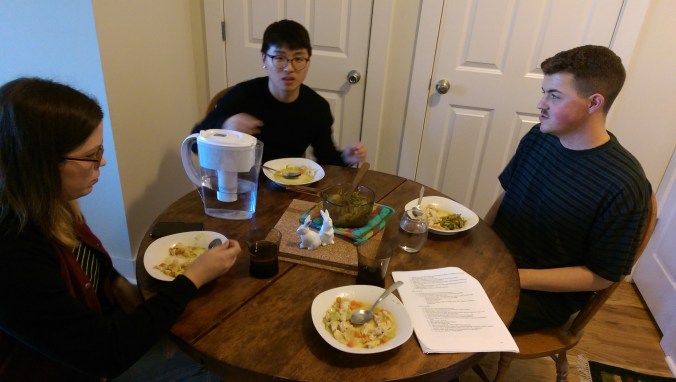
When Barnabas and I first arrived at the address we actually passed it, twice. I was expecting Jared to live somewhere way off campus, maybe some remote village or something. As it turned out, he lived just down the road from Cherry! When Jared invited us in I was greeted by the heavy aroma of southern cooking. Jared had prepared homemade Chicken and Dumpling soup for us alongside some southern style green beans.

I was instantly taken away by just how neat his apartment was. Not only that, but Jared was extremely kind, and inviting; he even had music playing on Pandora and candles lit. The reason that this stuck me was because I’ve been in my friends apartments before, but they never felt like a home, just a larger dorm. As the night moved on, and the small talk began, I found out Jared was an English major here at WKU and that he would be soon graduating as a senior. Shortly there after I met his roommate Emma, who was a student at WKU but now works at a candle shop.  She mentioned that she’s now interested in transferring to a school in Oklahoma. I made the mistake of asking which one and she proceeded to rattle off the various colleges available in Oklahoma while I, with zero geographical knowledge of Oklahoma, nodded continuously like an idiot. I don’t think she noticed.

IMAG1325

Once we got to eating the real conversations began. I asked a question I often use to get to know people, “If you could have dinner with three people who would they be?”. I got a wide variety of answers ranging from Burt Reynolds to Jesus to Hitler interestingly enough. The excuse for Hitler was that he was one of the ambitious men of his time, and it would be interesting to figure out where that drive came from. While personally,Hitler doesn’t sound like the ideal dinner date, It made me realize something. In class we discussed briefly that people have more and more homogenized their piers, that “cliques” whether they be high school friends of coworkers, tend to become less and less diverse with people searching for friends with similar traits as themselves. Now, here I was, sitting with three people that I wouldn’t have ever eaten dinner with were it not for this project, and I had a thought. It’s not because of some preconceived notion of who I am supposed to socialize with that I wouldn’t have dinner with these people, it was instead because each of our friend groups was made up, primarily, of people like each of us.  Yet, I found myself really enjoying the evening, especially as I got to learn more about Barnabas, who shared what life in Korea is like when compared to life in America. I find it amazing to think that someone from across the planet, who grew up speaking a different language, reading different books, learning different customs could sit down with three strangers from the other side of the world and carry on a conversation that interests everyone involved.

IMAG1328.jpg

If I could take away any major thought relating to Honors 251 it would be that Homogeneity is the downfall of democracy. As demonstrated in our class, it’s the variation on opinion, the disagreement on key points that gives perspective you wouldn’t otherwise have on a given subject.  To end on a bit of a cliche note, there is a quote a friend of mine told me last week; “Two people can illustrate crudity to you.
The first is the crude man, whom you see perceiving the diamond as a stone.
The other is the refined man, who makes clear to you the crudity of the first one.”

-Idries Shah

To me that quote speak to the matter of perspective in democracy. That the first made is crude due to lack of knowledge, the second is a crude man for demonstrating a lack of wisdom in when to use his knowledge. Without diversity, or at least a diversity of thought, democracy cannot flourish, only regress. That is my take away from my KKT project, an experience I was uneasy about going it, but so thankful for looking back.

Kentucky Kitchen Table Project

By Andrew

Going into this project I had no idea what to expect, other than maybe awkward and forced conversation on a rainy Wednesday. What I experienced was a totally different thing altogether. This has and will be my favorite memory of Honors 251, something I would have never guessed beforehand. The hosts, a writer couple, of the dinner were not only great cooks, but very interesting and kind people and I had the pleasure of getting to peer into their lives for a night. The group was diverse in many ways, with our beliefs (Christianity, Islam) and backgrounds, and the conversation was always respectful despite the differences. Abbas, a bio major hoping to become a plastic surgeon. Abbas is not only Muslim, but also in a fraternity which led to some funny stories. I did not know Stephanie’s religious beliefs, but she is also a bio major and an un upperclassman, she was a transfer student from a school in Florida. David and Molly were both writers who love going to parties together, traveling and have Catholic roots but are not religious. Something that surprised me initially is that Molly asked me to pray to start our dinner, but I felt that made all of us all open to one another. Talking about through introductions and Molly sharing interesting stories of a bizarre house party and her time in college at IU, we began to eat. Molly insisted on us not bringing food and providing the appetizers, main course and desserts. Molly and David described citizenship to us as being aware of what is going on in the world and also being courteous to those who were not as lucky. They explained that they felt citizenship was more of a relationship with ones community and country. Between our conversation starters many small conversations popped up, such as the stereotype of Christian gun owners, the presidential election, and even young marriage. Molly was surprised to hear that my family and I though Christian, were not pro-gun and I had the opportunity to share my beliefs on gun control and why I do not think being armed aligns with Christian values at all. Another interesting topic we discussed was our neighbors, and if we interacted with them or truly knew them. Molly and David were not particularly close to their neighbors due to them being very different. After David talked about his passion of teaching English at WKU and his love of different books that myself and the others had no previous knowledge of. Both of the hosts grew up and had fundamental knowledge of Catholicism which helped them understand my Christian background and upbringing. Our conversation jumped around for a while as we enjoyed a warm batch of brownies. We then talked about the stresses of school and our future, Molly did a great job of helping calm us and help us think about the big picture and making friends and having a good time. I took away a few things from the dinner that stayed with me, the first being how badly Christians often represent our faith. Molly and David had obviously had bad experiences with Christians that shoved their beliefs and political views down their throats. Something that was a positive takeaway from the night and the class in general, is that I learned being a citizen is more than paying taxes, and being kind to strangers. It is being aware of your situation and seeking improve not only your life, but the as well as the lives of others. This dinner and the conversations we shared was a great example of people who do not agree on religion or politics, still being able to enjoy each others company.IMG_2312