Average Leverage: A Chapter of the Kentucky Kitchen Table

by Claire Smith

The Landscape

Pulling up this semi-circular, pebbled driveway was not a new experience. The group of people chittering within the average house, on an average street, in an average little city named Bowling Green, Kentucky were not people unfamiliar to me. In some aspects, I attend a Kentucky Kitchen Table once a week. I eat a meal with these people once a week, if not more, to discuss life, and what we believe, and how we can believe it better by living it out, hopefully making the world look a bit more like heaven in the process. In many ways, this is exactly the purpose of Kentucky Kitchen Table, and is strangely parallel to the central questions of Honors 251.

The People

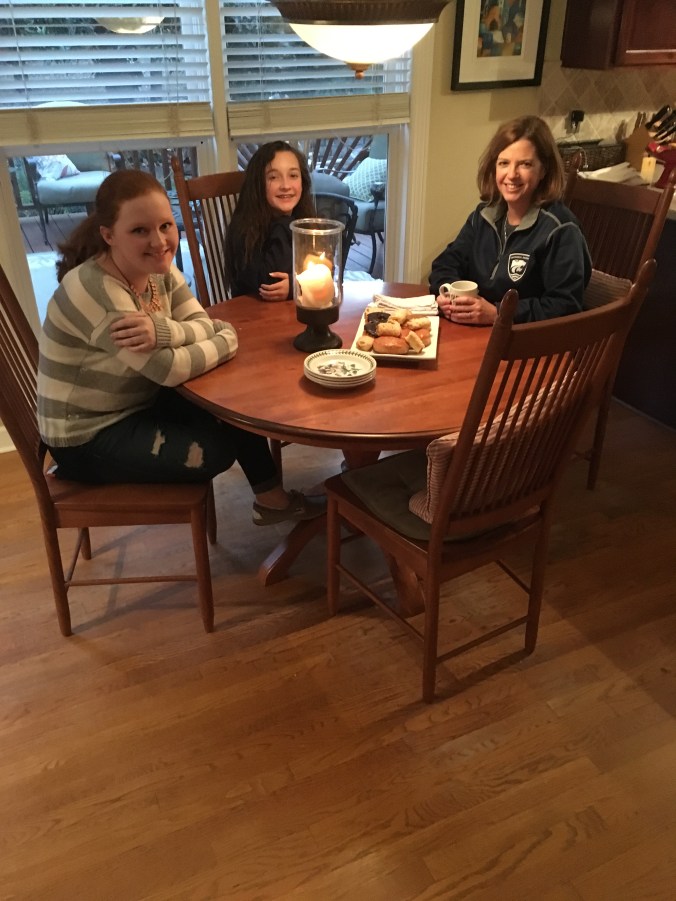
The individuals around my table are my church community group. We range from 18 (me, the youngest), to a couple with deeply graying hair, who chose not to disclose their age. Their names are Mike and Karen (Karen is only pictured in the annoyingly close selfie I took at the bottom of the article). They are kind and quiet; conservative, and always generous, with time, with their home, and with their resources. They sweetly offered to host for the project, just as they host us every week for dinner, coffee, and dessert. Sherry is our ray of sunshine; she is an accountant, and generally wants everyone to love everyone else, rarely stating strong opinions. She often tries to smooth things over when our resident feminist, Casey, gets riled up. Casey is delightfully passionate. She in her twenties, and is a certified doula, or midwife. Katie U. is a short, muscular person who works as a dietitian. You can tell from her appearance that she knows what she is talking about; she is her own proof and pathos. Joe and Katie S. are newly-ish-weds in their mid-twenties. Joe does something no one really understands called information security auditing reports, and Katie S. is a freelance photographer, though their desire is to one day work internationally within our church community. Sarah helps lead the WKU campus ministry CRU, and is the most personable human I have ever met, and one of the best storytellers. Paige, our final member, manages Vertical eXcape, the climbing gym off of Nashville Road. She is quiet, always planning out what she wants to convey before sharing.

The Vittles

Instead of attempting to coordinate the food or coming up with a theme, I just asked everyone to bring something. We ate homemade guac and beans, some cold pasta with peas in it, sweet tea, catalina taco salad, and rose-banana muffins, which was just as eclectic as I was hoping for. The food worked, in a weird way.

The Conversation (IE, Deliberation in Disguise)

I began with the required question, asking what citizenship meant to each individual, and mostly received blank stares. After some prompting, several were candid, saying they were not in the habit of pondering citizenship. Joe argued on the relativity of citizenship for awhile, and we eventually reached the conclusion of freedom, but the topic did not quite take off as I had hoped. People skittered off into tangents all around me, and I attempted to reign the conversation in. I asked what the best part of the world today was, and not a single answer was given in response. When that question also floundered, I went around the table and asked what each individual was most passionate about with regards to a social issue. Katie U. and Paige both discussed the environment, especially state parks. Paige wanted nature to be preserved for citizens to enjoy, and there has been some discussion on whether state parks should be maintained or downsized. It was important to maintain the parks because of quality of life, which can fall under the category of “living better together.”

Casey immediately began informing me about something we have discussed in Honors 251, but only briefly. She talked about how in Kentucky, doulas, or midwives, were often unable to find jobs, despite certification. It is preferable for expectant mothers to have a nurse who calls herself a midwife, certified or not. What Casey expressed frustration with was the American obsession with professionalism, a social issue I had not even known was a problem before 251. Despite being entirely competent, many like Casey in various fields cannot get a job without a degree, regardless of their experience.

Joe, Katie S., and Sarah all talked about fostering and adoption. Joe brought up the need for internal adoption. He gave the disclaimer that international adoption is still important, but also pointed out that there is a vast government ward, full of children who desperately need stability. His wife elaborated, and put forth options such as adopting through fostering. Fostering and adopting ties into 251 by giving others more of a say in their own lives, by providing stability and love in situations where neither would normally be provided.

When I came to Mike, Karen, and Sherry, I was not sure I was going to have much of a conversation, due to their political stance (conservative) and their age. They ended up sharing lots of insights, especially Mike. Mike’s social issue was, surprisingly, the accessibility of pornography. He rattled off statistics, and then struggled to come up options to protect children from viewing and becoming addicted. I noticed Mike wanted governmental action on this front, and when I brought up the freedom of speech, which implies freedom of media, he was frustrated, because he brought up “lazy parenting.” I liked that Mike brought this subject up, because it is an under-addressed problem, and in comparison to what legislature is coming up with now for children, such as cafeteria cup sizes, child addiction seems much more pressing, and helping children avoid or escape such a situation helps them have more of a say in their own lives.

I then asked if the state of freedom in America had changed since they were younger. We had a wonderful conversation; Karen and Sherry talked about how as time had gone on, the term tolerance had become prevalent, and how its principles had severely impacted their freedom. Their convictions were frowned upon, and often they felt that being a conservative was wrong somehow because of the backlash they received from individuals on the liberal end of the spectrum. We talked about how tolerance had evolved from unwilling acceptance to mandatory celebration of an issue one may not support. I think that this could potentially be argued as an encroachment on people’s say in their own lives, but it is a tangly topic.

The Results

One thing I learned from KKT was that I constantly am having informal deliberations, in the disguise of conversations. People have opinions, and they have fierce devotions and convictions.

Things got a little bit indignant and heated at one point in the conversation, and I did not attempt to moderate it. I think it was good for this individual to just have at it; sometimes, as citizens, we do not realize that we have a platform- (or we do… Facebook abuse). Those around us, friends, family, are our platform. Sometimes, we do not realize that we can go beyond being passionate or having opinions because we do not have any power, any special training for that kind of thing. But democracy is not about professionalism! Several of our first presidents did not even attend college, for crying out loud. It is a deception that citizens have to deal with if they want to have a say in how their country is run, one that is widespread and that has lead to a plague of complaining and online tirades. The person who exploded a little bit was like a real life Facebook tirade, unaware that they could DO something to change what they wanted to change.

Though much of the things I was able to discuss with these individuals was not new to me, I liked getting to talk to Casey about midwifery. It was fascinating to hear about her passion for natural birth and how it could help both the mother and children. I loved getting to hear Mike verbally fighting for kids whose parents may not always protect their “little eyes,” and challenging him on how he, not the government could help. That was certainly not something I would have done outside of the context of this project; I felt as the “administrator” or “proctor” that I was able to ask deep questions, questions that people wouldn’t normally answer. The veneer of the term project really opened people up to discussion. This makes me wonder; if deliberation, as discussed in “How We Talk Matters” became a part of this country, the way jury duty or voting was, as a civic responsibility, how many avenues of communication would open? How many solutions would meld from different minds? Especially when placed in a context grander than “project’- now the title is “democracy.”

Though the night took place in an average house, on an average street, in an average little city named Bowling Green, I have no doubt that this “average” has the power within itself to leverage beams and bricks and ideas and legislature and education and deliberation and voting into a bridge; perhaps we will reach the other side one day.

Kentucky Kitchen Table in Muhlenberg County, KY

IMG_4126

By Hope

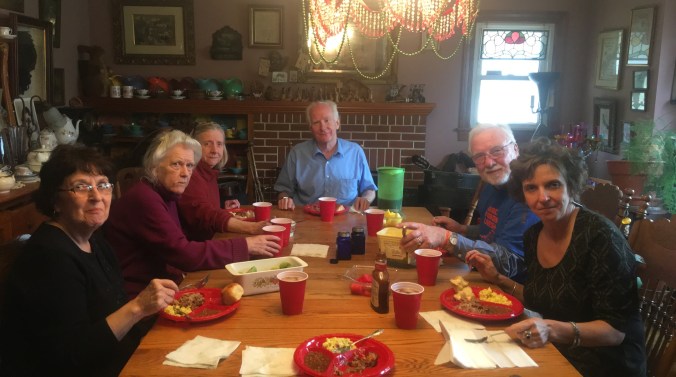
After hearing about the Kentucky Kitchen Table assignment all semester, I was excited to try this with my own family and friends, and to see what conversations and ideas would surface. I held my Kentucky Kitchen Table last Sunday (March 25th) at my home in Muhlenberg County, Kentucky. In attendance were my mom (Beth), my mom’s friend from work (George), my great-uncle (Richard), my great-aunt (Becky), a member of my church (Hilda), my grandmother (Connie), and myself (Hope). Although the meal was held at my home, everyone contributed to the meal. Beth fixed BBQ, Connie fixed most of the side items, and everyone brought a small plate or dessert to make a nice potluck meal.

I was a little bit nervous about how this meal would progress because I knew coming into it that I would have opposing views around the table. For instance, Beth has been involved in elementary education for 30 years and is more liberal-minded, while also being very religious. Connie is a retired elementary school librarian, and is more conservative-thinking and very religious. Becky and Richard both work in art, are very liberal-minded, and are not religious. I did not know George and Hilda very well before this dinner, but through conversation, I learned that Hilda is a world-traveler, sees herself as “middle-of-the-road” politically, and is religious. In addition, George worked in legislation and higher education, sees himself as a progressive liberal, and believes in a higher power while not attending a formal church. Lastly, I am a college student pursuing an arts degree, and I consider myself to be more liberal-minded and religious. Before the meal began, Connie led us in prayer. Although we all held hands and remained quiet during Connie’s words, I observed that Becky and Richard did not bow their heads and kept their eyes open during the prayer.

I began the conversation by encouraging everyone to be open and honest with their discussion and beliefs, and saying that it was okay if we didn’t agree on a certain topic. I started with the question about what citizenship meant to everyone beyond voting, paying taxes, etc. Beth began the talkback by answering that she felt citizenship was about “leaving the world a better place than the way she found it”. Everyone seemed to think this was a good way of putting it. Connie said that she agreed, and she felt that being a good citizen meant helping others and just being a good person. I noticed a lot of nodding. As we went around the table, everyone had pretty similar answers to this question.

Seeing how the concept of treating others well kept coming up, I decided to ask how one’s religious or spiritual identity relates to how we should treat others and how that ties back to citizenship. Hilda answered that she felt a majority of her actions were influenced by God. She said she felt like God is the one who “taps on her conscience” and tells her how to treat others. Becky said that she disagreed, and she felt that you don’t have to necessarily believe in God to know when to do the right and wrong thing. She explained that just because she isn’t religious, does not mean that she treats people badly. Richard followed up by explaining that he agreed with Becky, and he does things just because he thinks they are right or wrong. As tensions were rising around the table, George said that he could see truth in both sides, and while he thinks one can know the right or wrong thing without believing in God, God can work in a person’s life and influence them to do things that they wouldn’t normally do.

As George said this, I couldn’t help but think about the Jonathan Haidt reading. As George answered the question, he acknowledged that he could see truth in both sides and then gave his opinion. I thought this was a good way of “talking to the elephant,” even though he may not have been consciously aware of it. By saying this, he used the other’s intuition to keep the peace and avoid an argument.

After this question, I tried to lighten the mood and ask about what they loved most about living in Muhlenberg County, Kentucky. George began the conversation by saying that he grew up in Detroit where he noted that segregation and discrimination against African Americans was very noticeable. However, he now lives beside an African American family and feels that his neighborhood is quite diverse and accepting. Beth chimed in by saying she loved the fact that this area is rural and everyone knew her name, or at least her family. In addition, if she were to have a flat tire on the side of the road, she knew someone would stop and help her.

Furthering this topic, I asked what they liked most about the world today. Richard said that he felt new generations were very accepting and he loves seeing the progress we’re making in terms of equality and tolerance. I explained that I loved the advancements we’re making with technology, and I feel that much of this tolerance is coming from the world being connected and people gaining familiarity with people different than themselves. Connie said that she was very happy about the advancements of medicine and science. She said that she wished she had the opportunities growing up that I do now to make a difference in the world through technology and more general open-mindedness.

After this, I decided I wanted to see how different the people around my table really were and ask them about what social issues were closest to their heart. Some answers included equality, gun reform, the feminist movement, job creation, the LGBTQ movement, etc. We elaborated on each of these issues and somehow the topic of gun-control kept coming up over and over again. The March for Our Lives was the day prior, and I think it was just on everyone’s minds. Beth and I had attended a protest the day before, so I decided to ask everyone what they thought about the issue and the protests. Similar to our class deliberation, there were some opposing viewpoints. Becky, Richard, George, and Beth were very anti-guns and were very much in support for heavy restrictions of almost every kind. On the other hand, Connie and Hilda grew up with guns in their households and were supportive of light to moderate restrictions. However, much like our class deliberation, everyone around the table could agree that our country needs more background checks, mental-health screenings, and a ban on assault weapons.

While I was observing this conversation, I noticed that no one could come up with a “right” answer that would solve everyone’s problems or concerns with the issue; however, we could all at least agree on a few things. This reminded me of our class discussions on various wicked problems and how deliberating these issues is less about finding “right” or “wrong” answers, and more about weighing values and costs.

As the dinner neared its end, I talked a little bit about the bridge metaphor we talk about in class so often. I explained that for many of the social issues we discussed, people often see themselves at one end of the bridge and they have to take steps or actions to get to the other side of where they want to end up with the issue. In discussing this, Connie told Beth and me that she commended us for protesting the day before because it was taking an active step to the other side of the bridge. After learning that she was more hesitant to the idea of gun-control, this meant a lot to me. I appreciated that she could separate herself from her personal beliefs to respect my own.

After the dinner was over, I reflected on what I had observed. Although there were several different viewpoints present at the table, we were able to reach some agreement and compromise through peaceful discussion. I learned that it is okay not to have a “right” answer to every solution because often times, there isn’t one. However, simply talking to others and sharing opinions can help immensely. I feel that this dinner should be a metaphor for how we discuss and deal with problems in day-to-day life. Although no one is expected to prepare a homemade meal and talk around a table every time a problem arises, it is good to know that openly talking about an issue can help people think about things in new ways that they never have before. In addition, if one continuously surrounds themselves with people who are likeminded, he or she will never be able to have informative conversations like these to see how and why people think a certain way, and how a consensus can be reached. As I leave this meal and discussion behind me and continue on with my life, I will be reminded of the benefits of talking, discussing, and deliberating.

KKT in London, KY

6ZfqTrKmTRq2c6Cm2emw9A

By Mequeil Howard

My name is Mequeil Howard and I held my Kentucky Kitchen Table on March 13, 2018 in London, Kentucky. I held the dinner at my house with five people attending.  Those that attended my Kentucky Kitchen Table were Robyn, Colten, Ashlynn, Debbie, and Mitchell. Robyn, Colten, and Ashlynn are family friends from Texas who come to visit occasionally. Mitchell and Debbie are my parents who graciously allowed me to hold dinner at our house. Each of these individuals are very different and have different experiences.

Robyn is 48 years old and lives in Austin, Texas. Before she moved to Texas and got married she worked for the Red Robin Franchise out of Denver, Colorado. She is currently a stay at home mom and who is very involved in various community organizations. Her husband owns a construction company and she occasionally helps him with questions or issues he has. She recently helped him raise money to build houses for those that are homeless in Austin, Texas. Colten and Ashlynn are her two kids.

Colten is currently eight years old but will be turning nine by the end of the month. He is a boy scout and works on various projects such as building rockets and toy cars. He is very active and loves to learn about history. He is truthful and wants to know the facts. He will correct you no matter what.  Ashlynn is seven years old and loves to do art projects. She has a very outgoing personality once she warms up to you. She enjoys school and recently had her art work displayed in the community center. Her best trait is holding you accountable for whatever you say.

Debbie is 45 years old and owns a local flower shop in London, KY where she is the sole designer. She has always lived in London, KY and she has been a florist for the past thirty years. She is involved with the Laurel County Chamber of Commerce and stays involved with community organizations. Beyond having a local business and being involved in the community, she continues to help me pursue my education.
Mitchell is 47 years old and works as an accountant through the Federal Bureau of Prisons. On the weekend he helps my mom with the flower shop and whatever else may need done. He enjoys being outside and working on projects. He always ensures that I am doing well and succeeding in school.

As for me, I am 19 years old and attend Western Kentucky University. My major is psychological sciences and my minor is American Sign Language. I intend on going on to graduate school to be an Occupational Therapist. I am involved in various campus organizations and continue to look for more to get involved in.

When it comes to the Kentucky Kitchen Table dinner, we had ham, mashed potatoes, macaroni and cheese, and rolls. We also had cheesecake and regular cake for dessert. Since Robyn, Colten, and Ashlynn are from Texas, my mom made all of dinner. It was hard to decide what to make because Ashlynn is a picky eater, so she had all of the macaroni and cheese. I helped make both of the desserts because I love to make them. However, the most important part of this Kentucky Kitchen Table Project is the conversations we had at dinner.

When I first asked what citizenship means to them beyond voting, paying taxes, and following laws it was hard for the adults to come up with an answer. Colten and Ashlynn are still young and Colten has had more history classes than Ashlynn so he was able to answer the question a little easier. With this, me and Robyn made the question so that it would be easier for them to understand and answer.

Robyn started off the conversation by saying the biggest part of being a citizen is the freedom we have. This ranges from being able to choose where you travel to where you want eat. She went on to mention the ability to share opinions and create change. She described how as a citizen we are able to create platforms to voice concerns and create change. She used the example of the “Me Too” movement. As a citizen we have the ability to create a change which leads to her last point. Robyn said that as citizens we are obligated to the community and to make the place where you live a better.

This related to our class extremely well as one of our main questions is how can we live better together. It also made we think back to wicked problems and how we as citizens have an obligation to help. Robyn personally helps with the homeless community in Austin, Texas by building tiny homes. She has already begun to help solve a wicked problem, homeless. I went on to talk about the conversations we have in class about being obligated to do the morally right thing and Robyn believes that to some extent we are obligated to help but at the same time there are certain situations in which you can’t help. We then talked about the opioid epidemic and how we may be obligated to save their life but we can’t force them to seek treatment.

Colten then began to describe citizenship as helping other people in your community through being kind, obedient, and respectful at all times. He then talked about our freedom to choose what you want to be when you grow up. Ashlynn mentioned how we have the freedom to do the right thing through being nice and loving each other. She also said that we are able to choose who we talk to and who we want to be around. After talking with Colten and Ashlynn, it reminded me that children see the world in a different way than adults/teenagers do.

Going from this my dad, Mitchell, believes that citizenship is about freedom. Freedom to choose where he wants to go, buy what he wants to buy, and wear what he wants to wear. He believes he can freely speak and is able to make choices that citizens in other countries don’t have the opportunity to. This leads to my moms, Debbie, idea of citizenship being the freedom to choose and not living to strict rules.

Robyn, Mitchell, and Debbie all used the word freedom to describe citizenship which I believe has to do with the time in which they each grew up. Many people don’t think of citizenship as separate from paying taxes, obeying laws, and voting so asking someone what citizenship is without these things makes it difficult to come up with another answer. We could say that the word freedom relates to the laws we have because they allow us to have those freedoms. But I think it is more important than that, it is the not the freedom to do something but the freedom to choose what to do with it. Such as choosing to speak up to abuse with your freedom of speech. Many other countries have strict rules for the citizens that live there and they do not allow them to speak up or become what they want to become.

As for what I have learned about being a citizen and what it means to me, citizenship is mainly about voting, laws, and taxes because that is what we are taught about in our history classes. Many people don’t go throughout life and think about why they are a citizen, it is not something that someone who is born in the United States has to think about a lot. I look at citizenship as doing the right thing, solving wicked problems, and making an impact on those around you. It begins with us having the freedoms and abilities to do different things but we as citizens should do more. We should want to make the country in which we live a better place and we should be friendly to those around us. From this dinner my answer kind of encompasses everyone’s thoughts. This could be form my age and where I grew up but either way you can see how the idea of citizenship has changed.

So how does this all tie into what we read in class. David Brooks describes how in the past there has been shared moral frameworks amongst individuals in his article, “If It Feels Right.” He then goes on to say that today many people have individual values that are separate from others. You can see this throughout our conversation at dinner as the older adults felt that freedom was key to citizenship where myself and Colten and Ashlynn look to the traits of a person characterizing citizenship.

The conversation then ties into the reading “Love thy Neighbor: A story of War,” by Peter Maass which describes the Bosnian War from the perspective of a newspaper writer. Maass describes how neighbors and friends turn on each other during the war. Maass concludes that we should be able to accept each other as we are and to stand up for what you believe in. The majority of the time we are put in a difficult situation we don’t stand up for what we believe in, instead we go along with the crowd. It is important to see that Colten and Ashlynn believe that being a citizen is being friendly and caring because we often forget that we need to be someone’s friend in a difficult situation. There are so many cultural differences between what we see as the meaning of citizenship, yet we probably learned the same things in history class. This relates back to moral frameworks being part of the induvial instead of the group.

Overall the dinner went really well and I learned a lot. This class has shown me how to have conversations about difficult issues in a constructive way. It is important to have these conversations because there are differences in the way we see different issues but there is common ground also. When we listen to each other we are able to live better together and learn to solve problems together. Holding this dinner has allowed me to see how our class questions relate to everyday life and can be a conversation starter.

Kentucky Kitchen Table – The Importance of Community

By Rachel

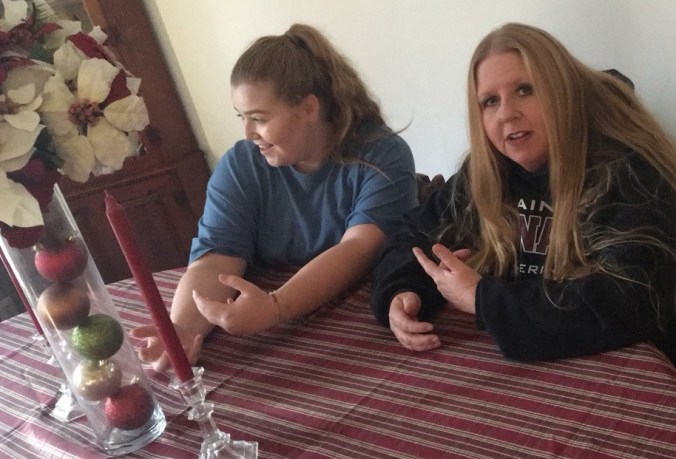
IMG_1431I conducted my Kentucky Kitchen Table in my hometown, Fort Thomas, KY. The attendees were very diverse in terms of age and background, and less in terms of race and ethnicity. The dinner took place at Maureen and Don’s house, a retired married couple. Their son Ken, a college professor, and his wife Lori, a nanny, were also in attendance, along with Maureen’s good friend Mary, a retired widow and great-grandmother. To represent a younger demographic was Katie, a graduate student at the University of Cincinnati. Perhaps the guest I knew the least about was Dan, a Catholic priest in his 60s, and a close friend of the hosts.
When asked the only required question regarding citizenship, everyone around the table seemed puzzled. It wasn’t that they didn’t know the answer, Maureen assured, it was that some of them were old and it took them some time to process what was being asked of them. Don later remarked that it was just a difficult question altogether, and to be fair, it was. When asked the question myself, it took me a few minutes to gather my thoughts and collect them in a way that would come across as comprehensible. So, we collectively decided to talk about some of the other given topics and hopefully that would end up tying into the first question. Because all of the guests were of varying age groups, I decided to ask about how they thought their age impacted their attitudes towards things like the government, morals, and citizenship. This question led to lots of stories about everyone’s childhoods, and gradually led into experience with certain historical and/or political events that happened at some point in their lives. Mary explained how when she was young, her family struggled to get by in the depths of WWII. She recalled that all she wanted one year for her birthday was a wagon. But because of the shortages of certain metals, she wasn’t able to get one. This, she explained, made her cherish the little things in life. Furthermore, to connect this memory to what she thought citizenship should be, she remembered sharing the ration stamps with neighbors in times of struggle, and this led to her belief that a sense of community and helping others is extremely crucial. We then briefly talked about neighbors. Ken, Lori, Don, and Maureen all said they had close relationships with at least 2 of their neighbors. Katie viewed this as less important, and Mary explained that it had been extremely difficult to try to build relationships with others following her husband’s passing. However, despite these differing relationships with neighbors, the consensus was that it is a positive thing to be close with neighbors because it creates a sense of community that some would argue is lacking in today’s society in the United States.

All of the older adults at the table explained that there had been times in their lives where it felt like everything in the United States was falling apart. Most notably, they collectively agreed, was the 60s. Not only was the Cold War happening in the early 60s, but it seemed to the American people that life in the U.S. was just one tragedy after another. The assassinations of John F. Kennedy, Martin Luther King Jr. and Robert Kennedy left citizens feeling hopeless, and growing objection to the Vietnam War left the country divided. Maureen then went on to explain that it was in times like these where being a citizen is the most important, and she pointed out that when she felt an injustice was being done in Vietnam, she refused to be quiet about it. She continued in saying that although it may be easy for people to just give up when it seems like everything is falling apart, we cannot just “throw in the towel.” It is our duty as citizens to foster community efforts that will make our country a better place for the coming generations. You have a duty to care and to try to educate yourself, she argued, no matter how hopeless things may seem. She articulated further by saying that we cannot expect everyone to protest or to become a politician, but we can expect everyone to care about what is happening in their country. This idea of having a duty to care/educate yourself about the state of the country overlapped with later conversation about our country today. Without getting too absorbed into the mess of today’s politics and the 2016 presidential election, Katie made a point that it was easy for people, especially young people, to tune out important political points made by the candidates, because the focus was on mudslinging and taking down the other side. Likewise, it was easy for people who already didn’t particularly care about politics to tune it out even more because the slander and scandal gave them reason to.

I wanted to lastly bring up religion and its relationship with citizenship because we had a priest at our table and I was curious about his input. Fr. Dan explained that as a Christian, he hopes that everything he does shows God to people that he interacts with. He strives every day to communicate the love of God and the Christian faith to those listening to his homilies, and he wants nothing more than to show people the love that he believes God can grant them. In building these relationships within his parish, he strengthens his church community – the type of community that we had concluded was so important earlier on in the meal. Loving one another through God and doing all things through Him is something Fr. Dan believes to be a big part of citizenship. Loving people, accepting them no matter the circumstance, and withholding judgment are all important components in creating a more positive and progressive world for those to inhabit it in the future. His religion and his moral beliefs have shaped his political opinions and influenced his passion to create a happier and stronger community in his parish. The others agreed, and although they did not have the same experience as being a religious figure, each person agreed that their religious beliefs or lack thereof often influenced their attitude towards other Americans, the government, and politics.

To conclude, our conversation during dinner was largely centered around the importance of community, hope, and spirituality, which all in some way relate to central themes of Citizen and Self. In reflecting upon the conversations that took place during dinner, I realized that a lot of what was being said related to the central questions of this course. For example, everyone seemed to believe that a sense of community is crucial in making life better for us and those around us. This directly relates to the question of “how we can live better together” and other similar ideas that are associated with interpersonal relationships and an emphasis on working collectively. My first inclination is that this ties into Maas’s Love Thy Neighbor. Although we are not at war with our neighbors, everyone seemed to agree that fostering relationships with those living close to us is beneficial to everyone involved, and that all involved parties should make more of a conscious effort to develop these positive relationships. Furthermore, kindness should not be limited to those similar to us, and that to live better together and to make society a better place for the future, being respectful, tolerant, and generally kind is an easy, but often overlooked significant factor. Something else interesting that resonated with me was that there was a general consensus from everyone at the table that we have a duty to work together and make conscious efforts to sustain and improve our society for those to come.

Overall, I learned a lot about different perspectives that people older than me may have. It was very interesting to hear childhood stories from people of such a wide age range, and I even learned some history. Textbooks and documentaries can only teach you so much – and in my opinion, it is more interesting to hear the perspectives of those that lived through the times firsthand, and it is often an enjoyable experience for the storyteller as well, provided that the memories are positive. Conducting this dinner was an eye-opening experience for myself, and even some people at the table. Katie, the graduate student, told me post-dinner that she felt that her attitude towards the importance of community had changed. I felt similarly – it is no secret that millennials and those younger are often so caught up in their own lives and the lives of those closest to them that they fail to see the importance in building relationships with people unlike themselves, or even just their neighbors that may be a different age. Hearing the positive experiences of those older than us in times where community was crucial made us younger adults feel that maybe more of a focus on community and helping others without expecting something in return would create a brighter future and a generally better place to live. All in all, actively listening to the thoughts of people different from me not only taught me a lesson in history, but also one of acceptance.

Kentucky Kitchen Table

IMG_8426

By Cole Constant

Late in the evening on the 12th of November, my mother, sister and I all gathered around the kitchen table of our home in Elizabethtown for a meal of sloppy Joes and steak fries (I had warned mom beforehand that there might be a lot of gesticulating over the course of the night). After some questions, I gave them a general overview of what they might expect or look to achieve over the course of the meal. I explained the central ideas behind the class and some things we discussed in there, as well as how that might relate to what we’d talk about.

My younger (16) sister, Lily, felt that citizenship was primarily about being guaranteed certain rights, while my mother (45) felt that American citizenship was unique in the amount of freedoms afforded to everyone, relative to many other less privileged/developed countries. She also noted a sense of comradery or “family” that comes with being what she believes is a “truly active” citizen. My sister cites a similar feeling, but having more to do with social media and increasing interconnectedness with her peers. She lists this as one of the best things about our world today; feeling that social media has caused much advancement in the areas of knowledge accessibility and general public awareness. My mother agreed that the advances in technology over the last twenty years have been amazing.

When asked about future living preferences, my mother and sister both demonstrated that, despite their aforementioned ideals about community, they would prefer to keep mostly to themselves.  My mom felt that, within your community, the best way to contribute is to have everyone work their hardest on improving their own situation; which would collectively mean a more “put-together” neighborhood. My sister felt that it was no-ones’ responsibility to help anyone else, and that everyone should just try their hardest to help themselves. My mother said that the older she got, the less hope she had in humanity and the more she would like simply to be “left the f*ck alone”. They immediately demonstrated their hypocrisy in this by revealing that their favorite thing about where they currently live is the sense of security they have, due to diligent and kind neighbors.

As an educator, my mother felt very strongly that her job did relate to her role as a citizen. She finds much pride in preparing the minds of the youth, and is very content with her ability to “push the envelope” as far as content, especially within a rural/conservative community. She also wanted me to note specifically that she feels cheated, as a government worker and citizen, by a new piece of legislation which completely changes how retirement works for educators. Apparently, government borrowing has totally expended the money from a system she has been paying into her entire life. And what can she do? My mother feels her voice is not heard. I remember voicing similar concerns about my own future to the class.

Neither my mom nor my sister considered themselves spiritual or religious, instead looking to their own set of values when making decisions or interacting with other people. My mom wouldn’t feel more obligated to help someone from her community over anyone else, but reasons that, due to the proximity, she would be more able/likely to. This is in line with her previous feelings of non-obligation to any particular group of people.

When asked about the kind of person she would like to be, Lily indicated that this question was the source of much stress in her life. She knows she would like to be a “good” person, but is unsure what exactly that entails beyond not being a “bad” person. She is comforted, however slightly, when mom tells her that she has changed who she is in life, before. To politicians seeking office, my mother advises they keep an open mind. I tell her that this is more or less the mantra of the class, explaining how refreshing it is to be surrounded by people who all do have an open mind. My sister lists transparency and honesty as very important qualities.

I admittedly was not expecting the response my sister provided concerning conversations she had with people of vastly different backgrounds. She recalled dinners she’d had at the home of her ex-boyfriend, who was part of a very conservative family. My sister was appalled at the normalcy with which they regularly talked down on people of other races and religions. She even went as far as describing them as brainwashed to a “scary” degree. She likewise feels that inclusivity and acknowledgement for underrepresented or oppressed groups is the most pressing social issue. My mother listed the tumultuous state of the government as the social issue closest to her heart, and between the two I’m sure you can see the similarities between my family and myself. I rarely missed an opportunity in class to blame a wicked problem or social issue on the intolerant, broken government.

By the end of the meal, my sister felt emotionally drained, but Mom was very relieved to learn the demographic of WKU (and this class specifically) was liberal-leaning. She has a lot of hope that our generation can rectify the mess that has been left for us to inherit. I must hope she is correct, and that Honors 251 class hasn’t artificially inflated my confidence in my generation’s ability to be kind, intelligent people.

Brian’s Kentucky Kitchen Table

By Brian

On November 23, 2017, a Kentucky Kitchen Table took place in Louisville, Kentucky on Thanksgiving Day. The participants involved included my mother Mary, a 1st grade teacher who enjoys time with her family, Alexa, the just-graduated-college girlfriend of my cousin, Jeanne, a fun, loving aunt, Katie, a smart and determined woman a couple years out of college who is my cousin, Emma, a silly cousin adopted from China who is still in high school, Elizabeth, another cousin a couple years out of college who loves traveling the world, Rhonda, an aunt who enjoys the company of others, Donna, the mother of Alexa’s boyfriend, and myself. Together we stood around the table and ate various snacks and veggie trays before making ravioli to be eaten on Christmas Day, a family tradition. While most of their husbands either made the ravioli filling or cooked chicken outside, we all flattened out the dough and filled it with its filling before cutting it into bite size pieces and storing them in containers. I chose this group of people to discuss citizenship with because it contained a diverse group of young, middle aged, and older women who have all taken different routes in their lives and never fail to impress me with their own unique wisdom. I approached the table to help make the ravioli and it was then when the Kentucky Kitchen Table really began. I started off with a simple question with not so simple answers. “Beyond voting, paying taxes, and following laws, what does citizenship mean to you?” Answers included themes such as holding those in your community accountable, being a part of a larger group, thinking about others in a selfless way, and creating the best possible environment for everyone to live in together. Mary, being a teacher in a public school for years, understands the importance of making others feel welcome in our community. She’s taught kids from multiple countries, who speak different languages, and believe in various religions. No matter where they were from though, she always considered it her duty not only as a teacher, but as a citizen, to welcome them in and make them feel just like everyone else. Emma, being from another country, personally knows what it’s like to be welcomed, despite not being born here. Donna herself has brought in her son’s friend from high school to live with them for years due to his own family life at home being unfriendly. She felt like it was her duty to take care of those who need help. Not only take care of him, but hold him accountable when he got in trouble or struggled in college. Citizenship is not only about making others feel welcome, but making sure they are doing their own part to be a successful citizen. A community like a chain, is only as strong as its weakest link.

The next question was what kind of community do you want to live in? Rhonda felt like a community you can feel safe in and be able to enjoy being a part of without any doubts was the best kind. Alexa wanted a community filled with friends and loved ones where you always have a place to go. Katie liked the idea of a place where everyone is accepted and not judged based on their appearance or beliefs. The overall theme of the answers to this question were the ideas of love, acceptance, and safety. The idea was your home should not just be the building you live in, but the community you are apart of. Luckily, everyone present felt like for the most part, they did live in communities described. No one was afraid of where they lived, and no one felt they were alone. Although not everyone can be as fortunate, I’m very grateful that my family seem to all live in healthy and successful communities.

I then got more personal and asked what kind of person do you want to be? Elizabeth just wanted to be someone who can make others laugh and feel good about themselves. She wants to leave others with a sense of warmth within. Jeanne said she wants to be a person who is loving and forgiving. She wants to leave her impact on the world as someone who just radiates with love. She feels like she’s tried to do this so far in her life and will continue to try to be this way going forward. Emma gleefully said she wants to be someone who is always happy and never hurts others’ feelings. Not one person said they wanted to be a rich and successful or something more self-focused such as that. Everyone talked about how they wanted to impact others or how they want to be a beacon of joy. This personally gave me a sense of joy and almost a pride to be apart of the family that I am.

The next question asked was what kind of advice would you give to people running for office in our country? I knew various members of the Kentucky Kitchen Table has different political interests, so I was interested to see what kind of answers were going to be said. Mary just hoped that whoever is in charge of our country governs with compassion and love. She wants our leaders to be thoughtful and caring even when tough decisions have to be made. Donna claimed she believes that the leader of a country should listen to the people and make clear decisions with honest intent. Those leaders should be open with the people about what they are doing and stay true to what they initially said they stand for. Emma admitted while she does not know a lot about politics, she still hopes that our president is kind and caring. She doesn’t want a malicious person leading our country who acts without remorse. Alexa wants those in charge to be thoughtful and accepting but also decisive. She prefers our leaders to act together and be confident in their decisions: not indecisive and arguing among themselves all the time. A successful government is one that is unified from the inside.

The last question asked was is there anything you can think to do that might make things better for you or your neighbors where you live? Jeanne believed trying to get more youth properly educated would result in healthier communities across the country and we should try to get more people aware of what a healthy community looks like. Emma said that you could get together a neighborhood event filled with bouncy houses and fun games in hopes that it draws people out of their homes so that relationships are built, and you get to know those living next to you. Elizabeth says just stopping to say hi or introduce yourself to neighbors you see while outside or on a walk will promote a more loving and unified community. All of the responses to this question dealt with people and making their lives and relationships better. It was not about building new facilities or anything physical but rather getting people together and fully aware of a caring community where all are welcome.

Once the conversation was over I could really see why we were required to be apart of a Kentucky Kitchen Table for our class. It reminded me of “Practicing Democracy,” in Smart Communities by Suzanne Morse. In the reading, communities such as those in Jacksonville or Oregon formed councils and groups that helped inform citizens of certain issues and helped decide how the local government should act. It was ordinary citizens who banded together and discusses local issues. Although this was a much smaller scale, it was similar in the sense that regular people sat down and talked about citizenship and real-life problems. Because of it, everyone involved had a better understanding of each other and the issues brought up. Questions that Honors 251 is centralized around like “How do we live well together?” and “How do solve problems?” were addressed and this project really did feel like the class was being applied to the real world.

The general themes I noticed from my Kentucky Kitchen Table was that of love, compassion, and human interactions. Each answer throughout felt very similar in the since that they shared a theme that everyone seemed to agree on for the most part. It was interesting to see how the same couple ideas could be present no matter how different the questions were. Never before have I had these kinds of conversations with my family and I am very glad I got the chance. It gave me a new understanding how these family members think, and I became proud of their ideals and beliefs. It makes me glad to be part of the family while also helping me understand a new meaning to citizenship. Now I have a new appreciation for these family members and it might not be the last time we sit down and have a down to earth conversation.KKT

Friendsgiving

By Mary


We had dinner around a kitchen table at kktmy friend’s apartment. The people that were there included, Andrew, Keaton, Kat, Gabby, Tori, Hayley, Ashlyn, Tatro, and myself. For my descriptions of these people, I thought that it would be best to not only use what they had to say about themselves, but also things I notice or appreciate about them. Andrew is a gentleman. He is compassionate and is genuinely interested in what you have to say whether he agrees with it or not. He is a goofy guy that loves being around good people, and wants to do something with his life. Even though I do not know him that well, I was able to pick up on those things about him very easily. Keaton’s description of herself is how I would describe her as well. She is extremely passionate and dedicated to doing the right thing, she always tries to stay positive and open minded, and she likes to look at the world from multiple different perspectives and learn from different situations. Kat is artistic in everything she does. She has a very bright, outgoing personality. She wants to use her art in art therapy or something else that is helpful. Gabby sells herself short. She gives without asking for anything in return. She instinctively takes care of those around her and has one of he kindest hearts that I know. Tori is a very loyal friend. She is unapologetically herself and brightens up a room when she’s in it. She is honest and will tell you what you need to hear. I do not know Ashlyn and Hayley that well. Ashlyn is carefree and enjoys being around people. She thinks for herself and is very independent. Hayley has a kind heart and cares about other people. She is a little soft spoken, but was insightful when she had something to say.

I think that we had a diverse group. We are all the same race, but we come from very different backgrounds and have different views on politics, life, and on the topics we discussed at dinner. Each person provided some type of dish. Since it is close to Thanksgiving, we had a “friendsgiving” and everyone made/brought something so we would have variety and enough for everyone to eat. We wanted to have a group of people that would give diverse answers and give us a different insight into issues. Everyone that was there respects the opinions of others even if they do not share the same view. I think that the discussion we had left everyone thinking of the points the other side had to make. I would say that I was able to understand a viewpoint that was different from mine.

Our discussion started with the obvious question of, “What does citizenship mean to you?” This question took them a moment to answer because it is not one that you get every day. Keaton had the response that I paid attention to the most. She said that citizenship means having freedom, but to a certain extent. It means being a part of a greater good and working to give back to your country in whatever way you can. Other people chimed in and added some more to what it meant to them. Some meant having a voice in society and being a productive member. Andrew said it simply meant doing your part in society and being good to others. This kind of lead to the question of, “What kind of person do you want to be?” One of the answers that multiple people said is that they want to be someone that people look up to and respect. They want to lead by example, and make a lasting impression on other people. Someone that everyone wants to be around and that radiates positivity. I felt that these answers and the conversation was going to the “Does your religious or spiritual identity relate to how you think we should treat other people? Does it relate to how you see yourself as a citizen?” I worded it differently because of the nature of the conversation, but it had the same meaning. A couple of us there are unreligious, so I agreed with their viewpoints. They felt that religion should not be the reason you are good to people or treat them well. That we are all human beings that deserve respect and kindness regardless of who you are. The religious people agreed with what was being said, but their faith compelled them to treat others well. Most were some form of Christianity and all used the bible as their main form of references. They said that the bible teaches you how to treat people and that being in the church environment made them feel like they were around positive influences that helped them figure it out. From here, I felt that the next question on the list, “Do you think we have any obligations to other people in our country? In our community?” was the logical transition. One answer was that we do have an obligation to respect and support people within the community even if they are different from us. With this question, the election was kind of brought up. It is still a sensitive topic, but one that I do not think I have really discussed with my friends yet. For a few of us, the election was still a wound that we were trying to make sense of, and for others they were happy with the results. The people that voted for Trump said that they wanted change. He was going to fix the economy and fix trade deals. Those of us that did not vote for him said that he was a vile person. He instilled hatred into millions of people and made discrimination okay. Someone that was against Trump said that as president, he was obligated to protect all Americans and not only middle and upper class white people. This conversation went on for a while, but we were all able to agree that regardless of what we believe, the repercussions of the election are tragic and it is sad that people have to be scared to live in their own country. It was interesting how they brought the conversation back to the questions that I was asking. I brought up, “How to we live better together?” because I felt it was appropriate for where we were at in the conversation. Gabby said that we should be there for each other regardless of what we think, and that now more than ever is when people should respect everyone.

Tatro and I were not able to get through all of the questions because the conversations we were having were quality. I think that this might have been the first time that the I have had such in depth conversations casually with friends. It was refreshing to be able to talk to friends about things that actually matter. I learned that regardless of your religion, who you vote for, or what your beliefs are, we tend to gravitate towards being kind and good to each other. I would say that we have learned to be aware and understof what someone else is thinking, feeling, or going through. It was interesting to see an understanding being made when someone gave an answer or made a statement about something that went against what they thought. Sometimes, I would even disagree with someone, but was able to think about it through their perspective. They are my friends and I was able to still associate that with them. What we all realized is that even though you are different from someone, we are all people too and deserve to be treated with respect. My central idea that this all related to, and one I have already mentioned, is “How do we live better together?”. I felt that this conversation and dinner centered on this because of the recent election and events that have followed. This experience was something very enjoyable and eye opening about my friends.

My Kentucky Kitchen Table

By Callie

When I first heard about the assignment, I was anxious at the thought of having dinner with people whom I did not know. As a relatively quiet person, I was nervous about the idea, but it turned out to be a great experience.

For this assignment, I was paired with Jamie. Her friend Shelby opened her apartment to us for the night.  The night’s menu consisted of spaghetti with marinara and alfredo sauces made by Jamie and Isaac, bruschetta made by Shelby, cookies from Karla, and French toast that I made. There was a total of six people in attendance, only two of which I knew beforehand. In attendance was Jamie, her friends Shelby, Thomas, and Isaac, me (Callie), and my friend Karla.

Everyone in attendance was a member of the Honors College here at WKU. However, Karla and I were the only freshmen, while the others were all seniors. Jamie is a psychology major from Lawrenceburg, KY. Shelby is also a psychology major from Lawrenceburg. Thomas is from Mayfield, KY and is a biology student. Isaac is studying meteorology and is from Aurora, IN. Karla is also a psychology student and is from both Shelbyville, KY and Los Angeles County, CA. I am a business student from Dunmor, KY. Another aspect that makes this group diverse is religion. Karla and Callie are Christian, Thomas was raised Catholic but no longer practices the religion, while Jamie and Isaac identify as being LGBT and practice no religion.

Throughout the discussion, Jamie and I would take turns asking questions to keep the conversation going. At times we would get off topic by sharing personal stories as we discovered different things that we had in common with each other. These connections allowed us to relate to each other and connect our similar experiences. These topics included H4 and living in Minton Hall. We discussed that H4 allowed us to meet many new people, many of which we would not have taken the time to meet otherwise. While each person’s experiences took place in different years, overall we shared similar opinions and circumstances. We covered topics including citizenship, social issues, diversity, religion, the kind of person we want to be, and many more.

We began the discussion with the question: What do you think are the best things about our world today? The answers were light-hearted and included food, puppies, warm weather, and friendship. The following question required more serious answers: Beyond voting, paying taxes, and following laws, what does citizenship mean to you? Many of the answers conveyed a similar message of truly caring for others and taking a stand for your beliefs. Isaac suggested that citizen should involve being politically engaged outside of voting and interacting with your local government. Others suggested being engaged with others and championing for a cause. These responses can be related to the class question of: How do we live well together? As we got off topic talking about out different experiences through the years, we came to the consensus that communication is key to living well with others. For example, Thomas and Isaac were roommates for several years and coming into college they had never met each other before. They agreed that talking things out allowed them to overcome their differences and become friends.

One of my favorite questions asked was: Have you ever had a conversation with someone from a really different background than yourself? I found it interesting to hear everyone’s personal account of their interactions with diverse people. We discovered that because of these interactions our worldviews have been expanded. Many of us grew up in small towns with little diversity, and as a result, our experiences with diversity have had a lasting impression on us and our worldviews. Isaac discussed how the ability to travel has shaped who is he as a person. Shelby told about her experiences staying in Europe with an Italian family where only one person spoke English. She found it interesting that they would listen to American music even though they were unable to understand it. Thomas spoke about his internship at the National Institute of Health, during which he lived in a house with an older woman from India and worked alongside people from all over the world. He found it exciting and educational to learn about other diversities in this way. Jamie explained that in elementary school she had friends who were Chinese and Japanese. She told that her best friend was a Bosnian refugee whose parents did not speak English. I told of my experiences at GSP where I met people from varying backgrounds, cultures, and religions. I found this time especially exciting, as it was my first real experience with diversity. Karla is from Hispanic dissent and grew up bilingual. She discussed that she was among the small diversity in her dominantly white neighborhood.

Overall, I found this experience worthwhile and enriching. Going into the assignment I was afraid that we would not be able to keep the conversation going considering I had never met the majority of the people in attendance. However, this was not the case at all. Through discussion we discovered many things that we had common with each other, which made the night flow more smoothly. The environment was very welcoming and it seemed there was no subject that was off-limits. I enjoyed hearing each person’s experiences and concerns. I was reminded of the fact that you cannot judge a book by its cover. While the majority of us came from small towns, we all were very different. Each of us held our own set of experiences, opinions, interests, and beliefs. Part of citizenship is living and interacting with others. In order for us to do so successfully, we must understand where each person is coming from and why they hold the positions that they do. Through this deliberation, I was able to get a glimpse of what the world could be like if we took the time to talk to those around us on a daily basis.

Mark’s Kentucky Kitchen Table Dinner

For my Kentucky Kitchen Table project, I invited over a few of my friends from the forensics team and their roommates. We had a great dinner consisting of pulled pork, salad, spicy baked white beans, cilantro lime brown rice, and bread. The people who were at the dinner were as follows. Bailey is a junior at WKU who is a member of the forensics team and brought the pulled pork. Eli is a freshman at WKU brought the rice and is roommates with one of my teammates Alex. Eli is also a member of the forensics team. Alex is also a freshman at WKU who is on the forensics team and he brought the spicy beans because he is a vegan. Alec is roommates with my friend Bailey and he is a junior from Lexington Kentucky. I originally planned to have my other teammates bring some of their floor-mates but they had cancelled at the last minute.

While the group wasn’t as diverse as it could have been, I do think that the group was representative of great geographic diversity. In fact, every single person who attended the dinner was from a different area. The group represented people from Blaine (Minnesota), Englewood (FL), Lexington (Kentucky), Albany (Georgia), and Newton (Kansas). Bailey and I are also first generation college students with family lineage going back to grandparents and/or parents who immigrated to the United States from Europe.

As dinner got under way the first thing that was brought up was the obvious, the results of the election. The majority of the people around the table had a general disgust with the election overall, which is how the conversation started. All parties involved decided that both Donald Trump and Hillary Clinton have been the two weakest candidates since we have been able to vote. Realizing that a Trump victory was an inevitability, much of the discussion was centered around the idea of why we believe that Trump had to use such bigoted and discriminatory framings to advance his policies. While none of us agreed with the policies that Trump was implementing, we all agreed that there could be some policies better formulated by Trump. One such suggestion was creating a system that vets all immigrants instead of just targeting Muslims by establishing a registry. We agreed obviously it is important to know the background of people who are going to reside within this country, but we all though that it should be easier to get citizenship.
Moving on from the political discussions, we began to talk about our family heritage. Eli, Alex, and Alec grew up with families who have lived in the United States for the last few generations. However, both Bailey and I had the unique experience of coming from families who are very diverse in their background and come from Europe. One thing that Bailey and I noticed was different was the size of our families. When we have family get-togethers, it is normal to have 30-40 people over at our house. However, the other members in our group came from very small families who weren’t very close. Both Bailey and I realized that we know our fourth cousins like they are our siblings, but the rest of the group really didn’t know their extended family very well or at all. However, everyone at the dinner came from families who are not extraordinarily wealthy. Baily and I learned to be frugal from the older generations of our families, but the rest of the group grew up in rural areas in families that know how to save money and spend frugally. I thought that is was quite interesting that even though our lineage came from very different backgrounds, there are some societal indicators that pass down traits through generations. In this instance, families who have come from humble upbringings teach future generations to be frugal with the money that they make.

The final theme that we discussed at our dinner was religion. For the people in the group, both Eli and I identify as being Roman Catholic. Alec identifies as Lutheran. Both Alex and Bailey stated that they did not believe in any higher power or God. This conversation got a bit personal but eventually centered around the idea of how religion can be used as a powerful tool in society. Many people in the past have used religion in harmful ways to extort money out of people for their personal gain. But, on the other hand we realized that the moral underpinnings of a variety of religions and moral codes all like on the same principles of being a good person and ensuring that you not only benefit yourself but also those around you.

Everyone at the end of the meal said what they thought citizenship means to them. In light of the recent political climate, many people in the group were slightly hesitant to identify as being proud of our nation. However, people said that being a citizen of this country goes beyond the bounds of the person our country elects in the white house. In fact, the group agreed that if you are unhappy with the political situation in the country it is your obligation to speak up and vote to incite change. Thus, we concluded that a citizen is someone who always stands up for their best interests and the best interests of everyone in this country. As a bunch of white males, we will never personally feel the ramifications of Trump’s immigration policies for the Latino or Muslim population. However, as citizens of this country we have an obligation to speak out and protect those around us. That is how we can truly “make America great again”.

I really enjoyed my Kentucky Kitchen table. In fact, this project had very pronounced connections to the class which preaches about a sense of community. A strong community will always strive for seeking out ways to live better together. While we didn’t agree on every issue that we discussed, there was always a middle ground that was found. This is because everyone in the group put forth their ideas in a reasonable and calm way. As a result, we kind of engaged in a deliberation that brought us together instead of polarizing us. This project has taught me that there is no way to live better together as a community than getting to know the people who surround you. And even though many of the members of this group were on the forensics team with me, I learned so much about my fellow teammates, especially the freshman. This just goes to show that talking to the people around you can bring you all closer together.

img_2772

MARK ALLSEITS KKT DINNER

Donuts and Democracy

by Taylor

There’s one thing that is certain about my family: we always take the time to eat dinner together. Our family dinners are an integral part of the day for us, and now that I’m away at college, I’ve realized that I took those dinners for granted. I eat dinner with friends, of course, but there’s just something special about gathering around the dinner table with your family and talking about the day’s events.

That being said, the concept of this project really resonated with me. Dinner conversation is the best conversation, in my personal opinion. As soon as the project was assigned, I called my parents and asked them to invite our next door neighbor over for dinner. I came home the next weekend, and our Kentucky Kitchen Table Project commenced.

My mom, sister, and I ate a delicious meal with Mrs. Lori, a single mother who lives two houses down from us. My mom, Carolyn, is beautiful, blonde, and bold. Jordyn, my 14 year old sister, though brunette, inherited every ounce of my mother’s spark. The two are firecrackers, compared to my reserved nature, but I love them to death for it. Mrs. Lori, though I didn’t notice at first, has a very kind and comforting smile. Talking to her was easy, and fun. She was quiet at first, like me, but we all quickly became comfortable with one another. I’m so glad that I put myself out of my comfort zone and got to know Mrs. Lori along with the rest of my family.

Our Kentucky Kitchen Table took place the weekend after the election. My family and I were very disheartened by the results of the election, and the beginnings of our conversation were a little somber. I had asked everyone what citizenship meant to them, and we all came to a similar consensus. Being an active citizen not only requires you to vote: it requires you to use any lawful means possible to let your voice to be heard. Mrs. Lori made a fantastic point when I asked her what it meant to be a citizen of the United States. Her exact words were

“Even though where we’re at right now doesn’t seem that great, we still have to put in every effort we can to get where we want to be.”

The week following the election was one of the most emotionally strenuous weeks of my life. I didn’t know what to think, where to turn to, who to talk to. Should I lose hope all together? Should I accept the situation, even though I’m not very happy about it? I asked Mrs. Lori, and the rest of the people at our table, what their thoughts were about the election. We had all just finished eating my mother’s manicotti, and we were starting to nibble on the donuts Mrs. Lori brought for desert. My sister, as eloquent as ever, said

“It kind of sucks.”

I told her to elaborate.

“Well,” she said, “It’s pretty bad for minority groups. And—,” she paused.

It is hard for me to describe the amount of sadness I saw in her young eyes.

“There’s just so much hate.”

We continued to talk about our thoughts, and we were all less than hopeful about the future. To brighten up the conversation, I asked everyone what they thought were the best things about our world.

I mentioned the wondrous availability of knowledge thanks to technology. This, I said, was especially important to college students.

“I think it’s great that our world is so different,” said my mom. “I mean, culturally, our world is so rich and interesting.”

Mrs. Lori nodded. “And even though we’re all so different, the great thing is that we really all want the same things: love, food, safety, a better life for our kids and families.”

She was absolutely right.

We continued to talk about our connection with others around the world well into the night. The donuts disappeared. The coffee became cold. Well after my sister, my mom, and I, wished Mrs. Lori a good night, I thought about what my neighbor said. With tensions continuing to rise in our country, especially among minority groups, it felt good to hear Mrs. Lori’s words.

I learned quite a bit that night. We really aren’t all that different, are we? America is a diverse, melting pot, and I’ve noticed that WKU certainly represents this. Our campus’s diversity is continuously shown to me during my morning walks from Minton to Cherry Hall: so many different races, cultures, religions. I think it’s wonderful.

It’s safe to say, though, that many of us can get wrapped up in how different we are from others. Human nature dictates that we divide, section, and organize people into their respective categories. It allows us to make sense of the world around us. But when does that become harmful?

My Kentucky Kitchen Table conversation made me realize just how alike we all really are. Our country is struggling right now. However, most of us want similar things, if we look past the aspects of society that want to divide us, such as religion, sexuality, gender, skin color, political affiliation, etc. We want a better world. We want to be happy, we want to feel safe, and we want what’s best for our families. As a kid, my mom and dad taught me to look for the good in everyone. Citizen and Self has taught me to not only be kind and respectful towards others’ opinions; it has also taught me to be empathetic. To see from others’ perspectives.

In these dark times, with hatred and fear bleeding through the news and onto the streets, our nation needs some kindness. Compassion. Understanding. And Mrs. Lori, my mom, and my sister, made me see this. We’re all citizens of the United States; that hasn’t changed. We shouldn’t continue to pin blame on voters who chose a path that others disagreed with. We must come together, accept our differences, and realize our common goals. Thinking about the future is unnerving for me, even now; but I know that I’m not alone, and I know that our country can unite as one. We’ll morph our fears into productivity and hope.

I’m not sure what these next four years will hold, but I’m grateful for the friendship I’ve made, and what it’s taught me. I’ll certainly be finding out where Mrs. Lori got those donuts, because they were quite delicious.

(Not pictured: my mom. She had some trouble with the IPhone Camera.)

img_7310