Kentucky Kitchen Table

By Kaleb

On April 14th, I had my Kentucky Kitchen Table at a host table in Bowling Green. The host’s name was Lauren, and the three people at the dinner besides myself were Madison, Nicole, (and technically, Lauren’s two-year-old daughter, Tenley). The only person there I had ever met before was Madison, so the other three individuals were complete strangers to me. Lauren was from New York City and was a married mother of two who worked as a sociology professor at WKU. Nicole, Madison, and I were all three students at WKU. Nicole is a journalism major, Madison a nursing major, and I a CIT major, and all three of us were born in Kentucky. Our group was not exactly racially diverse, and three of us had been raised in similar places, but overall I think there were diverse things about us, we had all had differing experiences throughout our lives and, for the most part, each had a different take on the issues we planned to discuss.

I drove Nicole to the dinner, so on our way there we were discussing how we thought the dinner was going to go. Of course, given the fact that we were strangers were going to be eating dinner with even more strangers, we expected the worst. All the way to the moment we were about to open the door we both expected a very awkward and tense experience, so you can imagine our surprise when the door shot open to reveal Lauren holding Tenley with a huge grin on her face. She told us to make ourselves at home and that she herself was running behind from multiple things she had to do. We saw that Madison had already arrived and had already settled in, so overall, we felt a lot more at ease and ready to begin the discussion.

The first question we began to answer was the one pertaining do the thing we love most about living where we do, and for most of us that was considered Bowling Green. Personally, I still consider myself to live in Hopkinsville, but regardless, the three of us students had different reasons compared to Lauren. We all liked the towns we lived in because they felt like larger cities compared to our hometown. We felt like we were escaping the small-town life that Kentucky is usually stereotyped to have. Lauren, on the other hand, was from New York City so her experience was more of the exact opposite. She thought that living a slower and more simple life was ideal for having a family, even if the initial experience left her with total culture shock. Talking about Bowling Green lead Lauren to discuss her job as a professor and what that meant to her. Since she specializes in sociology, a study of society, she felt like she had an impact on the world and that her work served a greater purpose. She tried to understand societies in order to determine what it was that either helped or hurt peoples’ ability to come together. The rest of us either had no job or worked minimum wage jobs, so the greater importance sort of didn’t apply to us, but we did agree with Lauren’s point.

The next thing we began to discuss was the meaning of citizenship (beyond voting, paying taxes, and following laws). Lauren’s answer to this was that the main role for any citizen was to show respect and compassion for others, something that really tied in with her profession. She also tied this into the fact that people when people have a disagreement, yelling biased opinions does nothing as a solution. People should learn to support their opinions and make decisions based on research and facts, not the influence of others. This point was generally agreed upon by the three of us, as compassion for your fellow citizens does seem like arguably the most integral part of being a citizen. The four of us then talked about the extremist views we had been exposed to in our lives and about the clear inequalities we witness in the world. For us that had lived only in Kentucky, we felt like we experienced a lot of radical or extremist views within our hometowns and even within our families, but as individuals who had tried to live beyond that bubble, we were able to rationally analyze and decide things for ourselves.

After this the conversation took a turn towards systematic oppression and highlighting the large inequalities that we can see within our society. We came to a consensus that for some people, opportunities to excel are harder to come by than for others, whether based on racial, gendered, class, or other grounds. With this in mind, we talked about how the idea of an “American Dream” based around a meritocracy doesn’t exactly seem to work. If some individuals start off with less of an opportunity that others, a system based solely on merit would be a broken system. Of course, it shouldn’t be made so that people who are able to excel on their own already should be punished, but that the starting line should be at the same spot for everybody. We talked about this issue from many different viewpoints and all of us had examples of times when we felt that maybe the system had left us at a disadvantaged spot. Overall, this conversation lasted the longest but served as probably the biggest window into how experiences differ.

When asked what social issue was closest to her heart, Lauren said that many were very prominent in her mind. Being involved in sociology, social issues are a main part of her work so choosing was extremely tough. But, she finally said that the most pressing issue for her currently was regarding the Fairness Ordinance in Bowling Green. The ordinance makes it so that people cannot be discriminated against in the workplace or when buying a home on the basis of gender identity or sexuality. As it stands in Bowling Green today, this ordinance has been shut down by the commissioners and doesn’t look like it will be implemented any time soon. This aggravated Lauren because she found it very inhumane to continuously allow discrimination to occur in modern society, especially in a situation where really nobody loses anything to have it overturned. For Nicole sexual abuse was a very concerning topic. She was very concerned with having people become educated to learn what the people around them were doing. Madison discussed sexism that still exists within not just everyday lives, but specifically in the workforce. She has had issues regarding sexism at her place of work, so she believes that addressing sexism would serve to benefit everyone. For me, I did not really comment on this question because I couldn’t exactly think of a social issue that sat closest to my heart than any other.

The main thing that I was able to tie back to the class was the importance of learning to talk to people in an effective way (or work well together), a key theme of being compassionate with others. Of course, this applies to the individualistic conversations people may have. When we talk to each other, it’s important to be respectful and listen attentively to what people have to say. These ideas are outlined in the “How We Talk Matters” reading by Keith Melville. The only way we can achieve a true conversation and exchange meaningful ideas is through deliberative speaking in which all everyone is on equal ground in importance. Even beyond individual cases, I think this idea sort of applies to how groups interact within society. In order to see true equality and change in the world, all people are going to have to approach issues with a clearer head and properly outline their positions rather than arguing nonsensically.

Overall, the dinner was actually a very enlightening experience. Of course, a dinner isn’t going to change my whole outlook on life, but I most certainly walked away with some new ideas in mind. The most prominent being that I as an individual cannot know everything about an area, despite knowing all the facts. This being because of peoples’ experiences that also help define the issue. As I listened to what Nicole, Madison, and Lauren had to say about the issues of compassion and inequality in our modern society, they fleshed out their opinion with more than facts, but also with experiences unique to them that helps them have a better grasp of the issue. This sort of made me think that the only way a person could ever really understand an issue completely, you’d have to analyze every single experience a person has had relating to that issue, basically an impossible task. Nobody can know everything, and we as individuals have to rely on each other to understand the world we live in. That is what I learned from this dinner.
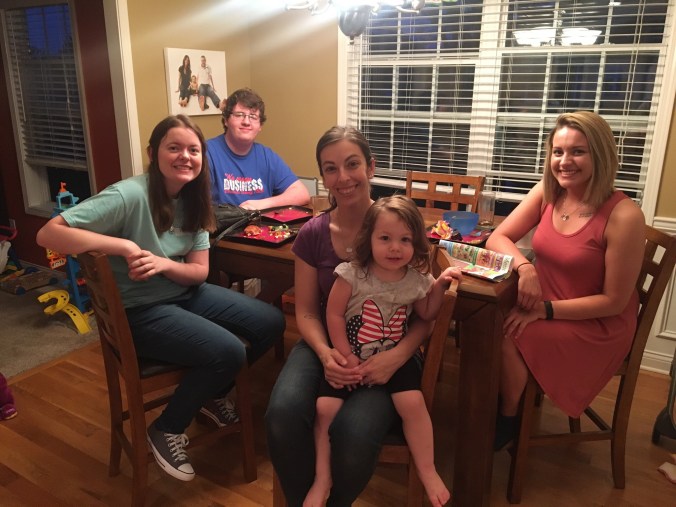
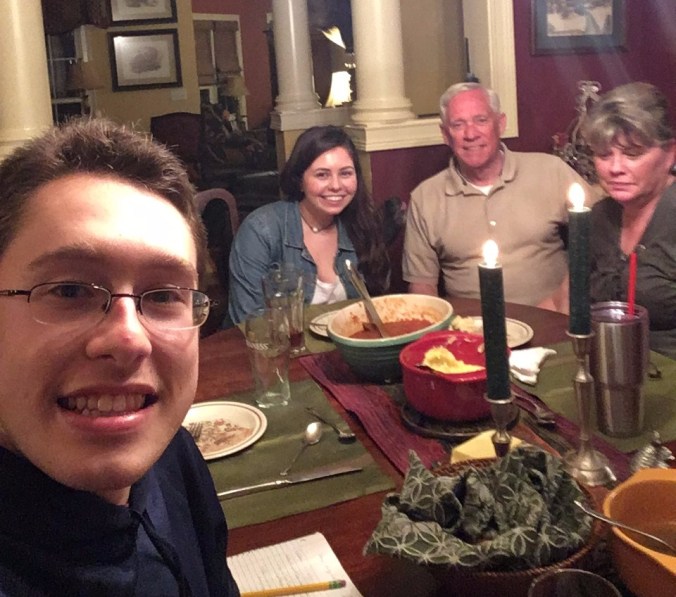
Image-1.png

Alvaton, Kentucky Kitchen Table

By Annie

On a drizzly evening on April 17th, after a rather quiet drive as my maps app took me on the most roundabout course possible to get to our destination, Antonio and I pulled into the driveway of a small house in Alvaton, Kentucky, a community about 30 minutes away from WKU’s campus. We were greeted by Allen, who met us at my car with a German Shepherd on his heels. After exchanging pleasantries, he led us inside where we were greeted by his wife Alisa, two more dogs, and two cats. Their home was quiet cozy, and I had no trouble getting comfortable on their couch and playing with their dogs as we waited for dinner to finish cooking. When we had arrived, Alisa had just put the rolls in the oven, which allowed the four of us time to get to know each other a little before we all sat down at the table.

And, wow, Allen and Alisa have done it all! Through their military backgrounds, they have traveled all over the world and have met so many different people. They have even visited the same college towns in Spain and England where I told them I will be studying abroad next semester. As a result, they always have a story to tell that relates to the topic at hand. We quickly began delving into political topics, something that seems to happen often when I am able to direct the conversation (as a student majoring in International Affairs, Spanish, and Arabic with a minor in Political Science, I have a quite a lot of opinions, as one might imagine). I soon learned that Antonio and I shared very similar opinions with Allen and Alisa, something that I was shocked to discover considering our very different generations. They are, to put it informally, pretty woke.

Both Allen and Alisa showed genuine interest in us and in our passions. After explaining my studies, Antonio told us that he was also majoring in Spanish as well as psychology. Allen was curious about what we both planned to do with our degrees once we graduated and, after hearing that I wanted to work for the UN but have never visited it, even went so far as to invite me to go to the UN with him for the annual conference he attends as part of his job (wow!!!). Allen and Alisa went out of their way to make us feel comfortable and at home, which is a character trait that I soon learned they exhibit in all facets of their live.

As our conversation progressed, we soon brought up questions that may have seemed controversial, but only further showed the openness and acceptance that Allen and Alisa both demonstrate. After a somewhat lengthy conversation about how many people seem to make judgments about Muslims or the Islamic faith in general, Antonio posed a question about Allen and Alisa’s own faith: does your religious identity relate to how you think we should treat other people? To set the stage, both Allen and Alisa are practicing Christians and attend church on a regular basis, and Antonio and I both went to private religious schools in Louisville. Allen and Alisa answered with a simple and straightforward, “yes, in every way.” When asked about how they believe Christianity and the LGBT+ community are meant to interact, they were very passionate about their belief that members of the LGBT+ community are, of course, welcome in their church. Alisa immediately quoted the passage, “judge not, lest ye be judged,” and explained that the desire of their church is to be a safe and welcoming space for all people, regardless of race, class, or sexual identity.

Similarly, when asked what social issues were closest to their hearts and why, Allen mentioned that he was very concerned about women’s reproductive rights. He told a story of how he was once being interviewed for a position and was asked his opinion on abortion, to which he replied something along the lines of, “Well, I think it’s terrible. I’ve never had one, and I’m never going to have one. I’m thankful I don’t have to make that decision because it is a weighty one that is not to be taken lightly, but it’s not my decision to make for whichever woman is contemplating it.” He didn’t get the job, but I appreciated his ability to be vocal about his belief without attempting to force it onto others. Another social issue Allen and Alisa mentioned was “fake news,” which he said is helping to create a misinformed electorate.

This fake news also ties into their response of what it means to be a citizen (besides voting, paying taxes, and obeying laws). They both believed that it is our duty to be informed, about current politics and events as well as about our history as a nation and as a world. Allen believed that, although my generation has a million and one tools at its disposal to gather information, these tools tend to not be used. This, he said, will be detrimental to our society, as political demagogues will take advantage of an uninformed public to advance their own agenda. Both Allen and Alisa mentioned how many people are unable to answer basic questions about U.S. history, citing a TV bit where an interviewer asked basic questions taken from a U.S. citizenship test to many students from the University of Texas (even the really smart ones, like the STEM majors) and most were unable to give correct answers to questions like “Who fought in the Civil War?” or even “Who won the Civil War?” Alisa said that another part of being a citizen is active community involvement at all levels of government, meaning that citizens need to call their representatives, go to town hall meetings, and show a genuine interest in and knowledge of governmental procedures within their communities that affect them and their neighbors.

One very encouraging thing that Allen said to me was that, despite what I may believe (I am notoriously a cynic), the younger generation that is beginning to rise up really is fantastic and really will make a difference, I’m just too close to it to see that. He said that his generation is a lost cause at this point, there’s no way to change their minds about things, but that once my generation comes to power, the world will be different. As someone who is deeply involved in political and social activism but also disheartened by the lack of progress I see, this came as a great relief to me.

Almost everything we talked about over dinner—which was delicious venison Salisbury steak with green beans, mashed potatoes, and the modern day manna that is Sister Schubert’s yeast rolls—related back to our class in some way; from the actual act of conversing with someone with no intention to be right, but rather to just put our opinions out there, to actually discussing how we can live well (or at least somewhat better) together. Dinner with Allen and Alisa showed that although we sometimes vary in opinion—for example, Allen said he was pro-gun—we are still able to find common ground on which to forge relationships. During one part of the conversation, when we were talking about how Islam is often misconstrued, I was reminded of Claudia Rankine’s Citizen (although this book is about race, not religion) in that, like people of color, Muslims must often face judgment, concerns, or different treatment from others that would not be passed onto Christians, or in Rankine’s case, white people. For example, Christians almost always take into account the context of a passage that they quote, and even regard that context as an integral part of understanding that specific scripture; however, many Christian critics of Islam (that I have observed, at least) fail to take into account the context of specific entries from the Qur’an. Partly because it is difficult to understand the context unless you are a scholar, because verses are ordered from longest to shortest, not chronologically or in a story format, and partly, I think, because eliminating the context makes it seem “bad” and gives them a better evidence to prove their point that Islam is wrong.

After we wrapped up conversation over desert, Allen stood at the end of his driveway with a flashlight and helped me back out, while extending an invitation for us to have dinner again sometime. All in all, I had a great time at dinner with Antonio, Allen, and Alisa. The openness of our conversation allowed us to get to know each other, and I noticed that on the drive back to campus, Antonio and I were much more talkative with each other, as well (it helps that my iTunes began playing an artist that we both enjoyed, nos encanta la banda mexicana “Jesse & Joy). It is amazing that in just two and a half hours, you can become comfortable enough with strangers to feel at ease sharing your opinions about rather controversial and deep topics. I wish the best for Allen and Alisa in the future, and may even take them up on their offer to stop by again!

IMG_5128

we cleaned our plates at our table!

Hannah’s KKT

By Hannah

Late on a Thursday evening I headed to a dinner where I was to eat with two girls I had never met before.  Very nervously, and after 10 minutes spent trying to parallel park, I knocked on the front door of my host’s apartment, cupcakes in hand.  I was greeted with the smiling face of my host, McKenzie, and an adorable, chunky little dog who seemed more excited than either of us.  Walking in I noticed the many walls dedicated to Western pictures, paintings, and other memorabilia.  We heard a knock on the door and welcomed in our other dinner member, Sabrina, who is also a Citizen and Self student.

Our Kentucky Kitchen Table took place in Bowling Green, Kentucky and consisted of many helpings of mac and cheese and chicken nuggets as well as Oreo’s and cupcakes.  As the three of us all sat around talking on couches and bar stools we realized how far from strangers we actually were and it seemed as though we had a lot in common.

I quickly learned that McKenzie had been my sister’s RA for two years and it was funny to realize how connected we were.  She asked me all about how my sister was, how Auburn and vet school were going, and especially about how my sister’s new puppy, a golden retriever named Zuri (all of which she knew), was. McKenzie seemed to have been close to my sister as she was very excited in telling me that they were Facebook friends and knew all about my sister’s 10 week trip to South Africa.  After filling her in on my sister’s life I asked her a little bit about her own life here in Bowling Green.  She graduated from Western and is currently working further on her psychology major and communications minor in School Psychology and the EDS program.  She is from a rural area outside of Louisville but both of her parents attended Western which is where they met and fell in love.  Growing up Western was the only school she had really ever thought about going to and she still thinks it was the perfect decision. 

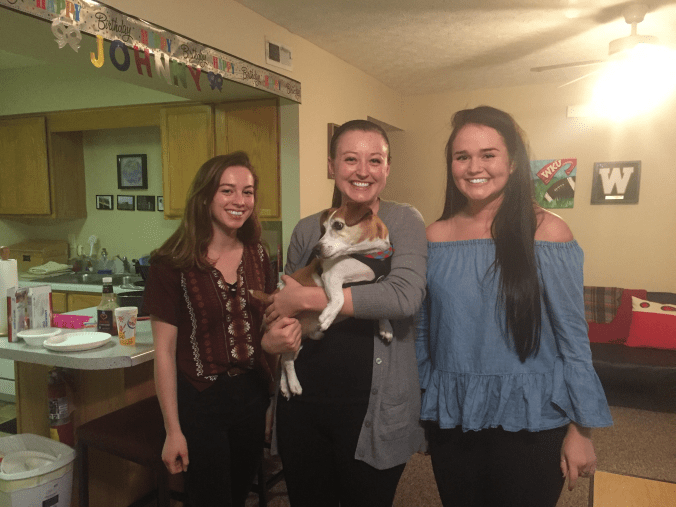
When asked how she described herself, McKenzie said that the one thing all of her friends described her as was an intense lover of senior dogs.  Her dog 10 year old dog Johnny Karate, yes named after Parks and Rec, was her newest addition to the family, being rescued from the shelter, and never left her side.  Her love for him was evident in the many chicken nuggets he was slipped throughout the night, and even though she said he did not get that special treatment often I had a feeling she was just hiding how spoiled he was, as shown by his very large belly.  She told us the story of how he was found in a Walmart parking lot so she felt that she had to make up for this by giving into him, saying that he won the arguments most of the time.

I learned that Sabrina also has a degree involving communications and the two talked about who their favorite professors were and McKenzie gave some insight on who Sabrina should try to take and who she should steer clear of.  I also learned that Sabrina came to Western not knowing anybody from her hometown of Nashville and, like me, had made a lot of friends here.

We all three talked about whether we enjoyed living here or not and all had different answers which I thought showed our different personalities. McKenzie said that while she loved living in Bowling Green and loved the people here she wants to move somewhere else after living in Kentucky for her entire 23 years of life. She noted that on her study abroad trip (which I will discuss later) she fell in love with the weather in England as it never got too hot and snowed just enough for you to say “wow this is pretty” and not “oh I hope I’m not snowed in for weeks.” Sabrina, being from Nashville, said that sometimes it gets a little boring, which I can agree to.  I personally love living in Bowling Green but I think I should attribute that to the fact that my parents are not here to tell me I can’t go out past midnight (sorry mom.)

As we ate our meal, we talked about how our semesters are going and our plans for the coming years.  We all seemed to have an interest in studying abroad and McKenzie told about her experience, as Sabrina and I were very intrigued. McKenzie studied in England at Harlaxton and told of all the fun adventures she took when she had time away from all of her school work.  She said it was one of the greatest experiences of her life. Sabrina shared her plans of studying in Norwich, England at East Anglia University in the Spring of 2018.  I too am interested in studying abroad and while I have not committed to a trip I am very interested in taking a weeklong trip to Bolivia where nursing students can help underprivileged people by setting up medical tents.

Once we were finished eating and we seemed to be running out of things to talk about, as strangers eventually do, and before things got too awkward, we got to the core question and the real reason we were there.  We asked McKenzie what citizenship meant to her, beyond things like voting, paying taxes, and following laws.  There was a long pause and we all chuckled a little as she said she needed some time to think of her answer.  After a few moments, she concluded that being a citizen means that we all help each other out.  She said “we are all here on this Earth together, we might as well make it easier for each other instead of getting so wrapped up and miserable in our own lives.”  Another thing she said that I really liked was that our goal as humans should be to make our little corner of the Earth a little brighter and that kindness is such a small thing but that we don’t have enough of it, meaning we just need to try and pick everyone up and make the world a happy place.  Sabrina and I both agreed and added a little bit to what we thought being a citizen meant.  Sabrina said that citizenship is about the community and working to live well with people around us, even if it gets hard sometimes.  I personally think that we all need to be kind to each other because as cliché as it sounds, we really do not know what is going on in other people’s lives.  After we all talked about what citizenship meant to us McKenzie jokingly asked Johnny what he thought it meant and I imagined his response to be something along the lines of “citizenship means kindness and kindness means you give me more nuggets.”

While our conversations never got super in depth on our values or our morals or anything of that nature I noticed how similar our lives were in many aspects and how easily it was for all three of us to share about ourselves. This dinner taught me that even though we may not all come from the same places, we are not all necessarily interested in all of the same things, and we are varying ages, there can still be thoughtful, pleasant, and insightful conversations.  I think that McKenzie was a wonderful example of being a good citizen by inviting two random college students into her home and helping them with a project, this is kindness on her part. On mine and Sabrina’s side, kindness came from the thoughtful desserts and help we gave each other.

This whole experience relates to the central question: “How do we live well together?”  We talked about how kindness would help us all live better together.  We were all very accepting of each other and respected what everyone had to say and this is yet another example of how we live better together.  This assignment reminded me of the reading that we had at the very beginning of the semester called “How We Talk Matters” by Keith Melville.  In the article, Melville discusses the effects of listening and not just talking.  To make the world a better place and to begin to live better together we need to thoughtfully listen to others instead of discarding opinions different than ours or discarding something someone says simply because they are different than us. In our conversation about what citizenship meant to us we built off of each others ideas in a very positive way and I think this should be something the world as a whole does more often to make everyone happier and live better together.

Going into this assignment I just wanted to get it over with because I am a somewhat shy person but McKenzie and Sabrina were very easy people to talk to and I think that we all had a very good time.   Overall I very much enjoyed this assignment and getting to meet new people and hear about their lives and talk about our differing opinions on certain things. 

kkt.png

By Nicole

My Kentucky Kitchen Table took place at a sociology professor’s home in the city of Bowling Green, Kentucky. There were four members at our dinner: the professor, Lauren, Madison, Kaleb, and myself. Lauren’s daughter was there eating with us as well, but she was two years old, so there were technically four people at our table. During our Kentucky Kitchen Table, we ate fruit salad and chicken salad in crescents. It was delicious. I am a picky eater, so I was unsure about whether or not I would like it, but it was really good. After we finished eating, we were hanging out at the table talking, and then Lauren’s daughter wanted to go outside so we moved our conversation to the outside furniture. Then, she wanted Lauren to watch her swing, so we moved to the swing-set and stood around and talked.

Lauren is married and has two children. She is from New York. For graduate school, she moved to Ohio to attend Bowling Green State University. She met her now-husband and started working as a professor at Western Kentucky University in Kentucky. During our Kentucky Kitchen Table discussion, she told us that she pays more for childcare than she does for her mortgage every month. One of the most important issues that she cares about the most is the Fairness Ordinance, which is the ordinance that supporters are trying to be passed by the City Commissioner’s Office in Bowling Green, Kentucky.

Kaleb is a freshman who is from Somerset, Kentucky, which is only about an hour away from campus. He was more shy during my Kentucky Kitchen Table than the rest of us. He wears glasses, wore a t-shirt and shorts, and lives in Minton Hall on campus. He is technically a sophomore and he is majoring in computer information technology. During my Kentucky Kitchen Table discussion, I learned that his father is a high school teacher who once was laid off, and when his father was laid off, his family was on food stamps for a few months. I found that interesting because I did not expect to learn that he and his family had been on food stamps.

Madison is a freshman who is from a town close to Maysville, Kentucky. She lives on a farm. To the Kentucky Kitchen Table, she wore a dress and a pair of boots, which was a cute outfit in my opinion. She is a freshman this semester. She was pre-med, and then she switched to pre-nursing. She had blonde hair. When I first saw her, she looked like a popular sorority girl. However, I was surprised by how she was much more than just a popular sorority girl. She was kind and was happy to help Lauren with her two-year-old daughter, Tenley. She has a country accent and tattoos. One of her tattoos, which I thought was really interesting, was “Just Breathe” written on her wrist. That particular tattoo came from words that her mother told her when she would have an anxiety attack, which happened frequently when she first came to college. During the Kentucky Kitchen Table, I learned that her father is a high school teacher. He used to work with mechanics and then got a pacemaker. When he got a pacemaker, he was laid off and then her family was on food stamps for a short period of time. I was also surprised by learning this because I did not expect to learn that she and her family had been on food stamps.

We spoke about a wide range of topics during our Kentucky Kitchen Table. We spoke about how citizenship and being a good citizen in society is helping and caring about other people around you. It also means thinking and considering what other people are dealing with and going through when making decisions and living our lives. One example that Lauren brought up during our Kentucky Kitchen Table was the Fairness Ordinance, which is an ordinance that protects LGBTQIA+ people from being discriminated against based on their sexuality and gender identity. As she pushed her daughter on the swing outside and we stood around her, she said, “Obviously, I’m not gay, but that doesn’t mean that I can’t be sympathetic to people who are gay and may identify as a different gender.” We discussed how citizenship means considering others around you instead of thinking only about yourself. We discussed how in America, we sometimes end up only thinking about ourselves and what we go through. I brought up how with the attempt of passing the American Health Care Act by the Republican party recently, the politicians are wealthy, white, and did not consider the ramifications that that healthcare legislation would have had on the impoverished communities in America who rely on Medicaid.

When we discussed listening to others and considering what others are going through, we discussed the factors that play into poverty, including institutionalized racism and job availability. We also talked about the difference between a personal problem and a public problem. For example, if one couple gets a divorce, people around that couple may think that that is simply a personal issue between that couple. However, if divorce rates have gone up in the community where that couple lives, then it becomes a public issue. Therefore, we talked about how we need to stop only thinking about ourselves and see the bigger picture. This discussion made me think about wicked problems and how there are a lot of different factors that go into solving wicked problems.

We talked about social issues that we are passionate about. One social issue that Kaleb talked about was Medicaid and food stamps. He talked about how he does not like that some people think that people who are enrolled in Medicaid or get food stamps are simply lazy and do not want to work in order to afford their own food and health care. That was when he told us about his father getting laid off and how his family was on food stamps for a certain period of time. I talked about how I was passionate about the issue of sexual harassment and sexual assault because I was sexually harassed by a coworker and I was extremely bothered by that incident. However, when I was harassed by him, I did not realize that it was sexual harassment because it was something that was extremely normalized in our society, which makes me feel sad about our society. Normalizing acts of harassment enables rape and harassment culture to continue, and that is something that I am passionate about ending. Madison talked about how she was in an abusive relationship and when she was in that relationship, she did not realize that it was abusive. She continued that relationship for a long time and then when she broke up with him, he called her over 40 times and left a bunch of voicemails where he threatened to kill himself because of her, which is one of many forms of emotional manipulation that he worked on her. Therefore, because of that situation, she is passionate about stopping abusive relationships and helping victims of abuse.

We also talked about the abortion-genocide pictures that were featured on campus in Centennial Mall recently. In general, the pictures were pictures of aborted babies and the displays compared them to pictures of genocide throughout history, such as genocide in Cambodia and the Holocaust during the 1940s. Lauren told us that those pictures have not changed since she was a student at college during the 80’s. I talked about how those pictures will not change anyone’s mind about the issue of abortion. Madison told us that she was pro-life because she came from a very small town where everyone was pro-life. I told her that I used to be pro-life until I took a step back and thought about the issue from the perspective of a woman who has had to get an abortion. We discussed how it is important for us to have a healthy debate about the issue of abortion, not compare it to genocide and make pro-choice supporters angry and not want to debate the issue. That topic that we were talking about made me think about the “Importance of Argument” reading that was in Week 1 of class. It is important for us to deliberate on topics instead of yelling at each other and not wanting to compromise on the issue. This could connect well with the “How We Talk Matters” reading, too. Deliberating is important in order to get things done in society.

Overall, I learned how although we all came from different backgrounds and had different views on things, we all still had similarities between us. I also learned how there are so many wicked problems in our world, including Medicaid, poverty, the minimum wage, and abortion. I could connect what I learned at the Kentucky Kitchen Table with the “Wicked Problems” reading because there is no right or wrong way to solve these problems. There are only better or worse ways to solve the problems. I appreciated the Kentucky Kitchen Table dinner because it helped me get different perspectives on the world around me.

Image-1.png

Potatoes, Dessert, and Community

By Elijah

For my Kentucky Kitchen Table, I decided to host mine in my hometown of London, Kentucky which is roughly two and one half hours east of WKU. Leading up to my Kentucky Kitchen Table, I was honestly a little bit nervous about the conversations that were to come. Generally as a rule, I have been taught not to bring up politics, religion, or any other sore subjects at the dinner table. The night of the meal however, I was going to do just that. I also didn’t want to ask anything that would make anybody uncomfortable. To my relief, everybody at my meal was really cool and very honest about each of the topics I brought up. It also helped that whenever there was a small lull in the conversation, one of my guests was ready to step in and get the discussion going again. Let’s meet this delightful cast of characters.

First, we had a woman named Juanita who went to high school with my mom. She used to be employed in social work, but now she taught social work classes at Eastern Kentucky University. Juanita has a Baptist background. With Juanita was her husband Bill. Bill was the lone atheist at the table and he worked as a security guard. Bill is always a fun guy to be around as he always makes conversation livelier. Sitting next to Juanita was a very good friend to my family and me. His name is Alex. Alex has a degree from the University of Kentucky in chemical engineering. This fall he will be going back to school to get his doctorate in chemical engineering. He’s a smart guy. Although growing up Baptist, Alex is very open to religious diversity having attended different denominational churches. In fact, while he was at UK, he attended a Methodist Bible study. To the left of Alex was me. I grew up Baptist but I also attended many different churches. I really try to promote an atmosphere of religious and all-round diversity and acceptance. I am a freshman at Western and I began my college career studying mechanical engineering. I recently changed my major to strategic marketing however, and will begin taking business classes next semester. Beyond that, I am a very creative person and I love writing music and performing on stage. To my left sat a couple that I respect quite a lot. Their names are Dan and Debbie Eubanks and they moved to Kentucky from Missouri about five years ago. Dan and Debbie came to London because Dan was employed at my Baptist home church as our discipleship pastor. Dan and I instantly became close friends because of our shared dry sense of humor. His wife Debbie is also very involved in the church and is a very kind-hearted person. Ever since I have known them, Dan and Debbie have been great role models for me in my walk with Christ. To Dan’s left sat my cousin Donavon. Donavon just graduated from Union College in Barbourville with a degree in history and political science. He was also there on a soccer scholarship. How cool! He actually just landed a position to work with a very prominent politician in the state. Donavon’s church is non-denomination and is inviting of people from all denominations. Finally, next to Donavon was his girlfriend Destiny. Destiny grew up Baptist, has a degree from the University of Kentucky, and now is in social work. In her job, she helps put troubled kids with a good influence that also has similar interests as they do.

We had some interesting diversity at our table which brought fresh perspectives. For example, Dan who is a pastor sat across from Bill who was an atheist. We had generational diversity as well. Juanita and Bill are in their forties; Dan and Debbie are in their fifties; Donavon, Destiny, and Alex are in their twenties; I was the youngest of the bunch at eighteen. We also had a mix of republicans and democrats.

At the beginning of the meal, after we made our plates of course, I got the conversation rolling with my first question. “Beyond voting, paying taxes, and following laws, what does citizenship mean to you?” Because this was the first question and the guest were just beginning to get to know each other, it took a few minutes for the conversation to hit its stride. The table came to a consensus that it meant being a good person and having a positive influence on society.

Next I asked, “What social issue is closest to your heart and why?” Destiny said that this question was bringing out her inner social worker which resulted in laughter from around the table. She said through her work, she believes that a child coming from a home with a parent in prison for any amount of time has a major affect on them and that this is an issue not many people think about. Everyone at the table seemed to agree with her and we listened to her talk about working with children from this kind of background. During this particular conversation, I explained to everyone a concept I had been discussing in Citizen and Self called wicked problems. I told them the characteristics of wicked problems and gave a couple examples and said how the problem aforementioned by Destiny could be referred to as a wicked problem.

I noticed that after each question was answered, the conversation would come to a slight halt and people would wait for me to ask another question. I wanted the conversation to be natural so I told everybody to just talk about whatever they would like and I would occasionally ask another question. I wanted to be sneaky when bringing up the issues I wanted to discuss, so I slyly slid them into conversations. I overheard my mom talking to someone behind me. She was bragging on me which she like to do because let’s face it, I’m pretty cool. She was telling them about the part of the dinner I prepared which was the potatoes and the dessert (see a picture of the desserts below). I wasn’t the only person at the table at my table and I repeated it and effortlessly slid in my next question. I said, “Yeah, I made the potatoes, the dessert, and what kind of community do you want to live in?” Laughter ensued. After the laughing died down and several guest commended me for my efforts, Juanita answered the question and hit the nail right on the head. She said she would like to go back to a community where people would sit on their porches in the evening, you could leave your door unlocked, and people were friendlier. The table also agreed that we wished there could be more face-to face interaction rather than just texting and social media.

The conversation shifted for a few minutes to Donavon’s new job working for the prominent politician. After a few minutes, it was time to bring up my next topic. I waited for my chance and took it. “Hey, Donavon, now that your working for {prominent politician}, do you see your job as serving a greater purpose?” Honestly unintentionally, this time my segway actually made sense. I added that this question was actually intended for everyone. Destiny said yes. She said that she believed she was helping troubled kids get help they needed which ultimately served a greater purpose. Juanita also said yes because she was helping educate a generation of young adults. Donavon also said yes as he was helping a young, honest politician rise up so they could help people all around the state. The consensus around the table was yes although because Dan is a pastor, we joked that Dan wasn’t serving any greater purpose.

The last question I asked was, “What advice would you to people running for office in our country?” Although we joked at first and said they should lie and do whatever it took to get to the top, we eventually came up with some good answers. Everyone gave a good answer to this question. We discussed Dan’s answer, which was the most specific, the most. He explained that they should abolish Amendment 16 which would get rid of federal tax. This led to a small political debate before I gave my answer. At the end of the political discussion, I said that the ultimate goal of a politician running for office or anyone for that matter should be to help as many people as possible.

In Citizen and Self, we have done a lot of discussion about how beneficial deliberation is. During my Kentucky Kitchen Table, I really got to see a real-life version of this. It was very nice to sit around a kitchen table, eat a home cooked meal, and civilly discuss issues important to everyone at the table. In class this semester, we had a reading called “How We Talk Matters”. In the reading, Keith Melville points out that listening and deliberating allows issues to be solved rationally. This really proved true during my dinner. Further, I learned that when you bring people of different backgrounds together to discuss issues, you get a wide variety of solutions as well as different perspectives on the problems. Originally, I was only hosting the dinner because it was for a class, but after doing it, I would love to do it again sometimes. In a digital world, it is so relieving to sit around a dinner table and just talk to people, especially when it’s over a good meal.

Healthy Conversation

By Bethany

My Kentucky Kitchen Table took place on a warm Sunday afternoon on the farm where I grew up in Hartford, KY. Participants included my two acquaintances Elizabeth, a marketing student, and Andrea, a psychology student. They brought along their two boyfriends, Hunter, a pre-med student, and Nathaniel, a participant of Chinese Flagship. My fiancé Seth, a paramedic, also attended. My parents, Karen and Brad, were the hosts. They are both members of the baby-boomer generation. My father is a manager at a local factory and my mother is a manager at a local restaurant. For everyone, it was our first home-cooked meal at a table in recent memory. This was also our first gathering together for the college students, and definitely our first time discussing topics outside of classes and our social lives.

We all shared a wonderful Italian dinner. My parents and I made the red sauce and noodles. Nathaniel and Andrea brought some delicious homemade brownies. Elizabeth and Hunter provided a wonderful white sauce. Seth brought us some zesty garlic bread to eat with our meal. My guests sat in the living room while my mother and I made final preparations for the meal. We set the table, got everyone their drinks, and soon after, we headed to the table.

To begin, we started off with some nice conversation about ourselves, our hometowns, and our aspirations. Elizabeth wishes to have a job in marketing with a business. Nathaniel also wishes to pursue a career in marketing, but is also fascinated by Chinese culture and language. He wishes to incorporate this passion into his career somehow. Andrea dreams going to a great graduate school and being a criminal psychologist. Hunter wants to go to medical school to be an anesthesiologist. Seth aspires to further his education and become a physician’s assistant. I would like to go to graduate school also. I want to get my masters of public health and make access to reproductive health services more accessible to members of my community. My parents, still young at heart, also have aspirations. My mother would love to publish a book, and my father dreams of gaining his pilot’s license.

I soon asked the first question: “Beyond voting, paying taxes, and following laws, what does citizenship mean to you?” Nathaniel spoke, saying that he feels that being a citizen includes having a positive influence on your community. He thinks that working to improve your community and helping others is a great way to do this. Everyone agreed on this. My parents added that citizenship means being a productive member of your community and working to improve yourself. To them, this meant having a job if you can work, helping your neighbors, and being a proactive member of the community. I questioned my table on what they thought we could do to be proactive within our communities. They answered that volunteering, participating in community events, building relationships, and attending community meetings regarding local legislation we all important to being a proactive citizen. We all also agreed that we could improve on doing these things.

My second question was: “What social issue is closest to your heart and why?” The table fell silent. It seemed as if everyone was kind of afraid to speak up. So I offered my answer: Healthcare. My fiancé, the paramedic elaborated a bit for me. He believes that everyone should have access to healthcare, but the issue with this that he sees in his profession is many people abuse resources like Medicaid. Hunter agreed with this, but pointed out that some people really do need those resources. We had found our first wicked problem. My father told us about what healthcare used to be like. Apparently, healthcare insurance did not exist before the 1980’s. He described how his father and mother would just write checks directly to doctors to pay for broken arms and doctor’s visits. Andrea asked how people could afford to do this. My father explained that healthcare was somewhat affordable before insurance companies came into the picture. It was after insurance companies that the price of healthcare skyrocketed to the prices of today. Elizabeth pointed out that everyone might not have been able to afford healthcare, even before insurance companies, which brought back the question of how can we make healthcare more accessible to other people.

I spoke and said if healthcare providers could come together to open clinics for people that operate outside of big insurance companies, perhaps then we could make healthcare more accessible. I told them my personal dream of opening a clinic for women and expectant mothers who otherwise couldn’t afford the care that my practitioners would provide. I hoped to set up affordable prices for services and exams, and to offer payment plans for patients without insurance. I also would enjoy to set up a network of practitioners, community members, and physicians who would like to see this positive change within the community. We agreed that coming together as a community would be helpful, but it isn’t necessarily realistic to always count on finding common ground.

My next question proved the most difficult to answer: “What do you think are the best things about our world today?” I immediately saw everyone making awkward eye contact and chuckle, as this was the weekend following airstrikes on Syria. The news lately was, for lack of better word, depressing. I acknowledged the tension, saying that yes, sometimes being positive was difficult, but everyone should always try to look on the brighter side of things. Nathaniel then spoke. He said that he felt everyone, in their own way and through their own opinions, genuinely did have the best intentions at heart. Everyone seems to care and want the best thing for others, even if we don’t all agree on what the best thing is. Seth said that this was especially true of our generation. He thinks that all of us want to improve our community in one way or another. My mother said that she enjoyed the resilience that people in our age tend to have to adversity. People today do not simply let others put them down. They fight back and try to promote positive change and they have hope for the future, despite everything. Perhaps things today are not as bleak as they seem.

To top off our dinner, I asked our final question, one that I felt would be pretty easy to answer: “What advice would you give people running for office in our country?” Elizabeth spoke immediately, saying that she thought that they should try to communicate clearly and honestly with citizens. They shouldn’t lie to us and give us false expectations just to get elected. Hunter agreed with this, and said that we need people in office who really represent us. We should shy away from career politicians and try to elect more business people, educators, and more citizens from diverse populations. We all agreed on this point.

I was pretty nervous about hosting this dinner. I have never done anything like this and this was my first time having this large group together. I was worried about a fight or someone possibly getting their feelings hurt. I was genuinely surprised with how well everyone got along. With my parents being baby boomers, and us being a part of generation x, I was worried about clashing opinions. But generally, we all had the same ideals and intentions, but different perspectives, which is a good thing. The topics discussed reminded me of the three questions we discuss in class. How can we live better together was encompassed in our discussion about citizenship. How can we take more control of our lives and help others do the same was related to our discussion about electing officials. How do we solve problems was a theme in our healthcare discussion. “How We Talk Matters” was truly relevant to this assignment. This passage highlights that deliberation is a skill that we must hone. Calm, respectful communication was key at the Kentucky Kitchen Table and is vital for understanding one another.

I am thankful for this assignment, as it opened my eyes to the opinions of others. I also helped me to not be afraid to speak my mind and express my feelings. It allowed me to better understand my parents and a few of my peers. These topics are ones we rarely speak of at home. This allowed me to get to know my parents better and to understand their thinking better. I won’t be as nervous to talk about issues with them because, as it turns out, we are not as different as I thought. I am also thankful for the connections with my peers, because without communication, we will never be able to make our future as great as we have the potential to.

Inclusiveness and Citizenship

By Christen

For my Kentucky Kitchen Table project, I decided to go back to my home in Springfield, Tennessee to have the meal. I chose to go home for this project not only because I knew it was where I would feel most comfortable, but also because I am moving to a new house in the next three days. I wanted to have one last formal meal in the house that I have grown up in for the last fourteen years. Although it was bittersweet to eat one last meal in my home, it was also a great experience that I learned a lot from.

I had a very interesting and fun group of people attend my Kentucky Kitchen Table. My mother Fonda, my younger brother Caleb, and my aunt Karen were some of the participants. My mother also invited two of her co-workers whom I had heard about, but not met at that point named Odaylis and Gelissa. These two women have very similar backgrounds that have helped them bond and become best friends. Odaylis, who recently became an official American citizen, is an immigrant that spent the first part of her life living in Cuba. She traveled to the states with her mother and grandmother, and now lives with her husband of two years who hails from the Dominican Republic. Gelissa on the other hand was born and raised in the United States. However, her mother’s side of the family is also of Cuban descent, while her father’s side of the family is African American.

Before starting the project, I was very worried that it would be hard to make the conversation flow. I was afraid that it would just be question after question answered with simple answers. However, that was not the case at all. It seemed that after the first question was asked, we just kept talking and talking. The conversation flowed so well that I often had to steer the conversation back on track. I started by asking the required question about citizenship, and being a new official citizen, Odaylis gave one of the best answers. To her, citizenship was of more importance than to a person that was born in the states and automatically labeled as a citizen. She thinks that being or becoming a citizen is about being apart of something bigger than yourself. She goes on to explain the benefits and the sense of inclusiveness that come with officially becoming a citizen. Somehow, the conversation went from discussing citizenship to discussing how to expunge certain behaviors off of criminal records. This conversation had nothing to do with any of the questions asked, but the information was very entertaining and overall useful.
After getting back on track, we next talked about the importance of community. Like earlier in the citizen question, overall inclusiveness seemed to be the theme. My participants also noted that they wanted to be a part of a community that was safe, open, friendly, and diverse. My mother went on to explain that these were some of the key things that she looked for when purchasing the new house that we are about to move to. Diversity and safety are important factors to her when choosing a new home because the neighborhood where we currently live is not diverse in the slightest.

Next, we discussed the importance of the job that my mother, Odaylis, and Gelissa do. They work for a healthcare company known as Bridges to Care. Again, the theme of inclusiveness and equity was brought up again. Everyday these three women strive to provide healthcare to individuals that my mother describes as “ people who have not been treated fairly”. She goes on to explain that these are usually people that don’t have any health insurance, not official U.S. citizens, and are also very poor. Because of this, these people are treated differently when they go to seek any kind of medical care. “ The bulk of our job”, she explains, “ is about making sure that people are treated fairly and are able to receive the services that everybody else receives”. Odaylis explains that she thinks that there line of work is important to her because in most cases, the people that come to Bridges to Care are all out of options. Bridges to Care are the only ones that will be able to help these people get the services that everyone deserves.

If I had to pick an overall theme for my Kentucky Kitchen Table would be inclusiveness. I think that inclusiveness is the key to one of the central course questions, “How do we live and work well together”. When considering plans that will help people of different backgrounds and different beliefs live well together within a community, it is important to make sure that everyone’s opinions, beliefs, and ways of life are taken into consideration.

Kentucky Kitchen Table in Small-Town Kentucky

By: Sophia
IMG_4908IMG_4909

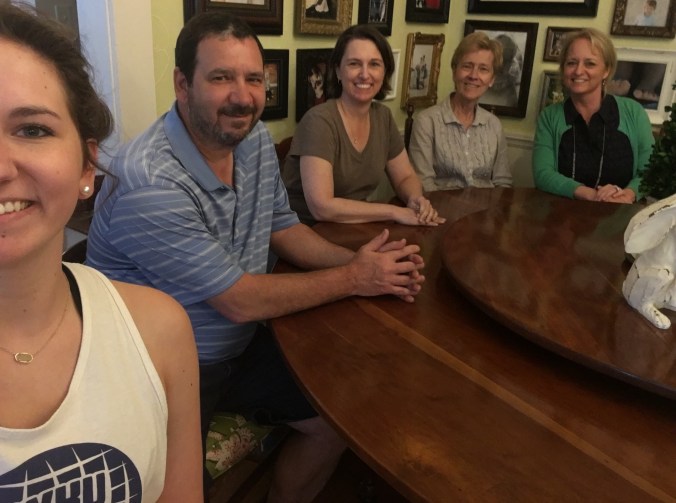
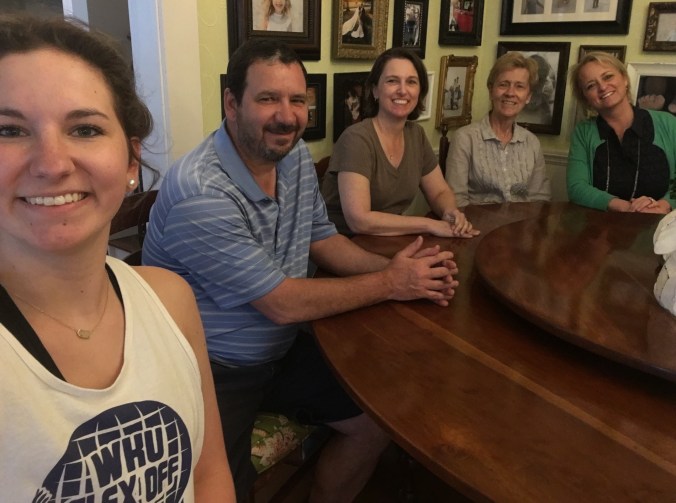
This dinner took place in the small, but developed town of Owensboro, Kentucky at in my parents’ home where I grew up. My mother and father, Jennifer and Philip, hosted this dinner for Frankie, Jeanne, and myself. We gathered around to discuss citizenship and enjoy my mother’s homemade burgoo, Frankie’s cornbread, and a delicious rum cake provided by Jeanne. I prepared by helping my mother with the burgoo, setting the table, and cleaning up afterwards. In the picture we are seated (from left to right): myself, Philip, Jennifer, Frankie, and Jeanne. Jennifer is a Registered Nurse in the Neonatal Intensive Care Unit and currently pursuing a doctorate in nursing. She has a passion for helping others and is a talented learner. Philip is a supervisor at the Toyota Motor and Manufacturing factory in Princeton, Indiana. He commutes an hour and a half to and from work each day. Philip is a war veteran who is proud of his service in Operation Desert Storm but reluctant to talk much about his days of combat. Frankie is a retired state employer who loves spending time with her grandchildren and tending to her garden. She recently moved onto our street so we thought inviting her would make her feel welcome to our neighborhood. Jeanne was a former Human Resources consultant for the Health Park in Owensboro, Kentucky and currently owns and runs a children’s boutique called Kid’s Stop. I was worked at Kid’s Stop before Jeanne bought it and had to quit before she took over to move to Bowling Green. I went to see how the store had changed with her ownership and ended up inviting her to my Kentucky Kitchen Table. Following my mother’s footsteps, I am studying nursing at Western Kentucky University and share the same passion as my mother of helping others. I wish to further my education after obtaining a Bachelor’s of Science in Nursing by pursing a nurse anesthetist degree.
To begin our discussions, I first started with asking each guest what citizenship means to them beyond voting, paying taxes, and following laws. Philip, who feels underappreciated by the American government for his eight years of service, believes citizenship entails certain rights in which he respects and actively exercises. He believes he has earned these rights, as a citizen and a soldier, through his service in war. Other than my father’s opinion, a common theme amongst the other guests was that citizenship is being actively involved in your community and engaging in bettering the lives of those living in your community. Jeanne mentioned something unique that stuck well with me: “Citizenship is also having a voice in your community and your nation’s society.” After all agreeing to this, we discussed citizenship being in the context of a verb: in order to be a citizen, one must be engaged in their community and in making it a better place. Jennifer talked about her years of community service as an active member of the Owensboro Junior League and how she feels she made a difference in the people’s lives for which her services were helping. “Our main focus was concentrating on issues and services in the community that were actually going to help people for longer than a day or two” By this she meant, for example, working with those in homeless shelters on reading skills. Jennifer feels as if, by doing services like this, she was giving people opportunities to better themselves and their lives by sharing and teaching helpful skills. The other guests shared times they felt they had done their duty as a citizen and helped their communities in various ways. Frankie enjoys taking her 20-month old granddaughter to the animal shelter and feels she is brightening the lives of the animals of the community and, in turn, helping the community. Jeanne tries to do various community service but finds she does not prioritize it and it, therefore, gets put on the backburner. She also tries her best to help the parents of Owensboro by offering higher-end children’s clothing and doctor-recommended children’s footwear for more-than-fair prices at her boutique, Kid’s Stop. She often has sales where she will make no profit off of her merchandise because she believes it is her way to help her community. I am required to serve a minimum of fifteen hours of service a semester for my sorority at Western Kentucky University.
After overall agreeing that an important aspect of citizenship is serving and bettering the community, we got a little side-tracked. Jeanne shared the struggles and excitements of moving Kid’s Stop to a different location. After many congratulating and encouraging words from the other guests, I directed our conversation towards politics in America by asking, “What is the most impactful decision the Trump Administration has made since being in office?” My father was the first to respond by saying he believed the recent bombings on Syria have been the most important and impactful decision made thus far. My mother and Jeanne quickly added nods and words of approval while Frankie shook her head expressing her disapproval. My father elaborated on his first statement by arguing that president Trump was decisive and has reminded the world of America’s military power. Jeanne agreed and mentioned that this decision was a “nice alternative to the Obama Administration who always said they would do something about gas bombs and never did.” Jennifer chimed in by saying that the people, especially the children, living in Syria need someone as strong as America fighting to stop the torture and killings, and Trump has shown that America will fight for them. Frankie disagrees; however, she understands why the decision was made. She fears another Cold War, or worse, more terrorist attack on American soil as a result of these bombings. Although afraid of the possible outcomes, she agrees that something needed to be done to help save the people Syria.
After feeling like we had discussed enough about the dreaded topic of politics, I decided to brighten up our conversation a bit by asking, “what kind of person do you want to be?” I was reluctant to ask this question because my parents and our guests are not young adults. But after some thought, I realized this question is not, “what kind of person do you want to be when you grow up,” but “what kind of person do you want to be each and every day?” I felt like Frankie had read my mind and knew my initial concern with my question because she quickly answered by saying, “I am 77 years old and I work each day to be the person who God wants and who I want to be. It is a life-learning process.” She went on to explain that she wants to be someone who her grandchildren look up to every single day. Someone who helps others and is empathetic of others’ situations. “With every encounter I have with someone, I try to keep in mind that this person has different experiences than me; therefore, has different feelings and opinions that I must appreciate even if I don’t agree.”
This made me think of one of the central questions of our course: “How do we live well together?” I think Frankie’s response to what kind of person she wants to be is one of many ways to answer this question. I brought this question up to my guests, telling them that it is one of the centralizing questions of this course, and my father’s response was interesting. He said that he had never thought of solutions to that question before and mentioned that the way Frankie tries to encounter people is a good start to people living together well.
I thought this was a good closing point for what I wanted to know for my Kentucky Kitchen Table project so I did not ask any more questions and allowed our new friends to genuinely mingle with my parent’s and me. Learning what we did about Jeanne and Frankie created the foundation for a strong friendship in which we all plan to keep.

Talking Over Tacos: A Discussion on Citizenship and Social Justice

By Grace

On Tuesday, March 28, 2017 I completed my Kentucky Kitchen Table. At first, I was not sure what to expect from the dinner. I wondered what kind of diversity I would find at our table. However, I found that there was a diversity of thought that was compelling, and I appreciated those thoughts which were in contrast to my own that gave me a new perspective. I ended up leaving with a greater sense of the purpose for the role I may play in our community. Among some of the topics we’d touch on, from various forms of discrimination and racism to leaving home for the first time, I felt empathy and sympathy—both for the characters described in stories of hardship and for the people sitting around the table with me. More than that, I felt optimistic for the future of our community because of the honest candor with which the others sitting around the table would express sentiments similar and dissimilar to mine. If we can continue to connect with people in the community in this way, there is certainly a pathway for progress.

The dinner was hosted by Leah and Chris who prepared tacos and other Mexican-style dishes for dinner. The WKU students at the table were myself, Victoria, and Gage. Victoria is a Spanish and Asian Religions and Cultures double major. She is also a member of the Chinese Flagship Program and has an interest in learning more about diverse cultures and ideologies. Gage is a student at WKU studying Economics. Leah works for the Center for Citizenship and Social Justice (CCSJ) and is very passionate about social issues. Chris is contractor who works in Nashville. Also, attending the dinner were McKenna, who is a senior at Bowling Green High Schoo, her boyfriend Cole, and Riley and Katie who are in middle school.

We began by talking about what citizenship meant to us. McKenna views citizenship as having rights, which are earned by being an active member of the community. To her, being a citizen is to have a house and to be able to go to school and get an education. As we discussed our views on citizenship, I envisioned the “bridge” metaphor that we often discuss in class. McKenna seemed to be focused on the right side of the bridge, which is where we want to be as a society. In other words, McKenna was saying that ideally we want to be able to live well together and have equal rights to the resources that are essential to our survival—like shelter and education. However, that is not the reality. Leah, through her work at the CCSJ, has had the experience to know that there is still much inequality in our society, and there are many people who are given less resources. Those people must work harder to have the life many of us are freely born into. She’s realistic about the hardships that many in our community face; she said, “It’s because I know what exists.” Leah described a situation where a fireman in Bowling Green was asked to resign from his post for perceived gayness. She also went on to note an article which cites dozens of criminal acts against people of different sexualities. She said, “there’s an obvious problem if a citizen employee can’t go to work without being harassed and picked on.”

As far as how we as citizens and as a community must get across the metaphorical bridge to become a more equal society, Leah had many ideas. She said, “Citizenship to me is being active in the community in some way, shape or form. There are numerous avenues where you are able to do that…reaching out to legislators, going to marches and protests.” She noted, too, how lately she’s seen even more citizens being active in the community during this past election season. Optimistically, she said, “I’ve been amazed at people working at things if they don’t like it…participating, going to city commission meetings, writing letters to the editor.”

I had a different point of view. I had difficulty seeing how certain protests and marches would really enact change because to some extent I felt as though protests were only dividing our country further. I think about what the “other side” (the people of the opposing viewpoint) will do in response to protests, and I wonder if these protests are effective in getting them to have a new perspective. Just as Keith Melville describes in “How We Talk Matters,” people often dislike conflict and also are so self-ensured about their opinions that they are unwilling to listen to others’ experiences and even to correct, factual arguments. Unlike Leah, I did not see protesting in particular as a particularly productive way to make progress in society because I worried that protests discouraged conversations between one side and the other on political issues. However, through my conversation with Leah, I realized that while protests themselves may not seem like a potential platform for an effective deliberation, they are a way of starting those conversations and engaging the community in a healthy discussion. The protest is simply a  spark for many deliberations to come. It forces people who witness the protest to look at the issues and to talk about them.

During the dinner, we also discussed different social issues, specifically those that were the most meaningful to each of us. Chris said that when it comes to social issues, people tend to think of “hunger, African children, third-world countries, but there are areas of our countries that do have hunger.” Chris feels the social issues here more personally because of the experiences he has in his life.  This discussion reminded me of a point that Ivan Illich made in “To Hell with Good Intentions” where he discouraged missionary work abroad. Similarly, Illich says, “If you have any sense of responsibility at all, stay with your riots here at home.” Here, Illich alludes to the issues that come up when people try to do good abroad, and fail to do so often without even realizing it. It makes more sense to focus on the problems we are experiencing within our own communities, where we can communicate well with the people we are trying to help and we are more likely to understand the issues when we have experienced them or seen them happening in our own communities.

While for the most part, Katie and Riley were silent on certain topics, Katie spoke up when we began talking about the obligation we have to people in our community to give them more of a say over their lives, like we often discuss in class. The overall consensus was that we do have an obligation to the people in the community who are less privileged and who have been born into their disabling circumstances. Katie gave the example of homelessness, a situation where, she said, “It’s not their fault if they’re homeless. We have more opportunity—it’s the right thing to do.” Chris supported Katie’s view. In his experience, working in construction in Nashville, he sees many Hispanic workers struggle to get access to health care because they’re illegal immigrants and are afraid to even deal with the government at all. Like Katie, Chris also said, “If you’ve been born into circumstances, I’m inclined to have a lot of empathy for [you].” Throughout this discussion, there was a theme of empathy and a call to service. However, we did not discuss how Katie and Chris might act on such calls to service. From this conversation, I learned not only that I’m not alone in my feelings of empathy for the underprivileged but also that I’m not alone in my inability to take that next step to help those in need. I suppose all of us feel these calls to service at one point or another and yet are unsure how to act. I believe this is due to the great complexity of these “wicked problems,” which are so large in scope and difficult to tackle that even those with the best of intentions may not have the time to dedicate to finding solutions to those problems.

While I tend to be more cynical about the issues we are facing today in our communities and in our country, this dinner made me feel more optimistic because even by being there I felt like I was engaging with the community in a new way. To sit down and discuss social issues with complete strangers and to come out of it having learned many valuable ideas, I think it will not be too difficult to contribute to my community in the future. I often unconsciously brush off responsibility for these issues because they honestly seem too large for me to tackle. However, throughout the course of this semester by discussing these issues in class and during my Kentucky Kitchen Table, I realize that not only must I own my obligation to my community, but also that I am able to do something even if it is simply by starting the conversation with others in the community. As Melville says in “How We Talk Matters,” these conversations “in town halls, in classrooms, among neighbors, or exchanges that take place over dinner tables” are where democracy begins.


IMG_0800


New Friends

By Margee

When I first began my Honors 251: Citizen and Self class, I understood that we were required to participate in a Kentucky Kitchen Table. A Kentucky Kitchen Table (KKT) is an opportunity for members of the local community to share a meal in a house with people they are unfamiliar with and discuss their lives and opinions. All of this was to be done in a very comfortable setting. I soon became very excited because there is nothing I love more than eating food and meeting new friends.

As the semester went on, I was assigned to a KKT that would be hosted at Dr. Alison Youngblood’s house, which was a comfortable walking distance from Western Kentucky University’s campus. Allison is a professor at Western Kentucky University (WKU) and she teaches Linguistics and Teaching English as a Second Language (TESL) for the Department of English. It was very nice of her to offer her home to us! The other adult who was kind enough to participate in the KKT was Dr. Leila Watkins, a professor at WKU who teaches Honors 251, as well as courses in English. All of these things I learned from emailing back and forth with them to try to set a date to meet for our KKT.

We decided to meet to share a meal on Wednesday, April 5th at 6pm at Alison’s house. When I first arrived, I entered the house and met Alison’s very sweet dog, Hazel. Hazel was quick to say hello and welcome me! I then met Alissa, another student at WKU who was assigned to this KKT as well. Alissa brought along 3 other friends who were very personable and added great conversation to our group. I had asked Alison and Leila if I needed to bring along any food or items, but both refused saying that they would arrange everything. All 7 of us sat down at Alison’s table together to share a meal consisting of green beans, fettuccine alfredo, garlic bread, clementines, and pizza. Alison also offered us La Croix- a carbonated spritz water that was flavored with a bit of coconut. It was a delicious meal, but the company was even better!

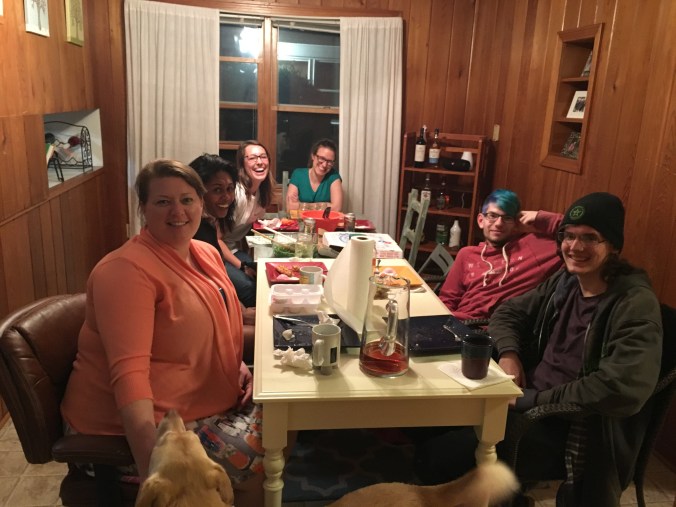
Our conversation first began with introductions and learning more about each other. While sharing a meal together, I learned that Alissa is a freshman from Louisville, Ky- like me- and graduated from Assumption High School. She is also a twin and lives with her twin sister in PFT (her twin sister is older) although she is also in the Honors College. She is pursuing a degree in chemistry with a minor in criminology. Alissa shared that she is an aromantic asexual meaning that she doesn’t experience romantic or sexual attraction. Alissa’s friend Emily is a fan of K-Pop and that is how they met. Emily is also very petite and talked about her little sister who is taller than her now. Alissa’s friend AJ was a bit quieter and was at the other end of the table, but always added witty comments and anecdotes to the conversation. I was also introduced to Dimitri who has really awesome blue hair! Dimitri and Alissa met because they are both openly in the LGBT+ community. Dimitri is gay and nonbinary and prefers the pronouns they/them in discussion.

While getting to know my new friends, I found that I was really enjoying the conversation. It was easy to find common points of interest, such as Alissa and I both growing up in Louisville and Leila and I have both eaten at a Mexican restaurant in White House, Tennessee. Leila’s husband works in Nashville and, of course, she works in Bowling Green so they found a happy medium by both commuting to their respective cities. Although I expected that I might differ to some of the party with my more conservative views, I began to feel accepted and understood by them when I shared what I thought. It was such a relief to be heard and known by them.

Trying to stir the conversation back to the required question, I asked the collective table members, ‘What does citizenship mean to you?’ Leila was quick to respond that to her citizenship means being a part of a conversation in which you are able to ask people about what matters to them. Also, the group added that being a citizen means that you have to be a part of the group to identify yourself as with the group.

This ties into the lessons we have been learning in Honors 251, such as learning about the importance of deliberations and discussing matters in a mature and collected way. I felt very comfortable sharing my opinions and listening to others’ in this setting. Also, I was able to discuss my experiences with short-term mission work in Kenya over the past summer. Alison was very interested because she discussed with us how she had lived in Japan for an extended amount of time teaching. I could just see from her discussion with us that she was so passionate about exploring different cultures and getting out of our comfort zone. Her passion encouraged me to pursue my interests in studying abroad.

We discussed the importance of being still and enjoying meals together with others – like how it was in Kenya for me. In Kenya, there was no clock around to check what time of day it was. There were no time restraints. The whole day was up to the decision of us and I loved that. Alison mentioned that she loved that about Japan, as well.

The grand gesture was when Alison brought out Mochi ice cream balls for all of us to try. It was such a treat because I had never tried one before. Mochi is originally from Japan and is a dessert made from ice cream with a confection sugar outside. Mine was chocolate flavored I believe and, although it had a strange texture, I really enjoyed it and was proud of myself for trying it.

Steadily the light in the room began to fade as the window grew darker and I realized that two hours had passed and I was still enjoying my company. While I was leaving, I began reflecting on why I enjoyed that so much and I think it was because sitting at a table with friends and family is one of my favorite activities. My family is a big advocate for family dinner at the table with no cell phones out and no TV playing in the background. Just our family, our food, and our conversation to keep us entertained. Enjoying a meal with my new friends felt like going home because I knew that just spending this time together learning from each other allowed me to truly breathe and reflect on my day. Those 2+ hours without checking emails or doing homework gave me an opportunity to re-evaluate what matters to me. And the next day when I saw Emily in line for Burrito Bowl on-campus for lunch, I was able to say hi with confidence because she’s my new friend.

IMG_4527From left to right: (Hazel (the dog), Alison, Emily, Margee (me), Leila, Alissa’s empty seat (she took the photo), Dimitri, and AJ