Brandon’s Kentucky Kitchen Table

By Brandon

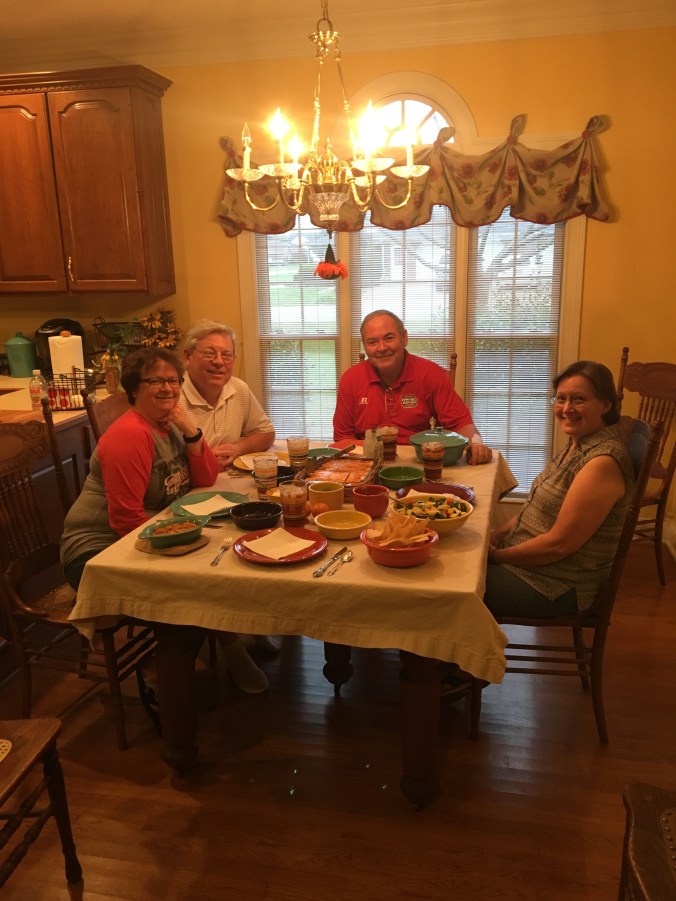
IMG_0832Left to Right: Me, Brandon, Dad, Mom, Ian, Braxton, Chapel, Sharon, Manyoo, Tricia

I had my Kentucky Kitchen Table at a good family friend’s house here in Bowling Green. The hostess, Tricia, is no stranger to friendly gatherings. She hosts small group bible studies occasionally throughout the year with potluck style dinners, so we’ve been unintentionally practicing for this for a few years. I could not think of a warmer house to have my KKT in.

Her husband, Ian, was born in Zimbabwe. His parents were missionaries so he grew up in South Africa. He came to America to get a degree in Mechanical Engineering at WKU. He has a fun accent.

I got to know them initially through their son, Brandon (he has the same name as me). We became friends in Middle School and have stayed friends since. He’s studying Advertising.

Brandon’s younger brother Braxton was hanging around too. He’s homeschooled, but also heavily involved in community sports.

As a whole, they’re all fairly conservative and strong Christians. Tricia is a stay-at-home mom that homeschools her kids, as well as a freelance writer.

My mom and dad are pictured on the left, in between Brandon and Ian. They like coming to Tricia’s house as much as me. My dad is a retired IRS agent and conservative. He grew up in East Tennessee. Mom works as a secretary for a federal probation office. She’s a registered Democrat but mostly stays out of politics. Overall, she’s a very optimistic person.

Across from them sat Ian’s brother’s family. His brother couldn’t make it, but his brother’s wife Sharon was there with their two adopted Korean children, Chapel and Manyoo. Sharon is a stay-at-home mom and a part-time substitute teacher. She’s also fairly conservative.

I’d never met Sharon and her kids before, despite knowing Tricia’s family for five years. Sharon’s pleasant to talk to and she was always one of the first to answer the questions. Chapel’s kinda shy and Manyoo is the opposite of shy.

Dinner started off with general conversation around the table. I waited until everyone was seated and had had the chance to eat a good portion of their meal before asking the first question. As for the food itself, my dad made some of his good ol’ homemade chili, Tricia made some excellent lasagna, and Sharon brought Korean potstickers. All of it was quite excellent.

I asked the required citizenship question first. It created a lot of blank stares and “Hmmmm” responses. Granted, it’s not something we really think about on a daily basis, or much at all, so I waited patiently for an answer.

Sharon was the first to give an answer. “Freedom,” she said. Everyone quickly echoed the sentiment. Group consensus wasn’t my goal, but everyone could get behind freedom, myself included, so I segued into the next question.

I asked what advice they would give to the people running for office in our country and there sure wasn’t any hesitation in the answer to that. Ian said, “Listen to the people,” and others added on variations of this sentiment. He said people are tired of feeling underrepresented and that if the people in charge actually listened to the people that put them in charge, then the country would be much better off. I noticed a distinct lack of politicization for either side in the answers, which I thought was interesting.

I stirred the pot with the next question, asking “What social issue is closest to your heart and why?” Brandon responded immediately with “Abortion” with the rest of his family backing him up. Tricia elaborated by explaining why it was important to them, citing the Bible and their belief in the sanctity of life, beginning at conception.

Sharon gave a slightly broader answer of “Family Life.” She talked about prioritizing her family, and how many of the things wrong with modern America had to do with the degradation of family values, such as the acceptance of gay marriage and a lack of child discipline.

The mood got very serious so I decided to lighten it by asking “What do you think are the best things about our world today?” This proved to be the most decisive questions of the night, though not in a bad way.

Ian said technology was one of the best things about the world, citing how it’s improved countless lives and brings people from all over the world together. Tricia reacted with surprise and said she thought technology was one of the worst things about the world. She elaborated on how people are addicted to today’s technology and have given in to instant gratification because of it.

I personally sided with Ian, partially because I’m optimistic but also because it goes along with our class discussions of bringing everyone together. Modern technology can be a double-edged sword, but overall I think it has massively benefited society.

Sharon had a completely different answer. She spoke of nature as one of the best things in the world and how the natural beauty of the world was something worth cherishing and protecting. It was a very inspiring answer.

I followed up with “What is the thing you love most about living where you do?” Since almost everyone present grew up in a different state (or country), I expected different answers, however, there was a common consensus that “community” and “friendliness” were what defined Bowling Green. Ian said community wasn’t nearly as valued in South Africa as it is here, which surprised me.

Sharon and Tricia both spoke highly of how everyone is willing to put aside their differences and come together for a common cause during times of distress, both on a national and local level, and that that was one of the things that made the U.S. unique. It was a nice, optimistic upswing. Everyone was smiling.

They kept wanting to answer more questions, so I kept asking them, even though everyone had already eaten dessert. They were really into it.

I asked the question about having meals around the table with your family growing up, and my dad took point on that one. He told us how his dad (my grandfather) worked a rotating shift at a factory when he was growing up, and even though his hours changed, he always tried to eat with his family whenever he could.

I always like hearing new details about my dad’s life growing up. He only tells these kinds of stories with friends, and most are ones I haven’t heard before. It was one of the little things that stuck with me.

All of the others said they ate with their families growing up as well. Sharon nudged Chapel into talking by asking her directly if they have dinner as a family. She gave a shy, “Yes.”

Most everyone highly valued having dinner with the family. Tricia said growing up she didn’t even know some families didn’t eat dinner together, and that it was a sad trend that more families weren’t eating together. Ian said he did it with his family in South Africa.

We ended the night with the soul-searching question “What kind of person do you want to be?” Manyoo gave the humorously vague answer of wanting to be a “good” person. Chapel tried to copy his answer, and after a few synonyms, Sharon gave up on trying to get a different answer out of her.

Interestingly, the adults answered the question not on who they want to be, but how they want to be remembered. At least, that was the common theme of their answers.

Ian wanted to be remembered as a kind, generous person, and after some prompting, he told us a story demonstrating these virtues. Several years ago during Thanksgiving, Ian was driving home to his family when he saw a car broke down on the side of the road with a black man standing next to it. He pulled over to offer his assistance, and the man said his car had a flat tire.

Ian called several different tire sellers to try to find the tire the guy needed, but it was an unusual brand of tire and the only place that had them was the Walmart in Franklin, KY. So, being the ultimate nice guy, Ian drove the man down to Franklin and waited with him until the auto center opened. Once the man bought his tire, Ian drove him back to his car.

It was really late by this time as the whole ordeal took about six hours. The man thanked Ian profusely and they went their separate ways. It was a rather heartwarming tale.

My mom said she wanted to be remembered as a do-gooder, even though doing good sometimes resulted in her getting taken advantage of by others. My dad said something similar.

Brandon didn’t give a serious answer. I said I wanted to stay the course and continue doing what I was doing. Tricia ended it by saying she wanted to leave behind a positive legacy for others to follow.

I thanked everyone for coming and gave Tricia a hostess gift. Overall, the discussion went really well and everyone enjoyed themselves. I learned that even though we all came from diverse geographic and demographic backgrounds, we all more or less wanted the same thing: To live good lives and be good people. It sounds cliche, but hey, life’s cliche. I was reminded of the article “How We Talk Matters” as the dinner showed that civil discourse is not only possible but can also be enjoyable. I walked away with a new appreciation for simple, dinner conversation.


Dinner at my Second Home: A Dialogue on Citizenship

By Kaitlynn

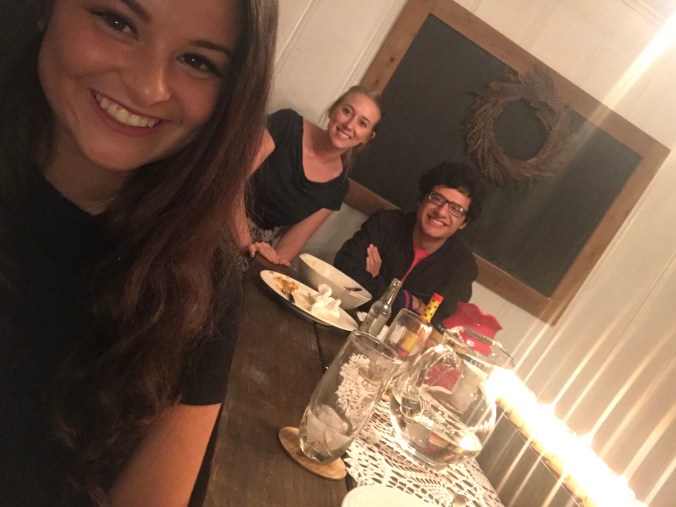
My meal took place at my grandmother’s home in Bowling Green, KY. Although my hometown is Lexington, Bowling Green has always been a second home for me. My parents were both born and raised here, and graduated from Western Kentucky University together in 1992. My grandparents live here, as well. For as long as I can remember, my family has made many trips here to attend WKU games and to visit with family. To say that choosing WKU for college was easy is an understatement. So, doing my Kentucky Kitchen Table project here in Bowling Green was very easy, for it truly is like home.

At my dinner were myself, my boyfriend, Nate, my grandmother, Janet, and a girl who lives in my dorm building, Meredith. Nate is a very funny and kind person. He is nineteen years old. He loves to hunt and fish, basically anything that will get him outside. He grew up in Bardstown, KY, and attended a catholic private school. He is also intelligent, and is majoring in biology with a pre-med concentration. He is an amazing boyfriend and best friend. We met in the elevator of our dorm the first week of college. He is easy to talk to and fun to be around. Although we share many similarities, we have a lot of differences, too. Our religious practices vary slightly, and most of our political views differ. We were also raised in different homes and lifestyles. I enjoy getting to discuss our differences and our perspectives on various issues. Janet is the most selfless person I know. She would do anything and everything to help someone, especially her family. She is sixty-nine years old. Retired now, she was a nurse. She won the battle against breast cancer when I was a toddler. As I have grown up, I have become closer and closer to her. She is a Christian and she holds her faith near and dear to her heart. She considers herself an independent politically, and is always willing to hear many different perspectives and ideas. I know that if I ever need anything, I can call her. Meredith is also from Lexington, KY, but I never knew her until now. She has the same major as me, nursing, so we have several classes together. Although I don’t know her very well, I wanted to invite her to this dinner because she has always shown me kindness. She lifeguards during the summer, she attended an arts school in high school, and I learned that she loves reality TV shows as much as I do.

For dinner, I made mac-n-cheese, Nate made green beans, my grandmother bought chicken, and Meredith made brownies. When we got to my grandmother’s house, the table was set beautifully. I loved it. She even lit candles, which I never really do at dinner with my immediate family. I made that comment, and my grandma told me that she always lights candles at dinner, and even told me that my aunt and my dad would take turns each night lighting the candles. Meredith said that her family would always light candles at dinner too. Although something kind of random, I thought that story was cool to hear, and possibly something I wouldn’t have heard if we didn’t have this meal. It was interesting to hear the difference because that is something my usual dinners never have, but something that their dinners always have.

At the beginning of the meal, I started by asking what citizenship meant to everyone. We went around the table. Nate said to him, citizenship means being a good neighbor and preserving his culture. He also thinks that writing his politicians educating himself from multiple perspectives on current issues is a key part of being a good citizen. Janet’s citizenship means being active in her community. She said that when she was younger and had kids, it encouraged her to become even more involved, for her children were part of different sports and activities which in turn made her get involved. She also said that being a leader and supporting local organizations is important, as well as taking care of her neighbors. Another thing she believes is important to citizenship is following the law, for the laws are ultimately made to protect everyone. Meredith said she tries to be a good citizen by being involved in the community, too, like going to local events. She also thinks that listening to others with respect and gaining insight from others, from differing perspectives, can help you cooperate and agree with more of your fellow citizens. I agree with what everyone said, and I feel that all of that contributes to my citizenship, too. I added that being nice to our neighbors, just with a smile and wave, means a lot to me as a citizen. Especially in the dorms, I make an effort to just be friendly to the girls in my hall, because I know that I appreciate that too.

Nate asked next what social issue means the most to everyone and why. I began to discuss my social issue, the standing or kneeling for the pledge of allegiance. I am such a proud American, and I feel so lucky to be a citizen in this country. To sit or kneel for the national anthem, to me, I explained, shows disrespect for the people who fight for everything that the national anthem embodies. I also shared a story of a WKU football game my family and I attended. We have season tickets in front of an elderly couple. As opposed to us, they do not attend many games, and it is pretty clear why. The man is quite old and has a very difficult time getting around. My dad will often help him stand and sit from his seat. He is a veteran, and though he did not stand during the entire game, he would struggle to stand just for the pledge of allegiance. It always brought tears to me and my mother’s eyes. Meredith’s social issue was the lack of funding for the arts, especially the cuts to her arts program back in high school that are taking affect now. She discussed how much she enjoyed her high school and the impact it made on her, and shared her concerns with this lack of funding. This statement lead us to discussing the current pension issue. I learned that Meredith’s mom is actually a teacher, so she could personally relate to this. My aunt, Janet’s daughter, is also a teacher. I posed the question, “where should we cut money from?” because, of course, no one wants money cut from their department, job, sector, etc. Nate suggested the military, while Meredith explained that a student in her communications class thought hemp could be a solution. His family’s farm was allowed to grow it this year, causing both their farm and the government to make a great amount of money. It was interesting to get to talk about such a relevant issue.

A reoccurring theme in our conversation was the value of the most basic level of community, our neighborhoods. Despite the topic we would be discussing, we would somehow always get back to being a good neighbor and the neighbor that you would want to have. Being a good neighbor, to us, means being friendly and simply smiling and waving, and being there for them when need be. A good neighbor is involved in their community and is willing to help out when people are in need. I think this shows that the epitome of a good citizen is a good neighbor.

Another theme that was prevalent throughout our discussions was the diverse opinions and background each of us held, and yet the mutual respect for one another. Although we all came from varying hometowns, religions, political views, ages, genders, and more, we were able to find a lot of common ground by discussing things in this fashion. We made eye contact and listened to what each person was saying, and kept an open mind. We tried to see things from each others’ shoes, and considered varying beliefs even if they opposed your own.

I was reminded yet again that deliberation truly is one of the best, if not the single best, ways to discuss these controversial, wicked problems that the world faces. As Keith Melville in “How We Talk Matters” explains, talking matters because by communicating in a better way we are more apt to agreeing and make democracy work better. Deliberating fosters group discussions and helps decision-making. He writes, “public deliberation is useful when there is a discrepancy between what is happening to people and what they think should be happening—yet there is no agreement on what should be happening.” Our society faces so many issues like these, with no right or wrong solution that affects so many peoples’ lives. By deliberating with people, like we did at our dinner, we were able to be empathetic and see things from other perspectives while finding common ground. Though our dinner was not a proper deliberation like those we have in class, it was a civil discussion that allowed us all to share our personal experiences, our opinions, and areas where we shared common ground, despite our diverse backgrounds and core beliefs.

This relates to the class, for living better together and solving problems can be made a little easier by simply having a discussion, perhaps a dinner around a table in your hometown.


Unfamiliar Faces

By Cristina

Unfamiliar faces surround me in a wicked world consumed by materialism and technology. Society buries its burdens and layers them with meaningless conclusions. Long-term solutions wither in despair. The roots of our community are parched and famished from no conversation. What once was a community is now a graveyard of lost democracy, identity, and empathy. All that surround me are faces. Faces that were once familiar, founded upon living flesh, but have now dried to cracked, brittle bones.

These cracked brittle bones form the skeleton of our society. The spine supports our foundation. Yet, our foundation lacks the flesh necessary to form a community. In the modern age, it is difficult to establish this community, as the second hand on the clock begins to tick faster and our minds begin to scatter. Numbers become blurred images and faces become placeless, losing their identity.

Gathered around the kitchen table, we could once find this sense of community. This historical event is marked in history books as being the bridge between where society is and where society wants to be. Under the bridge are the waters. If we cross the bridge and sit at the table, the waters will flood our bones and begin to bridge the divide between the citizen and the self.

To bridge the divide, I set up a Kentucky Kitchen Table, a gathering of people—friends, family, neighbors, and the like—around a meal at a kitchen table where ideas of citizenship and community are discussed. Around the table in Bowling Green Kentucky, cracked, brittle bones had individual identities. 7 diverse identities belonged to those, not including myself, named: Liz, Sarah, Jack, Dwayne, Ernie, Jess, and Melanie. Around the table, those identities were dissolved.

Liz is the daughter of Ernie and Melanie. Liz is a character like no other, devoting her time by volunteering at Curbside Ministries. Curbside Ministries is a Christian based organization that goes to underprivileged parts of Bowling Green, Kentucky with the mission of representing and showing Jesus’s love. Through volunteering at Curbside Ministries, Liz plays games and spends time with underprivileged children to establish bonds and show love. As she continues her volunteering through Curbside Ministries, Liz wants to further develop Bowling Green as a community that extends roots of empathy and compassion to all citizens no matter what demographic.

Sarah is a college freshman majoring in civil engineering. With her degree, she strives to work for the state and a private firm, and eventually continue her dad’s legacy by taking over his business. She is an individual who derives her character from her faith, Christianity. Through her faith in God, she develops and refines her morals and values. As a result, her religious identity positively grows her thoughts and her treatment of others around her.

Jack is a freshman at Western Kentucky University. He is majoring in wildlife biology. After obtaining his degree, he hopes to pursue his dream job as a park and recreation research biologist in order to better understand the environment and how society impacts it. If Jack could give one piece of advice to his neighbors, it would be to consider the impact our choices and decision not only have on our environment but also on other individuals; for, we have the ability to strengthen or weaken the fibers of the relationships we have with people around us.

Dwayne is an individual who is outgoing, determined, caring, and charitable. Dwayne recently changed his major to biochemistry. After obtaining his degree, Dwayne desires to go to medical school and become a pediatrician. Dwayne is charitable and has sympathy. Aiding children as a doctor reflects this quality. Dwayne strives to be the individual who is willing to lend a helping hand.

Ernie is reserved and down to earth. He has traditional values and values social reform. He is a General Manager at Tennessee Valley Authority (TVA). As a worker for TVA, Ernie supports their mission of providing regional environmental stewardship, reliable power, and economic development across seven states, specifically in Kentucky. Through employment at TVA, Ernie believes he is able to fulfill his role as a citizen, aiding others by the means of providing resources. Thus, his job relates to his role as a citizen.

Jess is also the daughter of Ernie and Melanie. Jess is a 7th grader who dedicates her time and effort to her favorite sport, basketball. Jess has a fireball of a personality. Jess is defined by the stamina and determination she puts forth during games and practices. Jess values teamwork on and off the court, from carrying out a basketball play with her teammates to working together with her family. The value of teamwork is Jess’s favorite thing about her community as it has no geographical domain and can be found anywhere she is present.

Melanie is a “blessing,” according to Liz.  Melanie has an outgoing personality and loves the company of others. As a mom, Melanie not only provides nurture and love for her kids, she also volunteers as a CASA. CASA works to prevent child victims of abuse, neglect, and dependency from being abused both in and out of their family of origin. In addition, Melanie volunteers at Hope House in Bowling Green, Kentucky; Hope House is an organization with the mission to alleviate physical and spiritual poverty through gospel restoration. There, she teaches classes to teenagers with kids. By preventing abuse and alleviating poverty through her job, Melanie can serve a greater purpose—providing children and adolescents with an open door of hope.

At the kitchen table, 7 diverse identities cooked in a melting pot to form ideas about community and citizenship. In order to develop these ideas, a series of questions were asked. The central question during the dinner asked what citizenship meant to each person. Specifically, what citizenship means, beyond voting, paying taxes, and following laws. This question presented obstacles as there is no concrete definition of the word citizenship. Rather, citizenship is a word constructed upon a white pillar of values: the collective group, freedom, and respect. These ideas were discussed at the table.

Citizenship is not about the self; rather, it is about the individual working towards not only the betterment of society but also towards the betterment of individuals within that society. Citizenship is “you before me,”—the individual making the safety of others a priority over theirs. Citizenship means forming a collective group. When natural or manmade disasters strike the stone walls of our existence, it is the duty of citizens to form a group and provide aid and relief to victims of despair. However, citizenship means forming a collective group even when convenience is amiss.  When wicked problems are at a great distance from our foundation or when our journey begins in arduous terrain, it continues to be the duty of citizens to form a group. Ease is a deficit that weakens the group; with this, shortcuts to solutions become poisonous thorns. Individuals must learn that when thunder strikes and sets fire to the rain, the group must act.

As a citizen, one has an array of freedoms, such as the freedom of speech. These freedoms are what society affirms as their natural rights as citizens. Citizens have the natural right to articulate their values and morals. However, the freedom of speech may become inundated with hostility. At the dinner table, most individuals agreed that society is filled with hostility people have towards others. When an individual hears another’s person’s opinions they have three options: ignore, accept, or refute. Most individuals respectfully carry out these options; however, there remain a fraction of people who carry out these options through hostility. Hence, a lack of respect resonates. This further develops the definition of citizenship—the quality of being respectful, rather than hostile through discussion. Once, a person learns to respect another person’s opinions, people will begin to work together as a community to solve society’s wicked problems.

Gathered around the kitchen table, we have now found the lost sense of community. No longer is society buried under a thousand screams. Rather it is delivered as a thousand praises placing society where it had strived to be. We have taken up the oar of our ancestors to rediscover citizenship and traversed the waters under the bridge. We have crossed the bridge and sat at the table; the waters have flooded our bones and begun to bridge the divide between the citizen and the self.

I, as a citizen of society, have learned that citizenship is more than its dictionary denotation. Citizenship possesses a connotation that differentiates it from other words. Citizenship is formed from a collective group that consists of diverse identities, morals, and values. Citizenship is molded as a cast of freedom and respect for the very values on which it protects. We pick up the shovels and dig a grave for hostility. The tombstone is inscribed with a farewell to relics of old memories.

If we examine the word citizenship and redefine what it means to be a citizen within a community, we will have addressed a probing question, “How can we solve our problems?”  As Martha Nussbaum proclaims in her chapter, “Citizens of the World,” in Not for Profit: Why Democracy Needs the Humanities: “The problems we need to solve—economic, environmental, religious, and political—are global in their scope. They have no hope of being solved unless people once distant come together and cooperate in ways they have not before.” It is imperative to regard Nussbaum’s words as words of wisdom and truth. When we examine the word citizenship, we have learned it is more than tangible voting, paying taxes, and following laws. Citizenship is intangible at its core. It is a thread of our identity. If we take a needle and sew the gap of hostility and act through deliberation, we will produce a garden of solutions to our wicked problems.

A Kentucky Kitchen Table is not a dreaded project, but rather a collective group of individuals gathering about a brown, cedar table in a crisp fall to discuss citizenship and community while eating a warm meal. Around this table, the cracked, brittle bones belonging to diverse identities—Liz, Sarah, Jack, Dwayne, Ernie, Jess, and Melanie—flourished with conversation and blossomed with white flowers of hope. Unfamiliar faces became familiar.

My Kentucky Kitchen Table

By Bryce

For my Kentucky Kitchen Table I ate dinner at my house with my grandmother, two sisters, and my oldest sisters two friends from graduate school, Emily and Natalie.  My guests Emily and Natalie are both 3rd years in the Physical Therapy program and WKU.  Emily described herself as a token liberal from North Carolina, while Natalie said she is a freshly 26-year-old who just got kicked off her parent’s health insurance policy. For dinner we ate steak and potatoes that I prepared in the oven and on the grill.

My Kentucky Kitchen Table was diverse because we had my grandmother whose generation is known as the baby boomers and four members from my generation the millennials.  Emily added some diversity in political ideology as she identifies as a liberal on the political spectrum, whereas the rest of us leaned more toward Republican views.

We started the conversation by talking about what citizenship meant to each person at the table.  The obvious and immediate response was voting and being an American, as our identity as Americans is often associated with simply being born and living here.  Upon further prying, my grandmother explained that there is a sense of pride with being a citizen of the United States.  This is her country, she worked hard and lived her version of the American dream, going from a dirt floor house to a trailer, and finally building her own home on the plot of land beside her mother.  My sister went on to mention that citizenship is contributing to the community, and told us about her recent volunteer work at the Bowling Green Marathon where she gave massages to runners afterwards using her physical therapy training to help those with soreness and cramps.  Emily and Natalie were both in agreement on what they felt it meant to them, when Emily exclaimed “Freedom!” to which Natalie then added “Trump!”.

We later talked about our neighbors and I asked my guests if they knew theirs.  Apparently, their interaction with their neighbor was limited to getting yelled at for parking in their neighbors parking spot and their neighbor flirting with their roommate, which was described as “odd.”  Natalie’s neighbor also knocked over her tomato plant, which she was rather upset about.  My grandma informed us that she knows about all her neighbors, because they are mostly kin to her.  After a laugh, she said with all seriousness that it is nice to have them living nearby because she always has someone to watch the house whenever her and my grandfather take a golfing trip.  Next it was me and my sister’s turn to talk about our neighbors, and sadly we know ours about as well as Emily and Natalie.  We explained that we believe we may have ran off our neighbor to the right, as they are moving out after a year.  Our neighbors to the left we are unsure of their names, but know they have a live-in nanny whom we had met.  As for the house that backs up to us, we know them as the vampires because we only ever see the dad at night time doing work outside.  The Kentucky Kitchen Table really opened my eyes to the divide that has formed in society from my grandmother’s generation to my own.  Whereas my grandmother grew up in a town where everyone knew each other, family was nearby, and you knew your neighbors first name, my generation is growing up in a much more secluded and the definition of neighbor has gone from someone who shares a common community to simply the guy next door we have never actually seen before. There is more of a sense that each yard is one’s domain, and you do not cross into their domain ever.

We later discussed how no one at the table has a job and was leeches off the government and adding to the trillion-dollar debt when talking about seeing our jobs as serving a greater purpose in society.  While Emily went off on a tangent about how her student loans were one of the governments few sources of income because they are all paying back their student loans for PT school with interest.  As physical therapists though, it will be their jobs to help get people off drugs like opioids, or meth, according to Natalie.  They will serve a greater purpose in the fight against opioid addiction in America and try to help those who have fallen victim to the deadly addiction.  Emily then mentioned how as physical therapists help keep the people healthy and insurance rates down making them a great benefit to the community.

The conversation then switched to about how spiritual identity relates to how we think we should treat people, and the answers were a bit out there.  My sister started the conversation by saying “Yes!” emphatically, but then ending with “but maybe not for us.”  My grandma then said, “Well, I went to Catholic school, so the nuns beat it into us” on the way they should treat people, which seems counterproductive.  Emily then recalled that the worst thing they did at her Catholic school was “staple our shirts to our pants if they came untucked.”  So, although the methods of doing so seemed odd, the table mostly agreed that religion helped to shape our morals and how we believed we should treat others.  They referred to the Ten Commandments from the Bible where it says to love thy neighbor as proof that religion preaches a sense of community and to treat others with respect.

Related to the topic of having an obligation to others in our country, there was consensus at the table that we should help those who cannot help themselves.  This can extend from those with disability to the impoverished and to the elderly.  We felt that we also have an obligation to help our veterans better than we currently do in America because of the sacrifice they have made for us and for our country.  We all felt we could do small things like donating old clothes or toys as well as be less wasteful with things that could be reused to help those who are impoverished.

Family dinners seemed to be a common affair in the households of my guests as well as my grandmother.  Emily and Natalie both recall having a family dinner every night growing up until they left for college.  In my household, scheduling conflicts and our active lives often keep us from eating as a family.  While no one ever eats alone, people tend to come and go from the dinner table in my house.  I may be eating and ten minutes later my sister and mother join, and I leave the table before my father sits down to eat.  Many times, my family will eat, and certain members not even be home.  My grandmother however eats with my grandfather most every night, and will even have her sister’s over to eat with from time to time.

Next, we changed topics to what kind of person everyone wanted to be.  The responses were good, Emily wants to be known as caring and giving, Natalie believes it is important to be compassionate and kind, and my grandmother said to be the kind of person to others that you would want them to be to you. My sister’s answer was a bit more comical, with her focus being a good physical therapist who doesn’t get sued for malpractice.  I said that personally I want to be someone that is remembered for something, whether big or small, to know I left an impact and put my stamp on something in this world.  I think that would be a great thing to add to my resume of who I am along with the other things mentioned at the table, besides the physical therapist not sued for malpractice.

The conversation got fun when I asked the question about what kind of advice would they give to someone running for office.  My sister was quick to say “Delete Twitter.  Immediately,” about the controversy over the current use of social media in politics.  My grandma and Emily chimed in that they felt it was important to tell them to make sure they are running to create positive change, and not for monetary gain or status. Natalie added in that you should make yourself seen, not heard and get out in the community if you want to run for office. This way, people can tell you are genuine and feel as though you are really running for them and not for yourself.

We ended the dinner conversation with a question on what social issue was most important to each person.  My sister began with a state level issue of the teacher pension removal plan currently in the state legislature.  It will get rid of the pension plan and move all teacher’s retirements to 401k plans.  She feels this will cost many teachers lots of money in retirement and will hurt the teaching profession as many of the better teachers will choose to leave the state in search of better retirements or better pay, and will also keep quality people from entering the teaching profession, ultimately affecting our future student’s educations.  My grandma was more concerned with the issue of same-sex marriage.  She did not feel it was fair that many states are still fighting against its legalization and that many churches turn away same sex couples.  While she admitted that it wasn’t for her, she believes that they should have the right to get married. This was a neat experience to eat with two people I had only ever met once at 2am driving them and my sister home from a bar.  Many of their stories and experiences were things that I had no prior experience with and it created a rich experience at the dinner table.

This activity related to our class by bringing people together to ask questions about society and the things we see every day.  We talked about how can we live well with the neighbor who knocks over our tomato plant (They did buy Natalie a bag of tomatoes form Meijer after.) and yells at us for parking in their spot.  We also looked at issues like running for office and pondered how we can solve the problems facing our community and help those who want to lead us with how to face those issues.  We also looked at how we can help in our community, and not say to hell with good intentions but create something meaningful.  In all, I enjoyed the Kentucky Kitchen Table and the conversation that came with it.

KKT Photo

Every Community Has a “Derek”…

IMG_2548

By Kaylee

Looking back on my dinner for the Kentucky Kitchen Table, I would categorize it as a young adult view and perspective on citizenship and community. Nine people in total attended, including me, ranging from the age of 17-28. It was split pretty 50/50 on people I knew and didn’t know, which made conversation and discussion surprisingly easy.

Brayden, (17) is a student here at WKU in the Gatton Academy. He grew up in Glasgow, Kentucky and was very excited to move to Bowling Green this past August. In the discussion, he highlighted the culture difference from just 30 mins away. He was accompanied by two other Glasgow natives who got to school at WKU also. Chandlor and Jacob (18) are roommates in a freshman all boys’ dorm on campus and both work off campus.

Olivia and Hayley (18) are both seniors at Bowling Green High School, and Olivia has grown up in Bowling Green. She is involved in choral and musical activities at her school. Hayley recently moved to Bowling Green, a little less than a year ago from California. Her father was recently asked to work as the Children’s Pastor at Crossland Community Church and she has lived in different areas of California and Texas throughout her life.

Katie (21) is a senior at WKU. She is majoring in marketing and works at a local branding company in Bowling Green. She is originally from Evansville, Indiana and lives close to campus with two roommates. Cameron (21) is a local musical artist and works for Royal Music and volunteers his strengths and talents at Crossland Community Church. He did not attend college to pursue his career in music and also volunteers at one of the campus ministries, CRU, with Katie.

Melissa (28) is the volunteer director for the Center for Courageous Kids, in Scottsville, Kentucky. She grew up in Louisville and moved here to attend WKU. She is married to her husband, Nick, and they have a one-year-old child, Cullen.

This group gave a very neat perspective for me, because all were involved in a volunteer position of some sort. I invited 4 participants, who then invited the other 4 participants to join. We ate a meal together and then I started the discussion by asking the first question: “Beyond voting, paying taxes, and following the law, what does citizenship mean to you?” Answers of similar degree were spouted off such as doing more, going the extra mile, and realize the rights and responsibilities you have as a citizen locally and nationally. There seemed to be a good degree of agreement among the group so I decided to switch the conversation to what kind of community was ideal to live in. Responses were brought back to the types of citizens in the community, and Cameron mentioned a community of everyone doing their part for the community, with a sense of unity within of a common ground or goal. Melissa decided to add onto that by highlighting community involvement with a mix of individualism. And Katie thought a main value of a community should be a concern for others inside and outside the community, and others piggy backed with being accepting of everyone, while others counter placed that with making sure boundaries were made from acceptance and being aware of your morals and not letting those fall.

Other answers were similar and we concluded that in an essence we were describing a form of socialism, which is, on paper, the perfect community, but it is not an achievable goal in real life due to human error. Other qualities such as selflessness were brought up, and how the more you give the more you will receive. A concern on this topic was how in today’s society communities and neighborhoods were not as connected as they once were.

I then asked if people truly knew their neighbors. Most were sad to agree that they didn’t, even those who lived in a dorm on campus, and those with roommates said there were many times they didn’t converse regularly with their roommates. We then discussed spiritual aspects of how the two greatest commandments calls us to love The Lord your God with all your heart, mind, soul, and strength and to love your neighbor as yourself and how we must keep those in mind when interacting within our communities. Hayley made a point to also say we are called to love our neighbors and our enemies, which Chandlor piggybacked by highlighting those enemies might be your neighbors. This did lead to somewhat of a gossip conversation about neighbors (good and bad), which, at first, I was nervous about, but surprisingly led to the highlight of the conversation of the night, which surrounded this blog post.

In the gossip of neighbors, a specific Derek* a neighbor in the community was brought up, and stories were shared of how he was rude and hard to get along with. After the gossip and jokes of Derek, Chandlor brought up a good point about how communities work. He asked how many “Dereks” you would want in your community, and immediately everyone shared they wouldn’t want “a Derek,” they wouldn’t want that person of conflict. We quickly realized that everything we said about hoping for the perfect community and acceptance of all went to waste. Chandlor then shared some studies he had read of how every community “needs a Derek” and how gossip and controversy almost brings people together and builds people up. There were some agreeable statements, but Cameron was not ok with that fact being accepted. He said instead of accepting that as fact, we should strive to make it the best and “perfect” it could become, but in fact it is unavoidable. The conversation then shifted to a more grey area instead of black and white, as we concluded that there is not necessarily always the “good guy” and “bad guy” in a group of people. In movies and TV shows we see the “villain” and most all other characters’ root against them, but in real life, not one person gets ostracized as the “villain”, but in an essence, we are all “a Derek.” We all fail, we all exclude, we all fall short of sin and acceptance. At one point, whether we want to or not, the evil will come out, and we must be the ones in the community to love the “Derek” through it and accept that person’s flaws. We pointed out how we become “Dereks” or make people “Dereks” in our everyday conversations, and the only thing we can do is be better from our past “Derek” mistakes. The final question I asked was: “What kind of person do you want to be?” After some thought, characteristics were thrown out of being yourself, and making a difference, we concluded that while we might not have life figured out, we can still make an impact, which will be different for all of our lives, and we can strive towards better and away from being the “Derek”.

*Name changed

Kentucky Kitchen Table

By Brandon

Recently I hosted my Kentucky Kitchen Table project at my home in Bowling Green, KY. My mother (Marianne), father (Billy), and we hosted one of dad’s coworkers, Eddy, and his wife, Suzanne. Suzanne and Eddy brought beans and rice to go along with my mother’s chicken enchiladas that we were having for dinner. Marianne is my mother who is a physical therapist at the Medical Center. She is the youngest of nine of a Catholic raised family. Billy is my father who works as an engineer at Lord Corporation. He paid for his education through raising tobacco, and he is a strong conservative. Eddy works with Billy and he is a strong advocate of volunteering as he goes to disaster relief zones to volunteer. Much of Eddy’s philosophies are affected by the death of his older brother in the Vietnam War, when Eddy was just a child. Suzanne is Eddy’s wife who is an elementary school teacher who has strong Baptist beliefs. Even though they are all white and in their fifties, they are still different due to their beliefs and backgrounds. Because Marianne and Suzanne have differing religious beliefs in Catholicism and Baptist, they brought different philosophical ideas on how they live their life to the dinner table. Everyone at the table is from differing communities. For example, Billy lived on a rural tobacco farm where you knew your neighbors well because that is who you depended on. On the other hand, Marianne grew up in downtown Owensboro where lived a childhood being apart of a large urban family, without any dealings with rural farm work. Coming from rural or urban communities changes what on becomes because of the different hardships and opportunities that each individual and unique community provides.

When asked the question, “Beyond voting, paying taxes, and following laws, what does citizenship mean to you?” my dinner guests all came to in agreement. That being a citizen of a community is not just an administrative thing. It is part of being a common group and being part of one unit that shows unity. A unit that cares for one another just as if what is happening to others is happening to you. Marianne actually disagreed with the question because she believed that being a citizen is taking care of each other and has nothing to do with the government taking care of you through taxes and laws. Eddy had an interesting view that the others have not experienced because of his natural disaster volunteer work. What citizenship meant to him is simply sacrifice. That is to be willing to give of yourself to help your neighbor. This neighbor could be your next door neighbor or your neighbor who lives 800 miles away. With his volunteer work he gets asked questions like: why did you go to New York to help with hurricane Sandy Relief efforts? Or why did you go to Texas? He strongly believes that citizenship is giving of yourself to make somebody else’s life a little better. To Eddy a good citizen can answer the question- since you have gotten up this morning what have you done to better somebody else’s life? This is because if you better somebody else’s life, your life will be more enriched.

The best advice that that the table unanimously agreed with is that to better this world we have to show kindness. By doing they were suggesting that the world should show kindness by thinking before speaking. This was brought up because a lot of instances in today’s world, altercations or hostility have stemmed from one’s lack of kindness. Altercations have also happened due to a member of society saying something without truly thinking of the consequences of their statement.

I wanted to know what each one of them thought was the best part of the world today. When I asked Suzanne this she thought the best part is seeing the volunteers help the people who have suffered these great tragedies such as natural disasters and shootings. The ability for one to care more about somebody else’s life then their own is a much undervalued trait in our world today. It became a dark conversation when we started to reflect on how much evil has happened this year, such as Hurricanes Harvey and Irma, the flooding in Texas, and the mass shootings that have happened at multiple churches and the Las Vegas music festival. The catastrophes that this country have faced in the past year really make it apparent for people in society to try to find a solution to end the suffering. How can we ask society how to live well together? Something required for this is to get society to care about the problem to begin with. Most people watch the news and feel awful about the tragedies that are occurring, but they still do not take action because it is not affecting them and their daily lives. On the bright side, if there even is one, is the hero stories that come out of them. That one person or group of people who were willing to risk their lives in order to protect their loved ones or even complete strangers that they had never met. Our society could use more of these people whose unselfishness goes to the point of caring for somebody else’s well being more than their own.

Marianne explained how being a physical therapist for years has given her a variety of experiences that the normal person would not have. Through her work she treats people from all ways of life and all races and ethnicities. She treats extreme poverty patients and upper class. None of this matters because she treats every patient equal. She treats them as any empathetic human being would at all times especially because they are going through a hard time, such as, physical therapy. She loves her job because she gets to help these people through physical recovery and at the same time gets a mental challenge from it because no two injuries are the same.

The table agreed that the best part about living in Kentucky is the citizens’ attitudes toward each other. The term Southern hospitality came up because most people in our community are nice enough to help a fellow neighbor or casually make conversation on the street. But Billy brought up many of occasions when he has been in other places with traveling with business and if he waved or said good morning to somebody on the street they would react and almost be offended by it. They all know and believe that our community is one that cares. Eddy had a person experience with this when his older brother died in the Vietnam War. Two days before Christmas the city of Scottsville shut down for the funeral. Every business shut down and the entire town showed up to show their condolences and to show that they cared. Our community is one that genuinely cares for one another and it is a blessing for us to live in a community that cares because we live in a world that seems to have tragic events due to people not caring everyday.

After discussing what was best about our community we transitioned to social issues that were the most important to everyone. Billy brought up the lack of ability for those who need it to get help for mental health. Before, there were an abundance of mental help institutions for those people who needed it could get help, but now they are far and few in between. Billy has traveled to many big cities and even in our community today there is large amount of mental health cases that are homeless on the streets. Billy’s daughter use to live in Portland, Oregon where there is a high homeless population. He explained how in this population there are a high percentage of mental health cases that could and probably should be in an institution getting help, but instead are out on the streets. Eddy’s problem with society now is that we have become a nation of entitlement. We have moved to a society that expects the government to take care of them instead of not taking care of themselves. If society is not will to take action for themselves then we will soon be a culture that will lack the ability to solve our own problems.

I didn’t really know a lot about Eddy and his wife Suzanne before this dinner but it really opened my eyes on how much Eddy has done for others through his disaster relief volunteering. As Eddy was talking about his volunteer work I thought back to the speech “To Hell With Good Intentions,” by Ivan Illich. I asked myself, “Was the volunteer work he was doing in these disaster areas resulting in the same emotions that were explained by Illich to have happened in Mexico?” Then I realized that there should not as much emphasis on how the people there perceived the help. But it is just important that Eddy was trying to make someone else’s life better before without selfishly thinking of his own, and society could really learn a thing from that. The ability to care about someone else’s life and really take action on it answers one of the central questions of the class: How do we live well together?

To be honest I was not looking forward to this assignment considering I am more quiet during these kinds of conversations, but once I finished, I have come to the conclusion that it was  actually pretty nice. To be able to sit around the table with a couple of people that I did not know very well and to be able to get to know them a little bit better was an enjoyable experience. For us as a community to able to talk about our problems is important. As Melville outlined in “How We Talk Matters,” what we say and how we say it matters in the way that if one person shares his ideas of doing the right thing other people will be more willing to take action or deliberate on bettering idea and move forward with it. An important component to Melville’s ideal talk is not only being able to converse attentively, but also learn how to listen to each other. It was important for me to be able to sit down at the kitchen table to talk about our world’s social problems with my guests because moving forward that is how I should be able to talk openly with anybody. Rather it be in a Honors 251 classroom setting or out in the real world it is important for everyone in every community to become part of the conversation. The conversation that goes beyond the kitchen table and extends into solving our society’s major social issues. KKT

An evening with new friends

IMG_0436

By Caleb

Even though I have been at college for just half a semester, I can say that Honors 251 (Citizen and Self) is one of my favorite classes here at WKU. The critical thinking and discussion format of the class is something that as a biology major I do not get very often. Furthermore, the discussions have been far more civil than I have seen before. It is much more often a deliberation rather than a debate. This being said, I was very nervous about the project. I was unsure of how well the discussion would go or if I would have anything constructive to say. Regardless of my initial feelings, I was still excited for the very unique project and approached the table with as much confidence as I could muster. The saying “fake it till you make it” is somewhat appropriate here.

My Kentucky Kitchen Table took place in the city of Bowling Green not too far off from campus. Though I had planned it in my mind to eventually schedule a Kentucky Kitchen Table in my hometown, this specific table was prescheduled for me by my professor who had offered it to anyone who wanted an easy, local table to go to. It was clearly a good opening I was willing to take. Additionally, this table also involved member from the Honors College, so this dinner turned out to be a great opportunity to get to know members of the Mahurin Honors College better.

I was emailed that there would be four of us in attendance, though there would only be three of us in total because one of our other guests, Sharon, was unable to make it. I got into contact with the other student I would be eating with beforehand. Her name was Taylor-Grace and was a freshman in the other Honors College Citizen and Self class. We decided it would be best to carpool together since I had a car on campus.

Coming into the driveway, the house was beautiful with vines growing on the side, a swing on the front porch, and pumpkins to signal the fall festivities ahead. Being warmly welcomed inside, I immediately noticed how tastefully furnished the house was. We joked that it looked as if it came right out of the TV show fixer upper on HGTV. The dinner was being held in the home of our host, Caitlin who worked as the coordinator of constituent relations in the Mahurin Honors College. She was twenty-six years old, a WKU alum, and her husband also worked at WKU in the sports department as the media director. Though we were all connected to Western and the Mahurin Honors College, I would soon find we had some diverse interests and opinions to bring to the table.

For dinner we had a wonderful jambalaya made by Caitlin. There was also some delicious greens picked from Caitlin’s parents’ garden.  Taylor-Grace and I contributed by bringing some sweet desserts to eat later. I brought a s’more dessert that my mom has made for years. Taylor-Grace brought a Bowling Green classic: a box of doughnuts from the Great American Donut Shop which is near campus. The two flavors of blueberry and glazed happened to be some of my favorite.

After some time eating and introducing ourselves we started asking some questions suggested to us in our preparation materials. The conversation started out with the same question as all the other Kentucky Kitchen Tables, “beyond voting, paying taxes, and following laws, what does citizenship mean to you?” Caitlin was the first to respond saying that citizenship is definitely beyond the bare minimum of what’s expected of citizens. She differentiated “good” citizens and “bad” citizens. Bad citizenship is doing bare minimum, only paying taxes and following laws. Though this is not necessarily being a bad citizen in the sense of actively harming the community, this group of people are not giving their part to the community. The “good” form of citizenship she described was the opposite the complete opposite. She emphasized some simple and good things we can do to be better citizens, for example getting to know our neighbors and volunteering our time to charitable organizations. These are steps that are achievable by most anyone and can be taken in small strokes. Caitlin told us about how she volunteers the first Wednesday of every month and makes sure to contribute to the community. Caitlin also mentioned that she saw a clear connection between what she does at the Honors College and how it helps her in her role as a citizen. By promoting the Honors College and helping fund the projects she does, her reach helps students, faculty, and community members alike.

Taylor -Grace and I agreed with everything she had to say relating it to our own Honors 251 (Citizen and Self) class. We both added how a good citizen should be able to talk about difficult issues with one another without letting our own beliefs get in the way of moving toward a common goal. I specifically mentioned how in my own community, I feel like rarely can citizens ever talk about topics with as much civility as our class. This was especially apparent in students from my own high school. Taylor-Grace went on to mention how the class reminded her GSP [Governor’s Scholar Program] seminar to which I agreed with her. In seminar, difficult topics were discussed in a way where we did our best to empathize with others even if they experience or opinion they were describing was different from our own. We both felt the class promotes productive and open conversation about issues that are pertinent today which I felt was reflected in the conversations we were having that night. I was constantly reminded of the article “How We Talk Matters,” where we discussed the importance of productive conversation. This conversation arrived when diverse and different opinions are used to fuel a multi-perspective argument rather than a divided and polarized view.

After that conversation seemed to have ended we went to the preparatory materials for another discussion question, and we then began to talk about some social issues that we felt were close to our heart. Caitlin was first again to say that she wanted to stop animal abuse here in Bowling Green relating it to her own dogs. I mentioned suicide and depression as many of those close to me have dealt with or continue to deal with the awful disease. I felt this topic was close to me because the answer is in helping others understand the disease and have more empathy for one another. When it came to Taylor-Grace, she couldn’t really pick just one issue so instead talked about an anecdotal issue in her hometown. The Winterfest Toys for Kids is a program that allows kids who would otherwise not gotten anything for Christmas an opportunity to get a gift. Volunteers shop from an open ended shopping list to get kids that gift under the tree. I and Caitlin both talked about similar programs in our own hometowns.

Afterwards, we dug into the question about the types of people we wanted to be in the future. Caitlin said she wanted to be the kind of person that people respected when they saw her. She was quick to clarify that it was not for popularity reasons and did not want to demand it from others. She instead described how she instead wanted to earn it through her actions so that those she has touched in her life can look to her and say that she is a respectable person. Taylor-Grace said that she wanted to be a good friend. She wanted to be the person that people can turn to in times of trouble and wants to live an open life. I said I wanted to be the person that is always growing and always learning. From day to day, week to week, and year to year, I want to be a better than the person I was before. I think there is something to learn from every day and something new to grow from just around the corner in my life. I can also see how the bridge can be useful in this context. In order to achieve the goals we have in life, it is crucial to understand not only one but both sides of “the bridge,” where one side is where we are at and the other side is where we want to be as a society/world. We need to understand who we are now and what are capabilities are so that we know what we our possibilities are, and the other side needs to be well defined and understood in so that you can approach life with a clear goal in mind. Otherwise you are aimlessly moving from day to day not approaching the goal in mind directly or efficiently. So you must know yourself and what you want if you want your dreams to become a reality.

We finished up the night by digging into the desserts. We kept on talking letting college, home, and just life frame each conversation jumping from topic to topic just letting the conversation flow. I’m certain we stayed longer than Caitlin expected, but the project turned into a unique growing opportunity to get to know two strangers better. I learned the simple power of getting out of your comfort zone to just enjoy the simple things about life like the kindness of strangers, the civility of a conversation, or simply delicious home cooked food! Overall, the night was one of wonderful food, wonderful conversation, and wonderful people.

Kentucky Kitchen Citizenship

By Dylan

IMG_5182

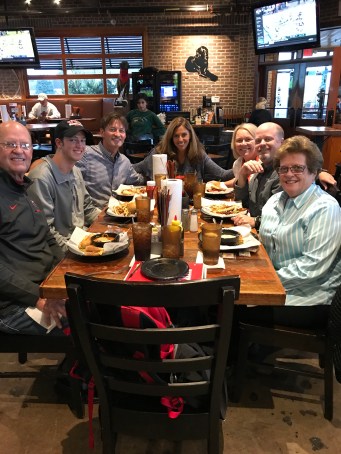
For my Kentucky Kitchen Table project, we met at a restaurant in Bowling Green, Kentucky called Double Dogs. Double Dogs is a sports bar that serves food anywhere from pizza to clam chowder. The people that were there were all part of my family, and we thought it would be interesting to involve our waitress in the project. Our waitress’s name was Amy (you can see her photobombing our picture above). She seemed to be of Middle Eastern background, but we did not ask her about that. She was young and was possibly in college or had just graduated. My family members’ names are my aunt Mary, uncle Todd, grandmother Miki, grandfather David, uncle Chris and aunt Kelly. All of them share similar political views and religious beliefs, but they are all different in some ways as well. They each come from different places and backgrounds. My grandparents are originally from New Albany, Indiana. They came to Western Kentucky University together and stayed here to raise my mom and uncle Chris. My aunt Mary and uncle Todd are both from Bowling Green, Kentucky. Aunt Kelly is from Owensboro, Kentucky. Different backgrounds and families shape the way you think and act. I was interested to see how they each would answer my questions.

The first question I asked was the required question that says, “Beyond voting, paying taxes, and following laws, what does citizenship mean to you?” Out of the things we talked about, the ones that stood out the most were pride, freedom and the responsibility you have as a citizen. Everyone agreed that being a citizen is a privilege. Chris said he felt prideful and thankful that he was a citizen in a country like this. Miki pointed out that the freedom we have in this country means a lot to her. She said this country was founded on freedom. Laws like the Bill of Rights give us basic, but important freedoms. Todd said that these freedoms give us opportunities to get up every day and strive to be successful. American citizens can be anybody they want to be. Amy said the freedom to express yourself was important to her, another aspect this country was founded on.

The next question I asked said, “What do you think are the best things about our world today?” Chris made the point that the communication technology and the internet we have now really shows how it’s a small world after all. Then we started singing the song from the Small World amusement ride at Disney World, in the middle of Double Dogs. Luckily no one seemed to mind. Others said they liked the advancements in medical technology. These advancements improve the quality of life and the longevity of life. David said he thought people of the world stepping up to help each other in times of need was very important. He also said that this question would be easier if it was only about the United States. I asked him what he meant by that and he explained that religious freedom and the quality of life here is better. This made everyone at the table think about how lucky we are to be living in this country with more freedoms than others in some cases.

The third question I asked said, “Does your religious or spiritual identity relate to how you think we should treat other people?” and “Does it relate to how you see yourself as a citizen?” Almost at the same time, everyone said, “Yes!” Nana said she was just watching “The View” on TV where they talked about even if you are not religious, people still follow the Ten Commandment rules. Everyone has the same sense of morality. Either we were born with it or we learned it as we grew up. Everyone at the table also agreed that their religious identity relates to how they see themselves as a citizen. Todd said that sometimes your religious views can make a difference on who you vote for. Nana pointed out that this country was founded on religious freedom. Aunt Mary made a good point when she said, “In God We Trust” is on all of our money and some of the monuments around the country. Religion is very important to a lot of people in this country. We reached the consensus that what we believe is right can definitely change the way you treat other people.

The fourth question asked what kind of person everyone wanted to be. Chris said he wanted to be 6’4” with hair. More seriously though, Miki said she wanted to be a Margaret. Margaret is my grandmother on my dad’s side of the family. She passed away during September of last year. She was loved by everyone and made an impact on each person she knew. Miki continued by saying the person who she wants to be all depends on how people remember you. That got a big “Amen” from several people at the table. Kelly said she wants to become a better Christian. Todd said he wants to build strong, meaningful relationships with people. Miki said she would like to become more involved in community participation. Amy said she wanted to be honest, loyal and hardworking. Chris and Kelly said something that really stood out to me. Chris said he wants to be exhausted at the end of life, and he wants to feel like he has done everything he ever wanted to do. Kelly brought up a poem called, “The Dash” by Linda Ellis. In short it says that the dash between the two years on your tombstone matter the most. While discussing this, we drew two conclusions: we want to be remembered as a good person and we want to make the best of the years between life and death.

The last question I asked said, “What social issue is closest to your heart and why?” This was probably the hardest question for them to answer. This could be because there are so many to choose from, or because they feel strongly about more than one issue. Todd and Mary said abortion was the social issue closest to their heart. When I asked them to elaborate, they explained that their religious beliefs tie into it, but they could see the reasons for it like if there were to be a rape case or something like that. But it is still a baby that cannot save itself. Kelly talked about capital punishment and the sanctity of life being most important to her. Religious beliefs tied into that too. Miki said spouse and child abuse stuck out to her the most. She explained her feelings of sympathy for those families who don’t have the resources or education to get themselves out of that situation. Meaning money or they don’t know who to talk to. David said the use of illegal drugs upset him. He said the ability of drugs to tear families apart hits home for him.

Some of the things mentioned relate to this class. In class, we talked about morality during our week two readings. David Brooks’ essay, “If It Feels Right” talked about how we make moral decisions. In the reading, he claimed that personal interests influence your moral decisions. Around the table, it seemed like religion, which is a personal interest, played a big part in everyone’s sense of morality. In class, we asked ourselves where does one get their sense of morality? Are you just born with it? Or do you learn it while growing up? Being born with your sense of morality connects with a religious factor. At Double Dogs, when we talked about if religious identities could shape the way you think people should be treated, morality was brought up, and it was the center of our discussion for this question. My mind was blown when Miki told us about what they said on “The View”, claiming that religious or not, people still follow the ten commandment rules, and that everyone has a similar sense of morality. This showed me that yes, there is good in the world, and we can have hope in humanity. Learning the moral values while you grow up goes with one of the central questions of our class that says, “How do we live well with each other?” One of the ways we can live well with one another is by setting good examples to those around us. It is easy for someone to follow someone else, so long that there are leaders for people to follow. We can all be leaders in some way.

The Kentucky Kitchen table experience taught me a few things that hit home for me. It taught me that your beliefs, religious or not, can change the way you think, act, treat others, dream and how you view yourself. What was said around or table at Double Dogs made think, “Hey this goes for me too!” or “I agree.” Most of the reasons people gave for why they said something all drew back to their religious beliefs or sense of morality. Sometimes religion teaches you those moral values. I liked this project very much. It was nice to get to see my family members and have a nice lunch with them. I thought at first talking about some of this stuff with them would be kind of weird, and I hoped that it wouldn’t start a fight between anyone. It turned out though that everyone loved it. It gave everyone the chance to voice their opinion about some important topics of today. This project turned out to be an absolutely positive experience.

A Dinner with New Friends

By Taylor-Grace

When we were introduced to the idea of Kentucky Kitchen Table, I was more than ecstatic because food and people are two of my favorite things. I knew that I wanted to do my Kentucky Kitchen Table in Bowling Green rather than my hometown from the very beginning; mainly because I thought the idea of getting to know citizens of Bowling Green would be much more interesting. I am so glad that I got to experience this…Now let’s dive into the dinner!

I was assigned to be hosted by Caitlin, who is a coordinator for constituent relations in the Mahurin Honors College. Caitlin lives here in Bowling Green, not very far from campus. Her home was gorgeous! It looked just like one that you would see on Fixer Upper on HGTV. Caleb, a student in another Citizen and Self seminar, also joined us for dinner. Caleb and I decided to carpool from Western Kentucky University’s campus to Caitlin’s house for convenience. We both took desserts for us to have after our dinner that night.

When we arrived, Caitlin led us through her living room into her kitchen, which connected to the dining room. We sat our desserts on the island in the kitchen and then took our seats at the table. Caitlin had prepared a jambalaya for dinner with roasted zucchini and squash from her parents’ garden. Caitlin then offered us a choice of tea, water, or ginger beer for our beverage. Caleb was brave enough to go out of his comfort zone and he tried the [non-alcoholic] ginger beer. Our meal was absolutely delicious. I loved every bite of it!

We discussed many different subjects during our dinner, but we first started off with talking about Western Kentucky University, our majors, our favorite class, and how Caitlin attended Western Kentucky University as well. Caitlin, who was originally from Breckinridge County, Kentucky, was a public relations major during her time here at Western Kentucky University and went on to work in Public Relations for Country Music Television after college, but then decided that she missed Western Kentucky University and thus decided to begin working at the university. Caleb, who is from Barren County, Kentucky, major’s in biology and he is on a pre-med track. I find this impressive because I know that I would never be able to have the time and dedication to do this. I, Taylor-Grace, told Caitlin and Caleb that my major was marketing and explained that I wasn’t exactly sure what I wanted to do with it yet. Caleb and I both agreed that Honors 251 was our favorite class. My reasoning being because it reminded me so much of the Governor’s Scholars Program and the seminars that I had during my time there. Caleb also attended Governor’s Scholars Program and said that it reminded him of seminar as well. We both discussed our love for the Governor’s Scholars Program and the friendships that we had made there. When you go to the Governor’s Scholars Program you can always make a connection with typically anyone around you, we discussed how we had mutual friends from the Governor’s Scholars Program. Caitlin explained to us that this class did not exist when she was a student in the honors college. She went on to tell us that her and her husband met while they were both students at Western Kentucky University, but what was interesting, was that they had not met before, though they both grew up only 15 minutes apart and knew some of the same people, but didn’t know each other until they met at a tailgate. She said that she was eating a BBQ sandwich that she had gotten from the Honors College and he asked where she had gotten it. She said that they began dating soon after that and that they’ve been together ever since.

I then asked Caitlin the required question, “beyond voting, paying taxes, and following laws what does citizenship mean to you?” She responded with, “It means being a good neighbor, giving back to your community through volunteerism, and getting involved.” She talked about how it’s going the extra mile instead of just doing what is required of you. We all agreed with this statement and felt like we’re pretty good citizens, but there is always more that we can do to be better. When we discussed this topic, I thought a lot about the three central questions. Specifically, “how do we live better (or less badly) together?” If we all take part in our citizenship, we will all be living better together. When people choose to not act accordingly as citizens, they are not working towards living better together.

We also talked a lot about how volunteerism is important in all of our communities and we asked each other the question of what our favorite philanthropy was. Caitlin stated that her passion was animals and she wants to do what she can to reduce animal abuse in the community of Bowling Green. Caleb talked about suicide and depression are important to him and he wants to do what he can with that specific cause. I personally could not pick one for certain because there are numerous events that I have worked to give back to the community, but one that I hold special to my heart is Winterfest Toys for Kids. I explained the Caitlin and Caleb that I grew up in a very rural community where many children go without meals during their summer and Christmas break and how many of those children don’t have a toy to find under their Christmas tree on Christmas morning Winterfest Toys for Kids was designed so that underprivileged children in my hometown and their families can have a Christmas dinner together. At the dinner, each child in attendance receives a Christmas gift. Many of the children wait to open the gift until Christmas morning. Events like this give me a better appreciation for the opportunities that I have and the things I have been blessed with. This topic relates greatly to our reading about “To Hell with Good Intentions,” by Ivan Illich but in a positive way. All of the issues that were on our hearts were things that could be helped and fixed right here in the United States. This helped me to see that there are so many problems here that we can work towards solving and we don’t have to go overseas to help out.

After discussing the issue that was closest to each of our hearts, we talked about what type of people we wanted to be. We all agreed that we wanted to be better people and that we wanted people to be able to look at us and say, “oh, they’re doing something good!” Caitlin said that she wanted to be respected. She explained that it was not in a way that demanded respect, but rather by doing good and people seeing the good that she is doing and them being able to say they want to do good like her, as if she was being a role model. I thought this response to the question was awesome! And it honestly made me look up to her in saying this because I hope to one day say the same thing for myself. Caleb explained that he wants to be the person who is always learning and always growing. I thought that that was something great to be too. I explained to Caleb and Caitlin that I wanted people to see me as a loyal friend. Someone that they could depend on in any time of need. I feel like that all of these attributes and types of people that we want to be are people needed in the world.

We then concluded our dinner by eating donuts from Great American Donuts and having small talk about Western Kentucky University, college, and just life in general. I am so beyond thankful for this experience because it allowed me to step out of my comfort zone in discussing some huge topics with people that I had never known before the night began. Kentucky Kitchen Table is an experience that I probably will never have something else that is similar to it. I am so glad that I had the opportunity to meet Caitlin and Caleb because they are people who I will be able to connect with even beyond this point during my next four years at Western Kentucky University. Kentucky Kitchen Table has had an even greater impact on my life than I had imagined it would and I am thankful for that. I believe that this was such a great learning experience and it is a project that should continue to take place in Honors 251 with Elizabeth. Having this experience of talking to two people that I did not know, has also helped me to have better comments and discussion points in Honors 251. Overall, I am just genuinely happy about my experience with Kentucky Kitchen Table. If the opportunity arises, I would SO do it all over again.

IMG_0436

Kentucky Kitchen Table

By Chloe

IMG_2854The Kentucky Kitchen table project seemed like it would be just another thing to add my to-do list. However, once I actually allowed myself an open mind and started to speak with my lunch guests I slowly become fond of the project. I did not know a few of the members of our meal, but quickly came to realize they were great people. We were able to speak about things that wouldn’t usually be brought up in normal conversation which allowed me to learn things about everyone that I didn’t already know. Because everyone had different backgrounds and future plans, I was able to see new perspectives on issues I thought I already knew all about. I feel like even after one meal together I have started a friendship with those that I had never met. These types of conversations and meals are important to expose yourself and your families to regularly so that you are open to new perspectives on everyday topics.

The meal took place here in Bowling Green. We ate around the kitchen table in my close friend, Jessie’s, apartment. I brought along my roommate and Jessie invited her two roommates who I had never met to the meal. Jessie is a graphic design major from Kentucky. She is interested in any form of art and has a true passion for visuals. She is also a dedicated women’s soccer fan and dedicates her time toward sports. While from a conservative, southern family she tends to be on the more liberal sides of political views. My roommate, Madeline is a conservative, Southern Baptist young woman who works hard in pursuing her goals of working in the medical field. Ashley comes from a close-knit family Western Kentucky. She is a psychological sciences major who spends time working in a lab. She is a Kappa Delta alumnae and is working on her master’s degree. Brooke has just started the nursing program here at WKU and spends her free time invested in sports. She comes from a busy family in Mississippi. I, Chloe, am striving towards becoming a nurse practitioner while being involved at WKU as much as possible: including being a member of Alpha Delta Pi. I am from a small, close knit community in Western Kentucky and have equally conservative and liberal views on political issues.

We started our actual discussion with the required question: beyond voting, paying taxes, and following laws what does citizenship mean to you? At first, none of us really knew how to answer this question. We are told all of our lives to be involved by voting, but that’s about it. Personally, I think that speaking up on and acting on issues you’re passionate about is a huge part of citizenship. We all agreed that, unfortunately, this doesn’t always happen as often as it should. It became obvious we all had the same main point: contribute to the air. Being someone and contributing meaningful things to your community and making changes for things you feel strongly about is something we all should do. Being the person who votes and follows laws but does nothing more than this isn’t truly a citizen at all, but really just a “filler”. The last thing we discussed about what it means to be a citizen is that it is important to leave something behind. Most of us agreed that as working people we strive to achieve great things and make change along the way. Without these marks and achievements left behind we would feel as though we hadn’t contributed our part to the world.

Eating dinner as a family was one of the biggest differences we had as a group. While myself, Brooke, and Madeline had never had the chance for uninterrupted nightly family dinners due to busy schedules, Ashley and Jessie always had dinner as a family. Ashley explained that this was often the one time that her whole family was together and able to catch up with the weekly events and how everything was going. She stressed that some of their best family moments came from these important, uninterrupted dinners and that she hopes to be able to do this with her family in the future. While the majority did not participate in family dinners, we engaged in family activities in other ways. Most of the family time we had was centered around sporting events or after school activities. These evets brought us closer as a family, but we lacked the undivided attention to each other that Jessie and Ashley got during their family meals.

One thing that most of us all had in common was our views on how to improve our lives with our neighbors. Jessie, Ashley, and Brooke often experience inconsiderate treatment form those that live near them and have taken these experiences to heart. Because of their constant frustration with their neighbors they constantly work to make sure they are the neighbors they want to be towards others. They have been unable to truly get to know their neighbors because of their differences but they felt like if they had a personal relationship with them things might be better. Madeline and I know the girls who live around us and have become friends rather quickly. We are all respectful of each other and consider their best interest because of this trusting friendship. The unanimous decision we made on how to live better alongside our neighbors is to treat others how we want to be treated. If their inconsiderate neighbors thought about this they would work harder to reduce disturbances and could then maybe spark a relationship with each other.

Through this discussion over a nice meal, I learned more than I realized. I learned that at the end of the day, regardless of where your come from or what your political views are, we all want the same thing. We all want to get along and get the most out of our lives in the best way possible. This is much easier said than done when dealing with busy family schedules and rude neighbors. I learned that when there is conflict between two groups of people, it cannot get any better without communication or the consideration of others situation. Jessie, Ashley, and Brookes neighbors will never change their behavior unless the other perspective. This could be fixed through a simple conversation explaining how this upsets them, but the conversation will never happen because of fear of confrontation. On another note, I learned what it is like to have a sit-down meal with friends. I was never able to have the experience of a discussion with family and friends over a meal and this experience has taught me how unique it is. It is more personal than a car ride with family or spending time with family at sporting events. I was able to see into each person’s life and what was important to them based on what they spoke about. Instantly we became closer because of sharing personal anecdotes and preferences and our hopes for the future. Not all of us agreed on everything, but that was okay. In a way, it made us more interesting and more real. We are all different but we work together so well to fit into the perfect puzzle.

The things I learned from this assignment fit perfectly into what I have learned in class. Many of the things I learned were about how to live well with others, one of our central class ideas. In class, we learn through discussion and readings that living with others isn’t all about you. We learn in “How We Talk Matters” that we often think that it’s “us versus them” but in reality, we are all us. This is often a forgotten concept; I myself forgot this concept. It came to us as such a clear solution to treat others how we wanted to be treated, so why can’t we do just that? It is hard to see both sides of a situation but it is one of the most important things we can do as citizens. Another central idea that this has related to is how we can have more say over our lives. To be a more involved citizen and make a change in our community is an active step in changing your own life for the better. To have more say over your life you must do more than simply vote and follow laws. Like we discussed during our meal, you have to actively work to achieve a goal or make a change. I learned plenty of things while eating dinner at a kitchen table and conversing with people who weren’t exactly like me. One of the most important things I learned was that I enjoyed myself and that keeping an open mind about people could open the door to new, great relationships down the road. Discussions and the exchanging of ideas and opinions in a respectful environment should be something that everyone has access to. This is something I have learned a lot form and that I hope I can continue throughout my life and introduce to others.