Big Ideas in Small-Town U.S.A.

By Hannah

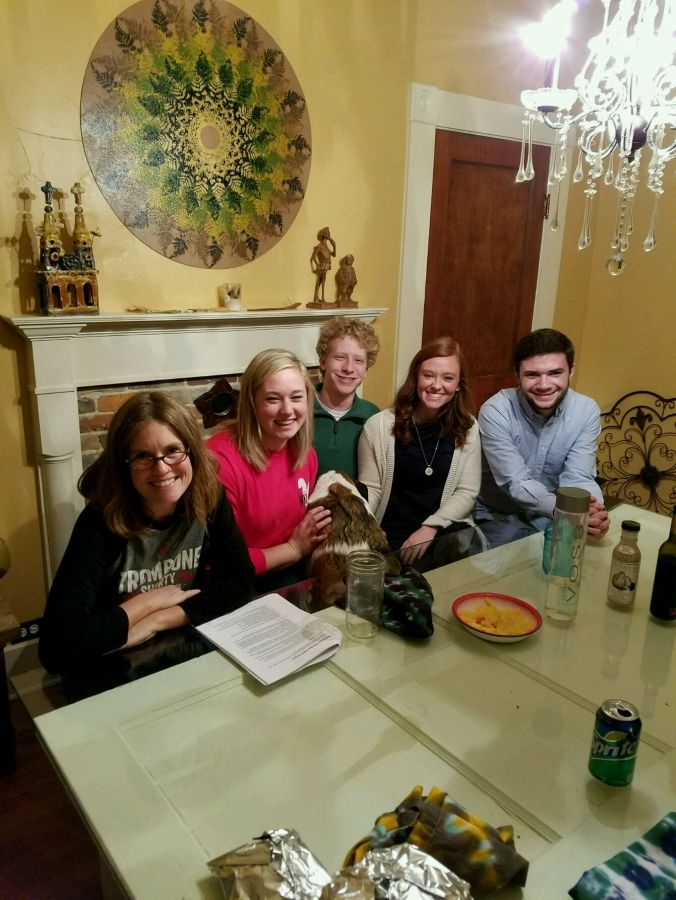
My Kentucky Kitchen Table meal took place in my home in a small-town, located in far eastern Kentucky, called London, Kentucky. This town is my hometown so I was very excited with the opportunity to host this meal here. In attendance to the meal was Ethan, Lyndsee, Delaney, Molly, and Carrie. Ethan is a graduate of the University of Cumberlands and is currently a teacher at Corbin Middle School in Corbin, Kentucky. He is also a member of the band Frontier, LLC. and their albums are available on iTunes and Spotify. Lyndsee is a sophomore at the University of Kentucky and is pursuing her career as a veterinarian. She is a member of the pre-veterinarian club and is also currently a residential hall assistant on campus in Donovan Hall. Delaney is a sophomore at the University of Kentucky, pursuing her physical therapy degree and is the academic chairperson of Delta Zeta. She also is a member of the pre-physical therapy association. Molly is a current student at Somerset Community College and is pursuing her degree as a dental hygienist. She is working currently at Hometown Bank as a bank teller. Carrie is a student at the University of Cumberlands, pursuing her accounting degree. She is the current accounting intern at ABC Automotive Systems Incorporation.

For the meal, I wanted to provide a home-cooked meal for my guests that I prepared myself, as I love to partake in cooking. I prepared the main entrees and desserts for the meal and then had my guests to provide their favorite appetizers. The meal was set to start at seven o’clock and after we had dined, I started the discussion. When asked the required question of beyond voting, paying taxes, and following laws, what citizenship meant to each of them personally, there was an anonymous understanding that citizenship means that we are all part of something more in this world together. We are all a part of something bigger than ourselves that we can relate to. Citizenship is part of our identity and it includes our freedoms and liberties and how we interact with others and our community, not just nationally, but locally as well. Ethan was very interested in the question of if he sees his job as relating to his role as a citizen. As a history teacher in the critical growth stage of middle school, he felt very strongly that his job does relate to his role as a citizen. This made me think of the Nussbaum reading, “Not for Profit” because he related it to how he feels education should equip students to see themselves as “citizens of the world rather than merely Americans”, and that personally is his role as a teacher. He feels that it is his job to introduce to his students what it truly means to be a citizen and reflect this through his lessons that he provides. Lyndsee also felt very strongly about this question as she is a residential hall assistant on a university campus. She experiences everyday trials that students must face now that they are living on their own, instead of being dependent upon their parents. She feels that her role is critical in helping freshmen students to make this transition more smoothly into the world as an adult. When discussing what kind of community they desired to live in, Ethan brought up how he desires to live in a more isolated area, for peace and quiet in a busy world, while Molly wants to live in an area where everybody knows everybody and the neighborhood is more like family. Ethan brought up that this difference could be attributed to how he grew up in a neighborhood where he did not personally know his neighbors, while Molly added that her viewpoint could be because she did grow up in a community where she knew all her neighbors and most of them were even her family.  Delaney brought up her personal experience of moving from a small-town community, where she knew all her neighbors, to Lexington, where she hardly knew anyone and the isolation that she felt from this transition. After getting involved in her sorority though, she started to feel more at home and not as isolated, but compared the two different atmospheres as being opposites and a difficult transition at first. This made me reflect on how there may be numerous internal struggles that my classmates may be facing on the inside that we cannot see from the outside.

When asked if our religious or spiritual identity relates to how we should treat other people, Carrie said yes and went on to say that it also can be related to how we are raised and could become innate from our upbringing. This related to our study on “The Righteous Mind” by Jonathan Haidt about the elephant and the rider. Our first initial reactions to other people may be related to what our elephants first think, in this case our upbringing. We also discussed how we do have obligations to other people in our country. At this point, I brought up the question if this includes if we also have the responsibility to take care of other people in our country. This question was hard for my guests to answer, just like it was in class. Delaney ended up stating that it is not our responsibility necessarily, because if a person does not do something we personally believe to be right, it does not mean that they are wrong, but it should be our obligation as the race of humans to be looking out for one another. Ethan added in that he does believe that his religious identity relates to how he treats other people because as a Christian, the Bible states to take care of the widows and the orphans, so he feels called to try to the best of his ability to treat everyone equally and help whenever he can. When discussing advice that we would give to people running for office in our country, it was a central theme that we needed to have more respect for one another. Lyndsee stated that she felt very bothered when seeing derogatory commercials of our presidential candidates stating mean things about the other. She also talked about how we should try and stop focusing so much on which “party” we belong to because it is creating more division than it should be. This reminded me of the article by Keith Melville, “How We Talk Matters,” because he wrote about how this world is not about “us vs. them. We’re all us.” There was an overall frustration that was voiced about how politics are currently. Lyndsee talked about how when the presidential debates were being aired, they held a viewing party in her dorm lobby and the students got so upset by the opposing views that the students all started to yell at each other and ultimately, the party ended up being cancelled and one student ran from the room, bursting into tears. This also reminded me of our discussions about how it is difficult for people to discuss hard issues like this and how often, it can lead to conflicts like what Lyndsee faced, leading two groups of people to be divided against each other. She also discussed about her experience thus far as a residential hall assistant and how she talks to people from all over the world of different origins and religions. She tries to relate to each person individually, aware of their diverse backgrounds and how she personally can learn something unique from each of her residents. When discussing if there is anything that we can do to make things better for our neighbors and where we live, Delaney brought up how she desires to be more friendly and open with her neighbors that she is not close with and it was even discussed how we desire to start more events for our neighbors to participate in together. Molly added that she knew of a neighborhood that would host a potluck every week, with a new family hosting weekly. This was not necessarily a time to visit for the neighbors, but a day that busy families could relax and not have to worry about preparing dinner for a night. It was a way that they could all help with the burden of a busy life together. Her story made me reflect on how we are all in this busy life together and that we can individually do things for one another that can help ease the stress and complications that we face, simply by in this case, preparing a meal once a week for others. This was what struck me and opened my eyes because I was doing this personally for my guests as well. Even though we may sometimes feel like we are a small human being in a big world and our impact does not matter, this is not the case. We can impact our world, communities, and friends in ways that we do not know and possibly, cannot see. Having this discussion in a way that was respectful and meaningful showed me how it can be possible and successful to have a conversation with others who have different experiences and backgrounds than you. Even though I went into this assignment feeling that I was going to teach my guests something, it was rather them who taught me.

Culture and Citizenship

By Andrew J.

This dinner took place in Bowling Green, Kentucky at my German Professors house. For dinner, Laura provided the schnitzel, salad and potatoes, but we had to cook them together in small groups. I did, however, bring chocolate as a gift to Laura for hosting this dinner, and Alex brought two pies as dessert. The dinner was attended by Laura, Heike, Julia, Alex, Ryan, Carlos, Maggie, Eric, Jack and I. Laura is my German professor and the department head of modern languages at Western Kentucky University. Heike is an English teacher from Germany who had come over with her students to Bowling Green for a few weeks. Julia is an instructor of Russian at Western Kentucky University. My classmates are of a diverse background as well. Carlos is a Mexican-American from Indiana who is studying mechanical engineering and German, and Maggie is a Chinese-American who is studying German and Chinese in order to be a translator after college. Ryan is studying German and Computer Science, and Alex is studying German and International Business. Erin is studying German and International Business, and Eric is studying Architecture and German. Jack is also studying German, and he recently came back from a semester in Germany. I myself am studying German and Geography. Since nearly everyone at the kitchen table had several years’ worth of experience with German, one of the topics that often came up in our dinner discussion was the difference between citizenship and politics in both the United States and Germany.

As we initially sat down for dinner, the table was relatively quiet. Eric was the first to bring up recent news to the dinner table, speaking about a recent political move made by President Trump to build the wall between the United States and Mexico. There was a shared sentiment of disapproval about Trump’s actions in the White House at the dinner table; however, Carlos, being Mexican-American, quickly called out the absurdity of the plan, noting that the proposal of building a wall between the United States and Mexico was not American. At this point, I thought it would be an appropriate time to ask everyone what it meant to be American. Everyone there had a different idea of citizenship, but there were recurring themes of opportunity and egalitarianism throughout each person’s opinion. Carlos held the belief that being a citizen entailed having the opportunity to speak and move freely and the right to pursue happiness by one’s own accord. He particularly emphasized examples in history of the importance of the right to pursue happiness, such as Mexicans immigrating to the United States to work so that they could better support their families. I supported this notion by stating that many of the anti-immigrant sentiments in the United States are based on scapegoating when in reality Latin American immigrants often work jobs that the typical person in the United States would refuse to. Ryan iterated that the United States was founded on the ideals of living one’s life the way they choose to, though he also added that the United States has an interesting quality regarding citizenship compared to the rest of the western world. It was his belief that the United States was the most individualistic western country, and that this affects how many citizens of the United States see themselves as Americans. Afterwards, Heike added to the topic, mentioning how a more collectivist attitude towards social issues exists in Germany and the rest of Western Europe. This means that while there are more government laws for assisting people, there is also more order and less free speech due to Germany’s troubled past.

The conversation shifted towards politics after talking about citizenship, as Jack recalled the current widespread malcontent with politicians currently. This brought the wide spectrum of political beliefs present in the United States to the dinner table. Virtually everyone at the table was disappointed with the current administration in a multitude of ways, which I didn’t find too surprising honestly. It did, however, become more interesting when Alex brought up the cause of the election’s results. He mentioned that the divide between rural and urban America has stratified our country, and that to move forwards the nation would have to first take an introspective look as to how we are all united as Americans, rather than divided. In agreement I replied that there appeared to be more challenging economic problems in areas like Appalachia and the Rust Belt, which a person living in an urban area would not understand. Jack noted that living in general has become more expensive, and that many well-paying jobs that once existed in rural areas are now gone. As we were all sitting at the table and pondering the situation, Ryan said that while the situation regarding work and economic prosperity looks somewhat grim at the moment, the same situation of a debilitated economy has happened several times before in the United States history, and that the tough conditions facing Americans today would, in some form or another, be overcome. The dinner was over shortly afterwards, though there were a few additional discussion topics that I felt taught me.

There were a few highlights from the night that I feel are worth mentioning in greater detail. My German professor, Laura, made an excellent point as to how the education system has evolved over the past fifty years. Where the University experience was once far more academic in nature, it has become more similar to a business model, since Universities now compete to get the best students by having the most amenities and accreditation. This, she noted, has heavily increased the cost of college, along with the increased need for a post-secondary education to obtain a fair-paying job. Many well-paying industrial jobs that one could obtain once they were finished with school are now gone, and the United States economy is increasingly based on service jobs, which are either minimum wage jobs or professional jobs. An important perspective on citizenship in different cultures came from Maggie, as she shared her opinion on the differences between Chinese and American culture. She remarked that there’s a higher sense of duty to one’s family in China than in the United States, and that this sense of duty will often manifest itself when decisions for the children are made. Parents are willing to sacrifice much of their own happiness for the sake of their child’s future. This resonated with me, as I had never heard a firsthand account of what life is like in China, where the cultural values are fairly different than in the United States. A final point that I found intriguing, though not in the main discussion around the dinner table, was a point brought up between Julia and Ryan, as they discussed learning Russian. Everyone at the table knew German to some degree, but Russian was familiar only to the two. It became very interesting as they talked about the varying contexts between Russian and German, agreeing that Russian is a higher-context language than German, which meant that the language is worded more implicitly. Although this small section of conversation wasn’t related to the rest of the discussion about citizenship and politics, I found it to be interesting on a more personal level, since I never really examined languages outside of my native English and German.

Of all the subjects we talked about in class, this dinner most reminded of the readings on global warming. Everyone at the table agreed that there were new political and social issues facing the world, but everyone seemed to have a different solution – or lack thereof – for the problem. The instructors, Laura, Julia, and Heike all seemed to agree that learning a second language is an important avenue towards higher intercultural sensitivity, which is important for citizenship in the 21st century. The other students and I had varying opinions on the meaning of citizenship in our modern world.  I, like Michael Pollan, admittedly had the bleakest outlook on the future. I feared that the world was going to be increasingly put under pressure by corrupt government and corporate rule which would limit our freedoms and force a more totalitarian system upon us. In short, I found that any good we could do as active citizens would be mitigated by forces on a larger scale. The other people attending the dinner, however, were not as cynical as I was. They came to a general consensus that through active citizenship and critical thinking, this generation would be able to overcome the pitfalls that impeded progress in the last two. One of the bigger ideas in class I feel this dinner alluded to was one of the three main questions: “How can we have more say over our own lives?” It seemed as though most of the conversation revolved around plans for the future and current global issues, with a heavy emphasis placed on what may happen to the world in the near future. While we couldn’t come to a conclusion as to what the future held, I think everyone at the table enjoyed the dinner and the conversation that came with it on this night.

When We Come Together

By: Elise

A couple of weeks ago, I was able to host a Kentucky Kitchen Table at my house in Louisville, Kentucky. I must give a great thank you to my old youth minister who helped me get a diverse group of people together while I was in school in a different city. He was able to contact people for me that came to my meal that I never would have gotten to talk to without his help; and I think this diversity embodies the idea of this project.

There were nine people who attended my project dinner, each one with their own unique perspective. And, as I had requested, they all brought one of their favorite side dishes to accompany the main course and dessert my family provided. There was Larry, an outreach minister at a church, Janet, a self-employed consultant, Iris, a writer for Anthem, Heavenleah, and instructor for students with autism, and Felix, a 5th grader at a local elementary school. Also, a few of my family members attended; there was, Jackie, a children’s minister, David, a director at a marketing agency, and Amanda, an instructor for students with autism. They have asked that I refrain from getting too detailed with their specific descriptions but, our group’s ages ranged across 60 years. There were varying political parties, orientations, economic classes, and races represented; and many people there were not born in Louisville. And, with all of these differences between people, I had anticipated some awkward moments. However, the dinner ran very smoothly. Everyone was excited to participate and eager to hear other opinions. They were all very respectful and willing to speak up.  It was a really cool thing to witness.

I began the conversation by explaining a little bit to my guests about what the class is and reminding them of the purpose. After that, I really let my guests run the conversation, and they needed very little prompting from me. With the exception of my changing the question or adding a comment here and there, I had very little to do with the direction of the conversation. They had lots of good answers, and even questions of their own. And, everyone listened to what the others had to say. This conversation really embodied Keith Melville’s thoughts in How We Talk Matters. In this article, Melville defines deliberation as an approach to public decision making; and, he emphasizes the importance of intentional conversation and listening. And, during this conversation I was able to see the amazing things that can happen when this practice is actually used. People came together and actually heard what the others were saying, despite their difference in political party or economic class. And while they might not have had their minds changed about certain topics, they heard other opinions that seemed to broaden their view of the subject, and make them more open to other ideas.

The first question I asked was the required one, what does citizenship mean to you? Overwhelmingly, the answer I heard was being a citizen meant being a part of a community. The idea of citizens being a team or a family.  Each person has a different job, but we need all of those jobs done in order to be successful. Iris was reminded of jury duty—of how one person can’t be the only decision maker, but it requires a team of people actively participating to get the job done. Similarly, Felix said that a community reminded him of a grandfather clock in which the people were like the gears that kept the clock running. Even though he is young, he had some interesting insights throughout the night.

They also discussed how you can be a “citizen” of many different communities. Of course, we were all citizens of the United States, of Kentucky, and of Louisville. But we are also citizens of churches, schools, sports teams, clubs, etc. Some of these things we choose, while others we must be a part of. So, it is important to be a good citizen in all areas of our life.

Then I asked the question, what is the thing you love most about living where you do? I opened up the question so that people could talk about Louisville, but also compare it to places they had lived in the past and what they liked about that, too.  I felt that this was important to talk about because it recognizes the fact that we did not all come from the same place, though we were there together in that moment. At first, people focused on Louisville.  They love that everyone there is so friendly, and that they may not know everyone’s name, but they know their story. They said that this made the big city seem more connected, and more like a small town. They like the reputation Louisville has of being kind and generous, and this reputation is embodied by celebrities from there that they mentioned such as Muhammad Ali and Jennifer Lawrence. They seemed to all agree that an ideal place to live had these qualities that they liked about Louisville.

After we spent time talking about what we liked, I asked about what improvements they thought should be made to the area. Without missing a beat, Amanda brought up how we needed more homeless shelters in the city. We have a few in the downtown area, but in the part of town that most of us live, we do not have anything substantial. We also discussed how our prison system needed to be reformed; both in the prison and in the transition out of it. We have many people in the city who have served their time, but still seemed to be punished because they can’t get hired anywhere. Others brought up the fact that our area needs to improve on its awareness and treatment of those with mental illness or addiction. Many people noted how they knew people who had been turned away for help in these areas because the doctors were unsure how to help, or the insurance didn’t cover it.

While I prompted this question with improvements they thought should be made in Louisville, it seemed to me that all of these problems they noticed applied across the country. And, most of them had to do with the larger systems in place. They all seemed helpless when discussing these topics because they were unsure how to get around the large systems, but they saw a clear problem in the way they were run. It made me think about a discussion we had briefly in class once about how large systems that were put in place, like the prison system or the foster care system, are put in place to fix one problem, but it can cause other problems. That what makes issues like these Wicked. You cannot foresee the consequences, and once you put the system in place it is time-consuming and costly to change or replace them.

The last thing I asked them was what advice they would give to people running for office in our country. I thought this would be an interesting topic to cover because of recent political divisions across the country. I wanted to see if the group could discuss something that could be politically charged in a calm and efficient manner. Luckily for me, they did. And I loved their answers. A main point that they all agreed on was they wanted a politician who would focus on what unites the country, and not what divides it. They want politicians who do not use Us vs. Them tactics, but who will be honest with their opinions and be true to what they think is best rather than what the Party wants. The table also advised that politicians should know that they can’t please everyone, but they should still try to make everyone feel like they are heard. A common theme of this discussion was that people felt alienated because no one was listening to them. The group thought that if leaders made an effort to listen, people would be more understanding of their actions, even if they weren’t the outcome they had hoped for.

I did not realize until it was over how great of an experience this project was. It is not often that I get to sit and talk with a diverse group of people about issues that actually matter. And, it is not that I dislike these types of conversations; I just get so caught up in my own life that things like this don’t happen. But, I now realize the value of this type of conversation. In this class we talk about the importance of deliberation, and I can see now just how effective it can be. If people were to openly discuss topics like these more often, I feel our communities would be stronger. Most people came to this table strangers, but I feel we left a connected group. If citizens would take more opportunities like these, they might feel more connected to their communities.

Small Town Democracy

By Mary

My Kitchen Kitchen Table took place in Glendale, KY, the quiet little town in central Kentucky that I call home. We sat around my family’s kitchen table, the table that my siblings and I sat around for years as kids.

Around the table were six people. My sister, Anne, is a 16 year old junior in high school who is an incredibly talented artist, writer and student who is gifted in not just the arts but in math and science as well. My mom sits at one end of the table. She has been a homeschooling mom of six kids for 28 years, and now is the development director for the local crisis pregnancy center. My dad sits at the head of the table. Dad is an engineer who works as the director of a healthcare clinic. My brother David sits across from Anne. He is 23 years old, works in the Louisville Ford plant as a CAD engineer, loves learning, and is the most industrious person I’ve met. Beside him is his fiance, Anna. David and Anna got engaged the week before we had dinner together. Anna is a senior in college, studying Asian Studies and Chinese. She works at the public library, and as the newest (soon to be) addition to the family, is a very welcome but not a very familiar presence at the dinner table.

We ate an incredibly scrumptious meal of pork, smashed potatoes, green beans, and a dessert of brownies, strawberries and ice cream prepared by my Mom, Anne and me. We had a wonderful time making dinner together.

This is a diverse group of ages, with my parents born in the Baby Boomer Generation, David and Anna born in the Millennial generation, and my sister and I born in Generation Z. Anna grew up in a different family and in a different town, my dad spent his childhood in Tennessee and Indiana, and my both my parents have lived and experienced much more in life than David, Anna, Anne and me.

We had a great conversation about citizenship. I asked the question, “What does citizenship mean to you?” We talked about two meanings of the word of citizenship – citizenship as a noun and citizenship as a verb. We said that to be a citizen (noun) means you have a particular legal status and fulfill duties within that status. To be a citizen (verb) means you take steps beyond just your legal status to improve the world around you. We said that the duty of a citizen is to do what they can. My dad said, “any good that people do – no matter what it is – adds to the greater good. Therefore, a citizen is responsible to do what good they can.”

Anna mentioned that globally, citizen participation is decreasing. We talked about how some countries are implementing compulsory voting laws. Anna talked about a unique system that India employs, where citizens’ thumbs are dipped in ink when they vote, making it easy to identify people who have and have not voted. We talked about how culturally, this system would not fit in in America, but it is interesting to see how other democracies go about the voting process.

I then asked, “Do you see your job as serving a greater purpose?” I picked this question intentionally, knowing that we had a diverse group of jobs and hoping that it would spark good conversation. My mom answered that she thought her job contributed to the greater good because the non-profit that she works for helps create healthy families, and healthy society cannot exist without healthy families. My brother said that he thinks his job in manufacturing definitely contributes the greater good, because every manufacturing plant provides a product to people who need it, whether the product seems “important” or not. He considers manufacturing a “noble profession” because it is not glamorous and doesn’t receive thanks but is instrumental to our society. Anna said that her job at the public library helps the whole community and every demographic, if people choose to take part in it. This, in a way, is a metaphor for democracy and engaged citizenship – if you choose to take part, your participation will benefit you and help strengthen the democracy. If you do not choose to take part, you have only yourself to blame. My dad said that he did consider his job as contributing to the greater good. As the director of a healthcare clinic that provides intensive care to Medicare patients with significant illnesses, Dad sees his job as connecting people with services they need that they wouldn’t be able to find elsewhere. He believes that because no man is an island, helping one person helps a lot of other people in turn.

We would define citizenship as taking deliberate action to do what you can to help another person, even if it is a small act or in an unconventional way like working in a manufacturing plant.

Sitting around the table eating dinner is not new to my family – growing up our family made it a point to stop and eat meals together. But having structured conversation about citizenship drew us together, because it gave us a picture into each person’s perspective on the world. I learned something about each of the people around the table, and developed my view of citizenship by having an intentional conversation about citizenship with my family. Our conversation reminded me of Jane Addams’ “Snare of Preparation” article. In her article, Jane Addams talks about how people often get caught up in preparation to serve and never actually embark to serve. The definition for citizenship that we developed touches on this, as it requires that citizenship be active based not on how large your impact can be, but how meaningful your impact can be. Often people don’t act (or vote, or write to their representatives, or talk intentionally or get involved in campaigns) because they think that it will not matter. In his article “Why Bother?,” Michael Pollan argues that we should bother about taking simple actions that don’t seem to have a large impact because they change ourselves and influence people around us. Our conversation helped relate Pollan’s article about the environment to citizenship. People should care about being good citizens because it makes you a good neighbor, a good friend, a good employee. Acting in the interest of others and not just in your own interest broadens your horizons and gives you an appreciation for people who are different than you. Citizenship is not limited to just political action; citizenship is a mindset that changes the way we interact with others. Only a transformed American citizenry can change American politics. Only citizens who deliberate with one another over kitchen tables, grocery store aisles and across party lines, and stay informed about both relevant issues and the needs of their neighbor can develop a flourishing democracy.

Homemade Pizzas and Home-style Conversation

By Jacob

For me, the Kentucky Kitchen Table Experience begun even before I expected it to. Our host, Christian, lived in Franklin, Kentucky, which was about thirty minutes away from Western Kentucky University. In order to save gas and hassle, I rode along with Conner, who I knew from my section of Honors 251, and Ally, a girl in a separate section of Hon 251 whom Conner already knew. After a quick detour to Walmart to pick up some miscellaneous pizza toppings (mushrooms, pepperoni, and pineapple) and some ice cream for dessert, we set off for Christian’s house. We all quickly got to know each other and dove into conversation, Earlier in the week, I had my gallbladder removed due to a rather painful 2.5 centimeter gallstone. Conner, being on the pre-med track, was interested in the process and asked some questions about my experience. Ally shared a story involving her rehabilitation following extensive ligament damage in her knee. We also discussed the election results of the week before, which was made more interesting by the fact all three of us voted for different presidential candidates (one for Donald Trump, one for Hillary Clinton, one for Gary Johnson).

Soon, we arrived at Christian’s house. After a quick discussion confirming we were at the right house, we went inside. There we were greeted by Christian, her partner Chuck, our fellow Honors 251 student Madeline, and two very large, very friendly dogs. After a quick tour of the house, and the expected awkward lull, conversation began in earnest. Christian is the Sustainability Coordinator at WKU and one of my main focuses as a Political Science major is in renewable energy policy. We started discussing a recent paper I had written detailing a potential initiative by the Department of Energy to increase funding and subsidies for renewable energy sources. Conner jumped in the conversation and shared his experiences as a member of the Student Government Association Sustainability Committee, including initiatives to decrease waste as Fresh Food Company and Subway. I also discussed my plans of going to law school with Chuck. Chuck is a former Marine who was attending law school before taking a job with Veteran’s Affairs. We talked about the opportunities afforded by a law degree and our shared interest in legal studies.

Eventually, we began to prepare the pizzas. Deciding on what toppings to put on each pizza helped open our conversations up to everybody in the room. Throughout making the pizzas, I got to better know Ally, who once wielded a firearm to dissuade a man from stealing a trailer, and Madeline, a Bowling Green native who knew the area far better than I. By the time we sat down to eat, we had already been making conversation for nearly two hours and were well acquainted with one another. We then set out to address some of the questions posed to us in the handout packet, beginning with: “What does citizenship mean to you?”

Chuck began the discussion by drawing on his military experience overseas. To him, the safety provided by our soldiers is the greatest part about citizenship. Being able to walk down the street without fear is something that doesn’t exist in many places around the world and he is thankful he lives in a country where he can. Ally and Madeline both said that American citizenship is about being able to express and practice what you believe, specifically regarding religion. Ally cited several examples of Christians facing persecution throughout the world. Christian shook up the conversation with a more local view of citizenship, telling us the stories of three women in Bowling Green who are creating change at the local and community level. I followed up with the opinion that citizenship is about being part of a larger whole. Each member brings something unique and valuable to the table and together, by using their strengths, they can create a better community for themselves and their neighbors. Conner also focused on the necessity of working together and meeting people where they are to form a strong and efficient community. The different backgrounds and perspectives of all at the table was eye opening.

Next, we talked about “What is the best thing about the world today?” All of us agreed that technology, globalization, and increased communication were all changing the world for the better. We can make more effective medicines, hear news from around the world nearly instantly, and travel almost anywhere. Along the same vein, I brought up how I believe the best thing about the world today is how we are always moving forward and always striving to be better, never satisfied with where we are. Christian and I talked about how that is an important mindset to keep moving forward, given the surprising results of the election the week before.

After dinner, we reverted back to our casual banter and conversation. Chuck and I went into the living room to watch the end of the Cowboys-Steelers game that was on while the others stayed in the dining area. After talking about football for a while and finishing the game, we joined the rest of our group in the dining room to clean up. Then, cookies and leftovers in hand, we bid farewell and walked back to Conner’s car.

Overall, I was very satisfied with my Kentucky Kitchen Table experience. Any awkwardness quickly fell away to reveal a diverse set of experiences that we all could learn from. We had very diverse political opinions and varied in our views of the world, but were easily able to find common ground. Unintentionally, we never discussed our political party affiliations but instead focused on our personal experiences, beliefs, and values. Without these labels to confine us, it was easy to discuss our differing opinions in an openly and in a constructive manner. Successful deliberation always begins with an open mind, and for at least one night in a kitchen in Franklin, Kentucky, we were able to do just that. kkt


Connection brings the beauty in citizenship.

By: Hilarie

IMG_2580.jpeg

Rudyard Kipling once wrote that, “If history were taught in the form of stories, it would never be forgotten.” What an incredible statement, he’s making. If you think about it, the things that we hold nearest to our hearts are the stories that maybe a parent or grandparent told us, a story that we’ve heard that really touched us, and for most of us, our own unique stories are all at the center of who we are. Stories are the unique connectors, the webs that are woven in order to unite people with each other, stories are often the building blocks of citizenship. Recently, I was able to experience a night full of exchanged stories, a kind of scattered dinner, and the building of friendships amongst people that truly surprised me.

At this dinner were five of us, each very unique. Of our group were myself, Rachael, Brent and his friend Tan, and our generous host Jennifer. I set up the dinner with Jennifer as I met her earlier this summer when we worked on the Ceremony for New Citizens together. Jennifer is the perfect example of what it means to be a citizen in a community and I thought she would be an excellent match for each of our group members’ interests. She graduated from college with a degree in Political Science, and her husband teaches Political Science here at Western. She is a devoted mother, and citizen as she does very intensive work with the refugee population here in Bowling Green. She does everything from organizing an intercultural soccer team for refugee children, to helping refugees adjust to daily life by attending driver’s tests, court cases, and doctor’s appointments with different families. If I were to model my life of service after one person, it would certainly be Jennifer. I have been getting to know Rachael and Brent more and more through our class, but it was eye-opening to learn more and more about them as we sat together to eat dinner. I was so happy that Brent brought along his friend Tan, as he was a new face for me to meet and his perspective was refreshing in our conversation. He has incredible talents and a spirit that is infectious. Over the course of this night, I learned how much Rachael and I are alike, from our love of feminism and literature to our desires to start a girl band, (which we are totally going to do.) I think I may have thrown Brent and Rachael way off because I don’t really like pie, but they accept  me for my ice-cream loving self and that’s a form of citizenship in itself. Rachael is incredibly insightful and kind and is exactly the kind of person that I need and want in my life. If anything, this class brought me a friend that is a girl after my own heart. Brent is also incredibly awesome, like I’m pretty sure that Brent is one of the coolest people that I know; he’s compassionate, incredibly aware, and full of surprises.  I feel like both Rachael and Brent would like to be described as students and citizens who are hungry for change and development in our world. Both of their hearts and minds are on fire to make a difference, which is what makes our friendships work together so well.

The bulk of our conversations, aside from the required questions and introductions was about Jennifer’s work with refugees and about each of our unique desires and ideas about the world. It was actually a very interesting dynamic that our group had as we bounced off each other’s ideas and built upon what each of us felt. It was a conversation that I have been missing in my daily life. I sometimes struggle with finding people to truly discuss and learn from, and this conversation certainly filled a void that I was missing. We briefly touched on the election, which actually wasn’t terrible to do. All of us were pretty much on the same side as who we thought should be elected, but we spent a small bit of the time discussing the other side and why each of us thought people voted the way they did. I think this is crucial; if we don’t take time to truly discuss the side that we aren’t on, then how do we find the common ground when trying to make progress for what we believe in? It was refreshing to take a moment and recognize the differences in the world as we were seeking the similarities amongst our group. We also discussed with Brent’s friend Tan what it was like in Vietnam and how culture was different from what he was experiencing here in America. His perspective was beautiful to try to understand. Global citizenship came up frequently in our discussion, as everyone at our table, aside from myself, had studied abroad. As I have yet to experience that form of citizenship, I truly learned complex ideas from the different abroad experiences that each of my friends have had. As I find may similarities amongst each of us at the table, we are all incredibly diverse as to how we want to change our world. The stories we each shared opened my eyes to the possibility and hope for our world, and people like Brent, Rachael, Jennifer, and Tan are the ones that will be forces against the nature of where we are today. I think the biggest thing I learned was just how important it is to discuss, not necessarily debate, but just interact with one another. I think we get way too caught up in making convenient exchanges with people that we forget to take the time to have thoughtful conversations. As one topic progressed in our conversations, diverse thoughts and beautiful ideas surfaced, allowing each of us to develop our own thoughts in concordance with each other. It was like building our own web of connection through the expression of our thoughts. I think this is exactly what our class was trying to teach us: how to live well together, how to solve problems, how do we change and evolve? We connect. That’s the most important thing. Connection leads to empathy, empathy leads to helping hands, helping hands lead to a little more love, and that love and acceptance of our fellow man, leads to one of the most beautiful things imaginable: citizenship.

Citizen and Self has been an eye-opening class for me, even when I have been scattered and not on top of things, it’s made me truly analyze what it means to be a member of a group and what it takes to make a difference. That’s the citizenship part, the part that has completely changed my idea of what being a citizen is, the part that has revolutionized my own plans for my life. The other part of this class is discovering myself in ways that I hadn’t thought of discovering. I think that we, as humans, are constantly on the mission of discovering ourselves. As I discover ideas and thoughts about our world and the people that connect it, I also discover something new about myself everyday. There are many things that I long to discover, things like how it is that one action can influence so many things and how different people seem to always inspire something. I find the most interesting things to discover are the abstract things that constantly change from day to day. I think that conversations like the one that I had around our table are the ones where you can simultaneously discover new things and recover old things that you knew and learn how to apply them. Taking the idea of talking around a table; something that we’ve all done, at least, once in our lives, and then combining it with the newness of strangers turned inspirers, is how I’ve found connection amongst myself and this new community that I’m a part of. I hope to continue to discover the ways that I, as an artist, student, citizen, and friend can grow. I realize that I have so many things to learn, I am just beginning to uncover them, and the best way I know of to learn is by feeding off of others and one of the most amazing things that I long to discover is how I can be an active voice in a group of like-minded, but also diverse individuals. This project helped me to discover a little bit more of that, and so has this class.

Elderly Dogs, Citizenship, and Chicken Nuggets

By Zach

Through this Kentucky Kitchen Table experience, I was able to go back to how I normally eat dinner during the holidays with my family, listening to each other and discussing how our years have gone usually encompasses a majority of our dinner. Since being at Western Kentucky University I find it hard to actually have those sit down conversations with people which go beyond just small talk because that is basically all we have time for. Although I had never met McKenzie prior to the Kentucky Kitchen Table I knew it wouldn’t take long for us to open up about our school lives, future plans, and other topics relating to the Honors 251 course.

Aubrey and I had already begun to open up about our lacking cooking experience and I will admit I gave her a hard time about not being able to make no-bake cookies, which she had promised to bring, and instead bought the cookies at a store a few hours before hand. After arriving at McKenzie’s apartment we soon realized we were not the only ones with minimal cooking abilities because we were welcomed with every college student’s favorite dishes, chicken nuggets and mac-n-cheese. The biggest surprise was when one of the most energetic dogs I had ever been around came up to me and began to beg for food, his name is Johnny Karate. Johnny would soon become the center of attention for the rest of the night.

Other than Johnny Karate, I did not see much diversity seeing as Aubrey and I were from the same hometown and McKenzie was from Shepherdsville, Kentucky. But the more I thought about it the more I saw that we are much more different than I had previously supposed. I am a biology major while Aubrey is an undecided major and McKenzie has graduated from Western Kentucky University (and the Honors College) with a degree in psychology. These differences in majors show how diverse our interests are from one another. Being raised on a farm in Northern Pulaski County with one younger sibling, I have a much different view of the world as compared to McKenzie who grew up in an area around Louisville is the oldest of five. I didn’t see much of a connection to be made with talk of what we all wanted to do with our majors, or in Aubrey’s case what types of majors would be enjoyable, so I was ready to dive into the recommended questions for discussion.

When I sat down I could not help but notice a pro-Hillary Clinton coloring book. Now being an outspoken Trump supporter I had questions rolling through my head about why she would pick Hillary Clinton to support but Aubrey had already told me before dinner that I should probably refrain from any political discussions just so we could keep the night going as smooth as possible. I decided not to bring up the issue explicitly but rather implicitly.

One of the major questions we discussed stemmed from the recommended questions in the handout which pertained to what we thought the best thing in our world today could be. McKenzie seemed to have an answer already prepared for this question seeing as she hardly hesitated when she replied that social media was one of the most beneficial things we have in society today. McKenzie acknowledges social media can be used to harm others self-esteem and may be used as a vehicle for bullying to occur. She stands by her stance of social media is more beneficial than harmful simply because social media allows people from across the globe to communicate in a way never seen before in history. I can see how social media benefits humanity in how it allows the transfer of experiences to people from completely different backgrounds.

Even though I realized McKenzie and I had differing views on who should be the next person running our country, Aubrey, McKenzie, and I all had similar views on social and humanitarian issues at hand. A required question was “Beyond voting, paying taxes, and following laws, what does citizenship mean to you?” McKenzie’s answer was spot on in how she believes we have an obligation to help others and those who cannot help themselves, yes that includes elderly dogs. McKenzie as well as myself believe no matter how small our efforts are; we can make a difference in our communities. I could see this idea relating to Pollan’s “Why Bother?” article in disagreement with what the articles theme is pushing for in that no matter what we do unless everyone participates nothing will change.

Another conversation I found interesting stemmed form the question of “Do you know your neighbors?” McKenzie stated that she was more of an acquaintance with her neighbors. I can understand why seeing as she does not necessarily have anything in common with her neighbors other than that they live in the same apartment complex. Growing up in a rural community I was very close with my neighbors, however, my neighbors and I had a majority of the same background so it seems easier to get to know them and become close. When taking on college I have noticed that it is much easier to get to know people who are much like yourself rather than reaching out and finding people with differing backgrounds and opinions. Through my experience in the Honors 251 class, I see that it would make for a more educated outlook on problems we face as a society.

As the night came to a close I realized I had most likely thrown over 100 balls for Johnny Karate and although he seemed to be exhausted he kept bringing the ball back and begged for one last throw. Aubrey and I helped clean up the leftover food and thanked McKenzie for having us for dinner. After reflecting on the night I understood how diverse our group actually was outside of our race or other physical features our opinions are what really defined the diversity of the group. Aubrey, McKenzie and I had a wonderful time with insightful conversations about elderly dogs, citizenship, and chicken nuggets.

4553061df8884f608358b38576cdfe48

Puppies and Pumpkin Cookies

kkt

By Madeleine

On November 13th I drove to Franklin, Kentucky to have dinner and share conversation with a group of people whom I had never met before. I was nervous to say the least.

Christian- Our gracious host. She is the Sustainability Coordinator for WKU and the owner of two incredibly playful and hairy dogs.

Chuck- Christian’s partner. An ex-Marine with a strong dislike for pineapple and spinach  pizza.

Connor- A Louisville native who loves Game of Thrones and is a senator at WKU.

Jacob- A Cincinnati native who had recently gotten his gallbladder removed.

Ally- From rural Lexington and an expert on what to do when someone is stealing your trailer.

Me- A Bowling Green native who thoroughly enjoyed the vegan pumpkin chocolate- chip cookies.  

Growing up my family hardly ever ate dinner together and our kitchen table was more of a place to set up homework or do school projects. Most nights I would be the last one home, coming from dance or work and I would go upstairs to say goodnight to my mom and little sister before reheating whatever they had made earlier. When we did have meals together it was done quickly so that we could get to our next activity or go do homework. The conversation never went past what we had done that day or what we had going on tomorrow. I had no idea that some people actually hold conversations and debate opinions at the dinner table. I was excited but very nervous about eating with people outside my family and trying to hold a conversation with people whom I’d never met.

I was the first to arrive even after first showing up to the wrong house (her neighbors are very nice people). I was greeted at the door by a smiling Ms. Ryan, two giant dogs, and the smell of cookies. A few minutes later Connor, Jacob, and Ally arrived. Connor and Jacob were both in class together and Ally knew one of them from another class, plus they had all driven up together so I was already feeling very apprehensive. Fortunately, my fears were unfounded as we quickly fell into casual conversation with everything from the elimination of the use of styrofoam in Fresh to how to make the perfect combination of pizza ingredients (Mushrooms and tomatoes go well together.) After the pizzas were made we got a tour of Ms. Ryan’s beautifully remodeled 1940’s home. It was amazing to hear about what it used to look like and how much work she had put into it for eleven years.

When it was finally time to eat we went into the dining room, put hand tie-dyed napkins in our laps, said grace and quickly tucked into our four amazing homemade pizzas and homegrown salad. As we ate we discussed the first question in our handout- what does citizenship mean to you beyond voting, paying taxes, and following laws? Chuck started the conversation by talking about how his view of citizenship is directly influenced by his experiences in other countries as a Marine. He discussed how amazing it is to be back in America and being able to walk down the street without being afraid that someone is waiting around the corner waiting to kill him, The safety in this country that we sometimes take for granted is what makes citizenship so important to Chuck. Next, Ally talked about how citizenship means the certainty of religious freedom without the fear of persecution. She discussed how amazing it is that we have to freedom to not only worship freely, but we also get to choose what we want to believe in without fear. I reiterated how amazing it is to have the freedom to practice the religion of my choice freely and also touched on how the opportunity for education is also central to my views of citizenship. Living in America gives me and others the incredible opportunity to continue our education. This is especially important to me because in other countries women and girls are not allowed to go to school, or speak their minds, or do anything other than make babies and do housework. I wake up every day knowing how privileged I am by being able to go to school and learn about things I am passionate about.

Next, Christian discussed how citizenship to her means participating in your community and how important it is to be passionate about something. She told us about a paper she had just written about community involvement and about how one of the three women she highlighted in her paper helped homeless people not by just showing up with food, but finding out what they truly needed (clothes, money, a place to sleep, etc) and then helping them get or find that. This can relate to our class in how we discussed how to try solve wicked problems or even just emergency situations by listening to what is needed instead of just doing what we believe is best. Jacob and Connor both gave a more general, world-wide definition of citizenship by discussing how people need to use their strengths in order to contribute effectively in the community in which they live. Before we had to go we briefly discussed the pressing issue of gun violence which I was happy to be able to be a major part of because of the social issue project  am working on in class. Lastly, we all talked about how we think technology is positively affecting the world today. In a world where so much negative attention is put on technology, it can be easy to forget the amazing benefits that comes with it. We all agreed that technology enables us to have a global economy, makes it easy to learn about other cultures that makes us more accepting individuals and easily accessible education on any topic you can think of.

Speaking of technology, by the time we finished eating I glanced at my phone for the first time and saw that I had several text messages from my cheer coach wondering where I was. When I first arrived I had been constantly checking my watch to see when I needed to leave but later was surprised that I had gotten so enthralled in the conversation and the incredible experience that I had totally forgotten about my phone and cheer practice. I guess that’s what this project was truly about. Meeting new people and learning new things, not only about other people and the world around you, but learning where you stand on issues compared to others. Through this I was able to hear about people’s personal experiences that shaped them into the people they are today, such as growing up in rural Kentucky, or going on several tours to Afghanistan. Hearing these stories made me think back on my own life and made me ask myself why I believe what I do. Why am I passionate about certain things?

In conclusion, I sincerely enjoyed this project far more and learned more about others and myself than I ever thought possible in a short three hours. Thank you so much to the amazing Ms. Ryan for opening up her beautiful home, Chuck for keeping us laughing all night and my fellow Honors 251 students for asking thought provoking questions and making some super good pizza.

Kentucky Kitchen Table

By Elizabeth

Last week I had the pleasure of sitting in and sparking conversation with a whole host of new company. Mary and I were welcomed to dine in the home of Keaton, Kat, and Tori. Joining us were fellow friends of theirs, Andrew, Gabby, Hayley, and Ashlyn. One benefit of being the new member of this diverse friend group was that each person got to paint themselves in whatever light they wanted. When asked how they liked to be described the answers involved both physical characteristics and core values. Andrew likes to be seen as a very tall gentlemen who was raised in Tennessee and has a background with horses. Gabby unlike the rest expressed one of her fatal flaws by stating she get ‘hangry’ quiet often, a slang term coined to express anger brought on by being very hungry. However she is fairly quiet at first but opens up when surrounded by familiar company. I am glad she was surrounded by friend too because she had great insight into some of the prompted questions. Hayley wants to be known for her humorous side which relates to her idea that she is fun to be around, which I can second after being in her company. Keaton most admirable qualities consist of her dedication and passion to do the right thing while keeping a positive outlook. Ashlyn in proud of her big smile and described herself as an avid extrovert. Hayley on the other hand is more meek and but will defend her point of view in a respectable manner when she feels necessary. Tori said that she is known for her candor and loyalty, never afraid to speak her mind, which added a lot to the discussion. All though it was a female dominated group a great source of diversity was found in the political views, social economic upbringings, and religious affiliations of the people sitting around the dinner table. Even after hoping in with different questions the unavoidable and controversial political debate which is so prevalent at this time dominated conversation.

However, the fundamental question of our class was what initially facilitated conversation. When asked, “What does citizenship mean to you?” Andrew started by answering very straight forward. He said it means doing your part and being good others. As I suspected the first answer would only scratch the surface of a more in depth answer but I was appreciative he was the first one to step up to the unorthodox table topic. Tori seconded Andrew but slightly caught on to the fact we might have been looking for something deeper and added that citizenship means being able to have a voice in society. She went on to express different ways she’s involved. By being involved in community through big or small parts you have a voice. She is involved in intramural sports and a sorority and volunteer work which makes an impact on the way society functions. After others expressed similar opinions that related to different ways each of them is involved and the way they give back, Mary steered conversation by bringing up a similar question, “What kind of person do you want to be?”  Regardless of what setting Mary and I would have been in, I think this question is what brings most people to a general consensus. This is also where I found a strong connection to our class and the material we have been reviewing. Each answer was inspired by an idealistic view of striving to be someone that is liked and respected. Just like in the class we are working to reach common goal by commutative input, each person have a common goal of who they want to be. The main difference is in the way were try to get there. Although the conversation to did move towards the a step by step game plan on how to accomplish this goal I think it is beneficial to be reminded that we are all striving for the same end game.

Diversity was seen again when religion was thrown into the mix. Both parties agreed to we should treat people justly, but where they drew their moral guide from was not the same. The people who identified as religious were Christian and those who were not were either agnostics or atheist. It was about a fifty fifty split.  Under the circumstances of a group or people that already willing associate, this controversial topic of religion, which lead into politics, was very civil. The agnostic perspective thought religion should not be the say all of what determines how we treat people. Interestingly enough, Mary and I’s friendship embodies the Kentucky kitchen table dynamics we had set up. Mary was able to relate to the agnostic point of view, while I resonated with the side of the discussion who pulled their view from religious back grounds. The Bible was reference by Gabby when she said how she values the golden rule: treat others the way you want to be treated. Ultimately this influenced the discussion toward what obligations do we have towards others. This is when politics found their way into the mix. Each person believed that the government and we as individuals have an obligation to treat others with fairness and kindness. However remarkably so as much as we might be able agree upon this as a society and a small group around a dinner table the feelings toward the elections still varied drastically. Even though I am rooted in a strong political stance like most it was refreshing to hear each person’s perspective discussed with such respect for others. On the one hand about half the individuals confessed to voting for Trump while the others half was in unison against Trump. Those in favor of Trump were goal oriented toward economic change that they believed would serve the general public. Those against Trump believed he stood for values that would deteriorate this society. Although the majority Trump supporters could sympathize with their friend’s feelings they still held true to their beliefs. In the end no one was thrilled with the state of affairs our society had been thrown into due to the election. As much as I wished the common ground could be that of rejoice it was not. The meat of the conversation came to a conclusion when we asked, “In retrospect of this how do we live better together?” Andrew mentioned that we must both respect the outcome of the elections and each other. While other might have not mentioned respecting the outcome of the elections all voices at the table agree on respecting their fellow citizens.

After sitting in on a group of people I had never met before, I learned that at the end of the day we are always more similar than different. If we look for similarities we can always find them and if we look for differences the same is true. What is important is that we emphasize our similarities. In regard to David Brooks’ take on the moral framework of today’s youth, discussed in his New York Times article, “If It Feels Right…” I would say these types of conversations prove him wrong. Not every meal is oriented around in depth discussions, but the fact that we can have one and express our opinions with respect and thought out reasoning is what is important. The elephant and the rider (from Jonathan Haidt’s book The Righteous Mind) were also prominent in the group discussion because people reasoning were rooted in the way the felt about the topic. I hope that these talks and hearing others similar goals with facilitate more thoughtful discussion that will continue to help this world answer the question of how we live better together.kkt

Citizenship, Democracy, and an Elderly Dog

by Aubrey

4553061df8884f608358b38576cdfe48As a college student, I am constantly on the go, seldom able to make time for much of anything other than the tedious tasks that being a college student entails. I eat my meals hurriedly between classes, seldom taking the time to talk or even sit at a table. So when I was required to do the Kentucky Kitchen Table project for Honors 251, needless to say I was out of my element. However, through this project I was able to gain a valuable experience that I will always remember. This experience had an incredible impact on not only me, but also my classmate, a former Western Kentucky University student, and an unexpected furry guest that contributed equally as much to the night as the rest of us did.

When Zach and I first arrived to McKenzie’s apartment in his enormous truck, armed with nothing but prepared questions for the night and a few more-hastily prepared side dishes, we had no idea what to expect for the night. We walked into the apartment unprepared for the greeting we were about to receive. As soon as we opened the door, we were not-so-viciously attacked by an adorable elderly dog known by the name of Johnny Karate. It was obvious from the start that Johnny and McKenzie were good friends, and that this dog would be an important part of our dinner.

When I looked around at our faces, I did not see much diversity (unless you count the elderly face of the beloved Johnny Karate). I was confused as to how we would have different perspectives as we seemed to be a lot alike. However, as we began to discuss, I realized that in many ways, we are more different than alike. We each had our own experiences and backgrounds that shaped us into the people we are today. Therefore, we were each able to contribute greatly to the conversation with unique perspective and ideas.

Zach, for example, was raised on a farm in Pulaski County, Kentucky, graduating first in his class at Pulaski County High School. He is a biology major, with hopes of using this major to further plant-related science. McKenzie is the oldest of five children, raised in Shepherdsville, Kentucky. She is a graduate student at Western Kentucky University. She graduated Western Kentucky University with a psychology degree, and hopes to work with corporations in this field. I also hail from Pulaski County, graduating first in my class at Somerset High school. I was raised in a very political family, with my dad being the Pulaski County Judge Executive. Unlike Zach and McKenzie, I have no idea what I want to major in. However, that did not stop me from enjoying the good food and company of these people who have their lives a little more figured-out than I do.

When we first sat down to eat, it was at first a little awkward. However, there is no awkwardness that chicken nuggets and macaroni and cheese cannot diffuse, so the awkwardness subsided quickly. After looking at my surroundings, I started to get a little bit nervous. On the coffee-table, there was a pro-Hillary Clinton coloring book. I began to panic on the inside, as I thought of my fellow classmate Zach, who is an open and avid Trump supporter. I knew that some of the questions we would be discussing would be politically charged, and I was nervous about someone in the room getting offended.

This nervousness was in vain, as no chaotic political bar-fights broke out throughout the night. What did break out was good, democracy-related conversation. It turns out that even though we may have different political views, we all have similar views on humanity and compassion. When asked “What does citizenship mean to you?”, we all were able to agree that this meant helping out those around you, regardless of their ethnicity or religion. I was able to relate this back to The Golden Rule, which states to treat others as you would like to be treated. McKenzie took citizenship a step further, by saying that we should not only be compassionate to the people around us, but also to the living things. The ears of the elderly dog, Johnny Karate, surely perked up a bit as this point was brought up. It was very clear that the elderly dog population is important to McKenzie, and her heart is big for the living things, human or not, that have the opportunity to be a part of her life.

We also discussed what we thought were the best things in our world today. McKenzie brought up the point of social media. Although social media is often used maliciously, it can be a great tool to connect with people in our world. Because of social media, it is easier to communicate with others than ever before. It is also a great way to see other people’s perspectives. This means that if you believe one thing, social media makes it easy to see someone else’s perspective about that issue, making it easy to be more open-minded. Zach and I were also able to connect social media to the election. Because of social media, we were able to stay more informed and aware of the candidates and their stances on the issue. We were all able to agree that social media was, overall, a great part of today’s society.

When asked what social issue was closest to our hearts, we all had different answers. For McKenzie, the important social issue for her was elderly dogs. She believes that all dogs deserve love, and the fact that elderly dogs are as neglected as they are is heartbreaking. After spending the whole night playing fetch with Johnny Karate, I could easily see why this issue was important to her. For me, the answer was racism. This has not always been the case, but through my participation in Honors 251, I have seen that racism is a much bigger issue than I had ever seen before. I have become more aware of racism in my everyday life, and have since felt convicted to make a change. Despite the fact that our passions about social issues were different, we were all able to see each other’s perspectives and recognize these problems.

After returning home from this night of discussion, I realized how grateful I was for this project. Although we may not have been the most diverse group of people, we all had important things to say. As we discussed citizenship and democracy, I realized that despite difference in political views, we all have similar concerns for citizenship and how we live well together. This experience has been one that I will never forget, and I cannot wait to see what the future holds for Zach, McKenzie, and Johnny Karate.