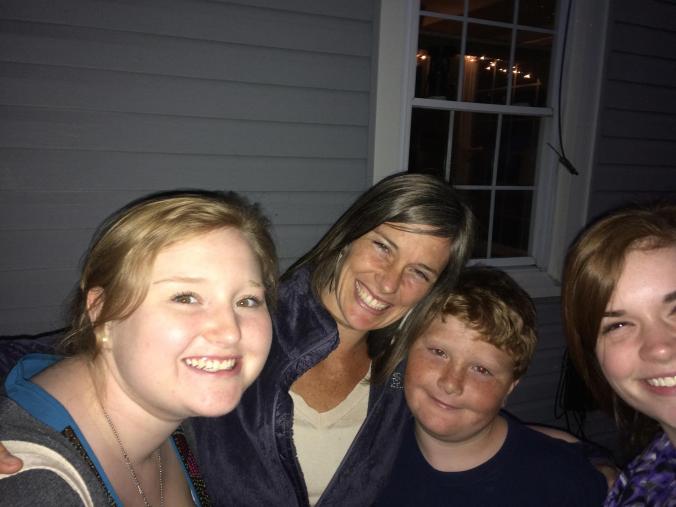
Strangers Aren’t So Strange After All

By Abbi

When this project was first assigned, I was somewhat hesitant to jump right in. The idea of having dinner with a bunch of strangers was somewhat daunting to me because it usually takes me a little while to warm up to people before I’m comfortable enough to have a more serious conversation with them. However, this project was not nearly as awful as I thought it would be.

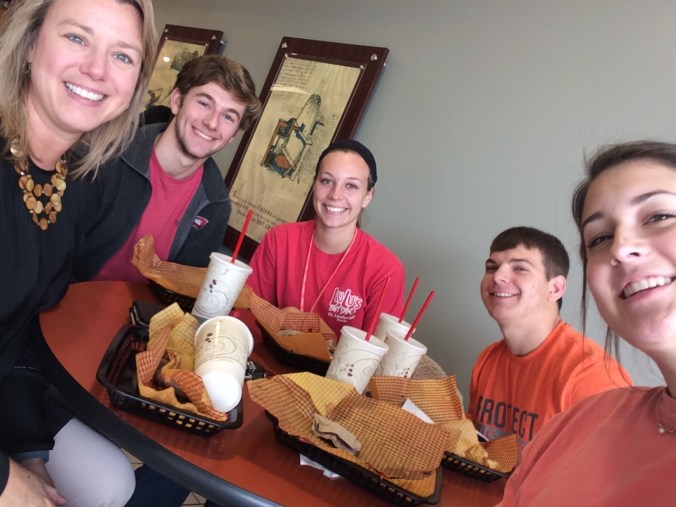
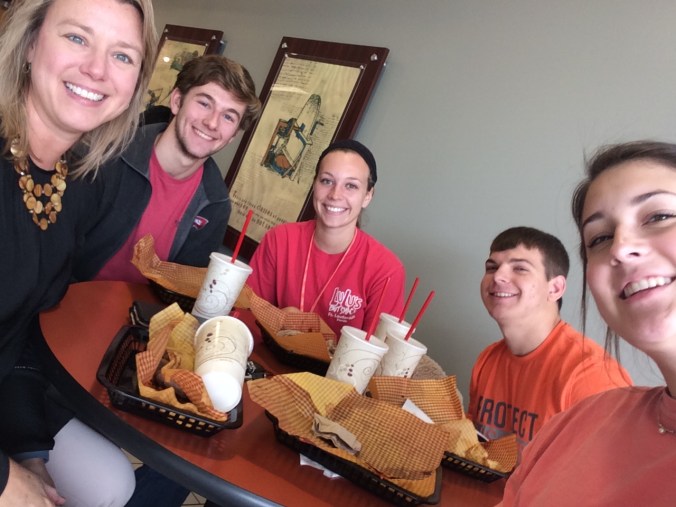
My Kentucky Kitchen Table group consisted of me (Abbi), Scott, Wil, Ellery, and Nancy.
kentucky-kitchen-table

A little bit about our group:

  • I am an Accounting major from Lexington. I am the second oldest of four children, and I am a member of the Alpha Gamma Delta sorority here at WKU.
  • Ellery is a Biology major from Danville. She has an older sister and a younger brother, and grew up surrounded by her family and neighbors. She is also a member of the Alpha Delta Pi sorority.
  • Scott is a Biology major from Louisville. Scott is from a more rural area in Louisville, where he grew up with his younger brother, and enjoys activities such as hunting, working out, and spending time with friends. He belongs to the Sigma Phi Epsilon fraternity.
  • Wil is a Biology major from Bowling Green. He has a younger sister and a younger brother, and he is a member of Phi Gamma Delta (FIJI) here at WKU.
  • Nancy is a Biology professor here at WKU. Nancy has two children and lives here in Bowling Green, where she also grew up and attended college as an undergraduate. Nancy was a member of Alpha Omicron Pi when she attended WKU. She has a Ph.D. and attended medical school in both Tennessee and Missouri (I don’t remember exactly), where she met her husband.

Obviously, our group was a little bit skewed in terms of majors, but we were diverse in other ways. For example, except for Nancy, and Wil, we are not from Bowling Green and are still not very familiar with the area. Also, Ellery and Scott grew up in more rural areas as well. Although everyone in the group participates in Greek life, no one belongs to the same organization. It was very interesting to see how our similarities and differences both contributed to our conversation.

The original plan was for our group to meet at Nancy’s house and have dinner with her and her family, however there were a few scheduling and logistical conflicts, so we adjusted our plan. We ended up meeting in DaVinci’s on the first floor of Snell Hall here on campus, and we all enjoyed our choice of pizza from the restaurant. At first the conversation was a little bit awkward and just a lot of small-talk, but after we got into it, things started to flow more smoothly.

We started off with the required question: “Beyond voting, paying taxes, and following laws, what does citizenship mean to you?” Nancy explained that to her, citizenship requires personal responsibility from everyone. Everyone really just has to do their part in contributing to the overall good and benefit of the community. This requires a lot of understanding and communication, which are topics we have been learning a great deal about in our class this semester.

We also talked about what we thought were the best aspects of our world today. Nancy said that technology has been very beneficial in terms of communication and having access to a multitude of information from around the world. Again, this benefits the way people collaborate and communicate with each other, and I think that technological advances will only increase in the future. However, we also discussed the downsides of technology, such as how everything is becoming the same in terms of language and format, which lessens diversity in communities.

A third topic that we discussed is the concept of neighbors. Ellery, Wil, and I mentioned that we all grew up being very close to our neighbors, and it has always been a very prevalent aspect of our lives. Scott added that he does not have much experience with neighbors because he is from a more rural area in Louisville and did not live in a neighborhood. Nancy told us that her family does have neighbors where they live in downtown Bowling Green, and that the kids are similar in age, however they don’t always hang out together.

Acting in a neighborly way with consideration for others is a significant part of being a good citizen. For example, Nancy mentioned that her family decided to install a fence in their backyard because her family has chickens, but they were somewhat of a nuisance to her neighbors. Because Nancy and her family valued their relationship with their neighbors more than letting the chickens roam free, they put up a fence to keep things peaceful.

We then got to talking about what kind of people we want to be and we want our children to be, and through this, there was a heavy focus on service. Nancy’s parents raised her in a way that emphasized service to others and to the community, and this is what she is teaching her children now. My parents instilled the same values in me and I had many opportunities in high school to serve my community. I also have the same opportunities to work in my community in college through my sorority, and I know Ellery, Scott, and Wil have similar opportunities as well.

Overall, the Kentucky Kitchen Table experience was very enriching and not at all awful. I realized that even though I could see obvious differences among our group, the conversation revealed many similarities that connected us in ways that we wouldn’t ordinarily realize. Although we may have different backgrounds and beliefs, the members of my group we able to find common ground and agreed on many simple ideas about community. I think that this realization is a key part of living in a community and acting as a good citizen towards others. This project has emphasized the class themes of how we can live better together and what it means to be a good citizen in today’s world. We can do this by taking responsibility and contributing to the overall good of society through acts of service, consideration for others, and communication and understanding.
Don’t take things for granted

by Scott

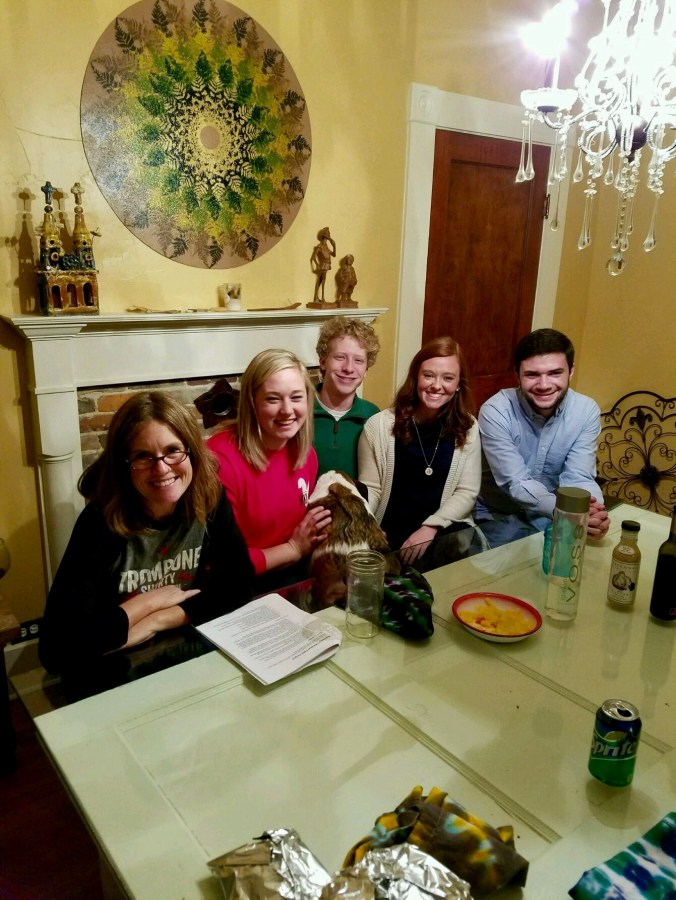
One thing I looked for in a group for this project was diversity.  Our table consisted of five people representing Louisville, Lexington, Bowling Green, and Danville.  Present at the table was Abbi, Ellery, Nancy, Scott, and Wil.  Abbi is an accounting major, that’s very goal oriented.  She is an extrovert and loves to volunteer in the community.  Ellery is a biology major and identifies as a Republican.  She is an extrovert, who spends most of her free time reading.  She loves politics and would do anything for her community.  Nancy has a PhD and is currently teaching Biology at Western.  She identifies as a Democrat and devotes all of her free time to serving the needs of Bowling Green.  I, Scott, am majoring in Biology as well with the hopes of becoming a doctor one day.  I identify as a Republican and spend most of my free time at the Preston Center.  Wil is majoring in Biology, and is a very studious person.  He is more of an introvert and identifies as a Republican.

We focused on what citizenship meant outside of voting, paying taxes, and following laws.  Nancy was quick to point out that this was a loaded question but provided a clear cut answer.  She said that the most important thing one can do as a citizen is to serve his/her community.  Nancy believes that a community is only as strong as its weakest link which requires unified communication.  She said that it can be very difficult to communicate with others who are much different at times but it’s a great skill in life to have.  She also said that things don’t always go as planned so you must be flexible.  For example, some neighbors might promise to help with a neighborhood improvement project and then not show up.  When I was listening to her talk, I was making connections to our class.  For example, just by deliberating in class this semester I have come to embrace how different people think.  You can pick things up and learn to value different perspectives by talking to others who are different than you.

We asked Nancy the question, “What advice would you give to people running for office in our country?”  She was quite hesitant to answer at first because politics is such a hot topic.  She eventually offered up the idea that we should treat one another as we would want to be treated.  While that may sound elementary, it’s the biggest weakness our country currently possesses.  During the presidential debates, the candidates focused more on insulting one another rather than their policies they would like to implement.  This caused the citizens to get nasty with each other and the country has become split.  John Dickinson once said, “united we stand, divided we fall.”  This semester I have learned that productive deliberation is a good thing, but once a decision has been reached, the group should come together to support it.  We are not always going to get what we want which is why it’s important to learn how to make the best out of every situation.


We then asked Nancy the question, “how do you think your job relates to your role as a citizen?”  She laughed, and went on to say if we had told her she was going to be teaching college kids one day she would have laughed in our faces.  She went to medical school and received her PhD but felt that she could make a stronger impact teaching the upcoming generation.  Nancy also said she wanted to make a difference in research.  She wanted me to emphasize one thing when sharing our project with the class and that was don’t pick a job based on money.  She could be making double what she is now but she feels as if this is her calling and will benefit her community more than anything.  I could relate this to the class because we have talked about sacrificing ourselves sometimes for the greater good.  Nancy is a perfect example of this and she isn’t struggling by any means.  We asked Nancy if she had ever had a conversation with someone from a really different background.  She stated that she hadn’t until she attended Western Kentucky University.  Nancy told us not to take the diversity on this campus for granted because you can learn so much from others that you never would have gotten the opportunity to have before.  Western truly does have international reach and the opportunity to understand what other’s lives are like in places other than the United States is quite unique.  We take things for granted in our everyday lives that are major concerns in other countries.  Sometimes we need to be brought back down to earth.

We asked Nancy, “What kind of person do you want to be?” She responded, “The person I am today.” When asked to clarify, she offered up examples of what her family does during the holiday season every year.  Nancy’s family delivers food to families in the Bowling Green community for Thanksgiving as well as buy presents for children whose families can’t afford them.  For one of her kids birthdays, they celebrated by doing a service project as a family.  This says a lot because I don’t know too many kids who would choose to serve others on their birthday.  Nancy’s giving attitude has rubbed off on others making Bowling Green a better place.

In conclusion, this project made me realize a lot about myself.  I now realize that I could be donating more of my time and talent to the community instead of being selfish.  I also see how the Bowling Green Community is much different than the Louisville Community.  While the people in these cities may be two hours apart, they’re still Americans that should be coming together for the common good.  After talking to Nancy, I got to see how we (citizens) can sometimes struggle working together to solve problems in the community.  Nancy showed that with enough work, progress can be made.  I will carry the lessons I’ve learned in this class for the rest of my life and will try to crack the codes to the wicked problems we have discussed. kentucky-kitchen-table

Maybe Going to A Stranger’s House Isn’t a Bad Idea After All

By: Ally

img_0288

(not pictured: Chuck)

Whenever someone told me that I was going into a stranger’s home to have a dinner, my first reaction wasn’t to get up and jump for joy. I was a little apprehensive as to where I was going, considering it was a half an hour drive through the back country. But also mainly because I had never met the homeowner and only knew one of the group members. I didn’t know what to expect from this experience based upon that fact that I could have totally different beliefs and viewpoints than anybody else around the table, was a scary position to be put in.

I come from a family where it’s just three of us, but my mom would cook a meal every night, I would set the table, and my dad would always do the dishes and clean up afterwards. So sitting around a kitchen table discussing the highlights and not so fun parts of our days were common and comfortable. Our conversations though, never really strayed from what was going on in each other’s daily lives though. So whenever the word ‘democracy’ came up about that being the core of the discussion for the Kentucky Kitchen Table project, I was nervous and felt very uncomfortable going into it.

My group consisted of six people including myself. First was Christian, who is the sustainability coordinator here at Western Kentucky and who graciously opened her home up to us to have this meal. Next was Chuck, who was formerly a U.S. Marine and now works the government. Then came Connor, Jacob, Madeleine, and myself. The four of us have similarities, but also many differences. We are all in the Honors College, but our backgrounds of where we have grown up are completely different. Madeleine is from right here in Bowling Green; Connor is from Louisville; Jacob is right across the border line from Cincinnati, and I’m from a rural town on the outskirts of Lexington. Each of our different upbringings have shaped us into the citizens we are today and have helped us form our opinions on the world today.

Once we had arrived at Christian’s house and awkwardly knocking on the back door, we were greeted by Christian and two large, loving dogs that shed a whole lot. But it was nice to be able to love on them, since I have been deprived of this since I have been at college. As a group, we got to make our own pizza that we were going to be eating for dinner. Out toppings were very diverse, ranging from plain cheese and pepperoni, to mushrooms and even pineapple. We threw in some tomato slices and some spinach leaves. Christian made a salad from greens she had grown herself, which was very refreshing and quite delicious. But she also made some pumpkin chocolate cookies, from a pumpkin she had baked earlier in the day. She made enough cookies to feed us and also to send back with us for our roommates.

As soon as we sat down for dinner, and after we had said grace for our food, Chuck was eager to dive into our discussion and was very vocal in encouraging us in our thoughts, but also very vocal in his own. Our first question of, “besides voting, paying taxes, and following laws, what does citizenship mean to you?” had a very different response from each member of the table.

Chuck defined his view on citizenship is derived from the safety he has in our country. Where he was in the Marines, he has experienced many things from being in other countries that he never has to experience here. He gave the example of never having to slam on his brakes when driving down the road worried that a road side bomb is going to go off. He can casually walk down the street without being hated for being an American and having to worry about a child, woman, or man wanting to kill him. The safety and protection we have in our country is something that he said he is very thankful for based upon the fact that we don’t have to worry for our lives just walking down the street because of where we are from.

For Christian, her view on citizenship was focused around the wicked problems of our world, which directly relates back to our readings in class. But she mentioned three of her friends that are aware of these wicked problems that are around them and they are trying to make a difference in any way they can, but they know that there isn’t just one solution to the problem and the entire problem is not going to just go away overnight. What really resonated with me, was that each of her friends, don’t have a position of power, but they are still making a difference in their community. You don’t always have to have a position of power to do things to change the world for the better. Jacob and Connor both agreed on their view of citizenship as the community aspect of our lives. We each live in a community that we can all have an impact on and being a responsible citizen in each of our respective communities is important if we expect to come together to make a difference.

Madeleine and I agreed on our view of citizenship being that we are free to have religious views or the lack thereof. We can freely worship without the fear of persecution because in many countries they don’t have a say in what they believe. They don’t really have the option to choose whether they want to believe in that, or something completely different. In some countries though, you could be killed if you believe something different and try to spread it around. It’s a very serious issue, yet a right that I believe we take for granted if we choose to exercise it. Madeleine also extended her view on citizenship is the basic rights that women now have, such as voting or simply just going to school. In some other countries, it is frowned upon for women to be educated and seek a job. So having that right as a woman is very near and dear to my heart. But we also had to remind ourselves that we don’t always get to choose the situation we are born into.

Upon wrapping up conversations from dinner, we shifted back into the kitchen where Christian was wrapping up leftovers for our roommates and we were saying our last goodbyes to the dogs; we once again we said thank you to Christian before walking out the door. But just like that we were in the car and our experience was over. This experience was something that I truly enjoyed and would recommend to anyone. But mainly what impressed me the most, is that no one was on their phones and we had quality conversations. It was very refreshing and felt good to know that people can still have quality conversations amongst each other without the distraction of phones getting in the way.

Kentucky Kitchen Table

By Wil

My Kentucky Kitchen Table was not conducted around an actual kitchen table, but at a small table inside of the Davinci’s restaurant in Snell Hall. My group consisted of Scott and Abbi. Scott is a biology major from Louisville. Abbi is an accounting major from Lexington. We invited two people to eat with us. These two people are Ellery and Nancy. Ellery is a biology major from Danville, and Nancy is a professor here at WKU. Nancy and I are both from Bowling Green. The original plan was to eat dinner at Nancy’s house, but that fell through, so we decided to eat at Davinci’s. 

Our conversation was all small talk at first. I actually ended up finding out that Nancy and my mom went to the same high school, but were a few years apart. Another thing that a majority of the group could relate to was living in a neighborhood. This subject came up when we brought up the question of if you know your neighbors. It may seem like a very common thing, but those of us who have lived or currently live in a neighborhood were able to discuss that feeling of community with your neighbors. Another member of my group and I both spent a lot of time with our neighbors similar ages. Nancy’s kids also have friends around their own age in their area that they can go out and play with. Eventually, our discussion became more deep. We started going through more questions in the packet, but in a casual way, so as not to be interrogative. It was clear early on that Nancy had a lot of knowledge, not just from her education, but from her experiences as well.

I don’t recall what exact conversations were sparked by each individual question that was brought up, but I do remember one thing that Nancy brought up. This idea is something that can be applied to multiple questions. She said that one of the most important values in her family has always been serving others. Her parents instilled the value of service in her, and she now does the same for her kids. She told us about how one year, her kids decided to collect money for a charity instead of receiving birthday gifts. I think part of the reason this particular value stuck with me is because it is one of the five values of my fraternity. Our five values are a guideline for us to become better men. Service is one of the values I tend to struggle with the most, because I don’t typically attempt to put any effort or time into serving. Hearing Nancy talk about her experiences with service made me realize that serving others doesn’t have to be a huge, life-altering sacrifice. It actually requires very little effort to serve your fellow man. That was the biggest thing that I learned during my Kentucky Kitchen Table – how to better serve others.

Service directly relates to two out of the three central questions of this class. The first is “How do we live better together?” This relates to service on a very basic level – treat others the way you want to be treated. If you want to be served, then serve others. We live better together when we are serving each other. The idea of serving others in your community leads to the next central question.

The second central question that service relates to is “How do we solve problems?” As we have learned in this class, a wicked problem is one with no clear solution. It is hard to solve because there are many layers. Examples of a wicked problem include homelessness, racial tensions, and healthcare. If everyday citizens got into the mindset of serving others, then we could begin to solve these problems. Let’s think about this with homelessness. More specifically, homelessness in Bowling Green. To solve homelessness, you essentially need two things: a steady income, and shelter. However, those two things are hard for a homeless person to attain on their own. If citizens who are already fortunate enough to have a steady income exhibited altruistic behavior in donating money for this problem, then it could be solved. Even better, those who own their own businesses or living complexes could offer jobs or a roof to live under. I realize that these are lofty expectations, but that is one way that our community could come together to serve those that are less fortunate than some of us are lucky to be. Like I said earlier, one of the big things I learned from my Kentucky Kitchen Table was that service does not always have to be a grand gesture. Service can also help solve smaller problems in our community.

An example of a small problem in Bowling Green is litter. It’s not a big enough problem to where you would be revolted when walking down the street, but it’s still a problem nonetheless. Anyone can solve this problem, and serve their fellow man, by simply picking up trash that you see. This might seem like a silly approach, but think about how many times you’ve seen litter and did not pick it up. That number is probably very high. It is for myself as well. If everyone in Bowling Green would take an extra ten seconds out of their day to pick up litter when they saw it, then we would all live in a much cleaner community.

Despite having some trouble with actually scheduling the meal, I had a good overall experience doing my Kentucky Kitchen Table. Davinci’s never disappoints, and the conversation was enriching as well. To sum up what I learned from my fellow Kentuckians, service is one of the keys to solving some of the major problems in our community. A saying that is used a lot in my fraternity is “service to others is the rent we pay for our space on this earth”. To me, this means that some of us are lucky enough to be able to live a fortunate life, and to serve others is the only true way to be thankful for what we have. If the citizens of Bowling Green thought this way, there would be no limit as to what we could accomplish in our community.

image1

Goat Caramel and Getting Dress Coded: My Experience at a Stranger’s Kitchen Table

idk.jpg

By Kaylin

As someone who comes from a family who only uses their dining room on Thanksgiving and Christmas, the Kentucky Kitchen Table project sounded to me like something I would have rather kept at the bottom of my to-do list (at first). When I heard that we would be eating dinner at Alison’s house, along with Leila, I was even more apprehensive. Entering the home of any stranger would be slightly uncomfortable, but entering the home of professors at my university sounded a lot weirder.

When Danielle, Amy, and I began our walk from campus to Alison’s home, we laughed about what we might be eating that night. “If it’s tofu, we’re going out to eat after this,” I suggested. Alison, our host, teaches in the English department at WKU. Leila, another guest, teaches Citizen and Self at WKU. Both professors seemed like they had more than a lifetime of experience already. Danielle, a freshman, comes from a town much larger than mine, but we share a lot of the same values. Amy, on the other hand, is a sophomore and is from Tennessee. I could tell she and I thought differently on a lot of issues, but we also have a lot of the same values. After guessing about which door to come in, we settled for the back door. We were greeted by Hazel, the yellow lab. I was relieved to see tacos on the stove.

The awkwardness was toned down a bit when Alison asked for our help in the kitchen. I chopped the cabbage while Danielle and Amy set the table. I was glad she was designating some responsibility to us so we didn’t have to wait in the kitchen and stare at her, especially since they had decided to provide the entire meal. Alison and Leila introduced themselves to us and asked us about our majors and how long we have been at WKU.  Things were still a little weird at this point, but I was starting to feel more comfortable.

When we sat down to eat we went through more motions trying to make small talk, but eventually this led into real conversations. The two professors, I quickly learned, have been well-cultured. Alison’s advice to us was to take the unforeseen opportunities which come our way. For her, this was teaching English to students overseas. She spent two years in Japan doing this and eventually did the same thing in European countries. I found this to be quite admirable. Both professors seemed to know a lot about ethnic food, which I envied. I decided to make it a goal of mine to try foods from other cultures whenever I could.

After talking about different places in Bowling Green we should go to eat, we finally started discussing things that felt like they really mattered – not just things that would help me out when my stomach started growling. When I asked the two professors what citizenship means to them, Alison said “recognizing that everyone is dealing with something.” I immediately made the connection to our empathy readings. In order to successfully deliberate, in order to live well together, we must put ourselves in the shoes of others on a regular basis. We must always give one another the benefit of the doubt. Alison meant noting that someone may behave a certain way because they are having a bad day, or going out of your way to help others simply because you can. This can also mean asking yourself why someone believes the things they do, or said the thing they said about it.

Leila laughed when asked this question, saying that she should have a good answer to it because she teaches the class. She ended up agreeing with Alison, and then we got sidetracked by talking about dress codes in high schools. This led to interesting points about feminism. Amy, a fellow student, explained that her high school stationed staff members at the doors to examine outfits and determine whether they were “appropriate.” We noted that dress codes typically only effect girls. Leila said to, “imagine if these authorities spent this much energy teaching men about consent,” referring to how much time they spend trying to enforce a dress code.

My favorite part of the dinner’s conversation came up accidentally and correlates very clearly to Honors 251. After talking about the dress code, we began discussing how many people who claim they are not feminists hold feminist values.  We said that many times, people simply don’t know how to say what they think. I brought up the example of when I was riding in the car with my at-the-time boyfriend and his mother and somehow ended up talking about abortion. His family are devout Baptists, so I was surprised when his mother stated that she would consider an abortion in some extreme cases. I was less surprised when she followed this statement with, “like if I were raped by a black man.” When my boyfriend asked her why specifically a black man, she went on to say that she doesn’t believe in interracial relationships, or, in this hypothetical case, conception. After further questioning of the issue, it became clear that she didn’t actually “not believe in” it, she just doesn’t see it fitting for herself. “I wouldn’t shun or look down on anyone else for it,” she explained. While I still don’t love what she had to say, my view of her was much better once she elaborated.

Had that conversation developed no further than her statement that she doesn’t believe in interracial relationships, I would have left that day thinking she was bigoted and kind of terrible. Afterwards though, I could recognize that she just didn’t know how to verbalize what she meant properly. Everyone at the dinner table agreed that this is not uncommon today, and that this is why we must properly deliberate and give others the benefit of the doubt.

When we began wrapping up our conversations, Alison remembered the dessert she had. We ate English cookies with Nutella and Mexican goat caramel (an example of how much they experiment with food). From the evening, I learned that there are way different people than the ones I spend most of my time interacting with, and that in some cases, they could be right in front of me. I ended up enjoying a lot of the conversations we had, and plan to Leila’s help when planning my study abroad ventures for spring of 2018.

The best part of the meal was that no one was on their cell phones. This was a refreshing change. Once we broke through the barrier of unclear expectations, we had meaningful conversation and a very enjoyable evening. In that hour and a half I learned about food, people, and tried two new things: green tea with brown rice and goat caramel. Who knew?

Kentucky Kitchen Table Project

By Andrew

Going into this project I had no idea what to expect, other than maybe awkward and forced conversation on a rainy Wednesday. What I experienced was a totally different thing altogether. This has and will be my favorite memory of Honors 251, something I would have never guessed beforehand. The hosts, a writer couple, of the dinner were not only great cooks, but very interesting and kind people and I had the pleasure of getting to peer into their lives for a night. The group was diverse in many ways, with our beliefs (Christianity, Islam) and backgrounds, and the conversation was always respectful despite the differences. Abbas, a bio major hoping to become a plastic surgeon. Abbas is not only Muslim, but also in a fraternity which led to some funny stories. I did not know Stephanie’s religious beliefs, but she is also a bio major and an un upperclassman, she was a transfer student from a school in Florida. David and Molly were both writers who love going to parties together, traveling and have Catholic roots but are not religious. Something that surprised me initially is that Molly asked me to pray to start our dinner, but I felt that made all of us all open to one another. Talking about through introductions and Molly sharing interesting stories of a bizarre house party and her time in college at IU, we began to eat. Molly insisted on us not bringing food and providing the appetizers, main course and desserts. Molly and David described citizenship to us as being aware of what is going on in the world and also being courteous to those who were not as lucky. They explained that they felt citizenship was more of a relationship with ones community and country. Between our conversation starters many small conversations popped up, such as the stereotype of Christian gun owners, the presidential election, and even young marriage. Molly was surprised to hear that my family and I though Christian, were not pro-gun and I had the opportunity to share my beliefs on gun control and why I do not think being armed aligns with Christian values at all. Another interesting topic we discussed was our neighbors, and if we interacted with them or truly knew them. Molly and David were not particularly close to their neighbors due to them being very different. After David talked about his passion of teaching English at WKU and his love of different books that myself and the others had no previous knowledge of. Both of the hosts grew up and had fundamental knowledge of Catholicism which helped them understand my Christian background and upbringing. Our conversation jumped around for a while as we enjoyed a warm batch of brownies. We then talked about the stresses of school and our future, Molly did a great job of helping calm us and help us think about the big picture and making friends and having a good time. I took away a few things from the dinner that stayed with me, the first being how badly Christians often represent our faith. Molly and David had obviously had bad experiences with Christians that shoved their beliefs and political views down their throats. Something that was a positive takeaway from the night and the class in general, is that I learned being a citizen is more than paying taxes, and being kind to strangers. It is being aware of your situation and seeking improve not only your life, but the as well as the lives of others. This dinner and the conversations we shared was a great example of people who do not agree on religion or politics, still being able to enjoy each others company.IMG_2312

Emma’s Kentucky Kitchen Table

For my Kentucky Kitchen Table project, I had the opportunity to collaborate with my classmate Sloan. We ate with Beth, the Coordinator of Resource Conservation at our university, who generously opened her home to us. Additionally, we got to eat with Beth’s three children—Gabe (9), Emmylou (8), and Camp (4)—and a couple of their friends who had come over to jump on the trampoline.

Beth and her family created a welcoming, open environment for dinner and conversation. It was a warm spring evening, so we decided to enjoy the weather by eating on a picnic blanket in the backyard. Beth said she and her family did this fairly regularly, and I admired the evident joy and connectedness she and her children felt in their home. Beth, Gabe, Emmylou, and Camp shared a similarly sunny disposition that helped alleviate my stress from school and enabled me to focus on the conversation we were to have that night.

For dinner, Beth prepared a delicious venison and vegetable stew using a deer that Gabe had shot himself. She also baked fresh bread. Sloan brought a fantastic, homemade hashbrown casserole. I brought tortilla chips and carrots to accompany the salsa ranch dip I had made.

When we sat down to enjoy our food, Beth asked Sloan and me about our college experience so far. We discussed the sense of possibility we felt here, as well as the similarities and differences between Bowling Green and our small hometowns. Then, we asked Beth about her interest in sustainability, which was evidenced around her home in a myriad of ways—the vegetable garden, the flowers, and the windows that allowed ample natural light to enter. She talked to us about how connected she felt to the earth, and then we got to learn about some of the kids’ interests. Gabe, Emmylou, Camp, and their friends told us about the numerous sports they were interested in. Their boundless energy was exemplified in their bubbly conversation and later in their running and jumping on the trampoline.

After we all learned more about each others’ interests and histories, Sloan and I asked Beth the required question: “Beyond voting, paying taxes, and following laws, what does citizenship mean to you?” Her answer really resonated with me. She told us that citizenship meant being a part of an interconnected community and being a good neighbor. She explained how knowing one’s neighbors helps one to cultivate empathy and better understand people, which translates to betterment of society as a whole when enacted on a large scale. This reminded me of the “Empathy Exams” readings we did for class, which emphasized the truth that one must actively listen to others in order to appreciate their situation and demonstrate compassion.

In conclusion, I learned a number of things from this dinner. From Beth, I learned to be more open and to make an effort to understand and communicate with those around me so that I may learn from their experiences and develop more empathy. From Gabe, Emmylou, and Camp, I learned to relish the activities and opportunities available to me, as well as the company that surrounds me. The Kentucky Kitchen Table was a refreshing break from routine, and I hope to someday host a meal with a similar setting that encourages thoughtful conversation.

Kentucky Kitchen Table Post

By Sloan

The day, in itself, started out differently than most do. It was an early Wednesday morning, and I was exhausted from staying up and studying for most of the night. Upon waking up, I realized that I had no supplies to make a dish for the impending dinner that I was attending later than evening. So, I crawled (literally crawled) my way out of bed and made a trip to Walmart. The day went smoothly after that, and soon enough I had my dish made and was on my way to meet Emma, my partner, downstairs to drive over to out destination together.

When we arrived at the home, I automatically felt at peace. There was just something about the atmosphere that put me at ease, especially after an already long and stressful week on campus. We both got out of the car and were immediately warmly greeted by Beth, who had agreed to be our host for the evening. We walked into her home and were also greeted by her three children, Camp, Emmy-Lou, and Gabe, and a few of their friends. The children were all having a wonderful time, playing with water balloons out on the trampoline and throwing them at one another. We all soon sat down for dinner with one another, but not before all stating what we were thankful for. The dinner was off to a wonderful start and I could not wait to see where it would lead.

After sitting down for some time and learning more about one another, we (Emma and I) asked Beth her opinion on one specific question, “Beyond voting, paying taxes, and following laws, what does citizenship mean to you?” She thought about it for a moment, but then responded with an answer that I had not thought of previously. She said, “I believe that citizenship is about coming together and working to be a good community, or good neighbors to one another.” She also referenced the phrase, “It takes a village to raise a child,” stating that this referenced her children and their friends (who were at the dinner with us) directly. It was very interesting to here her view point on this, and after sitting with her and talking more about it, I couldn’t help but to agree. In a way, her viewpoint relates directly back to one of the central themes in this course, which is establishing a community, and how communities can work well together.

Another interesting aspect to our dinner was the diversity that was in our group. I learned, after talking with her more, about Beth’s job at WKU, and what sustainability is all about, considering that I had no previous knowledge on the subject. I also learned about her children, and their friends, and found that I had some things in common with them, as well. In fact, Gabe had even shot the deer that the meat we had for supper came from!

Soon enough though, our dinner had to come to an end. We all helped clean up the food and said our goodbyes. (Here’s a picture of me, Beth, Gabe, and Emma from right before we left!)

Kentucky Kitchen table Picture


All in all, I believe I had one of the best Kentucky Kitchen Table Project experiences that I could have asked for. I learned so much about the family that I was paired with, my partner for this assignment (Emma), and, most importantly, I learned a lot about myself in this experience.