New Friends

By Margee

When I first began my Honors 251: Citizen and Self class, I understood that we were required to participate in a Kentucky Kitchen Table. A Kentucky Kitchen Table (KKT) is an opportunity for members of the local community to share a meal in a house with people they are unfamiliar with and discuss their lives and opinions. All of this was to be done in a very comfortable setting. I soon became very excited because there is nothing I love more than eating food and meeting new friends.

As the semester went on, I was assigned to a KKT that would be hosted at Dr. Alison Youngblood’s house, which was a comfortable walking distance from Western Kentucky University’s campus. Allison is a professor at Western Kentucky University (WKU) and she teaches Linguistics and Teaching English as a Second Language (TESL) for the Department of English. It was very nice of her to offer her home to us! The other adult who was kind enough to participate in the KKT was Dr. Leila Watkins, a professor at WKU who teaches Honors 251, as well as courses in English. All of these things I learned from emailing back and forth with them to try to set a date to meet for our KKT.

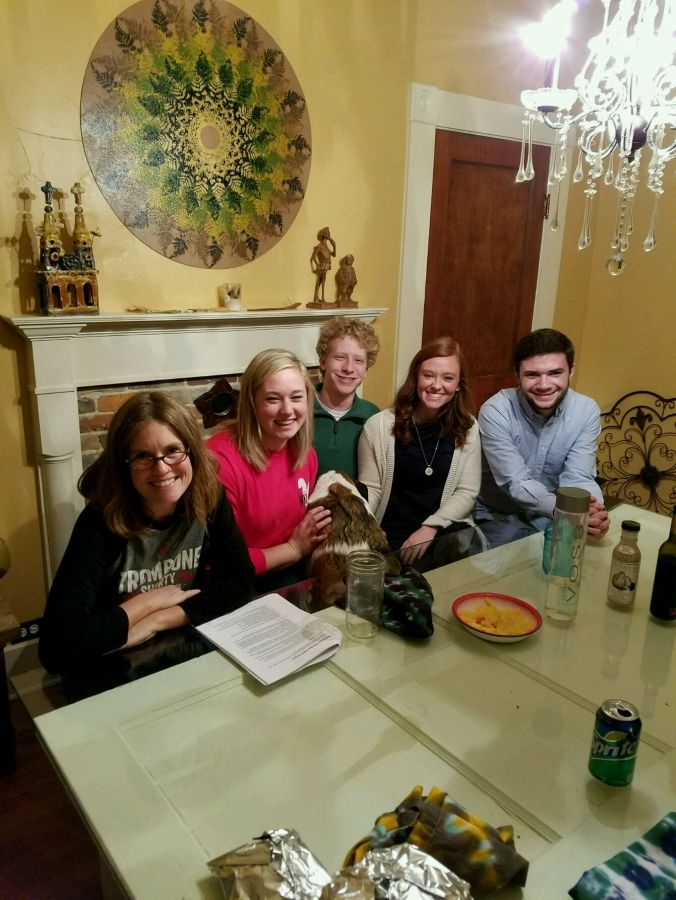
We decided to meet to share a meal on Wednesday, April 5th at 6pm at Alison’s house. When I first arrived, I entered the house and met Alison’s very sweet dog, Hazel. Hazel was quick to say hello and welcome me! I then met Alissa, another student at WKU who was assigned to this KKT as well. Alissa brought along 3 other friends who were very personable and added great conversation to our group. I had asked Alison and Leila if I needed to bring along any food or items, but both refused saying that they would arrange everything. All 7 of us sat down at Alison’s table together to share a meal consisting of green beans, fettuccine alfredo, garlic bread, clementines, and pizza. Alison also offered us La Croix- a carbonated spritz water that was flavored with a bit of coconut. It was a delicious meal, but the company was even better!

Our conversation first began with introductions and learning more about each other. While sharing a meal together, I learned that Alissa is a freshman from Louisville, Ky- like me- and graduated from Assumption High School. She is also a twin and lives with her twin sister in PFT (her twin sister is older) although she is also in the Honors College. She is pursuing a degree in chemistry with a minor in criminology. Alissa shared that she is an aromantic asexual meaning that she doesn’t experience romantic or sexual attraction. Alissa’s friend Emily is a fan of K-Pop and that is how they met. Emily is also very petite and talked about her little sister who is taller than her now. Alissa’s friend AJ was a bit quieter and was at the other end of the table, but always added witty comments and anecdotes to the conversation. I was also introduced to Dimitri who has really awesome blue hair! Dimitri and Alissa met because they are both openly in the LGBT+ community. Dimitri is gay and nonbinary and prefers the pronouns they/them in discussion.

While getting to know my new friends, I found that I was really enjoying the conversation. It was easy to find common points of interest, such as Alissa and I both growing up in Louisville and Leila and I have both eaten at a Mexican restaurant in White House, Tennessee. Leila’s husband works in Nashville and, of course, she works in Bowling Green so they found a happy medium by both commuting to their respective cities. Although I expected that I might differ to some of the party with my more conservative views, I began to feel accepted and understood by them when I shared what I thought. It was such a relief to be heard and known by them.

Trying to stir the conversation back to the required question, I asked the collective table members, ‘What does citizenship mean to you?’ Leila was quick to respond that to her citizenship means being a part of a conversation in which you are able to ask people about what matters to them. Also, the group added that being a citizen means that you have to be a part of the group to identify yourself as with the group.

This ties into the lessons we have been learning in Honors 251, such as learning about the importance of deliberations and discussing matters in a mature and collected way. I felt very comfortable sharing my opinions and listening to others’ in this setting. Also, I was able to discuss my experiences with short-term mission work in Kenya over the past summer. Alison was very interested because she discussed with us how she had lived in Japan for an extended amount of time teaching. I could just see from her discussion with us that she was so passionate about exploring different cultures and getting out of our comfort zone. Her passion encouraged me to pursue my interests in studying abroad.

We discussed the importance of being still and enjoying meals together with others – like how it was in Kenya for me. In Kenya, there was no clock around to check what time of day it was. There were no time restraints. The whole day was up to the decision of us and I loved that. Alison mentioned that she loved that about Japan, as well.

The grand gesture was when Alison brought out Mochi ice cream balls for all of us to try. It was such a treat because I had never tried one before. Mochi is originally from Japan and is a dessert made from ice cream with a confection sugar outside. Mine was chocolate flavored I believe and, although it had a strange texture, I really enjoyed it and was proud of myself for trying it.

Steadily the light in the room began to fade as the window grew darker and I realized that two hours had passed and I was still enjoying my company. While I was leaving, I began reflecting on why I enjoyed that so much and I think it was because sitting at a table with friends and family is one of my favorite activities. My family is a big advocate for family dinner at the table with no cell phones out and no TV playing in the background. Just our family, our food, and our conversation to keep us entertained. Enjoying a meal with my new friends felt like going home because I knew that just spending this time together learning from each other allowed me to truly breathe and reflect on my day. Those 2+ hours without checking emails or doing homework gave me an opportunity to re-evaluate what matters to me. And the next day when I saw Emily in line for Burrito Bowl on-campus for lunch, I was able to say hi with confidence because she’s my new friend.
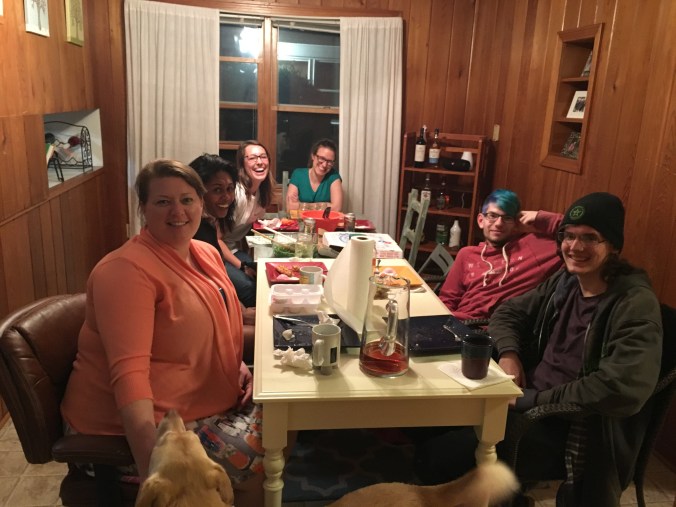
IMG_4527From left to right: (Hazel (the dog), Alison, Emily, Margee (me), Leila, Alissa’s empty seat (she took the photo), Dimitri, and AJ
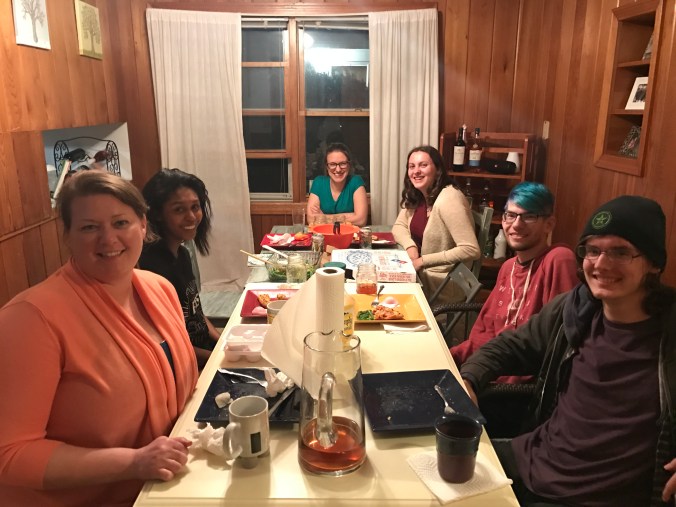
Alissa’s Kentucky Kitchen Table

By Alissa

For my Kentucky Kitchen Table assignment, Dr. Youngblood and Dr. Watkins kindly offered their kitchen table in Bowling Green to Margee and I. Going around the table, those in attendance were Dr. Youngblood, Dr. Watkins, Emily, Margee, Dimitri, AJ, and I. All of us have a connection to WKU, either attending the university as a freshman student or as faculty. Dimitri, Margee, and I found out that we are all originally from Louisville, Kentucky. AJ is from Hopkinsville, Kentucky and Emily is from Glasgow, Kentucky. Margee is a girl with a rather bubbly personality and is a psychological science major. She is in the Kappa Delta sorority on campus, in fact she holds an office position in her sorority, and is very passionate about working in the community for their service projects. Dimitri is a gay, nonbinary person who prefers the pronouns they/them. They are very passionate about social issues, especially with regards to the LGBT+ community, and about mental health issues. They are also a psychological science major and found out that they share a class with Margee. AJ is a rather quiet person who enjoyed entertaining Dr. Youngblood’s dog, Hazel. He is a psychology major here at WKU. Emily is an African-American girl who loves Korean pop music and is an English major. Dr. Youngblood is a professor in the English department and is also the moderator of the KPCC- the Korean pop culture club here on campus. Dr. Watkins teaches another section of Honors 251 in the Honors College. Last but not least, I am a chemistry major with a criminology minor. I have a twin sister who I share a dorm room with, and I am also an aromantic asexual, meaning I don’t experience either romantic or sexual attraction.

During the dinner we talked about a variety of things, including what citizenship meant to all of us. Most of us responded by discussing how feeling like a part of a group is necessary to citizenship and how being willing to be a citizen and act is also necessary. Other things that we talked about centered around traveling and comparing customs from other countries to the ones we have here in the United States. We also discussed our high school experiences, since all of us graduated about a year ago. Dimitri and I both attended private, single-gendered high schools while Margee attended a public high school in the same city. We talked about the positives and negatives of attending single-gender high schools versus attending public high schools, and how we thought our respective high schools prepared us for college. Dimitri expressed how they wished they could have attended one of the all female schools instead of an all male high school because everything turned into a masculinity contest. I brought up how it seemed that the girls who attended an all female school would speak up more in class, especially if there were more males enrolled in the class. Margee and Dr. Watkins both agreed with my observation, saying that they had noticed that as well.

I learned that while it was slightly awkward to discuss things like citizenship with people I don’t know all that well, doing it over dinner made it easier. I also learned that while people can be very diverse, you can find similarities and connect with just about anyone if you are willing. All of us arrived at the dinner not knowing much about one another, but we managed to connect through our discovery of shared hometowns, desire to travel/past travelling experiences, and music tastes to name a few.

To me this assignment really connected to the reading, “Giving Employers What They Don’t Really Want” not only because a large part of our conversation discussed education, but because one of the things that the article discussed was how employers want to hire people with good communication skills. We all had to talk to each other, face-to-face, and effectively communicate the point that we were trying to make to people who weren’t necessarily the same as us. That, in turn, fits with the first central question to the class: How can we live well together? A major factor affecting how we live together is whether we can communicate effectively with people who are similar to us as well as with people who are different.


IMG_0133

Kentucky and Tacos

By Victoria

KKT pic

The Kentucky Kitchen Table that I attended was in Bowling Green, Kentucky, right outside from Western Kentucky University’s campus. Grace, Gage, and I (all students in the Honors 251 Citizen and Self class) were invited to attend dinner at Leah’s house; Leah is the director for the center of citizenship and social justice. Gage and I happened to pull up to the driveway right behind each other; he is in an earlier citizen and self class than I am. Grace, on the other hand, is many a times my partner when it comes to discussions in our 251 class. When the three of us arrived, we were introduced to her husband who works in construction, her three daughters; Makenna who is a senior in high school, Katie who is a freshman in high school, and Riley who is also a freshman in high school, and Cole who is Makenna’s boyfriend, also currently a senior in high school. All together, there were nine people at this Kentucky Kitchen Table.
Even though the three of us had not previously met this family, it was not too awkward upon entering their home. I felt very welcomed, not to mention that the tacos we had for dinner were very good. The conversation formed on its own, with questions being asked about where we were all from and some of our interests. Leah grew up in Bowling Green, whereas her husband grew up in the north, later moving to Bowling Green. Makenna, the oldest daughter there, is planning on attending Western in the fall, with her boyfriend planning on working on a farm. Grace is originally from Evansville, Indiana, and Gage is originally from Kentucky, with myself representing East Tennessee

After our miniature introductions, the three of us asked the required question for this project: “Beyond voting, paying taxes, and following laws, what does citizenship mean to you?” Leah’s husband responded first, saying that for him, citizenship meant being more involved in one’s community, such as volunteering. During the first part of our discussion, it was a little hard to get the conversation moving, which is expected since all of us did not know each other, though I think this really added to our experience. The next response was from Leah, which was probably one of the best of the night. She mentioned the right of protesting, specifically concerning the protests of the recent election. She said, “Engaging in citizenship means to try and make or bring about changes in your community, for example, through marches or protests. She proceeded to say that this is the most active that she has seen citizens become in cities, particularly with the younger generations for the past few decades or maybe even ever.” Some of the girls in the family agreed on saying that there are some rights that you have earned as a citizen, such as having a house, having a school, and having a recycling bin.

The next question that we asked was “Do you think we have any other obligations to people in our community?” Katie, who is one of the freshmen daughters here in Bowling Green, mentioned homelessness. She said “It is not the people who are homeless’ fault that they do not have a place to live, and because of that we should help them because it is the right thing to do.” As a group, we all agreed that we, as citizens of the United States, do have a responsibility to help others in our community.

After the question concerning helping others in our community, we asked the family what social issue is closest to their hearts. The topic of hunger was brought up, and it was mentioned that while the problem of world hunger needed to be addressed specifically in third-world countries, we need to also focus on the situation here at home in the United States, and even on a more local level, like the community of Bowling Green. Leah said that this is especially seen in public schools with free and reduced lunch programs. Children who meet the requirements to receive such services are sometimes sent home with food for the night and for the duration of the weekends. However, this food is often times hardly adequate enough to last when it is to be split between siblings.

The next question concerned what we did and did not like about Bowling Green, Kentucky. One of the things that I said was how much it felt more like a community to me compared to some of the other universities that I visited. One of the stories that I told regarding why I came to Western aside from the Chinese Flagship program was on account of this welcoming feeling, specifically seen when I met with my advisor. He really personalized the time my family and I spent with him, going over possible classes for my schedule and the different requirements needed for a Spanish major, and he was genuinely interested in the questions we asked and what we had to say, making me and my family feel that my experience at Western would be more individualized and less like a statistic. Leah also commented that she liked how the Bowling Green community was also a refugee resettlement community, and how that added to the diversity on Western’s campus and throughout the city. All in all, there were no negative comments about this community.

Overall, I really enjoyed this project. At first the idea of eating dinner with many people whom I did not know so well was a bit daunting, but it was definitely a worth-while experience. I think one of the over-arching ideas that I learned from this was that no matter how different everyone is, whether that be their age, their ideas, their education level, their political stance, or their socioeconomic stance, we are still able to come together as a community to have a civilized discussion around a dinner table. In today’s modern society, particularly in the younger generation, I think that the skills needed to participate in an activity like this are slowly being diminished. Participating in the KKT definitely enables you to work on your people skills and be willing to hear other peoples’ opinions even though you may not agree with them.

Another aspect that I found very insightful from this process was hearing everyone’s opinions on various issues with regards to their life experiences. I always enjoyed listening to Leah give her ideas and opinions since she worked at the center of citizenship and social justice. I learned a bit more about what the center stands for and some of their purposes. I also thought it was interesting listening to what the high schoolers had to say in regards to certain issues. Referring back to the need for younger people (including college age students) to have more experience in communication, I think one of the reasons it was a little awkward was because we are so used to communicating with people through technology, without having to take into account body language and improvising the conversation, rather than having some time to think about what you are going to say before you send it or tell it.

Obviously, the Kentucky Kitchen Table experience largely relates to the citizen and self class, along with some of the readings. One aspect of the class that I relate the Kentucky Kitchen Table to is the bridge metaphor. On the far left side of the bridge is where we are in today’s society, on the far right side is where we would like to be in today’s society, and then the bridge itself is the journey to meet the goal. As students, we started out on the far left side of the bridge, with the goal on the far right side being to be a fully engaged, model citizen. The Kentucky Kitchen Table is one of the events on the journey to becoming a model citizen that is on the bridge. Therefore, through activities like this, we are able to better ourselves as citizens.

In addition, one of the readings in particular, Jane Addams’ The Snare of Preparation, relates to the Kentucky Kitchen Table. In this article, Jane talks about the fault that preparing so much has, that being someone who spends so much time preparing for an event or for action, but never actually follows through after the preparations or does not spend an adequate amount of time acting. I see the preparing proportion of this as the time spent in the citizen and self class, preparing ourselves on how to effectively deliberate with others and how to be a better citizen in general. However, simply learning the “how-to’s” is not enough until you have put what you have learned into practice. An example of this would be to participate and organize deliberations in your own community, to become more active in your community through volunteering and voting in local elections, and to even host or organize more events like the Kentucky Kitchen Table.

In conclusion, I think that this experience was very beneficial in understanding the class more, and it also helped in making connections with people in the Bowling Green community. Furthermore, it solidified some of the key points in the citizen and self class, like the bridge metaphor. Hearing other people’s opinions and thoughts concerning what citizenship means to them and how they view controversial issues was also insightful, making this a memorable experience.

Culture and Citizenship

By Andrew J.

This dinner took place in Bowling Green, Kentucky at my German Professors house. For dinner, Laura provided the schnitzel, salad and potatoes, but we had to cook them together in small groups. I did, however, bring chocolate as a gift to Laura for hosting this dinner, and Alex brought two pies as dessert. The dinner was attended by Laura, Heike, Julia, Alex, Ryan, Carlos, Maggie, Eric, Jack and I. Laura is my German professor and the department head of modern languages at Western Kentucky University. Heike is an English teacher from Germany who had come over with her students to Bowling Green for a few weeks. Julia is an instructor of Russian at Western Kentucky University. My classmates are of a diverse background as well. Carlos is a Mexican-American from Indiana who is studying mechanical engineering and German, and Maggie is a Chinese-American who is studying German and Chinese in order to be a translator after college. Ryan is studying German and Computer Science, and Alex is studying German and International Business. Erin is studying German and International Business, and Eric is studying Architecture and German. Jack is also studying German, and he recently came back from a semester in Germany. I myself am studying German and Geography. Since nearly everyone at the kitchen table had several years’ worth of experience with German, one of the topics that often came up in our dinner discussion was the difference between citizenship and politics in both the United States and Germany.

As we initially sat down for dinner, the table was relatively quiet. Eric was the first to bring up recent news to the dinner table, speaking about a recent political move made by President Trump to build the wall between the United States and Mexico. There was a shared sentiment of disapproval about Trump’s actions in the White House at the dinner table; however, Carlos, being Mexican-American, quickly called out the absurdity of the plan, noting that the proposal of building a wall between the United States and Mexico was not American. At this point, I thought it would be an appropriate time to ask everyone what it meant to be American. Everyone there had a different idea of citizenship, but there were recurring themes of opportunity and egalitarianism throughout each person’s opinion. Carlos held the belief that being a citizen entailed having the opportunity to speak and move freely and the right to pursue happiness by one’s own accord. He particularly emphasized examples in history of the importance of the right to pursue happiness, such as Mexicans immigrating to the United States to work so that they could better support their families. I supported this notion by stating that many of the anti-immigrant sentiments in the United States are based on scapegoating when in reality Latin American immigrants often work jobs that the typical person in the United States would refuse to. Ryan iterated that the United States was founded on the ideals of living one’s life the way they choose to, though he also added that the United States has an interesting quality regarding citizenship compared to the rest of the western world. It was his belief that the United States was the most individualistic western country, and that this affects how many citizens of the United States see themselves as Americans. Afterwards, Heike added to the topic, mentioning how a more collectivist attitude towards social issues exists in Germany and the rest of Western Europe. This means that while there are more government laws for assisting people, there is also more order and less free speech due to Germany’s troubled past.

The conversation shifted towards politics after talking about citizenship, as Jack recalled the current widespread malcontent with politicians currently. This brought the wide spectrum of political beliefs present in the United States to the dinner table. Virtually everyone at the table was disappointed with the current administration in a multitude of ways, which I didn’t find too surprising honestly. It did, however, become more interesting when Alex brought up the cause of the election’s results. He mentioned that the divide between rural and urban America has stratified our country, and that to move forwards the nation would have to first take an introspective look as to how we are all united as Americans, rather than divided. In agreement I replied that there appeared to be more challenging economic problems in areas like Appalachia and the Rust Belt, which a person living in an urban area would not understand. Jack noted that living in general has become more expensive, and that many well-paying jobs that once existed in rural areas are now gone. As we were all sitting at the table and pondering the situation, Ryan said that while the situation regarding work and economic prosperity looks somewhat grim at the moment, the same situation of a debilitated economy has happened several times before in the United States history, and that the tough conditions facing Americans today would, in some form or another, be overcome. The dinner was over shortly afterwards, though there were a few additional discussion topics that I felt taught me.

There were a few highlights from the night that I feel are worth mentioning in greater detail. My German professor, Laura, made an excellent point as to how the education system has evolved over the past fifty years. Where the University experience was once far more academic in nature, it has become more similar to a business model, since Universities now compete to get the best students by having the most amenities and accreditation. This, she noted, has heavily increased the cost of college, along with the increased need for a post-secondary education to obtain a fair-paying job. Many well-paying industrial jobs that one could obtain once they were finished with school are now gone, and the United States economy is increasingly based on service jobs, which are either minimum wage jobs or professional jobs. An important perspective on citizenship in different cultures came from Maggie, as she shared her opinion on the differences between Chinese and American culture. She remarked that there’s a higher sense of duty to one’s family in China than in the United States, and that this sense of duty will often manifest itself when decisions for the children are made. Parents are willing to sacrifice much of their own happiness for the sake of their child’s future. This resonated with me, as I had never heard a firsthand account of what life is like in China, where the cultural values are fairly different than in the United States. A final point that I found intriguing, though not in the main discussion around the dinner table, was a point brought up between Julia and Ryan, as they discussed learning Russian. Everyone at the table knew German to some degree, but Russian was familiar only to the two. It became very interesting as they talked about the varying contexts between Russian and German, agreeing that Russian is a higher-context language than German, which meant that the language is worded more implicitly. Although this small section of conversation wasn’t related to the rest of the discussion about citizenship and politics, I found it to be interesting on a more personal level, since I never really examined languages outside of my native English and German.

Of all the subjects we talked about in class, this dinner most reminded of the readings on global warming. Everyone at the table agreed that there were new political and social issues facing the world, but everyone seemed to have a different solution – or lack thereof – for the problem. The instructors, Laura, Julia, and Heike all seemed to agree that learning a second language is an important avenue towards higher intercultural sensitivity, which is important for citizenship in the 21st century. The other students and I had varying opinions on the meaning of citizenship in our modern world.  I, like Michael Pollan, admittedly had the bleakest outlook on the future. I feared that the world was going to be increasingly put under pressure by corrupt government and corporate rule which would limit our freedoms and force a more totalitarian system upon us. In short, I found that any good we could do as active citizens would be mitigated by forces on a larger scale. The other people attending the dinner, however, were not as cynical as I was. They came to a general consensus that through active citizenship and critical thinking, this generation would be able to overcome the pitfalls that impeded progress in the last two. One of the bigger ideas in class I feel this dinner alluded to was one of the three main questions: “How can we have more say over our own lives?” It seemed as though most of the conversation revolved around plans for the future and current global issues, with a heavy emphasis placed on what may happen to the world in the near future. While we couldn’t come to a conclusion as to what the future held, I think everyone at the table enjoyed the dinner and the conversation that came with it on this night.

Homemade Pizzas and Home-style Conversation

By Jacob

For me, the Kentucky Kitchen Table Experience begun even before I expected it to. Our host, Christian, lived in Franklin, Kentucky, which was about thirty minutes away from Western Kentucky University. In order to save gas and hassle, I rode along with Conner, who I knew from my section of Honors 251, and Ally, a girl in a separate section of Hon 251 whom Conner already knew. After a quick detour to Walmart to pick up some miscellaneous pizza toppings (mushrooms, pepperoni, and pineapple) and some ice cream for dessert, we set off for Christian’s house. We all quickly got to know each other and dove into conversation, Earlier in the week, I had my gallbladder removed due to a rather painful 2.5 centimeter gallstone. Conner, being on the pre-med track, was interested in the process and asked some questions about my experience. Ally shared a story involving her rehabilitation following extensive ligament damage in her knee. We also discussed the election results of the week before, which was made more interesting by the fact all three of us voted for different presidential candidates (one for Donald Trump, one for Hillary Clinton, one for Gary Johnson).

Soon, we arrived at Christian’s house. After a quick discussion confirming we were at the right house, we went inside. There we were greeted by Christian, her partner Chuck, our fellow Honors 251 student Madeline, and two very large, very friendly dogs. After a quick tour of the house, and the expected awkward lull, conversation began in earnest. Christian is the Sustainability Coordinator at WKU and one of my main focuses as a Political Science major is in renewable energy policy. We started discussing a recent paper I had written detailing a potential initiative by the Department of Energy to increase funding and subsidies for renewable energy sources. Conner jumped in the conversation and shared his experiences as a member of the Student Government Association Sustainability Committee, including initiatives to decrease waste as Fresh Food Company and Subway. I also discussed my plans of going to law school with Chuck. Chuck is a former Marine who was attending law school before taking a job with Veteran’s Affairs. We talked about the opportunities afforded by a law degree and our shared interest in legal studies.

Eventually, we began to prepare the pizzas. Deciding on what toppings to put on each pizza helped open our conversations up to everybody in the room. Throughout making the pizzas, I got to better know Ally, who once wielded a firearm to dissuade a man from stealing a trailer, and Madeline, a Bowling Green native who knew the area far better than I. By the time we sat down to eat, we had already been making conversation for nearly two hours and were well acquainted with one another. We then set out to address some of the questions posed to us in the handout packet, beginning with: “What does citizenship mean to you?”

Chuck began the discussion by drawing on his military experience overseas. To him, the safety provided by our soldiers is the greatest part about citizenship. Being able to walk down the street without fear is something that doesn’t exist in many places around the world and he is thankful he lives in a country where he can. Ally and Madeline both said that American citizenship is about being able to express and practice what you believe, specifically regarding religion. Ally cited several examples of Christians facing persecution throughout the world. Christian shook up the conversation with a more local view of citizenship, telling us the stories of three women in Bowling Green who are creating change at the local and community level. I followed up with the opinion that citizenship is about being part of a larger whole. Each member brings something unique and valuable to the table and together, by using their strengths, they can create a better community for themselves and their neighbors. Conner also focused on the necessity of working together and meeting people where they are to form a strong and efficient community. The different backgrounds and perspectives of all at the table was eye opening.

Next, we talked about “What is the best thing about the world today?” All of us agreed that technology, globalization, and increased communication were all changing the world for the better. We can make more effective medicines, hear news from around the world nearly instantly, and travel almost anywhere. Along the same vein, I brought up how I believe the best thing about the world today is how we are always moving forward and always striving to be better, never satisfied with where we are. Christian and I talked about how that is an important mindset to keep moving forward, given the surprising results of the election the week before.

After dinner, we reverted back to our casual banter and conversation. Chuck and I went into the living room to watch the end of the Cowboys-Steelers game that was on while the others stayed in the dining area. After talking about football for a while and finishing the game, we joined the rest of our group in the dining room to clean up. Then, cookies and leftovers in hand, we bid farewell and walked back to Conner’s car.

Overall, I was very satisfied with my Kentucky Kitchen Table experience. Any awkwardness quickly fell away to reveal a diverse set of experiences that we all could learn from. We had very diverse political opinions and varied in our views of the world, but were easily able to find common ground. Unintentionally, we never discussed our political party affiliations but instead focused on our personal experiences, beliefs, and values. Without these labels to confine us, it was easy to discuss our differing opinions in an openly and in a constructive manner. Successful deliberation always begins with an open mind, and for at least one night in a kitchen in Franklin, Kentucky, we were able to do just that. kkt


Puppies and Pumpkin Cookies

kkt

By Madeleine

On November 13th I drove to Franklin, Kentucky to have dinner and share conversation with a group of people whom I had never met before. I was nervous to say the least.

Christian- Our gracious host. She is the Sustainability Coordinator for WKU and the owner of two incredibly playful and hairy dogs.

Chuck- Christian’s partner. An ex-Marine with a strong dislike for pineapple and spinach  pizza.

Connor- A Louisville native who loves Game of Thrones and is a senator at WKU.

Jacob- A Cincinnati native who had recently gotten his gallbladder removed.

Ally- From rural Lexington and an expert on what to do when someone is stealing your trailer.

Me- A Bowling Green native who thoroughly enjoyed the vegan pumpkin chocolate- chip cookies.  

Growing up my family hardly ever ate dinner together and our kitchen table was more of a place to set up homework or do school projects. Most nights I would be the last one home, coming from dance or work and I would go upstairs to say goodnight to my mom and little sister before reheating whatever they had made earlier. When we did have meals together it was done quickly so that we could get to our next activity or go do homework. The conversation never went past what we had done that day or what we had going on tomorrow. I had no idea that some people actually hold conversations and debate opinions at the dinner table. I was excited but very nervous about eating with people outside my family and trying to hold a conversation with people whom I’d never met.

I was the first to arrive even after first showing up to the wrong house (her neighbors are very nice people). I was greeted at the door by a smiling Ms. Ryan, two giant dogs, and the smell of cookies. A few minutes later Connor, Jacob, and Ally arrived. Connor and Jacob were both in class together and Ally knew one of them from another class, plus they had all driven up together so I was already feeling very apprehensive. Fortunately, my fears were unfounded as we quickly fell into casual conversation with everything from the elimination of the use of styrofoam in Fresh to how to make the perfect combination of pizza ingredients (Mushrooms and tomatoes go well together.) After the pizzas were made we got a tour of Ms. Ryan’s beautifully remodeled 1940’s home. It was amazing to hear about what it used to look like and how much work she had put into it for eleven years.

When it was finally time to eat we went into the dining room, put hand tie-dyed napkins in our laps, said grace and quickly tucked into our four amazing homemade pizzas and homegrown salad. As we ate we discussed the first question in our handout- what does citizenship mean to you beyond voting, paying taxes, and following laws? Chuck started the conversation by talking about how his view of citizenship is directly influenced by his experiences in other countries as a Marine. He discussed how amazing it is to be back in America and being able to walk down the street without being afraid that someone is waiting around the corner waiting to kill him, The safety in this country that we sometimes take for granted is what makes citizenship so important to Chuck. Next, Ally talked about how citizenship means the certainty of religious freedom without the fear of persecution. She discussed how amazing it is that we have to freedom to not only worship freely, but we also get to choose what we want to believe in without fear. I reiterated how amazing it is to have the freedom to practice the religion of my choice freely and also touched on how the opportunity for education is also central to my views of citizenship. Living in America gives me and others the incredible opportunity to continue our education. This is especially important to me because in other countries women and girls are not allowed to go to school, or speak their minds, or do anything other than make babies and do housework. I wake up every day knowing how privileged I am by being able to go to school and learn about things I am passionate about.

Next, Christian discussed how citizenship to her means participating in your community and how important it is to be passionate about something. She told us about a paper she had just written about community involvement and about how one of the three women she highlighted in her paper helped homeless people not by just showing up with food, but finding out what they truly needed (clothes, money, a place to sleep, etc) and then helping them get or find that. This can relate to our class in how we discussed how to try solve wicked problems or even just emergency situations by listening to what is needed instead of just doing what we believe is best. Jacob and Connor both gave a more general, world-wide definition of citizenship by discussing how people need to use their strengths in order to contribute effectively in the community in which they live. Before we had to go we briefly discussed the pressing issue of gun violence which I was happy to be able to be a major part of because of the social issue project  am working on in class. Lastly, we all talked about how we think technology is positively affecting the world today. In a world where so much negative attention is put on technology, it can be easy to forget the amazing benefits that comes with it. We all agreed that technology enables us to have a global economy, makes it easy to learn about other cultures that makes us more accepting individuals and easily accessible education on any topic you can think of.

Speaking of technology, by the time we finished eating I glanced at my phone for the first time and saw that I had several text messages from my cheer coach wondering where I was. When I first arrived I had been constantly checking my watch to see when I needed to leave but later was surprised that I had gotten so enthralled in the conversation and the incredible experience that I had totally forgotten about my phone and cheer practice. I guess that’s what this project was truly about. Meeting new people and learning new things, not only about other people and the world around you, but learning where you stand on issues compared to others. Through this I was able to hear about people’s personal experiences that shaped them into the people they are today, such as growing up in rural Kentucky, or going on several tours to Afghanistan. Hearing these stories made me think back on my own life and made me ask myself why I believe what I do. Why am I passionate about certain things?

In conclusion, I sincerely enjoyed this project far more and learned more about others and myself than I ever thought possible in a short three hours. Thank you so much to the amazing Ms. Ryan for opening up her beautiful home, Chuck for keeping us laughing all night and my fellow Honors 251 students for asking thought provoking questions and making some super good pizza.

Goat Cheese Caramel and Good Conversation

idk

On Tuesday, November 2, 2016, a group of people gathered around a kitchen table on Kenton St. in Bowling Green, KY. This does not seem too odd, but half the guests were college students that were used to meals in dining halls and food courts.

There was Tyler and Kaylin, both freshman in the honors college. There was also Alison, a professor for the TESL (Teaching English as a Second Language) who hosted the event. Another professor, Leila, also joined us. She teaches for the honors college and also teaches Citizen and Self.

I was walking towards Kenton St. when I ran into Tyler and Kaylin on my way. We listened as google maps told us where to make turns, and eventually ended up at our address. The house had two different doors, and after a bit of debate we walked to the side of the house and knew we had found our place once we saw Alison and Leila through the window.

After brief introductions from both professors and Alison’s dog Hazel, we were put to work to prepare for dinner. Kaylin chopped cabbage, and Tyler and myself set the four-person table for five. Light conversation was made as the meal was finished up.

Finally, the tacos were served. As a college student where most meals consist of some sort of fried food with no vegetables, seeing a table with cabbage and avocados had me already happy to be there. We served ourselves and sat down to enjoy the meal.

Conversation continued to be very light, and I discovered that Alison actually was one of my sorority big’s professor. Alison had actually taught that class before our meal, but I later learned my big had actually skipped that night.

We talked about how Alison actually found her passion as a teacher on a whim. She had an opportunity to go to Japan, and instead of following her traditional plan, she chose to take the opportunity and go. She found a love for Asian cultures, but more importantly a love for wanting to teach English as a second language.

We continued having conversation, and then Kaylin remembered we had to at least ask one specific question. “Beyond voting, what does citizenship mean to you?” Leila, who actually taught the class made the comment that she should actually have a good answer for this question. Alison talked about empathy. She said that being a good citizen means recognizing that everyone is going through something. You need to take a step back and ask yourself why is this person acting the way they are. Are they having a bad day? It is about recognizing we are all people and we are all going through different things.

I cannot tell you exactly how we got on the topic of dress code, but we did. In my high school, it was announced over the intercom to check for any dress code violations, and as you walked down the halls teachers stared at you looking for something wrong. Tyler had a very similar experience. Teachers at her high school would sit at the doors and check outfits as they walked in. Alison and Leila were shocked by our experiences, and recognized how uncomfortable these situations made us. Leila also brought up how it must have been harder during a time where we are learning to accept our bodies and our personalities.

We talked a little more going through a slew of topics before having desserts. We had these crunchy waffles with Nutella and this caramel made with goat milk. I love goat cheese, so the caramel was very good. Alison offered to make some tea, and we started talking about traveling. Alison told me about all these places I should go see when I study abroad next semester. We also discussed places we need to visit in Bowling Green. It was interesting how many areas of Bowling Green I still haven’t explored.

When I looked at my phone, I realized it was 7:45 and we had been there for almost two hours. Originally, I had scheduled a committee meeting for 8:00, because I had assumed the meal would only last for about an hour. Alison had just finished steeping some green and brown rice tea, so I texted my committee that I would be running a few minutes behind. I was not ready to leave. I was really enjoying myself and the real conversation. I stayed long enough to finish my tea before I rushed to DSU, where I turned a 15-minute walk into 8 minutes.

As I was practically jogging back going through backyards trying to make it to my meeting, I realized how nice it is sometimes to just sit down and talk about real things. By real things, I don’t mean talking about base things about how class is stressful or which professor handed out another assignment. We got to share our experiences. I think part of human nature is wanting to share experiences and connecting on those levels.

It kind of reminded of the shipyard project: a mix of types of people coming together and sharing their experiences. This is one of those things that may not create the biggest change in the world, but allows people to connect on a level that is much more internal. It allows us to make connections with people that we may not think we have a lot in common with. Sharing your experience is both therapeutic and important to being a human.

In the class we ask ourselves how do we live better together. I think it starts with understanding the human experience. To understand that, you have to share and listen to the experiences of others. It is from there we can draw our conclusions on what we change and make better in our lives and the lives of others. If you don’t understand it, there is no way you can fix it.

I personally loved this assignment. It was nice to step outside of my normal routine and eat at a kitchen table.

My Kentucky Kitchen Table Experience

idk

By Tyler

I never really thought that I’d find myself at a stranger’s house for dinner, nor did it sound very appealing, but 10/10 would recommend. I’m more of an introvert and having conversations with people I don’t know makes me nervous. So I’m glad I was kind of forced to break out of my shell because I would never have done this on my own.

Kaylin, Amy, and I began our little journey using Google Maps to try and find where we were supposed to go. After a few wrong turns we finally made it only to realize there were two doors and we had no idea which to go in. After circling the house, we finally decided on a door because we could see people cooking through the window. When we walked in we were greeted by Alison’s dog, Hazel, and then Alison and Leila. Alison, our host, teaches in the English department at WKU. Leila was a guest also eating with us who teaches Citizen and Self at WKU. I guess I should also give a brief description about me and my classmates. I’m from a small town in Kentucky, Kaylin is from an even smaller town in Kentucky, and Amy grew up in a bigger town in Tennessee that neighbored an army base.

After introducing ourselves, Alison put us to work right away chopping vegetables and setting the table. I’m glad she gave us something to do to make the meal seem more like a team effort. We made small talk while doing so and once everything was ready, we took our plates and sat down to eat. I was starving and was super glad that we were having chicken tacos instead of some weird vegetarian food that Kaylin, Amy and I had joked about on our way there. We first talked about our majors and different little things about ourselves. Then Alison really got my attention when she told us about her college experience. She had originally gone to college with the goal of becoming a lawyer but then she got a random opportunity to go teach English in Japan. Since she had never gotten to study abroad, she took up this opportunity and ended up falling in love with it. She stayed for two years in Japan and went on to teach other countries as well. She dropped the idea of becoming a lawyer and became a teacher instead. Her advice to us was just try everything and jump at the random opportunities. This made me think of the Jane Addams reading for our class “Snare of Preparation.” We have to just throw ourselves into the world and not really think about it. We just have to actually do it.

As we were eating, Leila and Alison were guessing spices that were in each other’s dish. They both seemed to really like to cook and it wasn’t your normal everyday country cookin’. They knew a lot about different ethnic foods and seemed to have tried it all. Alison says she learned a lot of it from her experience in Japan. They gave us some suggestions for the best places to get sushi and told us to visit the salt cave in Bowling Green if we ever needed to clear up our sinuses.

We then decided we should probably ask the question of the day, “What does citizenship mean to you?” Leila laughed a little saying that she should have a good answer to it since she teaches the class and then Alison said that she thinks it means recognizing that everyone is dealing with something. I immediately started to wonder if she had sat in on one of our classes because those exact words have come up many times in our discussions about empathy and how to live better together. I was not expecting her to say something so dead on to what we have been discussing all semester. Honestly, I was expecting Leila to say something about it since she teaches the class, but she just agreed with Alison and added that we should always think about why a person is acting the way they are, maybe they’ve had a bad day, or maybe they weren’t brought up the same way we were. We had a small discussion about citizenship, much like ours in class, about putting ourselves in another person’s shoes.

We then got on the topic of dress codes at our high schools. We talked about how Amy and I had teachers that would sit at the door as we walked in to look at how we were dressed and make sure it was appropriate. We mentioned how guys were allowed to wear shorter clothes than us and then Leila made a comment about imagining if all of this time was spent teaching men about consent instead. This conversation eventually led into the talk about feminism. Amy mentioned how surprised she was by how few people stepped forward when asked if they were a feminist in the game we played in class. I have to be honest, I didn’t step forward in class because I thought that it meant that I got super offended when guys made jokes about women or got mad if a guy held a door open for me or something. I didn’t know that it actually just meant that you believe women should be equal to men. Someone mentioned that people just don’t know how to express themselves and Kaylin went on to tell a story about her boyfriend’s mom talking about how she didn’t believe in interracial marriage but eventually went on to say that she just didn’t want it for herself but she didn’t look down upon others who do it. Sometimes when people say things, they don’t actually mean what it sounds like. Sometimes things are definitely worth deliberating on.

We moved onto dessert, which consisted of cookies, Nutella, and goat caramel. After Alison said it tasted “goaty” I decided I would pass on that part of the dessert. However, everyone else seemed to really enjoy it. Alison offered us tea with rice in it and I decided that I should probably pass on that as well. As you can tell, I’m not very adventurous with the foods that I try. We wrapped up our conversations and said our goodbyes. Instead of the dreaded dinner that I had imagined, it ended up being my favorite part of this class. It’s not too often that you actually sit down at a dinner table and have a home-cooked meal filled with meaningful conversations, especially in college.

Kentucky’s Kitchen Table- Learning to be Inclusive

By Katie

Citizenship means different things to all people depending on their background and upbringing. For this Kentucky Kitchen Table project, my friend Kenoa and I were able to have dinner around a kitchen table which held people from all different walks of life. The hosts were Dick and Cindy, an older couple, in their eighties, that attend that same church as Kenoa and me. Dick and Cindy are American but spent most of their lives serving Christ overseas, Dick in Pakistan and Cindy in different countries in Africa. They now live in Bowling Green serving international populations here. Also at the table was Jessie, one of Dick and Cindy’s neighbors. Joel, Jessie’s husband is currently in Turkey at a conference. Joel and Jessie are preparing to move to Turkey to do missions. Because of this and because of Dick and Cindy’s extensive overseas experience, they had the idea to have Turkish breakfast for our dinner. Since most of us had no knowledge of authentic Turkish food, Dick and Cindy told us a list of things we could bring (bread, eggs, butter, olives, feta cheese, etc.) and we all chose something from the list and brought it.

Another guest at the table was Douda, a student at WKU and the son of two Liberian refugees. He is a friend of Joel and Jessie’s. His experiences with citizenship were enlightening and very different from everyone else’s at the table. He brought to the table very diverse experiences with culture and upbringing. Mary Lou, a WKU faculty member, was also an attendee at the dinner. She works at the International Enrollment Office on campus where she assists our very large number of international students. She has lived in America for almost her entire life but is originally Colombian. Mary Lou and Douda had very interesting cultural experiences. Mary Lou feels that her job really does a lot in serving a greater purpose in the world because she helps international students get involved on campus which is often difficult for them to do. Mary Lou defines citizenship as being involved in a community, and that is exactly what she helps international students do.

Other students who attended include Macy, a student worker in the international enrollment office and Kathleen, a graduate student at WKU studying math. They had very interesting perspectives to bring to the table. Macy spent this past summer volunteering at a refugee camp in Greece. Through this, she gained insight into what life is like for people who don’t have a place they feel they belong. Citizenship and democracy feel very different to someone who spent their whole summer in a place absent of these two concepts. Alex, another resident of Bowling Green and friend of Dick and Cindy’s also attended the dinner. He was born in a small town in Lexington, KY where he was homeschooled before coming to college. This caused him to have an interesting concept of citizenship and inclusion.

Citizenship took on very different meanings to everyone around the table: safety, community, inclusion. Dick and Cindy spoke of their time serving on mission overseas and the way the community was different in the places they served. Cindy expressed that while serving in Africa, she felt like more of a “true citizen” than she does sometimes in America. She believes this is because of the closeness of community in the small villages in which she served. Dick thinks that citizenship represents being there for one another and helping each other out. He stated, sadly, that he feels Americans sometimes forget that as the meaning of citizenship. We focus too much on our responsibilities as citizens instead of what we can do to make each other’s lives better.

Douda and Mary Lou had similar definitions of citizenship, as far as what it’s like coming from a different country or gaining American citizenship. Coming from an oppressed family, Douda equated citizenship with safety. Douda and Mary Lou emphasized the importance of the people in America who reached out to their families and made them feel welcome. They found that reaching out to people and making their transitions easier is a big part of what makes a community. Macy agreed wholeheartedly with what they were saying, especially considering her heart for refugees. She believes it is a gift and a passion of hers to make refugees feel that they are at home in America. To them, this doesn’t necessarily mean just gaining American citizenship and the rights to do things most citizens can, but it means being included by Americans and being shown different American customs and ways of life. Dick and Cindy were those people for Mary Lou and Joel and Jessie were those people for Douda so it was a great experience to be able to see those relationships come full circle.

Coming from a white, middle class family who has been exposed to very little oppression and exclusion, it was a very eye-opening experience to be able to see the way people go through the journey of feeling like a citizen in America. I have only had one experience overseas and that was last December when I went to Haiti. During that week, I experienced more feelings of not belonging than I ever have before and got to understand a little bit of how it feels to know you don’t fit in culturally or racially. Now, hearing Douda and Mary Lou’s stories, I think back on the kids in Haiti yelling “Blanc, blanc!” as we drove by and do not by any means equate those stories because the minimal exclusion I felt is monumentally smaller than anything they and their families have felt. However, I am glad I got the opportunity to hear their stories and hear everyone else describe their experience with citizenship. Because of this experience, I believe I am more educated and aware of ways I can become a better citizen here in Bowling Green. By going out of my way to be inclusive and empathetic toward those around me, I will be bettering the community by creating a more loving environment in which we can all live better together in unity.

Kentucky Kitchen Table

By Kenoa

When this project was assigned, my immediate thought was that I would complete this assignment in my hometown because I would be more comfortable there. However, after some thought, I realized the potential this project had. Some of my fondest family memories are of all of the many times my big, loud, family has been talking, laughing, and, most importantly, eating around our kitchen table. Bowling Green is going to be my home away from home for the remainder of my college career so I thought getting together with people I know and people I do not it the best way to create lasting memories and meaningful relationships with the people I will be around for a few more years. I got together with my friend Katie and hosted a Kentucky Kitchen Table here in Bowling Green at the home of a couple from my church and invited other members we did not know well and some neighbors of the couple.

Dick and Cindy are an older couple- in their eighties- that attends the same church as Katie and I. Dick spent most of his life living as a missionary in Pakistan and Cindy was a missionary in various countries in Africa. The couple was brought together by their faith and they both see this as the most important thing about them. Now they spend their days getting to know the local international population in Bowling Green and guiding other couples that feel called to move overseas for mission work. After reading this about them, it may come as no surprise that for dinner we had an authentic Turkish meal prepared by Dick and Cindy. It is obvious that their past experiences still hold a major influence on their life and they love to share stories about their time overseas. In some of the pictures, you can see everyone cracking their boiled eggs in the traditional Turkish way.

Jessie, a neighbor of Dick and Cindy, also attended with her new baby Lucy Mae. Her and her husband Joel are a young couple that Dick and Cindy help mentor because they are preparing to move to overseas in the near future.

Douda is the son of refugee parents originally from Liberia that is a friend of Jessie and Joel. It was interesting to have his point- of- view in the conversation because he has had a very different cultural experience than most of the people at the dinner and he has also had a different experience with citizenship in general. He is a student at WKU.

Mary Lou is a faculty member at WKU that attended. She spends her days in the international enrollment office, helping international students on campus. She is originally from Columbia but has lived in America for most of her life. This, once again, offered an interesting point of view to the conversation as Mary Lou has experienced citizenship in two countries as well.

Mary Lou brought along one of her student workers, Macy. Macy is from Louisville and is about to graduate from WKU. She recently studied abroad in Spain and spent a summer in Greece volunteering at a refugee camp and plans to work with refugees in some way after graduation.

Lastly, Alex is a recent graduate of WKU engineering department that currently works for a concrete mixing company in Bowling Green. He comes from a small town outside of Lexington, KY and was homeschooled growing up so the move to Bowling Green was a big transition for him.

The many different backgrounds and stages in life represented around this one table led to some good conversation with different ways of thinking presented. We started the conversation by simply asking everyone what citizenship meant to them. To Douda, citizenship represented safety. When he was a child, the corrupt government in his home country oppressed his family and he said he never felt much like a citizen, but becoming an American citizen gave him the opportunity to feel like he was a part of something bigger. On the other hand, Cindy felt more like a true citizen while she was in Africa. She remembers the importance of community in the small tribal villages she lived in and how this contributed to everyone feeling like a citizen. Dick agreed that, these days, Americans place more emphasis on the duties of citizenship, such as voting, and forget that citizenship includes helping each other out and instilling a sense of community locally as well as on a bigger scale. This stood out to me because this is something that has been so important in this class all semester. In order to create this sense of community we must put into practice things that we have been discussing- empathy for example.

Macy remembers studying in Spain and feeling like an outsider and believes this is what led her to want to help refugees get accustomed to life in America without feeling alone. Her experiences have shown that most refugees that become citizens participate in things like voting and paying taxes but do not truly feel like an American citizen until they have been included by an American family and have American friends to “show them the ropes.” Douda and Mary Lou both agreed that the Americans who reached out to them are the people who impacted their transition to a new country the most.

This discussion and hearing the stories from the people around the table that were from a different country or had a lot of experience abroad really opened my eyes to ways that I could be a more productive citizen in the community of Bowling Green. I kept thinking of the empathy readings and it reminded me to not just feel sorry for new citizens but to welcome them into this new, scary place and help them understand what it means to be a citizen. At the same time, this can introduce a wicked problem because some families are helped in a way that causes them to not develop a sense of independence. All in all, this Kitchen Table was really eye-opening and I feel like after this project, I am more open to talking about topics that can be seen as difficult with others.