Kentucky Kitchen Table

By Lily

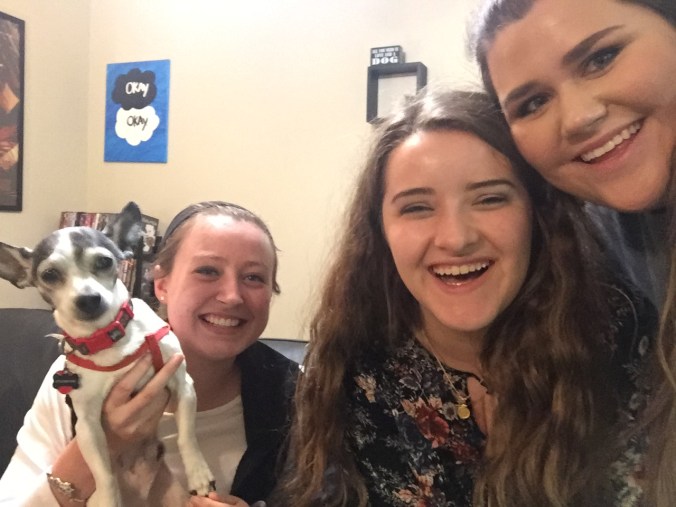
When I moved to Bowling Green for school my old youth pastor texted me. He reminded me his ex-girlfriend Paige lives here if I ever need anything. She sent me a similar message. They dated when I was in eighth grade and she was a junior at WKU. When she was in town she worked with my youth group and stayed the night at my house in Lexington a few times. She was an amazing role model as she clearly loved the Lord with her whole heart and I was overjoyed to have the chance to reconnect with her. When the Kentucky Kitchen Table project was assigned I knew I did not want to go home nor do the project with my friend group and a class mate’s. So, I opted for the host home option but when I found out host homes were sparse I remembered Paige. Before Paige could confirm dinner plans two girls from the other class, Lexi and Merritt, were assigned to the kitchen table I was supposed to be providing. Paige explained that while it would be hard to set up a dinner she may be able to work something out with her friend Jessie. By the time we finally had a date set Lexi decided to do the project at home.
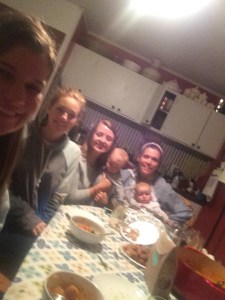
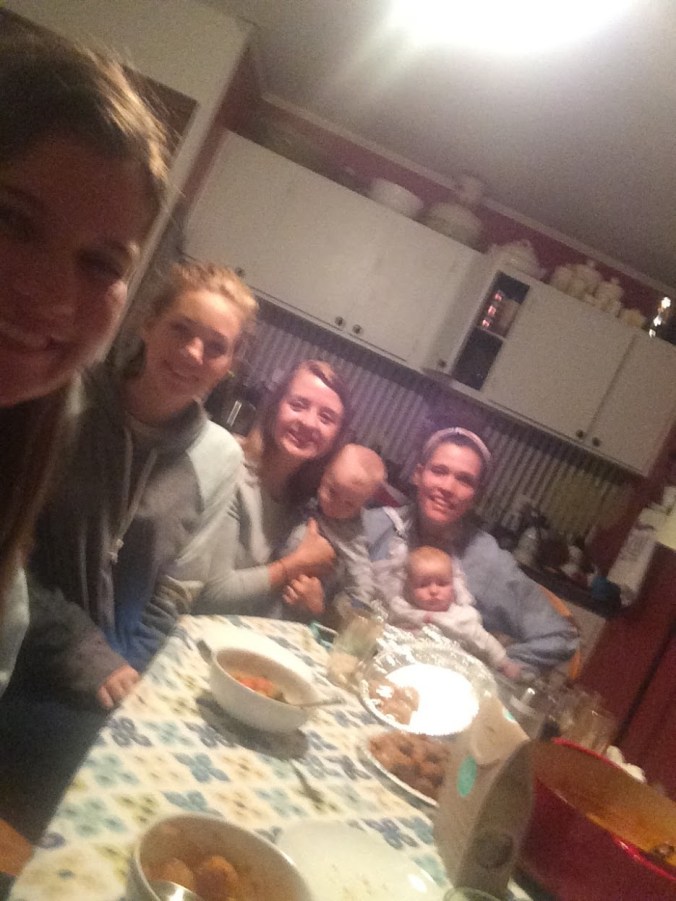
Merritt and I arrived in the neighborhood at about the same time. We met for the first time outside searching for Jessie’s house. Paige welcomed us in and explained the situation to Merritt; she, her son Bo, her husband Eric, Jessie, Jessie’s daughter Lucy, and Jessie’s husband Joel would all be moving to Turkey within the year so they were staying together while Eric and Joel were in Turkey at a training. Paige was simultaneously caring for her baby boy, Jessie’s baby girl, and cooking dinner. Jessie was out taking a meal to some international friends of hers. We offered and brought dessert and while she was very appreciative Paige explained that they have guests over so often they were drowning in food to offer us instead. She and Jessie suggested we take our dessert and share it with people on campus as an outreach to build community.

We sat down and began getting to know each other before we discussed anything related to the course. Paige is great with teenagers and people in general so although she is in a completely different stage of life than us our conversation was fluid. We took turns explaining different parts of our lives. Merritt talked about her upbringing with two brothers and two loving while protective parents. She went to an all-girls Catholic high school in Louisville. She is now participating in Greek life just like her mother and father were when they were in college. She also mentioned her family’s fondness of sports. Paige talked about her hometown only thirty minutes away from Bowling Green. She talked about how she met my old youth pastor and now her marriage to Eric. All the while being interrupted by babies, cooking and eventually Jessie returning home. Jessie talked about her job on campus at WKU where she and her husband are leaders at the Baptist Student Ministry. She related her work to Merritt’s sorority involvement and asked if Merritt had heard of a famous speaker. The woman used to find her identity in her sorority but once she graduated she did not know what to do. She ended up finding the Lord and speaking at sororities across the United states. Jessie talked about her impact on her after listening and her potential impact on so many more people.
When they were both home and sitting at the table they started explaining their impending move to Turkey. They will start working as missionaries for the International Mission Board with their families. They talked about short mission trips to Turkey they had each taken years prior. There was a specific unreached people group they wanted to reach-out to but they were going to have to enter the country and live in Istanbul for a while before they could. Their plan is to live in Istanbul learning Turkish for three years until it would make more sense to move to the part of Turkey they want to reach. At that point they would have to begin learning another new language, that of the Zazas. It was incredible to hear their long-term mind-set. The two had lived together before and were in it for the long-haul planning to live together again in Turkey. The two shared how they met at a church that outreaches to the housing projects in Bowling Green and had lived together before. God was working in their lives even then. Paige and her husband knew the neighborhood they wanted to live in and there was only one home available. When Jessie got married a few months later she and her husband wanted to live in the same neighborhood but no houses were available. The house was too big for the young couple but it worked out perfectly so Jessie and her husband could sublease with Paige and her husband.
Afterward, we began discussing what it means to be a citizen. Jessie talked about how she had never really considered it before. She said she did not value her citizenship as much as she should especially because in the United States we are awarded many more rights than other countries offer. Specifically as a woman she spoke of being very grateful for the society and country we live in. Paige agreed and they both talked about their citizenship in heaven. I was very interested in their perspective since they will soon be changing their citizenship. But they explained their earthly citizenship to no matter which country means little in comparison to their home in God’s house. They both are very thankful for their citizenship though. They feel a responsibility to support their governments and fellow citizens as Americans and as Christians. Merritt talked about how she had also never really considered her citizenship before this course. She explained that now that she can vote she is beginning to think about and learn more about government and how she can contribute to it. At dinner I was reminded of poverty and service, empathy, and learning from others weeks as a lot of our conversation was about how to live well with others.
When 7 o’clock rolled around so did the children’s bed time. We were welcomed back anytime and we all departed smiling and grateful.
I was very grateful to have learned from each of the beautiful people I had dinner with. I learned hospitality and outreach, a care for the people around me and a care for people around the world. I learned immediate love and long-term appreciation for people, respect for parents and affection for siblings and friends. I learned gentle peace and ambition, duty and perspective. I am very thankful for our dinner and our conversation. I am thankful for the chance to learn and connect with a peer I might never have met as well as citizens of Bowling Green in a different stage of life. I was really blessed by this experience and hope to continue my relationships with each of these ladies.
kkt

Kentucky’s Kitchen Table Project

By Coreyimg_4079

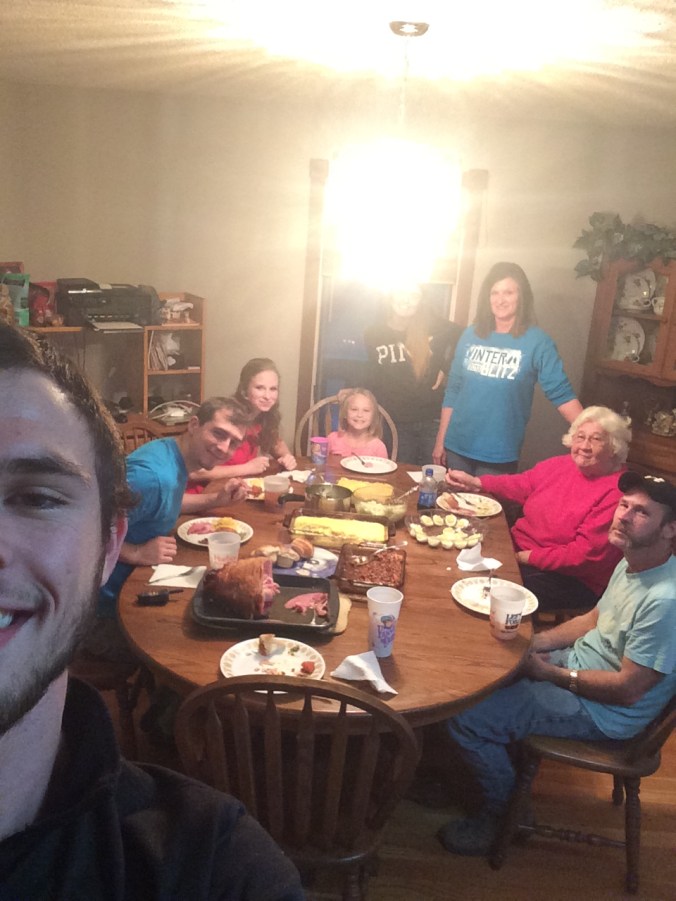
I will start off by saying that I greatly enjoyed this Kentucky Kitchen Table project. It allowed me to connect with some local people in my community and share some of our life experiences. I had dinner with eight people from various backgrounds. Luke is a man from Indiana who I was introduced to through a friend for this project. He is a mechanical engineering major. He is a funny guy, who has a very similar sense of humor to mine. We got along well from the beginning, and he was a great addition to the kitchen table. He wanted to be described as a kid from a small town who has never had anything given to him. Everything he has came from his own hard work. For the required question concerning what citizenship means, Luke said that citizenship means that you get out and participate in society. You work hard every single day, and try your best to make your dreams come true. You make money and spend money, and that’s how society works.

Kayla is a graduate from WKU, and has a degree in civil engineering. She is my sister, and she is an academically brilliant student graduating with an almost perfect GPA and Honors. She now has a full time job in civil engineering. Kayla wanted to be described as not your typical girl. She works in what some consider a man’s field, and has never been interested in most of the “girly” things. When I asked Kayla what citizenship meant to her, she had a similar answer to Luke saying that you must participate in society. She believes that citizenship means treating everyone with respect.

Mallory is my girlfriend, but she comes from a very different background than me, which provided even more diversity to the table. She also attends WKU and is majoring in Civil Engineering. She comes from the “cross town rival” independent school and was raised up in a more subdivided area. Citizenship means accepting everyone as they are to Mallory. She says that even if you do not agree with the way someone thinks or feels you should still accept them as they are.

Kiersten is my little sister and she was without a doubt the most interesting character at the kitchen table. She is one of the sassiest little girls I have ever known, and extremely smart. Whenever I asked Kiersten how she wanted to be described, she said she wanted to be described as a princess which is not in the least bit surprising.

Elaine comes from a background of only having enough to make ends meet. All through her life she has not had a surplus of money so she is very economically wise and very responsible. When I asked her about what citizenship means to her she had a very simple answer. She said that being a citizen means to contribute to society and make sure that you treat everyone with an equal amount of respect because everyone is made equal in God’s eyes.

Marietta is an elderly woman who has not had it easy from what I can gather. Recently her husband of many years passed away due to an ongoing illness. She said that one of her sons was in prison, and that another had a long fight with drug addiction that he recently conquered. The easiest word that I can find to describe this woman is tough, because she has had a lot of tough times in her life and she has always come through it. Marietta said that citizenship means loving this country and fighting for what you believe in.

The final guest I had at my kitchen table was a man named Kevin who was told a few years ago that he would never walk again. He was involved in a horrible four-wheeler accident that broke several of his vertebrae along with other injuries. He was rushed to UK hospital where he underwent immediate surgery, and at the conclusion of the surgery he was told he would never walk again. Yet, here he was walking into my house to have dinner. Kevin wanted to be described as a fighter because he said it seemed like he was always the under dog. When I asked Kevin what he thought citizenship meant, he said that citizenship meant trying your best to help others out around you.

Throughout the dinner we had a lot of small talk conversations about how everyone was doing and we all shared a little background about ourselves to begin with. Then, since I had been hunting the morning of the kitchen table project, I was asked if I had gotten a deer yet, and we spent a few minutes exchanging our best deer hunting stories with one another. One of the most well responded to questions I asked was: “Did you ever have meals around the table with your family or neighbors growing up?” This question seemed to almost be universally answered as a yes except for Luke. Luke said that his dad worked a lot as he was growing up, and that he didn’t really get to spend time just sitting down and eating dinner with his family. Both Kevin and Elaine responded yes to this question. They thought that it was a normal thing for a family to sit down at the dinner table and have a home-cooked dinner together almost every single night. It was something that they had done ever since they could remember, and couldn’t imagine what life would’ve been without that. Elaine said she felt that this dinner together made the family stronger, and made them get along better.

I honestly learned a lot at this short dinner filled full of conversation and good food. It can really open your eyes to the changing generations, and the differing views between every person no matter how similar they are. This reminds me very strongly of the idea of deliberation and the book Citizen by Claudia Rankine. As I sat at the kitchen table, I was very aware of the differing view points surrounding the table, yet we could all talk about our beliefs and views without offending anyone. That is the goal of deliberation and democracy is to understand everyone’s views and come together to form a better society. Finally, it reminded me of the book Citizen by Claudia Rankine because of the fact that everyone at the table mentioned at some point or another that no matter the skin color or views or ideas we all need to accept one another regardless of the circumstances, and that is very important.

Overall, I truly enjoyed this Kentucky Kitchen Table Project, and would suggest it to anyone. It opens your eyes to the way generations are changing, and how everyone has differing view points no matter if you’re from the same state, city, or household. It was a great experience and I’m glad I was able to participate.

Kentucky Kitchen Table

By Merritt

On November 15th, I did my Kentucky Kitchen table assignment. I was very nervous going into it because I had been paired with a girl who I did not know, nor did I know anyone attending the dinner. However, I can say that I was nervous for no reason because the dinner went amazingly. When I arrived at the street the house was on, I had issues finding it. Luckily the girl who I was paired up with, Lily, arrived soon after me and we found the house together. Lily and I had texted a little bit but this was the first time we had met each other. As we were looking for the house we shared some basic information about ourselves and got to know each other a little bit. We were having dinner at a family friend of Lily’s. Lily’s friend, Paige welcomed us in. Paige has a baby named Bo who is less than a year old. She explained to us how her and her friend Jessie were staying at this house, although they did not live there. Paige and Jessie are missionaries; they are planning on moving to Turkey in several months to pass along their faith. Their husbands were currently on a ten-day trip to Turkey for a missionary expedition so they were staying in the house until their husbands returned on Saturday.

Paige sat us down at the table and laid out plates for us. She was extremely polite and friendly. We shared basic information about our lives such as where we were from, members of our family, what we are studying, etc. Paige cooked meatball soup and cornbread which smelled amazing. She joked around saying she was not a very good cook and apologized if it was not good. Paige served us food and we talked a little long. Her soup and cornbread tasted amazing.  As we were eating Jessie walked in the door. She wasn’t back yet because she had made lasagna for one of her friends and was delivering it to her. Jessie was very similar to Paige in regards to kindness and generosity. Lily and I introduced ourselves to Jessie and we talked a little bit. Jessie also has a young baby who she brought out to us. Both babies were adorable. Jessie’s baby is a girl, so the two joked around saying that their babies were destined to get married. The two women are in their mid-twenties and they both attended WKU. We talked a little about the changes WKU has made since they have been there. They were also curious to hear about my sorority, since neither of them or Lily had been in sororities at WKU.

Jessie and Paige are very devoted Christians. When they asked me about my faith I told them I was Catholic. They were both happy to hear that I have a relationship with God. However, I would not say that I am anywhere near as a good follower as they are. It was very interesting to hear them talk about their faith. They both shared how they believe that God has a plan for them so no matter what happens they trust Him. They shared examples of when they have put their life into Gods hands which amazed me. Although I have a strong faith, hearing them talk about their devotion made me realize just how faithful they are. When we asked what citizenship meant to them, they both thought about it for a while. Jessie answered first explaining how she doesn’t think about citizenship much because she is moving to Turkey in a few months. However, she also added that she is very thankful for the rights that she has living in the US. She explained to us that she felt like she had no place to complain about her right’s because women or people in other countries have nowhere near the rights that we do. Paige agreed with this. Both women shared that they were thankful that God had them born into the US. However, they both stated that although their live on earth is important to them, the real place that they are citizens in is Heaven. Even though I come from a Catholic background I am often not around people who share their faith in a way that Jessie and Paige do. Although I do believe in Heaven and life after death, I focus on my life on earth quite more. This differed from Jessie and Paige who focus more on afterlife. It was very interesting hearing their side of the way they live. They also told us about their plans to move to Turkey. This was extremely interesting to me because I could not imagine moving that far away. Jessie explained that the first three years of their time in Turkey would be spent learning the native language so they could better communicate with the citizens. When we got on the topic of holidays they explained how they planned to have a big Thanksgiving and Christmas since it would be one of their last holidays with their families. After dinner Paige offered us dessert. The women have friends over almost every night of the week so they had a surplus of left over desserts.

From these two women I learned what is was truly like to live your live caring for other people. They live their whole lives trying to better the lives of others. They were both very thankful for the democracy that the United States has to offer. As I mentioned early they both felt no need to complain because the US has given them so much. This was a real eye opener to me because I often hear of people complaining about their rights as a US citizen. Although I do feel that there are some issues with the democracy in the US, and can honestly say that we have it way better than many other countries. Jessie and Paige helped make this more clear to me. In our class we often talk about how we can better the lives of people around us. Jessie and Paige better the lives of people around them by sharing their generosity and kindness with everyone. After an hour and a half Jessie and Paige said it was time to put their babies to bed. However, before Lily and I left Jessie and Paige made sure sure to let us know that we were welcome back at any time. I’m very glad that I had the chance to meet these two wonderful young women and I feel that I would never forget this experience.

image-1

Strangers Aren’t So Strange After All

By Abbi

When this project was first assigned, I was somewhat hesitant to jump right in. The idea of having dinner with a bunch of strangers was somewhat daunting to me because it usually takes me a little while to warm up to people before I’m comfortable enough to have a more serious conversation with them. However, this project was not nearly as awful as I thought it would be.

My Kentucky Kitchen Table group consisted of me (Abbi), Scott, Wil, Ellery, and Nancy.

kentucky-kitchen-table

A little bit about our group:

  • I am an Accounting major from Lexington. I am the second oldest of four children, and I am a member of the Alpha Gamma Delta sorority here at WKU.
  • Ellery is a Biology major from Danville. She has an older sister and a younger brother, and grew up surrounded by her family and neighbors. She is also a member of the Alpha Delta Pi sorority.
  • Scott is a Biology major from Louisville. Scott is from a more rural area in Louisville, where he grew up with his younger brother, and enjoys activities such as hunting, working out, and spending time with friends. He belongs to the Sigma Phi Epsilon fraternity.
  • Wil is a Biology major from Bowling Green. He has a younger sister and a younger brother, and he is a member of Phi Gamma Delta (FIJI) here at WKU.
  • Nancy is a Biology professor here at WKU. Nancy has two children and lives here in Bowling Green, where she also grew up and attended college as an undergraduate. Nancy was a member of Alpha Omicron Pi when she attended WKU. She has a Ph.D. and attended medical school in both Tennessee and Missouri (I don’t remember exactly), where she met her husband.

Obviously, our group was a little bit skewed in terms of majors, but we were diverse in other ways. For example, except for Nancy, and Wil, we are not from Bowling Green and are still not very familiar with the area. Also, Ellery and Scott grew up in more rural areas as well. Although everyone in the group participates in Greek life, no one belongs to the same organization. It was very interesting to see how our similarities and differences both contributed to our conversation.

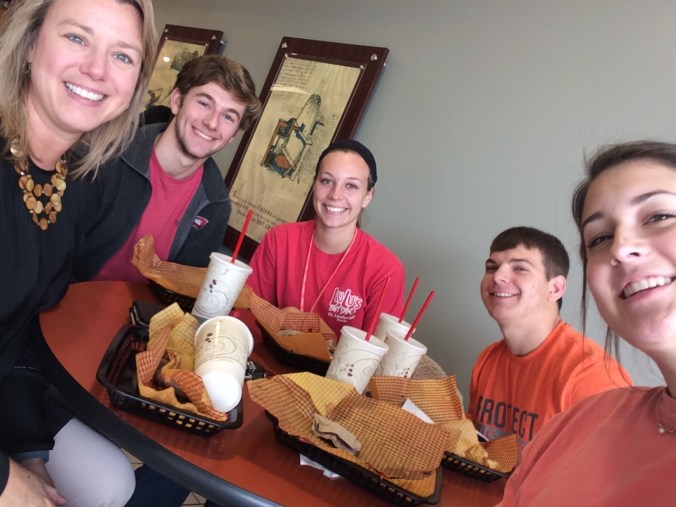
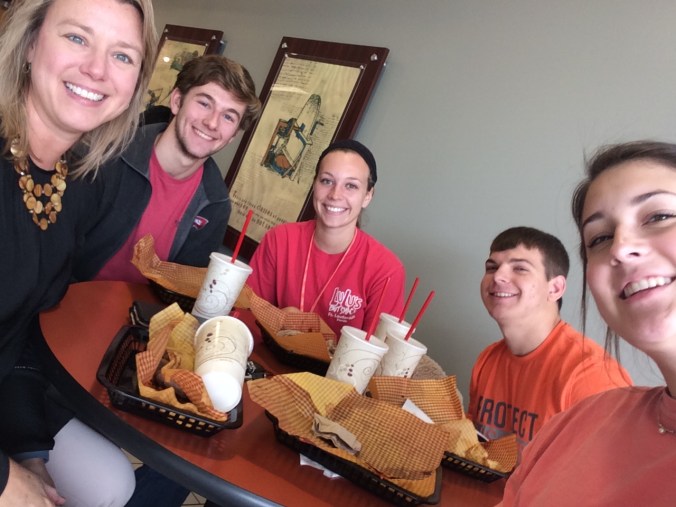
The original plan was for our group to meet at Nancy’s house and have dinner with her and her family, however there were a few scheduling and logistical conflicts, so we adjusted our plan. We ended up meeting in DaVinci’s on the first floor of Snell Hall here on campus, and we all enjoyed our choice of pizza from the restaurant. At first the conversation was a little bit awkward and just a lot of small-talk, but after we got into it, things started to flow more smoothly.

We started off with the required question: “Beyond voting, paying taxes, and following laws, what does citizenship mean to you?” Nancy explained that to her, citizenship requires personal responsibility from everyone. Everyone really just has to do their part in contributing to the overall good and benefit of the community. This requires a lot of understanding and communication, which are topics we have been learning a great deal about in our class this semester.

We also talked about what we thought were the best aspects of our world today. Nancy said that technology has been very beneficial in terms of communication and having access to a multitude of information from around the world. Again, this benefits the way people collaborate and communicate with each other, and I think that technological advances will only increase in the future. However, we also discussed the downsides of technology, such as how everything is becoming the same in terms of language and format, which lessens diversity in communities.

A third topic that we discussed is the concept of neighbors. Ellery, Wil, and I mentioned that we all grew up being very close to our neighbors, and it has always been a very prevalent aspect of our lives. Scott added that he does not have much experience with neighbors because he is from a more rural area in Louisville and did not live in a neighborhood. Nancy told us that her family does have neighbors where they live in downtown Bowling Green, and that the kids are similar in age, however they don’t always hang out together.

Acting in a neighborly way with consideration for others is a significant part of being a good citizen. For example, Nancy mentioned that her family decided to install a fence in their backyard because her family has chickens, but they were somewhat of a nuisance to her neighbors. Because Nancy and her family valued their relationship with their neighbors more than letting the chickens roam free, they put up a fence to keep things peaceful.

We then got to talking about what kind of people we want to be and we want our children to be, and through this, there was a heavy focus on service. Nancy’s parents raised her in a way that emphasized service to others and to the community, and this is what she is teaching her children now. My parents instilled the same values in me and I had many opportunities in high school to serve my community. I also have the same opportunities to work in my community in college through my sorority, and I know Ellery, Scott, and Wil have similar opportunities as well.

Overall, the Kentucky Kitchen Table experience was very enriching and not at all awful. I realized that even though I could see obvious differences among our group, the conversation revealed many similarities that connected us in ways that we wouldn’t ordinarily realize. Although we may have different backgrounds and beliefs, the members of my group we able to find common ground and agreed on many simple ideas about community. I think that this realization is a key part of living in a community and acting as a good citizen towards others. This project has emphasized the class themes of how we can live better together and what it means to be a good citizen in today’s world. We can do this by taking responsibility and contributing to the overall good of society through acts of service, consideration for others, and communication and understanding.

Don’t take things for granted

by Scott

One thing I looked for in a group for this project was diversity.  Our table consisted of five people representing Louisville, Lexington, Bowling Green, and Danville.  Present at the table was Abbi, Ellery, Nancy, Scott, and Wil.  Abbi is an accounting major, that’s very goal oriented.  She is an extrovert and loves to volunteer in the community.  Ellery is a biology major and identifies as a Republican.  She is an extrovert, who spends most of her free time reading.  She loves politics and would do anything for her community.  Nancy has a PhD and is currently teaching Biology at Western.  She identifies as a Democrat and devotes all of her free time to serving the needs of Bowling Green.  I, Scott, am majoring in Biology as well with the hopes of becoming a doctor one day.  I identify as a Republican and spend most of my free time at the Preston Center.  Wil is majoring in Biology, and is a very studious person.  He is more of an introvert and identifies as a Republican.

We focused on what citizenship meant outside of voting, paying taxes, and following laws.  Nancy was quick to point out that this was a loaded question but provided a clear cut answer.  She said that the most important thing one can do as a citizen is to serve his/her community.  Nancy believes that a community is only as strong as its weakest link which requires unified communication.  She said that it can be very difficult to communicate with others who are much different at times but it’s a great skill in life to have.  She also said that things don’t always go as planned so you must be flexible.  For example, some neighbors might promise to help with a neighborhood improvement project and then not show up.  When I was listening to her talk, I was making connections to our class.  For example, just by deliberating in class this semester I have come to embrace how different people think.  You can pick things up and learn to value different perspectives by talking to others who are different than you.

We asked Nancy the question, “What advice would you give to people running for office in our country?”  She was quite hesitant to answer at first because politics is such a hot topic.  She eventually offered up the idea that we should treat one another as we would want to be treated.  While that may sound elementary, it’s the biggest weakness our country currently possesses.  During the presidential debates, the candidates focused more on insulting one another rather than their policies they would like to implement.  This caused the citizens to get nasty with each other and the country has become split.  John Dickinson once said, “united we stand, divided we fall.”  This semester I have learned that productive deliberation is a good thing, but once a decision has been reached, the group should come together to support it.  We are not always going to get what we want which is why it’s important to learn how to make the best out of every situation.


We then asked Nancy the question, “how do you think your job relates to your role as a citizen?”  She laughed, and went on to say if we had told her she was going to be teaching college kids one day she would have laughed in our faces.  She went to medical school and received her PhD but felt that she could make a stronger impact teaching the upcoming generation.  Nancy also said she wanted to make a difference in research.  She wanted me to emphasize one thing when sharing our project with the class and that was don’t pick a job based on money.  She could be making double what she is now but she feels as if this is her calling and will benefit her community more than anything.  I could relate this to the class because we have talked about sacrificing ourselves sometimes for the greater good.  Nancy is a perfect example of this and she isn’t struggling by any means.  We asked Nancy if she had ever had a conversation with someone from a really different background.  She stated that she hadn’t until she attended Western Kentucky University.  Nancy told us not to take the diversity on this campus for granted because you can learn so much from others that you never would have gotten the opportunity to have before.  Western truly does have international reach and the opportunity to understand what other’s lives are like in places other than the United States is quite unique.  We take things for granted in our everyday lives that are major concerns in other countries.  Sometimes we need to be brought back down to earth.

We asked Nancy, “What kind of person do you want to be?” She responded, “The person I am today.” When asked to clarify, she offered up examples of what her family does during the holiday season every year.  Nancy’s family delivers food to families in the Bowling Green community for Thanksgiving as well as buy presents for children whose families can’t afford them.  For one of her kids birthdays, they celebrated by doing a service project as a family.  This says a lot because I don’t know too many kids who would choose to serve others on their birthday.  Nancy’s giving attitude has rubbed off on others making Bowling Green a better place.

In conclusion, this project made me realize a lot about myself.  I now realize that I could be donating more of my time and talent to the community instead of being selfish.  I also see how the Bowling Green Community is much different than the Louisville Community.  While the people in these cities may be two hours apart, they’re still Americans that should be coming together for the common good.  After talking to Nancy, I got to see how we (citizens) can sometimes struggle working together to solve problems in the community.  Nancy showed that with enough work, progress can be made.  I will carry the lessons I’ve learned in this class for the rest of my life and will try to crack the codes to the wicked problems we have discussed. kentucky-kitchen-table

Kentucky Kitchen Table

By Wil

My Kentucky Kitchen Table was not conducted around an actual kitchen table, but at a small table inside of the Davinci’s restaurant in Snell Hall. My group consisted of Scott and Abbi. Scott is a biology major from Louisville. Abbi is an accounting major from Lexington. We invited two people to eat with us. These two people are Ellery and Nancy. Ellery is a biology major from Danville, and Nancy is a professor here at WKU. Nancy and I are both from Bowling Green. The original plan was to eat dinner at Nancy’s house, but that fell through, so we decided to eat at Davinci’s. 

Our conversation was all small talk at first. I actually ended up finding out that Nancy and my mom went to the same high school, but were a few years apart. Another thing that a majority of the group could relate to was living in a neighborhood. This subject came up when we brought up the question of if you know your neighbors. It may seem like a very common thing, but those of us who have lived or currently live in a neighborhood were able to discuss that feeling of community with your neighbors. Another member of my group and I both spent a lot of time with our neighbors similar ages. Nancy’s kids also have friends around their own age in their area that they can go out and play with. Eventually, our discussion became more deep. We started going through more questions in the packet, but in a casual way, so as not to be interrogative. It was clear early on that Nancy had a lot of knowledge, not just from her education, but from her experiences as well.

I don’t recall what exact conversations were sparked by each individual question that was brought up, but I do remember one thing that Nancy brought up. This idea is something that can be applied to multiple questions. She said that one of the most important values in her family has always been serving others. Her parents instilled the value of service in her, and she now does the same for her kids. She told us about how one year, her kids decided to collect money for a charity instead of receiving birthday gifts. I think part of the reason this particular value stuck with me is because it is one of the five values of my fraternity. Our five values are a guideline for us to become better men. Service is one of the values I tend to struggle with the most, because I don’t typically attempt to put any effort or time into serving. Hearing Nancy talk about her experiences with service made me realize that serving others doesn’t have to be a huge, life-altering sacrifice. It actually requires very little effort to serve your fellow man. That was the biggest thing that I learned during my Kentucky Kitchen Table – how to better serve others.

Service directly relates to two out of the three central questions of this class. The first is “How do we live better together?” This relates to service on a very basic level – treat others the way you want to be treated. If you want to be served, then serve others. We live better together when we are serving each other. The idea of serving others in your community leads to the next central question.

The second central question that service relates to is “How do we solve problems?” As we have learned in this class, a wicked problem is one with no clear solution. It is hard to solve because there are many layers. Examples of a wicked problem include homelessness, racial tensions, and healthcare. If everyday citizens got into the mindset of serving others, then we could begin to solve these problems. Let’s think about this with homelessness. More specifically, homelessness in Bowling Green. To solve homelessness, you essentially need two things: a steady income, and shelter. However, those two things are hard for a homeless person to attain on their own. If citizens who are already fortunate enough to have a steady income exhibited altruistic behavior in donating money for this problem, then it could be solved. Even better, those who own their own businesses or living complexes could offer jobs or a roof to live under. I realize that these are lofty expectations, but that is one way that our community could come together to serve those that are less fortunate than some of us are lucky to be. Like I said earlier, one of the big things I learned from my Kentucky Kitchen Table was that service does not always have to be a grand gesture. Service can also help solve smaller problems in our community.

An example of a small problem in Bowling Green is litter. It’s not a big enough problem to where you would be revolted when walking down the street, but it’s still a problem nonetheless. Anyone can solve this problem, and serve their fellow man, by simply picking up trash that you see. This might seem like a silly approach, but think about how many times you’ve seen litter and did not pick it up. That number is probably very high. It is for myself as well. If everyone in Bowling Green would take an extra ten seconds out of their day to pick up litter when they saw it, then we would all live in a much cleaner community.

Despite having some trouble with actually scheduling the meal, I had a good overall experience doing my Kentucky Kitchen Table. Davinci’s never disappoints, and the conversation was enriching as well. To sum up what I learned from my fellow Kentuckians, service is one of the keys to solving some of the major problems in our community. A saying that is used a lot in my fraternity is “service to others is the rent we pay for our space on this earth”. To me, this means that some of us are lucky enough to be able to live a fortunate life, and to serve others is the only true way to be thankful for what we have. If the citizens of Bowling Green thought this way, there would be no limit as to what we could accomplish in our community.

image1

Won’t you sit and share this pizza with me?

By Michaela

IMG_7089

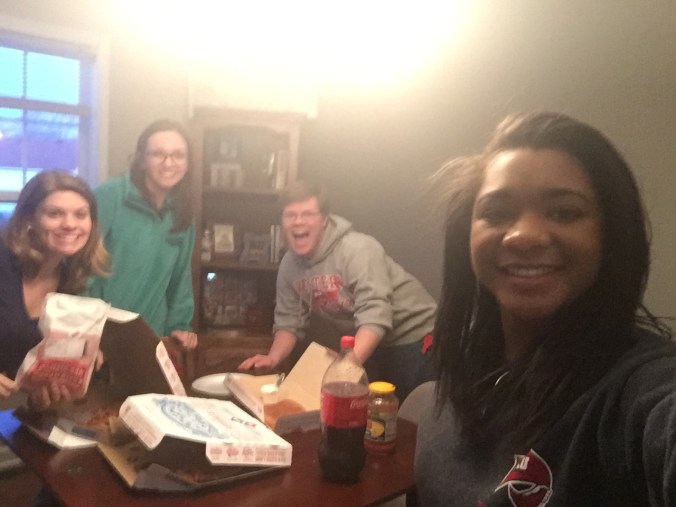
For my Kentucky Kitchen Table project, I had the amazing opportunity to share a delicious pizza with my host family Tyler, Jeanna with her roommates Haley and Molly. I am going to be very honest when I say that I had my reservations when I learned that we would be eating with strangers in their home. I was concerned that I wouldn’t feel welcomed since I didn’t know how much information was exchanged. However, the experienced turned out to be one of the best ones I have ever had.

Upon arrival, I was instantly welcomed with hugs and excitement by Jeanna and my her dog.  The pizza was running a little late so we got the chance to have a causal conversation before beginning out project around the dinner table. Jeanna was actually a recent graduate of Western Kentucky University. She works as a Park Ranger at the National Park and as a worker for an Autism organization. She has a very energetic kind of character and is very interested when it comes to stories shared by others. She likes to describe herself as a compassionate person who loves the outdoors. Haley is also a graduate of Western Kentucky University. She is a part of the campaign for the American Heart Association. She works on the Hoops for Heart campaign that urges elementary children to stay active and is an active fundraiser for the campaign. She has an opposite personality than her roommate Jeanna. She is a little more laid back. She loves golf and is very engaged in her studies.

As the pizza stared to arrive, we talked a little bit about our lives. We discussed where we came from in the parts of Kentucky. Jeanna and Haley had both originated from a rural neighbor in a small town where everyone knew each other. They said the move to Bowling Green was very intimating, because the city was so big. I thought this was pretty funny, because the town I come from, which was Lexington, is a lot bigger than Bowling Green. I was every interesting to see the different perspectives based on where they are raised.  I assumed that Jeanna and Haley would have different perspectives on today’s issues because they were raised in a small, non-diverse community. Instead, I have come to find out that their perspectives on today’s issues correlate to how a view today’s issues.  For example, Jeanna and I both agree that the environment should be the world’s top priority among with diverse equality, though she would put the world’s environmental effects as her number one priority. She has told me that she has seen the devastation of the environment first hand ever since she started working for at the National Park.  She says, “No one really understands the effects of human destruction on the environment, because they don’t see the impacts that come from their constant harmful effects first hand. Hearing about it on the news only makes us think that it is an issue that will fix itself or something that we will have to be worried about later. It’s the laziness and greed of humankind that will ultimately destroy the Earth someday, and its sooner than people think.” I told her we had discussed the devastation of the environment as a wicked problem in class. I told her that we might actually be too late to come up with a fast and effective solution, the only thing we can try to do is make it better”.  Her passion on the topic made me think that if everyone in the world had that kind of passion and heart, that we really could find a solution to the wicked problems of today, not just for the environment, but for other issues such as racial inequality and poverty.

As the conversation progressed to wicked problems, Haley also added her views on these issues, in particular, the racial inequality among the U.S. She made it clear that through she was a republican, she didn’t want to affiliate herself with the republican candidate Donald Trump. “He will singlehandedly destroy the US!” Though she does agree on the immigration problems with Mexico, she doesn’t believe that the problem can be fixed by building a wall. “What ridiculous moron would even suggest that! It’s completely inhuman, and offensive, and cold. How are they going to say ‘no immigrants ALLOWED’ when they are themselves immigrants?” This discussion also connected with the concept of wicked problems. I do agree with her statement, but I can also see how some people would be upset to the fact that there are illegal immigrants taking advantage of the opportunities of America without also sharing the responsibility of an American. We threw around some ideas that could help solve this problem, but some of the solutions had holes in themselves. However, we did conclude the only way to find a true solution is to talk about it. We like to think that it is best to have one person speak and have everyone follow, but then so many other ideas will be shadowed an ignored. We have to learn to sit down and talk to each other. Without talk, there can be no action.

The KKT project was a very stimulating project. It allowed me to discuss today’s issues with people who are different from me. Its process like this where we gather people from different backgrounds to try to come up with solutions to problems that opens our horizon to our own perspectives. It indirectly shortens that gap we like to create between ourselves and others, creating what the world had intended when society came up with the word citizen. Not only are we connected with our society, but the people within it. As soon as we start to realize that, we will be able to handle the wicked problems that arise.  So, to whoever may read this, won’t you sit down and have a pizza with me?


KKT with Lil Britches

By Kendall

I had the wonderful opportunity of having dinner with McKenzie, my friend Lindsey, and McKenzie’s adorable pup, Little Britches. As a table of three college-age women, we didn’t see much diversity at first. However, we found we were all raised very differently and are all majoring in very different fields.

Lindsey, who recently turned nineteen, was raised in a small town in central Kentucky that she jokes is “population more cows than people.” She is the youngest of two with an older brother. Her parents were very conservative when she was a child so she wasn’t exposed to much in the world of rap music, video games, TV,  or other common things for most children. She was raised very Christian and still holds her faith very close to her heart. Her faith drives many of her decisions and is where most of her morals stem from.

McKenzie, on the other hand, is a 22-year-old college senior who will be graduating in just a few short weeks. She raised in a suburb just outside of Louisville. She is the oldest of five which she believes played a huge role in her upbringing. She has a huge heart for others and always puts them before herself. Although she’s not Catholic, she says people often mistake her family for being a Catholic family because of their good morals and high standards. She says her mom was very strict, with her being the oldest, and instilled in her a perfectionist complex.

Finally, I was raised in Northern Kentucky right outside of Cincinnati, Ohio. My family always stressed the importance of academics and I was taught that I can and should excel at everything I do. I was brought up in a Christian household and went to a Catholic school until I was eight. Church was always a huge part of my life growing up but, now that I’m older, my family has drifted away from our church. I can tell you the last time I attended service there was Easter of my eighth grade year; however, my faith in God still remains. My family has always been big on community service and my drive to give back and my Christian values are the main contributors to my own personal morals.

We started our dinner with some light conversation about our majors, Little Britches, and how excited we were forMcKenzie’s macaroni and cheese and my double chocolate brownies.McKenzie and I discovered we were both in the psychology field. She is headed toward a degree in developmental while I’m on a behavioral and neuroscience track. Lindsey, on the other hand, is a graphic design major and fashion merchandising minor. Little Britches is graduating with a degree in face-licking and dog modeling. We joked about the “conversation starters” and kept the required “what does citizenship mean to you?” at the back of our minds.

We all agreed that one of the great things about our world today is how connected we all are. Often times, social media is painted in a bad light but it keeps us in touch with what is going on all over the world. Lindsey said it best stating, “our world is much smaller than it used to be now that we all have Twitters and Instagrams.” We also decided the availability of instant mac and cheese makes the world go ’round.

We all wanted to avoid political discussions as much as possible seeing as none of us consider ourselves very politically informed. However,McKenzie had some good advice for future presidents saying she’d rather they be “genuinely for the people” rather than put on a good face just for votes and, most importantly, be a huge dog lover.

After a brief break in conversation used to follow Little Britches’ Instagram page (which is @instabritches if you’re interested), we finally made our way back to the important question. “What does citizenship mean to you?” Lindsey believes doing community service and giving back to the community to make it a better place to live is a very important factor of citizenship. Likewise,McKenzie believes a good citizen is one who looks out for their fellows and helps those who can’t help themselves. She wants to be a good “steward of the earth” and keep it green. One of her biggest dreams is to one day own a sanctuary for older dogs whom no one wants to care for. She, of course, would call it In the Name of Britches after her very best friend. Mackenzie also wants to give back to the community through her field of study. Her dream is to help children with mental disabilities and to tailor schooling to their needs as they’re often pushed to the wayside.

McKenzie’s want to be “green” reminded me of Pollan’s Why Bother and Jensen’s Forget Shorter Showers. Unlike the views in these articles, both Mackenzie and I believe that, despite how small our efforts are, we could still make an impact on the state of our environment. Our discussion of citizenship was also pretty similar to the class’s general definition. There were parallels in the sense of giving back and working to make the world a better place.

I had a wonderful experience having dinner with Lindsey,McKenzie, and Little Britches.  learned a lot about how people with different perspectives view our society today and I’m happy to say I made two new friends. I can’t wait to stay updated with Little Britches via Instagram and hope to see him trotting around campus in his unicorn costume very soon!

KKT1IMG_5071IMG_5073

Kentucky’s Kitchen Table: “Finding Your Identity”

By Luke

After several weeks of scheduling conflicts and procrastination, our group was finally able to meet at our host Emily’s home for our Kentucky’s Kitchen Table project, which, to my enjoyment, ended up being a chicken taco night. After consuming an unsafe amount of Mexican food – as well as a delicious West 6th Amber Ale – it was finally time to have our discussion, which began of course with brief introductions.

Our host for the evening was Emily, a Bowling Green native currently completing her graduate degree at WKU involving an intricate combination of humanities courses. Dubbing herself as “Elisabeth Gish’s protégé”, Emily plans on living in a Chicago-based commune for approximately 9 months following graduation, and eventually hopes to attend divinity school in the Boston area.

Next around the circle was Daniel, a freshman on the path to nursing school. He briefly described his catholic-school upbringing in Louisville, which concluded with attendance at Saint Xavier High School. Like myself, Daniel enjoys reading and Netflix, but he also mentioned his heavy involvement with theater in high school. Volleyball is another of Daniel’s hobbies.

Ethan, another freshman honors student, was also in attendance. His interest in the broadcasting program brought him to WKU from Nolensville, TN, and his primary hobby involves working with the WKU-PBS television station. In addition, Ethan enjoys Netflix and hanging out with friends. He also mentioned being a baptist, although not extremely devout (this adjective described nearly all of our religious affiliations, aside from Emily’s).

The final member of our dinner/discussion was Alex, a fellow senior, who is wrapping up her degree in Agriculture this semester. Originally from the small town of Gallatin, TN, Alex enjoys horseback riding (specifically “barre racing”), kayaking, working on her truck & car, and shooting guns at the range with her father. She mentioned playing volleyball in high school, and identified as a southern baptist.

Only one of the “conversation starters” listed in the handbook (the required question) was officially addressed; however, our nearly two hour discussion encompassed several of the other questions indirectly. When asked about what “citizenship meant to her” (aside from voting, paying taxes, and following laws), Emily began detailing her somewhat abstract, yet immensely intriguing perspective on citizenship, which I’ll attempt to recollect.

She began by stating that we as individuals are citizens of several communities simultaneously. Some are obvious and based merely on residential locations such as hometowns, home-states and national residence (think “American citizens”). Others are more personal and greater in number/variety: extra-curricular clubs or groups, churches and other religious congregations, athletic teams at varying levels of competition, family units (whether traditional or not), friend groups, etc. As a result, human beings develop varying “identities” generated through association with varying communities (your personality/behavior around friends or colleagues changes when around parents and family, for example). According to Emily, as we grow and progress through the numerous chapters of our lives, we change how we prioritize the communities we belong to, and this in turn changes our identities over time. As a result, though any person at any given time may belong to a diverse collection of communities, one generally takes precedence over others and is responsible for what Emily referred to as that person’s “primary identity.” Think of it this way: when someone asks you to “tell a little about yourself,” the community associated with the majority of your description is your main priority (at the time) and is responsible for generating your primary identity as an individual.

For example, everyone in attendance other than Emily mentioned that practicing religious faith (i.e. our “religious community”) had become less of a priority since beginning school at WKU – an example of how priorities change in regards to communities we are citizens of. Personally, my social fraternity has been the most important community in my undergraduate career until now, and had previously generated my primary identity. However, as I prepare to graduate and move on to veterinary school in the fall, I’ve found that my primary identity has shifted, and the communities involving my girlfriend and select close friends have taken precedence. I’m sure that once I begin classes at Auburn this fall my “academic community” will become much more of a personal priority and change my primary identity. Being able to apply Emily’s theory to my own life helped it resonate all the more.

To conclude, Emily encouraged us to examine our own lives and practice articulating what our primary identities may be at the present time. This reminded me not only of Martha Nussbaum’s reading from Week 1 titled “Socratic Pedagogy: The Importance of Argument” that encouraged self-examination, but also Jonathan Haidt’s “The Intuitive Dog and Its Rational Tail” from Week 2 that urged readers to try and pinpoint the sources (i.e. the communities) of their own intuitions as a way to aid in debate and discussion. Discovering what motivates the decisions you make and the opinions you possess is critical to understanding yourself and properly empathizing with those around you, and I believe Emily’s theory attempts to get at the heart of what makes us who we are as individuals. If we find that we are satisfied with our primary identity, we should work to cultivate it and give our best to the communities responsible for its formation. If we are unsatisfied, however, perhaps we should begin to shift our priority to communities that can help us become the best versions of ourselves and support others in doing the same.

thumbnail_IMG_2302

Back row (from left to right): Ethan, myself, and Daniel. Front row (from left to right): Alex and Emily.


KKT Project Reflection

By Alex

For the Kentucky Kitchen Table project, I was grouped with Luke, Daniel, and Ethan. We had a wonderful dinner with Emily, a former Citizen and Self student and peer mentor who has graduated from the Honors College and with a Masters of Religion at WKU and is headed on to graduate school.  We decided to potluck ingredients for tacos, and make the actual dinner together, to help cut down on having to spend extra time prepping food, but also to have some casual conversation and get to know each other a little before the actual dinner. Ethan is a broadcasting major from Tennessee. He works at the TV station on campus and in his spare time enjoys Netflix and hanging out with friends. Daniel is a nursing major from Louisville who enjoys theater, Netflix, reading, and volleyball in his spare time. Luke is a Biology/ pre-vet major from Harrodsburg, Kentucky. He is a Sigma Chi, and enjoys sports, reading and Netflix.  We had an awesome conversation which we decided to begin with our question, “What does it mean to be a citizen?”  From there we went on to talk about a more personal aspect of citizenship, and what that looks like in varying identities. We talked about how we identify as individuals, and what types of things truly define us. Emily spoke a lot about personal reflection, and encouraged us to really think about what specific communities we identify ourselves in, and whether we are putting one hundred percent of ourselves into these communities. I do not think any of us left without seriously contemplating our lives as we did.  The conversation was very high level, respectful, and meaningful.

Specifically, each of us had a slightly varying view of what citizenship meant to us.  But overall the underlying principles were the same. Be active. Be involved. Help others. Do what you can. We all had an outlook of citizenship as being part of a group or community and giving your best to help and improve that community.  We discussed how this is also an inward commitment. We must choose what community, or communities we want to be defined by, and then give one hundred percent in order to be effective citizens.  Those communities are not solely our towns, states, country, etc. but also our families, social networks, workplaces, and more. We agreed there are no real set requirements for being an “effective citizen,” but that it is more about giving what you can, and giving one hundred percent in everything.  In order to make our communities what we would like to see, we must be actively involved and engaged in the activities of that community.  We also spoke briefly of these things in a religious context.  With varying religious backgrounds, (Ethan and I were raised Baptist, Danial Catholic, and Luke Methodist) we all agreed that this was a specifically good example of our community identities and how we must realize and ultimately choose which ones take precedence.

I think our conversation relates best to our class reading on the elephant and rider from Jonathan Haidt’s book The Righteous Mind. In fact, we discussed this briefly.  This is a good example of determining which is controlling which. Do we control our identities within a community, or do those identities control us? It is also a good comparison of how we function and work within our communities as active and involved citizens.thumbnail_IMG_2302