Culture and Citizenship

By Andrew J.

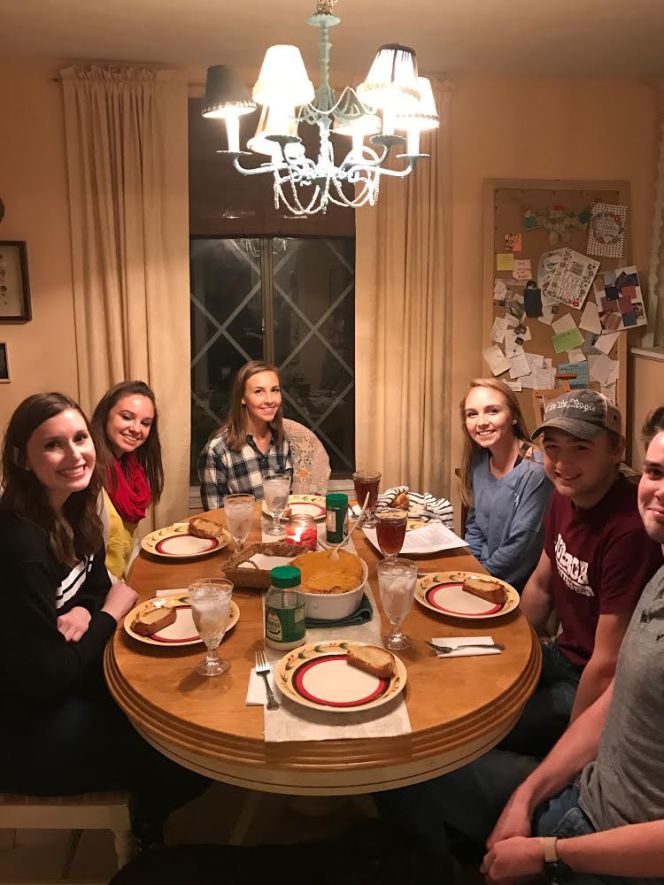
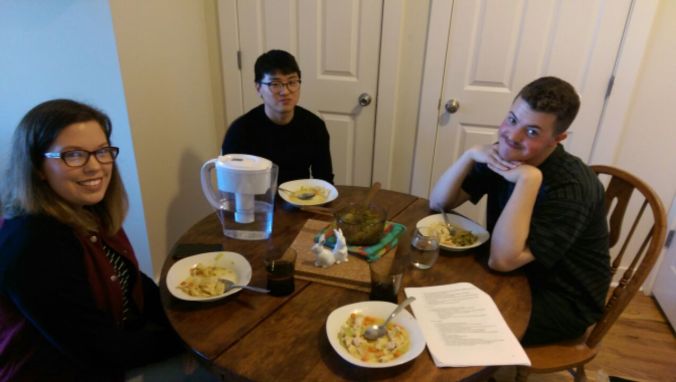
This dinner took place in Bowling Green, Kentucky at my German Professors house. For dinner, Laura provided the schnitzel, salad and potatoes, but we had to cook them together in small groups. I did, however, bring chocolate as a gift to Laura for hosting this dinner, and Alex brought two pies as dessert. The dinner was attended by Laura, Heike, Julia, Alex, Ryan, Carlos, Maggie, Eric, Jack and I. Laura is my German professor and the department head of modern languages at Western Kentucky University. Heike is an English teacher from Germany who had come over with her students to Bowling Green for a few weeks. Julia is an instructor of Russian at Western Kentucky University. My classmates are of a diverse background as well. Carlos is a Mexican-American from Indiana who is studying mechanical engineering and German, and Maggie is a Chinese-American who is studying German and Chinese in order to be a translator after college. Ryan is studying German and Computer Science, and Alex is studying German and International Business. Erin is studying German and International Business, and Eric is studying Architecture and German. Jack is also studying German, and he recently came back from a semester in Germany. I myself am studying German and Geography. Since nearly everyone at the kitchen table had several years’ worth of experience with German, one of the topics that often came up in our dinner discussion was the difference between citizenship and politics in both the United States and Germany.

As we initially sat down for dinner, the table was relatively quiet. Eric was the first to bring up recent news to the dinner table, speaking about a recent political move made by President Trump to build the wall between the United States and Mexico. There was a shared sentiment of disapproval about Trump’s actions in the White House at the dinner table; however, Carlos, being Mexican-American, quickly called out the absurdity of the plan, noting that the proposal of building a wall between the United States and Mexico was not American. At this point, I thought it would be an appropriate time to ask everyone what it meant to be American. Everyone there had a different idea of citizenship, but there were recurring themes of opportunity and egalitarianism throughout each person’s opinion. Carlos held the belief that being a citizen entailed having the opportunity to speak and move freely and the right to pursue happiness by one’s own accord. He particularly emphasized examples in history of the importance of the right to pursue happiness, such as Mexicans immigrating to the United States to work so that they could better support their families. I supported this notion by stating that many of the anti-immigrant sentiments in the United States are based on scapegoating when in reality Latin American immigrants often work jobs that the typical person in the United States would refuse to. Ryan iterated that the United States was founded on the ideals of living one’s life the way they choose to, though he also added that the United States has an interesting quality regarding citizenship compared to the rest of the western world. It was his belief that the United States was the most individualistic western country, and that this affects how many citizens of the United States see themselves as Americans. Afterwards, Heike added to the topic, mentioning how a more collectivist attitude towards social issues exists in Germany and the rest of Western Europe. This means that while there are more government laws for assisting people, there is also more order and less free speech due to Germany’s troubled past.

The conversation shifted towards politics after talking about citizenship, as Jack recalled the current widespread malcontent with politicians currently. This brought the wide spectrum of political beliefs present in the United States to the dinner table. Virtually everyone at the table was disappointed with the current administration in a multitude of ways, which I didn’t find too surprising honestly. It did, however, become more interesting when Alex brought up the cause of the election’s results. He mentioned that the divide between rural and urban America has stratified our country, and that to move forwards the nation would have to first take an introspective look as to how we are all united as Americans, rather than divided. In agreement I replied that there appeared to be more challenging economic problems in areas like Appalachia and the Rust Belt, which a person living in an urban area would not understand. Jack noted that living in general has become more expensive, and that many well-paying jobs that once existed in rural areas are now gone. As we were all sitting at the table and pondering the situation, Ryan said that while the situation regarding work and economic prosperity looks somewhat grim at the moment, the same situation of a debilitated economy has happened several times before in the United States history, and that the tough conditions facing Americans today would, in some form or another, be overcome. The dinner was over shortly afterwards, though there were a few additional discussion topics that I felt taught me.

There were a few highlights from the night that I feel are worth mentioning in greater detail. My German professor, Laura, made an excellent point as to how the education system has evolved over the past fifty years. Where the University experience was once far more academic in nature, it has become more similar to a business model, since Universities now compete to get the best students by having the most amenities and accreditation. This, she noted, has heavily increased the cost of college, along with the increased need for a post-secondary education to obtain a fair-paying job. Many well-paying industrial jobs that one could obtain once they were finished with school are now gone, and the United States economy is increasingly based on service jobs, which are either minimum wage jobs or professional jobs. An important perspective on citizenship in different cultures came from Maggie, as she shared her opinion on the differences between Chinese and American culture. She remarked that there’s a higher sense of duty to one’s family in China than in the United States, and that this sense of duty will often manifest itself when decisions for the children are made. Parents are willing to sacrifice much of their own happiness for the sake of their child’s future. This resonated with me, as I had never heard a firsthand account of what life is like in China, where the cultural values are fairly different than in the United States. A final point that I found intriguing, though not in the main discussion around the dinner table, was a point brought up between Julia and Ryan, as they discussed learning Russian. Everyone at the table knew German to some degree, but Russian was familiar only to the two. It became very interesting as they talked about the varying contexts between Russian and German, agreeing that Russian is a higher-context language than German, which meant that the language is worded more implicitly. Although this small section of conversation wasn’t related to the rest of the discussion about citizenship and politics, I found it to be interesting on a more personal level, since I never really examined languages outside of my native English and German.

Of all the subjects we talked about in class, this dinner most reminded of the readings on global warming. Everyone at the table agreed that there were new political and social issues facing the world, but everyone seemed to have a different solution – or lack thereof – for the problem. The instructors, Laura, Julia, and Heike all seemed to agree that learning a second language is an important avenue towards higher intercultural sensitivity, which is important for citizenship in the 21st century. The other students and I had varying opinions on the meaning of citizenship in our modern world.  I, like Michael Pollan, admittedly had the bleakest outlook on the future. I feared that the world was going to be increasingly put under pressure by corrupt government and corporate rule which would limit our freedoms and force a more totalitarian system upon us. In short, I found that any good we could do as active citizens would be mitigated by forces on a larger scale. The other people attending the dinner, however, were not as cynical as I was. They came to a general consensus that through active citizenship and critical thinking, this generation would be able to overcome the pitfalls that impeded progress in the last two. One of the bigger ideas in class I feel this dinner alluded to was one of the three main questions: “How can we have more say over our own lives?” It seemed as though most of the conversation revolved around plans for the future and current global issues, with a heavy emphasis placed on what may happen to the world in the near future. While we couldn’t come to a conclusion as to what the future held, I think everyone at the table enjoyed the dinner and the conversation that came with it on this night.

The One With the Baked Spaghetti

By Elizabeth

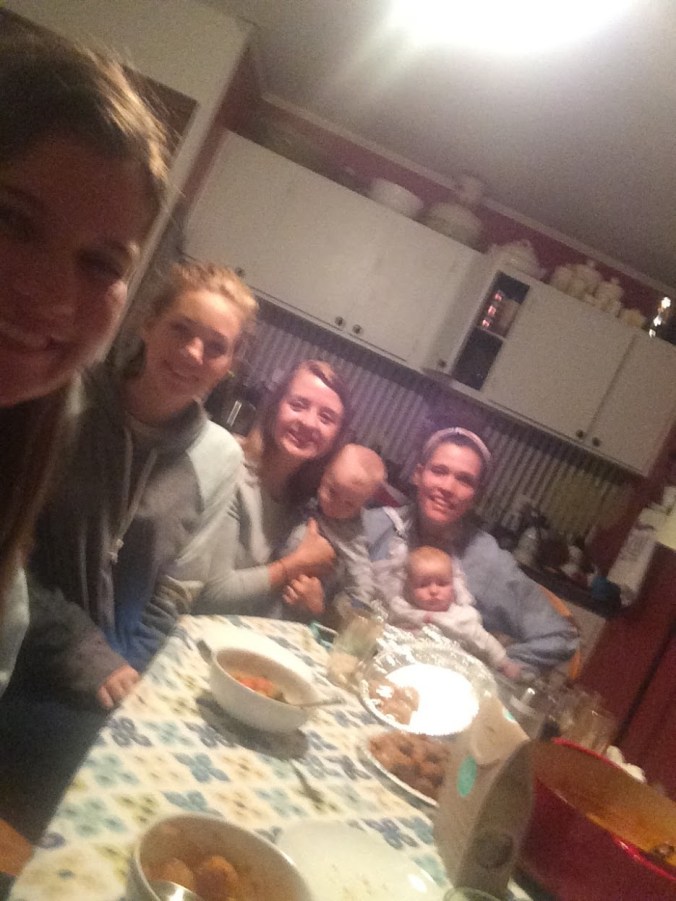
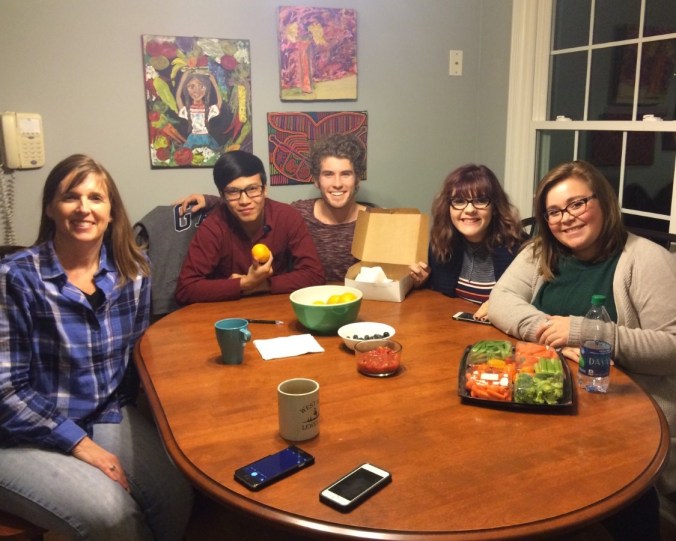
unnamedMy Kentucky Kitchen Table was held at my house, and five other people joined me. Caroline goes to Murray State University full time and works two jobs to help her save for an upcoming trip to Spain (she is majoring in Spanish and can speak the language very well). She recently went on a trip to London. She is very open about her faith and religious beliefs and found a way to apply those beliefs to our conversations. Sarah, friends with Caroline, also goes to Murray State University. She is running for an office in her sorority and wants to be a teacher. David is a few years older than the rest of us and was born in Japan, but grew up in Alaska and moved to the continental U.S. in high school. He added a very interesting perspective to conversations we had about communities, citizenship, and social issues because of his diverse background. Kennedy just moved to the area from Illinois, and she was quite a bit older as well. She was the comic among the six of us and loved to delve into the minor differences between Kentuckians and Illinoisians that she has picked up once since her move. Hunter, my boyfriend, joined me as well. He is a sophomore at Western Kentucky University and hopes to be an anesthesiologist. He took a more straightforward approach to topics we discussed and easily tied our ideas together.
We began our dinner of homemade baked spaghetti by talking about what it meant to be a citizen or to have citizenship. David noted that what came to his mind was his dual citizenship in the U.S. and Japan. His citizenship gave him rights in his countries of citizenship, and he felt like he should take advantage of those rights in order to be an active citizen. Kennedy shared that she thought citizenship was also about the impact that you make personally in the lives of people in your community or nation. She is a social work major and said she hopes to make a difference and be a better citizen. This led us to talk about the obligations that we felt like we had in our country and if we thought our jobs served a greater purpose.

Kennedy currently does not work, but thinking of her future career as a social worker, she said it was really clear to her that her job served a greater purpose because she would be helping people who otherwise wouldn’t have been helped in that particular way. Hunter, also currently unemployed, mentioned that he felt obligated to help people and to become a doctor because that field of study is what he is good at. I asked him if he felt like other people are obligated to help others by doing what they are good at. He said he thought the world would be a better place if they were, but he felt obligated in that way because of his religious beliefs and understood that not everyone believed the same things that he did. Sarah is a tutor as MSU and helps a number of students with disabilities. She said she hopes she is making an impact on them and encouraging them to make impacts on others. Caroline said that working in a jewelry store allowed her to help people find pieces for very important moments in their lives. She shared a story of a woman coming in to find something for her adopted daughter because her biological father passed away. It was clearly a tricky situation, she said, but she found the perfect bracelet that came with a card explaining the bracelet’s meaning. A few days later, the woman came back in to thank Caroline and told her that her daughter teared up and promised to keep the sentimental piece forever.

Caroline’s anecdote challenged us to think about the little things, like a bracelet, and how we could replicate something that meaningful with our actions in order to solve problems. Hunter argued that small actions won’t fix big problems. He explained that our country needed to think big to solve problems, and that is why he supports our military so much. Kennedy expressed that small actions may not resolve war, but it can bring communities together. I supported her statement with a story of my own about a series of break-ins in my neighborhood. Several families came together to support the ones that had suffered damages or emotional distress. Several men volunteered to camp out to catch the individual, which resulted in the arrest of a man a few nights later.

Our discussion led us to share what were the social issues nearest to our hearts. Sarah shared that the education system has so many flaws and she wishes she could do something to change it because she will soon hate administering standardized tests when she becomes a teacher. She explained she believes standardized tests standardize students. David explained that veterans make up a significant portion of suicides and homeless people every year, which bothers him because his father is a veteran. Caroline told us about a project she did over homelessness that taught her that most homeless people aren’t homeless for any reason that they could have prevented. She went on further and eventually changed all of our perspectives on the issue of homelessness.

My Kentucky Kitchen Table experience reminded me of Paying for the Party because we all had different levels of wealth or different kinds of families, which led us to have different beliefs. We were in a way different from Paying for the Party: we did not let that get in our way of “deliberating” our ways of thinking. The Kentucky Kitchen Table project reminded me of the choreographer in the “Shipyard Project.” It was a medium to bring us together and share experiences, similar to the people sharing their past at the shipyard.

By the end of dinner, I learned that each and every person I was with wanted to move from one end of their own bridge to another. We all had different opinions on the best way to solve problems, and I wondered if our diverse problem-solving strategies were a good thing or not. Should we all work to make the world a better place however we see  fit, or should we discuss and be on the same page when tackling problems? My perspectives definitely changed on many topics, from whether or not a jewelry store is making a difference, or whether or not we should we blame homeless people for putting themselves in a homeless situation. My definition of citizenship did not change, but I was happy to hear other perspectives. Because we all shared our opinions  honestly and openly, we all agreed our perspectives changed even if our opinions did not.

Kentucky Kitchen Table

By Lily

When I moved to Bowling Green for school my old youth pastor texted me. He reminded me his ex-girlfriend Paige lives here if I ever need anything. She sent me a similar message. They dated when I was in eighth grade and she was a junior at WKU. When she was in town she worked with my youth group and stayed the night at my house in Lexington a few times. She was an amazing role model as she clearly loved the Lord with her whole heart and I was overjoyed to have the chance to reconnect with her. When the Kentucky Kitchen Table project was assigned I knew I did not want to go home nor do the project with my friend group and a class mate’s. So, I opted for the host home option but when I found out host homes were sparse I remembered Paige. Before Paige could confirm dinner plans two girls from the other class, Lexi and Merritt, were assigned to the kitchen table I was supposed to be providing. Paige explained that while it would be hard to set up a dinner she may be able to work something out with her friend Jessie. By the time we finally had a date set Lexi decided to do the project at home.
Merritt and I arrived in the neighborhood at about the same time. We met for the first time outside searching for Jessie’s house. Paige welcomed us in and explained the situation to Merritt; she, her son Bo, her husband Eric, Jessie, Jessie’s daughter Lucy, and Jessie’s husband Joel would all be moving to Turkey within the year so they were staying together while Eric and Joel were in Turkey at a training. Paige was simultaneously caring for her baby boy, Jessie’s baby girl, and cooking dinner. Jessie was out taking a meal to some international friends of hers. We offered and brought dessert and while she was very appreciative Paige explained that they have guests over so often they were drowning in food to offer us instead. She and Jessie suggested we take our dessert and share it with people on campus as an outreach to build community.

We sat down and began getting to know each other before we discussed anything related to the course. Paige is great with teenagers and people in general so although she is in a completely different stage of life than us our conversation was fluid. We took turns explaining different parts of our lives. Merritt talked about her upbringing with two brothers and two loving while protective parents. She went to an all-girls Catholic high school in Louisville. She is now participating in Greek life just like her mother and father were when they were in college. She also mentioned her family’s fondness of sports. Paige talked about her hometown only thirty minutes away from Bowling Green. She talked about how she met my old youth pastor and now her marriage to Eric. All the while being interrupted by babies, cooking and eventually Jessie returning home. Jessie talked about her job on campus at WKU where she and her husband are leaders at the Baptist Student Ministry. She related her work to Merritt’s sorority involvement and asked if Merritt had heard of a famous speaker. The woman used to find her identity in her sorority but once she graduated she did not know what to do. She ended up finding the Lord and speaking at sororities across the United states. Jessie talked about her impact on her after listening and her potential impact on so many more people.
When they were both home and sitting at the table they started explaining their impending move to Turkey. They will start working as missionaries for the International Mission Board with their families. They talked about short mission trips to Turkey they had each taken years prior. There was a specific unreached people group they wanted to reach-out to but they were going to have to enter the country and live in Istanbul for a while before they could. Their plan is to live in Istanbul learning Turkish for three years until it would make more sense to move to the part of Turkey they want to reach. At that point they would have to begin learning another new language, that of the Zazas. It was incredible to hear their long-term mind-set. The two had lived together before and were in it for the long-haul planning to live together again in Turkey. The two shared how they met at a church that outreaches to the housing projects in Bowling Green and had lived together before. God was working in their lives even then. Paige and her husband knew the neighborhood they wanted to live in and there was only one home available. When Jessie got married a few months later she and her husband wanted to live in the same neighborhood but no houses were available. The house was too big for the young couple but it worked out perfectly so Jessie and her husband could sublease with Paige and her husband.
Afterward, we began discussing what it means to be a citizen. Jessie talked about how she had never really considered it before. She said she did not value her citizenship as much as she should especially because in the United States we are awarded many more rights than other countries offer. Specifically as a woman she spoke of being very grateful for the society and country we live in. Paige agreed and they both talked about their citizenship in heaven. I was very interested in their perspective since they will soon be changing their citizenship. But they explained their earthly citizenship to no matter which country means little in comparison to their home in God’s house. They both are very thankful for their citizenship though. They feel a responsibility to support their governments and fellow citizens as Americans and as Christians. Merritt talked about how she had also never really considered her citizenship before this course. She explained that now that she can vote she is beginning to think about and learn more about government and how she can contribute to it. At dinner I was reminded of poverty and service, empathy, and learning from others weeks as a lot of our conversation was about how to live well with others.
When 7 o’clock rolled around so did the children’s bed time. We were welcomed back anytime and we all departed smiling and grateful.
I was very grateful to have learned from each of the beautiful people I had dinner with. I learned hospitality and outreach, a care for the people around me and a care for people around the world. I learned immediate love and long-term appreciation for people, respect for parents and affection for siblings and friends. I learned gentle peace and ambition, duty and perspective. I am very thankful for our dinner and our conversation. I am thankful for the chance to learn and connect with a peer I might never have met as well as citizens of Bowling Green in a different stage of life. I was really blessed by this experience and hope to continue my relationships with each of these ladies.

kkt

Where Love Resides

By Brent

My Kentucky Kitchen Table project provided me a way to feel more connected to Bowling Green and get closer to a few of my peers, as well as fellow citizens. For our project, Hillary, Rachel, and I went over to Jennifer’s house for dinner. I also brought a friend, named Tan, who is from Vietnam and is studying at WKU. Our conversation lasted for about three hours and felt unexpectedly natural. No conversation topic felt like it was off limits. 
My partners for this project were phenomenal. When you first meet Hillary, you know that above all, she cares. She cares about how you are and what you believe in. She is naturally inquisitive and passionate. Her love for art and beauty is apparent in the way she lives and it rubs off on the people that she meets. Rachel, an English literature major, has a way with words and her humor is not only witty, but it is insightful as well. She tells a story of love and she preaches equality by her actions. Jennifer is a compassionate soul who lives intentionally and spends her time doing what she loves, which is pouring into the lives of immigrants and Refugees in the greater Bowling Green area. She is a mother, a wife, and a devoted member of society. She asks deep questions and listens with intention. She loves others with few bounds and is an inspiration to many. Tan is an inquisitive and passionate man. His self-prescribed nickname, “Crazy,” fits him well only because he is willing to take big risks and is able to overcome his fears very quickly. Tan has enjoyed the United States very much and hopes to get a business degree in order to start his own business when he returns to Vietnam.  
Our conversation went down many different paths. We began by answering what we thought it meant to be a citizen. Generally, we all agreed that being a good citizen means being involved with as many different types of people and groups as possible. As citizens, it is our job not to run away when things get hard. We are supposed to join together and use our voice to support our beliefs and lift other people up. I really liked Jennifer’s perspective on her life as a citizen because she focused on ways that she sees herself training her two boys on how to be good people and citizens. She also mentioned that being around like-minded people can be a good place to brainstorm, but, in the end, it is better to put yourself out into the world in order to gain a bigger perspective on what it means to live well with others.  
We also talked about the role that loving people plays in being a bigger part of society. We mentioned many simple acts, like being kind to a cashier or being patient at the DMV that go a long way. We all tell a story with the way we live our lives and it is important that that story builds other people up and recognizes everyone’s humanity. We decided that it is important to be humble and recognize that we will never know anyone’s full story. For example, we don’t know what it is like to be born into a country that has been in civil war for over eighty years. We don’t understand the hate that many immigrants and refugees face. So, rather than letting those differences scare us, it is important to face them fiercely and fight for equity.  
I learned a lot from our conversation, but I would say that my biggest takeaway was that it is important for me to meet people who are starkly different from me and be in community with them. I have so much to learn from other people, and I will never be done learning. We talked a lot about how having a face to put to an issue can be powerful for a lot of people. For example, if you have a friend that is a refugee or immigrant, you will naturally want to support laws and legislation that will protect their rights. I also think that I have a responsibility to make sure that more people reach out into the community to make those sorts of personal connection with people who are different from them.  
I also learned from Tan as I watched him interact with the difficult and theoretical conversations we were having. While he didn’t understand all of what we were saying, or why we were saying it, he knew it meant a lot to us and he respected that very much. I was humbled by his willingness to want to learn about other cultures and hear about how people see things like the recent election or holidays. I learned from him that listening is a gift and taking a risk in order connect with people is always worth it, at least for the experience.  
I think that our dinner and this project relate to our class in a few ways. Primarily, I saw that most of our conversation had to do with the idea of a crossing a bridge. We talked about how things are and where we want them to be, but most importantly, ways we thought we could get there. For example, we talked about how communities often respond to tragedy by throwing money and resources at a given problem. This raises issues because it leaves people disconnected and removed from the deeper causes that might be contributing the problems. We decided we wanted communities to be more involved so that when something happens, people know the needs of the victims they are helping and have an idea what their life is like prior to whatever incident might take place. Additionally, we mentioned that people have to become more connected with others who are different from them, spend time in the community, and break down stereotypes. This seems like a lot to ask, but it has to happen for us to be able to move forward as a society. I think that another way our conversation connected to the course was that we talked about how the power of patience is necessary to solve all of the issues we wanted to tackle. It was evident that Jennifer is an extremely patient person and her loves shine through in that way. She will wait on the phone for translators and lawyers to make sure that her friends, many of whom are refugees, aren’t getting taken advantage of and are getting the care and support they deserve. Even during out meal, she was checking up on a friend who was in the hospital for having an appendix removed. I think that, through her, I see how being patient is an act of love, and love makes us the best citizens that we can be. Overall, the experience allowed me to understand the importance of talking about change with people in the community because it made me feel like I had more people on my team and are willing to fight alongside me for what we believe is right.
thumbnail_img_2104

A Lesson on Engagement, Connection, and Planning

By Rachael

thumbnail_img_2104

Disclaimer: we almost forgot to take a photo, so there was much more food prior to consumption and clean-up. But the modeling of the pie and fruit by Brent and Tan is much better than the table full of food would’ve been anyway.

So because I am from Bowling Green, I originally planned to do my Kentucky Kitchen Table here with family and a few friends or distant relatives for diversity sake. However, that plan went awry. I won’t bore you with all the details (because they are boring and quite anticlimactic), but I ended up rather late in the game without a table. Luckily for me, I’ve met some really wonderful people in this class (looking at you Hilarie and Brent), and they kindly let me crash their dinner. And even though it was very last minute and totally not my plan, as is often the case, the spontaneity and the detour made it all the better.

I’ll get to all that good stuff in a moment, but first, an introduction. As implied by the term “crash,” I did not go in knowing who all would be attending this little soiree. (Just kidding, I looked up that word so I could see how to spell it, and it’s defined as a “fancy evening affair”; our evening was neither fancy nor grand enough to be called an “affair,” but nevertheless.) I obviously knew Hilarie and Brent from class: Hilarie from connecting outside of class because of overlapping friends and common interests and Brent from the social issue paper.

However, there was a lot that I didn’t know about them. For starters, Hilarie is a double major and a double minor. Who knew? And also, how impressive is that? Goodness. Hilarie is not much of a pie person; I know this because I brought an apple and a fudge pie (courtesy our great local bakery Riley’s Bakery). Luckily, she does enjoy ice cream (courtesy of our great local ice cream shop, hangout, and farm Chaney’s Dairy Barn), which made me feel better about my experience earlier in the day when I walked out of the shop, alone, with loads of sweets. (Cute.) Other than the pie thing, Hilarie is a girl much after my own heart—a singer, a social justice discusser, a feminist, and a constant thinker—and has so many talents and assets, not the least of which is her incredible brain and the thoughts that come from it. I so enjoyed getting to hear more of her ideas that night. She is also very gifted in choosing (and applying) excellent, bold shades of lipstick and rocking reddish, purpleish, silverish hair like no one else I’ve seen. She is also a great balance to my proclivity for sweets; she provided our table with homemade organic turkey sandwiches and a veggie tray. Hilarie is a small-town girl (Middlesboro, Kentucky being that exact small town) with pride and purpose because of her roots. If I could pick a few people who I’d like to mold myself after to be when I grow up, Hilarie would be one of those people.

Next is Brent. Brent has ferociously curly hair, which he just cut much shorter right before our dinner! (It looks very nice, Brent; don’t feel sad.) Brent is a Nursing major, something I had either known and forgotten or had never known at all; either way, I am fascinated and extremely impressed. He aspires to one day be part of Doctors Without Borders—color me more impressed. Brent also deeply enjoys chocolate pie, which is why we had fudge pie…also just because fudge pie is delicious. Brent and I have a very fun friendship, in which he makes jokes that I don’t get until later and irks me by “playing” sexist. Hilarious. In return, I like to step on his masculinity by constantly asserting myself in the conversation, laugh too hard at my own jokes, and tell him that no, he could not be on SNL. (Sorry, buddy.) Brent is from Nashville, Tennessee and spent this past summer in Taiwan—another surprise! He is a talented thinker, compassionate human, and I enjoyed hearing his insights and learning more about him at dinner. If I could pick a few people to model my hair after, Brent would be one of those people.

Brent brought along his friend Tan, who is an international student from Vietnam. He is 22 years old, has gorgeous, thick, jet-black hair, and you pronounce his name “Tahn.” He speaks extremely good English (a million times better than my Vietnamese would be, goodness); he is an interesting person outside of how well he speaks (I will get to this momentarily), but I just think it’s really impressive and something we take for granted, as most of us never have to/want to really learn another language. Tan is currently working on his English so that he can pursue a degree in Business. He originally wanted to be a Math teacher because he really enjoys the subject, but he has since changed his mind and decided he wants to pursue business, which, coincidentally, is what both of his parents do. He said he would still like to be able to teach at some point but for the moment is really interested in learning business, working for a company, and eventually starting his own business.

Tan is a pretty quiet guy, or at least was this evening; I suppose it’s a little silly of me to assume one night is the epitome of what a person is. (From some of the nights I’ve had, I would really hope that’s not the case.) Tan was really interested in the number of holidays here and the ways in which we celebrate them. He asked a lot of questions about Thanksgiving and told us that in his country they really only celebrate New Year and even that is different because it’s celebrated in February. I asked him what his parents thought of him coming over here and he said they were very worried about him changing a lot or being corrupted somehow, but that they spoke every day—despite the 11 hour time difference. Tan’s curiosity, bright smile, and eagerness to learn are infectious, and his presence was a real asset at the table.

And finally, there was Jen. Jen was our host for the evening who provided the cozy environment and necessary kitchen table. Jen is a social justice warrior who would never call herself that. Jen works and fights for people. Period. She works very closely with the refugees in Bowling Green in numerous capacities. One of my favorite moments of the evening was Jen talking about “doing good” without doing it for praise or even “because it’s the right thing to do”; for her “doing good” is just basic humanity and shouldn’t have any further thought; it should just be inherent. And I really loved this concept of thoughtful actions done thoughtlessly. I’d never framed it that way, and it was something really special.

Jen was born just outside of Philly and has lived many places, including Texas where one of her boys was born, much to her chagrin. Jen is married to a Political Science professor at WKU, and they have two children—one of whom is in Gatton Academy here. Jen was also a Political Science major in college but has pursued many different careers throughout her 40 some-odd-long life. She is currently working for Pearson as a writer and editor—something very much after my own heart. Jen is an incredibly intelligent, kind without agenda, and insightful beyond what a three-hour long dinner conversation could fully display.

As I am typing this out, I realize I am over 1100 words in and just finishing my “introduction.” And I am chuckling to myself at a couple of things. One, it’s hilarious how much I can pour into something when I’m not even trying to. And two, in direct relation to one, I didn’t even have to think about all the stuff I’ve written. I just remembered it. I have roughly an hour and a half of recordings from that night (I didn’t record our whole conversation because we would shuffle to get tea or something), but I have yet to refer to them once. I’m amazed and stunned at what I can remember when I’m actually listening, when I create an intention behind my listening, when my listening has motivation. This is also sad, obviously, that a looming grade is what has to pressure me to actively engage. And not even engage in conversation by speaking myself but simply by engaging my listening. There’s such a difference there: between being present for a conversation and being actively engaged in it; neither of those options require you to speak, but the first you could so easily not actually be present or engaged.

And I think, because of all this self-revelation I’m having in the moment, that that’s one of my biggest take-aways from this experience: just what it means to listen and to engage. I thought I was good at that already, but seeing how much I can pour out now simply because I was a willing, engaged vessel then shows me that there’s so much I miss. Maybe I already knew that Hilarie had two majors and two minors. Maybe I already knew that Brent was a Nursing major. Maybe I didn’t know either of those things. And that’s not my point. I’m just sort of here typing this, looking somewhat deranged I’m sure, nodding to myself and marveling at how much I would’ve missed if I hadn’t been actively involved that night—if I’d been on my phone or hyper-aware of the time or just unfocused. And what I’m realizing right now is just how powerful that engagement, that listening, is—in all situations. Think of how much smoother and more intelligently our political debates (among politicians and among ourselves) would go! Think of how much harder it would be to dismiss, dislike, or even hate people if we listened first—if we were actively engaged in hearing others. What would that look like?

This is something we even talked about a lot during our time together, but it’s just so moving right now as I sit here and reflect on how much I know about these strangers and semi-acquaintances, on how connected to them I feel now. What if that kind of connection could extend to all people? To the refugees who Jen works so closely with? To the homeless person on the corner? To the girl who sits next to you in class? What if we defaulted to connection, humanity, and engagement? What would our world look like?

And I really thought I would go into all the political conversation and the stories about the refugees Jen told us and how we each described what citizenship means to us, but I’m realizing that like my first plan for this project, that plan for this post needs to change. Because yes, we did have very cool, like-minded conversation about politics in America and the beauty in telling stories and how we all knew this was like-minded political conversation and that the real conversation and engagement needed to happen with people outside of this table and mindset. We had three hours of really cool, smart story swapping and idea sharing. But it was the actual engagement—the sitting down at the kitchen table, totally disarmed, drinking tea, just chatting, and listening—that was the most powerful and important for me. And that’s what is going to make this experience one of my, unexpectedly, best nights of the semester and moments of this course. (Cheesy, cheesy, cheesy, but genuine.)

So, all that said, I’ll just wrap up with some “thank you’s.” Thank you to the darling Hilarie and Brent. Thank you for letting me crash your evening. Thank you for being open and sharing your passions. Thank you, Tan, for coming to a random event and for sharing your experience with us. Thank you for coming to WKU and for being brave enough to take on our crazy, scary, awesome America all by yourself. Thank you, Jen, for being so gracious and for being such a warrior for people—because it should be our default setting to help, and it should be something done without fanfare. And thank you, Dr. Gish, for making this experience happen by assigning this project. I am a vocal and open but quite introverted person and would never have done this had it not been for this assignment. And I’m so glad I got to! So yeah, thank you to everyone for just giving me a chance to engage and remember what it’s like to be at peace in the midst of spontaneity. Thank you all for reminding me that fresh plans are often so much better than “planned” plans. (So much cheese.) (So much sincerity.)

Kentucky’s Kitchen Table- Learning to be Inclusive

By Katie

Citizenship means different things to all people depending on their background and upbringing. For this Kentucky Kitchen Table project, my friend Kenoa and I were able to have dinner around a kitchen table which held people from all different walks of life. The hosts were Dick and Cindy, an older couple, in their eighties, that attend that same church as Kenoa and me. Dick and Cindy are American but spent most of their lives serving Christ overseas, Dick in Pakistan and Cindy in different countries in Africa. They now live in Bowling Green serving international populations here. Also at the table was Jessie, one of Dick and Cindy’s neighbors. Joel, Jessie’s husband is currently in Turkey at a conference. Joel and Jessie are preparing to move to Turkey to do missions. Because of this and because of Dick and Cindy’s extensive overseas experience, they had the idea to have Turkish breakfast for our dinner. Since most of us had no knowledge of authentic Turkish food, Dick and Cindy told us a list of things we could bring (bread, eggs, butter, olives, feta cheese, etc.) and we all chose something from the list and brought it.

Another guest at the table was Douda, a student at WKU and the son of two Liberian refugees. He is a friend of Joel and Jessie’s. His experiences with citizenship were enlightening and very different from everyone else’s at the table. He brought to the table very diverse experiences with culture and upbringing. Mary Lou, a WKU faculty member, was also an attendee at the dinner. She works at the International Enrollment Office on campus where she assists our very large number of international students. She has lived in America for almost her entire life but is originally Colombian. Mary Lou and Douda had very interesting cultural experiences. Mary Lou feels that her job really does a lot in serving a greater purpose in the world because she helps international students get involved on campus which is often difficult for them to do. Mary Lou defines citizenship as being involved in a community, and that is exactly what she helps international students do.

Other students who attended include Macy, a student worker in the international enrollment office and Kathleen, a graduate student at WKU studying math. They had very interesting perspectives to bring to the table. Macy spent this past summer volunteering at a refugee camp in Greece. Through this, she gained insight into what life is like for people who don’t have a place they feel they belong. Citizenship and democracy feel very different to someone who spent their whole summer in a place absent of these two concepts. Alex, another resident of Bowling Green and friend of Dick and Cindy’s also attended the dinner. He was born in a small town in Lexington, KY where he was homeschooled before coming to college. This caused him to have an interesting concept of citizenship and inclusion.

Citizenship took on very different meanings to everyone around the table: safety, community, inclusion. Dick and Cindy spoke of their time serving on mission overseas and the way the community was different in the places they served. Cindy expressed that while serving in Africa, she felt like more of a “true citizen” than she does sometimes in America. She believes this is because of the closeness of community in the small villages in which she served. Dick thinks that citizenship represents being there for one another and helping each other out. He stated, sadly, that he feels Americans sometimes forget that as the meaning of citizenship. We focus too much on our responsibilities as citizens instead of what we can do to make each other’s lives better.

Douda and Mary Lou had similar definitions of citizenship, as far as what it’s like coming from a different country or gaining American citizenship. Coming from an oppressed family, Douda equated citizenship with safety. Douda and Mary Lou emphasized the importance of the people in America who reached out to their families and made them feel welcome. They found that reaching out to people and making their transitions easier is a big part of what makes a community. Macy agreed wholeheartedly with what they were saying, especially considering her heart for refugees. She believes it is a gift and a passion of hers to make refugees feel that they are at home in America. To them, this doesn’t necessarily mean just gaining American citizenship and the rights to do things most citizens can, but it means being included by Americans and being shown different American customs and ways of life. Dick and Cindy were those people for Mary Lou and Joel and Jessie were those people for Douda so it was a great experience to be able to see those relationships come full circle.

Coming from a white, middle class family who has been exposed to very little oppression and exclusion, it was a very eye-opening experience to be able to see the way people go through the journey of feeling like a citizen in America. I have only had one experience overseas and that was last December when I went to Haiti. During that week, I experienced more feelings of not belonging than I ever have before and got to understand a little bit of how it feels to know you don’t fit in culturally or racially. Now, hearing Douda and Mary Lou’s stories, I think back on the kids in Haiti yelling “Blanc, blanc!” as we drove by and do not by any means equate those stories because the minimal exclusion I felt is monumentally smaller than anything they and their families have felt. However, I am glad I got the opportunity to hear their stories and hear everyone else describe their experience with citizenship. Because of this experience, I believe I am more educated and aware of ways I can become a better citizen here in Bowling Green. By going out of my way to be inclusive and empathetic toward those around me, I will be bettering the community by creating a more loving environment in which we can all live better together in unity.

Kentucky Kitchen Table

By Kenoa

When this project was assigned, my immediate thought was that I would complete this assignment in my hometown because I would be more comfortable there. However, after some thought, I realized the potential this project had. Some of my fondest family memories are of all of the many times my big, loud, family has been talking, laughing, and, most importantly, eating around our kitchen table. Bowling Green is going to be my home away from home for the remainder of my college career so I thought getting together with people I know and people I do not it the best way to create lasting memories and meaningful relationships with the people I will be around for a few more years. I got together with my friend Katie and hosted a Kentucky Kitchen Table here in Bowling Green at the home of a couple from my church and invited other members we did not know well and some neighbors of the couple.

Dick and Cindy are an older couple- in their eighties- that attends the same church as Katie and I. Dick spent most of his life living as a missionary in Pakistan and Cindy was a missionary in various countries in Africa. The couple was brought together by their faith and they both see this as the most important thing about them. Now they spend their days getting to know the local international population in Bowling Green and guiding other couples that feel called to move overseas for mission work. After reading this about them, it may come as no surprise that for dinner we had an authentic Turkish meal prepared by Dick and Cindy. It is obvious that their past experiences still hold a major influence on their life and they love to share stories about their time overseas. In some of the pictures, you can see everyone cracking their boiled eggs in the traditional Turkish way.

Jessie, a neighbor of Dick and Cindy, also attended with her new baby Lucy Mae. Her and her husband Joel are a young couple that Dick and Cindy help mentor because they are preparing to move to overseas in the near future.

Douda is the son of refugee parents originally from Liberia that is a friend of Jessie and Joel. It was interesting to have his point- of- view in the conversation because he has had a very different cultural experience than most of the people at the dinner and he has also had a different experience with citizenship in general. He is a student at WKU.

Mary Lou is a faculty member at WKU that attended. She spends her days in the international enrollment office, helping international students on campus. She is originally from Columbia but has lived in America for most of her life. This, once again, offered an interesting point of view to the conversation as Mary Lou has experienced citizenship in two countries as well.

Mary Lou brought along one of her student workers, Macy. Macy is from Louisville and is about to graduate from WKU. She recently studied abroad in Spain and spent a summer in Greece volunteering at a refugee camp and plans to work with refugees in some way after graduation.

Lastly, Alex is a recent graduate of WKU engineering department that currently works for a concrete mixing company in Bowling Green. He comes from a small town outside of Lexington, KY and was homeschooled growing up so the move to Bowling Green was a big transition for him.

The many different backgrounds and stages in life represented around this one table led to some good conversation with different ways of thinking presented. We started the conversation by simply asking everyone what citizenship meant to them. To Douda, citizenship represented safety. When he was a child, the corrupt government in his home country oppressed his family and he said he never felt much like a citizen, but becoming an American citizen gave him the opportunity to feel like he was a part of something bigger. On the other hand, Cindy felt more like a true citizen while she was in Africa. She remembers the importance of community in the small tribal villages she lived in and how this contributed to everyone feeling like a citizen. Dick agreed that, these days, Americans place more emphasis on the duties of citizenship, such as voting, and forget that citizenship includes helping each other out and instilling a sense of community locally as well as on a bigger scale. This stood out to me because this is something that has been so important in this class all semester. In order to create this sense of community we must put into practice things that we have been discussing- empathy for example.

Macy remembers studying in Spain and feeling like an outsider and believes this is what led her to want to help refugees get accustomed to life in America without feeling alone. Her experiences have shown that most refugees that become citizens participate in things like voting and paying taxes but do not truly feel like an American citizen until they have been included by an American family and have American friends to “show them the ropes.” Douda and Mary Lou both agreed that the Americans who reached out to them are the people who impacted their transition to a new country the most.

This discussion and hearing the stories from the people around the table that were from a different country or had a lot of experience abroad really opened my eyes to ways that I could be a more productive citizen in the community of Bowling Green. I kept thinking of the empathy readings and it reminded me to not just feel sorry for new citizens but to welcome them into this new, scary place and help them understand what it means to be a citizen. At the same time, this can introduce a wicked problem because some families are helped in a way that causes them to not develop a sense of independence. All in all, this Kitchen Table was really eye-opening and I feel like after this project, I am more open to talking about topics that can be seen as difficult with others.

Brian – Kentucky Kitchen Table, Bowling Green, KY (Chinese Flagship House)

By: Brian

Kentucky Kitchen Table Cast and Crew

Kelly- A transfer from Simpson College and sophomore member of the WKU Forensics team. I’ve known her about a month now but we’re not that close.

Austin- My roommate, he is originally from California and is also a member of the Chinese Flagship. I’ve been friends with him since high school.

James- A 26-year-old from California, another transfer student who is a senior here at WKU. James wants to be a speech and debate coach after he graduates and gets his masters degree. He thinks that coaching students to be policymakers will help improve decision-making at all levels of government. The reasons he articulated lined up very nicely with ideas we discuss in class surrounding deliberative democracy. I’ve known him a year.

Abby- an ASL teaching assistant from Texas who is dating James. She’s very active in Baptist Campus Ministries and along with James is very religious. I had never met her before.

Myself- Well, you know me.

Dinner

There was a debate about what the meaning of citizenship was. Most of the debate was based around playing a role in the community outside the government. I talked about how important it is that when abroad you act as a citizen ambassador, specifically as a means of playing the role of American citizen outside the relevant government agencies such as the State Department or Central Intelligence Agency. They don’t want foreign governments targeting you after all. This means being willing to volunteer in foreign countries through little things like spending time with elderly people or introducing children to foreign cultures. James articulated the general understanding of what being a citizen means, specifically with regard to the social contract. He articulated the premise that being a citizen implies that we accept the government’s monopoly on violence and in return we get to feel safe. However, he took it one step further and said that it was more than just about accepting that we can’t take violence into our own hands, he further explained that when the government fails to use that monopoly on power to hold up their end of the bargain, that charges us with the responsibility to pick up the slack. He’s a big fan of Batman and made that pretty clear. In essence, we have to go out and protest abuses of government power and also volunteer where the government isn’t providing. James didn’t have the poetry of Claudia Rankine, but articulated how important it is that as citizens we recognize our privilege in all instances so as to avoid the small moments of racism, whether from ourselves or police officers. After wading through all the references to philosopher’s whose names we didn’t know, we all pretty much agreed with how James saw being a citizen, even if some of us had more faith in working through the government for structural change. Austin has already taken Citizen and Self, so he agreed that citizenship is a function of personal agency outside the realm of government action but added that it’s important to not just focus on what you can do but rather what you can convince people to do together.

We talked a lot about how everyone felt about Kentucky. None of us were originally from Kentucky, and each of us moved here at different stages in our lives. Kelly has just moved to Bowling Green from Iowa and hearing her describe what she thought of her new home was pretty interesting. Obviously, she has been pretty busy with school, but she’s acclimating to Kentucky culture pretty well. She finds that there is a lot more blatant sexism on campus than she found in other places she has lived. So we discussed how that has impacted the shift to Kentucky. She also made it pretty obvious that she wasn’t just letting those issues go either, which means that she’s probably got this Citizen and Self thing on lock. She hasn’t had a hot brown yet, a fact we all teased her about, but that’s alright. Abby had a fairly easy time transitioning to Kentucky, she and I are from more rural backgrounds than the others, and laughed about how much we hate wearing shoes during the summer- a fact that the others made fun of us for. James lamented how much he disliked Kentucky, complaints that Austin chimed in on as he was originally from California himself despite having moved to Kentucky at a young age. Sure, it isn’t the most exciting place and there is a lot of racism that all of us find problematic, but we all enjoy living here and racism is a problem everywhere not just the South. We also discussed how I went about making the main entrée and dessert for the night. My mother’s secret lasagna recipe (Stouffers) and her tiramisu recipe. Unfortunately, when I was making the Tiramisu the custard didn’t set as perfectly as it does when my momma makes it, but everyone still liked it, or at least were very polite guest. We discussed traditional kitchen gender roles and how odd it is that the perception is that only women cook and how it’s still sexist to think that men deserve bonus points for being good cooks. Yes, it’s a good trait to have, but thinking that it’s any more special than a woman knowing how to cook comes from a sexist notion that we have internalized. Kelly brought salad and some homemade ranch dressing and James and Abby brought sweet tea. Then they teased me over calling garlic Texas toast “garlic bread.” In my house, if it was bread and had garlic on it, it was garlic bread, but apparently they are two different things.

One of the most interesting parts of the activity was the breadth of languages used. Austin and I were able to teach the table some basic Chinese (hello, yes, no, etc.). Moreover, I got to give the group a tour of the house and teach them some cool things about the rules of Chinese dining etiquette. For example, the person who is the most respected in the group sits at the furthest middle seat away from the door. This is so that whoever walks in will see the person in the place of honor first. This seat is often taken up by the oldest patriarch of the family, except in instances of a funeral celebration in which case the youngest boy will sit there and represent the grandfather. We didn’t use chopsticks to eat lasagna or tiramisu, but we did think about it. Furthermore, Abby and James were able to teach the table some basic sign language (yes, no, thank you, etc.). Though many wouldn’t think it, Western Kentucky University is preparing students to interact with a broad range of backgrounds and cultures. I got to talk about my father, who was a teacher at the Kentucky School for the Deaf for a number of years. Abby, who would be traveling to KSD in the coming weeks, told me that she loves KSD. We were able to discuss this little deli in the middle of Danville, Kentucky and the world became that much smaller. When people think of language in Kentucky’s they usually think of a southern accent or maybe the state’s burgeoning Spanish-speaking population, but Kentucky’s culture is so much broader than that. Myriad languages have found their place in the Commonwealth, something that became all the more clear to me as a result of this project.

Home away from home

By Dominic

IMAG1326

When KKT was first brought up, I had no idea what it was or what the purpose was. Eat dinner with strangers? What was this, some sort of forced friend-building exercise? I already had friends, I didn’t need to waste a Sunday night to make more. That was my first mistake of the night, my last would be buying two pies instead of just one.

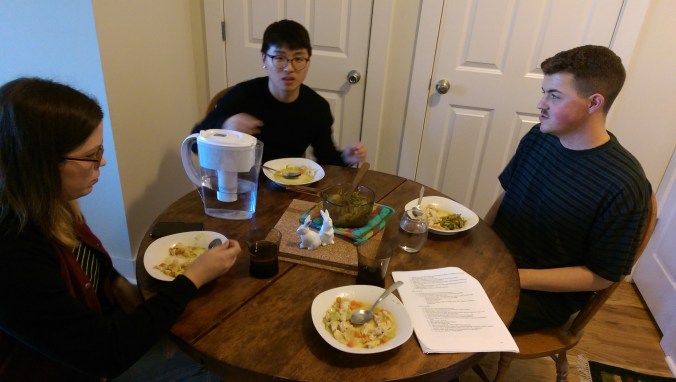
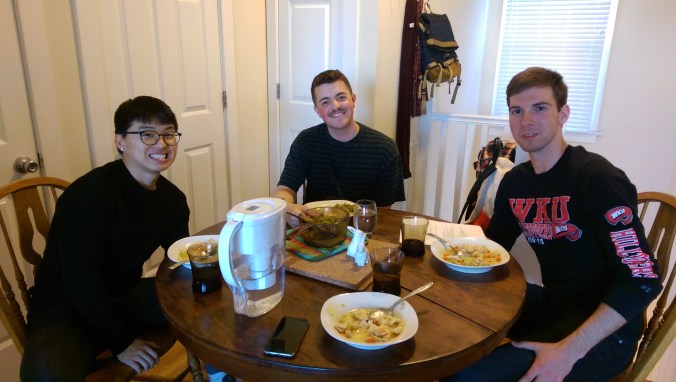
When Barnabas and I first arrived at the address we actually passed it, twice. I was expecting Jared to live somewhere way off campus, maybe some remote village or something. As it turned out, he lived just down the road from Cherry! When Jared invited us in I was greeted by the heavy aroma of southern cooking. Jared had prepared homemade Chicken and Dumpling soup for us alongside some southern style green beans.

I was instantly taken away by just how neat his apartment was. Not only that, but Jared was extremely kind, and inviting; he even had music playing on Pandora and candles lit. The reason that this stuck me was because I’ve been in my friends apartments before, but they never felt like a home, just a larger dorm. As the night moved on, and the small talk began, I found out Jared was an English major here at WKU and that he would be soon graduating as a senior. Shortly there after I met his roommate Emma, who was a student at WKU but now works at a candle shop.  She mentioned that she’s now interested in transferring to a school in Oklahoma. I made the mistake of asking which one and she proceeded to rattle off the various colleges available in Oklahoma while I, with zero geographical knowledge of Oklahoma, nodded continuously like an idiot. I don’t think she noticed.

IMAG1325

Once we got to eating the real conversations began. I asked a question I often use to get to know people, “If you could have dinner with three people who would they be?”. I got a wide variety of answers ranging from Burt Reynolds to Jesus to Hitler interestingly enough. The excuse for Hitler was that he was one of the ambitious men of his time, and it would be interesting to figure out where that drive came from. While personally,Hitler doesn’t sound like the ideal dinner date, It made me realize something. In class we discussed briefly that people have more and more homogenized their piers, that “cliques” whether they be high school friends of coworkers, tend to become less and less diverse with people searching for friends with similar traits as themselves. Now, here I was, sitting with three people that I wouldn’t have ever eaten dinner with were it not for this project, and I had a thought. It’s not because of some preconceived notion of who I am supposed to socialize with that I wouldn’t have dinner with these people, it was instead because each of our friend groups was made up, primarily, of people like each of us.  Yet, I found myself really enjoying the evening, especially as I got to learn more about Barnabas, who shared what life in Korea is like when compared to life in America. I find it amazing to think that someone from across the planet, who grew up speaking a different language, reading different books, learning different customs could sit down with three strangers from the other side of the world and carry on a conversation that interests everyone involved.

IMAG1328.jpg

If I could take away any major thought relating to Honors 251 it would be that Homogeneity is the downfall of democracy. As demonstrated in our class, it’s the variation on opinion, the disagreement on key points that gives perspective you wouldn’t otherwise have on a given subject.  To end on a bit of a cliche note, there is a quote a friend of mine told me last week; “Two people can illustrate crudity to you.
The first is the crude man, whom you see perceiving the diamond as a stone.
The other is the refined man, who makes clear to you the crudity of the first one.”

-Idries Shah

To me that quote speak to the matter of perspective in democracy. That the first made is crude due to lack of knowledge, the second is a crude man for demonstrating a lack of wisdom in when to use his knowledge. Without diversity, or at least a diversity of thought, democracy cannot flourish, only regress. That is my take away from my KKT project, an experience I was uneasy about going it, but so thankful for looking back.

Come together

by Barnabas

On Saturday, April 9th, I went to have a dinner with my friend Dominic, who is in my Honor 251 class, and people that I have never talked to and met before. I was very nervous about having to eat with random people and being in an awkward atmosphere. I usually do not eat lunch and dinner with my friends, because it provides me extra time to do other urgent things that are in my priority list. I thought this assignment will turn out to be terrible and challenging, but my assumption was wrong.

There were total of 4 people in my Kentucky Kitchen Table (including my self), all of whom were college students. Jared and Emma hosted and invited Dominic and me to their apartment near WKU to serve a dinner. Jared, senior and major in English in WKU, was the main cook who provided us with the delicious chicken noodle soup. This was actually my first time eating true “American food” other than hamburgers and pizza, and it was very delicious that I had to eat more than twice.  And Emma was one of his roommates, currently planning to transfer to college in Oklahoma. She used to go to WKU, but once she decided to transfer to Oklahoma, she got out of WKU and started to work in a candle store.

Contrary to my prediction that it is going to be awkward, it was very exciting to talk and share my thoughts and ideas to Jared, Emma, and Dominic. I talked about how difficult it was for me to come and having a dinner with them, since English is not my first language. I shared the frustration of being left out in the American college community due to poor English speaking ability and cultural difference. We talked about how Asians  like to get along only with people with their own kind and I explained that, this was due to the culture difference. There are certain things that Asians could form a common ground and agree and understand, while Americans can not. For example, when my roommate and I went to Greenwood shopping mall, my roommate gave me a weird look as I was spending my time in Hollister, and with his weird look, he asked me ” Hey, man what are you doing here?” He could not understand the fact that I was trying to buy clothing in Hollister, and he told me that Hollister was for high schoolers. In Korea, Abercrombie and Hollister struck the clothing markets, and they have become more popular and famous than Polo and other famous brands that many college students prefer.  In Korea, people regards being respectful to the elder as one of the significant cultural value. Being insulted by 2 years younger roommate made me realize that it is very difficult to fit into American culture, which became a barrier to socialization with American students. The Asians’ tendency to get along with other Asians is because they feel comfortable and agree on things more easily than when they are with American students. The hidden difficulty in Asians’ college life relates to the topics mentioned in  the “Paying for the Party.” Colleges should not view international students as influx of money, but great assets to diversify the college culture. Many students come to college pursuing their own pathways, and colleges can facilitate this by actively engaging. For example, WKU has done a great job to enrich American college experience to international exchange students by assigning American students to exchange students.

There were many other topics that we talked about after dinner, such as wicked problems, religions, gay marriage, and which historic person you would like to have dinner with, etc. Among the many topics, we showed much passion especially in a topic relating to college tuition. We talked about how expensive college tuition is, and how the cost of college education prevents many smart students from pursuing their dreams. We came up with some suggestions and possible solutions to reduce the college tuition, such as diminishing the investment on college sports and  on building construction on campus, etc. I mentioned that there are many additional things that are expensive along with college education, such as textbooks. We also noted that everything that has to do with college education seemed to be expensive without great efficiency, and that acceptance rate is very high, but the efficiency of college education is relatively low. Sternberg, author “Giving Employers What They Don’t Really Want,” says that colleges do not always provide what the employers want, which are the critical thinking, practical problem solving skills, and communication skills etc. If we go to college and get nothing out of it, except for good GPA, colleges are doing nothing good for us, but good for themselves, especially when we are paying tons of money.

After this KKT assignment, I learned that when people come together, we can learn what problems exist in our community, in our nations, and in the world and come up with effective suggestions from different perspectives. By sharing thoughts and ideas, we could discover effective ways to approach these problems, and we could even find issues that we never thought as problematic. I certainly learned that democracy is about individuals’ effort to make the world to live together and to solve the problem. Even if the individuals’ efforts are negligible to bring an impact to the problems, these small steps that they are taking is as significant as taking big steps to take down the problems. And without the small steps, the problems will eventually remain as wicked problems.

Talking to random people and sharing my thoughts and ideas was one of the greatest experience I have had in America. The interaction I had in Kentucky Kitchen Table taught me that in spite of  my poor English speaking ability, I could still actively participate in community efforts. Thank you Dr. Gish, for providing priceless opportunity for me to learn great lessons.

KakaoTalk_20160430_173954600

KakaoTalk_20160430_173957026