A Kentucky Kitchen Table in Mount Hermon

By Mikayla

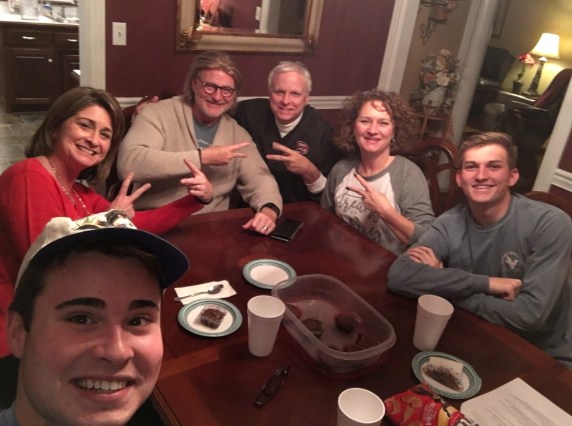
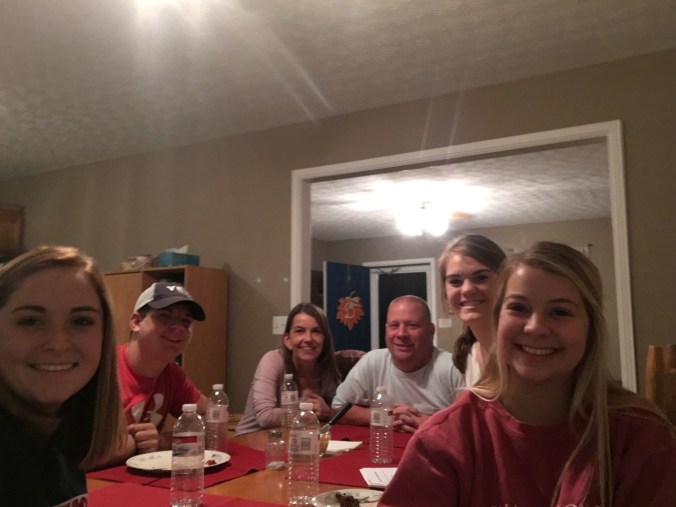
My Kentucky Kitchen table was hosted at my parent’s house in Mount Hermon, KY. Those attending were my father, my mother, my sister, John, and myself. My father, Craig, has lived in Mount Hermon his entire life. He is a third-generation farmer, a volunteer firefighter, and a carpenter. My mother, Christy, is originally from Indianapolis and moved here with her family while she was a child. She lived in Vernon, KY until she and my father married in 1992. She is the center coordinator at the Barren County Health Department. My sister, Maddie, is a senior in high school. She serves as secretary in her high school’s FFA chapter and plans to pursue a degree in agriculture at WKU. John is from a small area called Hestand, KY. He works in carpentry with my dad and this was his first time meeting the rest of our family. My mom, sister, and I decided to cook the entire meal consisting of roast, mashed potatoes, green beans, rolls, and gravy. John provided the sweet tea for the meal.

Although this group of people did not seem very diverse, we discovered diversity in our experiences, regions, political identities, and religious identities. My family is a stable, two-parent household while we learned that John comes from a family with divorced parents. His parents separated as he was beginning high school in 2007, his father passed away just last year, his older brother joined the air force and now lives in North Dakota, and he has some contact with his mother who lives in northern Kentucky. Another difference noted during our conversation was that we were used to homecooked meals gathered around the kitchen table every night while both of John’s parents seldom cooked. We were also diverse in the regions we originated from, with my mother most notably originating from Indiana, while the rest of us originate from different, small, rural neighborhoods in Kentucky. We also differed in our political identities. John identifies as a democrat while my family and myself identify as republican. This difference brought a unique conversation to the table as we discussed why everyone identified as they did. John believed more in the democratic platform than the republican platform, even though he was still on the fence regarding abortion because of his religious beliefs while my family and I were extremely conservative. This prompted us to talk about the results of the recent election and how we felt about the president-elect. John was quick to say that he did not vote for Trump, but was willing to give him the benefit of the doubt as his post-election speeches and mannerisms were more acceptable as opposed to his pre-election actions. He also clarified that he was by no means a Hillary Clinton fan either, but decided to vote for her as he believed that she was more qualified than Trump because of her experience. My family and I admitted to being Trump supporters and were glad when we received the news that he had won. All of us talked about the shock that we all had when Trump won the election, as none of us believed that he would win. Additionally, we were different in relation to our religious beliefs. Although we all were in the broad spectrum that is Christianity, John identifies with the Baptist denomination while my family and I identify as Church of Christ. This prompted a discussion that identified some differences between the two: primarily, the “once saved, always saved” concept and the idea of being saved before baptism. Other than these two differences, we noted that they were very similar in their other teachings.

After these initial, introductory conversations ended, I began to prompt with discussion-based questions. First, the question, “What does citizenship mean to you?” was asked. After initial silence, John began the conversation and stated that he believed an important component of citizenship was being understanding and respectful of others. He continuously mentioned that, although we may come from entirely different backgrounds and have different morals/beliefs, we must be respectful of everyone’s right to think and act differently and be both understanding and welcoming of those differences. We all agreed and my dad continued by stating that he also believes providing helping hands to those around you was an important function of citizenship. He related this to firefighting: he volunteers his time to help others in the community and explains that there are multiple ways to do this, such as helping your neighbors landscape or something as simple as a phone call to see how someone is doing. The next prompted question was “What is the thing you love most about living where you do?”. My sister jumped in by sharing that she loved how close-knit our little community was. If someone was sick, then we all knew about it and contributed in whatever way we could. If someone was faced with a disaster, then everyone contributed. Living in such a small, close-knit community made it seem more like a large family. My mom also mentioned that she never had to worry about the neighbors or having too much traffic around the house, especially while we were growing up. If she and dad were both at work, then she could easily find a babysitter with a neighbor. She also mentioned that she never worried about us wandering around alone because she knew every neighbor and the traffic around the area was minimal.

The conversation throughout the entire dinner flowed very smoothly between these multiple topics as we were all very open to the discussion, even during touchy subjects like politics and religion, and required very minimal “conversation starter” questions. Thus, I learned that diversity exists even when you least expect it to and I learned key components of citizenship and democracy. We discussed various topics evenly and openly, regardless of our differing backgrounds and identities, much like how a true democracy should function. Our conversations more accurately represented a proper deliberation, in the sense that we each spoke of our differences, compared them, and then brought our ideas and beliefs together once everyone had spoken. All in all, it was a very beneficial dinner that resulted in new ideas of citizenship as it relates to democracy and a better understanding of how experience is epistemologically significant.


A Hectic Kitchen Table | 11/05/16

By Hannah

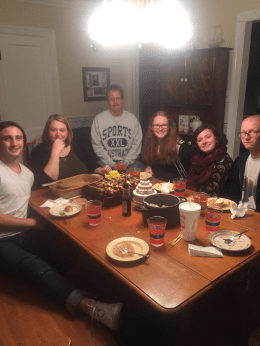
In anticipation for this project I reached out to two friends about a week and a half prior to the date I had in mind in hopes that one would host and both would participate. Bailey agreed to host and bring her cousins fiancé, Whitnie, who I didn’t know and Kalie agreed to bring two friends I didn’t know. I was going to bring my boyfriend Gage to the dinner since neither Kalie nor Bailey knew him that well. Monday before my Kentucky Kitchen Table was planned, Kalie called me to say she wasn’t able to attend anymore. I reached out to another friend, Jaley, to see if she was available for the 5th and she said she would check and get back to me. On Tuesday, she let me know she couldn’t attend. At this point I started to get a bit stressed. After debating over who to ask next, I decided to add some “diversity” to my group by asking a former high school teacher of mine, Mr. Grubbs, to attend. I texted him and explained what KKT was and he agreed to come and to bring his brother who I hadn’t met, IF he didn’t get tickets to the UK football game on Saturday. I agreed to his conditions and carried on with the planning. I decided on Thursday that in the of case Mr. Grubbs was able to get tickets, I would ask another friend of mine, Zach, to participate. He luckily had an open spot in his schedule and would be able to come. On Friday, Bailey and I had worked out the menu. I would make a lasagna and bring a cheesecake, she would have a salad and rolls made, and Gage would make a peanut butter pie. Mr. Grubbs had contacted me to let me know he wasn’t able to secure football tickets and so he would be able to attend. Going to bed that night I felt really good about how smoothly tomorrow was going to go.

Boy, was I wrong.

I woke up to a text from Zach explaining that his parents were making him volunteer at something at his church that weekend and how he had done his very best to get out of it, but they were making him go. I understood and told him it wasn’t a biggie. (Later that evening I saw pictures of him canoeing with friends, but that’s none of my business.) Now I wasn’t worried about replacing him because we already had enough people as it was. Fast forward to about 5 that evening. Gage and I had arrived at Bailey’s about an hour prior. The lasagna was in the oven and we were just sitting around chatting. I had Bailey text Mr. Grubbs to remind him of the time to be here. He still had an hour, given I had planned for it to start at 6, but I thought a friendly reminder wouldn’t do any harm. He replied about 10 minutes later explain how he was in Lexington waiting to pick up his wife from the airport. Lexington is about 90 minutes away from Somerset and her flight hadn’t even landed yet. My stress went from around a normal 3 to an extreme panic 10. Bailey told him not to worry about coming since he would probably be about 2 hours late. Gage, Bailey, and myself began desperately scrolling through our contact list to find someone who might possibly not have plans in 30 minutes. We called around 10 people before Bailey landed on her friend Andrea.

Andrea is a nice girl and I know her some just from going to school with her for a few years. Andrea was happy to attend the dinner, but there was one thing holding her back: She was on a date. Thankfully, she was able to convince her date, Josh, to take a detour to Bailey’s before they finished there evening at a friend’s bonfire. (Spoiler Alert: Andrea told her date the next day she had more fun at my dinner than any part of their date.) Once

Whitnie, Andrea, and Josh arrived we all sat down at the table for dinner. I felt a wave of relief wash over me as I looked around at all the faces I knew, kinda knew, and were strangers. I began the night by explaining what the purpose of the dinner was and what Citizen and Self was. Everyone eagerly participated in all conversations. I think my favorite discussion we had was about what eating with our families were like growing up versus now. Whitnie, for example, talked about how they would always have nightly dinners which she dreaded years ago, but now that they no longer had them she really yearned for that kind of connection again. While Josh, still had nightly family dinners and even occasionally would have neighbors over to eat with them. Although racially we were not a diverse group and the age difference ended up being around 5 years, there was a big diversity in the social class which was evident when we discussed the question about jobs and working. I won’t be specific but, some people talked how they never saw how having a job through school has a necessity, but more of a hobby. To juxtapose, a few people at the table explained how a job was expected of them and how it was not only their contribution to society, but to their family.

Overall, I really enjoyed having dinner with a group of people who didn’t necessarily match up or connect in every way. I learned a lot about everyone and had a fun time being with people in such an unconventional way. If it hadn’t been for Kentucky Kitchen Table, I can guarantee this group would have never shared a meal together. Honestly, I learned more than just about this small groups view on citizenship and the values they hold. I learned not to always trust people will be there even when you ask and they agree. Not only that, but over planning is always a good idea. Despite the craziness that occurred leading up to the meal, I would definitely do this again, but hopefully with more reliable friends.

KY Kitchen Table

By Rachel

I hosted my Kentucky Kitchen Table in my hometown of Bowling Green. I was lucky enough to manage to pull together a ragtag dinner group consisting of some distant cousins that I don’t remember being related to, an uncle, my dad, and the lawyer in charge of my grandads estate. Most of these poor souls just wanted to come to my grandparents house for a meeting and to sign some documents but had the misfortune of mentioning dinner and me deciding that my project was way more important than their ability to evacuate. We pulled together an oddly good meal consisting of ribs and chicken that where both of the farm fresh variety (slaughtered and put in a deep freeze till the grandkids forget it had a name) along with homemade cornbread, baked beans, and lemonade as a group (minus Pete who would rather watch football and left the kitchen). We decided to eat at the dining table in the sunroom surrounded by our prickly cacti friends and settled in for a good long meal.

The captives of the evening were my uncle Pete, my dad Paul, distant cousins Taylor, Terrah, and Graham (no that’s not a typo, my last name is Graham and his first name is Graham) and lawyer extraordinaire Tracy. While the group may not look that diverse on the outside we represent a wide demographic of ages, backgrounds, and belief systems. Pete who has lived a rough life and at 40 looks closer to 65 never went to college and now has seizures so he can no longer work on power lines like he used to so he’s been forced into retirement. My dad went to Western and then vet school and is now a veterinarian/farmer/archery coach. Taylor went to Louisville for college and now has a full time job there where she coordinates fundraisers. Graham was a professional archer from 18-23 but lost most his most of his vision in his dominant eye in a gun explosion and is now a welder. Terrah is a nurse and extremely religious (to the point she sent me a bible in the mail less than a week after this dinner/first meeting). Last but not least Tracy who has a law degree but decides to use it to do everything a lawyer does minus going into an actual courtroom and has 2 jack russell terriers that get stuck in groundhog holes.

As I started off the discussion I attempted to make it clear that this project is about insightful discussion and not starting brawls at the dinner table and thankfully everyone seemed to grasp the concept except for Pete who immediately started laughing about “those butthurt liberals” and immediately killed most of my hope for this to end with no hurt feeling and open minds. Once Pete got it together we started in on what citizenship means to each of us and we unsurprisingly ended up split up in our beliefs by age group with Taylor and I speaking more about being a part of a society who accepts you, Terrah and Graham talking more on their freedoms and their rights and how you are a citizen when your country let’s you be your own person while still protecting protects you and providing guidance almost like a parent would do, and Pete, Paul, and Tracy made their beliefs known that citizenship to them means feeling safe, loving your country and being willing to do anything in its name because it is your home. Luckily we all agreed on something, some people in the group brought up that no matter the background of a person, if they truly feel like an American and are only here with good intentions that they should be treated like citizens and not outcasts at least by the public. I was truly surprised that Pete agreed and I feel that he probably likes the idea of a utopian society but wouldn’t truly practice this due to the fact that I’ve heard one too many jokes about muslims come out of his mouth over the years but I guess he gets the benefit of the doubt for now.

After this I directed the conversation towards what kind of person everyone wants to be and what they do to try to become this ideal. All of the men ended up described their ideal way of being as being caring, friendly, useful people, and being able to protect their loved ones which reminded me of the paper we read on younger people not being able to really discuss morals because they were never taught any. This situation was kind of reversed from the article where I felt like the men weren’t taught how to truly express themselves but had words put in their mouths to spew out whenever they are told to. The guys had this preconceived notion of what a real man is from hearing it their whole lives and it was honestly disappointing to get such a generic answer. I do however feel that if any one of my younger male friends had been there he would have felt much more comfortable opening up. The ladies of the group however were not afraid to speak their minds and get into specifics. They brought to the table a collective desire to be able to give more of their time to their families and spend less time caught up in themselves. Terrah brought up her desire to be able to be there for everyone and that if anyone of her friends from church or otherwise ever needed anything at all that she could be there in a split second to do anything for them because not enough people take the time to care about others.

This lead into a discussion of religion and Terrah’s various mission trips. Out of all of us I was the only person who wasn’t a practicing christian which lead to a few overzealous minutes of preaching by Terrah but eventually managed to get turned back around to the relative zone of living better together. Everyone agreed that religion is a moral code and that not practicing one doesn’t make someone a bad person, it just means that they have to make their own limits and define good and bad for themselves. Graham brought up that community service is one of the best things a church does as it allows people to actually get together and make a difference and due to the sense of community and obligation to their group people tend to make more of an effort to help. Terrah brought up that the last 2 mission trips her church planned kept getting put off due to the snare of preparation and ended up happening 5 months after the originally scheduled dates. She shared that she;s not going on another trip as she believes they accomplished nothing because they brought shoes, toys, and toothpaste to an area that had way more pressing issues such as disease and how to get water than worrying about brushing their teeth. Taylor also brought up that on a mission trip that she went on where the kids got toothpaste that was mint flavored that the kids would end up eating the toothpaste like it’s candy and get ill because they had never seen it before. The article to hell with good intentions really hit home here and made me realize that the human race is basically just wandering around with its hands over its eyes convinced it is a gift from god bestowing greatness wherever it may go refusing to look at the reality that it’s poisoning everything it touches. After this the discussion took a quick turn to the official reason for everyone’s visit to Bowling Green and the discussion was promptly left at the table.

This project was surprisingly more comfortable than I had originally expected especially considering that half my group where stranger to me. After doing this project I have to believe that most people are inherently good and have good intentions but don’t necessarily know how to properly execute them. Since I know Pete as usually being very brash and his relatively cooperative and accepting attitude I must imagine that being taken out of your comfort zone and the preconceived notions of those closest to you gives you time to reflect and process what your beliefs as an individual are without the hive mind. This has also helped me realize how different we can be on the surface but the our souls share a like mind of love and acceptance.

ky-kitchen-table

Blue Dog Democrats and Microfiches: My Kentucky Kitchen Table Project

By Erik

img_5899

This fall, I had the pleasure of hosting my Kentucky Kitchen Table in my own dining room.  Since I have lived in Bowling Green, Kentucky my whole life, it was a convenient ten-minute drive from campus for me and John Mark, the cohost of the project.  Around the table (from left to right) was John Mark, a junior in the Honors College at WKU who is majoring in creative writing; DeAnn, John Mark’s mother, a very sweet woman who works as a physical therapist and is from Roanoke, Virginia; Rick R., my father, who works as a cognitive behavioral therapist, is infamous for his cheesy “dad jokes,” and is from Minnesota; Rick T., an accountant, history buff, and talker of all things politics who is from Carroll county and had lived in Franklin, Kentucky for many years; Kathy, my mother, who works as a marriage and family therapist, has the kindest of hearts, and is from Tennessee; and myself, a freshman in the Honors College at WKU who is majoring in chemistry and biology.

As the night began, we all gathered around the table and each enjoyed a big bowl of chili or two, making a few brief comments about my dogs who were loudly pleading for liberation from the bedroom in which they were locked in for the night.  Since the 2016 presidential election was earlier in the week, I knew political talk was inevitable, but I was excited to hear the various opinions that our guests had brought to the table, nevertheless.

Like most Kentucky Kitchen Table projects, we started out by discussing what it truly means to be a citizen, apart from voting and paying taxes.  The common response to this question was along the lines of how you should offer help to those who are in need, and how you should respectfully voice your opinions to the community when the opportunities arise.  In other words, you should be open to serving the community in hopes of making it a better place to live.  Connecting these ideas to the class, I presented the idea of how Thomas Jefferson highly valued town meetings because it was the healthiest way that the community could discuss societal issues.  After we explored many different answers, Rick T. posed his own question in response:  where has civility gone in today’s society?  His explanation to the question was composed of his experiences throughout his life, telling us about his noticing of society beginning to shift toward a lack of respect for one another’s opinions.  John Mark followed by talking about how people’s ideas are so polarized from each other, which oftentimes leads to people arguing with a closed mind, thus neglecting the idea of seeking a common ground to settle upon.

Switching the mood of the conversation, I asked those around the table what they thought some of the best things in today’s society were.  Those who were quick to answer listed off things such as technology, medicine, education, transportation, and the growth of capitalism and freedom.  DeAnn, reminiscing about old technology, asked me and John Mark if we happened to know about microfiches.   As we shook our heads no, DeAnn and Rick T. both took the opportunity to explain to us how troublesome it used to be to have to use a microfiche to research information for a school paper since all of your work had to be done at the library.  In contrast, the point was made about how our generation is fortunate enough to live in the age of technology, and how we are always roughly five clicks away from finding the answer to a myriad of questions online.  Being the philosopher that Rick T. is, he once again smoothly made his way into the conversation and posed another great question:  is the convenience of technology always a good thing?  We made the conclusion that in moderation, it is a good thing.  Rick R. talked about how thousands of years ago, people relied on each other for both safety and social interaction, and in contrast, people now just hunker down in the comfort of their home because technology and social media provides people with a sense of social connectedness.  This is one of the largest reasons that keeps us from getting to know our neighbors, and many of us are guilty of it.

Finally, with the election fresh on our minds, I posed the question, “what is some advice that you would give to the president-elect?”  A mutual agreement amongst everyone at the table was that the best piece of advice to is to tell him that the government is an institution, not a person.  This piece of advice would be good to tell the president-elect so that he may humble himself, and it is also a good piece of advice for those who are troubled by the thought of Mr. Trump in office.  Rick T. took this opportunity to access the perpetual history vault in his noggin to compare this situation to one seen earlier in American history: Ronald Reagan’s presidency.  Rick T. explained how Reagan was viewed as unfit for the presidency because he was a “stupid actor,” but went on to hold his own because of the smart individuals that he surrounded himself with in office – something that I think most of us hope Mr. Trump will do.  Also, one of the biggest revelations that occurred at the table was when Rick T. stated that he was a Blue Dog Democrat.  As a look of confusion emerged from many of our faces, Rick T. quickly explained that it was a term used for democrats who hold conservative views on many issues.  After Rick T. dropped this bomb on us, I personally began to question my stances on political issues and sift through the views that I can consider bipartisan.  As for DeAnn, she learned that her political views best matched up with Rick T.’s, considering herself a newly-found Blue Dog Democrat.

In closing, I came into this project expecting the night to be short, boring, and full of expected answers; however, I was shocked at how insightful and enjoyable the night turned out to be.  I am very thankful that I was required to complete this project, and I would absolutely do it again.  From the time I asked the first question of the night, to the time we cleaned up the dining room table, two, almost three hours had sped by.  Never in my life had I perceived the saying, “everyone has something to bring to the table,” as being so accurate.  If you ever have the chance to organize your own Kentucky Kitchen Table, I highly encourage you to, for you may walk away from the night with a different perspective on society, or maybe even discover that you are a Blue Dog Democrat, who knows…

By Kelby

Kentucky Kitchen Table .png

For my Kentucky Kitchen Table project, I hosted a hometown dinner. Instead of me being the one who invited the guest I let my sister decide who would be invited. I thought that letting her decide who should be there would put an interesting spin on how the project works. All the guests were younger than me which I expected to give a different perspective than what I would have gotten if I had invited people the same age as me here in Bowling Green. I had the dinner at my home in Louisville. My mother very graciously made my family’s favorite dinner for every one that was there.  This was to make sure that guests would not have to provide anything and would be able to just enjoy the evening.

Kylee, my sister, invited three of her friends that I had only met briefly in passing. The one girl invited was her friend Cate, who is her coworker at the library. They both work as clerks. Cate is a very liberal person and does not hesitate to share her views on anything, especially things that involve politics. Cate’s brother Bob was also invited. He has a lot of political views, but is often not as vocal about them as Cate. The last person she invited was her friend Brandon. He is an out gay man who she met through friends at school. My sister and my parents, Jon and Misty, were also there. My entire family is very conservative. My father is a southern Baptist preacher and my parents raised me and my sister very religiously.

When I talked to Kylee before the meal she said that Cate, Bob, and Brandon were very excited to meet our family and to participate in this project. The only thing that she mentioned in a negative way was that Brandon was not sure how my parents would react to him. I was interested to see how things unfolded. Knowing my parents, I know that while they have very strong views they are also very welcoming of anyone they meet. They like to get to know people’s stories. I knew that there would not be any issues even though there were would be several different views and beliefs presented that night.

This dinner happened to fall right around the same time as my sister’s birthday, so the conversations that took place early on were directed around that. We soon drifted into other subjects and had some very deep, meaningful conversations about current events. It became clear that there were several different opinions in the room. Everyone did a really good job of listening to others’ opinions and sharing their own viewpoints without chastising or belittling the other people in the room. We were able to have very good conversations and really learn about why people believe what they believe.

The way the conversation went reminded me of the reading How We Talk Matters. In that article we discussed the trend of people not listening to others when they talk about social or political issues and almost yelling and forcing their views on others. We also talked about how this trend is hurting society because no one will take the time to listen to others to gain an understanding about what they believe. This was not at all the case with this project. Everyone who was present really seemed interested in what others there had to say and were willing to think about things differently.

One of my favorite moments of the night actually happened after dinner was over. Cate, Bob, and Brandon stuck around after the meal and we all played Apples to Apples. At first it was just me, my sister, and her friends, the younger crowd. My parents were loading the dishes into the dishwasher and tidying up the kitchen. Toward the middle of the game my dad decided that he wanted to join in play. You could tell that Kylee’s friends were not sure how this was going to go and were afraid the fun we were having was about to be dampened by a middle age father wanting to play. They soon realized that my father was not easily offended, had a good sense of humor, and would play along with most anything that was happening. We spent a good part of the night playing different games and I think that was much more fun than the dinner itself was.

I think that this just goes to show that sometimes people defy your expectations. Sometimes you can find common ground in the funniest places with people you think may not except your way of life or agree with what you believe. I believe if more people realized this we would all be able to live better together, which is a key theme to this class. Also, the fact that my sister is such good friends with people who obviously believe very differently than her, shows that people can live in harmony if they are willing to work together and respect each other’s differences.

Overall this project was pretty fun. It was originally kind of hard to organize, and I had to change plans a several times for it to work out. An unexpected bonus, I believe that I gained three new friends out of it. It is so funny how you can hit it off with different people even if you think that you will probably only be acquaintances. Brandon and I ended up getting along really well and have stayed in contact since the project. To me, this new friendship is greater than any grade I might get for this project. I am glad that something that will hopefully last for a long time can blossom from an assignment that I wasn’t sure would be very fun. I hope that everyone else’s project went as well as mine did and I hope that classes in future semesters enjoy it as much as I did.

Lexi’s Kentucky Kitchen Table

When we first got assigned this project, I was immediately stressed out! I rarely go home because it is such a long distance, but I decided this project would make for a good excuse to travel the distance and plus I would get to meet up with old friends and make new ones. I texted my mom and told her we had to host a dinner for my friends for a class project. She was ecstatic; she lives for opportunities to host my friends (and listen to all the gossip). I invited friends who lived nearby and went to the University of Cincinnati and Northern Kentucky University and told them each to bring a friend they had made in college. The table would consist of seven college students, which doesn’t necessarily sound diverse, but after having mature conversations it turned out to be.

img_4932Sarah, Lacey, Lauren, and Meredith all grew up with me and were who I considered my best friends. Before we left for college my friends and I were all fairly similar: white, middle class, Republican. We all grew up in the same area: Fort Thomas, Kentucky (a suburb of Cincinnati), and attended the top rated achieving public high school, Highlands High School. Our parents all supported us in everything we did; they came to our sporting events, volunteered at school, and supported us financially.  As we went off to college we all grew somewhat distant of each other and came back home with completely different perspectives on all sorts of things.
Mia, a friend of Sarah’s who attended the University of Cincinnati, had grown up in a small town outside of Columbus, Ohio. She was very Christian and had ambitious goals of becoming a missionary. She brought such diversity to the table by sharing her experiences of when she traveled to Haiti and Ecuador to help educate young kids in third world countries. I personally had never really believed in missionary work and had a viewpoint similar to Ivan Illich in his essay we read in class “To Hell with Good Intentions.” I had never sought out stories of missionaries to change my mind, but hearing her story did change my perspective. It was truly incredible to see pictures of her in these places and inspiring to know that one person can make such a big impact where it is really needed.

Brooke, a friend of Lauren’s who attended Northern Kentucky University, was very shy! She grew up in Florence, Kentucky with not a lot of money, divorced parents, and four other siblings. She was surprised at how nice the dining room table was set and all the effort that was put into this dinner because growing up, she did not eat around a table with her family. It was always fending for yourself at her household. With having so many siblings and divorced parents, she talked about it being hard to find time to spend with her parents.

I knew for this project to be successful, the conversation needed to be more than surface level drama. With Trump just being elected President, I asked everyone how they felt about it. Just by this one question I learned a lot about everyone at the table and the things they believed in and stood for. Sarah, who used to have mostly Republican views, had suddenly very Democratic views. Lacey, who used to not stand for LGBT rights, had become surprisingly accepting. Lauren was very fond of Trump because of the way he prioritized jobs as she was looking further into her future. Meredith was kind of lost in the whole conversation as she does not like to affiliate with any sort of politics. Mia spoke very strongly on behalf of Hilary Clinton because of the opportunistic ideas she had about spreading democracy and helping third world countries. And Brooke had always had a very Democratic stance on things since her family was on public assistance while she was growing up and her view on government was very thankful for the opportunities it provided her family. It was crazy to see how everyone’s viewpoints were changing as we moved off on our own and did not just follow what our parents told us. Lacey even mentioned that she went to college and felt like she had been living in full ignorance inside the “Fort Thomas Bubble” and it wasn’t until she experienced everyday life on her own that she was able to learn what she believed in.

When I asked the question “beyond voting, paying taxes, and following laws, what does citizenship mean to you?” everyone had something to say, but the one that stuck out the most was Mia’s when she said “citizenship means that you are a part of something bigger than yourself. Its knowing that you are doing your duty to do what’s best for your country and in return, hopefully, the government will do the same for us.” I thought this was the strongest answer because a lot of what we learned in Honors 251 can be tied into this definition. In order for us to be productive citizens we have a duty to share our knowledge throughout government. In order to make changes to things we do not like, we have the responsibility to make it better and speak up for what we believe in. Really, being a productive citizen, we can begin to answer the three main problems this class brings to fruition: How do we live better together? How do we solve problems? How can people have more say over their lives? This class has been so helpful in making me realize that it is up to me to make a difference.

It’s fascinating to me to see all of us growing up. I’m really glad I got to meet new people in the process, too. They brought a whole different perspective to the dining room table and talked about things the rest of us had never been exposed to. They will be people that I definitely see myself hanging out with again when I come home. It was also refreshing to hear stories that were encouraging. What I thought would be a miserable project was actually one of my best memories with my friends.

My Kentucky Kitchen Table

kitchen-table

By: KP

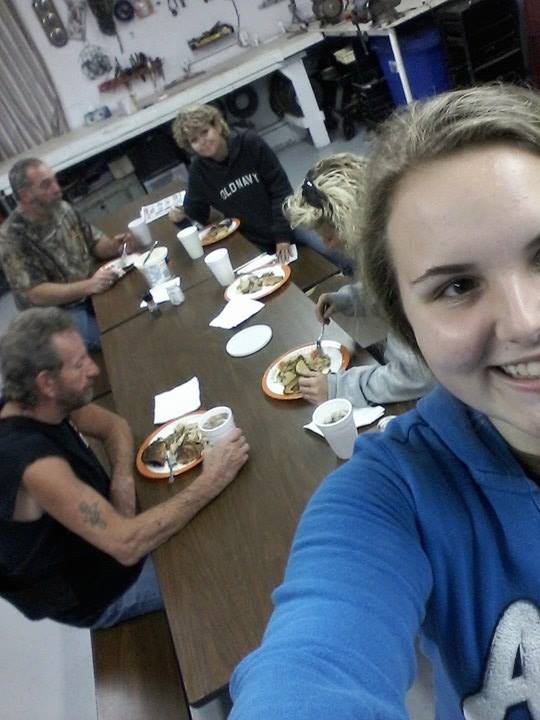
I had my Kentucky Kitchen Table on Election Day of November 8, 2016. There were five people including myself. I did not have a partner for this class project. I knew my mom and her best friend Kim but I did not know the other two men before the dinner. In my group was my Mom, who is forty-six, a single mom and her occupation is a barber. She went to technical school after high school. Kim is thirty-nine and has been for three years. She works at a salvage yard. She graduated from high school and is currently divorced. Keith is forty-seven. He works around his family’s farm and other farm jobs for different people. He got through high school. He has three kids and a possible fourth on the way. He has a preference for open relationships. Gibson is fifty-eight and works as a cattle driver. His wife passed away last year. He also completed high school. My mom cooked the pot roast and I made the lemonade. Our kitchen is a bit small, so we held the dinner in the garage on our lunchroom table.

I started off the dinner asking what did citizenship mean to them. My mom replied freedom. Kim said it was freedoms such as freedom of speech. Gibson said citizenship was rights that lessened every day. Keith agreed with Gibson saying citizenship was slavery. Things began to go South here. I asked Keith and Gibson why they felt this way. Gibson said they, as in the government, were taking away the right to own guns. I reminded him the right to bears arms was in the Bill of Rights and could not be fully taken away. My mother chimed in saying the government was limiting the ammunition, which made the guns useless. Keith began to join in saying we should overthrow this new government under Hilary. Keep in mind the election results were still being counted as it was only seven o’clock. I reminded Keith the reason we have government is to protect us and keep order and with that we have to give up some rights because with every exchange there is always an equal and opposite reaction.

Now I am unsure how it happened, but Keith began talking about how the Free Masons controlled the government. Gibson joined in with how the US currency was going to fall in the next 5 years because we are no longer on the gold standard. My mother joined in saying there was no gold at Fort Knox. I looked to Kim for help here, she had been quiet the entire time. I could tell she also wanted to get back to my original intent for the discussion. When the discussion turned to how the government prohibited the use of lead paint because it prevented the government from using mind control on us citizens, courtesy of Keith, I knew it was time for me to step in and turn this around.

I then asked the group if we could restart the conversation because I was not here to discuss conspiracies, I was there to discuss citizenship. I told them how I saw citizenship as being part of a certain nation. I asked the group if they believed they should help out their fellow citizens. Surprisingly there was a unanimous answer of yes. I asked why they felt that way. My mom spoke for the group saying because we can and somewhere along the way we have needed help.

Next, I asked the group if they knew their neighbors since neighbors are fellow citizens. Gibson said he has known his neighbors for thirty years where he lives currently and at his home before that he knew everybody because he used to deliver milk. My mom said she had met our neighbors when there was a wreck in front of our houses. I remember this time too because I had made my first 911 call that night. Kim pointed out that that was an act of good citizenship. Kim also said she knew her neighbors because her next door neighbor was her brother. Keith said he did not know his neighbors because he was too busy. Keith asked me if I knew my neighbors at my residence hall. I said yes and told them about my RA who lives right in front of me. I also told them of how one of the girls on my floor even shared the same birthday as me! I was very pleased of how the conversation had greatly approved.

At this point everyone was finishing up their plates and were complimenting my mom on her delicious pot roast. I asked the group if they had home cooked meals often. Gibson said when he was younger, he and his family rarely went out to eat. My mom replied with “when you were home”, referring to me. Kim and Keith said they were too busy to cook at home. The group all said home cooked meals were important. Kim said it helped with communication skills, Mom said it helped with sharing and Keith said it helped prevent him from spilling food on his shirt. The group was confused by this then Keith explained when he got a home cooked meal he usually was not going to end up eating in his recliner, but at a kitchen table. Everyone laughed when they realized what Keith was trying to convey.

The experience was definitely an interesting one. At first I thought this was going to be an awful project, but then things turned around and it was a great time! I learned a lot about the perspectives of other people, especially those older than me. My group was not the most diverse in terms of ethnicity but my group comes from and lives in different situations socially and economically. Although they did have one thing in common. They all loved to piddle with stuff in the garage, something I have never really got into. When I had to leave to return to campus, they had found a project to work on together. I hope to have another dinner with this group to see how their project is turning out and maybe discover some more of their oddball conspiracies. They are all friends now which is cute. I was worried about how my mom would handle life without having to worry about me twenty-four seven but now I know she will be ok. I do not regret doing this project!

Donuts and Democracy

by Taylor

There’s one thing that is certain about my family: we always take the time to eat dinner together. Our family dinners are an integral part of the day for us, and now that I’m away at college, I’ve realized that I took those dinners for granted. I eat dinner with friends, of course, but there’s just something special about gathering around the dinner table with your family and talking about the day’s events.

That being said, the concept of this project really resonated with me. Dinner conversation is the best conversation, in my personal opinion. As soon as the project was assigned, I called my parents and asked them to invite our next door neighbor over for dinner. I came home the next weekend, and our Kentucky Kitchen Table Project commenced.

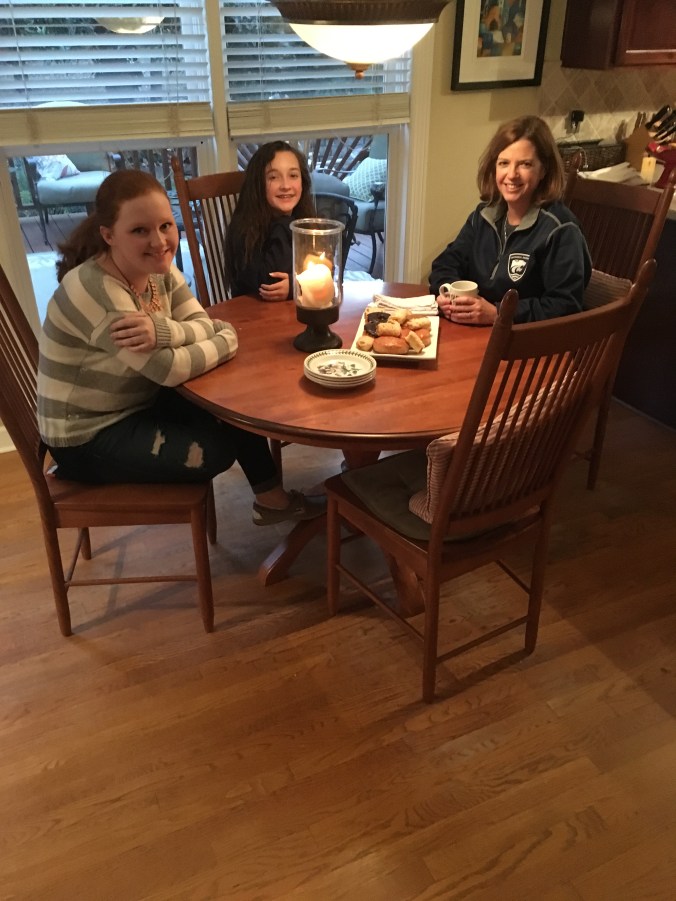
My mom, sister, and I ate a delicious meal with Mrs. Lori, a single mother who lives two houses down from us. My mom, Carolyn, is beautiful, blonde, and bold. Jordyn, my 14 year old sister, though brunette, inherited every ounce of my mother’s spark. The two are firecrackers, compared to my reserved nature, but I love them to death for it. Mrs. Lori, though I didn’t notice at first, has a very kind and comforting smile. Talking to her was easy, and fun. She was quiet at first, like me, but we all quickly became comfortable with one another. I’m so glad that I put myself out of my comfort zone and got to know Mrs. Lori along with the rest of my family.

Our Kentucky Kitchen Table took place the weekend after the election. My family and I were very disheartened by the results of the election, and the beginnings of our conversation were a little somber. I had asked everyone what citizenship meant to them, and we all came to a similar consensus. Being an active citizen not only requires you to vote: it requires you to use any lawful means possible to let your voice to be heard. Mrs. Lori made a fantastic point when I asked her what it meant to be a citizen of the United States. Her exact words were

“Even though where we’re at right now doesn’t seem that great, we still have to put in every effort we can to get where we want to be.”

The week following the election was one of the most emotionally strenuous weeks of my life. I didn’t know what to think, where to turn to, who to talk to. Should I lose hope all together? Should I accept the situation, even though I’m not very happy about it? I asked Mrs. Lori, and the rest of the people at our table, what their thoughts were about the election. We had all just finished eating my mother’s manicotti, and we were starting to nibble on the donuts Mrs. Lori brought for desert. My sister, as eloquent as ever, said

“It kind of sucks.”

I told her to elaborate.

“Well,” she said, “It’s pretty bad for minority groups. And—,” she paused.

It is hard for me to describe the amount of sadness I saw in her young eyes.

“There’s just so much hate.”

We continued to talk about our thoughts, and we were all less than hopeful about the future. To brighten up the conversation, I asked everyone what they thought were the best things about our world.

I mentioned the wondrous availability of knowledge thanks to technology. This, I said, was especially important to college students.

“I think it’s great that our world is so different,” said my mom. “I mean, culturally, our world is so rich and interesting.”

Mrs. Lori nodded. “And even though we’re all so different, the great thing is that we really all want the same things: love, food, safety, a better life for our kids and families.”

She was absolutely right.

We continued to talk about our connection with others around the world well into the night. The donuts disappeared. The coffee became cold. Well after my sister, my mom, and I, wished Mrs. Lori a good night, I thought about what my neighbor said. With tensions continuing to rise in our country, especially among minority groups, it felt good to hear Mrs. Lori’s words.

I learned quite a bit that night. We really aren’t all that different, are we? America is a diverse, melting pot, and I’ve noticed that WKU certainly represents this. Our campus’s diversity is continuously shown to me during my morning walks from Minton to Cherry Hall: so many different races, cultures, religions. I think it’s wonderful.

It’s safe to say, though, that many of us can get wrapped up in how different we are from others. Human nature dictates that we divide, section, and organize people into their respective categories. It allows us to make sense of the world around us. But when does that become harmful?

My Kentucky Kitchen Table conversation made me realize just how alike we all really are. Our country is struggling right now. However, most of us want similar things, if we look past the aspects of society that want to divide us, such as religion, sexuality, gender, skin color, political affiliation, etc. We want a better world. We want to be happy, we want to feel safe, and we want what’s best for our families. As a kid, my mom and dad taught me to look for the good in everyone. Citizen and Self has taught me to not only be kind and respectful towards others’ opinions; it has also taught me to be empathetic. To see from others’ perspectives.

In these dark times, with hatred and fear bleeding through the news and onto the streets, our nation needs some kindness. Compassion. Understanding. And Mrs. Lori, my mom, and my sister, made me see this. We’re all citizens of the United States; that hasn’t changed. We shouldn’t continue to pin blame on voters who chose a path that others disagreed with. We must come together, accept our differences, and realize our common goals. Thinking about the future is unnerving for me, even now; but I know that I’m not alone, and I know that our country can unite as one. We’ll morph our fears into productivity and hope.

I’m not sure what these next four years will hold, but I’m grateful for the friendship I’ve made, and what it’s taught me. I’ll certainly be finding out where Mrs. Lori got those donuts, because they were quite delicious.

(Not pictured: my mom. She had some trouble with the IPhone Camera.)

img_7310

Kentucky Kitchen Table in Bowling Green

img_3770

By Megan

When I first heard about the Kentucky Kitchen Table I knew that I wanted to host a meal in my home, but as the meal got closer, I became very nervous and apprehensive to share my home and my parents with individuals that I barely knew. I was accompanied by five individuals from very different backgrounds with differing views. The first guest at my kitchen table was my roommate and close friend, Lyn Dawsyn, who grew up in Glasgow, Kentucky and is also a freshman in the Honors College. Lyn Dawsyn is typically quieter in group settings; however, when she did speak during our discussion, she always made insightful and profound statements. Her love for politics and unconditional compassion for others truly enriched our discussion. Next was Hannah whose experiences growing up in a larger city like Louisville, Kentucky and attending an all-girl private school allowed her to contribute numerous well-thought out and valuable insights to our discussion. Next was Scott who also grew up in Louisville, Kentucky and is very independent and firm in his beliefs, yet open to hearing the opinions and perspectives of others. Scott was the individual at the table who I knew the least. The final two individuals at my Kentucky Kitchen Table were my parents, David and Tami. David has lived in and around Bowling Green his entire life and currently works as an Engineering Specialist for Medical Center Health (formerly Commonwealth Health Corporation). David enjoys sharing stories about his countless experiences and lessons learned thus far. Although I thought I had heard every story he had to tell over the last eighteen years, my dad shared stories during our dinner about his time in the Army that I had never heard, which was perhaps one of my favorite parts about this project. The final person seated at my kitchen table, my mom Tami, undoubtedly put in more work than anyone else leading up to the meal, which truly exemplifies her unconditional selflessness. Tami is a Certified Credit Specialist who also works for Medical Center Health. She is much less outspoken compared to David but still contributed numerous valuable comments to our discussion.

After everyone had filled their plates with delicious home-cooked food, we began our discussion by going around the table and sharing our opinions on what makes us all citizens and our responsibilities as citizens beyond those you typically learn about in school (voting, taxes, etc.). I was pleasantly surprised that we came to the unanimous decision that above all else, being kind to others and doing your part to be a genuinely good person to the people around you was the best way to be a better citizen. If each one of us made it our responsibility to be a good person, the dynamics in our communities would change drastically.

The next topic that we discussed was whether or not our jobs play a role in bettering the community. Because only two of the six people had true occupations, the students at the table answered the question based on the careers that we hope to have someday. Each of the young adults seated at the table had driven intentions of making a small difference or change in the field that they hope to enter. Lyn Dawsyn wanted to change the nature of political campaigns and advertising as a whole while Hannah wanted to change the nature of the media and how news is portrayed. Scott and I both plan to enter healthcare fields, and we are both largely aware of the impact that each individual interaction that we have with a patient, especially a child, could change the way that they view healthcare professionals as well as improve their mood or how the rest of their day goes despite their illness or disability.  David and Tami also expressed genuine desires to treat everyone with compassion and respect in the workplace regardless of how they treat you, their position or title, or how bad of a day you are having. After dinner, Hannah and I both decided that this discussion in particular reminded us of one of the central questions we are focusing on in this course: How do we live well together? I also personally related the way that each of us answered this question to the fact that the first step in crossing the theoretical bridge from how we currently live to how we want to live better together is to recognize the part that every single individual holds in making a difference in how individuals in a community live together. If everyone was conscious of how they interacted with the people that they encounter, we could begin to live better together.

Relationships and interactions with our neighbors was the next topic that we discussed, and it was a particularly nostalgic subject for my parents and I as a majority of the neighbors that we had when I was growing up have recently moved away in the last few years. Nearly everyone at the table expressed the same sentiment that they felt much closer and had more interactions with their neighbors during childhood compared to now, which may be a result of the technology that we now fill our free time with. Tami pointed out that in addition to the advances in technology that have led to a reluctance in spending time outdoors and interacting with neighbors, a lack of trust and willingness to be vulnerable amongst strangers has also greatly contributed to a change in how we interact with our neighbors.

Because my Kentucky Kitchen Table took place the week before Election Day, and we had become seemingly comfortable with each other, our conversation then shifted to a more controversial topic: the impending election. To ease into the topic and not enter directly into discussing specific candidates, Hannah asked what advice each of us would give to someone running for a political office. My parents and I have had this conversation multiple times over the last few months, so immediately my dad mentioned how although it is a tricky (AKA wicked) problem, he wishes there was a way to require the President of the United States to have some form of military experience or background because he/she is given the task of being the Commander in Chief of the Armed Forces. This epistemological knowledge of how the armed forces operates would be valuable because the decisions made by the Commander in Chief impact the actual lives of millions of Americans more so than many other decisions that the President makes that may impact Americans’ livelihoods like taxes, healthcare, etc. I also stated that I feel the President should be business-minded rather than politically minded yet still be experienced enough to understand how to make decisions for an entire nation. I think a business-minded candidate is necessary because “corruption” is so prominent in politics and improving our economy and international relations are extremely important to the current state of our nation. Overall, everyone at the table agreed that although it was difficult to choose a candidate based on character in this election and one cannot base their vote solely on character, ideally a candidate for a political office would be level-headed, respectable, generally trustworthy, and considerate of all races, backgrounds, and economic classes while also being well-qualified for the position.

In summation, the greatest thing that I took away from my Kentucky Kitchen Table project was that our campus, hometowns, nation, and world do not necessarily need drastic and radical changes in order to improve. I left the dinner comforted by the thought that if each individual is willing to give compassion and strive to receive respect from everyone they come in contact with, numerous problems that we identified throughout the night could be resolved. I strongly believe that every individual sitting around my kitchen table that night greatly benefited from this project. My parents have not stopped talking about how much they enjoyed hosting this project in our home and how renewed their faith is in my generation. I have eaten dinner around the same table nearly every night for the last eighteen years, and I believe undoubtedly that the night of my Kentucky Kitchen Table project was possibly the greatest experience I have had sitting at that table.

Kentucky Kitchen Table: A Dinner Fit For Kings

By Hayley

I decided to travel to my hometown, Lebanon, TN, for this assignment, strongly because a home cooked meal from my grandmother was calling my name. She insisted on cookin’ up all of the fixings; if it was a southern staple food, she had it!

img_0422

Along with my parents Julie and Johnny, my grandparents, Haywood and Norma Jean, invited their new neighbors to come over. Ken, Celeste, Elan, Matthew, and Ian Barry recently moved from Asheville, North Carolina to my home town, Lebanon, Tennessee. Ken is a civil engineer and his wife, Celeste, is a geologist. Matthew and Ian attend the local high school and Elan is a student at The University of Tennessee-Knoxville. As you can tell, it was game day. Go Vols!

img_0423

Having never met them before and knowing how knowledgeable my grandfather is, I knew that I was in for a treat. My grandfather is extremely involved in the community. If you looked up “active citizen” in the dictionary, a picture of him would be on the page. After being a successful lawyer for decades, he became a judge while serving on the town’s city council. At the age of 80, he is currently serving his fourth term as city circuit judge. To say the least, he is my hero, so I knew that he would have some admirable insight.

I started with the question, “What does citizenship mean to you?” After some shared chuckles over how open-ended and broad the question was, everyone simultaneously chimed in on their thoughts. Being all-inclusive was a reoccurring answer, being a good neighbor, standing for the National Anthem, and most importantly be civically engaged. My grandpa went on to say “it’s not all government that runs the world,” which is a unique thought to process. Another unique point that I wouldn’t normally think of was being involved with others in your profession to help make advancements. This came from the father of the new neighbors, the civil engineer, who helps maintain safe waterways.

The next question that I asked was “What kind of community do you want to live in?” The first thing that came out of about half of their mouths was a peaceful community. My grandpa then went on to explain that good law enforcement is crucial. It’s equally crucial that the law enforcement polices in a community balance. The next topic of discussion was being eco-friendly. Things as simple as keeping up with your own trash and making sure you don’t litter will not only help the environment, but also saves clean up money for tax payers. Also, my mom added in to not waste water or electricity, in other words be a “peaceful conserving community.” Another huge topic was having opportunities available. Coming from a pretty diverse community, I have witnessed first hand some races having more opportunities than others which goes back to being all-inclusive. A big facet of opportunities is opportunities in education and careers, which is definitely something that my community is lacking. I also asked “What advice would you give to people running for office in our country?” Of course my mom initially said “run,” which really sparked some laughter. After a lull my soft-spoken grandmother spoke up and said to make sure you have a clean past, which is sadly the driving factor. Some more responses were to assume the attitude that you don’t know it all, but you are willing to learn. This really struck a chord with me. I think that that one phrase applies to anything that you will ever do, especially when it pertains to being a citizen. I might make that my mantra. My grandfather also mentioned that it is important that you can work with/get along with both democrats and republicans-something that he has definitely ran into with his past political career.

The last question that I asked was “What social issue is closest to your heart and why?” The one that stuck out to me and that I was not fully aware of was drug abuse. My grandfather said that he sees more people in court driving under the influence of drugs-not alcohol. The answer for all of these cases is not incarceration. That opens up a whole new can of worms that I won’t dive into now, but it’s a pertinent issue. Communities need more treatment facilities because jail is the last place to cure people of their drug habits. I guess that I didn’t realize this issue was to relevant at such a local level. Some more social issue that were discussed briefly was climate change and employment. Regarding climate change, it was said that “we are the cause of the problem,” and we need to take initiatives to help preserve the earth. Employment was definitely stressed as an important issue. We need to bring jobs to people in suffering areas such as Eastern Kentucky, for example. Ever since the coal mining industry left, so many civilians have suffered financially because they don’t have the means/the drive to go find a different job. It seems like we could provide incentives to people moving to cities like Louisville or Lexington to get jobs. Shortly after this conversation, everyone finished up dinner. I definitely learned a lot about my family’s (and strangers) opinions on being a citizen, living in a healthy community, and social issues.