Kentucky Kitchen Table

By Taylor

I had my Kentucky Kitchen Table dinner in my hometown of Russell Springs, Kentucky. It was hosted at my house, where my dad insisted on making dinner himself (he absolutely loves to cook). On the menu that evening was smoked salmon, steamed rice, broccoli casserole, and corn on the cob. There were seven people who were able to come my table for dinner that evening: Tim, Tami, Sara, Loren, Carol, myself, and Logan (my little brother who didn’t contribute but loves to eat fish). Tim, my dad, is 39 years old and the manager at a car dealership in town. He is a registered independent voter and has lived in or around Russell Springs his whole life. Tami, my mom, is 37 years old and a stay at home mom. She is a registered republican. Sara, my sister, is 14 years old and is a freshman in high school, where she is a member of her school’s chapter of YMCA. Loren, my boyfriend, is 18 and attending Western Kentucky University to pursue a double major in history and social studies. He is a registered democrat. I also invited my neighbor a few houses down, Carol. I’d never really talked to her much besides a greeting as I walked by her house, but she seemed liked such a nice lady and her political views and background are much different than my parents’. Carol is 62, a registered democrat, has lived in a variety of small and big towns in Kentucky, and worked at a job servicing agency for the state for 30 years before retiring. The people at my table were very diverse in experience, political identity, and age; thus, a wide array of opinions was brought to the table and a great conversation ensued.

After we all filled up our plates, we sat down around the table and made small talk. After that, the first question I presented to the table was “Besides the usual voting, paying taxes, and following laws, what does it mean to you to be a citizen?” Not to my surprise, the table fell silent. After some more prodding on my part, Carol began to talk about what being a citizen means to her. She talked about how being a citizen means being an individual with freedoms – freedoms to speak and express our feelings. We all agreed, and Sara added something I thought was particularly interesting. She described that even though we have freedoms as citizens, we have duties, too, like helping others and being part of a community. Being a citizen means that we hold an obligation to our neighbors and our country to be active in the community. That led me to ask them the question of if they thought we have any obligations to other people in our country or community.  Almost everyone quickly agreed, with Carol telling a story about how she was brought up to believe in the golden rule of treating everyone like you want to be treated, and treating everyone like family. Tami added that she has always believed that she should help others whenever she can. A great discussion of obligation and how it was basic human decency to help others. It was at this point that Loren spoke up and said he disagreed completely. He talked about how he believed it was all up to each person to decide what they want to do. If they want to help, sure, but he doesn’t believe anyone should have to.  Everyone went back and forth for a bit, with neither side really budging. I sensed the conversation was at a standstill, so I sought to provoke a different discussion.

I asked the table what kind of community they would like to live in. Tim quickly jumped on this, near ranting about how he was tired of political banter and lying, and wished he could live somewhere without the political junk and with honesty. Carol added that she values safety, and wishes she could live somewhere that locking your doors was a myth and you never had to worry about trust. We talked about how that would be amazing, and Tami added that having a community where everyone was equals would be great, too. Sara added perhaps the most innocent and sweet comment of the evening when she said that she would like to live somewhere where everyone loves each other and everyone genuinely cared about each other. The older people got a little sad at that, and you could tell we all wished we could tell her that was real.

After that, I followed up by asking everyone what social issue was closest to their hearts. Tami said that for her, it was gender equality. She shared a touching story about how, when she was in high school, she dreamed to be a police officer and eventually a detective. She enrolled in college to study criminal justice, and was so excited for the future. But she faced so much persecution for it – being told it was a man’s profession and that she would never make it in the field – that she abandoned her dream. Everyone was visibly touched at the story, and we all agreed gender roles is an issue that needs attention. After this, Sara began to talk about racism and its impacts. Russell Springs is a small, predominantly white town. Sara’s best friend is African American, and she told us about how often her friend gets teased in school about being a different race. Carol brought up the recent issue of standing/kneeling for the American flag. We had conflicting views on the issue; some of us believed that you should stand for your country’s flag no matter what, while some of us believed that it is important to take a stand against the country’s injustices. This led us to discuss how far patriotism is required of citizens, and if there is a point to where it isn’t. We all came to the consensus that there is a point to which our country could not deserve patriotism, if injustice was high enough. Some believed we were at that point, others did not think we were yet.

We finished our meal, said our goodbyes to Loren and Carol, and enjoyed the rest of our evening. Reflecting on this dinner, I’m astonished at how much our conversation related to those we’ve had in class. The long discussion we had about obligations as citizens almost mirrored discussions we had in class centering the reading “If It Feels Right…”. This article discussed how much the idea of moral obligations has changed over time, especially in recent years. Nearly gone in the youth of today is the feeling that there is a simple right or wrong. People today have more of the mindset of – like the title of the article – if it feels right to someone, who are we to judge or tell them it’s wrong? Based on this, it is fitting that the millennially aged at our table felt this way. Older generations believed in an obligation to help our fellow citizens, and had been raised to think that way. The generation of young/rising adults has been raised in a time afraid of causing anyone offense, and thus feel it is up to the individual to choose what they believe.

Our class talks a lot about the importance of deliberation, referenced in the article “How We Talk Matters”. The article discusses the importance of changing how we talk to each other, referencing the importance of careful listening. It also talks about how while conflict is hard to overcome, it is actually very critical and necessary in deliberation. I reference this to be able to further express how impressed I was with our table talk. Without ever studying deliberation, everyone talked together extremely well and respectfully. When we talked about kneeling for the flag, everyone had differing and conflicting opinions; yet, everyone listened to the opposing side respectfully and everyone compromised at least some of their view.

Both of these points relate to central ideas of our class. A major question in our class is that of where in the middle of “anything goes” and “hard absolutism” does democracy fit? This relates to our talk on obligations, if they are a set in stone or each their own. Our class is all about discussing this fine balance. Another major topic in our class is deliberation and the importance of it when addressing “wicked problems” – a problem with no right or wrong solution, only better or worse. A few examples of wicked problems include poverty, environmental issues, and famine. The importance of deliberation in addressing these is to be able to converse deeply about these issues and better understand them; allowing for more informed, well-rounded decisions to be made and for all sides of the problems to be heard.

My Kentucky kitchen table allowed me to see things I’ve learned in class unfold in real life – not only the issues we discussed but the way they were discussed. In class, it is easy to agree that deliberation is great and that the things we talk about actually are true, but it is more important to discover it for yourself.
kkt pic

From left to right: Tami, Carol, Logan, Tim, Loren, and Sara (photo by Taylor)

Elena’s Kentucky Kitchen Table

My Kentucky Kitchen Table experience was both eye opening and heartwarming. It was an honest example of people coming together as members of society that care about where and how they live. Bringing to discussion the topics we’ve learned about in class, I was able to hear the voices of people outside of the classroom talk about the struggles they’ve faced in the real world, what has been important to them as citizens, and how they wish they could have more ability to apply these ideals in their daily lives. I believe these are the conversations America was built on, and I am encouraged to see that even in a generation that has strayed from this culture, we are still able to live out the deliberation our founding fathers imagined.

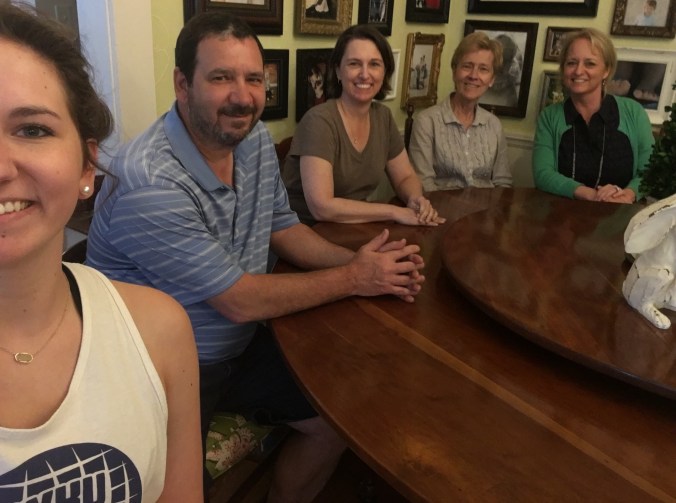
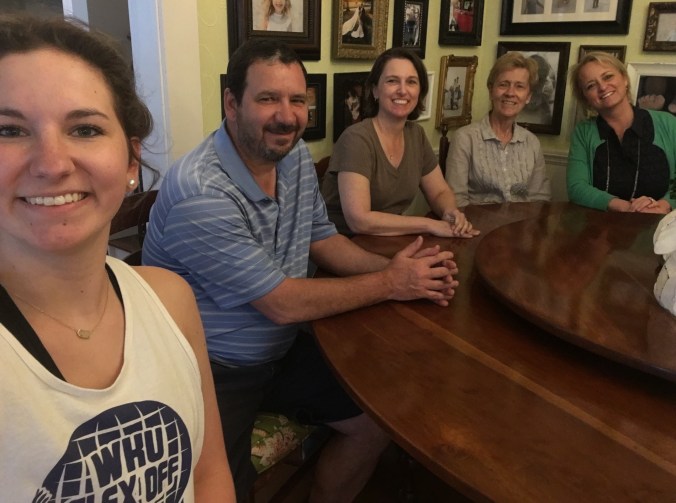
I hosted my Kentucky Kitchen Table at my home in Bloomington, Illinois. Around the table sat ten people consisting of mostly neighbors I have only spoken with briefly while walking my dog or getting the mail. A friend from high school and one of my mom’s coworkers also joined us. My mom and I cooked the main meal, but others brought wine, deserts, and appetizers to share. Going in order from left to right in the picture, first sat my parents Russ and Chris. Russ first started in the music industry and is now working sales for a company based out of Seattle, and Chris is in business improvement. Marilyn works in insurance at State Farm, Phil is Chris’s business partner at DuPont Pioneer, Karen has worked in Nursing since she graduated college in Bloomington, and her husband Tim retired from being the manager of a Nuclear Power Plant. Noi recently moved to town from Thailand and speaks limited English. She married George who is originally from India and has a doctorate in education. They spend the winters at his property back in India. Mike worked off and on in labor until becoming trained in Computer Science and is now retired from working in insurance. Finally, Quinn is a freshman nursing student at Illinois Wesleyan University and plays on the golf team. I chose this group because of the diverse stages in life, careers, and views on the world. Most of them did not know much about each other, so it created a space where we could speak as members of the same community and not as friends or family.

Our discussion started with the reasons why each person loved where they live. Bloomington is a small town in the sense that it is easy to recognize a friendly face at the movies or farmer’s market. There are events that bring people and families together downtown that show how the community values each other. Karen and Tim, who have lived here their whole lives, said they would never move to a big city. They would feel they had no impact over their environment and would have no sense of purpose in their community. This stress and fast pace is the opposite of the life they’ve built for themselves here. Having a voice that can be heard, seeing positive change happen where you live, and being a part of a community that means something to each other are common traits that the table found admirable. When there is a unified group like that which exists in Bloomington, each hand can be called on and people are given more power over what happens in their community.

Following this I asked what it means to be an active citizen. When I brought up this talking point there was an initial moment of silence. Marilyn shared that this was a question she hasn’t thought about in a long time. With going to work, spending time with family, and living out her daily responsibilities, being an active citizen is often left on the back burner. Others shared this same view and were struggling to define citizenship in their own lives. Russ said this is a result of the “I generation.” We live in an age where intellectual conversation is often avoided and people retreat to their phones, TV’s and computers instead of speaking to the people they encounter. Many admitted to living what they called a selfish life. It is easier to come home after a long day’s work and turn on a movie than it is to reach out to neighbors or participate actively in what’s going on in the community. This idea that citizenship is an activity that has become draining or caused a sense of guilt in many people is disheartening, but I believe it is a common way of life for many Americans. With each person specializing in their line of work, trusting that those higher up have it covered, people feel far away and separate from society. John McKnight wrote about specialization giving people less control over their lives. Working nine-to-five, and not seeing a direct impact takes the power from the citizen and puts it in someone else’s hands. Tim spoke about writing letters to the governor regarding Illinois becoming a sanctuary state. He was passionate about this issue, but felt there was nothing to do other than contact those above him. Others brought up how they wish they volunteered more but can’t find the time. Mike even said that if he had the choice he would live anywhere but Illinois because of the terrible financial state it is in, but he doesn’t feel like he has the power to change this, so he’s given up.

So how can people have more say over their lives and their influence in society? After talking about this for a while our table concluded that because Bloomington specifically is a wealthy town, housing two big colleges and State Farm headquarters, people are often inclined to just donate money to causes they remain distant from. By changing the mindset to a more hands on approach, we may feel more connected with society and therefore capable active citizens. They article, “Why Bother,” emphasizes the impact planting a garden can have on one’s feelings of independence and contribution. Active citizenship follows this same example. Encouraging young people in the community to pursue more trade labor jobs like construction and electrical work could bring people back in touch with their impact on the town. We could also take the time to pursue small issues that we have more control over, like Mike making some calls about the increase in trash pickup expenses that he believed were unfair. Lastly, we can come together more often and speak about issues or frustrations we are facing in the community. Almost everyone at the table told me after dinner how refreshing it was to have a space to discuss these issues and work together to come up with solutions. We’ve learned in class how important deliberation is, but I was surprised how much everyday people crave this form of interaction. It may not be that people don’t have the skills to deliberate, like Sternberg suggests in “Giving Employers What They Don’t Really Want,” but instead people are just not given the opportunity or environment to deliberate.

When it comes to what it means to be a citizen, George offered a much more heartwarming view. George spent some time working in London, and was exposed to a very hateful and racist culture. He was attacked on the street because of his race and was forced to live in fear of the people around him. He believes that he saw firsthand what citizenship means when he moved to Bloomington, Illinois. He told several stories that demonstrated the difference he saw in the people that lived here. One morning he grabbed the wrong coat on his way to work and realized he did not have his wallet when he pulled up to a gas station. The worker said it was no problem at all and told him to fill up his tank. George was overwhelmed with this man’s kindness and came back the next day to pay the man back. He insisted he keep his money and said, “I take care of my people.” George’s definition of citizenship is being a good neighbor. He came to America after being exposed to hate and violence and found a people that cared about each other. This is another important aspect of citizenship I think people often look over. Treating people with respect builds trust in a community and allows people to work better together.

Observing everyone at the table, I could see that this was an exercise that was making a difference, but needs to happen more often. There were some moments when we reached uncomfortable subjects, where people either crossed the line or played it too safe and couldn’t get to their point. “The Power of Patience” taught us that patience is a skill that must be practiced, and is necessary to listen and deliberate with other people. I also learned that citizenship has different meanings for different people. I can see how this would be important to define before trying to solve a problem or talk about an issue. Tim, who sees citizenship as doing your part to challenge the government and participate in political affairs, would probably go about an issue very differently than George, who sees it was caring for others in your community. I also feel closer to my home town. Hearing the voices of people with distinct roles and viewpoints widened my scope of what goes on in Bloomington. Carcasson talks about the value of having democratic focused conversations, but it isn’t until now that I realize what an impact this has on one’s connection with their community and their confidence in their ability to make change happen. This exercise in deliberation excites me to participate in more conversations like this and make a conscious effort to engage in my community.


Potatoes, Dessert, and Community

By Elijah

For my Kentucky Kitchen Table, I decided to host mine in my hometown of London, Kentucky which is roughly two and one half hours east of WKU. Leading up to my Kentucky Kitchen Table, I was honestly a little bit nervous about the conversations that were to come. Generally as a rule, I have been taught not to bring up politics, religion, or any other sore subjects at the dinner table. The night of the meal however, I was going to do just that. I also didn’t want to ask anything that would make anybody uncomfortable. To my relief, everybody at my meal was really cool and very honest about each of the topics I brought up. It also helped that whenever there was a small lull in the conversation, one of my guests was ready to step in and get the discussion going again. Let’s meet this delightful cast of characters.

First, we had a woman named Juanita who went to high school with my mom. She used to be employed in social work, but now she taught social work classes at Eastern Kentucky University. Juanita has a Baptist background. With Juanita was her husband Bill. Bill was the lone atheist at the table and he worked as a security guard. Bill is always a fun guy to be around as he always makes conversation livelier. Sitting next to Juanita was a very good friend to my family and me. His name is Alex. Alex has a degree from the University of Kentucky in chemical engineering. This fall he will be going back to school to get his doctorate in chemical engineering. He’s a smart guy. Although growing up Baptist, Alex is very open to religious diversity having attended different denominational churches. In fact, while he was at UK, he attended a Methodist Bible study. To the left of Alex was me. I grew up Baptist but I also attended many different churches. I really try to promote an atmosphere of religious and all-round diversity and acceptance. I am a freshman at Western and I began my college career studying mechanical engineering. I recently changed my major to strategic marketing however, and will begin taking business classes next semester. Beyond that, I am a very creative person and I love writing music and performing on stage. To my left sat a couple that I respect quite a lot. Their names are Dan and Debbie Eubanks and they moved to Kentucky from Missouri about five years ago. Dan and Debbie came to London because Dan was employed at my Baptist home church as our discipleship pastor. Dan and I instantly became close friends because of our shared dry sense of humor. His wife Debbie is also very involved in the church and is a very kind-hearted person. Ever since I have known them, Dan and Debbie have been great role models for me in my walk with Christ. To Dan’s left sat my cousin Donavon. Donavon just graduated from Union College in Barbourville with a degree in history and political science. He was also there on a soccer scholarship. How cool! He actually just landed a position to work with a very prominent politician in the state. Donavon’s church is non-denomination and is inviting of people from all denominations. Finally, next to Donavon was his girlfriend Destiny. Destiny grew up Baptist, has a degree from the University of Kentucky, and now is in social work. In her job, she helps put troubled kids with a good influence that also has similar interests as they do.

We had some interesting diversity at our table which brought fresh perspectives. For example, Dan who is a pastor sat across from Bill who was an atheist. We had generational diversity as well. Juanita and Bill are in their forties; Dan and Debbie are in their fifties; Donavon, Destiny, and Alex are in their twenties; I was the youngest of the bunch at eighteen. We also had a mix of republicans and democrats.

At the beginning of the meal, after we made our plates of course, I got the conversation rolling with my first question. “Beyond voting, paying taxes, and following laws, what does citizenship mean to you?” Because this was the first question and the guest were just beginning to get to know each other, it took a few minutes for the conversation to hit its stride. The table came to a consensus that it meant being a good person and having a positive influence on society.

Next I asked, “What social issue is closest to your heart and why?” Destiny said that this question was bringing out her inner social worker which resulted in laughter from around the table. She said through her work, she believes that a child coming from a home with a parent in prison for any amount of time has a major affect on them and that this is an issue not many people think about. Everyone at the table seemed to agree with her and we listened to her talk about working with children from this kind of background. During this particular conversation, I explained to everyone a concept I had been discussing in Citizen and Self called wicked problems. I told them the characteristics of wicked problems and gave a couple examples and said how the problem aforementioned by Destiny could be referred to as a wicked problem.

I noticed that after each question was answered, the conversation would come to a slight halt and people would wait for me to ask another question. I wanted the conversation to be natural so I told everybody to just talk about whatever they would like and I would occasionally ask another question. I wanted to be sneaky when bringing up the issues I wanted to discuss, so I slyly slid them into conversations. I overheard my mom talking to someone behind me. She was bragging on me which she like to do because let’s face it, I’m pretty cool. She was telling them about the part of the dinner I prepared which was the potatoes and the dessert (see a picture of the desserts below). I wasn’t the only person at the table at my table and I repeated it and effortlessly slid in my next question. I said, “Yeah, I made the potatoes, the dessert, and what kind of community do you want to live in?” Laughter ensued. After the laughing died down and several guest commended me for my efforts, Juanita answered the question and hit the nail right on the head. She said she would like to go back to a community where people would sit on their porches in the evening, you could leave your door unlocked, and people were friendlier. The table also agreed that we wished there could be more face-to face interaction rather than just texting and social media.

The conversation shifted for a few minutes to Donavon’s new job working for the prominent politician. After a few minutes, it was time to bring up my next topic. I waited for my chance and took it. “Hey, Donavon, now that your working for {prominent politician}, do you see your job as serving a greater purpose?” Honestly unintentionally, this time my segway actually made sense. I added that this question was actually intended for everyone. Destiny said yes. She said that she believed she was helping troubled kids get help they needed which ultimately served a greater purpose. Juanita also said yes because she was helping educate a generation of young adults. Donavon also said yes as he was helping a young, honest politician rise up so they could help people all around the state. The consensus around the table was yes although because Dan is a pastor, we joked that Dan wasn’t serving any greater purpose.

The last question I asked was, “What advice would you to people running for office in our country?” Although we joked at first and said they should lie and do whatever it took to get to the top, we eventually came up with some good answers. Everyone gave a good answer to this question. We discussed Dan’s answer, which was the most specific, the most. He explained that they should abolish Amendment 16 which would get rid of federal tax. This led to a small political debate before I gave my answer. At the end of the political discussion, I said that the ultimate goal of a politician running for office or anyone for that matter should be to help as many people as possible.

In Citizen and Self, we have done a lot of discussion about how beneficial deliberation is. During my Kentucky Kitchen Table, I really got to see a real-life version of this. It was very nice to sit around a kitchen table, eat a home cooked meal, and civilly discuss issues important to everyone at the table. In class this semester, we had a reading called “How We Talk Matters”. In the reading, Keith Melville points out that listening and deliberating allows issues to be solved rationally. This really proved true during my dinner. Further, I learned that when you bring people of different backgrounds together to discuss issues, you get a wide variety of solutions as well as different perspectives on the problems. Originally, I was only hosting the dinner because it was for a class, but after doing it, I would love to do it again sometimes. In a digital world, it is so relieving to sit around a dinner table and just talk to people, especially when it’s over a good meal.

Kentucky Kitchen Table

by Reid

We had our Kentucky Kitchen Table in my hometown of Belfry, in Pike County, a solid five hours away from WKU. I must say I was very nervous about doing my KKT, not only because discussing things like politics often get heated in my family, but also because the prospect of doing it for an assignment gave a whole new depth to that nervousness. In the end, it all went very smoothly, and we actually had a really great time talking deeper than we usually do with each other, not to mention the amazing dinner we had.

Seated around the dinner table were my dad, Kevin, who took a break from his mountain of work (he’s an accountant, and it’s right near the end of tax season) to make sure he could come to take part in the conversation. My dad was raised in a fairly traditional household, though he said that he didn’t really appreciate the values he was taught until he was already an adult and out of the house. Like most people in Pike County, he describes himself as a conservative democrat, and used the KKT to connect more with my little brother and I (both fairly staunch liberals) and understand how our view different from his, and why.

My mom, Shelia, a dedicated kindergarten teacher who always makes sure her sons do their assignments was also at the table. She also had a very traditional upbringing, but always understood why she appreciated them. She is the reason my dad began going to church, and is also the reason that my brother and I continue to go to church, despite our questioning of religion. She has influenced us all, in so many ways, regarding our faith.

My little brother, Ryan, who is just forming his own set of political opinions and used the KKT as an opportunity to round out his beliefs. He has had a sort of 180 happen to him over the past year. Where he used to hold the traditional values our parents taught us, he now has begun feeling his own way around the world, and trying to establish his own beliefs. He describes it as finding his independence, and I personally agree, as that’s how I described the same thing that happened to me. Of all of us sitting at the table, Ryan and I are the only two who weren’t Christians, both of us being agnostic.

My grandmother, Sheb, who insisted on cooking the entire meal, not because she believes she is a great cook, or that she must control everything, but because she couldn’t stand having people over to her house (where we did the KKT) and asking them to bring food with them. Sheb is probably the only person at that table who had not much to say. She’s never been a very talkative one, and even when we tried to engage her to step into the conversation, she hesitated. She describes herself as comfortable with her political beliefs, and not really one to stir up controversy.   

My grandfather, Cecil, who has shared several different political persuasions over the past 75 years and also saw the KKT as an opportunity to reexplore and redefine his political stances. Cecil is very outspoken, and not always politically correct, which made for some interesting conversations, but would never wish harm on an insect, much less a person. He is the oldest of us all at the table, and is the only one who is retired. His experiences while working the twenty-odd jobs he’s had added a sense of experience to the conversation.

And finally, one of our neighbors from up the hollow, Tina, who I’d only talked to in passing and never had a full conversation with, came to dinner to establish a connection with us, and get to know her neighbors better. During the conversation I learned more about Tina faster than I believed possible. I learned that she has two children who are both grown and moved away from Kentucky, she describes herself as a conservative democrat, but asserts that she’d rather give up her right to vote than vote for either of the last two candidates, and that she has never really sat down to ponder what citizenship means to her. She was probably the most fun to talk with, just because there was so much to find out about her.

I started the conversation with the required question “ Beyond voting, paying taxes, and following laws, what does citizenship mean to you?” Surprisingly, Tina was the first to answer. She told a story about her great-grandparents coming to America from Ireland, and defined citizenship as “the right to do all things American.” It was sort of a strange phrase at first, but once I started thinking about it, I thought it was genius. That question didn’t gather many responses, and so we moved on. I don’t remember many of the questions we talked about, as I didn’t write them down, but I do remember the answers I got to the question “What is the thing you love most about living where you do?” Ryan said he loved the interconnectivity of the small town we live in, and how “everybody knows everybody”. Shelia said she loved the attitude that most people held, and how they were ready to help everyone in need. Cecil said he loved how safe he felt living in the area, and Tina loved just being able to have a yard behind her house and a garden. She struck me as a woman who enjoys the simple things. My father’s answer had the most impact on me. He said “The thing I love the most about living here, is that I’ve never felt like I don’t belong here. I’ve never felt out of place or out of touch.” He went on to describe how he couldn’t imagine himself living or raising his children anywhere else, despite the decline of the coal industry, and the poverty and drug abuse that has stricken our little town. That stuck with me, not only because it involved me, but because, for my entire life, I had felt the complete opposite way. I’ve always felt out of place in that town, and the career I’ve chosen is specifically designed to take me out of it. My dad, though he’s given me countless amounts of wisdom and advice over my eighteen years, opened my eyes with only a few sentences, and made me question basically my entire life.

This reminded me of the reading about the snare of preparation, and how by being prepared, you sort of end up falling into a trap of your own design. Everyone has a tendency to over-prepare and sometimes it comes back to bite you. I had been preparing my entire life to leave my little hometown, and in fact, that’s why I came to Bowling Green in the first place, but in doing so, I’d lost the little magic that my dad relished about this place. I briefly described the main point of the reading, and everyone around the table gave their own stories of a time they over-prepared for something and found out they screwed themselves over. Most of them were funny, but a few of them were sobering, and one, given by my sweet grandfather, Cecil, was almost tear-inducing.

All in all, this assignment made me open my eyes to the differences in my family, and the similarities I shared with a stranger. I have to admit, I was loathing this assignment in the weeks leading up to it, but now I can’t believe I had not done something like this sooner. I believe that experience relates to the class more than anything. Everything we do in Citizen and Self might not make sense at first, but once you complete the task in its entirety, then you grasp the full meaning of it.

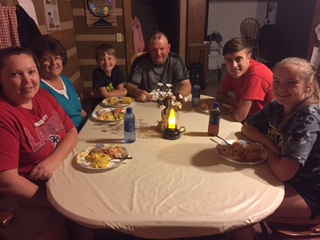
Note: I took the picture of the dinner table, and therefore am not in it. I’m if that violates any rules of the assignment.PEXD0712[1]

Healthy Conversation

By Bethany

My Kentucky Kitchen Table took place on a warm Sunday afternoon on the farm where I grew up in Hartford, KY. Participants included my two acquaintances Elizabeth, a marketing student, and Andrea, a psychology student. They brought along their two boyfriends, Hunter, a pre-med student, and Nathaniel, a participant of Chinese Flagship. My fiancé Seth, a paramedic, also attended. My parents, Karen and Brad, were the hosts. They are both members of the baby-boomer generation. My father is a manager at a local factory and my mother is a manager at a local restaurant. For everyone, it was our first home-cooked meal at a table in recent memory. This was also our first gathering together for the college students, and definitely our first time discussing topics outside of classes and our social lives.

We all shared a wonderful Italian dinner. My parents and I made the red sauce and noodles. Nathaniel and Andrea brought some delicious homemade brownies. Elizabeth and Hunter provided a wonderful white sauce. Seth brought us some zesty garlic bread to eat with our meal. My guests sat in the living room while my mother and I made final preparations for the meal. We set the table, got everyone their drinks, and soon after, we headed to the table.

To begin, we started off with some nice conversation about ourselves, our hometowns, and our aspirations. Elizabeth wishes to have a job in marketing with a business. Nathaniel also wishes to pursue a career in marketing, but is also fascinated by Chinese culture and language. He wishes to incorporate this passion into his career somehow. Andrea dreams going to a great graduate school and being a criminal psychologist. Hunter wants to go to medical school to be an anesthesiologist. Seth aspires to further his education and become a physician’s assistant. I would like to go to graduate school also. I want to get my masters of public health and make access to reproductive health services more accessible to members of my community. My parents, still young at heart, also have aspirations. My mother would love to publish a book, and my father dreams of gaining his pilot’s license.

I soon asked the first question: “Beyond voting, paying taxes, and following laws, what does citizenship mean to you?” Nathaniel spoke, saying that he feels that being a citizen includes having a positive influence on your community. He thinks that working to improve your community and helping others is a great way to do this. Everyone agreed on this. My parents added that citizenship means being a productive member of your community and working to improve yourself. To them, this meant having a job if you can work, helping your neighbors, and being a proactive member of the community. I questioned my table on what they thought we could do to be proactive within our communities. They answered that volunteering, participating in community events, building relationships, and attending community meetings regarding local legislation we all important to being a proactive citizen. We all also agreed that we could improve on doing these things.

My second question was: “What social issue is closest to your heart and why?” The table fell silent. It seemed as if everyone was kind of afraid to speak up. So I offered my answer: Healthcare. My fiancé, the paramedic elaborated a bit for me. He believes that everyone should have access to healthcare, but the issue with this that he sees in his profession is many people abuse resources like Medicaid. Hunter agreed with this, but pointed out that some people really do need those resources. We had found our first wicked problem. My father told us about what healthcare used to be like. Apparently, healthcare insurance did not exist before the 1980’s. He described how his father and mother would just write checks directly to doctors to pay for broken arms and doctor’s visits. Andrea asked how people could afford to do this. My father explained that healthcare was somewhat affordable before insurance companies came into the picture. It was after insurance companies that the price of healthcare skyrocketed to the prices of today. Elizabeth pointed out that everyone might not have been able to afford healthcare, even before insurance companies, which brought back the question of how can we make healthcare more accessible to other people.

I spoke and said if healthcare providers could come together to open clinics for people that operate outside of big insurance companies, perhaps then we could make healthcare more accessible. I told them my personal dream of opening a clinic for women and expectant mothers who otherwise couldn’t afford the care that my practitioners would provide. I hoped to set up affordable prices for services and exams, and to offer payment plans for patients without insurance. I also would enjoy to set up a network of practitioners, community members, and physicians who would like to see this positive change within the community. We agreed that coming together as a community would be helpful, but it isn’t necessarily realistic to always count on finding common ground.

My next question proved the most difficult to answer: “What do you think are the best things about our world today?” I immediately saw everyone making awkward eye contact and chuckle, as this was the weekend following airstrikes on Syria. The news lately was, for lack of better word, depressing. I acknowledged the tension, saying that yes, sometimes being positive was difficult, but everyone should always try to look on the brighter side of things. Nathaniel then spoke. He said that he felt everyone, in their own way and through their own opinions, genuinely did have the best intentions at heart. Everyone seems to care and want the best thing for others, even if we don’t all agree on what the best thing is. Seth said that this was especially true of our generation. He thinks that all of us want to improve our community in one way or another. My mother said that she enjoyed the resilience that people in our age tend to have to adversity. People today do not simply let others put them down. They fight back and try to promote positive change and they have hope for the future, despite everything. Perhaps things today are not as bleak as they seem.

To top off our dinner, I asked our final question, one that I felt would be pretty easy to answer: “What advice would you give people running for office in our country?” Elizabeth spoke immediately, saying that she thought that they should try to communicate clearly and honestly with citizens. They shouldn’t lie to us and give us false expectations just to get elected. Hunter agreed with this, and said that we need people in office who really represent us. We should shy away from career politicians and try to elect more business people, educators, and more citizens from diverse populations. We all agreed on this point.

I was pretty nervous about hosting this dinner. I have never done anything like this and this was my first time having this large group together. I was worried about a fight or someone possibly getting their feelings hurt. I was genuinely surprised with how well everyone got along. With my parents being baby boomers, and us being a part of generation x, I was worried about clashing opinions. But generally, we all had the same ideals and intentions, but different perspectives, which is a good thing. The topics discussed reminded me of the three questions we discuss in class. How can we live better together was encompassed in our discussion about citizenship. How can we take more control of our lives and help others do the same was related to our discussion about electing officials. How do we solve problems was a theme in our healthcare discussion. “How We Talk Matters” was truly relevant to this assignment. This passage highlights that deliberation is a skill that we must hone. Calm, respectful communication was key at the Kentucky Kitchen Table and is vital for understanding one another.

I am thankful for this assignment, as it opened my eyes to the opinions of others. I also helped me to not be afraid to speak my mind and express my feelings. It allowed me to better understand my parents and a few of my peers. These topics are ones we rarely speak of at home. This allowed me to get to know my parents better and to understand their thinking better. I won’t be as nervous to talk about issues with them because, as it turns out, we are not as different as I thought. I am also thankful for the connections with my peers, because without communication, we will never be able to make our future as great as we have the potential to.

Inclusiveness and Citizenship

By Christen

For my Kentucky Kitchen Table project, I decided to go back to my home in Springfield, Tennessee to have the meal. I chose to go home for this project not only because I knew it was where I would feel most comfortable, but also because I am moving to a new house in the next three days. I wanted to have one last formal meal in the house that I have grown up in for the last fourteen years. Although it was bittersweet to eat one last meal in my home, it was also a great experience that I learned a lot from.

I had a very interesting and fun group of people attend my Kentucky Kitchen Table. My mother Fonda, my younger brother Caleb, and my aunt Karen were some of the participants. My mother also invited two of her co-workers whom I had heard about, but not met at that point named Odaylis and Gelissa. These two women have very similar backgrounds that have helped them bond and become best friends. Odaylis, who recently became an official American citizen, is an immigrant that spent the first part of her life living in Cuba. She traveled to the states with her mother and grandmother, and now lives with her husband of two years who hails from the Dominican Republic. Gelissa on the other hand was born and raised in the United States. However, her mother’s side of the family is also of Cuban descent, while her father’s side of the family is African American.

Before starting the project, I was very worried that it would be hard to make the conversation flow. I was afraid that it would just be question after question answered with simple answers. However, that was not the case at all. It seemed that after the first question was asked, we just kept talking and talking. The conversation flowed so well that I often had to steer the conversation back on track. I started by asking the required question about citizenship, and being a new official citizen, Odaylis gave one of the best answers. To her, citizenship was of more importance than to a person that was born in the states and automatically labeled as a citizen. She thinks that being or becoming a citizen is about being apart of something bigger than yourself. She goes on to explain the benefits and the sense of inclusiveness that come with officially becoming a citizen. Somehow, the conversation went from discussing citizenship to discussing how to expunge certain behaviors off of criminal records. This conversation had nothing to do with any of the questions asked, but the information was very entertaining and overall useful.
After getting back on track, we next talked about the importance of community. Like earlier in the citizen question, overall inclusiveness seemed to be the theme. My participants also noted that they wanted to be a part of a community that was safe, open, friendly, and diverse. My mother went on to explain that these were some of the key things that she looked for when purchasing the new house that we are about to move to. Diversity and safety are important factors to her when choosing a new home because the neighborhood where we currently live is not diverse in the slightest.

Next, we discussed the importance of the job that my mother, Odaylis, and Gelissa do. They work for a healthcare company known as Bridges to Care. Again, the theme of inclusiveness and equity was brought up again. Everyday these three women strive to provide healthcare to individuals that my mother describes as “ people who have not been treated fairly”. She goes on to explain that these are usually people that don’t have any health insurance, not official U.S. citizens, and are also very poor. Because of this, these people are treated differently when they go to seek any kind of medical care. “ The bulk of our job”, she explains, “ is about making sure that people are treated fairly and are able to receive the services that everybody else receives”. Odaylis explains that she thinks that there line of work is important to her because in most cases, the people that come to Bridges to Care are all out of options. Bridges to Care are the only ones that will be able to help these people get the services that everyone deserves.

If I had to pick an overall theme for my Kentucky Kitchen Table would be inclusiveness. I think that inclusiveness is the key to one of the central course questions, “How do we live and work well together”. When considering plans that will help people of different backgrounds and different beliefs live well together within a community, it is important to make sure that everyone’s opinions, beliefs, and ways of life are taken into consideration.

Kentucky Kitchen Table in Small-Town Kentucky

By: Sophia
IMG_4908IMG_4909

This dinner took place in the small, but developed town of Owensboro, Kentucky at in my parents’ home where I grew up. My mother and father, Jennifer and Philip, hosted this dinner for Frankie, Jeanne, and myself. We gathered around to discuss citizenship and enjoy my mother’s homemade burgoo, Frankie’s cornbread, and a delicious rum cake provided by Jeanne. I prepared by helping my mother with the burgoo, setting the table, and cleaning up afterwards. In the picture we are seated (from left to right): myself, Philip, Jennifer, Frankie, and Jeanne. Jennifer is a Registered Nurse in the Neonatal Intensive Care Unit and currently pursuing a doctorate in nursing. She has a passion for helping others and is a talented learner. Philip is a supervisor at the Toyota Motor and Manufacturing factory in Princeton, Indiana. He commutes an hour and a half to and from work each day. Philip is a war veteran who is proud of his service in Operation Desert Storm but reluctant to talk much about his days of combat. Frankie is a retired state employer who loves spending time with her grandchildren and tending to her garden. She recently moved onto our street so we thought inviting her would make her feel welcome to our neighborhood. Jeanne was a former Human Resources consultant for the Health Park in Owensboro, Kentucky and currently owns and runs a children’s boutique called Kid’s Stop. I was worked at Kid’s Stop before Jeanne bought it and had to quit before she took over to move to Bowling Green. I went to see how the store had changed with her ownership and ended up inviting her to my Kentucky Kitchen Table. Following my mother’s footsteps, I am studying nursing at Western Kentucky University and share the same passion as my mother of helping others. I wish to further my education after obtaining a Bachelor’s of Science in Nursing by pursing a nurse anesthetist degree.
To begin our discussions, I first started with asking each guest what citizenship means to them beyond voting, paying taxes, and following laws. Philip, who feels underappreciated by the American government for his eight years of service, believes citizenship entails certain rights in which he respects and actively exercises. He believes he has earned these rights, as a citizen and a soldier, through his service in war. Other than my father’s opinion, a common theme amongst the other guests was that citizenship is being actively involved in your community and engaging in bettering the lives of those living in your community. Jeanne mentioned something unique that stuck well with me: “Citizenship is also having a voice in your community and your nation’s society.” After all agreeing to this, we discussed citizenship being in the context of a verb: in order to be a citizen, one must be engaged in their community and in making it a better place. Jennifer talked about her years of community service as an active member of the Owensboro Junior League and how she feels she made a difference in the people’s lives for which her services were helping. “Our main focus was concentrating on issues and services in the community that were actually going to help people for longer than a day or two” By this she meant, for example, working with those in homeless shelters on reading skills. Jennifer feels as if, by doing services like this, she was giving people opportunities to better themselves and their lives by sharing and teaching helpful skills. The other guests shared times they felt they had done their duty as a citizen and helped their communities in various ways. Frankie enjoys taking her 20-month old granddaughter to the animal shelter and feels she is brightening the lives of the animals of the community and, in turn, helping the community. Jeanne tries to do various community service but finds she does not prioritize it and it, therefore, gets put on the backburner. She also tries her best to help the parents of Owensboro by offering higher-end children’s clothing and doctor-recommended children’s footwear for more-than-fair prices at her boutique, Kid’s Stop. She often has sales where she will make no profit off of her merchandise because she believes it is her way to help her community. I am required to serve a minimum of fifteen hours of service a semester for my sorority at Western Kentucky University.
After overall agreeing that an important aspect of citizenship is serving and bettering the community, we got a little side-tracked. Jeanne shared the struggles and excitements of moving Kid’s Stop to a different location. After many congratulating and encouraging words from the other guests, I directed our conversation towards politics in America by asking, “What is the most impactful decision the Trump Administration has made since being in office?” My father was the first to respond by saying he believed the recent bombings on Syria have been the most important and impactful decision made thus far. My mother and Jeanne quickly added nods and words of approval while Frankie shook her head expressing her disapproval. My father elaborated on his first statement by arguing that president Trump was decisive and has reminded the world of America’s military power. Jeanne agreed and mentioned that this decision was a “nice alternative to the Obama Administration who always said they would do something about gas bombs and never did.” Jennifer chimed in by saying that the people, especially the children, living in Syria need someone as strong as America fighting to stop the torture and killings, and Trump has shown that America will fight for them. Frankie disagrees; however, she understands why the decision was made. She fears another Cold War, or worse, more terrorist attack on American soil as a result of these bombings. Although afraid of the possible outcomes, she agrees that something needed to be done to help save the people Syria.
After feeling like we had discussed enough about the dreaded topic of politics, I decided to brighten up our conversation a bit by asking, “what kind of person do you want to be?” I was reluctant to ask this question because my parents and our guests are not young adults. But after some thought, I realized this question is not, “what kind of person do you want to be when you grow up,” but “what kind of person do you want to be each and every day?” I felt like Frankie had read my mind and knew my initial concern with my question because she quickly answered by saying, “I am 77 years old and I work each day to be the person who God wants and who I want to be. It is a life-learning process.” She went on to explain that she wants to be someone who her grandchildren look up to every single day. Someone who helps others and is empathetic of others’ situations. “With every encounter I have with someone, I try to keep in mind that this person has different experiences than me; therefore, has different feelings and opinions that I must appreciate even if I don’t agree.”
This made me think of one of the central questions of our course: “How do we live well together?” I think Frankie’s response to what kind of person she wants to be is one of many ways to answer this question. I brought this question up to my guests, telling them that it is one of the centralizing questions of this course, and my father’s response was interesting. He said that he had never thought of solutions to that question before and mentioned that the way Frankie tries to encounter people is a good start to people living together well.
I thought this was a good closing point for what I wanted to know for my Kentucky Kitchen Table project so I did not ask any more questions and allowed our new friends to genuinely mingle with my parent’s and me. Learning what we did about Jeanne and Frankie created the foundation for a strong friendship in which we all plan to keep.

Kentucky Kitchen Table – Michaela

By Michaela

My Kentucky Kitchen Table project took place in the town that I live in, Franklin, Kentucky. I knew many of the people that joined us during this project, but there were two people in particular that I did not know well named Jennifer and Jessi. The others that participated in this project were named Jordan, Atalie, Ben, Destiny, Kaitlyn, and James. We had all met Jennifer and Jessi previously, but none of us were very familiar with their views or their personalities. A woman named Wanda had learned of this project and had insisted upon preparing dinner, giving us the options of spaghetti and fettuccini. Atalie cooked chocolate chip cookies for dessert.

Before we ate dinner, we played a little ice-breaking game of Speak Out to get some people laughing, particularly the people in the group that we were not completely familiar with. This was a great tactic, and it seemed to relieve some of the tension resulting from there being unfamiliar people. Jessi and Jennifer were familiar with one another, but they did not closely know each other, so they were quick to get in a group together. The rest of us had our close friend in the group that we automatically paired up with in teams. After the game, we all settled in to eat and talk together.

We didn’t have a super diverse group of people during this project, but there was some diversity in political views and religious views. Atalie and Jordan are married. They are strong, church-going Christians, and they have very conservative views. They are very nice people and are very giving to our church.  Ben is also very kind and Christian, and he has the heart of a missionary; he loves to travel anywhere and everywhere that people are in need, and he also loves to help people in our community. Destiny is a hard-worker and comes from a very low class family. She has had to work all of her teenage years and supports her immediate family with her work. She goes to Bowling Green Technical College for the sake of keeping her finances under control. She is very conservative and is very compassionate toward those in need. Kaitlyn is a singer and is a very hard worker. She previously went to Western Kentucky University but was unable to continue due to certain circumstances. James comes from an extremely conservative family, and he is very strong in his Christian views and in what he believes. As we learned during this dinner, both Jennifer and Jessi are fairly liberal with their points of view, and Jessi is not Christian. At the age of 18, Jessi had a baby while still in high school, and she has been in a battle for child support ever since. Jennifer has no children, is single, and works very hard in her job. These diversities led to some interesting and thought-provoking conversations.

Our first topic of discussion was citizenship. I asked the group what citizenship means to them, other than the basic requirements of voting, tax-paying, and following laws. The group agreed, despite our varied views, citizenship means to be an effective part of society and to actively promote our various views. Jessi and Jennifer agreed that this meant promoting and actively seeking equality for all people regardless of race, sexuality, gender, or religion. Everyone in the group agreed with this to a degree. The more conservative people of the group did not believe that it is necessary to celebrate diversity, but they believed that it is acceptable and good for there to exist diversity. Ben even said, “Diversity is important for a functional society, and it is important for all people to be treated equally. No person is more important than the next; because of this, those that are diverse from the “normal” people should not be celebrated. Celebrating diverse groups of people does not allow equality for those that aren’t considered ‘diverse.’”

The conservative views in the group suggested that citizenship meant to protect what we believe in, no matter the cost. They agreed that, because of this view, some of the most honorable members of society, and the most underappreciated, are soldiers. The more liberal of the group agreed with this, but they claimed that what they most believed in was equality for all people of different sexualities, race, gender, or religion. This brought a little tension in the group as the majority of the group did not believe that “celebrating” diversity was most important in their lives, so the topic changed fairly quickly as the tension quickly grew stronger.

Upon prompting the group, we next began to discuss our ideal communities to live in. Having come from such a tiny town as Franklin, most of us agreed that Franklin is fairly ideal. Jessi and Atalie, though, suggested maybe a slightly larger town would be ideal as long as it held the same support system as Franklin. We all discussed how lucky we are to live in a town that, when someone passes away or leaves, we are all able to mourn together, and nobody living there is ever alone. We also discussed how, similarly, when a new family or even just a new person moves into Franklin, the whole town is quick to welcome them. I agreed very strongly with this, having come from three hundred miles up north myself only five years ago. I told them all how, when I moved to Franklin, it seemed like half the town was at our doorstep on moving day and how it seemed like the whole town was at church that Sunday to hear my dad preach there for the first time.

This conversation about Franklin led directly into our discussion of whether or not we knew our neighbors. Ben’s first reaction was immediately yes; his whole extended family owns houses around his house. Although, after considering his other neighbors, he realized that there were plenty of other people living around his house that he has never spoken to because their paths have never really crossed. Atalie and Jordan live in a neighborhood, and they know their neighbors that live right next door but do not know the neighbors down the street because they have only lived in their house for a little over a year. James said he did not know his neighbors well, due to the fact that his family has just recently moved into a new house. Kaitlyn, however, has lived in the same house her whole life and knows all of her neighbors directly beside her and down the road from her. Jessi knows her neighbors because she, too, has lived in Franklin in the same house her whole life, and she has even begun to raise her child in that house with the support of her parents. Destiny lives back and forth between Franklin and Bowling Green. When she lives in Franklin, she knows all of her neighbors because she has lived there her entire life; however, in the house that she sometimes lives in in Bowling Green, she does not know her neighbors because she does not live there full time and never has. Jennifer has only lived in her house for a few years, but she is very social and enjoys getting to know those that live around her. She knows some of her neighbors, but there are still some that she does not know because they keep to themselves. I told them all of how I know my neighbors, though I have only lived in my house for five years, but in the city that I used to live in, I did not know my neighbors because the only interactions we had had with them were negative interactions.

I then prompted the group as to how they thought we could improve our relationships with those around us. I suggested that perhaps trying to get a better understanding of people and of their backgrounds would help us gain a more positive view of who they are. Destiny agreed with this and said that sometimes her interactions with people were negative because of miscommunications and misunderstandings. She said that if we took the time to get to know each other better, we would have far less misunderstandings and miscommunications. It would give us a better sense of what to expect from specific people.

I thoroughly enjoyed participating in this project because, while many of the group members participating were my friends, there were also two that I was very unfamiliar with that had very different views than the rest of us. I thoroughly enjoyed getting a better understanding of Jessi and Jennifer, and I really enjoyed getting a better understanding their views and where they came from. I also, of course, appreciated the time with my friends, but I got a better understanding of their backgrounds too. It was nice to sit and have a focused conversation and to intentionally discuss their backgrounds, and a lot of the people in the group did not know about the places that I have previously lived, and I think they all enjoyed hearing about where I used to live as well. I really enjoyed having a civilized conversation with people of a democratic point of view because so often we get so defensive of our stances in politics that we never take the time to listen to opposing point of views. I appreciated being able to relate our civilized conversation  to what we discussed in “How We Talk Matters” because it is very true that so often we just automatically scream at people without taking the time to understand. A lot of the time, I think we need to have times like this in our Kentucky Kitchen Table Project in which we are forced to sit down and have a nice conversation with those that are different than us.

Williamsburg Kentucky Kitchen Table

KENTUCKY KITCHEN TABLE

By Ryan

Williamsburg is a very small town with little to no diversity in the population to speak of. This town is, for the large portion of my life, what I called home and today- hundreds of miles away- the town still impacts my perceptions of the world. Returning home after over a month of absence was, of course, a needed aid to the homesickness I can occasionally feel. However, much more rewarding than any remedy to my nostalgia, I returned with purpose and an assignment to complete- my Kentucky Kitchen Table.

Naturally, my mother- who must constantly be aware of the everyday workings of my family- was informed of the dinner and the purpose it would serve. Of course mother insisted that any thing she could do to help me ace an assignment should be done. So, believing that my homecoming could be even more exciting with close friends and family, she decided to invite around twelve people. As mother and I often do, we politely debated why this would not be an effective endeavor and I encouraged her to limit the number to ten people. Fortunately, the people that she had invited had prior engagements but we were still able to draw in what I would call (as it relates to Williamsburg) relative diversity. My mother was able to get my father and sister to participate in the dinner- a task that may sound simple but, in actuality, involves coordinating with a highly independent teenager and an insistently stubborn adult. Further, we were able to have my mother’s best friend, Stacy, and Stacy’s daughter, Macy, in attendance. So, in total, we had six people in attendance: Sheri (my mother), Alan (my father), Hailey (my sister), Stacy, Macy and, of course, myself (the outlier). I also wanted to encourage everyone to make something, despite my mother’s insistence that it would be rude to invite guests and then expect them to cook. However, Stacy and Macy did make homemade brownies for desert and I brought in rolls and drinks for the meal (a settlement that satisfied my mother as she got to cook the rest of the meal). I felt that I was able to collect a relatively diverse group of people even though there were only six people in attendance. I also felt that having perceptions from two generations would offer a mix of opinions while, at the same time, I would be able to get opinions from a variety of opinions from individuals of different career fields. My mother works in public administration in our local health department and my father is a history teacher at our county’s alternative school. With Stacy as a nurse, I felt we would have opinions from individuals with differing incomes and experiences.

Despite being raised in this town where very few people seek higher education and, I imagine, even fewer attempt to place themselves outside of the world that they are exposed to every day, I was pleasantly surprised at how productive my Kentucky Kitchen Table was. While deliberative engagement might not be a term that is tossed around frequently in Williamsburg, it is certainly a subject that I wanted to bring up during my dinner. Our class had a list of pre-selected questions that I chose to go through and then subsequently ask for answers to follow-up questions. While I was able to predict some of what the table said, I was not able to completely conjure up what every individual person would say. What did not surprise me was the frequency in which religion or, specifically, Christianity and its moral teachings were mentioned.

Williamsburg, centered in the bible belt and my family- centered around the bible- are both unsurprisingly insistent upon the application of scripture in every day life. However, despite this strong belief of the scripture’s varying applications, both my family and our guests admitted to knowing very little about scriptural teachings and instead presented that their foundations lay within only what they knew of the bible or what they inherently believed was moral. I am the outlier in my family because, as previously mentioned, I am not religious and I do not draw my morality from any scripture or religious doctrine. It seemed that my assertion that morality was largely dependent on the individual was followed by responses of various statements to contest the allegation. The primary argument was that we should draw all of our morality from the bible. I found the assertion interesting for a variety of reasons- the largest being that they had stated before that they knew very little about scriptural teachings and instead drew their morality from what they “felt” was right. I suggested again that morality was subjective and, again, was met with shows of disapproval, despite the fact that they had just said the same thing. Citing “feelings” as a source of morality seemed to be, not only acceptable, but widely believed. It seemed as though the group drew a distinction between a feeling and a subjective belief- though what that distinction is I am unsure. What I do know is that I was unsurprised. Not simply because of the circular reasoning or their unwillingness to use the word “subjective” directly, but more so because I knew that, at least in Williamsburg, the spiritual feelings that they were citing as their source of morality were shared by a large portion of the populous and therefore could be much more easily understood. While religion was certainly not what we focused on during the dinner, it plays a very obviously role in my community and therefore was necessary to discuss.

What did surprise me were some of their responses on citizenship and the roles that we need to play in our local and global communities. Because Williamsburg is indeed such a small town, I erroneously assumed the groups limited experiences with cultures prominent outside of our town would, in turn, create perceptions that were very culturally insensitive. To be perfectly clear, there were some instances where this was indeed the case; such as when Stacy claimed that she had to give an injection to the child of “an illegal.” While I recognized that some of what was said was, indeed, culturally insensitive, I also recognized that their prevue of understanding was largely limited to what they were faced with daily in Williamsburg. Despite the side-comment about the “illegal”, Stacy also made a few points that I thought were very uncharacteristic for most people in Williamsburg. Citing the current situation with the United State’s Syrian refugees- individuals that are often met with scrutiny by a good portion of citizens in my small town- Stacy claimed that it was not only a Christian’s duty to help the less fortunate, but also our duty as global citizens to help one another through difficult situations. For the most part, everyone at the table agreed that in the situation of refugees, it was our duty to help in whatever way we possibly could. My mother cited our experience in Haiti as her reasoning for aiding those across the globe who demonstrate true need. I was honestly very surprised that the subject of refugees not only came up with very little debate, but also with a very clear desire to help the population of another country so foreign to most in my town. I will never forget the day in Honors 251, when we were going over the various beliefs and they were largely affected by what we saw every day. For example, Professor Gish stated that, while her family was mostly opposed to the United States accepting refugees, they would certainly accept one into their home and do as much as they could for them. Up until this dinner, I felt that my family would feel the same. Perhaps my family and our friends made this realization as well and therefore are now able to express a firm belief that the US should do what it can- just as individuals should.

I will reiterate that we talked about many more topics over the course of this dinner, however, they all were intentionally focused around our identity as citizens and how we came to develop these outlooks on our world. I believe that in just a few topics alone, I was able to discern more about my family and our friends’ outlooks on life. I believe that what I learned relates very closely to one of the central themes in our class: “How do we live well together.” I think that by understanding our identities and how they can relate to our perceptions of the world around us, we are better able to think about or adjust our biases accordingly. While the vast majority of people in Williamsburg draw their identity from conservative values, they do not all necessarily agree with every every aspect of the political philosophy. I believe that this held true with my very conservative family expressing that we should be doing more to help the refugees rather than simply turn them away. If our mission is to live well together, putting on someone else’s shoes and choosing to walk a mile in them is a magnificent way to start that process.

Ultimately, I took away from the dinner that perhaps I had taken my family and my town for granted when it came to their opinions. In suggesting that my parents and our friends had never tried to see the world from someone else’s perspective, I neglected to think that, perhaps, I was not trying to understand why they believed how they do. I believe that the most important lessons I learned from my Kentucky kitchen Table are as follows: because you are familiar with a person’s beliefs does not mean that you fully understand why they believe what they do; further, only by understanding our identities and attempting to understand the identities of those around us can we reach that ultimate goal of living together harmoniously.

Kentucky Kitchen Table

By Peyton

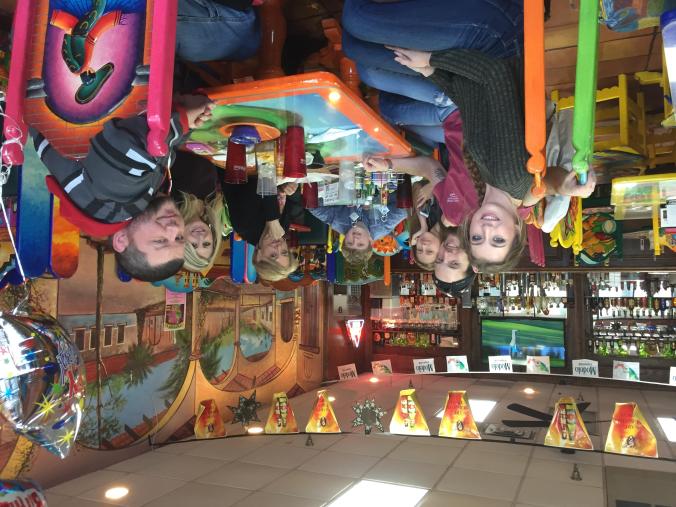
This Kentucky Kitchen Table was a very new and interesting learning experience. It took place in Somerset, Kentucky at a local Mexican restaurant. The dinner consisted of a variety of people, all of which brought great insight to the project and conversation as a whole. My step dad, Wes, was there. He is a local photographer who loves working with and around other people. He was also the reason we were all gathered together, it was his 40th birthday. My mother, Chrissa, was there as well. She is 38 years old and a CPA who also works in the stock market; she is very much a “numbers” person and enjoys figuring out patterns and probelms. My grandmother, Rita, was also present at the dinner. She has recently turned 65 and although I very rarely get to see her, I greatly admire the fact that she is a jack-of-all-trades. She has been hired to do several jobs such as work at the courthouse, law offices, insurance agencies, and many more things. My boyfriend Randy was there as well. Randy is 19 years old and is majoring in construction management. He is also one of the easiest people to get along with and enjoyed engaging this conversation. My little sister, Maddie, also joined us. Maddie is 13, however if you ask her she will make it very clear that she is 13 and three quarters. She’s a very sweet girl who doesn’t know what she wants to do when she grows up, but she wants to try and help as many people as possible. And last, but not least, my younger brother, Blake, was there as well. He is 15 and tends to keep to himself, but he loves technology and hopes to learn how to build computers.

Through out this dinner, we talked about a wide variety of things. We started out by having everyone answer the required question of “Beyond voting, paying taxes, and following laws, what does citizenship mean to you?” Some of the answers I got for this question were incredibly inspiring. Maddie told me that she believed citizenship meant doing the right thing and helping people in your community when you can. Blake told me that it was being nice to everyone. He stated, “When you have citizenship, you are part of a community. So you need to care about and be nice to the people close to you. Everyone needs each other, so just be nice.” Randy said that he believed citizenship was “working together to build not only a better future, but a better today as well.” However, Rita’s answer was probably the most entertaining. She said that “citizenship is when you’re surrounded by people you love. You don’t have to like them, but it makes life a whole lot easier if you at least love them.”

Some other aspects of our conversation included things such as broad questions about the world we live in as a whole and then much more personalized questions such as which social aspects we all care about as individuals. It was also very interesting to see the differences in the types of communities everyone wanted to live in. It seemed as if there is a major generation gap with the answers to this question. For example, Rita wanted a very close nit community, one in which everyone knows each other very well and on a deep, personal level. However, my mother and step dad wanted much more privacy. They did not care whether or not they knew everyone in their community; they just wanted to keep to themselves. But Blake, Maddie, and Randy’s answers all provided a wide variety of options. Blake wanted some anonymity, but still wanted to know at least some people in his town, such as his neighbors. However, Maddie and Randy wanted much more deep and personal connections with the people they lived near. They wanted a much more personal sense of community in which everyone was very involved and caring towards each other. I thought it was very interesting to see how the oldest generation present wanted no anonymity, the middle generation wanted all of it, and the youngest generation seemed to have a split between the two. These differences added to the diversity of the conversation and everyone seemed very happy to hear how the others felt about it.

Another component of the conversation that I think is worth mentioning is the different types of ways that people answered the question “what kind of person do you want to be?” Everyone seemed to be on the same page of “I want to be a good person.” But after hearing this generic response we all dove into what being a “good person” meant for each person that was present. After much discussion, we came to the conclusion that being a good person is a very broadly defined concept and almost everyone changed his or her answers after this conversation. They were changed to things such as “I want to be a more understanding person,” “I want to be a kind person,” and “I want to be a trustworthy person.” These are all things that everyone thought a good person and a good citizen should be in order to be better help serve and take part in the community as a whole as well as improve their own personal lives.

An important aspect of the KKT was when the question “is there anything you can think to do that might make things better for you or your neighbors where you live?” everyone seemed to displayed different thought processes and responses to this question, but it is very important to note that everyone did want to do something to help better the community around them. Some people at the table seemed to go towards a more personalized approach, such as going around and doing nice things for each of their neighbors one at a time such as raking their yards or offering to help them with individual tasks. While others wanted a more broad approach, such as starting a community garden or starting a neighborhood watch program. However, everyone seemed to focus on what they could do to help others, instead of themselves, and I thought this was very aw-inspiring.

What I learned from this was that everyone has their own ways of viewing not only the world, but the community around them as well. The diversity in generations, genders, and where and how people were raised seemed to play a factor in how they perceived citizenship. However, there were some similarities that I think helped bring everyone together such as the over all theme of “be a good person/citizen” and “help others.” But I also think it is very important to not only recognize, but celebrate the differences that we all have as well. Everyone seemed to place emphasis on different aspects of the conversation; for example Maddie had a lot to say about what social issue she cared about (bullying) while Rita really cared about advice she would give to people running for office. I believe that this diversity helped to further the conversation and help enrich not only this conversation, but the entirety of our lives as well.

I believe that this relates to our class in a variety of ways. For example, this conversation reminded me of our weekly deliberations very much so. In our class deliberations, typically everyone participates and contributes to the conversation. We also are presented with several different views on the same subject material. Also, our deliberations take place in a “safe place” where people could freely express their opinions on different subjects. This is very similar to how my KKT went. Everyone that was present took place and added several different, but valuable contributions to the discussion and shared the way they truly felt. The deliberation type style helps to contribute to how smoothly the conversation went and I also think that this setting helped everyone feel as if they could freely say how they felt about each issue.

This also relates to the honors 251 course because both our class and this KKT shared the commonality that it covered citizenship and individualism. In both of these contexts, a bridge was discussed as well. We often talk about where we are and how we will get to where we want to be. By improving our individual selves and working together as a community, we will be able to get across the bridge and not only improve our citizenship skills but improved the world in which we live at the same time.

I am very appreciative of this experience. It was a wonderful way to get to see how people in my community felt about different issues that impact their daily lives. It was incredibly eye opening and helped me become more open minded, this is also something that this course as a whole has done for me. I am pleased to say that this KKT went very well and I am happy that it was a requirement for this course.

IMG_6259

(I am very sorry my photograph is upside down, I do not know how to fix this.)