Kentucky Kitchen Table Project

By Bradford

Processed with VSCO with a5 preset
My family has never been the type to eat dinner together around the kitchen table. Typically, whenever meals were ready, we would each grab our own plates and head our separate ways. That being said, it was nice to have a reason to actually sit down with each other, not only to eat a nice meal, but also to delve into the meaning and importance of citizenship in today’s society.

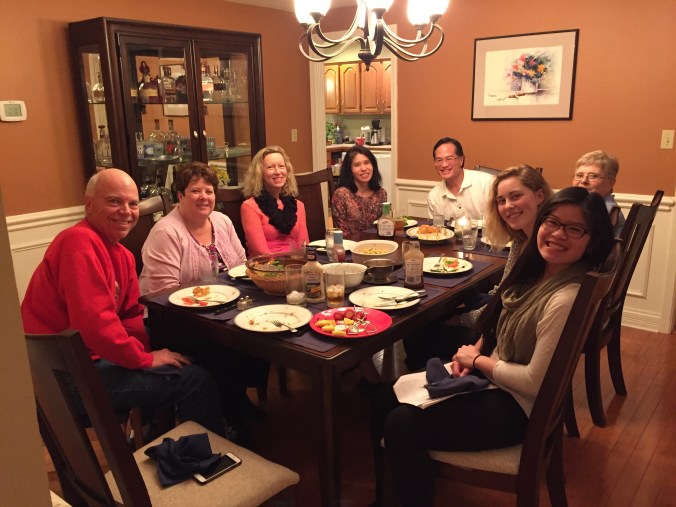
We had a diverse group at the table. My parents, Angela and Brian, are both extremely conservative Baptists who have never attended college and who have lived in Louisville all of their lives. My brother is currently a freshman at the local community college. My sister and her boyfriend, on the other hand, are both currently in high school; Amber goes to the local public school, while Mitchell goes to a local private school. Also, at the table, was my sister’s friend Megan. I had never met Megan before and she differed from my family in a lot of ways. She is originally from Pennsylvania but recently moved to Louisville. She considers herself a Democrat and a devout Catholic who loves to travel the world. Everyone offered a lot to the conversation and we had a wide array of opinions at the table.

The first question I asked was, “Beyond voting, paying taxes, and following laws, what does citizenship mean to you?” My mom mentioned that patriotism was a big thing for her. In her opinion, being a citizen in the United States was something that you should be proud of and that you should show. I had never really considered this as a “duty” associated with citizenship. Other answers to the question seemed to focus around freedom. To many individuals at the table, being a U.S. citizen meant that you get necessary and important freedoms, such as freedom  of speech and freedom to own a gun.

Something interesting that also came up during the dinner was the topic of homelessness. Megan mentioned that she recently read an article that talked about how homeless people in bigger cities can now register for specific cards that allow them to get donations from people put on their card. That way if, for example, someone doesn’t have cash on them, they can still help out the homeless by sending them money to their card. Some of us at the table thought that this was good news because it meant that it was easier to be kind and help people out. Others found it disturbing because it meant that it was now easier for homeless people to not attempt to find a job because they could get donations easier. This relates to what we talked in class about how sometimes people get too reliant on aid systems and structures that they don’t attempt to get out of their situation.

The topic of kindness and whether we have a duty to help others out was also brought up. My dad agreed that we do in fact have a duty to be kind to others. He mentioned that kindness is sometimes hard to find in the world but it’s definitely still out there. My mom agreed with him, though to a lesser extent. She believed that there were only certain situations where we needed to help someone out and that it was not necessarily always our duty. Megan on the other hand, said that she did not feel that we had any obligations to anyone else. She believed that people can typically fend for themselves. This was interesting to hear because it definitely counterbalanced the southern hospitality nature that my family and people in my area have.

In conclusion, I think that everyone at the table would agree that the Kentucky kitchen Table project was an enriching experience for all of us. Even my sister and her boyfriend agreed that, although they didn’t feel experienced enough to talk about some of the issues and topics, they learned a lot from hearing us discuss them. My family, as well as Megan and Mitchell, mentioned that the only time they really had dinner together with their families was on holidays. They all agreed that they’d like to change that and make it a daily thing because they felt it brings everyone closer. Personally, I couldn’t agree more.
Kentucky Kitchen Table Project: What Really Helps?

By Katherine

KyKT ProjectIt’s interesting where the unexpected can take you. When I first heard about this assignment, I thought it was odd and it may simply be an awkward dinner. However, it ended up being much more than that. While it did end up meeting the expectation of being slightly awkward in the beginning, the conversation eventually began flowing and it challenged me to thinks in news ways.
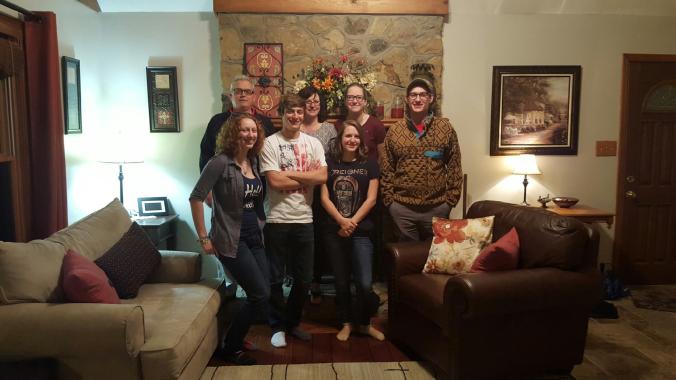
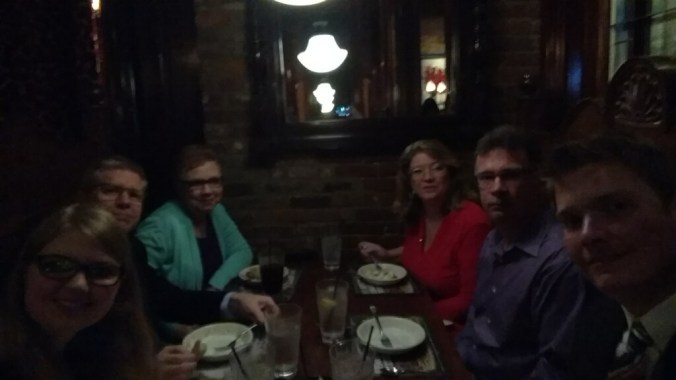
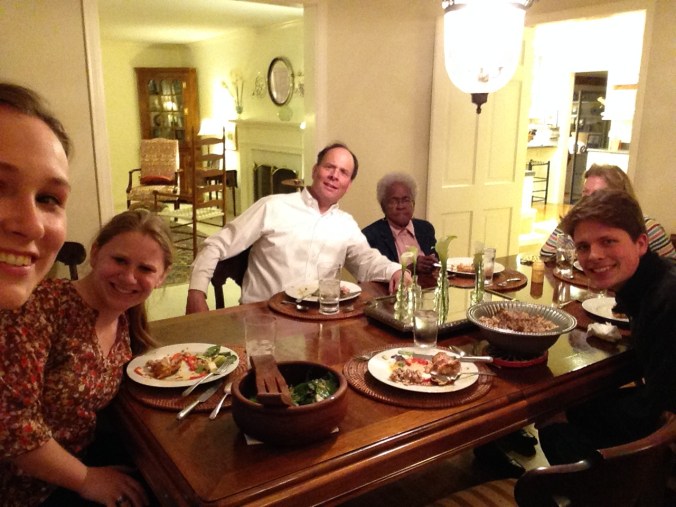
The dinner took place in my hometown Somerset, Kentucky with a family that graciously allowed me to bring a dish to their dinner table in their home. We have been family friends for over five years, and I know Becca, Leisha, Mike, and Hannah very well. However, I did not know their guests Bethel and Stella. Leisha and Mike are a middle-aged, married couple with two daughters, Hannah and Becca. Becca and I were best friends throughout middle and part of high school, and she now attends Belmont University where she is working on a degree in Theater Production. Hannah is a graduate from Western Kentucky University where she completed the Chinese Flagship Program, and she is now attending seminary in Louisville. Hannah also spends her time working with Scarlet Hope, a faith based organization that seeks to help women in abusive relationships as well as sex trafficking. Bethel is a Filipino young lady who grew up in a family that are full time missionaries, and she is going to seminary with Hannah to become a therapist and eventually return to the Philippines to also be a missionary.  Stella is a German exchange student in the Chinese Flagship Program at WKU. With the combination of these diverse perspectives and walks of life, the dinner conversation was full of differing experiences and opinions that made it an enriching evening.

The meal started with me explaining the purpose of the assignment and asking each to share a little about what they do as citizens to help improve communal issues. Hannah spoke of her work with Scarlet Hope, Becca talked of volunteering with minority support groups, and Leisha explained her active involvement in our church. One aspect of the Citizen and Self class that intrigued me was discussing how service can help but also hurt, so I asked how they thought their service made an impact and if they had seen any examples of service that did more harm than good. Hannah explained that she knew that simply removing those women from their situations would not help them in the long run; they would return to it eventually because the mental damage was instilled in them. Lasting change came from meeting their deeper emotional and religious needs. Bethel shared a similar message as Hannah with her experience working in her father’s church in the Philippines. They had a program that fed homeless people, but this was simply used as a gateway to meet their deeper needs. The healing that has come from both programs has stemmed from focusing on subsurface needs, which is what they agreed truly helps in terms of service. Mike and Leisha offered an example of aid that did not successfully help. They used to attend a church that would give financial handouts to those that stated they needed it, but this only created a dependence on assistance and most people would exploit the system and use the money for unessential items. This reminded me of the organization I spent four weeks with in Haiti last winter break since they refused to give any handouts. They provided community life skills classes that taught people how to work and support their families instead of giving away money. The themes of improvement through teaching how to support as well as meeting nonmaterialistic needs was beginning to emerge throughout our conversation.

Another aspect of service that we discussed focused on how much culture influences the ways in which we try to help others. Churches are generally supposed to be a place of refuge that offer services to help those in need, but Becca brought up the issue of how “Americanized” churches are in the United States. People seem to have to dress, act, and talk a certain way to be considered a normal member of the church. Outsiders that look different from the usual, middle class church goer are much less likely to be welcomed. Hannah reinforced the point with a story about a former prostitute whose life had been transformed by Scarlet Hope. This women was covered head to toe in tattoos and had bright, red dyed hair. Even though her appearance looked the same, she had undergone dramatic healing and dedicated her life to helping others in her former situation. However, Hannah recognized that if she walked into a church they would immediately want to “help” her by covering her tattoos and changing her appearance. But that is not what this women needed and that is not what would her actually help her. Leisha mentioned that most of us do not realize how stuck in our culture we are and that conforming people to fit our culture will not genuinely help them. In her experience, this occurred often on short term mission trips and service projects. We think that going to a foreign country or area and giving them our American commodities will better their community, but we fail to listen to what they actually need or would help them in the long run. The concept of listening and working with the stakeholders has been a repeated topic in our class.

As the dinner came to an end, I thanked everyone for openly voicing their opinions and allowing me to join them at their house for the evening. I honestly did not expect the assignment to have much of an impact on my thinking, but it did. I learned that I must be aware of how my culture defines help and that it imperative to serve in more ways than providing a tangible object. As a church goer myself, I realized that I should be welcoming to everyone, not just those that dress and act a certain way. I am glad to say I walked away from that dinner table more enlightened and pleasantly surprised where the unexpected took me.

KKT, Party of 7

By Trevor

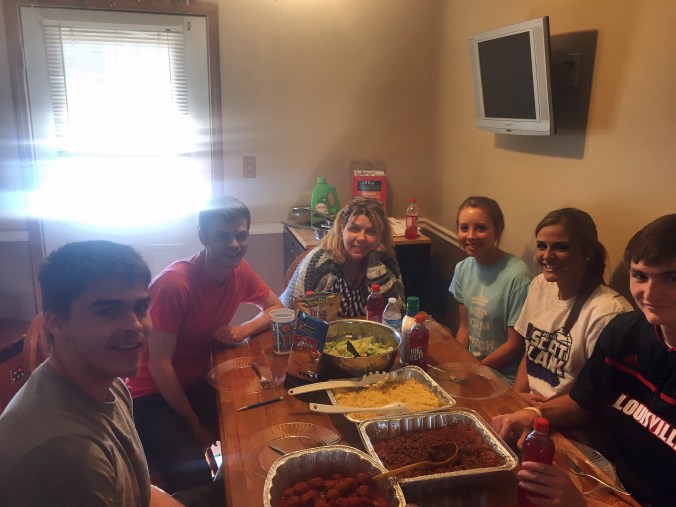
Rachel and I were paired for the Kentucky Kitchen Table Project, and we were accompanied by Madi and Allison from our section along with some of Madi’s family: parents Kim and Tim as well as cousin Nick. I had never spent any time with anyone around the table outside of class, so I had no clue what to expect when I arrived at the house.  I could make a pretty good guess at the political views of my classmates from the thoughts they shared in class, but the project allowed me to actually find out their stance and learn about the views of the three new faces.

Through our discussion I was able to confirm that Allison tends to lean left on most issues, while Rachel is a moderate.  Surprisingly, Madi and I have a very similar stance as we both consider ourselves Libertarians. Kim and Tim are strong conservatives, but Nick tries to avoid politics if he can. Even though this contradicts what most people what say is good citizenship, avoiding civic engagement is pretty common because of the complex nature of the political scene.

Nick was an interesting outlier from the group; while Allison, Madi, Rachel, and I are college students, and Kim and Tim are working adults, Nick is not in school and on his own at age nineteen.  While skipping out on college for a job is very common in my small Tennessee hometown, it was intriguing to learn from Nick about what it’s like.

Not everyone could form an answer of what citizenship meant to them beyond voting, paying taxes, and obeying the law. Tim joked that the question shouldn’t be so quick to assume he believes those three are required in his definition of citizenship.  However, he did add that he believes community involvement is essential to citizenship. This comment reminded me of the section of readings from Smart Communities with the Owensboro healthcare crisis, and the impact community involvement was able to make in that situation. Madi thought political literacy was important, as well as knowing the laws and the reasons they exist.

I wanted to make one point about citizenship regarding our obligation to others:  I think we aren’t always obligated to help others, rather our duty should be to avoid harming others.

When asked what type of community she wanted to live in, Allison responded by saying she wanted to live somewhere that it was easier to pay for her diabetic supplies.  Tim poked fun at the socialist agenda saying, “I want to live in the Bernie commune where everyone else can do the work, and I’ll reap the benefits.” While we agreed Allison, and everyone else, shouldn’t have to struggle to pay for health care, we also agreed socialism is not the way to go about it. Though Tim could benefit from a free healthcare system as he was blinded in one eye by a childhood accident, he was the largest opposition to socialism because he doesn’t deserve to be penalized for his hard work.

Now to the important part: the food.  It had been about a month before this project since I had eaten a home cooked meal.  The cuisine Madi’s family graciously supplied us with did not disappoint.  My favorite parts of the Kentucky Kitchen Table Project, aside from the invigorating discussion of course, were the burgers straight off the grill and the homemade macaroni and cheese.

IMG_0154

Kentucky Kitchen Table

By Carter

Imari Hammock and I did our Kentucky Kitchen Table project in our hometown of Scottsville. We did the project with a group of people from Imari’s church, all of whom I had never met before. At first it was a little awkward sitting with people I didn’t know and trying to have an in depth conversation about their views on citizenship and democracy, but as the meal and discussion went on I began to feel at home with these people and I’m glad we chose them as our family.

The family offered to fix the meal, and I’m glad they did, I don’t think that we could have made anything as good as they did. They prepared two of Imari and my favorite foods, pork tenderloin and macaroni. I would love to spend the rest of this post just talking about how great the food was but unfortunately I am notGuy Fieri and I do not have a show on the food network YET, so I will now tell of the great discussion Imari and I had with this family.

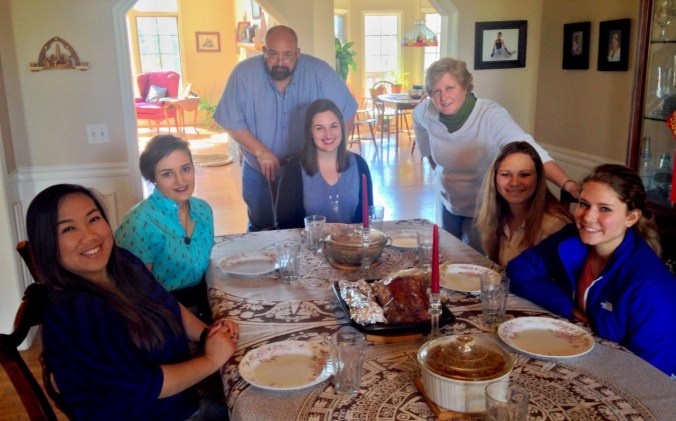
On the left is Martha and Clarence, a couple who Imari has known for a long time at her church. Hayden, the boy to my left is their grandson, he invited his friend Jordan to the meal. While they are both still too young to really give solid input to the conversation, they did have a little to say before they ran away to play. To Imari’s right was Monica and DJ, Monica is the Sunday school teacher at Imari’s church and DJ is her husband. DJ was the life of the conversation and was very entertaining. While we probably still would have had a great conversation, I’m glad DJ was there as he wasn’t scared to share his thoughts and opinions but also was able to keep the mood pretty light.

KKT.JPG

Our conversation went on a little longer than any of us thought that it would, but none of us had a problem with that, we all enjoyed it. One of the first things we discussed was what citizenship meant to us beyond the basics (taxes, voting, etc.). DJ answered first and said that “if everyone learned to respect one another, we would improve the quality of life tremendously”. Martha and Clarence answered next and stated that they are so happy that we live in a country with freedom and rights like we enjoy, but they wished that we could return to the time when people cared about one another. Monica followed them up saying that citizenship, to her, meant being with who you want to be with, really emphasizing the idea of America as the great melting pot.

What was really cool about this project was that, during this conversation, we spoke to a very diverse group of people as far as age and up bringing go, and while we had some very different ideas as one would expect, most of them repeated a lot of the general ideas, especially on their love of their families, community, and God.

I’m so glad that we had the opportunity to eat with this family and have this conversation, because it really opened my eyes returning to what we discussed after talking about wicked problems. When we look at wicked problems like racism or whatever else, we often get overwhelmed trying to think of some complicated or elaborate solution to try and hurry up and solve it, but I think that baby steps can go a long way. If we all just respected each other, many issues like sexual abuse, racism, sexism, etc. would all just go away, and in DJ’s words “would improve the quality of life tremendously.”

Kentucky Kitchen Table by Stevie

My mom is recovering from complications from a hip replacement surgery while parts of our house are being remodeled. Therefore, with the permission of Dr. Gish, we had to change plans and meet at a restaurant instead of eating at home. Although the situation wasn’t ideal, we had a really great time getting to know one another and had some great conversations about citizenship.

The members of the table were: Steve, a Democrat and a Catholic, moved around a lot when he was a kid because his father served in the Air Force. Fonda, who spent her childhood in a very conservative town in West Virginia, has always been very liberal and a confirmed Episcopalian. She has spent her life being a social worker and helping those who need it. Elizabeth is a Republican and a Baptist. She grew up in extreme poverty but has since made it to the upper middle class. Jeffery is a Republican and a Baptist. He was the only one (with the exception of me) who did not have a college degree. He was however, the first one of his family to get out of the farming business and start his own business. He is part of the upper middle class. Zack is a graduate of WKU and is currently in law school. Zack has traveled the world more than anyone at the table. He hopes to one day work in International Law.

The evening started off with me asking everyone what it meant to them to be a citizen. A couple of the ideas were that being a citizen meant being tied to the community and being involved in that community. While others took it a step farther and said that it also meant being part of the country as a whole, not just the community. They thought your identity as a citizen meant that you were part of something much greater than yourself. One at the table said that not only are you part of something greater than yourself but as a citizen you must give 100% to keep your country and community great.

The conversation then turned to how religion affects their actions as a citizen. Only one of them said that religion doesn’t affect them as a citizen.  They said that they firmly believe in a separation of church and state. A couple of the guests strongly disagreed with this sentiment. They vote, do community service, and other various activities based on their religion. The conversation turned to issues like gay marriage and Syrian Refugees. One of the members at the table said they didn’t agree with gay marriage. I was raised in a family where gay marriage has always been accepted, so this is a different view than what I am used too. It was a unique experience having a civilized conversation about such controversial issues at a dinner table. I can’t say we came to an agreement about the issues but we came to a mutual tolerance of each other’s beliefs.

I then asked if they felt obligated as a citizen or through their religion to help other people. I was surprised that I was the only one who thought that a citizen should be obligated to help other people. This is not to say that they didn’t agree that people should help other people but that it was not an obligation. They all talked about their involvement with charities and how they feel morally compelled to help impoverished children or victims of abuse but they weren’t obligated to do it. I was curious and asked if someone who had a lot of money or a lot of resources would have more responsibility to help those in need. Some of the members at the table didn’t think it was a responsibility exactly but if you are able to do something then you should because there are not enough resources for all who need them. One member of the group thought that a person’s wealth was their own, and it was up to them to decide what to do with it, and that they had absolutely no responsibility to anyone to donate their money or time to charity.

I asked them if it was important to be part of a community that valued charity and/or what other kinds of things they value in a community. They all agreed that communities that prioritized charity and where neighbors were involved in their community were things that they valued. One person mentioned that they want a community that is not only involved but strives to be close knit. A few mentioned wanting a lot of diversity in their neighborhoods. They said they enjoy learning about different cultures and when their kids were younger they made sure they were exposed to people from every walk of life. Another member of the table said that this wasn’t important to them. They would rather have a neighborhood with people of similar education, socioeconomic status, and backgrounds. They said that they relate to people better that are similar as opposed to diverse.

In seminar we talk a lot about tolerance vs. acceptance. I realized it is very easy for me to say someone who doesn’t accept gay marriage or someone who may be racist needs to at least be tolerant of those that are different from them even if they don’t accept them. It is, however, incredibly difficult for me to tolerate someone who is against gay marriage or racist or intolerant of others. My first instinct is to say something back and tell them that they are wrong or it’s not okay to treat someone like a second rate citizen. While it is not okay to treat someone like a second rate citizen, nothing gets accomplished by me getting angry at someone who has a way of thinking that maybe isn’t so accepting (or at least what I think is accepting). I thought a lot about the patience readings and how patience doesn’t just apply to learning or perfecting a skill, it also applies to dealing with people. There were times during the dinner that I had to demonstrate patience to try and understand where people were coming from. I really think being patient with people and understanding that many situations are more complex than they seem at first is a skill and a virtue that the world could use today.

I think this assignment also made me realize how important it is to have the patience to have conversations with everyone in the community before someone initiates a plan to help better the community. A lot of the members in the group wanted a close knit community; some wanted this by having lots of diversity while others wanted their neighbors to be of the same education and socioeconomic class as them. One person wanted a complete separation of church and state while the others wanted religion to be heavily involved with their daily civic lives.  It takes time to go through and talk to all of the stakeholders that could be affected by an initiative but at the end of the day you could really alienate a lot of people if you don’t get their opinions and ideas first.IMG_3700 (1)

A Table in Kentucky

By Rachel

My Kentucky kitchen table was hosted by another student in my class, Tori. I brought my roommate (also named Rachel), and we had dinner with Tori, her boyfriend Ian, and Ian’s friend Justin. We agreed to stick to snack type foods, and enjoyed chips and salsa and pigs in a blanket. Tori is a veterinary science major (and has a very cute cat and dog at her house!). Ian, her boyfriend, decided to go straight into the workforce after college, and had some interesting viewpoints on the differences between higher education and the alternate path that he chose. Rachel–my roommate– is a lesbian, and discussed with us some of her own struggles with her sexuality. Justin grew up in a fairly deprived background, and told us about his experiences with his bipolar disorder and receiving government assistance.

We talked about a lot of things, obviously, including citizenship, drugs, equality, and gender issues. While we all had a vague agreement on what it means to be a citizen–namely, don’t break the law or hurt other people–our varying backgrounds meant that we all had different specific views on how best to serve our community. Ian’s view seemed to be a more active one, in that he felt like you weren’t a good citizen unless you were actively doing good work in your community, while I felt that often citizenship can also be more passive, in the sense of minding your own business and allowing other people to have privacy. It was also interesting to me that the men were the ones who were more eager to bring up gender issues, and while the general consensus was that sexism is obviously an issue, Justin and Ian felt that there are still differences in what women and men are best suited for when looking for jobs and when serving their community. Justin’s background also meant he had much more experience with seeing the effects of drug abuse, so he was able to discuss the impact of these drugs that he’s seen.

I’m from Nebraska originally, so it was interesting to me to see the variety of experiences in Kentucky. The differences between the Midwest and the South came to the forefront when we discussed citizenship, I think. The South tends to be much more gregarious, which I think is why Kentucky people often see citizenship as involving an active engagement with other people. The Midwest is definitely much more closed off, and there’s often an attitude that other people’s lives aren’t really your business; while that sounds kind of bad, I also think that this kind of attitude is what contributed to Iowa, for instance, being one of the first states to legalize gay marriage. There’s a sense of “I don’t like what you’re doing, but it’s also not my place to tell you not to do it.” At the same time, I think this definitely could contribute to some of the passivity that we talked about in class, such as with the little Chinese girl who couldn’t get help.

Both sides have their pros and cons obviously, but it was interesting to me to see how the social attitude of the South contributed to Kentucky people’s views of citizenship. Obviously this relates to our own class’ discussion of citizenship, as there’s been a lot of argument over whether we have an active responsibility to do certain things. I can’t say whether there’s one right or wrong answer, but it was really interesting to see how these people of various backgrounds approached the issue.

16218

Good food, Good company

For the Kentucky Kitchen Table Project I was paired with Trevor and a family here hosted us in Bowling Green. At our kitchen table we had Madi, from class, along with her parents, Kim and Tim, and cousin Nick, along with my roommate Allison. I had never met Madi’s cousin Nick, who is nineteen, living on his own, and works in physical labor. Madi’s parents I have met before, and Tim is the manager of one of the local plants and Kim is a caretaker for several older and/or ill people. Madi is political science and paralegal major who has trade experience and wants to become a corporate lawyer. My roommate, Allison, wants to go in a very different direction with her art history major by becoming an art conservationist. Allison is also in a service sorority here on campus, while Trevor is in a fraternity. I myself want to teach eventually after my experience teaching Taekwondo in my hometown.

We talked about several different things, but the current presidential campaign was a subject of particular interest. Everyone had a different political perspective, which added to the debate. Allison is a liberal, Madi and Trevor are libertarians, and I change depending on the issue. Nick doesn’t identify with a party, and Kim and Tim are both conservative. We discussed the benefits and drawbacks of all the candidates, for example how Bernie Sanders has good ideas but they aren’t practical because of the country’s already tremendous national debt and how people are inherently selfish and if the tax rate for the rich was raised they would simply put more effort into hiding their money. Tim also made the point that he worked hard to get where he is, and that he shouldn’t be penalized for his work because some other people didn’t work as hard. Allison then brought up how many people aren’t given the same opportunities and go through their whole life at a disadvantage. Kim mentioned that when she was a child her family had an outhouse, but that she was able to go to college. Tim also told us about how an accident when he was a kid blinded him in one eye but that he adjusted to it and can drive just fine. Allison brought up how she also had to adjust to life long condition when she was diagnosed with Type 1 diabetes her freshman year of high school. This turned the conversation to healthcare because of how expensive diabetic supplies are and how finicky insurance can be about paying the correct share. Madi said that even though insurance is awful, free health care would be worse, and proved her point with the state of Canada. I have a cousin who lives there and she’s told me herself that it really is impossible to see a doctor there and that she tries to do as much as she can medically when she’s here in the US visiting family. Tim also brought up that if healthcare was free he would lose his ability to spend more money to pay for an experimental or expensive treatment than what some other people can afford.

We also discussed life on a college campus, and our different high school experiences. Trevor is from Tennessee and graduated with a class of 243, while Allison and I graduated with a class of about 400. Nick and Madi also graduated with about four hundred, and actually graduated from the same high school as her mother, but she was a part of the third class to ever graduate from the school and then there were only a hundred students. Tim had by far the smallest graduating class at only 24 people. We found that the smaller the class size the larger percentage of people everyone knew in their graduating class, but among Allison, Madi, and I we all knew different amounts of people based on what we did in high school. Allison and Madi were both very involved, taking a wide range of classes and getting involved in different types of after school activities. As a result, they knew easily over half of their graduating classes. Trevor was also very involved, particularly with sports, and he knew or recognized almost all of his graduating class. Nick also recognized most of his class. I was the outlier here because I did most of my extra-curricular activities through Taekwondo, which wasn’t associated with my high school, and as such only knew about a quarter of my graduating class. Kim and Tim both knew the entirety of their graduating classes.

The answer to the required question, “what does citizenship mean to you, beyond voting, taxes, and following the law,” stumped everyone for a few minutes. Tim mentioned how important community involvement is to him but he wasn’t sure how to relate that to citizenship. Madi said political literacy, knowing what you’re voting and advocating for. Trevor also made a really good point, especially considering the individualistic state of the country, that being a citizen doesn’t necessarily mean helping others but that it most certainly means being conscious of how far your rights go and not purposefully impeding another’s rights.

I really enjoyed having a home cooked meal that we all chipped in to pay for but that Madi and her family actually cooked. The discussion was also very interesting and enlightening, hearing from all different sorts of people.IMG_0154

Kentucky Kitchen Table in Oldham, Kentucky

By Allison

I hosted my own Kentucky Kitchen Table in Oldham County, Kentucky (a suburb of Louisville). On March 26th, our party of nine gathered together in fellowship for a wonderful meal that included Cornflake chicken (family recipe), green beans, salad, fruit (brought by Lisa and Mark), rice (my family’s staple), spätzle (traditional pasta dish from Cologne, Germany brought by Clare and Barbara), apple pie, and brownies with chocolate ganache on top (brought by Cathy).  We had this dinner at my dining room table at my house. It was an amazing meal with lots of conversation. I wanted to pick people for my Kentucky Kitchen Table that had different perceptions on life based on their age.

My mother, Cynthia, attended who is a part time physical therapist, aqua fitness instructor, and worker at GE. She is an adult who has one child at home and who works full time. My father, Eric, is a former pastor and is currently working at Starbucks. He is an adult who has one child at home and three children in college. In addition to my parents, I had my brother Nathaniel who is a Junior in high school. He is 17 and is living life with the freedom of having a car to himself. Both my parents and Nathaniel didn’t want to miss out on me cooking dinner that night. In addition to my family, I invited Clare who is a freshman at St. Louis University. She is studying biology and hoping to go into the medical field. I met Clare the summer before my senior year of high school at the Governor’s Scholars Program. Clare also brought her mom, Barbara, who was my individual who I had not previously met. Her mother Barbara, is a former English teacher. She loves to travel and is currently helping out in the family business. In addition, I also invited the couple Mark and Lisa who attend my home church. They have two kids Andrew and Allison who are both in college so I considered them adults who were “empty nesters.” Mark works in Communications and Marketing at University of Louisville, and was the former news anchor for WLKY. Lisa volunteers at Eastern Area Community Ministry and is actively involved in church. Lastly, I also invited Cathy, who was my past high school Sunday School teacher at my church. She is a retired English teacher. She currently works part time at an elementary school to help kids who need extra help on reading and math. She was the participant who I considered a senior citizen. Each individual that I invited were at different places in their lifetime.

Our conversation was mainly getting to know each other and telling about past adventures. Barbara even worked on a whale watching boat in Maine! All of us, did not originally start in Louisville, Kentucky, but ended up moving and putting roots down in Louisville. Our topics ranged from family, to NASA performing surgeries in space, to the new technology called the transcranial magnetic stimulation that helps alter neurons in the brain to fight depression. This dinner really exemplified that every individual comes from a different background where there are different cultures and traditions. Lisa grew up on a farm in Paducah, Kentucky and my family grew up in Southern California. Everyone had so many stories to tell at the table. There was not one quiet moment. For me, this experience reminded me that I don’t always have to carry the conversation. If you have a talkative bunch, the conversation carries itself. I loved having the opportunity to eat with friends and family who I now often don’t see due to college.

I ended the dinner with the question, “what does citizenship mean to you?” due to the great conversation that immediately started when we sat down at the table. I thought that everyone had amazing answers to this question and it didn’t matter what age one was. Nathaniel stated, “So many of my friends are indifferent on issues. I think indifference is toxic in our society and that everyone should take a stance on controversial issues. By taking a stance, one is able to be be assertive and hopefully educate themselves on what issues affect us today.” Cathy stated that citizenship is being a role model to the younger generation. She thinks influencing others and passing down knowledge is so important. It’s being alert to the needs of our community. Clare said,”being a citizen is having a sense of comfort that you belong to a community.” Other answers included looking beyond oneself, bringing something to the table no matter how big or small, and citizenship is the importance of interconnectedness. I loved being able to tell them that our class dives deeper into wicked problems, empathy versus compassion, and looking at ideas of fixing our world to the perception we want it to be. Overall, it was an amazing dinner. Everyone loved the idea of this project and was more than happy to help. It was a success!IMG_8629

Kentucky’s Kitchen Table: Dinner With “Halle Berry”

by Rachel

My Kentucky Kitchen Table was hosted by Matthew, a local minister in Bowling Green, and his wife Ann. Besides myself, two other students, Corinne and Tanner, attended. Before this, I didn’t know any of the others, so I didn’t really know what to expect from our dinner. We got to the house and introduced ourselves to Matthew and Ann, and found that Tanner, Corrine, and I had more in common than we knew. We were all freshmen, and majoring in some kind of science (engineering, chemistry, and biology, respectively). We found out that Matthew and Ann had lived in Bowling Green for several years, after moving from North Carolina. Just as we were beginning to ask the obligatory questions about citizenship, there was a knock at the door. Matthew got up to answer it and said “Thelma’s here. She’ll probably introduce herself as Halle Berry.” From then on we knew our dinner was going to be very interesting. Thelma, as it turned out, was 89 years old, and one of the funniest people I have ever met. She had stories to tell about everything from growing up in Bowling Green to her trip to the 2008 presidential inauguration. As it turned out, we didn’t need to ask many questions; we learned everything we needed to about citizenship from listening to Thelma’s amazing stories.

Thelma did, in fact, introduce herself as Halle Berry, and from that point on the night and the conversation only got better. First, she talked about going to Washington D.C. for President Obama’s inauguration in 2008. She talked about standing outside in the cold to watch, and going on a tour of the White House afterwards. To me, the presidential inauguration stands out as a unique symbol of democracy. It bring together the entire nation regardless of race, gender, political affiliations, or anything else. This was the first time I had met someone who had experienced it in person, and hearing Thelma describe it reminded me of what a unique opportunity to participate in our country’s democracy she had.

As the dinner progressed (and we all enjoyed the amazing food Ann had made for us), we moved on to more serious topics, and Thelma opened up about her childhood. The table grew quiet as she discussed being abused as a child. It was clear as she talked that she still felt the emotional pain of that time. I may not personally be able to understand how she had to feel, but I wanted to. I wished I could have empathized in a better way, and done something to help heal these wounds that obviously still hurt so many years later. Thelma also talked about her experience as an African-American woman, and the ways she had experienced racism on a personal level. She talked about growing up in a time of racial segregation, and feeling that nothing was being done, that “that was just how it was.” Even today, she still felt the effects of racism as one of the only African-Americans members of the presbytery at her church. She described that she feels her race makes her stand out, that she feels like “the loneliest fly in the buttermilk.” I was reminded of the subtle ways that a serious problem like racism can sometimes present itself, and of a Zora Neale Hurston quote that Claudia Rankine used to describe the same feeling in Citizen: “I feel most colored when I am thrown against a sharp white background.” Listening to Thelma’s stories, I was amazed again and again by how much she had experienced, how difficult her life had been, and yet how happy she was. She said, when discussing racism “it never bothered me.” She had learned to live with some incredibly difficult situations, and yet, had keep the sense of humor that let her introduce herself as Halle Berry, and I admired her for it.

As I was writing this post, and reflecting on what I learned that night at Matthew and Ann’s kitchen table, I was reminded of a discussion we had in my seminar towards the beginning of the semester. We had just read an article titled The Empathy Exams, and were discussing whether empathy is natural. Can you learn to put yourself in others’ shoes and understand their pain, or is it something you’re born knowing how to do (or not)? The class consensus was somewhere in the middle, we all seemed to think it was a little bit of both. It was months later, listening to an 89 year old woman talk about everything she had experienced, that I finally understood what it means to learn empathy. I couldn’t fully understand Thelma’s stories of abuse and racism, but listening to her, I could get a sense of what she must have felt. As best I could, I put myself in her place, and tried to understand what she had been through, and how it had made her the amazing person that she is. While I still couldn’t perfectly understand her situation, I had some small grasp on how it felt. In this way, I learned to be a little bit more empathetic, simply by trying to be. I was reminded of all the things that others, particularly those who are older and more experienced, have to teach, if I am willing to listen. This was just one of many lessons I learned that night. I also met a group of great people, who I was glad to share dinner with.IMG_0767

Kentucky Kitchen Table

By Tori

16218

For my KKT project, I chose to find my own table and be assigned a partner. I hosted our dinner at my house in Bowling Green where we enjoyed a delicious platter of pigs-in-a-blanket along with chips and salsa and queso. Rachel was my assigned partner from class who revealed that she is originally from Nebraska, which was very interesting to learn about the differences between our two states. She invited her roommate, also named Rachel, to our dinner, who is a lesbian and who provided information as to the differences and difficulties of an alternative sexual orientation. I invited my boyfriend, Ian, to attend the dinner as well, who  is currently pursuing an alternative to college by entering straight into the workforce after high school and thus providing a different viewpoint of the system. In addition, Ian invited his friend, Justin, who grew up in a very poor community, receives government assistance each month, and has been diagnosed with bipolar disorder. Justin was able to illustrate the benefits of government programs and the experiences of living with a mental illness. Including myself,  a woman from a rural background and the child of divorced parents, that makes five at the dinner.

At our dinner, we discussed many hot-topic issues that are currently going on within our country, such as equal rights, the legalization of marijuana, and the importance of being an active citizen. With the differing genders, backgrounds, sexual orientations, political beliefs, etc. of the group, we had a variety of different viewpoints on the issue that helped spur discussion. For instance, when asked what it meant to be a citizen (beyond paying taxes and voting and so on) we each found it difficult to vocalize into words. However, Rachel said that part of being a citizen is just being a decent human being in general. Ian suggested that contributing to the betterment of society is also part of citizenship, and I said that helping out your fellow neighbors and citizens is also part of what it means to be a citizen.

From this experience, I learned a lot about the people I shared it with as individuals, about myself and my own beliefs that I had not previously thought of, and about my duty to society as a citizen. I learned that just because we all might not agree on a topic, it is still important to listen to the beliefs of others and not discredit them because it might also help you understand why you believe what you do. And I feel that it is this discussion that can potentially help us cross the bridge to where we want to be. By listening to differing ideas and viewpoints, we can come up with solutions to even the most wicked of problems. That is why I feel like public discussion and forums are so important to our democracy. The people need to have a voice in the way their society is, and they need to be heard.