Kentucky Kitchen Table

by Reid

We had our Kentucky Kitchen Table in my hometown of Belfry, in Pike County, a solid five hours away from WKU. I must say I was very nervous about doing my KKT, not only because discussing things like politics often get heated in my family, but also because the prospect of doing it for an assignment gave a whole new depth to that nervousness. In the end, it all went very smoothly, and we actually had a really great time talking deeper than we usually do with each other, not to mention the amazing dinner we had.

Seated around the dinner table were my dad, Kevin, who took a break from his mountain of work (he’s an accountant, and it’s right near the end of tax season) to make sure he could come to take part in the conversation. My dad was raised in a fairly traditional household, though he said that he didn’t really appreciate the values he was taught until he was already an adult and out of the house. Like most people in Pike County, he describes himself as a conservative democrat, and used the KKT to connect more with my little brother and I (both fairly staunch liberals) and understand how our view different from his, and why.

My mom, Shelia, a dedicated kindergarten teacher who always makes sure her sons do their assignments was also at the table. She also had a very traditional upbringing, but always understood why she appreciated them. She is the reason my dad began going to church, and is also the reason that my brother and I continue to go to church, despite our questioning of religion. She has influenced us all, in so many ways, regarding our faith.

My little brother, Ryan, who is just forming his own set of political opinions and used the KKT as an opportunity to round out his beliefs. He has had a sort of 180 happen to him over the past year. Where he used to hold the traditional values our parents taught us, he now has begun feeling his own way around the world, and trying to establish his own beliefs. He describes it as finding his independence, and I personally agree, as that’s how I described the same thing that happened to me. Of all of us sitting at the table, Ryan and I are the only two who weren’t Christians, both of us being agnostic.

My grandmother, Sheb, who insisted on cooking the entire meal, not because she believes she is a great cook, or that she must control everything, but because she couldn’t stand having people over to her house (where we did the KKT) and asking them to bring food with them. Sheb is probably the only person at that table who had not much to say. She’s never been a very talkative one, and even when we tried to engage her to step into the conversation, she hesitated. She describes herself as comfortable with her political beliefs, and not really one to stir up controversy.   

My grandfather, Cecil, who has shared several different political persuasions over the past 75 years and also saw the KKT as an opportunity to reexplore and redefine his political stances. Cecil is very outspoken, and not always politically correct, which made for some interesting conversations, but would never wish harm on an insect, much less a person. He is the oldest of us all at the table, and is the only one who is retired. His experiences while working the twenty-odd jobs he’s had added a sense of experience to the conversation.

And finally, one of our neighbors from up the hollow, Tina, who I’d only talked to in passing and never had a full conversation with, came to dinner to establish a connection with us, and get to know her neighbors better. During the conversation I learned more about Tina faster than I believed possible. I learned that she has two children who are both grown and moved away from Kentucky, she describes herself as a conservative democrat, but asserts that she’d rather give up her right to vote than vote for either of the last two candidates, and that she has never really sat down to ponder what citizenship means to her. She was probably the most fun to talk with, just because there was so much to find out about her.

I started the conversation with the required question “ Beyond voting, paying taxes, and following laws, what does citizenship mean to you?” Surprisingly, Tina was the first to answer. She told a story about her great-grandparents coming to America from Ireland, and defined citizenship as “the right to do all things American.” It was sort of a strange phrase at first, but once I started thinking about it, I thought it was genius. That question didn’t gather many responses, and so we moved on. I don’t remember many of the questions we talked about, as I didn’t write them down, but I do remember the answers I got to the question “What is the thing you love most about living where you do?” Ryan said he loved the interconnectivity of the small town we live in, and how “everybody knows everybody”. Shelia said she loved the attitude that most people held, and how they were ready to help everyone in need. Cecil said he loved how safe he felt living in the area, and Tina loved just being able to have a yard behind her house and a garden. She struck me as a woman who enjoys the simple things. My father’s answer had the most impact on me. He said “The thing I love the most about living here, is that I’ve never felt like I don’t belong here. I’ve never felt out of place or out of touch.” He went on to describe how he couldn’t imagine himself living or raising his children anywhere else, despite the decline of the coal industry, and the poverty and drug abuse that has stricken our little town. That stuck with me, not only because it involved me, but because, for my entire life, I had felt the complete opposite way. I’ve always felt out of place in that town, and the career I’ve chosen is specifically designed to take me out of it. My dad, though he’s given me countless amounts of wisdom and advice over my eighteen years, opened my eyes with only a few sentences, and made me question basically my entire life.

This reminded me of the reading about the snare of preparation, and how by being prepared, you sort of end up falling into a trap of your own design. Everyone has a tendency to over-prepare and sometimes it comes back to bite you. I had been preparing my entire life to leave my little hometown, and in fact, that’s why I came to Bowling Green in the first place, but in doing so, I’d lost the little magic that my dad relished about this place. I briefly described the main point of the reading, and everyone around the table gave their own stories of a time they over-prepared for something and found out they screwed themselves over. Most of them were funny, but a few of them were sobering, and one, given by my sweet grandfather, Cecil, was almost tear-inducing.

All in all, this assignment made me open my eyes to the differences in my family, and the similarities I shared with a stranger. I have to admit, I was loathing this assignment in the weeks leading up to it, but now I can’t believe I had not done something like this sooner. I believe that experience relates to the class more than anything. Everything we do in Citizen and Self might not make sense at first, but once you complete the task in its entirety, then you grasp the full meaning of it.

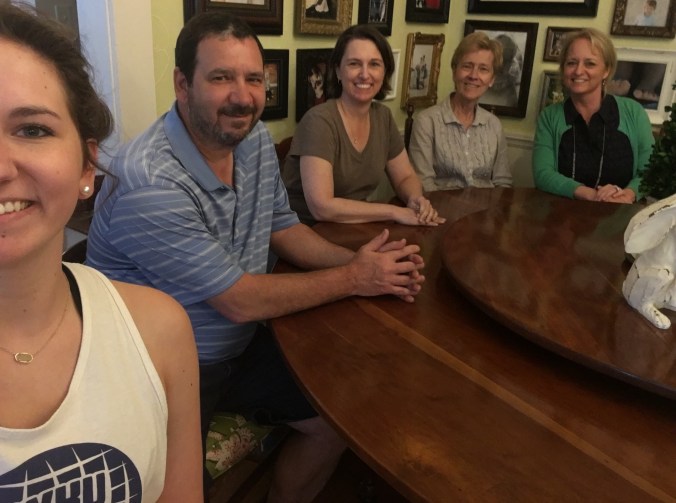
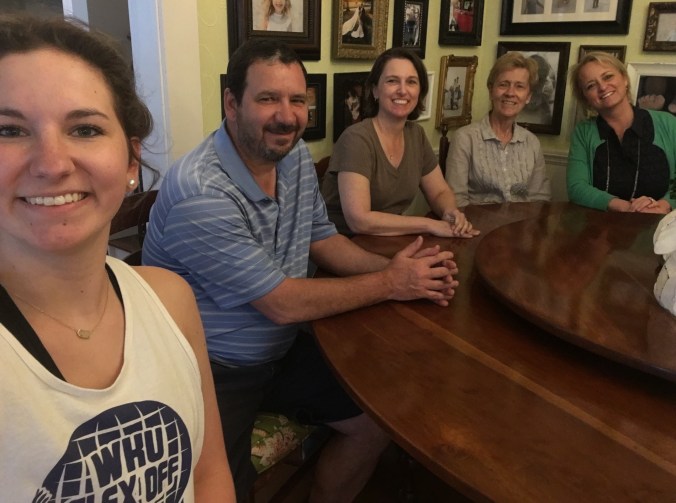
Note: I took the picture of the dinner table, and therefore am not in it. I’m if that violates any rules of the assignment.PEXD0712[1]

Healthy Conversation

By Bethany

My Kentucky Kitchen Table took place on a warm Sunday afternoon on the farm where I grew up in Hartford, KY. Participants included my two acquaintances Elizabeth, a marketing student, and Andrea, a psychology student. They brought along their two boyfriends, Hunter, a pre-med student, and Nathaniel, a participant of Chinese Flagship. My fiancé Seth, a paramedic, also attended. My parents, Karen and Brad, were the hosts. They are both members of the baby-boomer generation. My father is a manager at a local factory and my mother is a manager at a local restaurant. For everyone, it was our first home-cooked meal at a table in recent memory. This was also our first gathering together for the college students, and definitely our first time discussing topics outside of classes and our social lives.

We all shared a wonderful Italian dinner. My parents and I made the red sauce and noodles. Nathaniel and Andrea brought some delicious homemade brownies. Elizabeth and Hunter provided a wonderful white sauce. Seth brought us some zesty garlic bread to eat with our meal. My guests sat in the living room while my mother and I made final preparations for the meal. We set the table, got everyone their drinks, and soon after, we headed to the table.

To begin, we started off with some nice conversation about ourselves, our hometowns, and our aspirations. Elizabeth wishes to have a job in marketing with a business. Nathaniel also wishes to pursue a career in marketing, but is also fascinated by Chinese culture and language. He wishes to incorporate this passion into his career somehow. Andrea dreams going to a great graduate school and being a criminal psychologist. Hunter wants to go to medical school to be an anesthesiologist. Seth aspires to further his education and become a physician’s assistant. I would like to go to graduate school also. I want to get my masters of public health and make access to reproductive health services more accessible to members of my community. My parents, still young at heart, also have aspirations. My mother would love to publish a book, and my father dreams of gaining his pilot’s license.

I soon asked the first question: “Beyond voting, paying taxes, and following laws, what does citizenship mean to you?” Nathaniel spoke, saying that he feels that being a citizen includes having a positive influence on your community. He thinks that working to improve your community and helping others is a great way to do this. Everyone agreed on this. My parents added that citizenship means being a productive member of your community and working to improve yourself. To them, this meant having a job if you can work, helping your neighbors, and being a proactive member of the community. I questioned my table on what they thought we could do to be proactive within our communities. They answered that volunteering, participating in community events, building relationships, and attending community meetings regarding local legislation we all important to being a proactive citizen. We all also agreed that we could improve on doing these things.

My second question was: “What social issue is closest to your heart and why?” The table fell silent. It seemed as if everyone was kind of afraid to speak up. So I offered my answer: Healthcare. My fiancé, the paramedic elaborated a bit for me. He believes that everyone should have access to healthcare, but the issue with this that he sees in his profession is many people abuse resources like Medicaid. Hunter agreed with this, but pointed out that some people really do need those resources. We had found our first wicked problem. My father told us about what healthcare used to be like. Apparently, healthcare insurance did not exist before the 1980’s. He described how his father and mother would just write checks directly to doctors to pay for broken arms and doctor’s visits. Andrea asked how people could afford to do this. My father explained that healthcare was somewhat affordable before insurance companies came into the picture. It was after insurance companies that the price of healthcare skyrocketed to the prices of today. Elizabeth pointed out that everyone might not have been able to afford healthcare, even before insurance companies, which brought back the question of how can we make healthcare more accessible to other people.

I spoke and said if healthcare providers could come together to open clinics for people that operate outside of big insurance companies, perhaps then we could make healthcare more accessible. I told them my personal dream of opening a clinic for women and expectant mothers who otherwise couldn’t afford the care that my practitioners would provide. I hoped to set up affordable prices for services and exams, and to offer payment plans for patients without insurance. I also would enjoy to set up a network of practitioners, community members, and physicians who would like to see this positive change within the community. We agreed that coming together as a community would be helpful, but it isn’t necessarily realistic to always count on finding common ground.

My next question proved the most difficult to answer: “What do you think are the best things about our world today?” I immediately saw everyone making awkward eye contact and chuckle, as this was the weekend following airstrikes on Syria. The news lately was, for lack of better word, depressing. I acknowledged the tension, saying that yes, sometimes being positive was difficult, but everyone should always try to look on the brighter side of things. Nathaniel then spoke. He said that he felt everyone, in their own way and through their own opinions, genuinely did have the best intentions at heart. Everyone seems to care and want the best thing for others, even if we don’t all agree on what the best thing is. Seth said that this was especially true of our generation. He thinks that all of us want to improve our community in one way or another. My mother said that she enjoyed the resilience that people in our age tend to have to adversity. People today do not simply let others put them down. They fight back and try to promote positive change and they have hope for the future, despite everything. Perhaps things today are not as bleak as they seem.

To top off our dinner, I asked our final question, one that I felt would be pretty easy to answer: “What advice would you give people running for office in our country?” Elizabeth spoke immediately, saying that she thought that they should try to communicate clearly and honestly with citizens. They shouldn’t lie to us and give us false expectations just to get elected. Hunter agreed with this, and said that we need people in office who really represent us. We should shy away from career politicians and try to elect more business people, educators, and more citizens from diverse populations. We all agreed on this point.

I was pretty nervous about hosting this dinner. I have never done anything like this and this was my first time having this large group together. I was worried about a fight or someone possibly getting their feelings hurt. I was genuinely surprised with how well everyone got along. With my parents being baby boomers, and us being a part of generation x, I was worried about clashing opinions. But generally, we all had the same ideals and intentions, but different perspectives, which is a good thing. The topics discussed reminded me of the three questions we discuss in class. How can we live better together was encompassed in our discussion about citizenship. How can we take more control of our lives and help others do the same was related to our discussion about electing officials. How do we solve problems was a theme in our healthcare discussion. “How We Talk Matters” was truly relevant to this assignment. This passage highlights that deliberation is a skill that we must hone. Calm, respectful communication was key at the Kentucky Kitchen Table and is vital for understanding one another.

I am thankful for this assignment, as it opened my eyes to the opinions of others. I also helped me to not be afraid to speak my mind and express my feelings. It allowed me to better understand my parents and a few of my peers. These topics are ones we rarely speak of at home. This allowed me to get to know my parents better and to understand their thinking better. I won’t be as nervous to talk about issues with them because, as it turns out, we are not as different as I thought. I am also thankful for the connections with my peers, because without communication, we will never be able to make our future as great as we have the potential to.

Inclusiveness and Citizenship

By Christen

For my Kentucky Kitchen Table project, I decided to go back to my home in Springfield, Tennessee to have the meal. I chose to go home for this project not only because I knew it was where I would feel most comfortable, but also because I am moving to a new house in the next three days. I wanted to have one last formal meal in the house that I have grown up in for the last fourteen years. Although it was bittersweet to eat one last meal in my home, it was also a great experience that I learned a lot from.

I had a very interesting and fun group of people attend my Kentucky Kitchen Table. My mother Fonda, my younger brother Caleb, and my aunt Karen were some of the participants. My mother also invited two of her co-workers whom I had heard about, but not met at that point named Odaylis and Gelissa. These two women have very similar backgrounds that have helped them bond and become best friends. Odaylis, who recently became an official American citizen, is an immigrant that spent the first part of her life living in Cuba. She traveled to the states with her mother and grandmother, and now lives with her husband of two years who hails from the Dominican Republic. Gelissa on the other hand was born and raised in the United States. However, her mother’s side of the family is also of Cuban descent, while her father’s side of the family is African American.

Before starting the project, I was very worried that it would be hard to make the conversation flow. I was afraid that it would just be question after question answered with simple answers. However, that was not the case at all. It seemed that after the first question was asked, we just kept talking and talking. The conversation flowed so well that I often had to steer the conversation back on track. I started by asking the required question about citizenship, and being a new official citizen, Odaylis gave one of the best answers. To her, citizenship was of more importance than to a person that was born in the states and automatically labeled as a citizen. She thinks that being or becoming a citizen is about being apart of something bigger than yourself. She goes on to explain the benefits and the sense of inclusiveness that come with officially becoming a citizen. Somehow, the conversation went from discussing citizenship to discussing how to expunge certain behaviors off of criminal records. This conversation had nothing to do with any of the questions asked, but the information was very entertaining and overall useful.
After getting back on track, we next talked about the importance of community. Like earlier in the citizen question, overall inclusiveness seemed to be the theme. My participants also noted that they wanted to be a part of a community that was safe, open, friendly, and diverse. My mother went on to explain that these were some of the key things that she looked for when purchasing the new house that we are about to move to. Diversity and safety are important factors to her when choosing a new home because the neighborhood where we currently live is not diverse in the slightest.

Next, we discussed the importance of the job that my mother, Odaylis, and Gelissa do. They work for a healthcare company known as Bridges to Care. Again, the theme of inclusiveness and equity was brought up again. Everyday these three women strive to provide healthcare to individuals that my mother describes as “ people who have not been treated fairly”. She goes on to explain that these are usually people that don’t have any health insurance, not official U.S. citizens, and are also very poor. Because of this, these people are treated differently when they go to seek any kind of medical care. “ The bulk of our job”, she explains, “ is about making sure that people are treated fairly and are able to receive the services that everybody else receives”. Odaylis explains that she thinks that there line of work is important to her because in most cases, the people that come to Bridges to Care are all out of options. Bridges to Care are the only ones that will be able to help these people get the services that everyone deserves.

If I had to pick an overall theme for my Kentucky Kitchen Table would be inclusiveness. I think that inclusiveness is the key to one of the central course questions, “How do we live and work well together”. When considering plans that will help people of different backgrounds and different beliefs live well together within a community, it is important to make sure that everyone’s opinions, beliefs, and ways of life are taken into consideration.

Kentucky Kitchen Table in Small-Town Kentucky

By: Sophia
IMG_4908IMG_4909

This dinner took place in the small, but developed town of Owensboro, Kentucky at in my parents’ home where I grew up. My mother and father, Jennifer and Philip, hosted this dinner for Frankie, Jeanne, and myself. We gathered around to discuss citizenship and enjoy my mother’s homemade burgoo, Frankie’s cornbread, and a delicious rum cake provided by Jeanne. I prepared by helping my mother with the burgoo, setting the table, and cleaning up afterwards. In the picture we are seated (from left to right): myself, Philip, Jennifer, Frankie, and Jeanne. Jennifer is a Registered Nurse in the Neonatal Intensive Care Unit and currently pursuing a doctorate in nursing. She has a passion for helping others and is a talented learner. Philip is a supervisor at the Toyota Motor and Manufacturing factory in Princeton, Indiana. He commutes an hour and a half to and from work each day. Philip is a war veteran who is proud of his service in Operation Desert Storm but reluctant to talk much about his days of combat. Frankie is a retired state employer who loves spending time with her grandchildren and tending to her garden. She recently moved onto our street so we thought inviting her would make her feel welcome to our neighborhood. Jeanne was a former Human Resources consultant for the Health Park in Owensboro, Kentucky and currently owns and runs a children’s boutique called Kid’s Stop. I was worked at Kid’s Stop before Jeanne bought it and had to quit before she took over to move to Bowling Green. I went to see how the store had changed with her ownership and ended up inviting her to my Kentucky Kitchen Table. Following my mother’s footsteps, I am studying nursing at Western Kentucky University and share the same passion as my mother of helping others. I wish to further my education after obtaining a Bachelor’s of Science in Nursing by pursing a nurse anesthetist degree.
To begin our discussions, I first started with asking each guest what citizenship means to them beyond voting, paying taxes, and following laws. Philip, who feels underappreciated by the American government for his eight years of service, believes citizenship entails certain rights in which he respects and actively exercises. He believes he has earned these rights, as a citizen and a soldier, through his service in war. Other than my father’s opinion, a common theme amongst the other guests was that citizenship is being actively involved in your community and engaging in bettering the lives of those living in your community. Jeanne mentioned something unique that stuck well with me: “Citizenship is also having a voice in your community and your nation’s society.” After all agreeing to this, we discussed citizenship being in the context of a verb: in order to be a citizen, one must be engaged in their community and in making it a better place. Jennifer talked about her years of community service as an active member of the Owensboro Junior League and how she feels she made a difference in the people’s lives for which her services were helping. “Our main focus was concentrating on issues and services in the community that were actually going to help people for longer than a day or two” By this she meant, for example, working with those in homeless shelters on reading skills. Jennifer feels as if, by doing services like this, she was giving people opportunities to better themselves and their lives by sharing and teaching helpful skills. The other guests shared times they felt they had done their duty as a citizen and helped their communities in various ways. Frankie enjoys taking her 20-month old granddaughter to the animal shelter and feels she is brightening the lives of the animals of the community and, in turn, helping the community. Jeanne tries to do various community service but finds she does not prioritize it and it, therefore, gets put on the backburner. She also tries her best to help the parents of Owensboro by offering higher-end children’s clothing and doctor-recommended children’s footwear for more-than-fair prices at her boutique, Kid’s Stop. She often has sales where she will make no profit off of her merchandise because she believes it is her way to help her community. I am required to serve a minimum of fifteen hours of service a semester for my sorority at Western Kentucky University.
After overall agreeing that an important aspect of citizenship is serving and bettering the community, we got a little side-tracked. Jeanne shared the struggles and excitements of moving Kid’s Stop to a different location. After many congratulating and encouraging words from the other guests, I directed our conversation towards politics in America by asking, “What is the most impactful decision the Trump Administration has made since being in office?” My father was the first to respond by saying he believed the recent bombings on Syria have been the most important and impactful decision made thus far. My mother and Jeanne quickly added nods and words of approval while Frankie shook her head expressing her disapproval. My father elaborated on his first statement by arguing that president Trump was decisive and has reminded the world of America’s military power. Jeanne agreed and mentioned that this decision was a “nice alternative to the Obama Administration who always said they would do something about gas bombs and never did.” Jennifer chimed in by saying that the people, especially the children, living in Syria need someone as strong as America fighting to stop the torture and killings, and Trump has shown that America will fight for them. Frankie disagrees; however, she understands why the decision was made. She fears another Cold War, or worse, more terrorist attack on American soil as a result of these bombings. Although afraid of the possible outcomes, she agrees that something needed to be done to help save the people Syria.
After feeling like we had discussed enough about the dreaded topic of politics, I decided to brighten up our conversation a bit by asking, “what kind of person do you want to be?” I was reluctant to ask this question because my parents and our guests are not young adults. But after some thought, I realized this question is not, “what kind of person do you want to be when you grow up,” but “what kind of person do you want to be each and every day?” I felt like Frankie had read my mind and knew my initial concern with my question because she quickly answered by saying, “I am 77 years old and I work each day to be the person who God wants and who I want to be. It is a life-learning process.” She went on to explain that she wants to be someone who her grandchildren look up to every single day. Someone who helps others and is empathetic of others’ situations. “With every encounter I have with someone, I try to keep in mind that this person has different experiences than me; therefore, has different feelings and opinions that I must appreciate even if I don’t agree.”
This made me think of one of the central questions of our course: “How do we live well together?” I think Frankie’s response to what kind of person she wants to be is one of many ways to answer this question. I brought this question up to my guests, telling them that it is one of the centralizing questions of this course, and my father’s response was interesting. He said that he had never thought of solutions to that question before and mentioned that the way Frankie tries to encounter people is a good start to people living together well.
I thought this was a good closing point for what I wanted to know for my Kentucky Kitchen Table project so I did not ask any more questions and allowed our new friends to genuinely mingle with my parent’s and me. Learning what we did about Jeanne and Frankie created the foundation for a strong friendship in which we all plan to keep.

Talking Over Tacos: A Discussion on Citizenship and Social Justice

By Grace

On Tuesday, March 28, 2017 I completed my Kentucky Kitchen Table. At first, I was not sure what to expect from the dinner. I wondered what kind of diversity I would find at our table. However, I found that there was a diversity of thought that was compelling, and I appreciated those thoughts which were in contrast to my own that gave me a new perspective. I ended up leaving with a greater sense of the purpose for the role I may play in our community. Among some of the topics we’d touch on, from various forms of discrimination and racism to leaving home for the first time, I felt empathy and sympathy—both for the characters described in stories of hardship and for the people sitting around the table with me. More than that, I felt optimistic for the future of our community because of the honest candor with which the others sitting around the table would express sentiments similar and dissimilar to mine. If we can continue to connect with people in the community in this way, there is certainly a pathway for progress.

The dinner was hosted by Leah and Chris who prepared tacos and other Mexican-style dishes for dinner. The WKU students at the table were myself, Victoria, and Gage. Victoria is a Spanish and Asian Religions and Cultures double major. She is also a member of the Chinese Flagship Program and has an interest in learning more about diverse cultures and ideologies. Gage is a student at WKU studying Economics. Leah works for the Center for Citizenship and Social Justice (CCSJ) and is very passionate about social issues. Chris is contractor who works in Nashville. Also, attending the dinner were McKenna, who is a senior at Bowling Green High Schoo, her boyfriend Cole, and Riley and Katie who are in middle school.

We began by talking about what citizenship meant to us. McKenna views citizenship as having rights, which are earned by being an active member of the community. To her, being a citizen is to have a house and to be able to go to school and get an education. As we discussed our views on citizenship, I envisioned the “bridge” metaphor that we often discuss in class. McKenna seemed to be focused on the right side of the bridge, which is where we want to be as a society. In other words, McKenna was saying that ideally we want to be able to live well together and have equal rights to the resources that are essential to our survival—like shelter and education. However, that is not the reality. Leah, through her work at the CCSJ, has had the experience to know that there is still much inequality in our society, and there are many people who are given less resources. Those people must work harder to have the life many of us are freely born into. She’s realistic about the hardships that many in our community face; she said, “It’s because I know what exists.” Leah described a situation where a fireman in Bowling Green was asked to resign from his post for perceived gayness. She also went on to note an article which cites dozens of criminal acts against people of different sexualities. She said, “there’s an obvious problem if a citizen employee can’t go to work without being harassed and picked on.”

As far as how we as citizens and as a community must get across the metaphorical bridge to become a more equal society, Leah had many ideas. She said, “Citizenship to me is being active in the community in some way, shape or form. There are numerous avenues where you are able to do that…reaching out to legislators, going to marches and protests.” She noted, too, how lately she’s seen even more citizens being active in the community during this past election season. Optimistically, she said, “I’ve been amazed at people working at things if they don’t like it…participating, going to city commission meetings, writing letters to the editor.”

I had a different point of view. I had difficulty seeing how certain protests and marches would really enact change because to some extent I felt as though protests were only dividing our country further. I think about what the “other side” (the people of the opposing viewpoint) will do in response to protests, and I wonder if these protests are effective in getting them to have a new perspective. Just as Keith Melville describes in “How We Talk Matters,” people often dislike conflict and also are so self-ensured about their opinions that they are unwilling to listen to others’ experiences and even to correct, factual arguments. Unlike Leah, I did not see protesting in particular as a particularly productive way to make progress in society because I worried that protests discouraged conversations between one side and the other on political issues. However, through my conversation with Leah, I realized that while protests themselves may not seem like a potential platform for an effective deliberation, they are a way of starting those conversations and engaging the community in a healthy discussion. The protest is simply a  spark for many deliberations to come. It forces people who witness the protest to look at the issues and to talk about them.

During the dinner, we also discussed different social issues, specifically those that were the most meaningful to each of us. Chris said that when it comes to social issues, people tend to think of “hunger, African children, third-world countries, but there are areas of our countries that do have hunger.” Chris feels the social issues here more personally because of the experiences he has in his life.  This discussion reminded me of a point that Ivan Illich made in “To Hell with Good Intentions” where he discouraged missionary work abroad. Similarly, Illich says, “If you have any sense of responsibility at all, stay with your riots here at home.” Here, Illich alludes to the issues that come up when people try to do good abroad, and fail to do so often without even realizing it. It makes more sense to focus on the problems we are experiencing within our own communities, where we can communicate well with the people we are trying to help and we are more likely to understand the issues when we have experienced them or seen them happening in our own communities.

While for the most part, Katie and Riley were silent on certain topics, Katie spoke up when we began talking about the obligation we have to people in our community to give them more of a say over their lives, like we often discuss in class. The overall consensus was that we do have an obligation to the people in the community who are less privileged and who have been born into their disabling circumstances. Katie gave the example of homelessness, a situation where, she said, “It’s not their fault if they’re homeless. We have more opportunity—it’s the right thing to do.” Chris supported Katie’s view. In his experience, working in construction in Nashville, he sees many Hispanic workers struggle to get access to health care because they’re illegal immigrants and are afraid to even deal with the government at all. Like Katie, Chris also said, “If you’ve been born into circumstances, I’m inclined to have a lot of empathy for [you].” Throughout this discussion, there was a theme of empathy and a call to service. However, we did not discuss how Katie and Chris might act on such calls to service. From this conversation, I learned not only that I’m not alone in my feelings of empathy for the underprivileged but also that I’m not alone in my inability to take that next step to help those in need. I suppose all of us feel these calls to service at one point or another and yet are unsure how to act. I believe this is due to the great complexity of these “wicked problems,” which are so large in scope and difficult to tackle that even those with the best of intentions may not have the time to dedicate to finding solutions to those problems.

While I tend to be more cynical about the issues we are facing today in our communities and in our country, this dinner made me feel more optimistic because even by being there I felt like I was engaging with the community in a new way. To sit down and discuss social issues with complete strangers and to come out of it having learned many valuable ideas, I think it will not be too difficult to contribute to my community in the future. I often unconsciously brush off responsibility for these issues because they honestly seem too large for me to tackle. However, throughout the course of this semester by discussing these issues in class and during my Kentucky Kitchen Table, I realize that not only must I own my obligation to my community, but also that I am able to do something even if it is simply by starting the conversation with others in the community. As Melville says in “How We Talk Matters,” these conversations “in town halls, in classrooms, among neighbors, or exchanges that take place over dinner tables” are where democracy begins.


IMG_0800


New Friends

By Margee

When I first began my Honors 251: Citizen and Self class, I understood that we were required to participate in a Kentucky Kitchen Table. A Kentucky Kitchen Table (KKT) is an opportunity for members of the local community to share a meal in a house with people they are unfamiliar with and discuss their lives and opinions. All of this was to be done in a very comfortable setting. I soon became very excited because there is nothing I love more than eating food and meeting new friends.

As the semester went on, I was assigned to a KKT that would be hosted at Dr. Alison Youngblood’s house, which was a comfortable walking distance from Western Kentucky University’s campus. Allison is a professor at Western Kentucky University (WKU) and she teaches Linguistics and Teaching English as a Second Language (TESL) for the Department of English. It was very nice of her to offer her home to us! The other adult who was kind enough to participate in the KKT was Dr. Leila Watkins, a professor at WKU who teaches Honors 251, as well as courses in English. All of these things I learned from emailing back and forth with them to try to set a date to meet for our KKT.

We decided to meet to share a meal on Wednesday, April 5th at 6pm at Alison’s house. When I first arrived, I entered the house and met Alison’s very sweet dog, Hazel. Hazel was quick to say hello and welcome me! I then met Alissa, another student at WKU who was assigned to this KKT as well. Alissa brought along 3 other friends who were very personable and added great conversation to our group. I had asked Alison and Leila if I needed to bring along any food or items, but both refused saying that they would arrange everything. All 7 of us sat down at Alison’s table together to share a meal consisting of green beans, fettuccine alfredo, garlic bread, clementines, and pizza. Alison also offered us La Croix- a carbonated spritz water that was flavored with a bit of coconut. It was a delicious meal, but the company was even better!

Our conversation first began with introductions and learning more about each other. While sharing a meal together, I learned that Alissa is a freshman from Louisville, Ky- like me- and graduated from Assumption High School. She is also a twin and lives with her twin sister in PFT (her twin sister is older) although she is also in the Honors College. She is pursuing a degree in chemistry with a minor in criminology. Alissa shared that she is an aromantic asexual meaning that she doesn’t experience romantic or sexual attraction. Alissa’s friend Emily is a fan of K-Pop and that is how they met. Emily is also very petite and talked about her little sister who is taller than her now. Alissa’s friend AJ was a bit quieter and was at the other end of the table, but always added witty comments and anecdotes to the conversation. I was also introduced to Dimitri who has really awesome blue hair! Dimitri and Alissa met because they are both openly in the LGBT+ community. Dimitri is gay and nonbinary and prefers the pronouns they/them in discussion.

While getting to know my new friends, I found that I was really enjoying the conversation. It was easy to find common points of interest, such as Alissa and I both growing up in Louisville and Leila and I have both eaten at a Mexican restaurant in White House, Tennessee. Leila’s husband works in Nashville and, of course, she works in Bowling Green so they found a happy medium by both commuting to their respective cities. Although I expected that I might differ to some of the party with my more conservative views, I began to feel accepted and understood by them when I shared what I thought. It was such a relief to be heard and known by them.

Trying to stir the conversation back to the required question, I asked the collective table members, ‘What does citizenship mean to you?’ Leila was quick to respond that to her citizenship means being a part of a conversation in which you are able to ask people about what matters to them. Also, the group added that being a citizen means that you have to be a part of the group to identify yourself as with the group.

This ties into the lessons we have been learning in Honors 251, such as learning about the importance of deliberations and discussing matters in a mature and collected way. I felt very comfortable sharing my opinions and listening to others’ in this setting. Also, I was able to discuss my experiences with short-term mission work in Kenya over the past summer. Alison was very interested because she discussed with us how she had lived in Japan for an extended amount of time teaching. I could just see from her discussion with us that she was so passionate about exploring different cultures and getting out of our comfort zone. Her passion encouraged me to pursue my interests in studying abroad.

We discussed the importance of being still and enjoying meals together with others – like how it was in Kenya for me. In Kenya, there was no clock around to check what time of day it was. There were no time restraints. The whole day was up to the decision of us and I loved that. Alison mentioned that she loved that about Japan, as well.

The grand gesture was when Alison brought out Mochi ice cream balls for all of us to try. It was such a treat because I had never tried one before. Mochi is originally from Japan and is a dessert made from ice cream with a confection sugar outside. Mine was chocolate flavored I believe and, although it had a strange texture, I really enjoyed it and was proud of myself for trying it.

Steadily the light in the room began to fade as the window grew darker and I realized that two hours had passed and I was still enjoying my company. While I was leaving, I began reflecting on why I enjoyed that so much and I think it was because sitting at a table with friends and family is one of my favorite activities. My family is a big advocate for family dinner at the table with no cell phones out and no TV playing in the background. Just our family, our food, and our conversation to keep us entertained. Enjoying a meal with my new friends felt like going home because I knew that just spending this time together learning from each other allowed me to truly breathe and reflect on my day. Those 2+ hours without checking emails or doing homework gave me an opportunity to re-evaluate what matters to me. And the next day when I saw Emily in line for Burrito Bowl on-campus for lunch, I was able to say hi with confidence because she’s my new friend.

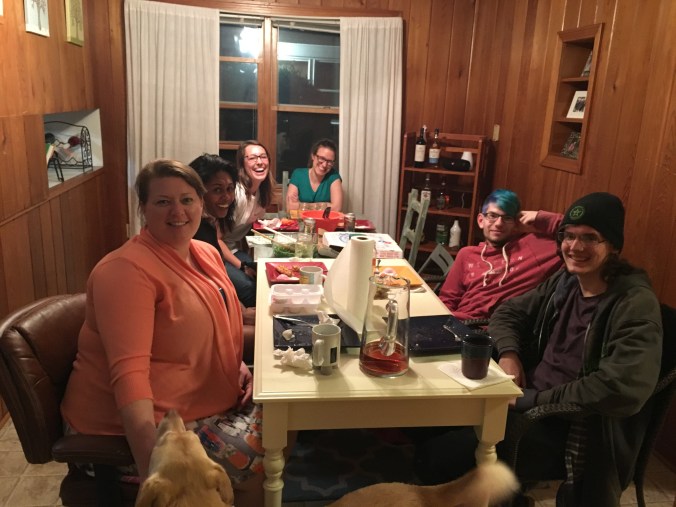
IMG_4527From left to right: (Hazel (the dog), Alison, Emily, Margee (me), Leila, Alissa’s empty seat (she took the photo), Dimitri, and AJ

Kentucky Kitchen Table – Michaela

By Michaela

My Kentucky Kitchen Table project took place in the town that I live in, Franklin, Kentucky. I knew many of the people that joined us during this project, but there were two people in particular that I did not know well named Jennifer and Jessi. The others that participated in this project were named Jordan, Atalie, Ben, Destiny, Kaitlyn, and James. We had all met Jennifer and Jessi previously, but none of us were very familiar with their views or their personalities. A woman named Wanda had learned of this project and had insisted upon preparing dinner, giving us the options of spaghetti and fettuccini. Atalie cooked chocolate chip cookies for dessert.

Before we ate dinner, we played a little ice-breaking game of Speak Out to get some people laughing, particularly the people in the group that we were not completely familiar with. This was a great tactic, and it seemed to relieve some of the tension resulting from there being unfamiliar people. Jessi and Jennifer were familiar with one another, but they did not closely know each other, so they were quick to get in a group together. The rest of us had our close friend in the group that we automatically paired up with in teams. After the game, we all settled in to eat and talk together.

We didn’t have a super diverse group of people during this project, but there was some diversity in political views and religious views. Atalie and Jordan are married. They are strong, church-going Christians, and they have very conservative views. They are very nice people and are very giving to our church.  Ben is also very kind and Christian, and he has the heart of a missionary; he loves to travel anywhere and everywhere that people are in need, and he also loves to help people in our community. Destiny is a hard-worker and comes from a very low class family. She has had to work all of her teenage years and supports her immediate family with her work. She goes to Bowling Green Technical College for the sake of keeping her finances under control. She is very conservative and is very compassionate toward those in need. Kaitlyn is a singer and is a very hard worker. She previously went to Western Kentucky University but was unable to continue due to certain circumstances. James comes from an extremely conservative family, and he is very strong in his Christian views and in what he believes. As we learned during this dinner, both Jennifer and Jessi are fairly liberal with their points of view, and Jessi is not Christian. At the age of 18, Jessi had a baby while still in high school, and she has been in a battle for child support ever since. Jennifer has no children, is single, and works very hard in her job. These diversities led to some interesting and thought-provoking conversations.

Our first topic of discussion was citizenship. I asked the group what citizenship means to them, other than the basic requirements of voting, tax-paying, and following laws. The group agreed, despite our varied views, citizenship means to be an effective part of society and to actively promote our various views. Jessi and Jennifer agreed that this meant promoting and actively seeking equality for all people regardless of race, sexuality, gender, or religion. Everyone in the group agreed with this to a degree. The more conservative people of the group did not believe that it is necessary to celebrate diversity, but they believed that it is acceptable and good for there to exist diversity. Ben even said, “Diversity is important for a functional society, and it is important for all people to be treated equally. No person is more important than the next; because of this, those that are diverse from the “normal” people should not be celebrated. Celebrating diverse groups of people does not allow equality for those that aren’t considered ‘diverse.’”

The conservative views in the group suggested that citizenship meant to protect what we believe in, no matter the cost. They agreed that, because of this view, some of the most honorable members of society, and the most underappreciated, are soldiers. The more liberal of the group agreed with this, but they claimed that what they most believed in was equality for all people of different sexualities, race, gender, or religion. This brought a little tension in the group as the majority of the group did not believe that “celebrating” diversity was most important in their lives, so the topic changed fairly quickly as the tension quickly grew stronger.

Upon prompting the group, we next began to discuss our ideal communities to live in. Having come from such a tiny town as Franklin, most of us agreed that Franklin is fairly ideal. Jessi and Atalie, though, suggested maybe a slightly larger town would be ideal as long as it held the same support system as Franklin. We all discussed how lucky we are to live in a town that, when someone passes away or leaves, we are all able to mourn together, and nobody living there is ever alone. We also discussed how, similarly, when a new family or even just a new person moves into Franklin, the whole town is quick to welcome them. I agreed very strongly with this, having come from three hundred miles up north myself only five years ago. I told them all how, when I moved to Franklin, it seemed like half the town was at our doorstep on moving day and how it seemed like the whole town was at church that Sunday to hear my dad preach there for the first time.

This conversation about Franklin led directly into our discussion of whether or not we knew our neighbors. Ben’s first reaction was immediately yes; his whole extended family owns houses around his house. Although, after considering his other neighbors, he realized that there were plenty of other people living around his house that he has never spoken to because their paths have never really crossed. Atalie and Jordan live in a neighborhood, and they know their neighbors that live right next door but do not know the neighbors down the street because they have only lived in their house for a little over a year. James said he did not know his neighbors well, due to the fact that his family has just recently moved into a new house. Kaitlyn, however, has lived in the same house her whole life and knows all of her neighbors directly beside her and down the road from her. Jessi knows her neighbors because she, too, has lived in Franklin in the same house her whole life, and she has even begun to raise her child in that house with the support of her parents. Destiny lives back and forth between Franklin and Bowling Green. When she lives in Franklin, she knows all of her neighbors because she has lived there her entire life; however, in the house that she sometimes lives in in Bowling Green, she does not know her neighbors because she does not live there full time and never has. Jennifer has only lived in her house for a few years, but she is very social and enjoys getting to know those that live around her. She knows some of her neighbors, but there are still some that she does not know because they keep to themselves. I told them all of how I know my neighbors, though I have only lived in my house for five years, but in the city that I used to live in, I did not know my neighbors because the only interactions we had had with them were negative interactions.

I then prompted the group as to how they thought we could improve our relationships with those around us. I suggested that perhaps trying to get a better understanding of people and of their backgrounds would help us gain a more positive view of who they are. Destiny agreed with this and said that sometimes her interactions with people were negative because of miscommunications and misunderstandings. She said that if we took the time to get to know each other better, we would have far less misunderstandings and miscommunications. It would give us a better sense of what to expect from specific people.

I thoroughly enjoyed participating in this project because, while many of the group members participating were my friends, there were also two that I was very unfamiliar with that had very different views than the rest of us. I thoroughly enjoyed getting a better understanding of Jessi and Jennifer, and I really enjoyed getting a better understanding their views and where they came from. I also, of course, appreciated the time with my friends, but I got a better understanding of their backgrounds too. It was nice to sit and have a focused conversation and to intentionally discuss their backgrounds, and a lot of the people in the group did not know about the places that I have previously lived, and I think they all enjoyed hearing about where I used to live as well. I really enjoyed having a civilized conversation with people of a democratic point of view because so often we get so defensive of our stances in politics that we never take the time to listen to opposing point of views. I appreciated being able to relate our civilized conversation  to what we discussed in “How We Talk Matters” because it is very true that so often we just automatically scream at people without taking the time to understand. A lot of the time, I think we need to have times like this in our Kentucky Kitchen Table Project in which we are forced to sit down and have a nice conversation with those that are different than us.

KY Kitchen Table

Resized_20170406_200326By Hannah

We met up at Blake’s house, a two-story in a residential neighborhood of Bowling Green. It was a Thursday evening unlike any other… Well, it wasn’t all that crazy.
Days before, Blake, Andrew, and I had met up for a few minutes to work out details of our collaborative supper. We talked about who would bring what piece of the meal, and what was going to make this project go smooth and swift. I think our main goal was to get everything planned out so that later in the week our dinner would be a calm and welcome environment for discussion and understanding. Not a bad goal, I think. Ultimately, we learned each other’s faces and exchanged numbers, communicating something about a willingness to reach out when it came time to see each other once again.
Because of this positive, face-to-face pre-interaction, I think our dinner went better than it could have gone without the interaction. It created a connection between some members of the group so that we had a comfy start before we would all eventually be corralled into sharing heavier thoughts and opinions amongst the group – a daunting task, yet, the main point of the supper.
Thursday came, and I travelled with Camille, a bright, freshman girl whom I had met at the beginning of the school year in my dorm. She agreed to accompany me because she thought the dinner would be an interesting experience. On the drive over to Blake’s, we talked about our aspirations for the future, which was founded in the academic and social obstacles of the now. Camille had just decided to drop her pre-medicine track and go for an engineering major. She is still interested in service industries, such as healthcare, but is switching gears for a bit. So, Camille and I had our heads wrapped around education and careers before we even stepped foot into the beautiful home in which we were destined to spend a couple hours conversing around a kitchen table.
We arrived a bit early and were greeted by Blake and his mother, Stacy – a nurse practitioner with three young adult children. Throughout the meal, she was not shy about sharing her observations and did a great job contextualizing our conversation in a more “grown-up” way. Overall, she was the pragmatist, and helped guide the rest of the group’s theorizing back down to earth.
We each contributed to the meal: Blake with mac n’ cheese and apple pie, Camille with baked beans, Andrew with the most exciting food, fried chicken, and I with chocolate cake, which Andrew had heartily requested. It was a fine meal for college students who were used to neither creating meals nor eating foods outside of their dorm rooms and dining halls.
As we ate, we talked about the neighborhood we were in, and what it was like years before, as Blake and Stacy’s family had been situated there for 12 years. This spurred us into talking more deeply about each of our own neighborhoods and their demographic makeups. Later on, we discussed the concept of a neighbor, and how each of us interacted differently with the people living in our communities. This brought up the question, “Do we owe our neighbors anything? And if so, do we owe them more or less than the people who are not our neighbors?” We defined and redefined the term neighbor to exclude and then include people who were beyond a certain proximity of us and outside the communities with which we associated. Andrew brought up the point that we might feel a stronger bond with the people closest to us, but that we should not prioritize them any higher than the people who are living across the globe from us. We all had a slightly different opinion on how much we should be involved with the lives of those around us. It was nice to hear the extremes and the middle grounds all represented on this particular issue. Hearing these diverse perspectives made me see how much experiences can shift your stance on socially and politically charged issues.
Once we began thinking globally, I think all of our brains started awakening to the many possibilities of ways the discussion could continue because we all became at least somewhat more vocal.
Technological advances and growing communities were the next topics we discussed. With healthcare being central to and Stacy’s profession and Camille’s probable future, we spent a considerable amount of time thinking on the ways technology had been detrimental and beneficial to the many communities, including the overall global community.
Blake is a film major who seemed to be very involved with film/theatre projects taking place at Western Kentucky University. In the few hours I knew him, he seemed to me passionate about people and their inner workings. At least, he tended to talk about how individual’s problems fit into the wicked problems we were discussing.
Andrew is a math major. He plans to teach mathematics at the collegiate level. As you would expect, he liked thinking about the logistics of solutions and how they might not “add up” to solving all parts of the problem.
The largest portion of our discussion had to do with the educational industry and where it was headed. As college students and a mother who had two in college and one who would probably end up there soon, we had given thought to this topic and felt our opinions had weight because of our experience. It was also interesting that Camille and I had discussed education earlier in the evening. That probably helped us communicate our opinions more clearly over supper. Andrew enlightened us with statistics on the educational crisis in The United States, and he and I were able to compare our understanding of the academia in other countries.
We also talked a bit about the different cultures we were a part of or simply knew about because of second-hand experiences. A few of us had in common that we had gotten close with some exchange students (Blake’s family even hosting one) and all of us had some exposure to young adults like ourselves who were very obviously of another ethnic background. What everyone shared on this topic was fun to hear.
By the time we were cleaning up the table, we were quite comfortable with one another and had transitioned into telling funny memories of our grade-school teachers. I think we all left feeling jovial.
Although we didn’t solve any wicked problems, I think we all learned about a perspective on a topic that we had never heard proposed before. Our conversation was very relaxed, and so it was an easy space to share. At the very least, we grew in our empathy for people and in our knowledge of problematic circumstances. We each came out of the supper better equipped to contribute to humanity, and I think that is where this type of deliberation does the most good. This type of deliberation surely did not help much of anything about our world, but it did help us grow as individuals striving to be citizens and community members every day.
In class we read a lecture by a professor at UC Berkeley named Robert Hass. At the end of his lecture, “Green Fire, the Still Point, and an Oak Grove: Some Reflections on the Humanities and the Environment,” he included this quotation:

This is the world our students are inheriting. They are going to need a sense of urgency and patience and a sense of complexity and everything they can learn about the processes of the natural world, if we are going to protect what our science tells us is at the core of life, the richness and diversity of the gene pool. The task may be beyond us. Wildlife biologists these days often have meetings with titles like, “Which Species Can We Save” or “Which Species Are We Willing To Save.” But we have to act as if we can accomplish it. We have to act as if the soul gets to choose.

This quotation correctly appropriates an urgency to the significant, or wicked, problems that society has not been able to successfully address. Hass is focused here on a scientifically pronounced issue we are faced with, but that does not mean his observations cannot translate into how we are tackling other wicked problems. A central theme of my Kentucky kitchen table and the citizen and self class is that we are responsible for change needed to better society. During the meal, we had discussed what citizenship meant to each of us, and came up with the idea that it may be different for everyone, but is grounded in a sense of community welfare. Hass is similarly saying that we are the determining factor of the state of our world. But just our empathies will not spontaneously act outside of us; we must both allow them to work through us and believe that “the soul gets to choose” for what and whom we become impassioned. That change in us – our developing understanding of other people – will be what changes the communities in which we live.

Kentucky Fried Kitchen Table

By Andrew

20170406_200326

This past Thursday, I rang the doorbell of a stranger while holding a bucket of fried chicken. Before you stop reading, this isn’t as awkward as it sounds. It was the beginning of my Kentucky Kitchen Table, an interesting experience with some equally interesting people. I, along with Hannah and Camille, participated in a dinner hosted by Blake and his mother Stacy at their home in Bowling Green, Kentucky.

Sitting around the dining room table with my fried chicken and heaping helpings of mac-n-cheese, baked beans, corn, and chocolate cake, we began our dinner with some timid introductions. Blake is a film major at WKU with a great interest in film production, and his mother Stacy is a nurse practitioner. They have lived in the Bowling Green area for around 12 years, and Blake has a brother who also attends WKU. Hannah is a social psychology major with an interest in performing research, and her friend Camille recently transitioned to an engineering major. After some brief talk about where we are from, including the coincidental realization that Camille and I grew up in fairly close towns, we started our conversation with a big question: What does citizenship mean to you?

I decided to get the ball rolling by describing my friendly neighbor ideal of citizenship within a community, where each member of the community is active in helping improve the community and helping each other. I added that this also means letting others live their lives in peace, unless their actions are harmful to the community. Everybody else seemed to have a similar definition, and Stacy emphasized that what we believe is harmful to the community is subjective. We then discussed how this is often the cause of debate within a community, as debates are often about problems that don’t have clear cut solutions, which we call wicked problems in our class.

From here, we transitioned to a conversation about how well we knew our neighbors/members of our community. While all of us knew some of our neighbors, we all agreed that we didn’t know all of them, including some of the next door neighbors. However, for some of us this wasn’t always the case. For example, Stacy said that during her childhood on the family farm, she knew everyone from the surrounding farms very well, and either Hannah or Camille commented that they knew all of the kids their age that lived close by. Blake commented that now he didn’t see kids outside as much anymore, and that nobody seemed to be around the neighborhood, especially on weekends. We thought that perhaps this isolation among people was due to an increase in technology.

While speaking about other people in our community, we switched topics and talked about people we knew who had very different backgrounds from ourselves. I had a hard time thinking of somebody as I realized that I don’t surround myself with very diverse people. Hannah talked about an exchange student she knew from South America. She described how one of the most peculiar things about him was how intense his work ethic was for school work. He and those that he traveled with all seemed to have this strong desire to work really hard on their school work, showing how different education is portrayed in different cultures. Blake also mentioned a German exchange student from high school who somewhat lacked a sense of humor. Stacy then remembered a man from the Middle East who is still here in Bowling Green. He is a friend of Blake’s brother, and he was taking classes to become a translator at WKU, but when his country fell into war, he couldn’t continue to receive money from his parents. So now he lives with the Baptist Campus Ministry, while trying to learn to drive so he can get a job. However, even under such circumstances, he was very respectful, and at a meal at Stacy’s house, he would even stand up when an adult male walked in the room and introduce himself. We find this odd in our culture, but to him it is just a sign of respect.

After some more food, we continued our conversation with a question of my own. I wanted to know what everyone’s thoughts are on the increasing price of a college education. I pointed out how it has changed the way that colleges operate, as they act more like businesses than they used to, causing things like grade inflation.  I also mentioned how much harder it is to get a sustainable job without getting a college education. I continued to point out a couple characteristics of the problem, and then Stacy asked us if we knew the root cause of the issue. We didn’t have an answer, and we agreed that this is due to the wicked nature of the problem.

From there we changed topics to a conversation about obligation to those in our communities. The first aspect of the question was whether we have any obligation. Stemming off of the citizen conversation earlier in the meal, we all seemed to agree that we have some sort of obligation to help those within our communities live their lives peacefully. Then Blake asked if we felt the same obligation to somebody who wasn’t in your actual neighborhood or town, but halfway around the world. I felt that there was an obligation, depending on how close your relationship is to the person or community you are helping.  However, I also brought up that some people help those far away from them while ignoring those closest to them in need. Stacy asked us if we thought that was common, and we all seemed to agree that while everybody doesn’t do it, it can be easier to send money or aid to a distant place rather than spend your time helping locally. Hannah said she thought that in a capitalist culture like ours, that we would be greedier about our money, but Blake and Camille pointed out that often people would rather lose some money if they can be lazier.

To finish up the meal, we then talked about how often we sat down at meals like that with our families. Stacy told us how she was required to sit and eat dinner with her family at the same time every day, and how she tried to continue that with her family. She pointed out that with the scheduling of activities, it became hard to find a time that worked, and that practice slowly faded away. I talked about how I regretfully didn’t often eat with everyone in my family. While we all in the same area during meals, often the television was on, and the focus wasn’t on conversation. Blake mentioned how he wishes his family sat down and ate together more often, even though he didn’t like it when they still did it. He said that as he got older he started to appreciate that time together, and that sometimes he just wants that time back with his family.

After this, we decided that we needed to go, and we cleaned up and headed out. Thinking back on the meal, I find that I really enjoyed it. While I am not too socially anxious, I often don’t like to put myself in situations where I don’t know anybody, since I hate awkward conversation. However, I found that some prompted questions in addition to food helped get rid of those awkward silences, and created a meaningful conversation that helped me get to know everyone a little bit better. The idea behind the Kentucky Kitchen Table reminds me of Nussbaum’s article, “Socratic Pedagogy: The Importance of Argument.” While this wasn’t a Socratic town hall debate, the concept behind such a debate is reflected in the way we conversed at our meal. The ability to listen to respectfully hear the point of others in a constructive way and speak for yourself to obtain a constructive result (which happened to just be a thoughtful conversation) is central to our democracy, especially in local government. Meals like this are a great way to teach this core aspect of democracy, and I was amazed after leaving the meal at how natural it felt. Perhaps such meals need to happen more often in our communities. A central point of our class is how do we get along with each other, and such conversations are may be the key. The nature of the situation gets rid of that tension between people, and brings out a peaceful conversation that feels like it can resolve any conflict.

Williamsburg Kentucky Kitchen Table

KENTUCKY KITCHEN TABLE

By Ryan

Williamsburg is a very small town with little to no diversity in the population to speak of. This town is, for the large portion of my life, what I called home and today- hundreds of miles away- the town still impacts my perceptions of the world. Returning home after over a month of absence was, of course, a needed aid to the homesickness I can occasionally feel. However, much more rewarding than any remedy to my nostalgia, I returned with purpose and an assignment to complete- my Kentucky Kitchen Table.

Naturally, my mother- who must constantly be aware of the everyday workings of my family- was informed of the dinner and the purpose it would serve. Of course mother insisted that any thing she could do to help me ace an assignment should be done. So, believing that my homecoming could be even more exciting with close friends and family, she decided to invite around twelve people. As mother and I often do, we politely debated why this would not be an effective endeavor and I encouraged her to limit the number to ten people. Fortunately, the people that she had invited had prior engagements but we were still able to draw in what I would call (as it relates to Williamsburg) relative diversity. My mother was able to get my father and sister to participate in the dinner- a task that may sound simple but, in actuality, involves coordinating with a highly independent teenager and an insistently stubborn adult. Further, we were able to have my mother’s best friend, Stacy, and Stacy’s daughter, Macy, in attendance. So, in total, we had six people in attendance: Sheri (my mother), Alan (my father), Hailey (my sister), Stacy, Macy and, of course, myself (the outlier). I also wanted to encourage everyone to make something, despite my mother’s insistence that it would be rude to invite guests and then expect them to cook. However, Stacy and Macy did make homemade brownies for desert and I brought in rolls and drinks for the meal (a settlement that satisfied my mother as she got to cook the rest of the meal). I felt that I was able to collect a relatively diverse group of people even though there were only six people in attendance. I also felt that having perceptions from two generations would offer a mix of opinions while, at the same time, I would be able to get opinions from a variety of opinions from individuals of different career fields. My mother works in public administration in our local health department and my father is a history teacher at our county’s alternative school. With Stacy as a nurse, I felt we would have opinions from individuals with differing incomes and experiences.

Despite being raised in this town where very few people seek higher education and, I imagine, even fewer attempt to place themselves outside of the world that they are exposed to every day, I was pleasantly surprised at how productive my Kentucky Kitchen Table was. While deliberative engagement might not be a term that is tossed around frequently in Williamsburg, it is certainly a subject that I wanted to bring up during my dinner. Our class had a list of pre-selected questions that I chose to go through and then subsequently ask for answers to follow-up questions. While I was able to predict some of what the table said, I was not able to completely conjure up what every individual person would say. What did not surprise me was the frequency in which religion or, specifically, Christianity and its moral teachings were mentioned.

Williamsburg, centered in the bible belt and my family- centered around the bible- are both unsurprisingly insistent upon the application of scripture in every day life. However, despite this strong belief of the scripture’s varying applications, both my family and our guests admitted to knowing very little about scriptural teachings and instead presented that their foundations lay within only what they knew of the bible or what they inherently believed was moral. I am the outlier in my family because, as previously mentioned, I am not religious and I do not draw my morality from any scripture or religious doctrine. It seemed that my assertion that morality was largely dependent on the individual was followed by responses of various statements to contest the allegation. The primary argument was that we should draw all of our morality from the bible. I found the assertion interesting for a variety of reasons- the largest being that they had stated before that they knew very little about scriptural teachings and instead drew their morality from what they “felt” was right. I suggested again that morality was subjective and, again, was met with shows of disapproval, despite the fact that they had just said the same thing. Citing “feelings” as a source of morality seemed to be, not only acceptable, but widely believed. It seemed as though the group drew a distinction between a feeling and a subjective belief- though what that distinction is I am unsure. What I do know is that I was unsurprised. Not simply because of the circular reasoning or their unwillingness to use the word “subjective” directly, but more so because I knew that, at least in Williamsburg, the spiritual feelings that they were citing as their source of morality were shared by a large portion of the populous and therefore could be much more easily understood. While religion was certainly not what we focused on during the dinner, it plays a very obviously role in my community and therefore was necessary to discuss.

What did surprise me were some of their responses on citizenship and the roles that we need to play in our local and global communities. Because Williamsburg is indeed such a small town, I erroneously assumed the groups limited experiences with cultures prominent outside of our town would, in turn, create perceptions that were very culturally insensitive. To be perfectly clear, there were some instances where this was indeed the case; such as when Stacy claimed that she had to give an injection to the child of “an illegal.” While I recognized that some of what was said was, indeed, culturally insensitive, I also recognized that their prevue of understanding was largely limited to what they were faced with daily in Williamsburg. Despite the side-comment about the “illegal”, Stacy also made a few points that I thought were very uncharacteristic for most people in Williamsburg. Citing the current situation with the United State’s Syrian refugees- individuals that are often met with scrutiny by a good portion of citizens in my small town- Stacy claimed that it was not only a Christian’s duty to help the less fortunate, but also our duty as global citizens to help one another through difficult situations. For the most part, everyone at the table agreed that in the situation of refugees, it was our duty to help in whatever way we possibly could. My mother cited our experience in Haiti as her reasoning for aiding those across the globe who demonstrate true need. I was honestly very surprised that the subject of refugees not only came up with very little debate, but also with a very clear desire to help the population of another country so foreign to most in my town. I will never forget the day in Honors 251, when we were going over the various beliefs and they were largely affected by what we saw every day. For example, Professor Gish stated that, while her family was mostly opposed to the United States accepting refugees, they would certainly accept one into their home and do as much as they could for them. Up until this dinner, I felt that my family would feel the same. Perhaps my family and our friends made this realization as well and therefore are now able to express a firm belief that the US should do what it can- just as individuals should.

I will reiterate that we talked about many more topics over the course of this dinner, however, they all were intentionally focused around our identity as citizens and how we came to develop these outlooks on our world. I believe that in just a few topics alone, I was able to discern more about my family and our friends’ outlooks on life. I believe that what I learned relates very closely to one of the central themes in our class: “How do we live well together.” I think that by understanding our identities and how they can relate to our perceptions of the world around us, we are better able to think about or adjust our biases accordingly. While the vast majority of people in Williamsburg draw their identity from conservative values, they do not all necessarily agree with every every aspect of the political philosophy. I believe that this held true with my very conservative family expressing that we should be doing more to help the refugees rather than simply turn them away. If our mission is to live well together, putting on someone else’s shoes and choosing to walk a mile in them is a magnificent way to start that process.

Ultimately, I took away from the dinner that perhaps I had taken my family and my town for granted when it came to their opinions. In suggesting that my parents and our friends had never tried to see the world from someone else’s perspective, I neglected to think that, perhaps, I was not trying to understand why they believed how they do. I believe that the most important lessons I learned from my Kentucky kitchen Table are as follows: because you are familiar with a person’s beliefs does not mean that you fully understand why they believe what they do; further, only by understanding our identities and attempting to understand the identities of those around us can we reach that ultimate goal of living together harmoniously.