Elizabeth’s Kentucky Kitchen Table

By Elizabeth

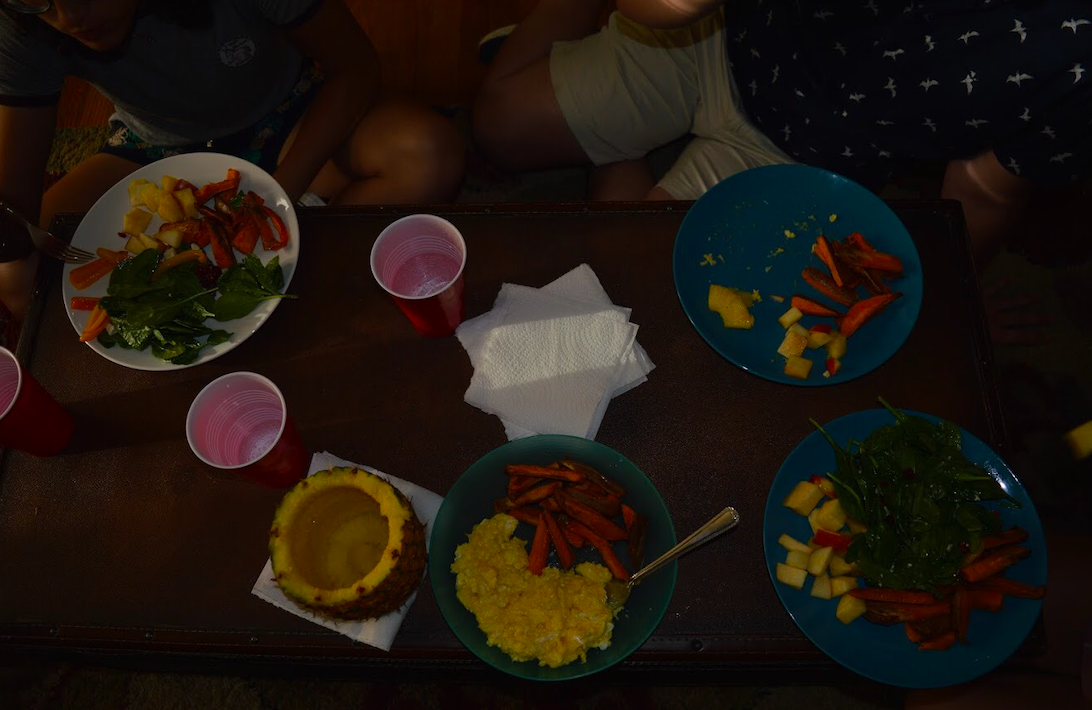
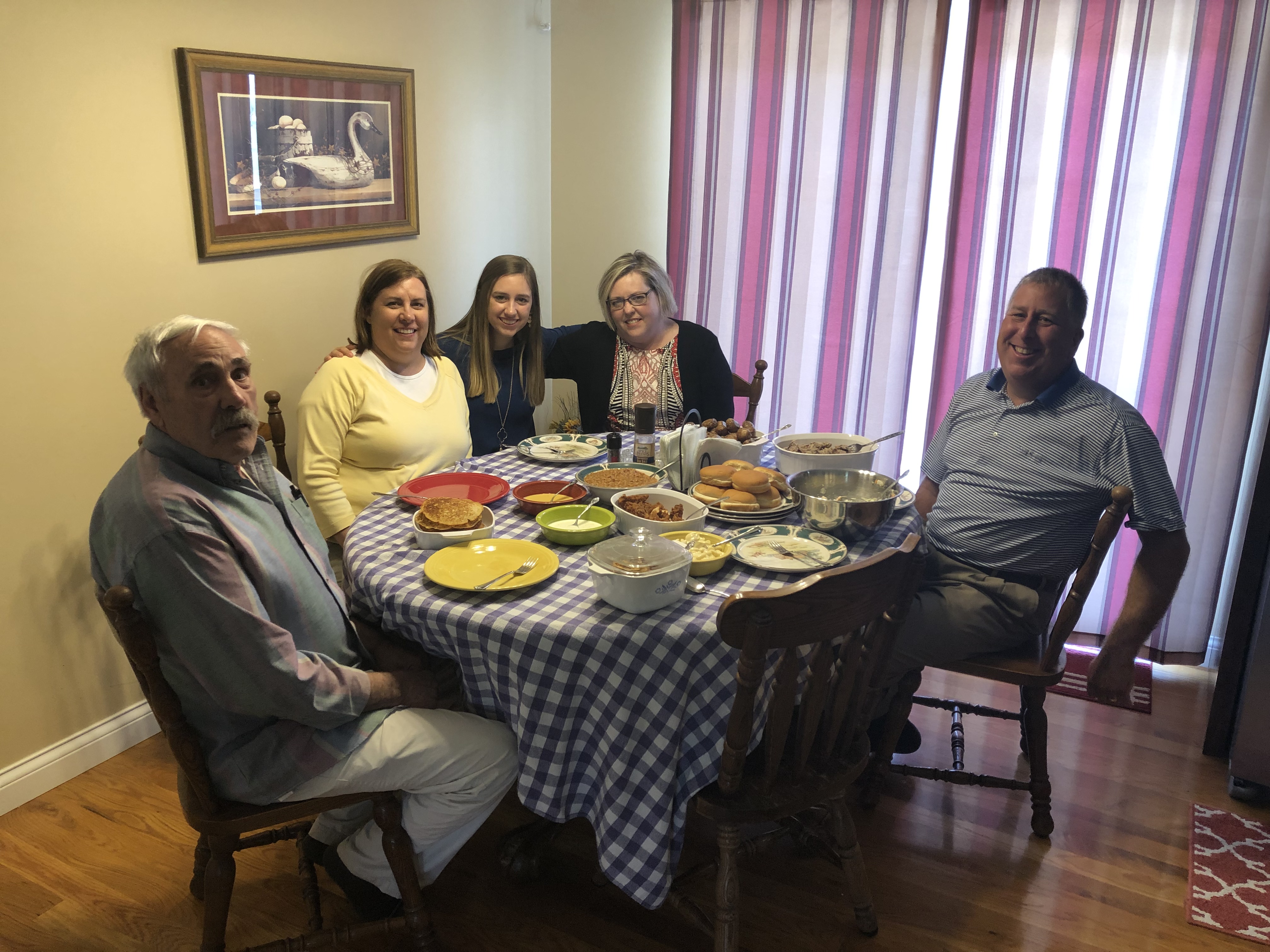
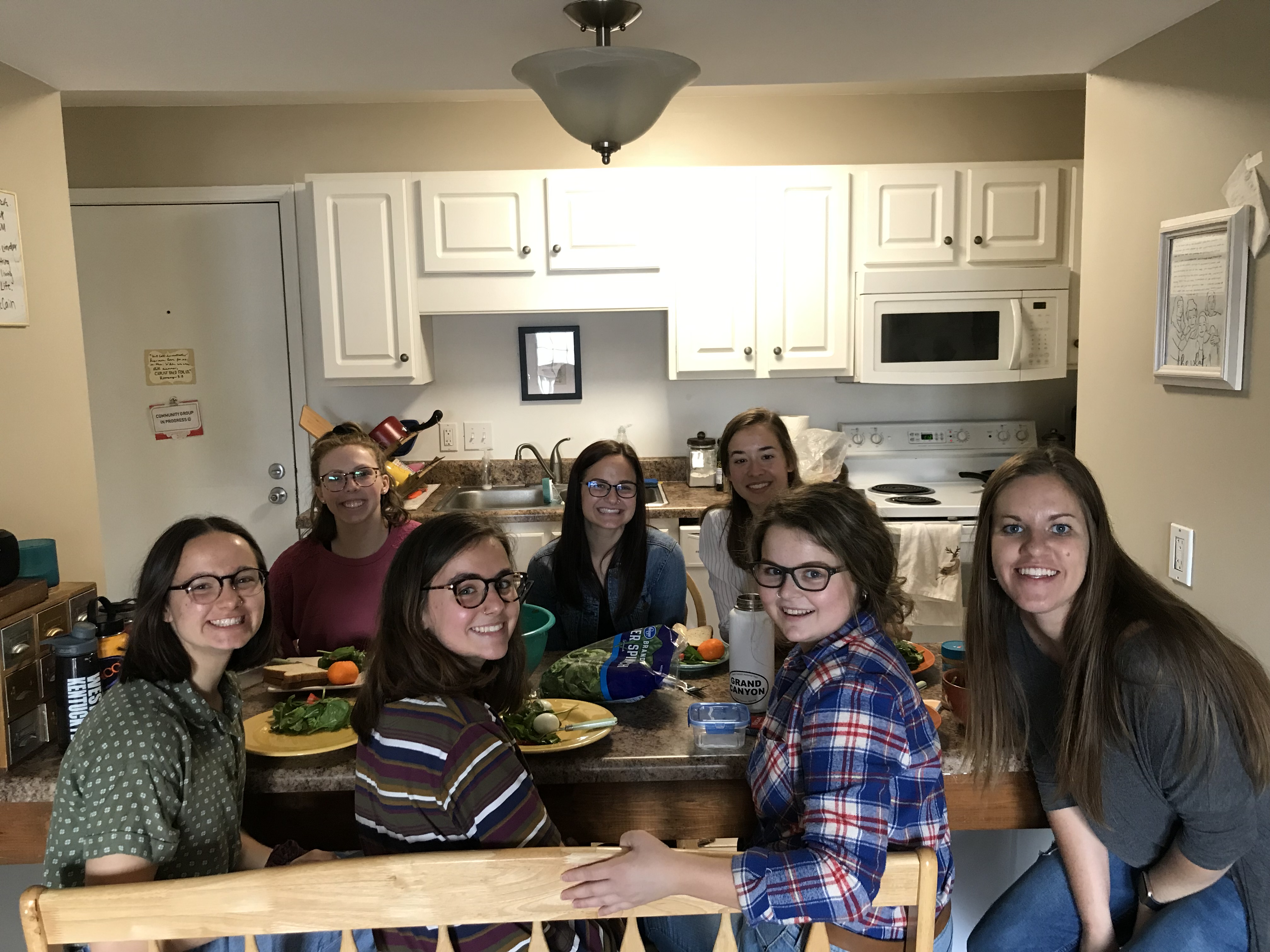
On April 11th, 2019, Bailey, Hayden and I hosted our Kentucky Kitchen Table Dinner in Bowling Green at my older sister’s house. We figured everyone was lacking on getting enough fruits and veggies (college kids). So, we prepared a vegetarian feast of salad, sweet potatoes, peppers, scrambled eggs, and fruit. Joining us was Laura, Logan, Amelia, and Erika. Laura is a sports psychology major from Segovia, Spain and plays on the WKU girls tennis team. Logan is very charismatic and knows how to laugh at himself. He was even kind enough to help me and Hayden prepare dinner. Amelia is a new friend of mine. She is kind-hearted and a great listener. Amelia is majoring in social work- how perfect! I had never met Erika before this dinner, but it turns out she had my mom as a teacher during high school for two years and had heard a lot about me. I’m sure she wanted to run out of the house after realizing I was the crazy kid my mom always talked about, but she remained very polite. Erika is a political science and economics double major. She plans to be a judge one day.

Our guests struggled to formulate an answer after we asked the required question. There was definitely a moment of hmm citizenship is more than voting, paying taxes and following laws? After everyone took a few seconds to think, we began to focus on the importance of participation. Everyone agreed that citizenship has a lot to do with what you contribute to your community and how active you are within it. Amelia mentioned that she loves how our generation is more politically and socially active. I think was easier to define the role of a good citizen than to describe what citizenship means. To be a considered a citizen you do not necessarily have to be politically and socially active. However, to be a good citizen you do. We didn’t go too in depth about what “socially and politically active” actually looks like. Today in class someone suggested that we tell the people who come to our deliberations that the fact that they simply showed up to talk is important. I think that is a fair illustration of the point our guests were attempting to make. It is our job as citizens to show up when there is an issue in our community. A good citizen is informed and concerned, or at the very least willing to listen to members of the community who are. This conversation made me realize how guilty I feel about the lack of effort I put into being a good citizen. I love to talk about controversial issues, and I love to listen to what people have to say about them. Yet, I mainly seek conversations and actions surrounding topics I find interesting. Sure, I recycle and I can talk about how I feel about abortion because I enjoy these topics. Nevertheless, you won’t find me advocating for people who don’t have access to a decent hospital who live only one town away from me. I’ve learned that being a good citizen requires you to care about things you maybe don’t care about or think about simply because they do affect your fellow citizens. Good citizenship requires more than considering just “How can we have more of a say over our lives?” Good citizens also contemplate “how can I contribute to others having more of a say over their lives?”

Next, we asked our guests what they think the best things about our world today are. Ericka admitted that all of the bad things ran through her mind before she could come up with something positive. She said she hates that she has to search for an answer. We talked a little bit about how most of us can go to bed feeling safe at night, and how we are privileged to feel this way. We talked more about how much worse things could be and how much worse things are in other parts of the world rather than how great our world is. Once we reminded everyone to think in broader terms, our guests mentioned their appreciation of diversity. Overall, this part of the conversation was really disheartening. Afterward, we asked them to describe the type of community they would like to live in. Our guests idealized the concept of a completely nonjudgemental community. I hesitate to validate what David Brooks said in “It Feels Right” because he really trashed our generation. That said, this aspect of our conversation reminded me of his argument that our generation is building an atmosphere of moral individualism. Of course, nobody wants to feel judged all the time. Still, I wondered why everyone jumped to this response. I believe that the issue is not to to the extent that Brooks argued, but I think a lot of our generation does tend to rationalize based on feelings and personal views. If this desire for a nonjudgmental community roots from our wanting others to accept our individualistic and diverse determinations of what is moral and immoral, we might run into even more issues later on. Creating a strong sense of citizenship and community often relies on coherent goals and beliefs about how the world should look. After this part of the conversation, I wondered if a community in which everyone accepts any and every different viewpoint and decision would only become more individualistic and polarized.

Unfortunately, our dinner felt rushed. Laura was somewhat quiet during the meal but she did briefly compare the slower pace of life in Spain to the faster pace of life in the U.S. Her comparison made me think about the reading “The Power of Patience” by Jennifer Roberts. I definitely agree with Roberts point. The more time you put into something, the more you get out of it. Looking back, the entire dinner sort of seems like one big analogy for the average American’s life. Sometimes we are so caught up in the rat race that we forget to sit and take our time and really get to know someone or understand something. When Laura mentioned a slower pace of life I felt envious and actually relieved by just imagining living that way for a second. I feel as if we had a great group of people but that a lot was left unsaid. Having a kitchen table dinner, something I hadn’t done in an embarrassingly long time, reminded me of how important it is to slow down and truly listen.   
Autumn’s Kentucky Kitchen Table

By Autumn

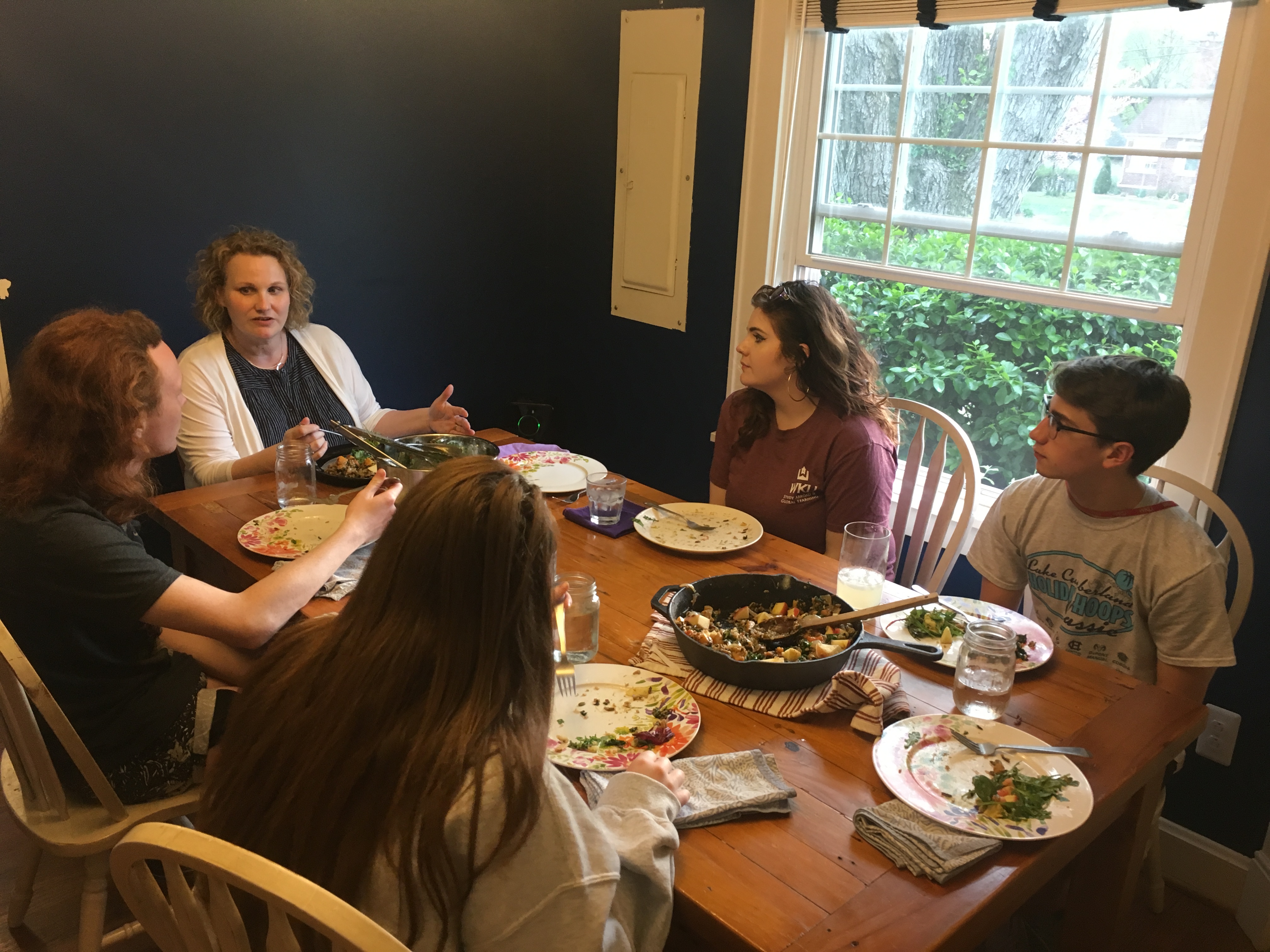
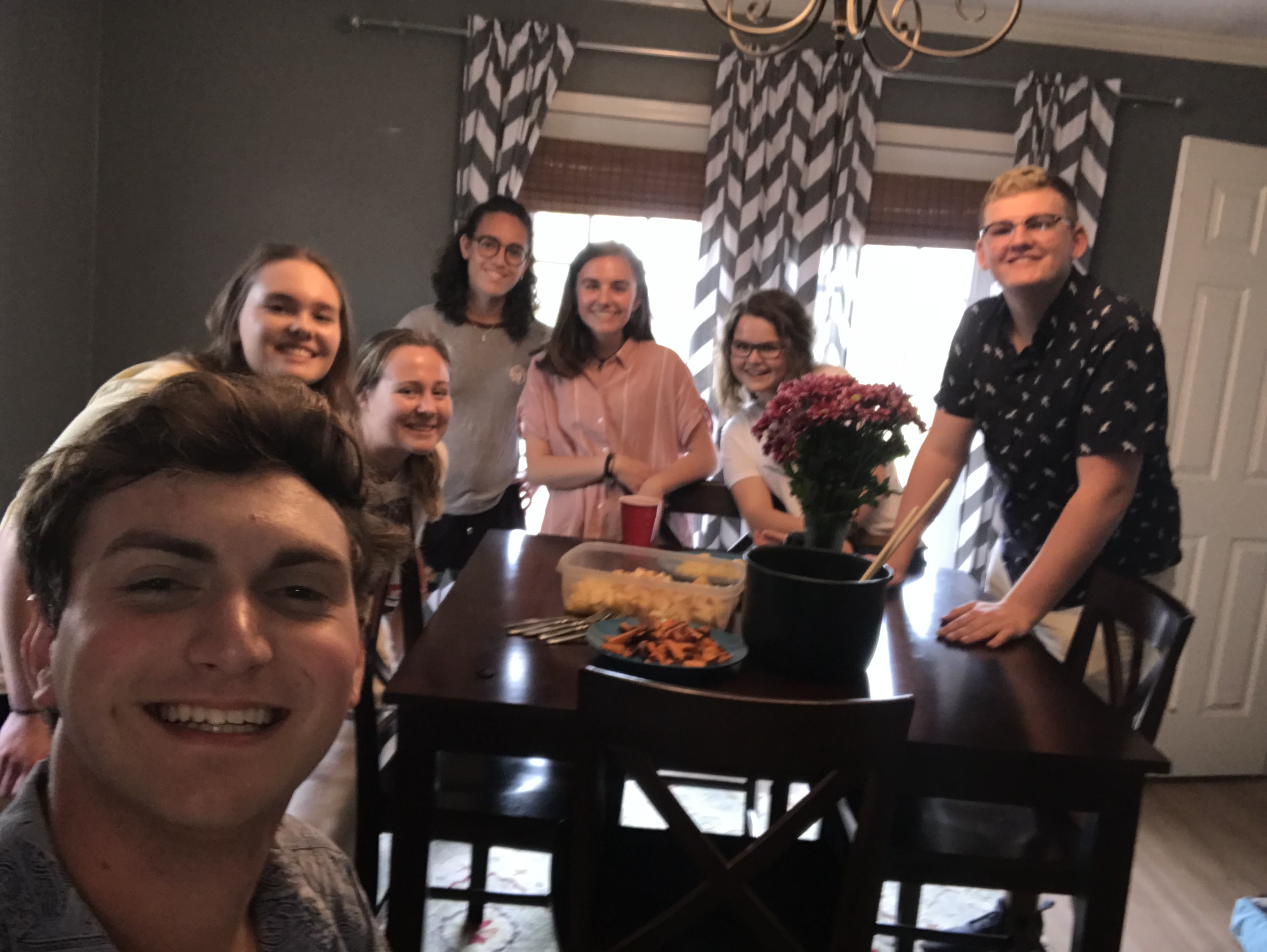
    Our Kentucky Kitchen Table took place on the eve of Thursday, April 11, 2019, at Professor Gish’s house in Bowling Green, Kentucky. We ate a sort of rice dish with apples and other atypical ingredients as well as a salad with avocados and angel food cake with strawberries for desert. That was the first time I actually managed to eat salad without my stomach punishing me for it, and I especially loved the avocado part. The attendees were another professor, Dr. Jen, two classmates, Riley and Shelby, a graduate student named Hilarie, the aforementioned Professor Gish, her daughter, Victoria, and of course myself, Autumn. There were also a dog and two cats, one of which stayed on my lap for a majority of the conversation.

    The general consensus is that Dr. Jen Jen was one of the most interesting guests. Originally from Canada, she now teaches History, and as my classmates recall, spoke  with a poetic tendency. Professor Gish likewise has that air of intelligence, but chose to try not to lead the conversation, as this was for her Honors 251 course. The others from our class, Riley and Shelby, were both from Kentucky. Regrettably, I have not spoken much with either outside this assignment, but they were both very kind. Riley has a calm voice and demeanour, while Shelby possesses a very friendly appearance. Hilarie, the graduate student, seemed to be the third most relaxed after the two professors. Victoria of course had the natural innocence portrayed only by a child, though her response to our key question showed that many adults should perhaps attempt emulating that innocence.

    At the meal, the first topic I recall is what we have learned, or been surprised by, in our class. Riley said that for him it was the intensity of the drug epidemic we learned from two of our readings. Shelby agreed with this, and I as well, though I did not speak up about that because I felt I did not have something to say that was already said. Me being me, I brought up afterwards that this course has made me more cynical about society. I enjoyed hearing people take this more negative outlook and considering the banes of human nature. Even just to hear it reflected by someone like Dr. Jen makes me happy because to me it seems like no one ever thinks about these things. We also talked about the recent Snyder outrage, and the impressiveness of the students’ united reaction. Even I have to admit I was pleased by this, I just wish it happened so successfully on a larger scale more often.

     We also discussed one stressed question of the assignment: what is the meaning of citizenship, other than voting, paying taxes, and following laws(all of which are apparently previously common themes). Hilarie and Riley shared similar themes of being knowledgeable in matters like history or problems, while Shelby placed an emphasis on being a good neighbor. My response was similar, proposing compassion as the key aspect. Victoria said that we should be nice to each other, and I could not agree more.

    Actually, my favorite part of the discussion was that of the general responses to this question. Voting was not criticised of course, but at the mention of following laws, Dr. Jen said “or not following them,” which I thoroughly enjoyed. In our class we talk about how we live better together and how we can solve problems, and I think sometimes these contradict. “Living better together,” in my view, categorises behaviour that encourages smooth interactions with others, and as such, little controversy. This is makes Dr. Jen’s response intriguing, as often in order to live better together we must compromise not only our goals and feelings but our morals. It is almost as if sometimes we have a choice between living fluidly or attempting to change what we do not like. Take for instance, the refusal of serving LGBT folks. In many circumstances, this is legal. Therefore, to protest or make a noise is not only an act of refuting current laws, but also of prioritising your morality above your relationship with the community.

    We have talked about deliberative democracy in several readings, but what of when that fails? How does on deliberate a racist? You will not dissuade a person with an argument detached from reason, so it is likely civil conversation will not change them. Which is more important then: being nice to your neighbors, or standing up for your morals? Or what of racism? I cannot say for certainty it is dissolved anywhere, but I do know for sure it is still evident in other places. What is our duty then? It is easy to say we should try to live well together, but can we really say that when the cost is the well being of others? Or should we perhaps stand up for our morals, even at the cost of a peaceful society? Sometimes, it seems, morality and cohesiveness contradict, and loathsome as it is, this seems to be a permanent trait of human reality. With this in mind, I would actually pose a new question for our class and anyone trying to be a good citizen: what do we do when we cannot live well together?

    Still, I think Victoria’s response displayed our hope for this dilemma: we must learn to be kind. I realise this seems contradictory to my previous statement, but what I mean is that we must place compassion before our personal beliefs. Compassion, in my view the hallmark of morality, should be seen as a sort of test for any other morals. If a belief contradicts with compassion, I propose we teach our children and students to brush it aside. We may believe whatever we want in our individual houses and minds, but if we want a society that does not destroy itself over differences in opinion or accept a peace in which the minority is suppressed, we need to learn to suppress that aspect of our nature which beckons us to imprint our own beliefs on the outside world. We must learn to objectively view our beliefs for the culmination of our experiences and situations, and put them to the test of compassion. Haidt argued we are but riders explaining the actions of a compulsive elephant; I argue that we should get off the elephant and walk on foot, even if it is harder for us. I think that I did garner a sense of cruel, necessary hope from reflecting upon this simple dinner.

Patrick’s Kentucky Kitchen Table

By Patrick

On April 7th, 2019, myself and my guests gathered in Southwest Hall in Bowling Green Kentucky to discuss what citizenship meant to us. My guests were Kerby who is a fellow honors student and Kentucky Y alumni who grew up in Warren County, Nick who is a local of Bowling Green and who is a member of the LGBTQ+ community, Carmen who is from northern Kentucky and studies Mathematics at Western Kentucky University, and Johnathan who I did not know well but comes from the Southeast part of Louisville and studies both History and Engineering.

Our conversation began with the anticipated “Beyond the given things, what is citizenship to us?” The answer to this seemed to guide future conversation well because our conceptions of citizenship were all based around ideas of community that differed between us. Citizenship seemed to be for those in the group helping those in need when the need should arise. That help was agreed could appear in many ways, shapes, or forms, but it was about a responsibility to community. This is where the first disagreement arose as what is community. When asked, Kerby’s conception of community was shaped by her interest in global affairs and a fluid conception of unity even though she grew up knowing very few of her neighbors. Johnathan, on the other hand, had a less fluid conception of community while identifying that he knew the names of all his neighbors. While these two factors may not have a large correlation considering Carmen and Nick both agreed more closely with Kerby even though they knew their neighbors, it is an interesting idea to consider. Whether knowing a local community growing up creates a more rigid conception of community as we get older.

As the conversation simmered down on community, the discussion shifted towards considering what factors each person looked for in a leader of their community be that spiritual, political, or other. Johnathan quickly responded although he had trouble finding the right word for the characteristics of versatility or experience that he admired. In the end, the group came to consider this quality adaptability which everyone quickly said was important. Kerby chimed in saying that honesty or integrity were also important factors for her when identifying with someone as a leader. While the people at this dinner spanned the political spectrum these two qualities were agreed upon unanimously as important.

From leadership, we traveled to religion. It was important to gauge how religion affected conceptions of citizenship because I knew going in that there were more religiously inclined and less religiously inclined people in the group. I was curious to know how much of an effect each person believed religion had on their morals or conceptions. Johnathan, for example, is a practicing catholic who went to an all-boys catholic school, and he identified how many of his core beliefs or principles came from relationships he found in the church. Carmen, on the other hand, went to an all-girls catholic school but was not raised within the church as her mom is spiritual in other ways. She, too, felt that the moral values of the church were part of where her foundation came from, but that the idea of human interaction was very important. Johnathan later echoed this idea that some of our morals are really trial-and-error. The ways we fail people or are failed ourselves inform us for how we should treat others in the future. Nick and Kerby who neither have a particularly religious upbringing identified strongly with this, and it seemed that the whole table really felt a mutual connection to the idea that our experiences are the most important factors to determine our morals. This was interesting for me having grown up in a very strong evangelical moralism community in Kentucky to hear that others did not feel that same connection between religion and morals. If they did, it played second fiddle to the stronger feeling of camaraderie with the human condition.

I was curious at this point and had posed a question specifically to Nick about his identity within the LGBTQ+ community and if they had a dramatic impact on his views of both citizenship, rights, and morals. He confirmed that hearing stories about others and living his experience as a gay man has given him a better ability to empathize with others. He felt a connection with the Christchurch victims considering the similarities to Pulse Nightclub in Orlando. It really resonated the idea of intersectionality within persecution. Our lived experiences stretch beyond the literal and enter abstraction to truly connect us with people that have little shared knowledge. This conversation harmonizes with Kerby’s earlier comments about a global community that does not require one to know the existence of any one person. It is a cerebral connection that is hard to verbalize. Of all the revelations in the conversation, that really stuck out as something wonderful and important.

This is where the conversation entered aspects of political consideration. Each person responded that they had inherited at least at some point many of their political beliefs from their parents. For Nick, college has proven a challenge to some of those conceptions while Kerby has found herself constantly questioning and building a greater pool to draw from when considering the issues. It was clear that parents and leaders of different kinds have a strong impact on opinions that they may not even be completely cognizant of which seems an important conversation to tackle.

Fluidly, we shifted towards censorship, free speech, and citizenship. I brought up the recent actions by Facebook to ban not only white supremacy but also white nationalism and white separatism. Nick immediately reacted with worry that such actions may prove to be the antithesis of the American forum of debate while Kerby strongly voiced that Facebook is not a public forum and has every right to police its servers how it pleases. This raised the question of how far the government should go in restricting the actions of Americans. Is it within a person’s rights to deny service to someone because of their sexual orientation? I brought up the point that it depends heavily on whether a person recognizes sexual orientation as a natural phenomenon or a personal choice. The table agreed that just as race is not a rightful grounds to discriminate assuming sexual orientation is natural then neither should it be. Carmen brought up the point that in the Bible there are plenty of condemnations of other races just as Leviticus condemns homosexuals, so a simple argument of biblical content is not fair. It was interesting to hear this point discussed because it is not one that frequently sees discussion bipartisanly. This issue frequently results in name calling and shouting. In our conversation, we were easily able to have the discussion without the anger or upheaval, and instead actually got somewhere.

I find it still difficult now to draw one meaningful conclusion from the more than an hour-long discussion that we were able to have. I heard comments that reaffirmed my feelings on topics and others that toppled the foundation of my conception. I grew to appreciate this idea that sans religious influence or with it, people arrived at the same ideas of a golden rule that are hailed by most global religions. It interesting how strongly this conversation has made me revaluate my opinion of Ivan Illich’s “To Hell with Good Intentions.” I, at one point, strongly agreed that traveling to places with no connection to the people was unproductive if not counterproductive. In reinterpreting my conceptions of community, I have a stronger belief that language alone is not something that should serve as a barrier. Presence means something to others as I know it has always to me. My morals are founded by my feelings not the religion I grew up with. It feels like a revolutionary idea for me that our morals are not dependent on our faith, but rather are dependent on a human condition larger than ourselves. It is in these reserves of empathy and emotion that we find ourselves most attuned to the needs of others. It is in this circumstance where we achieve a citizenship unbound from borders. It is in the heart of this understanding that our true morals are reasoned. I feel as if in this discussion I breached that sanctum. Somewhere along the way I was finally able to grasp the ideas that usually prove elusive. Kerby, Nick, Carmen, and Johnathan helped me to better understand myself, but more importantly the community around me. A community that spreads out across the entire globe. I am beginning to believe in the need for more truly good intentions.

Kayla’s Kentucky’s Kitchen Table

By Kayla        

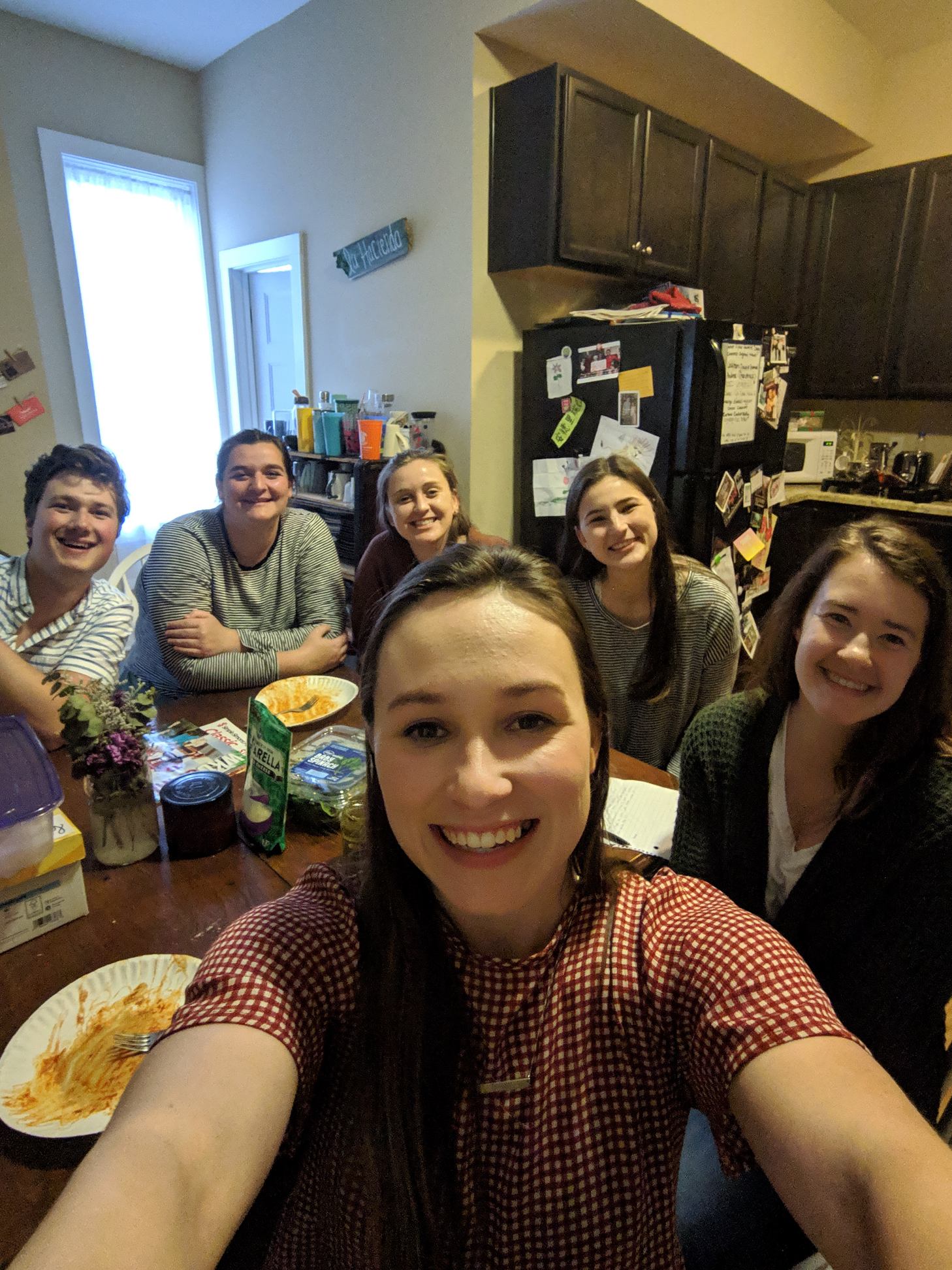
  On April 9th, 2019, I hosted my Kentucky Kitchen Table at 624 East 11th Avenue Bowling Green, KY. At this address stands a beautiful blue house. Inside lives a number of girls ranging in age from 21-24. However, there was one guest boy who attended the KKT. The first person at the Kitchen Table was named Corinne. Corinne is from Louisville, KY and has an avid passion for dogs. In the fall, she will be traveling to Sweden on a Fulbright grant to do chemical research and when she returns, will attend Vanderbilt University for Chemical Engineering Graduate School. The second person at the table is Lauren. Lauren is passionate about loving others and hopes to work in sport management with refugees in the future. The third person at the table is Andrea. Andrea is one of seven children and comes from Romania. In the fall, Andrea hopes to move to Tennessee to become an Elementary School music teacher. The fourth person at the table is Kassidy. Kassidy, like Corinne is also from Louisville, KY. She has just returned from Quatar where she attended an Arabic debate and she hopes to be working abroad in an embassy. The fifth and final person at the table was named Lincoln. Lincoln is graduating in May with a degree in Mechanical engineering. In September, he plans to marry Corinne and travel to Sweden alongside her where he will find an engineering job. For dinner, I made spaghetti with red sauce. As we began to feast, conversation began.

         I asked the first question, “Beyond voting, paying taxes, and following laws, what does citizenship mean to you?” Both Lincoln and Corinne agreed that being a citizen means to participate and represent both the government and society in a positive way. A unique answer came from Lauren who said that a citizen is someone who cares about what is going on around them. A common theme to this question was that citizens need to participate in many different aspects of government in order for a democracy to be successful and efficient. Everyone around the table was agreeance in the fact that right now, America does not have great participation form its citizens especially in voting. They made an especial note to say that this voting deficit is  prevalent in the youngest generation of voters. After discussion of the first question fizzled, I then asked, “What do you think are the best things about our world today?” Kassidy did a good job of putting everyone’s answer into one. She said that in today’s world, it is remarkable how we can share ideas and opinions within the click of a button and this is the difference between where the world was 40 years ago and where it is today. Andrea, being from Romania, said this was especially important to her. While she does live in the U.S. with her immediate family, the majority of her extended family lives on the other side of the world. Recent advances in technology have allowed her to communicate with them and make her feel like she is not missing out on their lives. The next question I asked was “What kind of person do you want to be in the future?” Lincoln responded by saying that he wanted to be someone who looked out for and provided for his family—an answer that really showed his character. All of the girls were in agreeance that they wanted to treat all people as equals no matter what background they came from or what beliefs they possessed. This was a good transition into the next topic of conversation. 

         It was evident that one of the most cared about issues by the table was the global refugee crisis. As every single person at the table either plans to be abroad in the future, or has been an immigrant themselves, the issue hit home. Andrea, in specific, spoke about how brave her parents were to move across the world for the betterment of their children. She said that she can only imagine what current refugees are going through as they battle difficult restrictions that her parents did not have to face. Corinne then spoke up about the refugee policies she had been researching in Sweden since she will be living there for 10 months in the near future. She mentioned that the Swedish government has implemented a much more thought-out plan for refugees compared to the U.S. For instance, refugees there are required to go through intense physical training because of the high fitness of the culture. The Swedish government feels that it is necessary to get refugees into shape because doing so will allow for a smoother transition of living among and getting integrated into a new culture/lifestyle. The table agreed that America’s refugee program is slacking in comparison to many of the programs installed around the world. In America, when refugees arrive, the moment they step foot on soil, they are setup for failure. There are no programs for refugees to become accustomed to American ways or to be assisted with attaining things such as a job or house. The American Dream is a fraud for many. Lauren brought up a good point after much discussion on the topic. How is America to pay for such programs? She hinted at the leadership of the country being poorly executed with money being allotted to the wrong areas. This spurred much political debate for the remainder of the dinner mainly with everyone in agreeance that our current president has made some questionable decisions in his presidency. 

         Overall, this Kentucky Kitchen Table was very valuable to me as I was able to understand different answers which came from different backgrounds on pressing questions. I was also very pleased that the conversation morphed into an in-depth analysis of the Refugee Crisis. It was neat to see a group of people so passionate about an issue. This relates to theme of our class because it is no secret that the Refugee Crisis is a wicked problem. It meets all descriptions outlined in the “Wicked Problems” reading. There is simply no clear solution to it in America and this was highlighted at the dinner table.        


Shelby’s Kentucky Kitchen Table

The meal was taken place at my hometown, Radcliff, Kentucky on March 30, 2019. My family and I had a wonder family breakfast with my older brother’s girlfriend. My dad’s name is Ed grew up in Hawaii and was always getting into something when he was younger. Now he is one of those very opinionated old men. He is just very into anything political and more on the conservative side of thinking. While my mom, Becky is from a small, farming community in Ohio. She tends to look at both side of thinking. She always tries to be understanding of were others are coming from and then putting in her own input. My older brother, Aaron is like my dad when it comes to political issues or hot topics. He is also naturally smart which makes him think he is always right. My younger brother, Casey is only 15 years old and a shy kid who has little to say. He is still trying to figure out who he is and not really paying attention to what is going on in the world. My older brother’s girlfriend, Richelle is the same age as I am. She comes from a very open-minded family and is very open to everyone’s’ option and respects where they are coming from. The final person was myself, Shelby, along with my brothers I grew up in the same community, but I am the only child who is attending college. I would view myself as an open-minded person and trying to see all sides of a situation like my mom does.

When asked about what it is to be a citizen beyond voting and paying taxes, everyone around the table agreed on one main that that being a part of the community. Then I asked what they mean by being a part of a community and how involved should a person be. My dad and Aaron stated how it depends on the person you are on being involved in the community even if it is a small effort to better the community. Then they both brought up the topic of immigrants and how they take up resources for actual US citizens. Aaron stated how he doesn’t care if people come into the country, his problem is all the social issues some immigrants bring like bringing in drugs into the US. That is the reason he supports the reason why and that he would not mind if he does to pay more taxes just to make that action happen. While all this was happening, my mom was trying to mediate the situation while also putting in her option. While my little brother sides a little funny comment here and there and Richelle telling Aaron that his a conservative and close-minded. Through every topic we hit during dinner, my dad and Aaron continually stated how kids who go into college be come liberal with all the liberal professor we have.

From the repeated liberal comment made me think how people’s background and experiences makes them see things differently. My brothers and I were al raised in the same community all our lives and were raised the same way. But we all have different options about certain topics. Especially between my older brother and I, Aaron is more conservative view thinking while I am more liberal view thinking. I wonder why that is, is it because the different types of people we are round or is it because how we are exposed differently to the same topic? Having this conversation with my family and Richelle opened my eyes to how people will experience the same event but will see totally different viewpoints. With my family I can see maybe why I am more liberal than the rest of my family is maybe because since I attend college, I am more exposed to all different kinds of people. But with people who I am around back at school will always have different ways of viewing things then I will. The lesson I learned from this, shows me how people will view the same situation differently from my own. Which relates to the central question in HON 251. Even though, people can come from different or same backgrounds or view things differently, it could open up other’s eyes to how people feel about situations. From this people can come together to figure out solution to problem so that we can have more say over our lives and how was can live better together as a community or society.

 F  q w e r t y u I o p a s d f g h j k l z x c v b n m q w e r t y u I o p o I u y t r e w q a s d f g h j k l k j h g f d s a z x c v b n m n b v c x z a s d f g h j k l p o I u y t r e w q a s d f g h j k l m n b v c x z x c v b n m l k j h g f d s a s d f g h j k l p o I u y t r e w q w e r t y u I o p k l j h g f d s a s d f g h j k l m n b v e c x z x c v b n m n b v c x z a s d f g h j k l k j h g f  d s a q w e r t y u I o p o I u y t r e w q a s d f g h j k l k j h g f d s a z x c v e c x z x c

Jon’s Kentucky’s Kitchen Table

My Kentucky’s Kitchen Table was held in Scottsville, Kentucky on April 9, 2019. There were five other people, besides me. Kim who is originally from Scottsville but lives in Ohatchee, Alabama. Delford, who served in the army, worked as a welding inspector in nuclear plants, and is half Native American is originally from Scottsville, Kentucky. Sandy is an eighth-grade Language Arts/English teacher. Shannon works for Bluegrass Cellular and is originally from Bowling Green, Kentucky. And lastly, Sarah, is a student at Allen County-Scottsville Kentucky.

After everyone got their plate and sat back down I started off the conversation with small talk to get everybody comfortable talking with each other, asking about their family, favorite part of the meal, etc. Once everyone seemed comfortable I asked the table what, aside from paying taxes, following laws, and voting, does citizenship mean to you? Sarah started off the conversation by mentioning how she had just finished a Civics course in high school. She said that being a citizen means that you are responsible for doing your civic duty. When asked to elaborate on what she meant by civic duty, she said that it included helping your neighbors, keeping your community clean, and donating time or money to help those who need it. Sandy agreed with Sarah and added that any contributions to society is a great way to show our care for our community as citizens of it. Delford took a different view and mentioned that as citizen of this country, we get to the comfort that are not always enjoyed in other places throughout this world. Kim also added on to it that freedoms we enjoy in this country is not universal in application and that as citizens we need to remember how special these freedoms are and how we must constantly work to protect them.

After listening to everyone had given their response to the question, the conversation started to die back down so I posed another question. I asked them what they believe their involvement in their community should be or does consist of. This time Sandy started off the conversation jokingly asking if teaching middle schoolers for twenty-six years count. She then mentioned volunteering in the community since there is a need to help those around us that are less fortunate. Since we live in a poor community, there are a lot of people who need help and volunteering to help them out is something that could make an immediate impact. Sarah acknowledged that volunteering was a great way to be involved and mentioned how through 4-H she had helped working in the local soup kitchen, Feeding Faith soup kitchen. Delford mentioned how getting older makes it harder sometimes to do volunteer work but that does not stop the need to be involved in your community. One thing that you can do is make sure your voice is heard. The easiest way to do this is through voting but she said that listening to other’s opinions and discussing various topics with them is also a great way to make sure your voice is heard. Kim then mentioned how communicating with your neighbors and creating that sense of close community is a vital part of being and staying involved in your area. That is when Sandy agreed how we should make sure to be involved in the area we live in. We should be able to give and receive help when we are asked or ask of our neighbors. She also mentioned how that was one of the best parts about living in Scottsville, the close, friendly communities, lead me to my next question.

My next question was centered on how they felt about the community they live in, which for everyone there was Allen County. This is when my father got involved in the discussion by talking about the sense of close-knit community. Sarah felt that the general kindness and respect shown by everyone around here was one of the highlights of living in a small town. While Sandy acknowledged that friendly neighbors was one of the best parts of living here, she also pointed out that it is a place that shares very similar values to her own. Part of this similar value was because of the number of churches and spiritual-minded people around this area. It seemed that those were the two main reasons that these people enjoyed living here in Allen County. Something else that seemed shared among those at the table was the fact that they all were passionate about similar social issues and their feelings on them. Delford, for example has two children in education and cared deeply for the issue of educational funding and how it would affect her kids while Sandy also shared similar feelings being a public-school teacher. I noticed in discussing current issues with them that the wet/dry vote, which is a vote to determine if it will be legal to sell alcohol in the county, was very prominent to the older generation while the younger generation, although they had opinions on it, did not think about it as readily. Instead, their focus was on the abortion vs. pro-life issue. This difference in social issues that were particularly important to them was interesting to me as to how the different generations think of different issues first. Through this meal and listening to responses to the questions I posed I learned a lot of new ideals that are held by the people I know and how they connect to what we have learned in class this semester. I learned how different people see the world through different lenses. I also learned how those “lenses” can determine what issues we see and the solutions to these issues we determine most viable. I also got to learn more about the community around me and how people I thought I knew a little bit about, by talking to them a couple of times, I really didn’t know anything besides their name. I also got to see how people can bring unique perspectives to you through their past experiences. This was most noticeable in the older generations when asked how they thought the community around them changed, or if it has changed at all. One of the big things that their answers centered around was the emergence of technology. This was also seen in talking with Sarah who said she really didn’t consider it because she had always grown up with it. This was one of the first times I had a “real-world” conversation that really helped me see what was going on around me and how talking to other’s that we may not normally talk to can help us see other perspectives we may have previously not considered. That was the biggest takeaway I saw from this Kentucky’s Kitchen Table and why I hope to have more opportunities to have more eye-opening conversations and discussions in the near future.

Rebekah’s Kentucky Kitchen Table

By: Rebekah

My Kentucky Kitchen Table took place in my grandparents’ home in Cartersville Kentucky on April 7th. This dinner was easy to arrange. In order to make sure we all spend time with my grandparents, my dad decided some time ago that we would all get together on Mondays and have dinner together. The work of preparing the meal was split evenly and whoever was available would rendezvous at my grandparents house, which has become a headquarters of sorts for our family.

The first person present at my Kentucky Kitchen Table is my dad Mike. He is an agriculture major from Berea Kentucky. He is the most driven, hardworking, and innovative person I know. He farms our nearly 300 acre farm and also works full time as a maintenance man at a nursing home. He is fairly outspoken and makes fast friends with everyone he meets. The next person present at my Kentucky Kitchen Table is my mom Julie. She is a newly retired psychologist. She graduated from Berea College with a bachelors in Psychology and went on to Eastern Kentucky University to earn her Masters in early childhood development. She worked at the Kentucky School for the Deaf for eight years before moving on to work in the school system in Rockcastle County. She worked closely with children with learning disabilities and helped make plans of action for the best ways to assist them in learning. She loves working with children and took great pride in her career. She is a bit more soft spoken and gentle, but she has a wicked sense of humor and a quick wit. Next is my sister Bailey. She graduated from Asbury University with a major in psychology and a double minor in French and Biology. She now works in the activities department of a nursing home and absolutely loves it. She is the most passionate, intelligent, and well-rounded person I know. Everything she does is done with integrity and passion. She also excels in reading people and creating meaningful bonds with everyone whom her life touches. She says her job at the nursing home doesn’t even feel like a job, but rather just spending time with her 90 extra grandmothers and grandfathers. The next person is my grandmother. She is a retired 6th grade teacher. She graduated from Morehead University, and then went on to teach science, art, and for a brief time English at Berea Community School. My grandfather is my next person. He worked at Parker Seal factory making rubber O rings for nearly 30 years while also farming on the side. He is a Veteran and served in the noncombative zone during World War II.  He is incredibly proud of his family and the success we have all achieved. His favorite thing to say is “I never went to college and failed the first grade.” His ingenuity and hardworking spirit however, made it possible for the rest of his family to have the opportunity to follow their passions and pursue their dreams. Next comes my uncle Scott and my aunt Karla. They both graduated from Eastern Kentucky University. Scott has a degree in geology and Karla has a nursing degree. They both work in Berea. Scott at a factory called Hyster and Karla at the Berea Hospital. The last person present at our table is my uncle Scott’s college friend and roommate Ed. Ed graduated from Eastern Kentucky University and now works as merchandiser.

My family tends to gravitate towards serving others. They have all taken their passions and found some way to apply them to their everyday lives and impact others in positive ways. They all have extremely different opinions and views. Our table is incredibly intellectually diverse and I was excited to see how everyone would respond to my questions and what discussions these questions would spur.

No one in my family has ever taken citizen and self and if they took a similar course in college, it has been years since they discussed such topics and the meaning of citizenship as we discuss in our class. While politics often come up during our weekly meals as a family, we rarely discuss citizenship and what it means to us. When politics do come up, they are often addressed in a blustery and flustered manner. However, I was pleasantly surprised by the insightful and thoughtful answers my loved ones gave when I asked them what being a citizen meant to them.

My mom, Julie, answered first. She explained that being a citizen means loving your country and taking pride in your nationality and heritage. She also expressed her sentiments by examining the importance of having connections with other citizens. There is power and a special type of bond between people who share the same rights and privileges. She insisted that citizenship is also about being accepted and belonging. “A universality,” My sister spoke up. “E Pluribus Unum, out of many we are one.” 

My sister Bailey then began to voice her outlook. She agreed with my mom, but she also brought up the point that citizenship is also owning land. The meaning of citizenship comes from having a piece of country that belongs to you and you belong to it. She felt as though this notion has been lost in the cities and suburbs, but in rural areas people still value their land greatly. The concept of “Home” is also an integral part of citizenship. As citizens we all have a sense of belonging and no matter what, always having a home in which to return.

My father seconded this notion. As probably the most politically versed person at our table, he tends to have a slightly cynical outlook on our government and the state of our nation in general. He often worries for the future and harbors a general distrust for politicians.  However, he insisted that being an American citizen is an integral part of our identities and it was important to remember that no matter the political climate, we are all Americans and strive to do what is best for our nation.

Ed then stepped in and stated that he agreed with both my sister and my father. To him being a citizen meant loving your country and supporting it with a genuine sense of patriotism. He also clarified that as a citizen of the United States, he also reserves the right to criticize that country and the actions taken by the government. When you truly love something, it is important to always strive to do what is best. He then explained that this is why he believes politics have become so polarized. It is easy to get heated and disagree with those who have different ideas about what is best for our country as a whole. Though it can seem frustrating, passion is behind every heated political discussion.

The next question I posed to my family, “do you know your neighbors?” really livened up the conversation. My entire family comes from a very small and close knit community. They were all familiar with their neighbors and quickly embarked on telling stories and talking about the bonds they share with their neighbors. This question enticed many different responses. My grandmother then stepped in and told a riveting story about bonding with her neighbors. She then embarked on discussing recent developments with her neighbors (who happen to be our cousins) chickens and her own chickens. It was long and entertaining but I honestly don’t remember the details.

Once the neighbor talk and stories died down, I posed another question to my family: what kind of community do you want to live in? This question enticed many different responses. My grandmother and mother both agreed that they value safety and community. They value times when they get together with their neighbors and get to know the people around them. My grandmother also expressed her sadness that people rarely get together anymore and often don’t even know their neighbors. She recalled times from her childhood where she got together regularly with her neighbors. She also explained that people used to feel very safe in their own communities and she pitied the young people at the table because we didn’t grow up in similar, close knit atmospheres.

Overall, I truly enjoyed this assignment. I enjoyed being the catalyst for productive conversation in my family. I also loved hearing my family answer to my questions. The topics we discussed at our Kentucky Kitchen Table, we have also discussed in Citizen and Self. While I have formed my own opinions over the course of the semester, it was interesting to hear the thoughts of my family and be able to see things from their perspectives. Everyone contributed in serious, thoughtful ways. It was also extremely interesting to see the perspectives of three different generations.

Fiona’s Kentucky Kitchen Table

By Fiona

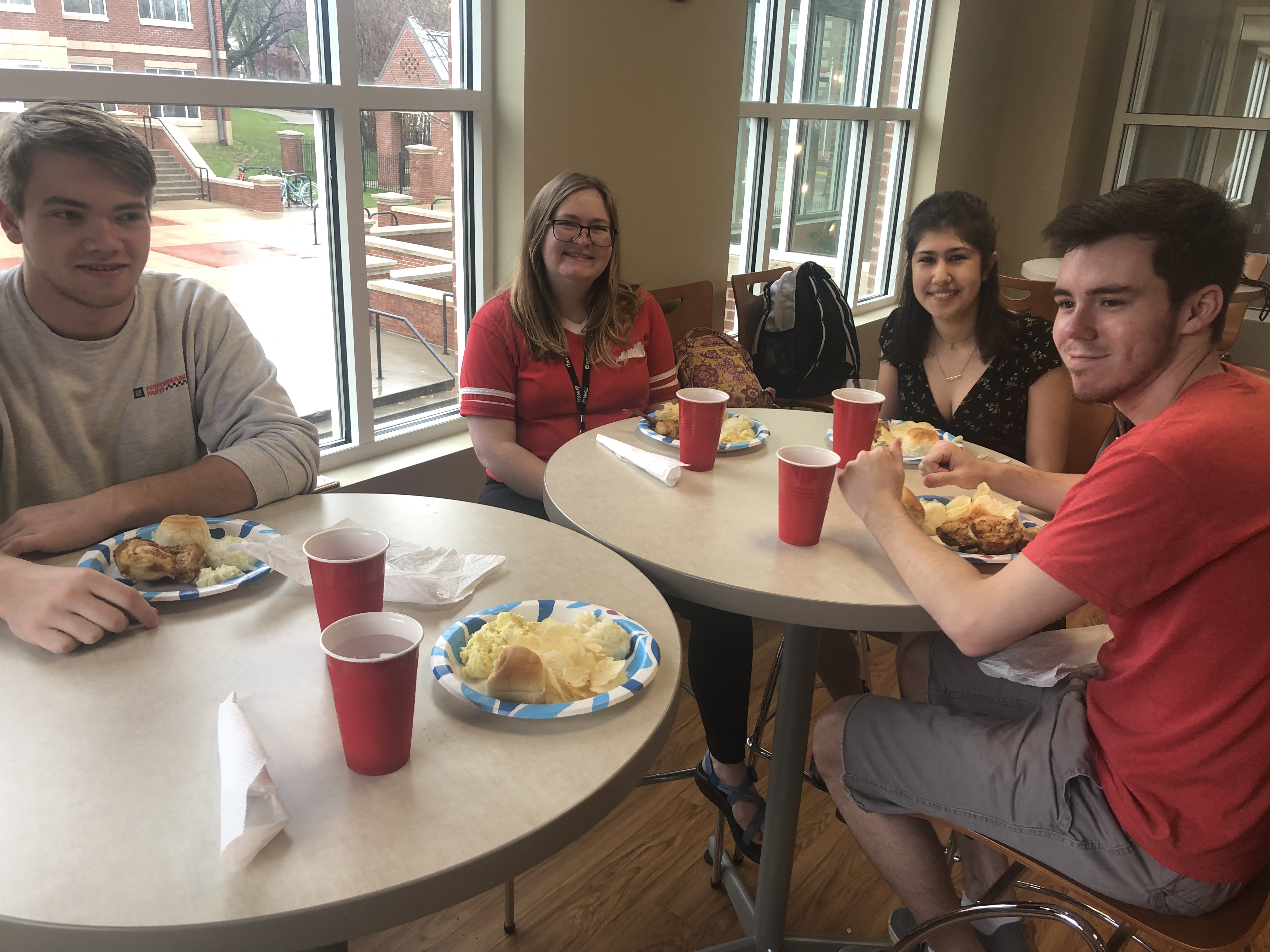
On April 6th, 2019, Taco night was held in my dorm kitchen in Southwest hall of Bowling Green. The original plan was to hold it at my family’s house with my friend from high school over curry, but my family is leaving the country the next morning. Taco Night consisted of 7 people who were all in my fraternity on campus, although others were in attendance but did not participate in the discussion and were at a different table. The guests include Kristine, who is a graduating pre-med student from Scottsville, Ky who is my chapter president and Kristen who is also a graduating pre-med student and a Fraternity brother. Christy is a graduating communication disorders student from Evansville who has traveled Spanish speaking countries and Ben is a physical education student. Brittney just spent a semester at Disney and is a graduating transfer student with a minor in musical theater and Kayla is a social work major who is also a lead resident assistant in the housing and residence life department. With a wide array of people at the table tonight, we enjoyed turkey and beef tacos fitting the different dietary needs, which was addressed at the table.

Initially we made dinner all together and brought ingredients per person. The new dorm kitchen made it easier to work together and make dinner. We talked about the difficulties of midterm exam season and how the early spring break effected the pushed midterms, making the difficult exams extra taxing. Kristine talked about how graduating that semester made it hard to care about individual exams as they seemed so much smaller in comparison to where she was going in life in just a few short months. Christy talked about how she was a graduating senior and leaving undergrad school was giving her anxiety because she isn’t sure what she wants to do beyond graduation. I asked everyone if they were wanting to go back to their hometowns after college. Kristine and Kristen said they would consider it, but Christy thought of her hometown- Evansville, IN- as more of a home base from her traveling. Brittney is planning on joining the work force soon after graduating and wants to jump in to a career where ever it is offered for her. Ben however wants to stay in Kentucky specifically as long as the governor doesn’t “screw up” the life of a teacher.

When asked about what it means to be a citizen, other than voting and paying taxes, and oddly enough the first thing someone said- Christy- was giving money to someone who is homeless on the street. She said she had offered food more than money though and likes to have conversations with the people. Christy said she enjoys hearing people’s story about living and surviving. Kristine found this kind of interesting but worried about Christy’s safety. Christy commented the safety of those people who live impoverished lives and who are interacting in a public atmosphere. Ben said that he is very uncomfortable when people approach his car, but being a citizen means participating in conversations with shared problems are important to him. Conversations can be in the form of a formal deliberation or a dinner like this one.

Ben talked about being a PE teacher and how he understands there will be all types of children with their own things going on. I asked him if he thought he was a kind of public servant, and he really thought he was just giving kids the opportunity to be healthy. He thinks students aren’t active enough and that its sad when there aren’t kids on the playground or riding bikes. Kristen mentioned her service work with her church back in high school, although she is more disconnected now. She said she went on a mission trip and met a lot of cool people. I remember the article about American missionaries and asked her what value she got from her trips. She mentioned that it felt important in the moment, but she felt like she spent more time fundraising for the trip than preparing for what public acts she was going to be doing. When she finally got there, she didn’t know the work they would be doing and when she left it was over and there was no way to tell if she had actually helped a community. Beforehand, I had no relation to that article but now I understand more about how missionary work as a servant with religious purpose could be unfulfilling and ill-suited.

Kayla brought up her role as serving the public, and she was really interested in how she will serve the community. She believes that being a citizen means contacting congressmen about problems and also far down at the other end helping an elderly person load their car with groceries. It was the sense of community that she loves about Bowling Green which she said is a bit scarcer in Nashville. I found her comparison interesting. I asked one of the questions with a twist asking more about, which type of person do you want to be, and does that say something to where you would you want to live? Kristine was really excited about this question and responded with how she is moving and wanted to mention how Bowling Green has always felt like a very warm place to live. For her, it was interesting because she isn’t from here, yet she feels like its home and fosters her best self. Kristine looked at her tacos and said that it was because there were so many types of people who create a diverse atmosphere to where we have amazing tacos and amazing Bosnian food. Kristine bringing up the Bosnian food being accepted and wanting the food made me think of the Bosnian treatment story we read, because it is culture that is persecuted, and it is amazing that such a small place in Bowling Green can accept all types of people.

I chose this time to ask about social issues, and Christy brought up the fact of poverty and the language barrier, one I hadn’t thought a lot about. She didn’t explain much about either, but she said that there is a separation between classes that makes it difficult to live together peaceful. Ben preached to the girls at the table and mentioned the gender wage gap and provided a first hand account to where he found out he was making more money than a girl who help the same position. He said what we all have said before, and that he never thought he would be affected by the problem and then he mentioned that we treat society’s problems like the are normal, and that is the biggest problem of all. We derailed for a while and talked about the quality of ground turkey in tacos and how to make shredded chicken.

I learned a lot about my fraternity brothers’ aspirations in life and their outlook on how they are bettering the community. The conversation was insightful but also pleasant. I expected people to respond shyly to my questions, but really everyone was really open to the idea of a conversation. The conversation touched on some public issues, but also excited me to want to know more about their ideas and concerns for the community, especially when relating to their field of studying. I found doing this with other college students really prospered the idea of having an intellectual web where we can foster ideas and share opinions.

Madison’s Kentucky Kitchen Table

By Madison

This Kentucky Kitchen Table took place in Morgantown, KY on April 6th, 2019. My mom, Tonya, has grown up in Morgantown and is a florist in Bowling Green, Kentucky. My dad, Bill, is from Elkton, KY and is one half Filipino. He went to WKU as well for management, but he can no longer work due to his lifetime battle against juvenile diabetes. My brother and sister, Zack and Kylie also were able to enjoy the meal and give short comments; they are 13 and 10, respectively. Zack likes to play basketball and Kylie is a flute player in the Elementary School band. I, Madison, am a freshman at WKU majoring in Accounting. I also work with my mom at Deemer’s Flowers in Bowling Green. Zack, Kylie, and I have all grown up in Morgantown our whole life. Lastly, Emma is a mutual friend who I have not been able to get to know that well. She is originally from Morgantown, but she has recently moved to Bowling Green. She is a social work major and will be graduating this May.

            Beyond voting, paying taxes, and following laws, citizenship meant to my dad that people should be fair and sensible. The community in a rural town treated him differently as a minority, much different than how the average white man was treated growing up. Emma believed that we should feel obligated to act as citizens when dealing with moral and social rules, and that we should try to help when we notice others struggling in situations. My mom, Tonya, said that she thought as citizens of our community we should try to give back to the community through volunteering and assisting the community when we can. Zack and Kylie agreed this was a great way to help in our community. I believe that volunteering is a significant part in a citizenship role, and that being involved in community issues and topics would be a great way to have a part in local government, but our community has not held community discussions like deliberation.

When discussing the community we want to live in, some common themes were having a safe environment as well as a sense of familiarity, knowing we could depend on each other. I would like to live in a bigger environment than our town, but it would be nice to have a sense of security where I live. However, I feel that this would be difficult to achieve in a bigger city. Here in Morgantown, we love being able to know the community. Especially as a mother, Tonya said that she likes knowing the teachers and staff at school, knowing her kids are in a safe environment. Emma lives in Bowling Green, and she enjoys having the access to more resources that a rural community wouldn’t give; however, she is choosing to move to Morgantown once she graduates to be able to have the sense of security. One action we believe our community could improve on are the prejudices that community members have. The issues of prejudice may come from the lack of experiences with people from different backgrounds. Honestly, growing up in a small Kentucky county does not offer much room for these experiences. However, me and Emma both agreed that coming to Western gave up much more room for interactions with diverse people. Another implementation our community could use is more access to health care, especially mental health care. There are only three options for mental health care here in Morgantown. Emma is interning with a social work program in Morgantown now, so she has first-hand seen the effects of this. Our community could use some considerable growth in jobs as well. People cannot usually find decent jobs here, therefore most people move out for better opportunities. Our population in Morgantown has not grown considerably because of this.

With being a social worker, Emma feels that her job helps her be an active citizen in her community. She first-hand sees the parts of our community behind closed doors, while most of us do not see. Working at a florist, my mom and I agreed that we can brighten people’s day. Whether for a birthday, anniversary, holiday, or just because it is nice to know you created something that will put a smile on someone’s face you don’t even know.

Child abuse is one of the biggest social issues Emma wants to overcome, and she is fully contributing to that by pursuing a career as a social worker. The price of health care is especially close to my family’s hearts due to of my dad’s disease. He has been a diabetic since the age of 2 and has had multitudes of difficulties since then. The opioid crisis has had an impact on my mom since several of her family members have dealt with addiction and have not been so fortunate. My dad wishes there was less prejudice in the world and that people should fairly treat others now, no matter how diverse they are. Zack agreed, he said he wanted to end racism. We discussed the tradeoffs of this issue, in a rural community like ours, there is still racism and judgments against people, but it seems in bigger communities that people are less approachable, and many people are rude. Kylie said she doesn’t like animal abuse, and I told her Kentucky doesn’t have a strong policy against the abuse of animals. She would like to change that when she grows up.

Many of these topics related to our class. When discussing what we could do as citizens to improve our community, deliberation would be a great idea to establish. I would love to contact some teachers I was close with in high school to discuss if a deliberation project would be reasonable for a school project. I would have loved to learn about having more of an active role in citizenship in school and having a class like this one. When talking about the opioid crisis, I was able to refer to the reading we discussed that week “Seven Days of Heroin: This is What an Epidemic Looks Like” and discuss my viewpoints on the issue. Emma was able to discuss the effects here in our own community, and how people try to quit but it is difficult. In some situations, it is the norm of the family: since they grew up in that environment, it is easy to fall in the same path. Even when people are unable to visit their own children, they still struggle with drugs and getting the help they need. This directly ties with how people can have more say in their lives as well. If people had more help with their addictions, it would be much easier for them to regain control over their lives. While discussing our community and how to improve it, there were some great ideas on how to live better together. We all believe our community could use some changes, in Bowling Green and here in Morgantown. Growing up, we all knew our neighbors and would easily run across the street to borrow sugar or bring over cookies. In Emma’s apartment in Bowling Green, she said that they do not interact with their neighbors, only the front office.

This experience helped me apply the topics we’ve discussed in class to my real life. In the future, I would love to contribute back to my community and implement some of the ideas. Emma gave me insight about our community since I never realized the number of harmful issues such as opioids and child abuse. I learned about the prejudice in our community first hand from my dad, since he is from an ethnic background. He doesn’t speak much about these experiences, but he does note that they’re prejudice people in the community. None of us experience this simply because we are predominately white. It is nice to envision the community through the eyes of diverse people, and I overall enjoyed this experience. It would be great to do another dinner like this in the future to experience different viewpoints and backgrounds.

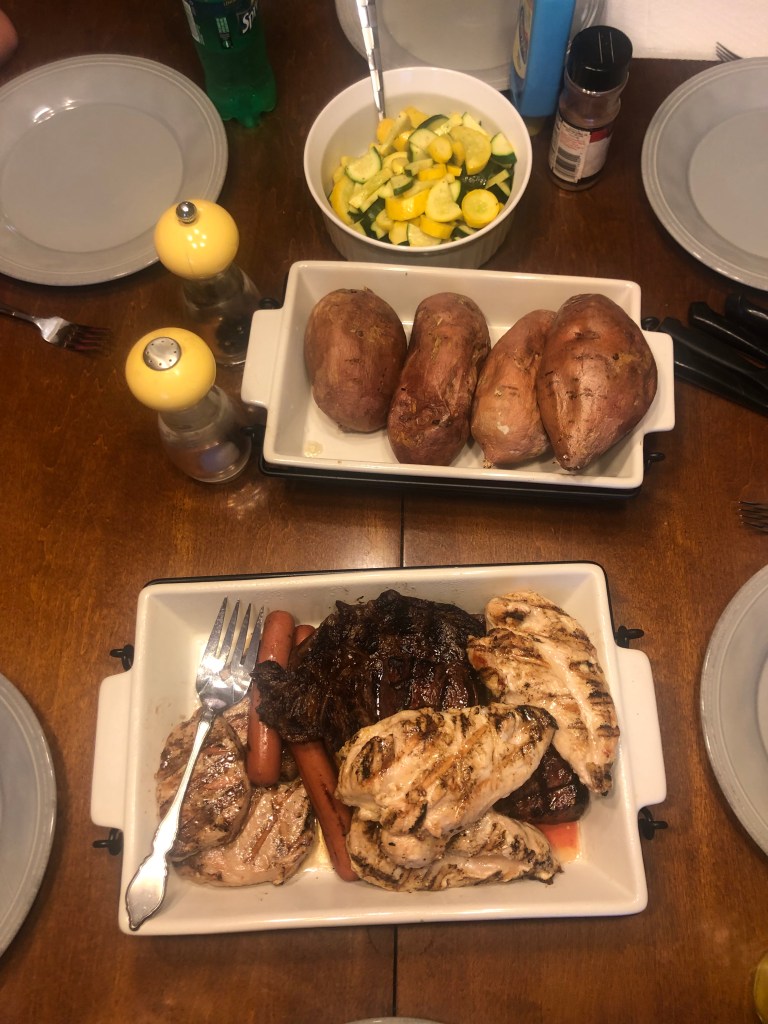
Steaks, Chicken, and Hot Dogs (for Kylie) grilled on a pretty day. We also enjoyed baked sweet potatoes, zucchini, and squash.

Jeanna’s Kentucky Kitchen Table

On Sunday, March 31 six other people and I came together around a friend’s tiny kitchen table in an apartment right off WKU’s campus. Going into this experience I thought I would only know my two classmates, Anna and Amelia, but when I walked into the apartment I recognized a girl from one of my other classes, Tatum. Tatum is in my English 200 class (where class is cancelled a lot), as well as a pre-pharmacy major who will be heading to pharmacy school in Alabama next year. The other girls in the room I recognized, but honestly, they were complete strangers before we began to talk. Anna sat across me, who was one of my partners for the Kentucky Kitchen Table and organized the lunch. Next to Anna was Elizabeth, whom I recognized from H4, but I didn’t know that well before. Elizabeth is an Honors freshmen as well, who was planning on doing her project sometime during the next weekend. Elizabeth sat next to Amelia, who was one of my first friends at college through H4 and was one of my partners for the project. Tatum, who I mentioned before, sat next to Amelia. Sitting next to me was Kate, a religion major who brought many insights to our conversation. Kate sat next to Lauren, who was very funny, lively, and I felt a very motherly-like quality from her. All these ladies had something about them that I enjoyed being around, and excited me for the conversation that we were about to have.

             After we all got food on our plates, which consisted of salad, potatoes, and chicken (eggs for the vegetarians), I began the conversation with the question: “What does citizenship mean to you?” With Amelia adding, “besides paying taxes, voting, and following laws.” At first, everyone thought on the question for a little while, with Kate answering first. Kate said that she thinks of citizenship as being a member of a community. Everyone has an obligation to their community, whatever community this might be. She went on to mention something about a global community, which was interesting because she wants to be a missionary. After this comment, the next few comments had a general theme of being in a community and a citizen means caring about what happens in your community. Lauren said something about how being a citizen also means knowing the history of where you live and seeing how this history has an impact on the community in present day. This point brought some interesting takes on how the history of citizenship in our country has changed. In our current day, citizenship in our country is more about embracing where you came from; instead of integrating yourself into the American culture. Tatum thought that encouraging people to embrace their heritage and family past is important for working towards bettering our society. The conversation sort of changed, but not in a bad way, when Elizabeth said her answer to the question I had asked. She felt the need to be a good citizen was because of her femininity and the privilege we have because we live as women in America. She mentioned that if we were in another country, we wouldn’t have the same freedoms as we do now. The privilege that she is given because of where she lives gives her an obligation to be a good citizen. The things that Elizabeth brought to the table really opened the rest of our minds, and it gave the rest of us an idea the being a good citizen as an obligation. Kate then mentioned that she thought about how global citizenship as fighting for the rights of people who are oppressed.

The next question I asked the table was “What do you think are the best parts of our world today?” As I was reading the question, immediately I could not think of one; all the negative parts of the world came in my head. I let the table know this, and they all agreed with me; everyone could only think about the negative parts of the world. The thought of advances in medicine and the uprising of human rights were brought into discussion, as well as the awareness of our problems, were discussed as positives in our world. One of the social issues that we all really cared about and were passionate, was then brought into the discussion by Kate. We had previously been talking about climate change and immigration, so Kate brought those two ideas together and mentioned the current political climate. She meant how the politicians use their words as inflammatory and how they are so rude to each other. The girls and I at the table elaborated on this and discussed how everyone is disrespectful to one another, rather than being civil. This idea of civility related back to practicing citizenship through listening to other people that we disagree with or have differing points of view. This last part of our conversation is something that I enjoyed listening to and being apart of; it really showed me what a Kentucky Kitchen Table was supposed to incorporate and feel like!

This meal taught me a lot: from meeting new people and learning new names, to different people’s views and how to use these views to become an overall better citizen. Around the world, people are dealing with all kinds of issues, but no way to solve them; it might not be up to us who don’t live in the community that has a problem, but it is important to be an engaged citizen to understand the problems that other people face on a day to day basis. I saw people, young women specifically, come together to find some common ground for somewhat opposing views. One major thing that opened my eyes is the negativity that was immediately recalled when I asked the table about the positives in the world. I was disheartened by the fact that none of us could think of a positive. I think that the world has turned away from positivity; every where you look something negative is being brought to our attention, and that is sad.

This discussion relates to the many discussions/mini-deliberations that we have in Honors 251. Each idea that one person brought to the table, another idea would pop up into someone else’s brain and brought a new light on a new perspective. Although I loved this experience, this reminded me of one of our readings that we is had a negative theme to it: “To Hell with Good Intentions.” When having this discussion, in my mind I was thinking that everyone had such great ideas, but, like Ivan Illich had said, we cannot place ourselves in a community where we do not belong. Yes, we have good intentions and good ideas, but we do not completely understand another community’s situation because we are not apart of it. We can sit around a table and discuss the issues of the world (which I enjoyed doing), but it will do no good if we try to place ourselves where we do not belong. However, I do believe that this discussion allowed me to see this reading in the real world; I was skeptical of Illich at first, but now I understand what he was saying.