Kentucky Kitchen Table: An American Staple

By Nathan

The Setting

It was a beautiful Sunday afternoon in Stanton, Kentucky, a small town nestled at the foothills of the Appalachian Mountains.  My family had just arrived at our home after attending our small church, in which we are currently making decisions of whether or not we want to remain in the specific denomination that we himg_3385ave been in for the past century or so, due to the very liberal approach the denomination is now taking.

We come in to our kitchen and decide the final details of our meal.  We decide to open up the dining room, which is typically only used for holiday or birthday meals.  We have invited a family who has recently moved into our community, though they have been involved in our community for over a decade.  We prepared a cookout style meal, with both families providing fresh vegetables for the burgers.

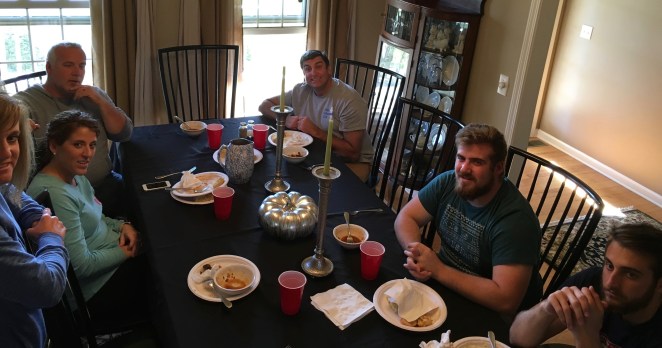
We casually sit around the table in no particular order.  One of my best friends, Zach, sits next to my older brother Matt.  They are both in college at different universities, one large and one small.  My father, Troy, sits next to Zach.  Troy is well-known in our community, being practically everyoIMG_3390.jpgne’s doctor, though he is only a physician’s assistant.  On the other side of the table, my mother, Deana, sits next to Martina, who is a guidance counselor at our town’s only high school.  Deana used to be a physical therapist, but is now working in the school system.  Rick sits next to his wife, Martina.  Rick was formerly working in a factory as a manager, but is now in the Alternative School, teaching kids who were removed from the high school and middle school.  He is also a coach for the high school football team.  The room was open, the lighting was natural, and the conversation came in the same way.
The Meal

My goodness, it was a good meal.

Citizenship

I began the conversation by asking what citizenship means to them, beyond voting and paying taxes.  This mostly garnered the same general response: being a citizen is giving back to the community, helping the community in a way that you see it necessary.  Rick said that people some of the people he works with don’t have any sense of duty or responsibility. They feel like the government is there to support them.  People sometimes live with the mindset of doing what you need to get by, and forgo being a productive member of society.  Troy mentioned that there are generally two basic types of people in a community, people who contribute and people who take, meaning that some people consciously put time and money into the community while others sit back and reap the rewards.  With that in mind, though, we all take away from what communities offer, whether it is intentional or not.  Kids going through school are taking away, usually without giving their fair share back.  Anyone who lives in the protection of the military is taking from society.  With these in mind, Matt adds that it is then your duty as a citizen to give back.

Careers

My next question dealt with their careers, and whether the desire to be a citizen impacted that career path.  Martina claimed that she always wanted to teach, to help people and to give to people.  She saw that becoming a counselor would maximize her potential to give to a community, but she never imagined how rewarding that profession would be for her.  She sees every type of student, from first-time college students to first-time high school graduates, and having a touch on people’s lives in that sense is the rewarding part. *8:30*

Rick then told a winding story of his career path.  Basically, he began in a factory in his hometown.  The factory was very family-oriented, making sure that priorities were kept straight, and that workers were being treated right.  For this reason, he loved the company.  Eventually, his company was bought by a bank, and as most banks are, the bank was very money-motivated.  The company he once loved lost sight of the values it was built upon, and the work was draining; the only thing that mattered was profit.  Eventually, Rick left and went back to school in search of making a difference.  He became a teacher, and now works with kids that have had disciplinary issue.  Here, he is able to have a direct influence on the kids that may need it the most.

Troy and Deana both added that any job could be turned into serving the public, if you make a conscious effort to do so.  Their thought was that if you focus your job on providing for people that need the work to provide for their families, then you could see a factory job (such as Rick’s) as serving the community through providing opportunity.  Reflecting on that outlook, though, a self-centered attitude in a role that should contribute heavily to the community could have a reverse effect and negatively impact the people it touches (think a teacher who doesn’t invest in students).  Thus, we somewhat concluded that any job can have social impact with a certain context, though there are some careers where you can have a much larger impact on the future generation.

Community

I asked the table if they would rather live in place that had a focus on family or community.  Most people responded that they would rather have communities building each other up as a whole than serving their own family first, which is very interesting.  There are several takes on how you could answer this question, an infinite number of variables as well as an infinite amount of outcomes.  One way to look at it is if you, as a parent, build up a community as your primary focus, your family will learn from your example.  At the same time, you do not want to neglect your family.  We did not go deep into this conversation at the table, but the influences were felt throughout the remainder of the meal.

Extracurricular

I recalled a story we read about in class about the Shipyard Project.  As the northeastern town was split between an artistic community and a blue-collar community, ours is split by drug abuse.  Statistically, Powell County is one of the worst counties in the state for drug abuse of all kinds in one of the worst states in the nation for drug abuse.  We have a problem, and you can see the effects on our community as a whole.  Rick, Martina and Deana are all working in the school system, Troy works closely with all the students (especially athletes) and Zach, Matt and I have all been through the school system in the past 3 years.  We all agreed that there is a split in the community, and the school.  I specifically asked Rick, since he is the head football coach’s right-hand man, if he thought football serves as a joining activity in a way similar to how the Shipyard Dance unified that community.  He said he saw potential for it, but doesn’t see that yet.  Kids are greatly affected by their parent’s participation.  Though transportation can be provided for students who wish to participate, it is difficult, and often there’s no motivation from the students.

For the students who do get involved, though, the results are spectacular.  Martina tells of an after-school Zumba program that she dabbled in last year, saying that several students really enjoyed the activity and looked forward to Zumba.  Most of these kids are kids that otherwise are not involved in any activities outside of academics.  I also brought up our high school’s soccer team, which has been started within the past 4 years and is already competing for regional championships.  Of the 40 kids on the team, soccer is the only extracurricular activity that 26 of them participate in.   On the subject of new start-ups, Martina brings up several new clubs in the school, like Card Club and FCCLA.  As a counselor, she sees that kids long to be a part of something, some kind of community that they can really dive into and find an identity in.

Closing

As a final question, I asked if the members at the table grew up having family dinners around the table.  Deana grew up always eating together, as she lived within yards of her extended family.  She also finally admitted that she, too, preferred Kraft Mac & Cheese over her grandma’s homemade macaroni.  Martina said her family made it a point to eat together at home every night, maybe getting a burger from a local joint and taking it home once a month.  Rick grew up on a farm with all of his aunts, uncles, cousins, grandparents and great-grandparents.  Every day, they would all work on the farm, congregate in a house for lunch and then meet in a different one for dinner.  Troy was much like Zach, Matt and myself, in that we were always busy, resulting in plenty of dinners with our brothers but not necessarily with parents during sports seasons, resulting in an amazing bond between the brothers.  The ones who grew up eating meals with their families recollect extraordinary memories from the systematic tradition.  Deana says that you never know how special it is to have dinner around a table with your family.  We decided after the meal was finished to have dinner together more often.

Reflections

I look back on my own memories, growing up at the high school football field with my brothers, having our own feasts around a table at China Wok.  We had always had our meals at home from the good doings of mother.  On Monday nights, Ma would feed us.  It never failed that we would surely either have a breakfast-dinner or a pot roast with potatoes and carrots.  Some of my fondest memories came centered around food.  I find it odd how much of a staple in American culture food has become, it seems like we have holidays just for food.  It does something amazing for us, as families and as groups.  People come together to provide an essential of life, providing for one another.  There is a certain kind of service, yet in some situations it can become a competition between cooks.  For some reason, when we gather around a table to eat more than we should, and we open up.  Being at the table, we listen to each other, we acknowledge one another in a way that is nearly impossible in our daily routines.  Maybe simply being around the table with people outside of just our families would help us understand our world better, thus helping our society get where we want to go.  We could understand how to bridge the gaps in our community, we just need to sit together and open up.
Kentucky Kitchen Table of Concern

By Lily

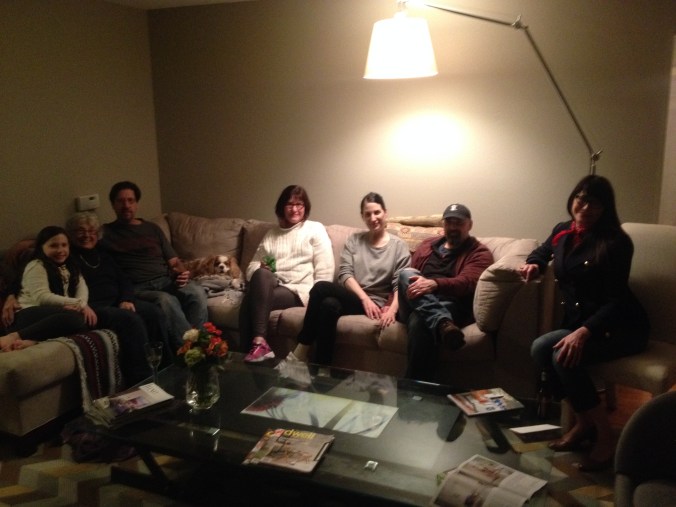
Over Spring Break, I hosted my Kentucky Kitchen Table dinner at my parent’s house in Des Moines, Iowa. I invited over family members, as well as friends of family member I did not previously know very well. There were seven people at my Kentucky (or Iowa) Kitchen Table. There was Scarlett, who is nine years old and enjoys making art, learning about animals and playing the piano. I also invited Marlene, who is 84 years old and from Storm Lake, Iowa, a small-town in rural Iowa. She is active in the Presbyterian Church and spent several decades working at a flower-shop, she was one of the first working mothers in her town. She grew up on a farm outside of Storm Lake, in part during the Great Depression. Until 2008, she was a registered Republican. Bill, who was also at the dinner, is a 60-year-old photographer who has lived most of his life in Des Moines, although he also spent several years serving as a military photographer. He has been very active in the Des Moines Democratic Party. Married to Bill is 59-year-old Jennifer, who has also lived in Des Moines most of her life, though she was born in a small-town in Iowa. She has spent time both as a stay at home mom and as a commercial stylist, she is also an enthusiastic artist and equestrian. Janet, who was also at the dinner, is a receptionist who has been involved with a variety of liberal political causes and is a voracious reader. Janet is in her late 40s and married to Tyson, who is a stay at home dad involved with mental health activism. Finally, I invited Julie, who is informed about, but not very involved with politics. She has been a legal secretary for most of her life, as well as a single mom. And of course, my dog Penny was there, though she did not contribute much to the conversation.

My parents (Bill and Jennifer) and I made turkey burgers, a recipe we are known for. Marlene brought brownies, Janet and Tyson brought potato salad, and Julie brought fruit salad. Scarlett brought a piece of art she made in school to decorate the fridge. While eating our dinner, we had a very good conversation about citizenship that revolved around discussing the tenor of the 2016 Presidential Election. I began by asking everyone what citizenship meant to them, the most insightful answers came from the oldest and the youngest at the table. Marlene said that citizenship meant not taking for granted the rights and privileges we have as Americans. She explained that she is neighbors with several immigrant families and has assisted Sudanese refugees with her church, and they have all made huge sacrifices to be American citizens. This is a sentiment that I am going to let motivate my social issue project. I am so grateful to be an American citizen and I want to pay some of that privilege forward by helping others, Syrian refugees, gain that same status.

Scarlett, at nine years old, also gave an insightful definition of citizenship. She said that citizenship meant caring about others. Her answer immediately made me think about the week we spent reading The Empathy Exams and discussing the role empathy plays in citizenship. Even at such a young age, she realized that it is not simply important, but required, to care about others in order to be a good citizen. If we cared about the needs and concerns of others when we went in to the voting booth, went to the grocery store or even when we paid our taxes, we would much likely be better citizens.

After discussing citizenship, we talked about how the gratitude and compassion Marlene and Scarlett mentioned is so absent from the 2016 Presidential election. Even people in the group who have not been involved in politics before, were well informed about this election and had a strong opinion. Almost everyone, even those who have voted Republican all of their lives, said they would vote for the Democratic candidate in November. The conversation reassured me that, despite the nasty rhetoric at the top, most Americans want politics to be civil and compassionate.IMG_2295

Kentucky Kitchen Table

By Carter

Imari Hammock and I did our Kentucky Kitchen Table project in our hometown of Scottsville. We did the project with a group of people from Imari’s church, all of whom I had never met before. At first it was a little awkward sitting with people I didn’t know and trying to have an in depth conversation about their views on citizenship and democracy, but as the meal and discussion went on I began to feel at home with these people and I’m glad we chose them as our family.

The family offered to fix the meal, and I’m glad they did, I don’t think that we could have made anything as good as they did. They prepared two of Imari and my favorite foods, pork tenderloin and macaroni. I would love to spend the rest of this post just talking about how great the food was but unfortunately I am notGuy Fieri and I do not have a show on the food network YET, so I will now tell of the great discussion Imari and I had with this family.

On the left is Martha and Clarence, a couple who Imari has known for a long time at her church. Hayden, the boy to my left is their grandson, he invited his friend Jordan to the meal. While they are both still too young to really give solid input to the conversation, they did have a little to say before they ran away to play. To Imari’s right was Monica and DJ, Monica is the Sunday school teacher at Imari’s church and DJ is her husband. DJ was the life of the conversation and was very entertaining. While we probably still would have had a great conversation, I’m glad DJ was there as he wasn’t scared to share his thoughts and opinions but also was able to keep the mood pretty light.

KKT.JPG

Our conversation went on a little longer than any of us thought that it would, but none of us had a problem with that, we all enjoyed it. One of the first things we discussed was what citizenship meant to us beyond the basics (taxes, voting, etc.). DJ answered first and said that “if everyone learned to respect one another, we would improve the quality of life tremendously”. Martha and Clarence answered next and stated that they are so happy that we live in a country with freedom and rights like we enjoy, but they wished that we could return to the time when people cared about one another. Monica followed them up saying that citizenship, to her, meant being with who you want to be with, really emphasizing the idea of America as the great melting pot.

What was really cool about this project was that, during this conversation, we spoke to a very diverse group of people as far as age and up bringing go, and while we had some very different ideas as one would expect, most of them repeated a lot of the general ideas, especially on their love of their families, community, and God.

I’m so glad that we had the opportunity to eat with this family and have this conversation, because it really opened my eyes returning to what we discussed after talking about wicked problems. When we look at wicked problems like racism or whatever else, we often get overwhelmed trying to think of some complicated or elaborate solution to try and hurry up and solve it, but I think that baby steps can go a long way. If we all just respected each other, many issues like sexual abuse, racism, sexism, etc. would all just go away, and in DJ’s words “would improve the quality of life tremendously.”

Kentucky Kitchen Table by Stevie

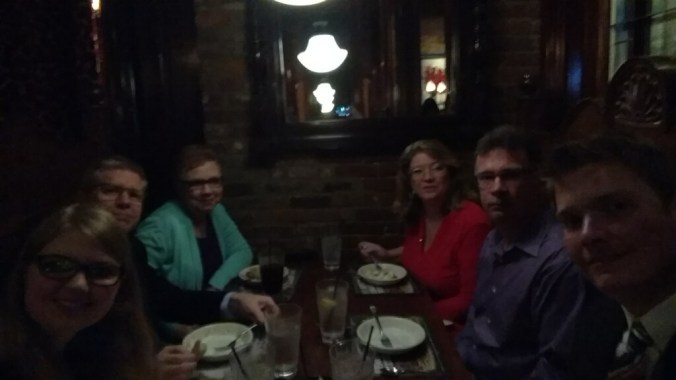
My mom is recovering from complications from a hip replacement surgery while parts of our house are being remodeled. Therefore, with the permission of Dr. Gish, we had to change plans and meet at a restaurant instead of eating at home. Although the situation wasn’t ideal, we had a really great time getting to know one another and had some great conversations about citizenship.

The members of the table were: Steve, a Democrat and a Catholic, moved around a lot when he was a kid because his father served in the Air Force. Fonda, who spent her childhood in a very conservative town in West Virginia, has always been very liberal and a confirmed Episcopalian. She has spent her life being a social worker and helping those who need it. Elizabeth is a Republican and a Baptist. She grew up in extreme poverty but has since made it to the upper middle class. Jeffery is a Republican and a Baptist. He was the only one (with the exception of me) who did not have a college degree. He was however, the first one of his family to get out of the farming business and start his own business. He is part of the upper middle class. Zack is a graduate of WKU and is currently in law school. Zack has traveled the world more than anyone at the table. He hopes to one day work in International Law.

The evening started off with me asking everyone what it meant to them to be a citizen. A couple of the ideas were that being a citizen meant being tied to the community and being involved in that community. While others took it a step farther and said that it also meant being part of the country as a whole, not just the community. They thought your identity as a citizen meant that you were part of something much greater than yourself. One at the table said that not only are you part of something greater than yourself but as a citizen you must give 100% to keep your country and community great.

The conversation then turned to how religion affects their actions as a citizen. Only one of them said that religion doesn’t affect them as a citizen.  They said that they firmly believe in a separation of church and state. A couple of the guests strongly disagreed with this sentiment. They vote, do community service, and other various activities based on their religion. The conversation turned to issues like gay marriage and Syrian Refugees. One of the members at the table said they didn’t agree with gay marriage. I was raised in a family where gay marriage has always been accepted, so this is a different view than what I am used too. It was a unique experience having a civilized conversation about such controversial issues at a dinner table. I can’t say we came to an agreement about the issues but we came to a mutual tolerance of each other’s beliefs.

I then asked if they felt obligated as a citizen or through their religion to help other people. I was surprised that I was the only one who thought that a citizen should be obligated to help other people. This is not to say that they didn’t agree that people should help other people but that it was not an obligation. They all talked about their involvement with charities and how they feel morally compelled to help impoverished children or victims of abuse but they weren’t obligated to do it. I was curious and asked if someone who had a lot of money or a lot of resources would have more responsibility to help those in need. Some of the members at the table didn’t think it was a responsibility exactly but if you are able to do something then you should because there are not enough resources for all who need them. One member of the group thought that a person’s wealth was their own, and it was up to them to decide what to do with it, and that they had absolutely no responsibility to anyone to donate their money or time to charity.

I asked them if it was important to be part of a community that valued charity and/or what other kinds of things they value in a community. They all agreed that communities that prioritized charity and where neighbors were involved in their community were things that they valued. One person mentioned that they want a community that is not only involved but strives to be close knit. A few mentioned wanting a lot of diversity in their neighborhoods. They said they enjoy learning about different cultures and when their kids were younger they made sure they were exposed to people from every walk of life. Another member of the table said that this wasn’t important to them. They would rather have a neighborhood with people of similar education, socioeconomic status, and backgrounds. They said that they relate to people better that are similar as opposed to diverse.

In seminar we talk a lot about tolerance vs. acceptance. I realized it is very easy for me to say someone who doesn’t accept gay marriage or someone who may be racist needs to at least be tolerant of those that are different from them even if they don’t accept them. It is, however, incredibly difficult for me to tolerate someone who is against gay marriage or racist or intolerant of others. My first instinct is to say something back and tell them that they are wrong or it’s not okay to treat someone like a second rate citizen. While it is not okay to treat someone like a second rate citizen, nothing gets accomplished by me getting angry at someone who has a way of thinking that maybe isn’t so accepting (or at least what I think is accepting). I thought a lot about the patience readings and how patience doesn’t just apply to learning or perfecting a skill, it also applies to dealing with people. There were times during the dinner that I had to demonstrate patience to try and understand where people were coming from. I really think being patient with people and understanding that many situations are more complex than they seem at first is a skill and a virtue that the world could use today.

I think this assignment also made me realize how important it is to have the patience to have conversations with everyone in the community before someone initiates a plan to help better the community. A lot of the members in the group wanted a close knit community; some wanted this by having lots of diversity while others wanted their neighbors to be of the same education and socioeconomic class as them. One person wanted a complete separation of church and state while the others wanted religion to be heavily involved with their daily civic lives.  It takes time to go through and talk to all of the stakeholders that could be affected by an initiative but at the end of the day you could really alienate a lot of people if you don’t get their opinions and ideas first.IMG_3700 (1)

The Memphis-KY Kitchen Table

By Emma

Sitting around the messy, unorganized table you see in this picture is a fairly interesting group of humans. The lovely woman in the blue shirt is my mother Anne-Marie, the little man in the red shirt is my brother Benjamin, the goofy man in the gray shirt is my neighbor Darren, and the couple to the right is comprised of my sister and her new boyfriend Hannah and Tristen. Anne-Marie works at a locally owned soap store by the name of The Bartlett Soap Company, volunteers frequently at the Oak Elementary, and is never shy in sharing her opinions. Benjamin is a current second grader with a passion for reading, science, and video games. Darren is a warehouse manager who writes poetry and has a passion for all things music, especially jazz and heavy metal. Hannah, a senior in high school, is a genius planning on going to Ole Miss to study chemical engineering. Finally, Tristen is Hannah’s boyfriend, also a high school senior, works in an auto garage and adores cars, guitars, and noise.

We began our discussion with hummus my sister made and pita bread my mom picked up from Kroger. I found out quite interesting things about every single person, especially Benjamin. Anne-Marie is extremely adamant about universal health care and the health care existing as a basic human right, the responsibility of the government to allocate their expenditures not to quantity but to quality and access. Though my mother is loud and never farouche when sharing her opinion about issues like the presidential race and the education system changes in Bartlett, Tennessee, I’ve never heard her speak on health care with such vivacity. Darren is passionate about unemployment as apparently he was once part of the population and clawed his way up from the bottom. Hannah was once almost taken by an eating disorder, an event that I too experienced with her hand in mine, so her social issue was eating disorders. She labels them as an “underestimated killer,” having known firsthand that many doctors, nurses, health professionals, peers, and even parents do not embrace the fact that eating disorders are indeed a mental illness, not just a mindset that can be overcome. Tristen’s social issue is stands in the presidential race. He has an outstanding and unswayable opinion on the candidacy of Bernie Sanders and his potential as president. And lastly, Benjamin’s social issue stood in how other children and parents treat his friends who moved to the United States and do not speak very fluent English. Kids and even their parents ostracize these children who are already incredibly shy, nervous, and very eager to make friends.

The main focus of conversation centered around citizenship and the ways to make ourselves more effective, educated community and world citizens. We also explored how compassion, logic, and psychology contribute to citizenship, just as in class. Both of my parents have a bachelor’s degree in psychology, and I knew that the concept of “the elephant and the trainer” would catalyze a explosive conversation. Darren emphasized that compassion functioned as a mountain while the government was logic functioning as the mountain climber. He explained this as compassion is unique and winding just as a mountain. When a mountain climber, or the government/logic in this sense, goes to hike a mountain, he/she can not predict how the mountain’s curves, crevices, bumps, and grooves will turn out to be. However, it is up to the mountain climber to not give up to the mountain’s complexity. With experience and climbing more mountains, the mountain climber can begin to understand how a mountain works, how to overcome its biggest inclines and its deepest trenches. In essence, the government can fully comprehend the more difficult situations by overcoming the ambiguousness of compassion and applying logic, or itself, to compassion.

In the end, the dinner ended up being more than just a conversation about community, but a newfound bond between family and neighbors. There was laughter and rough-housing, smiles and love. After being separated from my family for the first time in my life, I’ve felt lonely and disconnected from the people with whom I spent my life. I also didn’t grow up eating family dinners or spending a lot of time as a family unit, but this dinner was revolutionary for my family and for me.