Diversity Forms a Community

By Melanie

17821697_10213089944669562_789485082_n

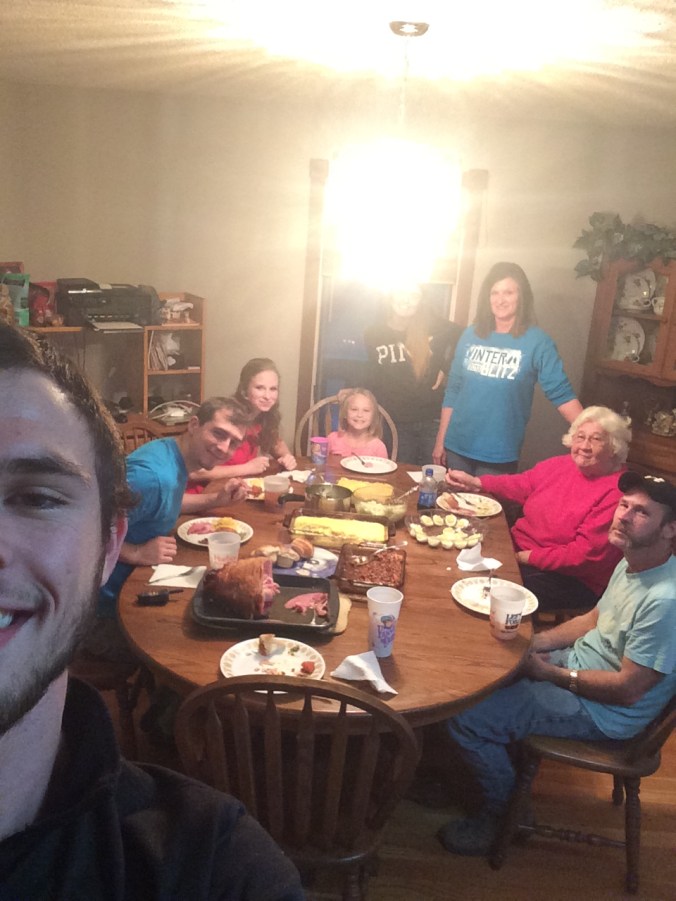
On March 11, I hosted a Kentucky Kitchen Table in my hometown of Radcliff, Kentucky. My family was an immense help in inviting friends of theirs to this dinner who contributed to the diversity and discussions we had.

There were seven people who attended this dinner. First was Drew, who lives in Fort Knox, KY but is from Virginia. He is a sophomore in high school who will be attending the Gatton Academy in the fall, planning to study engineering or music. Next is Morgan, who lives in Elizabethtown, KY and has family roots from Panama and New Zealand. She is a sophomore and is thinking of studying music as well. Then there’s Heather, who lives in Elizabethtown and grew up on a small farm in Russellville, KY. She is a high school Spanish teacher. Then there’s Mike, who lives and was born in Elizabethtown, KY, and is a factory worker. Next is Maria, my wonderful mother who graciously prepared the dinner. Growing up with Italian roots, traditions and family time became a necessity at home. My mom wanted to cook an authentic Italian meal and show her culture and diversity to the dinner. This allowed me to learn more about her, my culture, and my ethnicity as well. She lives in Radcliff, KY, but was born in Brooklyn, NY and works as a para-educator in an elementary school. Next is my oldest sister Stephanie who also lives in Radcliff and was born in Brooklyn. She is a third-grade teacher in an elementary school. Lastly, there’s myself. I live in Radcliff but am from Brooklyn as well. I am a freshman studying music education, and I plan to obtain my master’s degree in music therapy.

The dinner went much smoothly than I imagined. Although I didn’t know the other members of the table, everyone was comfortable with each other and were impressed with the grandiose display of food that my mom prepared. This led to my asking of the first question, “did you ever have meals around the table with your family or neighbors growing up, and did you enjoy it?” The answer from everyone was unanimous as we talked about our experiences and appreciation for eating dinner daily around a table because we could relax and talk about our days with our loved ones. My mom elaborated on this question by referencing her childhood. She grew up in a primarily Italian Catholic community, so she could learn about other people’s cultures and backgrounds. She mentioned her father and how he was heavily involved in the soccer club in Brooklyn, so she learned about his friends and their backgrounds as well. Mike, who is also Italian, explained a personal story as well. This allows us to communicate better with each other and our neighbors, which is a central idea of my Honors 251 course.

The next question I asked was: “Beyond voting, paying taxes, and following laws, what does citizenship mean to you?” Everyone had insightful answers, but the main points that stood out to me from the dinner were needing a sense of community and working together to better the world we live in. Stephanie briefly discussed patriotism, freedom, and having a sense of community and order, which are all necessary in a stable society. Heather elaborated by expressing our need to love fellow-men and participating in fellow affairs with intelligence and heart, which are extremely essential in working together today. Morgan mentioned needing to be an active member in the community, helping to make the environment a better place and provide equal rights for all, and striving to better the world around us. I continued the discussion while referencing climate change readings we have discussed in class and how that is one of the many wicked problems that are alive. A large topic that stemmed from this question was the necessity of communication to solve problems. From this, I referenced Keith Melville’s “How We Talk Matters” and how important it is to listen to one another, especially towards the opposing side of an argument, so we can respect and learn from each other. Talking effectively is equal to communication, and communication is a necessity in being able to work together to solve problems, which is one of the central questions of our HON 251 class. It is better to talk maturely and listen to other people’s opinions rather than just yell and disregard one’s outlook on a topic. This allows conflicts to be resolved rationally and promote action.

While discussing citizenship, we talked about President Trump’s recent actions of cutting funding for arts and humanities programs and the passing of a new law for charter schools. Heather, Stephanie, and my mom, all working with children in schools for a living, were strongly affected by this issue. This led to my asking of what social issue is closest to everyone’s heart and why. Everyone has a different social issue that affected them personally, but most people at my dinner were highly concerned with the newly passed charter school law and anything regarding education. They all fear that it will put many educators out of work and children out of a good education. Talking about social issues led to talking about other problematic topics that occur in our world today. I elaborated and told them about other wicked problems we have discussed in class, as social issues are types of and examples of the wickedness that we see daily.

The last topic of the night ended our discussion with a lighter tone. I asked, “What do you think are the best things about our world today?” Everyone, myself included, spoke highly of the forward steps we are taking and the efforts people are making for the equality of all people and for everyone to live in a fair world. Drew elaborates by explaining that this is his favorite thing to see in the world because it shows that we, as a group of people, are slowly learning to respect everyone, regardless of beliefs and appearances. We are thankful to be living in a free nation that has rights, choices, diversity, and different ways to be educated about different people and lifestyles. Drew also appreciates that we are constantly thinking outside of the box and are full of ideas that will lead to change. This will change and shape the upcoming society and generations for years to come as we find ourselves and our values. We are slowly reinventing the world, and it shows that it will lead to a better society, but this will only be successful if we work together and communicate.

I have learned a lot by participating in this project. I drew the conclusion that although people come from different backgrounds, we are more alike than we think. We as members of a democracy have differing opinions, but we have common cares for our neighbors and the world. Having discussions about these types of topics allow us to work well together and familiarize ourselves with different groups and types of people. I learned about my own culture and heritage, in addition to different cultures and walks of life by talking to different people. This has made me a better individual personally and as a member of society. Talking to other people proves that there are plenty of good people in this world, and if we want to make a change, we need to act and work together to deliberate effectively. Hosting this dinner forced me to make connections between my HON 251 course and real-life situations. I saw all three central questions we focused on in the class come to life when talking with everyone. I was hesitant going into this dinner, but I am happy with the outcome of my discussion and how much I have learned in this course that will be useful in the future.

 

Kentucky Kitchen Table

By Kaylynn

Saying I am from Louisville is technically accurate, but it is not that simple. I am from Valley Station, a neighborhood in the South End. We are part of Louisville Metro because of the city-county merger, but our little neighborhood has nothing on the vibrancy of downtown Louisville.

Our Kentucky Kitchen Table was held in Valley Station, at my family home. Donna – my mother – hosted the dinner. She is very particular about hosting, so she insisted the two of us preparing all the food. She is in her 50s, and she was raised Southern Baptist. When she married my dad, she converted to Catholicism, and now she works at their church. My dad, Michael, was at the dinner as well. He is a meteorologist at the National Weather Service. Susan is a childhood friend of my mom, but since she has a very busy schedule and lives on the other side of the city, I have only met her a couple of times. She is a single woman, quite affluent, and she is a Church of Christ member. Dianne and Joe are members of my parents’ Catholic Church. Dianne described herself as, “30, blonde, and skinny,” then laughed and added, “I have one kid, and I’m an accountant.” To round out the table, I am a 19-year-old Biology student at WKU.

First we talked about what citizenship meant. The consensus seemed to be that it was a sense of belonging. Being a citizen is something that brings Americans together, even if we were born in different places or have different cultures. Citizenship is an intention. We intend to make America better, but we all have different ideas on what “better” is. This is why the more instrumental parts of citizenship like voting are so important. They are the methods by which we bring our ideas of “better” together and work to get there.

Everyone at the table was from a different part of Louisville: my family is from Valley Station, Susan is from Middletown, and Dianne and Joe are from Pleasure Ridge Park. So everyone had a unique perspective on the good things about living in Louisville. Dad – who wants to live in the country someday – huffed and said he liked that the crazy weather means there is plenty of job security for meteorologists. Mom mentioned that Louisville is central: “You can get to other places around the country in a reasonable amount of time.” There was some dissonance in the group here, because the other people around the table thought more positively about Louisville. Dianne works downtown, so she appreciates that they get “big city benefits” while closer to home there is more of a “small town feel.” That is, people generally seem friendlier than those in other large cities. I tied this dissonance a little to one of the class’s main questions: “How can we have more of a say over our own lives?” The people who liked the city felt more of a control over their own lives. They lived where they wanted to. However, those who were more “settling” for Louisville and would rather live elsewhere felt less of a control over their lives. Where we live changes how we feel about life as a whole.

When we discussed the things we like about the world today, the generation gap showed itself. They talked for a long time about how much more accessible information is these days. It was observed that because kids have access to the Internet, they know so much more about the world and current events than kids of earlier generations ever did. This was an uncomfortable thought for them because the Internet is so new. There are no tried and true guidelines for how to expose kids to the Internet, so you must make the rules up as you go along and hope for the best. As a member of the generation of kids they were talking about, this was eye-opening. That was a challenge of parenting I had never thought about before. Dianne came back to the question for a final thought: “To me, the best thing about living now is love. When my parents were young, you couldn’t love someone who’s another race. But now you can, and I’m proud of the present for that.”

We talked a lot about neighbors: what it meant to be a neighbor, who could be considered a neighbor, how we feel about our neighbors. Dianne had a lot to say about this. “I’ve met my neighbors and I see them around sometimes. But I wouldn’t get a cup of sugar from them. And I’m ashamed of that. I would like to have more of a relationship with them, but I never have.” Joe, on the other hand, said that instead of only being friends with people living close by, now people separate more according to interests. Susan suggested that people you consider your neighbors may not be “next-door neighbors,” and the people you are closest with may not be the people who are nearest to you. She referenced how she and my mom have remained friends for decades despite my family living in Missouri and Florida for a while before coming back to Kentucky. No one at the table was close to their neighbors because they had friends from work or from church who they felt they had more in common with. However, my dad mentioned how during the ice storm in 2009, people walked around the neighborhood more, and interacted more with each other. Then, when the house across the street caught fire a few years ago, people in the area came running to help. Even if we are not as close to our neighbors as we were before, we will still help out if we can.

The conversation about neighbors reminded me of our deliberation on police, specifically the option that involved community policing and neighborhood watch groups. One of the difficulties of putting such a program in action would be the problem highlighted by the people at the dinner: people do not interact with their next-door neighbors. If a crime were to happen, would someone in my neighborhood be outside to witness it? Would they do anything about it? In my neighborhood, I think a watch would be beneficial and not too different from life as it is now. When the weather is nice, there is usually somebody out on a walk. Just like when the woman’s house caught on fire, I think people still have the compassion to help during bad times. But what about better times? I feel the important question now is how we can bring neighborhoods together. I think there are many options that would serve dual purposes. Take community gardens. They are ways of promoting healthier eating, and they are also good for the environment. But they also require cooperation, so neighbors learn how to interact better. Growing something together creates pride in the community and respect for those around you.

The last thing we talked about was the social issues most important to us. Everyone’s answers were vastly different, and this speaks to the fact that our experiences shape our opinions and values. Dianne was most concerned about LGBT rights because of her daughter, who is an actor with many LGBT friends. There was conflict between the Catholic Church’s teachings and her daughter’s more accepting attitude. Her struggle reminded me a bit of the empathy readings, particularly “Devil’s Bait.” I think, to her, being LGBT is an experience so alien that it is almost like it is not even real (sort of like Morgellons to a non-sufferer). She struggled with whether or not she should accept LGBT people, because what if it is a choice? But her conclusion seemed to be that she will never know what the best thing to do is, and so she tries to be supportive. Listening to her talk about this was difficult, as I never had to struggle to accept LGBT people. Because of the Internet, I knew that people could be LGBT much earlier than Dianne’s generation did, and I listened to people’s stories about coming out and whether they were accepted or rejected by those they told. My culture in that way is so much different from Dianne’s and I can respect where she is coming from.

In doing this project, I learned a lot about how people’s experiences shape the way they think and what they do. My parents have not had very good experiences with living in cities, and so their view of Louisville is more negative than others’. For everyone else at the table besides me, the Internet was still relatively new, so they were much more skeptical of it. My mom’s and Susan’s experiences as long-distance friends made them believe that distance is not what decides who is your neighbor. And Dianne’s Catholic background caused her to struggle over LGBT people. These are all experiences I have not had, but listening to them talk helped me be on the same level as them. We do not have to agree with everything, but if we listen to others’ stories, we can live better together.

kkt

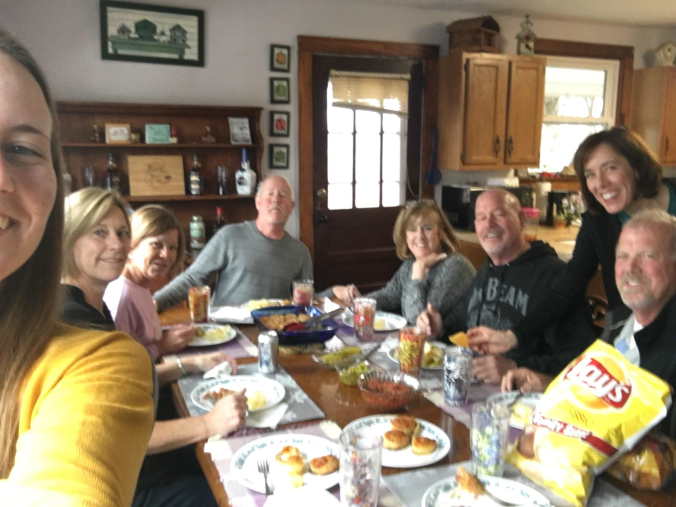
From left: Michael, Donna, Susan, Dianne, Joe (photo taken by Kaylynn)

KKT: Epic FAIL

KKT picBy Alexis

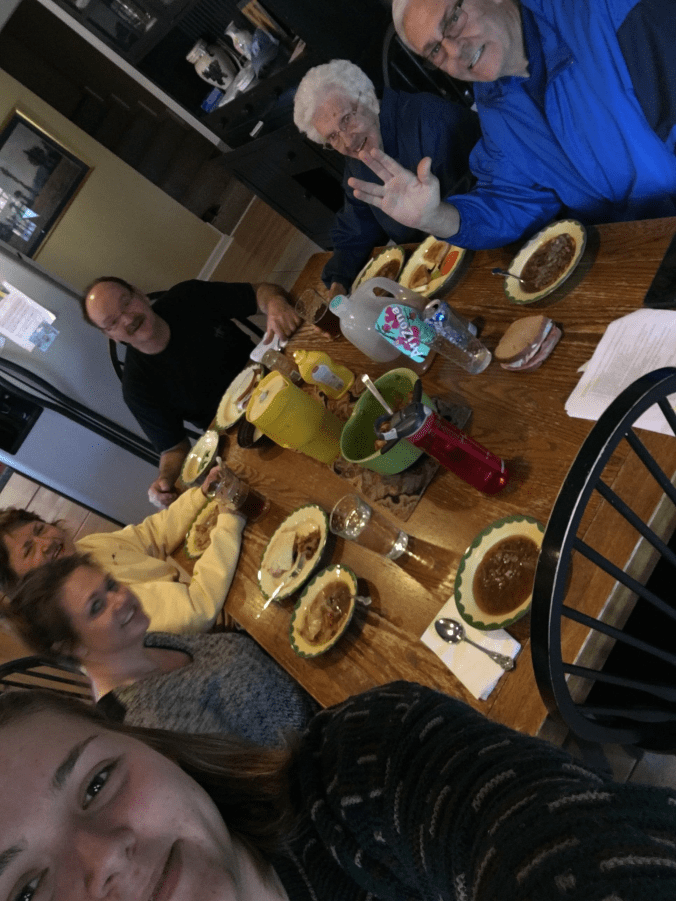
On March 16 I hosted a Kentucky Kitchen Table discussion in my home in Frankfort, KY. My mom, dad, and I provided the group with soup and sandwiches. The participants included me, my mom, dad, Fred, his mother Ruth, and his sister Lilly. [Some names changed.] My parents are both agnostic, white, 45+ years old, Republicans who voted for Trump, but they have pretty moderate views; they don’t hate gays, and they’re actually pretty accepting of a lot of the progressive ideas of our generation. My mother has completed 6+ years of college, and is an elementary school teacher. My father is a construction worker, ex-Army, and always very set in his beliefs and ways—he believes never wrong. Fred is the exact opposite of his sister Lilly. For starters, they’re the opposite gender, Lilly is a strong liberal whereas Fred is a strong conservative,Lilly is very selfless and Fred, it seems to me that Fred could be seen as selfish. Fred is widowed, and Lilly is divorced as of the 1970s; she’s almost always been on her own, and Fred always had a woman to take care of him. But they both have full college degrees; Fred got his masters in chemistry, and ran his own business for most of his adult life. Whereas Lilly got her degree in accounting and held jobs at banks and the sorts until she retired. As for their mother, Ruth, she is 90-ish years old—she’s unsure because she has Alzheimer’s. Sadly, she didn’t contribute much to my discussion because of her bad memory loss. I was hoping this discussion wouldn’t get too political, but you’ll soon come to see that this was completely impossible.

The only question I had time to ask was the required question “Beyond voting, paying taxes, and following laws, what does citizenship mean to you?”Lilly started the conversation with her opinion. She essentially explained that she sees us as citizens of the world and that we should do everything we can to help others and all get along better. This, surprisingly, related back to one of our main questions in the class; “How can we live better together?” Eventually her brother, Fred, interrupted her with the dictionary definition of “citizen”, which is “a legally recognized subject or national of a state or commonwealth.” After this definition was given Fred and my parents completely took over the discussion by telling Lilly she was wrong and stupid to think that we are citizens of the world. Fred and my father agreed that a citizen only needs to vote, pay taxes, and obey the laws. Fred, who appears to me to be rather selfish who boarders being libertarian, even shared that you only should take care of yourself. My father and mother both decided they believe you should only have to take care of “your own”—basically your immediate family. Any time after this that Lilly attempted to explain her side in a calm way Fred would interrupt her with his dictionary definition of a citizen. My dad got annoyed and said that “Honors 251 sounds like a very liberal class, and I don’t like it.” At some point Lilly and Fred were screaming at each other, and Lilly eventually said “I feel completely ostracized in a room full of people against me.” And she left crying. I listened quietly as the remaining participants bashed and laughed at her after she left, and eventually Fred and Ruth left as well.

I actually learned a lot from this complete disaster of a discussion. The main thing I took away was a good general statement for conservatives and liberals. It seems to me that conservatives have a more “at home” way of looking at things, whereas liberals have a “bigger picture” outlook on issues. For instance, Lilly sees us as citizens of the world and thinks we should do all we can to make the world better for everyone to live together cohesively and happily. Fred and my father believed more that we should take care of our; whether it be our family, friends, community, or social class. Also, liberals often have a view that we should help those all over our nation with things like food stamps and Obamacare, whereas conservatives are usually against things like this. This is probably because conservatives commonly have the opinion that “everyone should work for what they have.” This is obviously more of an overarching statement because this might not always be the case.

The most important thing I learned from this discussion is that people from older generations have not been taught how to deliberate, essentially. For instance, when Lilly was sharing her opinion the others sat quietly and “listened” until they had heard enough and gotten mad. Then, when she tried to explain herself and give a rebuttal to their arguments, she was cut off and ostracized. The same thing happened when she had enough of them sharing their opinions, which contrasted hers completely. The older generations don’t care to scream and make fools of themselves if this means defending their beliefs and making their point be “more heard.” “How We Talk Matters” by Keith Melville talks about how important it is to listen to others when in the middle of conflict. I’m honestly so glad that we have talked about this in class. Throughout high school I learned a lot about how to debate and share my opinions, but we never talked about how to listen. That’s one of the main things I’ve taken away from this class; listen and calmly respond. It seems a lot of people in the world don’t really know how to listen to people when arguing and debating. This could probably be the cause for all of the unresolved conflict and problems in the world and government.

I’m honestly really disappointed with the outcome of my Kentucky Kitchen Table discussion. I only got to ask the one main question, but it honestly gave me a sad reality. The men and women in charge of us, our children, and our governments are roughly the same age as Fred, Lilly, and my father. They usually have about the same levels of education; Fred has his masters, Lilly her undergraduate, and my father had basic college level schooling while he was in the army. If the 3 of them couldn’t even discuss their differences in a casual and calm setting how can we expect the men and women in charge to do the same? That’s why I’m extremely grateful to be learning such important, useful cooperative skills through the readings and discussions in our class.

Kentucky Kitchen Table Blog Post

By Blake20170406_200326

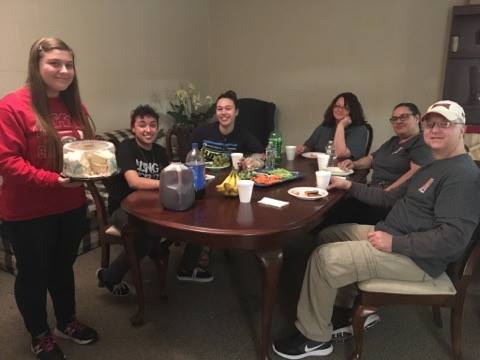
As I was the host of my group’s Kentucky Kitchen Table assignment, our meeting took place in the city of Bowling Green. There were five people involved – Andrew, Hannah, Hannah’s friend Camille, my mother Stacy, and myself. I included my mother in the meal because I wanted someone who grew up in a different generation to provide additional insights into concepts that college students might not have. Plus, she makes a great macaroni and cheese dish! My mother is a nurse practitioner that works at Logan Aluminum in Russellville, Kentucky, providing health care to the factory workers and their families. She grew up on a farm, was the first in her family to attend college, and now has attained her doctorate degree as of last year.

Camille is an engineering student. She was interested in pre-med, but recently has changed her desire to engage in a career in civil engineering. Hannah also transitioned from a pre-med background to the field of social psychology.  Andrew, a former Gatton student, expressed interest in becoming a professor, as he takes a great interest in mathematics. Then, there was me, the lone film student in a room full of math and science careers.

Both Camille and Hannah grew up in Christian households, as did I. My mother is a religious woman as well, having grown up in a strictly religious household. My household was quite strict on religious beliefs; however, Andrew and I both now hold agnostic/atheist viewpoints on religion.

Each of us brought our own dish. My mother made macaroni and cheese, as I expressed earlier, while I brought an apple pie. Hannah also brought a dessert, a chocolate cake, but hers had been eaten much more than my dish by the end. Camille brought a bowl of baked beans, and Andrew brought a plate of friend chicken. We had a nice home-cooked Southern meal!

We discussed many topics throughout the meal, but I will only elaborate on the most important parts of the night for time’s sake. First, we started off deliberating on what citizenship means to each of us. As the conversation went around the table, most of us agreed that a quality of a good citizen is being engaged in the community that you are a part of, not just being stagnant and watching events in the town pass you by. In order to be a productive member of society and fully be a part of a community, one must make an effort to shape the town in a way that will change it for the better. Often, members of a city or town will complain about various aspects of the community, but will do nothing to solve the problem. Without ever taking action, the town as well as one’s role as a citizen will grow stale and empty.

Additionally, we discussed the question of whether we knew our neighbors or not. My mother and I replied, saying that when we used to live in the small town of Munfordville, Kentucky, we knew everyone on our street as well as the next street over. However, when we moved to Bowling Green, even after twelve years of being a part of our neighborhood, we know very few people. Our family knows people sporadically throughout the subdivision, but we have difficulty remembering the names of the people who live on the right side of our house, even despite the close vicinity of the houses in our subdivision. Hannah and Camille expressed similar sentiment, while Andrew related to the table his neighborhood experience as a child. He told us that his neighborhood was mostly filled with elderly couples, leaving him no children to play with as he grew up. Additionally, we all noted the rapid decline of neighbors spending time outside in recent years. Before the cell phone technology boom, kids and adults would spend more time in their yards during the warm summer periods, barbequing, playing sports, and riding bicycles. In the present day, however, we have all noticed a greater number of families staying inside, keeping their attention on their various screens, and not requiring their children to engage in physical activity.

Next, we related memories of times in which we have engaged with people of considerably different backgrounds than our own. Andrew told the group that he feels a problem he faces is not having enough diversity in his friend group. He has acquaintances and has met people from different backgrounds, but could not say he had ever had a close friendship with someone whose history was much different than his. Hannah told us stories of her foreign exchange student friend, with whom she still keeps in touch, despite the long distance. She described his incredible sense of humor, but, conversely, I also shared a story of a German exchange student that lived with a friend of mine in high school. From what I experienced of the German exchange students that I came in contact with, they acted more serious and hesitant when it came to humorous subjects.

My mother brought up a story I had forgotten mostly about. She talked about when my brother brought a friend whose background was from the Middle East to our Christmas holiday dinner. His country had been barred off due to wartime, so he had no contact with his family and could no longer afford his schooling. He was studying to become a translator because he already knew six different languages. My brother, who worked at the Baptist Campus Ministry, offered his friend a job in exchange for a room at the building. My mother remembered an aspect of his personality that I had failed to notice. She recalled that every time an adult male entered the room, the young man would immediately rise and shake the adult male’s hand. It seemed to be an automatic response for him, which struck us as odd. We would not expect American college students to greet patriarchal figures in such a manner every time they entered a room.

After that, Andrew brought up the topic of college education and the high cost of tuition. Hannah, Andrew, and I identified the wickedness of the problem, while I explained to my mother the definition of what a wicked problem. As we discussed possible solutions to the problem, we realized the many different ways of treating it and the increasing complications as the conversation endured. However, after a minute, my mother commented, expressing her feeling that we need to first identify why there is a problem before attempting to solve it. Although none of us knew exactly why college tuition has become increasingly more difficult to pay for students, we all thought this was an important point.

Switching topics, we decided to deliberate on our obligations to others in our community as well as our country. We each agreed that we all have obligations to the individuals around us. If everyone isolated themselves inside of their own bubble, a community can suffer. As the topic went around the table, I asked the question “Does distance affect the willingness you have to help an individual?” I related the question back to the exercise in which we participated in class, where we decided whether or not we would send money to a family whom we had stayed with on a study abroad trip. Andrew expressed his morals, sharing that he felt distance should not matter when someone was in trouble. The rest of the table agreed, arguing that the only aspect that should matter is your personal relationship to the individual in question.

Lastly, we discussed whether each of us ever ate meals at the table with our families growing up. Andrew expressed regret, realizing that most of his meals as a child were spent on the couch, watching television alone. He wishes his parents had forced him to sit down and eat, as he felt this would have helped them to form closer relationships in the future. Hannah and Camille both related how they would frequently eat as a family, but sometimes schedules would conflict and family dinnertime would have to be sacrificed. Similarly, in my family, my parents would always force us to eat at the table for dinner. However, as my siblings and I grew up, we had to give up family time in order for my parents to transport all of us to our extracurricular activities after school. Now, my family has realized that many of our family meals now occur at restaurants, as my older brother and I are in college. Our parents realized the effective way of planning family time — by promising free food. On the other hand, my mother described a different experience from when she grew up. She recalled being forced to eat at the dinner table every day, at the same time every day. They also rarely ever went out to eat to restaurants for food because eating out was deemed too expensive. Because of these strict dinnertime rules, my mother always wanted her kids to share similar experiences around the dinner table with their family.

After the meal ended, my mother and I cleaned the plates, and the group sliced into the desserts. Camille, Hannah, and Andrew respectfully thanked us for offering up our house for the project, and we each commented on how easily the conversation went after it got going. I believe our group’s Kentucky Kitchen Table was a success!

KKT Brandenburg, Kentucky

By Hannah

            My Kentucky Kitchen Table (KKT) was held in Brandenburg, Kentucky. It was a family based, relaxed dinner. The people who participated in my KKT were three of my aunts, two of my uncles, and my parents. Although it seems like I would know my relatives well enough to not have a great discussion, I had not seen most of them for a year or so. My family usually catches up on an annual basis, so a lot of my aunts and uncles are almost strangers to me.

            I had a diverse group of generations and individual differences at my KKT. My aunt, Ellen, is an avid runner and currently works for a government agency. She is in her 40’s and is single. My uncle, Wally, is married to Irene. They are both retired and enjoying spending time with their children and grandchildren. My other uncle, George, is married to Kim, and are in a similar position as Wally and Irene. They are both retired, and they have four grandchildren to give their love to. My father is an employee at Jim Beam (as was George) and is soon set to retire. My mother works at our county’s UK Extension Office where she loves teaching adults and children about nutrition and healthy lifestyles.

            To start off the conversation, I asked an easy question to ease some nerves, “do you know your neighbors?” Wally, Irene, George, and Kim live in a subdivision. They said that they do know their neighbors. It seemed like they knew them mostly on a ‘hey, how are you?’ basis rather than a personal level. Ellen lives in Louisville and said that she knew almost everyone on her block. My parents live in the country compared to our relatives. They know one of neighbors well and talk to him weekly. The other neighbor they do not know as well. Overall, it seemed like there was always someone in the neighborhood that they did not get along with or personally know. I found this to be an interesting similarity because we all live in a different type of neighborhood structure. I asked them a follow-up question – is there anything you could do to help your neighbors? Kim said that she should probably join the neighborhood association to try to improve things where they live. Ellen seemed to have an idea pop up at that moment. She stated that she should stop fighting with her elderly neighbor about him cutting tree branches off. All of the solutions given were relatively simple fixes. I think that question got them to consciously think about what they can do to help other people. It seemed that they never had thought about that before which was very intriguing to me. I did not prod any further even though I wish I would have.

            I gave them another question to discuss which was, “do you think you have any moral obligations to others?”. I was thinking that they would be stumped by the question, but it was quite the opposite. Every person seemed to be passionate about their response. Some of the responses that were agreed upon were to respect others. They said that we all live together and that we need to be accepting of one another. References to the bible were made at this point and ‘be kind to thy neighbor’ was stated. I was pleasantly surprised at all of their positive and kind responses. I figured their age would factor into that question, but my responses lined up to theirs. A prominent theme of the dinner was brought up by an answer to this question. George stated that we have an obligation to make a difference in the world. That answer came with a quick, “but some people have more opportunities to make a difference in the world than others”. I found this to be an interesting statement that I did not think too much about until writing this reflection. It encouraged me to think if this is a true statement or not.

            Being concerned about George’s response, I asked the group if they volunteer anywhere. Sadly, the answers were not what I wanted to hear. Volunteering is something that I hold close to my heart, and I continue to volunteer even when my schedule is busy. Giving back to people in need is something that if everyone did it, there would be no person in need. So even though I agree with George that we all have an obligation to make a difference in the world, I do not think we all have different opportunities to do so. Any good difference one can make is a difference made. I encouraged them to go and volunteer their time. Most of them are retired and abled to help people in need. A few days after the dinner, my dad told me that Ellen and George texted him and told him that the conversation we had made them think of how to help others. Being involved in one’s community can help broaden one’s view on others.

            If we begin to open our minds and listen to others equally, a lot of conflict can be avoided. Selfishness and ignorance is at the root of many conflicts. This is similar to one central idea of HON 251, which is how do we communicate well with others. I am a strong believer that serving others is the best way to understand other people’s hardships and meet people you otherwise wouldn’t meet. By actively learning about other people’s viewpoints and experiences, one can begin to have high quality communication skills. Better communication can also lead to addressing shared problems as well as having more say over our lives, which are the other two central ideas of HON 251.

            I can relate this particular topic of serving others to Jane Addams’ writing called “The Snare of Preparation”. Addams discusses how she spent most of her time planning on helping others and the details of it. She spent most of the time preparing to help instead of acting. Addams realizes at one point when walking down the street that the problem of poverty is all around her, yet she has not done anything to help it. The people attending my KKT seemed to be in the same slump that Addams was in. They are all passionate about social issues and getting involved with associations, yet they have not put forth any action to do so.

            When asked, “what does being a citizen mean to you (other than voting)”, I received some interesting responses. Our discussion before this question had an impact on their answers as one response was to serve and help others. Another response was that citizens need to try and protect the environment we are in. We never got into environmental issues, but I liked this response. I think you could make a valid argument that protecting the environment for future citizens is an important role of being a citizen. Another response was getting more involved with local politics and making your voice heard by writing letters to the government. I encouraged them to make their voices heard because the government can’t make high quality decisions on wicked problems without hearing other people’s experiences and viewpoints. Research and facts can help with wicked problems, but personal experiences can help figure out better possible ‘solutions’ for wicked problems. I hope that this KKT has encouraged them to voice their opinions and get involved.

            An interesting conclusion made at the KKT was that no one eats dinner around a kitchen table anymore. Everyone (except for me) grew up eating around the dinner table as a family. When they were growing up, it was a different time without many of the distractions that we have today. I grew up eating dinner on a tv tray watching TV, and I hardly ever ate at the dinner table. Everyone else said that now they only eat at the kitchen table when there is company over. It seems like in our everyday life, we have strayed from having face to face conversations. Many do not seem to have the unique, enlightening conversations with other people in this modern world. The American culture has shifted more and more towards individualism. We tend to pay attention to only what our opinions are and ignore the opposing side. This causes a polarization that is hard to reverse. This polarization is what is making it hard to communicate well with others. Not listening or understanding other peoples’ viewpoints makes it hard for a democracy to exist.

            In conclusion, I have been encouraging my dad to keep in contact with his siblings more than he is used to. I think making him invite his siblings to this KKT made him realize how enjoyable talking to one another is. I enjoyed hosting a KKT and hope to host similar dinners with family and friends in the future. I think hosting this KKT has made an impact on a few of my family members and myself. Conversation is a powerful tool that is going obsolete in a world of technology. Hopefully, I can encourage people to put down the electronics (not just during meal times) and have enlightened conversations.

KKT


Citizenship and What It Means to Both the Old and the Young

By AbigailIMG_1742

My Kentucky Kitchen Table project, held in Owensboro, KY, provided a chance for me to learn from several different people about their role in society. It was interesting to hear all of the different perspectives and how the perspectives changed based on the age of the dinner guests. The dinner consisted of Kassandra, Jeff, Allison, Avery, Nijha, Rose, Isabella, Donny, and me. Kassandra is my hardworking mother. She provided the entire meal for the dinner because she wanted to try out a new recipe that she had seen. She made spinach lasagna and garlic bread. She also provided a beautiful strawberry cake for dessert. Interestingly enough, each of the guests helped in setting up for the dinner by laying place mats out, filling cups with ice and water, and putting silverware out. It was nice to see an element of “citizenship” playing out even before the dinner started. Jeff is my dad. He is 46 years old and works as a maintenance manager for Alcoa. Both Allison and Avery are my sisters. Allison is a college student at a local university and Avery is in high school. Avery brought a friend named Isabella. They do not go to the same high school, but met in middle school where they have remained friends since. Isabella brought her friend from her high school, Nijha. Nijha comes from a single parent household and she is biratial. My grandmother, Rose, lives in a government funded housing complex in the center of our city. She brought one of her friends from her housing complex named Donny. Donny is an U.S. army veteran. While I went into the dinner wanting to get my questions answered, I felt that our conversations sparked a more meaningful purpose for the dinner.

As we all sat down with our plates of lasagna and garlic bread, I started to ask some questions. Each member of the dinner came to the dinner with the understanding that they would be answering questions for a project of mine and so they were all prepared to give thoughtful responses to the questions I had. I asked each person the required question, “Beyond voting, paying taxes, and following laws, what does citizenship mean to you?” Interestingly enough, there was a stark contrast between the answers of the high-school aged members and the older members. Isabella said, “[Citizenship means] you’re apart of the country and happy to follow to rules.” Nijha, who seemed shy at first, said “[citizenship is] doing good for others even when no one is watching.” Where as Donny said, “You’ve given everything you could and now you get to receive.” He was directly referring to social security in his response. Rose agreed with Donny and said that she feels that she has less of an impact on society as an older person than “you young people have.”

However the topic that dominated our discussion was that of social issues and the root of all social issues. I asked both Allison and Kassandra which social issue is closest to their heart and why and while their answers were different, they both fell under a similar theme. Kassandra responded, “Abortion because it’s a direct assault against God’s character.” And Allison noted, “Divorce is the social issue closest to my heart because it results in the division of families.” Kassandra later went on to talk about how she believed that many social issues were rooted in a citizen’s home life. I brought up the issue of drug use and how it seems that no matter what we do, drug use will always be a problem. Kassandra felt that drug use begins because of a lack of stability at a young age. Each person began to try and create “mini solutions” for current social problems. And as each person talked about social issues that weighed heavy on their hearts, it almost because discouraging. Similar to our discussions in class about wicked problems, each member of the dinner began to understand the complexity of most of the issues and how the issues seem almost impossible to correct. I explained that in my class, we discussed that their are some issues that are so complex that they can almost never be solved. As Jeff reflected on what we can do to solve some of these problems he said, “[It is our] responsibility to attribute to the common good.” This seemed to resonate with most of the members of the dinner.

The most interesting take away for me were the differences in perspective (and in turn, answers) based on the members’ age. While almost everyone at the table seemed to bring something a little unique simply because we’re human, the older members were more conservative and viewed their citizenship as something that is not as prevalent anymore. It is almost as if they’ve given all they need to, and now it is time for them to sit back and reap the benefits of their hard work. However the younger members all responded in ways that seemed to define their citizenship as an active duty.

I also learned that situations are only awkward if you make up your mind that they will be. I was so afraid leading up to the dinner that I would put my foot in my mouth, or that someone would feel uncomfortable, but everyone seemed to be at ease and there was no awkward silence. Because I knew that Isabella would be bringing a friend that I did not know, I was afraid that the friend would feel uncomfortable or awkward. It turned out that Nijha was incredibly friendly and brought unique and interesting ideas to the discussion. Similarly, Donny, whom I had seldom met but once, was very vocal when it came to our discussion. He was eager to explain his own opinions, but also ready to hear what others had to say. It demonstrated to me the importance of putting myself out there in situations that I may deem as uncomfortable. Ultimately, how are we going to learn anything if we’re not willing to put ourselves in uncomfortable positions?

I felt that the dinner was putting everything we’ve covered in class into reality. We’ve talked about listening to others’ opinions and we’ve discussed how to learn from other people even when you don’t agree. There were times during the dinner where I felt frustrated with a guest’s answer or response, but then I realized that it was my job to listen and hear their point of view. As soon as I could free myself up to do just that, I felt myself understanding that person so much more. Even my own dad and I had differing opinions on current social issues, but we were able to listen to one another and acknowledge where the other one was coming from. That, in essence, is what citizenship is – Being able to work together and understand where someone else may be coming from.

Big Ideas in Small-Town U.S.A.

By Hannah

My Kentucky Kitchen Table meal took place in my home in a small-town, located in far eastern Kentucky, called London, Kentucky. This town is my hometown so I was very excited with the opportunity to host this meal here. In attendance to the meal was Ethan, Lyndsee, Delaney, Molly, and Carrie. Ethan is a graduate of the University of Cumberlands and is currently a teacher at Corbin Middle School in Corbin, Kentucky. He is also a member of the band Frontier, LLC. and their albums are available on iTunes and Spotify. Lyndsee is a sophomore at the University of Kentucky and is pursuing her career as a veterinarian. She is a member of the pre-veterinarian club and is also currently a residential hall assistant on campus in Donovan Hall. Delaney is a sophomore at the University of Kentucky, pursuing her physical therapy degree and is the academic chairperson of Delta Zeta. She also is a member of the pre-physical therapy association. Molly is a current student at Somerset Community College and is pursuing her degree as a dental hygienist. She is working currently at Hometown Bank as a bank teller. Carrie is a student at the University of Cumberlands, pursuing her accounting degree. She is the current accounting intern at ABC Automotive Systems Incorporation.

For the meal, I wanted to provide a home-cooked meal for my guests that I prepared myself, as I love to partake in cooking. I prepared the main entrees and desserts for the meal and then had my guests to provide their favorite appetizers. The meal was set to start at seven o’clock and after we had dined, I started the discussion. When asked the required question of beyond voting, paying taxes, and following laws, what citizenship meant to each of them personally, there was an anonymous understanding that citizenship means that we are all part of something more in this world together. We are all a part of something bigger than ourselves that we can relate to. Citizenship is part of our identity and it includes our freedoms and liberties and how we interact with others and our community, not just nationally, but locally as well. Ethan was very interested in the question of if he sees his job as relating to his role as a citizen. As a history teacher in the critical growth stage of middle school, he felt very strongly that his job does relate to his role as a citizen. This made me think of the Nussbaum reading, “Not for Profit” because he related it to how he feels education should equip students to see themselves as “citizens of the world rather than merely Americans”, and that personally is his role as a teacher. He feels that it is his job to introduce to his students what it truly means to be a citizen and reflect this through his lessons that he provides. Lyndsee also felt very strongly about this question as she is a residential hall assistant on a university campus. She experiences everyday trials that students must face now that they are living on their own, instead of being dependent upon their parents. She feels that her role is critical in helping freshmen students to make this transition more smoothly into the world as an adult. When discussing what kind of community they desired to live in, Ethan brought up how he desires to live in a more isolated area, for peace and quiet in a busy world, while Molly wants to live in an area where everybody knows everybody and the neighborhood is more like family. Ethan brought up that this difference could be attributed to how he grew up in a neighborhood where he did not personally know his neighbors, while Molly added that her viewpoint could be because she did grow up in a community where she knew all her neighbors and most of them were even her family.  Delaney brought up her personal experience of moving from a small-town community, where she knew all her neighbors, to Lexington, where she hardly knew anyone and the isolation that she felt from this transition. After getting involved in her sorority though, she started to feel more at home and not as isolated, but compared the two different atmospheres as being opposites and a difficult transition at first. This made me reflect on how there may be numerous internal struggles that my classmates may be facing on the inside that we cannot see from the outside.

When asked if our religious or spiritual identity relates to how we should treat other people, Carrie said yes and went on to say that it also can be related to how we are raised and could become innate from our upbringing. This related to our study on “The Righteous Mind” by Jonathan Haidt about the elephant and the rider. Our first initial reactions to other people may be related to what our elephants first think, in this case our upbringing. We also discussed how we do have obligations to other people in our country. At this point, I brought up the question if this includes if we also have the responsibility to take care of other people in our country. This question was hard for my guests to answer, just like it was in class. Delaney ended up stating that it is not our responsibility necessarily, because if a person does not do something we personally believe to be right, it does not mean that they are wrong, but it should be our obligation as the race of humans to be looking out for one another. Ethan added in that he does believe that his religious identity relates to how he treats other people because as a Christian, the Bible states to take care of the widows and the orphans, so he feels called to try to the best of his ability to treat everyone equally and help whenever he can. When discussing advice that we would give to people running for office in our country, it was a central theme that we needed to have more respect for one another. Lyndsee stated that she felt very bothered when seeing derogatory commercials of our presidential candidates stating mean things about the other. She also talked about how we should try and stop focusing so much on which “party” we belong to because it is creating more division than it should be. This reminded me of the article by Keith Melville, “How We Talk Matters,” because he wrote about how this world is not about “us vs. them. We’re all us.” There was an overall frustration that was voiced about how politics are currently. Lyndsee talked about how when the presidential debates were being aired, they held a viewing party in her dorm lobby and the students got so upset by the opposing views that the students all started to yell at each other and ultimately, the party ended up being cancelled and one student ran from the room, bursting into tears. This also reminded me of our discussions about how it is difficult for people to discuss hard issues like this and how often, it can lead to conflicts like what Lyndsee faced, leading two groups of people to be divided against each other. She also discussed about her experience thus far as a residential hall assistant and how she talks to people from all over the world of different origins and religions. She tries to relate to each person individually, aware of their diverse backgrounds and how she personally can learn something unique from each of her residents. When discussing if there is anything that we can do to make things better for our neighbors and where we live, Delaney brought up how she desires to be more friendly and open with her neighbors that she is not close with and it was even discussed how we desire to start more events for our neighbors to participate in together. Molly added that she knew of a neighborhood that would host a potluck every week, with a new family hosting weekly. This was not necessarily a time to visit for the neighbors, but a day that busy families could relax and not have to worry about preparing dinner for a night. It was a way that they could all help with the burden of a busy life together. Her story made me reflect on how we are all in this busy life together and that we can individually do things for one another that can help ease the stress and complications that we face, simply by in this case, preparing a meal once a week for others. This was what struck me and opened my eyes because I was doing this personally for my guests as well. Even though we may sometimes feel like we are a small human being in a big world and our impact does not matter, this is not the case. We can impact our world, communities, and friends in ways that we do not know and possibly, cannot see. Having this discussion in a way that was respectful and meaningful showed me how it can be possible and successful to have a conversation with others who have different experiences and backgrounds than you. Even though I went into this assignment feeling that I was going to teach my guests something, it was rather them who taught me.

When We Come Together

By: Elise

A couple of weeks ago, I was able to host a Kentucky Kitchen Table at my house in Louisville, Kentucky. I must give a great thank you to my old youth minister who helped me get a diverse group of people together while I was in school in a different city. He was able to contact people for me that came to my meal that I never would have gotten to talk to without his help; and I think this diversity embodies the idea of this project.

There were nine people who attended my project dinner, each one with their own unique perspective. And, as I had requested, they all brought one of their favorite side dishes to accompany the main course and dessert my family provided. There was Larry, an outreach minister at a church, Janet, a self-employed consultant, Iris, a writer for Anthem, Heavenleah, and instructor for students with autism, and Felix, a 5th grader at a local elementary school. Also, a few of my family members attended; there was, Jackie, a children’s minister, David, a director at a marketing agency, and Amanda, an instructor for students with autism. They have asked that I refrain from getting too detailed with their specific descriptions but, our group’s ages ranged across 60 years. There were varying political parties, orientations, economic classes, and races represented; and many people there were not born in Louisville. And, with all of these differences between people, I had anticipated some awkward moments. However, the dinner ran very smoothly. Everyone was excited to participate and eager to hear other opinions. They were all very respectful and willing to speak up.  It was a really cool thing to witness.

I began the conversation by explaining a little bit to my guests about what the class is and reminding them of the purpose. After that, I really let my guests run the conversation, and they needed very little prompting from me. With the exception of my changing the question or adding a comment here and there, I had very little to do with the direction of the conversation. They had lots of good answers, and even questions of their own. And, everyone listened to what the others had to say. This conversation really embodied Keith Melville’s thoughts in How We Talk Matters. In this article, Melville defines deliberation as an approach to public decision making; and, he emphasizes the importance of intentional conversation and listening. And, during this conversation I was able to see the amazing things that can happen when this practice is actually used. People came together and actually heard what the others were saying, despite their difference in political party or economic class. And while they might not have had their minds changed about certain topics, they heard other opinions that seemed to broaden their view of the subject, and make them more open to other ideas.

The first question I asked was the required one, what does citizenship mean to you? Overwhelmingly, the answer I heard was being a citizen meant being a part of a community. The idea of citizens being a team or a family.  Each person has a different job, but we need all of those jobs done in order to be successful. Iris was reminded of jury duty—of how one person can’t be the only decision maker, but it requires a team of people actively participating to get the job done. Similarly, Felix said that a community reminded him of a grandfather clock in which the people were like the gears that kept the clock running. Even though he is young, he had some interesting insights throughout the night.

They also discussed how you can be a “citizen” of many different communities. Of course, we were all citizens of the United States, of Kentucky, and of Louisville. But we are also citizens of churches, schools, sports teams, clubs, etc. Some of these things we choose, while others we must be a part of. So, it is important to be a good citizen in all areas of our life.

Then I asked the question, what is the thing you love most about living where you do? I opened up the question so that people could talk about Louisville, but also compare it to places they had lived in the past and what they liked about that, too.  I felt that this was important to talk about because it recognizes the fact that we did not all come from the same place, though we were there together in that moment. At first, people focused on Louisville.  They love that everyone there is so friendly, and that they may not know everyone’s name, but they know their story. They said that this made the big city seem more connected, and more like a small town. They like the reputation Louisville has of being kind and generous, and this reputation is embodied by celebrities from there that they mentioned such as Muhammad Ali and Jennifer Lawrence. They seemed to all agree that an ideal place to live had these qualities that they liked about Louisville.

After we spent time talking about what we liked, I asked about what improvements they thought should be made to the area. Without missing a beat, Amanda brought up how we needed more homeless shelters in the city. We have a few in the downtown area, but in the part of town that most of us live, we do not have anything substantial. We also discussed how our prison system needed to be reformed; both in the prison and in the transition out of it. We have many people in the city who have served their time, but still seemed to be punished because they can’t get hired anywhere. Others brought up the fact that our area needs to improve on its awareness and treatment of those with mental illness or addiction. Many people noted how they knew people who had been turned away for help in these areas because the doctors were unsure how to help, or the insurance didn’t cover it.

While I prompted this question with improvements they thought should be made in Louisville, it seemed to me that all of these problems they noticed applied across the country. And, most of them had to do with the larger systems in place. They all seemed helpless when discussing these topics because they were unsure how to get around the large systems, but they saw a clear problem in the way they were run. It made me think about a discussion we had briefly in class once about how large systems that were put in place, like the prison system or the foster care system, are put in place to fix one problem, but it can cause other problems. That what makes issues like these Wicked. You cannot foresee the consequences, and once you put the system in place it is time-consuming and costly to change or replace them.

The last thing I asked them was what advice they would give to people running for office in our country. I thought this would be an interesting topic to cover because of recent political divisions across the country. I wanted to see if the group could discuss something that could be politically charged in a calm and efficient manner. Luckily for me, they did. And I loved their answers. A main point that they all agreed on was they wanted a politician who would focus on what unites the country, and not what divides it. They want politicians who do not use Us vs. Them tactics, but who will be honest with their opinions and be true to what they think is best rather than what the Party wants. The table also advised that politicians should know that they can’t please everyone, but they should still try to make everyone feel like they are heard. A common theme of this discussion was that people felt alienated because no one was listening to them. The group thought that if leaders made an effort to listen, people would be more understanding of their actions, even if they weren’t the outcome they had hoped for.

I did not realize until it was over how great of an experience this project was. It is not often that I get to sit and talk with a diverse group of people about issues that actually matter. And, it is not that I dislike these types of conversations; I just get so caught up in my own life that things like this don’t happen. But, I now realize the value of this type of conversation. In this class we talk about the importance of deliberation, and I can see now just how effective it can be. If people were to openly discuss topics like these more often, I feel our communities would be stronger. Most people came to this table strangers, but I feel we left a connected group. If citizens would take more opportunities like these, they might feel more connected to their communities.

Small Town Democracy

By Mary

My Kitchen Kitchen Table took place in Glendale, KY, the quiet little town in central Kentucky that I call home. We sat around my family’s kitchen table, the table that my siblings and I sat around for years as kids.

Around the table were six people. My sister, Anne, is a 16 year old junior in high school who is an incredibly talented artist, writer and student who is gifted in not just the arts but in math and science as well. My mom sits at one end of the table. She has been a homeschooling mom of six kids for 28 years, and now is the development director for the local crisis pregnancy center. My dad sits at the head of the table. Dad is an engineer who works as the director of a healthcare clinic. My brother David sits across from Anne. He is 23 years old, works in the Louisville Ford plant as a CAD engineer, loves learning, and is the most industrious person I’ve met. Beside him is his fiance, Anna. David and Anna got engaged the week before we had dinner together. Anna is a senior in college, studying Asian Studies and Chinese. She works at the public library, and as the newest (soon to be) addition to the family, is a very welcome but not a very familiar presence at the dinner table.

We ate an incredibly scrumptious meal of pork, smashed potatoes, green beans, and a dessert of brownies, strawberries and ice cream prepared by my Mom, Anne and me. We had a wonderful time making dinner together.

This is a diverse group of ages, with my parents born in the Baby Boomer Generation, David and Anna born in the Millennial generation, and my sister and I born in Generation Z. Anna grew up in a different family and in a different town, my dad spent his childhood in Tennessee and Indiana, and my both my parents have lived and experienced much more in life than David, Anna, Anne and me.

We had a great conversation about citizenship. I asked the question, “What does citizenship mean to you?” We talked about two meanings of the word of citizenship – citizenship as a noun and citizenship as a verb. We said that to be a citizen (noun) means you have a particular legal status and fulfill duties within that status. To be a citizen (verb) means you take steps beyond just your legal status to improve the world around you. We said that the duty of a citizen is to do what they can. My dad said, “any good that people do – no matter what it is – adds to the greater good. Therefore, a citizen is responsible to do what good they can.”

Anna mentioned that globally, citizen participation is decreasing. We talked about how some countries are implementing compulsory voting laws. Anna talked about a unique system that India employs, where citizens’ thumbs are dipped in ink when they vote, making it easy to identify people who have and have not voted. We talked about how culturally, this system would not fit in in America, but it is interesting to see how other democracies go about the voting process.

I then asked, “Do you see your job as serving a greater purpose?” I picked this question intentionally, knowing that we had a diverse group of jobs and hoping that it would spark good conversation. My mom answered that she thought her job contributed to the greater good because the non-profit that she works for helps create healthy families, and healthy society cannot exist without healthy families. My brother said that he thinks his job in manufacturing definitely contributes the greater good, because every manufacturing plant provides a product to people who need it, whether the product seems “important” or not. He considers manufacturing a “noble profession” because it is not glamorous and doesn’t receive thanks but is instrumental to our society. Anna said that her job at the public library helps the whole community and every demographic, if people choose to take part in it. This, in a way, is a metaphor for democracy and engaged citizenship – if you choose to take part, your participation will benefit you and help strengthen the democracy. If you do not choose to take part, you have only yourself to blame. My dad said that he did consider his job as contributing to the greater good. As the director of a healthcare clinic that provides intensive care to Medicare patients with significant illnesses, Dad sees his job as connecting people with services they need that they wouldn’t be able to find elsewhere. He believes that because no man is an island, helping one person helps a lot of other people in turn.

We would define citizenship as taking deliberate action to do what you can to help another person, even if it is a small act or in an unconventional way like working in a manufacturing plant.

Sitting around the table eating dinner is not new to my family – growing up our family made it a point to stop and eat meals together. But having structured conversation about citizenship drew us together, because it gave us a picture into each person’s perspective on the world. I learned something about each of the people around the table, and developed my view of citizenship by having an intentional conversation about citizenship with my family. Our conversation reminded me of Jane Addams’ “Snare of Preparation” article. In her article, Jane Addams talks about how people often get caught up in preparation to serve and never actually embark to serve. The definition for citizenship that we developed touches on this, as it requires that citizenship be active based not on how large your impact can be, but how meaningful your impact can be. Often people don’t act (or vote, or write to their representatives, or talk intentionally or get involved in campaigns) because they think that it will not matter. In his article “Why Bother?,” Michael Pollan argues that we should bother about taking simple actions that don’t seem to have a large impact because they change ourselves and influence people around us. Our conversation helped relate Pollan’s article about the environment to citizenship. People should care about being good citizens because it makes you a good neighbor, a good friend, a good employee. Acting in the interest of others and not just in your own interest broadens your horizons and gives you an appreciation for people who are different than you. Citizenship is not limited to just political action; citizenship is a mindset that changes the way we interact with others. Only a transformed American citizenry can change American politics. Only citizens who deliberate with one another over kitchen tables, grocery store aisles and across party lines, and stay informed about both relevant issues and the needs of their neighbor can develop a flourishing democracy.

Kentucky’s Kitchen Table Project

By Coreyimg_4079

I will start off by saying that I greatly enjoyed this Kentucky Kitchen Table project. It allowed me to connect with some local people in my community and share some of our life experiences. I had dinner with eight people from various backgrounds. Luke is a man from Indiana who I was introduced to through a friend for this project. He is a mechanical engineering major. He is a funny guy, who has a very similar sense of humor to mine. We got along well from the beginning, and he was a great addition to the kitchen table. He wanted to be described as a kid from a small town who has never had anything given to him. Everything he has came from his own hard work. For the required question concerning what citizenship means, Luke said that citizenship means that you get out and participate in society. You work hard every single day, and try your best to make your dreams come true. You make money and spend money, and that’s how society works.

Kayla is a graduate from WKU, and has a degree in civil engineering. She is my sister, and she is an academically brilliant student graduating with an almost perfect GPA and Honors. She now has a full time job in civil engineering. Kayla wanted to be described as not your typical girl. She works in what some consider a man’s field, and has never been interested in most of the “girly” things. When I asked Kayla what citizenship meant to her, she had a similar answer to Luke saying that you must participate in society. She believes that citizenship means treating everyone with respect.

Mallory is my girlfriend, but she comes from a very different background than me, which provided even more diversity to the table. She also attends WKU and is majoring in Civil Engineering. She comes from the “cross town rival” independent school and was raised up in a more subdivided area. Citizenship means accepting everyone as they are to Mallory. She says that even if you do not agree with the way someone thinks or feels you should still accept them as they are.

Kiersten is my little sister and she was without a doubt the most interesting character at the kitchen table. She is one of the sassiest little girls I have ever known, and extremely smart. Whenever I asked Kiersten how she wanted to be described, she said she wanted to be described as a princess which is not in the least bit surprising.

Elaine comes from a background of only having enough to make ends meet. All through her life she has not had a surplus of money so she is very economically wise and very responsible. When I asked her about what citizenship means to her she had a very simple answer. She said that being a citizen means to contribute to society and make sure that you treat everyone with an equal amount of respect because everyone is made equal in God’s eyes.

Marietta is an elderly woman who has not had it easy from what I can gather. Recently her husband of many years passed away due to an ongoing illness. She said that one of her sons was in prison, and that another had a long fight with drug addiction that he recently conquered. The easiest word that I can find to describe this woman is tough, because she has had a lot of tough times in her life and she has always come through it. Marietta said that citizenship means loving this country and fighting for what you believe in.

The final guest I had at my kitchen table was a man named Kevin who was told a few years ago that he would never walk again. He was involved in a horrible four-wheeler accident that broke several of his vertebrae along with other injuries. He was rushed to UK hospital where he underwent immediate surgery, and at the conclusion of the surgery he was told he would never walk again. Yet, here he was walking into my house to have dinner. Kevin wanted to be described as a fighter because he said it seemed like he was always the under dog. When I asked Kevin what he thought citizenship meant, he said that citizenship meant trying your best to help others out around you.

Throughout the dinner we had a lot of small talk conversations about how everyone was doing and we all shared a little background about ourselves to begin with. Then, since I had been hunting the morning of the kitchen table project, I was asked if I had gotten a deer yet, and we spent a few minutes exchanging our best deer hunting stories with one another. One of the most well responded to questions I asked was: “Did you ever have meals around the table with your family or neighbors growing up?” This question seemed to almost be universally answered as a yes except for Luke. Luke said that his dad worked a lot as he was growing up, and that he didn’t really get to spend time just sitting down and eating dinner with his family. Both Kevin and Elaine responded yes to this question. They thought that it was a normal thing for a family to sit down at the dinner table and have a home-cooked dinner together almost every single night. It was something that they had done ever since they could remember, and couldn’t imagine what life would’ve been without that. Elaine said she felt that this dinner together made the family stronger, and made them get along better.

I honestly learned a lot at this short dinner filled full of conversation and good food. It can really open your eyes to the changing generations, and the differing views between every person no matter how similar they are. This reminds me very strongly of the idea of deliberation and the book Citizen by Claudia Rankine. As I sat at the kitchen table, I was very aware of the differing view points surrounding the table, yet we could all talk about our beliefs and views without offending anyone. That is the goal of deliberation and democracy is to understand everyone’s views and come together to form a better society. Finally, it reminded me of the book Citizen by Claudia Rankine because of the fact that everyone at the table mentioned at some point or another that no matter the skin color or views or ideas we all need to accept one another regardless of the circumstances, and that is very important.

Overall, I truly enjoyed this Kentucky Kitchen Table Project, and would suggest it to anyone. It opens your eyes to the way generations are changing, and how everyone has differing view points no matter if you’re from the same state, city, or household. It was a great experience and I’m glad I was able to participate.