Buffalo Kentucky Kitchen Table

table

By Virginia

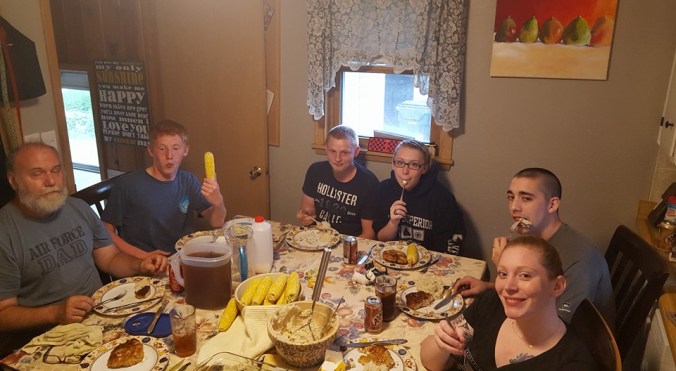
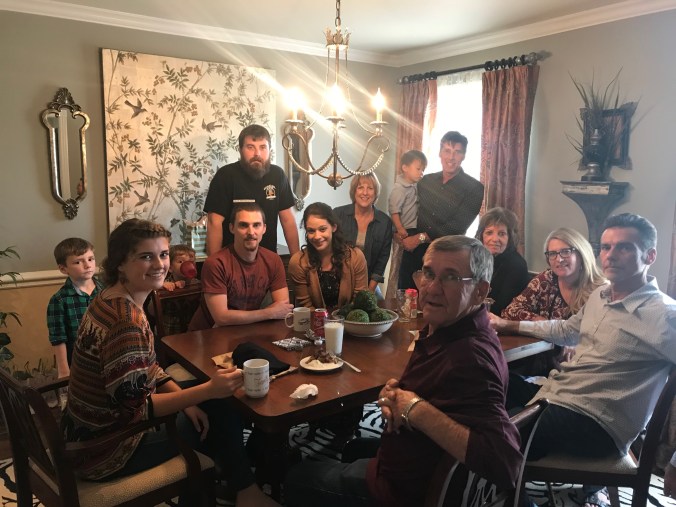
My Kentucky Kitchen Table took place in the town of Buffalo, KY. A small town outside of a small town, Hodgenville. My attendees included:

  • Kim- A mother of 5 boys, she is currently going back to school. She insisted that she cook all the food, but allowed us to set the table.
  • Rob- A disabled veteran, he is also currently going back to school.
  • Cameron- A freshman in the nursing program at Western Kentucky University. He is Virginia’s boyfriend, he’s really cool.
  • Virginia- That’s me, I’m a Spanish major at Western Kentucky University.
  • Jacob- A senior at LaRue County High School, he is a wrestler. Virginia and Jacob were in marching band together for 2 years.
  • Tristan- A 6-year-old, he’s in second grade
  • Alex- An 8-year-old, he’s in 4th grade at
  • Khyce- He is 15 years old, and a sophomore at LaRue County High School. He recently moved to Kentucky from Florida.

We went through the question list, and I’m going to retrace the steps of the conversation through these questions. They helped to structure the dinner, and to keep conversation moving. This first question was, “Beyond voting, paying taxes, and following laws, what does citizenship mean to you?” Kim responded with, “It means you belong somewhere, you have a group of people you are connected with. It comes with the freedom to be you.”

This question was the only question to get an answer out of the kids, “What do you think are the best things about our world today? Tristan replied, “Bacon pizza… God and Jesus… and my family!” Alex boldly stated, “Life itself.” Which is pretty deep, coming from an 8-year-old.

A question that I already knew the answer to was then put on the table, “What is the thing you love most about living where you do?” Rob chuckled and let out a single word, “Privacy.” This family does live in what most people would consider, “the middle of nowhere.” They have a miniature farm and decent sized garden, with a house full of exotic pets. They’re earthy people, people who appreciate life and what they can create.

Cameron asked the next question for me, “Do you see your job as serving a greater purpose?” Kim said, “Yes, I believe that everything is connected. My work may seem small but it is meaningful.” Which caused me to think of the big puzzle of a country we live in. It’s a puzzle in the fact that it’s made up of pieces. Constantly moving around to find their right spot, but trying to create the bigger picture. Rob responded with, “I believe that my service meant something to this country, so yes.”

Does your religious or spiritual identity relate to how you think we should treat other people? Does it relate to how you see yourself as a citizen? Kim smiled and responded with, “Yes, of course. I model myself to be like Jesus. I strive to be like him in every way of my life, regarding helping those around us.” Cameron then went into a rant on how religion isn’t real and how it’s all just a play on the cycles of the sun. However, he was not scolded for his beliefs, his family allowed his views to be heard. I saw in this family what had always been lacking in mine, an ear to the abstract thought.

Cameron threw out, “Do you think we have any obligations to other people in our country? In our community?” Jacob quipped, “I don’t owe any of these people anything.” Kim rolled her eyes to that response and broadcast, “Yes, we do. If we want others to help us we have to help them.” The golden rule is very much alive in this family. Kim understands more than anyone that hard times can come quick and unexpectedly, she helps people in hopes that if she was ever in their shoes, they would help her. I believe that does put a lot of faith in people who may not be trustworthy, but it reminds me of the video that was watched in class where the little girl was hit by the car. Individualism has dulled human compassion, the want to help others just to help. Being a shoulder to lean on does not make you weak, it makes you a citizen. A part of something greater, the power to help those who are connected to you.

The question, “What advice would you give to people running for office in our country?” was asked. Kim and Jacob handled this question, both saying something upon the lines of, “Tell the truth, do not just say what people want to hear.” This connected me to Ivan Illich’s reading, “To Hell with Good Intentions.” He told the volunteers that they were making things worse. This is not what a bunch of sweaty, comparably rich, white people want to hear. They want to be patted on the back and told their doing great. To be spoon fed positive notes and “everything’s going to be alright.” However, the truth is needed to get things done, quite frankly. Upon the recent presidential election, the entire country is in a state of political turmoil. People are biased, and unwillingly to educate themselves. It’s easy to “bait” voters by telling them things they want to hear, and once in a position of power, the baiters change their mind.

We then moved on to the question, “what social issue is closest to your heart and why?” Kim’s take on this question caused me to go into a downward spiral of self-reflection, “I live in a bubble. I don’t want to know what’s going on in the outside world, because it makes me sad. I can’t help everyone, and I can’t change anything.” Is self-aware ignorance bliss? Or is it foolish ignorance? I would be happy not knowing the perils of the outside world. But, it’s necessary to feel the pain of the world to truly be a part of it. Siddhartha Gautama spent the beginning of his life inside the walls of a palace, held from the darkness of the world. Upon finally adventuring out to see what had been outside his world’s edge, he found the disappointments of the world. They saddened him, but motivated him to find himself upon the mess. Life being more confusing, but also never as clear. He became Buddha and without the outside, he would’ve never truly connected inside. To shield oneself from the perils of the world is one’s own choice, but to break into uncomfortable thought and be ready for disaster, the outside world is needed. Rob’s issue, however, took a different route. “Disrespecting the flag. When they burn it at rallies, or do whatever else besides treat it properly.” I pondered this for a second, it did not send me searching deep into my soul, but rather searching in Rob’s. We all have images of peace, you can wear your favorite sweater or lucky perfume. I suppose an image of peace for Rob is the American flag. During service he saw it as a piece of home, all his loved ones, the reason he was there, and the reason to hope. Burning such an image that is held personally is understandably upsetting. I wouldn’t be any different if people ran through the streets burning stuffed plush bunnies like the one I’ve slept with since I was a kid. I started to think of the conflict that Americans go through with the flag today, scattering it on bikinis and embroidering it on polos. To commercialize such an image is to open it to disrespect, and to appear as a mock to Rob’s way of life.

I learned that people are much more than they seem. Most people would write these people off as country do-nothings. But, they have their own life, thoughts, and needs. They desire to function in peace within their household and community. But, they have moral expectations, which they would hope are also held by those they interact with. They made citizenship feel like a community. Broadcasting that every human has common ground, which, if was more accepted, might cause the need to help others become stronger. This brings us to the question, “How can we live well together?” Coming from this dinner, I saw several solutions to this question. The main theme coming out as the golden rule, “Treat others the way you would want to be treated.” To reinstall humanity into our nation would build a better world. Honest politicians, nice community members, and respectful strangers. Not a polarized, angry, and easily fooled mass of consumers. The reading that I would like to connect to this dinner would be chapter in The Empathy Exams, “The Devils’ Bait,” about all the people who had the illness Morgellons. They were all citizens of an illness, they may not have really known each other, but they were connected. They were allowed to be them with their loyalty to their disorder. They found their area to be true citizens, and to perhaps use the power that they felt there to connect to the world outside of the illness they had, Morgellons. This project was just like a regular dinner with them, but with more questions and more attention required. It’s opened the floor to new opinions and perspectives, and I hope to learn more.
Pork, Potatoes, and Politics: My Kentucky Kitchen Table

IMG_5146

By Granite

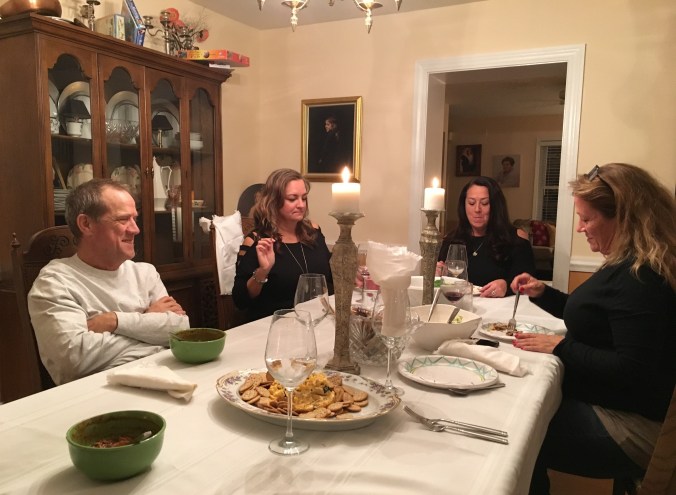
On October 22, 2017, I hosted my Kentucky Kitchen Table in the rural town of Gamaliel, Kentucky.  Gamaliel is a small town located in Monroe County and boasts a population of around 500 inhabitants. A total of 10 adults and three children attended my Kentucky Kitchen Table. These included my father Grady, my mother Cindi, sister Zena, grandmother Faye, grandfather Garon, uncle Geoff, aunt LaDonna, cousin Grayson, cousin Gibson, and Gibson’s wife Tessa. Grady is an emergency room doctor and Cindi homeschools my sister Zena, who is a senior in high school. Faye and Garon are retired, with Garon formerly working as a mechanic and then as the founder of Gamaliel Shooting Supply, the family business. Geoff manages the Shooting Supply, and LaDonna is an interior designer. Grayson is a sales representative at the Shooting Supply, Gibson is the communications director, and Tessa stays at home with their adopted son, Gideon. The family members present represented four generations of Pares and brought unique and diverse perspectives to the figurative and literal table.

My family began the dinner with a prayer led by my uncle, and then I provided a general description of the purpose of the dinner and of the class. To begin our discussion, I asked the only required question for the dinner: “Beyond voting, paying taxes, and following laws, what does citizenship mean to you?” As different members of my family voiced their opinions, a common theme quickly became prevalent: each individual believed that citizenship meant having pride in your country and in how you treat your fellow citizens. I was specifically interested in how the different generations represented would view different social issues. However, the generation gap did not seem to play a large role in their responses. Rather, each individual member of my family stressed the importance of citizenship and its role in our society today. As the conversation shifted between topics, I noticed, not for the first time, but in a new way, how tight-knit, respectful, and appreciative my family is. Despite having differing opinions on some topics, no one spoke over another, no arguments developed, and the mood was consistently jovial. This made the conversation much easier and allowed for people to feel they could truly voice their opinion.

After first allowing the conversation to continue organically, I realized that people were getting off topic. Thus, I decided to proceed through the list of provided questions and have people answer the question directly. Once someone had answered the question, others would join in and agree or disagree or even provide a personal experience of their own. I found one of my favorite parts of the discussion occurred when someone would share a personal experience in relation to a question, and then an entire conversation would develop between that family member and another, resulting in multiple side conversations that were all related to the topic at hand.

One of the first questions I asked was for someone to share a time that they had a conversation or interaction with someone from a very different background. Gibson and Tessa immediately spoke up and detailed the interactions they had with native Taiwanese while they were adopting their son, Gideon. Several years ago, they attempted to adopt a child from an orphanage in the Republic of the Congo. When this fell through, they turned to Taiwan in order to find the next member of the Pare family. Throughout the adoption process, Gibson, Tessa, Geoff, and LaDonna visited Taiwan multiple times, and Tessa even spent several months straight there while going through the legal section of the adoption process. While she was there, she was  reliant on the generosity and assistance native people of Taiwan for everything in her daily life. Because Tessa is an adopted child, she demonstrates one important facet of being a citizen- the willingness to care and provide for others in order to help improve their quality of life. Tessa’s history and familiarity with the adoption process caused Gibson and her to want to adopt their children.

When I asked for other examples, Grady began discussing his time spent as a doctor in the E.R. and how he often interacted and treated patients from all walks of life. He referred to having seen the homeless, drug addicts, alcoholics, terminally ill, and even a member of the brutally violent gang MS-13. As a doctor, he was expected to view and care for each patient equally, regardless of race, gender, religion, or social status. Everyone in my family supported this statement, which led into a brief discussion on my group deliberation regarding the mental health of EMS providers, a category which Grady falls into.

I quickly affirmed my suspicion that one of the issues closest to my family’s heart was freedom. As the owners of a gun store, my family is often presented with arguments from those opposing freedoms provided by the Second Amendment to the Constitution. While we fully support the Second Amendment, we also believe that the many other freedoms provided by the Constitution are paramountly important to the meaning of citizenship. Gibson pointed out that the freedom of religion embodies part of what it means to be a citizen- coexisting in harmony with those who have any religion, or even no religion at all. However, as Christians, our religion comes with a caveat- one of the tenets of our faith is to love our neighbor as we love ourselves. This plays a large role in our citizenship; we become a better citizen by loving those around us and helping to provide a better way of life for those whom we have the opportunity to help. Geoff also brought up the point that, in the United States, we live with no immediate fear of war. The peaceful living situation provided to us as citizens of the United States opens the door to incredible opportunities to promote change, make the world a better place, or simply do nothing. Grayson agreed, saying that one of the best things about being a citizen in a free country is that we have no obligations. Our freedom was won in order to have the ability to participate and also the ability to not participate at all. While voting, paying taxes, and following laws are important aspects of being a citizen, the freedoms provided by the United States of America allows citizens to exercise all, some, or none of these fundamental rights.

Following this spirited discussion between Uncle Geoff and his sons, we took a break from debating citizenship to enjoy another aspect of citizenship: the ability to spend time with family and enjoy good food! The conversation shifted for several minutes to the delicious dishes provided by Cindi, LaDonna, Faye, and Tessa. After dining on pork loins, mashed potatoes, cauliflower salad, rolls, macaroni and cheese, deviled eggs, and topping off dinner with Cindi’s delicious apple pie, the conversation turned back to citizenship. Before I even had the opportunity to present the question, Zena asked my grandfather Garon what social issue he was most interested in. While Garon thought about his answer, I asked other family members to chime in on the topic. Their responses were widespread and somewhat surprising to me. However, a common theme seemed to be earning what you make. Grady mentioned that he believed one of the greatest issues facing society was changing the mentality regarding people having a willingness to work versus having a willingness to receive unnecessary help from others. The rest of my family immediately agreed. Because my family has owned a small business since 1976, hard work has been one of the many values instilled in each generation of our family. During dinner there was a general appreciation of those who work for every dollar they earn. Nevertheless, this was not the only social issue brought to the table. Zena, who has earned a minor in American Sign Language through WKU despite only being a senior in high school, has a passion for educating the public of the fact that deafness is not a mental illness. She brought this up in response to her own question, and I was surprised to learn that many people view deafness as something that can prevent those who experience it from doing normal, everyday things. It was only after we had discussed all of these answers that I realized Garon never answered the question! However, I decided to pose another question to him. Upon asking him what kind of person he wants to be, he responded that he hopes to be someone who is peaceful, patient, and forgiving. This statement was echoed by Grayson and Gibson, who claimed that they are responsible for their own actions and ensuring that their actions are used to help others. As soon as they mentioned this, I immediately thought of If It Feels Right, an article by David Brooks. In this article, Brooks argues that many young adults in America believe moral choices are a matter of individual taste and that they only undergo actions that promote their own personal well being. As Grayson and Gibson spoke, I realized that these two young men were saying the complete opposite of what Brooks claims. They viewed the world through the the idea that it was their responsibility to be as good of a neighbor as possible and realized that their actions affected many more lives than just their own.  

Before we ended our dinner and discussion, I decided to pose one final question to my family. Because my family’s political views are fairly consistent throughout, I was interested to hear what advice they would offer to an incoming political candidate. From my sister to my granddad, everyone agreed that politicians who wish to be successful and invoke real change should strive with all their might to keep the promises they make on the campaign trail. Zena made the insightful comment that the first lie is the one that hurts the most. Once a politician has been labeled as a promise-breaker, they will never be trusted again. I thought this was very interesting in regards to the most recent presidential candidates. Both of our candidates in the last presidential election repeatedly made promises they were either unwilling or unable to keep, and this lowered their favorability in the eyes of the voters.

When I first read about this assignment, I thought it sounded very interesting and I knew I would enjoy having a thoughtful and intentional discussion with my family. The fact that my mother, aunt, and grandmother are excellent cooks was just a happy coincidence! After completing my meal, I realized that the experience lived up to my original expectations. The type of open, reasonable discussion that occurred around the dinner table is an excellent way to discuss difficult topics while respecting the opinions and ideas of others. Hopefully, the knowledge I gained from hosting my Kentucky Kitchen Table will allow me to be more attentive to the ways I speak to and interact with others and help me to become a better family member and citizen.

My Kentucky Kitchen Table

By Annalee

This past weekend I had the opportunity to eat a dinner around a table in my hometown, Louisville, and discuss the way the world is, and how our community interacts. Among the people I ate with was an “optimistic dreamer” who spends most of her time at the University of Louisville’s Office of Technology Transfer getting a first look at the new technology UofL has to explore, her name is Karen; a “quiet mom” who works passionately with GIS (geographic information system) looking at data and the maps in Louisville, her name is Lisa; the “hardworking” renaissance man I call dad, and of course, my “warm” Aunt Jenny who often used her experience working as a behavior specialist to add an authoritative response to the discussion. My Aunt Jenny was the first person to come to mind when thinking of who would allow me to host a dinner at their house, and she was thrilled to have an opportunity to bring out her china. Everyone brought their own dish to the dinner, and I supplied the dessert. The two woman, Karen and Lisa, that my Aunt Jenny invited where complete strangers to me when we began the meal, and throughout I noticed the difference in backgrounds and things that were closest to their hearts; I think that was one of the things that made the discussion that much more beneficial for us all.

The first thing I noticed when beginning the dinner was that the individuals around the table had never had an experience like this one before, and after answering their many questions about what my class is like I noticed how much they were all looking forward to it.

We started with my aunt’s homemade chili and a caesar salad that Lisa brought, and throughout the meal I saw a connection between how little these people had experiences like this and how they reacted to the questions I was asking; they often times had to think a little and a few times their response began with “I had never really thought of that, but…” I can definitely relate to this; many of the articles we have read in Citizen and Self have opened my eyes to options I never would have thought extensively about. We spent the first bit of the dinner discussing citizenship and what it meant to them, and Karen said that she thinks being able to be the person that you are is what citizenship is all about, and mentioned religion as an example. There was an overall agreement that those things were often taken for granted, and as the night went on their opinion on that slightly changed as they discussed social issues and how there are so many people in the world with a fear of being the person they are. I thought that it was interesting to see their slight shift in opinion, and while I think their opinions were very optimistic and hopeful, I think they were expected and represent a large part of how we think today. We believe something to be true until the moment the truth is contradicted and we either end up feeling inferior to the opposing argument, or fight back, when instead we should think for ourselves and have a reason behind a change of heart. While they were discussing which social issues are dearest to their hearts, I noticed that they were bringing up things that they felt a lot of empathy for, whether that was the kids from Maryhurst Alternative School in Louisville, who need escape from abuse, or something more widely known such as abortion. A lot of the discussion surrounding these social issues came from a more personal discussion about home lives. Because my dad and my aunt were both at the table, they had similar perspectives of their childhood: growing up around a dinner table where they had the same meals every week and could not leave the table until every bit of the meal was finished. My dad said, “I mean I can look back at it now and think of it fondly, but at the time I really hated it.” Karen thought of the girls in Maryhurst and how they definitely did not have safe home lives, and made the comment that so much of what she knows, from manners to social problems, comes from her household and how she was raised. A lot of the conversations that we have with our families are what shape the core of who our family is, and I think that can definitely relate to what we talk a lot about in class; what we are commonly exposed to, the media for example, is where we get the base of our arguments.

My Aunt Jenny spent the second half of her career working as a behavior specialist for Jefferson County Public Schools in Louisville, and during this dinner she mentioned how she feels as though she has an obligation to help families and children find their way in life. It meant so much to her to first-hand see the improvement in the student and the way they interact with their family. I think it is common for individuals in society to really resonate within their career path and think of it as their way to contribute to the community. It is a personal obligation, where she, and many others, feel the desire to see something happen. Later, when speaking about which social issue is closest to her heart she spoke about how she has a lot of empathy for the families she works with that need food stamps, but then struggles when she sees those parents with a laziness towards getting a job. That is another example where the people at the dinner noticed the contradiction in their own lives, which is something we talk a lot about in Citizen and Self; there being a disconnect not between how we feel, but how we explain how we feel. I was curious to see if anyone else around the table has something that they do because they believe that it is the morally right thing to do. Lisa talked about how she always felt the need to help the homeless by giving them money, although she often felt uncomfortable doing so. She eventually came up with a plan to take them out for a meal with her rather than just handing them the money and not seeing the use they put towards it. This situation reminds me of our discussion of Haidt’s article Righteous Mind, specifically about the elephant and the rider and I think it is a perfect example of a person’s rider taking a little control to explain a more logical approach to the elephant’s actions.

As dinner continued and we had the choice between Karen’s chess pie and my brownies, my dad was still thinking about the question about obligations to the other people in our country/community. He kept bringing up the point that “honesty is so important, regardless of the situation,” and went on to share his opinions on doing what is good versus what is right. His comment made me think about a time when a person in my life had lied to me about something that, had I found out about at the time would have really hurt me, and they did it to ‘protect’ my feelings. I learned from finding out the truth later that that experience was one where I would have much preferred the person have done what was right, instead of what was good; honesty is so important to me. I remember talking a lot about the battle between good versus right while discussing Ivan Illich’s speech, “To Hell with Good Intentions,” in class, and this moment at the dinner table was one where I felt I could really put the readings I had studied from class into the real world because someone I know from home was speaking about the same thing, it was quite frankly pretty cool.

I wanted to end the dinner on a more positive note, so I asked the question about the best things in our world today and each person had immediate responses. They were shouting out words like “people,” “love,” “family,” “relationships,” all of the things in the world that we can have strong connections with if we really try. Lisa’s response was one that I really loved, and it stuck with me throughout the night: she said, “the best thing is being able to help others in a crisis, it is about humanity and humility.” I think that if everyone took the time to talk with their neighbors and their families about the issues they hold dearest to their hearts, that it would start a chain reaction and broaden to positively changing the way democracy works today. We also talked a little about democracy during the dinner, and my Aunt Jenny spoke about how although we have so much freedom in the U.S., people still take things like religion and race and judge others with a righteous and almighty mindset; one that will have the opposite effect for an improving democracy.

Overall, I really enjoyed this experience. The reactions I got before the dinner had even begun were ones that would definitely inspire me to implement discussions like this into my daily life more. This was the first time that I had ever gone into a conversation about the world and about democracy that I had a different approach to, and it definitely had an impact on me, and hopefully the others around the dinner table. I learned that while my dad and my Aunt grew up in the exact same home environment, their adult lives had shaped them into seemingly very different people. Karen and Lisa both said that they never would have thought to taking the first step in befriending their neighbors, and I honestly cannot remember that being a normalcy in my childhood home, either. This semester we have been talking all about community involvement and actually getting out and talking with people about the topics that are depicting so much of our lives, and this night felt like a really good start.

KKT picture

Living Better Together


6VL6aaMeTVatyvTVh8LSLA

By Chad

My brother Chase and I had made a split decision to come home to Louisville that weekend just to have an opportunity to see our family and of course our loving dog, Buddy. I face-timed my mom and told her about our plans to come home, when I suddenly had the idea to have the Kentucky Kitchen Table dinner over the weekend. She seemed very excited and said she would invite her friends from college. On the drive home, I took in the newly forming spectacular fall colors that illuminated the trees, and formulated some questions that I could possibly inquire about at dinner. I had never done or even heard about an event similar to this so I really wasn’t sure what to expect.

As I walked into my house, I felt a sense of warmth and belonging that always comforts me. The heavenly scent of the bison roast emanating from the crock pot by the stove was making my mouth water and I was immediately thrilled to have the opportunity to converse about topics that I rarely discuss or even think about over my favorite meal. The mashed potatoes had already been prepared and were cooling in the refrigerator. The green beans were melding flavor with the bacon strips that lied below them in the slow-cooker. My mom gathered the entire family in the kitchen and asked us to help her prepare the salad for the dinner. By watching her make her famous lemon salad, and practicing countless times I felt I was ready to take on this responsibility. My dad can rarely come home before dinner time because of his strict work requirements so having him in the kitchen and sharing laughs that night really emphasized the importance of family time to me.

Our guests arrived just in time to watch the sunset from our screened-in porch. The deep pink and orange lit up the sky as we all snacked on cheese and crackers talking about the latest sports news with the University of Louisville and the race that Paul, had run that morning. We moved in from the cooler night air into the kitchen where the warming scent of pumpkin and vanilla candles greeted us. We spread out the food and we all took our places around the round kitchen table. As soon as we sat down, my mom exclaimed that “This is a dinner like my mom used to have every Sunday evening.” This is a statement I would revisit in a later conversation that evening. Once everyone was settled, I inquired about the meaning of citizenship beyond paying taxes, voting, and following laws. The first to speak was my mom’s best friend and former college roommate, Karen, who sat to the left of me. She explained that contributing to one’s community, to one’s family, and one’s country was the meaning of citizenship to her. She elaborated that while society offers us so much and it is a responsibility to nurture it through social, political, educational, and economical participation. Also Karen told us how going to ball games establishes an important connection between the university and the city. After Karen answered, my dad, Nick, interjected with his thought that being a citizen means discussing ideas about politics and other important issues with friends and family. I thought his response was particularly interesting because of its simplicity. Paul mulled over the question for a while and finally said that having open businesses that provide jobs for families was what being a citizen signified. I thought that everyone’s first response very nicely addressed one of our central questions for our course which is, “How do we live well together?” All of the answers that I received were related to the interactions between the general public and the greater community as a whole whether it be universities, foundations, or directly with the government.

I then asked my guests, “What is your ideal community?” Paul, who was sitting next to Nick, said he wishes more than anything that people could trust each other but more importantly, trust our government. This trust issue was a heavy point of emphasis for Paul and the rest of the guests throughout the night. Paul then referenced his and his wife, Karen’s trip to Denmark where they frequently saw people leave their purses and wallets in plain sight at their tables in public places when they went to use the bathroom. They said that these people had no fear of anyone stealing their valuables because there was an inherent trust in each other. For me this was quite a shocking story because I can’t imagine just leaving my phone or wallet at my table while I was occupied somewhere else. Unfortunately, this fear of theft begins with people in this country not being able to trust one another and this issue manifests itself in other ways. Everyone at the table agreed that people in the United States aren’t able to place trust in their government because politicians are too concerned with personal gain and winning for their particular parties. This issue was also a recurring theme throughout our conversation. This lead into my next question which was, “What are the worst things in our current government?” Nick said that commoners and people in office should share the same benefits of laws that are passed instead of politicians receiving monetary and power gains through their own work. Karen added that our government is too partisan and politicians only desire to win for their parties and not to better their communities.

When we were discussing the best things about our country, Karen mentioned something that I believe is crucial to growth for our community. She said that even through all the fighting between parties and all the polarizing figures in politics, our country is still a family. She referenced Hurricane Harvey and said that people banded together to save their fellow humans. Her statements made me think of a reading we have done, “Occupy Sandy: A Movement Moves to Relief.” This reading talks of how the government largely failed to provide assistance to the victims of Hurricane Sandy, however; people who witnessed the tragedy worked tirelessly to get the victims food, water, and shelter. Karen’s words reinforced that we are no matter our identity, or our position in life, we are all human beings. And when we discussed if everyone knew their neighbors, Nick and Jan said that they are great friends with their neighbors because they are retired and they desire to help take care of my parents. Everyone then agreed that more gatherings just like the one we were currently having was a good way of improving the sense of community amongst people.

The theme of trust in government was revisited in our conversation about advice for politicians. Nick, without hesitation said that they need to “Tell the truth.” My mom, Jan, rather energetically exclaimed that they must stand up for what is right, and not lose sight of the goal which is the betterment of the community.

Another lesson from a reading sparked in my brain when my guests talked about if Americans had an obligation to people in other countries. Nick said that we first need to make ourselves the best we can be, then and only then can we extend a helping hand to people in dire situations in other countries. However, he made it a point to say that we don’t owe subsidies or any other forms of monetary aid to them. I think Ivan Ilich was smiling somewhere because in his speech we read by him, “To Hell with Good Intentions” he lays out the reasons that American volunteering in developing countries is simply out of self-gain and not for the improvement of the less-fortunate. Jan chimed in that we do need to stand up for basic human rights for everyone, which means stopping chemical warfare and the use of mustard gas from radical governments against their own people. This ties into the point Karen made that we are still human beings.

When the guests were asked what issue was closest to their hearts, they had varying answers. Paul said that society should stop glorifying sports stars. He was frustrated with the fact that professional sports stars earned salaries higher than our doctors and educators. He referenced the fact that in South Korea, “the scientists are the rockstars.” Other cultures make education/family a priority. Karen was more concerned of the dangers of social media and how that people treat each other nowadays. She mentioned that kids don’t respect their parents, and this translates into them not respecting their teachers and elders, and therefore not respecting the president. The degradation of the family unit once again was highlighted as Jan said that parents need to raise their child in such a way that enforces the importance of going to school and receiving a quality education. Also, she said that we can’t blame others for our children’s failures. At the end of this debate, everyone came to the conclusion that trust in society is crucial and the family unit needs to be emphasized and revitalized.

By the end of the night, all my guests had shared thoughts which they probably don’t have the opportunity to express very often. I could tell there was an enhanced feeling of community among our group because we all revealed our true feelings about serious topics. It was clear to me that unfortunately people in this country don’t have a large amount of respect or trust in each other or our government. Also, the quality time spent with family has decreased and the family unit as a whole has diminished into a shell of what it used to be. I believe that having meals with one’s family is one of the most important steps one can take in improving these issues. Simply by eating with family, you can discuss topics and have a better understanding of another’s perspectives while having a better respect for your family members. In my opinion, stressing the importance of family and education to young children is the best way to combat the aforementioned problems. I thoroughly enjoyed the Kentucky Kitchen Table experience and I firmly believe that more events like this need to occur.  

Kentucky Kitchen Table

By Harlee Pennington

My Kentucky Kitchen Table project took place in my hometown- Paintsville, Kentucky. Even though it is a long drive back home (5 hours at the least), I knew I wanted to involve my family in this project from the very beginning. I don’t go home much, so I knew finding a time that would work for both myself and the people I wanted to include would be difficult. I went home a total of two times before I actually got the dinner to happen. I was sort of worried and stressed out at the time of the dinner, but as soon as we settled down into conversation I knew I had made the right choice of choosing to do this with my family.

There were five people in attendance, myself included. My mom, Julie, is a very conservative veterinarian who is not afraid to voice her opinion in any way, so you can imagine how interesting she made the conversation. One of my mother’s friends, Ruth and her husband, Jim, also attended. We went to church with them for years, but when we moved to Paintsville that all changed. They have quite similar, yet very different views on most things, so I thought they would make an interesting addition to our dinner. Ruth is a friendly phlebotomist who has an insane amount of compassion for others. Jim is a retired school bus driver turned farmer, who values church above most things. The last person that joined us, besides myself, was one of my childhood friends, Brittany. Brittany is a social worker that loves children in a way only someone with a special heart can; she is very quiet and open-minded, which is quite different from the other personalities we had at our table.

In true Pennington fashion, my mother refused to let anyone bring anything for dinner. She said that if we were the ones hosting that we should be the ones to provide the food; I didn’t argue. We had chicken, with a choice of fries or onion rings. By the end of the dinner, there was not a piece of food left, so I would say we had a pretty good time. Before diving straight into the questions, I wanted to just talk with them. I didn’t want our dinner to feel like a project, so I just started off the conversation with some light-hearted questions. We mainly talked about college, which is when I started asking the questions that will form this blogpost.

Like I expected, we all shared similar beliefs in what citizenship meant to us besides voting and paying taxes. Most of the responses I heard were along the lines of enjoying the freedom we have the privilege of having and honoring our country in ways like volunteer services and taking care of the land that we live in. Some of the questions I asked had little diversity, but the most interesting conversation we had was regarding the question of whether we have an obligation to help people in our country and our community. For a little while everyone was quiet. Julie, the outspoken person she is, decided to speak up. Since she is my mom and I know her pretty well, I had a good idea of what she was going to say, which I also knew would stir up some conversation with Ruth. Julie said that it was not an obligation, but more of a choice. She doesn’t think that people are entitled to help others, but that it is a choice we have to make. Ruth was quick to respond after this. Ruth, dislike my mother, was very adamant that we do have an obligation to help others- it says so in the bible, was her argument. Although there was a disagreement, they were able to see each other’s points and respectfully disagree after I explained to them that bickering was never going to come up with a solution- something I had come to learn very well throughout my Citizen and Self class. They appreciated me stepping in and telling them that it was okay to have different opinions while still respecting someone else’s views. After this conversation, when there was disagreement, it was resolved pretty fast.

Although there were many disagreements about things like what advice should be given to people running for office and what social issues were important, there were some really common themes I noticed that we all continued to point out. Everyone at the table really thought that fellowshipping with others was a good way to kick start problem solving. We all agreed that there was no way that anything, even small problems with easy solutions, could be solved if we didn’t know how to talk and interact kindly with one another. This conversation kick started our conversation about the type of people we wanted to be. My response was open. My mom laughed at this (I wasn’t surprised), but I quickly reminded her that we had just talked about fellowship; she apologized. My mom said she wanted to be authentic. Everyone agreed. We discussed how being true to yourself and your beliefs was an important thing to learn before trying to respect other people’s ideas. I brought up the idea that people tend to be defensive instead of receptive when they aren’t secure in themselves and their beliefs. Another interesting point that was brought up was the dinners around a table concept. Since I was little, I have had very few dinners around a table. My mom agreed; Ruth, Jim, and Brittany were shocked. They explained how much they valued the time they got to spend with their families around the dinner table. Since I rarely had the experience, it was fun listening to their stories about how they believed it had brought their family closer together. It almost made me wish that my mom and I had more chances to sit down and eat together, but I also knew there were specific reasons why that couldn’t happen. Overall, I was really happy with not only the diversity in our answers, but also the things we could come together and agree on. Part of me was scared that our opinions would be so different that it would be hard to find common ground, but after explaining the things and giving tips on how to talk with someone who has different opinions than yourself, we were able to come together and talk about common themes and ideas.

Surprisingly I learned a lot from our conversations. Honestly, coming into this dinner I thought it was just going to be mass chaos of voices with no real substance, but I was pleasantly surprised at how wrong they proved me. Not only did I learn new things about people that I have loved my whole life, I learned new things about myself and new ways to view the world. I told them about my favorite reading from the class, “The Snare of Preparation,” by Jane Adaams and asked them what they thought of it before telling them that it was my favorite. They had mixed ideas, but overall, they agreed with the idea that we can become too prepared to know what to actually do when a situation arises. My mom used the example of war to explain her point that we can think we know what to do when a situation arises, but you never really know until you are put into that position, and even then, it is often too late to be wrong. I learned that you can wrong about people, and that you should never judge someone without getting to know them and their intentions first. I loved sitting around with these people and learning more about them in a deliberative way.

In conclusion, I really enjoyed this project. Spending time with people I love is already fun, but when you add debate AND food to the mix, there’s really no room for disappointment. If the situation ever arises for me to have a deliberative engagement over dinner with my family, or with people I don’t know, I would definitely do this again. It’s a really interesting way to get to know people, and a good way to further develop your knowledge on issues you may not be familiar with. Not only was it an awesome opportunity to spend time with my family, but it also gave me a chance to work on my deliberation skills. After this dinner, I feel way more comfortable sharing my ideas with people who may not agree. I also learned a great deal about how to help people see other people’s points of view, and also how to help other people respect others to keep peace in a tense situation. In all honestly, I really did not think this project would turn out as well as it did, so I am extremely glad that I learned something and that I could pass along the helpful knowledge I have learned in class to people I love.

Kentucky Kitchen Table: Clarksville, TN

By Thomas

KKT Pic

(People Starting from left: Rob, Me, Brad, Cheyenne, Daniel, Rachel. Jennifer took the Photo.)

My Dinner took place in Clarksville, Tennessee. Clarksville is a place that borders Kentucky and is very close to Fort Campbell. Fort Campbell has a strong influence on Clarksville in terms of military service. The city itself consists of many soldiers. I thought of this when I was going to my host family. I wondered if a military presence in a city had an effect on what citizenship means to the citizens living there. Along with the military presence, Clarksville is a prevalent city in Tennessee, not as big as Memphis or Nashville though. Clarksville is basically one giant suburb with Austin Pay State University as the main attraction.

The folks I had dinner were Cheyenne, Jennifer, Rob, Rachel, Daniel, and Brad. Cheyenne is 20 years old and is a current college student at Nashville State Community College; she looks to be a little shy. Jennifer is a 40 year old who went back to school for social work, she currently works at a mental health clinic. Rob is a 52 year old painter who is also in college for art. All of the people I talked to are currently in college. Rachel and Daniel are married and are both in the Air Force visiting Jennifer and Rob. Brad is Cheyenne’s boyfriend who works at an Auto Zone. I talked to them about school and they said they were a bit stressed since the semester started to pick up, but they are muddling through it. Rachel and Daniel talked about Air Force promotion board and getting ready for that. Brad told me he is enjoying his life. They told me they all get home at weird times throughout the day because of their jobs.

I began the actual Kentucky Kitchen Table with the required question, “What does a being a citizen mean to you aside from following laws, voting, and paying taxes.” This was an interesting question to start off with since the other three were not expecting to go this deep into conversation. Rob remarked when I asked this “Well this is going to be a long dinner.” I got some weird looks from the table. When I asked about the awkward silence Jennifer answered “We don’t like to talk about this kind of thing since we all have much different meanings of citizenship.” I asked the group to further elaborate and Cheyenne started off by talking about social change and how true citizens should always look out for one another from the government we live in. She continued with how a citizen is always involved within their government and always stands up for what’s right. Jennifer and Rob were a bit uneasy from this response so I asked them to share their thought on citizenry. Rob reflected how a citizen is a good worker and stays to himself most of the time unless someone needs help. “If someone has a flat tire on the road downtown, I’ll pull over to help them,” he said. “I just don’t think a citizen should be helping all the time and being involved all the time, only when it matters like if a company lays outsources a bunch of workers and stuff like that.” Jennifer seemed a bit heated but she answered in a calm fashion. “I only think a citizen should follow laws, vote for what they want, and pay taxes. People shouldn’t urge others to get involved because they don’t know about their lives and what they deal with. I think getting involved is for people who want to get into politics, I’m not a huge fan of politics.”

I noticed that Rob and Cheyenne had similar answers so I pointed that out. They found that odd between each other since they told me they were on opposite sides of the political spectrum. I followed up with a question: “Does political leaning make a different kind of citizen in your eyes?” Jennifer answered first with a solid “Yes, I do. When people take a political stance on something they probably do it to make them look more involved. I find it to be dumb since they seek out people with different opinions and bicker about why their side is right and call the others names. It seems counter-productive to me since I think people should see all sides of an argument.” Rachel and Daniel seemed to disagree with Cheyenne and Rob, leaning towards Jennifer’s side. Rachel and Daniel explained that people just have to do their jobs and don’t do stupid things like go 50 in a 20 miles per hour zone. They talked about courtesy, loyalty, and honor. It was almost similar to the values the military holds its soldiers to. Brad did not know how to answer the question since he never thought of citizenship, he said he didn’t even vote.

Cheyenne took a different stance on this question. “I agree with Jennifer to an extent.” She started talking about how political leaning does make her see people in different ways, she’s sees the bickering as debating and a healthy way of how people share ideas nowadays. When I asked Rob, he agreed with Cheyenne. Rachel, Daniel and Brad seemed to duck out of this, they seemed a bit uncomfortable about talking about political matters. I felt a need to move on.

I asked if any of them had dinner like this around the table when they were growing up. Cheyenne said a little bit but she was really busy with after school activities and homework to actually have a conversation, she mostly just took a plate to her room. Jennifer said she did have dinner together as a family when she was growing up, but they really didn’t talk much. Rob on the other hand went into full story-teller mode and told the table about he had dinner as a family every day. “Even though I had a big family, we shared our time together at the dinner table and we talked about school, sports, anything really.” Rob seemed to appreciate the nostalgia of the question. He ultimately had a good time with his family dinner experience because he had talked with his family. Rachel, Daniel, and Brad all had similar experiences like Rob’s but a little more “vulgar.” The three started cracking jokes at the table, and it lightened the mood of the table, thus the picture for this project was taken. Jennifer just had dinner and didn’t talk. Jennifer said she wished her family had talked at the dinner table. I had dinner as a family at the table and we did talk but it was mainly about how school went and future scheduling events and planning stuff for the future, I found it quite boring. I also wish that I had Rob’s dinner table experience.

The next question I asked was what the best things in the world are today. Everyone said the Internet and smartphones, this took me by surprise so I asked them all why. Cheyenne started with how it is basically a pool of information we can all take from when we need it and it keeps everyone connected through social media. Rob reflected on how the world basically revolves around the internet nowadays and that it has many methods of entertainment with Netflix and games. Jennifer agreed with both people and said that the internet has made keeping up with everything so much easier. They asked me the same question. After much thought, I agreed with them, I saw the Internet as the defining keystone of today’s society in America. Brad agreed and told me about his gaming room and his hobby of gaming.  Rachel and Daniel looked at Brad and approved of his hobby. We all started talking about one video game that somehow brought the whole table in to a new world: The Legend of Zelda.

The Legend of Zelda took a huge chunk of this conversation because everyone in the table had a connection to it. Jennifer and Rob remember playing the first one on Super Nintendo and talked about the difficulty of blowing the cartridge to make the game run better. Rachel and Daniel started talking about the newest installment, The Breath of the Wild.  We all analyzed almost every Legend of Zelda game that came out, each giving our own opinions about the storyline, graphics, characters; we were connoisseurs of the Legend of Zelda, talking about it like vintage wine. This topic made everyone look back to the halcyon of a video game about a short blond kid slaying dragons and collecting pieces of magical relics.

I then asked about the worst things in this world. Rob started off with all the arguing and hostility between other countries, he would not like to see another war happen. Jennifer said that she thinks that the abuse of children and women across the globe is the absolute worst thing she could fathom. Cheyenne remarked that discrimination against people of color and sexual orientation was the worst thing. The three started to get heated and were arguing about which worst thing they thought of was more relevant. It was at this point I realized I had to be a bit of a mediator between us since they argued for a good five minutes before realizing that there was food on the table. I then made a rule that if you feel the need to argue, you can put in your thoughts but I want everyone’s ideas together, not against each other. If you want to argue, eat. They all agreed to the rule. I told them I thought the worst thing in the world was the Internet. I saw it as a very humane way of humanity dehumanizing itself. I saw it as separating more people through social media even though it brings people together. I saw it as a huge oxymoron.

I saw this as a learning experience for all of us. After that question, we all just continued with small talk, kind of like how Rob had dinner when he was growing up. This conversation was enlightening to me since I got to see some new perspectives to look at the world. I noticed that just the word “politics” can get people’s shields up and ready to argue. It is kind of like saying a statement with “but” in it and people only listening to the part after the “but.” The conversation, excluding the argument, went at a good pace. I had a very homey vibe during the time I was there. I found myself disagreeing with them with political views, but I did not voice my opinion to progress the conversation. I found that a little shocking since I thought I would be with the status quo of college students by staying not leaning towards liberal or conservative, but I found out from Cheyenne that most colleges are mainly  liberal minded. I wouldn’t necessarily take that to be true, but I have seen that trend in a few of my classes. I initially thought the Kentucky Kitchen Table would be a waste of my time, but I actually enjoyed my time with the host family.  I unfortunately forgot to ask the question about the military and citizenship, but I had a thoughtful conversation with the group and remembered how fun The Legend of Zelda was.

A College Kid Kentucky Kitchen Table

By Ruth

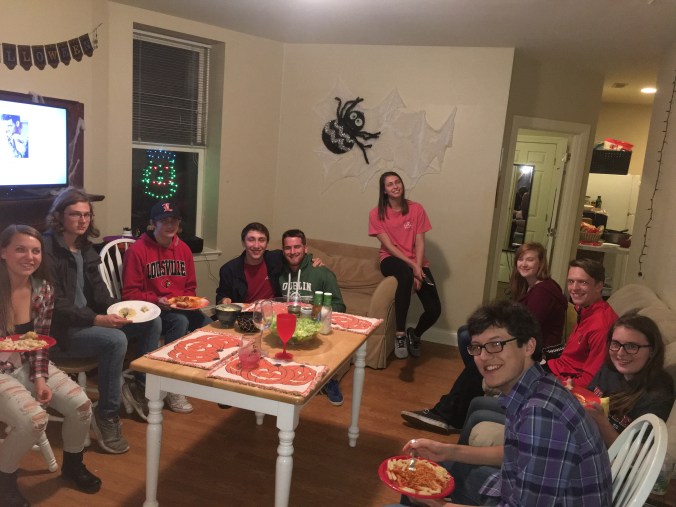
My meal took place in the city I was born and raised in: Louisville, Kentucky. I hosted my dinner at my sister’s apartment downtown, and we invited many of her friends. Everyone at the dinner attends the University of Louisville, and most of the guys were part of a fraternity. Although everyone who attended was approximately the same age, there was still an array of diversity, from sexuality to religion to upbringing.
Starting from the far left of my photo is Allison. Allison is one of my sister’s roommates and the only other person at the dinner that I knew besides my sister. Allison grew up in Bowling Green in a very conservative household with strict parents. She claims that her parents are extremely strict on some matters, such as boys and clothing, but lenient on others, such as alcohol and marijuana. Second is Joe #1. Joe #1 was extremely quiet the whole dinner, and when I asked him about himself, he said his life is “normal.” I never learned much about Joe #1 except that he is a sophomore and in the Lambda Qi fraternity at the University of Louisville. Next is Foster. Foster is a freshman, a Lambda Qi associate member. Throughout the course of the dinner, Foster was almost as quiet as Joe #1, although he did laugh a lot. I do not know much about Joe #1 or Foster, except that they smoke a lot of weed and were too high that night to give much input. Next up is Kyle, the sweetest, most respectful college-aged boy I have ever met. Kyle has very strong values and had tons of good input. After Kyle is his best friend Adam. Adam’s family grew up impoverished in downtown Louisville. He is very outgoing around people, but seemed shy when answering questions.
Next is Sophie, my older sister. Like me, Sophie grew up a preacher’s daughter, and has since, also like me, drifted away from her faith. Our parents are very conservative, but Sophie is very adventurous and independent. On the far end of the couch is Kayla. Both of Kayla’s parents came out as gay after Kayla was born. Her mother remarried a woman, and Kayla lives with them. Kayla doesn’t see or speak to her father anymore. Kayla was also very quiet the whole evening. Next to Kayla is Joe #2. Joe #2 is from Louisville; he grew up Catholic but now identifies as agnostic. Joe #2 seemed to be a very wise, in-tune person. Next is Rachel. Rachel is Allison’s cousin and is also from Bowling Green. Rachel is also a freshman, and she is openly gay. Lastly is Alex. Alex talked the most, and about a lot of things, however I never got much out of anything he said. He is from Louisville and lives at home with his parents. He grew up religious but is not so much anymore.
I started the dinner by having everyone share a little bit about themselves, and I asked follow-up questions to get to know each person better. We spent a decent amount of time doing this because I wanted everyone to get to know each other and be comfortable talking. Most everyone seemed at ease and willing to share, although some did take a slight bit of prodding. I asked the mandatory question of course, “Beyond voting, paying taxes, and following laws, what does citizenship mean to you?” I think people were a little stumped by this question and couldn’t really think of much. I got a couple answers about being there for people and supporting one another. We ended up talking about community, and being involved. The group agreed that being a part of a community is important when it comes to citizenship. I tried not to dwell on this question too much because, even though it was our one required question, it didn’t spark much conversation.
I asked a handful of the optional questions, ones that I thought would get some decent discussion. With almost every question, the conversation tended to veer back towards the idea of community. With one question, “What do you think are the best things about our world today,” Kyle said the internet. His point was how close it has made us. It has developed its own community that would otherwise not be possible. I asked if there were any downsides to the internet, and the group agreed that there is, but the benefits outweigh the negatives. They all seemed to just want to be good, loving, kind people. When I asked them if they thought they had an obligation to their community, they all immediately agreed that we all do. I found that interesting because in our class discussion on obligation, it took a while for us to decide. In class, we spent more time thinking and deliberating; we did not act upon our gut reaction.
Everyone who attended my dinner was very receptive and willing, but most of them were shy. Alex and Kyle would jump to give me a response, with the occasional initial answer from Joe #2. Once somebody answered, however, the rest of the group was more willing to give their opinion. It took a little longer to get the conversation going than I anticipated. I had to help mediate and include a few people here and there, but overall, I had a very good group.
My group was large, which I liked because it allowed for more personal side conversations. It seems strange, but I felt like everyone felt more at ease knowing they could occasionally gather in a smaller group they felt more comfortable in. It made the larger group discussions more impactful, and allowed me to listen in on the smaller discussions, getting to know everybody better. People would talk a little in a smaller group, and then come to the larger group and share their opinions. The smaller groups gave everyone a more comfortable atmosphere to come up with ideas. This reminds me of our class. We are given some time in the beginning to discuss in a pair or small group. We can gather our thoughts and then feel comfortable sharing our organized thoughts with the larger group.
If I am to be completely honest, I did not really learn much from this activity. Going into it, I had high hopes and expectations; I thought it was a cool activity and I would get a lot out of it. I know most people are the opposite, thinking this project is dumb and pointless. They then host the dinner and find that is was helpful and interesting. I, on the other hand, did not get much out of my dinner. I thought I did it correctly, and I thought we had pretty good discussion, but it just didn’t do much for me. I think I was stressing about the project too much that I didn’t allow myself to enjoy the dinner. I was worried about cooking and inviting and making sure everyone was happy when they arrived. I do, however, think the project is a good idea. Although I did not learn anything tangible, it gave me the opportunity to meet new people and hear thoughts from a diverse group.
This Kentucky Kitchen Table related to the central question of the class, “How do we live well together?” The whole discussion was geared toward the idea of community and how we can be there for those around us. A reading that closely relates is “The Empathy Exams Essays” by Leslie Jamison. This reading is about how humans want to feel cared for. We all have feelings, and we want our feelings to be validated by other people. It can be difficult to empathize with somebody, especially if you have not been through what they are going through and you do not understand their pain. We all deal with stuff, and we all expect someone to care. Caring for a struggling person can be hard when you are struggling yourself. We all must realize that we can live well together and support each other, but we cannot have unreasonable expectations of others.
The book “Citizen” by Claudia Rankine is another class reading that relates to the question “How do we live well together?” This book is all about an African American woman living in a mostly white world. She is explaining her experiences with racism and discrimination. My dinner group would say that the people in her community have an obligation to stand up to her. They should treat her equally and with respect, and should defend her in a time of need. This book is all about community and working together to improve our world.
Overall, this Kentucky Kitchen Table experience was mediocre. It was a very interesting project, and I have never done anything like it. I am grateful that I had the chance to experience something like this. It was more fun and exciting than a paper; it was a real, hands on project. It was a good thing to do and I think it benefits most people. IMG_8451

A Kentucky Kitchen Table in Sparta

By Shelby

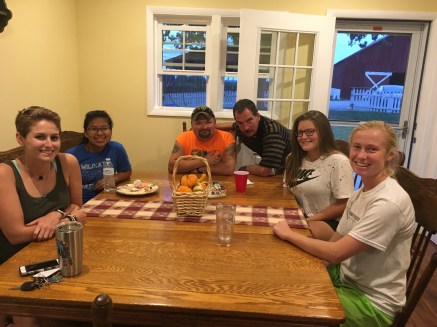
My Kentucky Kitchen Table took place on my family farm in Sparta, Kentucky. Sparta is a very small town in rural Gallatin County, the smallest county in Kentucky. To give you a feel for my county, there is one school in the entire county and the residents create a tightknit hometown community. Local businesses paint their windows in support of the high school football team every Friday night. Nearly all of Gallatin County can be found on the Ohio riverfront every Fourth of July for a celebration and fireworks. Farmland and fields stretch for miles on the outskirts of the small towns, my home being one such farm.
Over fall break, I went home and invited coaches and players from my high school’s girls soccer team to come to my dinner. My dad started the program several years ago, and continues to coach but has recently gained two assistant coaches. It was previously agreed that my mother and I would prepare a meal of baked chicken, green beans, macaroni and cheese, garden salad, and dinner rolls, and this was shared with my parents, Rick and Shelia, as well as, Nate, Kelsey, Hannah, and Angie. Rick is a dentist and a farmer, while my Shelia works at the front desk of his dental office. Both are college graduates who moved from Louisville, Kentucky to Sparta and have become active community members through church, are involved with the local school system, and have served on various community boards. They have spent many years coaching recreational sports for youth in our community, myself and my brothers included.
Nate and Hannah are the assistant soccer coaches. This previous season was their first season of coaching, so while I was somewhat familiar with Hannah who is a teacher at the local high school, I had not met Nate prior to their season. Nate works at one of the steel manufacturing plants in Gallatin County and has been a lifelong county resident who attended school in the Gallatin County School District many years ago. His daughter, Kelsey, is a freshman at Gallatin County High School and plays on the soccer team. Hannah is a special education teacher at Gallatin County High School and is originally from Norwood, Ohio. She attended Xavier University and moved to Gallatin County upon gaining a teaching position. Angie is from Mexico and moved to Kentucky with her family several years ago. She is a high school freshman, but she attends the ILEAD Academy which is an accelerated program that allows high school students to take college courses and earn a bachelors degree within two years after graduating high school.
As none of the unrelated individuals who came to my Kentucky Kitchen Table had previously been to my house, the Kentucky Speedway across the road from my house was an immediate topic of conversation. The placement of the racetrack in Gallatin County was a controversial topic when it was established and remains as such today. Many believed that such an attraction would bring economic growth to the county, and while it has been productive in many ways, it has also brought complications to the rural county. We discussed how the Kentucky Speedway hosts only two races a year and occasionally hosts charity events such cancer walks and car shows. While the Nascar races attract fans from all over the country, boosting businesses for a few days, Gallatin County does not have the facilities nor the infrastructure to host this influx of people. Traffic is atrocious on race days and intoxicated individuals flood the roads at the conclusion of races, causing headaches for locals and the police department.
The Speedway is an example of experts who lacked the knowledge and experience of life in Gallatin County making decisions for the community. The good intention of bringing economic growth and development to the rural county actually exacerbated problems, similar to the concepts discussed in Ivan Illich’s “To Hell with Good Intentions.” Initially, my guests thought it would be fascinating to live so close to a landmark like the Speedway, but upon learning of the problems that accompany the racetrack, they decided it might not be as exciting as they originally thought.
Our discussion transitioned to school and the role of technology, as well as, its affects on how students interact and complete school work. During the 2016-2017 school year, all students in the local high school were provided with Chromebook laptops in their One to One Program. Online classrooms have since been used to post assignments, provide additional resources, and reinforce concepts taught in the physical classrooms. This has given students access to classroom materials online and allowed the school to reduce paper expenditures. The computers also serve as a method for students to gain access to unlimited information and easy communication. While these seem like beneficial results of the One to One Program, Hannah discussed how she has noticed students lacking patience that might be traced to children being taught to want immediate gratification about their inquiries as a result of technology. The computers, in combination with personal cell phones, allow students to immediately find answers to questions and problems. While this is beneficial in many regards, as Hannah mentioned, it might reduce students’ capacities for patience.
This brought me to the “Power of Patience,” article by Jennifer Roberts we read and discussed in class about the teacher who gave her students the assignment of observing a painting for three hours. In this study, patience was used as a learning tool, and Hannah agreed that while technology has a very important role in classrooms, patience is also crucial to learning, as well as, developing social skills. She actually searched for an image of the Boy with a Squirrel painting, and I explained how it was created to represent the time it was meant to endure.
Following our conversation about school and the skills students gain or fail to gain in high school, I asked my guests what citizenship meant to them, beyond voting, paying taxes, and following laws. Shelia’s idea of citizenship revolved around being an active citizen in your own community by participating in community events and programs that might include volunteering at the food pantry or organizing sports for local children. She also believes that citizens should be responsible for being aware of current events and life around them. Nate used the current situation in the NFL concerning the decision of many players to kneel during the national anthem to help explain his idea of citizenship. As a member of the Freemason Society, he felt that it was disrespectful to the American flag and to the men and women who have served in the armed forces to kneel during the anthem. This topic has become very controversial across the nation as a whole. It began as a movement to raise awareness about racial tensions, but many believe it has developed into a protest to President Trump’s comments and behavior toward athletes in the NFL. Nate felt that citizenship should encompass a certain level of respect for one’s country, its values, and those who defend those values.
Rick suggested that citizenship was based on family and helping others. He believed parents should be involved in their children’s lives, teaching them to act responsibly, and individuals should help others if they are capable of doing so. He raised the topic of the Las Vegas Shooting that had recently taken place and mentioned how some people’s first reaction was to run to safety, while others immediately looked to protect people by ushering them to safety or laying over their bodies to shield them from the raining bullets. Those who put the needs and safety of others before themselves were demonstrating true citizenship in his opinion.
This led to a discussion about moral obligation, and I asked if we were morally obligated to help others and if so, to what extent were we obligated. The general consensus was that if you are capable of helping someone in need, you should help them. However, the proximity of the issue and any possible threat to one’s own safety were critical factors to be considered. I told my guests about the video of the young Chinese girl who was run over by the van and how everyone who passed her simply left her lying in the street. Kelsey found it hard to believe that no one would help the young girl, and it was suggested that the situation would be handled differently in America and likely most other countries. It is possible that children and the obligation to help others is seen differently by varying cultures. Hannah suggested that people are much more likely to help women and children than men because of a social notion relating children and innocence. People become more conscious of their own safety when grown men are involved, thus they are less likely to help an adult male.
I questioned if there was a difference in the moral obligation of helping someone you can see versus helping, for example, those forced to work in a sweat shop in another country to support themselves and their families. My guests said they would not necessarily feel obligated to help in this situation because different cultures have different issues, values, and standards of living.
After our dinner, we all went out to our barn, and Kelsey and Angie helped me feed chickens and horses. Because I graduated before they entered high school, I did not know them very well, and they had been quieter during dinner. Feeding the animals gave me an opportunity to share some of my experiences growing up on a farm with them. This interaction seemed easier for them to relate with, and Angie told us about her experiences raising chickens when her family lived in Mexico.
My Kentucky Kitchen Table allowed me to connect with people who I did not know particularly well and gain insights about topics that I had not previously considered. I learned that citizenship can embody numerous meanings, and those meanings largely depend on individual interpretations of the word. There was a general consensus in the idea that citizenship involved helping others in the community, and this concept would allow individuals to live better together, an idea central to our class. We can be better citizens by respecting the ideas and beliefs of others, helping those in need, and being active in our community. According to our Smart Communities reading by Suzanne Morse, individuals who are engaged in community affairs are more likely to take ownership of their community. This is crucial to living well with fellow citizens and might help us cross the bridge to where society should be with communities we are proud to call home.

Not pictured in the image: Shelia

Every Community Has a “Derek”…

IMG_2548

By Kaylee

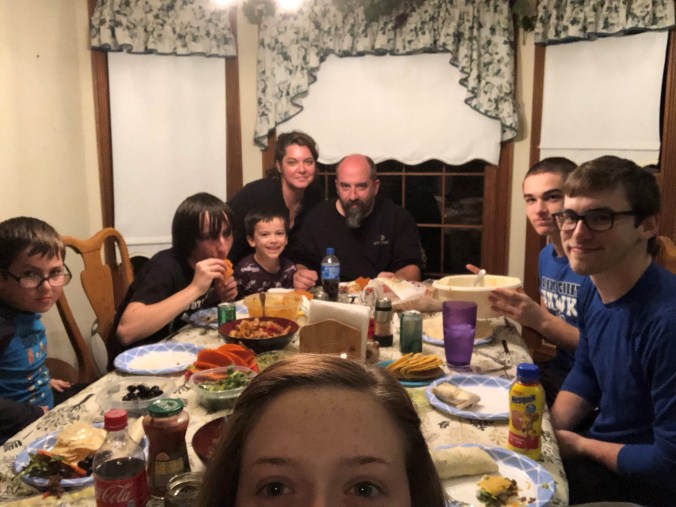
Looking back on my dinner for the Kentucky Kitchen Table, I would categorize it as a young adult view and perspective on citizenship and community. Nine people in total attended, including me, ranging from the age of 17-28. It was split pretty 50/50 on people I knew and didn’t know, which made conversation and discussion surprisingly easy.

Brayden, (17) is a student here at WKU in the Gatton Academy. He grew up in Glasgow, Kentucky and was very excited to move to Bowling Green this past August. In the discussion, he highlighted the culture difference from just 30 mins away. He was accompanied by two other Glasgow natives who got to school at WKU also. Chandlor and Jacob (18) are roommates in a freshman all boys’ dorm on campus and both work off campus.

Olivia and Hayley (18) are both seniors at Bowling Green High School, and Olivia has grown up in Bowling Green. She is involved in choral and musical activities at her school. Hayley recently moved to Bowling Green, a little less than a year ago from California. Her father was recently asked to work as the Children’s Pastor at Crossland Community Church and she has lived in different areas of California and Texas throughout her life.

Katie (21) is a senior at WKU. She is majoring in marketing and works at a local branding company in Bowling Green. She is originally from Evansville, Indiana and lives close to campus with two roommates. Cameron (21) is a local musical artist and works for Royal Music and volunteers his strengths and talents at Crossland Community Church. He did not attend college to pursue his career in music and also volunteers at one of the campus ministries, CRU, with Katie.

Melissa (28) is the volunteer director for the Center for Courageous Kids, in Scottsville, Kentucky. She grew up in Louisville and moved here to attend WKU. She is married to her husband, Nick, and they have a one-year-old child, Cullen.

This group gave a very neat perspective for me, because all were involved in a volunteer position of some sort. I invited 4 participants, who then invited the other 4 participants to join. We ate a meal together and then I started the discussion by asking the first question: “Beyond voting, paying taxes, and following the law, what does citizenship mean to you?” Answers of similar degree were spouted off such as doing more, going the extra mile, and realize the rights and responsibilities you have as a citizen locally and nationally. There seemed to be a good degree of agreement among the group so I decided to switch the conversation to what kind of community was ideal to live in. Responses were brought back to the types of citizens in the community, and Cameron mentioned a community of everyone doing their part for the community, with a sense of unity within of a common ground or goal. Melissa decided to add onto that by highlighting community involvement with a mix of individualism. And Katie thought a main value of a community should be a concern for others inside and outside the community, and others piggy backed with being accepting of everyone, while others counter placed that with making sure boundaries were made from acceptance and being aware of your morals and not letting those fall.

Other answers were similar and we concluded that in an essence we were describing a form of socialism, which is, on paper, the perfect community, but it is not an achievable goal in real life due to human error. Other qualities such as selflessness were brought up, and how the more you give the more you will receive. A concern on this topic was how in today’s society communities and neighborhoods were not as connected as they once were.

I then asked if people truly knew their neighbors. Most were sad to agree that they didn’t, even those who lived in a dorm on campus, and those with roommates said there were many times they didn’t converse regularly with their roommates. We then discussed spiritual aspects of how the two greatest commandments calls us to love The Lord your God with all your heart, mind, soul, and strength and to love your neighbor as yourself and how we must keep those in mind when interacting within our communities. Hayley made a point to also say we are called to love our neighbors and our enemies, which Chandlor piggybacked by highlighting those enemies might be your neighbors. This did lead to somewhat of a gossip conversation about neighbors (good and bad), which, at first, I was nervous about, but surprisingly led to the highlight of the conversation of the night, which surrounded this blog post.

In the gossip of neighbors, a specific Derek* a neighbor in the community was brought up, and stories were shared of how he was rude and hard to get along with. After the gossip and jokes of Derek, Chandlor brought up a good point about how communities work. He asked how many “Dereks” you would want in your community, and immediately everyone shared they wouldn’t want “a Derek,” they wouldn’t want that person of conflict. We quickly realized that everything we said about hoping for the perfect community and acceptance of all went to waste. Chandlor then shared some studies he had read of how every community “needs a Derek” and how gossip and controversy almost brings people together and builds people up. There were some agreeable statements, but Cameron was not ok with that fact being accepted. He said instead of accepting that as fact, we should strive to make it the best and “perfect” it could become, but in fact it is unavoidable. The conversation then shifted to a more grey area instead of black and white, as we concluded that there is not necessarily always the “good guy” and “bad guy” in a group of people. In movies and TV shows we see the “villain” and most all other characters’ root against them, but in real life, not one person gets ostracized as the “villain”, but in an essence, we are all “a Derek.” We all fail, we all exclude, we all fall short of sin and acceptance. At one point, whether we want to or not, the evil will come out, and we must be the ones in the community to love the “Derek” through it and accept that person’s flaws. We pointed out how we become “Dereks” or make people “Dereks” in our everyday conversations, and the only thing we can do is be better from our past “Derek” mistakes. The final question I asked was: “What kind of person do you want to be?” After some thought, characteristics were thrown out of being yourself, and making a difference, we concluded that while we might not have life figured out, we can still make an impact, which will be different for all of our lives, and we can strive towards better and away from being the “Derek”.

*Name changed

Indiana Kitchen Table: How to Live Well Together

By Gabe

My Kentucky Kitchen Table was different than most of those that were done for this project due to one simple fact: it was not done in the state of Kentucky, but rather, in my hometown of Santa Claus, Indiana. So, for the rest of this post, I will refer to the meal as the Indiana Kitchen Table. In a quick preview, the meal went very well and smoothly, and the conversations flowed well with some great content in the discussions, with credit given to the fact that while I may not have known everyone there, everyone else knew each other, which heavily contributed to the conversation not running dry. Beforehand, I was a little nervous that it wouldn’t go well at all, but in retrospect, it was a great experience to pick the brains of others when it comes to citizenship and democracy as a whole and caused me to do some reflection and deeper thinking of society.

The dinner took place at the home at the home of my girlfriend, Kate, who had family friends over who I had not gotten to meet yet. Her family insisted on making the meal rather than everyone bringing a dish (delicious Stromboli and salad), yet the family friends, who love to bake, still brought a cake for dessert. There was a total of nine people at the dinner: Kate, Ray, Denise, Spencer, Kelsey, Kylee, Ray, and Colleen. Kate is a senior at the high school I am from, and plans on attending Western next year. Ray, her father, is an eighth-grade history teacher, and Denise, Kate’s mother, works at a local hospital. Spencer is a graduate student at the University of Kentucky who is in dental school and plans on being a dentist, and his wife, Kelsey, who is one of Kate’s sisters, is also a student at the University of Kentucky and is in PA school. Both are going to graduate soon. Kylee, the other sister, graduated from WKU last year, and now is living in New York City and works at a marketing firm. There was another Ray at the dinner who works in finance, and his wife, Colleen, owns her own travel agency; Colleen and her husband have been all over the world. Ray and Colleen are close friends of Ray and Denise, and I had not gotten the pleasure of meeting them yet, nor have I had much deep conversation with her sisters and brother-in-law as they are well into their dependent lives. The dinner was a great opportunity to meet Ray and Colleen and also to get to know Kate’s family members better.

The group lacked in diversity as far as race goes, as all members are white. However, they had diversity in some other areas, such as of age, experience, field, and economic status. Ray and Denise are of middle class, while Ray and Colleen are more towards upper middle class. Kylee, Kelsey, and Spencer are all fresh into their independent lives, and Kelsey and Spencer will contract large amounts of debt due to their graduate school expenses. Ray and Denise are in their upper 40’s, along with Ray and Colleen; Spencer and Kelsey are in their upper 20’s, while Kylee is in her lower 20’s; meanwhile, Kate and I are 18 and 19, respectively.

Once dinner was served and after we all prayed as a group, we started to eat and general small talk ensued. Simple questions such as “What class is this project for? What are you going to gather from this project?” immediately were asked. After answering these, I responded with a question of my own, and decided it would be best if we addressed the main subject and effectively broke the ice before relying on some of the other questions offered on our handout packets. I delved straight into the topic at hand: beyond voting, paying taxes, and following laws, what does citizenship mean to all of you? Right away, Kate’s father, Ray, straightened up to answer. Ray strongly believes in being an active citizen, and participating in our democracy is a very important part of that belief. He spoke of several actions one is obligated to do as a citizen in his view, such as advocating for stances on issues, calling your state representative, and being educated and well read on the current state of problems and issues, among other things. Collen added on to this by mentioning that we can exercise our right to protest. These obvious suggestions did not strike me as peculiar or extensively thought provoking; while they are correct ways to be active in a democracy and a citizen, I yearned for deeper and more intricate responses. Spencer was the first person that supplied my yearning. He agreed with all of the suggestions Ray made, while also adding that one can also participate in events in their respective communities in order to make practical contributions to strengthening our society and becoming closer as a people. Once he made that comment, my brain triggered a connection already between our class and this dinner: what Spencer had said could be one of many possible answers to the central question of “how do we live well together?” I pointed this out to the group, and in reflection, this was one of my favorite points made the entire evening as it incited me to think further on this question, which I will get to further on in this writing.

After these points were made, Kelsey addressed a different side of this question: rather than ways to participate, she answered what citizenship meant to her. From her view, being a citizen is more than how one can participate in democracy. She views it as how we act in how communities, how we treat and respect one another, and what we do to be there for each other in times of struggle and prosperity. Being a good citizen is more than completing objectives as if they are on a checklist, but rather doing the intangible things, such as being kind, loving and respecting all people, regardless of views, race, sexual orientation, gender, and religion. Once again, this made me think of our central question of how do we live well together. Kylee, Kate, and Colleen agreed with this viewpoint heavily, and easily concurred with Kelsey’s opinion. The men of the group agreed, but dissented that while being kind and respectful is important, it does not practically solve the problems that our nation faces.

As I said earlier, the entire conversation provoked me to do some much deeper thought on the matter. Hearing the perspectives of other people, even those who are not familiar to me, provided insight that I had not thought of in a realistic sense. I come from a close-knit hometown where people participate and are involved, and everyone is kind and respectful of another; while I may have been living in that type of environment, I had never had the thought of what may result from applying it to communities and people all across the country cross my mind. The way that I see the current state of our nation, people get so heavily wrapped up into political parties and nationwide issues, and rather than doing practical applications to make these wicked problems better, we as a society instead get absorbed into debate. While nationwide issues are of great importance and political parties are an efficient way to channel our stances and approaches of handling issues, they are even furthermore complicated and can take extremely long amounts of time to see change and progression.

Much like Spencer pointed out, I believe that we as people rather can focus on our individual towns, counties, and cities, and involve ourselves to make more productive improvements. We can get involved in service opportunities to one another, engage in deliberative discourse, or help to organize, promote, and effectively run neighborhood events that can bind the people living in them together. Rather than waiting for a never-ending concept of “others to take action” or an overarching body to pursue these endeavors, the people who make up our individual localities can take up the mantle of progressing society in the ways such as Spencer mentioned. Once we have stronger individual communities, others can follow suit, and this could attribute to amending nationwide issues in the long run. If we can live better together through engaging in our hometowns, we can lean on one another and can collectively cooperate on the other central questions, such as how we should solve problems, and how we can have more say over ourselves.

Moreover, we can enhance our personal communities not only through how we involve ourselves in our communities, but also how we treat and respect one another in them. Much like what Kelsey said, if we give each other respect, kindness, honesty, and fairness, this can enhance how we live well together, and can make our communities closer knit and supportive, much like the one I was raised in. Through this type of relationship, solving problems, coordinating events to help solve issues, and other activities can be easier achieved, and the other two central questions can be easily addressed.

After my thoughts had been stimulated, the deep and introspective dinner conversation soon faded and formed charismatic and rich togetherness, as those who knew each other caught up and the family friends enjoyed their evening together. I felt as if we were starting the beginnings of answering that crucial central question right there through our fellowship together, and a project that initially seemed impractical and unappealing to me now was a pleasant and eye-opening experience, full of learning that I had not expected to encounter: from insight ranging on what being an active citizen looks like– according to Ray who is active in his democracy– such as writing representatives, advocating stances on issues, and being educated on the state of problems and the options to approach them; methods that may seem more time efficient and personal, much like Spencer mentioned, such as coordinating community events or serving in your respective communities and becoming involved; to what his wife, Kelsey, had to say—that being a citizen is more than performing actions or providing service, but can also include how we treat one another and truly live well together.  Life is full of learning. We must seize every opportunity we can in order to better ourselves as a society. Whether that be at formal, academic deliberations, or at simple Kentucky—or rather, Indiana—kitchen tables.