Louisville, Kentucky Kitchen Table

By Haley

At first, when hearing about the Kentucky Kitchen Table project I thought it was dumb. I didn’t understand the point of it, and just saw it as another thing to do on my to-do list. I then googled “Kentucky Kitchen Table” and started reading other people’s experiences, and my interest was piqued. I read all of these stories about people’s family and friends engaging in meaningful conversation about topics that actually matter. I was then excited to host my own Kentucky Kitchen Table.

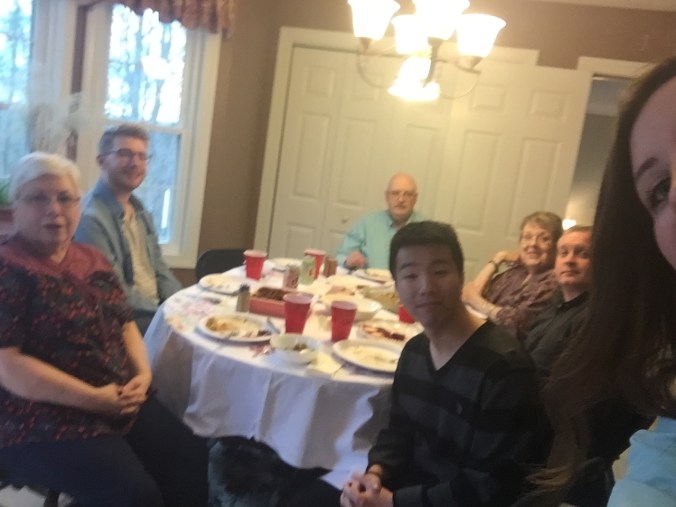
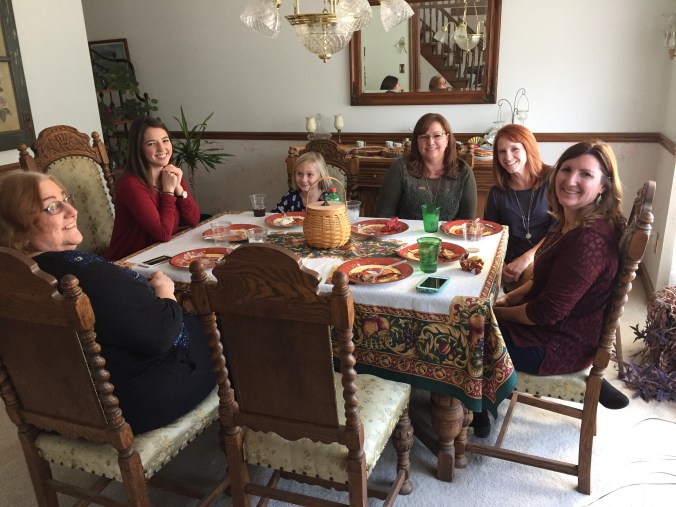
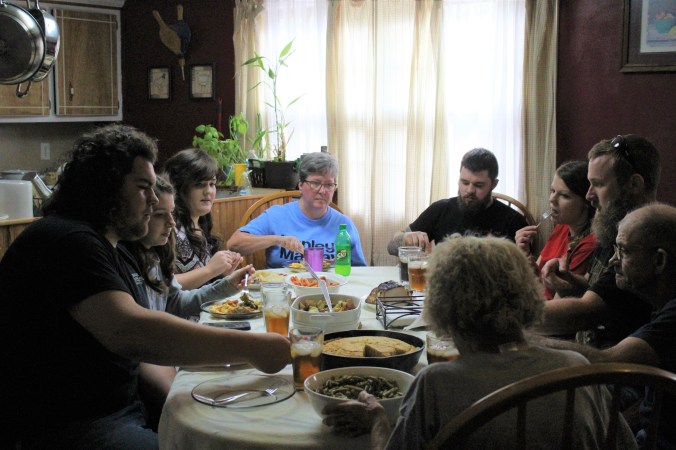
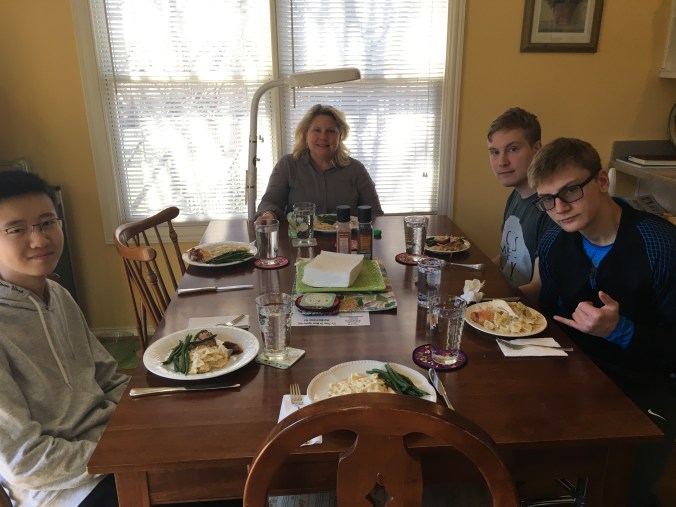
For my Kentucky Kitchen Table I decided to do it in my hometown, Louisville, Kentucky. I hosted the dinner at my house, with my parents and our neighbors whom I invited to make the table more diverse. My neighbors brought their 14-year-old daughter and 12-year-old son as well, making 7 people around the table. My mom, Jennifer, is a pharmacist who loves to read and go to yoga, and my dad Steve, is the CEO of an insurance company, who loves to go to the gym and play golf. Both of my parents are pretty strong republicans and tend to have very conservative view points. Jim and Nancy my neighbors, come to find out, have very different political views. Jim is a Physician’s Assistant who loves to play games with his kids in his free time, and Nancy is a social worker at a low-income school in Jefferson County who loves to paint. They told me that they tend to lean towards the more democratic side, but would consider themselves more of independents. Their two kids Sophie and Jack, go to Kammerer Middle School and love to play sports and hang out with their friends. Their kids quite frankly were a little young for some of the conversation, but they brought some valuable opinions nonetheless.

When I invited them over they seemed thrilled, and asked if they could bring anything. I told them that I would make the main course, chicken parmesan, if they could bring a vegetable, and they brought asparagus. We had mostly only had small talk with our neighbors at this point, so it was cool to actually sit down and talk to them. When they got there, we introduced ourselves more formally, and actually started to get to know one another. Jim and Nancy were both very sweet people, with very interesting life stories. They are both from Kentucky, born and raised, but other than that common denominator they were as different as they come. This became very interesting as we sat down at the dinner table and began discussing the more pressing topics.

I started the conversation by telling them about our class and the topics of how can we live better together, how can we solve problems, and how can we have more of a say over our lives. I described to them the process of deliberation and how this conversation should stay respectful, and how listening to other opinions could perhaps give each-other a new point of view.

When asked the question, “what does citizenship mean to you”, there was kind of a dead silence and then once everyone got to talking the phrase “being a productive member of society” kept being repeated. When I started to think about that, I thought what does that mean? Sophie surprisingly chimed in on this question and said that citizenship to her meant being kind to everyone and helping people, whereas Steve said that being a citizen means that you do your fair share in the economy, and community. I think that it was interesting especially on this question, how age really affected the answer. Sophie, Jack, and I seemed to think that citizenship is something that is so simple, and that we as citizens, overcomplicate it. Whereas the older people at the table, Steve, Jennifer, Jim, and Nancy thought that citizenship was more of a job that included more dutiful tasks and work. This question got the ball rolling but there was not much disagreement, or diversity in the conversation. One question that I thought was very interesting was, “do you see your job as serving a greater purpose?” When asked this question Nancy started telling stories of her children that she works with in the schools. She feels like sometimes she is the only one who can make an impact on these children in low-income schools. She believes that her greater purpose is to be a light in these schools, and uses her faith to drive her in that. We then began talking about how it is so important to have mentors as a child, who push you to be a better person. The question then arose, is it these kid’s faults that they end up in drug circles, and gangs, when the only thing that they have ever grown up around is drug circles and gangs. It was interesting when Sophie and Jack began to talk about how they feel like they can make an impact on kids in their schools from what their parents are teaching them at home. How can we as citizens make sure that we are doing all we can to lessen the amount of poverty and crime in these low-income communities? This made me realize you don’t have to be in a position of power, status, or wealth to be able to positively impact someone. My mom, Jennifer then brought to the table how she didn’t think that you had to have a direct role, to make an impact. This brought some controversy, as myself and Nancy disagreed pretty heavily with her. We had the mindset that in order to do something, about anything, not just with at-risk children, you have to take initiative and play a direct role, which is something that as citizens who have the means to do so, should do.

When talking about what our responsibilities are, and who we want to be I think it was a general consensus that we all want to be “good people”. The disagreement came when discussing how we could achieve that. I think for different people being a good person, means different things. For Sophie and Jack, that could mean sitting with someone who is sitting alone in the cafeteria, but for Jennifer or Jim that could mean, helping a co-worker who is struggling, or donating to a charity. At the end of this discussion, I thought to myself maybe this is why it is so hard as a collective group of citizens, to decide on how to fix a problem, or even live well together, because we all have different ways of contributing to society. Maybe, instead of scrutinizing people because they don’t bring what we do to the table, or they bring something different to the table, if we commended them and opened our minds to what they have to bring we would live more harmoniously.

The last thing we talked about is how we had lived next to each other for almost 3 years and haven’t done this sort of thing sooner. This was really interesting to me because it really shows how selfish we are as human beings. We are “too busy” to really invest in our surroundings, which is a huge pitfall of our generation and current time. I think this is a huge reason of why we find it so difficult to live better together, and to solve problems collectively, is that we simply don’t make it a priority. This dinner gave my parents especially, who live there, a great opportunity to get to know the people who they live right next to. I think also it gave them a good opportunity to discuss how neighbors can be better neighbors. One definition of neighbor is a person who shows kindliness or helpfulness toward fellow humans, and I think that this dinner allowed Jim and Nancy and Steve and Jennifer to be able to assess how they can be better neighbors to each other. My parents have since then had dinner with Nancy and Jim several times, and they even all played a round of golf together.

To me this dinner really encompassed the main purpose of this class, I found myself throughout the dinner referring to some of the readings that we did in class, and drawing from that knowledge to form how I thought about the issue. “To Hell With Good Intentions” and “How We Talk Matters” encompass themes that were so prevalent in our conversation, such as how should we help, should we even help at all, and how can we best cater to others. It was through this night that I realized that we have a long way to go in society to become a well-oiled machine, and talking about controversial topics, and having open conversations about them is the first step. I also learned that branching out and learning more about the people that live in your community is so important. Jim and Nancy challenged me to think about things differently, and consider those who had a different childhood than I did, and who have different circumstances than me. Overall, this was a very rewarding experience, and one that I would do again given the chance.
Brenna’s KKT: Kitchen Table in The Capital

kkt

By Brenna

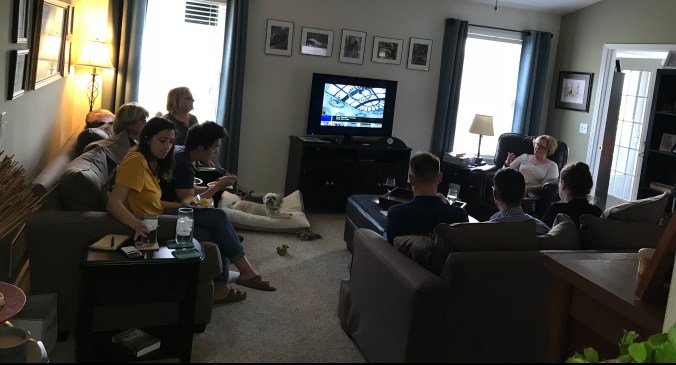
On Friday, April 13th, I traveled to my hometown Frankfort for my Kentucky Kitchen Table assignment. I had invited my mother’s group of close-knit work friends that I had only met a few times before. I brought my close friend Nathaniel with me so I did not have to make the drive alone. All together my house held nine people and two dogs. My mother insisted on cooking a southern comfort meal for all of us. She is experiencing empty nest syndrome and has missed cooking throughout the week. She fried chicken, cooked green beans, made cornbread, and baked macaroni and cheese. It was five-star meal compared to what I usually get at Fresh. Despite the bad juju surrounding the day, being Friday the 13th and all, the meal was a success.

My mother’s friends all work in some department of Kentucky’s state government. Therefore, our choice of background noise was the KET live-stream of the Kentucky Chambers during this crazy legislative session. Growing up in the state’s capital, this was a familiar scene in my household. My mother has worked for the state in various capacities. She is currently serving as one of three, also the only female, Public Service Commissioner. She is fiscally conservative, but she thinks “everyone should mind their own business about everyone else’s bedrooms and bodies.” I could not have said it better myself.

Eileen is an opinionated woman who has learned to love life. She works an office job but finds herself traveling across the country on a Harley during the summers with her husband. Karen is an eccentric friend that my mother has known for many years; they worked together under Fletcher. An avid UK fan and fellow political science student.  Aron is one of the only males accepted into this gang of women. Aron is a tremendously intelligent young man with an extremely analytical mind. He was able to work abroad for the government because he is fluent in Chinese. Kenya is actually a WKU Alum, and a very proud one at that. She is enthusiastic and lots of fun to be around. She has an adorable daughter that I’ll be babysitting this summer. Shiela was the only friend I had not met before. She is quieter than the others but just as opinionated and wise. Scott was Aron’s friend that tagged along. He was very timid, but this group of brash women can be intimidating. My friend Nathaniel is a fellow Hilltopper and took Honors 251 in the Fall 17 semester but his professor did not require a Kentucky Kitchen Table project. My dogs, Misty and Buttercup, were the life of the party and expressed their moderate political views by barking at certain legislators on the television.

Overall, the group was fiscally conservative. However, they have many different views on things such as environmental issues, social issues, and Kentucky issues. We spoke on the pension bill and budget that was making its way through the House that day. It was evident that these women realized the consequences of these bills – almost more so than the legislators themselves. Their jobs are directly affected by these bills which then affect how they can serve the Commonwealth. The group cared about their jobs and had a passion for serving the people of the Commonwealth in whatever capacity they held.

The only question I was able to ask before the work gossip started was the required question: Beyond voting, paying taxes, and following laws, what does citizenship mean to you?

Eileen grew up in a military family so she believed that service was important to citizenship. Not necessarily military service, but public service or even just community service. She believed that this was an important aspect to improve one’s community as well. This received a few nods of agreement from the group. Shiela chimed in that simply participating was important. Voting, for example, is not just picking a name on a ballot. Actively participating in an election is following the cycle and learning of the candidates to choose the one that most aligns with your views. As a group, we decided this was an extremely plausible aspect of citizenship that everyone can do. Social media has made news easily accessible for all. While this may spread “fake news” it keeps people aware of the current political climate. Karen wanted to add that one does not need to be extremely passionate about politics to be an active participant. Emphasizing that although we as a group enjoy watching the KET live stream and C-SPAN, being a good citizen does not require you to carry a pocket constitution and dream of internships in DC. We are passionate about these things, but that does not make us better citizens than those who do not. My mother then chimes in from the kitchen “Also, don’t be stupid!” She uses that as a basic rule of thumb for most aspects of life. From here the conversation steered towards anecdotes about kids and work gossip. Another piece advice I learned, from daredevil Eileen of course, was “If you’re gonna sin, sin hard.”

Overall, the dinner was extremely enjoyable. These women and Aron have a dynamic extremely similar to that of my college friends. They truly enjoy each other’s company and it was great to learn faces and personalities of the people my mom spends the most time with.  They were also knowledgeable and wise. Through their years they have learned many aspects of citizenship that I, at just 19, am ignorant of. Citizenship can be stripped to simply doing your responsibilities: follow laws, pay taxes, vote a few times a year. However, citizenship requires participation. Active participation. This does not mean everyone must hold public office, but everyone should know who serves in a public office. Simply being aware of your legislators is a great start to becoming a good citizen.

One of the central questions of this course is: How can we have more of a say over our lives – and contribute to others having more of a say over their lives? I believe this starts with actively participating in elections. Being knowledgeable of the candidates and throwing your support behind one can make the difference. If you support a candidate it is possible that your friends will as well and this can ignite change into today’s government by placing new faces in old seats. The group agreed that having a voice starts with a whisper but can soon become a yell. At first, it may seem like the effort is making no difference but soon, one can impact many lives. My Kentucky Kitchen Table was full of great people, great food, and even better advice.

Kentucky’s Kitchen Table: From a Smalltalk Conversation to a Deliberative Engagement:

By Alex

The Kentucky Kitchen Table I hosted took place in Liberty (the seat of Casey County), Kentucky. Liberty is a very small town located 30 miles south of Danville, Kentucky, a town most people have heard of unlike my actual hometown. The diner consisted of 7 people all from my hometown, who had differing opinions on several of the topics discussed.

Scott and Jamie, my parents, have lived in Liberty their entire lives and both attended Western Kentucky University for their college educations, but have differing opinions on several issues and topics, that will be discussed further along in this paper. Scott works for the Kentucky Transportation Department, and though I may be biased, is one of the hardest working people I have ever met, shaping some of his beliefs. Jamie is a teacher, who loves her job and the students she works with.

Adam and Andrew, my brothers, are currently enrolled in the Casey County School System, and are both athletes, which takes up a large amount of their time. Andrew is in 6th grade currently, and knows little about politics, freedoms, and other aspects of the United States, but was eager to learn during the conversation. Adam is a Sophomore in high school who recently tuned 16 years old, but has little interest in politics and similar topics, and focuses mostly on athletics, so his contribution to the conversation was interesting.

Lauren is currently enrolled at Western Kentucky University, and is one year away from a bachelor’s degree in Communication Disorders and plans to become a Speech Language Pathologist. She is also from my hometown, so I thought it would be interesting to include her into our conversation. And Lastly, Lexi is a junior at Casey County high school, and a friend of my brother. I had never really talked to her outside of the Kentucky’s Kitchen Table discussion we had, and her various opinions were interesting and helped maintain conversation.

Our conversation started simply, with the following question; other than voting, paying taxes, and following laws, what does citizenship mean to you? Responses weren’t immediate, and everyone at the table took some time to think before responding. Finally, Lauren sparked conversation by mentioning that it citizenship includes all the rights and responsibilities that come with living in the United States of America. This answer sparked the conversation, as I simply asked everyone around the table what some of those rights and responsibilities could possibly include, looking for a particular answer. Everyone listed off certain things they thought were rights, such as having a job and paying income taxes, along with earning an income and being able to make a living, but no one seemed to reach the answer I was hoping for. Finally, I chipped in to help everyone see the point I was attempting to make; As an American Citizen, we can all attempt to engage with one another on certain issues to solve different types of problems.

Before moving on to other questions, I thought it was important to explain the main points of our Honors 251 class at WKU. I explained to my guests that wicked problems surrounded the world today, giving the technical definition along with several examples I will mention later on. After this, I mentioned that the technique of deliberative engagement was very important to help solve wicked problems and help come up with practical solutions that had more benefits than disadvantages.

After mentioning wicked problems, I decided to ask the question, “What social issues are closest to your heart and why,” hoping to reach a wicked problem and discuss how deliberation can help in maintaining a neutral and helpful attitude when solving them. Jamie quickly answered, with the support of Lexi, Adam, and Andrew. Since they are all in the school environment, the several issues in the United States surrounding gun control and how to stop school shootings. I asked Jamie what she thought of the situation, along with how to help reduce the amount of school shootings, and her response was very set in stone. She believed that the number of guns in the United States was way too high, and that gun control should be enacted to help reduce shootings. Scott quickly responded with the opposite answer of hers, making several points that taking guns only works if you can remove all weapons from United States citizens, but the number of illegal weapons not in circulations makes that impossible, putting responsible American’s who would potentially turn in their weapons at harm.

The gun control debate went on, until I mentioned that my Honors 251 class had a very similar discussion. Going off of the Honors Discussion, I asked my family to think of different options, with pros and cons, that could help the gun control situation. After holding my own mock deliberation around the dinner table, my family quickly realized something that I learned early from practicing deliberative engagement. They learned that though people have severely differing opinions on the same issue, they are not necessarily wrong.

To ease the tension of discussion the touchy subject of gun control, I asked more questions with hope to get a better sense of everyone’s opinion at the table. Taking another page from the class in order to get everyone to have an input of the conversation, I asked everyone around the table to give an answer to the following question: What is the thing you love most about where you live? Adam answered first, saying he really liked where he lived because of his friends and how often they got together. Lexi responded similarly, that she enjoyed how close everyone was in Casey County. Scott and Jamie both responded that they loved being able to live very close to their families and friends. Andrew mentioned that it was simply home for him, and Lauren joked (though it is true) that it was the only place in the world that she did not need a GPS to travel. Each answer had the same underlying theme, it was familiar, more familiar than anywhere else.

One of the last questions I asked everyone around the table was if they thought this conversation was important, and if they felt we had accomplished something from our Kentucky Kitchen table. Andrew and Adam both said no jokingly, and admitted it was more interesting than expected. Lexi and Lauren both were happy to have been included, and mentioned that the discussion was intriguing and interesting, and said that they would work to realize others opinions were not wrong but just different than their own. Scott and Jamie both admitted that the conversation was much different than they were expecting, being it was mandatory from a college class I was taking and were very happy to have been able to participate and communicate on issues, while also agreeing to look at some future discussions differently than past ones.

During this Kentucky Kitchen table, I learned several things. One of the first things I learned is that even though Scott and Jamie are the same age and have lived relatively similar lives, they each had differing opinions on certain topics. These opinions weren’t massively different for every question I asked, but overall their answers differed from one another. Another important thing I learned was that talking to people from your hometown doesn’t have the same effect as talking to people from different areas. For example, the people at my Kentucky Kitchen table are lacking what I have gained from Honors 251. Where my Kentucky Kitchen table consisted of people all from my hometown, Honors 251 is full of people from all over Kentucky and other areas and has allowed me to talk with those who have very different opinions from my own. As highlighted briefly above, I learned quickly that having differing opinions doesn’t mean that someone is wrong, and that talking to those you disagree with is an effective way to solve problems.

Throughout Honors 251, I have learned several new key principles that have already began to help me in real world conversations and in disagreements with others. The class has highlighted how important communication with others is to solving real-world problems, and has allowed me to realize that conversation is key to bettering the world we live in. My Kentucky Kitchen table kept reminding me of the reading we did early in this semester by Keith Melville, “How We Talk Matters.” I’m sure my family did not initially want to spend their dinner while I was home from college talking about what they thought was going to be a forced discussion brought on by a college course they did not know much about, but as the conversation trekked on everyone at the table became more interested and alert to the topics at hand and became more and more talkative. This helped me realize that a lot of the problem in the world today aren’t because the world today is in a worse shape than it has been in the past, but because the people of the world refuse to communicate on the issues at hand. People now would rather their opinions be considered right than to solve the topic at hand, and the beginning of my Kentucky Kitchen table embodied just that, but as the conversation went on, more open-mindedness began to occur, and our dinner better represented what the world so eagerly needs; common ground and respectful conversation.

IMG_0894


Happy Kentucky Kitchen Table In Alvaton

By Reuben

KKT PictureMy name is Reuben and I had my Kentucky Kitchen Table in Alvaton, Kentucky. I am grateful for Emma, my wonderful classmate that invited me to be apart of her family’s Easter gathering. I am also grateful for her kind and welcoming family, without them, this script would have never came to be. It was a extraordinary day that gave birth to new mindsets within my brain, new relationships that I dearly treasure, and a chance to befriend a wondrous family whom were so kind, and very much so inspiring.
I have never been to Alvaton before, but the people whom I met during that eventful day has made the name more than memorable. When I first step foot into their humble abode, I noticed their walls comprised of colorful quilts with different patterns and a masterfully made wooden coffee table in the middle of the living room. I had the honor of touring a room filled with relics from both Native American and Egyptian cultures. A room filled with sentimental memories of the past and numerous ornaments on the walls instilled with a sense of treasure less value which only Larry and Norma can grasp.

Being the only stranger at the dinner table, I had trouble memorizing people’s names; however, thanks to Emma, I learned that the people in attendance were Steve, Larry, Norma, Carol, Baker, and Jack. Everyone around the table brought a unique set of experiences and came from different backgrounds. Steve, Emma’s father who shares his daughter’s love of song and theater, a good father as well as an excellent man of character. Larry, Emma’s grandfather who is a retired mechanical engineer who has a hobby for woodworking, his wood shop displaying many of his fine crafts. Larry’s wife Norma, has her own hobby of quilt-making and cooking, she was excellent in both regards, and in my memory I haven’t met anyone who’s made prettier quilts. Auntie Carol – is not Emma’s real aunt – but nevertheless a valuable family friend, she moved here from Hawaii. I listened to her interesting stories about the fishes of Hawaii that tasted far greater than any fish that she has ever found in Kentucky. Along with her adorable dog called Jack, and I’ll genuinely admit, meeting this adorable dog has been the greatest happenstance of my life. Last, but not least, there was Emma and Baker, the kind couple who gave me the opportunity to attend this lunch. Emma, my wonderful classmate who’s studying elementary education and history at Western Kentucky University. Baker, her dear boyfriend who’s studying advertising and graphic design at WKU, whom also has a great sense of humor. Last, but the best, the precious soul that is Jack, a adorable dog that took a instant liking to me, and I to him. The food was superb, a lot of traditional comfort food, and most of all, the conversations were enlightening, impactful, and overall an enjoyable time. I am very grateful for Emma.

We began the discussion with the fundamental required question: “Beyond voting, paying taxes, and following laws, what does citizenship mean to you”? The immediate response around the table were puzzled pauses and curious glances. Auntie Carol broke the silence by talking about her Canadian-born friend whom has lived in America for a long time, but she obtained her American citizenship later on. She described that our American citizenship is a privilege that many Americans take for granted by those people who obtained it by being born on U.S. soil. She said “I have always thought of this place as my country, my identity isn’t something I would give up easily.” I think that Auntie Carol has brought up an topic of identity. That our identity is not always defined through our roles, professions, or conflicts. Our identity is who we ARE not we do. Auntie Carol stated that there was something right about being an American, that we should be proud of our history, our ancestors that fought for it, and that we have our freedoms.

Afterwards, we dove into the issue of DACA, the Deferred Action for Childhood Arrivals, the program created in 2012 by the Obama administration allowing young people brought to this country illegally by their parents to receive permission to work, study and obtain driver’s licenses. While I am not affected by DACA, I feel bitter for the people who are affected by Trump’s decision to reverse President Obama’s executive action of creating DACA. Baker mentioned his that friend, Husway, was brought illegally into American by his parents when he was young; therefore, he was affected by DACA. He stated that Husway is going to get married soon, and he fears that the situation with DACA will bring worth unwanted complications. I told the family my experiences with international students. I knew that whilst WKU’s student population was over 20,000, the international student population was below 1000, and the numbers have been dwindling as time moves forward. I strived to make the connection between the DACA affectees and the international students, because our country is constantly changing, shifting our many viewpoints and with the new president in the White House, I noticed that less and less international students were coming to WKU for schooling, whereas before he took office the numbers were raising every year. I share my experiences because I have worked with ISO before, International Student Office at WKU, and they tell me that over time that less and less students are coming to WKU, and visas are becoming more difficult to obtain. I shared with the family that international students have an F1 International Student Visa, and they are greatly limited in regards to finding work, applying for scholarships, and many other resources. International students can’t complete the FAFSA form, because they are not citizens, so for many international students, funding their education is one of their greatest challenges in the U.S. As I speaking, Auntie Carol mentioned that Saudi Arabia is undergoing new changes with the new Prince. She also mentioned that Japan is under new educational changes, so that could also affect the population of Japanese students studying abroad. Steve talked about his friend Katar who got into real estate and the Sulocks who are in west Texas. After much sidetracking about education, visas, and internationals, Steve brought us back into the main conversation and asserted that some people think “Citizenry” is just working. He said whether if it’s in retail, restaurant, or factory work, to some Americans, being a working citizen and contributing back to society is their idea of being a citizen. Larry reasserted Auntie Carol’s statement that some people take their citizenship for granted, because even though people are citizens, he worries about the fact that many Americans know so little about their own country. In my humble opinion, I agree with Grandpa Larry, because I realize that there are many people in the U.S. that are not working, but still expect the government to give them money. Programs like medicaid, or other assistance programs are providing for people who refuse to work, and I believe that those people are not good examples of good citizenry.

Later on, I posed the question about whether or not the group trusted the government. I was met with laughter and chuckles around the table. Grandma Norma stated “sometimes”. I asserted to the group that while I do not trust our government, I certainly believe in our country. Steve recalled his story of discussing the idea of “pensions” and how the state legislators in Kentucky has voted to alleviate their budget with teacher pensions. He stated that people are inherently selfish, and that comment resonated with everyone at the table. He described that these “pension” ideas, for example, social security, was created during a time when there was a “need”, that the legislature created a great idea, but it was for them and the people during that time period. However, the younger generation with their respective visions, is far different from the older generation. I remember Auntie Carol stating that while she does not trust the government as a whole entity, you have to look at the individual situation and what’s occurring in the moment. That you can’t listen to “fake” news, and that people have to do some research or investigation of their own, because you can’t completely trust the government.

The theme that I learned was that our government is not always on the same page of the people it serves. For example, Larry said that our social security would be just fine if the government didn’t take money out of the fundings, but the younger generation came in and relocated some of the money for other fundings. I remember Auntie Carol summed it well when she asserted that the government aren’t aware of what small groups or individuals want because they’re far removed from the people that they’re meant to help. Overall, I was ecstatic at our conversation around the table, that everyone had a different opinion and story in regards to citizenship, American values, and our government. I looked around the table, people who felt like strangers, now feel more familiar. I was overjoyed by what conversation and deliberation could bring, I was happy that each person brought their thoughtful opinions, values, and opinions to our conversation, and I learned so much just from listening. I learned so much from the family, and I am sincerely grateful that Emma has brought me to her family’s lunch.

Before the dinner was over, I asked the people around the table if they had faith in humanity. Again, I was met with laughter and chuckles from the group. It was a dramatic question, but I knew it would elicit interesting opinions. I asserted that it’s wrong to live with no faith, because if you have no faith, you don’t believe in others, and my logic is that happiness comes from the people around us, Auntie Carol said that there was faith in everyone, it just depends on how that faith is developed and nurtured. Baker said that everyone is inherently evil, but as people grow up, they change their ways for good, because society influences change in the individual. At the end, unexpectedly, Steve responded with razor wit and said:


“Do you drive?”

“I do drive.”

“I think everyone in here has faith in humanity then.”


I was awed by his undoubtedly high IQ logic. I had learned a great many lessons with this family, and I am indebted to them for giving me their knowledge. I think this can relate to Keith Melville’s “How We Talk Matters”, that deliberation is very different from conventional conversations, and that they require the skills of patience and tolerance. In hindsight, I realized that conversing in my Kentucky Kitchen Table, a successful deliberation requires everyone to be open-minded, be willing to share their opinions, and talking about difference. I learned that disagreement is certainly a positive force, it opens mindsets to different perspectives, and I always believed that the word “different” is not necessary good or bad, it’s just different. In relating my Kentucky Kitchen Table to our central ideas of the class, I would relate it most to “How can we solve problems?” I learned that there isn’t one process to solving a problem, it’s a number of steps, and deliberating and sharing different opinions is one of the fundamental steps to solving problems. We can begin to solve problems by striving understand one another, by reducing the boundaries of our differences to nothingness. The reason to care for another, the amounts of efforts that we put to bridging our gaps, that thought along can make a difference, and I realize that that deliberations may not save the world, but it can make a difference to someone, and by slowing understand that change comes with time and patience, I know then, we can start to solve problems and make the world better.


Kentucky Kitchen Table

IMG_5597.JPG

My kitchen table project was set in Louisville, Kentucky. Michael, Kristin, Peter, Charlie, and Josh ate dinner with me (Sarah) at my family’s home. Michael is my father who used to work for General Electric, and now works for First Build. Kristin is my mother who works as a stay at home mom and substitute teacher. Peter is an exchange student from China who goes to Josh’s school. Josh is my younger brother, a sophomore in high school. Last, but not least, Charlie is my older brother. He also attends Western Kentucky University and is a junior. Mike did not want to be included in the photograph.

We all helped participate in making the dinner, splitting the jobs of shredding the cheese to help make the pasta, baking the chicken, and boiling the green beans.

“Citizenship means being able to govern ourselves,” Mike said as he answered the question “what does citizenship mean to you?” He went on to explain how citizenship in the United States gave people freedom that some countries do not have.

We went on to discuss what each person believed what the best thing about our world today is. In Peter’s opinion, the best thing is the temporary peace. However, Josh stated that technology is the best thing about the world. This single question began to show how different viewpoints can shape opinions and have a result that is completely different than the person next to them.

Peter’s answer of peace made sense, as he came from China. Many people are still in danger in China, whereas the United States is a free country. In Peter’s eyes, that is peace.

Josh, on the other hand, has been raised with the privilege of freedom. Technology has been centered in his life through school work and communication as well as appliances and other things. Technology is the world to him, so that is why he answered with that.

Mike stated that his favorite thing about the world today is life. He is content with just living and breathing.

“I love breathing, man,” he said. “Let me tell you something, we are blessed.”

He also loves the diversity of nature and the beauty of the world itself.

When asked what he wanted to live in, Josh once again responded with a twenty-first-century answer. He mentioned wanting to live in Silicon Valley. Silicon Valley is an area in southern San Francisco, where there is a lot of technology and businesses.

When Peter answered what he liked most about living in China, his answer was simple: food. He loves the traditional Chinese food. During the dinner, Peter mentioned how much he missed it, but he also enjoyed the food we ate in the United States.

Mike and Josh agreed that the one thing they love most about living in the United States is the freedom we are given. They are able to do what they want to do (legally, of course), and go where they want to go, when they want to. Religion is not persecuted in the United States, so they are also free to believe what they want to.

Mike and Kirstin both agreed that it is important as a society to get to know your neighbors. That way, a community can be built within the neighborhood. Within a strong community, people can communicate and help each other out. However, Josh’s point of view was quite different.

Josh believed that there was not a point to knowing his neighbors, as he wasn’t doing anything with them like talking to or working with them. In his words, “there’s no need for me to interact with them.”

Peter knew his neighbors from China because his father worked with them.

When we discussed how our jobs influence others, everyone agreed. No matter whether someone’s job is in a business or a teaching job, the way people interact with others matters. First impressions especially stand out. Many jobs require connections. Connections are made by creating a relationship between people, and most people would like that relationship to be a positive one.

Those in the dinner did not have much advice to give to the people running or office. This is because none of us are smart enough, have the experience, nor are planning to run for office in the future. Charlie, however, eventually gave a firm, well thought out advice that everyone could take into thought. Charlie did not participate in the discussion too much, but he finally had something to say. “Do what is meaningful, not what is expedient,” Charlie advised.

Religion can make an impact on how people treat other people, but it does not have to. Christianity, for example, tells believers to treat everyone with love and kindness, but someone does not have to be a Christian to have those traits. Religion may have certain guidelines for morals, but even those who are not religious do, too.

This conversation helped me learn more about how age can shape views. For example, the younger participants cared more about technology and money, whereas the older participants cared about the community and helping others. This may be caused by the increase of social media and technology, which the younger participants had grown up with. The older participants, however, were used to getting to know people in person and building relationships.

This connects to the class because we are learning about how we can work together as a community. Without community, problems cannot be solved very well. In order to solve issues together, the community needs to get along and understand where each other is coming from so that they can work together in a peaceful environment and avoid conflict as best as they can.

Growing up in different countries also changes perspectives. Peter, for example, comes from a persecuted family in China, whereas Josh comes from a privileged family in the United States. Peter focused on what he believes to be the temporary peace that is seemingly spread around the world, whereas Josh focused his part of the conversation in angling back to the advancement in technology.

Easter in Alvaton


IMG_3918

By Emma

On Easter Sunday, seven people, ranging from my close family to a considerably recent acquaintance, gathered at my grandparents’ house for a time of food and fellowship in Alvaton, Kentucky, a community outside of Bowling Green. For me, traditional family dinners on holidays are a well-worn tradition that has formed my childhood and shapes my adult life. This dinner allowed me to catch up with my family while also adding a new guest and the opportunity to discuss and deliberate on a variety of social issues and our interests regarding citizenship.

Around the table sat a variety of interesting personalities that brought an array of experiences and opinions to the conversation. My name is Emma, and I am a nineteen-year-old studying elementary education and history at Western Kentucky University. While I have lived in Bowling Green for the past ten years, much of my childhood was spent in Indiana. My dad, Steve, is forty-eight years old, holds degrees in political science and student affairs and a doctorate degree in educational leadership, and works as an administrator at the University of Kentucky College of Medicine. While Steve is a registered Republican, he is often relatively moderate in his political opinions. Also at the table were my maternal grandparents, Larry and Norma, who are in their late sixties. They are high school sweethearts who have lived all over the country from Indiana, Texas, California, Nebraska, and now, Kentucky. They have two children, a son, who lives in Colorado, and a daughter, my mom Laura. Larry is a retired engineer who now fills most of his free time with woodworking, photography, and watching football. Norma is also retired and enjoys quilting and cooking. She insisted on cooking the entire meal on Easter Sunday, which was full of traditional comfort food. Both Larry and Norma are considerably conservative in their political opinions. Auntie Carol, despite her affectionate title, is not actually related to anyone at the table. She was born and raised in Iowa but spent much of her adult life in Hawaii as a massage therapist where she raised her two children. She lost her husband many years ago to cancer, and after meeting my grandparents, she befriended my family, moved to the mainland in Nebraska, and has become like another grandparent. She, too, is largely conservative politically and a devout Catholic. Next to me sat my boyfriend Baker, a twenty-year-old advertising and graphic design student at Western Kentucky University. Baker was born and raised in Kentucky, works as an intern at a local church, and considers himself to be politically moderate. Finally, my friend and classmate, Reuben was our new and very welcomed guest at the table. Reuben was born in New York and is very involved with learning and growing in his Chinese heritage. He is an architecture student at WKU. Primarily in age, levels of experience, and interests, our diversity was evident as we sat around the table. After catching up on school and hobbies and discussing my mom and sister, who were out of town on vacation, we began our deliberation on citizenship and other topics that were important to us.

“What does citizenship mean to you?” opened the conversation and provided the opportunity for many people to discuss their perspectives. Carol discussed that it was a privilege that is often taken for granted by those who obtain it by birth. She said it was more than just living somewhere and that it should be appreciated for all the rights and responsibilities it brings. She discussed her appreciation for those who work to obtain citizenship honorably but also recognized her lack of appreciation for those who may try to immigrate illegally. Larry and Norma both remarked that they were extraordinarily proud to be American and that people often forget how special it is. Baker noted that a close friend of his, an illegal immigrant, had recently become engaged to an American citizen, an occurrence that some people had speculated was just an attempt for him to gain citizenship. Baker’s comment sparked conversation regarding the DACA, or Deferred Action for Childhood Arrivals, controversy. Steve adamantly opposed the deportation of illegal immigrants who arrived in the United States as children. It seemed that Steve felt that a person who feels a connection to the place they live and is willing to contribute to the productivity of the society deserves the opportunity to stay in the country. Norma added to this point, saying that many natural citizens of the country lack the willingness to contribute to society and rely on government assistance. The overall theme of the answers to the citizenship question seemed to be that American citizenship was a privilege that should be held in the highest regard. Too often, we take the rights we have for granted.

Then, Reuben posed the next question about whether the group trusted the government. Carol answered quickly that she did not but began to reason through her adamant opposition to the current government. She stated that the government is currently far removed from the people it serves, particularly at the national level. This was a resounding comment at the table. I mentioned my thoughts that perhaps the democracy envisioned at the country’s inception was not the democracy that frames the nation today. I mentioned that I firmly believe in the country’s ideals, but I think too often, the ideals that shaped early American values remain absent from the America we know today. Steve, Larry, and Baker discussed the concept of term limits for legislators who may maintain a level of comfort that prohibits them from executing their duties effectively. Norma mentioned that it is up to the citizens to ensure that unofficial term limits are enforced. Overall, this topic yielded an agreement that the government’s failures, especially on the national level, are currently more evident than its successes. Additionally, I found it interesting that the entire table agreed that citizenship is a distinct privilege, yet we all found issues within the government that seeks to serve its citizens. Reuben also asked the table if we held a hope for humanity. Each person giggled slightly at the seemingly dramatic question, but after a few moments, many of us came up with a thoughtful response. While I do not remember the specific responses, every person at the table agreed that hope in humanity was certainly present. I think hope for the future and a hope for the success of ourselves and the people around us is what ultimately drives all ambition and purpose. I also couldn’t help but look around at the kind, familiar faces that sat at the table and the large helpings of food in between us and feel that my hope in humanity, as silly or dramatic as it may sound, was right around me in that moment.

This afternoon allowed me to appreciate the many perspectives of my family that are not often shared around the familiarity of the dinner table. Additionally, it allowed me to see that taking the time to get to know a classmate and appreciate him for the unique experiences he brings to the table is a necessary and special way to stretch beyond the comfort of an ordinary family dinner. I left the dinner with a new appreciation for the many backgrounds present that allowed each of our circumstances to meet at that specific moment. Furthermore, I saw the benefit of the deliberative engagement described by Keith Melville. While we did not solve the world’s problems over dinner, my family did gain insight into diverse opinions and maintain respect for one another while discussing issues of considerable importance.

IMG_3928I think it’s important to note that one of my favorite moments of the afternoon occurred outside of the meal we shared together. My grandparents are antique dealers, and one of the rooms in their home is dedicated to many of their priceless or collectible items including Native American artifacts, tobacco tins, clocks, china, and Civil War artifacts. One of the more special items in their collection is a Civil War rifle that was carried by one of my relatives in the Battle of Antietam. Before our meal, my grandma showed our special guest, Reuben, around the antique room and allowed Reuben to hold the rifle, which is one of the photos I included. After reflecting on the afternoon and looking at the picture of Reuben holding the rifle, I came to an interesting realization. My relative, Joseph Carter, carried that gun into a battle in 1862, and Reuben is a young man descended from Chinese immigrants living in 2018. There seems to be little connecting the two parties, yet the simple invitation of Reuben to my grandparents’ home allowed this wide gap to be bridged tremendously. In our class, we often discuss a bridge that connects how things currently are and how we would ideally want things to be. The bridge holds many diverse ideas and strategies, yet I think the overarching theme of the bridge is effort and respect. It took a small amount of effort to invite Reuben to a family dinner, and we all enjoyed and respected hearing his unfamiliar and diverse stories and ideas. Similarly, if even a small amount of effort and respect is applied to other aspects of life and deliberation, many other wide gaps can be bridged as well.

Kentucky Kitchen Table

By Kelsin

The meal took place in my hometown, Shepherdsville, Kentucky, which is located about 20 minutes south of Louisville. Right on the outskirts of the biggest city in Kentucky, the similarities mostly end after proximity is accounted for. Louisville is a hub of racial, ethnical, political, and ideological diversity, while Shepherdsville is not. To put everything in perspective, it made headlines in our local paper when my old high school hired its first non-white faculty member during my sophomore year. Even when my brother and sister went to school there less than 10 years ago, you could count the number of non-white students on one hand, even though our school had over 1,200 students. However, progress has been made. My dad was a band teacher at our local middle school up for 30 years until he retired two years ago. When he first started working there, his students would bring in pictures of their dads in KKK uniforms and hand him pamphlets inviting him to join. Now, the most offensive behavior I have witnessed was a parade of 20 or so trucks sporting confederate flags parked in front of our school and driving around Shepherdsville for a week or so and the occasional racist comment. I hate that I reference these actions in such a dismissive way when others are deeply offended by these actions, but I like to think that they stem from ignorance, not true hatred. It’s difficult discussing these matters and hard to find the balance between optimism of the improvements that have been made and the reality that every act of racism is horrible. I say all of this to give the setting for this dinner, and describe what me, my brother, and sister grew up around.

For this dinner, my brother, Ben insisted on cooking everything for the simple reason that he loves to cook. While he usually likes to try making some fancy new dish, he decided to be more reserved and make something he expected everyone would like- Mexican. At the dinner was my mother Angie, my father Kirby, my aunt Lois, my uncle Bob, my sister Lauren, my brother Ben, a friend of my brother named Tess, and me, Kelsin. Angie and Kirby are both devout Christians who aren’t very political, but happen to identify as Republicans for social reasons. While they both are ideologically on the same page today, they grew up with different backgrounds. Kirby grew up in a part of Louisville called the Highlands in a liberal, Catholic household along with 6 other kids. He ended up going to EKU where he met Angie and then became a middle school band teacher, which he just retired from. Angie grew up in Eastern Kentucky living a seemingly simpler life with what could be called religiously extreme parents that didn’t allow the celebration of any holidays or for her to cut her hair. She grew up to become a computer programmer and then substitute teacher after having kids. Lois grew up with the exact same background since they are sisters only separated by a year of age, however she has diverged even further from her parent’s beliefs than my mother has. She now attends what she calls a progressive church and leans further left than Angie. She became a preschool teacher and also just retired from that. Her husband, Bob, grew up in Hopkinsville, considers himself to be a libertarian, an atheist, and works in management at Humana. Lauren is recently married, works as a high school German teacher in Hardin county even though she lives in Louisville. She is very conservative and identifies as republican. Ben on the other hand is harder to define. He had always identified as republican, however after the past election he said he was going to switch to democrat, however, I am unsure if he ever did. He works at a public relations company in Louisville, but would rather be off writing short stories. I never got to meat Tess until he brought her to this dinner but she is also from Louisville, attended U of L for an art degree, currently works at Heine brothers, makes leather bound books on the side, and is a vocal feminist. This dinner was filled with diversity in background, age, and ideology which led to a very good discussion.

After a few months of eating fast food almost daily, I really appreciated being home, having a home cooked meal, and getting to talk with people from my hometown. When starting our conversation, I tried really hard to start the conversation off well and set the tone because I didn’t want to make these people feel like it was some sort of interview. To do this I described to them the purpose of the class by going through our three central questions and talking about the bridge that takes us from where we are to where we want to be. I also mentioned some of our readings that emphasized the importance of deliberation and talking through issues so that they could better understand the purpose of the class and assignment.

When inviting people to come eat dinner and help me with a class project it always came out that I was going to ask what citizenship meant to them, so everyone was very prepared for this which meant I got a lot of answers. Angie was quick to point out that citizenship unfortunately does not have as significant of a meaning as it should because there are so many people taking advantage of our country and getting the perks of citizenship without taking on any responsibility or costs that come along with it. While many didn’t agree with the severity of this issue they agreed with the structure of there being benefits and costs, but some saw costs more in the light of what a person is able to give back. Bob felt like a civilly productive member of society since he had just finished serving jury duty the week before, but felt that he gave even more than that back. He really embraced the idea that you get just as much out of citizenship as you put in because his citizenship allows him to benefit by having the security clearance he does which then allows him to help every US citizen by assisting the military in their effort to defend us. Lois however, felt that service was the key to citizenship: doing as much good for others as you can. Ben, who has traveled across four different continents, attended GSA and GSP, and loves to debate, questioned her on this though. If you measure how good of a citizen you are by your service, how do you know if your service is good. Ben graduated with a double major in Chemistry and Spanish and seriously considered joining the Peace Corps until he questioned if his motives were to make himself feel good about himself or if it was truly to help others and if this was even actually helping these people. An all too giddy me jumped at the opportunity to share how perfectly this aligned with a whole week of our readings in class. This is almost the exact same message that Illich presents in, “To Hell With Good Intentions,” when he talks about the dangers of jumping in to help solve a problem without fully considering the potential consequences and repercussions that could come about from these actions.

ess then combatted this by arguing that following this train of thought is what is making our government so stagnant and doesn’t allow it to actually solve problems and what makes our democracy ineffective. Bob jumped on the bandwagon to bash our democracy’s ineffectiveness but justified it by having two sides that just don’t listen to the other. He said that people inherit their belief systems from their parents and will do anything in their power to justify what they think is true. This just proves what we learned in class as the importance of critical thinking as well as deliberation, however, it also relates very closely to the reading, “The Emotional Dog and Its Rational Tail.” In this reading the author talked about how people are guided mostly by their emotions, but mostly use their logical side to try and justify their intuitions. This has the ability to lead to a political disconnect like Bob was saying because it proves the difficulty for most people to be persuaded through facts and logic which then makes having political conversations more difficult to have and then polarizes our country. Ben then disagreed with the thought that democracy wasn’t working and thought that having two sides is good. He said that having the ability to express your own opinion is exactly what makes our nation great. What he would find alarming is if everyone felt the same way about something and the implications it would imply.

This last comment is what stuck with me most from the entire discussion because whenever I think about disputes and disagreements I automatically correlate this discomfort with a lack of progress. I never really considered the importance of divergent thinking which a reading said was the key first step in starting to solve a problem. This entire dinner gave me a unique opportunity to see people with vastly different opinions and backgrounds come together and discuss very big ideas civilly and come to agreements. In this assignment I learned everyone has a unique perspective and that I want to hear it.

A Night of Reflection

By Ashley

My dinner went a little differently than a typical Kentucky Kitchen Table due to some difficulties in making plans and plans being cancelled so I used my families Thanksgiving dinner for my conversation. Because my mom’s side of the family is so large, we aren’t able to all fit around one table so throughout our Thanksgiving meal I table hopped to ask everyone for their thoughts on some of the discussion questions. The meal took place at my house in the fairly small town of Crestwood, KY which is about 20 minutes from downtown Louisville, however, those in attendance were not all from our town. Kent, my mom’s brother, and Pru, Kent’s wife, are also from Crestwood but they live in a more remote, quiet part of town than we do. Kent was raised in Louisville and is now a pipe fitter and a preacher at his and Pru’s small church. Pru was a rock and roll disk jockey for nearly 30 years till she retired. She now works in the Papa John’s international headquarters located in Louisville in marketing. They are married with one son named Kenny who was also at the dinner. Kenny is currently living in Florence, KY near Cincinnati working as a photographer at a studio. Laura, my mom’s sister, is from Richmond, KY along with her two children Sue and Jay, and Sue’s husband Anthony and their kids Molly and Brock who were also all in attendance. Laura is now retired and spends most her time with her grandkids. Sue is an elementary school teacher, Anthony is a police officer and apart of the armed forces, and Jay is an auto mechanic. My mom’s sister Lisa was also there. She lives in Louisville and works with an insurance company. She shares a house with my Grandma Jean, who was also at dinner, to help her in her old age. My grandma never had a job since her and my grandpa, who has passed away, had 5 children which was a lot to take care of. My mom, dad, and sister were also there. My mom Stacy is flight attendant for Delta and has been flying with them for over 30 years. My dad John works with Humana in their offices in downtown Louisville in the IT department. My parents have been happily married for 29 years now. My sister Rachel is four years older than I am and is going to school at the University of Louisville for English.

To start the conversation with everyone I got around to talking with, I would ask the required question; “Beyond voting, paying taxes, and following the laws, what does citizenship mean to you?” Almost everyone had the same initial response that was something along the lines of ‘Wow that’s a though question!’ However, after a little goading, I would get an answer out of them and most enjoyed talking about it. I talked to Kent, Kenny, and John all together and Kent and John were thinking similarly in that citizenship meant being apart of a community and helping your neighbors. In addition, they brought up the other benefits we have such as our many freedoms and our ability to run for office, which was a sentiment also shared by Pru. Kenny agreed with those things, but pulled from different life experiences as he is about 30 years younger. To Kenny it meant that so long as he was paying his taxes and following the laws, he had as much value as a person and the ability to use his life however he so wanted to. I found these responses very interesting because of the generational difference and their different life experiences. Neither Kent or John had the perfect life, but they both grew up as your typical boy. They enjoyed playing and watching sports and had good friendships in high school and college. Kenny on the other hand, has been through some tough times. In high school he started having homosexual feelings and he didn’t know what do because he wasn’t sure how his parents would respond as his dad was a preacher. One thing led to another and instead of telling his parents this, he turned to drugs and alcohol and by college, was doing these things quite regularly. He finally got the help he needed and over the last several years has been figuring out who he is as a person, but these experiences have made him grateful for the freedoms he has because he said in other countries he may have been persecuted for living this lifestyle. Instead he’s be able to take his time figuring out who he is and what he wants to do which is what he felt like citizenship meant to him. Sue and Anthony said that to them, citizenship was about being a part of something bigger themselves and being able to come together in times of need, which they really understand because of Anthony’s time in the service. Rachel felt that citizenship was apart of our identity. It is something that has been apart of shaping many different parts of us from obvious ways such as our language and the way we dress to how we view the world and our morals and values. Pru also talked about citizenship shaping how we view the world some. She told us about how working in the international headquarters she was led to many people from other countries, as well as when she was a disk jockey she would work with many artists who were not from America. In these interactions, she learned that so many of them view our citizenship in much higher regard than we do and that they would even know the privileges we have better than we do. This made her realize how many things we take for granted because we live in this generally calm, peaceful place where we don’t feel like we have to worry about these privileges being taken from us because we have citizenship.

From there, I would normally look at the list of questions and ask them one or two more depending on where our conversation about the first question had gone. For example, with John and Kent since we had been talking about benefits of being a citizen, I asked what they thought the best thing about the world was right now which they answered with things such as the availability of information, medicine, and healthcare. It was interesting though because they struggled with answering this question and kept going back to negative things and I would have to remind them I asked about the best things in the world not the worst. It struck me that so often this is how society works and it rubs off on us personally. The news and other media outlets always focus on the bad things in the world, senators write legislation to try and keep making things better, technology companies keep coming out with new and improved products, people always try to make more and more money because what we feel like what we have is never enough. The more society does this, the more I see people in my life changing to this negative outlook on everything, myself included. This is one downfall of citizenship. We are so interconnected that we sometimes struggle to be our own person and not simply become the person society has deemed as ideal. This interconnection can also be a great thing though. When I asked Sue and Anthony what type of community they want to live in, they said a smaller one where the saying “it takes a village to raise a kid,” was reality. One where they would feel safe sending their kids outside to play and where people are helpful. This got me to thinking about my childhood and how many people I have been impacted by, and all the little parts of people that I have adopted as a part of me that have shaped me to be the person I am today. Even now, I realized, I am still growing and changing and being affected by the people who now fill my life.

Overall, this experience was really awesome, and I got to do a lot of reflecting on my own life and learn more about my family and talk to them in way I haven’t before. The central idea of our class I can best relate my personal Kentucky Kitchen Table to is how we can have more say over our lives. I feel like for everyone that I talked to, the questions I asked required a lot of reflection which is a great way to have more say over your life. When you are able to recognize the good things in your life, you can become more grateful and a more joyful person and have a more positive outlook on life. When you are able to recognize the bag things in your life, you can start working on either fixing those bad things or removing them from your life. One reading this related to is the article by Jennifer Roberts, “The Power of Patience: Teaching Students the Value of Deceleration and Immersive Attention.” Reflection requires a lot of patience. It is not always the most fun thing to sit there and look back at our lives when we feel like there are so many things we need to be doing or could be doing to keep moving forward. However, we have to keep in mind that history contains many great lessons that we can learn from to move forward. So as Roberts discussed, by taking time to sit and observe something for a long period of time, the more you will learn and see in that thing. Even during my Kentucky Kitchen Table, the longer I would talk to someone and pry answers out of them, the deeper and more reflective they were able to get.


A Kentucky Kitchen Table to Be Thankful For

By: Natalie

The Kentucky Kitchen Table was conducted in St. Louis, Missouri at my family’s Thanksgiving party. Since the Table took place over the holidays, the participants were family. Seven people, including myself, were generous enough to eat their turkey while talking about their views of the world, themselves as citizens, and the social issues that we as Americans and global citizens face. Those at the table were my great aunt, my sister, two of my aunts, my mom, and my second cousin. My great aunt, Crazy Aunt Joyce, is 64, unmarried with no children, and works for American Optometric Association, and, as her name entails, she is the life of the party. My sister, Emilie, is 21, a student at Missouri State University, a Global Studies major with a minor in Spanish and Geo-tourism, and an avid world traveler. My Aunt Teri just turned 50, married into our family, mother of three boys who are all in college, works as a kindergarten teacher, and is a phenomenal baker. My Aunt Kristi is in her late forties, married into the family, is mother to a daughter and son both in college, works as an administrator in a daycare, and loves to visit her lake house. My mom, Ann-Marie, is in her late forties, is mother to two girls who are both in college, has been a stay-at-home mom since her kids were born, and loves to craft and camp. My second cousin, Emily, is an 8-year-old who loves to dance, but happily ate her turkey and listened to the conversation.

During the Kentucky Kitchen Table, we discussed several different questions and how they related to our lives. First, I asked, beyond voting, paying taxes, and following laws, what does citizenship mean to you? Responses included carrying on traditions, having the freedom of speech, defending freedom, protecting those who don’t have freedom. Emilie said, “being a citizen is being apart of the community of Americans as a whole”. She went on to talk about all of the communities you are involved in, like your school, church, work, and neighborhood. Emilie described that even though we are connected and involved in the same or similar communities, we are all completely different at the same time. Our different religions, ethnicities, educational background, upbringings, and others make us all unique, but builds on to our communities as a whole. After this was said, the group related their experiences to being a citizen. Kristi spoke about how women have more rights and freedoms in America than most other countries. As a woman and as a society we should work towards granting those rights towards all women across the globe.

When I asked the group what social issue was closest to their heart, and why, their answers related closely to their professions or to their political beliefs. Kristi, a former preschool teacher and current preschool administrator said that early education for children was important to her. As a country we do well as educating our children at a young age, but she says that we could do better. Kristi advocates for getting kids into social setting and beginning their education at a young age. Ann-Marie spoke about due process and why it is vital to the country. This fundamental right protects our government from locking up anyone for any reason. Through this building block of our country, you can’t do what you want, but other people can’t do what they want to you.

Furthermore, the question revolving how their spiritual identity relates to how they view and treat other people sparked a good conversation. Joyce, Emilie, Teri, and Ann-Marie were all born into and continue to practice Catholicism. Kristi is, a not practicing, Christian, but has similar fundamentals as those at the table. The table agreed that their faith does relate to the how they view other people. Joyce brought up the how she was taught the Catholic Golden Rule to treat one another as you would want to be treated. She says this has taught her to be understanding, compassionate, forgiving, and loving towards other people. Ann-Marie brought up that the Constitution and Bill of Rights fundamentally relates to the Ten Commandments in terms of right and wrong. Teri thought that she has learned and taught to be accepting of others because we she was taught that only God is perfect. We are mere humans who cannot judge the faults and the actions of imperfect people. Although, she emphasized that this does not give people a “free pass” to act how they please. It simply explains why people make mistakes. Also, Emilie says that the values she has learned through her faith, such as compassion and empathy, has driven her to volunteer for her community throughout her life. She says that she has been blessed with so much in her life and that she has also been taught to give back to other through material needs and since she is an able-bodied individual. Therefore, their faith has shaped how they see other around them.
Additionally, I asked if anyone ever had a conversation with someone from a different background than them. The immediate response of everyone at the table was, “of course”. Ann-Marie and Emilie have meet people of different backgrounds while traveling and living abroad. Emilie said that during one of her many trips abroad she lived with a host family for a semester. She not only spoke to the family about their culture, daily life, and heritage, but she was able to experience it first-hand. Teri and Kristi meet individuals of different backgrounds through their respective jobs. Ann-Marie spoke of how her family serves at the soup once a month for the past three years. There she has meet people of different background than herself. People without loving parents, people who were unsure of where their next meal came from, and various other people. After detailing her various encounters, she said that the people weren’t that fundamentally different than herself. She has bonded over “knock knock” jokes, soccer, and Christmas presents; things many people can relate to.

Through this Kentucky Kitchen Table I learned about that the older members had different upbringings and community relations than I do. For example, family dinners were mandatory each night for my great aunt and almost always took place at my aunts’ and mom’s homes. When I was living at home my family made it a priority to have family dinners. However, with each of our busy schedules, including practices, meetings, and my dad’s traveling for work, our family dinners would happen about 4 times per week. Also, growing up they knew their neighbors very well. Ann-Marie would play with the neighborhood kids all the time when she was younger. She and her brothers would meet up with the other kids to play every sport imaginable in the summer and build long snow forts in the winter. As adults, Kristi and Teri, know their neighbors very well. They have been friends with many of them since they first moved into the neighborhood. Everyone agreed that the only neighbors they didn’t know were the ones that didn’t come out of their house very often. This shows a difference within the structures of our families. Therefore, there seemed to be a change within the participants families. Even though they grew up with structured family meals, as matriarchs, they encouraged, but did not require their families to have meals together every night. While the change isn’t necessarily negative, the priorities of the family changed from one generation to another.

Lastly, the aforementioned conversations greatly relate to the themes of this class, readings, and deliberations. First, the conversation reflecting on what it means to be a citizen relates to the central course question, how do we live well together? Those at the table spoke about how as citizens we must defend our rights and our freedoms. Not only do we have to defend our own rights, but those of others. We can live better, together, if everyone is treated equally and granted to the same basic freedoms. As discussed, each person is not just a citizen within their own community, but they are a global citizen. They have similar responsibilities as a citizen of the world as they do a citizen of their community or nation. For this reason, Kristi spoke about defending the rights of women in other countries and creating a greater equality within our own country. Additionally, our discussion about viewing the world according to our faith relates to Jonathan Haidt’s chapter, “The Intuitive Dog and Its Rational Tail” in The Righteous Mind. Haidt writes about each person’s rider and elephant. The elephant, the dominant side, represents emotion and the rider represents the logical thinking. Sometimes, when individuals make decisions based on their faith they let the elephant make the initial decision and rider justifies it. Logistically, a person cannot be forced to treat others with respect and dignity. However, our elephant tells us to accept the teachings of a religion because it is the right thing to do. Our rider justifies this choice by saying we want to be treated with these qualities, and we can’t expect it from others unless we practice the same things. Therefore, the conversations with those at the Kentucky Kitchen Table validate the themes of this course through the opinions and discussion of others.IMG_6468

Kentucky Kitchen Table: Change is a Good Thing

KKTBy Sara

The sound of laughter and chatter filled the warm air outside as guests began to arrive. Attention was focused around my two-year-old niece as she implored the guests to play ball with her while they were waiting. I hosted my Kentucky Kitchen Table at my home in Barren County, Kentucky. Barren County, which neighbors Warren County, is a rural area consisting mainly of farmland. As of 2015, only 43,570 people called Barren County home. Those guests who have decided to wait outside in the warm October air admire the rolling hills and roaming cattle surrounding the home. They chatted and caught up and for some, spoke to one another for the very first time. Inside the house, the smells of pot roast, fresh bread, vegetables, and warm cake mingled in the air. The table was set for ten, with filled glasses of sweet tea and lemonade already claiming spots for each guest. I went outside and announced that the meal was ready, and my guests began to make their way inside.

Bobby Joe, a seventy-year-old farmer from Green County, Kentucky and his wife, Donna, a fifty-four-year-old factory worker from Somerset, both smile as they talk with everyone else at the table. Bobby Joe grew up incredibly poor in a small community in Hart County, Kentucky and received no more than an eighth-grade education. He married young and had three children with his first wife, making an honest and hard-earned living as a farmer growing tobacco, raising cattle, chickens, mules, and mares, and repairing farm machinery for others in the community. His first wife, Glenda, worked in the local hospital, Jane Todd, for practically her entire life until she passed away from Lou Gehrig’s disease. Bobby Joe remarried years later, marrying Donna, who worked in the same hospital and was friends with Glenda. Donna was a single mother who raised her son while working to provide for them. These two individuals have very different backgrounds that offer two unique perspectives at our table.

Eva Mae, Bobby Joe’s sister and a recently widowed eighty-one-year-old, lives in Hart County, Kentucky with three of her grandkids. She has dealt with her children’s drug usage and many medical hardships that both she and her husband endured in their thirty-six years of marriage.

Drew, a thirty-four-year-old recovered, (but always recovering, he emphasized), alcoholic and father to a fifteen-year-old son offers a unique perspective at the table. Drew speaks from a place of someone who has hit rock bottom and bounced back. While he expresses regret over these wasted years of his life, he also expresses appreciation for the new outlook on life that recovering from this situation gave him.

Andrea, the twenty-five-year-old newlywed wife of Drew and newly named step mother to his son, also expresses a lot of her outlook on life as being influenced by her new husband. She grew up in a lower-middle class family that was never hungry but didn’t have much more than they needed. Growing up, she struggled with wanting what everyone else had but also feeling privileged to have what she did. She worked minimum wage jobs throughout high school. After graduating, and since, Andrea has worked a factory job. Jacob, the also twenty-five-year-old twin of Andrea, also sat at the table. Growing up in the same situation, he joined the National Guard straight out of high school. He underwent basic combat training at Fort Benning, Georgia and advanced individual training at Fort Lee, Virginia. Returning home after AIT graduation, he went to work in a factory while still attending monthly drill trainings for the military.

These drill trainings were stationed in Central City, Kentucky, where Jacob met his newlywed wife Kylie. He and Kylie share a two-year-old daughter that they have raised in Barren County, Kentucky. Kylie grew up in a home with a mother who abused various substances and created dangerous situations for she and her siblings. This placed a strain on her relationship with her family that she continues to battle with today. In her teenage years, Kylie struggled with accepting herself and admitting to her family that she was bisexual but eventually found the courage to feel comfortable with herself. She also joined the National Guard directly out of high school, effectively removing herself from the situation she had felt so stuck in. She now works at the local hospital and focuses her attention on being the best mother that she can.

Tristan, a nineteen-year-old Mexican-American, sits awkwardly at the table as he is unfamiliar with the majority of people he is sitting with. Tristan was raised in a Mennonite community until he reached the end of their educational system, that does not extend past eighth-grade. He works with his father at their family owned construction business and on their family owned farm in a small community called Fountain Run, Kentucky. He and his sisters help their father tend to their unique herd of cattle, horses, donkeys, and zebras. To help him feel more comfortable during the meal, Tristan’s girlfriend Leah came along with him. Leah is an eighteen-year-old student of Southern Kentucky Community and Technical College. Leah grew up in a rather affluent household in Barren County with her married parents and two brothers. She leans toward the Democratic side of politics, a contrast from many others at the table.

I, Sara, an eighteen-year-old first-generation college student, sat at the table and absorbed every word said by my guests. I recognized that every single person at this table had a different story and had lived their life in a way that I would never be able to fully understand. In the moment I took a moment to appreciate the way that this assignment brought me closer to some of my family members, a friend, and a new friend that I had the privilege to meet that day.

I had decided that to make the most of the meal, I wanted to cook everything by myself. I prepared a meal made of many homemade Southern comfort foods, something that was sure to go over well with all of my guests. Beginning the meal, I allowed everyone to fill their plates and talk amongst themselves before I initiated the most important part of the project. I asked the one required question but requested that my guests didn’t answer until I asked it again at the end of the meal. Instead, I prompted them with the question: “What kind of person do you want to be?”

It was silent for a few moments, as could be expected. I waited and allowed my guests to think it over rather than trying to break the silence with another question. After a few awkward moments, Drew decided that he would like to be a person that others could depend on and someone that is never known to speak negatively of other people. Eva Mae agreed and added that the best thing she could strive to be is someone known to love other people, no matter their situation. The conversation continued as Jacob assured Eva Mae that she was exactly that kind of person and thanked her for the lessons that she had taught to him and his new wife.

As the discussion on that question died down, I moved to ask if what my guests enjoy most about where they live. Everyone in attendance lived in rather small communities but Leah had experienced the lifestyles of bigger cities. While practically all of the others talked about enjoying that they had room for their children to play outside their home and were never far from family, Leah expressed appreciation for the safety and the true sense of community that a small town provides.

I continued asking other questions, not only the ones offered on the handout but also ones that came to mind while I heard my guests reminisce and reflect on their lives. The discussion went smoothly and by the end, Tristan and Leah both felt so incredibly comfortable with these people who just an hour ago had been complete strangers. After getting a sense of where my guests stood on certain issues, I decided that I would soon wrap up the conversation. I arose and offered dessert and reminded everyone of the question that I would soon be asking again. I had to repeat myself as my voice was drowned out by the chatter and laughter just a few feet away. When everything settled down, I asked the question: “Beyond voting, paying taxes, and following laws, what does citizenship mean to you?”

Kylie was the first to answer, sharing that to her citizenship was a sense of belonging—a sense of true belonging—and what led her to enlist in the National Guard. Jacob agreed, adding that citizenship took an entirely new meaning to him when he joined the military. Tristan, who asked that I mention again his Mexican-American decent, said that to him, citizenship is not something that you learn but something that you feel. To him, citizenship is a feeling of safety and assurance in life. We all nodded in agreeance and began to stack our plates and get up. Right before everyone left the table, Bobby Joe chimed in and said, “Citizenship is everything.”

Reflecting on the meal, it is made clear in my mind that this project relates heavily to one of our classes’ central questions: “How do we live well together?” It was obvious that everyone at the table wanted nothing more than everyone to accept one another and who they were, no matter how they lived their life. It is not surprising that current politics came into the discussion but every single person at the table agreed that our political climate and how we discuss politics are entirely wrong. It was mentioned that it was extremely difficult to have a political conversation without someone or a group of people being attacked for their views. When this was said, not only did I remember the importance of guided deliberation, but the imagery of the rider and the elephant immediately came to my mind. In our society, everyone wants to defend their side of the idea without even trying to understand where their “opponent” is coming from.

During this project, not only did I get to learn many things about people who I thought I knew completely, but I also got to learn that what most people really want is a genuine world peace. Most members of our society, or at least the ones that sat around me at my Kentucky Kitchen Table, are tired of the way things are. The world needs to change, and discussion is the first step.