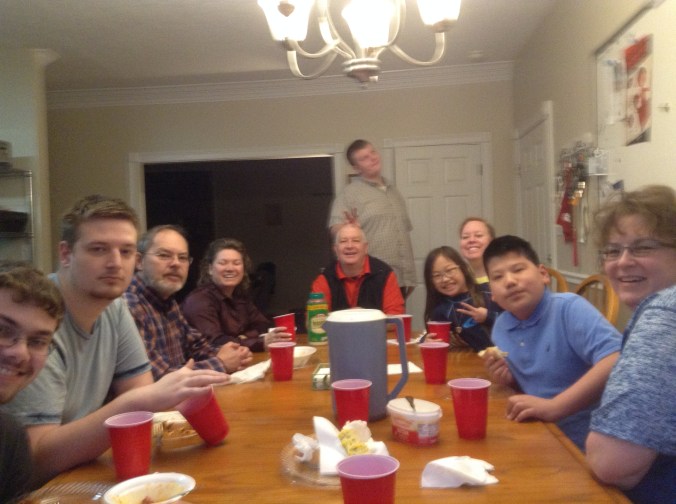
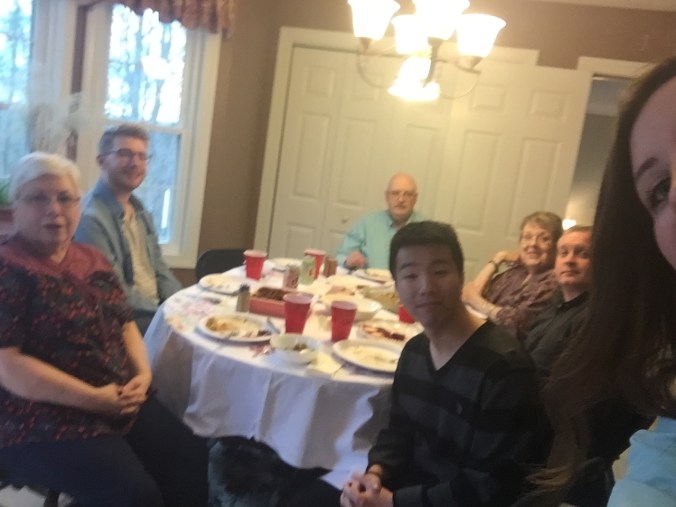
Coleton’s KKT


Maker:0x4c,Date:2017-11-7,Ver:4,Lens:Kan03,Act:Lar01,E-Y

By Coleton

When I first heard about the Kentucky’s Kitchen Table assignment, I wasn’t quite sure how to feel about it. I thought that it was a neat concept, but my family is very conservative, and they also do not truly take the time to truly hear what each person has to say so serious conversations can often be frustrating. I still knew I had to do it and as the time to do it came closer I stopped dreading it so much and just wanted to get the dinner part over with. I had planned my Kentucky’s Kitchen Table for spring break where my whole family, as well as another family from my hometown, Mt. Juliet TN, would be in a house together. Unfortunately, we never sat down for a meal at the house like we had planned at the beginning of the week because we were at Universal Studios from open to close almost every day, so we never had a meal altogether that wasn’t at a restaurant. Luckily, I was going to visit my friend’s family with him a week later in Union Kentucky, which is right by Cincinnati, and they offered to help me out with my project and host my Kentucky’s Kitchen Table at their house.

On the day that we were going to have dinner together, I woke up and looked out the window and saw a blanket of snow covering the ground. It was so beautiful. It had been awhile since I had seen some real snow on the ground. I love how the snow reflected the sunlight into the windows and filled the whole house with a radiating energy that would put anyone in a good mood. On the menu for dinner were buffalo chicken tacos, a recipe found on Pinterest that his mother Beverly had been wanting to try. The smell of buffalo chicken soon filled the house and it got me excited for the meal that we were going to share.

Once dinner was finished cooking we all went to the kitchen and made our plates and claimed our spot around the table. As I sat down I thought about one of the requirements for the Kentucky’s Kitchen Table assignment: that we were required to have a diverse group of people at our meal. I started thinking that this was not good because I am the only one sitting here with a different last name, so where is the diversity in that? But then as we started talking I would soon realize that there can be diversity even in a family unit.

Taylor is a single mom and a college nursing student that works as a waitress at Skyline Chili. Taylor’s three-year-old daughter Audrey also joined us for dinner, she didn’t say much about the topics, but she gave the dinner a certain breath of fresh air with some comedic relief. Zach is nineteen, a pre-vet student, and is gay. Emma is a high school freshman. Beverly and Jamos, the mother and father of the family, work at the VA in town. I learned my first lesson of the night from this very moment. Just because two people are from the same family, it doesn’t necessarily mean that those two people will have the same life experience. Sure, they grew up with the same parents and in the same physical home, but your life experiences are molded by the people you surround yourself with and what characteristics you possess.

The first question I asked everyone was the only required question of the night: Other than voting and paying taxes, what does it mean to be a citizen. After I asked the question, everyone just sat in silence staring at me until. I thought that the dinner was going to be like pulling out teeth to get people to answer my questions, but then Beverly asked what I meant by the question. Once I cleared up the question, Zach answered that other than paying taxes and voting you need to be active in your community and help others. When we all inquired about what he meant about that he explained that being a citizen is like being productive to your community and not allowing others to go unnoticed, and he then admitted to not really being a citizen according to his definition. He explained that he is not active in his community and does not always reach out to help other people. Everyone around the table nodded their heads and voiced their agreement to what Zach had said, but no one else really spoke up soon after. I found this answer intriguing because we all had this idea of citizenship as being active in our community, and we all would call ourselves citizens, yet none of us thought that we really were active in our community.

In order to carry that idea over, I inquired about their relationships with their neighbors. Beverly said that when the kids were young they would all play outside together and they would be friendly with their neighbors. They said it wasn’t odd to say hello and have a small conversation or ask to borrow some milk, but they would not talk about serious topics or share meals together. Zach jumped in and said that they still have one neighbor that they talk to occasionally but other than the wave as you are driving by, they don’t really talk to their neighbors. I did not find this to be especially groundbreaking. I mean, my family has experienced the same thing as all of my family grew up and no longer played outside with the neighborhood kids.

Soon after we had talked about this I asked what they thought the best thing about the world is today. Emma jumped in with how connected everyone is in my class on social media and things of that nature, and Jamos added how being that connected can also sometimes be a bad thing due to bullies and the ongoing competition to be that much better and to get one more like or follower than your enemy. Beverly also said that she believes that how understanding everyone one is today. Everyone agreed with this statement and added that people are not judged as much for personal life choices made. I found this, along with the previous discussion, very interesting. That we as a society have become more open-minded and understanding of the people we live around, yet somehow, we have become less interactive with each other. I tried to ask what everyone thought about that and no one had an answer, but they understood what I was talking about. I found this to be one of the most interesting moments in our meal as we began to really think about how we, as a society, have become so kind with one another, yet we don’t talk as much in person. I think that this can connect with the empathy readings that describe how today’s generation is not fit to make moral decisions and we just do “what feels right.” We do not want to be subjected to judgment from any of our peers, so in turn, we don’t feel as if we should subject other to the same type of judgment we fear ourselves. Along with this, I think that we do not talk in person as much because it is just more convenient for us, in this fast-paced world, for us to connect with friends online. Upon further thinking I was able to conclude that people being more understanding and people not communicating as often in person are correlated, meaning they happen at the same time, but are not causal.

Moving forward in the conversation we all talked about politicians and some of the suggestions that we all had for people running for office. Beverly started with the politicians really listening to the people and doing things that benefit everyone and not just their campaign or their well-being in the political world. Zach also reiterated her claim by saying that there are too many politicians that would just do and say whatever they have to in order to be elected or to not lose support from the general public. I think that this would benefit the world greatly because even though the government and policies won’t fix all of the world’s problems, they can be a crucial stepping stone to get the public involved in these types of situations.

In closing, despite my initial reservations about the Kentucky’s Kitchen Table project, I thoroughly enjoyed what I was able to glean from the conversation I had with their family. Such as that diversity exists in the typical family unit, as well as the realization that we are becoming more understanding in a less in-person-connected world. I think that the world will change as soon as people start having more discussions like this because people can learn that there are other people that share their opinion with them. So, they can initiate change in their communities because all it takes is a small change to lead to something more.

Kentucky’s Kitchen Table: A Reflection on Discomfort

By Chloe

My name is Chloe and for my Kentucky’s Kitchen Table assignment, I had my meal at a cabin in Stanton, Kentucky. It was held at Bailey’s family cabin in a gated community. We were joined by her mother Barbara, some of her friends that were from Spencer and some that go to Western. Barbara said that she would make all of the food, unless people wanted to bring things. Mhari and Lydia made burgers and hot dogs on the grill, while Shaban made his special spicy-soup-that’s-sometimes-a-sauce. Tiger brought the music and Silas brought his poetry book. I brought the dessert (cookies and cakes from Kroger of course). Also present were Chris and Emily, though they did not bring anything with them besides their personalities. I had never met Chris, Emily, Tiger, and Shaban before this meal.
Lydia is from Louisville and she went to the Brown School. She is a sophomore at Western. She went there for most of her life, as it is a kindergarten through twelfth grade school. Her mom is a guidance counselor at Presentation Academy and her dad works on a boat. Lydia says that she gets her creativity from her dad and her sass from her mom. They live in a big green house with one cat. Lydia has many tattoos, though most of them don’t mean anything; she just thought they were pretty.
Mhari and Tiger are both from Oldham County where they went to high school together. Lydia says, “They’re not dating but they’re also not not dating. Ya know?” Mhari and Tiger are both juniors at Western. Mhari smells perpetually of vanilla and cardamom and has a loud infectious laugh that makes one feel included and warm. Tiger is quieter and subtler, but he’s profoundly witty once you can hear what he is saying. His family is of Asian descent, and he has proudly dubbed himself the “coolest Asian any of you all know.” Both of them wear old glasses that are now too big for their heads because they have been stretched out but they both also refuse to get them fixed.
Shaban grew up in Virginia but he was born in a small country in Africa. When asked which country, he replies, “You won’t know what it is. No American has ever heard of it.” He speaks with a faint accent that comes out more when asked about his childhood. He loves NPR, green pants, and funky sweaters. His best friend, Morgan, is in Denmark right now studying at The Danish School and he speaks of her often.
Silas was born and raised in Portland, Oregon. His house sits on a plot of land that used to be a Christmas tree farm and he says that they are still everywhere, growing in neat rows. His mom was a school teacher before she retired and decided to homeschool him. He went to high school with other kids who had been homeschooled their whole lives too. Mhari and Lydia say that Silas has the purest heart of anyone they know. He is soft spoken and agreeable, calm and fun. He says that he used to have long thick hair before he cut it over the winter break while he was in Israel.
Chris is from the suburbs of Chicago and is a freshman at Western. Bailey and Emily are both from Spencer. Bailey goes to Western but Emily is still in high school. Bailey’s mom Barbara has short greying hair that she refuses to dye, much to her daughter’s protest. She enjoys watching British baking shows and assorted cartoons. She is clever and sharp.
Silas had brought a book of poetry with him and Tiger started reading some of the poems aloud to us as we were making dinner and preparing the table. Many of the poems were gloomy and dark, but they were certainly thought provoking. It was a book that seemed to be a lot about loving people, living amongst people and leaving people. It had themes of self-worth, inner strength, identity and false love. Everyone seemed to have incredibly different thoughts about them, though we all certainly agreed that the book was a bit of a downer. The girls seemed to have more opinions and thoughts about the ones related to self-worth and inner strength. We talked about how much beauty is drilled into girls’ brains from the very start and how damaging it is. Lydia is tall and thin and was told quite often that she has the body of a model, but was also told by boys that she didn’t have enough curves to be appealing. Mhari was told the opposite; she has too many curves to be appealing. Neither one could change their body, short of surgery, yet still had to listen to these things be said to them. It’s hard to love your appearance and feel worthy of much when people are telling you that the way that you were born is not good enough. No one has control over how they naturally look. I didn’t ask to be short, Lydia didn’t ask to be rail thin, and Mhari didn’t ask to be curvy, yet that’s what we all use to base our confidence on. It’s hard to find balance in it all when there’s so many kinds of bodies and looks but there only seems to be one kind of perfect.
We all agreed that the book was an odd contrast to Silas’s personality, which is generally light and pleasant. It’s a weird thing to think about the differences between what people think and what they actually say out loud to other people. I wasn’t sure if this was an instance in which Silas was reading the book because he wanted to expose himself to thinking that doesn’t really coincide with his own, or if he chose the book because the thinking does coincide with his own.
When I asked the group about their thoughts on the meaning of citizenship, Shaban was perhaps the most passionate. He was the only one out of the bunch that is not a natural born American citizen and you only have to speak with him for a short time to realize that he is incredibly proud of his heritage. He was born in Africa, but he didn’t live there long and America is what he knows best. He believes that citizenship goes beyond documents and regulations and dives deeper into passion. To him, citizenship is how one feels about their country. Documents are necessary but so is genuine love and appreciation. The rest of us at the meal can’t ever fully understand what he was saying to us because we have never experienced what he has. We, as natural born citizens in an incredibly fortunate country, take for granted so many things: grocery stores, indoor plumbing, cars, electricity. Obviously, I know that my life has been a cotton candy cloud compared to people living in third world countries and impoverished places. This wasn’t a new revelation to me but it was still a jarring experience. It’s always weird to be hit in the face with your own privilege. I take so much for granted, as many people do, because we haven’t ever had to live differently. I will never go hungry or lack electricity for years, but Shaban has. He got out of that and he came to America. Now that he’s here, he faces entirely different problems. I will never get pulled over by a police officer based upon the color of my skin or be discriminated against because of the way that I speak, but Shaban has. American people meet him and make up their minds about him without even really knowing him. Why bother coming to a new country when people there are going to treat you terribly? You have to choose between two evils. At least here you can survive, though you won’t always be treated respectfully. You choose survival so you can be around people that are terrible to you. How is that okay? It’s not, but it seems to be reality right now.
How can we live better together? Maybe we could start by not being racist. How do we do that? How do we change the minds of people that have it so ingrained in their brains that they are superior because of the color of their skin? We moved on from this topic to talk about where we live, our neighbors, what we want to do with our lives, and so many other things but I really got stuck on this first topic. I couldn’t move past it. I just wanted to grab all of the people that have ever been terrible to people of different races and shake them. Why are you like this? Why do you believe this to be true? I don’t think that any of them would have been able to give me an answer I was okay with, and maybe that’s what I want. I don’t want an answer I’m okay with because then I have to forgive them and stop being angry. Obviously, that goes against everything that we’ve learned in this class this semester. We can’t live better together or have more of a say over our lives if we’re so blinded by anger that we can’t even see straight.
The whole time Shaban was talking, I kept thinking about Claudia Rankine and Citizen. Rankine wrote about little micro-aggressions that she’s dealt with her whole life. People talking to her in “black talk” or saying stupid things that they didn’t mean to say out loud. Things that I don’t and won’t ever have to deal with, but she deals with every day. I don’t know if I’m really allowed to be angry about them on her behalf but I am.

Throughout Honors 251, we have talked about social issues and wicked problems. We talk about the things that no one wants to talk about and the things that people don’t know that they should be talking about. It has been eye opening in that it has forced me to not only see the point of view of others but also figure out how I myself feel about things. I have avoided thinking about heavy things for the longest time because they generally seem to bum me out or make me anxious. Having to do this dinner and this assignment was wonderful because I met new people who are very different than I am but I also got to know some of my friends better than I did before and it forced me to think about things that I don’t usually like to think about. I think that everyone should be forced to confront the things that make them uncomfortable because that is when you really seem to figure out who you are and what you believe.

IMG_6630

Shaban’s special “spicy-soup-that’s-sometimes-a-sauce” : chicken edition

IMG_6632

Making dinner on the grill!                   (Left to Right) Tiger, Lydia, Mhari, Silas, Emily

Kentucky’s Kitchen Table: From a Smalltalk Conversation to a Deliberative Engagement:

By Alex

The Kentucky Kitchen Table I hosted took place in Liberty (the seat of Casey County), Kentucky. Liberty is a very small town located 30 miles south of Danville, Kentucky, a town most people have heard of unlike my actual hometown. The diner consisted of 7 people all from my hometown, who had differing opinions on several of the topics discussed.

Scott and Jamie, my parents, have lived in Liberty their entire lives and both attended Western Kentucky University for their college educations, but have differing opinions on several issues and topics, that will be discussed further along in this paper. Scott works for the Kentucky Transportation Department, and though I may be biased, is one of the hardest working people I have ever met, shaping some of his beliefs. Jamie is a teacher, who loves her job and the students she works with.

Adam and Andrew, my brothers, are currently enrolled in the Casey County School System, and are both athletes, which takes up a large amount of their time. Andrew is in 6th grade currently, and knows little about politics, freedoms, and other aspects of the United States, but was eager to learn during the conversation. Adam is a Sophomore in high school who recently tuned 16 years old, but has little interest in politics and similar topics, and focuses mostly on athletics, so his contribution to the conversation was interesting.

Lauren is currently enrolled at Western Kentucky University, and is one year away from a bachelor’s degree in Communication Disorders and plans to become a Speech Language Pathologist. She is also from my hometown, so I thought it would be interesting to include her into our conversation. And Lastly, Lexi is a junior at Casey County high school, and a friend of my brother. I had never really talked to her outside of the Kentucky’s Kitchen Table discussion we had, and her various opinions were interesting and helped maintain conversation.

Our conversation started simply, with the following question; other than voting, paying taxes, and following laws, what does citizenship mean to you? Responses weren’t immediate, and everyone at the table took some time to think before responding. Finally, Lauren sparked conversation by mentioning that it citizenship includes all the rights and responsibilities that come with living in the United States of America. This answer sparked the conversation, as I simply asked everyone around the table what some of those rights and responsibilities could possibly include, looking for a particular answer. Everyone listed off certain things they thought were rights, such as having a job and paying income taxes, along with earning an income and being able to make a living, but no one seemed to reach the answer I was hoping for. Finally, I chipped in to help everyone see the point I was attempting to make; As an American Citizen, we can all attempt to engage with one another on certain issues to solve different types of problems.

Before moving on to other questions, I thought it was important to explain the main points of our Honors 251 class at WKU. I explained to my guests that wicked problems surrounded the world today, giving the technical definition along with several examples I will mention later on. After this, I mentioned that the technique of deliberative engagement was very important to help solve wicked problems and help come up with practical solutions that had more benefits than disadvantages.

After mentioning wicked problems, I decided to ask the question, “What social issues are closest to your heart and why,” hoping to reach a wicked problem and discuss how deliberation can help in maintaining a neutral and helpful attitude when solving them. Jamie quickly answered, with the support of Lexi, Adam, and Andrew. Since they are all in the school environment, the several issues in the United States surrounding gun control and how to stop school shootings. I asked Jamie what she thought of the situation, along with how to help reduce the amount of school shootings, and her response was very set in stone. She believed that the number of guns in the United States was way too high, and that gun control should be enacted to help reduce shootings. Scott quickly responded with the opposite answer of hers, making several points that taking guns only works if you can remove all weapons from United States citizens, but the number of illegal weapons not in circulations makes that impossible, putting responsible American’s who would potentially turn in their weapons at harm.

The gun control debate went on, until I mentioned that my Honors 251 class had a very similar discussion. Going off of the Honors Discussion, I asked my family to think of different options, with pros and cons, that could help the gun control situation. After holding my own mock deliberation around the dinner table, my family quickly realized something that I learned early from practicing deliberative engagement. They learned that though people have severely differing opinions on the same issue, they are not necessarily wrong.

To ease the tension of discussion the touchy subject of gun control, I asked more questions with hope to get a better sense of everyone’s opinion at the table. Taking another page from the class in order to get everyone to have an input of the conversation, I asked everyone around the table to give an answer to the following question: What is the thing you love most about where you live? Adam answered first, saying he really liked where he lived because of his friends and how often they got together. Lexi responded similarly, that she enjoyed how close everyone was in Casey County. Scott and Jamie both responded that they loved being able to live very close to their families and friends. Andrew mentioned that it was simply home for him, and Lauren joked (though it is true) that it was the only place in the world that she did not need a GPS to travel. Each answer had the same underlying theme, it was familiar, more familiar than anywhere else.

One of the last questions I asked everyone around the table was if they thought this conversation was important, and if they felt we had accomplished something from our Kentucky Kitchen table. Andrew and Adam both said no jokingly, and admitted it was more interesting than expected. Lexi and Lauren both were happy to have been included, and mentioned that the discussion was intriguing and interesting, and said that they would work to realize others opinions were not wrong but just different than their own. Scott and Jamie both admitted that the conversation was much different than they were expecting, being it was mandatory from a college class I was taking and were very happy to have been able to participate and communicate on issues, while also agreeing to look at some future discussions differently than past ones.

During this Kentucky Kitchen table, I learned several things. One of the first things I learned is that even though Scott and Jamie are the same age and have lived relatively similar lives, they each had differing opinions on certain topics. These opinions weren’t massively different for every question I asked, but overall their answers differed from one another. Another important thing I learned was that talking to people from your hometown doesn’t have the same effect as talking to people from different areas. For example, the people at my Kentucky Kitchen table are lacking what I have gained from Honors 251. Where my Kentucky Kitchen table consisted of people all from my hometown, Honors 251 is full of people from all over Kentucky and other areas and has allowed me to talk with those who have very different opinions from my own. As highlighted briefly above, I learned quickly that having differing opinions doesn’t mean that someone is wrong, and that talking to those you disagree with is an effective way to solve problems.

Throughout Honors 251, I have learned several new key principles that have already began to help me in real world conversations and in disagreements with others. The class has highlighted how important communication with others is to solving real-world problems, and has allowed me to realize that conversation is key to bettering the world we live in. My Kentucky Kitchen table kept reminding me of the reading we did early in this semester by Keith Melville, “How We Talk Matters.” I’m sure my family did not initially want to spend their dinner while I was home from college talking about what they thought was going to be a forced discussion brought on by a college course they did not know much about, but as the conversation trekked on everyone at the table became more interested and alert to the topics at hand and became more and more talkative. This helped me realize that a lot of the problem in the world today aren’t because the world today is in a worse shape than it has been in the past, but because the people of the world refuse to communicate on the issues at hand. People now would rather their opinions be considered right than to solve the topic at hand, and the beginning of my Kentucky Kitchen table embodied just that, but as the conversation went on, more open-mindedness began to occur, and our dinner better represented what the world so eagerly needs; common ground and respectful conversation.

IMG_0894


Tackling Problems One Meal at a Time

By Nate

My Kentucky Kitchen Table project took place in the suburbs of Bowling Green. Though Bowling Green is not my original home, I have come to call it so. My girlfriend’s family hails from here, and I seem to make new friends here each day. There were four people gathered around my table: Kaitlynn, my girlfriend, Meredith, a girl that I know in passing from my dorm building, and Janet, Kaitlynn’s grandmother that hosted the Kentucky Kitchen Table project at her house. Kaitlynn is my girlfriend of seven months and is from Lexington. She is bright and a very cheerful person. Although we have differing ideologies, we have much more in common than separates us. Meredith is reserved and very intellectual. She has the vibe of an old soul and has similar beliefs as me. Janet is sixty-nine years old and although I have only met her a couple of times, I can tell that she is a very kind person who cares deeply about people. I prepared green beans as a side, which I cooked in a deep brownie tray because I didn’t have a pot at the dorm, so I made due and they turned out great. Kaitlynn made mac n’ cheese and Janet bought chicken. Meredith baked brownies for dessert.


After diving into our meal, the first question was “what does citizenship mean to you?” This spurred answers from Meredith about being involved in local events such as the fair and shopping local. Janet, being the eldest there, had a slightly different perspective. She said that citizenship for her was mostly about being a good neighbor and helping those in need, she added that the world would be a much better place if people would get to know their neighbors more and lend a hand when someone is in need. A question that spurred more conversation was “what kind of community do you want to live in?” Theses answers were mostly stereotypical, a nice crime-free suburban neighborhood, until I said I want to live in a very small town, where you know everybody and every car you pass waves at you. This prompted some discussion about the positive and negative aspects of living in a rural versus an urban area.

Soon after the question “What social issue is closest to your heart?” was discussed, we delved into politics. Then it became apparent that we were a very diverse group. Not a traditional ethnically diverse group, but a group with diversity of thought. Around the kitchen table we had people that represented both the political right and left, as well as moderate and more hardcore versions of each. In today’s political climate it is made to look as if people with differing political opinions cannot engage each other in civil conversation. However, around this Kentucky kitchen table I found this stereotype to not be true whatsoever. Our diverse group discussed matters, and, in many cases, we had a lot more in common than one would be believe. When we did not share the same viewpoint, we would treat the other people respectfully.

Another theme of the discussion was that most of the things we were discussed about community was family based. It seemed the underlying motive behind the ideal community that good citizenship is meant to propagate is that this community would be a good one to raise kids. Janet, being the only one there to have raised a family was very enlightening. She pointed that knowing your neighbors and helping them out is a good thing to do when you are planning on raising kids as they can help keep your kids out of trouble. Also, she talked about supporting children who are less fortunate in the community by supporting local youth organizations and maybe even volunteering. The younger people around the table, myself included, idealized a perfect little house in a nice community, but hadn’t thought as having a role in making this happen. Janet illuminated this concept of building a community by actively working to make it better. In my life I have seen this to be true but had not realized it. My father, being a landlord, had always talked about how if you fix up your yard in a run-down neighborhood, some of your neighbors are bound to do the same. This shows the ripple effect that being a good citizen and member of society can have. Also, in my town I have seen that you cannot simply buy your way in to a good community. The most upscale neighborhood in my town isn’t the place I would call the best community. It is filled with rich people who hardly know each other, and the neighborhood has an out of control burglary problem. After Janet’s comments I reflected on this and also noticed that perhaps the best community where I am from is far from the wealthiest, however it is filled with lovely people who love life and know all of their neighbors. Every spring this neighborhood has a community yard sale and they have neighborhood cleanup days. This all shows that the only way to achieve everyone’s wish of living in a good community was to work at it through being a good neighbor and therefor a good citizen.

Through this Kentucky Kitchen Table project, I learned that everyone has dreams, and a major path to these dreams is through good citizenship. In order to live in a society that everyone wants to live in, we must work at it. In a society that is so divisive and makes everyone and everything seem as if it has its own agenda, one thing that can bring us together is our shared citizenship. If we all worked on being better citizens, then this country would be a much better place.

Another thing that I learned during the course of this project was the importance of communication. When I first met my girlfriend, it was clear that we had far different political views, however for our sake we decided that we would both discuss it with each other with civility and respect, and we have done so very well. Over our conversations I have come a little bit her way, and her mine. I had thought that this kind of civil discussion and working too see other people’s points could only be maintained for two people at most, but this project persuaded me to believe otherwise. In our discussions I saw people of vastly different beliefs communicating respectively and effectively with each other, in a fashion I thought extinct from our nation’s discourse. In 1850, the United States had acquired a vast new amount of land from winning the Mexican-American War and the slave states and anti-slave states came to the compromise of 1850, admitting California as a free state and passing a tougher fugitive slave law, while the other new territories’ laws would be decided under popular sovereignty. This kind of “meet-in-the-middle” compromising needs to see a revival in our nation. I believe that this revival would best be started around kitchen tables across the country, as people with varying beliefs can come together and discuss matters with civility as we did around our kitchen table.

This project relates to the central class question, “How do we solve problems?” because around our table, our diverse in thought group were able to come together on varying issues much easier than one would have thought it to be. When trying to solve problems, it is important that we try to engage each other with civility and mutual respect that allows us to reach agreeable solutions to the many wicked problems our community and world face. Around the familiar kitchen table environment, it was much easier to discuss matters that are typically controversial and avoided—perhaps, maybe they should serve fried chicken at the floor of the Senate!

This assignment made me realize that we have more in common with our neighbors than we think. Seeing these mutual held beliefs is an important step in appreciating the values of deliberative engagement of a community. I believe this project relates to the reading, “Tackling Wicked Problems Through Deliberative Engagement” by Martin Carcasson. Around the table, it was almost like a miniature town hall meeting. We had divergent thinking going on; everyone was coming from a different place and had their individual beliefs which they expressed freely. We worked through the groan zone next, though I did not find it to be so bad. Then, all there was to do was convergent thinking, which was fairly natural to do at this point. We were quick to come to common ground, realizing our “end goals” were basically the same. Through this miniaturized set of deliberative engagement, I saw how we should all work to solve our wicked problems. By letting everyone’s voice be heard, treating that voice with respect, and putting forth the effort to see where that voice is coming from, leads us all to realize that there is no problem too big when we all work together.

Kentucky Kitchen’s Table Project

By Matthew

The dinner took place in Hopkinsville, Kentucky at the Pennyroyal Veteran’s Center. Present at the dinner was Matthew, a student at Western Kentucky University, Jeff, administrator of the Pennyroyal Veteran’s Center, Tim, a retired veteran of the army, Mark, another employee at the Veteran’s Center, Erica, and Paul, two more employees at the Veteran’s Center. Food was provided mainly by Tim and Erica and consisted of chicken, potatoes and macaroni and cheese. There was also cherry pie for desert provided by Jeff.

While many of those questioned were involved with veterans, they were still quite diverse. Matthew is a student at Western Kentucky University, and Mark, Erica, and Paul never served in the military. Paul also recently moved to the United States from Nigeria, and Mark is Jamaican. Jeff is a retired army veteran who went on to further serve the country he served by serving as administrator of the Veteran’s Center, and Tim is a retired veteran from the army who is currently housed at the center. The group, while diverse, was united under a banner of service and loyalty to one’s country.

The conversation centered on citizenship, with a strong focus on service. When asked what citizenship meant to them, many of the answers provided centered around loyalty to one’s country. Having served as a veteran in the military, Jeff and Tim emphasized service to one’s country as a key factor in citizenship. Jeff went on to say that this service is not exclusive to military service, and can be demonstrated by ways such as community service and, sometimes, even joining the work force. Paul was especially convinced that loyalty is the most important aspect to citizenship as loyalty and a wish for the country to prosper is the stem of all other aspects of citizenry such as the simple things like voting and paying one’s taxes. A point that was brought up was giving back to one’s community in any variety of ways, be it community service or providing support for those who need it.

As everyone aside from Matthew at the dinner was involved in the military in some way, be it through actual service or simply being employed at the Veteran’s Center, a prominent topic during the dinner became focused on military service. While everyone at the table agreed that military service was incredibly important and a great display of loyalty and pride in one’s country, it was not the only way to show one’s loyalty. Tim even went on to say that military service could be a way for one to form pride and loyalty in a nation. He described how putting your own life on the line instills a pride in your country that is hard to form through other ways of service. It is one of the most prominent ways to serve one’s country as you are essentially saying that the safety and prosperity of your country is more important to you than your own life.

When asked how their job at the Veteran’s Center relates to their role as a citizen, there was a near unanimous agreement that they were giving back to their community by providing for those who had willingly offered their lives so that our country – and by implication, those questioned – could grow and prosper. It was agreed upon that citizenship boils down to providing for one’s community, and that the way one does so is not relevant or important. As long as one is providing a positive benefit to society, then they are being a citizen. There are other important factors involved in this, namely loyalty to the community you are involved in, but the primary role of a citizen is to give back to the community in which they are a part of. This was the primary purpose of those employed at the Veteran’s Center, giving back to the community, specifically the veterans, and as a result, the employment of everyone at the table (Matthew and Tim aside) played a very important part in their primary role as a citizen.

Another major theme that arose during the conversation was race. While anyone at the table questioned would claim that they are not racist, Mark and Paul mentioned (though to be clear, they did not try to call anyone at the table out as a racist) that many people have subtleties and remarks that they make that they might not even realize would be racist, as they are neither of the minority targeted or even on the receiving end of those remarks.  Actions such as hiring to fulfill a quota, or even finding a person of minority solely for the sake of diversity in a group setting, while not inherently racist could come across as objectifying the minorities in question. It was very reminiscent of the minor transgressions we don’t even think about that Rankine’s Citizen brought up as a focal point. We may not have any racist thoughts or tendencies, but it’s a way that we are brought up as a society and instills small tendencies that to the majority don’t seem as anything bad, but may come across as discrimination towards a minority in a way that we may not even see.

The major point that resonated throughout the entire dinner was service, fitting as we were eating within a shelter for homeless veterans. It does not matter how one can serve one’s community, as long as they are able to serve in some capacity. Even something non-physical like wisdom and knowledge to pass down to one’s prosperity can be a service and a way to give back to the community that has nurtured and helped one grow.  As one of the major questions of the course is “How can people live better (or, at the least, less badly) together?”, this seemed to actually be a very fitting and appropriate response. If everyone in society can provide and serve, then it would benefit everyone else. This could potentially cause a snowball effect, as those benefitted would see the source of their growth and desire to leave that same effect on their prosperity, similar to ideas brought up in discussion of the “Energy Diet” article. If everyone is serving their community, then they should be improving their lives and as a result should be living better together.

A common thread that resonated throughout all of the questions asked was the importance of the small details. Whether it be the small actions ones makes towards a particular group, or a small contribution someone makes to a group or community, they are still important and should not be discredited because it is only a minor action. What might be minor in one person’s eyes may resonate greatly in another’s and, as discussed earlier, this other person could inspire another and cause a snowball effect. You don’t have to give your life in battle in order to serve your country or community. Sometimes, simply helping those around who have helped serve your community is enough needed to serve and give back to community. You do not have to take the grandest action to fulfill your role as a citizen. If everyone is taking the large roles, there will be no one providing the background support of the minor jobs. Every role is important. This was probably the most important message that was never explicitly said that resonated throughout the dinner.

Pictured from left to right:
Paul, Tim, Mark, Erica, Matthew
Not pictured (photo credits): Jeff


Kentucky Kitchen Table in Relation to Our Everyday Lives


This slideshow requires JavaScript.

By Kinsley

This week, I had the privilege of sitting down and enjoying a meal with familiar faces and some not so familiar ones in Bowling Green, Kentucky. My name is Kinsley, and quite possibly one of the times I learned the most during my freshman year of college is during a Kentucky Kitchen Table assignment for my advanced Citizen and Self class. The assignment’s premise was simple: grab a few people who are from culturally different backgrounds, people who grew up in different areas of the world, and ask them to a dinner where they contribute food and quality conversation. I think it’s fitting to introduce the faces of the fresh ideas and possible solutions to solve the world’s wicked problems. To put it simply, a wicked problem is one that is difficult or impossible to solve because of incomplete, contradictory, and changing requirements that often are difficult to recognize.

Katelyn is a soft-spoken, aspiring journalist with a passion for the Middle East; she is in the process of learning Arabic with intentions to better serve the people of countries in need. She spends her free time researching new ways to help the refugee influx from recent years into the Bowling Green area, and she is excited to serve in a Middle Eastern country this summer. She will begin volunteering at the International Center of Kentucky soon. She is passionate about her faith, her family, and loving her neighbors, despite the stereotypes associated with their physical attributes. Katelyn brings a heart for the nations to our table.

Taylor is a southern gentleman at his finest, as he loves the outdoors and believes strongly in the rights and privileges that the Second Amendment provides. He is a computer science major, following closely in the footsteps of his father. He loves the classics, Ocean’s Eleven and Talladega Nights topping his list, and he would classify himself as “one of the funny ones.” His ancestry is a large part of who he is; as twenty-five percent Taiwanese, he loves the history that his grandmother brought from Taiwan to the United States in the twentieth century. Taylor adds cultural diversity to our table.

Nichole is passionate about Dallas Cowboys football and feels most comfortable when gaming with her guy friends. From a young age, she has had the divine opportunity to travel the world; some of the most beautiful, enticing destinations she has visited include Munich, Germany and Brussels, Belgium. For as long as she can remember, she has had the chance to be immersed in a variety of diverse cultures. Nichole is keen to moving around the United States and sees each new move as a new way to grow. Perhaps one of the most influential points in Nichole’s life occurred a mere three weeks ago when her mother was diagnosed with breast cancer. Nichole brings a fresh sense of emotionally raw diversity to our table.

Rylee is a fellow classmate and spends her time studying; as a part of the Mahurin Honors College at Western Kentucky University, and a writer for The Talisman magazine published on campus, she is passionate about what she does. As the only one at our table to have lived in the Bowling Green area for her entire life, she is knowledgeable about the happenings in the city we all now call home. She is passionate about her faith and the people she meets in her day to day interactions at the Beverly Hills Bargain Boutique, for her she draws much more than a paycheck. Rylee thrives on customer service. She is more liberal-minded than many in this small group, enabling her to bring forth diversity. Rylee brings a heart for people and a smile that can light up a room to our table.

Holly teaches eighth grade English at Butler County, a local middle school in Bowling Green, while she raises two children of her own. She is passionate about her line of work, but is also concerned about the crisis of cut funding in Kentucky schools. Her childhood, marked by certain events, allowed her to have differing opinions from the rest of the group. Holly loves pouring her knowledge into the children she encounters every day, and she brings strong, yet caring, opinions and ideas to our table.

Polio, a chronic disease that has seemingly plagued her since her youth, does not prevent Bonita from living her life radically. Bonita is an actively involved member of a local church and spends much of her time witnessing her grandchildren grow. As the oldest participant at our table, she brings knowledge of the early 1900s, and she is able to compare the ways in which the world was and how it is now. Bonita brings a new perspective and seasoned years to our table.

Michael is the principal of Bluegrass Middle School in Bowling Green, Kentucky. As he and his spouse, Holly, are both employed by schools systems, thus employed by the government, he has many opinions about the corruption and inequality of budget-cutting among public schools in the state. With a background in psychological science, he deals heavily with the emotional aspects of children. He has much to say about the refugee crisis in America, and especially the impact that it has had in the Warren County area. Michael brings the inner workings of the mind and emotional states of being to our table.

When asked the most crucial question of the entire night, “Beyond voting, paying taxes, and following laws, what does citizenship mean to you,” each person at the table emitted a variably different response. Everyone present was raised in atmospheres foreign to the others, and this created an exciting idea of citizenship. As for me, both of my parents are Air Force veterans, leading me to grow into an adult familiar to the concepts of honor and pride for my nation, which eventually led to many of my adult decisions resting upon my Republican, conservative-minded upbringing. Perhaps one of the most interesting testimonies is that of Bonita, who was born and raised in Kentucky. She was born into a farming community, and because she was overcome with Polio at such a young age, she has a unique outlook on the ways in which the world helps the disabled and needy. This question in particular caused me to be reminded of the key theme of “How can we live better, or at least less badly, together?” When people of ethnically diverse backgrounds are faced with the complex idea of citizenship, as it has possibly never crossed their minds before, they oftentimes struggle to find words enough to describe their associated thoughts and emotions.

Perhaps the most controversial conversation of the evening began with these simple words: “What kind of community do you want to live in?” Thus, a discussion about gun control and Second Amendment rights was launched. “As for me, I’d like to live in a community that is graciously armed,” says Taylor, “because that is what I am most comfortable with. I could practically shoot a gun before I could walk.” Though many at the table were in agreement with Taylor’s opinion, Holly had a strikingly different viewpoint. Even after growing up in a community where guns were present and in her own home, she feels the most comfortable when there are none in her close proximity. This topic spurred a conversation that lasted for upwards of twenty minutes, and intertwined within was the reality that citizens, those living in the same city, shopping at the same grocery stores, and enrolling their children in the same public school systems, can, and do, coexist. Political, social, and moral decisions, while crucial to one’s expressed identity, do not solely define a human being. To allow guns or not to allow guns is simply a matter of opinion in which, when handled properly, can allow for healthy stretches of the mind and the realm of normal conversation.

It was interesting to learn that the dynamic of “being neighborly” has changed drastically in recent years. In the twentieth century, it was expected that neighborhoods were familiar with the families that lived there; dinner parties and welcoming cookie platters were typical. However, when our table was faced with the question, “Do you know your neighbors? Why or why not?” the answers were more than scarily similar. I, personally, have lived in the same house for ten years, and I dare say that I have no recollection of a single person’s name on my street. This unknowing is more spurred by a busy life rather than the lack of desire to get to know those living close to me. I think community has changed with this century due to the very virtual reality that we now live in. Society as a whole is under this incorrect impression that knowing people on social media is the same as having a personal relationship with them. “No, I really don’t know my neighbors, and I’m not sure there’s a real reason behind that,” was the resounding response from many at the table. Katelyn had a different idea though; growing up in the house her parents have owned since before her birth, she came to know the girls who lived in the house next to hers. As life usually does, it drew the girls apart, reducing Katelyn’s known neighbors to an astounding zero.

Though I could write forever of the lessons I learned, I think it is essential to remember the key themes of Citizen and Self and how they truly relate to the intense realities of the world. Knowledge and intentionality of conversations was a prevailing piece of our Kentucky Kitchen Table experience. No doubt was this exposure of the inner workings of each person’s hearts one of the most eye-opening of my life; I think this is simply because the millennial generation in which I identify with has forgotten the importance of “loving thy neighbor” and of communicating, deliberating, thinking in an effective way to solve the wicked problems present in the world today. Relative to the class as a whole, I would say that Love Thy Neighbor: A Story of War by Peter Maass is the most related to the ideas and topics discussed at our table. Faith, family, and personal history were the key themes in the ways that conversations were driven.

I truly believe that the first steps towards a more connected world are to obtain culturally different opinions and retain this knowledge in order to answer the questions that it seems all citizens desire to be answered:

How can we live better, or at least less badly, together?

How can we ensure that we have more of a say over our own lives, and how can we ensure that others have more of a say over their own lives?

How can we solve problems?

It is our job as citizens to strive towards the type of world these questions illustrate each and every day of our lives and to not give in to our desires to quit until we have found the answers we have always so desperately searched for.

With All Sincerity, Kinsley

Brandon’s Kentucky Kitchen Table

By Brandon

IMG_0832Left to Right: Me, Brandon, Dad, Mom, Ian, Braxton, Chapel, Sharon, Manyoo, Tricia

I had my Kentucky Kitchen Table at a good family friend’s house here in Bowling Green. The hostess, Tricia, is no stranger to friendly gatherings. She hosts small group bible studies occasionally throughout the year with potluck style dinners, so we’ve been unintentionally practicing for this for a few years. I could not think of a warmer house to have my KKT in.

Her husband, Ian, was born in Zimbabwe. His parents were missionaries so he grew up in South Africa. He came to America to get a degree in Mechanical Engineering at WKU. He has a fun accent.

I got to know them initially through their son, Brandon (he has the same name as me). We became friends in Middle School and have stayed friends since. He’s studying Advertising.

Brandon’s younger brother Braxton was hanging around too. He’s homeschooled, but also heavily involved in community sports.

As a whole, they’re all fairly conservative and strong Christians. Tricia is a stay-at-home mom that homeschools her kids, as well as a freelance writer.

My mom and dad are pictured on the left, in between Brandon and Ian. They like coming to Tricia’s house as much as me. My dad is a retired IRS agent and conservative. He grew up in East Tennessee. Mom works as a secretary for a federal probation office. She’s a registered Democrat but mostly stays out of politics. Overall, she’s a very optimistic person.

Across from them sat Ian’s brother’s family. His brother couldn’t make it, but his brother’s wife Sharon was there with their two adopted Korean children, Chapel and Manyoo. Sharon is a stay-at-home mom and a part-time substitute teacher. She’s also fairly conservative.

I’d never met Sharon and her kids before, despite knowing Tricia’s family for five years. Sharon’s pleasant to talk to and she was always one of the first to answer the questions. Chapel’s kinda shy and Manyoo is the opposite of shy.

Dinner started off with general conversation around the table. I waited until everyone was seated and had had the chance to eat a good portion of their meal before asking the first question. As for the food itself, my dad made some of his good ol’ homemade chili, Tricia made some excellent lasagna, and Sharon brought Korean potstickers. All of it was quite excellent.

I asked the required citizenship question first. It created a lot of blank stares and “Hmmmm” responses. Granted, it’s not something we really think about on a daily basis, or much at all, so I waited patiently for an answer.

Sharon was the first to give an answer. “Freedom,” she said. Everyone quickly echoed the sentiment. Group consensus wasn’t my goal, but everyone could get behind freedom, myself included, so I segued into the next question.

I asked what advice they would give to the people running for office in our country and there sure wasn’t any hesitation in the answer to that. Ian said, “Listen to the people,” and others added on variations of this sentiment. He said people are tired of feeling underrepresented and that if the people in charge actually listened to the people that put them in charge, then the country would be much better off. I noticed a distinct lack of politicization for either side in the answers, which I thought was interesting.

I stirred the pot with the next question, asking “What social issue is closest to your heart and why?” Brandon responded immediately with “Abortion” with the rest of his family backing him up. Tricia elaborated by explaining why it was important to them, citing the Bible and their belief in the sanctity of life, beginning at conception.

Sharon gave a slightly broader answer of “Family Life.” She talked about prioritizing her family, and how many of the things wrong with modern America had to do with the degradation of family values, such as the acceptance of gay marriage and a lack of child discipline.

The mood got very serious so I decided to lighten it by asking “What do you think are the best things about our world today?” This proved to be the most decisive questions of the night, though not in a bad way.

Ian said technology was one of the best things about the world, citing how it’s improved countless lives and brings people from all over the world together. Tricia reacted with surprise and said she thought technology was one of the worst things about the world. She elaborated on how people are addicted to today’s technology and have given in to instant gratification because of it.

I personally sided with Ian, partially because I’m optimistic but also because it goes along with our class discussions of bringing everyone together. Modern technology can be a double-edged sword, but overall I think it has massively benefited society.

Sharon had a completely different answer. She spoke of nature as one of the best things in the world and how the natural beauty of the world was something worth cherishing and protecting. It was a very inspiring answer.

I followed up with “What is the thing you love most about living where you do?” Since almost everyone present grew up in a different state (or country), I expected different answers, however, there was a common consensus that “community” and “friendliness” were what defined Bowling Green. Ian said community wasn’t nearly as valued in South Africa as it is here, which surprised me.

Sharon and Tricia both spoke highly of how everyone is willing to put aside their differences and come together for a common cause during times of distress, both on a national and local level, and that that was one of the things that made the U.S. unique. It was a nice, optimistic upswing. Everyone was smiling.

They kept wanting to answer more questions, so I kept asking them, even though everyone had already eaten dessert. They were really into it.

I asked the question about having meals around the table with your family growing up, and my dad took point on that one. He told us how his dad (my grandfather) worked a rotating shift at a factory when he was growing up, and even though his hours changed, he always tried to eat with his family whenever he could.

I always like hearing new details about my dad’s life growing up. He only tells these kinds of stories with friends, and most are ones I haven’t heard before. It was one of the little things that stuck with me.

All of the others said they ate with their families growing up as well. Sharon nudged Chapel into talking by asking her directly if they have dinner as a family. She gave a shy, “Yes.”

Most everyone highly valued having dinner with the family. Tricia said growing up she didn’t even know some families didn’t eat dinner together, and that it was a sad trend that more families weren’t eating together. Ian said he did it with his family in South Africa.

We ended the night with the soul-searching question “What kind of person do you want to be?” Manyoo gave the humorously vague answer of wanting to be a “good” person. Chapel tried to copy his answer, and after a few synonyms, Sharon gave up on trying to get a different answer out of her.

Interestingly, the adults answered the question not on who they want to be, but how they want to be remembered. At least, that was the common theme of their answers.

Ian wanted to be remembered as a kind, generous person, and after some prompting, he told us a story demonstrating these virtues. Several years ago during Thanksgiving, Ian was driving home to his family when he saw a car broke down on the side of the road with a black man standing next to it. He pulled over to offer his assistance, and the man said his car had a flat tire.

Ian called several different tire sellers to try to find the tire the guy needed, but it was an unusual brand of tire and the only place that had them was the Walmart in Franklin, KY. So, being the ultimate nice guy, Ian drove the man down to Franklin and waited with him until the auto center opened. Once the man bought his tire, Ian drove him back to his car.

It was really late by this time as the whole ordeal took about six hours. The man thanked Ian profusely and they went their separate ways. It was a rather heartwarming tale.

My mom said she wanted to be remembered as a do-gooder, even though doing good sometimes resulted in her getting taken advantage of by others. My dad said something similar.

Brandon didn’t give a serious answer. I said I wanted to stay the course and continue doing what I was doing. Tricia ended it by saying she wanted to leave behind a positive legacy for others to follow.

I thanked everyone for coming and gave Tricia a hostess gift. Overall, the discussion went really well and everyone enjoyed themselves. I learned that even though we all came from diverse geographic and demographic backgrounds, we all more or less wanted the same thing: To live good lives and be good people. It sounds cliche, but hey, life’s cliche. I was reminded of the article “How We Talk Matters” as the dinner showed that civil discourse is not only possible but can also be enjoyable. I walked away with a new appreciation for simple, dinner conversation.


Dinner at my Second Home: A Dialogue on Citizenship

By Kaitlynn

My meal took place at my grandmother’s home in Bowling Green, KY. Although my hometown is Lexington, Bowling Green has always been a second home for me. My parents were both born and raised here, and graduated from Western Kentucky University together in 1992. My grandparents live here, as well. For as long as I can remember, my family has made many trips here to attend WKU games and to visit with family. To say that choosing WKU for college was easy is an understatement. So, doing my Kentucky Kitchen Table project here in Bowling Green was very easy, for it truly is like home.

At my dinner were myself, my boyfriend, Nate, my grandmother, Janet, and a girl who lives in my dorm building, Meredith. Nate is a very funny and kind person. He is nineteen years old. He loves to hunt and fish, basically anything that will get him outside. He grew up in Bardstown, KY, and attended a catholic private school. He is also intelligent, and is majoring in biology with a pre-med concentration. He is an amazing boyfriend and best friend. We met in the elevator of our dorm the first week of college. He is easy to talk to and fun to be around. Although we share many similarities, we have a lot of differences, too. Our religious practices vary slightly, and most of our political views differ. We were also raised in different homes and lifestyles. I enjoy getting to discuss our differences and our perspectives on various issues. Janet is the most selfless person I know. She would do anything and everything to help someone, especially her family. She is sixty-nine years old. Retired now, she was a nurse. She won the battle against breast cancer when I was a toddler. As I have grown up, I have become closer and closer to her. She is a Christian and she holds her faith near and dear to her heart. She considers herself an independent politically, and is always willing to hear many different perspectives and ideas. I know that if I ever need anything, I can call her. Meredith is also from Lexington, KY, but I never knew her until now. She has the same major as me, nursing, so we have several classes together. Although I don’t know her very well, I wanted to invite her to this dinner because she has always shown me kindness. She lifeguards during the summer, she attended an arts school in high school, and I learned that she loves reality TV shows as much as I do.

For dinner, I made mac-n-cheese, Nate made green beans, my grandmother bought chicken, and Meredith made brownies. When we got to my grandmother’s house, the table was set beautifully. I loved it. She even lit candles, which I never really do at dinner with my immediate family. I made that comment, and my grandma told me that she always lights candles at dinner, and even told me that my aunt and my dad would take turns each night lighting the candles. Meredith said that her family would always light candles at dinner too. Although something kind of random, I thought that story was cool to hear, and possibly something I wouldn’t have heard if we didn’t have this meal. It was interesting to hear the difference because that is something my usual dinners never have, but something that their dinners always have.

At the beginning of the meal, I started by asking what citizenship meant to everyone. We went around the table. Nate said to him, citizenship means being a good neighbor and preserving his culture. He also thinks that writing his politicians educating himself from multiple perspectives on current issues is a key part of being a good citizen. Janet’s citizenship means being active in her community. She said that when she was younger and had kids, it encouraged her to become even more involved, for her children were part of different sports and activities which in turn made her get involved. She also said that being a leader and supporting local organizations is important, as well as taking care of her neighbors. Another thing she believes is important to citizenship is following the law, for the laws are ultimately made to protect everyone. Meredith said she tries to be a good citizen by being involved in the community, too, like going to local events. She also thinks that listening to others with respect and gaining insight from others, from differing perspectives, can help you cooperate and agree with more of your fellow citizens. I agree with what everyone said, and I feel that all of that contributes to my citizenship, too. I added that being nice to our neighbors, just with a smile and wave, means a lot to me as a citizen. Especially in the dorms, I make an effort to just be friendly to the girls in my hall, because I know that I appreciate that too.

Nate asked next what social issue means the most to everyone and why. I began to discuss my social issue, the standing or kneeling for the pledge of allegiance. I am such a proud American, and I feel so lucky to be a citizen in this country. To sit or kneel for the national anthem, to me, I explained, shows disrespect for the people who fight for everything that the national anthem embodies. I also shared a story of a WKU football game my family and I attended. We have season tickets in front of an elderly couple. As opposed to us, they do not attend many games, and it is pretty clear why. The man is quite old and has a very difficult time getting around. My dad will often help him stand and sit from his seat. He is a veteran, and though he did not stand during the entire game, he would struggle to stand just for the pledge of allegiance. It always brought tears to me and my mother’s eyes. Meredith’s social issue was the lack of funding for the arts, especially the cuts to her arts program back in high school that are taking affect now. She discussed how much she enjoyed her high school and the impact it made on her, and shared her concerns with this lack of funding. This statement lead us to discussing the current pension issue. I learned that Meredith’s mom is actually a teacher, so she could personally relate to this. My aunt, Janet’s daughter, is also a teacher. I posed the question, “where should we cut money from?” because, of course, no one wants money cut from their department, job, sector, etc. Nate suggested the military, while Meredith explained that a student in her communications class thought hemp could be a solution. His family’s farm was allowed to grow it this year, causing both their farm and the government to make a great amount of money. It was interesting to get to talk about such a relevant issue.

A reoccurring theme in our conversation was the value of the most basic level of community, our neighborhoods. Despite the topic we would be discussing, we would somehow always get back to being a good neighbor and the neighbor that you would want to have. Being a good neighbor, to us, means being friendly and simply smiling and waving, and being there for them when need be. A good neighbor is involved in their community and is willing to help out when people are in need. I think this shows that the epitome of a good citizen is a good neighbor.

Another theme that was prevalent throughout our discussions was the diverse opinions and background each of us held, and yet the mutual respect for one another. Although we all came from varying hometowns, religions, political views, ages, genders, and more, we were able to find a lot of common ground by discussing things in this fashion. We made eye contact and listened to what each person was saying, and kept an open mind. We tried to see things from each others’ shoes, and considered varying beliefs even if they opposed your own.

I was reminded yet again that deliberation truly is one of the best, if not the single best, ways to discuss these controversial, wicked problems that the world faces. As Keith Melville in “How We Talk Matters” explains, talking matters because by communicating in a better way we are more apt to agreeing and make democracy work better. Deliberating fosters group discussions and helps decision-making. He writes, “public deliberation is useful when there is a discrepancy between what is happening to people and what they think should be happening—yet there is no agreement on what should be happening.” Our society faces so many issues like these, with no right or wrong solution that affects so many peoples’ lives. By deliberating with people, like we did at our dinner, we were able to be empathetic and see things from other perspectives while finding common ground. Though our dinner was not a proper deliberation like those we have in class, it was a civil discussion that allowed us all to share our personal experiences, our opinions, and areas where we shared common ground, despite our diverse backgrounds and core beliefs.

This relates to the class, for living better together and solving problems can be made a little easier by simply having a discussion, perhaps a dinner around a table in your hometown.


Happy Kentucky Kitchen Table In Alvaton

By Reuben

KKT PictureMy name is Reuben and I had my Kentucky Kitchen Table in Alvaton, Kentucky. I am grateful for Emma, my wonderful classmate that invited me to be apart of her family’s Easter gathering. I am also grateful for her kind and welcoming family, without them, this script would have never came to be. It was a extraordinary day that gave birth to new mindsets within my brain, new relationships that I dearly treasure, and a chance to befriend a wondrous family whom were so kind, and very much so inspiring.
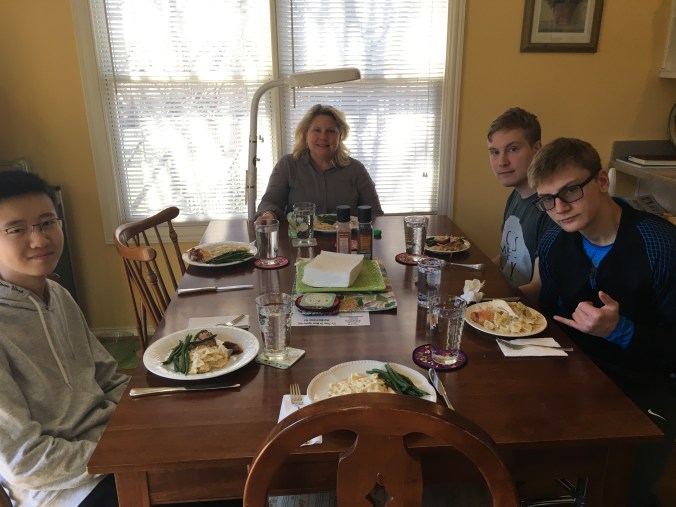
I have never been to Alvaton before, but the people whom I met during that eventful day has made the name more than memorable. When I first step foot into their humble abode, I noticed their walls comprised of colorful quilts with different patterns and a masterfully made wooden coffee table in the middle of the living room. I had the honor of touring a room filled with relics from both Native American and Egyptian cultures. A room filled with sentimental memories of the past and numerous ornaments on the walls instilled with a sense of treasure less value which only Larry and Norma can grasp.

Being the only stranger at the dinner table, I had trouble memorizing people’s names; however, thanks to Emma, I learned that the people in attendance were Steve, Larry, Norma, Carol, Baker, and Jack. Everyone around the table brought a unique set of experiences and came from different backgrounds. Steve, Emma’s father who shares his daughter’s love of song and theater, a good father as well as an excellent man of character. Larry, Emma’s grandfather who is a retired mechanical engineer who has a hobby for woodworking, his wood shop displaying many of his fine crafts. Larry’s wife Norma, has her own hobby of quilt-making and cooking, she was excellent in both regards, and in my memory I haven’t met anyone who’s made prettier quilts. Auntie Carol – is not Emma’s real aunt – but nevertheless a valuable family friend, she moved here from Hawaii. I listened to her interesting stories about the fishes of Hawaii that tasted far greater than any fish that she has ever found in Kentucky. Along with her adorable dog called Jack, and I’ll genuinely admit, meeting this adorable dog has been the greatest happenstance of my life. Last, but not least, there was Emma and Baker, the kind couple who gave me the opportunity to attend this lunch. Emma, my wonderful classmate who’s studying elementary education and history at Western Kentucky University. Baker, her dear boyfriend who’s studying advertising and graphic design at WKU, whom also has a great sense of humor. Last, but the best, the precious soul that is Jack, a adorable dog that took a instant liking to me, and I to him. The food was superb, a lot of traditional comfort food, and most of all, the conversations were enlightening, impactful, and overall an enjoyable time. I am very grateful for Emma.

We began the discussion with the fundamental required question: “Beyond voting, paying taxes, and following laws, what does citizenship mean to you”? The immediate response around the table were puzzled pauses and curious glances. Auntie Carol broke the silence by talking about her Canadian-born friend whom has lived in America for a long time, but she obtained her American citizenship later on. She described that our American citizenship is a privilege that many Americans take for granted by those people who obtained it by being born on U.S. soil. She said “I have always thought of this place as my country, my identity isn’t something I would give up easily.” I think that Auntie Carol has brought up an topic of identity. That our identity is not always defined through our roles, professions, or conflicts. Our identity is who we ARE not we do. Auntie Carol stated that there was something right about being an American, that we should be proud of our history, our ancestors that fought for it, and that we have our freedoms.

Afterwards, we dove into the issue of DACA, the Deferred Action for Childhood Arrivals, the program created in 2012 by the Obama administration allowing young people brought to this country illegally by their parents to receive permission to work, study and obtain driver’s licenses. While I am not affected by DACA, I feel bitter for the people who are affected by Trump’s decision to reverse President Obama’s executive action of creating DACA. Baker mentioned his that friend, Husway, was brought illegally into American by his parents when he was young; therefore, he was affected by DACA. He stated that Husway is going to get married soon, and he fears that the situation with DACA will bring worth unwanted complications. I told the family my experiences with international students. I knew that whilst WKU’s student population was over 20,000, the international student population was below 1000, and the numbers have been dwindling as time moves forward. I strived to make the connection between the DACA affectees and the international students, because our country is constantly changing, shifting our many viewpoints and with the new president in the White House, I noticed that less and less international students were coming to WKU for schooling, whereas before he took office the numbers were raising every year. I share my experiences because I have worked with ISO before, International Student Office at WKU, and they tell me that over time that less and less students are coming to WKU, and visas are becoming more difficult to obtain. I shared with the family that international students have an F1 International Student Visa, and they are greatly limited in regards to finding work, applying for scholarships, and many other resources. International students can’t complete the FAFSA form, because they are not citizens, so for many international students, funding their education is one of their greatest challenges in the U.S. As I speaking, Auntie Carol mentioned that Saudi Arabia is undergoing new changes with the new Prince. She also mentioned that Japan is under new educational changes, so that could also affect the population of Japanese students studying abroad. Steve talked about his friend Katar who got into real estate and the Sulocks who are in west Texas. After much sidetracking about education, visas, and internationals, Steve brought us back into the main conversation and asserted that some people think “Citizenry” is just working. He said whether if it’s in retail, restaurant, or factory work, to some Americans, being a working citizen and contributing back to society is their idea of being a citizen. Larry reasserted Auntie Carol’s statement that some people take their citizenship for granted, because even though people are citizens, he worries about the fact that many Americans know so little about their own country. In my humble opinion, I agree with Grandpa Larry, because I realize that there are many people in the U.S. that are not working, but still expect the government to give them money. Programs like medicaid, or other assistance programs are providing for people who refuse to work, and I believe that those people are not good examples of good citizenry.

Later on, I posed the question about whether or not the group trusted the government. I was met with laughter and chuckles around the table. Grandma Norma stated “sometimes”. I asserted to the group that while I do not trust our government, I certainly believe in our country. Steve recalled his story of discussing the idea of “pensions” and how the state legislators in Kentucky has voted to alleviate their budget with teacher pensions. He stated that people are inherently selfish, and that comment resonated with everyone at the table. He described that these “pension” ideas, for example, social security, was created during a time when there was a “need”, that the legislature created a great idea, but it was for them and the people during that time period. However, the younger generation with their respective visions, is far different from the older generation. I remember Auntie Carol stating that while she does not trust the government as a whole entity, you have to look at the individual situation and what’s occurring in the moment. That you can’t listen to “fake” news, and that people have to do some research or investigation of their own, because you can’t completely trust the government.

The theme that I learned was that our government is not always on the same page of the people it serves. For example, Larry said that our social security would be just fine if the government didn’t take money out of the fundings, but the younger generation came in and relocated some of the money for other fundings. I remember Auntie Carol summed it well when she asserted that the government aren’t aware of what small groups or individuals want because they’re far removed from the people that they’re meant to help. Overall, I was ecstatic at our conversation around the table, that everyone had a different opinion and story in regards to citizenship, American values, and our government. I looked around the table, people who felt like strangers, now feel more familiar. I was overjoyed by what conversation and deliberation could bring, I was happy that each person brought their thoughtful opinions, values, and opinions to our conversation, and I learned so much just from listening. I learned so much from the family, and I am sincerely grateful that Emma has brought me to her family’s lunch.

Before the dinner was over, I asked the people around the table if they had faith in humanity. Again, I was met with laughter and chuckles from the group. It was a dramatic question, but I knew it would elicit interesting opinions. I asserted that it’s wrong to live with no faith, because if you have no faith, you don’t believe in others, and my logic is that happiness comes from the people around us, Auntie Carol said that there was faith in everyone, it just depends on how that faith is developed and nurtured. Baker said that everyone is inherently evil, but as people grow up, they change their ways for good, because society influences change in the individual. At the end, unexpectedly, Steve responded with razor wit and said:


“Do you drive?”

“I do drive.”

“I think everyone in here has faith in humanity then.”


I was awed by his undoubtedly high IQ logic. I had learned a great many lessons with this family, and I am indebted to them for giving me their knowledge. I think this can relate to Keith Melville’s “How We Talk Matters”, that deliberation is very different from conventional conversations, and that they require the skills of patience and tolerance. In hindsight, I realized that conversing in my Kentucky Kitchen Table, a successful deliberation requires everyone to be open-minded, be willing to share their opinions, and talking about difference. I learned that disagreement is certainly a positive force, it opens mindsets to different perspectives, and I always believed that the word “different” is not necessary good or bad, it’s just different. In relating my Kentucky Kitchen Table to our central ideas of the class, I would relate it most to “How can we solve problems?” I learned that there isn’t one process to solving a problem, it’s a number of steps, and deliberating and sharing different opinions is one of the fundamental steps to solving problems. We can begin to solve problems by striving understand one another, by reducing the boundaries of our differences to nothingness. The reason to care for another, the amounts of efforts that we put to bridging our gaps, that thought along can make a difference, and I realize that that deliberations may not save the world, but it can make a difference to someone, and by slowing understand that change comes with time and patience, I know then, we can start to solve problems and make the world better.


Kentucky Kitchen Table

IMG_5597.JPG

My kitchen table project was set in Louisville, Kentucky. Michael, Kristin, Peter, Charlie, and Josh ate dinner with me (Sarah) at my family’s home. Michael is my father who used to work for General Electric, and now works for First Build. Kristin is my mother who works as a stay at home mom and substitute teacher. Peter is an exchange student from China who goes to Josh’s school. Josh is my younger brother, a sophomore in high school. Last, but not least, Charlie is my older brother. He also attends Western Kentucky University and is a junior. Mike did not want to be included in the photograph.

We all helped participate in making the dinner, splitting the jobs of shredding the cheese to help make the pasta, baking the chicken, and boiling the green beans.

“Citizenship means being able to govern ourselves,” Mike said as he answered the question “what does citizenship mean to you?” He went on to explain how citizenship in the United States gave people freedom that some countries do not have.

We went on to discuss what each person believed what the best thing about our world today is. In Peter’s opinion, the best thing is the temporary peace. However, Josh stated that technology is the best thing about the world. This single question began to show how different viewpoints can shape opinions and have a result that is completely different than the person next to them.

Peter’s answer of peace made sense, as he came from China. Many people are still in danger in China, whereas the United States is a free country. In Peter’s eyes, that is peace.

Josh, on the other hand, has been raised with the privilege of freedom. Technology has been centered in his life through school work and communication as well as appliances and other things. Technology is the world to him, so that is why he answered with that.

Mike stated that his favorite thing about the world today is life. He is content with just living and breathing.

“I love breathing, man,” he said. “Let me tell you something, we are blessed.”

He also loves the diversity of nature and the beauty of the world itself.

When asked what he wanted to live in, Josh once again responded with a twenty-first-century answer. He mentioned wanting to live in Silicon Valley. Silicon Valley is an area in southern San Francisco, where there is a lot of technology and businesses.

When Peter answered what he liked most about living in China, his answer was simple: food. He loves the traditional Chinese food. During the dinner, Peter mentioned how much he missed it, but he also enjoyed the food we ate in the United States.

Mike and Josh agreed that the one thing they love most about living in the United States is the freedom we are given. They are able to do what they want to do (legally, of course), and go where they want to go, when they want to. Religion is not persecuted in the United States, so they are also free to believe what they want to.

Mike and Kirstin both agreed that it is important as a society to get to know your neighbors. That way, a community can be built within the neighborhood. Within a strong community, people can communicate and help each other out. However, Josh’s point of view was quite different.

Josh believed that there was not a point to knowing his neighbors, as he wasn’t doing anything with them like talking to or working with them. In his words, “there’s no need for me to interact with them.”

Peter knew his neighbors from China because his father worked with them.

When we discussed how our jobs influence others, everyone agreed. No matter whether someone’s job is in a business or a teaching job, the way people interact with others matters. First impressions especially stand out. Many jobs require connections. Connections are made by creating a relationship between people, and most people would like that relationship to be a positive one.

Those in the dinner did not have much advice to give to the people running or office. This is because none of us are smart enough, have the experience, nor are planning to run for office in the future. Charlie, however, eventually gave a firm, well thought out advice that everyone could take into thought. Charlie did not participate in the discussion too much, but he finally had something to say. “Do what is meaningful, not what is expedient,” Charlie advised.

Religion can make an impact on how people treat other people, but it does not have to. Christianity, for example, tells believers to treat everyone with love and kindness, but someone does not have to be a Christian to have those traits. Religion may have certain guidelines for morals, but even those who are not religious do, too.

This conversation helped me learn more about how age can shape views. For example, the younger participants cared more about technology and money, whereas the older participants cared about the community and helping others. This may be caused by the increase of social media and technology, which the younger participants had grown up with. The older participants, however, were used to getting to know people in person and building relationships.

This connects to the class because we are learning about how we can work together as a community. Without community, problems cannot be solved very well. In order to solve issues together, the community needs to get along and understand where each other is coming from so that they can work together in a peaceful environment and avoid conflict as best as they can.

Growing up in different countries also changes perspectives. Peter, for example, comes from a persecuted family in China, whereas Josh comes from a privileged family in the United States. Peter focused on what he believes to be the temporary peace that is seemingly spread around the world, whereas Josh focused his part of the conversation in angling back to the advancement in technology.