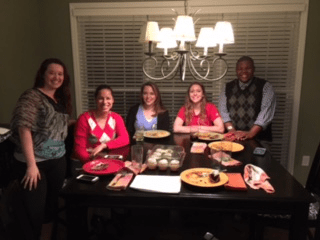
Kentucky’s Kitchen Table: “Finding Your Identity”

By Luke

After several weeks of scheduling conflicts and procrastination, our group was finally able to meet at our host Emily’s home for our Kentucky’s Kitchen Table project, which, to my enjoyment, ended up being a chicken taco night. After consuming an unsafe amount of Mexican food – as well as a delicious West 6th Amber Ale – it was finally time to have our discussion, which began of course with brief introductions.

Our host for the evening was Emily, a Bowling Green native currently completing her graduate degree at WKU involving an intricate combination of humanities courses. Dubbing herself as “Elisabeth Gish’s protégé”, Emily plans on living in a Chicago-based commune for approximately 9 months following graduation, and eventually hopes to attend divinity school in the Boston area.

Next around the circle was Daniel, a freshman on the path to nursing school. He briefly described his catholic-school upbringing in Louisville, which concluded with attendance at Saint Xavier High School. Like myself, Daniel enjoys reading and Netflix, but he also mentioned his heavy involvement with theater in high school. Volleyball is another of Daniel’s hobbies.

Ethan, another freshman honors student, was also in attendance. His interest in the broadcasting program brought him to WKU from Nolensville, TN, and his primary hobby involves working with the WKU-PBS television station. In addition, Ethan enjoys Netflix and hanging out with friends. He also mentioned being a baptist, although not extremely devout (this adjective described nearly all of our religious affiliations, aside from Emily’s).

The final member of our dinner/discussion was Alex, a fellow senior, who is wrapping up her degree in Agriculture this semester. Originally from the small town of Gallatin, TN, Alex enjoys horseback riding (specifically “barre racing”), kayaking, working on her truck & car, and shooting guns at the range with her father. She mentioned playing volleyball in high school, and identified as a southern baptist.

Only one of the “conversation starters” listed in the handbook (the required question) was officially addressed; however, our nearly two hour discussion encompassed several of the other questions indirectly. When asked about what “citizenship meant to her” (aside from voting, paying taxes, and following laws), Emily began detailing her somewhat abstract, yet immensely intriguing perspective on citizenship, which I’ll attempt to recollect.

She began by stating that we as individuals are citizens of several communities simultaneously. Some are obvious and based merely on residential locations such as hometowns, home-states and national residence (think “American citizens”). Others are more personal and greater in number/variety: extra-curricular clubs or groups, churches and other religious congregations, athletic teams at varying levels of competition, family units (whether traditional or not), friend groups, etc. As a result, human beings develop varying “identities” generated through association with varying communities (your personality/behavior around friends or colleagues changes when around parents and family, for example). According to Emily, as we grow and progress through the numerous chapters of our lives, we change how we prioritize the communities we belong to, and this in turn changes our identities over time. As a result, though any person at any given time may belong to a diverse collection of communities, one generally takes precedence over others and is responsible for what Emily referred to as that person’s “primary identity.” Think of it this way: when someone asks you to “tell a little about yourself,” the community associated with the majority of your description is your main priority (at the time) and is responsible for generating your primary identity as an individual.

For example, everyone in attendance other than Emily mentioned that practicing religious faith (i.e. our “religious community”) had become less of a priority since beginning school at WKU – an example of how priorities change in regards to communities we are citizens of. Personally, my social fraternity has been the most important community in my undergraduate career until now, and had previously generated my primary identity. However, as I prepare to graduate and move on to veterinary school in the fall, I’ve found that my primary identity has shifted, and the communities involving my girlfriend and select close friends have taken precedence. I’m sure that once I begin classes at Auburn this fall my “academic community” will become much more of a personal priority and change my primary identity. Being able to apply Emily’s theory to my own life helped it resonate all the more.

To conclude, Emily encouraged us to examine our own lives and practice articulating what our primary identities may be at the present time. This reminded me not only of Martha Nussbaum’s reading from Week 1 titled “Socratic Pedagogy: The Importance of Argument” that encouraged self-examination, but also Jonathan Haidt’s “The Intuitive Dog and Its Rational Tail” from Week 2 that urged readers to try and pinpoint the sources (i.e. the communities) of their own intuitions as a way to aid in debate and discussion. Discovering what motivates the decisions you make and the opinions you possess is critical to understanding yourself and properly empathizing with those around you, and I believe Emily’s theory attempts to get at the heart of what makes us who we are as individuals. If we find that we are satisfied with our primary identity, we should work to cultivate it and give our best to the communities responsible for its formation. If we are unsatisfied, however, perhaps we should begin to shift our priority to communities that can help us become the best versions of ourselves and support others in doing the same.

thumbnail_IMG_2302

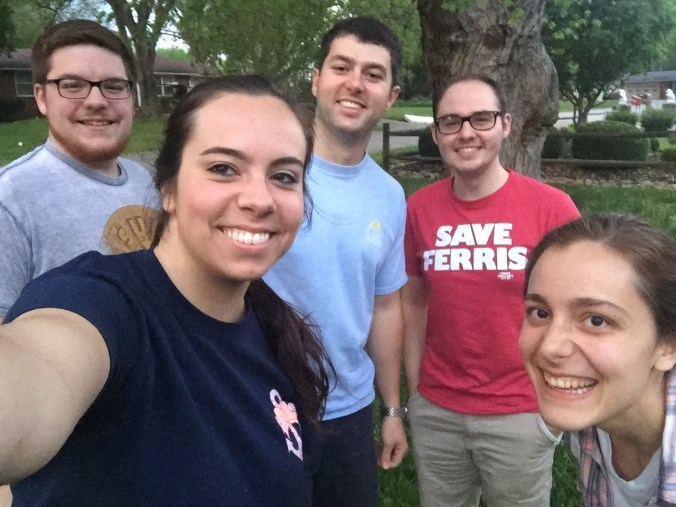
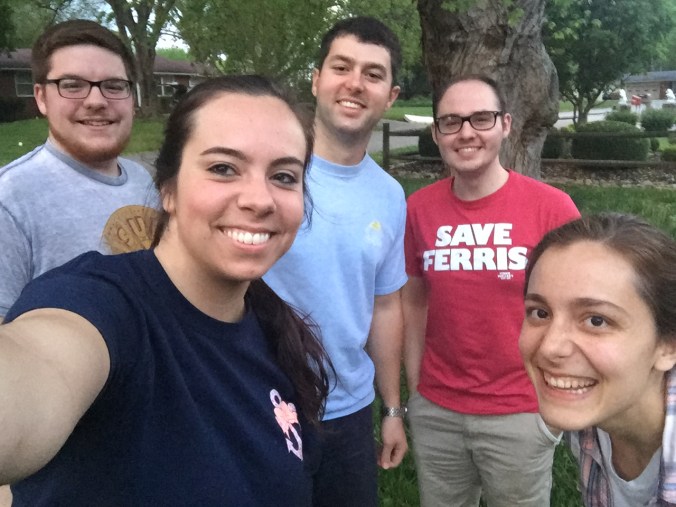
Back row (from left to right): Ethan, myself, and Daniel. Front row (from left to right): Alex and Emily.
 

KKT Project Reflection

By Alex

For the Kentucky Kitchen Table project, I was grouped with Luke, Daniel, and Ethan. We had a wonderful dinner with Emily, a former Citizen and Self student and peer mentor who has graduated from the Honors College and with a Masters of Religion at WKU and is headed on to graduate school.  We decided to potluck ingredients for tacos, and make the actual dinner together, to help cut down on having to spend extra time prepping food, but also to have some casual conversation and get to know each other a little before the actual dinner. Ethan is a broadcasting major from Tennessee. He works at the TV station on campus and in his spare time enjoys Netflix and hanging out with friends. Daniel is a nursing major from Louisville who enjoys theater, Netflix, reading, and volleyball in his spare time. Luke is a Biology/ pre-vet major from Harrodsburg, Kentucky. He is a Sigma Chi, and enjoys sports, reading and Netflix.  We had an awesome conversation which we decided to begin with our question, “What does it mean to be a citizen?”  From there we went on to talk about a more personal aspect of citizenship, and what that looks like in varying identities. We talked about how we identify as individuals, and what types of things truly define us. Emily spoke a lot about personal reflection, and encouraged us to really think about what specific communities we identify ourselves in, and whether we are putting one hundred percent of ourselves into these communities. I do not think any of us left without seriously contemplating our lives as we did.  The conversation was very high level, respectful, and meaningful.

Specifically, each of us had a slightly varying view of what citizenship meant to us.  But overall the underlying principles were the same. Be active. Be involved. Help others. Do what you can. We all had an outlook of citizenship as being part of a group or community and giving your best to help and improve that community.  We discussed how this is also an inward commitment. We must choose what community, or communities we want to be defined by, and then give one hundred percent in order to be effective citizens.  Those communities are not solely our towns, states, country, etc. but also our families, social networks, workplaces, and more. We agreed there are no real set requirements for being an “effective citizen,” but that it is more about giving what you can, and giving one hundred percent in everything.  In order to make our communities what we would like to see, we must be actively involved and engaged in the activities of that community.  We also spoke briefly of these things in a religious context.  With varying religious backgrounds, (Ethan and I were raised Baptist, Danial Catholic, and Luke Methodist) we all agreed that this was a specifically good example of our community identities and how we must realize and ultimately choose which ones take precedence.

I think our conversation relates best to our class reading on the elephant and rider from Jonathan Haidt’s book The Righteous Mind. In fact, we discussed this briefly.  This is a good example of determining which is controlling which. Do we control our identities within a community, or do those identities control us? It is also a good comparison of how we function and work within our communities as active and involved citizens.thumbnail_IMG_2302

Come together

by Barnabas

On Saturday, April 9th, I went to have a dinner with my friend Dominic, who is in my Honor 251 class, and people that I have never talked to and met before. I was very nervous about having to eat with random people and being in an awkward atmosphere. I usually do not eat lunch and dinner with my friends, because it provides me extra time to do other urgent things that are in my priority list. I thought this assignment will turn out to be terrible and challenging, but my assumption was wrong.

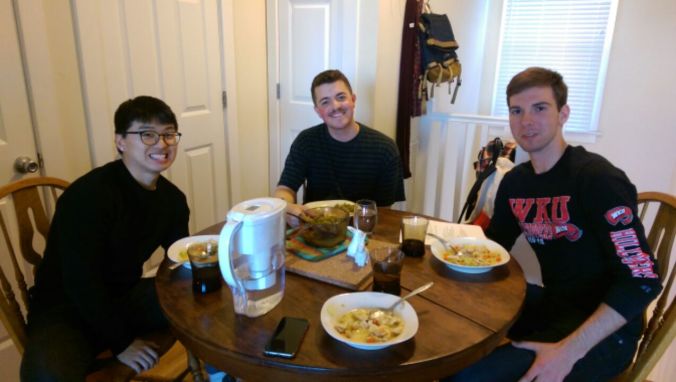
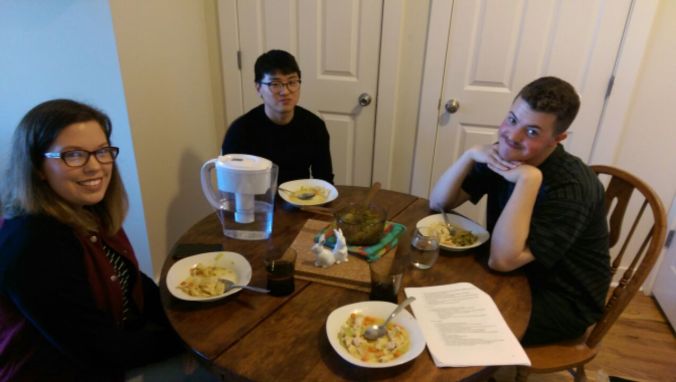
There were total of 4 people in my Kentucky Kitchen Table (including my self), all of whom were college students. Jared and Emma hosted and invited Dominic and me to their apartment near WKU to serve a dinner. Jared, senior and major in English in WKU, was the main cook who provided us with the delicious chicken noodle soup. This was actually my first time eating true “American food” other than hamburgers and pizza, and it was very delicious that I had to eat more than twice.  And Emma was one of his roommates, currently planning to transfer to college in Oklahoma. She used to go to WKU, but once she decided to transfer to Oklahoma, she got out of WKU and started to work in a candle store.

Contrary to my prediction that it is going to be awkward, it was very exciting to talk and share my thoughts and ideas to Jared, Emma, and Dominic. I talked about how difficult it was for me to come and having a dinner with them, since English is not my first language. I shared the frustration of being left out in the American college community due to poor English speaking ability and cultural difference. We talked about how Asians  like to get along only with people with their own kind and I explained that, this was due to the culture difference. There are certain things that Asians could form a common ground and agree and understand, while Americans can not. For example, when my roommate and I went to Greenwood shopping mall, my roommate gave me a weird look as I was spending my time in Hollister, and with his weird look, he asked me ” Hey, man what are you doing here?” He could not understand the fact that I was trying to buy clothing in Hollister, and he told me that Hollister was for high schoolers. In Korea, Abercrombie and Hollister struck the clothing markets, and they have become more popular and famous than Polo and other famous brands that many college students prefer.  In Korea, people regards being respectful to the elder as one of the significant cultural value. Being insulted by 2 years younger roommate made me realize that it is very difficult to fit into American culture, which became a barrier to socialization with American students. The Asians’ tendency to get along with other Asians is because they feel comfortable and agree on things more easily than when they are with American students. The hidden difficulty in Asians’ college life relates to the topics mentioned in  the “Paying for the Party.” Colleges should not view international students as influx of money, but great assets to diversify the college culture. Many students come to college pursuing their own pathways, and colleges can facilitate this by actively engaging. For example, WKU has done a great job to enrich American college experience to international exchange students by assigning American students to exchange students.

There were many other topics that we talked about after dinner, such as wicked problems, religions, gay marriage, and which historic person you would like to have dinner with, etc. Among the many topics, we showed much passion especially in a topic relating to college tuition. We talked about how expensive college tuition is, and how the cost of college education prevents many smart students from pursuing their dreams. We came up with some suggestions and possible solutions to reduce the college tuition, such as diminishing the investment on college sports and  on building construction on campus, etc. I mentioned that there are many additional things that are expensive along with college education, such as textbooks. We also noted that everything that has to do with college education seemed to be expensive without great efficiency, and that acceptance rate is very high, but the efficiency of college education is relatively low. Sternberg, author “Giving Employers What They Don’t Really Want,” says that colleges do not always provide what the employers want, which are the critical thinking, practical problem solving skills, and communication skills etc. If we go to college and get nothing out of it, except for good GPA, colleges are doing nothing good for us, but good for themselves, especially when we are paying tons of money.

After this KKT assignment, I learned that when people come together, we can learn what problems exist in our community, in our nations, and in the world and come up with effective suggestions from different perspectives. By sharing thoughts and ideas, we could discover effective ways to approach these problems, and we could even find issues that we never thought as problematic. I certainly learned that democracy is about individuals’ effort to make the world to live together and to solve the problem. Even if the individuals’ efforts are negligible to bring an impact to the problems, these small steps that they are taking is as significant as taking big steps to take down the problems. And without the small steps, the problems will eventually remain as wicked problems.

Talking to random people and sharing my thoughts and ideas was one of the greatest experience I have had in America. The interaction I had in Kentucky Kitchen Table taught me that in spite of  my poor English speaking ability, I could still actively participate in community efforts. Thank you Dr. Gish, for providing priceless opportunity for me to learn great lessons.

KakaoTalk_20160430_173954600

KakaoTalk_20160430_173957026

Kentucky Kitchen Table

By Daniel

By concept, the Kentucky Kitchen Table project just seems like an awkward situation to me. I questioned whether or not I would enjoy this experience. Although hesitant, I tried to keep an open mind so I could get something out of the dinner. Little did I know, this experience would become one of my favorite memories from this class.

My group consisted of Luke (a Biology pre-vet major from Harrodsburg, KY), Alex (an Agriculture major from Gallatin, Tennessee), Ethan (a Broadcasting major from Nolensville, Tennessee), and our host, Emily (a grad student and former Honors College student). We all brought ingredients for chicken tacos, which Emily made. We started out with a little small talk while waiting on the food. Once the chicken tacos were done, we moved into the living room and started our discussion.

We jumped right into the conversation with the question, “Beyond voting, paying taxes, and following laws, what does citizenship mean to you?” Emily believed that citizenship means being a part of a community and really owning your identity within that community. The language we use to define citizenship and self is like a market; it’s a cost-benefit analysis. We ask “Is what I’m putting into this community the same as what I’m getting out of it?” This mindset leads to believing that if you didn’t get enough from your community yesterday, then you won’t be inclined to contribute to it today. We have to go all in and take the risk that we won’t receive as much back, but also staying wary about into which communities we’re giving our all.   We can’t put our all towards every group we come across, or else we’ll be spread too thin. At the same time, though, we can’t isolate ourselves.

A lot of our discussion had to do with our identity, or as Emily would call it, our story. We talked about how college challenges every part of our identity we though we knew. All of us are some denomination of Christianity. Luke is a Methodist. Ethan is a Baptist. Alex was raised Southern Baptist, but just identifies as Christian. Emily is Christian, as well. I am Catholic. We have all had our faith shaken and identity put into question while in college. We discovered that, even though Alex and Luke are seniors and Ethan and I are freshmen, we are in similar situations. Alex and Luke will soon graduate and go into the workforce where their identity from college will be tested. Meanwhile, Ethan and I are about to finish our freshman year, where we’ve had our high school identity challenged. We decided that no one comes out of college unscathed—meaning no one leaves college as the same person they were when they started. Even though we will be pushed to our limits in college, we will come out stronger. This will make us realize, as Emily puts it, which identities are stronger and which are weaker. She explained this by telling us a story from her junior year. During Emily’s junior year, she was a good girlfriend, good best friend, and good student. When she was hit by a car, however, she lost all of that. When she felt she lost all parts of her identity, she realized the parts of her that are meaningful—the stronger parts of her identity.

The takeaway from this is that we must defend our identity, our story. Citizenship is a story. How we act in our community and how we contribute to our society is a part of our story. Therefore, we need to become better storytellers. We need to find the best way that we can contribute to our community—whether that’s our family, our church, our city, or our country—and own it.  In doing so, we solidify our identity, become better storytellers, and fully participate as citizens. kkt


Kentucky Kitchen Table

By Ethan

Our Kentucky Kitchen Table went a lot different than what I had thought would happen. I thought that it would be more awkward than insightful, but I was proven wrong. Our conversation revolved around how what we perceive as our identity can greatly influence who we are and how  we become better citizens.

My group, which included myself, Alex, Luke, and Daniel, were graciously hosted by Emily, a grad student who majored in Religious Studies. After our dinner of chicken tacos. we dove straight in and discussed what citizenship means to us. Some of the answers included having an obligation and a pride to the country we live in. As the talk progressed, we began to talk about how experience and choices we make will mold the identity we have and we present ourselves. Emily talked about how an experience she had that really had a profound effect on her and her identity. Before, she had spent her college career with the same group of friends from high school that all went to Western together. After an auto accident she was in, however she explained how her friend group essentially fractured. This essentially led her to reevaluate her identity that had been stripped bare. She also talked about she is at a crossroads in her life, and why she decided to live in a commune after graduating from grad school. Her experiences and words of wisdom were very valuable to the rest of us.

The rest of our group also talked about how our majors really have shaped or have begun to shape the identity we are creating for ourselves. Luke and Alex, both seniors talked about how the activities and majors they chose really played out in their identities. Luke is a Biology major and involved in Sigma Chi fraternity. He chose his major because his dad is a vet and he was around animals a lot growing up. He also talked about how his fraternity helped him meet friends he otherwise wouldn’t have made. Alex is an Agriculture major and she talked about how she lived at the agriculture farm WKU has and enjoys the small group of them there, who including the professors, are like family to her. Daniel and I are both freshmen and both of us are still trying to understand what our identities are and how we are presenting ourselves. Daniel is a nursing major, but went through a few other majors before deciding on it. He talked about the differences between WKU and his high school in Louisville, Saint X, an all guys Catholic school. I myself am a Broadcasting major living down near Nashville. I talked about how I came here, despite all my friends going off to the University of Tennessee, where I could have easily gone myself. But I wanted to break the norm of my surroundings, where most people in my high school end up going to Tennessee. I also chose to attend Western because of the highly ranked School of Journalism and Broadcasting and what I wanted to do with that.

One major talking point about identity that came up for us was that of our respective faiths. All of us were Christian, although different denominations for the most part. Daniel, having gone to an all Catholic school was first surprised that not everyone down here is Catholic. Luke said that he was a Methodist although he also said he doesn’t really know what that means in terms of denomination. I am technically a Baptist, and I also didn’t really know what that meant. Alex is a Southern Baptist and grew up in the church, deciding to come to Western instead of a private Christian college. Emily herself is a Christian and when she is done with grad school said she is planning on living in a commune for a few months before going to theology schools in Boston, in order to get a better understanding of herself and how a community interacts and supports one another.

In the end, the idea of identity is important to the idea of citizenship, as our identity coincides with how we act as citizens of our towns, states, and country. My Kentucky Kitchen Table really opened my eyes up to this and is something I can use to evaluate the person I am right now, and the person I will be a few years down the road.

IMG_2302

My KKT

20160411_202510By Madison

At my KKT I cooked dinner for my partner Allison, my boyfriend Luke, my friend Rachel, Rachel’s friend Emily, and both of my parents. I love to cook so I practically insisted. Allison is an Art History major at WKU who intends on going into art conservation after college from Northern Kentucky. Rachel is Allison’s roommate, she is an English major with a math minor who teaches Tae Kwon Do from Northern Kentucky. Emily, Rachel’s classmate, is an English Major with an International Studies minor from Eastern Kentucky. Luke is currently working for our home city as he prepares to go to the police academy, following in his father(our local sheriff), brother, and uncle’s footsteps. My mother, Kim, has been a stay at home mom since she left investment banking when I was in middle school and currently takes care of several elderly people as well as a neighbor of ours who has terminal cancer. My father is the manager of the Safety and Security departments at the top employer in the county and has begun to delegate the task as he is nearing retirement but he at one time consulted at facilities worldwide to help companies improve their safety measures.

The night had a rather lighthearted feel at the beginning as I got down to business (and admittedly interrogated everyone). We surprisingly didn’t have as much trouble as expected when we tried to find differences among us. Emily is a vegetarian (I made sure she had a veggie burger). Allison is a lesbian. Luke grew up in a police family and when he was 14 he assisted in an arrest by tackling a suspect while he was out for a run. My mother grew up in significant poverty, living in multiple homes where they only had an outhouse (she is only 47, most houses had toilets). My father has been blind in one eye since he was 8 due to a childhood accident. I have a trade certification in drafting and experience with electricity and lathe operation. Rachel is a Tae Kwon Do instructor. It was interesting to say the least to see what everyone focused on about themselves. Luke and Allison also bonded over the fact that both have had near death experiences, Allison when she was diagnosed with diabetes and Luke when he suffered from two heat strokes during a high school football game and was treated incorrectly on site. I’m fairly certain the others ignored Emily and I as we bonded over political science professors and courses.

Our responses to the required question of “other than voting, paying taxes, and following laws, what does citizenship mean to you?” were interesting to say the least. My father (a strict conservative) thinks he is funny; he replied that you shouldn’t be so quick to assume he thinks voting, taxes, and laws are part of citizenship. My mother thought it meant helping others, going beyond just passively existing in society and not getting in others’ way. Luke honestly hadn’t thought about it before but in the end he agreed with me, that you have to be politically literate. By this I mean knowing what is going on, actively seeking ways to influence the change you want to see in your country in any lawful way available to you. Political Literacy is knowing what is going on in your country and outside of it.

It really was remarkable to see were we all stood politically, socially, even economically and discuss how it could have effected our opinions. Even knowing a second language had to be factored in, going to a different type of school like my dad had, growing up as a minority in his own school like Luke had. It was a great illustration of the diversity this class demands we factor in when we think about solutions to public problems.

We’re the Dinner Ensemble – a KKT project

20160411_202510By Allison

Starting off our Kentucky Kitchen Table project, both my partner Madi and I worried that this entire ordeal would be rather awkward. We decided to have our meal over at Madi’s house, with both of her parents Kim and Tim, her boyfriend Luke, and our mutual friend Rachel, who in turn brought her friend Emily. From a first glance, our group did not seem to be very diverse, but, after having our conversation, our group’s differences came to light.

We began our conversation at the dinner table, after everyone had helped themselves to a classic grill out-dinner of hamburgers (or a veggie burger, in Emily’s case), fruit, macaroni and cheese, mashed potatoes, and snickers pie. We asked everyone one thing that made them unique, and if they would mind being described like that. As we went around the table, I jokingly decided to call myself the Sorority Lesbian, and further ridiculous names for the others were also born. After we all declared our unique names, we noticed that we sounded like some weird knock-off version of the Breakfast Club, and decided that we should give a name to our little rag-tag group of people. And in that moment, the Dinner Ensemble was born.

After that, our conversation got a little more serious. We started talking about diversity, and what makes people different from one another. We discovered that, even though we were all the same race, we all had a majority of differences that we believed counted as diversity, for example, our differing geographical locations, our sexuality, and our religious beliefs. Both Rachel and I are from northern Kentucky, which is essentially Ohio, Emily is from the Appalachian area, and Madi, Luke, and her parents are from Russellville. When it comes to sexuality, I identified as a lesbian, Rachel identified as bisexual, and the others identified as straight. Lastly, all of us have varying religions: I’m considered Agnostic, Rachel is Catholic, Emily is a Methodist, and again, Madi, Luke, and her parents are all Baptists.

On top of these, we also found that our individual experiences and personal beliefs helped make us diverse as well. Politically, we had a nice range, with Emily and I being liberals, Rachel being in the middle, and Madi, Luke, and Tim being Libertarians. Emily, Rachel, and Madi know another language besides English, and Luke doesn’t know how to write in cursive. Both Luke and I have had a near death experience, Madi has trade school experience, and Rachel is a black belt. I’m the only one who is a member of the Greek community, Emily, Rachel, and Luke are all CPR/First Aid certified, and both me and Tim have a disability: Tim is half blind, and I have diabetes.

We asked the one required question next: Beyond voting, paying taxes, and following laws, what does citizenship mean to you? Getting answers from people for this question was rather difficult – no one really knew how to answer. I started off by saying that citizenship to me means being politically literate, and not passive; actually understanding what is going on, and voicing you own opinion and being active, whether that be through voting or other means. Tim said that citizenship to him means being involved in the community.

Overall, our Kentucky Kitchen Table project was very enjoyable. There was great food, intriguing conversation, and good company, even if we didn’t really know each other beforehand. It was really awesome discovering that diversity is not just limited to race, gender and sexuality, but also a multitude of other factors as well. I found it remarkable that we were able to interact well with each other, despite our varying differences, especially the differences in religious beliefs and political views. Ultimately, I learned that people live better together by communicating with each other, learning to see each other’s viewpoints and sharing each other’s ideas, and that being active in your community can help you to communicate with others to accomplish great things.

Kentucky Kitchen Table of Concern

By Lily

Over Spring Break, I hosted my Kentucky Kitchen Table dinner at my parent’s house in Des Moines, Iowa. I invited over family members, as well as friends of family member I did not previously know very well. There were seven people at my Kentucky (or Iowa) Kitchen Table. There was Scarlett, who is nine years old and enjoys making art, learning about animals and playing the piano. I also invited Marlene, who is 84 years old and from Storm Lake, Iowa, a small-town in rural Iowa. She is active in the Presbyterian Church and spent several decades working at a flower-shop, she was one of the first working mothers in her town. She grew up on a farm outside of Storm Lake, in part during the Great Depression. Until 2008, she was a registered Republican. Bill, who was also at the dinner, is a 60-year-old photographer who has lived most of his life in Des Moines, although he also spent several years serving as a military photographer. He has been very active in the Des Moines Democratic Party. Married to Bill is 59-year-old Jennifer, who has also lived in Des Moines most of her life, though she was born in a small-town in Iowa. She has spent time both as a stay at home mom and as a commercial stylist, she is also an enthusiastic artist and equestrian. Janet, who was also at the dinner, is a receptionist who has been involved with a variety of liberal political causes and is a voracious reader. Janet is in her late 40s and married to Tyson, who is a stay at home dad involved with mental health activism. Finally, I invited Julie, who is informed about, but not very involved with politics. She has been a legal secretary for most of her life, as well as a single mom. And of course, my dog Penny was there, though she did not contribute much to the conversation.

My parents (Bill and Jennifer) and I made turkey burgers, a recipe we are known for. Marlene brought brownies, Janet and Tyson brought potato salad, and Julie brought fruit salad. Scarlett brought a piece of art she made in school to decorate the fridge. While eating our dinner, we had a very good conversation about citizenship that revolved around discussing the tenor of the 2016 Presidential Election. I began by asking everyone what citizenship meant to them, the most insightful answers came from the oldest and the youngest at the table. Marlene said that citizenship meant not taking for granted the rights and privileges we have as Americans. She explained that she is neighbors with several immigrant families and has assisted Sudanese refugees with her church, and they have all made huge sacrifices to be American citizens. This is a sentiment that I am going to let motivate my social issue project. I am so grateful to be an American citizen and I want to pay some of that privilege forward by helping others, Syrian refugees, gain that same status.

Scarlett, at nine years old, also gave an insightful definition of citizenship. She said that citizenship meant caring about others. Her answer immediately made me think about the week we spent reading The Empathy Exams and discussing the role empathy plays in citizenship. Even at such a young age, she realized that it is not simply important, but required, to care about others in order to be a good citizen. If we cared about the needs and concerns of others when we went in to the voting booth, went to the grocery store or even when we paid our taxes, we would much likely be better citizens.

After discussing citizenship, we talked about how the gratitude and compassion Marlene and Scarlett mentioned is so absent from the 2016 Presidential election. Even people in the group who have not been involved in politics before, were well informed about this election and had a strong opinion. Almost everyone, even those who have voted Republican all of their lives, said they would vote for the Democratic candidate in November. The conversation reassured me that, despite the nasty rhetoric at the top, most Americans want politics to be civil and compassionate.IMG_2295

Finding Similarities in Our Differences: A KKT Project

by Rachel

For mine and Amber’s Kentucky Kitchen Table, I invited Dalla and Chris; Amber invited Sarah. Dalla has been friends with my mom for years. She is from Brazil and moved to the United States when she was 12 to live with her aunt because her home life was terrible. After she met her husband while she was at Western, she and David put their roots down in Bowling Green, KY. Since Dalla constantly moved around when she was growing up, she is extremely integrated in the Western and Bowling Green community because this is her children’s home. Dalla also works at Western, as does her husband. 

Chris is an African American meteorology major from Louisville, KY with his sights set on an amazing career as the most informative weather man ever. He is obsessed with snow and all things weather. Chris also was the head of our study group which got me, and him, through Calculus III. A great interesting thing about Chris is that he is always dressed up. Every time I have ever seen him, Chris is wearing dress slacks, gorgeous dress shoes, a button up shirt, a tie, and either suit coat or a sweater vest. Chris explained that he does this because when he dresses casually he feels overlooked or considered unimportant, especially as a young black man.

Amber’s friend Sarah is a Caucasian Music Education major. One of the major things she shared with us when we were discussing the importance of giving and receiving help, was that in this new world of short attention spans, she feels like asks for help is an inconvenience for those around her. Sarah highlighted the fact that with the intense shift towards instant knowledge has cut us off from each other. Through dinner, we discovered that we all felt that the absolute most important part of being a part of a community is being willing to communicate, by talking but also being willing to listen.

Amber and I started the dinner off by awkwardly asking some of the suggested questions. Dalla seemed to jump right in and eventually pulled all of us into an amazing conversation primarily based around what community means. Our over-arching theme of community was communication and being willing to help each other. We all shared great personal experiences that highlighted times we helped others, times we were the ones receiving help, times we held the burdens of others, and times we gave our burdens to someone else.

I couldn’t help but think of the chapter on Jane Addams’ Hull House we read in class that discussed the tribulations that come with good intentions. Many of the stories that were shared over our stuffed pasta and garlic knot dinner were ones of helpful deeds with many obstacles. Chris shared an experience when he put his life on hold for a few days to help his friend hunt down the perfect printing of his poster to take to the meteorology research presentation conference. Chris explained that even though it was long and grueling, he did it because he knew his friend would be less stressed and happier when the situation was resolved.

Dalla shared a heartwarming story of colleagues joining together to support each other in the mourning of a lost friend. She even told us that she was the supportive rock in this situation because she knew that her employees needed someone to just listen to them cry. Dalla explained that though that was her role now, she could just as easily be on the other side tomorrow, needing someone to cry to. We all agreed that this is a key component in a successful and happy social environment. To create a better world we must all be willing to be what others need us to be but also understand that we will eventually need someone to be our hero in a time of need as well.

We also discussed that within a community, it is equally important to take care of oneself as well as help others. We noted that if we do not take care of ourselves first, how can we expect to help others. Overall I believe this idea of knowing not only what others need but also being aware of your needs and finding the balance of filling these needs was our key in “designing” a goal community.

KKT

The Citizen, Community and You

By Amber

My KKT project partner was Rachel. We had dinner at her house with a table of 3 additional people, Dalla, Sarah, and Chris. Chris is an African American man who is majoring in meteorology and has had the experience of reporting with various local news channels. Dalla is also a woman of color and works at WKU. She has done extensive traveling, living in several different places for extended periods of time. She offered a different perspective because she was the oldest in the group (30s) and from a different generation. Sarah is a Caucasian female with a major in Music Education and grew up in an urban setting. Rachel and myself are both Caucasian females who have lived in the Bowling Green area most if not all of our lives. For dinner, Rachel’s father cooked stuffed pasta shells and garlic bread. I brought the dessert of cupcakes and Dr. Pepper so that people could have a variety of drink options.

At first, the dinner was strange and a little awkward. We didn’t know each other at all, so it was difficult to begin discussing such profound topic with strangers. Rachel tried to facilitate conversation by welcoming everyone and asking the first few questions about citizenship and what it meant to everyone at the table. We asked questions that had been the topic of discussion in our classes including: what are we obligated to do for our communities, and when is it okay to say no to other members of the community? Dalla jumped right in and began sharing her life experiences. Rachel and I found that the conversation steered itself to a degree and didn’t require either of us constantly asking questions to keep a decent discussion. Eventually, everyone became noticeably more comfortable and started to loosen up and the discussion came quite easily.

For Dalla, who has moved several times, her sense of community changed throughout her life given different cultures and norms. Now, she has a very close connection to her WKU, religious, and Bowling Green communities. She also feels very connected, happy, and safe to have such connections knowing that she has people who are willing to help her just as much as she helps them.

Sarah, even though quiet, reported that she feels uncomfortable asking people for help not as a symbol of pride, but that she doesn’t want to inconvenience people. She also said that she is much happier because of the connections and friends she has made within her community.

Chris’s community of meteorology friends has not only provided him with friendship, but also a continuing flow of knowledge and references for future employers and jobs. He has also found that the nicer he dresses the better people treat him. He feels, especially as a young African American man, that if he wears casual clothing people tend to by pass him, but if he wears a suit, people often call him sir and ask if they can help him in any way.

Rachel also feels very comfortable in her community. She understands that there are certain things that we are obligated to do for our neighbors, friends, and even strangers. In general, it’s all about making life a little better for everyone.

I shared that I am a country girl from a small community. Everyone knows everyone where I’m from and watches out for each other. Often times, without the help of others, crops die and families are plunged into debt.

Overall, the main points made were: Who is in your community? How do you fit into your community and what can you contribute? Equally important is knowing when to ask your community for support so that you don’t get so overwhelmed that you become a problem instead of help to the community. The group came to the consensus that knowing and understanding these points is very important to having an efficient community and for overall happier living. We originally planned on having dinner for about an hour and a half. However, we began at 6:00 and didn’t leave until 8:30. We had some very interesting and insightful conversations that most Americans, in our busy lives, forget about. Too often we expect other people to “figure it out” for us and forget that we actually have the power to make change in our own communities. IMG_1432