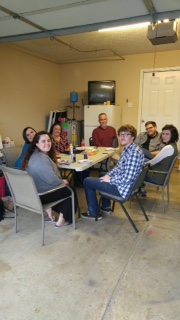
Brian – Kentucky Kitchen Table, Bowling Green, KY (Chinese Flagship House)

By: Brian

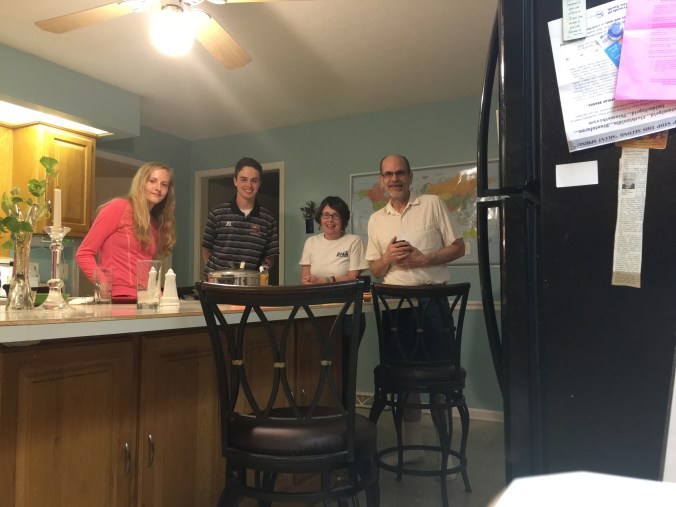
Kentucky Kitchen Table Cast and Crew

Kelly- A transfer from Simpson College and sophomore member of the WKU Forensics team. I’ve known her about a month now but we’re not that close.

Austin- My roommate, he is originally from California and is also a member of the Chinese Flagship. I’ve been friends with him since high school.

James- A 26-year-old from California, another transfer student who is a senior here at WKU. James wants to be a speech and debate coach after he graduates and gets his masters degree. He thinks that coaching students to be policymakers will help improve decision-making at all levels of government. The reasons he articulated lined up very nicely with ideas we discuss in class surrounding deliberative democracy. I’ve known him a year.

Abby- an ASL teaching assistant from Texas who is dating James. She’s very active in Baptist Campus Ministries and along with James is very religious. I had never met her before.

Myself- Well, you know me.

Dinner

There was a debate about what the meaning of citizenship was. Most of the debate was based around playing a role in the community outside the government. I talked about how important it is that when abroad you act as a citizen ambassador, specifically as a means of playing the role of American citizen outside the relevant government agencies such as the State Department or Central Intelligence Agency. They don’t want foreign governments targeting you after all. This means being willing to volunteer in foreign countries through little things like spending time with elderly people or introducing children to foreign cultures. James articulated the general understanding of what being a citizen means, specifically with regard to the social contract. He articulated the premise that being a citizen implies that we accept the government’s monopoly on violence and in return we get to feel safe. However, he took it one step further and said that it was more than just about accepting that we can’t take violence into our own hands, he further explained that when the government fails to use that monopoly on power to hold up their end of the bargain, that charges us with the responsibility to pick up the slack. He’s a big fan of Batman and made that pretty clear. In essence, we have to go out and protest abuses of government power and also volunteer where the government isn’t providing. James didn’t have the poetry of Claudia Rankine, but articulated how important it is that as citizens we recognize our privilege in all instances so as to avoid the small moments of racism, whether from ourselves or police officers. After wading through all the references to philosopher’s whose names we didn’t know, we all pretty much agreed with how James saw being a citizen, even if some of us had more faith in working through the government for structural change. Austin has already taken Citizen and Self, so he agreed that citizenship is a function of personal agency outside the realm of government action but added that it’s important to not just focus on what you can do but rather what you can convince people to do together.

We talked a lot about how everyone felt about Kentucky. None of us were originally from Kentucky, and each of us moved here at different stages in our lives. Kelly has just moved to Bowling Green from Iowa and hearing her describe what she thought of her new home was pretty interesting. Obviously, she has been pretty busy with school, but she’s acclimating to Kentucky culture pretty well. She finds that there is a lot more blatant sexism on campus than she found in other places she has lived. So we discussed how that has impacted the shift to Kentucky. She also made it pretty obvious that she wasn’t just letting those issues go either, which means that she’s probably got this Citizen and Self thing on lock. She hasn’t had a hot brown yet, a fact we all teased her about, but that’s alright. Abby had a fairly easy time transitioning to Kentucky, she and I are from more rural backgrounds than the others, and laughed about how much we hate wearing shoes during the summer- a fact that the others made fun of us for. James lamented how much he disliked Kentucky, complaints that Austin chimed in on as he was originally from California himself despite having moved to Kentucky at a young age. Sure, it isn’t the most exciting place and there is a lot of racism that all of us find problematic, but we all enjoy living here and racism is a problem everywhere not just the South. We also discussed how I went about making the main entrée and dessert for the night. My mother’s secret lasagna recipe (Stouffers) and her tiramisu recipe. Unfortunately, when I was making the Tiramisu the custard didn’t set as perfectly as it does when my momma makes it, but everyone still liked it, or at least were very polite guest. We discussed traditional kitchen gender roles and how odd it is that the perception is that only women cook and how it’s still sexist to think that men deserve bonus points for being good cooks. Yes, it’s a good trait to have, but thinking that it’s any more special than a woman knowing how to cook comes from a sexist notion that we have internalized. Kelly brought salad and some homemade ranch dressing and James and Abby brought sweet tea. Then they teased me over calling garlic Texas toast “garlic bread.” In my house, if it was bread and had garlic on it, it was garlic bread, but apparently they are two different things.

One of the most interesting parts of the activity was the breadth of languages used. Austin and I were able to teach the table some basic Chinese (hello, yes, no, etc.). Moreover, I got to give the group a tour of the house and teach them some cool things about the rules of Chinese dining etiquette. For example, the person who is the most respected in the group sits at the furthest middle seat away from the door. This is so that whoever walks in will see the person in the place of honor first. This seat is often taken up by the oldest patriarch of the family, except in instances of a funeral celebration in which case the youngest boy will sit there and represent the grandfather. We didn’t use chopsticks to eat lasagna or tiramisu, but we did think about it. Furthermore, Abby and James were able to teach the table some basic sign language (yes, no, thank you, etc.). Though many wouldn’t think it, Western Kentucky University is preparing students to interact with a broad range of backgrounds and cultures. I got to talk about my father, who was a teacher at the Kentucky School for the Deaf for a number of years. Abby, who would be traveling to KSD in the coming weeks, told me that she loves KSD. We were able to discuss this little deli in the middle of Danville, Kentucky and the world became that much smaller. When people think of language in Kentucky’s they usually think of a southern accent or maybe the state’s burgeoning Spanish-speaking population, but Kentucky’s culture is so much broader than that. Myriad languages have found their place in the Commonwealth, something that became all the more clear to me as a result of this project.

Kentucky Kitchen Table Project

By Andrew

Going into this project I had no idea what to expect, other than maybe awkward and forced conversation on a rainy Wednesday. What I experienced was a totally different thing altogether. This has and will be my favorite memory of Honors 251, something I would have never guessed beforehand. The hosts, a writer couple, of the dinner were not only great cooks, but very interesting and kind people and I had the pleasure of getting to peer into their lives for a night. The group was diverse in many ways, with our beliefs (Christianity, Islam) and backgrounds, and the conversation was always respectful despite the differences. Abbas, a bio major hoping to become a plastic surgeon. Abbas is not only Muslim, but also in a fraternity which led to some funny stories. I did not know Stephanie’s religious beliefs, but she is also a bio major and an un upperclassman, she was a transfer student from a school in Florida. David and Molly were both writers who love going to parties together, traveling and have Catholic roots but are not religious. Something that surprised me initially is that Molly asked me to pray to start our dinner, but I felt that made all of us all open to one another. Talking about through introductions and Molly sharing interesting stories of a bizarre house party and her time in college at IU, we began to eat. Molly insisted on us not bringing food and providing the appetizers, main course and desserts. Molly and David described citizenship to us as being aware of what is going on in the world and also being courteous to those who were not as lucky. They explained that they felt citizenship was more of a relationship with ones community and country. Between our conversation starters many small conversations popped up, such as the stereotype of Christian gun owners, the presidential election, and even young marriage. Molly was surprised to hear that my family and I though Christian, were not pro-gun and I had the opportunity to share my beliefs on gun control and why I do not think being armed aligns with Christian values at all. Another interesting topic we discussed was our neighbors, and if we interacted with them or truly knew them. Molly and David were not particularly close to their neighbors due to them being very different. After David talked about his passion of teaching English at WKU and his love of different books that myself and the others had no previous knowledge of. Both of the hosts grew up and had fundamental knowledge of Catholicism which helped them understand my Christian background and upbringing. Our conversation jumped around for a while as we enjoyed a warm batch of brownies. We then talked about the stresses of school and our future, Molly did a great job of helping calm us and help us think about the big picture and making friends and having a good time. I took away a few things from the dinner that stayed with me, the first being how badly Christians often represent our faith. Molly and David had obviously had bad experiences with Christians that shoved their beliefs and political views down their throats. Something that was a positive takeaway from the night and the class in general, is that I learned being a citizen is more than paying taxes, and being kind to strangers. It is being aware of your situation and seeking improve not only your life, but the as well as the lives of others. This dinner and the conversations we shared was a great example of people who do not agree on religion or politics, still being able to enjoy each others company.IMG_2312

A Kitchen Table in Bowling Green, Kentucky

by Davis

At the start of the semester when I first heard about this assignment, I wasn’t sure what to expect from it. But after I had dinner with my classmate, Savannah,  and our host, Jennifer, I had learned more about what it means to be a citizen.

The dinner that Jennifer made for us was a delicious bow-tie pasta dish and a salad, and the coversation we had was just as good as the food. Our conversation started with the question, “What does it mean to be a citizen?” All of the answers to this question were very enlightening, and we each had a slightly different way of answering the question. However, all of us agreed that having compassion and empathy for other people is one of the cornerstones of citizenship. If people aren’t able to talk to each other or seek understanding with others, democracy stops working because people won’t be able to reach compromises. This led to more discussion about the 2016 presidential elections and immigration about the importance of creating dialogue between people instead of divisions.

I especially liked Jennifer’s attitudes about empathy. She talked about her work with a humanitarian organization at a refugee camp, and how the refugees were basically stuck in the camp because most of them didn’t have any papers that would allow them to get citizenship in another country. Almost all of the aid that reached the camp came specifically from that humanitarian organization, and it tried its best to help some of the families immigrate to the United States. However, once in the United States, refugee families still need support from the communites they live in, and the people still in the camp need support as well. Hearing a story like this underlined the importance of reaching out to other people and having empathy for where they came from, as well as where they are going.

My biggest takeaway from this project was the importance of interacting with other people. Under normal circumstances, I wouldn’t have had this dinner, but because of this assignment I had a meal and a conversation that I learned a lot from. If you don’t take the chance to reach out to other people, you will never learn what insights they have to offer. But by having empathy for others, you can be a better citizen and help to create more understanding between people.

60’s, 70’s, and 80’s Hits Pandora Playlist

By William

At the dinner was myself, Colten, and our gracious host Nate. Colten is a Bio-Chem major and is from McLean county. Nate retired from his teaching position at Warren Central High School around 2005 and is currently a pastor at his church in Christian County. While growing up Nate moved frequently, changing residence every couple years due to his dad’s job. He has a killer 60’s, 70’s, and 80’s hits playlist that was playing before, during, and after our dinner. When Colten and I arrived at Nate’s house (after pulling into the wrong drive-way of course) we were greeted in the drive way by a white poodle and Nate himself. Now, sitting at the kitchen counter, we all got to know a little about each other over the fresh fruit I had brought. Eventually, we moved to the dinner table big enough for only three people. For the first minute or so we all stuffed our faces with the surf n’ turf meal Nate had prepared. As we proceeded to inhale everything in sight, Nate informed us on how excited he was to cook this meal. Sadly, Nate’s wife passed away a few months before. Because of this he doesn’t cook much for anyone other than himself.

After stomaching this news we started to ask Nate the questions that were supposed to induce conversation. Unfortunately, neither Colten or I were good at making these questions seem smooth or not awkward to bring up in discussion. Nate, however, took the questions and ran with them by going on tangents and telling stories. When we asked Nate about what social issue is closest to his heart, he responded with education. Because Nate was a teacher, he has a deep interest in the lives of the kids he was with everyday. He values education, he says, because “people can steal your money and your identity, but they cannot take away your education.” Nate told us a story about a student he once had in class who did not receive the love that he needed from those around him, especially his parents. Everyday, Nate would give this student a hug and eventually would say, “Hey man, I just want you to know that I love you and I care about you.” Nate says he would get a lot of concerning looks and comments from the teachers about how it was inappropriate for Nate to interact with a student like this. He made it very clear to us that if he got fired for making sure a student knew that they were loved and appreciated then so be it. Next, we asked Nate if he believes that he had any kind of obligation to the people in his community. Immediately he responds saying that we do have a responsibility to those around us and that “we are human, what’s the point if you’re not going to care?” To follow up this question we asked what he thought you could do in the community to help others. Three things came to his mind. The first way to give to the community was through your time. If you didn’t have time to give, then money was another option. Lastly, and most importantly, was through building relationships. Both Colten and I agreed that this was the most important way to give back to the community. We immediately mention how we just talked about this topic in class. We brought up the point that it is sometimes counter productive to go into an area, do the work, and then leave as if we know the solution to some one else’s problem. We tied this back into the relationship comment saying that a lot of the time people are just looking for someone to listen to them so they can actually help and be useful. We also talked about how Nate’s religious identity relates to how he thinks we should treat other people. To answer this, Nate tells a story about his church. Nate’s church, which is Disciples of Christ denomination, declared gay people as still part of the church. He says after doing that, around fifty percent of the church left. He says that people lack the confidence to be good and instead put others down to make themselves feel better about their relationship with God. Nate reiterated throughout the conversation that “by our love” we show what Christianity really is. Although it was the first question we asked Nate, I think it is the best one to end this post with. “What does citizenship mean to you?” He replied with a simple yet ultimately true statement. “To help other citizens in need.” Nate understood that being a citizen doesn’t mean doing whats best for yourself. It is about doing what’s best for others which in turn will be best for everyone, including yourself.

Finally, to end the night we had some coffee, water for me however since it was close to bedtime, and dirt pudding made by Colten. While we ate dessert, there wasn’t much conversation other than a story about how Nate met his wife. While he told the story, I reflected on what all had been said at dinner. I realized that a lot of what we talk about in class, comes down to just being a good person. Nate has never taken Honors 251, yet he embodies most of the idea and principles that we go over in class. We listened to how Nate doesn’t always agree with others around him, yet he still cares about them, loves them, and wishes to see the best for them. That is definitely something I will take away from this dinner with Nate and Colten.

IMG_7177

By Victoria

KKT PicMy partner in in the Kentucky Kitchen Table assignment was Sam, a broadcasting major from my Citizen and Self seminar. Our hosts for this project were Tom and Stephanie, a married couple. Tom and Stephanie follow a vegan diet, so this meal was a fairly new experience for me. While enjoying the delicious meal, we talked about several topics relating to what we’ve learned in class, starting with what citizenship entails beyond voting, paying taxes, and following laws. The main points that were brought up on this subject were ways to successfully live with each other. For example, we agreed that it is important to pay attention to those around us, rather than living in our own little bubble, and that we have to be patient and work with others to resolve differences. We also talked about what feel are the best things in our world today. Stephanie had a lot to say on this subject. With her kids living in many different places around the world, she is very thankful the world is so interconnected, and that she is thankful for programs like Skype that allow her and Tom to stay close to their kids despite the physical distance. Next we talked about whether or not we have any obligations to other people in our country and community, and we had a couple different opinions within the group. Tom, Stephanie, and I agreed that we do have obligations to those around us, especially when they’re in trouble, but Sam disagreed, giving the same opinion he gave when this subject was discussed in class: that we should help those in need, but we don’t really have any obligation to do so. Though we could see understand where Sam was coming from, and vice versa, we eventually had to simply agree to disagree on the subject. Finally, we talked about what advice should be given to those running for office in our country. The main points there were that political candidates should be open and transparent, keep their promises, and accurately represent the people they are supposed to be representing. The project was a good opportunity to learn how to discuss important social issues and what can be done about them, which relates directly to what we have been learning in class. It also gave me a chance to enjoy a meal unlike what I usually eat, with people who lead a different kind of lifestyle than I do, which relates to what we’ve talked about in class with understanding people’s experiences that differ from yours, which can give you a new point of view on a subject. Lastly, it allowed me to meet new friends. I thoroughly enjoyed dinner with Tom, Stephanie, and Sam, and the conversations we had.

Emma’s Kentucky Kitchen Table

For my Kentucky Kitchen Table project, I had the opportunity to collaborate with my classmate Sloan. We ate with Beth, the Coordinator of Resource Conservation at our university, who generously opened her home to us. Additionally, we got to eat with Beth’s three children—Gabe (9), Emmylou (8), and Camp (4)—and a couple of their friends who had come over to jump on the trampoline.

Beth and her family created a welcoming, open environment for dinner and conversation. It was a warm spring evening, so we decided to enjoy the weather by eating on a picnic blanket in the backyard. Beth said she and her family did this fairly regularly, and I admired the evident joy and connectedness she and her children felt in their home. Beth, Gabe, Emmylou, and Camp shared a similarly sunny disposition that helped alleviate my stress from school and enabled me to focus on the conversation we were to have that night.

For dinner, Beth prepared a delicious venison and vegetable stew using a deer that Gabe had shot himself. She also baked fresh bread. Sloan brought a fantastic, homemade hashbrown casserole. I brought tortilla chips and carrots to accompany the salsa ranch dip I had made.

When we sat down to enjoy our food, Beth asked Sloan and me about our college experience so far. We discussed the sense of possibility we felt here, as well as the similarities and differences between Bowling Green and our small hometowns. Then, we asked Beth about her interest in sustainability, which was evidenced around her home in a myriad of ways—the vegetable garden, the flowers, and the windows that allowed ample natural light to enter. She talked to us about how connected she felt to the earth, and then we got to learn about some of the kids’ interests. Gabe, Emmylou, Camp, and their friends told us about the numerous sports they were interested in. Their boundless energy was exemplified in their bubbly conversation and later in their running and jumping on the trampoline.

After we all learned more about each others’ interests and histories, Sloan and I asked Beth the required question: “Beyond voting, paying taxes, and following laws, what does citizenship mean to you?” Her answer really resonated with me. She told us that citizenship meant being a part of an interconnected community and being a good neighbor. She explained how knowing one’s neighbors helps one to cultivate empathy and better understand people, which translates to betterment of society as a whole when enacted on a large scale. This reminded me of the “Empathy Exams” readings we did for class, which emphasized the truth that one must actively listen to others in order to appreciate their situation and demonstrate compassion.

In conclusion, I learned a number of things from this dinner. From Beth, I learned to be more open and to make an effort to understand and communicate with those around me so that I may learn from their experiences and develop more empathy. From Gabe, Emmylou, and Camp, I learned to relish the activities and opportunities available to me, as well as the company that surrounds me. The Kentucky Kitchen Table was a refreshing break from routine, and I hope to someday host a meal with a similar setting that encourages thoughtful conversation.

Won’t you sit and share this pizza with me?

By Michaela

IMG_7089

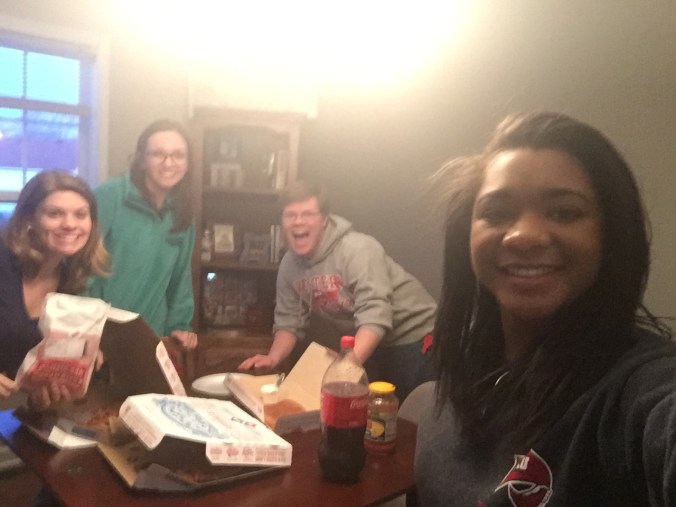
For my Kentucky Kitchen Table project, I had the amazing opportunity to share a delicious pizza with my host family Tyler, Jeanna with her roommates Haley and Molly. I am going to be very honest when I say that I had my reservations when I learned that we would be eating with strangers in their home. I was concerned that I wouldn’t feel welcomed since I didn’t know how much information was exchanged. However, the experienced turned out to be one of the best ones I have ever had.

Upon arrival, I was instantly welcomed with hugs and excitement by Jeanna and my her dog.  The pizza was running a little late so we got the chance to have a causal conversation before beginning out project around the dinner table. Jeanna was actually a recent graduate of Western Kentucky University. She works as a Park Ranger at the National Park and as a worker for an Autism organization. She has a very energetic kind of character and is very interested when it comes to stories shared by others. She likes to describe herself as a compassionate person who loves the outdoors. Haley is also a graduate of Western Kentucky University. She is a part of the campaign for the American Heart Association. She works on the Hoops for Heart campaign that urges elementary children to stay active and is an active fundraiser for the campaign. She has an opposite personality than her roommate Jeanna. She is a little more laid back. She loves golf and is very engaged in her studies.

As the pizza stared to arrive, we talked a little bit about our lives. We discussed where we came from in the parts of Kentucky. Jeanna and Haley had both originated from a rural neighbor in a small town where everyone knew each other. They said the move to Bowling Green was very intimating, because the city was so big. I thought this was pretty funny, because the town I come from, which was Lexington, is a lot bigger than Bowling Green. I was every interesting to see the different perspectives based on where they are raised.  I assumed that Jeanna and Haley would have different perspectives on today’s issues because they were raised in a small, non-diverse community. Instead, I have come to find out that their perspectives on today’s issues correlate to how a view today’s issues.  For example, Jeanna and I both agree that the environment should be the world’s top priority among with diverse equality, though she would put the world’s environmental effects as her number one priority. She has told me that she has seen the devastation of the environment first hand ever since she started working for at the National Park.  She says, “No one really understands the effects of human destruction on the environment, because they don’t see the impacts that come from their constant harmful effects first hand. Hearing about it on the news only makes us think that it is an issue that will fix itself or something that we will have to be worried about later. It’s the laziness and greed of humankind that will ultimately destroy the Earth someday, and its sooner than people think.” I told her we had discussed the devastation of the environment as a wicked problem in class. I told her that we might actually be too late to come up with a fast and effective solution, the only thing we can try to do is make it better”.  Her passion on the topic made me think that if everyone in the world had that kind of passion and heart, that we really could find a solution to the wicked problems of today, not just for the environment, but for other issues such as racial inequality and poverty.

As the conversation progressed to wicked problems, Haley also added her views on these issues, in particular, the racial inequality among the U.S. She made it clear that through she was a republican, she didn’t want to affiliate herself with the republican candidate Donald Trump. “He will singlehandedly destroy the US!” Though she does agree on the immigration problems with Mexico, she doesn’t believe that the problem can be fixed by building a wall. “What ridiculous moron would even suggest that! It’s completely inhuman, and offensive, and cold. How are they going to say ‘no immigrants ALLOWED’ when they are themselves immigrants?” This discussion also connected with the concept of wicked problems. I do agree with her statement, but I can also see how some people would be upset to the fact that there are illegal immigrants taking advantage of the opportunities of America without also sharing the responsibility of an American. We threw around some ideas that could help solve this problem, but some of the solutions had holes in themselves. However, we did conclude the only way to find a true solution is to talk about it. We like to think that it is best to have one person speak and have everyone follow, but then so many other ideas will be shadowed an ignored. We have to learn to sit down and talk to each other. Without talk, there can be no action.

The KKT project was a very stimulating project. It allowed me to discuss today’s issues with people who are different from me. Its process like this where we gather people from different backgrounds to try to come up with solutions to problems that opens our horizon to our own perspectives. It indirectly shortens that gap we like to create between ourselves and others, creating what the world had intended when society came up with the word citizen. Not only are we connected with our society, but the people within it. As soon as we start to realize that, we will be able to handle the wicked problems that arise.  So, to whoever may read this, won’t you sit down and have a pizza with me?


KKT with Lil Britches

By Kendall

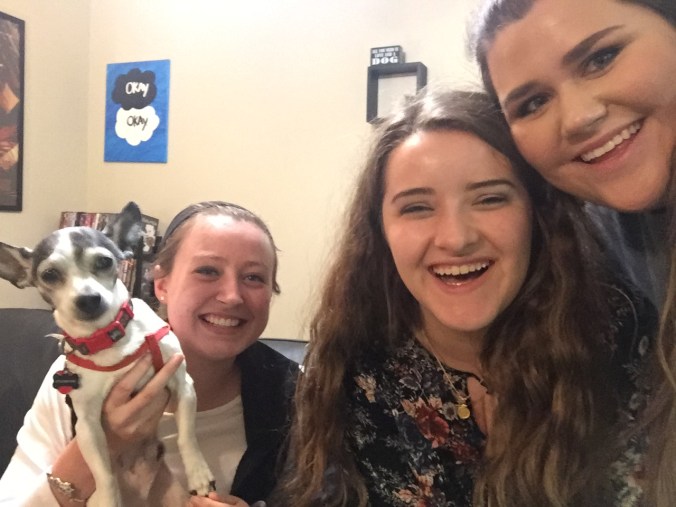
I had the wonderful opportunity of having dinner with McKenzie, my friend Lindsey, and McKenzie’s adorable pup, Little Britches. As a table of three college-age women, we didn’t see much diversity at first. However, we found we were all raised very differently and are all majoring in very different fields.

Lindsey, who recently turned nineteen, was raised in a small town in central Kentucky that she jokes is “population more cows than people.” She is the youngest of two with an older brother. Her parents were very conservative when she was a child so she wasn’t exposed to much in the world of rap music, video games, TV,  or other common things for most children. She was raised very Christian and still holds her faith very close to her heart. Her faith drives many of her decisions and is where most of her morals stem from.

McKenzie, on the other hand, is a 22-year-old college senior who will be graduating in just a few short weeks. She raised in a suburb just outside of Louisville. She is the oldest of five which she believes played a huge role in her upbringing. She has a huge heart for others and always puts them before herself. Although she’s not Catholic, she says people often mistake her family for being a Catholic family because of their good morals and high standards. She says her mom was very strict, with her being the oldest, and instilled in her a perfectionist complex.

Finally, I was raised in Northern Kentucky right outside of Cincinnati, Ohio. My family always stressed the importance of academics and I was taught that I can and should excel at everything I do. I was brought up in a Christian household and went to a Catholic school until I was eight. Church was always a huge part of my life growing up but, now that I’m older, my family has drifted away from our church. I can tell you the last time I attended service there was Easter of my eighth grade year; however, my faith in God still remains. My family has always been big on community service and my drive to give back and my Christian values are the main contributors to my own personal morals.

We started our dinner with some light conversation about our majors, Little Britches, and how excited we were forMcKenzie’s macaroni and cheese and my double chocolate brownies.McKenzie and I discovered we were both in the psychology field. She is headed toward a degree in developmental while I’m on a behavioral and neuroscience track. Lindsey, on the other hand, is a graphic design major and fashion merchandising minor. Little Britches is graduating with a degree in face-licking and dog modeling. We joked about the “conversation starters” and kept the required “what does citizenship mean to you?” at the back of our minds.

We all agreed that one of the great things about our world today is how connected we all are. Often times, social media is painted in a bad light but it keeps us in touch with what is going on all over the world. Lindsey said it best stating, “our world is much smaller than it used to be now that we all have Twitters and Instagrams.” We also decided the availability of instant mac and cheese makes the world go ’round.

We all wanted to avoid political discussions as much as possible seeing as none of us consider ourselves very politically informed. However,McKenzie had some good advice for future presidents saying she’d rather they be “genuinely for the people” rather than put on a good face just for votes and, most importantly, be a huge dog lover.

After a brief break in conversation used to follow Little Britches’ Instagram page (which is @instabritches if you’re interested), we finally made our way back to the important question. “What does citizenship mean to you?” Lindsey believes doing community service and giving back to the community to make it a better place to live is a very important factor of citizenship. Likewise,McKenzie believes a good citizen is one who looks out for their fellows and helps those who can’t help themselves. She wants to be a good “steward of the earth” and keep it green. One of her biggest dreams is to one day own a sanctuary for older dogs whom no one wants to care for. She, of course, would call it In the Name of Britches after her very best friend. Mackenzie also wants to give back to the community through her field of study. Her dream is to help children with mental disabilities and to tailor schooling to their needs as they’re often pushed to the wayside.

McKenzie’s want to be “green” reminded me of Pollan’s Why Bother and Jensen’s Forget Shorter Showers. Unlike the views in these articles, both Mackenzie and I believe that, despite how small our efforts are, we could still make an impact on the state of our environment. Our discussion of citizenship was also pretty similar to the class’s general definition. There were parallels in the sense of giving back and working to make the world a better place.

I had a wonderful experience having dinner with Lindsey,McKenzie, and Little Britches.  learned a lot about how people with different perspectives view our society today and I’m happy to say I made two new friends. I can’t wait to stay updated with Little Britches via Instagram and hope to see him trotting around campus in his unicorn costume very soon!

KKT1IMG_5071IMG_5073

A Teacher in and out of the Class

IMG_7177

By Colten

William and I were very lucky to be paired with our host, Nate Quarcelino. Not only does Nate have a good taste in music, but he is a fabulous cook. Nate retired from his math teaching position and department chair position at Greenwood High School in 2005. After retiring Nate is able to spend more time visiting his grandchildren in Florida, but always comes back near WKU where he and his wife, who has passed, called home. He can never stay in Florida too long for Nate is now a pastor at Pembroke Christian Church, where he has preached for the last eight and a half years. He says he will continue preaching until “they boot me out.” I describe Nate to you and will continue to tell you about some of his stories because it connects to the world that is and the kind of world that Nate wants to live in and strives to create.

As we ate fruit provided by William, Nate finished cooking the dinner. During this time Nate talked about segregation that still occurs in the world around him. One specific example he pointed out occurred in the churches. African Americans go to their church, and whites go to their church. He noticed that there is little to zero mixing, and told a story that occurred six years ago as an elderly black woman walked into his church. He recalls the first time that she was wearing a “dress, white gloves, wonderful hat, and a huge smile.” Nate paid close attention, unsure of how his congregation would react. Soon a young teenager came over to this woman and welcomed her to the church and informed her about the church. After the sermon Nate goes speak with the woman and lets her know that he appreciates her coming. He notices that she shows up every fourth Sunday. He learns that is because her son’s work schedule makes it to where he is not able to take her to the further away predominately African American church. The woman said she had visited another church (known to be predominately white) before but they didn’t even speak to her. After about a year, the African American woman decided to become a member of the Christian Church.

This begs the question, what type of world do we want to live in? A world where people don’t talk to others because of the color of their skin? People treat someone differently because they are not the same? Nate tells us that he wants to live in world filled compassion and love for one another and thinks that is part of being a good citizen. He especially wants Christians to show who they are and what they represent “by [their] love.” However, “[Some] people lack the confidence to be good and therefore put down others,” he explains. Nate recalls another story of the church where it reaches out and tries to connect to others by declaring gays a part of the church. Then he said that about fifty percent of the church left. Nate believes that we obligated to care about others and states clearly, “You’re human. What’s the point if you’re not going to care?” This is very similar to the empathy that we have talked about having in Citizen and Self. When asked how these obligations connected in our country and community, Nate responded that if you take care of the individuals around you, you take care of your community, which trickles up and benefits the country.

We asked Nate about another social issue that he felt close to, and to no surprise he responded with education. Something that I also feel deeply about, as it is what I plan to do with my life. Nate remarked that he heard a saying. It went something like people can “steal your money, steal your identity, but cannot steal you education.” Nate believes that an education empower people and promotes a better life. (An interesting aspect that we should have brought to the conversation was the fact that some kids receive a crappy  education because of where they grow up.) Nate says the best returns in teaching is that you truly can “touch lives” and that he did. So me kids just needed someone in their life that cared about them he states and for one kid, Nate was that one person.

The Kentucky Kitchen Table project has allowed me to get more of a feel of how people in our community view citizenship. Although this project was meant for myself and the person I had dinner with, it sparked  conversation with my roommate, family, and friends and became a great way to start some of the same conversations with other people.

People Are People

By Kate

I have always done things a little bit differently from my peers. Many people consider me to be rather unusual, for a myriad of reasons (i.e. my non-traditional background.) So it is not surprising that I took a bit of a different perspective on this assignment, too. I planned to do my “Kentucky” Kitchen Table project in Richmond, Virginia, during my trip home for Spring Break. However, as it often happens, my idea did not go according to plan. As it turned out, my mom decided to come for a visit to see my new apartment in town. So, I adapted, as we do, and planned an after-church lunch real Kentucky Kitchen Table at my future in-laws’ home, while my mom was in town.

I realized one of the fundamental requirements for this project was that there had to be people in attendance that I did not know well, so we took this one step further and invited my boyfriend’s step-sister’s boyfriend, whom we were all meeting for the first time. In addition, up to this point, I had only met my boyfriend’s step-sister once, over a year ago. When all was said and done, in attendance were myself, my mom, Jill, my boyfriend, Travis, his dad, Todd, his step-mom, Denise, her daughter, Ashlee, Ashlee’s boyfriend, Josh, Travis’ step-sister in-law, Brittani, and brother, Mitch, and Mitch’s girlfriend, Kristen.  Also in attendance was my other boyfriend, Brittani’s son, Ryan, whom I did not count toward the ten-person attendance limit, due to the fact that he is three, and cannot even count up to ten.

I feel it is important to note that, although those who participated in the meal and conversation were all related in some way or another, we were still an incredibly diverse group of individuals, in composition. Racially and ethnically, for instance, I am Mexican, and Filipina, while my mom is where my Hispanic blood comes from. My mom also has a significant amount of Alaska Native in her. Travis, Todd, Mitch, Denise, and Ashlee, on the other hand, are mostly Caucasian, although the boys do have a small amount of Cherokee in them. Josh is biracial–African American and Caucasian. Brittani’s father is Puerto Rican.

Furthermore, Travis has lived in Bowling Green pretty much all of his life. Denise, Todd, Kristen, and Mitch have spent the majority of their time living in different parts of Kentucky. Brittani’s husband, Denise’s son, Shane, was in the Marines, so he was stationed in North Carolina when he met Brittani. My mom and I were both military brats growing up, so both she and I are “stateless,” not from anywhere. Todd owns a business, so Travis and Mitch spent a good portion of their childhoods being raised in an upper-class home, until later, when they all had to adjust to a lower-middle-class lifestyle. Conversely, my mom and I, and our family, have risen from a previously lower-class household to a now solidly upper-middle-class one. Another difference is that Todd, Ryan, and I were the only people whose parents have been together since marriage.

So, despite our apparent similarities, we are actually a very diverse group. That being said, once we began discussing the prompts I had, I was somewhat surprised at how similar everybody’s responses were, regardless of our different backgrounds. Everyone provided me with similar answers to my main question, which regarded just what “citizenship,” means to them (outside of voting, following laws, and paying taxes.) Almost every person I addressed simply said, “that is what citizenship means to me.” This question definitely did not resonate with anybody I spoke with about it. After much prompting, however, I was able to elicit a slightly more solid response to this central question–everybody agreed that citizenship also involves being neighborly, having a sense of patriotism, and being involved in your country. It seemed everybody believed that citizenship is more about community than about the individual, which I found interesting.

I read a few of the suggested questions, to see if anybody was interested in discussing any of them, and every person there was amused by the question about whether or not they had ever had a conversation with somebody from a different background, as that was exactly what we were doing. We also talked about issues important to each of us. Kristen and Mitch are far more liberal, Brittani, Ashlee, and Josh are somewhat liberal on some issues (such as legalization of marijuana,) and very conservative on others, like me and Travis (although the issues we are more centered on are not the same as theirs,) while Jill, Todd, and Denise are all conservative on nearly every issue. We discussed abortion, women in combat, and the election.

I learned it really does not matter what something looks like on the surface—until you get involved and actually interact with another person, you can never really know what they believe in or why. I also learned that my personal views line up much more closely with the older people than with the younger people, beside Travis (we have similar views.) This relates to what I have learned in this class about how different situations change peoples’ beliefs. This was displayed in many of the pieces we read, as well as the two “line” activities we did in class. Paying for the Party showcased how economic class makes a difference, the three environmental pieces that we read (“Why Bother,” “The Energy Diet,” and “Forget Shorter Showers“) showcased how differently people can feel about the same topic. The biggest thing I learned from this project is something that seems obvious when put on paper, but is often forgotten or ignored, which is that you simply cannot tell or predict what a person’s values are based off of any one piece of information. There are innumerable factors that shape who people are and what they believe in, and I think that that is an intrinsically beautiful thing.


thumbnail_IMG_5366

Starting at the far middle, to the right: Todd, Mitch, Kristen, Travis, Me, Brittani, Jill. Not pictured: Ashlee, Josh (inside the house,) Denise (taking the photo,) and Ryan.