Connection brings the beauty in citizenship.

By: Hilarie

IMG_2580.jpeg

Rudyard Kipling once wrote that, “If history were taught in the form of stories, it would never be forgotten.” What an incredible statement, he’s making. If you think about it, the things that we hold nearest to our hearts are the stories that maybe a parent or grandparent told us, a story that we’ve heard that really touched us, and for most of us, our own unique stories are all at the center of who we are. Stories are the unique connectors, the webs that are woven in order to unite people with each other, stories are often the building blocks of citizenship. Recently, I was able to experience a night full of exchanged stories, a kind of scattered dinner, and the building of friendships amongst people that truly surprised me.

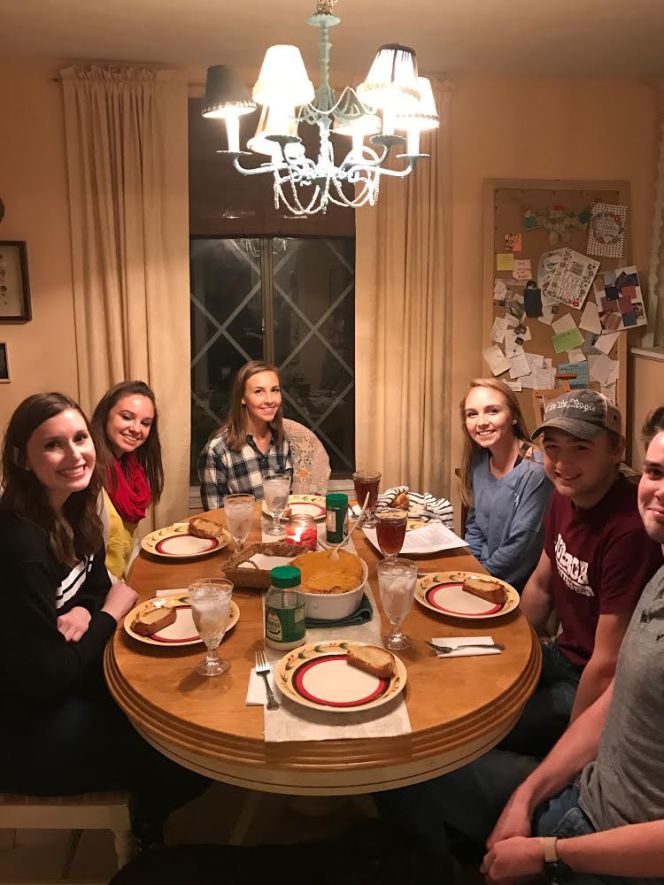
At this dinner were five of us, each very unique. Of our group were myself, Rachael, Brent and his friend Tan, and our generous host Jennifer. I set up the dinner with Jennifer as I met her earlier this summer when we worked on the Ceremony for New Citizens together. Jennifer is the perfect example of what it means to be a citizen in a community and I thought she would be an excellent match for each of our group members’ interests. She graduated from college with a degree in Political Science, and her husband teaches Political Science here at Western. She is a devoted mother, and citizen as she does very intensive work with the refugee population here in Bowling Green. She does everything from organizing an intercultural soccer team for refugee children, to helping refugees adjust to daily life by attending driver’s tests, court cases, and doctor’s appointments with different families. If I were to model my life of service after one person, it would certainly be Jennifer. I have been getting to know Rachael and Brent more and more through our class, but it was eye-opening to learn more and more about them as we sat together to eat dinner. I was so happy that Brent brought along his friend Tan, as he was a new face for me to meet and his perspective was refreshing in our conversation. He has incredible talents and a spirit that is infectious. Over the course of this night, I learned how much Rachael and I are alike, from our love of feminism and literature to our desires to start a girl band, (which we are totally going to do.) I think I may have thrown Brent and Rachael way off because I don’t really like pie, but they accept  me for my ice-cream loving self and that’s a form of citizenship in itself. Rachael is incredibly insightful and kind and is exactly the kind of person that I need and want in my life. If anything, this class brought me a friend that is a girl after my own heart. Brent is also incredibly awesome, like I’m pretty sure that Brent is one of the coolest people that I know; he’s compassionate, incredibly aware, and full of surprises.  I feel like both Rachael and Brent would like to be described as students and citizens who are hungry for change and development in our world. Both of their hearts and minds are on fire to make a difference, which is what makes our friendships work together so well.

The bulk of our conversations, aside from the required questions and introductions was about Jennifer’s work with refugees and about each of our unique desires and ideas about the world. It was actually a very interesting dynamic that our group had as we bounced off each other’s ideas and built upon what each of us felt. It was a conversation that I have been missing in my daily life. I sometimes struggle with finding people to truly discuss and learn from, and this conversation certainly filled a void that I was missing. We briefly touched on the election, which actually wasn’t terrible to do. All of us were pretty much on the same side as who we thought should be elected, but we spent a small bit of the time discussing the other side and why each of us thought people voted the way they did. I think this is crucial; if we don’t take time to truly discuss the side that we aren’t on, then how do we find the common ground when trying to make progress for what we believe in? It was refreshing to take a moment and recognize the differences in the world as we were seeking the similarities amongst our group. We also discussed with Brent’s friend Tan what it was like in Vietnam and how culture was different from what he was experiencing here in America. His perspective was beautiful to try to understand. Global citizenship came up frequently in our discussion, as everyone at our table, aside from myself, had studied abroad. As I have yet to experience that form of citizenship, I truly learned complex ideas from the different abroad experiences that each of my friends have had. As I find may similarities amongst each of us at the table, we are all incredibly diverse as to how we want to change our world. The stories we each shared opened my eyes to the possibility and hope for our world, and people like Brent, Rachael, Jennifer, and Tan are the ones that will be forces against the nature of where we are today. I think the biggest thing I learned was just how important it is to discuss, not necessarily debate, but just interact with one another. I think we get way too caught up in making convenient exchanges with people that we forget to take the time to have thoughtful conversations. As one topic progressed in our conversations, diverse thoughts and beautiful ideas surfaced, allowing each of us to develop our own thoughts in concordance with each other. It was like building our own web of connection through the expression of our thoughts. I think this is exactly what our class was trying to teach us: how to live well together, how to solve problems, how do we change and evolve? We connect. That’s the most important thing. Connection leads to empathy, empathy leads to helping hands, helping hands lead to a little more love, and that love and acceptance of our fellow man, leads to one of the most beautiful things imaginable: citizenship.

Citizen and Self has been an eye-opening class for me, even when I have been scattered and not on top of things, it’s made me truly analyze what it means to be a member of a group and what it takes to make a difference. That’s the citizenship part, the part that has completely changed my idea of what being a citizen is, the part that has revolutionized my own plans for my life. The other part of this class is discovering myself in ways that I hadn’t thought of discovering. I think that we, as humans, are constantly on the mission of discovering ourselves. As I discover ideas and thoughts about our world and the people that connect it, I also discover something new about myself everyday. There are many things that I long to discover, things like how it is that one action can influence so many things and how different people seem to always inspire something. I find the most interesting things to discover are the abstract things that constantly change from day to day. I think that conversations like the one that I had around our table are the ones where you can simultaneously discover new things and recover old things that you knew and learn how to apply them. Taking the idea of talking around a table; something that we’ve all done, at least, once in our lives, and then combining it with the newness of strangers turned inspirers, is how I’ve found connection amongst myself and this new community that I’m a part of. I hope to continue to discover the ways that I, as an artist, student, citizen, and friend can grow. I realize that I have so many things to learn, I am just beginning to uncover them, and the best way I know of to learn is by feeding off of others and one of the most amazing things that I long to discover is how I can be an active voice in a group of like-minded, but also diverse individuals. This project helped me to discover a little bit more of that, and so has this class.
Elderly Dogs, Citizenship, and Chicken Nuggets

By Zach

Through this Kentucky Kitchen Table experience, I was able to go back to how I normally eat dinner during the holidays with my family, listening to each other and discussing how our years have gone usually encompasses a majority of our dinner. Since being at Western Kentucky University I find it hard to actually have those sit down conversations with people which go beyond just small talk because that is basically all we have time for. Although I had never met McKenzie prior to the Kentucky Kitchen Table I knew it wouldn’t take long for us to open up about our school lives, future plans, and other topics relating to the Honors 251 course.

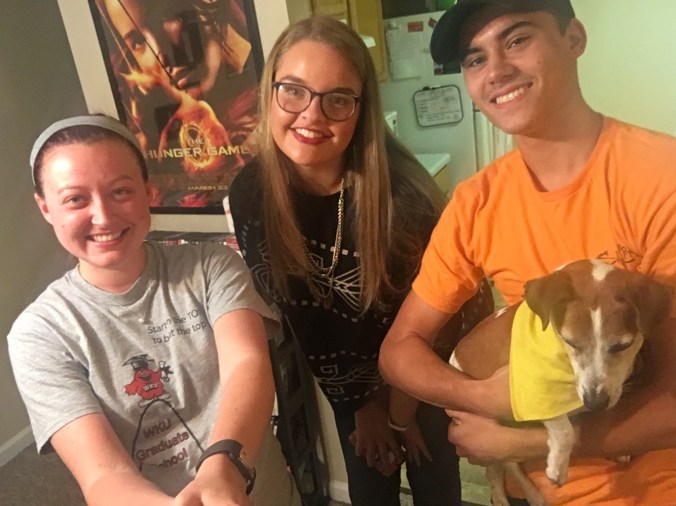
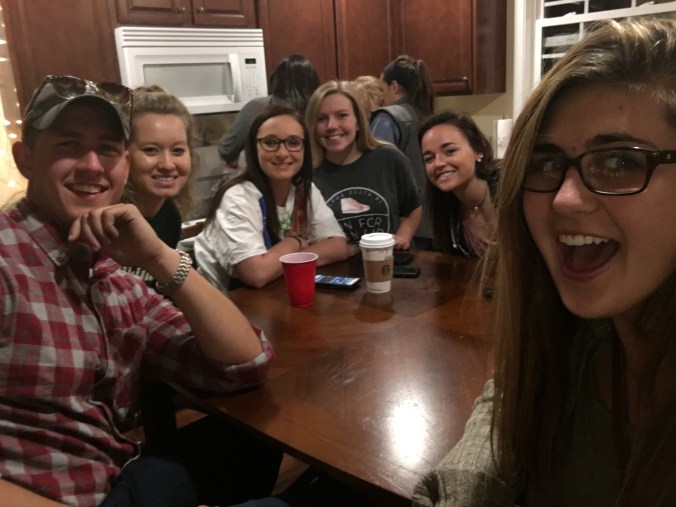
Aubrey and I had already begun to open up about our lacking cooking experience and I will admit I gave her a hard time about not being able to make no-bake cookies, which she had promised to bring, and instead bought the cookies at a store a few hours before hand. After arriving at McKenzie’s apartment we soon realized we were not the only ones with minimal cooking abilities because we were welcomed with every college student’s favorite dishes, chicken nuggets and mac-n-cheese. The biggest surprise was when one of the most energetic dogs I had ever been around came up to me and began to beg for food, his name is Johnny Karate. Johnny would soon become the center of attention for the rest of the night.

Other than Johnny Karate, I did not see much diversity seeing as Aubrey and I were from the same hometown and McKenzie was from Shepherdsville, Kentucky. But the more I thought about it the more I saw that we are much more different than I had previously supposed. I am a biology major while Aubrey is an undecided major and McKenzie has graduated from Western Kentucky University (and the Honors College) with a degree in psychology. These differences in majors show how diverse our interests are from one another. Being raised on a farm in Northern Pulaski County with one younger sibling, I have a much different view of the world as compared to McKenzie who grew up in an area around Louisville is the oldest of five. I didn’t see much of a connection to be made with talk of what we all wanted to do with our majors, or in Aubrey’s case what types of majors would be enjoyable, so I was ready to dive into the recommended questions for discussion.

When I sat down I could not help but notice a pro-Hillary Clinton coloring book. Now being an outspoken Trump supporter I had questions rolling through my head about why she would pick Hillary Clinton to support but Aubrey had already told me before dinner that I should probably refrain from any political discussions just so we could keep the night going as smooth as possible. I decided not to bring up the issue explicitly but rather implicitly.

One of the major questions we discussed stemmed from the recommended questions in the handout which pertained to what we thought the best thing in our world today could be. McKenzie seemed to have an answer already prepared for this question seeing as she hardly hesitated when she replied that social media was one of the most beneficial things we have in society today. McKenzie acknowledges social media can be used to harm others self-esteem and may be used as a vehicle for bullying to occur. She stands by her stance of social media is more beneficial than harmful simply because social media allows people from across the globe to communicate in a way never seen before in history. I can see how social media benefits humanity in how it allows the transfer of experiences to people from completely different backgrounds.

Even though I realized McKenzie and I had differing views on who should be the next person running our country, Aubrey, McKenzie, and I all had similar views on social and humanitarian issues at hand. A required question was “Beyond voting, paying taxes, and following laws, what does citizenship mean to you?” McKenzie’s answer was spot on in how she believes we have an obligation to help others and those who cannot help themselves, yes that includes elderly dogs. McKenzie as well as myself believe no matter how small our efforts are; we can make a difference in our communities. I could see this idea relating to Pollan’s “Why Bother?” article in disagreement with what the articles theme is pushing for in that no matter what we do unless everyone participates nothing will change.

Another conversation I found interesting stemmed form the question of “Do you know your neighbors?” McKenzie stated that she was more of an acquaintance with her neighbors. I can understand why seeing as she does not necessarily have anything in common with her neighbors other than that they live in the same apartment complex. Growing up in a rural community I was very close with my neighbors, however, my neighbors and I had a majority of the same background so it seems easier to get to know them and become close. When taking on college I have noticed that it is much easier to get to know people who are much like yourself rather than reaching out and finding people with differing backgrounds and opinions. Through my experience in the Honors 251 class, I see that it would make for a more educated outlook on problems we face as a society.

As the night came to a close I realized I had most likely thrown over 100 balls for Johnny Karate and although he seemed to be exhausted he kept bringing the ball back and begged for one last throw. Aubrey and I helped clean up the leftover food and thanked McKenzie for having us for dinner. After reflecting on the night I understood how diverse our group actually was outside of our race or other physical features our opinions are what really defined the diversity of the group. Aubrey, McKenzie and I had a wonderful time with insightful conversations about elderly dogs, citizenship, and chicken nuggets.

4553061df8884f608358b38576cdfe48

Kentucky Kitchen Table

By Elizabeth

Last week I had the pleasure of sitting in and sparking conversation with a whole host of new company. Mary and I were welcomed to dine in the home of Keaton, Kat, and Tori. Joining us were fellow friends of theirs, Andrew, Gabby, Hayley, and Ashlyn. One benefit of being the new member of this diverse friend group was that each person got to paint themselves in whatever light they wanted. When asked how they liked to be described the answers involved both physical characteristics and core values. Andrew likes to be seen as a very tall gentlemen who was raised in Tennessee and has a background with horses. Gabby unlike the rest expressed one of her fatal flaws by stating she get ‘hangry’ quiet often, a slang term coined to express anger brought on by being very hungry. However she is fairly quiet at first but opens up when surrounded by familiar company. I am glad she was surrounded by friend too because she had great insight into some of the prompted questions. Hayley wants to be known for her humorous side which relates to her idea that she is fun to be around, which I can second after being in her company. Keaton most admirable qualities consist of her dedication and passion to do the right thing while keeping a positive outlook. Ashlyn in proud of her big smile and described herself as an avid extrovert. Hayley on the other hand is more meek and but will defend her point of view in a respectable manner when she feels necessary. Tori said that she is known for her candor and loyalty, never afraid to speak her mind, which added a lot to the discussion. All though it was a female dominated group a great source of diversity was found in the political views, social economic upbringings, and religious affiliations of the people sitting around the dinner table. Even after hoping in with different questions the unavoidable and controversial political debate which is so prevalent at this time dominated conversation.

However, the fundamental question of our class was what initially facilitated conversation. When asked, “What does citizenship mean to you?” Andrew started by answering very straight forward. He said it means doing your part and being good others. As I suspected the first answer would only scratch the surface of a more in depth answer but I was appreciative he was the first one to step up to the unorthodox table topic. Tori seconded Andrew but slightly caught on to the fact we might have been looking for something deeper and added that citizenship means being able to have a voice in society. She went on to express different ways she’s involved. By being involved in community through big or small parts you have a voice. She is involved in intramural sports and a sorority and volunteer work which makes an impact on the way society functions. After others expressed similar opinions that related to different ways each of them is involved and the way they give back, Mary steered conversation by bringing up a similar question, “What kind of person do you want to be?”  Regardless of what setting Mary and I would have been in, I think this question is what brings most people to a general consensus. This is also where I found a strong connection to our class and the material we have been reviewing. Each answer was inspired by an idealistic view of striving to be someone that is liked and respected. Just like in the class we are working to reach common goal by commutative input, each person have a common goal of who they want to be. The main difference is in the way were try to get there. Although the conversation to did move towards the a step by step game plan on how to accomplish this goal I think it is beneficial to be reminded that we are all striving for the same end game.

Diversity was seen again when religion was thrown into the mix. Both parties agreed to we should treat people justly, but where they drew their moral guide from was not the same. The people who identified as religious were Christian and those who were not were either agnostics or atheist. It was about a fifty fifty split.  Under the circumstances of a group or people that already willing associate, this controversial topic of religion, which lead into politics, was very civil. The agnostic perspective thought religion should not be the say all of what determines how we treat people. Interestingly enough, Mary and I’s friendship embodies the Kentucky kitchen table dynamics we had set up. Mary was able to relate to the agnostic point of view, while I resonated with the side of the discussion who pulled their view from religious back grounds. The Bible was reference by Gabby when she said how she values the golden rule: treat others the way you want to be treated. Ultimately this influenced the discussion toward what obligations do we have towards others. This is when politics found their way into the mix. Each person believed that the government and we as individuals have an obligation to treat others with fairness and kindness. However remarkably so as much as we might be able agree upon this as a society and a small group around a dinner table the feelings toward the elections still varied drastically. Even though I am rooted in a strong political stance like most it was refreshing to hear each person’s perspective discussed with such respect for others. On the one hand about half the individuals confessed to voting for Trump while the others half was in unison against Trump. Those in favor of Trump were goal oriented toward economic change that they believed would serve the general public. Those against Trump believed he stood for values that would deteriorate this society. Although the majority Trump supporters could sympathize with their friend’s feelings they still held true to their beliefs. In the end no one was thrilled with the state of affairs our society had been thrown into due to the election. As much as I wished the common ground could be that of rejoice it was not. The meat of the conversation came to a conclusion when we asked, “In retrospect of this how do we live better together?” Andrew mentioned that we must both respect the outcome of the elections and each other. While other might have not mentioned respecting the outcome of the elections all voices at the table agree on respecting their fellow citizens.

After sitting in on a group of people I had never met before, I learned that at the end of the day we are always more similar than different. If we look for similarities we can always find them and if we look for differences the same is true. What is important is that we emphasize our similarities. In regard to David Brooks’ take on the moral framework of today’s youth, discussed in his New York Times article, “If It Feels Right…” I would say these types of conversations prove him wrong. Not every meal is oriented around in depth discussions, but the fact that we can have one and express our opinions with respect and thought out reasoning is what is important. The elephant and the rider (from Jonathan Haidt’s book The Righteous Mind) were also prominent in the group discussion because people reasoning were rooted in the way the felt about the topic. I hope that these talks and hearing others similar goals with facilitate more thoughtful discussion that will continue to help this world answer the question of how we live better together.kkt

Citizenship, Democracy, and an Elderly Dog

by Aubrey

4553061df8884f608358b38576cdfe48As a college student, I am constantly on the go, seldom able to make time for much of anything other than the tedious tasks that being a college student entails. I eat my meals hurriedly between classes, seldom taking the time to talk or even sit at a table. So when I was required to do the Kentucky Kitchen Table project for Honors 251, needless to say I was out of my element. However, through this project I was able to gain a valuable experience that I will always remember. This experience had an incredible impact on not only me, but also my classmate, a former Western Kentucky University student, and an unexpected furry guest that contributed equally as much to the night as the rest of us did.

When Zach and I first arrived to McKenzie’s apartment in his enormous truck, armed with nothing but prepared questions for the night and a few more-hastily prepared side dishes, we had no idea what to expect for the night. We walked into the apartment unprepared for the greeting we were about to receive. As soon as we opened the door, we were not-so-viciously attacked by an adorable elderly dog known by the name of Johnny Karate. It was obvious from the start that Johnny and McKenzie were good friends, and that this dog would be an important part of our dinner.

When I looked around at our faces, I did not see much diversity (unless you count the elderly face of the beloved Johnny Karate). I was confused as to how we would have different perspectives as we seemed to be a lot alike. However, as we began to discuss, I realized that in many ways, we are more different than alike. We each had our own experiences and backgrounds that shaped us into the people we are today. Therefore, we were each able to contribute greatly to the conversation with unique perspective and ideas.

Zach, for example, was raised on a farm in Pulaski County, Kentucky, graduating first in his class at Pulaski County High School. He is a biology major, with hopes of using this major to further plant-related science. McKenzie is the oldest of five children, raised in Shepherdsville, Kentucky. She is a graduate student at Western Kentucky University. She graduated Western Kentucky University with a psychology degree, and hopes to work with corporations in this field. I also hail from Pulaski County, graduating first in my class at Somerset High school. I was raised in a very political family, with my dad being the Pulaski County Judge Executive. Unlike Zach and McKenzie, I have no idea what I want to major in. However, that did not stop me from enjoying the good food and company of these people who have their lives a little more figured-out than I do.

When we first sat down to eat, it was at first a little awkward. However, there is no awkwardness that chicken nuggets and macaroni and cheese cannot diffuse, so the awkwardness subsided quickly. After looking at my surroundings, I started to get a little bit nervous. On the coffee-table, there was a pro-Hillary Clinton coloring book. I began to panic on the inside, as I thought of my fellow classmate Zach, who is an open and avid Trump supporter. I knew that some of the questions we would be discussing would be politically charged, and I was nervous about someone in the room getting offended.

This nervousness was in vain, as no chaotic political bar-fights broke out throughout the night. What did break out was good, democracy-related conversation. It turns out that even though we may have different political views, we all have similar views on humanity and compassion. When asked “What does citizenship mean to you?”, we all were able to agree that this meant helping out those around you, regardless of their ethnicity or religion. I was able to relate this back to The Golden Rule, which states to treat others as you would like to be treated. McKenzie took citizenship a step further, by saying that we should not only be compassionate to the people around us, but also to the living things. The ears of the elderly dog, Johnny Karate, surely perked up a bit as this point was brought up. It was very clear that the elderly dog population is important to McKenzie, and her heart is big for the living things, human or not, that have the opportunity to be a part of her life.

We also discussed what we thought were the best things in our world today. McKenzie brought up the point of social media. Although social media is often used maliciously, it can be a great tool to connect with people in our world. Because of social media, it is easier to communicate with others than ever before. It is also a great way to see other people’s perspectives. This means that if you believe one thing, social media makes it easy to see someone else’s perspective about that issue, making it easy to be more open-minded. Zach and I were also able to connect social media to the election. Because of social media, we were able to stay more informed and aware of the candidates and their stances on the issue. We were all able to agree that social media was, overall, a great part of today’s society.

When asked what social issue was closest to our hearts, we all had different answers. For McKenzie, the important social issue for her was elderly dogs. She believes that all dogs deserve love, and the fact that elderly dogs are as neglected as they are is heartbreaking. After spending the whole night playing fetch with Johnny Karate, I could easily see why this issue was important to her. For me, the answer was racism. This has not always been the case, but through my participation in Honors 251, I have seen that racism is a much bigger issue than I had ever seen before. I have become more aware of racism in my everyday life, and have since felt convicted to make a change. Despite the fact that our passions about social issues were different, we were all able to see each other’s perspectives and recognize these problems.

After returning home from this night of discussion, I realized how grateful I was for this project. Although we may not have been the most diverse group of people, we all had important things to say. As we discussed citizenship and democracy, I realized that despite difference in political views, we all have similar concerns for citizenship and how we live well together. This experience has been one that I will never forget, and I cannot wait to see what the future holds for Zach, McKenzie, and Johnny Karate.

Kentucky Kitchen Table Project

By John Mark

On Friday, November 11th, Erik and I hosted four members of the Warren County community for dinner at his family’s residence. Beyond my partner and me, we had four guests join us: Rick #1, Rick #2, Kathy and DeAnn. Rick #1 is a banker from Franklin, KY who now lives in Bowling Green. Rick #2 and Kathy are married and run a Christian Counseling Center together in the local area. They are from Minnesota and moved to Kentucky several years back. DeAnn is my mother. She is from Roanoke, VA originally and moved to Bowling Green when she was young. She now works as a physical therapist for a county school system.

Over the course of our dinner together, we discussed a wide variety of topics from the election, to the role of spirituality in the rebuilding/rekindling of relationships, and to the intercultural perceptions of current social issues here in the United States. One of the topics that stuck out to me the most was mostly between Rick #1 and me. Rick #1 identifies as a “Blue Dog” Democrat. Now, as I considered myself to be a conservative republican coming into the conversation, I was prepared to give my typical response to the common democratic points on the typical short-list of issues. But as it turned out, I agreed with a lot of what Rick #1 had to say about fiscal spending and the future of our economy. It threw me off initially that a democrat would actually call for a smaller governmental role in our economy, as an advocate of our capitalistic free-market economy.

That is what really got me thinking, “Am I really a conservative republican?” Now, the question itself is not the moral of the story, but merely the beginning of a mind-bending few days during which I questioned heavily my political alliances and preferences. I believe in a literal interpretation of the United States Constitution. Therefore, I am – at a glance – a republican. I also believe in a small government and free-market: republican. But, what I began to think about what how similar Rick’s political interpretations and social motives were to mine. This is when I knew I could scratch the “conservative” off the subheading of my political nametag. So now, I was in pursuit of understanding more about his stance before declaring my own.

Next we discussed gun control. Initially, we established that neither of us like gun violence nor the amount of Americans that die from being shot each year. As most democrats would claim, Rick #1 said we should eliminate firearms in the United States. Being a literal constitutionalist, this made me cringe. I realized that the divide in our opinions is fundamentally a difference in approach between us, not patriotism or moralism. He responds to gun violence by treating it at the source: removing guns. He is willing to relinquish his own right to bare arms in order to disable violent offenders from accessing firearms. I could not overlook or deny the soundness of his logic:

A. Drivers are licensed to get from point a to point b, so we should educate and license gun-owners. B. The more quickly we can curb the sociocultural connotations of gun-control the more quickly we will be able to reduce senseless gun violence in the U.S. C. People don’t embrace change with open arms. Therefore, we must move forward with the underst that sensible gun control will not happen overnight. We must inch our way towards progress with our sights on long-term prevention as opposed to short-term reaction in order to connect with the citizenship.

As a Kentuckian farm-boy who has grown up shooting guns regularly, it disheartened my sense of regionalistic pride to concede to such a progressive representative. In hindsight, his approach makes sense. I just don’t know how realistic these goals are, since the rights to bear arms just so happens to be articulated plainly as the second entry to our Constitution’s Bill of Rights. It was at this confusing and slightly shameful crossroad that I remembered a key point of discussion from our time together this semester.

Wicked problem (n) – a problem that is difficult or impossible to solve because of incomplete, contradictory, and changing requirements that are often difficult to recognize.

I realized that American rates of gun violence are a wicked problem. My stance that everyone should concealed-carry because they have the right to do so does not solve the problem; it reacts to the problem. That being said, the Blue Dog’s proposition may get us closer to solving the problem. The biggest barrier for me in supporting the rescinding of private gun rights is the black market’s long history of getting around the law as well as law enforcement. People have already begun 3-D printing firearms and the technology is improving exponentially each year. I know that there will be terrorist attacks and I would hate to play a part in disabling one of the victims from being able to defend themselves.

There is no way to define and design a sure-fire solution for a wicked problem such as gun control. What struck me was that in order to reach our ultimate goal of eliminating gun violence, we must start somewhere. According to our Intro. to Wicked Problems handout,   “There is no immediate and no ultimate test of a ‘solution’ to a wicked problem. You can
only see if the way you wish to address the problem works by trying it. Every ‘solution’ to a wicked problem is a ‘one-shot operation.’ Because there is no opportunity to learn by trial and error, every attempt matters.” Every attempt matters. If the goal is to eliminate gun violence, we must begin with a new perspective and make a new attempt because past attempts have not worked. The only way we will know if banning certain firearms will serve as an antagonist to large-scale attacks is to try it.

I am among the last of persons you would have expected to consider any legislation that voids American’s rights to bear arms, even if it is only the AR-15. Thanks to the Kentucky Kitchen Table project and the intellectual contributions of our guests, I now have new eyes in an array of political and recognize that we will not cross the bridge of eliminating gun violence without employing new strategies, whatever they may be.


The One With the Baked Spaghetti

By Elizabeth

unnamedMy Kentucky Kitchen Table was held at my house, and five other people joined me. Caroline goes to Murray State University full time and works two jobs to help her save for an upcoming trip to Spain (she is majoring in Spanish and can speak the language very well). She recently went on a trip to London. She is very open about her faith and religious beliefs and found a way to apply those beliefs to our conversations. Sarah, friends with Caroline, also goes to Murray State University. She is running for an office in her sorority and wants to be a teacher. David is a few years older than the rest of us and was born in Japan, but grew up in Alaska and moved to the continental U.S. in high school. He added a very interesting perspective to conversations we had about communities, citizenship, and social issues because of his diverse background. Kennedy just moved to the area from Illinois, and she was quite a bit older as well. She was the comic among the six of us and loved to delve into the minor differences between Kentuckians and Illinoisians that she has picked up once since her move. Hunter, my boyfriend, joined me as well. He is a sophomore at Western Kentucky University and hopes to be an anesthesiologist. He took a more straightforward approach to topics we discussed and easily tied our ideas together.
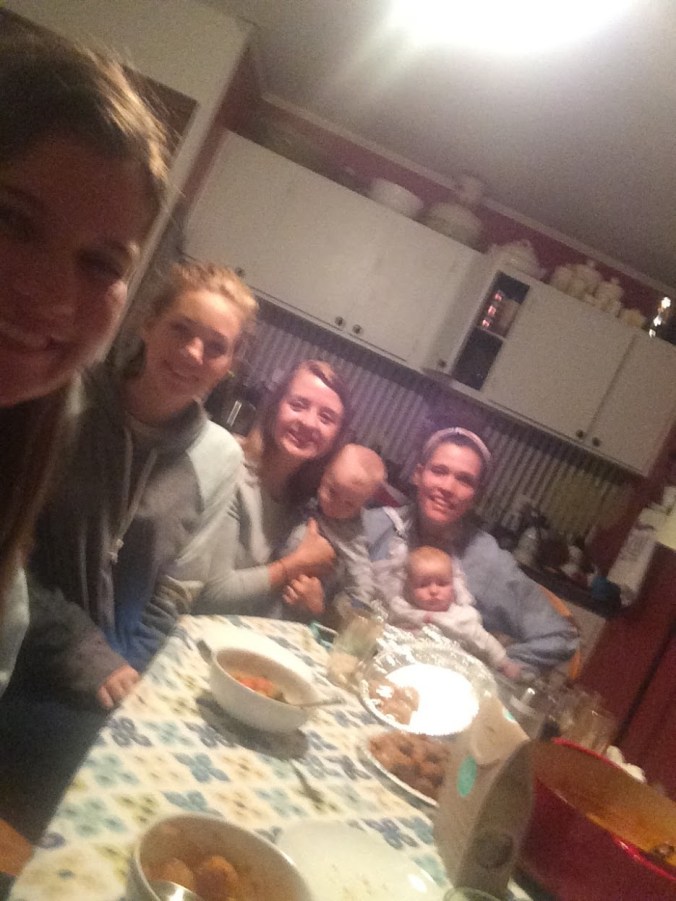
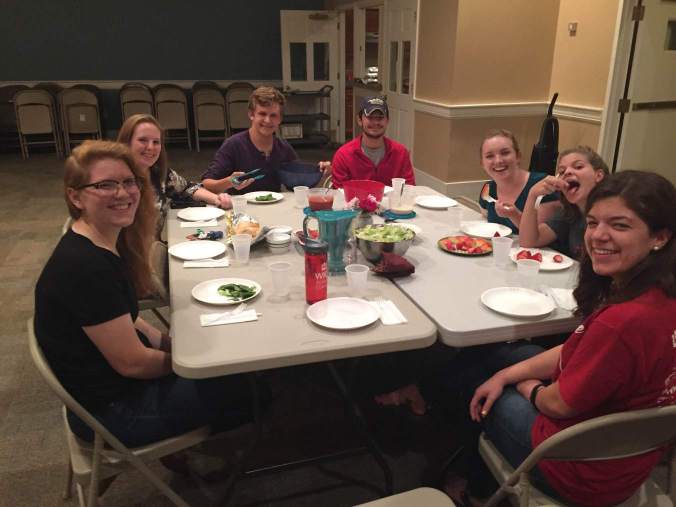
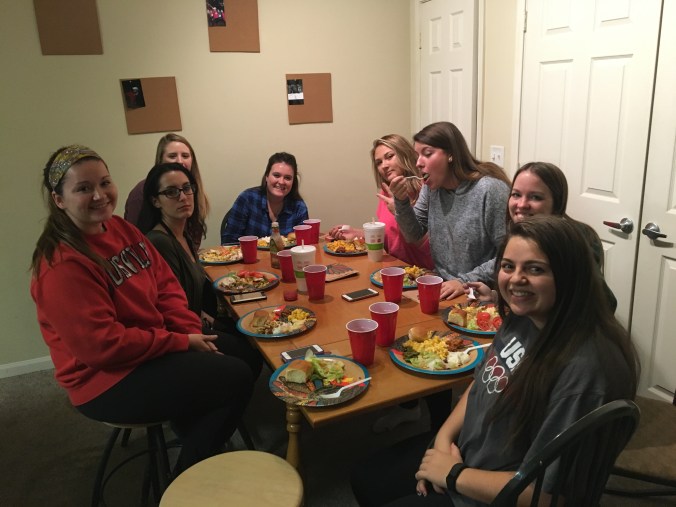
We began our dinner of homemade baked spaghetti by talking about what it meant to be a citizen or to have citizenship. David noted that what came to his mind was his dual citizenship in the U.S. and Japan. His citizenship gave him rights in his countries of citizenship, and he felt like he should take advantage of those rights in order to be an active citizen. Kennedy shared that she thought citizenship was also about the impact that you make personally in the lives of people in your community or nation. She is a social work major and said she hopes to make a difference and be a better citizen. This led us to talk about the obligations that we felt like we had in our country and if we thought our jobs served a greater purpose.

Kennedy currently does not work, but thinking of her future career as a social worker, she said it was really clear to her that her job served a greater purpose because she would be helping people who otherwise wouldn’t have been helped in that particular way. Hunter, also currently unemployed, mentioned that he felt obligated to help people and to become a doctor because that field of study is what he is good at. I asked him if he felt like other people are obligated to help others by doing what they are good at. He said he thought the world would be a better place if they were, but he felt obligated in that way because of his religious beliefs and understood that not everyone believed the same things that he did. Sarah is a tutor as MSU and helps a number of students with disabilities. She said she hopes she is making an impact on them and encouraging them to make impacts on others. Caroline said that working in a jewelry store allowed her to help people find pieces for very important moments in their lives. She shared a story of a woman coming in to find something for her adopted daughter because her biological father passed away. It was clearly a tricky situation, she said, but she found the perfect bracelet that came with a card explaining the bracelet’s meaning. A few days later, the woman came back in to thank Caroline and told her that her daughter teared up and promised to keep the sentimental piece forever.

Caroline’s anecdote challenged us to think about the little things, like a bracelet, and how we could replicate something that meaningful with our actions in order to solve problems. Hunter argued that small actions won’t fix big problems. He explained that our country needed to think big to solve problems, and that is why he supports our military so much. Kennedy expressed that small actions may not resolve war, but it can bring communities together. I supported her statement with a story of my own about a series of break-ins in my neighborhood. Several families came together to support the ones that had suffered damages or emotional distress. Several men volunteered to camp out to catch the individual, which resulted in the arrest of a man a few nights later.

Our discussion led us to share what were the social issues nearest to our hearts. Sarah shared that the education system has so many flaws and she wishes she could do something to change it because she will soon hate administering standardized tests when she becomes a teacher. She explained she believes standardized tests standardize students. David explained that veterans make up a significant portion of suicides and homeless people every year, which bothers him because his father is a veteran. Caroline told us about a project she did over homelessness that taught her that most homeless people aren’t homeless for any reason that they could have prevented. She went on further and eventually changed all of our perspectives on the issue of homelessness.

My Kentucky Kitchen Table experience reminded me of Paying for the Party because we all had different levels of wealth or different kinds of families, which led us to have different beliefs. We were in a way different from Paying for the Party: we did not let that get in our way of “deliberating” our ways of thinking. The Kentucky Kitchen Table project reminded me of the choreographer in the “Shipyard Project.” It was a medium to bring us together and share experiences, similar to the people sharing their past at the shipyard.

By the end of dinner, I learned that each and every person I was with wanted to move from one end of their own bridge to another. We all had different opinions on the best way to solve problems, and I wondered if our diverse problem-solving strategies were a good thing or not. Should we all work to make the world a better place however we see  fit, or should we discuss and be on the same page when tackling problems? My perspectives definitely changed on many topics, from whether or not a jewelry store is making a difference, or whether or not we should we blame homeless people for putting themselves in a homeless situation. My definition of citizenship did not change, but I was happy to hear other perspectives. Because we all shared our opinions  honestly and openly, we all agreed our perspectives changed even if our opinions did not.

Kentucky Kitchen Table

By Lily

When I moved to Bowling Green for school my old youth pastor texted me. He reminded me his ex-girlfriend Paige lives here if I ever need anything. She sent me a similar message. They dated when I was in eighth grade and she was a junior at WKU. When she was in town she worked with my youth group and stayed the night at my house in Lexington a few times. She was an amazing role model as she clearly loved the Lord with her whole heart and I was overjoyed to have the chance to reconnect with her. When the Kentucky Kitchen Table project was assigned I knew I did not want to go home nor do the project with my friend group and a class mate’s. So, I opted for the host home option but when I found out host homes were sparse I remembered Paige. Before Paige could confirm dinner plans two girls from the other class, Lexi and Merritt, were assigned to the kitchen table I was supposed to be providing. Paige explained that while it would be hard to set up a dinner she may be able to work something out with her friend Jessie. By the time we finally had a date set Lexi decided to do the project at home.
Merritt and I arrived in the neighborhood at about the same time. We met for the first time outside searching for Jessie’s house. Paige welcomed us in and explained the situation to Merritt; she, her son Bo, her husband Eric, Jessie, Jessie’s daughter Lucy, and Jessie’s husband Joel would all be moving to Turkey within the year so they were staying together while Eric and Joel were in Turkey at a training. Paige was simultaneously caring for her baby boy, Jessie’s baby girl, and cooking dinner. Jessie was out taking a meal to some international friends of hers. We offered and brought dessert and while she was very appreciative Paige explained that they have guests over so often they were drowning in food to offer us instead. She and Jessie suggested we take our dessert and share it with people on campus as an outreach to build community.

We sat down and began getting to know each other before we discussed anything related to the course. Paige is great with teenagers and people in general so although she is in a completely different stage of life than us our conversation was fluid. We took turns explaining different parts of our lives. Merritt talked about her upbringing with two brothers and two loving while protective parents. She went to an all-girls Catholic high school in Louisville. She is now participating in Greek life just like her mother and father were when they were in college. She also mentioned her family’s fondness of sports. Paige talked about her hometown only thirty minutes away from Bowling Green. She talked about how she met my old youth pastor and now her marriage to Eric. All the while being interrupted by babies, cooking and eventually Jessie returning home. Jessie talked about her job on campus at WKU where she and her husband are leaders at the Baptist Student Ministry. She related her work to Merritt’s sorority involvement and asked if Merritt had heard of a famous speaker. The woman used to find her identity in her sorority but once she graduated she did not know what to do. She ended up finding the Lord and speaking at sororities across the United states. Jessie talked about her impact on her after listening and her potential impact on so many more people.
When they were both home and sitting at the table they started explaining their impending move to Turkey. They will start working as missionaries for the International Mission Board with their families. They talked about short mission trips to Turkey they had each taken years prior. There was a specific unreached people group they wanted to reach-out to but they were going to have to enter the country and live in Istanbul for a while before they could. Their plan is to live in Istanbul learning Turkish for three years until it would make more sense to move to the part of Turkey they want to reach. At that point they would have to begin learning another new language, that of the Zazas. It was incredible to hear their long-term mind-set. The two had lived together before and were in it for the long-haul planning to live together again in Turkey. The two shared how they met at a church that outreaches to the housing projects in Bowling Green and had lived together before. God was working in their lives even then. Paige and her husband knew the neighborhood they wanted to live in and there was only one home available. When Jessie got married a few months later she and her husband wanted to live in the same neighborhood but no houses were available. The house was too big for the young couple but it worked out perfectly so Jessie and her husband could sublease with Paige and her husband.
Afterward, we began discussing what it means to be a citizen. Jessie talked about how she had never really considered it before. She said she did not value her citizenship as much as she should especially because in the United States we are awarded many more rights than other countries offer. Specifically as a woman she spoke of being very grateful for the society and country we live in. Paige agreed and they both talked about their citizenship in heaven. I was very interested in their perspective since they will soon be changing their citizenship. But they explained their earthly citizenship to no matter which country means little in comparison to their home in God’s house. They both are very thankful for their citizenship though. They feel a responsibility to support their governments and fellow citizens as Americans and as Christians. Merritt talked about how she had also never really considered her citizenship before this course. She explained that now that she can vote she is beginning to think about and learn more about government and how she can contribute to it. At dinner I was reminded of poverty and service, empathy, and learning from others weeks as a lot of our conversation was about how to live well with others.
When 7 o’clock rolled around so did the children’s bed time. We were welcomed back anytime and we all departed smiling and grateful.
I was very grateful to have learned from each of the beautiful people I had dinner with. I learned hospitality and outreach, a care for the people around me and a care for people around the world. I learned immediate love and long-term appreciation for people, respect for parents and affection for siblings and friends. I learned gentle peace and ambition, duty and perspective. I am very thankful for our dinner and our conversation. I am thankful for the chance to learn and connect with a peer I might never have met as well as citizens of Bowling Green in a different stage of life. I was really blessed by this experience and hope to continue my relationships with each of these ladies.

kkt

Making Home in a Dorm: a Kentucky Kitchen Table Story

By Baylee

When I was first introduced to this project, I was apprehensive. I thought “how in the world am I going to pull this off?” However, I’ve always been a little creative, and overall I’d say our Kentucky Kitchen Table was one of the most inventive things I’ve ever contributed to.

For starters, my KKT was original in that I teamed up with my friends Katy and Katelyn to attempt a non-cafeteria, non-fast food, wholesome dinner at Western Kentucky University. I’d have to say that the preparation for Kentucky Kitchen Table was one of my favorite parts. We experienced different forms of diversity through the entire project, even from the start when we planned our components around one of our guest’s vegan diet, which I had never done before (vegan food is actually not bad). Before starting the project, I was closely acquainted to both Katy and Katelyn, but through the grocery shopping and frantic cooking I became closer with both girls as I learned more about their different personalities and backgrounds (even Katy’s love of “You’re so Vain” by Carly Simon). First, we had some challenges because of our group decision to stay on campus. We needed a kitchen table! And a kitchen! Luckily, the organization Christian Student Fellowship, which Katy and I are involved in, was kind enough to let us borrow their table in their house where they hold non-denominational worship Tuesday and Sunday nights for students. For our kitchen, we utilized the kitchen in Minton Hall, where we all live here on campus. The kitchen had to be the most difficult obstacle, because it is smaller than most walk-in closets. However, we beat the heat coming from the stove and managed to produce a wonderful meal together. We decided on pasta with a choice of marinara or alfredo sauce. To complement our main dish, we included a salad and garlic bread. We ended the meal with delicious brownies that Katelyn made.

One of the premier parts of our dinner were the guests. We each invited a few friends, which totaled to eight people. I invited my friend Seth, Katy brought Theresa and Tucker, and Katelyn brought Anne and Jill. All of our attendants were students at WKU, with varying majors and reasons for coming to Bowling Green. Although the group lacked apparent diversity, we were all from various upbringings and had different, unique personality traits. One of the most unique, however, was our guest Yujen. Better known on campus as “Loud Asian”, Yujen joined our table halfway through dinner when he heard us from upstairs at the Christian Student Fellowship house. Although his presence was brief, because he enjoyed our dorm-made pasta so much that he polished his plate in less than fifteen minutes, we enjoyed hearing about his passion for martial arts and the state of California. Yujen added additional diversity to our group, as well as a conversation burst upon his exit. After he departed, our group began to discuss our different views of Yujen’s frequent presence on campus, as well as some of his antics which he is locally famous for.

Yujen was not the only topic of discussion at our table. Initially, conversation was one of my main concerns for our group. However, from the start of our dinner my previous assumptions that things would be awkward were blown away with jokes and opinions frequenting the table. I particularly enjoyed this, because I like to be very social and liked learning about our guest’s unique characteristics. For example, I listened while Seth shared the reasons for getting a large chest tattoo, and Theresa’s passion for the clarinet, which she plays in the Big Red Marching Band. I also thought it was interesting hearing about everyone’s hometowns. Every guest at our table originated from Kentucky, with the exception of Katelyn and myself, who call Tennessee home. Tucker and Anne are both from Frankfort, and Seth and Theresa went to the same high school. Although these guests shared a few aspects of the places they reside, they had very different opinions when asked about some of the details like neighbors and favorite things about their hometown. As we got into other details of our lives, including both campus and back home, I began to gain an appreciation for the prevalent diversity appearing at our table. This began to clear things up for me as to why we did this project in Honors Citizen and Self. I realized that openly sharing our different opinions and interests which made us unique in a comfortable, welcoming environment simultaneously united us as we all were desperate to find out more about one another.

As we began to shift to less superficial topics, Katy, Katelyn, and I presented our required question “Beyond voting, paying taxes, and following laws, what does citizenship mean to you?”. Seth, being the light-hearted guy he is, responded with a firm “Murica” which we all responded to with laughs and giggles. However, after we calmed our enjoyment, Anne offered an excellent response which received approving nods in agreement from the rest of our table. She responded to our question by sharing that to her, being a citizen means being able to freely express opinions and views openly, thus utilizing the freedoms and rights we are granted as citizens and unifying us under these rights. Anne’s response resonated with me, and made the meaning and relevance of Kentucky’s Kitchen Table all the more apparent to me. I realized that despite our guest’s differences, not all in appearance, we were able to unite under the fact that we were free to share our various backgrounds and thoughts at a simple dinner.

After our plates were clean and our bellies full, Katy, Katelyn, and I said goodbye to Jill, Anne, Theresa, Seth, and Tucker. As we washed up the dishes and packed what few leftovers we had, we reflected on our dinner and agreed that this project was an excellent example of healthy deliberation and how our guest were willing to contribute to making a great dinner, just as we as citizens strive to contribute to making a better world.

kkt

Payton’s Kentucky Kitchen Table

Friendsgiving was the first thought I had when I learned about this assignment. All throughout high school my friends and I would have dinner together during Thanksgiving Break and sit around talking. We looked forward to it every year; sadly, we were not all going to be able to get back together this year due to some of us traveling. However, Friendsgiving was not lost. I was invited to have a Friendsgiving by one of the older members in my sorority, Kelcie, to come to her apartment and I was super excited!

My favorite part about getting together to eat at an actual table is the home-cooked meal that comes with it. There were nine people who were invited (including me) and we all were to bring food. I knew what I was going to bring immediately— mac and cheese! It is one of my absolute favorite foods. Also on the menu were rolls, mashed potatoes, green beans, chicken, dressing, and many different casseroles. And don’t think I forgot about the dessert! We had enough pies to feed a small army!

When I arrived at the apartment I was immediately greeted by Kelcie when I walked in the door. She introduced me to the other girls who lived in the apartment with her: Abby, Kristen, and Morgan. One of Kelcie’s friends, Sydney, also came by for dinner. After her came the three girls from my sorority: Abbi, Anna, and Loretta. I knew this was going to make for an interesting table conversation because we all have different personalities.

I’ll start by giving a little background information on everyone. Sydney, Loretta, Kelcie, Anna, and myself are all from Louisville. Abbi grew up in Lexington, Morgan is from Paducah, and both Abby and Kristen are from Frankfort. Sydney is not a very talkative person, but if you ask her why she prefers not to talk so much she’ll respond by saying that she just likes to listen to what other people have to say. Loretta wants to be described as a humorous, sarcastic human being (as you can tell by her face in the picture). Kelcie is a very loud and, as she likes to say, energetic person. Morgan and Anna remind me of each other in the sense that they both are motherly figures. Abbi preferred that I referred to her as a “fun-loving” kind of girl. Kristen wanted to be described as having a bright personality and Abby is also a bit shy, but she warmed up towards the middle of the dinner. Even though we were all girls, we came from different parts of Kentucky, from different social classes, and from different home lives.

So as we all sat around the table with our plates stacked with the food, I said that we needed to take a group picture. While the majority of us knew we were going to smile normally, of course I was asked if we “had to” smile. I responded that they could make any face that they wanted. So I was left with Loretta “mean-mugging”, Morgan throwing up a peace sign, and Kelcie in the middle of eating a forkful of food. Abbi wasn’t pictured because she was actually taking the picture.

I decided to break the ice with the table since I still didn’t know all of the girls. We started with the question, “Did you ever have meals around the table with your family or neighbors growing up? Did you like that? Why or why not?” We were from all different places in Kentucky so I thought that it would provide for a lot of different answers and reasons.

I thought that Sydney’s answer really coincided with her personality. She had meals around the table growing up and she liked it because it was a way to see how the rest of her family members’ days were going. She is the kind of person who likes to hear what other people have to say and this goes along with wanting to hear how her family’s day went. I related this to the part of the class about deliberative arguments. If she were to participate in one, she would be able to listen to everyone’s point of view before she would speak and give hers. She is a good example of how we can live better together because she is more likely to listen to someone than to argue with them and make the situation worse.

Abby’s answer was not similar to Sydney’s. Abby came from a low-income household. Both of her parents worked long hours and it was a fend-for-yourself situation in her house when it came to dinner. She said that it would have been nice to have sit down dinners every night or at least three or four times a night. The only time that her family would have a sit down dinner was on holidays or once a month. I was wondering if this had something to do with her shy personality in which she didn’t talk very much.

When it came to the question “what does citizenship mean to you?” I received a range of answers. Anna, one of the motherly figures in the group, said that she views citizenship as helping others around you and making sure that your fellow citizens are doing just as well as your family members. Come to find out, Anna volunteered at a soup kitchen in the rough part of Louisville. She would make dinner for the children living there that otherwise would not get a dinner and then afterwards would help them finish their homework. To her, volunteering to help these children was her way of making sure that they were treated (as close as they could be) like her family. Kelcie’s answer took more of a patriotic perspective; she thinks that citizenship is maintaining the virtues that our country values, and not asking what our country can do for us, but what we can do for our county. When it came down to Loretta, she added a little humor to the table and responded with, and I quote, “Citizenship means doing exactly what Queen Loretta wants, no matter what.” And with that, the table erupted in laughter.

Obviously, Loretta’s answer is the opposite of what citizenship is. However, I thought it was cool how no one at the table (except for Abbi and myself) had taken this Citizen and Self class, and they had an idea of what citizenship was besides the basic voting, paying taxes, and following laws answer. Each one of these women had a different meaning to them; even though we all had different opinions, we accepted what each other thought. I think that was the best part about this assignment because it tied together what this class is all about. I didn’t even know everyone as we sat around this kitchen table. I didn’t have to feel obligated to accept what everyone said just because we were friends— because we weren’t all friends. But the fact that we all accepted each other’s opinions, beliefs, and stories is how democracy should be.

This assignment has led me to actually want to eat around a kitchen table more often. At first, I wasn’t sure how a kitchen table dinner could be any different from just eating at a table in DSU. However, know I can understand and appreciate the intimacy and a certain level of quietness that the kitchen table brings. I look forward to appreciating many more kitchen table dinners in my future.

IMG_1101.JPGFrom left to right: Sydney, Loretta, Kristen, Abby, Morgan, Kelcie, Anna, Payton (me)

Not pictured: Abbi

Goat Cheese Caramel and Good Conversation

idk

On Tuesday, November 2, 2016, a group of people gathered around a kitchen table on Kenton St. in Bowling Green, KY. This does not seem too odd, but half the guests were college students that were used to meals in dining halls and food courts.

There was Tyler and Kaylin, both freshman in the honors college. There was also Alison, a professor for the TESL (Teaching English as a Second Language) who hosted the event. Another professor, Leila, also joined us. She teaches for the honors college and also teaches Citizen and Self.

I was walking towards Kenton St. when I ran into Tyler and Kaylin on my way. We listened as google maps told us where to make turns, and eventually ended up at our address. The house had two different doors, and after a bit of debate we walked to the side of the house and knew we had found our place once we saw Alison and Leila through the window.

After brief introductions from both professors and Alison’s dog Hazel, we were put to work to prepare for dinner. Kaylin chopped cabbage, and Tyler and myself set the four-person table for five. Light conversation was made as the meal was finished up.

Finally, the tacos were served. As a college student where most meals consist of some sort of fried food with no vegetables, seeing a table with cabbage and avocados had me already happy to be there. We served ourselves and sat down to enjoy the meal.

Conversation continued to be very light, and I discovered that Alison actually was one of my sorority big’s professor. Alison had actually taught that class before our meal, but I later learned my big had actually skipped that night.

We talked about how Alison actually found her passion as a teacher on a whim. She had an opportunity to go to Japan, and instead of following her traditional plan, she chose to take the opportunity and go. She found a love for Asian cultures, but more importantly a love for wanting to teach English as a second language.

We continued having conversation, and then Kaylin remembered we had to at least ask one specific question. “Beyond voting, what does citizenship mean to you?” Leila, who actually taught the class made the comment that she should actually have a good answer for this question. Alison talked about empathy. She said that being a good citizen means recognizing that everyone is going through something. You need to take a step back and ask yourself why is this person acting the way they are. Are they having a bad day? It is about recognizing we are all people and we are all going through different things.

I cannot tell you exactly how we got on the topic of dress code, but we did. In my high school, it was announced over the intercom to check for any dress code violations, and as you walked down the halls teachers stared at you looking for something wrong. Tyler had a very similar experience. Teachers at her high school would sit at the doors and check outfits as they walked in. Alison and Leila were shocked by our experiences, and recognized how uncomfortable these situations made us. Leila also brought up how it must have been harder during a time where we are learning to accept our bodies and our personalities.

We talked a little more going through a slew of topics before having desserts. We had these crunchy waffles with Nutella and this caramel made with goat milk. I love goat cheese, so the caramel was very good. Alison offered to make some tea, and we started talking about traveling. Alison told me about all these places I should go see when I study abroad next semester. We also discussed places we need to visit in Bowling Green. It was interesting how many areas of Bowling Green I still haven’t explored.

When I looked at my phone, I realized it was 7:45 and we had been there for almost two hours. Originally, I had scheduled a committee meeting for 8:00, because I had assumed the meal would only last for about an hour. Alison had just finished steeping some green and brown rice tea, so I texted my committee that I would be running a few minutes behind. I was not ready to leave. I was really enjoying myself and the real conversation. I stayed long enough to finish my tea before I rushed to DSU, where I turned a 15-minute walk into 8 minutes.

As I was practically jogging back going through backyards trying to make it to my meeting, I realized how nice it is sometimes to just sit down and talk about real things. By real things, I don’t mean talking about base things about how class is stressful or which professor handed out another assignment. We got to share our experiences. I think part of human nature is wanting to share experiences and connecting on those levels.

It kind of reminded of the shipyard project: a mix of types of people coming together and sharing their experiences. This is one of those things that may not create the biggest change in the world, but allows people to connect on a level that is much more internal. It allows us to make connections with people that we may not think we have a lot in common with. Sharing your experience is both therapeutic and important to being a human.

In the class we ask ourselves how do we live better together. I think it starts with understanding the human experience. To understand that, you have to share and listen to the experiences of others. It is from there we can draw our conclusions on what we change and make better in our lives and the lives of others. If you don’t understand it, there is no way you can fix it.

I personally loved this assignment. It was nice to step outside of my normal routine and eat at a kitchen table.