Around a Kentucky Kitchen Table

By Drew

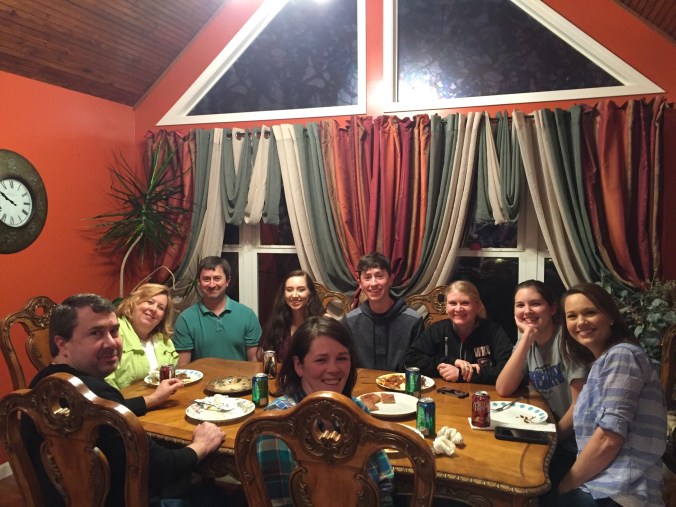
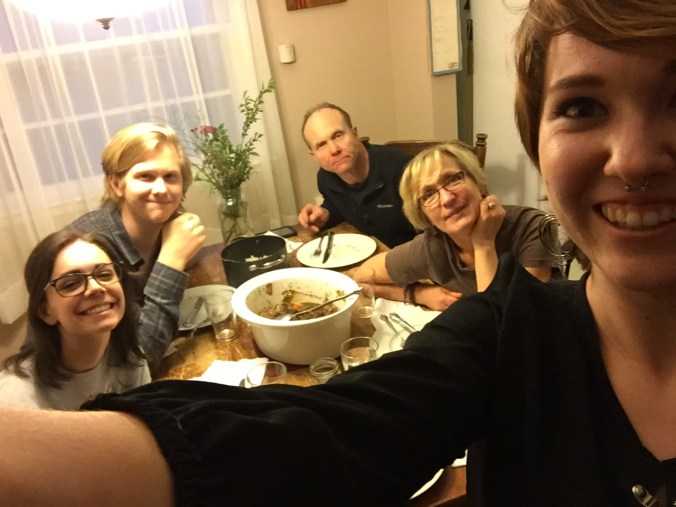
My Kentucky Kitchen Table was hosted at Kamber’s dinner table and was attended by myself, Kamber, John, Jordan, Sarah and Hannah. The only person who I initially knew at this meal was Kamber (my girlfriend) and Sarah. I asked Kamber to invite one person that she knew and I did not, and ask that individual to invite one person, and so on. Kamber invited Sarah and Hannah who then invited her boyfriend, John who, in turn, invited Jordan. Each person at the table is from a different hometown. Kamber is from Lagrange, KY which is a rural area of Kentucky and attended Oldham County High School. Hannah is from Louisville and attended Male High School. Her boyfriend John is from Rochester, New York and attended Brighton High School. Jordan grew up here in Bowling Green, KY and went to Greenwood High School. Lastly, Sarah grew up in Atlanta, Georgia and attended Blessed Trinity High School.

I was debating on whether to start the dinner conversation with the required “What does citizenship mean to you?” but I decided to let the conversation develop organically and see where it went in order to learn more about everyone present. The first question I posed was based on the type of food everyone brought. John and Hannah collaborated on a recipe that John’s grandma told him about. It was lasagna made with ground beef and pepperoni, as well as a layer of green peppers among the other necessary ingredients in lasagna. Sarah brought a side item of rice and broccoli cooked in chicken broth with shredded cheese. She learned this recipe from her dad and went on to say that this was her father’s favorite meal in college. Of all the dishes, this was my favorite.  I made a side item of macaroni and cheese. I explained that in my house, mac and cheese is the equivalent of a vegetable. It is very simple to make as it is just boiled macaroni shells mixed with Velveeta cheese. They may have been saying it to be nice, but everyone claimed to have enjoyed it.

As each person described their recipe and its origins, the conversation would branch off in many different directions. John explained to us his reasoning behind coming to WKU which led to everyone else stating why they chose WKU over other universities. As the conversation went on, the topics being discussed continued to delve deeper and deeper into each individual’s life in their hometown. Hannah and I grew up with very similar friend groups it turns out, yet we never met. We had very similar weekend activities including going to football games, attending night races at Churchill Downs, and going out on the Ohio River. While they are not from the same hometown, John and Kamber each shared similar experiences. During the summer they would visit their lake houses. John would go to Lake Ontario, and Kamber would visit Lake Cumberland. Jordan, along with Kamber and I, said that he would typically be at a bonfire or a farm party on the weekends just drinking and hanging out with friends.

In relation to our class, this project has reinforced the idea that being a citizen requires more of us than simply voting and paying taxes as well as the meaning of citizenship to me. When there is a problem, issue, or injustice in the world, citizenship does not call on us to set out with the intention of solving it alone, but collaborating with others who may have different convictions than our own and who are from all different backgrounds and places to solve the problem as a community. This lesson can be tied back to Jane Addams and her experiences at the Hull House. She came from a completely different walk of life than those she was trying to help. The issues that she set out to solve a problem on her own (giving the candy factory children candy on Christmas) did not go as she had initially planned. The interaction with those in the community and close to the problems in the community led to the Hull House being as successful as it was. While John and I grew up nearly 600 miles apart, our different viewpoints on a given topic can be used to expand our individual thinking and solve community issues which may, alone, be unsolvable.

(Jordan took the picture for us)
IMG_2800

A Meal to Remember

By Jordan

This past Saturday, I had the privilege of going home to Hebron, Kentucky for the weekend and spending quality time with family and friends. The experience was extremely culturally enriching and intriguing. There were eight adults at the table including myself, my boyfriend of 2 years (Matt), and my parents (Herbie and Wendy). Although my family was there, the focus was on our guests and getting to know more about them, so I will limit my conversation mostly to them. One of the couples that joined us have been our close family friends for years. We met them through my brother’s baseball team where my father was able to coach their sons. Josh and Anne-Karina have been a blessing to us ever since. We have even had a few similar dinners with them at their own kitchen table in Covington, KY. The other couple was introduced to my family though my father’s work. Pedro has been an instrumental part of my dad’s construction “family” since we moved to Northern Kentucky. He has been a loyal foreman to my dad and an even more loyal friend. Peg, Pedro’s newly wedded wife, is also an instrumental part of my father’s work. She and Pedro met through their jobs, fell in love, and are now happily married. This was the first time I had the pleasure of making Peg’s acquaintance, although I had met Pedro a few times before.

Time spent with close friends and family is always a wonderful experience, but what made this dinner so special was the diversity around the table. Anne-Karina is originally from Austria and a native German speaker. She was drawn to America when she was offered a job at Cincinnati Children’s Hospital as a pulmonary research biologist. She met Josh here in America and together they have two children. Josh works in IT and was born and raised in Kentucky. Pedro was born in Fresno, California but moved back to Mexico, where most of his family still resides, shortly after he was born. When he was a teenager, he joined the U.S. Navy and took up boxing as a pass-time. He is still undefeated to this day. Peg is originally from San Fransisco and has never left the country, although she wishes to visit the land Pedro inherited in Mexico soon. Because everyone at the table has a different ethnic background, we asked each person to bring a dish that reflects their own heritage. My family made chicken and dumplings, a southern favorite; Anne-Karina and Josh brought Schnitzel with Austrian clove rice; and Pedro and Peg brought authentic enchiladas and tamales with Spanish rice and pico de gallo.

The meal was fantastic, but the conversations we had were even better. With different ethnic and cultural backgrounds comes different opinions on various matters. When asked what citizenship meant to each of them, the responses were extremely varied. Anne-Karina was the first to pipe up. She revealed that she does not have citizenship here in America, but she is a citizen of Austria and will remain so for the rest of her days. She has considered dual citizenship but “does not identify as an American” enough to go through the complex and time-consuming process. Although she is happy remaining an Austrian citizen exclusively, she still wishes she were able to vote. With only her green-card, she is taxed, but not represented, which troubles her greatly. Anne-Karina believes that voting is a responsibility, not a choice, if we are to be proper citizens. Because of this, she still votes for political titles in Austria even though she no longer resides there.  Conversely, Peg strongly dislikes politics and believes that all politicians are crooked. She does not exercise her right to vote and claims “she should be ashamed of herself” for not taking advantage of this right, but maintains that she could not have a clear conscience voting for a person she does not believe is fit for office. Peg also acknowledges that since she does not vote, she has no right to complain about policies set in place by government officials. She abides by the laws set in place and does not complain when things are not going her way in a political sense. Pedro does not vote either, but for a different reason than Peg. He is an American citizen but feels connected to Mexico just as Anne-Karina is connected to Austria. He abides by the laws of America but does not want anything to do with American politics. Josh was somewhere in the middle of these extremes. He is an American citizen who votes regularly, but is not overly-involved in politics.

There were also differences in opinion on social issues. We happened upon this issue after talking politics. Anne-Karina was the first to talk on her pro-choice, pro-gay marriage, pro-gun control opinions. She believes that a woman should be able to make the choice about her own body without government influence. Much of my family is very pro-life and conservative. Although we did not necessarily agree with her opinion on this issue, we were intrigued to hear a new viewpoint of this topic and understood how she could arrive at this opinion. This relates to what we have said in class about morality and opinion. We must be able to understand multiple viewpoints before we are able to reach our own educated decisions about topics. Although Pedro and Peg did not seem to have too much of an opinion on Anne-Karina’s pro-choice discussion, they did have something to say about gun control. Anne-Karina’s background in Europe has much to do with her pro-gun control stance. She explained that not many people in Europe have guns simply because they are under such high control and she believes that is why there are less mass shootings in Europe than in America. Pedro countered that with respect to his rough-around-the-edges childhood. He said that guns are a way to protect your own and maintain safety in America. Matt agreed with Pedro, saying that guns are so deeply rooted in our nation’s culture that even if we did control guns, people who wanted to use them for evil would still obtain them and good people would be left unprotected.

This experience was an extremely interesting one to say the least. The different viewpoints at the table brought so much enlightenment to me and my family. No one in my family has been outside of the United States and it was so interesting to see how people from different cultures view the world. It was very easy to see from this Kentucky Kitchen Table that Jonathan Haidt was right in his essay The Righteous Mind. The “elephants” of our friends were extremely prevalent, more so than their “riders”. Many of the beliefs expressed by the individuals at the table were due to past and cultural experience. Also, it is evident that not every issue has a “right and wrong” answer and that many are much more complex than that. We often assume our opinion is right simply because we are the one that reasoned it and deemed it to be morally acceptable. When listening to opinions that differed from my own however, my mind was opened to the possibility of other answers to difficult questions. From this dinner, I learned that it is important to listen to all sides of the story before passing judgement. We must be tolerant of others and give everyone a chance to express their opinions in a free and trusting environment so that we can have meaningful and insightful conversations about the world we live in.

KKT in Bowling Green

By Jordan

Last Thursday, I had the pleasure of joining a family in Bowling Green for dinner.My partner, Charlie, and I were only required to bring dessert (which ended up being a cookie cake from Walmart and in no way was comparable to the wonderful chicken that was baked for dinner). We arrived to our host family’s home 15 minutes early and they, including their dogs, welcomed us with open arms.

The dinner was for four; me, Charlie, Alisa, and Allen. Alisa and Allen live in Bowling Green. They’re grandparents to one grandson (almost two). Alisa has family in Bowling Green and that is how they decided to settle down here to raise their family. Upon telling them I was from Maysville, KY and expecting to get puzzled glances, Allen asked what Maysville was called before it received its current name. I was clueless and he told me it was called Limestone.

Right after introductions and casualties, Allen dug into the heart of the conversation while Alisa finished cooking. I was slightly taken aback at first, but excited that our host family was eager to engage. We began by talking about our majors and future careers. I explained I am going to school to be a speech language pathologst and Charlie discussed how he hopes to be a diplomat. Prior to our KKT, I did not think mine and Charlie’s futures had much of an overlap, but Allen immediately showed me otherwise. Throughout dinner, both Allen and Alisa would ask us open ended questions like “What do we do about budget cuts to secondary education?” or “What do we do about gun control?” Allen ultimately would come back to one solution: better preschool-kindergarten education. This hits home for me because as a future SLP, I could have a position to be concerned with children’s speech and language delays which directly impacts their performance in the classroom. When thinking of the wicked problems Charlie would face as a diplomat, better quality education is the solution to a lot of the roots of those problems.

The most valuable lesson from this experience has been the importance of life-long learning. Alisa made a comment about this in response to discussing primary education. I have heard my whole life that my education does not end with a high school diploma, undergraduate diploma, or graduate diploma. But meeting this couple who started out as strangers to me and are continuously growing and changing to be better people- that is something altogether different. Both hosts were incredibly knowledgable on everything under the sun and I was in awe the whole meal. Initially, I was apprehensive to answer these broad questions in fear of sounding ignorant, but I found this dinner table to be a safe place to throw around solutions and opinions. In class, we discuss how every experience is a learning experience. We build our lives around what we gather from the world. In addition to answering our questions with an abidance of knowledge, our hosts told stories about their lives to support their claims.

When told about KKT in class, I was not ecstatic at the idea of spending an evening with strangers. I could not have been more surprised by my experience. We sat around the table long after we were finished with our cookie cake dessert and ended up spending three hours at our host family’s home. If I ever have the chance to do something like this again, I will take the opportunity to learn more about the citizens of Bowling Green.


Kentucky Kitchen Table – Bowling Green

By Trevor

My Kentucky Kitchen Table project took place in my own home in Bowling Green, Kentucky. My parents insisted on cooking the entire meal for our guests. My parents were super excited to have people over for dinner because we don’t often do. I invited a couple of my friends, our neighbors, and the majority of our other guests were friends and colleagues of my mom. First, we have my friends Conner, Abby, and Shelby. I’ve known each of them for many years, and we’ve went to many of the same schools. Now, Shelby lives in Nashville and attends Belmont, Abby attends SKYCTC, and Conner goes to WKU with me. Next, we have my neighbors Vickie and Brian. My mom’s friend and coworker Stephanie joined us, and she brought her son Corey. I had never met them before, but she is really good friends with my mom. Corey ate with my little brothers and sister, but they aren’t pictured in the photo. My parents not only cooked, but ate with us and contributed a lot to the conversation.

To start things off, we went around and told each other where we worked and what we did, and each of us answered the question about how each of our jobs relate to our roles as citizens. It just so happened that my mom, Stephanie, and Vickie all work at the hospital, but they all work in different departments and do different things. They all talked about how they feel that their jobs relate to their roles as citizens because they help other citizens in times of need such as when they are sick or are having a baby. Abby talked about how she keeps score for many kids’ sports teams in our community, which makes it possible for them to get out and play with each other. Conner works at a vets office. She absolutely loves it. She hopes to one day be a vet, and she is currently working as a kennel worker gaining knowledge and experience. My dad teaches architecture and drafting at the tech school in Russellville. Brian works at the Kobe aluminum plant, and Shelby thought that was quite interesting because her dad works at Logan aluminum. When we asked Brian what he did at Kobe, he said “I run a daycare… no actually, I manage a group of 6 or 7 people, but it often feels like I’m running a daycare.”

The conversation soon shifted to us discussing the reasons why we enjoy living where we do. Having came from small towns such as Tompkinsville and Scottsville, Vickie, Brian, my mom, and my dad all agreed that the reason they moved to Bowling Green was because there are many more job opportunities here and “there is everything you would ever need here,” said Vickie. Vickie also said she loves Bowling Green because it is a big enough city, but still small enough to have that hometown feel without a lot of traffic. Shelby made a lot of good points when she talked about how there isn’t a lot of crime in Bowling Green compared to other cities such as Nashville where she lives now. She said she also liked living in Bowling Green because the sales tax is lower in Kentucky. During this discussion, Abby finally realized why her McDonald’s Sweet tea was $1.06 in Kentucky but $1.10 or $1.09 in other states like Tennessee. Her mind was blown. It was hilarious. We all came to the conclusion that the cost of living is a lot lower in Bowling Green and most parts of Kentucky compared to other places in the United States. My dad talked about how blessed he feels that he is living in the United States. He talked about how grateful he is that he can have as many kids as he wants, and choose his occupation, and just other simple freedoms that we often take for granted and others in the world don’t have.

My family has always sat at the dinner table each and every time we ate dinner at home. It is something that I have actually always enjoyed, even as a kid. For this reason, I was interested in finding out if other families in Bowling Green did this as well. Abby told us that her family usually eats in the living room but they are usually still all together and watching a sports game. Both Vickie and my mom talked about how when they were younger they sat at the dinner table. When they got married, they usually ate wherever, but once they had kids, they made it a New Year’s Resolution one year to eat dinner each night as a family at the table, and it just kind of stuck, and it has been that way ever since. Brian said that as a child, his family ate dinner in different locations in the house, but now that his family sits at the table each night, he really enjoys it a lot more. He talked about how it was really the only time to actually be able to catch his kids and talk to them since all their schedules were so different.

As everyone started to finish their dinner, we decided to discuss the final question of what does citizenship mean to you. Conner and Abby’s responses were simple yet important. They said that they believed it to just being a part of the community, caring for others, and doing your part. Shelby talked about how she felt it was “being responsible for yourself as well as others in the community.” “It’s a whole system and we all have to contribute to make it work.” Finally, my dad made some good points when he related to himself. He talked about how citizenship is being a part of something bigger than what you could accomplish on your own. “I can’t build a road from here to Russellville to get to work and teach students, but I pay taxes so others will build the road for me. Now, I can get to work in order to make money to provide for my family while the construction workers were also making money to provide for theirs.”

Conversations like these are actually not uncommon in my family. Sometimes we talk about some pretty serious things, especially when it comes to the news and what’s going on all over the world. However, it was interesting to get some new people’s opinions on some very important topics.

KKT


KKT in My Hometown Louisville

By Morgan           

             I did my Kentucky Kitchen Table in my hometown in Louisville, Kentucky. I was joined by my neighbors Dennis and Linda, my mom, my sister Regan, my brother Carson and his girlfriend Callie. Dennis is retired and his wife Linda works for the Core of Engineers. My mom works as a financial manager for a law firm in Louisville. My sister is currently in vet school in Auburn and is engaged. My brother is a criminology major at U of L and plans on joining the LMPD. His girlfriend Callie is also a criminology major at U of L who plans on becoming a paralegal.

            When asked to defined citizenship, we came to a consensus that citizenship is a responsibility to contribute to the community which includes the obvious paying taxes and participating politically and it also means helping out the community when it is in need. We also discussed there is an obligation for citizens to serve each other which can mean volunteering at a soup kitchen to serve the homeless in the community or donating food and clothes to those in need. Volunteering is an important part of being a citizen. All citizens should find some way to volunteer in the community in order to better the community. This idea of citizenship relates to the lecture on service and public work. Public work was defined in the lecture as people working together with others to help them which could be applied to the definition of citizenship we discussed. Every citizen should work together to help solve social issues in their community.

             We also discussed gun control and various issues surrounding it. My neighbor Dennis is pro-gun control and his argument is that gun violence can only be solved with more sanctions on gun sales. He does not think Americans should not have access to guns, but that it should be very limited in order to prevent tragedies such as school shootings, gang violence, or drive by shootings. My mom, my sister, my brother and I all disagreed with this. We argued that there is already a system in place to do background checks but it is nearly impossible to know whether or not someone who purchases a gun will use it safely and legally. Majority of the people who purchase guns at stores like Cabelas uses guns safely and responsibly. My brother argued that blaming stores that sell guns for gun violence is equivalent to blaming car dealerships for selling cars to drunk drivers. We agreed that prevented Americans from purchasing weapons leaves them unprotected. This can be considered a wicked problem. Both sides to the argument provide valid statements but neither “solution” would solve the problem with gun violence. Allowing for the sale of guns can lead to the use of them for gun violence, but can be used as protection for citizens against these people. On the other hand, banning guns would make it very difficult for criminals get access to them, but the common American would have no means of protection against people who find a way around the system to purchase weapons. Either way there will still be violence.  

            Finally I asked everyone around the table which social issue was most important to them. My neighbor Dennis believes the healthcare system in the US is the most important issue because healthcare should be a fundamental right for all citizens. Linda is most concerned with the lack of job opportunities and the large unemployment rate in the US. My mom is concerned with the education system specifically in Louisville where the public school system is lacking so private school is the better option for those who can afford it. She thinks there are too many public schools and not enough spots for students in the best public schools like Manuel and Male. My sister is also currently concerned with the education in this state, specifically with the cuts the government is trying to pass for spots in professional programs in veterinary science and optometry. Since Kentucky does not have either a vet or optometry school, it covers a certain amount of tuition for students in other states. She is concerned with them cutting spots for the fall semester after students have already been accepted into certain programs. She also believes it is unfair to cut spots for only these professional programs but not other programs. The most important social issue to my brother is the affordability of higher education which has continuously gotten more expensive. Callie is most passionate about gender equality mostly in the career field. The legal field tends to be male dominated so she wants to be paid as much as men in the paralegal field and treated equally on a professional level.  

IMG_2047 [1069549]


Kentucky Kitchen Table in Owensboro

By Hannah

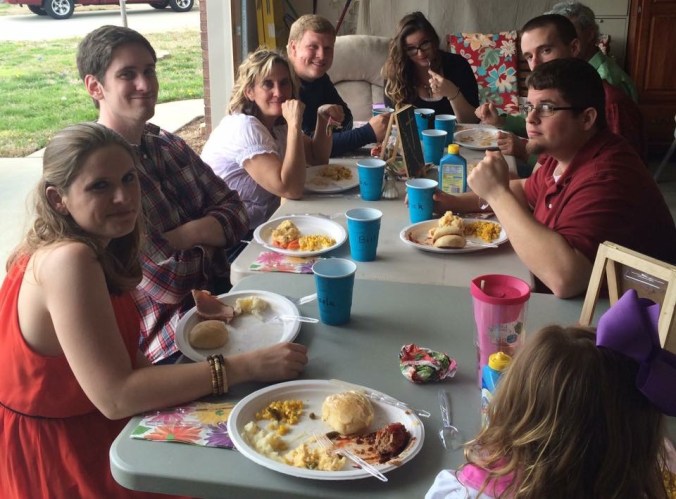
My Kitchen Table Project took place in the good old Owensboro, or as many of us like to call it “the dirty”. I went to my grandparent’s house, Virgil and Jane (not pictured). We had a few other family members there and some family ‘outsiders’ that I had not met before or do not know as well. My grandpa Virgil, or as I call him, Papaw, grew up on the farm and often tells many of his old tales from living with the farm animals and walking miles to attend school in a small one room building. My grandma, Jane aka Mammy, grew up in a nice christian family with a little more money and opportunities than my Papaw. Also joining us was my brother, a 20 year old stay at home community college student. Also attending was My aunt Debbie, her two kids Michaela (her new finance, Bill, who recently moved here from North Caroline) and Patrick. Last not but not least Were two of my other cousins Wes and Audra. Wes graduated from UofL and is now in the National Guard. Audra finished her education with high school and now helps with her family’s horses and works in a factory. With the variety of ages, education, and city/country life we had much diversity. It was also interesting to get to know Bill since I had never met him before. (We all contributed to part of the meal).

When asking everyone what citizenship meant to them, I received a wide variety of answers. Wes, who is in the National Guard, felt very obligated to serve his country and be up to date with everything happening to be a well rounded citizen. He believed you should be actively involved and helping in any way that you can. My brother, Caleb, felt his citizenship was more defined just by your political actions. To him being a citizen entails being very up to speed with anything politics and actively voicing your opinions and voting when at all possible. Everyone else joined at the table didn’t have much of an opinion on their citizenship except that they lived in the country and felt they should vote. Michaela mentioned something with having good morals and stepping in to help other citizens when needed.

The rest of the conversation seemed to then find itself among the lines of education obligations. Bill found that everyone had an obligation to become educated and get a well paying job to support yourself and any future family. My cousin Audra, who did not attend college, found that there are ways to work and find yourself and have a successful life without higher education. My brother Caleb found himself in the middle. As a night time community college student who is a manger of a Chick-fil-a during the days, he found that you can always find a balance between the two. He doesn’t necessarily need to go to college but he is to further his education and become a better business manger in what he does. It was very interesting to view the different stand points on higher education and whether or not it is necessary. This reminded me of Jane Adams and her failures at medical school for some reason. Not everyone goes to college and if they do are always successful. But in the end you find your path along  the way and get to where you are supposed to be. For some that might include higher education and for others it might not.

IMG_2059(My grandparents have a very small kitchen table so we pulled out collapsable tables in the garage!)


Kentucky Kitchen Table- Louisville, KY

By Olivia

I ate dinner with my boyfriend and his family. Mike, my boyfriend’s dad, is a very kind man that doesn’t talk often but when he does, he always has something valuable to share. He is a mechanic.  Monique, my boyfriend’s mom, is originally from the Netherlands and moved to the United States about thirty years ago. She works at a coffee shop and enjoys cooking. She insisted that she make the meal and that I was not allowed to bring anything. Kalina is my boyfriend’s older sister. She also works at a coffee shop. She is very outgoing and enjoys laughing with others. My boyfriend, Robbie, is fairly quiet. He likes making up stories and trying to get people to believe them. Their family moved to Kentucky three years ago from California. I have met Robbie’s family once before, but this was my first time having a real conversation with Mike. I was excited to use this project as an excuse to get to know them more.

The first question we discussed was “What does citizenship mean to you?” This was when I learned that Monique is not a citizen of the United States. Monique was born and raised in the Netherlands. She speaks four different languages. When she moved to the United States, she acquired a green card. Before answering the question, I asked her if she had considered becoming a United States citizen. She said that she had definitely thought about it. The rules for citizenship have changed a lot in the past ten years. The United States is very strict about how one can go about attaining citizenship. She would most likely not be granted dual citizenship and would have to give up her citizenship in the Netherlands. Monique is not willing to give that up and is planning on continuing to live with a green card. She does pay taxes and feel that she is a part of her community just like everyone else. Kalina feels that part of being a citizen is being a good person. She gave the example that if you see a guy beating up his girlfriend, you are obligated to call the police. She feels that looking out for each other is an important part of being a citizen. Mike had another view. He believes that the definition of citizen has been warped since the government has become what he called “corporate.” He believes that instead of the government benefitting the people, the people are working so that the government can get more in debt and less out of debt. The people don’t own anything themselves anymore; the government owns everything.

We continued to the question “Does your religious background affect how you think we should treat each other?” Everyone at the table agreed. Monique elaborated more. She said that growing up as a Christian helped her learn that we need to take care of those in need. We are not to overlook those that need help. Mike added that it was once the churches’ job to take care of the needy, but the government usurped control of that job. He believes that job is done much better when private organizations are in charge. Robbie tried to steer the conversation back on track to remind everyone that we weren’t talking about welfare, but about helping the community as a whole. Robbie agreed that we all have a moral duty as citizens to help each other.

Through this dinner I learned that caring for others is very important to other people than just my family. Although religious backgrounds did affect their beliefs, this can be applied to many different, diverse groups of people. Having a religious background in this situation is not a bad thing, it’s very positive. I also learned that there are very negative views of the government out there, but people are sitting on those views and doing nothing about them. It was very interesting to hear from Monique since she has experienced life in the Netherlands and in the United States. Her outlook gave the dinner something that my family dinner couldn’t have had.

This relates to the overall importance of citizenship and being a good citizen. Like Kalina mentioned, it is important for citizens to look out for each other. It shows that we care about our neighbors, our community, our country, and even our world. It implies an unwritten duty that is higher than the laws and regulations. As seen by Monique, citizenship also doesn’t just apply to just citizens. It applies to everyone living in the United States. Somewhere in time, we decided that we have the moral obligation to care about someone other than ourselves, and that it is our duty to improve the world around us. That is being a good citizen.IMG_3351

The Memphis-KY Kitchen Table

By Emma

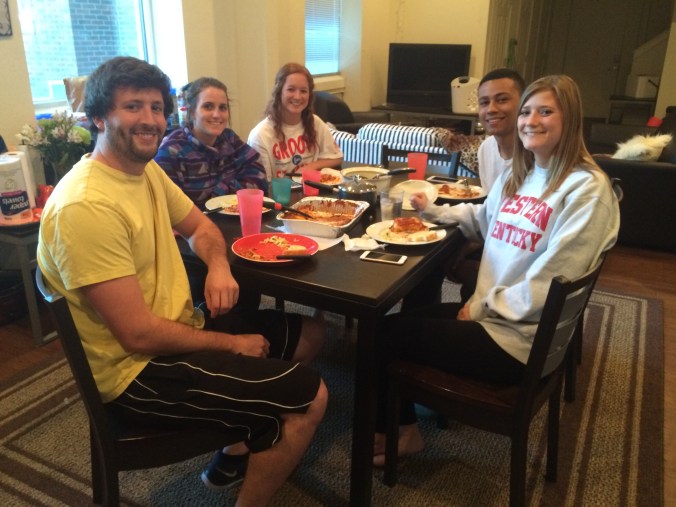
Sitting around the messy, unorganized table you see in this picture is a fairly interesting group of humans. The lovely woman in the blue shirt is my mother Anne-Marie, the little man in the red shirt is my brother Benjamin, the goofy man in the gray shirt is my neighbor Darren, and the couple to the right is comprised of my sister and her new boyfriend Hannah and Tristen. Anne-Marie works at a locally owned soap store by the name of The Bartlett Soap Company, volunteers frequently at the Oak Elementary, and is never shy in sharing her opinions. Benjamin is a current second grader with a passion for reading, science, and video games. Darren is a warehouse manager who writes poetry and has a passion for all things music, especially jazz and heavy metal. Hannah, a senior in high school, is a genius planning on going to Ole Miss to study chemical engineering. Finally, Tristen is Hannah’s boyfriend, also a high school senior, works in an auto garage and adores cars, guitars, and noise.

We began our discussion with hummus my sister made and pita bread my mom picked up from Kroger. I found out quite interesting things about every single person, especially Benjamin. Anne-Marie is extremely adamant about universal health care and the health care existing as a basic human right, the responsibility of the government to allocate their expenditures not to quantity but to quality and access. Though my mother is loud and never farouche when sharing her opinion about issues like the presidential race and the education system changes in Bartlett, Tennessee, I’ve never heard her speak on health care with such vivacity. Darren is passionate about unemployment as apparently he was once part of the population and clawed his way up from the bottom. Hannah was once almost taken by an eating disorder, an event that I too experienced with her hand in mine, so her social issue was eating disorders. She labels them as an “underestimated killer,” having known firsthand that many doctors, nurses, health professionals, peers, and even parents do not embrace the fact that eating disorders are indeed a mental illness, not just a mindset that can be overcome. Tristen’s social issue is stands in the presidential race. He has an outstanding and unswayable opinion on the candidacy of Bernie Sanders and his potential as president. And lastly, Benjamin’s social issue stood in how other children and parents treat his friends who moved to the United States and do not speak very fluent English. Kids and even their parents ostracize these children who are already incredibly shy, nervous, and very eager to make friends.

The main focus of conversation centered around citizenship and the ways to make ourselves more effective, educated community and world citizens. We also explored how compassion, logic, and psychology contribute to citizenship, just as in class. Both of my parents have a bachelor’s degree in psychology, and I knew that the concept of “the elephant and the trainer” would catalyze a explosive conversation. Darren emphasized that compassion functioned as a mountain while the government was logic functioning as the mountain climber. He explained this as compassion is unique and winding just as a mountain. When a mountain climber, or the government/logic in this sense, goes to hike a mountain, he/she can not predict how the mountain’s curves, crevices, bumps, and grooves will turn out to be. However, it is up to the mountain climber to not give up to the mountain’s complexity. With experience and climbing more mountains, the mountain climber can begin to understand how a mountain works, how to overcome its biggest inclines and its deepest trenches. In essence, the government can fully comprehend the more difficult situations by overcoming the ambiguousness of compassion and applying logic, or itself, to compassion.

In the end, the dinner ended up being more than just a conversation about community, but a newfound bond between family and neighbors. There was laughter and rough-housing, smiles and love. After being separated from my family for the first time in my life, I’ve felt lonely and disconnected from the people with whom I spent my life. I also didn’t grow up eating family dinners or spending a lot of time as a family unit, but this dinner was revolutionary for my family and for me.


Kentucky Kitchen Table

By Austin

Let me start by saying I am a pretty awkward person as it is, and typing on my computer or scribbling notes while people were talking at dinner would have made me very uncomfortable and my awkwardness worse, so I did not record what everyone said verbatim. But while none of these answers are exactly what the guests said, I questioned them until I understood their answers enough that I could write about them without changing their intended meaning.

So let us begin.

INTRODUCING FIRST! From LaRue County, Kentucky, standing at 5’ tall, Mrs. Katy Cecil! Mrs. Cecil is a high school English teacher and Larue County High School’s Speech and Debate head coach. She has been a mentor to me since my freshman year of high school. In fact, she is the one that convinced me to apply to college in the first place, and she still helps me when I have no idea how to do something… like organizing a dinner with people I don’t know. Also, she is the reason that our dinner wasn’t a potluck. She wanted tikka masala, which only Mr. Cecil knew how to cook, and nobody else knew how to complement.

Introducing second, from somewhere in Colorado, standing at 6’3” (ish), Mr. Cecil! He is also a teacher, but he teaches Honors and AP Chemistry. I never had Mr. Cecil because as a sophomore in high school I was somewhat of a slacker and took the easy class. He cooked dinner and it was absolutely amazing.

Next, we have the Cecil’s daughters, Elena and Elise. Elena is 15 and attends the high school that her parents teach at, and Elise is 10 and goes to an elementary school in the same town.

The man taking the picture is Ellis Fraser. He grew up in Louisville, but moved to LaRue County his senior year of high school and competed on the speech team that Mrs. Cecil coaches. He went to WKU for a degree in Film, but now he is the assistant coach of the Speech team.

Also there, but not pictured, is my friend Damon Helton. I told you I’m awkward, so I wanted someone goofy there to counteract my awkwardness. He answered some of the questions, but his answers won’t be featured in this post.

I think it’s safe to say that while this group of people has much in common, there is a fair amount diversity. All different age groups are represented, from Generation X, all the way to the new generation born after 2000 that there isn’t even a name for yet. Ellis and I are both Millenials, but even though we are technically the same generation, there is quite a bit of difference in what we remember from the ‘90s. Also, perhaps most obvious, Ellis is black. I think that gives him a rather unique perception of the world. Less obviously, I am Mexican. I may not look Mexican, and I may not have a Mexican name, but I can assure you I group with plenty of Latino culture in my house. Also, we were all born in different places and we’re all from different financial backgrounds. Ellis was born in Germany, I was born and grew up in LA, Mrs. Cecil is from Kentucky, and Mr. Cecil is from Colorado. Even the Cecils’ daughters were born in Michigan. All of this contributed to our collective uniqueness, which I hope will be enough to make this post what it needs to be.

Now for the fun part, dinner.

I started out with questions from the packet, like “Do you see your job as serving a greater purpose?”  but it eventually just turned into a conversation about community. It was quite interesting hearing the benefits of small town from someone that grew up in a small town, left their small town, and eventually came back to find that they loved it even more. Mrs. Cecil said that nothing can beat being able to text the pharmacist a question, and knowing they will reply almost immediately. It’s actually quite funny seeing things like that in action. Mr. Cecil agreed that it is nice knowing everyone and knowing that if he was running late, he could call and the pharmacy, or the bank, or the grocery store would stay open for him. He did say, however, that he would prefer to live in a big city. Ellis, too, said he likes the city more than small town life. But they both acknowledge the benefits of being close with the people of your community. It’s all relevant to our class because a big part of what we talk about is community based; community communication, community betterment, etc. Even the wicked problems that we’ve discussed, all of the papers that we’ve read agree that the changes necessary to “solve” them have to start at the community level.

KKT.Picture

Louisville Kentucky Kitchen Table

By Sarah

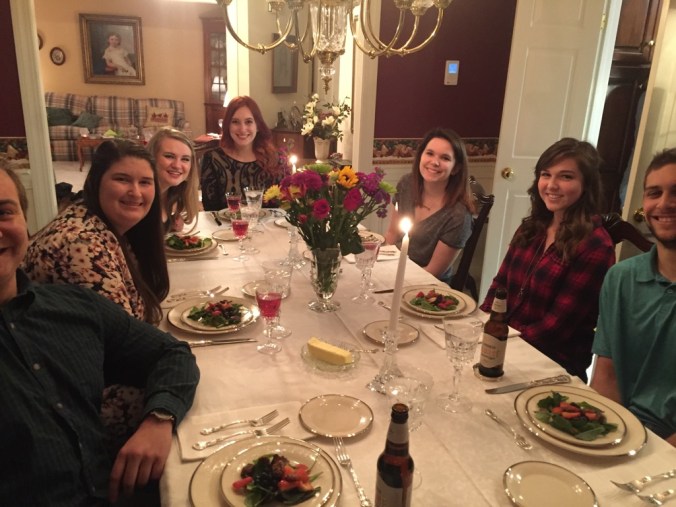
At my Kentucky Kitchen Table, I invited six guests to my house for dinner. My mother graciously offered to take the picture of us all, but her skills are not the best and she cut off halves of two faces. She also insisted that since strangers were coming to the house that we had to use nice silverware and plates to give a good impression on my guests. Nevertheless, my table included Mr. Dennis and his wife Mrs. Dennis, a couple that I know from church, Kara, who is a teacher at a middle school in Louisville, Paige who is a senior student at University of Louisville who brought along two people she knew from a diversity class, Kelsey who is a sophomore and Max who is a senior student and an immigrant from Cuba. I felt that this group provided a variety of insights and backgrounds to the table. For dinner, Kara prepared a salad with fruit and candied walnuts, I made a family recipe of Hot Brown Casserole, and the Dennis’s provided bourbon ball ice cream to round off a very “Kentucky” kind of dinner. Kelsey provided the flowers seen in the middle of the table, and Max brought some beverages.

One topic I wanted to discuss was family meals. I thought it was important to understand how these people felt and were willing to speak up based on how comfortable they were with eating at a dinner table regularly. I had grown up eating at the dinner table with my whole family every night, so this was commonplace for me. Both of the Dennis’s had agreed, Mrs. Dennis’s family was very tightly knit and Mr. Dennis’s was too, and now they had dinner nightly together in their own home. Kelsey and Paige said their families did not do it every night but did it often enough. Max said that he did not have them much recently, but growing up they were very important to keep the family together. I thought it was interesting, and after I asked this I wanted to see who spoke up the most about politics and citizenship. It seemed that those who had grown up regularly having dinner meals every night were the ones leading the conversations around the table, regardless of age. Those who had not had many, or not as many recently, were quieter and pitched in their opinions more when the rest of the group paused the conversation.

The main conversation that they all were willing to talk about was different political and citizenship topics, and I was really interested to see how they felt about being an active citizen and participating in the election coming up this year. All of us were registered to vote and so we all had a stake in the election somehow. Kara and Kelsey had said they had not voted before due to different circumstances but were now eager to participate. The Dennis’s had voted many times before and even in the last presidential race and were looking forward to voting again. Max and Paige had voted only in local or statewide elections previously but felt that that was enough for them and their civic duty until this fall when a new president is elected. We were divided almost halfway between Republicans and Democrats, with one more on the left side. It was interesting to see how everyone fit on the spectrum, especially Max’s point of view being a strong conservative and very into the political sphere of this country.

I learned that where a person is from impacts how they view their participation in their community. It is my assumption that those who forge stronger bonds with their families over discussions at regular intervals, such as family dinners nightly, possess a higher drive to participate in ongoing conversations about the world around them. Even though many of us held opposing views about politics or the nature of citizenship, it was clear that we all had some kind of idea as to what was important and what made a good participant in the citizenry of Kentucky. I felt that this was such a wonderful opportunity for me to learn from people of all different backgrounds and I am very thankful for this opportunity to experience this kind of diversity in my own household.thumb_IMG_4595_1024