Kentucky Kitchen Table

IMG_5597.JPG

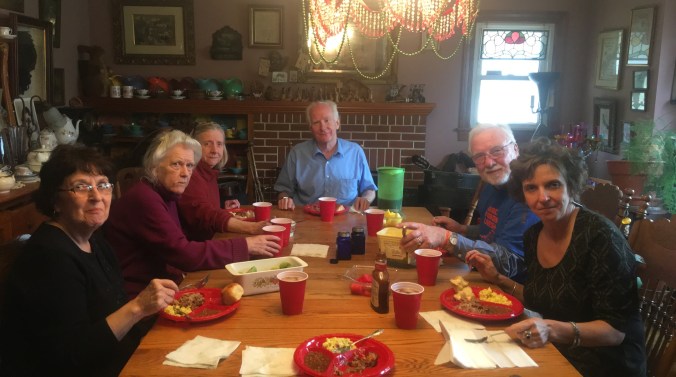
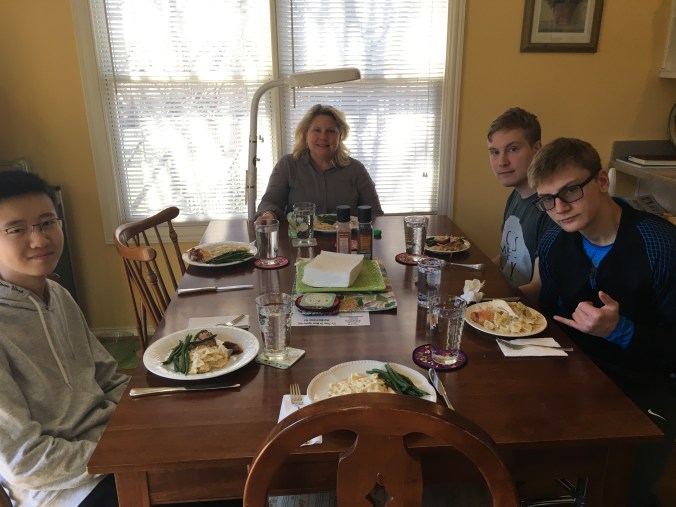
My kitchen table project was set in Louisville, Kentucky. Michael, Kristin, Peter, Charlie, and Josh ate dinner with me (Sarah) at my family’s home. Michael is my father who used to work for General Electric, and now works for First Build. Kristin is my mother who works as a stay at home mom and substitute teacher. Peter is an exchange student from China who goes to Josh’s school. Josh is my younger brother, a sophomore in high school. Last, but not least, Charlie is my older brother. He also attends Western Kentucky University and is a junior. Mike did not want to be included in the photograph.

We all helped participate in making the dinner, splitting the jobs of shredding the cheese to help make the pasta, baking the chicken, and boiling the green beans.

“Citizenship means being able to govern ourselves,” Mike said as he answered the question “what does citizenship mean to you?” He went on to explain how citizenship in the United States gave people freedom that some countries do not have.

We went on to discuss what each person believed what the best thing about our world today is. In Peter’s opinion, the best thing is the temporary peace. However, Josh stated that technology is the best thing about the world. This single question began to show how different viewpoints can shape opinions and have a result that is completely different than the person next to them.

Peter’s answer of peace made sense, as he came from China. Many people are still in danger in China, whereas the United States is a free country. In Peter’s eyes, that is peace.

Josh, on the other hand, has been raised with the privilege of freedom. Technology has been centered in his life through school work and communication as well as appliances and other things. Technology is the world to him, so that is why he answered with that.

Mike stated that his favorite thing about the world today is life. He is content with just living and breathing.

“I love breathing, man,” he said. “Let me tell you something, we are blessed.”

He also loves the diversity of nature and the beauty of the world itself.

When asked what he wanted to live in, Josh once again responded with a twenty-first-century answer. He mentioned wanting to live in Silicon Valley. Silicon Valley is an area in southern San Francisco, where there is a lot of technology and businesses.

When Peter answered what he liked most about living in China, his answer was simple: food. He loves the traditional Chinese food. During the dinner, Peter mentioned how much he missed it, but he also enjoyed the food we ate in the United States.

Mike and Josh agreed that the one thing they love most about living in the United States is the freedom we are given. They are able to do what they want to do (legally, of course), and go where they want to go, when they want to. Religion is not persecuted in the United States, so they are also free to believe what they want to.

Mike and Kirstin both agreed that it is important as a society to get to know your neighbors. That way, a community can be built within the neighborhood. Within a strong community, people can communicate and help each other out. However, Josh’s point of view was quite different.

Josh believed that there was not a point to knowing his neighbors, as he wasn’t doing anything with them like talking to or working with them. In his words, “there’s no need for me to interact with them.”

Peter knew his neighbors from China because his father worked with them.

When we discussed how our jobs influence others, everyone agreed. No matter whether someone’s job is in a business or a teaching job, the way people interact with others matters. First impressions especially stand out. Many jobs require connections. Connections are made by creating a relationship between people, and most people would like that relationship to be a positive one.

Those in the dinner did not have much advice to give to the people running or office. This is because none of us are smart enough, have the experience, nor are planning to run for office in the future. Charlie, however, eventually gave a firm, well thought out advice that everyone could take into thought. Charlie did not participate in the discussion too much, but he finally had something to say. “Do what is meaningful, not what is expedient,” Charlie advised.

Religion can make an impact on how people treat other people, but it does not have to. Christianity, for example, tells believers to treat everyone with love and kindness, but someone does not have to be a Christian to have those traits. Religion may have certain guidelines for morals, but even those who are not religious do, too.

This conversation helped me learn more about how age can shape views. For example, the younger participants cared more about technology and money, whereas the older participants cared about the community and helping others. This may be caused by the increase of social media and technology, which the younger participants had grown up with. The older participants, however, were used to getting to know people in person and building relationships.

This connects to the class because we are learning about how we can work together as a community. Without community, problems cannot be solved very well. In order to solve issues together, the community needs to get along and understand where each other is coming from so that they can work together in a peaceful environment and avoid conflict as best as they can.

Growing up in different countries also changes perspectives. Peter, for example, comes from a persecuted family in China, whereas Josh comes from a privileged family in the United States. Peter focused on what he believes to be the temporary peace that is seemingly spread around the world, whereas Josh focused his part of the conversation in angling back to the advancement in technology.

Easter in Alvaton


IMG_3918

By Emma

On Easter Sunday, seven people, ranging from my close family to a considerably recent acquaintance, gathered at my grandparents’ house for a time of food and fellowship in Alvaton, Kentucky, a community outside of Bowling Green. For me, traditional family dinners on holidays are a well-worn tradition that has formed my childhood and shapes my adult life. This dinner allowed me to catch up with my family while also adding a new guest and the opportunity to discuss and deliberate on a variety of social issues and our interests regarding citizenship.

Around the table sat a variety of interesting personalities that brought an array of experiences and opinions to the conversation. My name is Emma, and I am a nineteen-year-old studying elementary education and history at Western Kentucky University. While I have lived in Bowling Green for the past ten years, much of my childhood was spent in Indiana. My dad, Steve, is forty-eight years old, holds degrees in political science and student affairs and a doctorate degree in educational leadership, and works as an administrator at the University of Kentucky College of Medicine. While Steve is a registered Republican, he is often relatively moderate in his political opinions. Also at the table were my maternal grandparents, Larry and Norma, who are in their late sixties. They are high school sweethearts who have lived all over the country from Indiana, Texas, California, Nebraska, and now, Kentucky. They have two children, a son, who lives in Colorado, and a daughter, my mom Laura. Larry is a retired engineer who now fills most of his free time with woodworking, photography, and watching football. Norma is also retired and enjoys quilting and cooking. She insisted on cooking the entire meal on Easter Sunday, which was full of traditional comfort food. Both Larry and Norma are considerably conservative in their political opinions. Auntie Carol, despite her affectionate title, is not actually related to anyone at the table. She was born and raised in Iowa but spent much of her adult life in Hawaii as a massage therapist where she raised her two children. She lost her husband many years ago to cancer, and after meeting my grandparents, she befriended my family, moved to the mainland in Nebraska, and has become like another grandparent. She, too, is largely conservative politically and a devout Catholic. Next to me sat my boyfriend Baker, a twenty-year-old advertising and graphic design student at Western Kentucky University. Baker was born and raised in Kentucky, works as an intern at a local church, and considers himself to be politically moderate. Finally, my friend and classmate, Reuben was our new and very welcomed guest at the table. Reuben was born in New York and is very involved with learning and growing in his Chinese heritage. He is an architecture student at WKU. Primarily in age, levels of experience, and interests, our diversity was evident as we sat around the table. After catching up on school and hobbies and discussing my mom and sister, who were out of town on vacation, we began our deliberation on citizenship and other topics that were important to us.

“What does citizenship mean to you?” opened the conversation and provided the opportunity for many people to discuss their perspectives. Carol discussed that it was a privilege that is often taken for granted by those who obtain it by birth. She said it was more than just living somewhere and that it should be appreciated for all the rights and responsibilities it brings. She discussed her appreciation for those who work to obtain citizenship honorably but also recognized her lack of appreciation for those who may try to immigrate illegally. Larry and Norma both remarked that they were extraordinarily proud to be American and that people often forget how special it is. Baker noted that a close friend of his, an illegal immigrant, had recently become engaged to an American citizen, an occurrence that some people had speculated was just an attempt for him to gain citizenship. Baker’s comment sparked conversation regarding the DACA, or Deferred Action for Childhood Arrivals, controversy. Steve adamantly opposed the deportation of illegal immigrants who arrived in the United States as children. It seemed that Steve felt that a person who feels a connection to the place they live and is willing to contribute to the productivity of the society deserves the opportunity to stay in the country. Norma added to this point, saying that many natural citizens of the country lack the willingness to contribute to society and rely on government assistance. The overall theme of the answers to the citizenship question seemed to be that American citizenship was a privilege that should be held in the highest regard. Too often, we take the rights we have for granted.

Then, Reuben posed the next question about whether the group trusted the government. Carol answered quickly that she did not but began to reason through her adamant opposition to the current government. She stated that the government is currently far removed from the people it serves, particularly at the national level. This was a resounding comment at the table. I mentioned my thoughts that perhaps the democracy envisioned at the country’s inception was not the democracy that frames the nation today. I mentioned that I firmly believe in the country’s ideals, but I think too often, the ideals that shaped early American values remain absent from the America we know today. Steve, Larry, and Baker discussed the concept of term limits for legislators who may maintain a level of comfort that prohibits them from executing their duties effectively. Norma mentioned that it is up to the citizens to ensure that unofficial term limits are enforced. Overall, this topic yielded an agreement that the government’s failures, especially on the national level, are currently more evident than its successes. Additionally, I found it interesting that the entire table agreed that citizenship is a distinct privilege, yet we all found issues within the government that seeks to serve its citizens. Reuben also asked the table if we held a hope for humanity. Each person giggled slightly at the seemingly dramatic question, but after a few moments, many of us came up with a thoughtful response. While I do not remember the specific responses, every person at the table agreed that hope in humanity was certainly present. I think hope for the future and a hope for the success of ourselves and the people around us is what ultimately drives all ambition and purpose. I also couldn’t help but look around at the kind, familiar faces that sat at the table and the large helpings of food in between us and feel that my hope in humanity, as silly or dramatic as it may sound, was right around me in that moment.

This afternoon allowed me to appreciate the many perspectives of my family that are not often shared around the familiarity of the dinner table. Additionally, it allowed me to see that taking the time to get to know a classmate and appreciate him for the unique experiences he brings to the table is a necessary and special way to stretch beyond the comfort of an ordinary family dinner. I left the dinner with a new appreciation for the many backgrounds present that allowed each of our circumstances to meet at that specific moment. Furthermore, I saw the benefit of the deliberative engagement described by Keith Melville. While we did not solve the world’s problems over dinner, my family did gain insight into diverse opinions and maintain respect for one another while discussing issues of considerable importance.

IMG_3928I think it’s important to note that one of my favorite moments of the afternoon occurred outside of the meal we shared together. My grandparents are antique dealers, and one of the rooms in their home is dedicated to many of their priceless or collectible items including Native American artifacts, tobacco tins, clocks, china, and Civil War artifacts. One of the more special items in their collection is a Civil War rifle that was carried by one of my relatives in the Battle of Antietam. Before our meal, my grandma showed our special guest, Reuben, around the antique room and allowed Reuben to hold the rifle, which is one of the photos I included. After reflecting on the afternoon and looking at the picture of Reuben holding the rifle, I came to an interesting realization. My relative, Joseph Carter, carried that gun into a battle in 1862, and Reuben is a young man descended from Chinese immigrants living in 2018. There seems to be little connecting the two parties, yet the simple invitation of Reuben to my grandparents’ home allowed this wide gap to be bridged tremendously. In our class, we often discuss a bridge that connects how things currently are and how we would ideally want things to be. The bridge holds many diverse ideas and strategies, yet I think the overarching theme of the bridge is effort and respect. It took a small amount of effort to invite Reuben to a family dinner, and we all enjoyed and respected hearing his unfamiliar and diverse stories and ideas. Similarly, if even a small amount of effort and respect is applied to other aspects of life and deliberation, many other wide gaps can be bridged as well.
Skyler’s Kentucky Kitchen Table in Alvaton, KY

IMG_1590(I had to be the photographer, so I am not in the picture.)
By Skyler

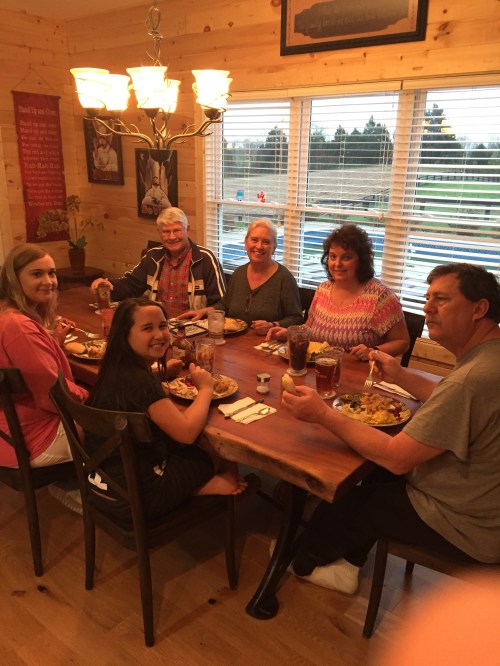
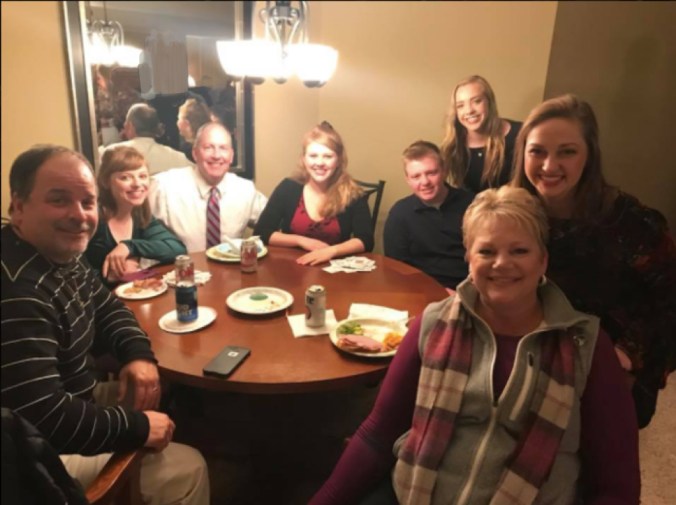
My Kentucky Kitchen Table meal took place at my home in Alvaton, Kentucky, a small community just outside of Bowling Green in Warren County. Overall, there were seven people at my meal, each of whom brought interesting experiences had a unique perspective on the questions we discussed while eating. I had immediate family, extended family, and an old friend from another university who I had not connected with in quite a while at my meal. My name is Skyler, and I am a sophomore at Western Kentucky University. I am majoring in biology and agriculture, with minors in land surveying and GIS. In addition to my studies, I work as a supervisor at an elementary after school program in the Bowling Green area. I also farm livestock of all sorts and raise a large garden alongside my father. Being a rather inexperienced chef, I picked up canned cranberry sauce and rolls for the meal. My father, Miles, is an auctioneer as well as a cattle farmer. He has spent his life on the farm, growing up working in his father’s slaughterhouse and raising livestock and crops, and now raising cattle himself as well as working as an auctioneer selling cattle auctions on a weekly basis and hosting other types of auctions from time to time throughout the year. We decided to have a Thanksgiving-like meal for this occasion, and Miles was responsible for cooking turkey as well as using his family recipe for dressing, something he particularly enjoys doing. My mother Tracie was also a part of the meal, and had some especially strong opinions and experiences on some of our discussions due to the 25 years she has spent as an elementary school teacher in Bowling Green. Tracie takes a lot of pride and joy in her role as a teacher. A self-proclaimed “city girl,” she does not always see eye to eye with my father and I on issues concerning our farm and other things of that nature. Tracie supplied vegetables for the meal, such as corn and green beans. Another participant in the meal out of my immediate family was Hayla, my nine-year-old little sister who is currently in fourth grade. Hayla was adopted by family out of foster care when she was a baby, and has been a perfect fit ever since. Hayla has a brilliant mind and strong views on the world for her age, and her contributions to the discussion were very valuable and interesting. She is a little actress, having been in over fifteen plays since she was five years old. This includes a recent starring role in the play adaptation of Pocahontas, where she played the lead role of Pocahontas herself. Her experiences with kids and adults of all ages and backgrounds in her theater community has led her to branch out and hold some very interesting views on life that differ quite a bit from my own. With the help of our mother, she made a cake for our dessert.

My grandparents came up all the way from Florida for this meal. They are permanent residents of the sunshine state now that they are retired, and we do not get to see them very much anymore. My grandmother, Jennifer, is my mother’s mother. She retired from WKU as an employee of the Preston Center, and worked many other jobs throughout her career. My grandfather, Bobby, is a retired electrician who worked for others and ran his own company. He is now an avid golfer and fisherman, taking advantage of the warm Florida weather. They are both strong conservatives with heavy interest in politics, which differs quite a bit from my immediate family who are much more moderate. Finally, my friend from the University of Kentucky, Kirsten, came down for the meal. Kirsten is an old friend of mine from high school, as well as a neighbor who lives somewhat close by. I have hardly talked to since going to college nearly two full years ago, as she lives year around in Lexington now. She is a sophomore and a member of the Delta Gamma sorority at UK, and is an avid football fan. She is originally from Nashville, TN, and she has traveled throughout much of the country with her dad, who works selling apparel at sporting events and many other various things. She is a business and marketing major at UK, and her experiences and views on things are quite different from anything my family has. She brought another very unique perspective to the dinner table. Her college experience has been vastly different from mine as well. Kirsten brought an excellent hashbrown casserole to the meal. I had another guest set to attend, a student of mine in the after school program who came to America from Vietnam a bit over two years ago, however he fell ill and was unable to attend.

We had some great discussion throughout our meal, beginning with one main question: “What does citizenship mean to you?” Each person at the table had an answer for this, and they all varied quite a bit. My grandparents Bobby and Jennifer felt that citizenship leaned more towards the political side of things, including exercising your rights that are granted by the Constitution in America. Bobby, a gun collector, emphasized that he felt his right to bear arms was one of many rights that played a big part in his definition of citizenship. Jennifer was also quick to mention that while these rights are a huge part of citizenship to her, they must not be abused and misused. Peace and equality were two factors that they both said should play into our rights, and while they admitted these two things were not where they felt they should be in today’s world, they did not back down from the importance they placed on their own rights. Bobby added that without the rights he has here in America, he would be rather move abroad because Constitutional rights are what makes being a citizen in this country better than others. My mother Tracie took on a different perspective, instead choosing to emphasize her role as a teacher to model her definition of citizenship. Tracie feels that being a citizen includes doing what you can to take care of others, and to be a positive role model for all and be kind to others. She mentioned how she views her role as a teacher as a way to make a positive impact on kids that could perhaps last a lifetime, and she feels she is doing her duty as a citizen by being there for her students each and every day. My father Miles, a quiet individual despite his occupation of auctioneering, did not say much, however he added that he felt sticking to your word and being honest, as well as helping out others in need is a big part of citizenship. He said that being there for our neighbors for little things like there cattle getting out while they’re on vacation as well as for the big things, like taking over their farm operations as they recover from a heart attack, is a big part of being a citizen. I personally feel the same way, and I added to his definition by emphasizing my passion for helping others as a part of what citizenship means to me. Being there for whoever needs me, and helping even strangers, makes me happy and it’s something that I try to do every day of my life. My little sister Hayla had a lot to say about this question, and while a lot of it was rambling and her wild imagination, she did say that citizenship to her meant getting along with everyone and treating them well, no matter how different they were from you. She attributed this to her acting director, who instills this value in them on a daily basis. Kirsten also had a slightly different take on the matter. She leaned more towards the political side of things as well, however she has more liberal views in comparison to my grandparents. She stated that being a citizen meant having your rights, but also having the right to feel safe. She challenged Bobby on his gun stance, and they had a peaceful and fascinating discussion on the subject. If everyone deliberated the subject the way they did, perhaps some solutions could be reached that could appeal to everyone.

While that question was the main topic of discussion, we also went into how religion plays a part in our lives. My immediate family and I are strong Christians, and this plays a huge part in how we live our daily lives and how we see our roles as citizens. Bobby, Jennifer, and Kirsten on the other hand are Christians, but they do not regularly attend church and they do not really practice the religion to a very great extent. We had a great discussion about our faiths, as well as other faiths that we encounter on a near daily basis. We came to a general conclusion that religion has always played s a big part in people’s lives, and it will for a long time to come. We also discussed many other questions related to citizenship and our own views on life in general. I learned a lot about everyone, and was surprised to learn a lot of previously unknown stuff about my own parents and little sister!

One topic we did address that had some intense conflicting views was immigration. Bobby and Jennifer, as well as my father Miles and friend Kirsten, felt that immigration is a huge problem in America that needs to be stopped. Bobby felt especially strong about tightening down on immigration. My mother Tracie and I work in a local elementary school with kids from over thirty different countries, and the experiences they’ve had are shocking and at times disturbing. We have met children who have ran from war, who have been shot at and had their homes destroyed. We have met children of all backgrounds. These experiences have given us a completely different view on immigration. I pointed to a book, Exit West by Mohsin Hamid. I detailed how these people in the book ran from such horrible terrors in their home country, only to find hostility and danger in supposed safe places as well. I have seen firsthand that this happens every day in real life, and those people are right here in my own city, in a school that I work at each and every day. At one point in the book, the characters are being threatened by military in London, after having already run from war at home. I detailed this part to the rest of the table, telling them that these people are here in our country, and instead of being hostile towards them, we should accept them and help them however we possibly can. I do this by donating food to the pantry at the elementary school I work at, and mentoring the kids who have immigrated. Tracie does the same each and every day. I told the others at the table that by accepting these people, we can live better together, just as we have discussed in Citizen and Self class. Hostility towards them does nothing in my opinion. They have already been through things we cannot imagine, so we must help them I believe. I think that may have swayed the others at my table to believe this as well, or at least I hope that I did.

Overall, this was a wonderful experience. It’s not often that you get to sit down and have these meaningful discussions in today’s world. If people could do this more, and deliberate more peacefully, I believe the world might be in much better standing today. I have learned that conflicting views can coexist peacefully, and that discussion and deliberation is perhaps the ultimate tool we have at our disposal for this.

Citizenship and Chicken Pot Pie

By Rachel

I am Rachel and My Kentucky Kitchen Table assignment took place in Owensboro, Kentucky in Kelsey’s house. For this meal, we all agreed that my mom and I would bake a pot pie and bring it over and Carol and Kelsey would bake dessert. My mom, Kelsey, and Carol were there. Carol is Kelsey’s mom and a friend of my mom. Both my mom and Carol work in the lunchroom at a local high school. Carol and my mother are both middle aged and have lived in Kentucky their whole lives. Neither have travelled outside of the country. Although they have lived in Kentucky, which is known for its rural areas, both have always lived in a decent sized city. Carol comes from a lower middle-class family while my mom comes from an upper middle-class to upper-class family. When asked, my mom and Carol identified as Republicans while Kelsey and I identified as Democrats.

Carol is recently divorced with a younger son still in high school. She currently is living with her mother to take care of her. Her family is very important to her and she has done everything in her power to ensure they all stay together. She is the assistant manager in the lunchroom at the local high school and she really enjoys her job. She likes being around the kids everyday but she also likes that she is the boss.

My mom has never been married and has operated as a single parent from the beginning. She has always had at least two jobs if not three on occasion. She herself has claimed to be primarily a one issue voter; that issue being abortion. Her views on this topic stem primarily from her religion, but also simply from how she was raised. Her parents were very strict about what was and what was not socially acceptable and many of these lessons have stuck with her despite the changing social climate.

Kelsey recently moved back to Owensboro from Florida to have her baby boy, Jaxton. Kelsey is a server at Red Lobster. She is a very brave young woman. She picked up and moved to Florida to go to college and didn’t know a soul down there. After that experience, she really came to appreciate her ability to travel and to explore new places on her own. While in college, she studied abroad in England for 3 weeks over the summer. She has also gone on several spontaneous road trips by herself when the mood has struck her. Her freedom of mobility is the right that she holds most important.

As a new mother, Kelsey mentioned that it was really important to her to live in a safe and friendly neighborhood. They recently had some trouble with the next-door neighbors because of Kelsey’s dog. She has a Pitbull who is one of the sweetest dogs in the world, Naya; however, Naya thinks she is the size of a lap dog. The way Kelsey’s house is set up, she lets Naya out of the side door so that she can go into the backyard. Naya has been trained to go straight there, but one day the neighbor’s Chihuahua was outside when Naya was let out. Naya tried to play with the dog and unintentionally hurt it. The neighbors called animal control and had Naya picked up and sent to what is essentially doggy jail. In order to get Naya back, Kelsey had to pay an $800 fine, pay the vet bills for the dog next door, and enroll Naya in obedience classes. Naya is also not allowed outside of the house without a leash. If Kelsey were to get caught letting Naya out without a leash, she would be fined another $200. As a single mother who is working as a server, this was a big hit to her financially. It’s also inconvenient for her to let Naya out now since she has to drop everything to walk Naya to the fenced in area of the backyard. As a result of this situation, Kelsey touched on how she would appreciate having neighbors who are tolerant of those around them. Kelsey said she always liked her neighbors and she would have been more than willing to work with them but the rigid fines and requirements have soured the neighborly love.

The general question of what it means to be a citizen was raised while we were eating. Carol mentioned how when she was younger she thought it was just paying taxes and obeying laws. Now that as she is older, she feels more of an obligation towards her fellow citizens to help where she can such as volunteering and donating to causes she supports. Kelsey disagreed that there wasn’t any obligation to those around her. To her, citizenship is the ability to live freely and make her own choices without the government becoming domineering. My mom felt that being a citizen meant volunteering and voting in local elections. She made it clear, however, that she does not vote in presidential elections because she adamantly opposes the electoral college system. She feels that the popular vote should win in such cases because gerrymandering silences many voters. This topic lead to a pretty heated debate between Carol and my mom. Carol claimed anyone who did not vote in presidential elections did not have a right to complain about the president. My mom, however, explained why she felt her vote would not affect the outcome simply because of the ratio of voter parties in our district. After the explanation Carol admitted that she hadn’t considered things from that perspective.

Another topic that was brought up was the legalization of marijuana. Carol’s son smokes because it helps him with his anxiety. Carol explained that there are rules that her son has to follow such as he is not allowed to drive anywhere while under the influence and he isn’t allowed to smoke more than three times a week. He also has to have his own job to pay for it. My mom admitted that she didn’t think it would be terrible if it were to be legalized but that she would never actively support its legalization. Both Kelsey and I expressed hesitancy about its legalization. Kelsey and I both talked about how we know some people in college who would use it to excess and miss their classes and even drop out because it stripped them of their motivation. My mom, however, pointed out that same thing could happen with alcohol. Kelsey and I both agreed that although my mom had a valid point we still didn’t feel it would be in best interest of our communities to make marijuana more easily accessible.

The last thing we talked about was religion and if it’s related to being a good person or good citizen. There was a general consensus that one’s religion was not an indicator of whether someone is a good person. My mom pointed out specifically that she has known some very religious people who have also not been the nicest people. She said it doesn’t matter what religion someone prescribes to, everyone has the same capacity of good and bad. Kelsey said that although being religious was obviously not required to be a good person, she felt the values her religion instilled in her helped her to be kinder towards others. Carol also felt the same way but mentioned that she has also known some people who preach one thing but practice another. I said that although my religion plays a part in how I treat people, I do not allow it to affect my citizenship. To clarify, I do not vote based on my religious views. I feel that if I were to cast my vote in accordance with my religion, I would be in some way forcing my religion on those around me. Just because my religion holds that something is wrong, it does not mean it is wrong for those around me. I firmly believe there should be a separation between church and state regarding political views in order to be a good citizen. My mom did not agree with me, but Carol and Kelsey took what I said into consideration.

During this dinner, I learned that it’s okay to have differing opinions. Even people from the same family can have opposing viewpoints and still get along with one another. I can honestly say I know more about the gerrymandering of districts now than I ever had. I was aware there was a problem, but was unaware of the extent of that problem. I also learned that my own mother doesn’t vote in national elections, but she defended her stance well. On some level, I agree with my mom. It really made me ask myself, “what good will my vote do if I’m surrounded by those who will vote the other way?” It makes me question the value of the electoral college. After the dinner, I actually looked into national elections where the electoral college produced different results than the popular vote and found that in more recent years there have been two: Gore v. Bush and Trump v. Clinton. The margin of difference in the popular vote actually increased between these two elections suggesting the electoral college may be on its way to becoming an outdated system. Overall, this dinner exposed me to differing opinions on some touchy subjects; however, it was encouraging to see that some form of deliberation can take place around a common dinner table. This relates to the Wicked Problems reading because in order to solve a wicked problem it must first be talked about at a local level. It also relates to the central question of “how can we live better together?” because in order to live in a successful community there must be communication and the dinner table is a great place to start the conversation.


IMG_4517

Noah’s Kentucky’s Kitchen Table- Growth in Wake of Disagreement

IMG_2603.JPGFort Thomas, KY – March 31, 2018

My family isn’t one that often finds itself eating around the dinner table. As a child, we would eat every dinner in the dining room, but as us kids grew up, we found ourselves less and less able to congregate each night around the dinner table. We had play practice, band rehearsal, baseball games– we were getting involved and being busy, but missing out on human connection each night.

That is why I was so excited to host Kentucky’s Kitchen Table in my hometown with not only my siblings and father, but my aunt, uncle and their children from McMinnville, TN, in town for the Easter holiday.  I invited everyone over with the primary intent to conduct this project of healthy deliberation, but secondarily to catch up. Being away at college, I had lost touch with my aunt and uncle’s family in particular,  but also didn’t get to see my family as much so this was needed.

My two sisters are pictured next to my dad, from left to right Maria and Claudia. Maria is a senior in college at Northern Kentucky University majoring in Education– my mom is a teacher and she is following in her footsteps. She is a relatively liberal person regarding politics, but a devout Christian and loves to travel and be involved. Claudia is a sophomore in college also at Northern Kentucky University, also majoring in Education– that’s why we say Maria and Claudia are two peas in a pod. She is also liberal and Christian, but has a louder opinion on things and isn’t afraid to put it how it is. She brought steamed carrots and vegetables.

Claudia brought her friend Annalee, whom I had never met. She is also a sophomore in college at, guess where? Northern Kentucky University (seems like I’m the only one who got out of the NKY Bubble). But she, unlike Maria and Claudia, is majoring in physical therapy. She, while also devoutly Christian, is a strong conservative and a wide supporter of Trump. They collaborated on a nice pan of brownies– a college student staple, just need a box mix, eggs, oil, and water.

Then we have my father, a staunch rejecter of partisan politics who is an avid believer in person over politics, i.e. voting based on who they are, not what they stand for. He is currently a history teacher at my high school, which made for some fun AP U.S. History, but at least I passed. He made the ham and let me say, the man can cook.

My aunts and uncle, Theresa and Tom, coming from Tennessee really embody the stereotype of the American South. They are devout Baptists, staunch conservatives, and believers in a free America where the government has no intervention on their lives. Their kids, Keegan and Ellie, are 15 and 22 respectively, with Keegan being just a freshman in high school, and Ellie graduating from Vanderbilt University in May. They brought deviled eggs, a bold choice considering the 6 hour drive from Tennessee to Northern Kentucky.

To begin, after we had gotten our plates, I started with a basic question: How does everyone feel about America right now, in any capacity? This included politics, social rights, economy, and even the weather.

My sisters both agreed that the political climate wasn’t conducive to anything productive; my dad agreed that the geographical climate was not conducive to being able to go outside– how’s that for parallelism? My dad said that he tried to look at things in a positive way because of his near-death experience as a child when he got into a car crash that put him in a coma for days.

My sister’s friend Annalee spoke highly of Trump’s economic stimulation and job creation, and my aunt and uncle openly agreed. Their daughter Ellie agreed with my sisters. Keegan tried to steer clear of the conversation regarding politics altogether, the ham took up enough of his time. This conversation heightened in intensity due to both sides refusing to listen to the other.

This first question brought up an important part of this project by revealing a notion in American politics– side taking. People were quick to polarize into liberal or conservative and were not willing to meet in the middle. The only other facet of beliefs was those who didn’t want to get involved. I believe that in American politics today, this is the case with the general populace. People are either very strongly one side, or do not want to talk about it at all. This is reasoning behind why American politics is at a lag at this point in time, and reason enough for me to change the subject.

I decided to next ask a question that would foster positive deliberation. “What do you think are the best things about our world today?”This was a turning point in the night’s conversation. For once, answers generated laughs and smiles. I started by saying I loved the dedication in the world to finding solutions, whether it be a cure to cancer or ocean cleanup.

A few responses that stood out included Annalee’s, who said the best thing is people fighting for what they were passionate about, echoing movements such as #MeToo and March for Our Lives, largely ideologically liberal movements. It was surprising that she said that, especially after discussing politics passionately had just erupted a few minutes prior. But it was a step in the right direction to see someone stuck up in their own beliefs finding a bipartisan way to support positive movements.

My aunt Theresa’s answer surprised me in a way that disrupted positive conversation. She said that the best thing in the world was Trump’s administration because it was giving her community jobs after having a high unemployment rate. I was perfectly fine with  her supporting him, but we were baffled that that was really the best thing to her. This taught me that some people are polarizing not just because they are passionate, but because they believe everyone else is wrong. That mindset killed this question, but brought up a good point about how different people see politics.

My penultimate question was “Have you ever had a conversation with someone from a really different background than yourself?” I was interested to see responses, considering that my aunt and uncle stem from relatively homogeneous areas of the nation.

My sister Maria started by saying she had never met an international student until she came to college when she joined an International Student Coalition and broadened her mind to people who were different than her, both refugees, immigrants, and people working here on visas.

My cousin Keegan finally chimed in, saying he has a friend whose mom died. This was another facet in that backgrounds can be different in many ways. Like Keegan’s friend, you could have a traumatic event that not many have to experience that shapes you as a person, but you could also simply be from a foreign nation. I was really proud of Keegan for sharing this emotional information, even if it was just his friend. Both change you as a person and open up the minds of others to either how good they have it or how their life differs from others.

Lastly, I decided to close on a unique note, that could have no political repercussions: “What kind of person do you want to be?” This was purely personal and required introspection, so I was intrigued to see how this group handled it.

My dad joked that it was too late for him to aspire to be someone, he was who he was. I liked that he was open about it, but I spoke up that we can always improve ourselves as our lives shape us in new ways, and he seemed to agree. Ellie’s response was something that summed up the night well. She said not just a good person, but a person who loves deeply and puts her relationships as a priority. This was truly what we all wanted– to put aside our differences and love each other as a sister, brother, mother, father, or cousin.

Overall, I learned that everyone’s lives are colored differently, based on experience. Theresa loved Trump because it had a direct impact on her in a positive way, my dad handled situations in a funny manner because he has a true zest for life after almost losing it. All opinions were valid because they weren’t just stances, they were personal. I learned to see everyone as human and their beliefs as legitimate (even when I disagreed).

As it relates to Honors 251: Citizen and Self, this project showed the value in healthy deliberation, and getting deliberation back on track when it derails. As Kevin Melville noted, when we engage in aggressive, unhealthy discussion, we undermine democracy and do not stimulate new ideas. This project was a prime example of both good and bad deliberation, the bad being political feigning and the good being digging into our morals and recovering. Deliberation is the key to opening minds and when we introspect, we find that our beliefs are personal to us, but can be changed with empathetic conversation that encourages disagreement. We all broadened our minds and became closer as not only people with political beliefs, but family (yes, even Annalee who was a stranger before).


Kentucky’s Kitchen Table in Lexington, KY

By Liz

The Setting + People:

My “Kentucky Kitchen Table” dinner took place on March 31, 2018, in my paternal grandmother’s home just outside of Lexington, KY. The meal was mostly graciously prepared by my grandmother, who insisted upon cooking as it is one of her most favorite hobbies and she has always loved having people over. She prepared chili, pimiento sandwiches, and provided many clementines. To help out, I roasted sweet potatoes and Brussel sprouts and baked cupcakes (which I unfortunately forgot to take a picture of). Including myself, our dinner party had eight attendees. To open the recap of the conversations that took place at the meal, I will first introduce each one of the attendees.

My name is Liz and I am currently a junior mathematical economics major at Western Kentucky University with minors in finance and business administration.

My grandmother, Sue, is 72 years old and is from Paris, KY. She ran farms for most of her life, both in Paris and in Syracuse, New York. She retired 15 years ago from a Butternut bakery in Winchester and now lives in a house right across the street with my wonderful step-grandfather.

My grandfather, Gary, is 81 years old and he is from Indiana where he was one of 12 siblings. He is retired now as well, but he managed bread delivery routes when he was still working and met my grandmother when he was briefly my father’s boss, and they hit it off. They’ve been married since about five years before I was born and have always been very involved in mine and my sister’s lives; we honestly couldn’t have asked for better grandparents. Also, before moving on, I must mention that both of my grandparents in attendance are very religious and involved in a local church and their faith is very important to them.

My little sister, Shannon, is 18 years old and will be graduating high school this year. She has played soccer her whole life as I did, but unlike me she will be playing college soccer for Campbellsville University starting in the fall. She is very sarcastic, but she is smart and has a very good heart.

My mother, Anita, is 49 years old and is from Bath County, Kentucky. She grew up in a low-income home for most of her life and was put out by her divorced parents once she graduated high school and has had to essentially fend for herself ever since. This adversity has made her strong, and she can be very fierce and set in her ways. She currently works very hard alongside my dad in the bread distribution business to meet and exceed our family’s needs and wants.

My father, Bill, just turned 52 and is a very kind-hearted man who has worked in the bread distribution industry his whole life. He went to college for a while when he was younger, as all of his siblings and step siblings did, but had to drop out during his second semester due to a tragic car accident that left in the hospital for over a month. He is often the calm voice of reason to my mother and is very thoughtful and caring.

My boyfriend, Andrew, is 27 years old and was born and raised in Winchester. His father is a preacher and his family is very religious. He always went to private Christian schools growing up, and played baseball for Asbury University in college, where he studied business. He now works full-time at a warehouse selling various electronic equipment as a desk sales representative in the office. He is a very warm and kindhearted guy, and always looks for the best in people and things around him.

Finally, my neighbor Mackenzie also attended the dinner. Although she has been my neighbor for as long as I can remember, I have never really gotten to know her very well due to the gap in our ages. She is sixteen years old and attends my old high school, where she is a competitive swimmer. She got into swimming about 8 years ago and it has consumed her life ever since. She loves the water and even got her first primary job as a lifeguard so she could be near the pool even when she wasn’t at practice. She had many interesting insights that I never would have seen coming from her throughout this dinner. I am grateful that this experience has helped me see more of who she really is.

Our Conversation:

I opened our dinner conversation by asking the required question, “Beyond voting, paying taxes, and following laws, what does citizenship mean to you?”. My father answered by saying that it meant he had the opportunity to be whatever he wants to be, and everyone agreed. I asked my grandfather what citizenship meant to him next, and he described it as “the hottest commodity America has to offer” due to the fact that so many people attempt to immigrate into our country on a daily basis. This struck a nerve within the group, and began a fierce discussion (or, better put, a rant) about immigration, the right and wrong ways to go about it, and moral and ethical issues with treating illegal immigrants leniently. My mother especially tried to dominate this topic. She had to deal with them a lot while managing a local greenhouse; with all of the frustrations that arose with background checks failing, false social security I.D.s, and troubles that occasionally arose with legal liabilities, my mom has become rather bitter towards immigrants who do not achieve legalization. My neighbor stayed quiet throughout this discussion; I had the idea that she was more sympathetic towards immigrants and was afraid to express her dissent to my older family members. My grandparents and parents then began talking about how they felt that Americans have become really and abnormally patriotic and protective over their citizenship since 9/11, and that they agreed with the movement and they were all proud to be an American.

The next question I asked once the previous discussion had lulled a bit was whether or not my fellow attendees believed we have obligations to other people in our country and/or in our community. I phrased this as “do we owe our neighbors anything?” at a point which got a laugh out of the group as we looked at Mackenzie and Shannon shot a joking “no” at her as Mackenzie blushed. Moving to a serious note, my parents quickly asserted that we do not owe anything to anyone, per se. Everyone agreed that it should be a “goodness of heart” thing, as my father put it, as opposed to something that is required of you. However, everyone at the table agreed that you should morally help as many people as you can, especially if they have helped you, but once again the decision to do so should be left entirely up to the individual. I then brought up the video we watched in class about the Chinese toddler getting hit by two large vehicles and people passing by her and not helping. This drew a strong reaction as everyone was horrified at the thought of the event. Shannon and Mackenzie did not even believe me that it had really occurred, at first. The attendees then, essentially as a group, backtracked a little and agreed that in certain extreme circumstances such as this one, you really should be obliged to help. My grandfather then interjected and concluded that America is by far one of the most charitable countries and that we should work to maintain that reputation as being a good and moral country, whether we are technically obliged to or not.

I then prompted the dinner’s attendees to reflect on a time when they’ve had a conversation with someone from a different background. Andrew was the first to pipe up, talking about how he took a chance and moved in with a guy from work that he didn’t know very well named Zach. Zach was a marine and has had vastly different life experiences than Andrew, but somehow, they have been able to make it work and have grown very close since moving in together. My grandpa then began talking about a time when he was still supervising bread routes and was tasked with training African American individuals in a ghetto area in Cincinnati. He said there were many difficulties at first because many of them couldn’t add very well and they had a very different vernacular language from what he was used to. By working with them for years, however, my grandpa learned to work with them much better and said they learned a lot from each other. My grandma brought up a story about when she moved to New Jersey and people would follow her and make appointments specifically with her so that they could hear her Southern accent. My mom finally concluded with a humorous story about her interactions with my step-aunt Debbie, who is a licensed and well-renowned psychologist who cried when she first met my mom due to being distressed about my mother’s “obvious emotional baggage”.

The response to the final prompt was intriguing. When I asked the group what they thought the best thing about the world today is, I was answered with a long pause. The pause was finally broken when my father said “oh, that’s a hard one.” As sad as it is, no one had anyone to say right off and this prompt really seemed to stump them. My father then answered “freedom”, and Mackenzie soon after added about how amazing it is that countries more easily work together to do amazing things, such as search for cures for cancer and provide humanitarian relief to those in need. My grandfather then acknowledged missionaries’ great work spreading love and the word of God to people around the world. My father believed the best thing to be that he has his own little world, gesturing to everyone at the table, and that was enough for him. My favorite answer, however, was my grandmother’s. She stated simply that the greatest thing about the world was that beautiful things are free. This started a warm conversation about the little things we experience every day that are so beautiful and don’t cost us anything, such as hearing the laugh of a friend or watching the sun set. Andrew then concluded that we all have so much living in the circumstances we do, but we take it all for granted and we should all focus on being thankful more.

Reflection:

This conversation undoubtedly relates to the themes we have discussed in HON 251 this semester, especially to our theme of “how do we live better (or, at the least, less badly) together?”. I think it very important to hear from a variety of perspectives when considering an issue, whether that variety is coming from differing experiences, age, socioeconomic statuses, etc. There are many things I learned from this conversation that I would not have been aware of previously, such as the notion that patriotism has increased and shaped American thought since 9/11 (which, being so young when it happened, I had no real way of comparing the way things were before to how they are now) without the insights of my older family members.

I also saw our class reading, “If It Feels Right,” come into play in this conversation. Although many of the people in attendance had differing views on some issues, they all ultimately agreed that what mattered the most to them was their “own little world” and they felt that the best thing they could do in life would be to take decisions day-by-day and to just do whatever feels right and makes them feel like they’re bettering the world a little bit whenever possible.

Average Leverage: A Chapter of the Kentucky Kitchen Table

by Claire Smith

The Landscape

Pulling up this semi-circular, pebbled driveway was not a new experience. The group of people chittering within the average house, on an average street, in an average little city named Bowling Green, Kentucky were not people unfamiliar to me. In some aspects, I attend a Kentucky Kitchen Table once a week. I eat a meal with these people once a week, if not more, to discuss life, and what we believe, and how we can believe it better by living it out, hopefully making the world look a bit more like heaven in the process. In many ways, this is exactly the purpose of Kentucky Kitchen Table, and is strangely parallel to the central questions of Honors 251.

The People

The individuals around my table are my church community group. We range from 18 (me, the youngest), to a couple with deeply graying hair, who chose not to disclose their age. Their names are Mike and Karen (Karen is only pictured in the annoyingly close selfie I took at the bottom of the article). They are kind and quiet; conservative, and always generous, with time, with their home, and with their resources. They sweetly offered to host for the project, just as they host us every week for dinner, coffee, and dessert. Sherry is our ray of sunshine; she is an accountant, and generally wants everyone to love everyone else, rarely stating strong opinions. She often tries to smooth things over when our resident feminist, Casey, gets riled up. Casey is delightfully passionate. She in her twenties, and is a certified doula, or midwife. Katie U. is a short, muscular person who works as a dietitian. You can tell from her appearance that she knows what she is talking about; she is her own proof and pathos. Joe and Katie S. are newly-ish-weds in their mid-twenties. Joe does something no one really understands called information security auditing reports, and Katie S. is a freelance photographer, though their desire is to one day work internationally within our church community. Sarah helps lead the WKU campus ministry CRU, and is the most personable human I have ever met, and one of the best storytellers. Paige, our final member, manages Vertical eXcape, the climbing gym off of Nashville Road. She is quiet, always planning out what she wants to convey before sharing.

The Vittles

Instead of attempting to coordinate the food or coming up with a theme, I just asked everyone to bring something. We ate homemade guac and beans, some cold pasta with peas in it, sweet tea, catalina taco salad, and rose-banana muffins, which was just as eclectic as I was hoping for. The food worked, in a weird way.

The Conversation (IE, Deliberation in Disguise)

I began with the required question, asking what citizenship meant to each individual, and mostly received blank stares. After some prompting, several were candid, saying they were not in the habit of pondering citizenship. Joe argued on the relativity of citizenship for awhile, and we eventually reached the conclusion of freedom, but the topic did not quite take off as I had hoped. People skittered off into tangents all around me, and I attempted to reign the conversation in. I asked what the best part of the world today was, and not a single answer was given in response. When that question also floundered, I went around the table and asked what each individual was most passionate about with regards to a social issue. Katie U. and Paige both discussed the environment, especially state parks. Paige wanted nature to be preserved for citizens to enjoy, and there has been some discussion on whether state parks should be maintained or downsized. It was important to maintain the parks because of quality of life, which can fall under the category of “living better together.”

Casey immediately began informing me about something we have discussed in Honors 251, but only briefly. She talked about how in Kentucky, doulas, or midwives, were often unable to find jobs, despite certification. It is preferable for expectant mothers to have a nurse who calls herself a midwife, certified or not. What Casey expressed frustration with was the American obsession with professionalism, a social issue I had not even known was a problem before 251. Despite being entirely competent, many like Casey in various fields cannot get a job without a degree, regardless of their experience.

Joe, Katie S., and Sarah all talked about fostering and adoption. Joe brought up the need for internal adoption. He gave the disclaimer that international adoption is still important, but also pointed out that there is a vast government ward, full of children who desperately need stability. His wife elaborated, and put forth options such as adopting through fostering. Fostering and adopting ties into 251 by giving others more of a say in their own lives, by providing stability and love in situations where neither would normally be provided.

When I came to Mike, Karen, and Sherry, I was not sure I was going to have much of a conversation, due to their political stance (conservative) and their age. They ended up sharing lots of insights, especially Mike. Mike’s social issue was, surprisingly, the accessibility of pornography. He rattled off statistics, and then struggled to come up options to protect children from viewing and becoming addicted. I noticed Mike wanted governmental action on this front, and when I brought up the freedom of speech, which implies freedom of media, he was frustrated, because he brought up “lazy parenting.” I liked that Mike brought this subject up, because it is an under-addressed problem, and in comparison to what legislature is coming up with now for children, such as cafeteria cup sizes, child addiction seems much more pressing, and helping children avoid or escape such a situation helps them have more of a say in their own lives.

I then asked if the state of freedom in America had changed since they were younger. We had a wonderful conversation; Karen and Sherry talked about how as time had gone on, the term tolerance had become prevalent, and how its principles had severely impacted their freedom. Their convictions were frowned upon, and often they felt that being a conservative was wrong somehow because of the backlash they received from individuals on the liberal end of the spectrum. We talked about how tolerance had evolved from unwilling acceptance to mandatory celebration of an issue one may not support. I think that this could potentially be argued as an encroachment on people’s say in their own lives, but it is a tangly topic.

The Results

One thing I learned from KKT was that I constantly am having informal deliberations, in the disguise of conversations. People have opinions, and they have fierce devotions and convictions.

Things got a little bit indignant and heated at one point in the conversation, and I did not attempt to moderate it. I think it was good for this individual to just have at it; sometimes, as citizens, we do not realize that we have a platform- (or we do… Facebook abuse). Those around us, friends, family, are our platform. Sometimes, we do not realize that we can go beyond being passionate or having opinions because we do not have any power, any special training for that kind of thing. But democracy is not about professionalism! Several of our first presidents did not even attend college, for crying out loud. It is a deception that citizens have to deal with if they want to have a say in how their country is run, one that is widespread and that has lead to a plague of complaining and online tirades. The person who exploded a little bit was like a real life Facebook tirade, unaware that they could DO something to change what they wanted to change.

Though much of the things I was able to discuss with these individuals was not new to me, I liked getting to talk to Casey about midwifery. It was fascinating to hear about her passion for natural birth and how it could help both the mother and children. I loved getting to hear Mike verbally fighting for kids whose parents may not always protect their “little eyes,” and challenging him on how he, not the government could help. That was certainly not something I would have done outside of the context of this project; I felt as the “administrator” or “proctor” that I was able to ask deep questions, questions that people wouldn’t normally answer. The veneer of the term project really opened people up to discussion. This makes me wonder; if deliberation, as discussed in “How We Talk Matters” became a part of this country, the way jury duty or voting was, as a civic responsibility, how many avenues of communication would open? How many solutions would meld from different minds? Especially when placed in a context grander than “project’- now the title is “democracy.”

Though the night took place in an average house, on an average street, in an average little city named Bowling Green, I have no doubt that this “average” has the power within itself to leverage beams and bricks and ideas and legislature and education and deliberation and voting into a bridge; perhaps we will reach the other side one day.

Kentucky Kitchen Table in Muhlenberg County, KY

IMG_4126

By Hope

After hearing about the Kentucky Kitchen Table assignment all semester, I was excited to try this with my own family and friends, and to see what conversations and ideas would surface. I held my Kentucky Kitchen Table last Sunday (March 25th) at my home in Muhlenberg County, Kentucky. In attendance were my mom (Beth), my mom’s friend from work (George), my great-uncle (Richard), my great-aunt (Becky), a member of my church (Hilda), my grandmother (Connie), and myself (Hope). Although the meal was held at my home, everyone contributed to the meal. Beth fixed BBQ, Connie fixed most of the side items, and everyone brought a small plate or dessert to make a nice potluck meal.

I was a little bit nervous about how this meal would progress because I knew coming into it that I would have opposing views around the table. For instance, Beth has been involved in elementary education for 30 years and is more liberal-minded, while also being very religious. Connie is a retired elementary school librarian, and is more conservative-thinking and very religious. Becky and Richard both work in art, are very liberal-minded, and are not religious. I did not know George and Hilda very well before this dinner, but through conversation, I learned that Hilda is a world-traveler, sees herself as “middle-of-the-road” politically, and is religious. In addition, George worked in legislation and higher education, sees himself as a progressive liberal, and believes in a higher power while not attending a formal church. Lastly, I am a college student pursuing an arts degree, and I consider myself to be more liberal-minded and religious. Before the meal began, Connie led us in prayer. Although we all held hands and remained quiet during Connie’s words, I observed that Becky and Richard did not bow their heads and kept their eyes open during the prayer.

I began the conversation by encouraging everyone to be open and honest with their discussion and beliefs, and saying that it was okay if we didn’t agree on a certain topic. I started with the question about what citizenship meant to everyone beyond voting, paying taxes, etc. Beth began the talkback by answering that she felt citizenship was about “leaving the world a better place than the way she found it”. Everyone seemed to think this was a good way of putting it. Connie said that she agreed, and she felt that being a good citizen meant helping others and just being a good person. I noticed a lot of nodding. As we went around the table, everyone had pretty similar answers to this question.

Seeing how the concept of treating others well kept coming up, I decided to ask how one’s religious or spiritual identity relates to how we should treat others and how that ties back to citizenship. Hilda answered that she felt a majority of her actions were influenced by God. She said she felt like God is the one who “taps on her conscience” and tells her how to treat others. Becky said that she disagreed, and she felt that you don’t have to necessarily believe in God to know when to do the right and wrong thing. She explained that just because she isn’t religious, does not mean that she treats people badly. Richard followed up by explaining that he agreed with Becky, and he does things just because he thinks they are right or wrong. As tensions were rising around the table, George said that he could see truth in both sides, and while he thinks one can know the right or wrong thing without believing in God, God can work in a person’s life and influence them to do things that they wouldn’t normally do.

As George said this, I couldn’t help but think about the Jonathan Haidt reading. As George answered the question, he acknowledged that he could see truth in both sides and then gave his opinion. I thought this was a good way of “talking to the elephant,” even though he may not have been consciously aware of it. By saying this, he used the other’s intuition to keep the peace and avoid an argument.

After this question, I tried to lighten the mood and ask about what they loved most about living in Muhlenberg County, Kentucky. George began the conversation by saying that he grew up in Detroit where he noted that segregation and discrimination against African Americans was very noticeable. However, he now lives beside an African American family and feels that his neighborhood is quite diverse and accepting. Beth chimed in by saying she loved the fact that this area is rural and everyone knew her name, or at least her family. In addition, if she were to have a flat tire on the side of the road, she knew someone would stop and help her.

Furthering this topic, I asked what they liked most about the world today. Richard said that he felt new generations were very accepting and he loves seeing the progress we’re making in terms of equality and tolerance. I explained that I loved the advancements we’re making with technology, and I feel that much of this tolerance is coming from the world being connected and people gaining familiarity with people different than themselves. Connie said that she was very happy about the advancements of medicine and science. She said that she wished she had the opportunities growing up that I do now to make a difference in the world through technology and more general open-mindedness.

After this, I decided I wanted to see how different the people around my table really were and ask them about what social issues were closest to their heart. Some answers included equality, gun reform, the feminist movement, job creation, the LGBTQ movement, etc. We elaborated on each of these issues and somehow the topic of gun-control kept coming up over and over again. The March for Our Lives was the day prior, and I think it was just on everyone’s minds. Beth and I had attended a protest the day before, so I decided to ask everyone what they thought about the issue and the protests. Similar to our class deliberation, there were some opposing viewpoints. Becky, Richard, George, and Beth were very anti-guns and were very much in support for heavy restrictions of almost every kind. On the other hand, Connie and Hilda grew up with guns in their households and were supportive of light to moderate restrictions. However, much like our class deliberation, everyone around the table could agree that our country needs more background checks, mental-health screenings, and a ban on assault weapons.

While I was observing this conversation, I noticed that no one could come up with a “right” answer that would solve everyone’s problems or concerns with the issue; however, we could all at least agree on a few things. This reminded me of our class discussions on various wicked problems and how deliberating these issues is less about finding “right” or “wrong” answers, and more about weighing values and costs.

As the dinner neared its end, I talked a little bit about the bridge metaphor we talk about in class so often. I explained that for many of the social issues we discussed, people often see themselves at one end of the bridge and they have to take steps or actions to get to the other side of where they want to end up with the issue. In discussing this, Connie told Beth and me that she commended us for protesting the day before because it was taking an active step to the other side of the bridge. After learning that she was more hesitant to the idea of gun-control, this meant a lot to me. I appreciated that she could separate herself from her personal beliefs to respect my own.

After the dinner was over, I reflected on what I had observed. Although there were several different viewpoints present at the table, we were able to reach some agreement and compromise through peaceful discussion. I learned that it is okay not to have a “right” answer to every solution because often times, there isn’t one. However, simply talking to others and sharing opinions can help immensely. I feel that this dinner should be a metaphor for how we discuss and deal with problems in day-to-day life. Although no one is expected to prepare a homemade meal and talk around a table every time a problem arises, it is good to know that openly talking about an issue can help people think about things in new ways that they never have before. In addition, if one continuously surrounds themselves with people who are likeminded, he or she will never be able to have informative conversations like these to see how and why people think a certain way, and how a consensus can be reached. As I leave this meal and discussion behind me and continue on with my life, I will be reminded of the benefits of talking, discussing, and deliberating.