By Elizabeth
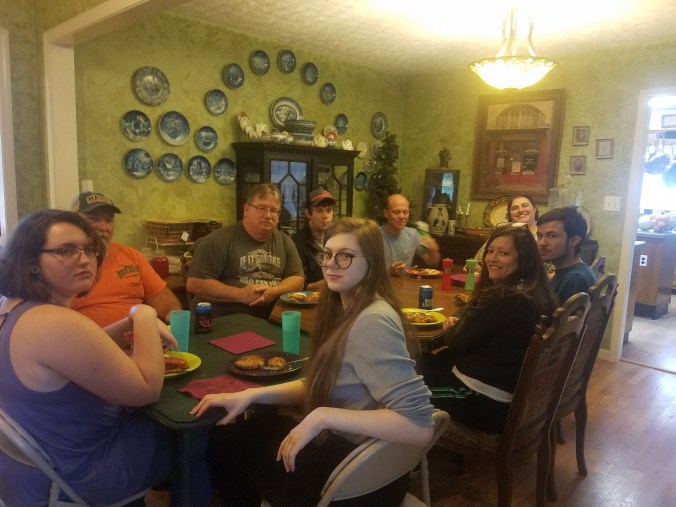
For this Kentucky Kitchen Table project, I asked two of my friends, Sarah and Shane, if they could join me for a nice conversation over dinner about some topics they usually do not talk about with friends; they both said they would be happy to join me. Sarah has been one of my best friends since high school and who I am confident will be a friend of mine for the rest of my life. I met Shane last semester but we did not get to know each other well until this semester and now he is one of my best friends as well. I decided to ask them to ask a friend or two of theirs, of which I do not personally know well, and they asked Andrew, Whitley and Caroline to join us at the dinner; they all said they would be there. Andrew is one of Shane’s fraternity brothers and was born and raised in Nashville, he is a construction management major and plans to take over his dad’s business one day. Whitley is from Lexington and is one of Sarah’s sorority sisters, she mentioned that she recently changed her major to Biology with and interest in pre-med. Caroline, who is from Nashville as well, and Sarah have had classes together so they met one another through those. We had the dinner here in Bowling Green at Sarah’s house, which is on College Street. I felt as if it was my obligation to cook for them since they were doing me a favor, and Sarah let us use her house, so I decided to cook the food and made baked chicken pasta. This Kentucky Kitchen Table was a unique experience as none of us are family, nor was any of my family there, and we are all college students here at WKU.
When we sat and stood around the counter island in the kitchen (because there were not enough seats and also no table), and I told them a little more about the project they are helping me with and the Honors 251 course. I mentioned the three main questions of the class: how can we live better together, how can we solve problems, and how can we have more say over our lives. I mentioned to them that it might not be a bad idea to have those questions in the back of their mind while answering the other questions I was going to ask them, as it might make the other questions clearer and easier to answer. I am not sure if telling them this helped them at all, but it did not hurt to try to involve the class a little more.
To begin the conversation, I asked them what citizenship means to them. Shane was the first to respond saying that he thought of citizenship as contributing to the society that we live in. We then continued to talk about what citizenship means and overall everyone agreed with what Shane said about contributing to society. To add to that, everyone agreed with that being a good citizen meant contributing to our society in a positive manner. I then asked them how they thought they contributed to the society we live in. Shane is the only one that was old enough to vote in the past year’s elections, so he mentioned that he has voted in the past and will continue to do so in the future. Sarah works with kids at an elementary school so she feels like that she contributes to our society by providing an example to the future generations to be the best person they can. Andrew then mentioned that he does not feel like he does much as a citizen for the Bowling Green community, but he feels the opposite when he is back home in Nashville. He stated that he works for his dad’s construction business that puts pipes in the ground all around the city so that people have flowing water to and from their residences. He said how much hard work it took, but after sour conversation about citizenship, he felt that his work was worth it because it helped tons of people in the Nashville area.
After Andrew mentioning he is from Nashville, Caroline and Andrew started talking about the city of Nashville: what part of town they live in, where they went to high school, who they know, etc. They mentioned a couple of people that they both knew of, but not well, but they still said they were surprised they did not know one another. That surprised Sarah, Shane and I as we all think of Nashville as a huge city when compared to Bowling Green; they obviously do not see the vastness of the city like we do. To include Whitley in the conversation, I asked her if she feels the same way about Lexington as they do about Nashville; meaning whether she felt like she knew a lot of people or not. She said that she did not feel like she knew a lot of people because she went to a high school that was a lot smaller compared to most of the other ones. After this conversation died down, since we were already on the topic of hometown communities, I decided to ask them what kind of community they want to live in.
As the conversation began, Sarah and Shane both mentioned that they wanted to live in a bigger community than what they do now. On the other hand, Caroline, Andrew and Whitley all mentioned that they wanted to live in a community similar to the one they call home now, which they constitute as a big community. I asked them why they felt like living in a bigger community was better than that of a smaller community and the response I got was the opportunities present in a city. They mentioned that there are more businesses, places to live, and people in bigger communities which often leads to a greater amount of opportunities available to them. I asked them how they felt about the interpersonal relationships they would be able to gain from a business point of view by living in a bigger community, mentioning that I feel as if the relationships I have gained from persons in the Bowling Green community, a smaller community, are on a personal level. Andrew then mentioned that the relationships he has gained from working at his dad’s business have been personal and that he has even grown closer with his dad. Whitley mentioned that she works at a YMCA club during the summers in Lexington and feels like she is able to gain personal relationships with the kids and adults that come to the YMCA. Caroline said she was unable to tell whether the she has gained any personal relationships while working in business because she has only babysat her cousins so those relationships were already on a personal level. Overall, we all agreed that we wanted to live in bigger communities because the opportunities available mean more than the possibility of not having any personal relationships in the business world.
I learned a lot from my friends, the people I had just met, and even myself. I also was able to see how the themes of the class actually play into reality. Even though we are only college kids and still have a lot to learn about ourselves as adults and who we want to be, I think living life by trying to answer the three main questions of the class can do a lot of good for our future selves and future generations. Doing Kentucky Kitchen Table with my college peers really allowed me to see how diverse or similar a small group of people can be when asked small yet difficult to answer questions. It is important, even necessary, for people to have differing opinions in some situations and the same in others. It is also important for people for voice their opinions and ideas because who knows, maybe that idea could change the entire situation. For example, all the deliberations that I attended this week would have been extremely hard to make happen without some light disagreements and practically impossible without people voicing their ideas and opinions on how to solve the problem. Solving problems, especially those that are wicked, can be difficult and sometimes feel impossible; but, with everyone putting in their opinions and ideas about the issue at hand then that can lead to us living better together as a society. I am glad I got to talk to my college peers and ask them personal questions about themselves and the society we live in today. Overall, I am glad I had to do this project because these conversations would have never happened without these guidelines, but after this first time, I feel like these types of conversations are likely to happen again. Kentucky Kitchen Table really opened my eyes and showed me that even though we are young adults, it is still possible to have adult-like conversations around the dinner table (or dinner island in my case).


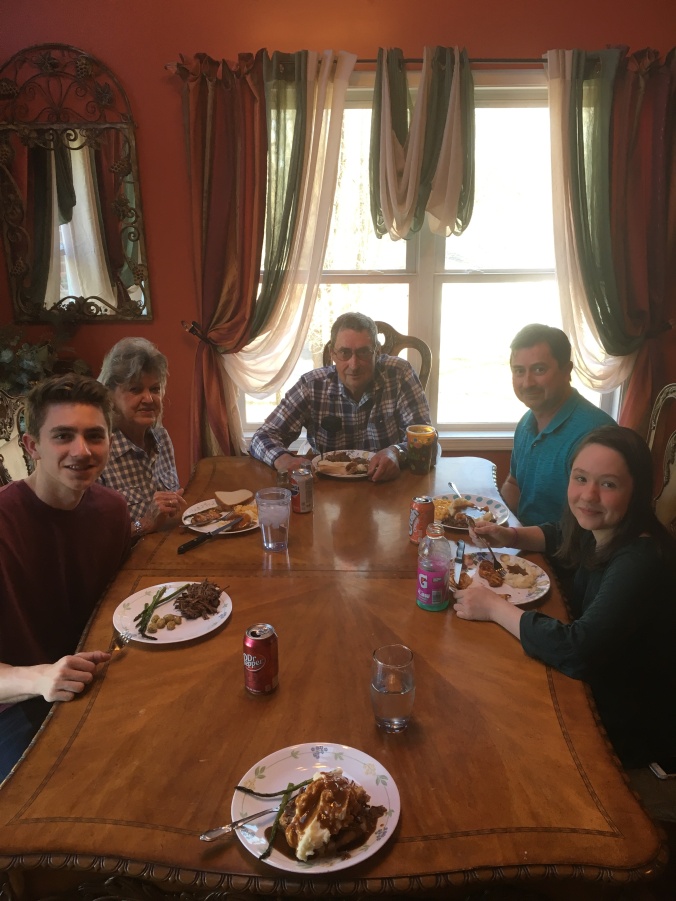
 family had a late Easter dinner on April 14, 2018 which is when I chose to engage in my Kentucky Kitchen Table Project. This took place in Calvary, Kentucky which is the birthplace of both of my great grandparents. At the dinner (my table) was myself, my grandfather, Rickie, great grandmother, Patty, and my other great grandmother, Betty. I chose to have this discussion with people who were older in order to view different generations’ perceptions on citizenship, government, e.g. Both of my great grandmothers are in their early eighties and have lived in Marion County their entire lives, Patty describes herself as wiser due to being the oldest of ten siblings. Both come from agricultural families of middle-class income. Ricky, my grandfather is in his fifties and is more engaged in politics than my grandmothers. I started off this discussion by asking the first question to them “Beyond voting, paying taxes, and following laws, what does citizenship mean to you?” To which the conversation began to center around how America allows people to earn their status based on achievement and hard work, in many cases. Patty stated “I wish I had the opportunities your generation had, I always felt like I was obligated to stay around here and do exactly what all my family did before me.” In some cases, social class can hinder one’s ability to fulfill their dreams, but when bringing this up they all agreed that although college is expensive that it is much more accessible for today’s youth. I found this as an interesting topic because in our class we always talk about how we could live better together and I feel that most people coming to college and fulfilling their dreams have some interest in learning more about others on diverse college campuses. Furthermore, another topic of discussion relating to this question was that citizenship to them means that you should contribute to society and work hard at whatever contribution you make. My grandfather is a very hard-working farmer, which he takes a lot of pride in, and said that having that contribution to society makes him feel like he is a part of something, and gives him purpose rather than focusing on the monetary incentive. This statement motivated me to move into another point of discussion on what types of people they wanted to be, and although my great grandmothers are old in age they had some very refreshing answers. My grandmother, Betty, said that she wants to be more carefree and outspoken; Grandma Betty has always been the quieter of the two, but she claimed that talking to people that she doesn’t know is still something that she forces herself to do on occasion. I found this inspiring because if all of us would go out of our way to talk to strangers and get to know other people in society I feel that could be a small start to understanding and living better together as American citizens. Furthering from her answer, the main theme of their desires was to be a person who was hard-working, religious, and honest. In my opinion, I feel that these are all qualities that I strive for and are very respected in their generation as well as this generation. Also, since they brought up religion I introduced the question of whether religious beliefs shaped how they believed we should treat others. Since they are honest people they did admit that being raised within a period where racism was more prevalent that they were not proud of how they had viewed African Americans at some points in their life, but all three of them said that because of their deep belief in God and his creations that they never treated anyone as different. They also expressed that they consciously tried to be compassionate to others and their situations due to their religious beliefs. Therefore, I believe that religious beliefs do motivate some people to disregard biases they may have been exposed to, to accept people as equal and treat people with respect.


 Kentucky's Kitchen Table