Thelma’s Table Talk

By Tanner

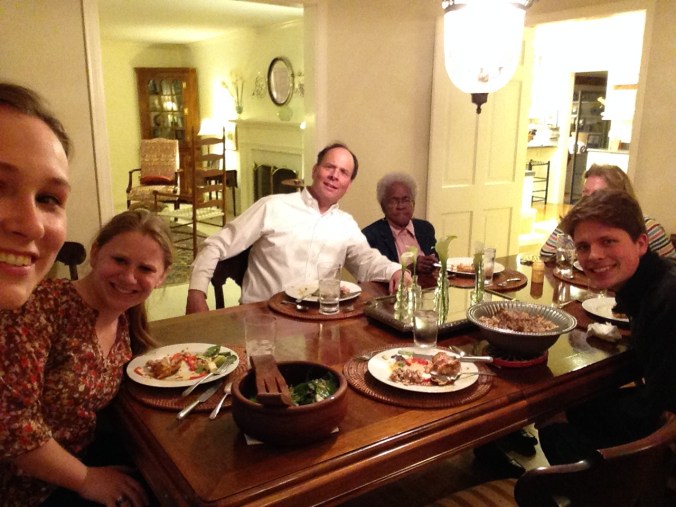
I shared my Kentucky Kitchen Table experience with fellow students Rachel and Corinne on April 10, 2016.  A couple, whose names were Matthew and Anne, were gracious enough to invite us into their home, and allowed us to share a meal with them. None of us students had ever met Matthew or Anne before, who probably had no real reason to be especially excited about the evening ahead of them. It seems to me that having a dinner in your home, at your dinner table, invaded by three college students would not be the ideal way to relax after what must be the busiest day of the week in their household. Matthew is a pastor in Bowling Green, and this dinner happened to fall on a Sunday night. Upon meeting Matthew and Anne I could not help but notice the kindness that they share as a couple. They were not overly talkative, but Matthew especially had a dry sense of humor that kept the conversation lively, even when at first the conversation was mostly small talk. When we first arrived Anne was in the kitchen working hard on the meal we were about to enjoy. She volunteered to cook the entire meal herself and did not ask any of us to bring anything. This caused her to have to try and be in two places at once, hurrying from the living room to the kitchen, and back again as she simultaneously baked pie, cooked chicken, and got to know her guests.

As I said before, the other guests, besides me, were Corinne and Rachel, who are both our class Citizen and Self, though Rachel has the class at a different time than Corinne and I do. I knew Corinne very well before the night began. She was one of the first people I met when I arrived at WKU earlier this year. I knew that she would be just as social that night as she is all the time. She has a great personality, and is a good listener. I had never met Rachel before, but Corinne told me beforehand that she had had a biology class with her during the fall semester, and that she was very nice. When I did meet Rachel I could see that she was a little nervous, but she definitely opened up over the course of the evening. The biggest impression she left on me was her love for animals as she monopolized the attention of our host’s new puppy over the course of the evening.

We had probably been in Matthew and Anne’s home for about fifteen minutes when Matthew informed us that he was expecting one more guest. He informed us that an elder of another one of the local Presbyterian churches would be joining us for dinner. Matthew told us that her name was Thelma, and that she was an eighty-nine year old African-American women who was a big personality, and often introduced herself as Halle Berry. This description made me both nervous and excited. I had just begun to become comfortable in a stranger’s home, and now a new stranger was coming who was not even sure of their own identity. I had a feeling though that such a big personality would make the dinner more informative and entertaining.

Soon after Thelma arrived, I realized that my excitement and to some extent my nervousness were both warranted. One of the very first stories she told when she arrived was how she had gotten the opportunity to attend the inauguration of President Obama. The part of her story that really stood out to me was how she was very embarrassed during the event when a white man she was sitting next to wrapped her in his coat in an effort to make her more comfortable. What must have been to the gentleman a kind gesture extended to an elderly woman, was perceived by Thelma as a source of embarrassment. She said she was afraid how people watching the inauguration on television would perceive it. Here this was, a major event in the history of civil rights for African Americans, and she was being taken care of by a white man. She believed it clashed with the meaning of the event, which was that an African American was completely capable of leading the most powerful nation on earth.

No one else at the table, besides Thelma really spoke much over the course of the evening. This was not a bad thing though. You could tell that she loved the attention, and her stories were so vibrant because of her amazing memory that I was completely captivated by them. She spoke about what it was like growing up with an abusive stepfather. She told about her experience with racism. She apparently would be excluded from golfing scrambles because no one thought a black woman belonged in a country club. During these conversations everyone else at the table would get very quiet, but someone was always nodding in agreement as she talked. I think even Matthew and Anne were surprised by some of the stories that they may have never heard before.

These conversations really fit together well with the book “Citizen” that was discussed in the Citizen and Self seminars. She did not limit the conversation to just race. She dispelled some of my beliefs about what eighty-nine year olds are capable of when she told of how she still went in to schools for problem students to talk with them and be a role model. She also told about how she could make it to Louisville from Bowling Green in an hour. The fact that she still drove amazed me as did her memory and her sense of humor.

I am very grateful to Anne and Matthew for inviting me into their home and introducing me to Thelma. The discussions that we had at that table were so educational, and will be one of the first things I think about when I remember my freshman year at Western. In Citizen Self we read an article titled “Happiness” about what it really takes to be truly happy in life. I do not know what the answer is, but I think Thelma does, and I think everyone at that table had a lot to learn from someone who has overcome so much in life yet still has such a lively spirit in her twilight years.IMG_0767
Around a Kentucky Kitchen Table

By Drew

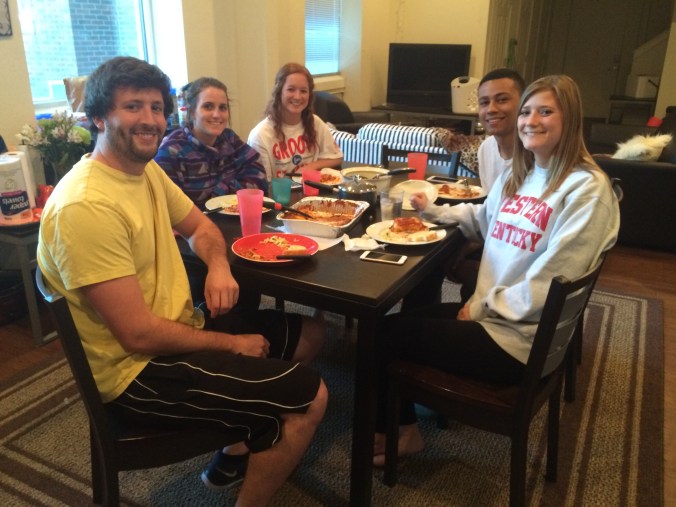
My Kentucky Kitchen Table was hosted at Kamber’s dinner table and was attended by myself, Kamber, John, Jordan, Sarah and Hannah. The only person who I initially knew at this meal was Kamber (my girlfriend) and Sarah. I asked Kamber to invite one person that she knew and I did not, and ask that individual to invite one person, and so on. Kamber invited Sarah and Hannah who then invited her boyfriend, John who, in turn, invited Jordan. Each person at the table is from a different hometown. Kamber is from Lagrange, KY which is a rural area of Kentucky and attended Oldham County High School. Hannah is from Louisville and attended Male High School. Her boyfriend John is from Rochester, New York and attended Brighton High School. Jordan grew up here in Bowling Green, KY and went to Greenwood High School. Lastly, Sarah grew up in Atlanta, Georgia and attended Blessed Trinity High School.

I was debating on whether to start the dinner conversation with the required “What does citizenship mean to you?” but I decided to let the conversation develop organically and see where it went in order to learn more about everyone present. The first question I posed was based on the type of food everyone brought. John and Hannah collaborated on a recipe that John’s grandma told him about. It was lasagna made with ground beef and pepperoni, as well as a layer of green peppers among the other necessary ingredients in lasagna. Sarah brought a side item of rice and broccoli cooked in chicken broth with shredded cheese. She learned this recipe from her dad and went on to say that this was her father’s favorite meal in college. Of all the dishes, this was my favorite.  I made a side item of macaroni and cheese. I explained that in my house, mac and cheese is the equivalent of a vegetable. It is very simple to make as it is just boiled macaroni shells mixed with Velveeta cheese. They may have been saying it to be nice, but everyone claimed to have enjoyed it.

As each person described their recipe and its origins, the conversation would branch off in many different directions. John explained to us his reasoning behind coming to WKU which led to everyone else stating why they chose WKU over other universities. As the conversation went on, the topics being discussed continued to delve deeper and deeper into each individual’s life in their hometown. Hannah and I grew up with very similar friend groups it turns out, yet we never met. We had very similar weekend activities including going to football games, attending night races at Churchill Downs, and going out on the Ohio River. While they are not from the same hometown, John and Kamber each shared similar experiences. During the summer they would visit their lake houses. John would go to Lake Ontario, and Kamber would visit Lake Cumberland. Jordan, along with Kamber and I, said that he would typically be at a bonfire or a farm party on the weekends just drinking and hanging out with friends.

In relation to our class, this project has reinforced the idea that being a citizen requires more of us than simply voting and paying taxes as well as the meaning of citizenship to me. When there is a problem, issue, or injustice in the world, citizenship does not call on us to set out with the intention of solving it alone, but collaborating with others who may have different convictions than our own and who are from all different backgrounds and places to solve the problem as a community. This lesson can be tied back to Jane Addams and her experiences at the Hull House. She came from a completely different walk of life than those she was trying to help. The issues that she set out to solve a problem on her own (giving the candy factory children candy on Christmas) did not go as she had initially planned. The interaction with those in the community and close to the problems in the community led to the Hull House being as successful as it was. While John and I grew up nearly 600 miles apart, our different viewpoints on a given topic can be used to expand our individual thinking and solve community issues which may, alone, be unsolvable.

(Jordan took the picture for us)

IMG_2800

A Meal to Remember

By Jordan

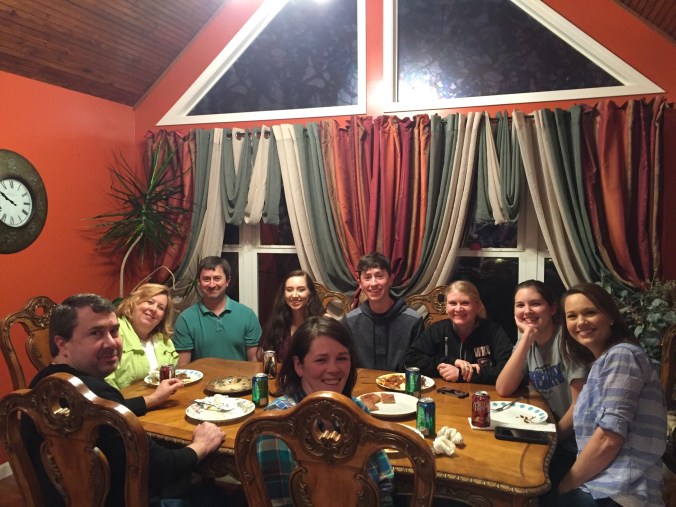
This past Saturday, I had the privilege of going home to Hebron, Kentucky for the weekend and spending quality time with family and friends. The experience was extremely culturally enriching and intriguing. There were eight adults at the table including myself, my boyfriend of 2 years (Matt), and my parents (Herbie and Wendy). Although my family was there, the focus was on our guests and getting to know more about them, so I will limit my conversation mostly to them. One of the couples that joined us have been our close family friends for years. We met them through my brother’s baseball team where my father was able to coach their sons. Josh and Anne-Karina have been a blessing to us ever since. We have even had a few similar dinners with them at their own kitchen table in Covington, KY. The other couple was introduced to my family though my father’s work. Pedro has been an instrumental part of my dad’s construction “family” since we moved to Northern Kentucky. He has been a loyal foreman to my dad and an even more loyal friend. Peg, Pedro’s newly wedded wife, is also an instrumental part of my father’s work. She and Pedro met through their jobs, fell in love, and are now happily married. This was the first time I had the pleasure of making Peg’s acquaintance, although I had met Pedro a few times before.

Time spent with close friends and family is always a wonderful experience, but what made this dinner so special was the diversity around the table. Anne-Karina is originally from Austria and a native German speaker. She was drawn to America when she was offered a job at Cincinnati Children’s Hospital as a pulmonary research biologist. She met Josh here in America and together they have two children. Josh works in IT and was born and raised in Kentucky. Pedro was born in Fresno, California but moved back to Mexico, where most of his family still resides, shortly after he was born. When he was a teenager, he joined the U.S. Navy and took up boxing as a pass-time. He is still undefeated to this day. Peg is originally from San Fransisco and has never left the country, although she wishes to visit the land Pedro inherited in Mexico soon. Because everyone at the table has a different ethnic background, we asked each person to bring a dish that reflects their own heritage. My family made chicken and dumplings, a southern favorite; Anne-Karina and Josh brought Schnitzel with Austrian clove rice; and Pedro and Peg brought authentic enchiladas and tamales with Spanish rice and pico de gallo.

The meal was fantastic, but the conversations we had were even better. With different ethnic and cultural backgrounds comes different opinions on various matters. When asked what citizenship meant to each of them, the responses were extremely varied. Anne-Karina was the first to pipe up. She revealed that she does not have citizenship here in America, but she is a citizen of Austria and will remain so for the rest of her days. She has considered dual citizenship but “does not identify as an American” enough to go through the complex and time-consuming process. Although she is happy remaining an Austrian citizen exclusively, she still wishes she were able to vote. With only her green-card, she is taxed, but not represented, which troubles her greatly. Anne-Karina believes that voting is a responsibility, not a choice, if we are to be proper citizens. Because of this, she still votes for political titles in Austria even though she no longer resides there.  Conversely, Peg strongly dislikes politics and believes that all politicians are crooked. She does not exercise her right to vote and claims “she should be ashamed of herself” for not taking advantage of this right, but maintains that she could not have a clear conscience voting for a person she does not believe is fit for office. Peg also acknowledges that since she does not vote, she has no right to complain about policies set in place by government officials. She abides by the laws set in place and does not complain when things are not going her way in a political sense. Pedro does not vote either, but for a different reason than Peg. He is an American citizen but feels connected to Mexico just as Anne-Karina is connected to Austria. He abides by the laws of America but does not want anything to do with American politics. Josh was somewhere in the middle of these extremes. He is an American citizen who votes regularly, but is not overly-involved in politics.

There were also differences in opinion on social issues. We happened upon this issue after talking politics. Anne-Karina was the first to talk on her pro-choice, pro-gay marriage, pro-gun control opinions. She believes that a woman should be able to make the choice about her own body without government influence. Much of my family is very pro-life and conservative. Although we did not necessarily agree with her opinion on this issue, we were intrigued to hear a new viewpoint of this topic and understood how she could arrive at this opinion. This relates to what we have said in class about morality and opinion. We must be able to understand multiple viewpoints before we are able to reach our own educated decisions about topics. Although Pedro and Peg did not seem to have too much of an opinion on Anne-Karina’s pro-choice discussion, they did have something to say about gun control. Anne-Karina’s background in Europe has much to do with her pro-gun control stance. She explained that not many people in Europe have guns simply because they are under such high control and she believes that is why there are less mass shootings in Europe than in America. Pedro countered that with respect to his rough-around-the-edges childhood. He said that guns are a way to protect your own and maintain safety in America. Matt agreed with Pedro, saying that guns are so deeply rooted in our nation’s culture that even if we did control guns, people who wanted to use them for evil would still obtain them and good people would be left unprotected.

This experience was an extremely interesting one to say the least. The different viewpoints at the table brought so much enlightenment to me and my family. No one in my family has been outside of the United States and it was so interesting to see how people from different cultures view the world. It was very easy to see from this Kentucky Kitchen Table that Jonathan Haidt was right in his essay The Righteous Mind. The “elephants” of our friends were extremely prevalent, more so than their “riders”. Many of the beliefs expressed by the individuals at the table were due to past and cultural experience. Also, it is evident that not every issue has a “right and wrong” answer and that many are much more complex than that. We often assume our opinion is right simply because we are the one that reasoned it and deemed it to be morally acceptable. When listening to opinions that differed from my own however, my mind was opened to the possibility of other answers to difficult questions. From this dinner, I learned that it is important to listen to all sides of the story before passing judgement. We must be tolerant of others and give everyone a chance to express their opinions in a free and trusting environment so that we can have meaningful and insightful conversations about the world we live in.

KKT in Bowling Green

By Jordan

Last Thursday, I had the pleasure of joining a family in Bowling Green for dinner.My partner, Charlie, and I were only required to bring dessert (which ended up being a cookie cake from Walmart and in no way was comparable to the wonderful chicken that was baked for dinner). We arrived to our host family’s home 15 minutes early and they, including their dogs, welcomed us with open arms.

The dinner was for four; me, Charlie, Alisa, and Allen. Alisa and Allen live in Bowling Green. They’re grandparents to one grandson (almost two). Alisa has family in Bowling Green and that is how they decided to settle down here to raise their family. Upon telling them I was from Maysville, KY and expecting to get puzzled glances, Allen asked what Maysville was called before it received its current name. I was clueless and he told me it was called Limestone.

Right after introductions and casualties, Allen dug into the heart of the conversation while Alisa finished cooking. I was slightly taken aback at first, but excited that our host family was eager to engage. We began by talking about our majors and future careers. I explained I am going to school to be a speech language pathologst and Charlie discussed how he hopes to be a diplomat. Prior to our KKT, I did not think mine and Charlie’s futures had much of an overlap, but Allen immediately showed me otherwise. Throughout dinner, both Allen and Alisa would ask us open ended questions like “What do we do about budget cuts to secondary education?” or “What do we do about gun control?” Allen ultimately would come back to one solution: better preschool-kindergarten education. This hits home for me because as a future SLP, I could have a position to be concerned with children’s speech and language delays which directly impacts their performance in the classroom. When thinking of the wicked problems Charlie would face as a diplomat, better quality education is the solution to a lot of the roots of those problems.

The most valuable lesson from this experience has been the importance of life-long learning. Alisa made a comment about this in response to discussing primary education. I have heard my whole life that my education does not end with a high school diploma, undergraduate diploma, or graduate diploma. But meeting this couple who started out as strangers to me and are continuously growing and changing to be better people- that is something altogether different. Both hosts were incredibly knowledgable on everything under the sun and I was in awe the whole meal. Initially, I was apprehensive to answer these broad questions in fear of sounding ignorant, but I found this dinner table to be a safe place to throw around solutions and opinions. In class, we discuss how every experience is a learning experience. We build our lives around what we gather from the world. In addition to answering our questions with an abidance of knowledge, our hosts told stories about their lives to support their claims.

When told about KKT in class, I was not ecstatic at the idea of spending an evening with strangers. I could not have been more surprised by my experience. We sat around the table long after we were finished with our cookie cake dessert and ended up spending three hours at our host family’s home. If I ever have the chance to do something like this again, I will take the opportunity to learn more about the citizens of Bowling Green.


Kentucky Kitchen Table – Bowling Green

By Trevor

My Kentucky Kitchen Table project took place in my own home in Bowling Green, Kentucky. My parents insisted on cooking the entire meal for our guests. My parents were super excited to have people over for dinner because we don’t often do. I invited a couple of my friends, our neighbors, and the majority of our other guests were friends and colleagues of my mom. First, we have my friends Conner, Abby, and Shelby. I’ve known each of them for many years, and we’ve went to many of the same schools. Now, Shelby lives in Nashville and attends Belmont, Abby attends SKYCTC, and Conner goes to WKU with me. Next, we have my neighbors Vickie and Brian. My mom’s friend and coworker Stephanie joined us, and she brought her son Corey. I had never met them before, but she is really good friends with my mom. Corey ate with my little brothers and sister, but they aren’t pictured in the photo. My parents not only cooked, but ate with us and contributed a lot to the conversation.

To start things off, we went around and told each other where we worked and what we did, and each of us answered the question about how each of our jobs relate to our roles as citizens. It just so happened that my mom, Stephanie, and Vickie all work at the hospital, but they all work in different departments and do different things. They all talked about how they feel that their jobs relate to their roles as citizens because they help other citizens in times of need such as when they are sick or are having a baby. Abby talked about how she keeps score for many kids’ sports teams in our community, which makes it possible for them to get out and play with each other. Conner works at a vets office. She absolutely loves it. She hopes to one day be a vet, and she is currently working as a kennel worker gaining knowledge and experience. My dad teaches architecture and drafting at the tech school in Russellville. Brian works at the Kobe aluminum plant, and Shelby thought that was quite interesting because her dad works at Logan aluminum. When we asked Brian what he did at Kobe, he said “I run a daycare… no actually, I manage a group of 6 or 7 people, but it often feels like I’m running a daycare.”

The conversation soon shifted to us discussing the reasons why we enjoy living where we do. Having came from small towns such as Tompkinsville and Scottsville, Vickie, Brian, my mom, and my dad all agreed that the reason they moved to Bowling Green was because there are many more job opportunities here and “there is everything you would ever need here,” said Vickie. Vickie also said she loves Bowling Green because it is a big enough city, but still small enough to have that hometown feel without a lot of traffic. Shelby made a lot of good points when she talked about how there isn’t a lot of crime in Bowling Green compared to other cities such as Nashville where she lives now. She said she also liked living in Bowling Green because the sales tax is lower in Kentucky. During this discussion, Abby finally realized why her McDonald’s Sweet tea was $1.06 in Kentucky but $1.10 or $1.09 in other states like Tennessee. Her mind was blown. It was hilarious. We all came to the conclusion that the cost of living is a lot lower in Bowling Green and most parts of Kentucky compared to other places in the United States. My dad talked about how blessed he feels that he is living in the United States. He talked about how grateful he is that he can have as many kids as he wants, and choose his occupation, and just other simple freedoms that we often take for granted and others in the world don’t have.

My family has always sat at the dinner table each and every time we ate dinner at home. It is something that I have actually always enjoyed, even as a kid. For this reason, I was interested in finding out if other families in Bowling Green did this as well. Abby told us that her family usually eats in the living room but they are usually still all together and watching a sports game. Both Vickie and my mom talked about how when they were younger they sat at the dinner table. When they got married, they usually ate wherever, but once they had kids, they made it a New Year’s Resolution one year to eat dinner each night as a family at the table, and it just kind of stuck, and it has been that way ever since. Brian said that as a child, his family ate dinner in different locations in the house, but now that his family sits at the table each night, he really enjoys it a lot more. He talked about how it was really the only time to actually be able to catch his kids and talk to them since all their schedules were so different.

As everyone started to finish their dinner, we decided to discuss the final question of what does citizenship mean to you. Conner and Abby’s responses were simple yet important. They said that they believed it to just being a part of the community, caring for others, and doing your part. Shelby talked about how she felt it was “being responsible for yourself as well as others in the community.” “It’s a whole system and we all have to contribute to make it work.” Finally, my dad made some good points when he related to himself. He talked about how citizenship is being a part of something bigger than what you could accomplish on your own. “I can’t build a road from here to Russellville to get to work and teach students, but I pay taxes so others will build the road for me. Now, I can get to work in order to make money to provide for my family while the construction workers were also making money to provide for theirs.”

Conversations like these are actually not uncommon in my family. Sometimes we talk about some pretty serious things, especially when it comes to the news and what’s going on all over the world. However, it was interesting to get some new people’s opinions on some very important topics.

KKT