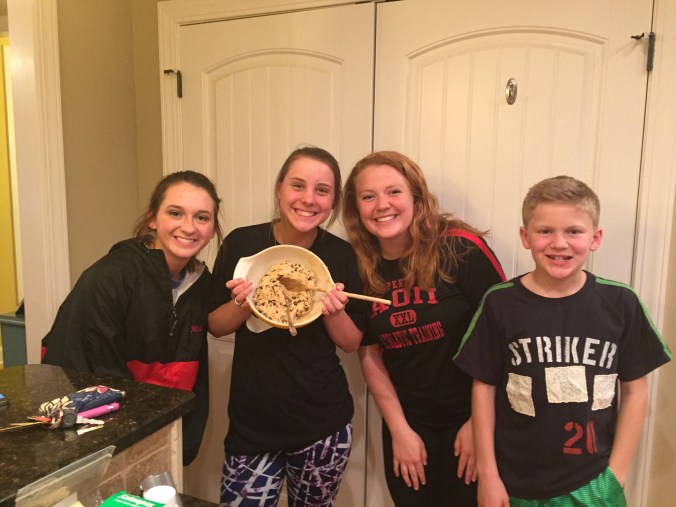
Finding Similarities in Our Differences: A KKT Project

by Rachel

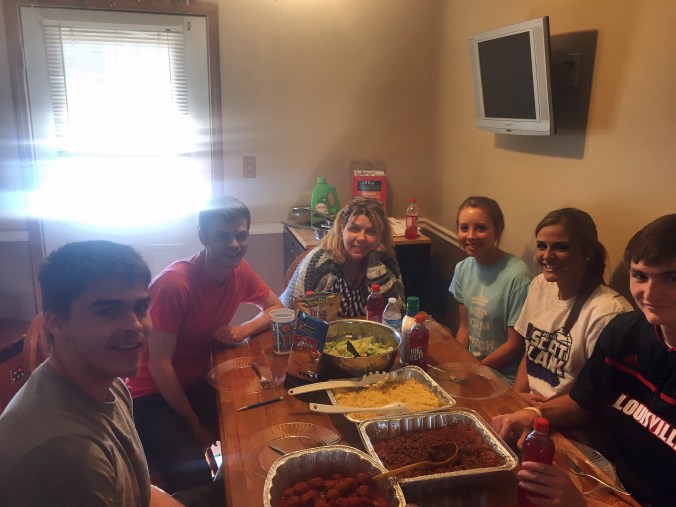
For mine and Amber’s Kentucky Kitchen Table, I invited Dalla and Chris; Amber invited Sarah. Dalla has been friends with my mom for years. She is from Brazil and moved to the United States when she was 12 to live with her aunt because her home life was terrible. After she met her husband while she was at Western, she and David put their roots down in Bowling Green, KY. Since Dalla constantly moved around when she was growing up, she is extremely integrated in the Western and Bowling Green community because this is her children’s home. Dalla also works at Western, as does her husband. 

Chris is an African American meteorology major from Louisville, KY with his sights set on an amazing career as the most informative weather man ever. He is obsessed with snow and all things weather. Chris also was the head of our study group which got me, and him, through Calculus III. A great interesting thing about Chris is that he is always dressed up. Every time I have ever seen him, Chris is wearing dress slacks, gorgeous dress shoes, a button up shirt, a tie, and either suit coat or a sweater vest. Chris explained that he does this because when he dresses casually he feels overlooked or considered unimportant, especially as a young black man.

Amber’s friend Sarah is a Caucasian Music Education major. One of the major things she shared with us when we were discussing the importance of giving and receiving help, was that in this new world of short attention spans, she feels like asks for help is an inconvenience for those around her. Sarah highlighted the fact that with the intense shift towards instant knowledge has cut us off from each other. Through dinner, we discovered that we all felt that the absolute most important part of being a part of a community is being willing to communicate, by talking but also being willing to listen.

Amber and I started the dinner off by awkwardly asking some of the suggested questions. Dalla seemed to jump right in and eventually pulled all of us into an amazing conversation primarily based around what community means. Our over-arching theme of community was communication and being willing to help each other. We all shared great personal experiences that highlighted times we helped others, times we were the ones receiving help, times we held the burdens of others, and times we gave our burdens to someone else.

I couldn’t help but think of the chapter on Jane Addams’ Hull House we read in class that discussed the tribulations that come with good intentions. Many of the stories that were shared over our stuffed pasta and garlic knot dinner were ones of helpful deeds with many obstacles. Chris shared an experience when he put his life on hold for a few days to help his friend hunt down the perfect printing of his poster to take to the meteorology research presentation conference. Chris explained that even though it was long and grueling, he did it because he knew his friend would be less stressed and happier when the situation was resolved.

Dalla shared a heartwarming story of colleagues joining together to support each other in the mourning of a lost friend. She even told us that she was the supportive rock in this situation because she knew that her employees needed someone to just listen to them cry. Dalla explained that though that was her role now, she could just as easily be on the other side tomorrow, needing someone to cry to. We all agreed that this is a key component in a successful and happy social environment. To create a better world we must all be willing to be what others need us to be but also understand that we will eventually need someone to be our hero in a time of need as well.

We also discussed that within a community, it is equally important to take care of oneself as well as help others. We noted that if we do not take care of ourselves first, how can we expect to help others. Overall I believe this idea of knowing not only what others need but also being aware of your needs and finding the balance of filling these needs was our key in “designing” a goal community.
KKT

The Citizen, Community and You

By Amber

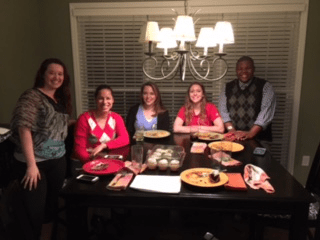
My KKT project partner was Rachel. We had dinner at her house with a table of 3 additional people, Dalla, Sarah, and Chris. Chris is an African American man who is majoring in meteorology and has had the experience of reporting with various local news channels. Dalla is also a woman of color and works at WKU. She has done extensive traveling, living in several different places for extended periods of time. She offered a different perspective because she was the oldest in the group (30s) and from a different generation. Sarah is a Caucasian female with a major in Music Education and grew up in an urban setting. Rachel and myself are both Caucasian females who have lived in the Bowling Green area most if not all of our lives. For dinner, Rachel’s father cooked stuffed pasta shells and garlic bread. I brought the dessert of cupcakes and Dr. Pepper so that people could have a variety of drink options.

At first, the dinner was strange and a little awkward. We didn’t know each other at all, so it was difficult to begin discussing such profound topic with strangers. Rachel tried to facilitate conversation by welcoming everyone and asking the first few questions about citizenship and what it meant to everyone at the table. We asked questions that had been the topic of discussion in our classes including: what are we obligated to do for our communities, and when is it okay to say no to other members of the community? Dalla jumped right in and began sharing her life experiences. Rachel and I found that the conversation steered itself to a degree and didn’t require either of us constantly asking questions to keep a decent discussion. Eventually, everyone became noticeably more comfortable and started to loosen up and the discussion came quite easily.

For Dalla, who has moved several times, her sense of community changed throughout her life given different cultures and norms. Now, she has a very close connection to her WKU, religious, and Bowling Green communities. She also feels very connected, happy, and safe to have such connections knowing that she has people who are willing to help her just as much as she helps them.

Sarah, even though quiet, reported that she feels uncomfortable asking people for help not as a symbol of pride, but that she doesn’t want to inconvenience people. She also said that she is much happier because of the connections and friends she has made within her community.

Chris’s community of meteorology friends has not only provided him with friendship, but also a continuing flow of knowledge and references for future employers and jobs. He has also found that the nicer he dresses the better people treat him. He feels, especially as a young African American man, that if he wears casual clothing people tend to by pass him, but if he wears a suit, people often call him sir and ask if they can help him in any way.

Rachel also feels very comfortable in her community. She understands that there are certain things that we are obligated to do for our neighbors, friends, and even strangers. In general, it’s all about making life a little better for everyone.

I shared that I am a country girl from a small community. Everyone knows everyone where I’m from and watches out for each other. Often times, without the help of others, crops die and families are plunged into debt.

Overall, the main points made were: Who is in your community? How do you fit into your community and what can you contribute? Equally important is knowing when to ask your community for support so that you don’t get so overwhelmed that you become a problem instead of help to the community. The group came to the consensus that knowing and understanding these points is very important to having an efficient community and for overall happier living. We originally planned on having dinner for about an hour and a half. However, we began at 6:00 and didn’t leave until 8:30. We had some very interesting and insightful conversations that most Americans, in our busy lives, forget about. Too often we expect other people to “figure it out” for us and forget that we actually have the power to make change in our own communities. IMG_1432

Kentucky Kitchen Table Project

By Bradford

Processed with VSCO with a5 preset
My family has never been the type to eat dinner together around the kitchen table. Typically, whenever meals were ready, we would each grab our own plates and head our separate ways. That being said, it was nice to have a reason to actually sit down with each other, not only to eat a nice meal, but also to delve into the meaning and importance of citizenship in today’s society.

We had a diverse group at the table. My parents, Angela and Brian, are both extremely conservative Baptists who have never attended college and who have lived in Louisville all of their lives. My brother is currently a freshman at the local community college. My sister and her boyfriend, on the other hand, are both currently in high school; Amber goes to the local public school, while Mitchell goes to a local private school. Also, at the table, was my sister’s friend Megan. I had never met Megan before and she differed from my family in a lot of ways. She is originally from Pennsylvania but recently moved to Louisville. She considers herself a Democrat and a devout Catholic who loves to travel the world. Everyone offered a lot to the conversation and we had a wide array of opinions at the table.

The first question I asked was, “Beyond voting, paying taxes, and following laws, what does citizenship mean to you?” My mom mentioned that patriotism was a big thing for her. In her opinion, being a citizen in the United States was something that you should be proud of and that you should show. I had never really considered this as a “duty” associated with citizenship. Other answers to the question seemed to focus around freedom. To many individuals at the table, being a U.S. citizen meant that you get necessary and important freedoms, such as freedom  of speech and freedom to own a gun.

Something interesting that also came up during the dinner was the topic of homelessness. Megan mentioned that she recently read an article that talked about how homeless people in bigger cities can now register for specific cards that allow them to get donations from people put on their card. That way if, for example, someone doesn’t have cash on them, they can still help out the homeless by sending them money to their card. Some of us at the table thought that this was good news because it meant that it was easier to be kind and help people out. Others found it disturbing because it meant that it was now easier for homeless people to not attempt to find a job because they could get donations easier. This relates to what we talked in class about how sometimes people get too reliant on aid systems and structures that they don’t attempt to get out of their situation.

The topic of kindness and whether we have a duty to help others out was also brought up. My dad agreed that we do in fact have a duty to be kind to others. He mentioned that kindness is sometimes hard to find in the world but it’s definitely still out there. My mom agreed with him, though to a lesser extent. She believed that there were only certain situations where we needed to help someone out and that it was not necessarily always our duty. Megan on the other hand, said that she did not feel that we had any obligations to anyone else. She believed that people can typically fend for themselves. This was interesting to hear because it definitely counterbalanced the southern hospitality nature that my family and people in my area have.

In conclusion, I think that everyone at the table would agree that the Kentucky kitchen Table project was an enriching experience for all of us. Even my sister and her boyfriend agreed that, although they didn’t feel experienced enough to talk about some of the issues and topics, they learned a lot from hearing us discuss them. My family, as well as Megan and Mitchell, mentioned that the only time they really had dinner together with their families was on holidays. They all agreed that they’d like to change that and make it a daily thing because they felt it brings everyone closer. Personally, I couldn’t agree more.

Kentucky Kitchen Table Post

By Sloan

The day, in itself, started out differently than most do. It was an early Wednesday morning, and I was exhausted from staying up and studying for most of the night. Upon waking up, I realized that I had no supplies to make a dish for the impending dinner that I was attending later than evening. So, I crawled (literally crawled) my way out of bed and made a trip to Walmart. The day went smoothly after that, and soon enough I had my dish made and was on my way to meet Emma, my partner, downstairs to drive over to out destination together.

When we arrived at the home, I automatically felt at peace. There was just something about the atmosphere that put me at ease, especially after an already long and stressful week on campus. We both got out of the car and were immediately warmly greeted by Beth, who had agreed to be our host for the evening. We walked into her home and were also greeted by her three children, Camp, Emmy-Lou, and Gabe, and a few of their friends. The children were all having a wonderful time, playing with water balloons out on the trampoline and throwing them at one another. We all soon sat down for dinner with one another, but not before all stating what we were thankful for. The dinner was off to a wonderful start and I could not wait to see where it would lead.

After sitting down for some time and learning more about one another, we (Emma and I) asked Beth her opinion on one specific question, “Beyond voting, paying taxes, and following laws, what does citizenship mean to you?” She thought about it for a moment, but then responded with an answer that I had not thought of previously. She said, “I believe that citizenship is about coming together and working to be a good community, or good neighbors to one another.” She also referenced the phrase, “It takes a village to raise a child,” stating that this referenced her children and their friends (who were at the dinner with us) directly. It was very interesting to here her view point on this, and after sitting with her and talking more about it, I couldn’t help but to agree. In a way, her viewpoint relates directly back to one of the central themes in this course, which is establishing a community, and how communities can work well together.

Another interesting aspect to our dinner was the diversity that was in our group. I learned, after talking with her more, about Beth’s job at WKU, and what sustainability is all about, considering that I had no previous knowledge on the subject. I also learned about her children, and their friends, and found that I had some things in common with them, as well. In fact, Gabe had even shot the deer that the meat we had for supper came from!

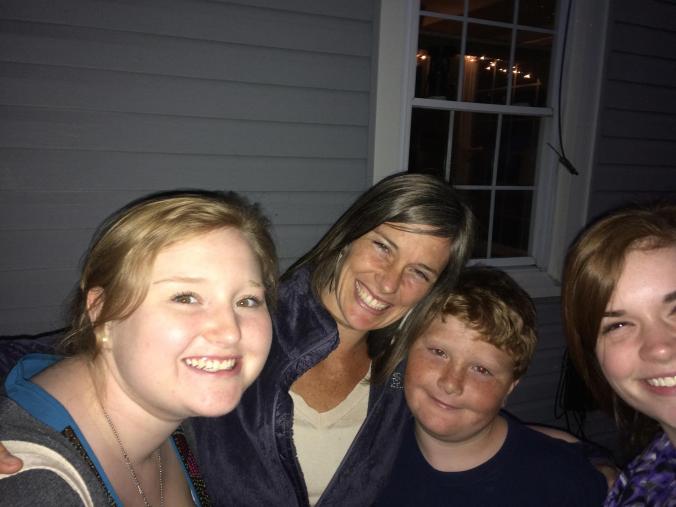
Soon enough though, our dinner had to come to an end. We all helped clean up the food and said our goodbyes. (Here’s a picture of me, Beth, Gabe, and Emma from right before we left!)

Kentucky Kitchen table Picture


All in all, I believe I had one of the best Kentucky Kitchen Table Project experiences that I could have asked for. I learned so much about the family that I was paired with, my partner for this assignment (Emma), and, most importantly, I learned a lot about myself in this experience.

Kentucky Kitchen Table Project: What Really Helps?

By Katherine

KyKT ProjectIt’s interesting where the unexpected can take you. When I first heard about this assignment, I thought it was odd and it may simply be an awkward dinner. However, it ended up being much more than that. While it did end up meeting the expectation of being slightly awkward in the beginning, the conversation eventually began flowing and it challenged me to thinks in news ways.
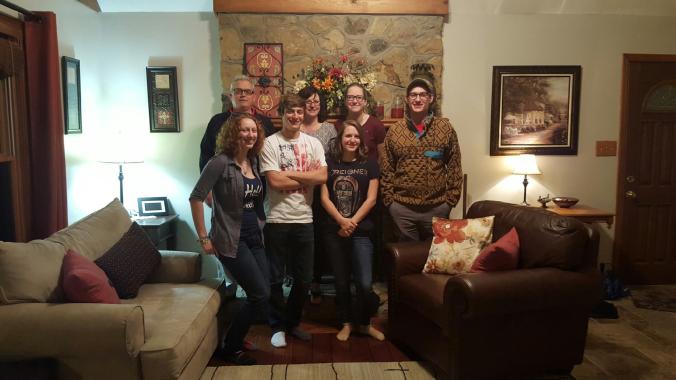
The dinner took place in my hometown Somerset, Kentucky with a family that graciously allowed me to bring a dish to their dinner table in their home. We have been family friends for over five years, and I know Becca, Leisha, Mike, and Hannah very well. However, I did not know their guests Bethel and Stella. Leisha and Mike are a middle-aged, married couple with two daughters, Hannah and Becca. Becca and I were best friends throughout middle and part of high school, and she now attends Belmont University where she is working on a degree in Theater Production. Hannah is a graduate from Western Kentucky University where she completed the Chinese Flagship Program, and she is now attending seminary in Louisville. Hannah also spends her time working with Scarlet Hope, a faith based organization that seeks to help women in abusive relationships as well as sex trafficking. Bethel is a Filipino young lady who grew up in a family that are full time missionaries, and she is going to seminary with Hannah to become a therapist and eventually return to the Philippines to also be a missionary.  Stella is a German exchange student in the Chinese Flagship Program at WKU. With the combination of these diverse perspectives and walks of life, the dinner conversation was full of differing experiences and opinions that made it an enriching evening.

The meal started with me explaining the purpose of the assignment and asking each to share a little about what they do as citizens to help improve communal issues. Hannah spoke of her work with Scarlet Hope, Becca talked of volunteering with minority support groups, and Leisha explained her active involvement in our church. One aspect of the Citizen and Self class that intrigued me was discussing how service can help but also hurt, so I asked how they thought their service made an impact and if they had seen any examples of service that did more harm than good. Hannah explained that she knew that simply removing those women from their situations would not help them in the long run; they would return to it eventually because the mental damage was instilled in them. Lasting change came from meeting their deeper emotional and religious needs. Bethel shared a similar message as Hannah with her experience working in her father’s church in the Philippines. They had a program that fed homeless people, but this was simply used as a gateway to meet their deeper needs. The healing that has come from both programs has stemmed from focusing on subsurface needs, which is what they agreed truly helps in terms of service. Mike and Leisha offered an example of aid that did not successfully help. They used to attend a church that would give financial handouts to those that stated they needed it, but this only created a dependence on assistance and most people would exploit the system and use the money for unessential items. This reminded me of the organization I spent four weeks with in Haiti last winter break since they refused to give any handouts. They provided community life skills classes that taught people how to work and support their families instead of giving away money. The themes of improvement through teaching how to support as well as meeting nonmaterialistic needs was beginning to emerge throughout our conversation.

Another aspect of service that we discussed focused on how much culture influences the ways in which we try to help others. Churches are generally supposed to be a place of refuge that offer services to help those in need, but Becca brought up the issue of how “Americanized” churches are in the United States. People seem to have to dress, act, and talk a certain way to be considered a normal member of the church. Outsiders that look different from the usual, middle class church goer are much less likely to be welcomed. Hannah reinforced the point with a story about a former prostitute whose life had been transformed by Scarlet Hope. This women was covered head to toe in tattoos and had bright, red dyed hair. Even though her appearance looked the same, she had undergone dramatic healing and dedicated her life to helping others in her former situation. However, Hannah recognized that if she walked into a church they would immediately want to “help” her by covering her tattoos and changing her appearance. But that is not what this women needed and that is not what would her actually help her. Leisha mentioned that most of us do not realize how stuck in our culture we are and that conforming people to fit our culture will not genuinely help them. In her experience, this occurred often on short term mission trips and service projects. We think that going to a foreign country or area and giving them our American commodities will better their community, but we fail to listen to what they actually need or would help them in the long run. The concept of listening and working with the stakeholders has been a repeated topic in our class.

As the dinner came to an end, I thanked everyone for openly voicing their opinions and allowing me to join them at their house for the evening. I honestly did not expect the assignment to have much of an impact on my thinking, but it did. I learned that I must be aware of how my culture defines help and that it imperative to serve in more ways than providing a tangible object. As a church goer myself, I realized that I should be welcoming to everyone, not just those that dress and act a certain way. I am glad to say I walked away from that dinner table more enlightened and pleasantly surprised where the unexpected took me.

KKT, Party of 7

By Trevor

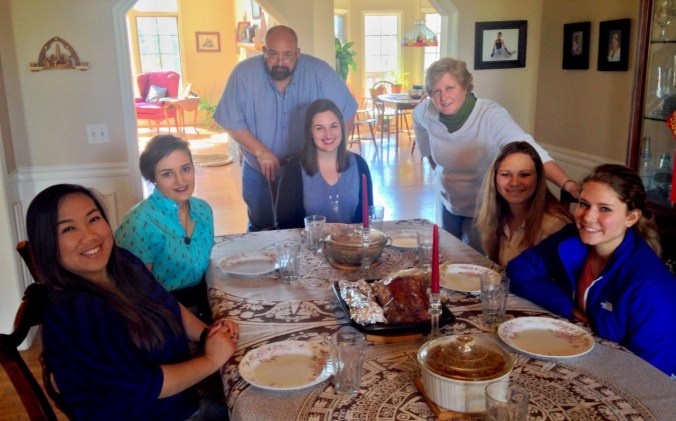
Rachel and I were paired for the Kentucky Kitchen Table Project, and we were accompanied by Madi and Allison from our section along with some of Madi’s family: parents Kim and Tim as well as cousin Nick. I had never spent any time with anyone around the table outside of class, so I had no clue what to expect when I arrived at the house.  I could make a pretty good guess at the political views of my classmates from the thoughts they shared in class, but the project allowed me to actually find out their stance and learn about the views of the three new faces.

Through our discussion I was able to confirm that Allison tends to lean left on most issues, while Rachel is a moderate.  Surprisingly, Madi and I have a very similar stance as we both consider ourselves Libertarians. Kim and Tim are strong conservatives, but Nick tries to avoid politics if he can. Even though this contradicts what most people what say is good citizenship, avoiding civic engagement is pretty common because of the complex nature of the political scene.

Nick was an interesting outlier from the group; while Allison, Madi, Rachel, and I are college students, and Kim and Tim are working adults, Nick is not in school and on his own at age nineteen.  While skipping out on college for a job is very common in my small Tennessee hometown, it was intriguing to learn from Nick about what it’s like.

Not everyone could form an answer of what citizenship meant to them beyond voting, paying taxes, and obeying the law. Tim joked that the question shouldn’t be so quick to assume he believes those three are required in his definition of citizenship.  However, he did add that he believes community involvement is essential to citizenship. This comment reminded me of the section of readings from Smart Communities with the Owensboro healthcare crisis, and the impact community involvement was able to make in that situation. Madi thought political literacy was important, as well as knowing the laws and the reasons they exist.

I wanted to make one point about citizenship regarding our obligation to others:  I think we aren’t always obligated to help others, rather our duty should be to avoid harming others.

When asked what type of community she wanted to live in, Allison responded by saying she wanted to live somewhere that it was easier to pay for her diabetic supplies.  Tim poked fun at the socialist agenda saying, “I want to live in the Bernie commune where everyone else can do the work, and I’ll reap the benefits.” While we agreed Allison, and everyone else, shouldn’t have to struggle to pay for health care, we also agreed socialism is not the way to go about it. Though Tim could benefit from a free healthcare system as he was blinded in one eye by a childhood accident, he was the largest opposition to socialism because he doesn’t deserve to be penalized for his hard work.

Now to the important part: the food.  It had been about a month before this project since I had eaten a home cooked meal.  The cuisine Madi’s family graciously supplied us with did not disappoint.  My favorite parts of the Kentucky Kitchen Table Project, aside from the invigorating discussion of course, were the burgers straight off the grill and the homemade macaroni and cheese.

IMG_0154

Kentucky Kitchen Table

By Carter

Imari Hammock and I did our Kentucky Kitchen Table project in our hometown of Scottsville. We did the project with a group of people from Imari’s church, all of whom I had never met before. At first it was a little awkward sitting with people I didn’t know and trying to have an in depth conversation about their views on citizenship and democracy, but as the meal and discussion went on I began to feel at home with these people and I’m glad we chose them as our family.

The family offered to fix the meal, and I’m glad they did, I don’t think that we could have made anything as good as they did. They prepared two of Imari and my favorite foods, pork tenderloin and macaroni. I would love to spend the rest of this post just talking about how great the food was but unfortunately I am notGuy Fieri and I do not have a show on the food network YET, so I will now tell of the great discussion Imari and I had with this family.

On the left is Martha and Clarence, a couple who Imari has known for a long time at her church. Hayden, the boy to my left is their grandson, he invited his friend Jordan to the meal. While they are both still too young to really give solid input to the conversation, they did have a little to say before they ran away to play. To Imari’s right was Monica and DJ, Monica is the Sunday school teacher at Imari’s church and DJ is her husband. DJ was the life of the conversation and was very entertaining. While we probably still would have had a great conversation, I’m glad DJ was there as he wasn’t scared to share his thoughts and opinions but also was able to keep the mood pretty light.

KKT.JPG

Our conversation went on a little longer than any of us thought that it would, but none of us had a problem with that, we all enjoyed it. One of the first things we discussed was what citizenship meant to us beyond the basics (taxes, voting, etc.). DJ answered first and said that “if everyone learned to respect one another, we would improve the quality of life tremendously”. Martha and Clarence answered next and stated that they are so happy that we live in a country with freedom and rights like we enjoy, but they wished that we could return to the time when people cared about one another. Monica followed them up saying that citizenship, to her, meant being with who you want to be with, really emphasizing the idea of America as the great melting pot.

What was really cool about this project was that, during this conversation, we spoke to a very diverse group of people as far as age and up bringing go, and while we had some very different ideas as one would expect, most of them repeated a lot of the general ideas, especially on their love of their families, community, and God.

I’m so glad that we had the opportunity to eat with this family and have this conversation, because it really opened my eyes returning to what we discussed after talking about wicked problems. When we look at wicked problems like racism or whatever else, we often get overwhelmed trying to think of some complicated or elaborate solution to try and hurry up and solve it, but I think that baby steps can go a long way. If we all just respected each other, many issues like sexual abuse, racism, sexism, etc. would all just go away, and in DJ’s words “would improve the quality of life tremendously.”

Kentucky Kitchen Table by Stevie

My mom is recovering from complications from a hip replacement surgery while parts of our house are being remodeled. Therefore, with the permission of Dr. Gish, we had to change plans and meet at a restaurant instead of eating at home. Although the situation wasn’t ideal, we had a really great time getting to know one another and had some great conversations about citizenship.

The members of the table were: Steve, a Democrat and a Catholic, moved around a lot when he was a kid because his father served in the Air Force. Fonda, who spent her childhood in a very conservative town in West Virginia, has always been very liberal and a confirmed Episcopalian. She has spent her life being a social worker and helping those who need it. Elizabeth is a Republican and a Baptist. She grew up in extreme poverty but has since made it to the upper middle class. Jeffery is a Republican and a Baptist. He was the only one (with the exception of me) who did not have a college degree. He was however, the first one of his family to get out of the farming business and start his own business. He is part of the upper middle class. Zack is a graduate of WKU and is currently in law school. Zack has traveled the world more than anyone at the table. He hopes to one day work in International Law.

The evening started off with me asking everyone what it meant to them to be a citizen. A couple of the ideas were that being a citizen meant being tied to the community and being involved in that community. While others took it a step farther and said that it also meant being part of the country as a whole, not just the community. They thought your identity as a citizen meant that you were part of something much greater than yourself. One at the table said that not only are you part of something greater than yourself but as a citizen you must give 100% to keep your country and community great.

The conversation then turned to how religion affects their actions as a citizen. Only one of them said that religion doesn’t affect them as a citizen.  They said that they firmly believe in a separation of church and state. A couple of the guests strongly disagreed with this sentiment. They vote, do community service, and other various activities based on their religion. The conversation turned to issues like gay marriage and Syrian Refugees. One of the members at the table said they didn’t agree with gay marriage. I was raised in a family where gay marriage has always been accepted, so this is a different view than what I am used too. It was a unique experience having a civilized conversation about such controversial issues at a dinner table. I can’t say we came to an agreement about the issues but we came to a mutual tolerance of each other’s beliefs.

I then asked if they felt obligated as a citizen or through their religion to help other people. I was surprised that I was the only one who thought that a citizen should be obligated to help other people. This is not to say that they didn’t agree that people should help other people but that it was not an obligation. They all talked about their involvement with charities and how they feel morally compelled to help impoverished children or victims of abuse but they weren’t obligated to do it. I was curious and asked if someone who had a lot of money or a lot of resources would have more responsibility to help those in need. Some of the members at the table didn’t think it was a responsibility exactly but if you are able to do something then you should because there are not enough resources for all who need them. One member of the group thought that a person’s wealth was their own, and it was up to them to decide what to do with it, and that they had absolutely no responsibility to anyone to donate their money or time to charity.

I asked them if it was important to be part of a community that valued charity and/or what other kinds of things they value in a community. They all agreed that communities that prioritized charity and where neighbors were involved in their community were things that they valued. One person mentioned that they want a community that is not only involved but strives to be close knit. A few mentioned wanting a lot of diversity in their neighborhoods. They said they enjoy learning about different cultures and when their kids were younger they made sure they were exposed to people from every walk of life. Another member of the table said that this wasn’t important to them. They would rather have a neighborhood with people of similar education, socioeconomic status, and backgrounds. They said that they relate to people better that are similar as opposed to diverse.

In seminar we talk a lot about tolerance vs. acceptance. I realized it is very easy for me to say someone who doesn’t accept gay marriage or someone who may be racist needs to at least be tolerant of those that are different from them even if they don’t accept them. It is, however, incredibly difficult for me to tolerate someone who is against gay marriage or racist or intolerant of others. My first instinct is to say something back and tell them that they are wrong or it’s not okay to treat someone like a second rate citizen. While it is not okay to treat someone like a second rate citizen, nothing gets accomplished by me getting angry at someone who has a way of thinking that maybe isn’t so accepting (or at least what I think is accepting). I thought a lot about the patience readings and how patience doesn’t just apply to learning or perfecting a skill, it also applies to dealing with people. There were times during the dinner that I had to demonstrate patience to try and understand where people were coming from. I really think being patient with people and understanding that many situations are more complex than they seem at first is a skill and a virtue that the world could use today.

I think this assignment also made me realize how important it is to have the patience to have conversations with everyone in the community before someone initiates a plan to help better the community. A lot of the members in the group wanted a close knit community; some wanted this by having lots of diversity while others wanted their neighbors to be of the same education and socioeconomic class as them. One person wanted a complete separation of church and state while the others wanted religion to be heavily involved with their daily civic lives.  It takes time to go through and talk to all of the stakeholders that could be affected by an initiative but at the end of the day you could really alienate a lot of people if you don’t get their opinions and ideas first.IMG_3700 (1)

Kentucky Kitchen Table

By Anna

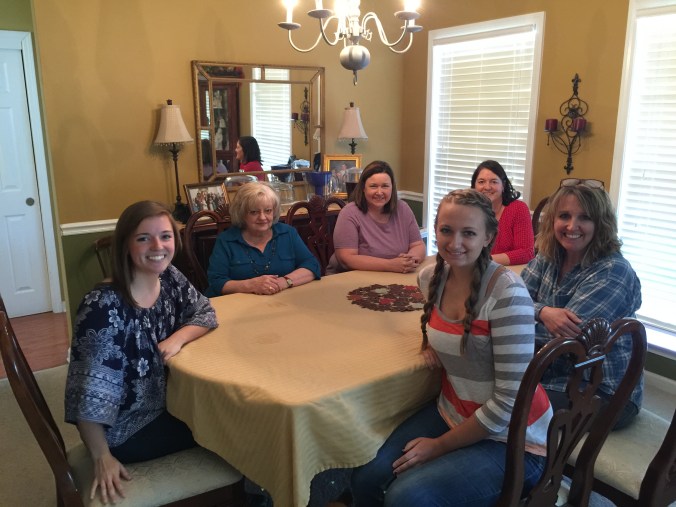
For my Kentucky Kitchen Table project I sat around my dinning room table in Franklin, TN with five other women. Yes I wanted diversity at my table, but I wanted to keep one common variable, gender. Two of my neighbors, Maddie (18) and her mother, Amy (43) came. They are both white, middle class, democrat women who are originally from California and only moved to my hometown five years ago. Maddie is a senior in high school and her mother works in the healthcare business. My next guest was my mother, Beth. She is a 48 years old and a speech pathologist at Vanderbuilt University. She was born and raised in Bowling Green. KY to a well off middle class family. Next was my great aunt Angie (52) who i had never met before but suprisingly happened to be visiting Franklin for the weekend. She is from Owensboro, KY, single mother of two, and she works as a public defender. She is definitely lower on the socioeconomic scale and not as well off as the rest of my guests. My last guest was my grandmother, Helen (75). She was born into a poor family in Minnesota but then married and lived most of her life Nashville, TN and Owensboro, KY. She is a mother of five and has spent her whole life being a stay at home mom. For this dinner my mother insisted on cooking the whole meal so my guests did not bring food.

When we first sat down I thought I would start out with an easy question to get the ball rolling. This question was, “What do you like the most about the community you live in?” Right off the bat Amy started speaking about the neighborhood we live in and of how thankful she is that we live in a community where we can all rely on each other. My mother agreed saying how great of a community we had in Franklin and how there isn’t much she would change. Angie and Helen had different opinions on it though. They both said that growing up (and even now) they never really knew their neighbors or many people in their communities besides relatives and close family friends. They agreed that in their situations reaching out to your neighbors would be an oddity. I then branched off of this asking if they believed we had any obligations to our communities. Overall, there was a group consensus that yes there is. This may not be a very specific obligation, but we all at least have the obligation to keep the peace and unity so our society can function as it should. Going with this we touched on helping people in our community. Amy was very passionate about protecting the powerless. with protecting the powerless we discussed how and what can we do to help the powerless in the long run. Then Maddie made a really good point when she brought up the quote, “Give a man a fish, and he will eat for a day. Teach a man to fish, and he will eat for a lifetime.” As a society we are always giving to organizations and trying to do big things so that we can give back to the people in need in our communities. This is great but we need to take more of the right steps to improve our issues and do more than the ever so popular temporary fix. With the topic of helping people we also touched on the government and how it is actually very hard to make changes since we are just everyday people. I briefly touched on some of the articles we talked about in class such as the shipyard project and the healthcare in Owensboro. They were all encouraged by these because they saw them as examples of everyday people coming together for a cause.

I decided to wrap up our conversation with the most important question, “Beyond voting, paying taxes, and following laws, what does being a citizen mean to you?” Granted at this point we had already generally answered this question many times, but I thought it would be a good chance to simplify and sum up everything we talked about.  Everyone had really good final statements on this but two stuck out to me. The first one was from my mother, Beth. She said, “Bloom where you are planted.”At first I didn’t get how it pertained to my question but then it slowly made more sense. She was saying that no matter the situation you are in, you can always do your best to make the best of it. You can always try your hardest to make your life and the lives of people in your community better. If everyone did this, just imagine the types of communities we would have today. The next statement that really stuck out to me was a little less positive, but it was said by my grandmother, Helen. She said “A house divided always falls.” This seemed a little morbid after my moms supper positive comment, but it is true. She says that citizen ship is working together and people need to realize that if we can’d do that then natural consequences will follow. Unity is the source of citizenship and that is all that really matters.

I learned a lot through doing this project. One being how interesting it is to hear all different opinions on things that people usually don’t take the time to talk about. I would have never known my mothers stance on poverty in America or that my neighbor Amy used to run her homeowner association back in California. I really enjoyed this and so did my guests. Overall I would say it was a very successful experience and something I wouldn’t hesitate to do again!

IMG_1773

By Hannah

I am from Bowling Green, so my family hosted two girls that are friends with my room-mate.  So, at my Kentucky Kitchen Table, the diversity was not apparent at first. Of the three college students present, we were all in a Greek organization, female, Caucasian, and from Kentucky. However, as introductions were made, we realized the diversity at the table. First, my family itself has a lot of diversity to show. My mom was an Army brat turned Army nurse, which has caused her to live all over the world, and she is currently working as a nurse practitioner midwife for medicaid and refugee patients in Bowling Green. Also, my dad is a professor here at WKU, my little sister is very involved with church worship and music, my little brother is ten years old and he knows about every new technological update available. Madelin, my first guest at my table, is from Daviess County and she grew up playing softball and competing in FFA. Miranda, my second guest, is from Todd County, a county with one stop light, and she grew up dancing and competing in FFA.

During dinner, we started with the mandatory question, “Beyond voting, paying taxes, and following laws, what does citizenship mean to you?” Because most people were a little nervous to start the conversation, I said that I believed that part of being a citizen is helping to make your community a better place for people to live. My mom added that she believes a big part of citizenship is making sure that communities are safe and secure for people to live. Both Madelin and Miranda mentioned volunteering and helping those who need it. Miranda worked all summer at a Native American camp in Oklahoma, so she talked about how much the kids would look up to her and how much their spirits would be lifted after she and others helped volunteer at their camp. She thought that this related to citizenship because older people in communities need to set good examples for younger members. My dad, a teacher, agreed, and he talked about how the work that my sister and I do for our youth group at church helps set examples and relationships for the younger students to show, and not just tell, them how to be a young Christian. From there, Madelin and Miranda talked a lot about life in their small towns, and how much bigger Bowling Green seemed. According to them, living in the big city sounds like a night mare. This could not be any more different to what my family feels- we love going to big cities! Miranda and Madelin talked a lot about their farm animals and experiences, and my whole family learned not only what FFA is, but what all they did in that club. Miranda also told us all about agronomy, her major, because she wants to be a seed company representative. My whole family is very suburban, so we knew nothing about that subject, and both Miranda and Madelin laughed at our questions about why there are different kinds of cows.

I think the conversation that we had over dinner demonstrates something that we have talked about in class- the idea that a person’s experiences shapes how they think and feel about certain issues. This shows in our conversation because my mom, who has been around the army all of her life, was worried about security, while my dad, a teacher, was thinking about leading with examples for the next generation.

The conversation lasted so long that we forgot to take a picture and went straight to making cookies, so I’m attaching a picture that my mom took of my brother, Madelin, and Miranda with our cookies; my sister and dad didn’t want to be involved because they were doing dishes (lol).

kkt

This project helped me because it helped me to use the skills and ideas that I have learned so far in Honors 251 and apply them to real-life conversations in a realistic setting. I am looking forward to using these skills to continue thought-provoking conversations in my daily life.