Kentucky’s Kitchen Table: “Finding Your Identity”

By Luke

After several weeks of scheduling conflicts and procrastination, our group was finally able to meet at our host Emily’s home for our Kentucky’s Kitchen Table project, which, to my enjoyment, ended up being a chicken taco night. After consuming an unsafe amount of Mexican food – as well as a delicious West 6th Amber Ale – it was finally time to have our discussion, which began of course with brief introductions.

Our host for the evening was Emily, a Bowling Green native currently completing her graduate degree at WKU involving an intricate combination of humanities courses. Dubbing herself as “Elisabeth Gish’s protégé”, Emily plans on living in a Chicago-based commune for approximately 9 months following graduation, and eventually hopes to attend divinity school in the Boston area.

Next around the circle was Daniel, a freshman on the path to nursing school. He briefly described his catholic-school upbringing in Louisville, which concluded with attendance at Saint Xavier High School. Like myself, Daniel enjoys reading and Netflix, but he also mentioned his heavy involvement with theater in high school. Volleyball is another of Daniel’s hobbies.

Ethan, another freshman honors student, was also in attendance. His interest in the broadcasting program brought him to WKU from Nolensville, TN, and his primary hobby involves working with the WKU-PBS television station. In addition, Ethan enjoys Netflix and hanging out with friends. He also mentioned being a baptist, although not extremely devout (this adjective described nearly all of our religious affiliations, aside from Emily’s).

The final member of our dinner/discussion was Alex, a fellow senior, who is wrapping up her degree in Agriculture this semester. Originally from the small town of Gallatin, TN, Alex enjoys horseback riding (specifically “barre racing”), kayaking, working on her truck & car, and shooting guns at the range with her father. She mentioned playing volleyball in high school, and identified as a southern baptist.

Only one of the “conversation starters” listed in the handbook (the required question) was officially addressed; however, our nearly two hour discussion encompassed several of the other questions indirectly. When asked about what “citizenship meant to her” (aside from voting, paying taxes, and following laws), Emily began detailing her somewhat abstract, yet immensely intriguing perspective on citizenship, which I’ll attempt to recollect.

She began by stating that we as individuals are citizens of several communities simultaneously. Some are obvious and based merely on residential locations such as hometowns, home-states and national residence (think “American citizens”). Others are more personal and greater in number/variety: extra-curricular clubs or groups, churches and other religious congregations, athletic teams at varying levels of competition, family units (whether traditional or not), friend groups, etc. As a result, human beings develop varying “identities” generated through association with varying communities (your personality/behavior around friends or colleagues changes when around parents and family, for example). According to Emily, as we grow and progress through the numerous chapters of our lives, we change how we prioritize the communities we belong to, and this in turn changes our identities over time. As a result, though any person at any given time may belong to a diverse collection of communities, one generally takes precedence over others and is responsible for what Emily referred to as that person’s “primary identity.” Think of it this way: when someone asks you to “tell a little about yourself,” the community associated with the majority of your description is your main priority (at the time) and is responsible for generating your primary identity as an individual.

For example, everyone in attendance other than Emily mentioned that practicing religious faith (i.e. our “religious community”) had become less of a priority since beginning school at WKU – an example of how priorities change in regards to communities we are citizens of. Personally, my social fraternity has been the most important community in my undergraduate career until now, and had previously generated my primary identity. However, as I prepare to graduate and move on to veterinary school in the fall, I’ve found that my primary identity has shifted, and the communities involving my girlfriend and select close friends have taken precedence. I’m sure that once I begin classes at Auburn this fall my “academic community” will become much more of a personal priority and change my primary identity. Being able to apply Emily’s theory to my own life helped it resonate all the more.

To conclude, Emily encouraged us to examine our own lives and practice articulating what our primary identities may be at the present time. This reminded me not only of Martha Nussbaum’s reading from Week 1 titled “Socratic Pedagogy: The Importance of Argument” that encouraged self-examination, but also Jonathan Haidt’s “The Intuitive Dog and Its Rational Tail” from Week 2 that urged readers to try and pinpoint the sources (i.e. the communities) of their own intuitions as a way to aid in debate and discussion. Discovering what motivates the decisions you make and the opinions you possess is critical to understanding yourself and properly empathizing with those around you, and I believe Emily’s theory attempts to get at the heart of what makes us who we are as individuals. If we find that we are satisfied with our primary identity, we should work to cultivate it and give our best to the communities responsible for its formation. If we are unsatisfied, however, perhaps we should begin to shift our priority to communities that can help us become the best versions of ourselves and support others in doing the same.

thumbnail_IMG_2302

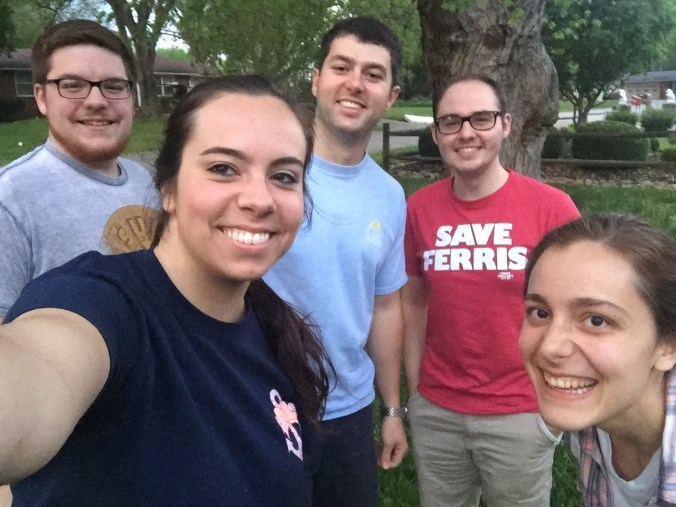
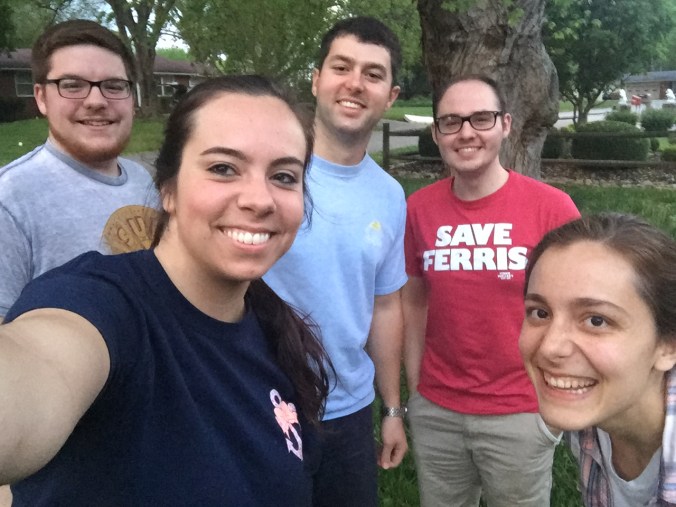
Back row (from left to right): Ethan, myself, and Daniel. Front row (from left to right): Alex and Emily.
 

KKT Project Reflection

By Alex

For the Kentucky Kitchen Table project, I was grouped with Luke, Daniel, and Ethan. We had a wonderful dinner with Emily, a former Citizen and Self student and peer mentor who has graduated from the Honors College and with a Masters of Religion at WKU and is headed on to graduate school.  We decided to potluck ingredients for tacos, and make the actual dinner together, to help cut down on having to spend extra time prepping food, but also to have some casual conversation and get to know each other a little before the actual dinner. Ethan is a broadcasting major from Tennessee. He works at the TV station on campus and in his spare time enjoys Netflix and hanging out with friends. Daniel is a nursing major from Louisville who enjoys theater, Netflix, reading, and volleyball in his spare time. Luke is a Biology/ pre-vet major from Harrodsburg, Kentucky. He is a Sigma Chi, and enjoys sports, reading and Netflix.  We had an awesome conversation which we decided to begin with our question, “What does it mean to be a citizen?”  From there we went on to talk about a more personal aspect of citizenship, and what that looks like in varying identities. We talked about how we identify as individuals, and what types of things truly define us. Emily spoke a lot about personal reflection, and encouraged us to really think about what specific communities we identify ourselves in, and whether we are putting one hundred percent of ourselves into these communities. I do not think any of us left without seriously contemplating our lives as we did.  The conversation was very high level, respectful, and meaningful.

Specifically, each of us had a slightly varying view of what citizenship meant to us.  But overall the underlying principles were the same. Be active. Be involved. Help others. Do what you can. We all had an outlook of citizenship as being part of a group or community and giving your best to help and improve that community.  We discussed how this is also an inward commitment. We must choose what community, or communities we want to be defined by, and then give one hundred percent in order to be effective citizens.  Those communities are not solely our towns, states, country, etc. but also our families, social networks, workplaces, and more. We agreed there are no real set requirements for being an “effective citizen,” but that it is more about giving what you can, and giving one hundred percent in everything.  In order to make our communities what we would like to see, we must be actively involved and engaged in the activities of that community.  We also spoke briefly of these things in a religious context.  With varying religious backgrounds, (Ethan and I were raised Baptist, Danial Catholic, and Luke Methodist) we all agreed that this was a specifically good example of our community identities and how we must realize and ultimately choose which ones take precedence.

I think our conversation relates best to our class reading on the elephant and rider from Jonathan Haidt’s book The Righteous Mind. In fact, we discussed this briefly.  This is a good example of determining which is controlling which. Do we control our identities within a community, or do those identities control us? It is also a good comparison of how we function and work within our communities as active and involved citizens.thumbnail_IMG_2302

Kentucky Kitchen Table

By Daniel

By concept, the Kentucky Kitchen Table project just seems like an awkward situation to me. I questioned whether or not I would enjoy this experience. Although hesitant, I tried to keep an open mind so I could get something out of the dinner. Little did I know, this experience would become one of my favorite memories from this class.

My group consisted of Luke (a Biology pre-vet major from Harrodsburg, KY), Alex (an Agriculture major from Gallatin, Tennessee), Ethan (a Broadcasting major from Nolensville, Tennessee), and our host, Emily (a grad student and former Honors College student). We all brought ingredients for chicken tacos, which Emily made. We started out with a little small talk while waiting on the food. Once the chicken tacos were done, we moved into the living room and started our discussion.

We jumped right into the conversation with the question, “Beyond voting, paying taxes, and following laws, what does citizenship mean to you?” Emily believed that citizenship means being a part of a community and really owning your identity within that community. The language we use to define citizenship and self is like a market; it’s a cost-benefit analysis. We ask “Is what I’m putting into this community the same as what I’m getting out of it?” This mindset leads to believing that if you didn’t get enough from your community yesterday, then you won’t be inclined to contribute to it today. We have to go all in and take the risk that we won’t receive as much back, but also staying wary about into which communities we’re giving our all.   We can’t put our all towards every group we come across, or else we’ll be spread too thin. At the same time, though, we can’t isolate ourselves.

A lot of our discussion had to do with our identity, or as Emily would call it, our story. We talked about how college challenges every part of our identity we though we knew. All of us are some denomination of Christianity. Luke is a Methodist. Ethan is a Baptist. Alex was raised Southern Baptist, but just identifies as Christian. Emily is Christian, as well. I am Catholic. We have all had our faith shaken and identity put into question while in college. We discovered that, even though Alex and Luke are seniors and Ethan and I are freshmen, we are in similar situations. Alex and Luke will soon graduate and go into the workforce where their identity from college will be tested. Meanwhile, Ethan and I are about to finish our freshman year, where we’ve had our high school identity challenged. We decided that no one comes out of college unscathed—meaning no one leaves college as the same person they were when they started. Even though we will be pushed to our limits in college, we will come out stronger. This will make us realize, as Emily puts it, which identities are stronger and which are weaker. She explained this by telling us a story from her junior year. During Emily’s junior year, she was a good girlfriend, good best friend, and good student. When she was hit by a car, however, she lost all of that. When she felt she lost all parts of her identity, she realized the parts of her that are meaningful—the stronger parts of her identity.

The takeaway from this is that we must defend our identity, our story. Citizenship is a story. How we act in our community and how we contribute to our society is a part of our story. Therefore, we need to become better storytellers. We need to find the best way that we can contribute to our community—whether that’s our family, our church, our city, or our country—and own it.  In doing so, we solidify our identity, become better storytellers, and fully participate as citizens. kkt


Kentucky Kitchen Table

By Ethan

Our Kentucky Kitchen Table went a lot different than what I had thought would happen. I thought that it would be more awkward than insightful, but I was proven wrong. Our conversation revolved around how what we perceive as our identity can greatly influence who we are and how  we become better citizens.

My group, which included myself, Alex, Luke, and Daniel, were graciously hosted by Emily, a grad student who majored in Religious Studies. After our dinner of chicken tacos. we dove straight in and discussed what citizenship means to us. Some of the answers included having an obligation and a pride to the country we live in. As the talk progressed, we began to talk about how experience and choices we make will mold the identity we have and we present ourselves. Emily talked about how an experience she had that really had a profound effect on her and her identity. Before, she had spent her college career with the same group of friends from high school that all went to Western together. After an auto accident she was in, however she explained how her friend group essentially fractured. This essentially led her to reevaluate her identity that had been stripped bare. She also talked about she is at a crossroads in her life, and why she decided to live in a commune after graduating from grad school. Her experiences and words of wisdom were very valuable to the rest of us.

The rest of our group also talked about how our majors really have shaped or have begun to shape the identity we are creating for ourselves. Luke and Alex, both seniors talked about how the activities and majors they chose really played out in their identities. Luke is a Biology major and involved in Sigma Chi fraternity. He chose his major because his dad is a vet and he was around animals a lot growing up. He also talked about how his fraternity helped him meet friends he otherwise wouldn’t have made. Alex is an Agriculture major and she talked about how she lived at the agriculture farm WKU has and enjoys the small group of them there, who including the professors, are like family to her. Daniel and I are both freshmen and both of us are still trying to understand what our identities are and how we are presenting ourselves. Daniel is a nursing major, but went through a few other majors before deciding on it. He talked about the differences between WKU and his high school in Louisville, Saint X, an all guys Catholic school. I myself am a Broadcasting major living down near Nashville. I talked about how I came here, despite all my friends going off to the University of Tennessee, where I could have easily gone myself. But I wanted to break the norm of my surroundings, where most people in my high school end up going to Tennessee. I also chose to attend Western because of the highly ranked School of Journalism and Broadcasting and what I wanted to do with that.

One major talking point about identity that came up for us was that of our respective faiths. All of us were Christian, although different denominations for the most part. Daniel, having gone to an all Catholic school was first surprised that not everyone down here is Catholic. Luke said that he was a Methodist although he also said he doesn’t really know what that means in terms of denomination. I am technically a Baptist, and I also didn’t really know what that meant. Alex is a Southern Baptist and grew up in the church, deciding to come to Western instead of a private Christian college. Emily herself is a Christian and when she is done with grad school said she is planning on living in a commune for a few months before going to theology schools in Boston, in order to get a better understanding of herself and how a community interacts and supports one another.

In the end, the idea of identity is important to the idea of citizenship, as our identity coincides with how we act as citizens of our towns, states, and country. My Kentucky Kitchen Table really opened my eyes up to this and is something I can use to evaluate the person I am right now, and the person I will be a few years down the road.

IMG_2302