Jackson KKT Post MW 1020

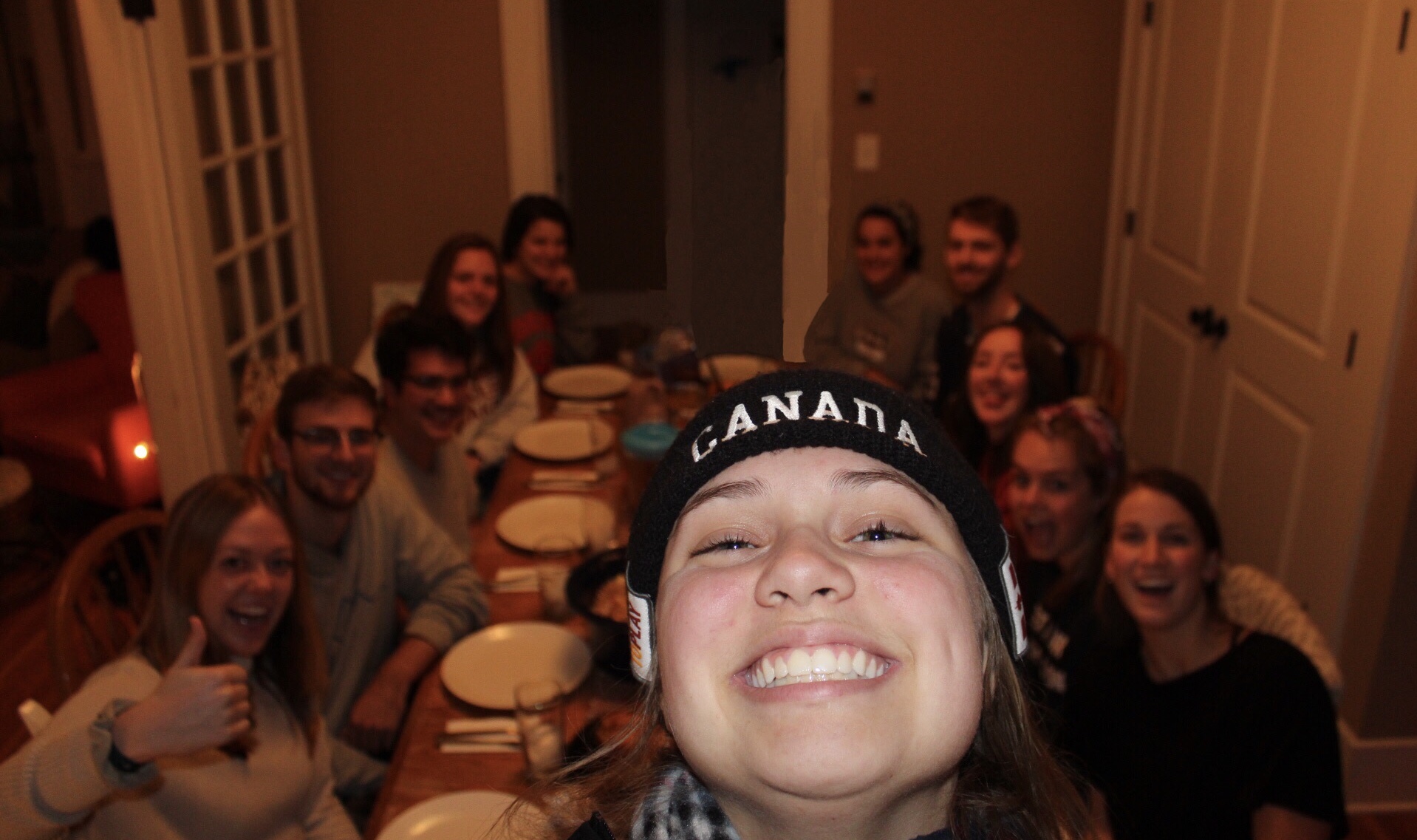
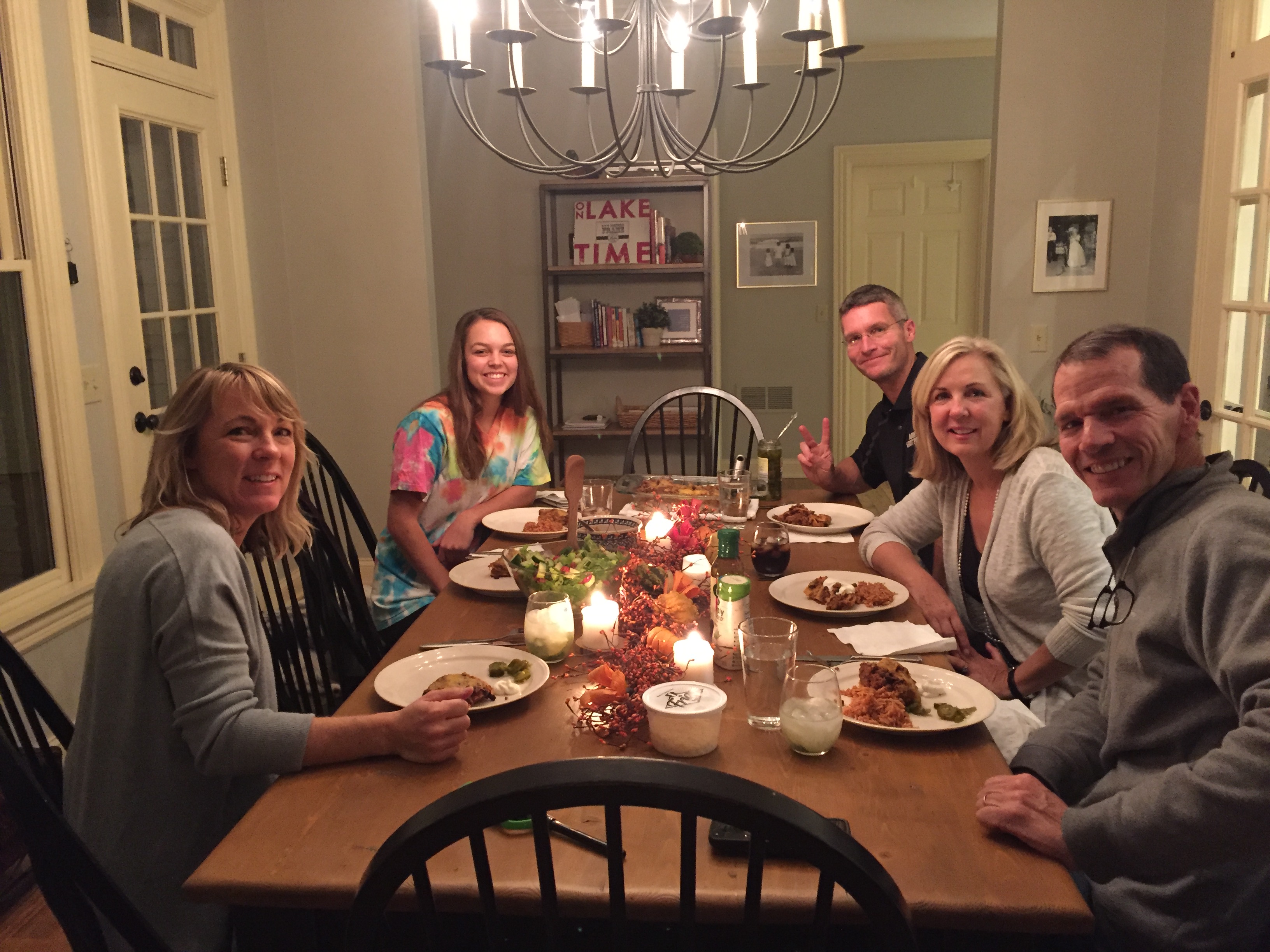
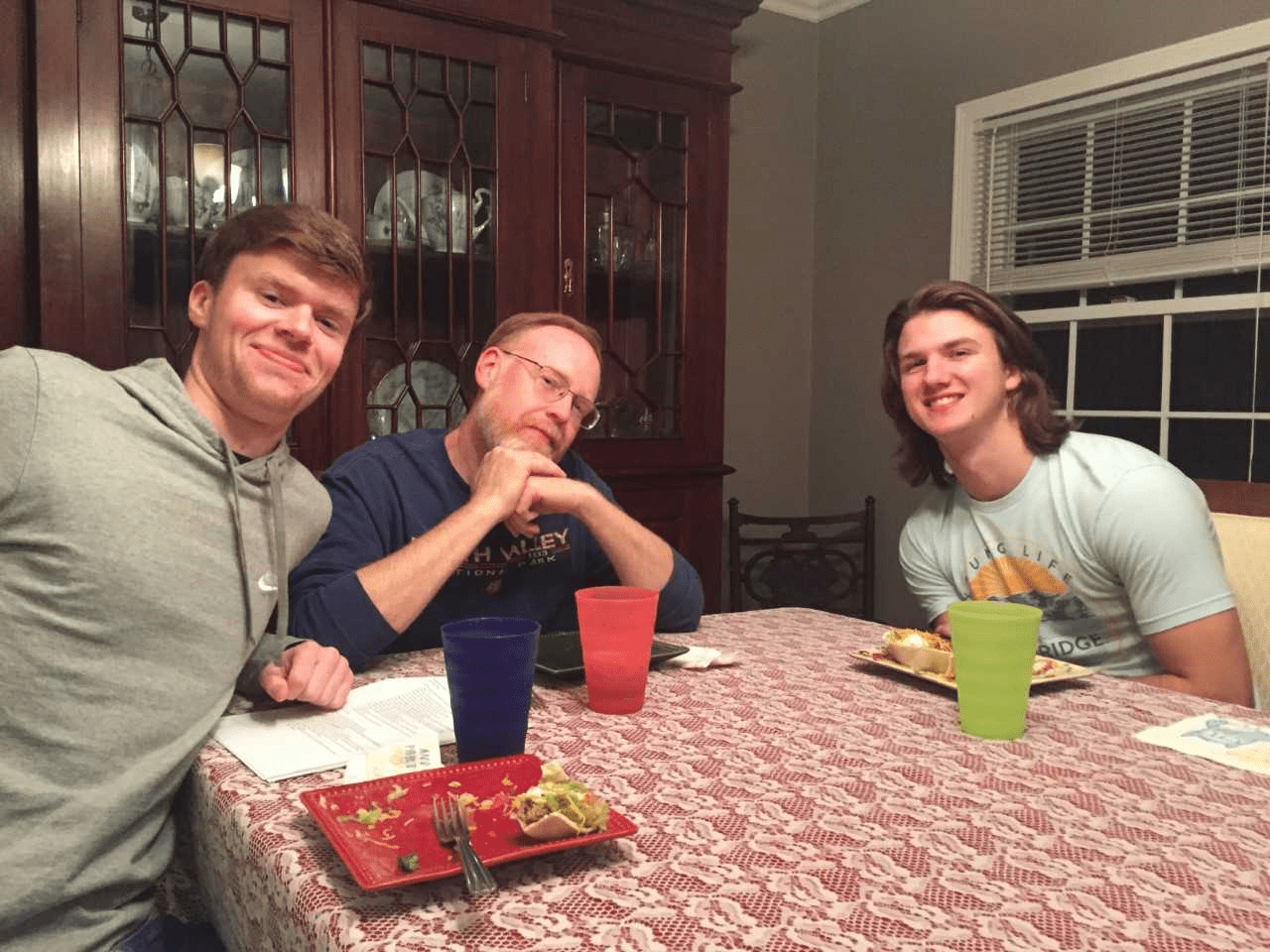
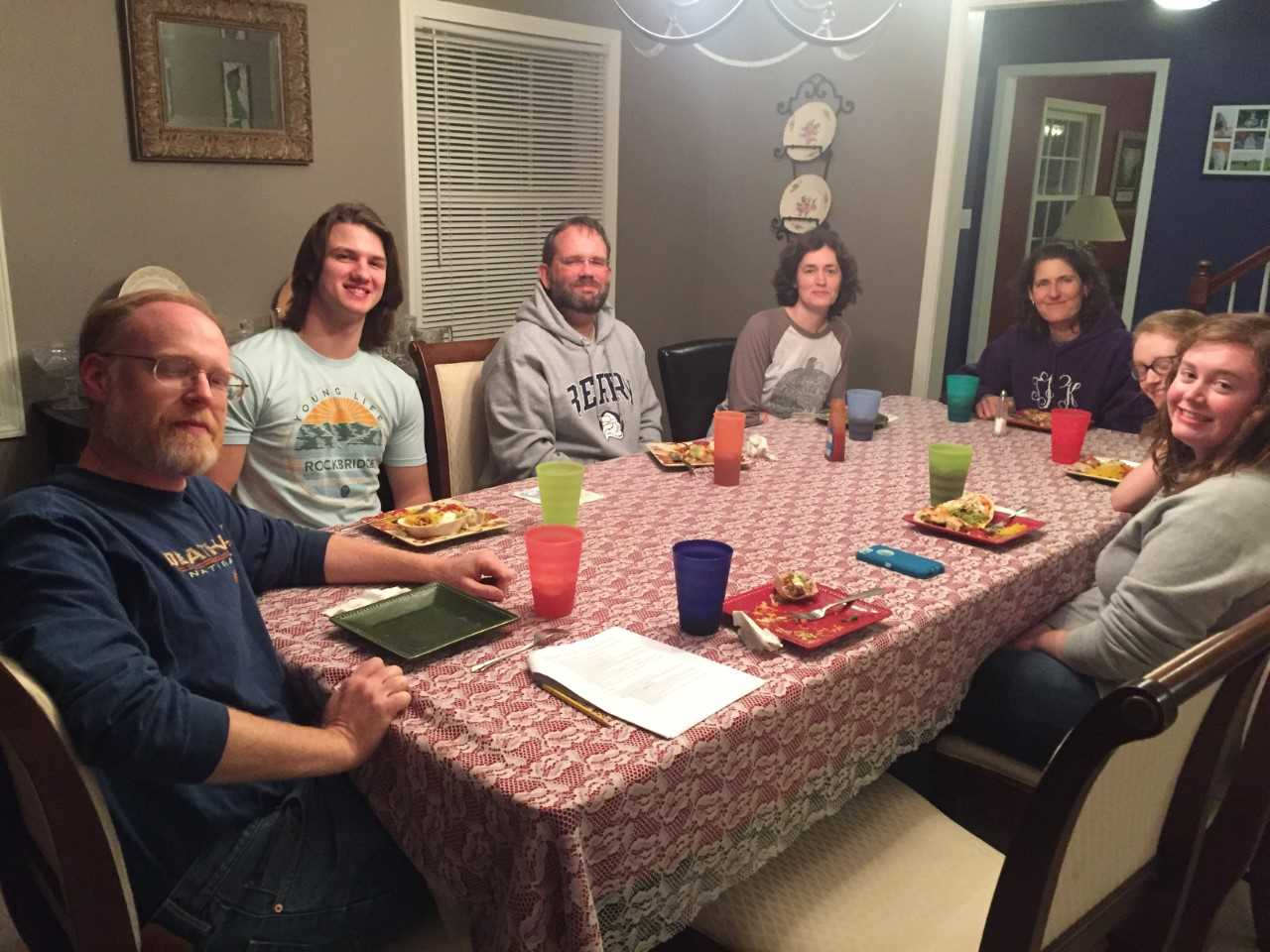
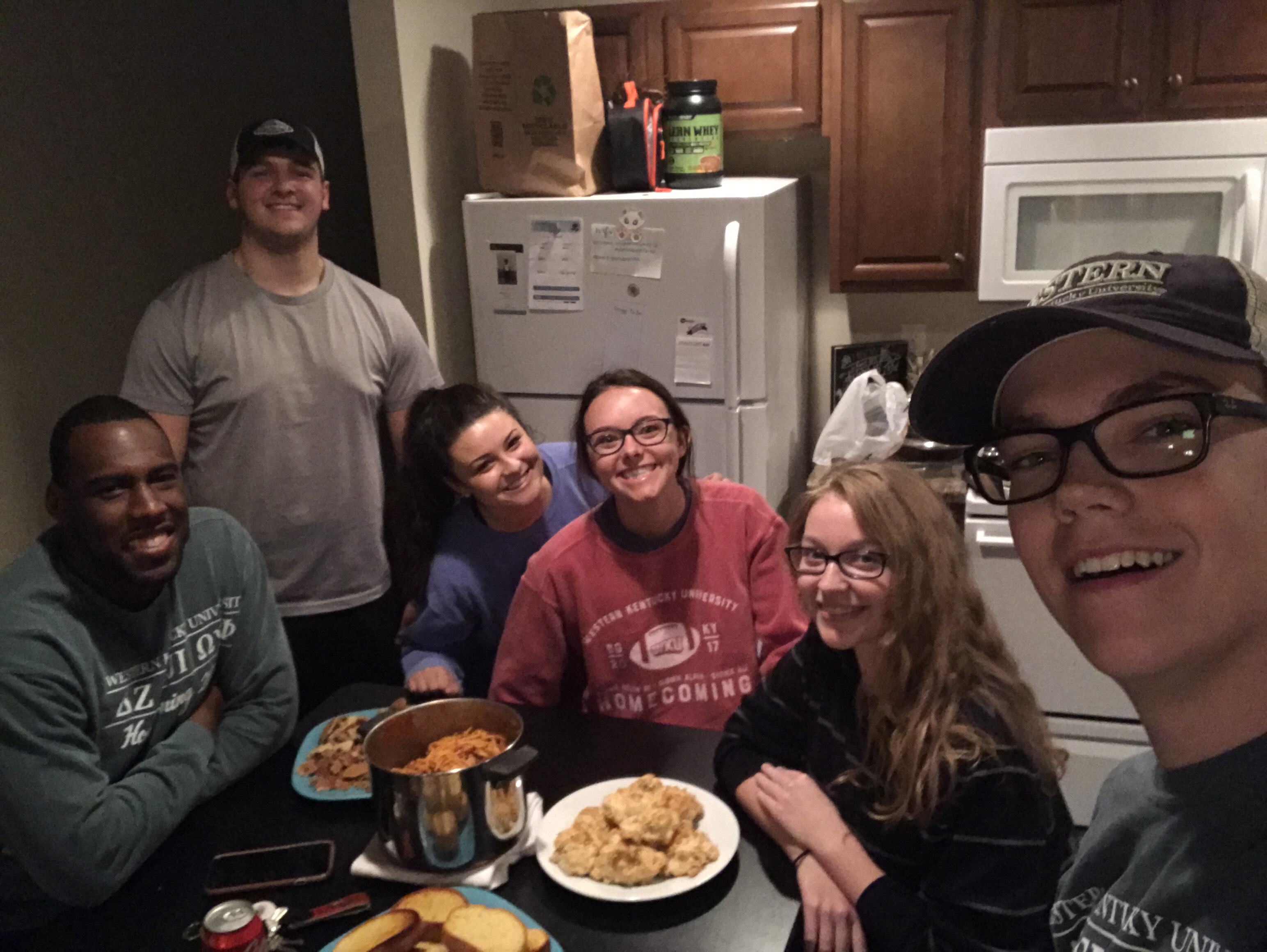
My Kentucky Kitchen Table took place on October 21st at my sister’s friend’s house in Louisville.  The dinner took place around Laura P’s kitchen table, and we had a potluck.  I brought spaghetti and Italian sausage (cooked by yours truly), while others brought bread, salad, and vegetarian pasta.  The food was excellent, but the highlight of the meal was definitely the conversation.  My table included four college educated women.  My sister, Laura K, a graduate student studying geography, was one of the participants.  Her friend, Cecily, is in medical school doing clinical practices at the moment.  Kara, Cecily’s friend, works for a non-profit organization based on environmental sustainability in urban environments.  And Laura P is a graduate student at physical therapy school.  While this group consisted of all women except for me, I believe they had diverse opinions and experiences.  Two of the aforementioned proudly identify as LGBQT members in our area.  Cecily is from Richmond KY, and Laura P is from Maryland.

            I opened our conversation up with the required, “What does it mean to be a citizen to you? Other than paying taxes, voting, and following the law.”  Laura P’s answer was the most memorable one.  She stated she thought citizenship was a term for exclusion.  It is a social construct that allows one group of people to exclude someone they view as different than themselves.  Certain groups that the majority feels has slighted them collectively are often made aliens to places they call home.  Cecily stated citizenship was a term for privilege.  It gives someone the privilege to vote and live without fear of being deported from their homelands.  Laura K stated a citizen is someone who promotes their nation in any way possible, while remaining true to themselves.  Their nation can be based on ethnicity, or it can be based on allegiance pledging.  Kara viewed a citizen as a legal structure that enables people to gain certain rights and privileges.  Privilege came up during multiple answers, which I thought was an interesting perspective, since some Americans would say that citizenship is a right which is clearly dependent on whom’s perspective you ask.  They then asked me what I thought it meant to be a citizen?  To me, being a citizen is a cosmopolitan effort.  It is about being a good person and promotion of mankind as a whole to reach greater heights.  I took on citizenship as a distinctly more positive term that has been abused by those in power to create the negative connotation my KKT participants stated. 

            I then switched the conversation to a more uplifting one.  I asked what is the best thing in our world today?  Laura P stated that the park system in Louisville is beautiful.  We have dozens of parks in our community that are each uniquely beautiful and a great opportunity to mountain bike.  Cecily stated Mammoth Cave because of its rich history and awe inspiring beauty.  Laura K said that the Louisville community was the best part of the world.  It offers the perks of a large city such as transportation and entertainment, while also offering a small-town feel.  She enjoyed how she could not go anywhere in public without running into people she knows.  This kind of experience helps foster a genuine sense of belonging within the community and a mutual bipartisan desire for people to help improve the community.  Kara stated the refugee community in the Louisville area as her favorite part of the world.  Louisville is proudly a refugee center and has groups of refugees from all across the world.  She enjoys planning events that help bring the worlds of all Louisvillians together through her non-profit.  My favorite part of our world today is the interconnectedness of our melting pot.  Through soccer, I have met people from all over the world who I may not have met otherwise.  Off the soccer field someone may receive preferential treatment or be wealthy.  On the field though, we are all equals there for the love of the game and we all care deeply about the world’s greatest game. 

            We then talked about how we could make life better for those around us.  Laura P stated a friendlier environment for American immigrants would make life better; she finds it ironic that almost all Americans migrated to the United States, yet there is still a great disdain towards them by a significant portion of the population.  Kara challenged this sentiment by stating people in the south were welcoming to all cultures despite their anti-immigration stance.  I played devil’s advocate to this statement responding that there is a big difference between allowing someone to live near you, as opposed to making them feel truly welcomed in your town.  I also brought up Peter Maas’ Love Thy Neighbor in which Bosnia descended into chaos in a multi-cultural nation.  It was important to note under the right leadership and right circumstances that genocide and war atrocities could be committed in a developed nation.  Cecily stated improvement in funding in Jefferson County Public Schools would elevate our society by helping our future voting citizens become more educated and informed.  Currently, some lower income schools are struggling with sending their students to college and maintaining positive learning environments.  Laura K stated that Louisville could expand its eco-friendly public transportation system.  The city currently has a few “green” routes, yet could do more as a leader in the city by cutting emissions.  Louisville sits in the Ohio River Valley and has notoriously poor air quality, particularly in the summers.  My biggest area for improving life in our area was the city hosting more public events that help bring diverse people out to celebrate the greatness of diversity.

            I then transitioned by asking what social issue was closest to their hearts.  Laura P’s was immigration.  She was very upset with Trump’s immigration policy and hundreds of children under the age of five being kept in cells without their parents.  She believes it is a scare tactic by Trump to deter future illegal immigrants who want to move to the United States in search of a better life.  Cecily’s biggest social issue was LGBT rights.  She believed that they are accepted in most areas of society, yet there is still a strong number of people who would prefer no interaction with people from this community.  Laura K stated that the environment was her biggest social issue.  She believes there will be no time for politics when there are water shortages and mass migration problems as people from coastal cities are forced into mainland cities.  She said if you think immigration is a problem now, wait until the environment forces an astronomical amount of people to move inward.  I mentioned that in our reading, “Forget Shorter Showers”, municipal waste only creates 3% of all environmental waste.  Laura stated she knew corporations were the largest polluters, and that restrictions being passed down on them from politicians who care about the environment would be the best avenue to create positive change.  Kara’s biggest concern was minority rights.  While she did concede strides have been made to getting minorities more representation, it has not enough to satisfy her concerns.  She cited the disproportionate amount of African Americans in prison and involved in police shootings to continue the fight for their rights.  My biggest concern was gun control as I strongly believe we need to increase restrictions on gun control.  I know we cannot feasible track all weapons, but the amount of mass shootings is on a sharp rise; they simply do not occur when people who should not have guns do not possess them.  The second amendment is the right to bear arms, not the right to mass murder. 

            From this kitchen table, I gained new perspective on both global and local points of contention as a male in society.  As these women conveyed, they do not feel fully represented by their government and know it a reality that they have an extra step to go to be granted equal rights and opportunities as men.  It is important to not be set in your ways of thinking, and always be open to the possibility that your opinion and perspectives may not always be correct and accurate.  You should obviously believe in something, however it is important to inquire about why we think the way we do and how we can learn to consider all perspectives as much as possible when weighing the consequences of our actions.  Overall, my conversation was a great learning experience and effective in pushing me to think outside my own norms.  Everyone who participated was invested in the dinner, and I would recommend future classes partake in the activity.  I believe my group was extra effective in that it cited facts and statistics, not solely how one issue made them feel, which is a skill that is dying out in our society.  Our own view of the world is affected by outside and internal factors.  It is important to be able to keep a leveled head when processing outside factors, so that we come to rational conclusions.  I felt as though our conversation was a deliberation, in which everyone let everyone else speak.  The participants in my dinner cared about our conversation, but they did not take disagreements as a personal slight, and realized that is important to have disagreements about our future, because it shows people are trying to conceive all possible outcomes, not just ones we want to see.
Hannah’s Kentucky Kitchen Table

By Hannah

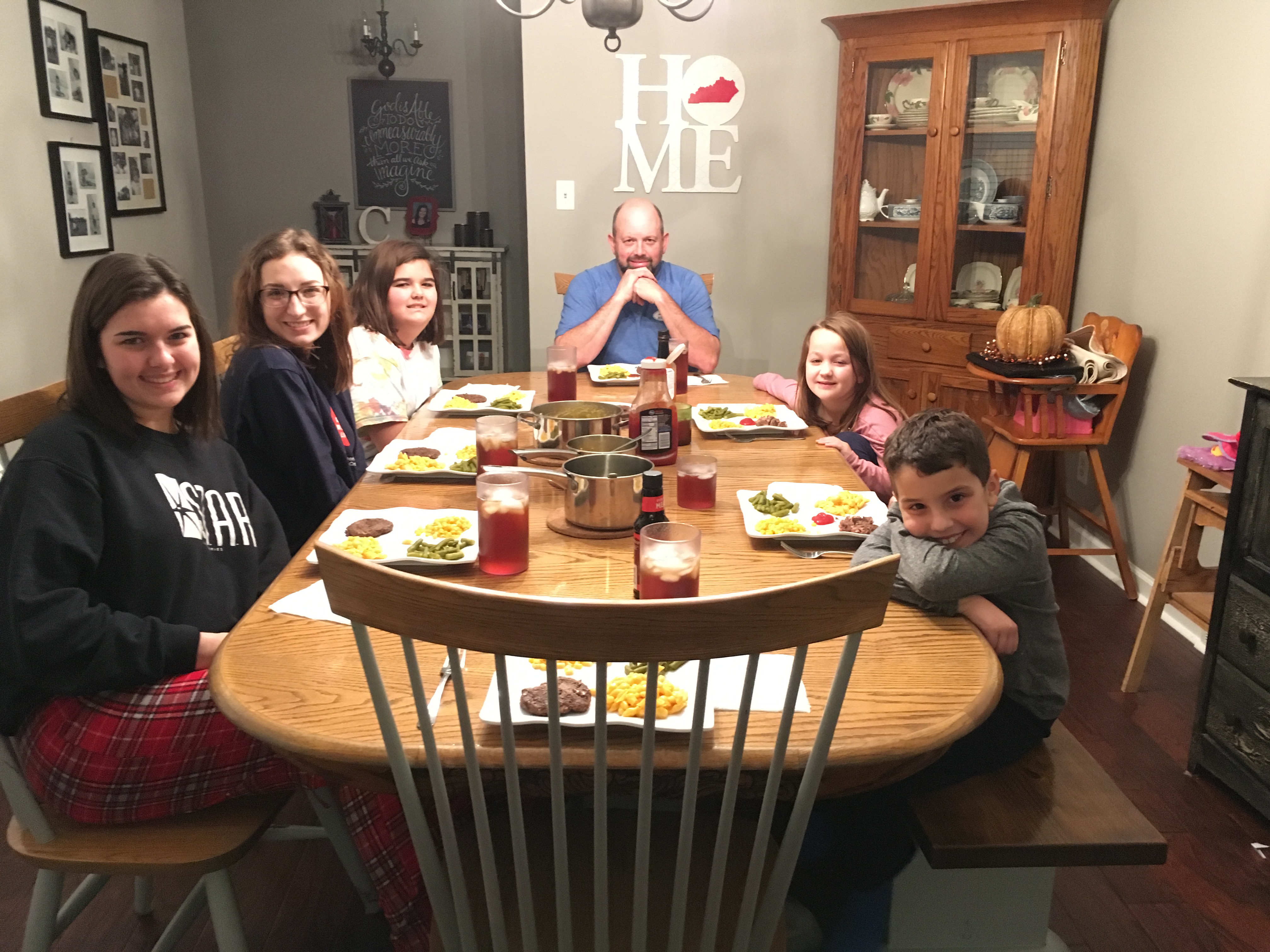
On November 15th of 2018, I hosted my Kentucky Kitchen Table at my house in Bowling Green, KY. Since all of my friends were at work or busy with assignments, I asked my sister, Sarah, to invite over her friend Kendra. They joined me, my dad, and my younger siblings Kaila, Caydon, and Kiara for a steak dinner. I figured it would not be very safe (or appetizing) if everyone made a dish themselves, so my dad just allowed the younger kids to help him with smaller tasks in the kitchen. We worked together to make steak, macaroni and cheese, creamed corn, green beans, sweet tea, and brownies for dessert. While most of us were family, we have very different personalities and aspirations, and, from what Sarah had told me, I knew Kendra had grown up much differently than any of us. Kendra is seventeen years old and is planning on going to school to become a social worker. I learned that she has been in the foster care system for most of her life due to abusive and alcoholic parents and has not been taught any certain religious beliefs, or even knows if she believes in a God. My dad is 47 years old and a navy veteran. He has been working as an electrical engineer at the same factory in the 200 person town he grew up in since he was honorably released from the military. His parents are pastors, so he is incredibly religious and also very openly pro-Trump. Sarah is sixteen and hopes to become a police officer. She is very much a daddy’s girl and will do nearly anything to please him. Kaila is ten years old, very outgoing, and is extremely determined to become a school teacher. Caydon is nine, obsessed with sports and his Nintendo DS, and has high aspirations of becoming Steph Curry when he grows up. Kiara is six, lives in a fantasy world, and wants to be the tooth fairy when she grows up ( but plans to keep the money ). As for me, I am 18, currently a Psychology major, very passionate about equality and feminism, and want to work as a rape and sexual assault therapist in the future. Now that you understand a little bit more about who was participating in this conversation, hopefully the things said will make more sense.

After my dad prayed over the meal, I began the dinner by asking the question, “Beyond voting, paying taxes, and following laws, what does citizenship mean to you?” All of the older people could agree that one of the main parts of being a good citizen dealt directly with being a loving neighbor to everyone. Of course the inevitable “Make America Great Again” slogan was thrown in there a few times, but ultimately we could all put our differences aside and agree on this main idea. Kiara said she had absolutely no idea what a citizen could do other than vote and follow the law. Caydon, on the other hand, felt very strongly that to be a good citizen you have to clean up the country and make it healthy. This lead to me asking, “How do you practice being a good citizen right now?” We all said something centering around being caring to those around us and sharing love. Kendra added in that she supports those who fight for equality and love for all. My dad believed one of the highest forms of being a great American citizen was by putting your life on the line for someone else’s freedoms whether that be by the military or first responders. We also talked for a while about how it is easy to call yourself a citizen just because you live someplace, but that is not all that citizenship entails. It was brought to my attention that it is very easy to come up with a “beauty pageant” answer to these types of questions when you know that other people who may not believe the same as you will hear what you have to say. I wondered if I had not taken a picture of the table and prefaced with the fact that this was for a project if I would have gotten vastly different results.

Ultimately, after the citizenship questions the conversation moved on to the school day, weather, and funny things we saw online, but I was left thinking about how surprised I was at some of the answers I received. It was shocking to me how much the answers related to our class discussion about empathy. Since both Sarah and my dad are extreme Trump supporters, empathy was the furthest thing from my mind when trying to predict their answers. They both even specifically mentioned treating every class, sexuality, gender, race, and ethnicity with compassion. When thinking about this sudden drastic change in their views, I remembered back to in The Empathy Exams Jamison talked about how hearing about an individual story can make someone feel more empathy. When Kendra was telling us about how she grew up, she told stories about her mom experimenting with both sexuality and religion, and she mentioned several instances where they had to beg for money or food to stay alive. Since this was all of our first times hearing this incredibly emotional story from someone we had all grown to relate to, I believe it caused my dad and Sarah’s eyes to open and allowed them to put themselves in her shoes, which made them show more empathy to those who are different from them. This discussion proved to me just how much empathy can change views and bring people from all different walks of life, personality types, political parties, and generations together enough to agree on the basic idea of compassion.

Caydon’s answer that citizenship is about cleaning up our country and make it healthy initially caused some laughs around the table, but the more I pondered on the thought, I came to agree with him. I found it interesting that the second youngest person at the table was the only one to mention anything about taking care of the environment, while the older people snickered at the idea. This reminded me of our reading No Rock Scorns Me A Whore where the author, an adult, sees the idea of saving the Earth as essentially hopeless since even those who want to make a change have things they refuse to give up. Since Caydon is so young, he still has the optimism most children seem to grow out of as they mature. Those of us around the table who have seen the depressing news stories and statistics about climate change and destruction of the ecosystems seem to have given up on the idea that something can be done to reverse or at least lessen the damage that when presented to us, we literally laughed. Possibly if we looked at problems with the same childlike optimism and hope my brother did instead of just dismissing or even laughing at the ideas that seem impossible, we would have more progress as not only a country but as a society.

Honestly, at first I just saw this project as another homework assignment I had to do, but after completing it, I can see why it is so important. Not only did I get to connect and share what I have been learning in Citizen and Self with the people at the dinner table, but I also got to have a meaningful and eye-opening conversation with the people I care about. This seemingly simple question gave me insight into how my dad, siblings, and Kendra see and experience the world around us. Also, it served as a gateway for me to talk about other deep and controversial questions and topics I had been steering away from for fear of what they would say. In times like these, the media and society focuses on the differences between various groups and tries to create a greater separation between political parties, races, genders, sexualities, religions, and any other way people like to define themselves. Even with one short discussion, I have seen how easy it is to come together and make decisions when everyone is polite, respectful, and open-minded like every good deliberation should be. By seeing these impacts first hand, I will definitely use these techniques in the future when potentially divisive topics arise, which often happens around the holiday season. Hopefully, in this upcoming Thanksgiving and Christmas season, not only me but also my family and Kendra can use the empathy and communication skills we exercised during this dinner to discuss and solve problems in a more effective and humble way. With this new open and free communication between me and my father, I am sure we will grow to live better together while still respecting our differences. My biggest lesson learned from this dinner was that although everyone has different experiences, those differences should not divide or discourage us, but instead they should help bring us closer together through freely sharing our ideas in a respectful way that can work to open the eyes of those participating.

Madeleine’s Kentucky Kitchen Table

By: MadeleineIMG_3702

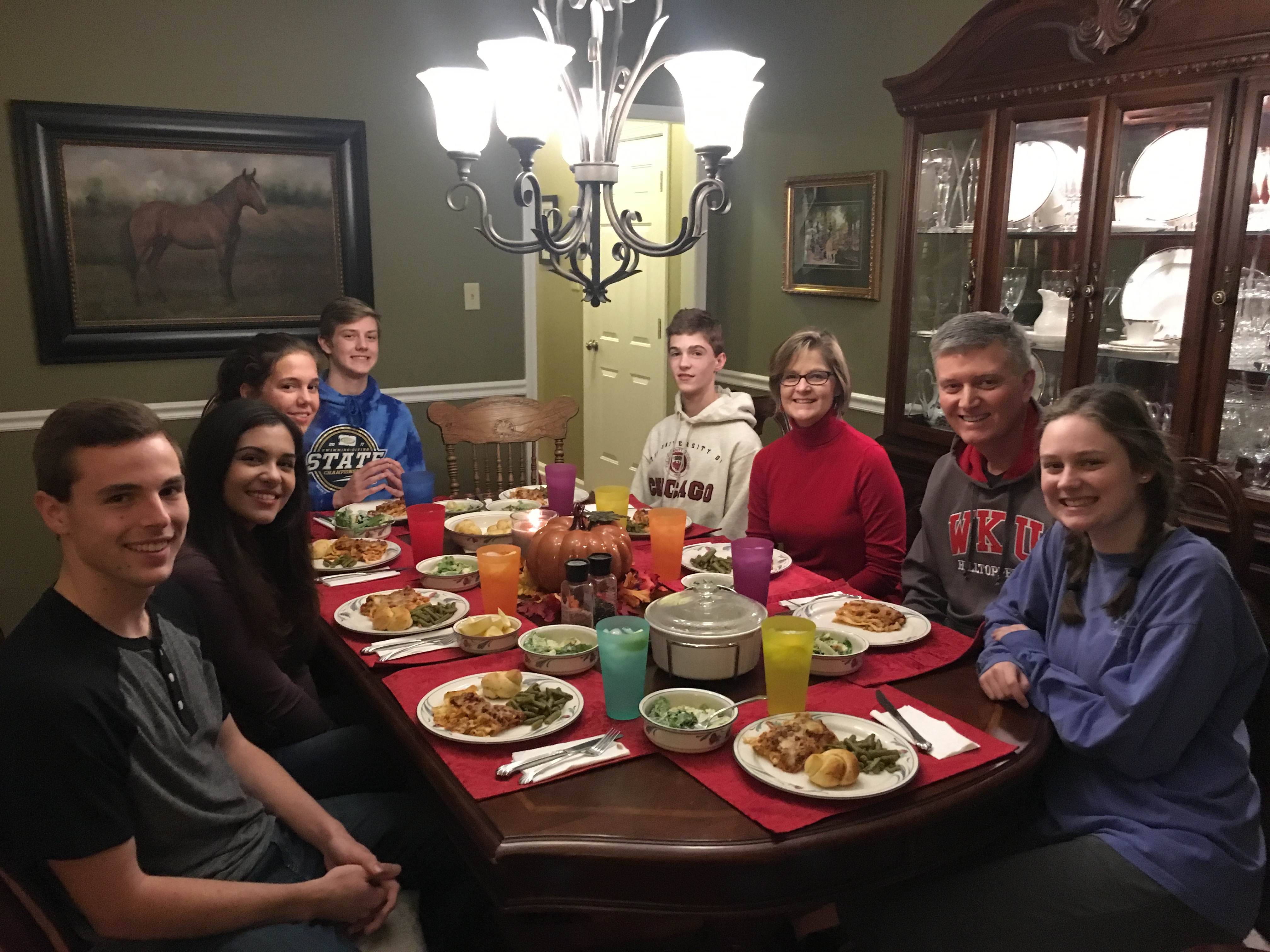
My Kentucky’s Kitchen Table took place on November 10th, at my house, in Bowling Green, Kentucky. I invited 8 people over to join me including two people from our class. Ron is my dad who always has on a smile when talking to people and actually loves to cook so when I told him about this dinner he was very excited to say the least. He works at Western Kentucky University, and as I said, loves talking/discussing with people of all ages, so this was truly his element. Jennifer, my mom, is a wonderful person who truly cares about everyone. She also works at Western Kentucky University and loves helping out in her local community in many different ways. Someone I didn’t know very well was Jason who is Luke’s best friend. He is known to be one of the smartest kids in his grade, as well as quiet but can be very funny when you get him talking. Luke is my younger brother, a sophomore in high school, who is also smart and enjoys swimming as a sport. He might be one of the goofiest people I know but that also is only of the best parts of his personality. Another goofy person is Luke’s friend Abby. She is one of Luke’s newer friends, but it didn’t take long to realise she is very energetic which goes along with her love for acting. I just recently became friends with Hope through my honors 251 class but also she lives right across the hall from me in Minton. She is very talented at both singing and acting which fits perfectly for her musical theater major. Scott is also one of my newer friends from my class. He is a biology major who may seem quiet, but has a very funny and sarcastic sense of humor. It may not seem like a super diverse group but we all had different views and topics to bring to the table.

The dinner was so much fun to be a part of because we answered many questions in a serious matter but also had so many laughs throughout the dinner. Starting with the main question, “Beyond voting, paying taxes, and following laws, what does citizenship
mean to you?” Jennifer began talking about how she believes it’s important to help out in local communities. She gave examples of how she has helped out through things through church and also through her job. She also talked about how she volunteered her time to help Jeanie Smith campaign for Kentucky Senate. Hope explained her opinions on how she thought it was important to support local businesses, like local theaters. She has worked at her own towns local business of a consignment shop. I brought into the discussion how I did not realise how much the library really does help in our community until I started working there last year. The library helps a lot in the community by holding different classes, free books (obviously), children’s programs, and so much more. We all agreed that it was important to help out your local community in any way that you can. I feel like this really goes along with how we can live better together, by working together as a community.

Neighbors and neighborhoods came up as a topic as we shared where we are from and Scott talked about how he lives in a place with no neighbors. Scott is from Hardin County which is a very rural and small community. Although Bowling Green is usually explained to as small, the rest of us grew up next to neighbors. Jennifer explained that when my brother and I were younger or even when she was growing up, talking to your neighbors and interacting with them was a lot more common. Hope shared that although she had neighbors, she never seemed to speak to them. Abby shared how when she was younger, the houses around her as a kid were very close and the kids would always play together after school. We all talked about how people might still seem to be kind to their neighbors but the dynamics are definitely changing and have changed over time.

We began to also talk about the kind of communities that we each wanted to live in, in the future. A majority of us love our current community but are thinking of moving somewhere larger in the future. Abby, Luke, and Jason all explained that they would prefer to live in either New York or Chicago in the future. With Abby’s goal of being on broadway in the future, I can see her thriving in New York City. We asked what Luke and Jason hoped to do in those larger cities as well as with their career choices and they weren’t sure yet. They knew they wanted to leave this smaller type town and hopefully figure out their passion later in life through college and more experiences. This led to the topic of asking if we thought people’s current/future jobs led to a greater purpose. Jennifer shared that she helps a lot in her job with different events for students and also in the community. Ron also shared that he thought that when he raises money it helps students to have nicer facilities and also different scholarships.  Hope wasn’t really sure how job could help serve a greater purpose, but Abby explained that she could inspire younger children to love the theater world. Then scott of course, with his pediatric job, could help sick children get better so they can help others in their lives.

Social issues were brought up when we tried to get both Luke and Jason to talk more. We asked what social issue was closest to their heart. Of course being sophomore boys they weren’t the most serious in their answers, but it did give us some laughs which added a light mood to the more serious topics. After hearing their ideas of helping the Amish and letting dogs off their leashes I added a more serious social issue we could talk about. One social issue that is close to my heart is mental health awareness. I asked if anyone had any thoughts or opinions on this and everyone was in agreement that the stigma is needing to be squashed. Abby then added that it would be helpful if people had easier access to getting the help they need. Ron agreed with that and talked about how people should also be educated more on the topic and that it should be added more into the schools.

One of the more personal issues involved in our lives at the moment was the mold problem at Minton Hall. This dinner took place during the time of the Minton Mold disaster, so you can imagine how much we discussed our anger. Hope, Scott, and I were all explaining how frustrated we were with the situation. Hope and Scott were already moved into their new homes for the next couple of weeks, but I still had to move the next day. We talked about how we think there could’ve been a better way to handle the situation, but this was before we got the email about the $1000 credit on the housing cost next semester. Still a very unfortunate situation that we had to experience.

Everyone was curious if Hope, Scott, and I did these types of deliberations a lot and we laughed because we basically do them every class period. We explained how we have had an ongoing project about deliberations with groups of people on different topics. Hope explained her topic, which I was a part of, trust in the media, and then Scott shared some on his topic of the criminal justice system reform. We realised some of our more important actions, in both topics, included adding more education on these topics in the school systems. Jennifer explained how she felt that educating the youth at an appropriate age would help solve some issues in many deliberation topics people might have.

Overall I had a wonderful experience during my Kentucky Kitchen Table project and was glad I could host one for some of my classmates. We enjoyed a meal of caesar salad, lasagna, garlic knots, and a wonderful mud pie for dessert. My parents all gladly made this for the extra few people than they normally had and it was quite delicious. We shared many insightful conversations that I believe made everyone think a little differently but my favorite parts were probably the laughs. Usually when we take part in deliberations they are all serious and although I do enjoy them, it was nice to take a lighter note on one. I think we all saw both the elephant and the rider in each person as we discussed through the dinner. I would love to do this kind of conversation again with some of my other friends and family to see how it would differ from this one.


Miles’ Kentucky Kitchen Table

For my Kentucky Kitchen Table project, I held dinner at my brother’s house here in Bowling Green, Kentucky, this past Tuesday, November 13th. While planning this gathering, I decided to invite a selection of individuals that reflected diversity and engaged citizenship in order to deepen conversation.

The first individual that was invited to my dinner, partly because I used his home, was my older brother, Jacob. Growing up, Jacob was always an inspiration to me. He remains constantly involved within his community, whether that be through public service or leading worship at the local Christian church. Jacob is extremely intellectual, somewhat shy, and takes his faith into account when making political decisions (He tends to be more conservative). My next guest was my roommate and best-friend, Reed. Although I’ve only known him for a little over a year, I would consider Reed more like a brother. He is extremely friendly, a devout Catholic, and is very politically sound. Although he comes from a conservative family, Reed identifies as a liberal. In addition to Jacob and Reed, I also invited Alyssa, a new acquaintance I made through my brother and the Chemistry department here at WKU. I have known Alyssa for a few months now because of her involvement in my chemistry lab as a peer tutor. Although we have never delved into serious conversation regarding politics or community issues, I do know that Alyssa identifies as a member of the LGBTQ+ community and is agnostic. My last guest was my dear friend, Hannah. Hannah and I have been friends since we met one another at the H-4 retreat for WKU Honors students this past August. She is the embodiment of kindness in addition to being one of the friendliest people I have ever encountered. When it comes to politics or religion, Hannah is quite indifferent, and seems to lie in the “grey area” of most societal issues.

IMG_7643

From left to right: Alyssa, Hannah, Reed, and Jacob.

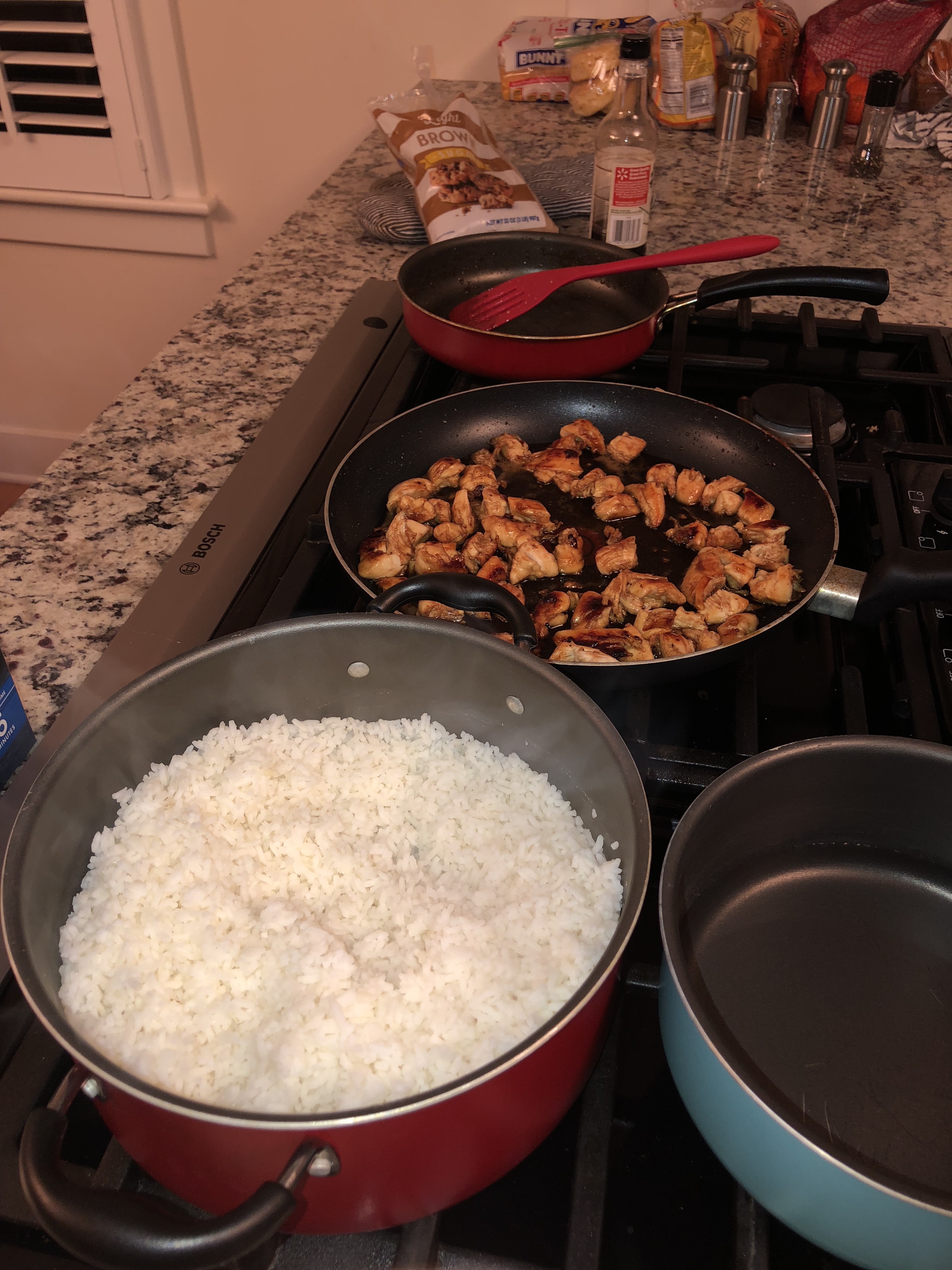
Prior to the dinner, I asked these guests to bring a small dish to the gathering, but none of them were able to do so for various reasons (finances, time constraint, etc.). As a result, I decided to make a dish for us all: grilled teriyaki chicken on a bed of steamed white rice. Although it was simple, I knew this dish would be rather easy to make and pleasing to all those attending. Each guest arrived about 10 minutes before the meal was ready to serve, so while finishing up with cooking, I decided to start some intentional conversation.

IMG_7641

Grilled Teriyaki Chicken with Steamed White Rice.

First, I explained to my guests that in Honors251, the class has spent the semester studying citizenship, global issues and possible solutions for each. I then asked what everyone believed the best part about living in our modern world was. Jacob was quick to respond, humorously saying that the best part about living in today’s society was listening to Cardi B’s music. After a quick laugh, he continued on a more serious note, voicing that being able to practice religion freely and having political opinion in America was extremely valuable. Reed concurred with this statement, agreeing that our ability to have a voice in the happenings of the government is one of the best things about our country. On a different note, Alyssa stated that the increasing acceptance of minorities (race, sexual orientation, social class, etc.) was her favorite part about today’s society, in addition to freedom of speech. Hannah agreed with the other guests’ opinions but didn’t have much to say regarding her own thoughts.

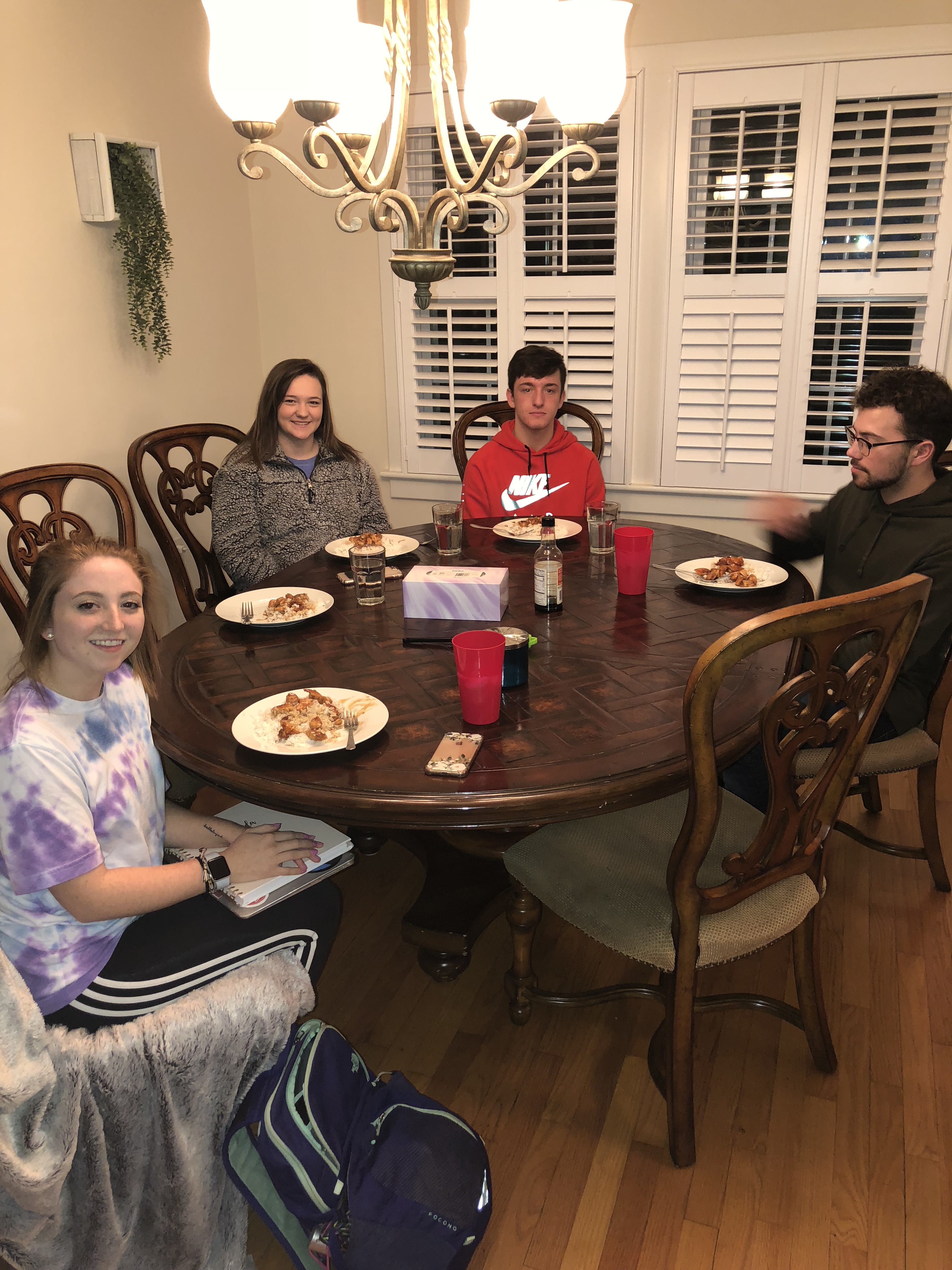
Shortly following this discussion, the meal was finished being prepared, and each guest made a plate. As we moved towards our seats at the table, I snapped a picture of my plate, as well as my guests. After a few moments of casual discussion, I decided to ask another pointed question: Did you ever have meals around the table with your family or neighbors growing up? If so, did you enjoy this? To no surprise, Jacob spoke of our family, explaining that we ate a homecooked meal around the dinner table at least 2-3 times a week during our childhood. These gatherings always began with a blessing, followed by casual conversations about our day or important things happening in our lives. Jacob also shared some of the humorous stories about our sibling rivalries that took place at the dinner table. All in all, Jacob stated that he always loved these times of family fellowship and misses them now that he is in college. Hannah shared similar experiences growing up, stating that her family gathered at least once a week to share a meal and catch up with one another. However, Hannah went on to say that she didn’t always enjoy these times, explaining that these gatherings would often cause discourse between her family members. Reed responded that his family had dinner around the table almost every night of the week. He told that his grandparents and other extended family members were regular guests at these gatherings, considering that they all reside close to one another. Despite this, Reed explained that these times of fellowship were hardly conversational and mostly consisted of silent eating. On a much different note, Alyssa answered the question with a sense of somber, saying that her family rarely ever shared meals together, especially around a dinner table. Alyssa went on to say that if she wanted dinner, she would either have to go to a restaurant and pick up food or cook whatever she had in her pantry, leaving her with the feeling that she wasn’t a part of a family unit. Hannah agreed with this statement, saying that this scenario was sometimes the case in her family when her parents got divorced in her mid-teens. This was somewhat surprising to me, given that I had never experienced this with my own family. In this moment, I felt extremely blessed for my family members and their involvement within my everyday life. We continued to discuss various family stories until I was ready to ask my next discussion question.

Once our discussion ended, I asked my guests if they believed that they had any obligations to other people in our country or community. Hannah responded that she didn’t inherently think she had an obligation to other people besides being respectful and accepting. Reed quickly agreed with this statement, saying that the “golden rule” of treating others the way you would like to be treated should always be applied. He also went on to say that voting and voicing your political opinion is one of the most important obligations we have as American citizens. Jacob concurred with this statement, stating that voting is our utmost obligation in this country and community. In response to this, Alyssa voiced that our obligation to accept and care for one another was far more important than our right to vote. I interjected and stated my opinion, which combined and agreed with everyone’s previous statements regarding the importance of common courtesy and voting. At this point, everyone was done eating, so I collected everyone’s dishes and placed them in the sink. In a moment of curiosity, I peeked into my brother’s freezer to find something truly glorious: chocolate chip cookie dough ice cream. After presenting this finding, everyone seemed quite interested in dessert.

Although I didn’t get the opportunity to take a picture, each guest received a bowl of ice cream. I continued our discussion by asking everyone about a current social issue they held closest to their hearts. Jacob responded that he believed the country’s refugee population to be one of the biggest issues facing our society. Coming from a church that has an incredible population of African refugees, Jacob knows first-hand just how significant this demographic is within the city of Bowling Green. He believes that this special population requires a more hands-on government willing to assist them until they are prepared to return to their home country, which has hopefully experienced diplomatic resolve by that point. Alyssa began by stating that, in her opinion, religious views are the cause of most of the world’s societal issues. She went on to say that she believed gender roles and inequality were the largest issues facing today’s society. As a member of the LGBTQ+ community, Alyssa believes that people should be able to live free of the negative labels associated with being a lesbian woman and should be offered the same opportunities as everyone else. She explained that, in order to catalyze change, it must begin within the minds of the youth, and bleed into the remainder of society. Hannah concurred with this belief, stating that inequality was the greatest issue surrounding our society. Reed, on the other hand, told us that immigration was the most prominent issue within the world. For the entirety of Reed’s teenage years, he has been very close friends with two DACA citizens. He is constantly advocating for reform of certain immigration laws and believes that immigrants in America sometimes work even harder than natural born citizens do. Reed’s thoughts quickly reminded me of class discussion regarding President Trump and his various proposals regarding immigration and citizenship. I began thinking about what it may be like for Reed to live a life being uncertain that his close DACA friends will always be permitted to reside in the United States. Upon this thought, I decided to mention this class discussion to my guests, and the discussion that resulted was extremely fruitful and continued until we finished our ice cream.

After collecting my guests’ dishes, I was sure to ask one final question: Beyond voting, paying taxes, and following laws, what does citizenship mean to you? Alyssa started by saying that caring about those around you is the first step to being an effective citizen. She then said that being involved within your community through public service was the next step to becoming engaged in citizenship. Hannah agreed with this statement, believing that the greatest way to be an excellent citizen is by being friendly and keeping those around you on the right path. On a different note, Jacob responded in agreement with Hannah and Alyssa, but added that citizenship was on both a national and community level. He explained that citizenship is a privilege, and that in order to be most effective, one must informatively vote and remain involved politically. Reed was quick to concur with this statement, as was I. In this moment, I mentioned my class’ experience with engaged citizenship and that our honors course was in place for the sole purpose of fashioning individuals to become engaged citizens. After a brief discussion concluding our thoughts on citizenship, the dinner had come to a close and it was time to depart. Before leaving, I thanked each guest for their participation in discussion and thanked my brother for allowing me to host a dinner in his home.

IMG_7644

An off-guard picture of my guests. Alyssa was working on some homework, Hannah was still smiling, Reed was unamused, and Jacob was ready to dig in.

This Kentucky Kitchen Table project taught me an incredible amount about my peers, my community, and myself. Through this discussion with Alyssa, Hannah, Reed, and Jacob, I was greatly enlightened by the diversity and insightfulness of their thoughts and opinions. Just as we have discussed in class, I learned first-hand that, although opinions may be different, every voice deserves to be heard and differences should be celebrated. Whether liberal or conservative, religious or agnostic, LGBTQ+ or straight, people are the driving force of this community and this country. Although it may seem cliché, hosting this dinner was a great privilege and has instilled in me a sense of pride for my peers, community, and country.

Abigail’s Kentucky Kitchen Table

By: Abigail

IMG_5351

My Kentucky Kitchen Table took place on the 8th of November 2018 in Bowling Green Kentucky. For this assignment my classmate Will and I partnered up. Our hosts, Taylor and Sarah, were kind enough to lend their apartment kitchen to us in order to prepare the meal and dessert. The meal itself consisted of spaghetti, garlic bread, biscuits, and homemade cookies. Our little group contained six contributors overall including my partner and I. We were lucky enough to have the combined opinions of three freshman, two sophomores, and a senior in college from varying cultural backgrounds, ethnicities, sexualities, and upbringings. Austin (Perk) is a senior at WKU studying Psychology and is a very kind, soft spoken, and observant individual. Taylor, a sophomore at WKU, is majoring in Education and had a very bubbly, outspoken, and caring personality type. Sarah, our other sophomore also attending WKU, is majoring in Speech Pathology and was the one gracious enough to offer up her apartment for our project. Sarah gave off a very maternal and compassionate vibe that made the KKT feel more comfortable. Austin (T), a fellow freshman at WKU, is studying Business and Architecture and was a huge help in preparing the food and giving a helping hand just because it was in his nature to do so. My partner Will is majoring in Mechanical Engineering and is a freshman with a very open mind as well as an accepting individual you makes sure everyone feels equally involved and respected. I myself am a freshman majoring in Marketing with a Psychology minor.

The biggest question posed to the table was what citizenship meant to everyone aside from voting, paying taxes, and following laws. At first the question led to silence, as no one had an immediate answer besides the restricted ones. Form this observation I figured that citizenship was not something many people put much thought to in their daily lives. Once the gears in everyone’s brains started turning we got a good response out of the group. Being a good neighbor or a good samaritan were two things the group agreed a citizen should strive to be. Citizenship also brought to mind volunteer work and giving back to your community and country you were born and raised in. An interesting thought brought into the discussion was the fact that what citizenship means can differ from one community to another and be dependent on wealth, socioeconomic status, or where you’re from. We also asked everyone what they liked most about WKU, their current community. Everyone came to the conclusion that WKU was a good middle ground for those from big and small cities to feel comfortable because it’s not overwhelmingly large but it’s also not a small community. Some key likes of WKU was how easy it is to create a close community due to the manageable size and how most of the people here are welcoming to others. The downside to WKU was how nearly everything is closed on the weekends which makes most people go home due to having little to no incentive to stay on the weekend. Weekend activities to draw people back or provide something for those staying was agreed to be a good idea long overdue for WKU’s campus life.

Another significant question Will and I asked was what kind of person everyone wished to become in the future. The overall ideal self was someone trustworthy, reliable, genuine, and charismatic. Something that really stood out to me was when Sarah said the “biggest compliment is a genuine thank you” and that all she wanted to be was someone who did right by others and had them feel genuinely thankful for whatever she did. Her saying was something she had read somewhere before and decided to keep tucked in her mind as a reminder of who she strove to be and what her goal as a citizen was to uphold for herself as well as for those around her. The follow up question was what advice any of them would offer to someone running for office. This question drew in everyone’s attention the most, as many of them felt as though too many of those in office did not do their job how they should. Those running for office would do best to be advised to understand where they come from as well as those they represent and find middle ground everyone is comfortable with on issues instead of catering to one side due to preference or money. Being entirely transparent was a largely supported idea in the group, as no one should lead who hides things from those who put their complete trust in them.

What I learned from my KKT is that the questions we asked our participants need to be discussed more openly in society. It was very obvious during the discussion that the topics at hand were not ones that often came to people’s minds in their daily life even though they were simple things that should be considered more. I also found that I had more in common with a group of strangers than I thought I would. I tend to agree with just about everything that was contributed to the discussion and that came as a pleasant surprise to me. The whole experience reminded me of The Small Work in the Great Work by Victoria Safford in “ The Impossible Will Take a Little While”. Much like in this passage we all met as a group to discuss a general topic all together respectfully. In both my experience and in the chapter my class read and discussed the group discussion was in a way therapeutic and left everyone with different perspectives to ponder even after the discussion took place. I realized how important it is for communities to come together and talk about literally anything, hard and easy topics, in order to have a better sense of togetherness and to make everyone feel included and involved. If people do not work together and keep their minds open the world cannot progress in a way that is beneficial to all and inclusive of everyone.

I did not know any of my Kentucky Kitchen Table participants prior to the meal except Will, so I was completely out of my comfort zone doing this project. I found that having a meal with people allowed us to feel closer even though we didn’t know each other and helped us to open up more with one another. Being as I’m usually quiet in discussions due to having anxiety it was a huge accomplishment to feel comfortable enough to share my opinion with a group of strangers. After the discussion I felt like I had a much better understanding of everyone I interacted with. The conversations that look place made me realize I need to implement these important questions as well as other topics into my daily life and make myself more informed in order to contribute more to society. I plan to talk more about wicked problems as well as simple topics like who I strive to be just to keep my goals clear and my mind thinking. The world grows on thoughts, and the more we think the more we can grow and improve the world around us as well as better our understandings of ourselves and what we stand for. If we as a society get into the habit of holding gatherings like this with our neighbors or our communities I think we would all benefit positively. There are no downsides to learning from one another, we can only gain from understanding others standpoints and feelings about things. The Honors class I’m in has definitely challenged me to contribute to discussions and think more in depth about topics in order to best respond in class and share my thoughts. The class discussions are a great gateway to implementing productive discussions to personal lives instead of just academic lives. I have also observed that when people open their minds they are much more respectful and able to benefit from talking about issues. The main problem we face today is that closed off attitude that I am very thankful my Kentucky Kitchen Table lacked. If people are unwilling to listen to differing opinions then they are unwilling to learn and refuse to reevaluate their own mindset.

Overall the Kentucky Kitchen Table was a learning experience I am thankful for even if it was out of my comfort zone. I genuinely enjoyed eating supper with people I did not know well and learning their standpoints on the questions I asked. It was very refreshing to talk to people I would normally just walk by in the street without a second thought. I think occasions like this are a good way for people in a community to grow close and become stronger and more representative of each other. Back in my hometown there is a huge lack of personal connection amongst the community and this project made me realize just how bad it was. I feel much more aware of the lack of communication our society has but I also feel more prepared to help change that problem. This class and this project have made me feel more involved and more likely to talk about problems I see with those around me, whether I know them or not, just to see how they feel and what they think. I would like to see the world grow, and I look forward to growing along with it.

Jessicas Kentucky Kitchen Table

By Jessica

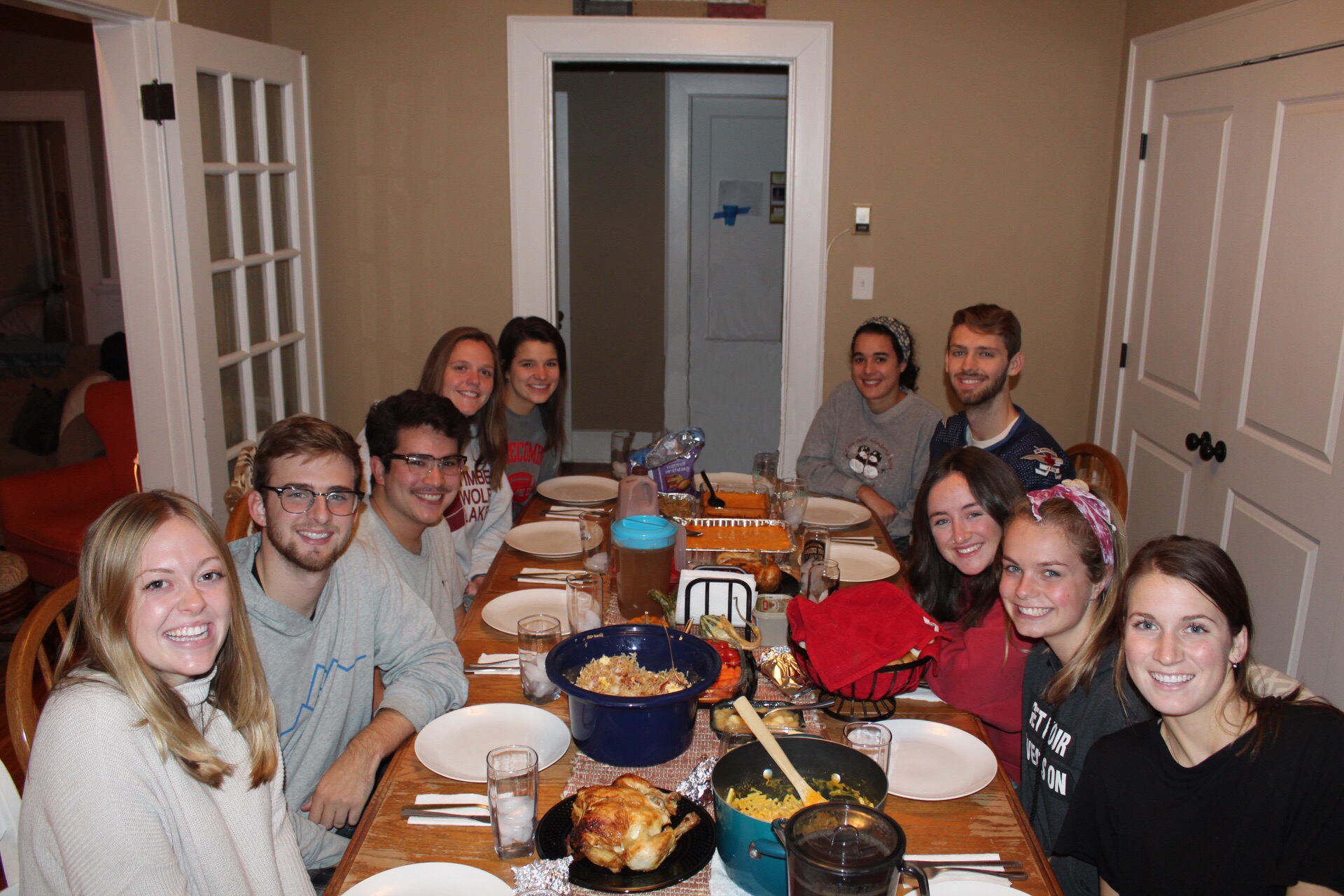
My Kentucky Kitchen table was hosted in Bowling Green, Kentucky on November 15th with participants Christina, Jackson, Tyler, Kelsey, Anna, Emily, Nick, Olivia, Olivia, and Holly. Each of these attendees are upper class-men

IMG_8321IMG_8322

students of Western Kentucky University, but are still very unique from one another! Christina is a photographer and videographer and is a member of the sorority of Kappa Delta. Jackson is from Kenton County and is currently involved in Young Life. Tyler is from Boone County and enjoys traveling whenever he can to anyplace that he can. Kelsey is also from Kenton Country and enjoys all sorts of sports such as tennis and basketball. Anna is a part of the sorority Alpha Delta Pi and has also served as Gamma Chi director for WKU PanHellenic. Emily is in a relationship and is involved currently in Young Life. Nick is from Warren Central and is a big Cubs fan. Olivia is an incredible artist and studied abroad for a semester in Italy. Olivia loves nature, high school musical, and is always up for an adventure especially to other countries. Lastly, Holly is an alum of the sorority of Chi Omega, is from Louisville, and is currently in the nursing program. Each of these people were graciously willing to meet with me as I only know Christina personally and have had short conversations with Olivia and Anna. Each of them know each other as they have some kind of connection with Young Life on campus, but I personally had not met the majority of them. Each were willing to bring meals and due to it being close to thanksgiving we chose traditional thanksgiving foods for our potluck. Holly made mac n cheese, Christina made a casserole dish, Olivia made buffalo dip, Nick brought a turkey, and the others brought miscellaneous items such as drinks, chips, or vegetables. As everyone came into the home they chatted and got to catch up and then we gathered around the table to eat the yummy food and begin our discussion.

The first question that I asked them was “Beyond voting, paying taxes, and following laws, what does citizenship mean to you?” I was not sure how they would respond, but after a couple minutes to really think about it, a few shared their opinion. Nick said to him citizenship is a collective group of people that are trying to work together for a common goal and Kelsey said that it means someone is in our country legally and that each citizen of our country welcomes those new citizens even if they are different than them. Olivia stated that citizenship means that people are all doing their best to reduce waste in their environment to help create something sustainable to preserve this earth that we live in. Lastly, Anna mentioned that the military reminds her of citizenship as there are those that are fighting for our country in order for us to be called citizens of the United States. As we all discussed this question we all had similarities of what citizenship meant to us but, these were some of their initial thoughts discussed when this question was addressed.

Next, I asked the question of “What do you think are the best things about our world today?” Everyone was eager to answer this question as they all had a commonality in their answers. Everyone around the table mentioned in their answer about how our world has shifted drastically to encourage everyone to be their authentic selves and to be genuine. We all agreed that society has changed from strict guidelines to how now each person is encouraged to do something out of their comfort zone each day. Technology was also mentioned by Christina that the advances that have happened in our world are indescribable and she loves to be able to use technology to capture the beauty of our world. Overall with this question, relationships, authenticity, and the overall beauty of the world is what makes this world the best.

We then discussed the question of neighbors and if the people around the table knew or currently know their neighbors. Everyone had funny neighbor stories of when they were little. Some mentioned that their neighborhoods always had parades and a tight knit community while others said that they had never had more than a five-minute conversation with their neighbor. Not many of them were able to have a sit down, home cooked meal with their neighbors, but some would know their neighbors very well. They then shared stories of how when they each started at college and how they needed to meet their roommates and neighbors. They explained that some went knocking on doors to introduce themselves, while others waiting for the knocking on their door. Each then agreed that having those relationships with neighbors is very important, but it takes in work. Once mentioned that they have a crazy schedule and are not home so they have to work very hard to get to know who they are living next to. As many of the participants will be graduating soon, they agreed that they want to, wherever they live, to be able to know their neighbors as best as they can.

The question of “Do you think we have any obligations to other people in our country?” came up, was thought on, and was answered and discussed. Emily said that she believed that we should be trying to help others around us to the best of our availability especially if we have those resources around us. Everyone agreed as to there is a need to show compassion and help others who need this help. I then told them about our reading by Ivan Illich, “To Hell With Good Intentions” and how he stated that there is major concern in helping those who need help. Everyone around the table was very interested in this view as they had not thought about the negative impact of helping others. Many of the people around the table had been on mission/service trips and told their stories of what they did. This spurred good conversation as to what may be the best way to help those that need help. We came to a common consensus that we need help those to be able to help themselves to get back on their feet.

Lastly, we discussed as a group of social issues in our world. The ones brought up (some duplicated) were abortion, human trafficking, physician assisted suicide, gun control, and environmental issues. Everyone discussed why there were passionate to these certain issues and how we answer these issues can determine our future world. Everyone around the table is involved in a religious organization, Young Life, and they all agreed that their religion played a major role in how they answered these tough issues. They all said that their faith was the backbone of how they view this world and that is how they came to their conclusions on these questions.

Before I had my Kentucky Kitchen Table I was not sure what to expect. I did not know the majority of the people that were going to be there, and I was not sure if they were going to give me fluff answers or actually tell me, a complete stranger, deep answers to important questions. As soon as we sat down for our meal and began chatting it felt so easy and normal and it continued to go well throughout the night. All of the attendees loved to talk about the questions and wanted to also share why they were so passionate on a particular topic. I learned throughout this whole process that people enjoy talking about these questions. They, in fact, want to discuss them even more. Each of the people wanted to keep talking and talking and got more into the whole conversation as it went on. Each person was respectable if there were differences and if their commonalities, people got to know that they were not alone in their opinions and were able to build off of each other.

Throughout the whole conversation I was thinking of how this dinner reminded me of our class. There was no yelling or crazy interruptions and each person was respectful of what one another had to say. “How We Talk Matters: by Keith Melville clearly shows why it is so important for everyone to be on the same page of respect and valuing of each person and the discussion that I had at my Kentucky Table I would fit into these guidelines very well. Our class, especially during deliberation, is like this and it showed me that discussion does not always need to be in classrooms for them to be insightful, but they can happen anywhere. If everyone is able to say what they believe, why they believe it, and then respect others opinions, then conversations are destined to be very informative and insightful. We must be willing to start and then continue in these conversations with those around us.


Annabelle’s Kentucky Kitchen Table​

By Annabelle

I held my Kentucky Kitchen Table Project at my house in my hometown of Danville, Kentucky. Most of my family was at the dinner, including both of my parents, Kate and Matt, and one of my sisters, Elizabeth. My mother also invited a couple that lives in our neighborhood, Sid and Rebecca, to participate in the discussion. I gave everyone a copy of discussion points that I made based off of the given questions so that if we came to a dead-end in conversation, we could refer back to it. The dinner took place on Monday, November 12th and lasted a little over an hour, as we discussed major themes surrounding citizenship, community, and moving forward as a society.

My mom, who was the host of the dinner, is forty-six years old and a first-grade teacher at a nearby elementary school. She grew up in a military family, and as a result, has lived many different places around the world. For college, she attended the University of Kentucky where she met my father, and later settled down in Danville. My father is also from a military family and served in the United States Air Force before moving to Danville with my mom. He is forty-eight and currently works at primary care practice as a pediatrician. Both my mother and father were raised strictly Catholic, although my siblings and I were brought up more on the basis of choosing our own religious beliefs. My sister Elizabeth is a sophomore in high school and has a twin who was not present at the dinner. She has lived in Danville for most of her life. Sid is 57 and a retired Air Force general; because of this, he has lived in many different places around the world and currently is involved in work in Saudi Arabia. He has three daughters, all current students or graduates from college, and one grandson who is four years old. Rebecca has traveled with Sid to many different places around the world and also loves spending time with their children and grandson. Before living in Danville, Sid and Rebecca have been stationed in places such as Turkey, Saudi Arabia, and Germany. They also currently have a home on Lake Martin in Alabama.

After being prompted by the first question, “Beyond voting, paying taxes, and following laws, what does citizenship mean to you?” each person at the table shared some of their experiences, and how these have shaped their beliefs concerning our roles as citizens. There were three main ideas that came up during our discussion: education, participation, and societal roles.

With the recent elections in mind, one of the first topics that was brought up was the importance of voting. Rather than emphasizing the significance in voting itself, we discussed why citizens should educate themselves on candidates and political parties before heading out to the polls. My mom, as she has mentioned to me many times before, worries that many people in our community go out and vote without having researched the candidate’s beliefs and plans for if they were to be elected. Another point brought up was that citizens often simply vote for their political party, without taking into consideration the character and goals of each individual candidate. In the same way that we should educate ourselves in the area of politics, it is also important that we learn about our neighbors. Many communities are made up of a diverse group of people, and it is important that we understand each other. My mom brought up an event that we have in Danville, where an organization hosts a dinner, representatives of multiple countries cook their native foods, and the community comes together to learn about and celebrate its diversity. If we better understand our neighbors, we will be able to interact more cohesively, and in turn, be better equipped to solve shared problems.

This discussion reminded me of the reading, “Green Fire, the Still Point, and an Oak Grove,” which was about students who were advocating against an oak grove at their university being replaced by a football stadium. After a long description of the history of the oak grove and the university, the author emphasized the importance of being educated on an issue before fighting for it. I was reminded of this reading when we were discussing the duty of citizens to educate themselves before voting for a candidate. If we really want to make a difference in our communities, we should first take upon the responsibility of becoming informed and aware citizens beforehand.

The conversation of education led into the discussion of the significance of being an active participant and building relationships with others in your community. Not only should participation include obvious tasks such as voting, paying taxes, and following laws, but it also involves volunteering and being present at community activities such as the diversity dinner mentioned earlier. We discussed the need for more privileged citizens to step up and help those in a lesser financial, mental, or physical positions; this is the best way to see our communities progress. A couple ideas that we can implement in our town were volunteering at the local nursing home, working at a locally owned “pay what you can” restaurant, and participating in projects such as Soups on Us and Project Christmas Child. It is important for citizens to offer up their skills to help others in the community, for example, my mom mentioned how, before she got her current job, she volunteered at Jennie Rogers Elementary school. My mom is great with kids, so giving whatever extra time she had during the day to help out with elementary students made sense for her. Similarly, my dad volunteers for our high school football team as a team doctor, this makes sense for him. I talked about maybe over Christmas signing up to work at Grace Café, which is a local restaurant that offers food to everyone; if you are unable to pay, you simply work at the café to compensate for your meal. Aside from volunteering, we also discussed the importance in supporting fellow community members. In some places this may mean going out to a high school soccer game, participating in a summer festival, or shopping locally in order to support local businesses. Overall, it is important to actively participate in society, because if we all contribute and support each other, we are more likely to cooperate, and therefore progress further as a whole.

We also discussed another important responsibility of a citizen: finding your societal role. Everyone at my table is a part of a military family, because of this, we have all lived on a military base. One thing that is interesting about a military base is that everyone that lives there has a specific purpose; there is nobody that is unemployed or requires assistance from the government. This incorporates the idea of everyone having a role in society, and the importance of finding this role in order to contribute to your community. Whether this is being a teacher, a waitress, a coach, a manager, a doctor, a lawyer, or whatever other profession you may choose, you in some way benefit the community as a whole.

All of these big ideas tie into two of our class questions, “How do we live well together?” and “How do we solve shared problems?”  After having discussed citizenship for so long, I asked the table these questions and their opinions on how they relate to what we had discussed. In some ways, our conversation of what it means to be a citizen offers potential answers to these questions. How do we live well together?  Well, we can start by supporting each other, and giving back to our communities. If we are more active participants in our communities, we will build relationships with each other, and ultimately understand each other better. How can we expect to live well together when we do not understand and appreciate each other? How do we solve shared problems? Beginning in our own communities, helping those in need that are right in our hometowns would definitely help. And wouldn’t it be much easier to solve shared problems when we all have a better understanding and appreciation for our differences?

Through our discussion, I have learned what it really means to be a citizen. Citizens educate themselves, participate in their communities, appreciate their neighbors, offer help to those in need, and serve a purpose in their community. My biggest take away from this discussion was the responsibility of citizens to find their role in society. As a college student with an undeclared major, I often stress about what path I will decide on, and eventually what I will do for a living. The discussion we had at dinner allowed me to see my potential career paths in a different way: as my role that I will serve to my community; how I will contribute and give back to others. As I get older, it is important that I understand what it means to be a good citizen, in order to have a positive impact on not only the Bowling Green and WKU communities, but also on other communities I may become a part of after college.

IMG_4139.JPG

Evan’s Kentucky Kitchen Table

By: Evan

kkt 1kkt 3kkt 4kkt 6My Kentucky Kitchen Table experience took place on Sunday, November 11th, 2018 in my hometown of Russellville, Kentucky. I gathered some of my friends and family at my home to have a meal around our kitchen table. Most of my immediate family was present, including my mom, dad, and two sisters. My mom, Melanie, works at the local board of education and plays the piano at my church. My dad, Chris, renovates and rents out homes to people in the community and is the choir director at my church. My two sisters, Ellie and Madelyn, are both still in school. Madelyn is in high school, while Ellie is in college studying to become an elementary teacher. Outside of my family, the friends I invited included Joe and Kaye and Ethan. Joe and Kaye (who are married) have been my parents’ friends for a long time, but have only recently moved back to Kentucky from Georgia. Joe and Kaye both attend our church, and teach the college age Sunday School class. Joe is a local attorney who ran for district attorney the previous year, and Kaye is a teacher at one of the local elementary schools. Ethan is one of my friends that I have recently met at WKU. Including myself, there were eight people present, three of which I did not know extremely well. When everyone arrived, the supper my mom had prepared was not quite ready yet, so I introduced Ethan to everyone and we sat and talked for a while. Once the tacos, refried beans, rice, and all the taco toppings were ready to eat, we moved to the table. My dad then blessed the food and we began to eat.
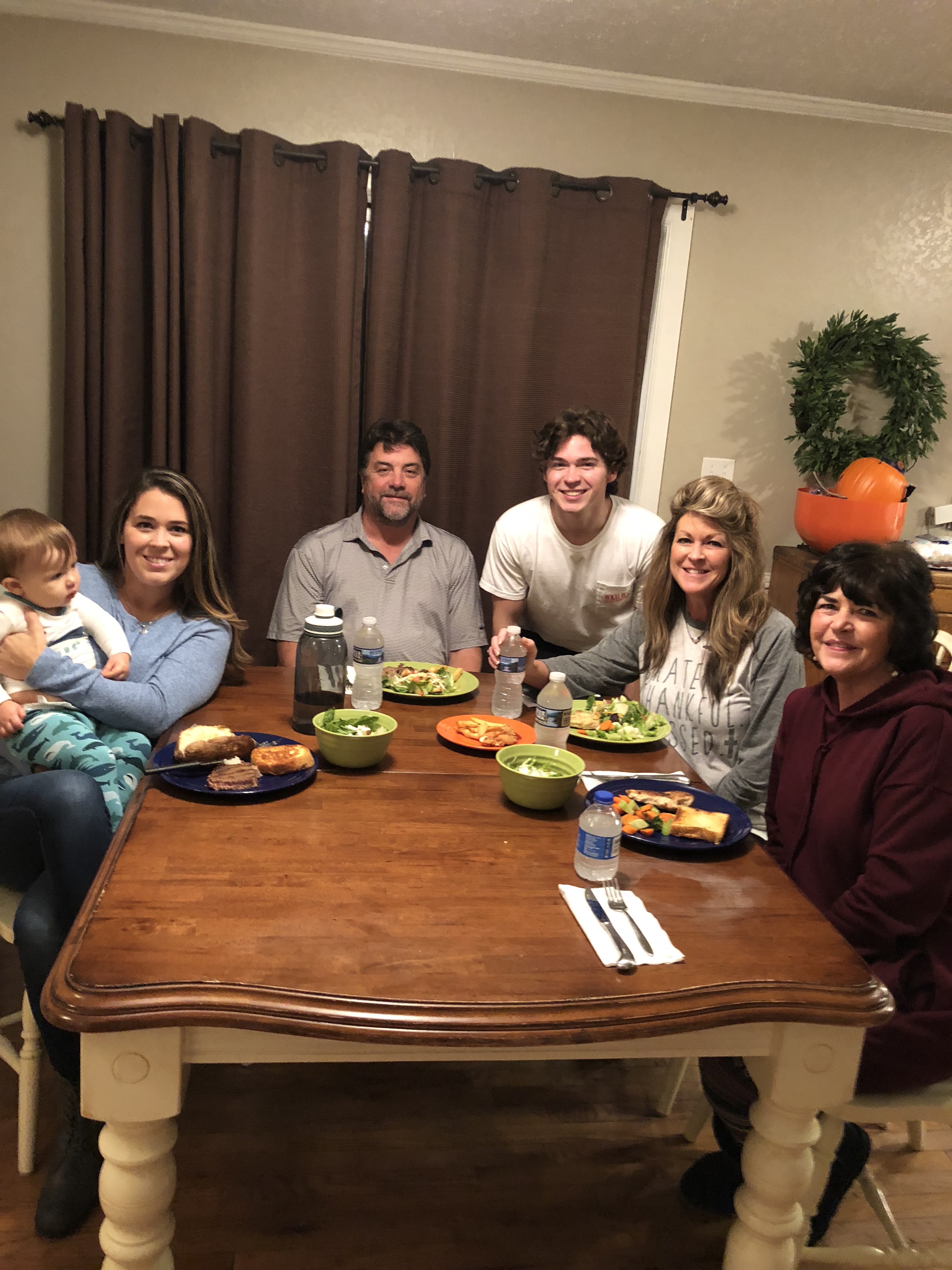
We all ate for a while and talked amongst ourselves, not wanting to move into the real assignment at hand. After a few minutes, Ellie prompted me to go ahead and ask the first question to begin discussion. So, I asked the table what citizenship meant to them. Almost immediately, the response was to follow the “golden rule.” Everyone at the table agreed that citizenship was to do your part to make our society better, and the way to do that was to treat others how you yourself want to be treated. Joe particularly added that when he does his job, and he does it right, he fills his role in society, as well as employs other people, allowing them to contribute to society. After this, Kaye and my mom began talking about their experiences as teachers. They believed their jobs to be particularly important parts of citizenship. Their jobs were to take children and to teach them and mold them into good citizens, people who try to better society in whatever position they find themselves in. One of Kaye’s statements that I found to be fitting was, “I build little citizens.” Following this, the table shifted to what the meaning of “good citizenship” was. The discussion of this centered around behavior, patriotism, and responsibility. Once again the golden rule came up, as the table as a whole believed this was a central part of the behavior of a good citizen. The idea was that if people see people in need of help, they should go help, as they would want someone to do the same for them. My dad also brought up the idea of responsibility. He and Joe discussed the importance of people knowing how to care for themselves and their families, and hopefully not having to rely on government or other assistance.
At this point, opioid addiction was brought up in the discussion, as we were talking about reasons people find themselves unable to be responsible citizens. Ethan and I discussed how we had been talking about this in class, and we told some of the stories we had read about. We also commented on the existence of wicked problems and how they relate to the functioning of society. Joe then touched upon another wicked problem in society, mental health. A debate then began about institutionalization, and when people should be institutionalized. This led to talk of what society should do with people who are mentally ill and carry out criminal acts. We began talking about school shooters and when they should be considered “safe.” Since we were already talking about social issues, I asked another guided question, “what social issue is closest to your heart”? The table agreed on one social issue, which was the breakdown of families, and the misunderstanding of marriage. Multiple people at the table had experienced divorce of had a parent leave during childhood, while some people, such as myself, had never experienced this. We all came to a consensus that many social issues all begin with this social issue. Joe then referred to his experiences as an attorney. He had seen a lot of divorce cases, as well as child custody battles, and he explained that, particularly in poor areas, the children almost never make it to a better life when their families are torn apart. He had seen many children who had never lived with their parents, but lived with an uncle, grandparent, or family friend. These children rarely received a sense of stability, and their makeshift guardians often struggled financially with feeding extra mouths.
Since Joe and Kaye had moved back to Logan County only within the last few years, I wondered why they would want to move back, so I asked another guided question, “what is the thing you love most about living where you do”? Everyone, other than Ethan who is from Owensboro, had an answer ready very quickly. We all decided that we liked the small-town feel of our home. We could always count on seeing someone we knew when we went into town, and we saw there was an almost innate generosity in the people of our hometown. Joe and Kaye also loved all the local history that exists around Russellville and Logan County. For example, the Red River Meeting House, the site of the first camp meeting of the Second Great Awakening, is in Adairville (a small Logan County town). Since it was very nearly related to this question, I asked another one of the conversation starters, “what kind of community do you want to live in”? My sister’s response was that she wanted to live somewhere perfect. No one really knew what she meant by this, so I asked her to elaborate. This led to a table wide discussion of our ideal commune. We all focused much more on the people in the society than any physical aspects of a community. We wanted a community full of good citizens that would take care of themselves, as well as helping out others who were struggling. This discussion led right back around to the beginning of the KKT assignment, as we began talking about what it means to be a good citizen, and the “obligations” we should all feel. Joe stated that part of the problem in society today is that people do not seem to have their own moral obligations, and they look to the government to establish moral boundaries for them. This reminded me of one of the articles we read in class by David Brooks. Brooks talked about how the generation I am a part of does not have a real set of morals and does not know what a moral dilemma is, nor have they ever encountered one.
With the discussion coming full circle, I decided it was a good time to wrap it up. Ethan and I thanked everyone for participating, and we thanked my mom and sisters for cooking food. In reflection, the activity was not nearly as unbearable as I imagined it would be. I had envisioned everyone quietly eating while I asked questions and tried to force conversion out. However, the discussion tended to flow very well, and everyone at the table seemed genuinely interested in the topics. I also thought it would be very awkward to have someone there that I barely knew, but Ethan seemed to have a good time. In addition, I enjoyed the activity myself. I had not eaten around a table with my family since the holidays, so it was nice to eat with them and to actually talk about things that are happening in the world and things that matter.
Not only did I enjoy this activity, but I learned a lot from it. I discovered some of my family members views on current issues, as well as a peek into their political views as a whole. It was interesting to see where I personally agree with my family on things and where my views differ slightly. I also gained quite a bit of knowledge from Joe and Kaye on current issues, local history, government institutions, and family life. To add to this, the experience as a whole gave me a new insight into the importance of deliberation. If families were to sit down together every night, or at least once a week, and talk about things that actually matter, as well as talk about their individual views on the issues, I believe it would lead to a much stronger family bond, as well as many more well-informed citizens. Even if friends just got used to talking, and talking respectfully and knowledgeably, about current issues, it could cause a real shift in the political atmosphere. I feel like it would cause people on all parts of the political spectrum to be more understanding of others, as well as more competent in discussing their own views. As with everything, deliberation takes practice, and if people were to practice, I think it would create a much more well-informed, much more participatory, much less polarized citizen. All in all, I get it. I see that practicing deliberation and learning about current issues and wicked problems is important. I see that the things we have practiced in class can help me become a better citizen, and can help all citizens as a whole “take back their job.” As we discussed in class, through the “Professionalized Services” article, citizens do not currently have much of a role in society. Though this is not how it should be, it is how it is and deliberation is one of those steps we must take to get to how we know it should be

Will’s Kentucky Kitchen Table

By Will


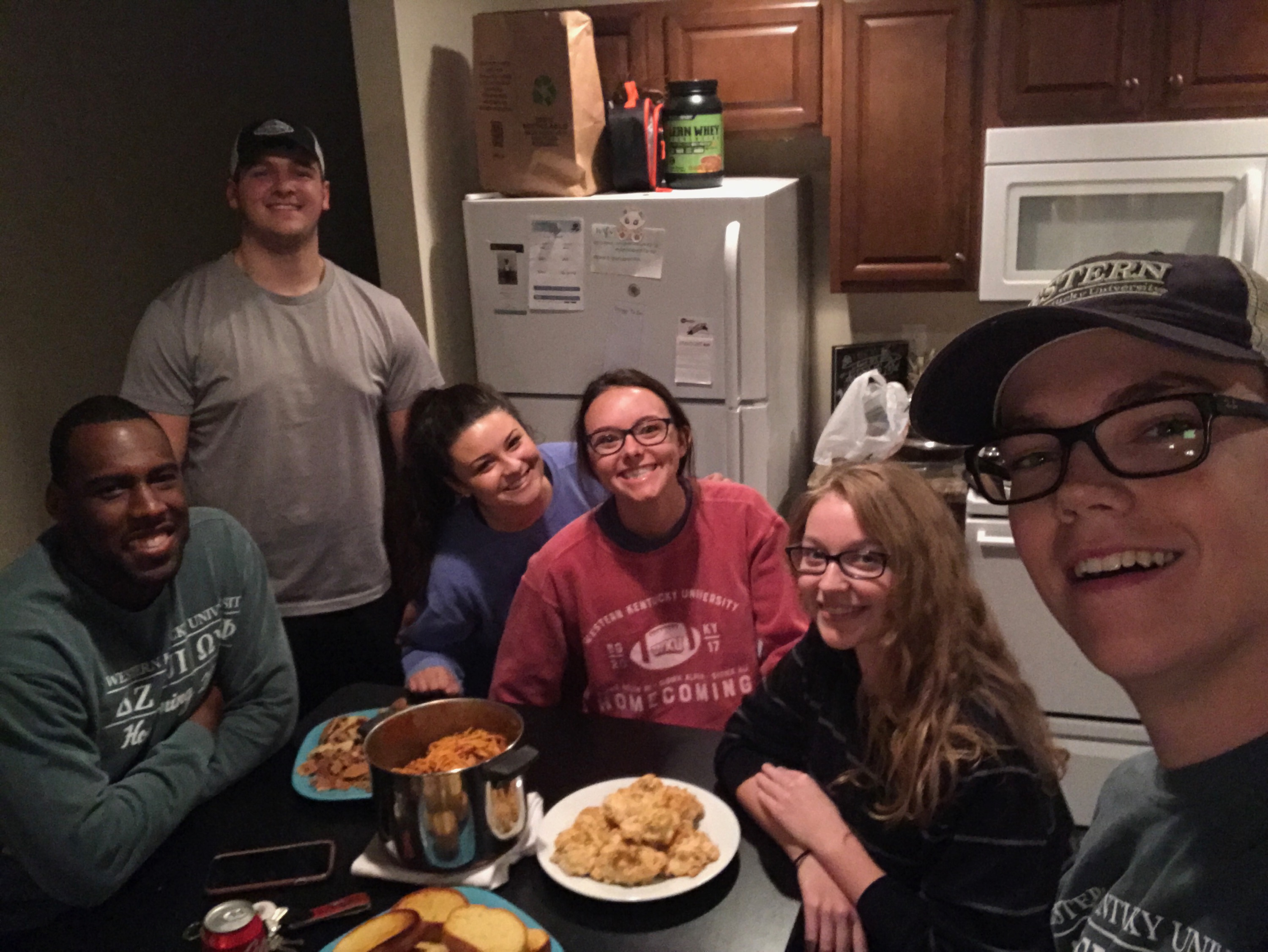
The Kentucky Kitchen Table project was held in Bowling Green, Kentucky at a Participants apartment on Thursday, November 8th. The guests consisted of Austin, T, Taylor, Sarah, Abigail and I (pictured left to right.)

Austin is a 22 year old senior from Louisville, Kentucky who attends Western Kentucky University. Sarah is a 19 year old sophomore from Clementsville, Kentucky. Clementsville is a very small agricultural based town in south-central Kentucky. She is studying speech pathology at Western Kentucky University. She was also hosted the dinner at her apartment. T is an 18 year old freshman also from Clementsville and is the brother of Sarah. He is a double major in architecture and business at Western Kentucky University. Taylor is a 19 year old sophomore attending Western Kentucky University. Abigale is an 18 year old freshman from Elizabethtown, Kentucky majoring in Marketing with a minor in psychology at Western Kentucky University. This group is very diverse in their upbringing and their life experiences and each brought a unique perspective to the table for this dinner.

Just to start out preparing for this dinner was a very stressful process. Preparing ingredients and working with people to fit the dinner into their schedule was a very hectic process, and after all that I faced the task of cooking (something I am far from good at.)  And after all that it ended much earlier than expected, but looking back now I wouldn’t have had it any other way because that has caused me to focus on answers given by participants and ponder my own answers to the questions that did get to get asked.

The dinner started like most Kentucky Kitchen Table dinners do, with the question “Beyond voting, paying taxes, and following laws, what does citizenship mean to you?” There was quite a pause in between the question and an answer which is expected for this very loaded question. Participants eventually took hold of the conversation stating being a good Samaritan and volunteer are very important aspects of being a citizen. These are common values most people hold so I wanted to hear more individual answers from participants so I asked how their upbringing and more importantly where they were raised effected their idea influenced their idea of citizenship. The conversation eventually led onto the idea that citizenship greatly depends on where you’re from. Participants Sarah and Austin couldn’t be from any more different hometown. Louisville and Clementsville are perfect antitheses of each other in almost every aspect. Louisville is the largest city in the commonwealth and Clementsville doesn’t even have a stoplight. Despite these massive differences the people from them drew some very similar parallels. This evolved further into is that your definition of citizenship is extremely reliant on where you live and on your socio-economic standing. Whether you’re in a very small county or a big city your experience of citizenship can change from street to street or neighborhood to neighborhood. Participants spoke on their personal experience of this phenomenon. Neighborhoods in very geographically similar areas divide themself into their own exclusive groups. One area gets the label as the wealthy “affluent” area and others as the poorer less desirable areas. This greatly affects your view of the community and in turn your sense of citizenship. Austin stated that he was looked down upon by the more affluent high schools because he went to a different school but still lived in the same neighborhood of the ones who looked down on him. This almost undoubtedly affected his sense of citizenship and his perceived place in the community.

The next question was “What do you love most about your community?” We made sure the definition of community was very broad including your hometown, Bowling Green and even WKU. Everyone quickly agreed that here in Bowling Green the best thing is that “you get the feel of a small town with the perks of a bigger city.” This answer was basically uniform from all participants despite where they they were raised. “Having a personal sense of community while retaining most perks of living in a larger city is one main reason I attended WKU” I said, and every participant said that is also a large reason of why they are attending Western also. People then went on to speaking about their hometown. Sarah talked about one thing she loved was at a local gas station you can still run a tab. The concept of a tab is largely unheard of for most people of college age since the practice is so rare in our times. “This sense of trust” ,she said “really made the town seem very welcoming and genuine; that there’s a sense of inter-reliance on each other .”

The next question was “What kind of person do you want to be?” Almost everyone wanted characteristics like charisma and reliability. Qualities of being a good friend echoed throughout these responses. After this I  again wanted more personal answers so I broadened the question to “what kind of legacy do you want to leave after you’re gone? What do you want to be remembered as?” Everyone said they wanted to be remembered for making an impact on the world and individuals through service or through some other means. As the conversation advanced Sarah said “The greatest compliment you can receive is a genuine thank you.” this was the single most important quote that has stuck with me from this dinner. She elaborated with saying “A simple thank you from holding the door for someone doesn’t involve this type of thanks but actually making an impact on someone’s life in a positive way and being thanked is the best thing anyone can tell you.”

The next question was “What advice would you give to people running for office?” In today’s day and age this can be a very loaded and potentially dangerous question especially with people with different views and opinions are discussing. Despite this the answers people gave seemed to be very similar. All responses led me to believe that people feel a disconnect between their representatives and their constituents. Participants all agreed that the officials need to have a deep understanding of the area they are representing and most importantly the people they are representing. I stated the most important thing for me was integrity. Even above policy I think integrity is the most important quality and elected official can have and the participants seemed to agree. The main theme I took away is that despite our differing views of policies that we all want very similar qualities in the people who represent us.

This dinner has made me reflect on ideas of citizenship we have discussed in-class throughout our semester. The response about the greatest compliment being “thank you” has really resonated with me for the past days while writing this post. Many of the greatest servants such as Nelson Mandela and Jane Addams must have received immeasurable amounts of praise and thanks from countless people and this undoubtedly had to have been a great motivator for them. This has made me see the responsibility we have to not only to serve and be thanked but to make sure we thank those who have impacted our lives positively. Giving thanks can be a great motivator for someone to want to help others in the way they helped you. The other main idea I’ve taken away from this dinner is everyone’s sense of citizenship and community is a an extremely personal idea and is completely unique  to all people. Numerous experiences impact our ideas of citizenship, and these experiences are not the same in any two people. Most of these experiences are out of our control or anyone’s control for that matter. The article “How We Speak Matters” was brought to mind. When discussing the question “What advice would you give to people running for office?” I was worried that this could lead down a slippery slope of an argument, but participants were very polite and despite their personal views. Most surprisingly about this is that every participant agreed on qualities that public servants should have. This is a very valuable thing to remember when discussing candidates for an election; that most people want a representative with the same qualities that you do despite your different views on policy. Remembering this could be vital to maintaining a productive tone for discussions.

This small dinner has been a very valuable experience for me and hopefully all participants that attended. It has helped redefine my personal definition of citizenship and appreciation for the community I am currently a part of. Hearing new comprehensive ideas on multiple topics has broadened my idea of citizenship and what I need to do to encourage and more importantly contribute to my community. Seeing discussions like these seem to be a very rare occurrence and fortunately I was able to partake in one in the form of this dinner. I hope that I can take what I learned in these discussions and apply it into my own personal life.Image-2

Cy’s Kentucky Kitchen Table

By Cy

IMG_6537

For my Kentucky Kitchen Table Project, I decided to make a trip back home to Muhlenberg County, Kentucky last weekend to have my dinner on the night of November 11th. In Muhlenberg County, the 2 “big” cities are known as Central City and Greenville. I was born and raised in Greenville, Kentucky, which happens to be where majority of my family is from. For the dinner, I decided to invite my mom, Candra, my sister, Catey, my grandmother, Jean, whom we call “Gigi”, and our neighbor, Grant. On the very left is Catey (holding Jhett), with Grant in the center, myself next to him, my mom, and then Gigi on the very right. My niece, Jameson, stood on a chair to take the photo.

Mom is a third-grade teacher in Muhlenberg County. She was born and raised in this county, and has decided to spend her life here. She attended Western Kentucky University, where she met my late dad, and they returned to Muhlenberg county after graduating. They later started their family. Mom is conservative and many of her beliefs come directly from the bible, which sometimes causes us to butt heads. However, she doesn’t quite lean entirely left, and she often has insightful opinions on very controversial issues. Mom is very simple in that it does not take much for her to be happy and content. She carries a uniqueness that I think has always distinguished her from other adults that I’ve encountered throughout my life. She is very wise, having been through loss multiple times and dealing with many things that some people never experience. She’s very loving, genuinely herself, kind, supportive, and passionate about her faith and being a friend to others.

Catey is my 24-year old sister, who is a teacher aide in one of the local schools in Greenville, Kentucky. Much like my mom, she decided to pursue education and spend her life working in the school system. Catey attended Madisonville Community College and never left Muhlenberg County. Shortly after finishing her education, she got married to her high school sweetheart and started her family relatively early. She is a mother to 2 kids, named Jameson and Jhett. Jhett is present in the picture but Jameson was our lovely photographer. Catey is very liberal, differing from my mom in many aspects, especially regarding their stances on tattoos, which Catey loves. Catey is extremely passionate about people. She has a huge heart and has been through much in her short 24 years. I deeply admire her willingness to forgive and love others, and I have always thought of her as one of my very best friends.

Gigi is mother to my mom. Surprise, surprise, she was also born and raised in Muhlenberg County. Gigi married young to my late grandfather whom everyone called “Pig.” He passed when mom went to college, well before I was even thought of. Gigi owns a store on Main Street in Greenville, known as Merle Norman Cosmetics. She’s been a business owner for longer than I’ve been alive. She works 7 days a week, constantly working hard to make her business flourish, and it shows. Gigi is around 70, but you could never tell by the way that she works and handles herself. Gigi comes from a very different generation, one in which hard work is valued above most things, marriage was typical at a young age, and much of today’s technology would never have been imagined in her youth. She is very set in her ways, yet I’ve always loved her willingness to be open-minded. She’s very passionate about her family, her business, her faith, and being a good person. Gigi and I are very similar and I genuinely believe that we have the same “old soul”, so I’ve always valued her company and the conversations that we have when it’s just the two of us.

Grant is one of our neighbors whom we’ve always known, but never known very well, so I decided that he would be the perfect addition to our dinner table. From what I’ve gathered, Grant is very much a family man, and he values most of the same things that our family does. Like the rest of us, he was born and raised in Muhlenberg County, but in the more rural parts. He owns a trucking business that he inherited from his late father, and he runs it with his mother, sister, and brother. He’s a very hard worker, often putting in long hours to keep his business running optimally. Grant also owns a lot of property in other parts of Muhlenberg County, so he spends a lot of time tending to his land and cattle. He is a proud conservative, and he is passionate about working hard and being a good person.


To kick off the discussion, I asked the big question: beyond voting, paying taxes, and following laws, what does citizenship mean to you? At first, I didn’t really receive the kind of input I expected. Everyone at the table was a little confused, so I had to rephrase. Gradually, I received some answers. Grant bravely answered first, saying that citizenship was about not taking our freedom for granted, and being involved in the happenings of your community. Mom described what citizenship means to her as the way she explains citizenship to her third graders, that citizenship is following the rules so that our society can function most efficiently. She also agreed with Grant in that citizenship means being actively involved in the community. Catey said that citizenship to her means that we should help our fellow neighbor and our community, and that we should be involved and be a decent person. Gigi also agreed with Catey, but simply said that citizenship means helping our fellow man.


In order to keep the conversation flowing, I decided to ask them what kind of advice they would give to people running for office. The answers I received for this question were much more passionate and I was impressed at what each person had to say. Catey was the first to speak up, speaking very quickly and with conviction. She said that leaders should go to church and listen to the “little people”, meaning that politicians should have some sort of faith and make efforts to genuinely listen to those that they representing. Mom agreed and added that future leaders should be aware of the different cultures and groups of people that they are representing, making an effort to understand that while we are all Americans, we have different values that should be recognized and addressed. Grant answered differently. He brought up a valid point, saying that politicians should do what they say they’re going to do and avoid making empty promises. He also said that they should do things that benefit everyone, not just themselves or specific groups of people. Gigi more or less reiterated what everyone else said, yet she did so with enthusiasm.


After I felt that we had exhausted conversation about advice that we would give to people running for office, I asked everyone if they thought that they had an obligation to people in our community/country. There was a consensus in that everyone at the dinner table thought that yes, they do have an obligation to others. Mom and Catey agreed as per part of their jobs. They’re legally obligated to keep an eye on the kids in their classroom and ascertain the well-being of each child. Gigi and Grant agreed regarding taking care of their fellow neighbor when they are in need. Grant also mentioned that we are obligated to be functioning members of society and in doing so everyone benefits. I thought that this question was somewhat related to the question “Do you see your job as serving a greater purpose?” so I asked when the timing was right. This question was received very well because each person at the dinner table had a direct relation to serving others in their careers. Mom and Catey strive to educate and provide care for the children that they serve every day, thus shaping them into better people year after year. Gigi and Grant, both being business owners, provide jobs for their employees and provide beneficial services to their customers, thus serving other people in various ways. In these ways, each member of the dinner table felt that their job was much bigger than themselves.


Wrapping up our dinner, I asked what kind of person everyone wanted to be. Their answers were very similar, each one being someone who is kind, loving, wise and respected, humble, and encouraging. Through our dinner conversations, I learned that Mom, Gigi, Catey and Grant all value mostly the same things, yet they are each very unique individuals. I learned that they care deeply for those around them, and each of them has some sort of ingrained duty to serve those who are in need. I learned that they’re all passionate about their careers for the common reason of serving and building others up. Through the question about advice to those running for office, I learned that they respected the needs of everyone, not just themselves.


In class, the question that has really stuck with me throughout the semester is “How do we live better together?” I felt that this question really came to mind over and over throughout my conversations at the dinner table. Upon explaining to them the nature of what this assignment and what it was for, I mentioned the 3 central questions that our course has been founded upon. From their various opinions and answers to the questions that were asked, it seemed to me that everyone at the dinner table believed that we live better together by being active in our communities, tending to our fellow neighbor, and working as hard as possible in our careers, especially those that are tied directly to serving others. Their answers reminded me of the “Professionalized Service” reading, in which we learned about how the abundance of professionalized services can dampen our sense of self-efficacy and the power that we hold as individuals. Their input showed me that through caring for our neighbors and our community, we effectively provide the love and personal care that professionals cannot accomplish, and we promote a stronger sense of self-efficacy. As a result, we can help one another live better together.