A Kentucky Kitchen Table…in Tennessee

By Kallyn

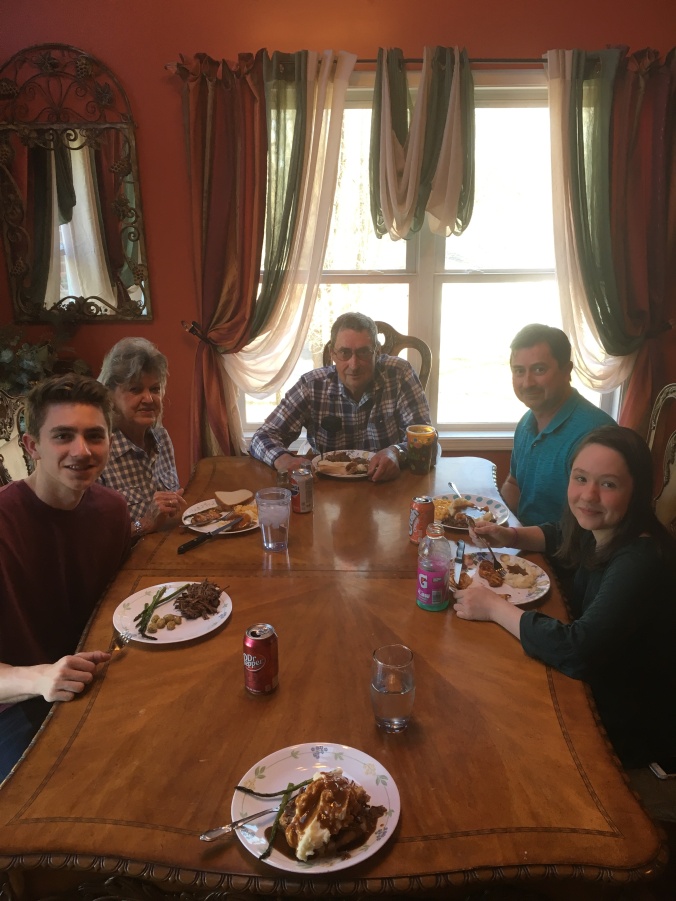
In my family, eating together at a table in the comfort of our home with homemade food is a norm. Almost all our larger family gatherings (birthdays, Thanksgiving, Christmas, etc.) are potluck style and every household is responsible for bringing some sort of dish. This assignment felt just like any other large family gathering, just with a few extra guests and a required question. Everybody met at my dining room table at my house on October 12th, 2018 in Murfreesboro, Tennessee.

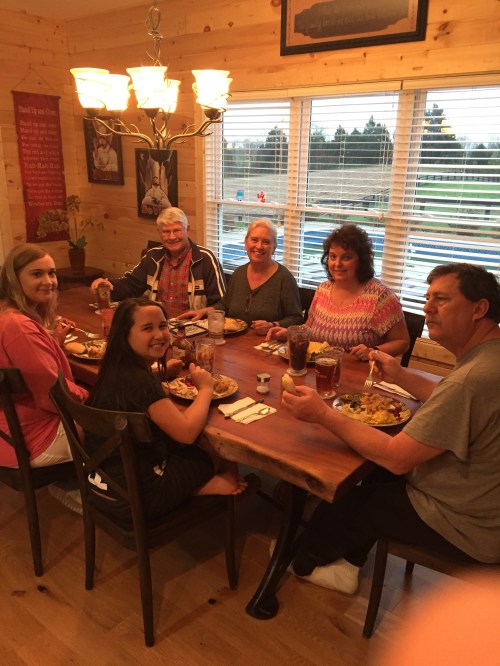
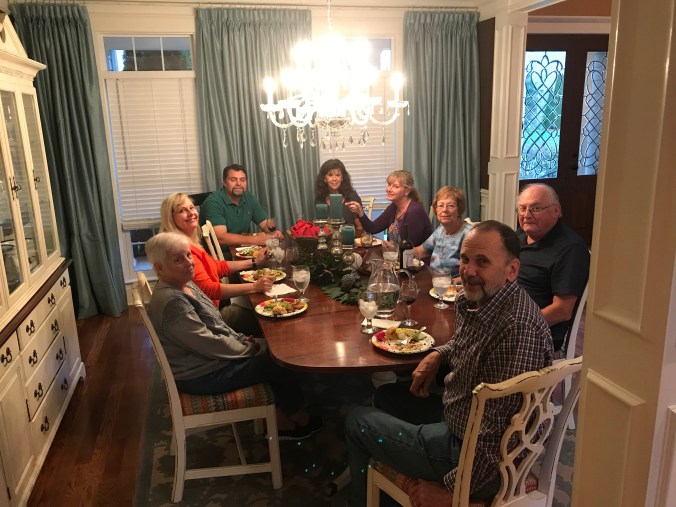
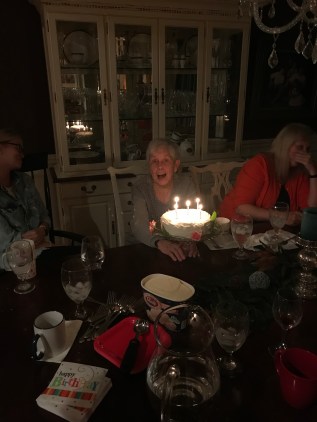
I must confess that due to the celebration at hand there were more than 10 people in the house of this table but less than 10 sat at the table that were actively participating in my project. The participating members are pictured below. The older man closest to the front is my grandfather, Rich. He’s 82 years old but has a young heart. My grandfather is one of the smartest and most hardworking people I know even in his old age. Then on his left is my grandmother, Frankie. She’s big on traditions and she loves her family fiercely. This dinner also doubled as a celebration of her 81st birthday, making her the longest person to live on either side of her family. Both my grandparents were born into poor families and were very poor for most of my mom and aunts’ childhoods. My grandfather worked as a mining engineer and worked diligently to earn the respect of his coworkers. My mom has told me many times how hard of a worker and how well respected my grandfather was when he was working at the mine in Carthage, Tennessee. Through frugal living and hard work, my grandparents made a fortune for themselves and they have been able to live beyond comfortably, travel the world, and spoil their daughters in their adulthood and grandchildren from their birth.

My aunt, Darise, is the oldest daughter on my mom’s side of the family. She’s a teacher at a local middle school and probably the most liberal individual in my family. Then there is my dad, Joel, who knows more about sports than ESPN. He played football at Vanderbilt University and has instilled a love for football in his children. He works as a salesman selling some sort of medical test. He was born and raised in a speck of a small town in rural Ohio but moved to Nashville for college where he met my mom who is the next woman in the picture. My mom, Amy, will, by the time I have posted this, have run her fifth half marathon. Both of my parents love the Lord and raised me to do the same. They are passionate about having their children know the history of this country as well as current events.

My aunt, Michelle, has two kids of her own who I am very close too. Her son and my cousin, Ben, is currently working as an English teacher to children in China. He Facetimed us during the meal and we all got to hear about a few funny stories he had so far. Ben confessed that although he doesn’t regret coming to China, he doesn’t enjoy it as much as he thought he would. According to him, the food isn’t that great and the people are very rude. He said that he has more of an appreciation for America and for his family. He doesn’t come home until August 2019 so he still has lots of time left in China. This will be our families first Thanksgiving, Christmas, and Easter without our Benjamin.

The last two people at the table, and dare I say the most important for the sake of this assignment, are friends of my grandparents that they made when they lived in a retirement community called Fairfield Glade in Crossville, Tennessee. My grandparents lived out there with them for 11 years. I have very fond childhood memories of “the Glade” as a lot of our family gathering used to take place around my grandparent’s dining room table instead of my own. The woman’s name is Pat and her husband’s name is Jerry. What I learned about Jerry was that he not only graduated from West Point but did so without any help from his parents. His mom had in her mind that he was going be a minister and had no idea that he had even applied but Jerry defied her by going to West Point.I didn’t get to learn much about his wife, Pat, other than she lived in Detroit for a while and loves the NFL team, the Detroit Lions.
kkt

I kicked off the conversation with the key question about citizenship. Michelle was the first to answer. For her, citizenship means being proud to be an American. She looks at living in America as a privilege but also a responsibility. My other aunt, Darise, expanded on that idea and said that she felt that as Americans we don’t just owe citizenship to one another but to other countries. She stressed that we need to prove that although sometimes flawed, America is still one of the best countries in the world to live in. My grandma continued saying America is meant to be a beacon of light to other countries and talked about how she’s been proud to be an American her whole life. My dad, who just came back from a trip to Washington D.C. with my little brother, said that he felt citizenship is the right to assemble and protest peacefully without fear of the consequences. Citizenship to my grandfather meant leaving the world better than you found it. Lastly, Jerry added that Americans have been given the gift of freedom through citizenship and that living here is a privilege. This privilege comes with a price as we need to give back to our country as it has given to us.

During the conversation, my cousin Josh passed through the room and although he was not technically a Kentucky Kitchen Table participant because he did not eat at the table my other participants absolutely insisted on knowing his definition of citizenship. He responded with a quick and simple definition of just where you were born and live. That’s all he thought of because he explained that I hadn’t mentioned America at all but I had just said simply “citizenship”. Before I continue, I think I should point out the diversity in age at my table. Josh is only just now in his 30s. Besides me, my international guest, Ben, is the youngest at 23. My dad, my mom, and both of my aunts are in their 50s and 60s. My grandparents are in their early 80s and their friends are in their mid 70s. Because of the stout age difference between most of the table and Josh, one might jump to the conclusion that Josh’s age was revealed in his response. I don’t know if that’s a fair assumption as I had an answer similar to the more complex and patriotic ones that everyone else was discussing. However, Josh did serve as a reminder of the importance of understanding that everybody may not feel as passionately about citizenship or process that it is more than paying taxes, voting and following the law.  Josh stresses the importance of making Americans aware of how blessed they are and informing them what being a citizen encompasses.

After the citizenship question, I decided just to let the conversation flow naturally. We started talking about David Price, the current pitcher of the major league baseball team, the Boston Red Sox. Darise taught David when he was in middle school and Josh played on the same baseball team as him when they were 10. Darise talked about not only what a stellar student David was but how he was very kind. David has not forgotten about Murfreesboro and has done a lot of good things for the community. His most recent and biggest project, a special baseball field and playground for children with physical disabilities. We started talking about how there are people in this world like David, who remain good people despite the temptation to be corrupted by money and fame. They remain their kind selves and the money and popularity only helps them be able to expand their kindness and generosity further. But, there are also people in this world who are corrupted by money and fame. Although these people have the capability to help make the world a better place, they don’t seize their opportunity as they should.

At some point later in the evening, I learned that Pat and Jerry spent time living in Venezuela. This got the group talking about the cultures and differences from other countries to the United States. My whole family has done quite a bit of travel for vacations, work and as I mentioned early I have a cousin currently living in China and another living with her husband on a U.S. naval base in Spain. These are just a few of many international excursions my family and our guests have been on. We talked briefly about the tragedy of natural disasters in places such as Venezuela and Haiti. Though natural disasters have had devastating effects in America ( Hurricane Michael, wildfires in California, Hurricane Harvey etc.) countries like Haiti don’t have the economic or political stability to help people that need it. Haiti must depend almost entirely on individuals or other countries, like the U.S. to step in and help.

Overall, what I think I learned is that even though America has its flaws, it is a gift to live in the United States. This group is well-traveled and thus I feel safe concluding that the United States offers its citizens an opportunity for a wonderful, blessed life. In class, we toyed with the idea of whether Americans should use this opportunity to give back in the form of mission trips when we discussed “To Hell with Good Intentions”. The author argued that Americans should stick to tourism because when we try to help we do more harm than good. However, I think my table and I have concluded that in the terms of one of the key questions we deal with in Honors 251 that Americans can help others only have more say over their lives by representing America well. U.S. citizens can also improve the quality of other lives by donating their time, talent and treasure in helping their neighbors outside the United States. Just as people hope that athletes use their money and fame to make a difference, Americans, who have the resources and power to help people both domestically like David Price and abroad should do so.

I also learned is how lucky I am that I have a family that has sit-down, homemade meals often. I think the fast-paced, workaholic trend in America today pushes people away from both home-cooked meals and taking the time to fellowship with one another during meals. It occurred to me that this project may be one of a few times that some of my classmates have had dinner in this style. The community that one experiences from sharing a meal with other people is irreplaceable. And if nothing else, this project reminded me to be thankful for the country I live in and the family I’ve been given. Time is precious and these family dinners are going to end up being some of my most cherished family memories.

P.S. Here’s a picture of my grandma with her birthday cake and candles.
grandma

Unexpected Common Ground

By Jessica

My Kentucky Kitchen Table took place in Bowling Green, Kentucky, at my parent’s home. Present were my parents, my three siblings, and a young couple from the community.

My parents are both nurses, studied at a community college, and come from a conservative background. My siblings, Kenneth, Jeffry, and Candice are all in high school. Candice is very social and reads a ridiculous number of books each week; Jeffry loves history and math, he absorbs facts like a sponge; Kenneth is graduating this spring and will be studying chemistry with a minor in biophysics at WKU.

None of my siblings have solidified their viewpoints yet, but they provided an intellectualism and curiosity that drove the conversation forward. Generally, they favored opinions like my parents, but they demonstrated a heightened awareness of certain social issues, like religious discrimination.

The young couple I invited were Andrew and Lin. Andrew is from Baltimore, MD and Lin from Todd County, KY. These two brought a strong line of diversity into the discussion, as they proved to have very different perspectives and political views. Their ideas tended to be more liberal than my parent’s ideals, and they were more aware of social prejudice and activism.

Otherwise, the group was homogenous. My parents and Andrew all had a bachelor’s degree education. I am working towards my bachelors, and my siblings are all working through high school with plans to go to college. All people present identified as Baptist but went to different churches within the denomination.

Finally, there was of course me. I am a freshman in college, pursing a degree in biochemistry. I would rather talk about science than politics or philosophy, and I generally feel very uncomfortable in discussions like these. I straddle the lines between many ideological divides, so my are a tend to be a strange mix of liberal and conservative, old and new. Like many young people, I dislike both the existing powers in our nation, and their opponents. What I want in a society is peace, not extremism. Ultimately though, my values are grounded in my faith, the most important force in my life.

As Lin and Andrew would be coming straight from a previous appointment, it was agreed that my mom and I would make the food for the meal. It was a team effort; I went grocery shopping and made the salad, my mom made barbecue chicken, brownies, and macaroni and cheese. The table was barely large enough to fit everyone, plus the food, but we crowded around.

IMG_20180419_190411

From the bottom left corner, counterclockwise: my dad, my mom, Candice, me, Jeffry, Andrew, and Lin (Kenneth not pictured).

After giving everyone several minutes to get to know one another, I posed the first question: beyond voting, paying taxes, and following laws, what does citizenship mean to you? I didn’t get much of a response other than “wow, that’s a big question,” so I developed the question further. First, I asked how they felt their job related to their role as a citizen. The first unanimous response was that working helped the economy. My mom said that as a nurse, she improves the healthcare of the community. Andrew said he both pays taxes through his work and has relied on financial support in times of unemployment. Thus, he has both relied on and supported society.

“Do you see your job as serving a greater purpose?” I asked. There was a moment of silence, then my dad said, “yes, ultimately.” Everyone else agreed. It did not so much matter what kind of job they worked, was the consensus, it was the fact that they were working, serving, and being served in their various positions.

Next, I asked the group if their religion or spiritual identity relates to how they treat others and act as citizens. Andrew laughed, “would anyone say no to that?” The group seemed to agree that spiritual identity is absolutely fundamental to who we are and how we act. There was a positive bias towards religious identity. One of my siblings briefly mentioned extreme religious beliefs that lead to violence. Thus, religion’s profound influence can also have dangerous effects. Instead of helping us live better, it takes the freedom of others.

The conversation lagged, so I asked, “what are some issues close to your heart?” This provoked some quick and strong responses. Lin immediately said school shootings, and all of the parents in the group chimed in with agreement. My dad brought up drugs and related some of his experiences as a nurse caring for addicts. He was a fierce advocate for harsh penalties, but my mom opposed him. She advocated rehabilitation, citing her experiences with drug abuse within her extended family. Thus, they represented two of the options presented by German Lopez in his article “How to Stop the Deadliest Drug Overdose Crisis in American History.” Finally, they agreed that it is too complicated an issue to solve with either option alone, unknowingly identifying it as a wicked problem.

The conversation turned to racism, and Andrew expressed a desire to live in a diverse society that was a safe space for different identities. The whole group related their various experiences with racism, mostly stories of observed racism. My dad mentioned that much of the racism he heard was not from people being purposefully malevolent. “People just want to be funny,” he said, “and what comes out is unacceptable, whether they realize it or not.”

I asked the group if they had dinners with friends and family when they were young. They all said yes, it had been a common occurrence in their childhood. Lin said it had always been an exciting event, a chance to meet new and interesting people. It made me think of my dad’s stories, that as a child, he would attend farm event dinners with his father and was mind-blown at the many people he experienced. Especially for children, it is incredibly important that people are exposed to new people groups. It is not always an unpleasant experience, as we tend to stereotype it.

As we dug into brownies and ice cream, I posed the final question: “What kind of person do you want to be?” I heard a lot of adjectives: selfless, caring, free, safe. I believe these relate back to the first question, what it means to be a citizen. Being a citizen, at least according to the people gathered at my kitchen table, means striving to be the best version of ourselves and both living in and providing an environment for others to do so as well.

The evening was thought-provoking for me. Looking back over the conversation, I was surprised that there had not been more conflict. From what little I knew of the attendees’ political views, I had expected argument. Instead, they were unified in the face of the problems they discussed, and the held the same basic values. This taught me something new about citizenship. Citizenship is not about politics or even about the social issues that plague us. Citizenship is about relationships, how we are bound with the common goal of being better. It is not a singular effort, but rather the simultaneous effort of everyone in the community.

Within this simultaneous effort, there are hundreds of tiny exchanges that occur every day. My parents, nurses, willingly provide healthcare for the community. In exchange, they expect a salary with which to support their family. Andrew relied briefly on unemployment from the government. He now works, provides a service to the community, and pays taxes. We give police officers power over our community, and in exchange we expect safety. I offer an intimate glimpse into my thoughts and ideas and expect that the reader will respond with thought and at least a minimal level of respect. This social trading is what holds together our society, so it makes sense that when the exchanges become unfair, or unreciprocated, problems arise. Being a citizen then, means making fair and noble exchanges, demanding what we must, and compromising when we can.

In the discussion, Lin mentioned how hard it is to solve problems in America because in our world everyone has vastly different opinions of what must be done. So, in the end, nothing is done. For us to answer the question of how we can solve problems, we must first answer the question of how we can live together better.

The second lesson I learned hails back to the reading “Green Fire, the Still Point, and an Oak Grove.” This reading left an imprint on me because it teaches the importance of knowing the whole story before passing judgement on an issue. I tried to apply this concept in the discussion. Rather than responding immediately to a statement with my own opinion, I attempted to hear the whole story by asking questions and learning the background of the speaker.

This helped shape the discussion and I saw my dad soften towards some of Andrew and Lin’s ideas that I knew he disagreed with. Knowing his life story explained why he felt strongly about representation of minorities.

This was an evening that formed some of my fundamental beliefs about citizenship. I hope to become a better citizen, and I think it begins with dinners like these.

Seth’s KKT: The Answer’s Problems

By Seth

I conducted my Kentucky Kitchen Table on April 14th in Bowling Green kentucky with five other people. Carter is a junior at South Warren High School and is involved in the school’s FFA chapter, the bowling team, and the music/ marching band program. Pauline and William are from Tompkinsville Kentucky where William is running for major. They spend a lot of their time interacting with the community and are well known in the town. Keely, my little sister, is currently a middle school student that has played three years of recreational soccer and has an interest in being a psychologist when she is older. Chris, my father, has been a high school drafting teacher at the new vocational in Logan Kentucky for nineteen years. The largest diversity among the group lies in the difference of age; each person at the table represents a different generation which is extremely valuable for discussion because it includes the opinions and experiences of each generation. Interestingly, the three oldest members also differ in their political party affiliation; William is registered as a democrat while Chris is a libertarian and Pauline is a republican. This is also a great opportunity for the discussion as it is interesting how the three main political parties’ values are represented in each person’s comments and how they might differ from the other two parties.

After the introduction of each person I opened the discussion by asking the question “Beyond voting, paying taxes, and following laws, what does citizenship mean to you?”. The majority of the responses were not surprising as most everyone responded with answers such as being there for their fellow citizens when they struggle and having the mentality of reaching your full potential for the sake of the society. Carter mentioned something insightful about knowing where you fit into the community; the main idea being that the most you can do as a citizen is to find where you are most needed and do everything in your power to do the best in that position knowing you owe that to your community. The most surprising response to that question was from William who stated that much of being a citizen is the ability to move forward despite the hardship that the government will put on you. This was a shocking comment mainly because William is running for major in Tompkinsville, therefore, led me to believe that this was precisely the reason to run in the first place; he wants to try to reduce the strain that authority puts on his fellow citizens by being that authority himself. In his situation and response to the question, William represents what many of us strive to be as citizens and I am very proud to know him.  

After we discussed the required question we moved on to more specific issues such as gun control, the opioid epidemic, and the death penalty. While we were discussing these issues I noticed the main theme in regards as to why these problems are so difficult to solve was believed to be that the majority of the people are not directly connected to the problem and that when they are it is extremely polar to one side which can get in the way of solving the problem from both sides. Chris mentioned for example that the reason that the opioid epidemic is such a powerful problem comes from the fact that not enough people are invested through genuine knowledge and experience to the problem and therefore do not work to solve it. The table seemed to agree that the big obstacle in trying to solve these problems comes from the ignorance of the people about the entirety of the problem.

I mentioned the issue of trying to solve problems when information is incomplete and people are misinformed due to lack of exposure to the problem and asked them to balance the benefit of immediate action and drawback of haste with the benefit of deeper investigation and drawback of delayed action to these problems such as gun control and the opioid epidemic. The consensus of the table seemed to be conditional based on the social issue at hand which reflected the main ideas of wicked problems; there are characteristics that define a wicked problem and many social issues are categorized as wicked problems but ultimately wicked problems are unique to each other. This is the most formidable characteristic of wicked problems making the answer to one of the three main questions of the class, how do we solve problems, indefinite. The answer to that question is frustrating because it is conditional and as humans seeking answers to similar yet unique problems we hate it when we cannot generalize.

Due to the diversity of the table regarding age, I thought it would be a good opportunity to discuss our thoughts about how our generations have become connected. I was curious about what we thought about each other and wanted to see the degree at which society in general has changed through the point of view of Pauline and William. I started off by asking about the  amount major issues in this generation’s society and how they might compare to the amount of social issues seen in the older generations. I was not surprised to see that Pauline and William thought that, with time, the amount of major social issues within the nation has increased substantially. When we discussed why more problems arise in this generation it was interesting what Chris noted. He claimed that it might not be that this generation has more problems but instead it might actually be that with the advancements in technology, transportation, and various communication methods that we are simply more aware of the many social issues facing our nation. So with this I thought that maybe our country is much more united and informed than the older generation. We discussed this a little further and I found that the degree of unity probably has not changed in amount but rather in form. The older generations seemed to be more unified in the sense of local community while the younger generations gradually became more detached from their local society and more unified with the bigger more general aspects of society. When I asked why, William responded by crediting this to the advancement in technology and medicine. He claimed that with all these advancements, the individual can do more for themself and will not have to rely on the diversity of their local community for as much help.

With everything that was discussed, the project was a fun opportunity to get connected with people in the community and discuss the way in which we see our community’s characteristics and issues. It was a great chance to become a bigger part in each other’s lives thus unifying the community even more. I was able to take away many themes from the conversations, not the least of which was how we tend to believe that we have too many differences to overcome a shared problem and how this cannot be further from the truth. I noticed this because before the dinner I was under the notion that much of the discussion would be saturated with debate and differences due to three distinctly different political parties being present along with such a polar generation gradient. My initial judgement was quickly extinguished when we found each other agreeing on many actions that could be taken to solve social issues such as gun control and the opioid epidemic. I was thoroughly surprised with the conversation and came up with the idea that, in the face of extreme social issues, in order to come up with any plan of action, we must overcome our differences in opinion to come up with a solution. While the dinner table is not the way large scale society functions, it did give a small scale example about how we must interact with one another to advance in the right direction.

The focus I had in this Kentucky Kitchen Table was based upon wicked problems; I was curious to see how other people viewed wicked problems and attempted to dissect them. Much of the conversation reflected exactly what we learned in class about wicked problems; we could not attempt to solve them without drawbacks, there was a struggle to find a solution for every side of the problem, and actions could not be expected to work without trying to change the opinions of others which also reflected what we learned about communicating with each other. Throughout the discussion the three main questions of the course were starting to be answered when I looked at the effects the project had on the table. The answer, while it may be incomplete, was very clear once the project had concluded and was surprisingly simple. The answer is rooted in what the project was; the answer is communication, deliberation, discussion, and participation. When we apply these things to something larger than the dinner table we will start to see progress. The progress that is made once we do this on large scale is progress that involves everyone. The experience, ideas, beliefs, and knowledge of everyone afflicted by a social issue is able to be presented and utilized once we participate together. With this in mind, the answer to the three main questions of this course results in the most complicated wicked problem I have encountered. How do we get everyone involved in society through communication, deliberation, discussion, and participation? Once we answer this wicked problem, progress will result beyond the kitchen table. KKT

Cut the Small Talk

By Callie

My name is Callie and my Kentucky’s Kitchen Table project took place in Bowling Green, Kentucky on April 14, 2018. There were six people present at the dinner including myself. Because my immediate family lives in three separate states, I decided to do my project with two of my closest friends who are like family to me, and three other people I had never met before. All of us come from different families and different cities. We have roots in five different states.

Ramon is 20 years old and is a nutritionist for the Army. He lives on base in Fort Campbell, Kentucky but is from Williamsburg, Virginia. He is African American but was raised by both a white family, who adopted him, and his black family. As a kid, he grew up in poverty until his best friend’s family took him in at age fifteen and provided him financial stability. Now that he has a stable career, he is able to send money back home to his siblings who live with his grandparents.

Michael is 22 and he is also a nutritionist in the Army and lives on base in Fort Campbell, Kentucky. Last year, he served nine months in Kuwait. In a few weeks, his contract will be up and he will switch from active duty to reserves. He is moving back home to Chicago, Illinois to study to become a nurse practitioner. He would prefer a practical career that will earn him a lot of money, rather than one that he feels passionate about.

Kayshla is from Texas and goes to WKU. She is mixed, Puerto Rican and Caucasian. She is 22 and has one more year of college. She is studying Communication and Leadership with hopes of working with the Special Olympics. She has a passion for helping people and making a difference in the lives of others. Kayshla is also a strong Christian and strives to model that in the way she treats others.

Chelsea is 25. She wants to work with children with intellectual disabilities and learn how to improve their learning processes in the most effective ways. She wants to help these children improve their skills in order for them to perform efficiently. Chelsea has a big heart and strives to help others in any way possible.

Lindsey is 21 and is from Somerset, Kentucky. She attends WKU where she is majoring in Electrical Engineering and Meteorology and minoring in Systems Engineering and Mathematics. She wants to be a satellite or radar engineer.

Finally, I am 19 years old and studying Exercise Science and Entrepreneurship. I am originally from Spartanburg, South Carolina but now call both Louisville, Kentucky and Norfolk, Virginia home. I am working to create and own my own gym and am currently studying to get my personal training certification. I believe very strongly in creating a life you love and never settling for a job and lifestyle that do not make you excited to get out of bed every morning.

To begin the night, we all gathered in the kitchen. Instead of all bringing separate dishes, we decided to cook together and combine the dinner with a game night. Kayshla and Lindsey made lasagna with veggies while Ramon and Chelsea made pizza because they didn’t want lasagna. Michael and I made cookie brownies for dessert.

I started the conversation by asking the required question, “Beyond voting, paying taxes, and following laws, what does citizenship mean to you?” Everyone had pretty similar answers for this question with a focus on putting others above ourselves and helping out those in need. This was one of the biggest themes of our conversation.

I was really excited to talk to Ramon and Michael because I was curious about the effects of the Army on their viewpoints. To dig into this, I asked, “How does being in the army affect the way you view the world today?” They looked at each other with wide eyes and the conversation seemed to shift away from the light-hearted mood we had before. Michael said that the current president in office has a lot of the men and women serving our country on their toes. He said that with the recent Syria bombing, while most regular citizens take the topic a little lighter, everyone in the military immediately grew fearful of being deployed. Ramon who plans to get out of the Army as soon as his contract is up, cut in and said, “If World War III were to happen, we’d be gone,” suggesting that the military would deploy everyone. He also said that many people are indifferent about decisions involving the nation’s military and fail to realize that every number is a soldier’s life and every soldier has friends and family whose lives would also be drastically affected if they were deployed.

Michael added that he feels like the president is looking at a map and deciding a location to bomb without considering the fact that there are innocent families living there. He said that to the president, it’s entirely political and he seems to care so little about the aftermath. Michael said, “I hate that I’m technically apart of that and associated with the death of innocent kids.”

When they brought this issue up, it reminded me of “Green Fire, the Still Point, and an Oak Grove,” by Robert Hass. I took a minute to explain this reading to everyone at the table. All of us agreed that people tend to speak on issues without knowing all of the facts. In the case of the bombing of Syria, Michael and Ramon felt that some people were quick to support the president’s decision without taking in consideration the effects that it could have on innocent Syrian families and the United States Military.

Next I asked everyone what kind of person they wanted to be. I was afraid everyone at the table would say similar things, such as “I want to be kind to others,” but this question ended up sparking the most moving response of the conversation. I asked everyone to go in a circle and respond. When it was Ramon’s turn, he said that he wanted to be a person who lived every second of his life to the fullest. At age nine, Ramon lost his 26 year old mom to a severe heart condition. It made him realize that every day he is alive is precious because he is getting closer and closer to the age his mom lost her life. He was also born with heart issues which can sometimes scare him because he knows the next day is never promised. He then said that even saying this aloud made him want to get out of his routine because his biggest fear is living an average life.

The last question I asked was which social issue is most important to everyone. This question was super important to me because we as individuals cannot give our all to resolving each and every social issue but we can pick one or two and make it our passion to change it.

Ramon started by saying that the most important issue to him is racial inequality, and more specifically, police brutality. He said he cares so much about it because he feels like we as a country are not making progress with race issues. He said something to the effect of, “No one should be treated like that, it’s not righteous at all. I am scared because that could be my little sister or brother.”

Chelsea agreed with Ramon and said that she believes while we as a country have gotten better in many ways, she thinks it has been 3 steps forward and 2 steps back. She also brought up gun violence which has been so prevalent in our society recently. She said she thinks there are a lot of things we need to change.

Kayshla added that she believes change starts with teaching our children right from wrong. She believes that loving each other more and helping out those who need it will help us unite as a country.

Michael said that while he agrees that we need more love in the world, he also thinks there are more practical steps to making change. He said that we as a society need to continue bringing social issues to light and speak out when we don’t agree with something.

I agreed with Michael and added that many people are unwilling to understand other people’s point of view and need to practice the act of listening. I emphasized the importance of deliberation to finding common ground with wicked problems.

Lindsey was the last person to speak on the issue and said that she has never been asked this question and it made her realize that although she cares a lot about certain issues, she is doing nothing to change or improve them. She didn’t know exactly what was the most important issue to her.

Lindsey’s realization reminded us of the importance of making meaningful conversation with the people around us. Too often, we hardly scratch the surface even with the people we are closest with. Many times, they are willing to share the hardships they’ve experienced if we just get the courage to ask.

This project gave me the opportunity to not only meet new people but also grow as a person. I have many family members who have experienced interesting things, like war, poverty, divorce, disease, etc. that I am always hesitant to ask about, as they might be sensitive subjects. However, this project made me realize that I can learn a lot very quickly about people and the world if I am simply willing to ask questions and listen. This project inspired me to cut the small talk with my family and friends and dig deeper into what makes them the way they are today.

Kentucky Kitchen Table

By Ashley

My Kentucky Kitchen Table took place in my home in the small town of Leitchfield, Kentucky. Leitchfield is in Grayson County and is about an hour drive away from Bowling Green. My dinner took place on April 15, 2018 after church. There were six people at my kitchen table not including myself. The names of the people around my table are (from left to right of me in the green dress): Henry Thomas (first and middle name), Steve, Mac, Bob, and Claire and my mother, Lisa, who chose not to be in the picture. I asked these individuals to my table because I had grown up being friends with Claire and had always gone to church with her family, but thought that this would be a great opportunity to get to know them better. First and foremost, my name is Ashley. I am pre-medicine and majoring in chemistry and minoring in biology. While I currently have enough college credit hours to be almost a junior status, it is my first year attending Western Kentucky University. Henry Thomas, known as “H.T.” to everyone, is a 93-year-old veteran who served in World War II and received a purple heart for getting shot in the arm while serving in Germany. Steve is a retired farmer who has three beautiful grandchildren that he loves with all of his heart. Mac is also a farmer who although had a stroke a while back, still does everything that he can to ensure that his farm stays functioning. Bob is the father of Claire; he is currently working at a law office, but also worked part time at the fire department in the past. Claire is a second-year medical school student at the University of Kentucky College of Medicine and is currently thinking of specializing in a field rather than becoming a family physician. Lastly, my mother, Lisa, is a high school social studies teacher at the only high school in the county, Grayson County High School.

For our meal, my mother helped me make chicken, vegetables, and bread. Claire’s family brought a chocolate cake for us to have for dessert. Overall, while everyone at the table grew up either on a farm or around a farm and shared similar beliefs, they all shared unique perspectives on each topic brought up during the dinner. When asked what citizenship meant to them, the reply of Henry Thomas stood out the most to me mostly because of his respectable military past. Henry Thomas said, “To me citizenship is more than just abiding by the law and voting in yearly elections; it is showing that you are devoted enough to the privilege of freedom that you are willing to take time to do something for someone else. Whether it be a huge commitment like serving your country, or simply helping someone through community service, practicing citizenship is the concept of serving others before yourself.” Claire also agreed to the statement made by her grandfather adding that the concept of helping others is what drove her towards wanting to become a physician. It was never the thought that she may be financially well off, she wanted to spend her life making a difference in other people’s lives. My mother added that ever since she was a little girl she knew that she wanted to choose a career in which she could help others, so when she told her family that she was choosing to be a teacher, it was no surprise to them. Moreover, like his father Henry Thomas, Bob also had experience risking his life to ensure the safety of others by fighting fires, but he made the point to add that more individuals should contribute to local organizations that help the county run like the fire department.

Furthermore, when I asked the table what social issue is closest to their heart and why, each individual provided me with unique sides to each issue. My mother, Lisa, said that children going hungry and without love were two of the biggest things that bothered her each year as a teacher. My mother is unique in the fact that at the start of each week she asks students about their weekends each Monday through their bellwork and she always takes the time to read through each response and write at least a paragraph back. She said that we could not even begin to imagine the things that students had admitted to enduring over the two short days that they weren’t in school. She said the really sad thing is that students readily told her what their situations were, but no one else gave them that opportunity so often times those stories stayed bottled up. Over the course of her years she has been able to help many children, but she knows that there are always far more that she never gets to reach. Whenever Henry Thomas answered the question he related it to veterans and how they are treated when they come back from war. Living it first hand, whenever Henry Thomas came back from World War II, he struggled to be himself again for a long time and did not even think about seeking mental help. He believes now that there is factual evidence that post dramatic stress disorder is something that veterans suffer from, that each individual who served no matter how old, should have free access to services because even at 93 years old he still has flashbacks. When Claire answered the question about which social issue was close to her heart she answered that parents vaccinating their children was one that constantly bothered her. Since entering the medical field, Claire has seen first-hand the effects of what has happened since parents have chosen not to vaccinate their children. Diseases that were once thought eradicated have been coming back and it all due to the fact that some parents are choosing against getting vaccinations that would protect their children and others. Claire believes that the choice should be taken out of the parents’ hands and that all children should be vaccinated in order to not only protect the health of the individual child, but everyone else’s child as well.

Overall what I learned from the dinner was that even if individuals grow up with the same background such as Claire’s family, they can all hold different opinions and values on issues. I had known that Henry Thomas had served in World War II, but after hearing some of the things that he endured and seeing that he still turned out to be the person that he is today, I respected him immensely. I also strive to have a husband that loves me as much as he loves his late wife, Betty Jo. They were married for 65 years, and although she has been gone for over two years now due to Alzheimer’s Disease, he still talks about her like she is the best thing that ever happened to him.  I also was not aware that Bob served as a volunteer fire fighter. Hearing some of the stories about how he barely made it out of burning homes also gave me a new-found respect for him. Moreover, although I have grown up hearing my mother’s stories all of my life I felt so proud to call her my mother hearing her talk about how passionate she was about helping the youth of our community.

My dinner relates to what we learned in our class because we often talked about whether or not we have a duty to help others, and each of the individuals at my table believed that yes; we do have a duty to help others when we have the means. Whenever talking to both my mother and Claire and her family, I was reminded of Jane Addams writings. In her writings, Jane expressed  how she, like the individuals at my table, believed that people should stop coming up with excuses and start serving others. Furthermore, my dinner also related to one of the central themes of the class: how can we live better together (or at least less worse together)? This was seen as every single one of the individuals at my table was/is able to make a difference in the world by working to not just benefit themselves, but others. Whether it be through serving their community or country, providing food for their family and others, teaching the next generation, or helping to improve the health of others, everyone makes the world a little more colorful by adding their splash of uniqueness.

In conclusion, I thought that this was a very interesting assignment in the sense that not only did I get to enjoy a delicious meal and dessert, but I also got to get to know a wonderful family who have each made it their mission in life to help serve others. I hope in the future I can do this again, not for the purpose of an assignment, but to get to know the stories of more and more individuals that I otherwise would not have the opportunity to do so.Photo 1 (2)

Kentucky Kitchen Table: Citizenship Consensus

By Rylee

IMG_5443

IMG_5442


We could not get everyone in one shot, so Bonita is missing from the top picture and Michael is missing from the bottom one. Therefore, we took two photos to make sure they were at least each in one.

My KKT involved eight people, including myself, who met at my home in Bowling Green, KY. The first person there was my mother, Holly. She is 49 years old and is originally from Morgantown, KY. She teaches eighth grade English for a living at Butler County Middle School. She is passionate about her job and those she teaches, and is currently rallying for teachers’ rights in Kentucky. She makes a difference in as a citizen in this way. Second was my stepdad, Michael. Michael grew up in Brownsville, KY, better known as Edmonson County. As a young boy and teenager, he did a lot of farm work to help his family. At age 47, he is currently principal of Bluegrass Middle School in Elizabethtown, KY. He truly started at the bottom and was able to achieve much through his intelligence in order to get where he is in his career today. The last member of my family who was there was my grandmother, Bonita. She is Michael’s mother and is 73 years old. She lived in Edmonson County her entire life until moving in with Holly and Michael six months ago. She has a strong Christian faith and although she suffers from polio, she does not let it get her down as she maintains a spunky attitude. She offered another perspective to our group since she is two generations older than most of us.
The next people to be described are people who attend school at WKU. Kinsley came and assisted me in hosting the dinner because we have Honors 251 together. She is a freshman from White House, TN and was raised by military parents. As an honors student, she is a hard worker and considers college to be a full-time job. She is also an avid member of CRU, a Christian group on campus. Her strong faith and kindness cause her to radiate light. Another friend of mine who came is Nichole. She grew up near Florence, KY but later moved to White House, TN. She has done a lot of traveling in her life and gains perspective from other cultures in this way. She enjoys helping others and plans to do so through her career path as a nursing major. The last two people in attendance were Katelyn and Taylor. I had met them a couple times before, but do not know them as well as Kinsley and Nichole. This opportunity allowed me to learn more about them. Katelyn is sophomore honors student studying journalism and tends to be more soft spoken. Her boyfriend, Taylor, is a junior honors student majoring in computer science. He mentioned that he enjoys talking and proved this by adding much to our discussion, typically asserting his conservative values.
Getting into our discussion, we started by discussing the required question: “Beyond voting, paying taxes, and following laws, what does citizenship mean to you?” The main consensus was that as citizens, we should be polite to those around us. Holly and Michael also mentioned that part of being a citizen is standing up for how you believe life should be in this country, not only through voting, but through freedom of speech, petition, and press. Considering the fact that they both work in education, this is particularly relevant to them at this time as they have attended rallies and protests to support teachers when the Kentucky state government is cutting funds for their pensions. They also believe a citizen should be well informed when participating in protests such as these. Essentially, we came to the conclusion that citizens should be polite, work together, and contribute to society by utilizing American rights.
The next question we discussed was what kind of community we would like to live in. As residents of southern states, most everyone reiterated that it’s nice to live in a community where people are generally nicer to each other than the stereotypical rudeness of northern states. Bonita pointed out that this is something she has noticed in her lifetime. Taylor also brought up that he believes people should be armed to protect themselves, but that extensive background checks should possibly be made on people who purchase guns. After some deliberation, we agreed we are okay with having a gun locked away safely in people’s houses for the purpose of defense and hunting animals, but that no one should have a military grade weapon. I think what was most important to us all is that we live in a nice and safe community.
Some good responses were made to the question about how each of our jobs relates to our roles as citizens. Holly feels that all citizens should be educated and as a teacher, she does a good job of ensuring that they are. Additionally, I used to work at a Boys and Girls Club where I felt that I was being a good citizen by tutoring young children who may have not had the best home environments. I currently work in retail, where I enjoy interacting with others and helping them find what they need. Nichole also described how she worked in a grocery store and would help people take groceries out to their cars, which is part of being a polite citizen. Overall, we just do our best to help people in our occupations.
Following that, we asked how our religious identities influence how we treat other people. All of us firmly answered yes. Although we may be involved in different denominations of Christianity, we are all Christians. As Christians, we believe that people should treat others the way they would want to be treated. Kinsley mentioned that she thinks of how Jesus would act towards others and how he loved everyone. She is influenced by this and tries to show kindness towards others in her daily interactions. We all agreed that this is how we want to live our lives as well. Tying into that, we discussed our obligations to other people in our country and community. Our religious identities have a huge effect on this. Christians believe that you should serve your fellow beings. This allowed Kinsley and I to refer back to our class discussion about moral obligations and the video we watched of the young Chinese girl who was hit by a car. We decided that we believe we should be like the good samaritan that is described in the bible and help those we have the ability to help. That is our obligation.
These are not all the topics that were discussed that night, but I feel that these were the ones worth mentioning because they all have running themes of our consensus on citizenship. We basically answered the first central question of our class: how do we live better together? Everyone agreed that citizens should be polite, serve others, and be well informed in order to contribute to a nice, safe community. Citizens should not only vote and pay taxes, but stand for what they believe in and engage in solving social issues through the use of their basic rights. This leads to living better together.
Some of our conversation also reminded me of readings we have done in our class. Early on, Holly and Michael mentioned how citizens should be informed about politics and situations they may be advocating for or protesting. This relates back to our class reading of “Green Fire, the Still Point, and an Oak Grove.” In this reading, the college students protested the removal of the oak grove when they thought the trees were wild and had grown there ages ago. In fact, the grove was merely a garden. The students’ ignorance led to blind protests and they were simply seen as egrets fishing through their smeared reflections.
I also thought back to our reading, “If It Feels Right,” when talking about our obligations to others in our community and country. The author, David Brooks, claims that young people no longer have a shared moral framework and may lack moral reasoning abilities. However, I drew from our discussion that the millennials at our table do in fact seem to have shared moral standards. I believe this goes back to everyone’s religious identity because Christians have certain moral obligations in serving and helping others. Thus, not all young people can be said to only do things “if they feel right”. Many millennials were taught core moral values as children and keep them in their hearts, such as the ones in this group.
In conclusion, this experience allowed me to interact with intelligent individuals about the proper way to be a citizen. I was also able to engage with others who have different values than me. For instance, I am a democrat while most of the college students there had conservative views. It was a nice opportunity to deliberate with various people and reach a decision about what citizenship truly entails.

Kentucky Kitchen Table

IMG_0933

From left to right: Steve, Brenda, Lynda, Les, Anna Jo, Carly, Jim

By Will

My Kentucky Kitchen Table took place in Cynthiana, Kentucky. Cynthiana is a small town halfway between Lexington, Kentucky and Cincinnati, Ohio. Those who took part in the dinner were Lynda, Les, Anna Jo, Brenda, Steve, Carly, Jim, and myself. I am a freshman physics major at Western Kentucky University. Lynda is a mother of four who works as a secretary at a school. Les is retired from the Marine Corps and works at the Post Office in Paris. He has traveled to over 20 countries around the world. Les and Lynda have lived in Cynthiana for over 20 years. Anna Jo was an inspector for the EPA out of Frankfort. She made sure that coal companies in Eastern Kentucky were up to code. Jim is a retired Sergeant Major from the Army. Anna Jo and Jim raise their granddaughter, Carly, who is a junior in high school. They have lived in Cynthiana for over 10 years. Brenda works in public records at the local hospital and Steve works at a factory in Georgetown. Brenda has lived in Cynthiana her entire life and Steve has lived in Cynthiana for 20 years. Steve moved to Cynthiana from Eastern Kentucky and was raised around coal mining. For dinner, everyone brought an assortment of different soups and sandwiches. For dessert, we had brownies and cookies.

The conversation started with me asking the question, “Beyond voting, paying taxes, and following laws, what does citizenship mean to you?” As I went around the table, the general answer was along the lines of helping our neighbors and the people around us as best we can. We have to live our own lives, but when people are in obvious need, we have the obligation to help. The ways in which each of us help our neighbors did change though. When I am home in the winter and summer, I shovel snow, mow yards, and take the trash to the street for my elderly neighbors. My parents, Les and Lynda, check up on people on our street to make sure they are doing alright. Lynda also regularly talks to her mother and brings her food to keep her company. Since Anna Jo, Carly, and Jim live out in a more rural area, they have a more unique way of helping their neighbors. They watch out for their neighbors’ houses when they are away and shoot groundhogs that are in their yard from their front porch. At this point (and quite a few others), the conversation took a side track. Les started to talk about a recent episode of Alaska: The Last Frontier he watched in which muskrats were being trapped and their fur sold for coats. Jim had also seen a show similar to that and talked about how many skins went into making a coat along with their costs.

For Brenda, the social issue closest to her heart was food stamps. She does not like that she and Steve both work full-time jobs and has a harder time paying for groceries than people on food stamps. When she goes to the grocery store, she buys off brand food just to pay the bills. She finds it unsettling when the person in front of her has a full cart of name brand food and steak, then pays with food stamps. She believes that people are becoming too dependent on the government and people who actually work without government assistance have a harder time paying bills. We all agreed that with many programs, people abuse the system because they do not want to work. Les talked about some people he has worked with that did not want to work and avoided working when possible.

When the conversation shifted to politics and the government, there were quite a few negative opinions. Jim believes that the representatives citizens elect should do what is best for their constituents, but they continue to do what benefit themselves. There was a general consensus that government officials need to do focus on making the right moral decisions in legislation. Legislators do what people want right before elections to get reelected then do what they want the rest of the time they are in office. People help out each other in their communities but the government does not. The government has been helping other countries more than its own citizens. Les said you know a politician is lying if his mouth is moving. Overall, we are all skeptical of the government’s ability to do things correctly.

When I asked what everyone loved most about where they lived, almost no one had the same answer. Brenda liked that she lived close to where she worked; she lives less than a mile away from the hospital. Anna Jo liked that she lived out on a farm away from people, but was still very close to town. Les and Lynda liked that they live in the same area as their parents and are close to their family. Les, Lynda and I live on the east side of town, just within city limits; Brenda and Steve live a few miles further in town; and Jim, Anna Jo, and Carly live on the west side of town just outside city limits.

The dinner concluded after I asked, “Have you ever had a conversation with someone from a really different background than yourself?” Les grew up on military bases, then joined the Marine Corps and Jim retired from the Army. In the military, they encountered a very diverse spectrum of people. Having moved from base to base, Les got to talk to people from all over the United States. Both Les and Jim were able to talk to people in other countries when they were deployed. Steve works in a factory so he sees a few diverse people. The rest of us never really talk to people of extremely different backgrounds because we have all lived in the same general area for most of our lives.

Overall, everyone agreed that we already do what we can for our neighbors. A few thought that if they tried to help people too much, others could be irritated with their interference. Some people want to live their lives without help from others, whether it be from our neighbors or the government. Those at the dinner do what they can for the people around them without being overbearing. We respect the differences in people but realize that we are more similar than we are different. The main reason society is the way it is today is because people do not listen to each other or respect other people’s opinions. If we would listen to what people need and see things from their view, society would be a much better place.

I learned a lot from this activity about different people’s perception of good citizenship. Some of us believe that we should go out in the community and help others, while some help those close to us. The few that I ate dinner with thought that the government has a negative impact on citizenship. When people in communities rely more on the government, they rely less on each other and those around them. I also learned that people live in different areas for different reasons. People choose where to live according to their work, families, or communities. Also, when you live in a small town, there is not very much diversity in people.

My discussion over dinner reminded me a lot of Ivan Illich and good intentions. Ivan Illich believed that good intentions mean nothing when overall it does more harm than good. We all help people around us when they are in need, but we only help at the proper time and certain situations. There are circumstances where it is a personal problem and people do not like others meddling in their business. Everyone needs to be aware of what is needed and not jump at every opportunity they think they may have. Many people value their privacy and do not like others “helping” them to make themselves feel good. Those at the dinner recognized that there are limitations to how much they can help others. Helping in the wrong place is no longer helping, it is hindering.

One of the central questions of Citizen and Self is “How can we have more of a say over our lives – and contribute to others having more of a say over their lives?” From the dinner and discussion, we can have more say over our lives when others help us when we need help. We, as good citizens, then reciprocate and help others that are in need later. If everyone respects each other, we would have much more of a say over our lives. Even though we live in America and have more freedom than any other country in the world, people for some reason do not respect others’ opinions. If we are kind to others, it will be easier for them to have more say over their lives because people will be encouraging them instead of being discouraging.


Skyler’s Kentucky Kitchen Table in Alvaton, KY

IMG_1590(I had to be the photographer, so I am not in the picture.)
By Skyler

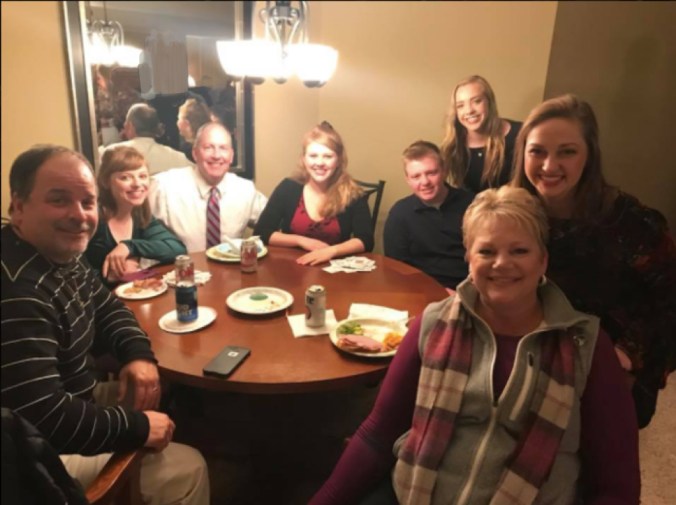
My Kentucky Kitchen Table meal took place at my home in Alvaton, Kentucky, a small community just outside of Bowling Green in Warren County. Overall, there were seven people at my meal, each of whom brought interesting experiences had a unique perspective on the questions we discussed while eating. I had immediate family, extended family, and an old friend from another university who I had not connected with in quite a while at my meal. My name is Skyler, and I am a sophomore at Western Kentucky University. I am majoring in biology and agriculture, with minors in land surveying and GIS. In addition to my studies, I work as a supervisor at an elementary after school program in the Bowling Green area. I also farm livestock of all sorts and raise a large garden alongside my father. Being a rather inexperienced chef, I picked up canned cranberry sauce and rolls for the meal. My father, Miles, is an auctioneer as well as a cattle farmer. He has spent his life on the farm, growing up working in his father’s slaughterhouse and raising livestock and crops, and now raising cattle himself as well as working as an auctioneer selling cattle auctions on a weekly basis and hosting other types of auctions from time to time throughout the year. We decided to have a Thanksgiving-like meal for this occasion, and Miles was responsible for cooking turkey as well as using his family recipe for dressing, something he particularly enjoys doing. My mother Tracie was also a part of the meal, and had some especially strong opinions and experiences on some of our discussions due to the 25 years she has spent as an elementary school teacher in Bowling Green. Tracie takes a lot of pride and joy in her role as a teacher. A self-proclaimed “city girl,” she does not always see eye to eye with my father and I on issues concerning our farm and other things of that nature. Tracie supplied vegetables for the meal, such as corn and green beans. Another participant in the meal out of my immediate family was Hayla, my nine-year-old little sister who is currently in fourth grade. Hayla was adopted by family out of foster care when she was a baby, and has been a perfect fit ever since. Hayla has a brilliant mind and strong views on the world for her age, and her contributions to the discussion were very valuable and interesting. She is a little actress, having been in over fifteen plays since she was five years old. This includes a recent starring role in the play adaptation of Pocahontas, where she played the lead role of Pocahontas herself. Her experiences with kids and adults of all ages and backgrounds in her theater community has led her to branch out and hold some very interesting views on life that differ quite a bit from my own. With the help of our mother, she made a cake for our dessert.

My grandparents came up all the way from Florida for this meal. They are permanent residents of the sunshine state now that they are retired, and we do not get to see them very much anymore. My grandmother, Jennifer, is my mother’s mother. She retired from WKU as an employee of the Preston Center, and worked many other jobs throughout her career. My grandfather, Bobby, is a retired electrician who worked for others and ran his own company. He is now an avid golfer and fisherman, taking advantage of the warm Florida weather. They are both strong conservatives with heavy interest in politics, which differs quite a bit from my immediate family who are much more moderate. Finally, my friend from the University of Kentucky, Kirsten, came down for the meal. Kirsten is an old friend of mine from high school, as well as a neighbor who lives somewhat close by. I have hardly talked to since going to college nearly two full years ago, as she lives year around in Lexington now. She is a sophomore and a member of the Delta Gamma sorority at UK, and is an avid football fan. She is originally from Nashville, TN, and she has traveled throughout much of the country with her dad, who works selling apparel at sporting events and many other various things. She is a business and marketing major at UK, and her experiences and views on things are quite different from anything my family has. She brought another very unique perspective to the dinner table. Her college experience has been vastly different from mine as well. Kirsten brought an excellent hashbrown casserole to the meal. I had another guest set to attend, a student of mine in the after school program who came to America from Vietnam a bit over two years ago, however he fell ill and was unable to attend.

We had some great discussion throughout our meal, beginning with one main question: “What does citizenship mean to you?” Each person at the table had an answer for this, and they all varied quite a bit. My grandparents Bobby and Jennifer felt that citizenship leaned more towards the political side of things, including exercising your rights that are granted by the Constitution in America. Bobby, a gun collector, emphasized that he felt his right to bear arms was one of many rights that played a big part in his definition of citizenship. Jennifer was also quick to mention that while these rights are a huge part of citizenship to her, they must not be abused and misused. Peace and equality were two factors that they both said should play into our rights, and while they admitted these two things were not where they felt they should be in today’s world, they did not back down from the importance they placed on their own rights. Bobby added that without the rights he has here in America, he would be rather move abroad because Constitutional rights are what makes being a citizen in this country better than others. My mother Tracie took on a different perspective, instead choosing to emphasize her role as a teacher to model her definition of citizenship. Tracie feels that being a citizen includes doing what you can to take care of others, and to be a positive role model for all and be kind to others. She mentioned how she views her role as a teacher as a way to make a positive impact on kids that could perhaps last a lifetime, and she feels she is doing her duty as a citizen by being there for her students each and every day. My father Miles, a quiet individual despite his occupation of auctioneering, did not say much, however he added that he felt sticking to your word and being honest, as well as helping out others in need is a big part of citizenship. He said that being there for our neighbors for little things like there cattle getting out while they’re on vacation as well as for the big things, like taking over their farm operations as they recover from a heart attack, is a big part of being a citizen. I personally feel the same way, and I added to his definition by emphasizing my passion for helping others as a part of what citizenship means to me. Being there for whoever needs me, and helping even strangers, makes me happy and it’s something that I try to do every day of my life. My little sister Hayla had a lot to say about this question, and while a lot of it was rambling and her wild imagination, she did say that citizenship to her meant getting along with everyone and treating them well, no matter how different they were from you. She attributed this to her acting director, who instills this value in them on a daily basis. Kirsten also had a slightly different take on the matter. She leaned more towards the political side of things as well, however she has more liberal views in comparison to my grandparents. She stated that being a citizen meant having your rights, but also having the right to feel safe. She challenged Bobby on his gun stance, and they had a peaceful and fascinating discussion on the subject. If everyone deliberated the subject the way they did, perhaps some solutions could be reached that could appeal to everyone.

While that question was the main topic of discussion, we also went into how religion plays a part in our lives. My immediate family and I are strong Christians, and this plays a huge part in how we live our daily lives and how we see our roles as citizens. Bobby, Jennifer, and Kirsten on the other hand are Christians, but they do not regularly attend church and they do not really practice the religion to a very great extent. We had a great discussion about our faiths, as well as other faiths that we encounter on a near daily basis. We came to a general conclusion that religion has always played s a big part in people’s lives, and it will for a long time to come. We also discussed many other questions related to citizenship and our own views on life in general. I learned a lot about everyone, and was surprised to learn a lot of previously unknown stuff about my own parents and little sister!

One topic we did address that had some intense conflicting views was immigration. Bobby and Jennifer, as well as my father Miles and friend Kirsten, felt that immigration is a huge problem in America that needs to be stopped. Bobby felt especially strong about tightening down on immigration. My mother Tracie and I work in a local elementary school with kids from over thirty different countries, and the experiences they’ve had are shocking and at times disturbing. We have met children who have ran from war, who have been shot at and had their homes destroyed. We have met children of all backgrounds. These experiences have given us a completely different view on immigration. I pointed to a book, Exit West by Mohsin Hamid. I detailed how these people in the book ran from such horrible terrors in their home country, only to find hostility and danger in supposed safe places as well. I have seen firsthand that this happens every day in real life, and those people are right here in my own city, in a school that I work at each and every day. At one point in the book, the characters are being threatened by military in London, after having already run from war at home. I detailed this part to the rest of the table, telling them that these people are here in our country, and instead of being hostile towards them, we should accept them and help them however we possibly can. I do this by donating food to the pantry at the elementary school I work at, and mentoring the kids who have immigrated. Tracie does the same each and every day. I told the others at the table that by accepting these people, we can live better together, just as we have discussed in Citizen and Self class. Hostility towards them does nothing in my opinion. They have already been through things we cannot imagine, so we must help them I believe. I think that may have swayed the others at my table to believe this as well, or at least I hope that I did.

Overall, this was a wonderful experience. It’s not often that you get to sit down and have these meaningful discussions in today’s world. If people could do this more, and deliberate more peacefully, I believe the world might be in much better standing today. I have learned that conflicting views can coexist peacefully, and that discussion and deliberation is perhaps the ultimate tool we have at our disposal for this.

Noah’s Kentucky’s Kitchen Table- Growth in Wake of Disagreement

IMG_2603.JPGFort Thomas, KY – March 31, 2018

My family isn’t one that often finds itself eating around the dinner table. As a child, we would eat every dinner in the dining room, but as us kids grew up, we found ourselves less and less able to congregate each night around the dinner table. We had play practice, band rehearsal, baseball games– we were getting involved and being busy, but missing out on human connection each night.

That is why I was so excited to host Kentucky’s Kitchen Table in my hometown with not only my siblings and father, but my aunt, uncle and their children from McMinnville, TN, in town for the Easter holiday.  I invited everyone over with the primary intent to conduct this project of healthy deliberation, but secondarily to catch up. Being away at college, I had lost touch with my aunt and uncle’s family in particular,  but also didn’t get to see my family as much so this was needed.

My two sisters are pictured next to my dad, from left to right Maria and Claudia. Maria is a senior in college at Northern Kentucky University majoring in Education– my mom is a teacher and she is following in her footsteps. She is a relatively liberal person regarding politics, but a devout Christian and loves to travel and be involved. Claudia is a sophomore in college also at Northern Kentucky University, also majoring in Education– that’s why we say Maria and Claudia are two peas in a pod. She is also liberal and Christian, but has a louder opinion on things and isn’t afraid to put it how it is. She brought steamed carrots and vegetables.

Claudia brought her friend Annalee, whom I had never met. She is also a sophomore in college at, guess where? Northern Kentucky University (seems like I’m the only one who got out of the NKY Bubble). But she, unlike Maria and Claudia, is majoring in physical therapy. She, while also devoutly Christian, is a strong conservative and a wide supporter of Trump. They collaborated on a nice pan of brownies– a college student staple, just need a box mix, eggs, oil, and water.

Then we have my father, a staunch rejecter of partisan politics who is an avid believer in person over politics, i.e. voting based on who they are, not what they stand for. He is currently a history teacher at my high school, which made for some fun AP U.S. History, but at least I passed. He made the ham and let me say, the man can cook.

My aunts and uncle, Theresa and Tom, coming from Tennessee really embody the stereotype of the American South. They are devout Baptists, staunch conservatives, and believers in a free America where the government has no intervention on their lives. Their kids, Keegan and Ellie, are 15 and 22 respectively, with Keegan being just a freshman in high school, and Ellie graduating from Vanderbilt University in May. They brought deviled eggs, a bold choice considering the 6 hour drive from Tennessee to Northern Kentucky.

To begin, after we had gotten our plates, I started with a basic question: How does everyone feel about America right now, in any capacity? This included politics, social rights, economy, and even the weather.

My sisters both agreed that the political climate wasn’t conducive to anything productive; my dad agreed that the geographical climate was not conducive to being able to go outside– how’s that for parallelism? My dad said that he tried to look at things in a positive way because of his near-death experience as a child when he got into a car crash that put him in a coma for days.

My sister’s friend Annalee spoke highly of Trump’s economic stimulation and job creation, and my aunt and uncle openly agreed. Their daughter Ellie agreed with my sisters. Keegan tried to steer clear of the conversation regarding politics altogether, the ham took up enough of his time. This conversation heightened in intensity due to both sides refusing to listen to the other.

This first question brought up an important part of this project by revealing a notion in American politics– side taking. People were quick to polarize into liberal or conservative and were not willing to meet in the middle. The only other facet of beliefs was those who didn’t want to get involved. I believe that in American politics today, this is the case with the general populace. People are either very strongly one side, or do not want to talk about it at all. This is reasoning behind why American politics is at a lag at this point in time, and reason enough for me to change the subject.

I decided to next ask a question that would foster positive deliberation. “What do you think are the best things about our world today?”This was a turning point in the night’s conversation. For once, answers generated laughs and smiles. I started by saying I loved the dedication in the world to finding solutions, whether it be a cure to cancer or ocean cleanup.

A few responses that stood out included Annalee’s, who said the best thing is people fighting for what they were passionate about, echoing movements such as #MeToo and March for Our Lives, largely ideologically liberal movements. It was surprising that she said that, especially after discussing politics passionately had just erupted a few minutes prior. But it was a step in the right direction to see someone stuck up in their own beliefs finding a bipartisan way to support positive movements.

My aunt Theresa’s answer surprised me in a way that disrupted positive conversation. She said that the best thing in the world was Trump’s administration because it was giving her community jobs after having a high unemployment rate. I was perfectly fine with  her supporting him, but we were baffled that that was really the best thing to her. This taught me that some people are polarizing not just because they are passionate, but because they believe everyone else is wrong. That mindset killed this question, but brought up a good point about how different people see politics.

My penultimate question was “Have you ever had a conversation with someone from a really different background than yourself?” I was interested to see responses, considering that my aunt and uncle stem from relatively homogeneous areas of the nation.

My sister Maria started by saying she had never met an international student until she came to college when she joined an International Student Coalition and broadened her mind to people who were different than her, both refugees, immigrants, and people working here on visas.

My cousin Keegan finally chimed in, saying he has a friend whose mom died. This was another facet in that backgrounds can be different in many ways. Like Keegan’s friend, you could have a traumatic event that not many have to experience that shapes you as a person, but you could also simply be from a foreign nation. I was really proud of Keegan for sharing this emotional information, even if it was just his friend. Both change you as a person and open up the minds of others to either how good they have it or how their life differs from others.

Lastly, I decided to close on a unique note, that could have no political repercussions: “What kind of person do you want to be?” This was purely personal and required introspection, so I was intrigued to see how this group handled it.

My dad joked that it was too late for him to aspire to be someone, he was who he was. I liked that he was open about it, but I spoke up that we can always improve ourselves as our lives shape us in new ways, and he seemed to agree. Ellie’s response was something that summed up the night well. She said not just a good person, but a person who loves deeply and puts her relationships as a priority. This was truly what we all wanted– to put aside our differences and love each other as a sister, brother, mother, father, or cousin.

Overall, I learned that everyone’s lives are colored differently, based on experience. Theresa loved Trump because it had a direct impact on her in a positive way, my dad handled situations in a funny manner because he has a true zest for life after almost losing it. All opinions were valid because they weren’t just stances, they were personal. I learned to see everyone as human and their beliefs as legitimate (even when I disagreed).

As it relates to Honors 251: Citizen and Self, this project showed the value in healthy deliberation, and getting deliberation back on track when it derails. As Kevin Melville noted, when we engage in aggressive, unhealthy discussion, we undermine democracy and do not stimulate new ideas. This project was a prime example of both good and bad deliberation, the bad being political feigning and the good being digging into our morals and recovering. Deliberation is the key to opening minds and when we introspect, we find that our beliefs are personal to us, but can be changed with empathetic conversation that encourages disagreement. We all broadened our minds and became closer as not only people with political beliefs, but family (yes, even Annalee who was a stranger before).


Kentucky’s Kitchen Table in Lexington, KY

By Liz

The Setting + People:

My “Kentucky Kitchen Table” dinner took place on March 31, 2018, in my paternal grandmother’s home just outside of Lexington, KY. The meal was mostly graciously prepared by my grandmother, who insisted upon cooking as it is one of her most favorite hobbies and she has always loved having people over. She prepared chili, pimiento sandwiches, and provided many clementines. To help out, I roasted sweet potatoes and Brussel sprouts and baked cupcakes (which I unfortunately forgot to take a picture of). Including myself, our dinner party had eight attendees. To open the recap of the conversations that took place at the meal, I will first introduce each one of the attendees.

My name is Liz and I am currently a junior mathematical economics major at Western Kentucky University with minors in finance and business administration.

My grandmother, Sue, is 72 years old and is from Paris, KY. She ran farms for most of her life, both in Paris and in Syracuse, New York. She retired 15 years ago from a Butternut bakery in Winchester and now lives in a house right across the street with my wonderful step-grandfather.

My grandfather, Gary, is 81 years old and he is from Indiana where he was one of 12 siblings. He is retired now as well, but he managed bread delivery routes when he was still working and met my grandmother when he was briefly my father’s boss, and they hit it off. They’ve been married since about five years before I was born and have always been very involved in mine and my sister’s lives; we honestly couldn’t have asked for better grandparents. Also, before moving on, I must mention that both of my grandparents in attendance are very religious and involved in a local church and their faith is very important to them.

My little sister, Shannon, is 18 years old and will be graduating high school this year. She has played soccer her whole life as I did, but unlike me she will be playing college soccer for Campbellsville University starting in the fall. She is very sarcastic, but she is smart and has a very good heart.

My mother, Anita, is 49 years old and is from Bath County, Kentucky. She grew up in a low-income home for most of her life and was put out by her divorced parents once she graduated high school and has had to essentially fend for herself ever since. This adversity has made her strong, and she can be very fierce and set in her ways. She currently works very hard alongside my dad in the bread distribution business to meet and exceed our family’s needs and wants.

My father, Bill, just turned 52 and is a very kind-hearted man who has worked in the bread distribution industry his whole life. He went to college for a while when he was younger, as all of his siblings and step siblings did, but had to drop out during his second semester due to a tragic car accident that left in the hospital for over a month. He is often the calm voice of reason to my mother and is very thoughtful and caring.

My boyfriend, Andrew, is 27 years old and was born and raised in Winchester. His father is a preacher and his family is very religious. He always went to private Christian schools growing up, and played baseball for Asbury University in college, where he studied business. He now works full-time at a warehouse selling various electronic equipment as a desk sales representative in the office. He is a very warm and kindhearted guy, and always looks for the best in people and things around him.

Finally, my neighbor Mackenzie also attended the dinner. Although she has been my neighbor for as long as I can remember, I have never really gotten to know her very well due to the gap in our ages. She is sixteen years old and attends my old high school, where she is a competitive swimmer. She got into swimming about 8 years ago and it has consumed her life ever since. She loves the water and even got her first primary job as a lifeguard so she could be near the pool even when she wasn’t at practice. She had many interesting insights that I never would have seen coming from her throughout this dinner. I am grateful that this experience has helped me see more of who she really is.

Our Conversation:

I opened our dinner conversation by asking the required question, “Beyond voting, paying taxes, and following laws, what does citizenship mean to you?”. My father answered by saying that it meant he had the opportunity to be whatever he wants to be, and everyone agreed. I asked my grandfather what citizenship meant to him next, and he described it as “the hottest commodity America has to offer” due to the fact that so many people attempt to immigrate into our country on a daily basis. This struck a nerve within the group, and began a fierce discussion (or, better put, a rant) about immigration, the right and wrong ways to go about it, and moral and ethical issues with treating illegal immigrants leniently. My mother especially tried to dominate this topic. She had to deal with them a lot while managing a local greenhouse; with all of the frustrations that arose with background checks failing, false social security I.D.s, and troubles that occasionally arose with legal liabilities, my mom has become rather bitter towards immigrants who do not achieve legalization. My neighbor stayed quiet throughout this discussion; I had the idea that she was more sympathetic towards immigrants and was afraid to express her dissent to my older family members. My grandparents and parents then began talking about how they felt that Americans have become really and abnormally patriotic and protective over their citizenship since 9/11, and that they agreed with the movement and they were all proud to be an American.

The next question I asked once the previous discussion had lulled a bit was whether or not my fellow attendees believed we have obligations to other people in our country and/or in our community. I phrased this as “do we owe our neighbors anything?” at a point which got a laugh out of the group as we looked at Mackenzie and Shannon shot a joking “no” at her as Mackenzie blushed. Moving to a serious note, my parents quickly asserted that we do not owe anything to anyone, per se. Everyone agreed that it should be a “goodness of heart” thing, as my father put it, as opposed to something that is required of you. However, everyone at the table agreed that you should morally help as many people as you can, especially if they have helped you, but once again the decision to do so should be left entirely up to the individual. I then brought up the video we watched in class about the Chinese toddler getting hit by two large vehicles and people passing by her and not helping. This drew a strong reaction as everyone was horrified at the thought of the event. Shannon and Mackenzie did not even believe me that it had really occurred, at first. The attendees then, essentially as a group, backtracked a little and agreed that in certain extreme circumstances such as this one, you really should be obliged to help. My grandfather then interjected and concluded that America is by far one of the most charitable countries and that we should work to maintain that reputation as being a good and moral country, whether we are technically obliged to or not.

I then prompted the dinner’s attendees to reflect on a time when they’ve had a conversation with someone from a different background. Andrew was the first to pipe up, talking about how he took a chance and moved in with a guy from work that he didn’t know very well named Zach. Zach was a marine and has had vastly different life experiences than Andrew, but somehow, they have been able to make it work and have grown very close since moving in together. My grandpa then began talking about a time when he was still supervising bread routes and was tasked with training African American individuals in a ghetto area in Cincinnati. He said there were many difficulties at first because many of them couldn’t add very well and they had a very different vernacular language from what he was used to. By working with them for years, however, my grandpa learned to work with them much better and said they learned a lot from each other. My grandma brought up a story about when she moved to New Jersey and people would follow her and make appointments specifically with her so that they could hear her Southern accent. My mom finally concluded with a humorous story about her interactions with my step-aunt Debbie, who is a licensed and well-renowned psychologist who cried when she first met my mom due to being distressed about my mother’s “obvious emotional baggage”.

The response to the final prompt was intriguing. When I asked the group what they thought the best thing about the world today is, I was answered with a long pause. The pause was finally broken when my father said “oh, that’s a hard one.” As sad as it is, no one had anyone to say right off and this prompt really seemed to stump them. My father then answered “freedom”, and Mackenzie soon after added about how amazing it is that countries more easily work together to do amazing things, such as search for cures for cancer and provide humanitarian relief to those in need. My grandfather then acknowledged missionaries’ great work spreading love and the word of God to people around the world. My father believed the best thing to be that he has his own little world, gesturing to everyone at the table, and that was enough for him. My favorite answer, however, was my grandmother’s. She stated simply that the greatest thing about the world was that beautiful things are free. This started a warm conversation about the little things we experience every day that are so beautiful and don’t cost us anything, such as hearing the laugh of a friend or watching the sun set. Andrew then concluded that we all have so much living in the circumstances we do, but we take it all for granted and we should all focus on being thankful more.

Reflection:

This conversation undoubtedly relates to the themes we have discussed in HON 251 this semester, especially to our theme of “how do we live better (or, at the least, less badly) together?”. I think it very important to hear from a variety of perspectives when considering an issue, whether that variety is coming from differing experiences, age, socioeconomic statuses, etc. There are many things I learned from this conversation that I would not have been aware of previously, such as the notion that patriotism has increased and shaped American thought since 9/11 (which, being so young when it happened, I had no real way of comparing the way things were before to how they are now) without the insights of my older family members.

I also saw our class reading, “If It Feels Right,” come into play in this conversation. Although many of the people in attendance had differing views on some issues, they all ultimately agreed that what mattered the most to them was their “own little world” and they felt that the best thing they could do in life would be to take decisions day-by-day and to just do whatever feels right and makes them feel like they’re bettering the world a little bit whenever possible.