Working Past the Small Talk

By Lora

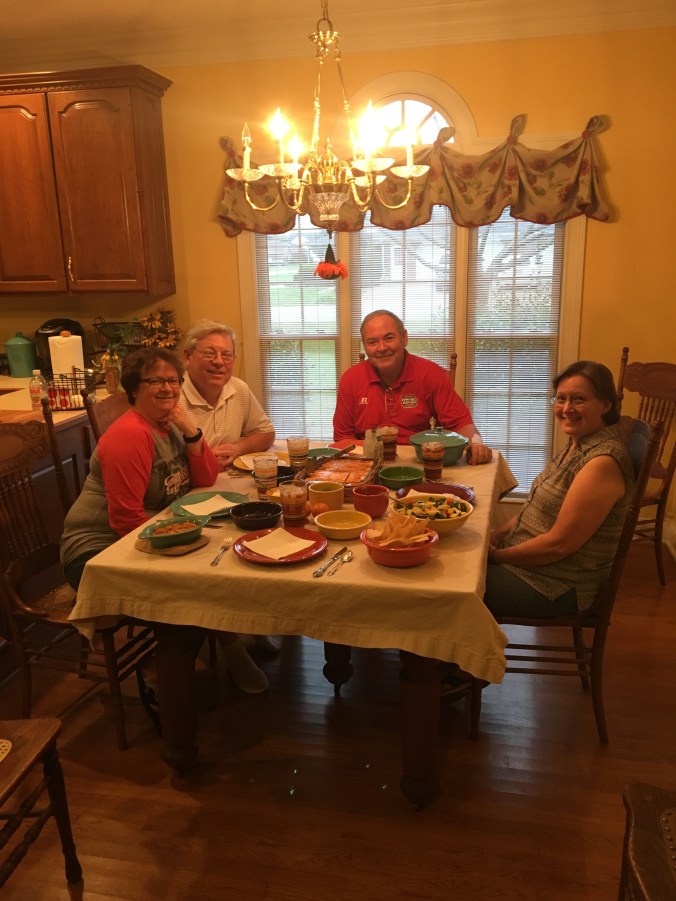
I had initially scheduled my Kentucky Kitchen Table with my best friend’s family who would have loved to participate, but unfortunately they had to cancel a week before our meeting. In a panic, I searched my mind for someone else I could have dinner with, and I decided on my high school English teacher who has a wonderful family, but on the day we were supposed to have our dinner, she canceled due to a family emergency.  At this point, I was concerned with what I was going to do. I had gone through my first option and a backup option, and I just had two days to find someone else. My last ditch effort was to sit with some people at my home church at a potluck that upcoming Sunday. I was feeling defeated, but I continued with the project and sat in front of the first  people I could. Little did I know that these people, who I wasn’t particularly close to, would give me new insight and a look into their lives. After having a meal with them, I felt a closeness and connection that was certainly not there before. Needless to say, they completely exceeded my expectations and gave me new concepts to think about.

I sat down with Mark, Ricky, Martha, and Tiffany. Mark, a local newspaper owner in his 40s, was the first to sit with me, and he seemed excited to participate in the project. Ricky, a retired mechanic, and Martha, who is an administrator, were a little less eager to participate. I told them about my project, and because we don’t know each other particularly well, I think they were a little hesitant. However, I was impressed on how quickly they came around. Tiffany, a nurse, is in her 30s practically jumped into the conversation once she knew what we were going to be talking about. I believe that this group of people is diverse because they come from different generations, and they are all in drastically different career paths. Their diversity, however, did not hinder their intellectual conversation, in fact, it may have just helped it.

“Beyond voting, paying taxes, and following the laws, what does citizenship mean to you?” With this question, Ricky and Mark did not hesitate. Their answer was “freedom” right off the bat. Mark, who went to West Point military academy and served in the army for five years, was very passionate about his answer. He felt that the sacrifice that our soldiers make to our country was the best aspect of our country, and his citizenship was based on that freedom. Ricky who served in the army as well, felt that without this freedom, our nation would be lost. Our rights of freedom of religion and speech are unique to us as a nation, and without these freedoms, citizenship would have a very different meaning.

As we progressed through the conversation and I asked some other questions, a common theme I saw was that each person believed in helping their neighbors. This wasn’t a big surprise to me because in our small town, community was everything. In 2008, a terrible tornado ripped through our town and destroyed or damaged hundreds of homes. Our community banded together and organized groups to gather, pack, and distribute supplies to the affected people. I don’t think anyone who was helping will forget the sense of community I know I felt that week of chaos. Mark shared a story of his parents and of a time when their health was going down. He said that the community helped so much by sending food and offering kind words. Tiffany shared a similar story of her mother-in-law. I steered the conversation towards a national focus, and  Ricky and Martha both felt that a good aspect of our nation is that we help each other. We talked about the efforts to help in Houston and Tiffany and Mark recalled the efforts to help in Florida and Louisiana when hurricane Katrina ripped through homes and other buildings. Martha knits prayer shawls for a ministry through our church, and she said that she finds comfort in knitting these shawls for people who needs them. I can recall the ministry sending some to Sandy Hook and many other people across the country. When I asked each person to reflect on their jobs and how that relates to their role in society, each felt that their contribution was helping others with their day to day needs. A writer helps keep citizens informed; a nurse helps people stay healthy so they can make their contribution to society; an administrator helps people stay honest; a mechanic helps people get to work to contribute to society themselves. I think this can be correlated to the central question of how can we live well together. If everyone could contribute a service, whether it be cooking a casserole or policing a town, the world would be a much better place. Every service touches someone in some way: the casserole may touch a grieving family and the police officer may find a little girl’s dog. These services, big or small, give people comfort and happiness, and I think if everyone was at least a little happy, we could start living better together.

When we started talking about obligations to others, I found that the conversation just took off. I asked the group if they felt that they had more of an obligation to their neighbors than to someone halfway across the world. In a reading that we have done, I learned that many people are more likely to be connected to something if it is in close proximity to them than farther away. I was expecting a similar answer from my group, but to my surprise they said that their obligation was the same. I was taken aback by this because it contradicted what I had previously learned, and I asked them to explain. Tiffany said that she felt the same obligation because everyone needs help and that that person on the other side of the world is somebody’s neighbor too, so we have an obligation to them as well. While on the subject of helping neighbors, we talked about some advice to give a neighbor. One common theme I saw was that they wanted their neighbors to try to help themselves before they asked for someone else’s help. I thought about this afterwards, and I thought how I would feel helping someone who really didn’t try to do anything for themselves. I think in that situation, I would feel aggravated, but then again aren’t the people who just accept their fate and don’t try to do anything about it the ones that need the most help? Someone who is driven and ambitious may just be able to make something on their own just from their sheer ambition, but someone who is hopeless needs someone to show them that same drive that can help them. Reflecting on this conversation after everything was said and done really gave me another perspective, and I think that was the main goal of this assignment.

We also talked about issues that are close to us, and Martha and Ricky, who are married, both felt very passionately about helping children who were unwanted by their families. Tiffany shared her interest in drug abuse, and I shared mine about drug companies taking advantage of senior citizens. As we each explained why these issues were important to us and posed facts and figures pertaining to these issues, I learned something. I learned a lot of things, actually. I learned a lot of things about a lot of different issues that I hadn’t thought of before just by asking to hear these people’s passions. This taught me that by simply asking we can find out information about important issues that we may have never heard before, and all it takes is one simple question! I think about friends I have who aren’t particularly passionate about any issue, but is that because they have never heard someone so passionate about something they can barely leave room for someone else to talk? What if we all had passions like the ones set before me? I think that people would find more ways to have more of a say over their lives if everyone was that passionate about issues that affect our society.

I started my meal almost hopeless because it seemed like hardly anyone was eating at the table anymore. I didn’t have very high expectations, and I was ready to get it over with. To my surprise, I emerged with a new understanding of the people that go to my church. I learned that these people who I have known for my entire life are caring and want to help other people as much as they can. I learned that they are passionate about children and drug abuse. I learned that they would help someone they did not know just as soon as they would help their next door neighbors. I learned that you don’t necessarily know someone because you see them every Sunday or you have the occasional small talk. You get to know people by asking them questions about their opinions and beliefs, and you ask them to explain so they feel understood. Through this project, I learned how to listen to my neighbors, how to discuss issues in our nation with people who may not have the same political views, and how to really get to know someone. IMG_2634

Kentucky Kitchen Table

By Brandon

Recently I hosted my Kentucky Kitchen Table project at my home in Bowling Green, KY. My mother (Marianne), father (Billy), and we hosted one of dad’s coworkers, Eddy, and his wife, Suzanne. Suzanne and Eddy brought beans and rice to go along with my mother’s chicken enchiladas that we were having for dinner. Marianne is my mother who is a physical therapist at the Medical Center. She is the youngest of nine of a Catholic raised family. Billy is my father who works as an engineer at Lord Corporation. He paid for his education through raising tobacco, and he is a strong conservative. Eddy works with Billy and he is a strong advocate of volunteering as he goes to disaster relief zones to volunteer. Much of Eddy’s philosophies are affected by the death of his older brother in the Vietnam War, when Eddy was just a child. Suzanne is Eddy’s wife who is an elementary school teacher who has strong Baptist beliefs. Even though they are all white and in their fifties, they are still different due to their beliefs and backgrounds. Because Marianne and Suzanne have differing religious beliefs in Catholicism and Baptist, they brought different philosophical ideas on how they live their life to the dinner table. Everyone at the table is from differing communities. For example, Billy lived on a rural tobacco farm where you knew your neighbors well because that is who you depended on. On the other hand, Marianne grew up in downtown Owensboro where lived a childhood being apart of a large urban family, without any dealings with rural farm work. Coming from rural or urban communities changes what on becomes because of the different hardships and opportunities that each individual and unique community provides.

When asked the question, “Beyond voting, paying taxes, and following laws, what does citizenship mean to you?” my dinner guests all came to in agreement. That being a citizen of a community is not just an administrative thing. It is part of being a common group and being part of one unit that shows unity. A unit that cares for one another just as if what is happening to others is happening to you. Marianne actually disagreed with the question because she believed that being a citizen is taking care of each other and has nothing to do with the government taking care of you through taxes and laws. Eddy had an interesting view that the others have not experienced because of his natural disaster volunteer work. What citizenship meant to him is simply sacrifice. That is to be willing to give of yourself to help your neighbor. This neighbor could be your next door neighbor or your neighbor who lives 800 miles away. With his volunteer work he gets asked questions like: why did you go to New York to help with hurricane Sandy Relief efforts? Or why did you go to Texas? He strongly believes that citizenship is giving of yourself to make somebody else’s life a little better. To Eddy a good citizen can answer the question- since you have gotten up this morning what have you done to better somebody else’s life? This is because if you better somebody else’s life, your life will be more enriched.

The best advice that that the table unanimously agreed with is that to better this world we have to show kindness. By doing they were suggesting that the world should show kindness by thinking before speaking. This was brought up because a lot of instances in today’s world, altercations or hostility have stemmed from one’s lack of kindness. Altercations have also happened due to a member of society saying something without truly thinking of the consequences of their statement.

I wanted to know what each one of them thought was the best part of the world today. When I asked Suzanne this she thought the best part is seeing the volunteers help the people who have suffered these great tragedies such as natural disasters and shootings. The ability for one to care more about somebody else’s life then their own is a much undervalued trait in our world today. It became a dark conversation when we started to reflect on how much evil has happened this year, such as Hurricanes Harvey and Irma, the flooding in Texas, and the mass shootings that have happened at multiple churches and the Las Vegas music festival. The catastrophes that this country have faced in the past year really make it apparent for people in society to try to find a solution to end the suffering. How can we ask society how to live well together? Something required for this is to get society to care about the problem to begin with. Most people watch the news and feel awful about the tragedies that are occurring, but they still do not take action because it is not affecting them and their daily lives. On the bright side, if there even is one, is the hero stories that come out of them. That one person or group of people who were willing to risk their lives in order to protect their loved ones or even complete strangers that they had never met. Our society could use more of these people whose unselfishness goes to the point of caring for somebody else’s well being more than their own.

Marianne explained how being a physical therapist for years has given her a variety of experiences that the normal person would not have. Through her work she treats people from all ways of life and all races and ethnicities. She treats extreme poverty patients and upper class. None of this matters because she treats every patient equal. She treats them as any empathetic human being would at all times especially because they are going through a hard time, such as, physical therapy. She loves her job because she gets to help these people through physical recovery and at the same time gets a mental challenge from it because no two injuries are the same.

The table agreed that the best part about living in Kentucky is the citizens’ attitudes toward each other. The term Southern hospitality came up because most people in our community are nice enough to help a fellow neighbor or casually make conversation on the street. But Billy brought up many of occasions when he has been in other places with traveling with business and if he waved or said good morning to somebody on the street they would react and almost be offended by it. They all know and believe that our community is one that cares. Eddy had a person experience with this when his older brother died in the Vietnam War. Two days before Christmas the city of Scottsville shut down for the funeral. Every business shut down and the entire town showed up to show their condolences and to show that they cared. Our community is one that genuinely cares for one another and it is a blessing for us to live in a community that cares because we live in a world that seems to have tragic events due to people not caring everyday.

After discussing what was best about our community we transitioned to social issues that were the most important to everyone. Billy brought up the lack of ability for those who need it to get help for mental health. Before, there were an abundance of mental help institutions for those people who needed it could get help, but now they are far and few in between. Billy has traveled to many big cities and even in our community today there is large amount of mental health cases that are homeless on the streets. Billy’s daughter use to live in Portland, Oregon where there is a high homeless population. He explained how in this population there are a high percentage of mental health cases that could and probably should be in an institution getting help, but instead are out on the streets. Eddy’s problem with society now is that we have become a nation of entitlement. We have moved to a society that expects the government to take care of them instead of not taking care of themselves. If society is not will to take action for themselves then we will soon be a culture that will lack the ability to solve our own problems.

I didn’t really know a lot about Eddy and his wife Suzanne before this dinner but it really opened my eyes on how much Eddy has done for others through his disaster relief volunteering. As Eddy was talking about his volunteer work I thought back to the speech “To Hell With Good Intentions,” by Ivan Illich. I asked myself, “Was the volunteer work he was doing in these disaster areas resulting in the same emotions that were explained by Illich to have happened in Mexico?” Then I realized that there should not as much emphasis on how the people there perceived the help. But it is just important that Eddy was trying to make someone else’s life better before without selfishly thinking of his own, and society could really learn a thing from that. The ability to care about someone else’s life and really take action on it answers one of the central questions of the class: How do we live well together?

To be honest I was not looking forward to this assignment considering I am more quiet during these kinds of conversations, but once I finished, I have come to the conclusion that it was  actually pretty nice. To be able to sit around the table with a couple of people that I did not know very well and to be able to get to know them a little bit better was an enjoyable experience. For us as a community to able to talk about our problems is important. As Melville outlined in “How We Talk Matters,” what we say and how we say it matters in the way that if one person shares his ideas of doing the right thing other people will be more willing to take action or deliberate on bettering idea and move forward with it. An important component to Melville’s ideal talk is not only being able to converse attentively, but also learn how to listen to each other. It was important for me to be able to sit down at the kitchen table to talk about our world’s social problems with my guests because moving forward that is how I should be able to talk openly with anybody. Rather it be in a Honors 251 classroom setting or out in the real world it is important for everyone in every community to become part of the conversation. The conversation that goes beyond the kitchen table and extends into solving our society’s major social issues. KKT

A Surprisingly Enlightening Pot Roast

By Chase

xWXCRIVFT96TPHddKLIHZw

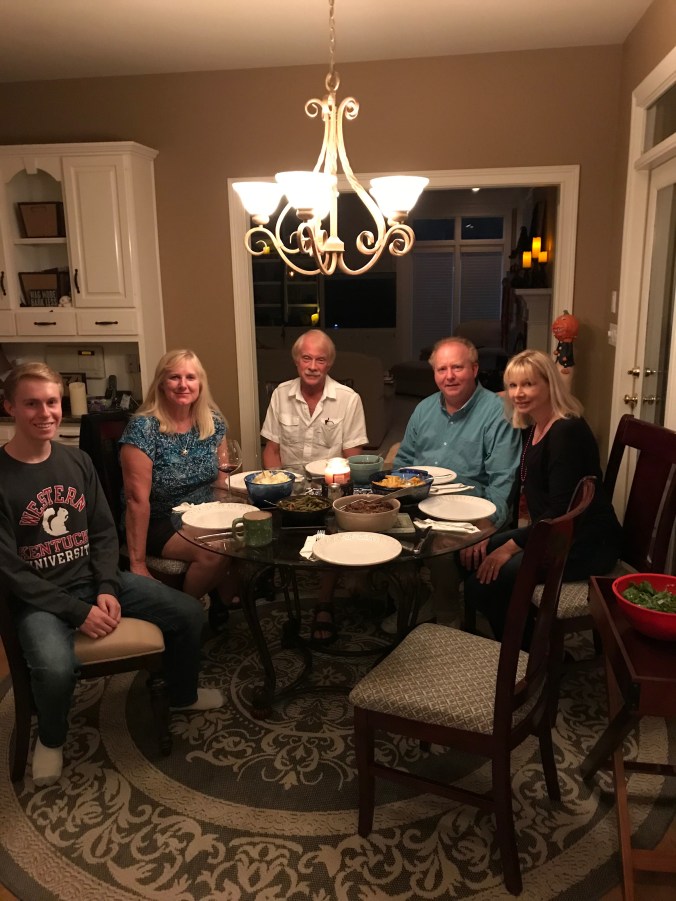
As an unusually warm mid October day came to a close in my hometown of Louisville, Kentucky, I raced downstairs in my Western Kentucky University t-shirt to the sound of expectant knocking at the door. Thoughts of indifference and relative unease swirled through my head as I neared the hungry guests waiting patiently outside. With little excitement for the Kentucky Kitchen Table assignment facing me, I focused on the incredible smell of my mother’s famous pot roast emanating from the kitchen. Opening up our home, our two guests, Karen and Paul, stood before me at the entrance before eagerly coming into the sweet aroma of homemade cooking.

Hearing the sound of our guests, Jan, my mom, raced over to the hallway to exchange hugs with Karen, her old roommate from college at the University of Louisville, and her husband, both chemical engineers. After my dad, Nick, told some corny jokes, we all headed outside to enjoy summer’s last fling before the fall sun quickly disappeared below the horizon. As I sipped on my iced water with my brother, Chad, I silently dreaded the imminent awkwardness of asking family friends of their views on citizenship and society as a whole.

Bellies rumbling, we collectively decided to get ready for dinner as the natural light outside slowly faded into nothingness. As twins, Chad and I softly sighed realizing, even at dinner we would have to do some schoolwork.

Lighting the candle and dimming the lights in our cozy kitchen, I set the tone for an intimate and revealing conversation where everyone could talk freely. Diverse not in race or socioeconomic class, we all gathered around the table as friends of different religions, jobs, and, most importantly, perspectives on the world. Though largely of the same political mindset, I was thoroughly surprised at the difference of opinion that would ensue on issues of citizenship and society throughout the night.

As we passed the lemon salad, pot roast, macaroni and cheese, green beans, and mashed potatoes around the table we made small talk about the delicious feast that lay before us. Though we did not pray before eating we each implicitly went around the table and told something we were thankful for in an almost Thanksgiving-like manner, mostly commenting on the importance of family and friends and the beautiful spread on our many plates. With six people squeezed around a table for four, we dug into our food with relish as I prepared my first question in my head.

And so it began with the first shaky question out of my mouth: “Besides for paying taxes, and voting, what does it mean to be a citizen?” Through the ramble of clanking dishes and chewing mouths, without hesitation Karen chimed in that citizenship was truly about contributing to society. Though interrupted by Nick’s slight tangent on the issue of not being able to contribute to society’s political discourse because of the staunch politically correct culture that embodies American culture at the moment, Jan largely finished Karen’s thought that we may all contribute through supporting the economy through our purchases, and helping others in need.

Karen continued her point about contribution as she cited her own personal endowment to the local community. After the horribly upsetting news about the UofL men’s basketball program the in the past month, she typed and sent a letter to the University of Louisville Board of Trustees to speak her mind about the corruption and ineffectiveness of the athletic program as an avid fan and season ticket holder. Though she recognized her letter probably received little attention at the meeting, Karen expressed just how much better she felt as she properly expressed her opinion through the undeniable right of free speech in American society.

The normally quiet and reserved Paul related that in providing a safe, reliable, and rewarding workplace to his employees at his chemical engineering firm he was doing his own part in providing to society. As more and more comments flooded in about economic security in our communities, Jan’s comment of the necessity of feeling as if we all support ourselves and the society harmoniously struck me as she continued that it proves imperative that we all have a stake in our communities, whether it be through our work and services we offer to other citizens, taxes we pay to help keep the economy, and our society as a whole afloat, or simply working to be a productive member for our own families and by default contributing to the wellbeing of the population of Louisville and Kentucky.

Through continued remarks of just how delicious the pot roast was and probing questions into the location of the butter, we moved on to the idea of “ideal communities” as I began to appreciate this assignment more and more. With her boisterous views, Jan immediately talked of the ideal community in which everyone was working towards the greater good for their families and consequently working towards the greater good for the community as a whole. Recognizing that unemployment was a real issue that plagued many Americans she didn’t mind the idea of welfare and government help to get people back on their feet, but held that everyone should contribute in any way they must while unemployed whether it be through helping the local daycare where their child attends, or actively searching for a way to a better life through persistence and will to not be “a bump on a log”.

With a variety of agreeable comments and the occasional “teach a man to fish” parables, family and friends held firm in their prescription to fix the ailments of society through each individual’s hard working contribution. Though interesting, by far the most resonating idea came from Paul who related his experiences of living in Denmark to the ideal community. I know personally that Paul would never subscribe to the principles of a socialistic government like they have in the very liberal Scandinavia, but even through these convictions he greatly praised the incredible trust the Danish people have in each other and their government giving examples of the government run child-care system and people leaving their babies unattended in their strollers out on street corners while in stores due to such deep confidence in their lack of harm.

Hearing this, I was incredulous at the thought of complete faith in and reliance on the workings of the government and the everyday person as the ever-so polarized American political system exposes and perpetuates American citizens inability to get along with one another and work towards the common goal of happiness and success for all. It seems to me that we are so focused on our political and ideological convictions in this country with two incredibly opposed political points of view, that we forget that most of us really do wish for the betterment of society. Through our lack of understanding one another, both liberals and conservatives alike, we find ourselves facing a wicked problem of our own creation: the ineffectiveness of communication across arbitrary political, racial, theological, and socio-economic divides in our equally as wicked battle in identity politics.

As the conversation ensued, I was constantly reminded of the numerous selections we read in class and their application to real people’s experiences and frames of mind. When we arrived on the topic of global citizenship and its meaning to each of us, quotes and memories of seminar discussions about the necessity for us to make ourselves look at the world from the standpoint of our global effect on one another came flooding back into the forefront of my mind. Though views ranged from never subsidizing and supporting monetarily other countries to our absolute need to make sure other countries do not fail their own people, we all came to the unconditional conviction that we must stand up and speak out for the defense of basic human rights across the world.

I found it quite interesting that at a largely conservative-minded table that stereotypes the focus on the individual and the patriotism of America, everyone saw it imperative to protect and serve our fellow human beings around the world when their humanity was threatened.

Finishing our scrumptious home-cooked meal in the comfort of friends and family, we relished in our gratefulness for one another and our friendship that we shared. Taking the last morsel of mac and cheese on my fork I came to the slow but enlightening conclusion of the importance of this assignment in its ability to start a conversation towards solutions of everyday problems in our local communities and larger society. This idea of proper, intimate, and friendly conversation struck a chord with me in an American society that seems to idealize the polarization of our differences to such a degree that we cannot seem to progress as a unified people. As we focus more on white and black, Christian and Muslim, conservative and liberal, and straight and gay, we lose sight of our shared experiences, and more importantly, our shared humanity. Though it may be hard to believe, most all citizens desire to find betterment not only for themselves but for others in our society and world. If we ever truly want to pioneer a more accepting, trusting, and loving world where everyone works toward society’s advancement, we must learn to communicate not for our differences, but despite them.

Kentucky Kitchen Citizenship

By Dylan

IMG_5182

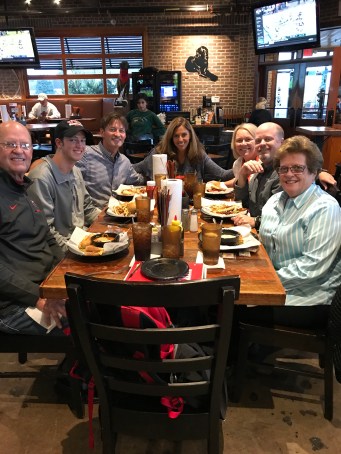
For my Kentucky Kitchen Table project, we met at a restaurant in Bowling Green, Kentucky called Double Dogs. Double Dogs is a sports bar that serves food anywhere from pizza to clam chowder. The people that were there were all part of my family, and we thought it would be interesting to involve our waitress in the project. Our waitress’s name was Amy (you can see her photobombing our picture above). She seemed to be of Middle Eastern background, but we did not ask her about that. She was young and was possibly in college or had just graduated. My family members’ names are my aunt Mary, uncle Todd, grandmother Miki, grandfather David, uncle Chris and aunt Kelly. All of them share similar political views and religious beliefs, but they are all different in some ways as well. They each come from different places and backgrounds. My grandparents are originally from New Albany, Indiana. They came to Western Kentucky University together and stayed here to raise my mom and uncle Chris. My aunt Mary and uncle Todd are both from Bowling Green, Kentucky. Aunt Kelly is from Owensboro, Kentucky. Different backgrounds and families shape the way you think and act. I was interested to see how they each would answer my questions.

The first question I asked was the required question that says, “Beyond voting, paying taxes, and following laws, what does citizenship mean to you?” Out of the things we talked about, the ones that stood out the most were pride, freedom and the responsibility you have as a citizen. Everyone agreed that being a citizen is a privilege. Chris said he felt prideful and thankful that he was a citizen in a country like this. Miki pointed out that the freedom we have in this country means a lot to her. She said this country was founded on freedom. Laws like the Bill of Rights give us basic, but important freedoms. Todd said that these freedoms give us opportunities to get up every day and strive to be successful. American citizens can be anybody they want to be. Amy said the freedom to express yourself was important to her, another aspect this country was founded on.

The next question I asked said, “What do you think are the best things about our world today?” Chris made the point that the communication technology and the internet we have now really shows how it’s a small world after all. Then we started singing the song from the Small World amusement ride at Disney World, in the middle of Double Dogs. Luckily no one seemed to mind. Others said they liked the advancements in medical technology. These advancements improve the quality of life and the longevity of life. David said he thought people of the world stepping up to help each other in times of need was very important. He also said that this question would be easier if it was only about the United States. I asked him what he meant by that and he explained that religious freedom and the quality of life here is better. This made everyone at the table think about how lucky we are to be living in this country with more freedoms than others in some cases.

The third question I asked said, “Does your religious or spiritual identity relate to how you think we should treat other people?” and “Does it relate to how you see yourself as a citizen?” Almost at the same time, everyone said, “Yes!” Nana said she was just watching “The View” on TV where they talked about even if you are not religious, people still follow the Ten Commandment rules. Everyone has the same sense of morality. Either we were born with it or we learned it as we grew up. Everyone at the table also agreed that their religious identity relates to how they see themselves as a citizen. Todd said that sometimes your religious views can make a difference on who you vote for. Nana pointed out that this country was founded on religious freedom. Aunt Mary made a good point when she said, “In God We Trust” is on all of our money and some of the monuments around the country. Religion is very important to a lot of people in this country. We reached the consensus that what we believe is right can definitely change the way you treat other people.

The fourth question asked what kind of person everyone wanted to be. Chris said he wanted to be 6’4” with hair. More seriously though, Miki said she wanted to be a Margaret. Margaret is my grandmother on my dad’s side of the family. She passed away during September of last year. She was loved by everyone and made an impact on each person she knew. Miki continued by saying the person who she wants to be all depends on how people remember you. That got a big “Amen” from several people at the table. Kelly said she wants to become a better Christian. Todd said he wants to build strong, meaningful relationships with people. Miki said she would like to become more involved in community participation. Amy said she wanted to be honest, loyal and hardworking. Chris and Kelly said something that really stood out to me. Chris said he wants to be exhausted at the end of life, and he wants to feel like he has done everything he ever wanted to do. Kelly brought up a poem called, “The Dash” by Linda Ellis. In short it says that the dash between the two years on your tombstone matter the most. While discussing this, we drew two conclusions: we want to be remembered as a good person and we want to make the best of the years between life and death.

The last question I asked said, “What social issue is closest to your heart and why?” This was probably the hardest question for them to answer. This could be because there are so many to choose from, or because they feel strongly about more than one issue. Todd and Mary said abortion was the social issue closest to their heart. When I asked them to elaborate, they explained that their religious beliefs tie into it, but they could see the reasons for it like if there were to be a rape case or something like that. But it is still a baby that cannot save itself. Kelly talked about capital punishment and the sanctity of life being most important to her. Religious beliefs tied into that too. Miki said spouse and child abuse stuck out to her the most. She explained her feelings of sympathy for those families who don’t have the resources or education to get themselves out of that situation. Meaning money or they don’t know who to talk to. David said the use of illegal drugs upset him. He said the ability of drugs to tear families apart hits home for him.

Some of the things mentioned relate to this class. In class, we talked about morality during our week two readings. David Brooks’ essay, “If It Feels Right” talked about how we make moral decisions. In the reading, he claimed that personal interests influence your moral decisions. Around the table, it seemed like religion, which is a personal interest, played a big part in everyone’s sense of morality. In class, we asked ourselves where does one get their sense of morality? Are you just born with it? Or do you learn it while growing up? Being born with your sense of morality connects with a religious factor. At Double Dogs, when we talked about if religious identities could shape the way you think people should be treated, morality was brought up, and it was the center of our discussion for this question. My mind was blown when Miki told us about what they said on “The View”, claiming that religious or not, people still follow the ten commandment rules, and that everyone has a similar sense of morality. This showed me that yes, there is good in the world, and we can have hope in humanity. Learning the moral values while you grow up goes with one of the central questions of our class that says, “How do we live well with each other?” One of the ways we can live well with one another is by setting good examples to those around us. It is easy for someone to follow someone else, so long that there are leaders for people to follow. We can all be leaders in some way.

The Kentucky Kitchen table experience taught me a few things that hit home for me. It taught me that your beliefs, religious or not, can change the way you think, act, treat others, dream and how you view yourself. What was said around or table at Double Dogs made think, “Hey this goes for me too!” or “I agree.” Most of the reasons people gave for why they said something all drew back to their religious beliefs or sense of morality. Sometimes religion teaches you those moral values. I liked this project very much. It was nice to get to see my family members and have a nice lunch with them. I thought at first talking about some of this stuff with them would be kind of weird, and I hoped that it wouldn’t start a fight between anyone. It turned out though that everyone loved it. It gave everyone the chance to voice their opinion about some important topics of today. This project turned out to be an absolutely positive experience.

Food and Friends

Kentucky Kitchen Table

By Rachel

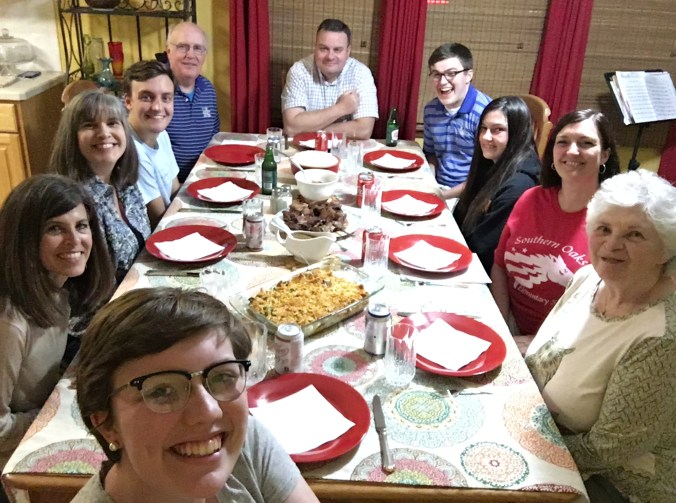
Last night I hosted a dinner for ten people at my home in Utica, Kentucky, a small rural community about ten minutes south of Owensboro. Since the project is Kentucky’s Kitchen Table, I wanted the dinner to feel like a traditional, homey meal, and for this reason I chose to serve pot roast with homemade mashed potatoes, broccoli casserole, carrots, and the most delicious rolls in the world. It is a meal that is a staple in my family, and so it is the one I most closely associate with home. I have never been one to cook, and I barely know my way around a kitchen, but, I decided that I wanted to cook for this dinner. My mother taught me how to prepare the roast just like my grandmother taught her, and my great grandmother taught my grandmother.

The attendees were William, Dylan, Catherine, Kim, Charles, Jody, Betty, Jim, Terri, and myself. We really had a full table. The group was diverse in age, political views, occupations, and upbringings.

First, there was me, Rachel. I am 18 and a student studying middle grades education at WKU. I have lived my entire life in Utica, but am of course now living in Bowling Green while I am at school. I define myself as a liberal, especially with social issues.

William is 21 and a student at Georgetown College. He will be graduating this December with a degree in religion, and he will be attending seminary next fall to continue his studies. He grew up in Utica as well, but now lives in Georgetown, Kentucky. He defines his political views as progressive.

Dylan is 21 and a student at the University of Kentucky with the goal to become a chemical engineer when he graduates next Spring. He is originally from Owensboro but now lives in Lexington. Politically, he identifies as conservative but does not affiliate himself with the Republican party.

Catherine is 17 and a high school student. She grew up and lives in Utica. She is not typically interested in politics, and hates the polarization it causes among people she cares about. She is a talented violinist and is interested in the ability of music and other arts to unify people.

Kim is a 50-year-old elementary school teacher who is very moderate in her political views. She is the daughter of a pastor, and moved around often while growing up.

Charles is 51-year-old pastor of a small country church who is progressive in his political views. He is the son of missionaries and grew up in multiple other countries, mostly in Southeast Asia, but he has lived in the U.S. since he was eighteen, when he came to Kentucky for college. When he and Kim married, they lived in Louisville for many years, and then relocated to Utica when Charles was offered a job.

Jody is 49 and has a background in accounting. She currently resides in Texas, but lived in Lexington for many years. Politically, she is conservative, but more libertarian than republican.

Terri is 58. She recently retired from a career of teaching French and Spanish at the high school level. She typically makes political decisions based on feelings for others and those in need.

Jim is 75 and is a retired pastor. He is conservative and a registered republican. His wife Betty is 74 and a retired respiratory therapist. She is also a conservative republican. Jim and Betty both grew up in small towns in the mountains in Eastern Kentucky. At one point, Jim described that the road he grew up on was nicknamed for his family, because his many family members occupied almost every house on the street. After Jim and Betty were married, Jim joined the armed forces and later became a pastor, causing them to move around fairly often. They settled in Lexington for many years, but recently moved to Owensboro.

Our conversation centered mainly around the theme of citizenship, and for the most part, everyone agreed that the biggest part of citizenship is service. The most important thing we can do is help other people as best we can. One common thing among the ten of us is the Christian faith, and this faith plays a huge part in dictating what values we hold. It was stated that, as Christians, we are called to help and serve others, thus linking citizenship with religious values.  However, one thing that is hard about this call to service is the fact that we do not want to be taken advantage of. Jim and Betty, having lived in Lexington for a long time, gave the example of people asking for money on the side of the road. It was a large problem in Lexington for a while, and, often, monetary aid was not used in the way that the giver expected, but rather for things like drugs or alcohol. Though they want to help people, they do not want to give money if it will not be used in a way they think is appropriate. Jody provided a well-known metaphor: “Give a man a fish and he’ll eat for a day. Teach a man to fish and he’ll eat for a lifetime.” Though she wants to help people in her community, she would rather “teach a man to fish” than to “give a man a fish.” We talked a lot about how we can help people, and even about whether or not we should help them at all. This part of the conversation really reminded me of our in-class discussion about morality and whether we have an obligation toward our fellow man. We also talked about how one way to help people is simply being aware that problems exist, even if you can’t directly help them by donating food, money, etc. It was said that good citizenship means not being apathetic and ignorant. We need to learn what is going on in the world around us and we need to care about what is going on in the world around us. If we fail to do this, then we also fail to make change.

The conversation soon turned into a discussion about progress. A couple of people around the table label themselves as progressives, and it was during this part of the conversation when they really had a lot to say. Charles said he thinks all societies in the world are moving in a progressive direction toward a goal of social justice and equality. Some groups are moving at faster paces than others, but he believes, eventually, every person will be treated equally anywhere in the world. Charles gave the example of athletes kneeling during the national anthem recently. These athletes are breaking the social norm of standing at attention during the anthem because they are trying to make a statement about the issues they care about. Jim said that, as a veteran, he finds the kneeling to be disrespectful. However, he also says that even though he thinks it is disrespectful, the athletes have the right to do it. He wishes there were another way to protest, but he can at least respect that the athletes are taking advantage of the rights he fought for them to have. Jody said she did not have any problem with people protesting peacefully, but she thinks that, once laws are broken, that is when it has gone too far. Charles disagrees. He says that rules need to be broken if they are unjust. He gave the example of Rosa Parks. She broke the law when she refused to give up her seat, but she did it because that law was unjust. Now, we look back with pride when thinking about Ms. Parks’ actions, but at the time, many people were just as upset about it as they are now about athlete’s kneeling. Someday, Charles says, people will look back at today’s protests in the same way.

By this time, we had finished the main course and were started on dessert, apple pie, and we changed the subject to something a little sweeter as well: what are the best things about the world we live in? Catherine said that, in her opinion, music is the best thing in the world. Music is universal. Every culture has it, and it is a great way to express emotion and ideas. On top of this, it is a wonderful unifier. Kim and Terri think that one of the best things about the world today is the fact that we are able to connect with people and truly be global citizens thanks to technology. Now more than ever we are able to know what is going on in the world, and we are able to communicate and befriend people from all over the globe. Technology does have drawbacks, but the benefits of it are extraordinary. Jody said that, for her, the best thing is to see how people come together in times of hardship. She gave the example of the recent hurricanes. So many people have worked together to help our fellow men when they were in need. Though it sometimes feels like we are all just selfish, and that there is no hope for us, unfortunate events like these prove that we do care about each other. Dylan said one of the best things in the world to him is being able to sit around a kitchen table together having meaningful conversation and lots of fun with good people. I agreed with him.

During this project, I have learned how important it is to me to be able to talk with my friends and family so openly, without fear of judgement and without fear of starting an argument. Often, we get swept up into the emotions behind our opinions on problems, and we want to argue and offend those who disagree with us. We get so absorbed by wanting to be right and wanting to “win” that we forget that the most important thing is maintaining relationships with people we care about. Everyone at my table had different ideas, interests, and opinions, but we are all the same in that we are all people who, ultimately, just want the world to be a better place for everyone in it.

Union Kentucky Kitchen Table

By Sam


My Kentucky Kitchen Table took place in my home in Union, Kentucky. The names of the people who participated in the dinner, not including myself, are Vince, Elizabeth, Janice, and Manda.
Vince, my father, is 53 years old and a father of three. He spent his early childhood in Southern California, but went to high school in Northern Kentucky so his step-father could pursue a job opportunity. After graduating high school, he immediately went into construction and has been in construction sales ever since. He was raised Catholic.
Elizabeth, my step-mother, is 42 years old. She grew up in Gallatin, Tennessee. She later left Gallatin for Bowling Green as she attended WKU. She obtained a degree in education and was a high school business teacher for a few years before deciding teaching was not her passion. After some time in real estate, she then settled on a career in Human Resources. Roughly eight years ago, through mutual friends, she met my father. She is Methodist but mainly identifies as Christian.
Janice, my grandmother, is 76 years old and a mother of four. She grew up in rural Indiana and, pursuing a job opportunity and family, eventually moved to Southern California. At the time, she was a secretary for a phone company. This is where she met her husband, who would later move her and her four kids to Northern Kentucky. Once in Northern Kentucky, she got a job at a local news station while working on a degree in education. She would go on to spend many years teaching middle schoolers. She is Catholic.
Manda, my grandmother’s friend, is 70 years old. I invited her to dinner because I do not know her very well, and I believed she could add a unique and diverse perspective to the conversation. She is a mother but did not specify how many kids she has. She grew up in Peoria, Illinois in a progressive household. Her mother was a member of the media, so Manda, naturally, pursued a career in broadcasting. She moved to Northern Kentucky after hearing of a job opening at a local news station. This is where her career in the media took off, and where she met my grandmother. She did not mention her religious affiliation.
The first question I asked at dinner was, “Beyond voting, paying taxes, and following laws, what does citizenship mean to you?” The responses I got were very intriguing. Vince and Elizabeth both agreed that citizenship was ultimately the individual’s responsibility of cultivating a better community. They believe a good citizen is active in the community and helps their neighbors when need be. Manda furthered this idea by pointing out how citizenry is an active effort that looks to better society, and effective citizenship that betters our nation, and eventually the world, cannot be achieved until it is practiced in our homes. She emphasized how the home is a microcosm for the world and the birthplace of proper citizenry. The interesting thing I noticed from this discussion was the consensus that moral obligation is a necessary component of being a citizen. Everyone participating in the conversation believed that it is their responsibility to look after their neighbors. It is the “right” thing to do. “Why is this the right thing to do?” I asked. Vince, Elizabeth, and Janice mentioned their faith. Manda noted how she would want others to look out for her, so she looks out for them. This is citizenship to them.
I then asked the question, “How do you think your job relates to your role as a citizen?” The responses I received were similar to the first question. Vince mentioned how he enjoys the constant interaction he has with people in construction sales. He looks forward to seeing clients and hearing about their lives. He mainly just wants to use his job as an outlet to reach others and help them with whatever he can. Janice said her years as a middle school teacher where propelled by a desire to shape young minds and hopefully prepare them for being an active member of their community. She was on the ground level of citizen training. Elizabeth said her job in human resources gives her a firsthand account of the issues fellow citizens are facing and how they are responding to them. She views her position as an opportunity to guide those struggling and steer them towards greater production in the workplace and community. Again, the theme of moral obligation was prevalent. They all think it is their responsibility, as contributing members of society, to help those in need so that they can contribute, perpetuating the cycle of neighbor helping neighbor and societal improvement.
The conversation then got a little lighter as I asked, “Did you ever have meals around the table with your family growing up? Did you enjoy it?” Manda noted she was a raised in a traditional household that emphasized family unity through dinner. It was an expectation to eat dinner together because this was the time for true cohesion. Janice and Elizabeth reiterated this, stating they were both raised in traditional families and enjoyed the time they spent with the family at dinner. Vince, however, said family dinners were not a priority of his childhood due to both his parents constantly working. He said that the lack of family dinners, and the effect this had on his development, cemented the importance of the ceremonial event for family building, urging him to implement it into his children’s lives. This demonstrated to me how important our home life is in shaping us into the individuals and citizens we are.
My next question was, “What kind of person do you want to be?” It took few minutes for them to think of their responses. Elizabeth was first to chime in. She said she wanted to be a better mother and Christian. She admitted to not adamantly practicing her faith and that she needs to. Vince and Janice both desired to be more informed in our information-abundant society. They both stressed how critical it is to discern what is correct information from the incorrect and that they would like to be more skilled at this. Manda, interestingly, mentioned a desire to be more empathetic. She stated empathy was key to promoting social change, and, through empathizing, we can become more informed, and morally well-rounded, citizens. Everyone hit on the desire to become either better moral executioners or more informed with the goal of it furthering moral execution. It is interesting how this theme of morality seems to be the foundation for citizenship and improving as individuals within society.
I then asked, “What advice would you give people running for office in our country?” Vince responded first, noting that someone running for office needs to take into consideration the views of all his/her constituents, and a noticeable effort towards creating a unified nation is key. Manda pointed out how most politicians tend to campaign in the areas containing those funding their campaign. According to Manda, politicians will never take into consideration the views of all their constituents as long as a select few campaign donors are influencing policy platforms and campaigning. This snowballed into the topic of structural flaws in our government, and how these flaws could potentially be fixed. However, everyone at dinner spoke of this governmental reformation as a hopeless and nearly-impossible cause. This forced me to consider how any kind of societal change can occur when the people charged with inciting said change believe its hopeless.
Another question I asked that sparked interesting dialogue was, “Is there anything you can think to do that might make things better for you or your neighbors where you live?” Janice said a significant, but small, change she has made that has created an increasingly-positive neighborhood environment is simply making herself available to her neighbors. She has started a dialogue with other members of the neighborhood and informed them that if they ever need anything, or just want to hang out, she is here for them. She said it has created a friendlier, dependent neighborhood that willingly interacts. Elizabeth mentioned that she also believes an open, honest dialogue with the neighbors will create a safer and smarter community. Similar iterations of community conversation came from Vince and Manda. It is interesting and sensical that simply talking is what can lead to more efficiently operating communities.
My final question was, “What social issue is closest to your heart and why?” This question got somewhat heated as some had differing opinions on prominent social issues. Vince immediately gave his social issue: NFL players kneeling during the national anthem. He believes that the national anthem precedes all social statements and change, affirming everyone should stand for the flag first and then discuss social injustices. In short, the national anthem comes first, and then discussion is had. Manda, being the individual I do not know very well, responded to this with respectful, yet defensive, disagreement. She firmly stated the national anthem means different things to different cultures, and kneeling for the flag is the epitome of being American. It is an individual’s right. If these demonstrations are not done, according to her, no social change can occur. This then led to the conversation of whether kneeling NFL players are kneeling for a cause, or just kneeling with the intent of following their teammates stance. The debate ultimately ended with the recognition we can never truly know someone else’s motives. Elizabeth and Janice did not have much to say as this was discussed. I found it interesting how two people can look at the same situation and have radically varying perspectives. It made sense considering Manda’s liberal and Vince’s conservative background. The main takeaway was that this “debate” over when it is appropriate to protest remained a civilized discussion. It did not escalate into an argument due to both parties’ recognition of the importance of empathy.
One of the main things I learned was how important morals are considered to be in citizenship. Everyone at the table defined citizenship as a moral obligation to care for our neighbors and, thus, further society. Another takeaway was that healthy discussion was key to actually achieving a greater, more representative society. They recognized the need for empathy in order to have healthy discussions, and a community without dialogue is divisive. Finally, there is a sense of hopelessness clouding people’s desire to change their societies. Unfortunately, some believe we are trapped in our current society and view change as dauntingly impossible.
Honestly, I was surprised by how similar everything discussed was to our class. We talked about the role of empathy, how morality factors into our lives, and the presence of wicked problems. The central idea that was most prevalent was definitely the importance of deliberation. The chapter we read, “How We Talk Matters” discusses how the discrepancy between what is happening and what should be happening (like the bridge metaphor we discussed in class) can truly be overcome when a healthy dialogue is created. By listening to and understanding each other’s ideas, we can venture towards compromise and social change. Everyone around my table viewed deliberation as the first step towards understanding, and even practiced this when debating when it is appropriate to protest.

A Meal Back Home

By Ellie


When I first read the syllabus for Honors 251, I saw the description for Kentucky Kitchen Table and immediately started to stress out. I didn’t know when I would be able to come home to do the project, or if anybody I knew would even be willing to help me by agreeing to be interviewed. After the explanation given in class, though, I figured it would be better to get it over with. Since I was going home this past weekend, I asked my parents if it would be okay to host a Kentucky Kitchen Table when I came home. We were already hosting a potluck that Sunday, so they suggested that I sit down all the people I wanted to interview at one table and ask them my questions about citizenship. Before the event, I asked the ladies I wanted to interview if they would be okay doing it while they were at my house and they all agreed. My Kentucky Kitchen Table took place at my home in Mayfield, Kentucky on October 15, 2017. I hosted the event on a Sunday morning after church services in my family’s 4 car garage. We ate a potluck style meal, with lots of home-cooking that I hadn’t had in weeks. I was overjoyed to be able to eat food that wasn’t a greasy pizza or burger. This was the first chance I had since school has started to see anybody from church and say more than “Hello. Yes, school is going well.” I was excited to have the opportunity to have a real discussion with women who helped make me into the person I am today.

I invited several women who go to church with me back home to participate in this project. There were 7 women and 1 little boy present during the conversation. Mrs. Peggy is an independent woman who lives alone and is famous in Mayfield for her hostess skills. Ms. Marti is a widow who spends her days knitting blankets for expectant mothers in our congregation. Mrs. Pat is an Avon saleswoman who met her husband of 52 years while attending Western Kentucky University (her three children later went on to attend there). Mrs. Kay is a Chicago native who has three children, one of whom joined the military. She spends her days now watching her 2 youngest grandchildren for her other son. Mrs. Janice works at the local senior center in Mayfield and has a grandson that I babysit regularly during the summers. My mother also attended, and she is a high school Family and Consumer Sciences teacher at McCracken County High School. Also at the table was Brayden, the 5-year-old grandson of Mrs. Janice, but he was more concerned with eating the sugar cookies my mom had made instead of contributing to the conversation about citizenship. None of these women seem to have any particular qualities in common, beyond their belief in God, but all of these women are very close to each other. These are the type of women who care for others needs before their own and have taught me to try and do the same. I was curious to see what some of their answers would be to the questions I was supposed to ask.

I knew that I really had no reason to be, but I was a little nervous to discuss some of the questions with these women. Most of them are very conservative minded, so I had a general idea of what answers to expect, but I also didn’t know how they would react to being interviewed. Also, a few of these women were elder’s wives, which means they can hold sway over my dad’s job as a preacher, so if I said something that came off wrong, it could potentially negatively impact my dad’s position. They already knew that this project was for school, and were very willing to help. Some of the answers that came out during the meal actually didn’t seem 100% conservative, and that honestly shocked me.  I was happy to have diversity, that I wasn’t yet aware of, present at our kitchen table.

I began our conversation by asking the basic question of what citizenship meant to each of the strong women at that kitchen table. Mrs. Peggy and Mrs. Marti responded that citizenship to them meant freedom, and I asked for an elaboration from the group on what that meant. Mrs. Kay responded that to her, citizenship meant putting your hand over your heart when you hear the national anthem, and that you stand when you hear the pledge of allegiance. To Mrs. Pat, citizenship means being able to worship freely, and to everyone else at the table, they all responded that citizenship meant having the right to freedom of speech. One of the most interesting answers I got was when I asked these women what kind of community they wanted to live in. Mrs. Kay answered that she wanted to live in a world where she didn’t have to lock her doors at night, which seemed a bit odd to me since I know she is from Chicago. After thinking about her response, I later figured that she has learned a lot from small-town life and craves that experience for the rest of the country, even in places that are more densely populated. Everyone at the table responded that a community with unlocked doors was something they crave as well. When thinking back to the video we watched in class of the little Japanese girl who was run over by a moving truck, I asked all the ladies if they felt that we had a moral responsibility to help people in our community and the world, and they all unanimously responded that we all have a responsibility to help our fellow neighbor. I can’t remember who said it, but one of the women responded that that is part of what being a Christian is all about. When asked what advice they would give to their neighbors, the advice that really stuck out to me was to always put others first. Mrs. Kay agreed with that statement and went a step farther to say that God comes first, then others, and then you. One of the last questions I asked was whether or not they had meals at a kitchen table with their neighbors and family growing up. They all smiled and started to reminisce about their childhood. One commented that she enjoyed these meals because it gave her family a chance to catch up after a long day of work. Another commented that she enjoyed these types of meals because it was time for families to nurture their relationships with each other.

As our conversation progressed throughout the meal, I found myself thinking back to the readings we did on empathy by Leslie Jamison (The Empathy Exams) . These women I interviewed have all had vastly different life experiences, and I know that I will never experience what it’s like to go through some of the hardships they have gone through, so the best I can do is imagine what they have been through and try to empathize once they start discussing their childhood experiences.  When I did ask that question about social issues, all of those present chose issues that they had experience with, which also relates back to the idea that empathy can influence your decisions when you are close to a situation. Because of life experiences, women’s rights were an answer that came up almost immediately when asked about what social issues resonated closely with them. A few of these women were widowed fairly young, so this issue is important to them because they were left to provide for themselves, and even their children, in a world that only a few years ago, wouldn’t have given them the option to work. I have never been in a situation where I wasn’t allowed to work or do something because I’m a woman, so listening to their answers elicited empathy from me.

What really stood out to me during the meal was that even after I had finished asking questions pertaining to the assignment, the conversation still went back to topics about citizenship. At one point, towards the end of the meal, Mrs. Kay even looked at me and said, “Put this in your assignment.” as they were discussing citizenship later when they thought my interview was over. This helped me realize how important the topic of citizenship was to everyone, including people you normally don’t think about being extremely patriotic. It also taught me how drastically America has changed, even in the past few years. If you had asked any of these women to interview someone while they were in college about if they ate at a kitchen table growing up, they would have laughed because virtually everyone did that.

Overall, this experience was very rewarding to me. I was not sure how the project would work out at home, but it was really enlightening to see how these women’s life experiences have shaped their view of our society and country. I enjoyed getting to learn more about the way my role models think, and it helped me learn how many different interpretations of citizenship there really are. Overall, the women at my Kentucky Kitchen Table were proud to be citizens of the United States of America, and I am proud that I had the chance to interview all of them.

Kentucky Kitchen Table- Emily

By Emily

IMG_1789

My Kentucky Kitchen Table took place in my hometown Shelbyville, Kentucky at my house. I had 7 people at my house to participate in this dinner. The first four people were my family members. My father, Mike, is 50 years old and is a sales manager for Valvoline oil. He travels quite a bit for his job and experiences many different areas but is very involved in our family. My mother, Stephanie, is also 50 years old and is a goal clarity coach in Jefferson County Public Schools. She is a Christian and is dedicated to her church and community. My twin sister, Lauren, is 18 years old and attends Northern Kentucky University. She is majoring in elementary school education and came home for the weekend. My younger brother, Evan, is 13 years old and is in middle school in Shelby County. He is into fishing and playing baseball which takes up most of his time. The other 3 people I invited for this dinner assignment was a family that recently moved to our neighborhood over the summer before I went to college. One of the family members was Bill, a 47-year-old father who is a real estate appraiser. He grew up catholic and is a strong republican. His wife, Jennifer, also attended the dinner and is a 45 years old. She is an accountant and described her position as a controller. She is also catholic because of her husband and Is opinionated about the government. Their daughter, Anna, is 16 years old and attends high school in Shelby County. She is a cheerleader and also takes classes at the local community college in the area. My family fried fish and made pasta salad while the other family brought brownies and some kind of ranch dip. I have only met them a few times over the summer when my family introduced them to the neighborhood. It was interesting getting to know them and their views on life. They contribute diversity to the group because they have different religious views than my family; they are catholic. They also have strong beliefs about republican viewpoints and government laws which I thought would contribute to interesting conversation.

The conversation at dinner focused a lot about citizenship and personal viewpoints. I was nervous at first that there was not going to be much to talk about or the conversation would get dull but I was surprised by the opposite. The first question I asked was the required question: Beyond voting, paying taxes, and following laws, what does citizenship mean to you? Stephanie started the conversation and was discussing how citizenship means getting involved in your community, state, and country. Everyone else basically agreed but then Bill brought up another point. He said that citizenship was being a good neighbor and then started talking about how he believed that paying taxes was one of the last things he thought about when he considered citizenship. I thought that was very interesting because that is one of the national requirements for having a job. Mike also brought up freedom and the idea of everyone considers the United States the place of freedom and each citizen gets that freedom. There was kind of mutual agreement on this question.

While looking through the options of questions for discussion, I highlighted a few that stood out and I thought could bring up different viewpoints. One question I asked was how do you think your job relates to your role as a citizen? Stephanie said that since she works for the public-school system, she works for the community and gets the opportunity to teach kids to be productive and be good citizens. That stood out to me because she related her role as citizen to be passed down to the children that she teaches so they can be influenced in their role as a citizen. Jennifer brought up how her job as an accountant requires her to follow ethical policies and deal with money which is a significant part of being a citizen. Mike brought up a valid point that I never really considered. He talked about how he pays taxes and helps with the welfare system which overall benefits our community. I never thought about it that way but it allowed for discussion about the importance of taxes and the welfare system.

Another key theme that was discussed at dinner was the question: do you think we have any obligations to other people in our country or our community? Jennifer brought up how controversial this topic is. She believed that we do have obligations but limited it to the people who actually need help and who want to better their lives. She thinks that we have obligations to people that have good intentions to improve their lives. A good point she brought up was that we need to help people so they can teach their children how to become better citizens. I thought this was a good question to ask because I could relate it to “To Hell With Good Intentions” by Ivan Illich that we discussed in class. This reading really intrigued me because I felt the complete opposite than the author. I brought up the reading to the people at the table and how the author believed that United States volunteers are not helping and can make things worse when providing aid to a poor country. That brought up a very opinionated conversation since everyone at the table is religious and believe attending mission trips and helping the less fortunate is part of what we are called to do. Lauren said she did not agree with what Illich was saying because anything that helps the poorer countries are done with the best intentions in mind. A good point that was brought up was anybody needs help, even our own country. Bill brought up other good points that realized that yes we are fortunate but we work for what we have and other countries perceive us as having bad intentions. This conversation related to what we learned in class about how we solve problems. We discussed how someone was supposed to get help if there is just going to be criticism and judgement every time some tries to help. Everyone at the table agreed that to solve the problem of helping the less fortunate was to go on mission trips and donate money. There is only so much one can do to improve the lives of others without overstepping boundaries. It also related to wicked problems (which I informed the table about what a wicked problem was). The discussion about the solution to this problem was very interesting and there were a variety of options. It just proves how this idea is controversial and our deliberation could work through the ideas.

The last question I asked was what kind of advice would you give to people running for office in our country? I thought this would be a good question to ask since there were different political views at the table. Stephanie took the lead in this conversation because she related it back to her job and role as a citizen. She believes that the people who run for office need to take their role professionally and keep their personal opinions limited. She also discussed how Matt Bevin does not listen to the teachers in the country and is affecting their jobs and retirement. This topic related to deliberation quite a bit because whoever is running our country has to take into consideration the voice of the people. To solve problems and live well together, our country has to have a strong relationship between the leaders and the people to get things done. Jennifer said how whoever is running for office needs to listen to the people and understand what the people want. This is a key idea in deliberation because you need to able to listen to others in order to have appropriate discussions which is what we have been learning in class.

What I have learned throughout this dinner is that citizenship is way more than just voting, paying taxes, and following laws. Citizenship takes into account deliberation, helping others, and getting involved, basically what we have been learning in class all semester. Citizenship plays a huge role in our country and in our lives. What we learn in class is a part of our everyday lives and after this discussion I have realized how important being an involved citizen is. Citizenship is solving problems, living well together, and having more say over our own lives, which are our three central ideas of the class. How we live our lives and how we work through problems as a country will shape and affect future generations. A constant theme that kept resurfacing throughout the conversations was that we need to be good citizens for ourselves and for our children. We need to be good citizens and if we want our children to be like that then we need to set a good example. Citizenship and what it consists of is something that has a variety of meanings. This dinner discussion helped open my eyes to what it means to be a productive citizen in society and what it means from the eyes of different people, which is just like our class and the discussions we have every week.


Kentucky Kitchen Table

By Courtneyfam squadpumpkins

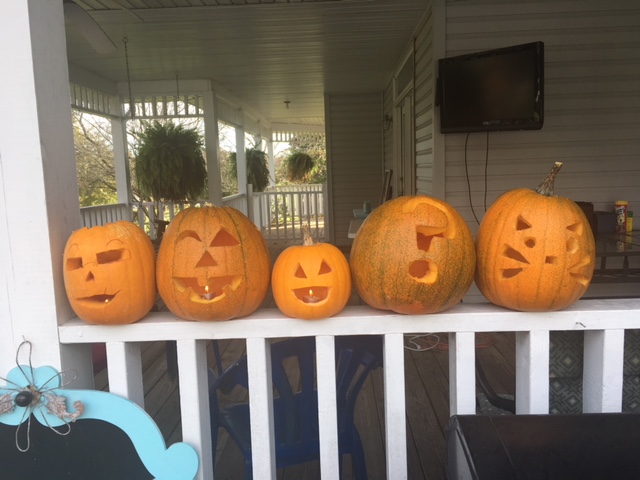
I conducted my Kentucky Kitchen Table project in Annville, Kentucky. We had dinner around the dining room table in my parents’ home. My mother and father spent most of the day and the day before preparing the meal, but guests also brought items to contribute to a traditional southeastern Kentucky family meal. The menu consisted of fried chicken, soup beans, dumplings, cornbread, and potatoes in various forms. For dessert, there were fried apple hand-pies and spice cake. In addition to dinner, we also prepared some special decorations for the table and had a pumpkin carving session for the children afterwards.

By the time all the guests arrived, we had nine hungry people at our table. Those who arrived to eat and take part in the conversation were of varying ages, genders, geographical identities, and political identities. Shirley, a 71-year-old retired social worker, and her husband Wayne, a 79-year-old retired coal miner, are both staunch Republicans from Hyden, Kentucky. James is a 69-year-old retired high school math and special education teacher from Booneville, Kentucky. Betsy, 60 years old, is a retired preschool teacher from Beattyville, Kentucky; she and James both share political ideals aligning with the Democratic party. Shawn currently works as a water plant and sewage technician for the Lexington-Fayette Urban County Government, he’s 35 years old and is from Lexington, Kentucky. His wife Becky, also present at the table, is a 30-year-old stay-at-home mom from Lexington, Kentucky. Both Becky and Shaun identify as Republicans. Owen, a 19-year-old Computer Science major at Eastern Kentucky University, is from Richmond, Kentucky and is a registered Democrat. Lauren is a high school student at North Laurel High School, she’s 15 years old and a sophomore there. She’s from Annville, Kentucky, and though she can’t vote yet has predominantly Democratic ideals. Karley is a 12-year-old attending North Laurel Middle School as a 7th grader, she is also from Annville, Kentucky. This mix represents both urban and rural perspectives, as well as both sides of the current political spectrum. The people at this table represent multiple generations of Kentuckians.

We began the dinner by having everyone go around the table and introduce themselves, talking a little about their previous life experiences, what they’re doing now, and who they were. When asked the primary question of “What does citizenship mean to you?” many of the older people at the table thought citizenship was about being a good neighbor, having a job, and finding your role in the community. Shirley and Wayne spoke about their participation in the local volunteer fire department. The younger members of the table primarily discussed community service to demonstrate their role as future citizens. Lauren spoke about projects she’d formally been involved in, as well as kind acts done by her neighbors in times of need. When discussing the “best” things about our world today, the item most commonly discussed was our ability to communicate instantaneously with others. This was brought up by Karley, the youngest person at the table, and seconded by Betsy who provided personal anecdotes about how hard it was to communicate when she was Karley’s age. James and Wayne mentioned how much they loved the freedoms they experience in the United States; they discussed taking road trips and being able to exercise their freedom of speech. They thought the autonomy they experience every day is what truly makes life worth living, being able to do what you want when you want. For the most part, everyone mentioned being pleased with their current community, but Becky and Shaun were in the process of picking somewhere new to move to. They mentioned wanting to live somewhere more private, with good neighbors; everyone at the table also seconded this notion. Wayne mentioned wanting to live in Flagstaff, Arizona, which seemed off-the-wall when he first stated it, but then as we continued to discuss it, it became clear that this also aligned with their current living scenario now and their ideals, just in a different state. Most everyone at their table responded that they did know their neighbors quite well, except Lauren and Karley who reported that they only saw their neighbors when there were issues going on either in the neighborhood or between homes. With two veterans, a civil servant, and a few public educators at the table it was very easy for them to make connections between their jobs and serving the country. They also easily saw their jobs as serving a greater purpose to help people, educate children, protect the country, and provide amenities like electricity and clean water. While a few of them did believe their religion served as a moral compass in that following their God made them want to help others, Shaun thought that religious people got “a little out of hand” with that notion. His experiences led him to believe that they did more to try and get him to join them than they did serving and helping other people. Most of them felt that there was no legal obligation to help people in the community and country, but there definitely was a large moral obligation. Owen expressed that the moral obligation also extended past the limits of community and country. He, Lauren, and Karley showed a more global view in that we should all watch out for each other as citizens of the world and as human beings rather than belonging to an area or group. All the people at the table responded positively to having meals with their family around a table, Becky even mentioned that her family insisted upon eating around the kitchen table even when there were just two or three people in the house to sit down and eat with. A lot of the older people at the table felt that they were the person that they wanted to be and were content with their current state of being. Younger participants noted that they’d like to be a nicer or more forgiving person as they got older. When the topic drifted to a more politically focused conversation, the older members of the table got a little riled up, especially since Kentucky teachers’ and state employees’ pension system is currently the political hot button issue in Kentucky. In addition, quite a few of them were teachers and state employees. When asked for advice for politicians, they responded immediately and with fervor. They wanted their politicians to not make promises they couldn’t keep as well as to run for office not to benefit themselves, but to work for the country. Shaun suggested politicians take extreme wage decreases, and Owen even joked about politicians’ salaries coming from a GoFundMe page that citizens can donate to if they do an adequate job.

From this discussion I learned a lot about the problems we’re facing here in Kentucky as opposed to the broader issues we always hear about on Twitter, national news, etc. Shaun and Becky talked a lot about the mounting homelessness problem in Lexington. The city and county government there are apparently handling the panhandling in Lexington very poorly. To decrease the number of panhandlers on the streets, city officials are now taking the homeless people and having them pick up garbage. A local radio show staged themselves as a panhandler and told on air that they had raised more than $300 in one hour.

In class we’ve discussed specialization through the Michael Pollen, “Why Bother?” essay, after dinner during casual conversation many of the participants began discussing their gardens. They talked about who grew what where and how much the deer had eaten; I watched as they discussed giving each other all kinds of vegetables and fruits from their gardens and was immediately mentally sent back to this reading. I inquired about why they gardened, and they said it was about independence for them and the fact that they had always grown up doing it. In addition to that, once the topic of “global communication” was brought up, the “when I was your age” anecdotes also emerged. In the Jennifer Roberts “The Power of Patience: Teaching Students the Value of Deceleration and Immersive Attention” reading, she mentions honing patience as if it were a skill, but the members of my table spoke of it as a life necessity. They constantly had to wait to communicate with each other, and thus treasured the real-life conversations they had even more so. Many of the older people at the table stated they were happy with their lives; most young people want to rush through high school, speed through college, find a good job, and immediately find a significant other to settle down with, but the lesson we can take away from them is that it takes a lot of time, work, and patience to achieve all these things we want to happen instantaneously. As we are so used to seeing everything else in our lives coming together very quickly, it’s hard at times to think that what we’re doing in the moment is enough.

A Meal in Lexington

By Riley

As I approached this assignment, I dreaded the idea of sitting down and asking a list of required questions because my family tends to avoid talking about serious topics. Nevertheless, I reluctantly gathered my mother (Lisa), my father (Malachy), my younger brother (Willy, age twelve), and our neighbor (Sara, age eighty). By the end of the meal, however, I was surprised not only by my family’s willingness to contribute to the analyzation of these complex questions but also by the honesty of the answers they provided. I am thankful that I have been placed in a situation in which it was necessary for me to do this project because if I hadn’t, then I never would have had the motivation to lead an event like this.

My mother is fifty years old, and she teaches kindergarten. She was raised Lutheran but attends Catholic church with the rest of my immediate family. My father is forty-nine years old, and he is a professor at the University of Kentucky for rehabilitation. He was raised in an Irish Catholic family and raised my siblings and me as Catholic. My parents were born and raised on the west coast, in Oregon and Washington. Willy is twelve years old and attends SCAPA, a middle school for the arts. Sara has been our neighbor for years. She is eighty years old, and she lives by herself because her husband recently passed away. I was good friends with her husband, Ed, for much of my childhood, but I hardly ever talked to Sarah; I didn’t know much about her until she shared her background at this meal. She identifies as Methodist and has lived her whole life in Lexington. The conversation took place at my parents’ house in my hometown, Lexington, Kentucky.

At the beginning of the meal, I let everyone interact naturally as I sat quietly and observed. I had previously told them that I would be asking some questions regarding citizenship for a project that I would be writing about, so they were aware of the situation before the meal started. As soon as we all sat down, Sara immediately asked, “Well is someone going to say grace?” This was interesting to me because my family does not pray together before eating a meal except on holidays, even though we do identify as religious. In a polite response, my dad said “of course” and proceeded to recite the Catholic prayer, “Bless us oh lord and these thy gifts which we are about to receive from thy bounty through Christ our lord, Amen.” Sara then explained that she was familiar with this prayer because her husband recited it on a regular basis before she converted him to Methodist. She then asked Lisa what religion she believed in, and Lisa responded that she was raised Lutheran. Sara asked if she had converted to Catholic since the rest of our family was clearly raised Catholic as we had all recited the words of the Catholic prayer. My mother seemed to struggle in finding a response; I knew that she only attends church on special occasions, and when she does, it is to the Catholic church with the rest of our family. She replied hesitantly, “Oh yeah, I just go to the Newman Center with everyone else, but I guess I’m still a Lutheran.” An awkward silence followed this comment, so I figured that this was an opportune time to end this interesting period of simply observing and begin the formal questions.
Since the group had already started on the topic of religion, I initiated the question, “does your religious or spiritual identity relate to how you think we should treat other people?” Sara was quick to respond, “absolutely, it has everything to do with it.” She explained how she lived through her faith, and the decisions that she makes are based on her religious identity as a Methodist. My family, however, suggested that they do not make decisions entirely based on their faith, but they do believe that Catholicism encourages people to “love thy neighbor.” Willy, of course, was not invested in the conversation as much as he was invested towards his phone. I asked him, though, about how we should treat people, and he responded that “it’s important to be okay with people that are different.” It was clear that Sara feels that religion is the sole basis of how we treat people, whereas my family seemed to feel that religion and the way we treat people agree but are separate. However, everyone agreed that it is essential to be tolerant of people who are different, as Willy stated.
Next, I asked the required question, “Beyond voting, paying taxes, and following laws, what does citizenship mean to you?” Lisa provided all the expected answers, such as contributing to society and helping your neighbors. Sara explained that she thought the underlying responsibility as a citizen is to care for the people who need your help. She explained how she appreciated everything that I have done for her and her husband over the years, such as mowing their yard every week and shoveling the snow from their driveway and sidewalk without needing a request to do so or asking for money. I realized that it always felt like my responsibility to care for them by doing these tasks for them that they are no longer able to do. To Sara, this innate responsibility of caring for those in need is the backbone of being a good citizen because if everyone did this, most of our problems would be solved.

The next question I asked was “What do you think are the best things in our world today?” I asked Willy first. He replied that he thought the best thing in the world today is the people who are working towards developing solar energy so we can stop using fossil fuels. I admired this answer because he clearly had never thought about this subject before and was forced to share the first answer that he thought of, but his answer was about a very real issue today. Malachy said that the best thing in the world is children, and after that, Lisa and Sara agreed whole-heartedly because they both have experienced the joy of having children and could not think of anything better than that.

Curious about what Sara did for a living before retirement, I asked her what her occupation was and how she thought it contributed to her role as a citizen. Sara worked for a credit union. Her main job was to ensure that people could afford their houses. She said it contributed to her role as a citizen because it allowed her to help and advise people who were making big decisions in their life. Lisa, on the other hand, is a kindergarten teacher. She strongly believes that teaching fulfills the role of a good citizen because it provides an education to the children who will eventually run the world. It is important that the future generations are educated so they can think for themselves and solve problems effectively.

The last question I asked was “What advice would you give to people running for office in our country?” Sara immediately classified herself as a registered Democrat who votes Republican. I found it interesting that even in a scenario where the distinction of political parties was irrelevant, the first thing that happened in response was the clarification of a personal identification with a political party. This, along with other hints that I picked up, further expresses the tendency that Sara had to provide everyone with labels. I noticed that in every story that she told, she would identify every person by their religious identity, political party, or skin color, even if this classification was irrelevant to the story. This seems like a generational trend; older people tend to label things first and make judgments after that, whereas this is not as common among younger people today. Anyway, Sara suggested that the leaders of the country should tell the truth, be professional, and not tweet. Lisa agreed and almost instinctively started listing every problem she had with Trump’s leadership today. This turned into a deliberation among Lisa and Sara in which they discussed what the leader of our country should be like and how one could eventually become that leader. Lisa and Malachy are both strongly liberal in their point of view, and Sara is strongly conservative. However, as they described and ideal leader of the country, their political party affiliation disappeared, and everything they said about what a leader should be was the same.

The main concept that I took away from this experience was that people may have completely different viewpoints or beliefs on a topic (such as religious identities, political preferences, etc.), but between each side there is common ground. My family is Catholic, Sara is Methodist, and religion play roles of various magnitudes in each of our lives. However, we all believe that these spiritual identities help us treat others equally and respectfully. My family has a very liberal stance on political issues, and Sara identifies as conservative, but we all believe that someone running to be the leader of our country should be honest, professional, and considerate of those in need.
People tend to categorize others as democrats or republicans and automatically assume that they are polar opposites. It is true that both sides have different views on problems, but they also share some values. In the class, we learn that deliberation is crucial to solving problems effectively, and in order to deliberate, all parts of the problem must be acknowledged and understood. Then, when all sides of the problem have been considered, common ground and shared values can be found to produce the best solution for everyone. This relates to the chapter, “How We Talk Matters,” because it applies the idea of analyzing all sides of the problem to find the best solution rather than each side repeatedly forcing its own point of view at the other side, which only magnifies the division between the two sides. This activity clearly illustrated that among diversity, people share some of the same underlying values. It is necessary to identify these common values to cross the bridge from how things are to how things should be.

Much of the conversation also relates to the question, “How do we live well together?” The participants discussed their realization that being a citizen is about taking care of each other, especially those in need. They explained that as citizens, it is our unwritten responsibility to help each other and make sacrifices for each other. Living well together is not achieved solely by individual success; it is done by working together with others to create a better world for everyone, not just yourself.