Kentucky Kitchen Table in Bowling Green

By Callie

IMG_5649

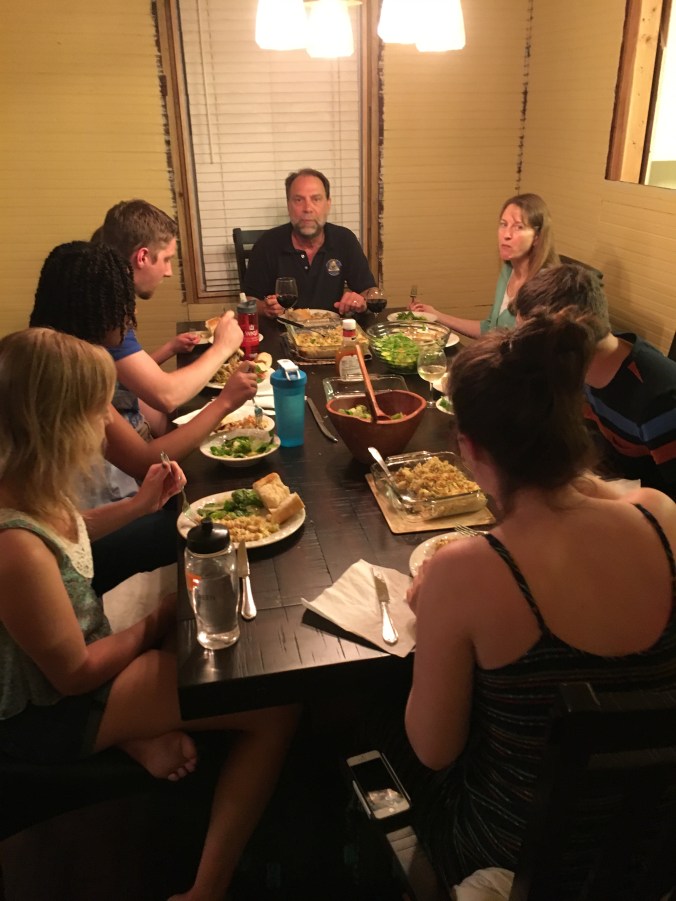
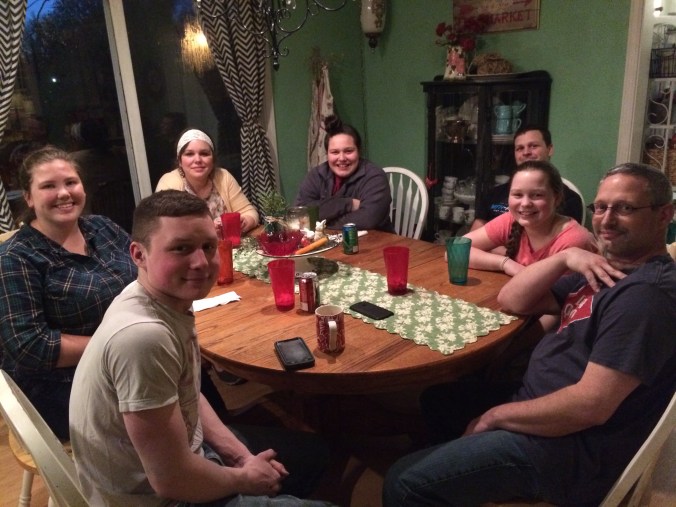
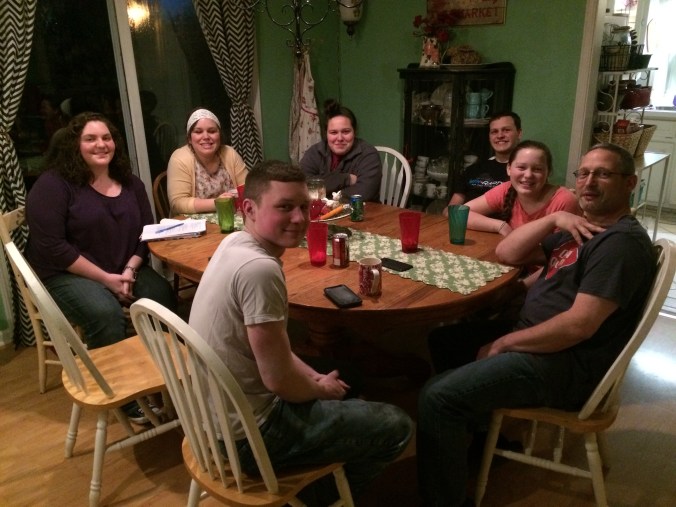
My Kentucky Kitchen Table took place right here in Bowling Green. My partner, Brittney, had relatives in town that graciously opened their home to us. Her aunt, Carly, prepared a delicious dinner of nachos and cupcakes. Raised the daughter of a caterer, her kitchen was a source of pride. Her kitchen belonged on a Pinterest board. Her husband, Mike, and their four children, James, 19, Jon, 17, Anna, 16, and Olivia, 14, also joined us for dinner. Carlee is a painter who also is a homeschool teacher to her children. Mike is the supervisor at a machine shop in town. James works in a granite shop in town. Jon is a senior in high school and works at Chick-fil-a. Anna is a junior in high school who enjoys baking. Olivia is a seventh grader who likes to write. Brittney is a freshman at WKU who is clarinetist in the Big Red Marching Band. She dreams of becoming an English teacher. I am a senior at WKU who hopes to be a physician. We each had varying religious and political views, but we found that we agreed on many topics. This is our table.

We began our discussion with a topic central to our HON 251 course: beyond voting, paying taxes, and following laws, what does citizenship mean to you? I was surprised by everyone’s responses. Overall, we agreed on what it means to be a citizen. Mike began our discussion stating that “[citizenship] means responsibility. In order to have rights, we have to have responsibilities like to protect and exercise them and share them with children and grandchildren. It also means sharing history and working to change laws to improve the community.” Being a citizen is an active role, if you choose to take it. Citizenship is not only caring for the current community, but preparing for the future community. We also agreed that communities can overlap or even be nested inside one another. A neighborhood is a community that is nested inside a community of a town or city. It is our role as citizens to foster each of our communities.

Our next question in the discussion asked what we can do as citizens to create these communities that we want. Anna provided an excellent example of how to grow a neighborhood community. “One way we help our own neighborhood is helping our elderly neighbors. We get calls asking to help them, say, get their mail and we go over and do it.” By serving members, like the elderly, connections are formed promoting growth towards the ideal community. Another aspect of community growth concerns the economy. By opting to buy goods and services within your community, it will grow. A large aspect of community economics is word of mouth. In my family’s small canoe and kayak rental business, 90% of our business comes from word of mouth.The community is advocating for the business and helping it to grow.

In relation to what kind of community would we like, we also discussed the best things about the world as a whole and what community we would like to live in. Carly believes service to others is the most important quality any person or community can possess.”In world relations, we should have a charitable attitude. You should help your neighbor. For example, James will help you out if there’s something wrong with your car or even help you with building things in your home. Jon can fix your computer problems, and both can do those because they followed their father’s footsteps.” We use the skills we have to better the community we live in. Jon believes “each person has abilities, and no one can do everything. It has to be a situation within your means, but we need to take care of each other.” Olivia believes we need to celebrate our differences.

Our conversation turns slightly to our next question. How do you think your job relates to your role as a citizen? A a Chick Fil A associate, Jon feels that it is his role as a citizen interacting with the public “to enjoy the day with people in good moods and uplift those having bad days.” Carly believes that no matter a persons job, they should display excellent leadership as well as citizenship. If we want our community to reflect ourselves, we need to be the best versions of ourselves at work and at home. This applies to management positions as well. Be the kind of boss you would like to have. By providing quality goods and services in your job, the community can grow to be its best self. For those of us who work in the education sector, our job is to promote the future of the community. Teachers train young minds to later make a difference in their community. Students learn, so that they can one day be productive members of society. This course, HON 251, is a perfect example of the symbiotic relationship between education and citizenship. Brittney stated, “this class is a great starting point to learn about citizenship, and encounter new ideas to form my opinions.”

We also discussed how our religious beliefs affect our role as citizens. Jon put it best in saying, “if you believe something, you shouldn’t have to say it. It should come through your words and deeds.” Faith guides people to help their fellow man. Actions speak louder than words. This was the only portion of our discussion where viewpoints differed. I would not consider myself religious, and as such, my actions are not die to religious reasons. As citizens, we have to respect differences of opinion and religion. We need a community that accommodates many view points, so its members do not feel ostracized by any one group.

Finally, we discussed our closing thoughts and reflections. Overall, this was a positive experience. It was nice to have an open honest, discussion about varying viewpoints. I hope to have discussions like these in my own home one day.
IMG_5650

Kentucky Kitchen Table Dinner in North Carolina

By Ian

0312161821

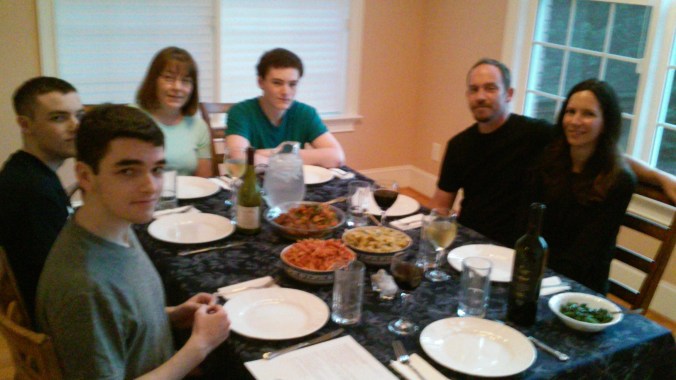
I held my Kentucky Kitchen Table Dinner at my house in North Carolina. In attendance was (from Left To Right) Robert (Not pictured because he was taking the picture), Me, Jacob, Marilyn, Thomas, Brian and Katherine. Robert is my Dad. He works at Wells Fargo. His diet mostly consists of meats such as steak, hot dogs, hamburgers, chicken, turkey and fish. Marilyn is my Mom. She used to work at the Federal Reserve with my Dad but stopped working after my older brother was born. Jacob is my older brother. He currently attends Northeastern University in Boston. He has split time between taking classes and doing co-ops with companies in the field of chemistry. He’s not particularly talkative. Thomas is my younger brother. He is currently a sophomore in high school and isn’t very fond of school. Thomas is also a teacher assistant at religious school. My Dad, Mom, and brothers are all Jewish (with varying degrees of how religious they are). Katherine was recently hired by my Dad to work with him at Wells Fargo. Brian is Katherine’s husband. Brian and Katherine are vegan. We had pasta for dinner because that was something that everyone could eat. My parents insisted on cooking dinner so it would be acceptable to everyone.

During the dinner, we talked about being obligated to do things to help other people in the community. We didn’t list out any specific obligations because we believed that everyone should do what they could. It didn’t make sense to us to force people to do things because everyone has their own needs and responsibilities. We also recognized that different people in different communities have different needs and so not every community needs the same form of help. This ties into our discussions of Jane Addams and how she tried to help the immigrant communities in Chicago and how some of the things she did didn’t work because she wasn’t understanding the needs of the community in some of her attempts for solve problems such as giving candy to children who worked in candy factories.

We also talked about the need for a better-informed democracy. Most of us were (and still are) very concerned about the rise of Donald Trump. My personal concern was that people don’t take the time to look at the candidates and learn about them. I had voted early in the North Carolina Primary that day. My Dad, who also voted with me on that day, didn’t take the time to look up the candidates so he just asked me who I was voting for while we were waiting in line to vote. While I was ok with my candidates getting an extra vote, my dad didn’t do his own research to see why I chose those candidates. Another issue that bothered many of the adults at the table was that people are not actually looking at the contents of the candidates messages and paying attention to the flaws in it, such as candidates wanting to do things that are not within their power or are against the law,  or that some of the language used is discriminatory towards minorities such as Hispanic immigrants, Muslims, or African-Americans. Some candidates have also been changing their positions wildly and sometimes within the course of a week. The anger felt by voters is reflected in the remaining candidates but clearly at a cost of candidate quality which we felt could be damaging to the country, depending on which candidate gets elected. Some candidates were viewed differently than others by different people. This relates to the lecture where we talked about local politics being reflective of national politics.

Kitchen Table in St. Augustine

By Ashton

[Our first “Kentucky Kitchen Table” was in St. Augustine, Florida with several students who attend school in Kentucky.]

At my Kitchen Table, there were ten total people.  My father, Allen, was there.  He works in Jacksonville at Commercial Diving Academy. It is a technical trade institute that teaches diving and underwater welding.  He works in the administrative side of the company. My mother, Ann, was there as well.  She is a proof-reader for various companies in Florida.  She was mainly a stay at home mother until my sister and I both graduated high school.  My dad invited Mark, one of his coworkers.  Mark has been working with my dad for the past 5 years.  He is in his mid-twenties and teaches one of the welding classes at CDA.  Lauren was another guest.  She is one of my mother’s friends and works at the library down the street from our house.  Lauren brought one of her coworkers, Stephanie.  Stephanie is from Gainesville and is currently in veterinary school. The rest of the guests I knew beforehand: Casey, Lataya and Brittany.  All four of us go to WKU together and they all came home with me for spring break.  Casey is from Northern Kentucky, but his family is from Italy.  Lataya is from Minnesota and is at WKU for the Forensics Team, like myself.  Brittany is originally from St. Louis but spent last semester studying in Morocco.

I was very excited for the start of the dinner.  I hoped that the group would mingle well and I was correct.  My college friends got along very well with my parents and their guests.  My house is somewhat small, so it was hard for everyone to cook their own dish.  Luckily, my parent’s friends brought dishes of their own.  Mark made an amazing pasta dish – he has strong German roots and made a family recipe.  Mark insisted on providing most of the food, he wanted to thank my dad for hosting the meal.  However, he did allow to Lauren to bring a salad that her mom taught her how to make.  Stephanie showed up cookies that were in the shape of dog biscuits; she wanted to represent her career.

Although I did have planned conversation starters, they were pretty unnecessary.  The conversation flowed very naturally.  When I brought up the topic of citizenship, it was interesting to hear everyone’s answers.  Mark and Casey both have immigrants in their immediate families, Mark’s from Germany and Casey’s from Italy.  They provided a new perspective about acclimating and adapting to a new country.  My parents have similar views that I also share, based on how they raised me.  They told me sister and me that citizenship was always about ensuring every person in our country feels safe and welcomed – regardless of their backgrounds.  Brittany was able to talk about her experiences in Morocco as an exchange student. Lataya spoke about being a black women in America and the challenges she and her family have faced over the years.  Lauren spoke of her job at the library and how she enjoys making people better citizens by aiding in their education.  St. Augustine has a very large school for the deaf and blind so she runs programs that aids in community outreach.

Religion was briefly discussed but not too much.  My family is Jewish so I believe that some of the guests may have felt uncomfortable discussing any other views.  While I do not believe that should have been the case, I do understand not wanting to potentially disrespect my parents in their home.  It would have been nice to be able to openly talk about other religions, but I will be able to do that at another time.  Politics were discussed for a bit of time as well.  I had just submitted my absentee ballot that day, so it was an easy conversation to bring up.  Surprisingly, everyone at the table had socialist democratic values.  Casey, Mark and my father have economic opinions that more easily follow the Republican party, but everyone was socially democratic.  I found that very interesting, especially considering the diverse jobs and home states.  This made talking about obligations to other citizens very easy – I think that people who identify socially with the democratic party have similar views on how to act as a helpful citizen.  Everyone was in support of resettling refugees, a topic that I brought up thanks to our social issues paper.

Not everyone at the table was used to so many people at one meal.  I grew up having family dinners every night but that was not the case for everyone else.  Stephanie grew up in a single parent household and had a very different childhood than the rest of us.  Lataya’s parents both worked full-time so it was rare for them all to share a meal together. Overall, this was a very enriching experience.  Not only did I learn to be very appreciative of having my friends and family at a meal together, but it was really nice to meet new people and share our thoughts on citizenship.  Talking about what it means to be a good citizen was something I had never done with my parents once I was in college and it was very interesting to have such a serious conversation with them.  It is refreshing to know that so many people, from differing generations and ethnic backgrounds, all have similar ideals on how to be productive in our society.

This is a picture from the dinner.  I did not want to tell anyone I was taking the picture so it would look more like a natural shot from the dinner, but both of my parents saw it happening.  Clearly not in enough time to smile, but I still liked the picture enough to keep it.  You can see the pasta dishes(there were two because Mark knew Stephanie is vegetarian so he made on meat-free) and the salad Lauren brought.  My dad is at the head of the table and then going right it is my mom, Casey, Lauren, Stephanie, Lataya, Mark and Brittany.  Mark is very tall and pretty much covered Brittany in the picture.  I didn’t notice that at first or I would have taken a second picture.  It was a really fun group!

IMG_3083

Kentucky Kitchen Table Project

By Taylor

This semester I had the privilege of eating several meals at Sean’s home. Sean is employed locally and is married with three children. With me was Seth, Taylor, Alec, Brandon, Brent, Bradley and Andrew all of whom are college students varying in age and background. Seth is a entrepreneurship major from Lexington, Taylor is a civil engineer from London, Alec is a math major from Indianapolis, Brent is a Health Care Administration Major from Winchester, Bradley is a finance major from Louisville, and Andrew is a finance major from E-town.

The purpose of us meeting throughout this semester is all a part of Shawn’s ministry. He devotes a few hours out of his week to invest into young men in the WKU community to engage in conversation about leadership, fatherhood/manhood, and faith. I was hesitant at first to use this as my Kentucky Kitchen Table project, but I figured that the purpose of this project was to interject myself into an environment that stimulated conversation about my role in society. I believe that this opportunity did just that.

On many occasions I asked Sean specific questions about his role as a professional, father, and member of a community. Specifically, I was really curious about his role in his job and his balance between professional life and his role as a father and husband. I also asked questions that had to deal with how he reacted to problems in his work environment, where he may have had a specific vision about a solution to a problem but one of his coworkers had a conflicting vision. Many of our conversations quickly led into examples of how he had approached an issue that had risen in the past and how he handled it as well as how he could’ve handled it better.

His solution to many of these problems was very simple. He continually talked about the existence of boundaries within relationships, both professional and personal. Personally, we need to have boundaries with those close to us. We have to recognize the things that we own and the things that we don’t. We own our time, we own our feelings and emotions, but we don’t own other people’s feelings and emotions. Likewise, with professional relationships there needs to be boundaries that funnel interactions towards a more productive and goal oriented environment.

This separation, in my opinion, can easily be applied to some of the central ideas of this class. When we can separate ourselves as individuals first and foremost and then recognize our role in society, I think that we can begin to make a difference on small step at a time. This idea coincides well with the Energy Diet reading which I enjoyed very much. If we can all recognize and take responsibilities over our needs as individuals we can then start making movements outwards towards larger scale issues. However, if we lack a responsibility for ourselves it only makes sense that we would fail to take responsibility over something larger than ourselves, much less something as large as society as a whole. I think during our exercise with the vulnerability questions, we saw that our problems aren’t exactly that unique. What sets some people apart from others, however, is how they own their problems. Do they blame it on other circumstances or do they accept them and attempt to better their situation? I think this is a key understanding to the idea of citizenship. That we all have problems and issues but when we can own them and look outward we can start becoming a part of society and start making it a better place.Image-1.png

Welcome to Kentucky’s Kitchen Table

Kentucky’s Kitchen Table is a project of Citizen and Self, a class in the Mahurin Honors College, and the Department of Philosophy and Religion at Western Kentucky University. Students gather together friends, family, and neighbors to have conversations around the kitchen table about what matters to them and what it means to be part of a community. As of Summer 2019, over 1800 Kentuckians in 70 towns and cities across the state have taken part in our Kentucky Kitchen Tables. Here you can see some pictures from the shared dinners, and read about what people learn when they gather together for conversation about who we are and who we want to be.

Screen Shot 2016-01-18 at 3.07.58 PM