Kentucky Kitchen Table – Bowling Green

By Trevor

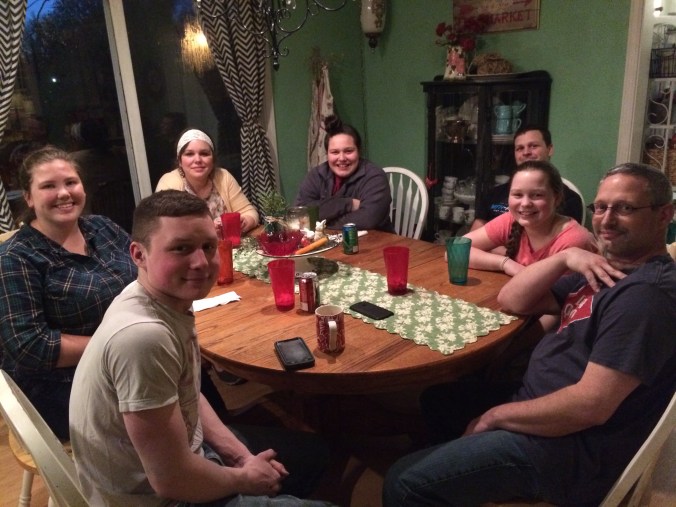
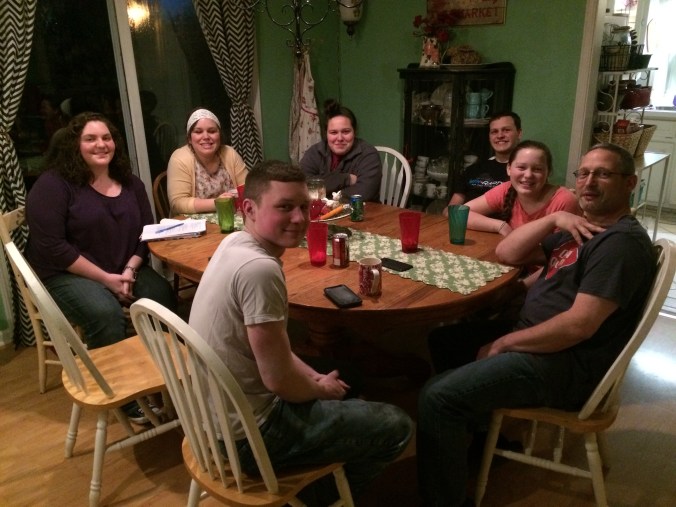
My Kentucky Kitchen Table project took place in my own home in Bowling Green, Kentucky. My parents insisted on cooking the entire meal for our guests. My parents were super excited to have people over for dinner because we don’t often do. I invited a couple of my friends, our neighbors, and the majority of our other guests were friends and colleagues of my mom. First, we have my friends Conner, Abby, and Shelby. I’ve known each of them for many years, and we’ve went to many of the same schools. Now, Shelby lives in Nashville and attends Belmont, Abby attends SKYCTC, and Conner goes to WKU with me. Next, we have my neighbors Vickie and Brian. My mom’s friend and coworker Stephanie joined us, and she brought her son Corey. I had never met them before, but she is really good friends with my mom. Corey ate with my little brothers and sister, but they aren’t pictured in the photo. My parents not only cooked, but ate with us and contributed a lot to the conversation.

To start things off, we went around and told each other where we worked and what we did, and each of us answered the question about how each of our jobs relate to our roles as citizens. It just so happened that my mom, Stephanie, and Vickie all work at the hospital, but they all work in different departments and do different things. They all talked about how they feel that their jobs relate to their roles as citizens because they help other citizens in times of need such as when they are sick or are having a baby. Abby talked about how she keeps score for many kids’ sports teams in our community, which makes it possible for them to get out and play with each other. Conner works at a vets office. She absolutely loves it. She hopes to one day be a vet, and she is currently working as a kennel worker gaining knowledge and experience. My dad teaches architecture and drafting at the tech school in Russellville. Brian works at the Kobe aluminum plant, and Shelby thought that was quite interesting because her dad works at Logan aluminum. When we asked Brian what he did at Kobe, he said “I run a daycare… no actually, I manage a group of 6 or 7 people, but it often feels like I’m running a daycare.”

The conversation soon shifted to us discussing the reasons why we enjoy living where we do. Having came from small towns such as Tompkinsville and Scottsville, Vickie, Brian, my mom, and my dad all agreed that the reason they moved to Bowling Green was because there are many more job opportunities here and “there is everything you would ever need here,” said Vickie. Vickie also said she loves Bowling Green because it is a big enough city, but still small enough to have that hometown feel without a lot of traffic. Shelby made a lot of good points when she talked about how there isn’t a lot of crime in Bowling Green compared to other cities such as Nashville where she lives now. She said she also liked living in Bowling Green because the sales tax is lower in Kentucky. During this discussion, Abby finally realized why her McDonald’s Sweet tea was $1.06 in Kentucky but $1.10 or $1.09 in other states like Tennessee. Her mind was blown. It was hilarious. We all came to the conclusion that the cost of living is a lot lower in Bowling Green and most parts of Kentucky compared to other places in the United States. My dad talked about how blessed he feels that he is living in the United States. He talked about how grateful he is that he can have as many kids as he wants, and choose his occupation, and just other simple freedoms that we often take for granted and others in the world don’t have.

My family has always sat at the dinner table each and every time we ate dinner at home. It is something that I have actually always enjoyed, even as a kid. For this reason, I was interested in finding out if other families in Bowling Green did this as well. Abby told us that her family usually eats in the living room but they are usually still all together and watching a sports game. Both Vickie and my mom talked about how when they were younger they sat at the dinner table. When they got married, they usually ate wherever, but once they had kids, they made it a New Year’s Resolution one year to eat dinner each night as a family at the table, and it just kind of stuck, and it has been that way ever since. Brian said that as a child, his family ate dinner in different locations in the house, but now that his family sits at the table each night, he really enjoys it a lot more. He talked about how it was really the only time to actually be able to catch his kids and talk to them since all their schedules were so different.

As everyone started to finish their dinner, we decided to discuss the final question of what does citizenship mean to you. Conner and Abby’s responses were simple yet important. They said that they believed it to just being a part of the community, caring for others, and doing your part. Shelby talked about how she felt it was “being responsible for yourself as well as others in the community.” “It’s a whole system and we all have to contribute to make it work.” Finally, my dad made some good points when he related to himself. He talked about how citizenship is being a part of something bigger than what you could accomplish on your own. “I can’t build a road from here to Russellville to get to work and teach students, but I pay taxes so others will build the road for me. Now, I can get to work in order to make money to provide for my family while the construction workers were also making money to provide for theirs.”

Conversations like these are actually not uncommon in my family. Sometimes we talk about some pretty serious things, especially when it comes to the news and what’s going on all over the world. However, it was interesting to get some new people’s opinions on some very important topics.
KKT


Kentucky Kitchen Table in Bowling Green

By Brittney

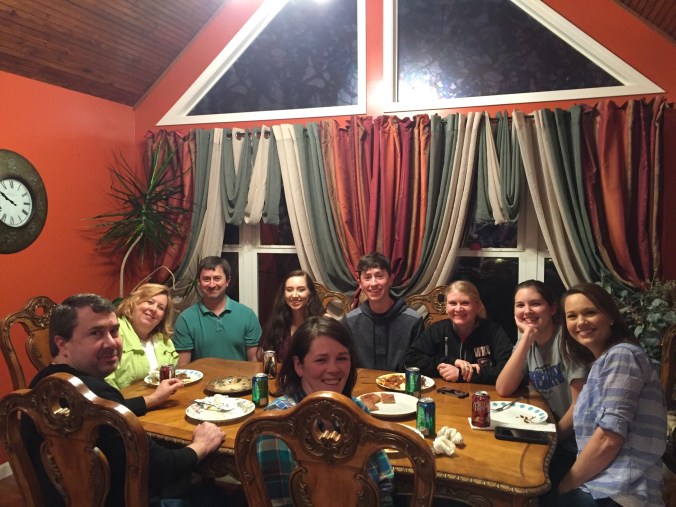
My partner, Callie, and I went to Mike and Carly’s house (because of scheduling changes, Callie’s friend was unable to come). They are my aunt and uncle, but I thought it would be neat to have a discussion with them, because they are extremely religious. Mike works at CGS Machine and Tool and is a WKU grad. Carly is an artist who owned a business with another painter and recently opened a store in downtown Franklin. They have four kids, three of which are home-schooled. James is 19, works at Southern Kentucky Granite, and loves working on trucks. Jon is 17, works at Chick Fil A, and is being called into ministry. Anna is 16, loves to bake, especially pies, and will graduate high school early. All three love playing basketball. Olivia is 14 and is artistic like her mom. Callie and I sit across from each other in class and didn’t know anything about each other. She is a senior and will take a year off before medical school because she aspires to be a physician. She has multiple jobs and is “just trying to figure out life.” She is not religious, describing herself most likely as agnostic, so we were able to get different points of view during the discussion.

Carly insisted on fixing nachos for dinner, which we finished before taking the pictures. After eating, we started the discussion by asking the first question (What does citizenship mean?) and saw where the conversation went. Each person’s view came out in his or her answer. Mike said it meant responsibility to your community and country and “sharing history and working to change laws to improve the community.” Mike’s dad and brother served in the military so he believes we have to protect and exercise our rights and share that history. As an educator and active community member, Carly said, “teaching and participation.”  Callie said it is “fostering the community you want to live in,” which makes sense because she has different jobs like the manager of a water park who trains lifeguards who care for the public’s safety. We then discussed how to create the communities we want. Anna said she creates her community by helping her elderly neighbors with daily tasks. We all agreed that helping people is important and helps create the communities we want, and it takes all people with all abilities. Each member of the family has different abilities. Some are athletic, some are fixer-uppers, some are cooks, and some are great with technology, and each person tries to utilize his or her talents. Callie wants to use her skills and dedicate her life to helping people in the medical field and I want to help students by being a high school teacher.

As we discussed helping others, I brought up the video we watched in class of the girl being run over. I asked if we have an obligation to help others. Callie believes people are fundamentally selfish and must overcome that instinct. We should help people but we do not have any actual obligation, and I agree with her view. However, as a Christian, I understand Jesus expects us to help others. My family spoke strongly with the belief that we do have an obligation. Jon said it is a conviction and James said “If a person can ask for help, help him. If he cannot ask for help, definitely help him.” Anna said that they have been blessed so it is their job to pass on the blessing.

We continued discussing ways to help others in their neighborhood and workplaces. It reminded me of the recent reading “The Energy Diet.” Andrew Postman takes small steps to reduce his family’s harm to the environment. His small changes added up and led to a few other small changes. I believe that my cousins take small steps each day to share their faith and better their community, and I think those actions encourage others to take small steps, too. Jon mentioned how he can be the difference in a customer’s day and while at work, he tries to take initiative and do what needs to be done. Mike discussed how he must monitor his actions and reactions as a supervisor. He must show respect and keep his emotions in check. James said he follows his motto, “Do the best you can, because that helps the community. Callie discussed her jobs both at the water park and in the Communication Department. She monitors her words and actions, too. I’m a student but I try to help my friends, peers, and others on my residence hall floor.

I asked the question “Does your religious identity relate to your role as citizen in any way you haven’t mentioned?” in order to hear their specific thoughts, because I could hear their faith in all their answers. Jon said, “If you believe something, you shouldn’t have to say it. It should come through your words and deeds.” And it sure did. That is why they focus so intensely on helping others. It reminded me of the early reading “If It Feels Right.” Young adults were asked about morals and right versus wrong, and responded that it is an individual decision. Everyone has different views, experiences, and beliefs, so it is up to each person to decide. My cousins are a different story, though. They are firm in their beliefs, which is admirable, but can come across as judgmental. They typically believe there is a right and wrong, so I wonder how they would operate in situations with gray areas.

My family said they usually have in depth discussions about tricky subjects like this, so it was not unusual for them, but it was fun. I enjoyed listening to their opinions which I typically don’t hear and learning more about them. I also enjoyed getting to know Callie more and hearing her views. I thought this was an enjoyable activity and hopefully I can create conversations like this with my immediate family, friends, and neighbors at home.

Kentucky Kitchen Table in Bowling Green

By Callie

IMG_5649

My Kentucky Kitchen Table took place right here in Bowling Green. My partner, Brittney, had relatives in town that graciously opened their home to us. Her aunt, Carly, prepared a delicious dinner of nachos and cupcakes. Raised the daughter of a caterer, her kitchen was a source of pride. Her kitchen belonged on a Pinterest board. Her husband, Mike, and their four children, James, 19, Jon, 17, Anna, 16, and Olivia, 14, also joined us for dinner. Carlee is a painter who also is a homeschool teacher to her children. Mike is the supervisor at a machine shop in town. James works in a granite shop in town. Jon is a senior in high school and works at Chick-fil-a. Anna is a junior in high school who enjoys baking. Olivia is a seventh grader who likes to write. Brittney is a freshman at WKU who is clarinetist in the Big Red Marching Band. She dreams of becoming an English teacher. I am a senior at WKU who hopes to be a physician. We each had varying religious and political views, but we found that we agreed on many topics. This is our table.

We began our discussion with a topic central to our HON 251 course: beyond voting, paying taxes, and following laws, what does citizenship mean to you? I was surprised by everyone’s responses. Overall, we agreed on what it means to be a citizen. Mike began our discussion stating that “[citizenship] means responsibility. In order to have rights, we have to have responsibilities like to protect and exercise them and share them with children and grandchildren. It also means sharing history and working to change laws to improve the community.” Being a citizen is an active role, if you choose to take it. Citizenship is not only caring for the current community, but preparing for the future community. We also agreed that communities can overlap or even be nested inside one another. A neighborhood is a community that is nested inside a community of a town or city. It is our role as citizens to foster each of our communities.

Our next question in the discussion asked what we can do as citizens to create these communities that we want. Anna provided an excellent example of how to grow a neighborhood community. “One way we help our own neighborhood is helping our elderly neighbors. We get calls asking to help them, say, get their mail and we go over and do it.” By serving members, like the elderly, connections are formed promoting growth towards the ideal community. Another aspect of community growth concerns the economy. By opting to buy goods and services within your community, it will grow. A large aspect of community economics is word of mouth. In my family’s small canoe and kayak rental business, 90% of our business comes from word of mouth.The community is advocating for the business and helping it to grow.

In relation to what kind of community would we like, we also discussed the best things about the world as a whole and what community we would like to live in. Carly believes service to others is the most important quality any person or community can possess.”In world relations, we should have a charitable attitude. You should help your neighbor. For example, James will help you out if there’s something wrong with your car or even help you with building things in your home. Jon can fix your computer problems, and both can do those because they followed their father’s footsteps.” We use the skills we have to better the community we live in. Jon believes “each person has abilities, and no one can do everything. It has to be a situation within your means, but we need to take care of each other.” Olivia believes we need to celebrate our differences.

Our conversation turns slightly to our next question. How do you think your job relates to your role as a citizen? A a Chick Fil A associate, Jon feels that it is his role as a citizen interacting with the public “to enjoy the day with people in good moods and uplift those having bad days.” Carly believes that no matter a persons job, they should display excellent leadership as well as citizenship. If we want our community to reflect ourselves, we need to be the best versions of ourselves at work and at home. This applies to management positions as well. Be the kind of boss you would like to have. By providing quality goods and services in your job, the community can grow to be its best self. For those of us who work in the education sector, our job is to promote the future of the community. Teachers train young minds to later make a difference in their community. Students learn, so that they can one day be productive members of society. This course, HON 251, is a perfect example of the symbiotic relationship between education and citizenship. Brittney stated, “this class is a great starting point to learn about citizenship, and encounter new ideas to form my opinions.”

We also discussed how our religious beliefs affect our role as citizens. Jon put it best in saying, “if you believe something, you shouldn’t have to say it. It should come through your words and deeds.” Faith guides people to help their fellow man. Actions speak louder than words. This was the only portion of our discussion where viewpoints differed. I would not consider myself religious, and as such, my actions are not die to religious reasons. As citizens, we have to respect differences of opinion and religion. We need a community that accommodates many view points, so its members do not feel ostracized by any one group.

Finally, we discussed our closing thoughts and reflections. Overall, this was a positive experience. It was nice to have an open honest, discussion about varying viewpoints. I hope to have discussions like these in my own home one day.

IMG_5650

Kentucky Kitchen Table Project

By Taylor

This semester I had the privilege of eating several meals at Sean’s home. Sean is employed locally and is married with three children. With me was Seth, Taylor, Alec, Brandon, Brent, Bradley and Andrew all of whom are college students varying in age and background. Seth is a entrepreneurship major from Lexington, Taylor is a civil engineer from London, Alec is a math major from Indianapolis, Brent is a Health Care Administration Major from Winchester, Bradley is a finance major from Louisville, and Andrew is a finance major from E-town.

The purpose of us meeting throughout this semester is all a part of Shawn’s ministry. He devotes a few hours out of his week to invest into young men in the WKU community to engage in conversation about leadership, fatherhood/manhood, and faith. I was hesitant at first to use this as my Kentucky Kitchen Table project, but I figured that the purpose of this project was to interject myself into an environment that stimulated conversation about my role in society. I believe that this opportunity did just that.

On many occasions I asked Sean specific questions about his role as a professional, father, and member of a community. Specifically, I was really curious about his role in his job and his balance between professional life and his role as a father and husband. I also asked questions that had to deal with how he reacted to problems in his work environment, where he may have had a specific vision about a solution to a problem but one of his coworkers had a conflicting vision. Many of our conversations quickly led into examples of how he had approached an issue that had risen in the past and how he handled it as well as how he could’ve handled it better.

His solution to many of these problems was very simple. He continually talked about the existence of boundaries within relationships, both professional and personal. Personally, we need to have boundaries with those close to us. We have to recognize the things that we own and the things that we don’t. We own our time, we own our feelings and emotions, but we don’t own other people’s feelings and emotions. Likewise, with professional relationships there needs to be boundaries that funnel interactions towards a more productive and goal oriented environment.

This separation, in my opinion, can easily be applied to some of the central ideas of this class. When we can separate ourselves as individuals first and foremost and then recognize our role in society, I think that we can begin to make a difference on small step at a time. This idea coincides well with the Energy Diet reading which I enjoyed very much. If we can all recognize and take responsibilities over our needs as individuals we can then start making movements outwards towards larger scale issues. However, if we lack a responsibility for ourselves it only makes sense that we would fail to take responsibility over something larger than ourselves, much less something as large as society as a whole. I think during our exercise with the vulnerability questions, we saw that our problems aren’t exactly that unique. What sets some people apart from others, however, is how they own their problems. Do they blame it on other circumstances or do they accept them and attempt to better their situation? I think this is a key understanding to the idea of citizenship. That we all have problems and issues but when we can own them and look outward we can start becoming a part of society and start making it a better place.Image-1.png