A Kentucky Kitchen Table in Sparta

By Shelby

My Kentucky Kitchen Table took place on my family farm in Sparta, Kentucky. Sparta is a very small town in rural Gallatin County, the smallest county in Kentucky. To give you a feel for my county, there is one school in the entire county and the residents create a tightknit hometown community. Local businesses paint their windows in support of the high school football team every Friday night. Nearly all of Gallatin County can be found on the Ohio riverfront every Fourth of July for a celebration and fireworks. Farmland and fields stretch for miles on the outskirts of the small towns, my home being one such farm.
Over fall break, I went home and invited coaches and players from my high school’s girls soccer team to come to my dinner. My dad started the program several years ago, and continues to coach but has recently gained two assistant coaches. It was previously agreed that my mother and I would prepare a meal of baked chicken, green beans, macaroni and cheese, garden salad, and dinner rolls, and this was shared with my parents, Rick and Shelia, as well as, Nate, Kelsey, Hannah, and Angie. Rick is a dentist and a farmer, while my Shelia works at the front desk of his dental office. Both are college graduates who moved from Louisville, Kentucky to Sparta and have become active community members through church, are involved with the local school system, and have served on various community boards. They have spent many years coaching recreational sports for youth in our community, myself and my brothers included.
Nate and Hannah are the assistant soccer coaches. This previous season was their first season of coaching, so while I was somewhat familiar with Hannah who is a teacher at the local high school, I had not met Nate prior to their season. Nate works at one of the steel manufacturing plants in Gallatin County and has been a lifelong county resident who attended school in the Gallatin County School District many years ago. His daughter, Kelsey, is a freshman at Gallatin County High School and plays on the soccer team. Hannah is a special education teacher at Gallatin County High School and is originally from Norwood, Ohio. She attended Xavier University and moved to Gallatin County upon gaining a teaching position. Angie is from Mexico and moved to Kentucky with her family several years ago. She is a high school freshman, but she attends the ILEAD Academy which is an accelerated program that allows high school students to take college courses and earn a bachelors degree within two years after graduating high school.
As none of the unrelated individuals who came to my Kentucky Kitchen Table had previously been to my house, the Kentucky Speedway across the road from my house was an immediate topic of conversation. The placement of the racetrack in Gallatin County was a controversial topic when it was established and remains as such today. Many believed that such an attraction would bring economic growth to the county, and while it has been productive in many ways, it has also brought complications to the rural county. We discussed how the Kentucky Speedway hosts only two races a year and occasionally hosts charity events such cancer walks and car shows. While the Nascar races attract fans from all over the country, boosting businesses for a few days, Gallatin County does not have the facilities nor the infrastructure to host this influx of people. Traffic is atrocious on race days and intoxicated individuals flood the roads at the conclusion of races, causing headaches for locals and the police department.
The Speedway is an example of experts who lacked the knowledge and experience of life in Gallatin County making decisions for the community. The good intention of bringing economic growth and development to the rural county actually exacerbated problems, similar to the concepts discussed in Ivan Illich’s “To Hell with Good Intentions.” Initially, my guests thought it would be fascinating to live so close to a landmark like the Speedway, but upon learning of the problems that accompany the racetrack, they decided it might not be as exciting as they originally thought.
Our discussion transitioned to school and the role of technology, as well as, its affects on how students interact and complete school work. During the 2016-2017 school year, all students in the local high school were provided with Chromebook laptops in their One to One Program. Online classrooms have since been used to post assignments, provide additional resources, and reinforce concepts taught in the physical classrooms. This has given students access to classroom materials online and allowed the school to reduce paper expenditures. The computers also serve as a method for students to gain access to unlimited information and easy communication. While these seem like beneficial results of the One to One Program, Hannah discussed how she has noticed students lacking patience that might be traced to children being taught to want immediate gratification about their inquiries as a result of technology. The computers, in combination with personal cell phones, allow students to immediately find answers to questions and problems. While this is beneficial in many regards, as Hannah mentioned, it might reduce students’ capacities for patience.
This brought me to the “Power of Patience,” article by Jennifer Roberts we read and discussed in class about the teacher who gave her students the assignment of observing a painting for three hours. In this study, patience was used as a learning tool, and Hannah agreed that while technology has a very important role in classrooms, patience is also crucial to learning, as well as, developing social skills. She actually searched for an image of the Boy with a Squirrel painting, and I explained how it was created to represent the time it was meant to endure.
Following our conversation about school and the skills students gain or fail to gain in high school, I asked my guests what citizenship meant to them, beyond voting, paying taxes, and following laws. Shelia’s idea of citizenship revolved around being an active citizen in your own community by participating in community events and programs that might include volunteering at the food pantry or organizing sports for local children. She also believes that citizens should be responsible for being aware of current events and life around them. Nate used the current situation in the NFL concerning the decision of many players to kneel during the national anthem to help explain his idea of citizenship. As a member of the Freemason Society, he felt that it was disrespectful to the American flag and to the men and women who have served in the armed forces to kneel during the anthem. This topic has become very controversial across the nation as a whole. It began as a movement to raise awareness about racial tensions, but many believe it has developed into a protest to President Trump’s comments and behavior toward athletes in the NFL. Nate felt that citizenship should encompass a certain level of respect for one’s country, its values, and those who defend those values.
Rick suggested that citizenship was based on family and helping others. He believed parents should be involved in their children’s lives, teaching them to act responsibly, and individuals should help others if they are capable of doing so. He raised the topic of the Las Vegas Shooting that had recently taken place and mentioned how some people’s first reaction was to run to safety, while others immediately looked to protect people by ushering them to safety or laying over their bodies to shield them from the raining bullets. Those who put the needs and safety of others before themselves were demonstrating true citizenship in his opinion.
This led to a discussion about moral obligation, and I asked if we were morally obligated to help others and if so, to what extent were we obligated. The general consensus was that if you are capable of helping someone in need, you should help them. However, the proximity of the issue and any possible threat to one’s own safety were critical factors to be considered. I told my guests about the video of the young Chinese girl who was run over by the van and how everyone who passed her simply left her lying in the street. Kelsey found it hard to believe that no one would help the young girl, and it was suggested that the situation would be handled differently in America and likely most other countries. It is possible that children and the obligation to help others is seen differently by varying cultures. Hannah suggested that people are much more likely to help women and children than men because of a social notion relating children and innocence. People become more conscious of their own safety when grown men are involved, thus they are less likely to help an adult male.
I questioned if there was a difference in the moral obligation of helping someone you can see versus helping, for example, those forced to work in a sweat shop in another country to support themselves and their families. My guests said they would not necessarily feel obligated to help in this situation because different cultures have different issues, values, and standards of living.
After our dinner, we all went out to our barn, and Kelsey and Angie helped me feed chickens and horses. Because I graduated before they entered high school, I did not know them very well, and they had been quieter during dinner. Feeding the animals gave me an opportunity to share some of my experiences growing up on a farm with them. This interaction seemed easier for them to relate with, and Angie told us about her experiences raising chickens when her family lived in Mexico.
My Kentucky Kitchen Table allowed me to connect with people who I did not know particularly well and gain insights about topics that I had not previously considered. I learned that citizenship can embody numerous meanings, and those meanings largely depend on individual interpretations of the word. There was a general consensus in the idea that citizenship involved helping others in the community, and this concept would allow individuals to live better together, an idea central to our class. We can be better citizens by respecting the ideas and beliefs of others, helping those in need, and being active in our community. According to our Smart Communities reading by Suzanne Morse, individuals who are engaged in community affairs are more likely to take ownership of their community. This is crucial to living well with fellow citizens and might help us cross the bridge to where society should be with communities we are proud to call home.
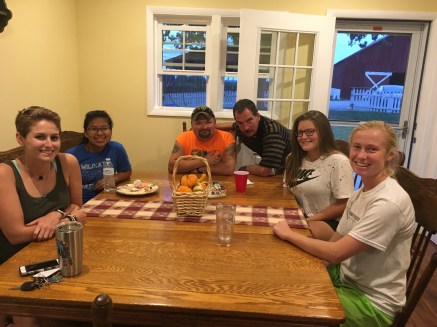
Not pictured in the image: Shelia

Working Past the Small Talk

By Lora

I had initially scheduled my Kentucky Kitchen Table with my best friend’s family who would have loved to participate, but unfortunately they had to cancel a week before our meeting. In a panic, I searched my mind for someone else I could have dinner with, and I decided on my high school English teacher who has a wonderful family, but on the day we were supposed to have our dinner, she canceled due to a family emergency.  At this point, I was concerned with what I was going to do. I had gone through my first option and a backup option, and I just had two days to find someone else. My last ditch effort was to sit with some people at my home church at a potluck that upcoming Sunday. I was feeling defeated, but I continued with the project and sat in front of the first  people I could. Little did I know that these people, who I wasn’t particularly close to, would give me new insight and a look into their lives. After having a meal with them, I felt a closeness and connection that was certainly not there before. Needless to say, they completely exceeded my expectations and gave me new concepts to think about.

I sat down with Mark, Ricky, Martha, and Tiffany. Mark, a local newspaper owner in his 40s, was the first to sit with me, and he seemed excited to participate in the project. Ricky, a retired mechanic, and Martha, who is an administrator, were a little less eager to participate. I told them about my project, and because we don’t know each other particularly well, I think they were a little hesitant. However, I was impressed on how quickly they came around. Tiffany, a nurse, is in her 30s practically jumped into the conversation once she knew what we were going to be talking about. I believe that this group of people is diverse because they come from different generations, and they are all in drastically different career paths. Their diversity, however, did not hinder their intellectual conversation, in fact, it may have just helped it.

“Beyond voting, paying taxes, and following the laws, what does citizenship mean to you?” With this question, Ricky and Mark did not hesitate. Their answer was “freedom” right off the bat. Mark, who went to West Point military academy and served in the army for five years, was very passionate about his answer. He felt that the sacrifice that our soldiers make to our country was the best aspect of our country, and his citizenship was based on that freedom. Ricky who served in the army as well, felt that without this freedom, our nation would be lost. Our rights of freedom of religion and speech are unique to us as a nation, and without these freedoms, citizenship would have a very different meaning.

As we progressed through the conversation and I asked some other questions, a common theme I saw was that each person believed in helping their neighbors. This wasn’t a big surprise to me because in our small town, community was everything. In 2008, a terrible tornado ripped through our town and destroyed or damaged hundreds of homes. Our community banded together and organized groups to gather, pack, and distribute supplies to the affected people. I don’t think anyone who was helping will forget the sense of community I know I felt that week of chaos. Mark shared a story of his parents and of a time when their health was going down. He said that the community helped so much by sending food and offering kind words. Tiffany shared a similar story of her mother-in-law. I steered the conversation towards a national focus, and  Ricky and Martha both felt that a good aspect of our nation is that we help each other. We talked about the efforts to help in Houston and Tiffany and Mark recalled the efforts to help in Florida and Louisiana when hurricane Katrina ripped through homes and other buildings. Martha knits prayer shawls for a ministry through our church, and she said that she finds comfort in knitting these shawls for people who needs them. I can recall the ministry sending some to Sandy Hook and many other people across the country. When I asked each person to reflect on their jobs and how that relates to their role in society, each felt that their contribution was helping others with their day to day needs. A writer helps keep citizens informed; a nurse helps people stay healthy so they can make their contribution to society; an administrator helps people stay honest; a mechanic helps people get to work to contribute to society themselves. I think this can be correlated to the central question of how can we live well together. If everyone could contribute a service, whether it be cooking a casserole or policing a town, the world would be a much better place. Every service touches someone in some way: the casserole may touch a grieving family and the police officer may find a little girl’s dog. These services, big or small, give people comfort and happiness, and I think if everyone was at least a little happy, we could start living better together.

When we started talking about obligations to others, I found that the conversation just took off. I asked the group if they felt that they had more of an obligation to their neighbors than to someone halfway across the world. In a reading that we have done, I learned that many people are more likely to be connected to something if it is in close proximity to them than farther away. I was expecting a similar answer from my group, but to my surprise they said that their obligation was the same. I was taken aback by this because it contradicted what I had previously learned, and I asked them to explain. Tiffany said that she felt the same obligation because everyone needs help and that that person on the other side of the world is somebody’s neighbor too, so we have an obligation to them as well. While on the subject of helping neighbors, we talked about some advice to give a neighbor. One common theme I saw was that they wanted their neighbors to try to help themselves before they asked for someone else’s help. I thought about this afterwards, and I thought how I would feel helping someone who really didn’t try to do anything for themselves. I think in that situation, I would feel aggravated, but then again aren’t the people who just accept their fate and don’t try to do anything about it the ones that need the most help? Someone who is driven and ambitious may just be able to make something on their own just from their sheer ambition, but someone who is hopeless needs someone to show them that same drive that can help them. Reflecting on this conversation after everything was said and done really gave me another perspective, and I think that was the main goal of this assignment.

We also talked about issues that are close to us, and Martha and Ricky, who are married, both felt very passionately about helping children who were unwanted by their families. Tiffany shared her interest in drug abuse, and I shared mine about drug companies taking advantage of senior citizens. As we each explained why these issues were important to us and posed facts and figures pertaining to these issues, I learned something. I learned a lot of things, actually. I learned a lot of things about a lot of different issues that I hadn’t thought of before just by asking to hear these people’s passions. This taught me that by simply asking we can find out information about important issues that we may have never heard before, and all it takes is one simple question! I think about friends I have who aren’t particularly passionate about any issue, but is that because they have never heard someone so passionate about something they can barely leave room for someone else to talk? What if we all had passions like the ones set before me? I think that people would find more ways to have more of a say over their lives if everyone was that passionate about issues that affect our society.

I started my meal almost hopeless because it seemed like hardly anyone was eating at the table anymore. I didn’t have very high expectations, and I was ready to get it over with. To my surprise, I emerged with a new understanding of the people that go to my church. I learned that these people who I have known for my entire life are caring and want to help other people as much as they can. I learned that they are passionate about children and drug abuse. I learned that they would help someone they did not know just as soon as they would help their next door neighbors. I learned that you don’t necessarily know someone because you see them every Sunday or you have the occasional small talk. You get to know people by asking them questions about their opinions and beliefs, and you ask them to explain so they feel understood. Through this project, I learned how to listen to my neighbors, how to discuss issues in our nation with people who may not have the same political views, and how to really get to know someone. IMG_2634

It’s All About Talking and Listening

By Caroline

When initially looking at the Kentucky Kitchen Table assignment, I knew that I would love to bring this fascinating project to my hometown because it would not only allow me to further my knowledge of this class but would expand my idea of people in my own community as well. With that being said, on fall break, Lebanon, KY was in for a delightful treat in my hometown household. Contemplating who I would invite, I wanted to bring a tasteful diversity to the table and immediately came up with a total of 5 people: my former AP Human Geography & Psychology teacher, Jamie, her husband, Chris, a woman in my community who is of Hispanic ethnicity, Kenya, and my mother and father, Jim and Sharon. To begin with, Jamie is someone I do know very well being that she is one of my past teachers, but she brings very diverse experiences to the group in the fact that she has traveled to many cultures around the world and has a large amount of knowledge regarding the potential topics for the kitchen table. Her husband, Chris, is someone I do not know very well, but I quickly realized that he has served in the army and brings a plethora of personal stories that added flavor to our discussions. I also invited Kenya who is a woman that lives in my community that I am not as familiar with, but she brought a very different perspective since she is of Hispanic ethnicity and has lived in both the United States and Mexico. Lastly, my mother and father attended and were both delighted to host this project in the welcoming hospitality of our home. My mother works in the emergency room in our local hospital, and my father is the loan officer and Vice President of a bank in my town. My mother, being the host, decided that she would make a meal which consisted of a scrumptious meat loaf, mashed potatoes, rolls, and green beans, but she said that if anyone wanted to bring a dish they could. Kenya made authentic Mexican chicken tacos with a side of guacamole, Jamie made a coconut bar dessert (which was a hit), and Chris made potato soup.  I quickly realized that it was very neat with the people that I invited because everyone who attended either didn’t know each other very well or were complete strangers, so it made the discussions that much more interesting.

To begin the conversation, I explained to the group what the Kentucky Kitchen Table was and what all it encompasses. My father then said the grace, and we began eating and talking right away. I commenced the discussion by introducing the first question regarding what citizenship means to us, beyond simply voting, paying taxes, and following laws. Jamie jumped right to the question in saying that citizenship comes down to being loyal to one’s country and truly holding everything that your country values close to your heart. However, Kenya introduced the idea that she has witnessed citizenship from an outsider’s perspective and a US citizen’s point of view as well because in Mexico, unlike the United States, people do not “hang the flag in every corner you turn” and are less likely to praise and show citizenship to their country. She noticed that as Americans, we show citizenship much more outwardly than other places. However, my father mentioned that “giving back to our country and community” is a definite way to show citizenship whether that is simply serving your community or even country. With that said, we realized that Chris has served in the army, and he shared many of his stories of his time serving the United States. One being, he was in Germany when the Berlin Wall was being taken down which was a very eye-opening experience for him. Through his experience, citizenship to him means wholeheartedly serving his country. With Chris talking about his time fighting for our nation, it quickly led to a discussion about gun violence with the recent horrific mass shooting that occurred in Las Vegas. Although we all tried to come up with solutions to this “wicked problem”, we each realized that there was no one solution. I explained to them that in class, we learned that there really is no solution to a wicked problem like mass shootings, only a better or worse, in that we can pull things from many different solutions to make things more suitable.

We also talked about our obligations to people in our community and people in other countries. The theme of this aspect of the discussion was along the lines of what we have said in class in the fact that we feel more obligated to those people in the closest proximity to us. However, Kenya explained from her perspective that we really do need to feel obligated to people of distant countries because she has witnessed the true condition that people in other countries are in and was once in similar conditions in Mexico. She explained that from truly living in those shoes, she sees that people coming to help other countries is something that is prayed for and the obligation should be there. She gave very vivid descriptions about the drug violence, the brokenness, and the poor conditions that overwhelmed her past country. This really opened my eyes because although in class we read the speech by Ivan Illich, “To Hell with Good Intentions” that ultimately explained that by entering another culture with the intent to do good, we are only doing more harm because we truly don’t understand the gravity of the situation. However, by hearing her personal, genuine story, I was able to see the opposing perspective realizing that maybe we do need to continue our “good intentions” in the pursuit to help others. My mother, with her huge heart, began to tear up after Kenya’s anecdote because she herself felt that as people we really do have an obligation to others but must understand to what extent we can truly help those around us. Jamie talked about her traveling experiences, mainly to China and how we simply don’t understand other countries until we step foot on their grounds. She explained that she honestly only knew about other places from what she had read from textbooks and heard by word of mouth, but quickly realized that by traveling to other cultures, she was able to understand the rest of the world better. I think that that really tied up our discussion because although we have so many wicked problems and are expected to show citizenship to our country, to truly be able to “live well or less badly together” we must understand the rest of the world around us which will overall add to our understanding of our obligations, our country, and even ourselves.

Overall, I really enjoyed this assignment more than I thought was possible. Coming home for fall break, this project added such a new, captivating experience to my time off, and the people who attended made the remark that they learned a lot and would love to do this more often. To sit down and have a real discussion with people was honestly remarkable because those types of things unfortunately don’t happen anymore because of the fast-paced world that we have become accustomed to. We were able to sit down free of technology and just speak honestly sharing our personal experiences and opinions with one another; it was beautiful. Through this assignment, I learned initially that if we would simply slow down each day and have patience to just talk about things, as discussed in the article, “The Power of Patience,” we could discover so much more and learn a vast amount of information about our world and those around us. By simply sitting around a table with somewhat strangers and those who I am closer to as well, I dug deeper into the world we live in and was able to deliberatively understand other people’s opinions and why they are who they are . I also learned that my perspective of the world around me isn’t all there is to be offered and that there is so much more to know than just what I have learned in the nineteen years I have been here. By having experience like Kenya in Mexico or like Chris in the military, we are able to understand even more about our world and through that, live a much more fulfilled life. I have learned through this project that one of the central ideas of our class “how do we live well or less badly together” is ultimately a mixture of many ideas. For instance, it takes understanding of many perspectives, actively speaking about issues, seeking a better understanding of the world around us, and simply being empathetic to listen to others’ opinions and experiences. We can’t simply go through the motions every day, we must do more and seek more out of our daily life and encounters, and through this assignment of casually talking around a kitchen table, I realized that time spent in conversation and listening to others is one of the most valuable aspects in our world today.FullSizeRender