Emma’s KKT

By Emma

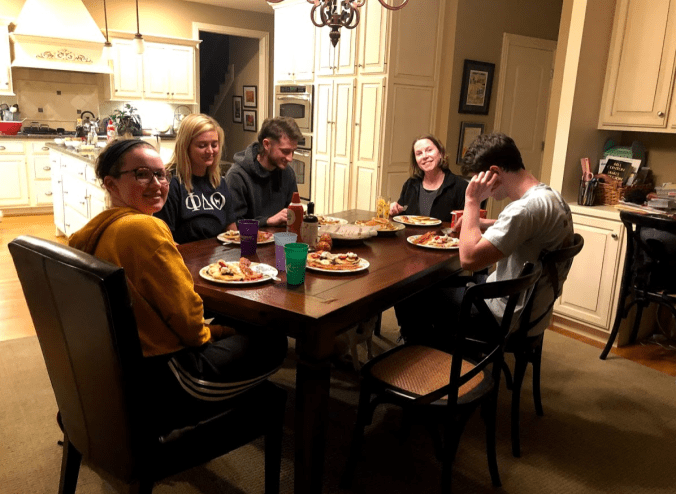
I went home to Louisville, Kentucky to host my Kentucky Kitchen Table Dinner. I invited my dad, David, sister, Sarah, brother, Andrew, and our neighbors Caroline and Sean. My dad is a dentist and leans more conservative. My sister is a nurse and considers herself an independent. My brother is a senior at the University of Louisville and is also conservative like my father. Our two neighbors, Caroline and Sean are more left sided and liberal. I tried to get a demographic of different views and perspectives to broaden the discussion.

I opened the discussion with asking all the members of the dinner to be respectful of everyone’s input and opinions. Sometimes family and friend discussions can get tense and carried off topic.

I began the first question by asking the required question, “Beyond voting, paying taxes and following law, what does citizenship mean to you?” Caroline was the first to jump in and replied with, “Everyone should bring something to the table to their community. It can be simple or small, big or inspiring. Contribution to your community and those around you is important as a citizen.” Andrew added onto the conversation, “I believe citizenship means serving your community on all scales.” The table discussion came to a consensus that contribution to one’s community whether it be voting, charity, one’s occupation, etc. is important regarding citizenship. We conversed that whatever one is motivated and inspired by should use that as a way to feed one’s environment and those around him or her.

I next lead the discussion with the question, “How do you think your job relates to your role as a citizen?” Sean commented and replied, “As an owner of a company, I feel that I am employing people and making their lives better. My company is big on including immigrants and connecting with charities such as Catholic Charities. Working with immigrants, I have learned how their work ethic is so vigilant and that is something as Americans that we can learn from. However, sometimes I do get distracted and involved in my own work that I forget that I do have a purpose as a citizen and to serve others within my job.” My sister, Sarah, added on, “As a nurse, I experience intense, critical medical situations where I am called to assistance. I think my job relates to my role as a citizen because I work to help and save lives every day. I work with families of patients admitted and console them in times of crisis. My job is stressful, but at the end of the day, I am happy to be contributing to peoples’ lives.” The table discussion agreed that having one’s job connect to one’s role as a citizen can be challenging at times. Many jobs in society to not work to serve others as a purpose of charity. However, we agreed that with the occupations all around the world, there is always room to be thoughtful in the way people go about their business. Even if it is as simple as making a work environment comfortable and friendly to all employees, that could be a way to be a way to relate a job to citizenship. Even better, people can get involved in charities and hands-on service within the field of their work.

The next question relates to the one above, “Do you see your job as serving a greater purpose?” My sister commented again on how her role as a nurse is self-explanatory in serving a greater purpose within the medical field. Caroline, who is in Graduate School for her master’s in psychology replied, “I chose this field to work with children and adolescents. I have always been interested in working with those from broken families and be an aid for them. I also want to work with the families as a whole who are struggling to help get to the root of the issues that continue to contribute to the cycle of family brokenness and abuse. I hope to bring a little light to their lives and help them understand that things can get better. I think my occupation serves a greater purpose by guiding, listening, and being there for those in need.” People intend for their jobs to have a greater purpose, but that is not always the case. Economic stability can be a big reason as to why people choose the professions they do. Although not all jobs serve a greater purpose, that does not mean one cannot be the best citizen he or she can.

Later in the table discussion, I told them about the LGBTQ+ deliberation I attended with my class. I told them about how it was about whether religious rights are accepted as to a way of discrimination of those with different sexual orientations. In addition, I told them about the fairness ordinance. I then asked the question, “Does your religious or spiritual identity relate to how you think we should treat other people?” Remaining on the topic of the LGBTQ+ community, my dad replied, “Growing up Catholic, homosexual people were not very accepted. It was rare to really know anyone homosexual—or at least homosexual people being ‘out.’ However, it was very interesting to see how socially accepting society became and still is becoming over the years. Being 53, I have noticed how generational views are regarding this issue.” The table conversation continued to discuss how religion connects to how people treat others. We agreed that it is easy to forget about religious values in treatment of others. Religious values do not always coincide with the actions of people.

The theme within the table discussion I found was individualism. Many topics referred to how a single individual decides to live his or her life and the values they choose to carry. We ended the table discussion talking about humans have intrinsic qualities that lead them to make the decisions they do. We conversed about how all actions relate to one’s own morals and what he or she believes is right. Because humans are inherent to the way they think, it is important for society to come together and listen to one another to come to consensuses on conflicts. Individuals will choose to make their own choices regardless of what may be right.

The Kentucky Kitchen Table Discussion taught me that it is important to have conversations like these with those in your community. I learned a lot about my family and neighbors. I learned the significance of listening to the thoughts and opinions of others that broadened my views. This discussion was very insightful to the idea that working with your community starts with simple conversations as these.

This talk connects with our course because I kept thinking about the central question, “How can we solve problems?” Solving problems begins with discussion and the sharing of ideas and opinions. This reminded me of the reading “How We Talk Matters” by Keith Melville. When discussing controversial issues or sensitive topics that have a broad range of opinions, it is crucial to be thoughtful of how we speak to one another. Keeping an open mind, listening, taking into consideration someone else’s position is all important when solving problems. Surprisingly, my table did a decent job of listening and understanding one another when sharing. The table conversation validated the claim in Melville’s piece that the way we talk truly does matter.
Becca’s Kentucky Kitchen Table

By Becca

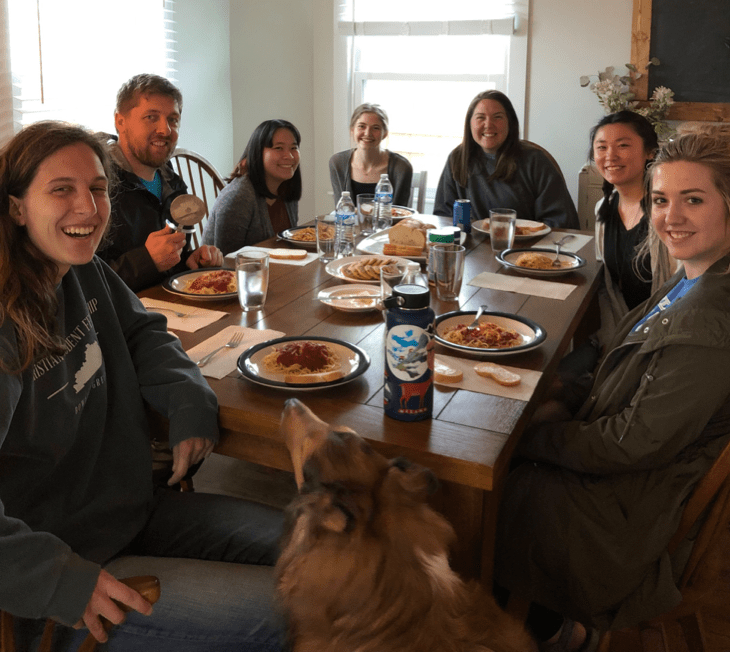
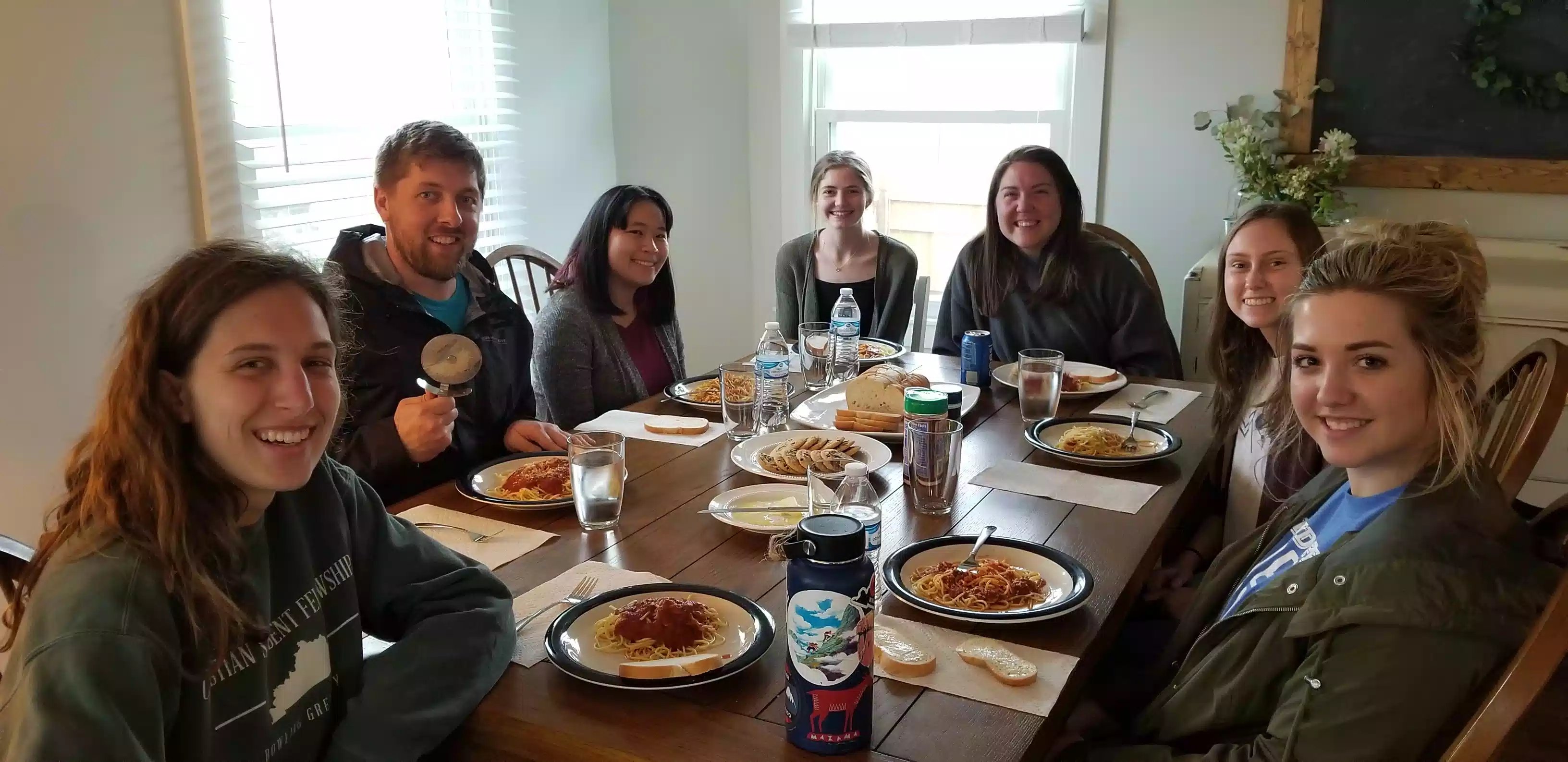
My Kentucky Kitchen Table took place in Bowling Green, Kentucky on March 25, 2019. My friend, Kelsi, was so kind and let me use her beautiful home to host the dinner. It proved to be incredibly difficult to get enough people to come, because most people anymore are too busy to make time for a sit-down, home-cooked meal together. Luckily, Kelsi invited a friend and her husband, both of whom I did not know very well. I ended up really enjoying this assignment, because I truly love the conversations that can develop when people are sharing food, and I enjoyed being able to host friends with unique personalities, thoughts, and opinions.

Kelsi’s friend, Callie, is in the bottom left hand corner of the picture. She works as a Christian Student Fellowship staff leader, and she is currently a senior at Western Kentucky University. She enjoys being outdoors and being with friends. Just to the right of Callie is Kelsi’s husband, Nathan. He also works at CSF, and is a landlord for Mimosa apartments. He brought lots of diversity to the table through his perspective as a boy and being full of energy. Next, is my roommate, Emmy. She is a student at WKU, and she loves to listen to music and play piano. She tends to be more on the quiet side, but her opinions introduced some new discussions to the table. Following Emmy is Liz, who is a forensic psychology and criminology major at WKU. Liz expressed many well-reasoned thoughts and opinions that really pushed the table to think deeply about issues. To the right of Liz is Kelsi. She works as a CSF staff leader. Her favorite things include photography, cooking, and talking to people. Beside Kelsi is Emmi. She helped with hosting the Kentucky Kitchen Table. Last in the picture is Haleigh. Haleigh is another freshman at WKU who loves to read and watch UK basketball. I am taking the picture. My name is Becca, and I am a freshman exercise science student at WKU with dreams of becoming a physical therapist. I am from Lexington, love my family, love hiking, and really enjoy spending time with my friends.

The making of the meal was really special to me. I brought ingredients to make a spaghetti dinner, so we all piled into the kitchen to cook the pasta and organize the sides onto plates. I think having a home-cooked meal was really important when it came to discussing community and citizenship.

The first question we discussed was “Beyond voting, paying taxes, and following laws, what does citizenship mean to you?” This question threw a curveball at Nathan, because his first reaction involved giving money to the government. Kelsi implied that being a citizen includes participation. It is possible to participate without merely voting, paying taxes, and following laws. It can also be becoming educated on issues. We used our table itself as a metaphor for citizenship because we actively participated in the conversation, and we even questioned Nathan’s citizenship when he left the table because it comprised his ability to participate in the conversation. Liz mentioned how participation as a citizen arises out of caring for your community and practicing activism. Everyone pretty much agreed that citizenship is a sense of belonging.

Following that question, we answered the question, “Do you know your neighbors?” This really livened the conversation because it stepped on the toes of every single person at the table, especially Nathan and Kelsi. They told us how they have been living in their house for six months now, and they still do not know their neighbors. They are not happy with that fact because their jobs are very relational, but sometimes when they come home, they forget to be a citizen in their neighborhood. Since Emmy and I are roommates, we discussed how we have some very interesting neighbors, but we don’t know any of them very well. Emmi and Liz mentioned the tough issue of the Minton shutdown and how that affected her ability to meet her neighbors. All of the freshmen at the table are now in different residence halls, and it is difficult to get to know neighbors that have already established themselves there. I learned that Nathan went to the same neighborhood Kroger in Lexington that I did. It was really interesting how he talked about riding his bike with neighborhood friends to go a get coffee from there. My childhood was nothing like that, and it was interesting to discover how today’s society does not value community involvement like it used to. In response to our favorite thing about living where we do, the table mostly threw out answers like having a bathroom and having space to host friends. We continued to talk about neighborly love by sharing what advice we would give our neighbors. For Emmi and I it was to turn the music down a little. Kelsi and Nathan just wanted a chance to meet their neighbors, so the table gave them ideas such as have a sweet tea stand to start up some conversations.

My favorite question that we talked about was “Who do you want to be?” Nathan immediately said he wanted to be a dog, because they are loyal and good. Kelsi said she want to look more like Jesus. Liz mentioned how she wants to be someone that makes changes and is not hypocritical. Callie profoundly said how she wants to actively live out what she preaches, which Nathan summed up very well as “Talk the talk, and walk the walk.” Everyone at the table strongly agreed that their religious and spiritual identity relate to how they see themselves as a citizen.

The ideas they shared reminded me of Jane Adams in “The Snare of Preparation.” In this article, Jane Adams talks about how she spent so much time preparing to help people that it took away from her being able to help people. Their idea is also very similar to what is discussed in Michael Pollens’ “Why Bother?” because it suggests the importance of practicing what you preach.

I learned how it is difficult for people in every walk of life to participate as a citizen, because while they may be well-intentioned, today’s society is not the best for forming community relationships and practicing citizenship.

Emmi’s Kentucky Kitchen Table

By Emmi

I held my Kentucky Kitchen Table in Bowling Green, Kentucky on March 25th, 2019. Eight people, including myself, sat down to a spaghetti dinner full of great conversation to come. Becca, another honors student, and I held our KKT together and invited our roommates, Emmy and Liz, acquaintances, Callie and Haleigh, and, of course, the lovely and gracious hosts of the home, Kelsi and Nathan. While all of us are Christians, everyone brought different experiences to the table.

Nathan and Kelsi are a married, non-college couple. Nathan grew up in Lexington and went to WKU where he met Kelsi; he is now a pastor at the Christian Student Fellowship (CSF). Kelsi grew up just outside of Cincinnati and moved to Bowling Green after college; now, she is a full-time staff member at CSF. Callie, a senior, is studying outdoor recreation administration and is also a staff member at CSF; she also has only bought ethically made clothing for the past two years. Haleigh, a freshman, is from a small town in Western Kentucky, is from a “nuclear” family, and is a pre-dental major. Becca, a freshman, is an exercise science major from Lexington and went to a private Christian school. Emmy, a freshman and Becca’s roommate, is a biochemistry and music major from Georgia and is an adopted only child. Liz, a freshman and my roommate, is a forensic psychology and criminology major from a part of Northern Kentucky that is known for the opioid epidemic. I am a biology and Spanish major from Bowling Green, Kentucky and am adopted with four other adopted siblings.

The dinner started off with a prayer and then went on to a conversation about using scissors to cut food, which then somehow lead to the question of “what does citizenship mean to you?” When I asked this question, I intentionally left off the “beyond voting, paying taxes, and following laws” part, so I could see what the first thing that popped into their minds was. Nathan was the first to respond with an answer that basically encompassed voting, paying taxes, and following laws; then, with a nudge from Becca, I asked the question again with the “beyond…” part. Kelsi mentioned being a part of a community and having a sense of belonging, which lead Callie to joke that Nathan wasn’t a part of our dinner community because he cuts food with scissors. Everyone else’s answers leaned towards being a part of the community with mentions of activism from Liz. She said that being a citizen encompasses activism, as in finding something that you’re passionate about and standing up for/doing something about issues.

The next question I asked was, “Do you know your neighbors? Why or why not?” Kelsi and Nathan said that they don’t know their neighbors that well; there’s a couple that they know well enough to smile at and have small talk with, but other than that they only know descriptive details about their neighbors. They moved into their home in August and were kind of shocked by how none of their neighbors greeted them and welcomed them into the neighborhood since both of them came from neighborhoods where you would go say hi to the new neighbors and introduce yourself. Then, everyone talked about their neighborhoods growing up, which ranged from close-knit ones with a lot of kids to not as close ones with no neighborhood kids. We then moved on to our neighbors in college, which brought up Moldy Minton. All of us freshman lived in Minton this past fall, and we said we don’t know our neighbors in our new residence halls. We all agreed that our first taste of college community was broken because of the unfortunate situation, and we discussed how we were getting comfortable with the people on our floors and in Minton itself. Now, we’ve been put into already established communities where we feel uncomfortable to disrupt their flow.

Some of the other questions I asked were, “What advice would you give to your neighbors?” to which Nathan replied, “Be our friends.” And, “What is the thing you love about living where you do?” Nathan and Kelsi both said that they love living close to downtown, Callie said she “loved” the hole in her bathroom ceiling, and Becca and Emmy said that they loved having their own bathroom. Another was, “Does your religious or spiritual identity relate to how you see yourself as a citizen?” which was answered with a unanimous yes. My last question was, “What kind of person do you want to be?” Everyone took their time for this one. Kelsi said that she wanted to be like Jesus; obviously, we all felt the same. Liz added that she wanted to be a Christian woman who is motivated and intelligent as well as compassionate and kind.

With the discussion of neighbors, I thought about the article, “How We Talk Matters,” and the question, “How do we live well together?” While Keith Melville focuses on American society in his article, his overall message is that all societies have disagreements, but in the way we disagree is what truly matters. In order to have a healthy disagreement or just a conversation, you have to listen politely, talk respectably, and submerge yourself into another’s point of view all while maintaining a leveled head. This whole view syncs perfectly with how we live well together; one of the major factors that affects how we live together is communication. For the majority of America, I think that since we are more oriented toward individualism, it’s, in a way, harder to have these deep conversations and make these connections with our neighbors or anyone for that matter. I think that the reason Kelsi and Nathan have struggled to form the relationships that they want with their neighbors is due to this individualistic culture. They don’t want to force a relationship with their neighbors, and the neighbors might not want to go out of their way to form a connection.

After this dinner, I feel like I really got to know everyone’s personalities, especially the people that I don’t know as well. And while we all had different experiences and viewpoints, we didn’t have any polar opposite opinions; everyone was polite and shared their thoughts on the questions I asked as well as other ideas and topics of interest. This dinner really made me think about our conversations of being a Christ-like person, making connections with the community, and, of course, citizenship.

McKenzie’s Kentucky Kitchen Table

By McKenzie

My Kentucky Kitchen Table took place in my hometown of Scottsville, Kentucky on March 23, 2019. The dinner was at my older sister’s house and consisted of mostly family, with the exception of my boyfriend and one of my sister’s friends who I didn’t know very well. I enjoyed this assignment because I always like getting to see my family and have conversations with them about things that matter.

My nephew, Peyton, who is in the bottom left hand corner of the picture, is 5 years old and he is in pre-school. He loves to talk and voice his opinion, even though he is young. Going clockwise in the picture, my younger sister is next. Her name is Harleigh and she is 14 years old. She loves softball and enjoys going to church. Next is my boyfriend, Jose. Jose is 23 years old and he is from Puerto Rico. He has also lived in New York City. He works with me at Olive Garden and he enjoys playing video games in his free time. He provides the most diversity here because he has vastly different views of the world based on the places he grew up and the things he has experienced. Noah, my other nephew who is almost 8 years old, has quite the personality. When I asked how he wanted to be described in my blog, he jokingly said “handsome.” I finally got it out of him that he likes playing basketball and baseball.  Next is Taylor, who is my younger sister’s friend. She is 14 and loves playing softball, just like my sister. My other sister, Lindsey, is pictured next. Lindsey is a 31-year-old family nurse practitioner who loves her job and enjoys spending time with her three children. My mom, Melissa, also attended the dinner. She is a cosmetologist in Scottsville, where she owns her own business. Then of course, there was me. I was the one taking the picture. My name is McKenzie and I am a 21-year-old pre-med student from Scottsville, Kentucky. I am also a server at Olive Garden.

It was interesting to hear how the opinions differed, and remained the same, between the three generations that were present at my Kentucky Kitchen Table. In regards to the actual dinner, Lindsey had garlic bread and salad for us, my mom made lasagna, and Jose and I brought strawberry shortcake for dessert.

I initially asked everyone what citizenship meant to them besides voting, paying taxes, and following laws. My mom was the first to speak up and she said that being a good neighbor was a major component of citizenship. Others around the table pitched in and we eventually came to the conclusion that we all have bad days sometimes, and that as citizens it is important for us to lift each other up when we get down. Jose mentioned that he thought an important component of citizenship was being a good listener. We all want to live better together and solve problems, both of which require us to listen to each other and consider what one another has to say. This part of the conversation reminded me of the article we read in class by Keith Melville titled “How We Talk Matters.” Being a good listener and considering different perspectives when we discuss tough issues with one another is so important. Two of the central questions that we discuss in class a lot are based on solving problems and living better together, and if we aren’t good listeners as citizens, it will be impossible for us to fix things on the local and national levels that may directly affect our lives.

My nephews and even Harleigh and Taylor agreed that being a good listener is important for them because if they are good listeners in school, they learn more and perform better, which will eventually contribute to their understanding of citizenship. Peyton and Noah were very vocal during the discussions which surprised me because of their age. They were constantly trying to contribute to the conversation and actively engage with us about citizenship, which leads me to the next point that we discussed which is the idea that citizenship means teaching the future generations about the components of citizenship. From things ranging from participating in politics and following laws to being a good neighbor.

The conversation strayed to how being a good citizen also means being empathetic and compassionate towards others. If we are unable to take a step back and stand in the shoes of our fellow citizens, we can’t really see the world from their perspective and therefore we can’t solve problems. This entire section of the discussion was interesting because I hadn’t ever really thought about citizenship in regards to how we treat others due to the fact that citizenship seemed so limited to participating in elections and obeying the laws before we had this discussion.

I then asked what social issues were closest to their hearts. Jose said that one of the main social issues he has the most experience with is racism. He has had differential treatment in some instances based solely on his race. He didn’t go into detail on those instances, but he stated that racism does still exist today even though many people believe it doesn’t. This issue is of particular interest to him because he has personal experience with it, and it perplexed the rest of us because we couldn’t fathom how people could treat others differently based on something as superficial as skin color. We discussed how social issues such as this one ultimately divide citizens and keep us from reaching our full potential as a community, and even as a nation. Through this part of the discussion, I learned how rampant racism still is in society, and how it affects those who are the subjects of it. This isn’t something that Jose and I had ever really talked about, so I learned a lot about how passionate he is about the issue and how he has been affected by it in the past.

We then briefly discussed what kind of community we want to live in, and we all agreed that we want to live in a community that is safe for raising our family, or our future families. Harleigh stated that during the past couple years, Scottsville has experienced more murders and crime than ever before, and that she really disliked what it had become. Taylor, alike, said that she didn’t want to live in a place where things like that were common. My mom said she wanted to live in a place where she feels safe leaving her business alone at night, and Lindsey said she wanted to live in a place where drugs aren’t so bad. She sees a lot of patients with drug abuse history, so this is an issue that was really personal for her.

Overall, I feel like I learned a little about what each person is passionate about and how they view the world. It is interesting to have dense discussion with others because with each tiny bit of conversation, you see more of the world in a different light. I was particularly surprised by how the discussion about citizenship was based mainly around the treatment of others instead of more towards politics and things of that nature. I also learned that mostly all of us want the same things from society: a safe community, good neighbors, and polite interactions with others. I think all of this goes to show that it is important for us as citizens to always be aware of others. As a whole, we are greater than the sum of our parts. Citizenship is about being the best version of yourself you can be to contribute as much as you possibly can to the best version of society that we all seek to create.

Maggie’s Kentucky Kitchen Table

By Maggie

I held my Kentucky Kitchen table in my hometown of Prospect, KY on March 9th, 2019. It was held at my parents home. While having family dinners are fairly standard for my family, this one was quite different- we almost never discuss anything deeper than the events of the day. In order to have a successful and engaging discussion, it is imperative to have greater diversity than that of a nuclear family- diversity in this group was promoted by a variety of ages, social classes, and experiences.

My dinner was attended by 6 people. My mother, Bethany, is 49, works as an ultrasound technician, and is originally from Cleveland, Ohio. She works to support our family and spends significant portions of her time helping at local charities. Lucas is 20, works as a parks guide, and resides in Goshen, Kentucky. He hopes to one day work at a national park and have a family. Meghan is 19, an elementary education student at Western Kentucky University, and from Sellersburg, Indiana. She comes from a higher class family and hopes to one day be able to support children’s love of learning. Alec is 19, a business student at Western Kentucky University, and is from Prospect, Kentucky. He comes from a lower class family, and aims to be able to support himself. Katie is 16, a student at Oldham county schools, and aims to be a biologist. Last but not least, I was there, and am a 19 year old psychology student at Western Kentucky University from Prospect, KY. I brought variety to the table from my experience of growing up in a broken family, with myself being the only one I could depend on consistently. Although we are all from the same region, I invited this group to dinner because of the wide variety of experiences, political opinions, and values that the group holds.

The conversation began with me asking “Beyond voting, paying taxes, and following laws, what does citizenship mean to you?” To my surprise, there was a fast agreement that to be a good citizen, one must be morally driven and supportive of others. As Bethany said, “There is no point in having a social organization if we don’t really care what others are saying.” This point well sums up what the group believes- that if we support no one, then no one will support us. This agreement, though gloomy, gave me some sort of hope for a society in which we can rely upon others being “good Samaritans”.

The conversation began to get interesting when I asked the question “What social issue is closest to your heart and why?” Unlike the previous discussion, I got a variety of answers. Myself, I care the most about reproductive rights and sexual health. This is a topic that I have always been interested in and believe should be talked about more, taught in schools, and protected by the law. I received several questions about my answer- Lucas asked me why it was so important if it doesn’t have a pressing influence on my life. I believe that this rhetoric revealed a lot about both of our personalities- while I tend to look towards the big picture, or the universal impacts of an issue, Lucas tends to care more about what impacts the local community. Alec and Lucas both said that they are most concerned about the environment. This surprised me, as they both hold conservative viewpoints in almost every other social issue. They both said that this issue is closest to their hearts because of how it will impact the human race for the future generations to come. Bethany said that education issues mean the most to her- having four children that had grown up in public schools, while good ones, she has hated seeing Kentucky public education being threatened. She specifically referenced several bills currently going through the Kentucky state House of Representatives and Senate that will redirect funds from public to private education, as well as transportation of children to and from school in rural areas.

It was at this point in the conversation that we began to discuss how we can make a change regarding these issues- rather than merely sitting by and letting these social issues take their course, almost all of us agreed that we have a duty as citizens to make an effort to change, both as individuals and as a society. There was one dissenting opinion- regarding climate change, Alec believes that we have surpassed the point of no return. In his word, “If there’s no going back, shouldn’t we just live it up?” This point was met with disagreement from the rest of us attending. There was a general agreement that our responsibility goes beyond voting for those we hope will represent our best interests. A specific example given was by Katie, who believes that peaceful political action is the best way to have our voices heard. She gave the example of teacher strikes in our district, who effectively demonstrated their support of public education. Another opinion was voiced by Meghan, who believed that making personal changes are not enough- similar to the opinion voiced by Michael Pollan, author of Why Bother?, Meghan believes that the most of the responsibility for solving social issues belongs to those that cause them, and in most cases they are corporations and big businesses. All of the individuals at the dinner had some sort of big picture idea of how the issues we care about can be solved most effectively.

Besides the actual content of the discussions had during the dinner, I had a much larger realization- these people, that I thought I knew at least decently well, had a significant amount of opinions that surprised me. I think that this point well sums up one of the biggest problems in society and democracy- we spend so much time making assumptions about others that we don’t put any effort to genuinely understanding others values and opinions. As I reflect on my Kentucky Kitchen Table, I believe that although we all have our different opinions and beliefs in what are the most important issues, we all recognize our duty as citizens to be involved. Talking more openly about our opinions is a crucial first step to progressing as a nation and being able to have more of a say in our lives.

Abigail Mitchell’s Kentucky Kitchen Table

By Abigail

            I held my Kentucky Kitchen here in Bowling Green,Kentucky on December 1, 2018. I held it at my sister’s apartment, and it was abit of a more relaxed situation than we were originally planning. The weekend Iwas originally going to host my KKT I had to move out of Minton, which led tous having it later than what was originally intended. However, we still hadsome wonderful discussions, and I’m glad that we were able to find a time tohave this meal together.

            One of the things that made our evening lovely was the people there, who all helped to deepen the discussion in some way. To start off with, there was my sister Emma and I. We are from a small town in Indiana, and we come from a very conservative, religious family. Get ready to see a theme. Emma’s roommates who were there with us that evening were Olivia and Madison. Emma met them through church, so as you could guess, they too come from conservative families. Madison is from a small town in Kentucky, but Olivia is from Memphis, so she brought with her the experience of living in a more diverse community her whole life.

            The student who I hosted this Kentucky Kitchen Table with was Faith, who is my Citizen and Self class with me. She has lived in Indiana, Arkansas, Mississippi, and currently lives in New York, so she has had a broad experience of different communities and regional cultures within our country. The last person who attended our KKT was Blake. He also attends church with us, and is neighbors with Emma and her roommates. Before our KKT we had not talked to each other that much, so it was interesting to hear the opinions of a person who I did not know as well.

            When it came to the meal itself, it was not exactly traditional. Considering that we are all broke college students living in small apartments with little space to cook (or couchhopping with no space), I did not want to require everyone to cook. Instead, we had a very stereotypical college meal. Faith and I both brought a pizza, and Emma and her roommates brought drinks and chips. When we had all arrived, we sat down at Emma’s table, and Blake said a prayer to start off our meal.

            I had only ever had casual conversations with most of the people at the table, so it was a little intimidating to start off the meal with the question of “what does citizenship mean to you?” People were quiet for a few moments, but soon people began to speak up. Olivia shared that she believes part of citizenship is the rights that you have as a citizen, such as freedom of speech and a right to fair trial. Emma said that she thinks a lot about local citizenship, since she can see her actions making more of a difference on that smaller scale than she can on a national level. She feels that being a citizen of a community means that you have a responsibility to those around you to help where you can, and to play your part.

            Madison then related this to citizenship as a whole. She pointed out that as citizens of America, we have a responsibility to work, and to do our part to keep our country’s system going. We all agreed that every county and economy can be compared to cogs in a machine, and that if one area stops functioning correctly the whole thing starts to fail. As citizens, we need to work and pay taxes to keep the system of our society functioning the way it is intended to.

            Blake then brought up the topic of how religion relates to citizenship. We are all Christians, and we believe that our “citizenship is in heaven”. Does this belief impact our roles in our earthly citizenship? Discussing this idea took up a big chunk of our time, and we related it to many issues that related to citizenship in multiple ways. From our perspectives on taxes to our political stances, we all felt that our ideology surrounding even the term “citizenship” were highly influenced by our religion.

            As this conversation progressed, I became a little concerned that we may be getting a little off topic. But then I considered the fact that the purpose of this dinner was to let the conversation flow, and to hear people share whatever feelings on the topic of citizenship they may have. So, I chose to let the conversation continue to flow, and everyone continued to discuss how religion effects their view of social issues.

            One topic that came up was the difference between American citizenship, and more general citizenship of nations worldwide. We discussed how your identity is a part of being a citizen, even though it does not tell the whole story. This led to us deliberating on the citizenship of the Dreamers, as they identify so strongly as Americans but are not seen as such in the eyes of the law. In addition to this we also brought up racism, homelessness, equality in educational opportunity of minorities, and how all of these things effected people’s experiences with citizenship. We all had different stories and opinions to share in the discussion, and everyone openly shared these things with each other.

            As this portion of our discussion began to slow down, Faith and I felt that another good question to ask would be “what social issue is closest to your heart and why?” Olivia spoke up first, and said that the social issue closest to her heart was women breaking the glass ceiling. She said that she has seen gender inequality impact several of the women in her life, and believes that it is a social issues that’s solution is long overdue. Emma shared that she cares very much about modern slavery. She has researched a lot about the relation to the relevance of pornography in our culture to sex slaves, and how even though that some pornography is consensual so much of it is tied to sex slavery and people being forced into situations that they did not ask for. She does her best to be a spokesperson for this cause, and supports groups that fight against this modern slavery.

            Madison feels that one issue that has been close to her heart in recent times is abortion. She feels that unborn children should count as human lives, but she also recognized that making abortion illegal would lead to more dangerous, illegal abortions taking place. Faith said that the issue closest to her heart at the moment is racism. She recognizes that we all have some form of racism and prejudice in us, and that everyone needs to be more to be aware of what they are doing to hurt and help those around them.

I said that the issue I care most about currently is environmentalism. I feel that environmentalism is something that many people overlook because its results are not immediate, so people do not feel a real need to act. However, not caring about the environment could fundamentally change our planet and the lives of all people, so I believe that it is something that people need to make a priority in their lives.

            Blake brought up an interesting idea as his “social issue”. He said that the social issue closest to his heart is sin. He feels that the root cause of all of these problems we discussed is sin and corruption in the hearts of people, and that if people changed their relationships with God and lived more Christ-like lives then these problems would be solved. This is another example of how religion has shaped the lives of the people at my Kentucky Kitchen Table, and how it has  definitely shaped Blake’s perception of the issues that we are facing in our world today.

            As a whole, I feel like I learned a lot about the mindsets of the people I had at my Kentucky Kitchen Table. I have spent a lot of time around my sister’s roommates, but I had never thought about asking them about their opinions on these complex issues. It was a pleasant surprise to discover that they did have well-thought-out answers to the questions that Faith and I asked, and it reminded me that people think about social issues more than we see. It was also nice to get to know Blake better, since he was a person who I had spent a little bit of time with but had also never had deep discussion with.

            I felt that this was a really great experience to learn more about everything we discussed in class. I did not have much opportunity for true deliberation since everyone at my Kentucky Kitchen Table were mostly on the same page when it came to citizenship and social issues, but I think that the experience was still helpful to prepare for having more controversial discussion in the future. I am glad that I had the opportunity to “host” this event, and I hope that it leads to further discussion on these issues in the future.

Faith’s Kentucky Kitchen Table

By Faith

My Kentucky Kitchen Table was quite postponed but still meaningful. I had it with my fellow honors student Abigail, her sister Emma, Emma’s roommates; Olivia and Madison, and another friend, Blake. We had it in Bowling Green at Emma’s house around her table on December 1st.  Abigail as I said, is also a part of our Honors 251 class. Emma is an Honors student, so she had also participated in an Honors 251 class, but she did not do a Kentucky Kitchen Table. We all shared religious values in common, but we also did have diversity. Olivia is from the city, whereas Emma, Abigail, Madison, and Blake are from less urban areas, and I have moved around a lot. We all are studying different things from environmental science to Interior Design, to Biology and more. There were also different political leaning around the table.

Abigail is a freshman at Western, studying Environmental science. Emma is a junior studying biology. They are both from southern Indiana. Olivia and Madison are also both juniors. Olivia is studying interior design and Madison is studying Elementary Education. Madison is from Kentucky and Olivia is from Memphis. Blake is from Indiana and He is a student at Western but I’m not sure what year he is or what he is studying. I am a freshman, studying English professional writing and cultural anthropology. Like I mentioned I’ve moved around a lot but currently, my family lives in upstate New York.

After going around to share a little about them, we started the discussion with the required question: what does citizenship mean to you? The conversation was a bit slow at first. I think that starting with such a broad question as “what does citizenship mean to you?” was hard at first. Abigail and I had the benefit of having been in this class the whole semester, but I don’t think the average person contemplates citizenship very often. I think that some people at our table had a hard time knowing how to answer. We each described slightly different things. At first, we mainly focused on our relationship with the government; our freedoms, our rights, and our laws. Emma brought in the idea of a more personal contribution. One of the things brought up in the discussion was occupation. Emma said that by doing her job, she was contributing to the world and that was part of citizenship. The discussion continued talking about how by doing our job we are being a part of the machine that is society. This reminded me of “Professionalized Services,” but where it saw each person doing their own specialty and not handling much else as a negative, the people around our table generally saw it as positive.

Eventually, the discussion shifted to the difference between being a citizen of a nation and a citizen of a community. Many of us agreed that we found our community citizenship more important than our national citizenship. Although we appreciate the rights provided to us by our country, we found the impact we could have on our own communities to be more meaningful and important. The theme followed well with the “Why Bother” reading. We cared a lot about small actions that can make the spaces we live in that little bit better.

Because we all brought up our religious beliefs, I decided to ask how we thought our religious beliefs affected our citizenship. One thing that was brought up is the Bible’s commandment to submit to the government. We discussed what that means to us; not just following laws but also respecting our government even when we don’t agree with them.

We also decided that many of the beliefs we hold tend to make us better citizens due to the fact we are always looking for way to better ourselves and to help others because of our religious beliefs.

I also believe that our religious beliefs affect us because we see ourselves as citizens of something bigger (God’s kingdom) before we see ourselves of citizens of America. That belief permeates all that we do and the whole discussion we had.

Once conversation began to take off a little, we talked about a variety of topics. We talked about the French national anthem, and Olivia brought up gun control. The table even brought up the Pledge of Allegiance which some of us are not comfortable saying. As the conversation dwindled I decided to write one last question; what social issue is closest to your heart? 

Olivia said it was women breaking the glass ceiling. Madison brought up abortion. Emma said modern slavery and human trafficking. Blake mentioned just the general sin and immorality in our world. Abigail brought up concerns about the environment. I talked about racial inequality which started a whole conversation about the complexity of race in America. I really enjoy seeing the things that people, especially my peers are passionate about. Sometimes we think that people are so caught up in themselves that they do not care about what is going on in the world but from what I have seen in this class that is simple not the case.

I found it interesting how somethings that maybe would normally be seen to go hand in hand with citizenship, did not equal citizenship in the minds of some of us. In particular, the fact that some members of our table do not say the Pledge of Allegiance. The Pledge of Allegiance is so closely tied to our nationally indentity but our discussion brings the question, do you have to indentify perfectly with your nation to truly be a productive citizen?

I really enjoyed talking to my friends about some things we don’t always talk about. This assignment and this whole class have inspired me to try to cultivate complex conversations with those that are around me. I think we are often afraid of starting polarizing debates and so we miss out on productive and engaging interactions. We all have things that we are passionate about or concerned about and maybe if we spent more time considering them together we could encourage one another to be productive citizens. The food itself was nothing fancy but by coming together with a group of people I wouldn’t normally eat with and discuss these things with we were able to create a space that was truly unique, even if only for a little while.

The part of the discussion that really stuck with me was when we were talking about being citizens of our community and not just Citizens of our nation. I think that it goes along with the Illich reading to some extent. Illich brought up working where you know as an alternative to working somewhere we don’t understand and then accidentally doing harm. Changing the world can be a daunting task but we do have power to affect the people and places around us, and to me, that is what citizenship is truly all about.

Citizenship does not just mean being a member of a nation it means being a member of a community. It means making a community out of the space that you are in. It means looking out for the needs of those around you. It means that you do your part to make the world better. It means that you respect those above you, but you also advocate for change. Citizenship looks different for each of us. Just like each person around the table brought their own unique point of view to the conversation, we each approach citizen with our individualized spin because of the different experiences we have had. The people at our table described citizenship in their own ways but that does not mean that it is the way everyone views citizenship. It’s like when we talked about experience being epistemologically significant. By sharing our opinions we can learn more about citizenship but that does not dictate what citizenship means. When it comes down to it, the important thing is what citizenship means to you.

McKenzie KY Kitchen Table

By McKenzie

My Kentucky Kitchen Table Project took place in Lexington, Kentucky, my hometown. At the dinner was Cameron, Lexi, Jacob, Kaleb and myself. Cameron is 20 years old and the thing that makes him diverse to the group is that, one, he is the oldest and two, that he is of a minority ethnicity. His mother was born in Guatemala and moved to the U.S. about 30 years ago. He describes himself as very open, caring, and “opinionative to the max”. He said that he is never afraid to share his opinion (which is why we used to be such good friends). Lexi used to be my absolute best friend in high school, to the point of practically my sister. She describes herself as easy-going, very relaxed, very opinionated but more so than not quiet about sharing them. (She did agree to share them for this project and did with every part and tangent within the conversation.) She is 19 years old and from Versailles, Kentucky. One of the things that makes her diverse to the group is her sexual orientation. She asked that I not say more than that. She is very kind-hearted and it showed a lot during the discussion. Kaleb is very quiet. Even when talking one-on-one he isn’t one to lead the conversation. I actually had to ask Lexi to help describe him because he didn’t know how to explain himself when asked. All he said was that he was very quiet and that he seldom has strong opinions and even more seldom expressed them. He was very obviously engaged in the conversation but more so by listening than speaking. He would throw in a lot of “yeah same”s and “I agree”s. The thing that made him diverse to the group was that he was the youngest. He is 16 and still trying to form opinions. Kaleb and Lexi are siblings. Jacob is also quiet but more talkative than Kaleb. He described himself as a very introverted person who loves conspiracy theories and loves to question things and people, especially their reasonings for opinions. This was very much a part of our conversation. Jacob also described himself as being very compassionate. The thing that made Jacob diverse to the group was that he was home-schooled his entire life. I would describe myself similar to Lexi with the exception that I am not quiet about my opinions. If I have an opinion about something, I will say it with no filter more than likely. The thing that made me diverse to the group is I am the only one who is/plans/planned to attend(ing) college. Kaleb is not pictured but was there, he just showed up late and we forgot to take another picture with him because we were already in conversation..

Over the course of the meal we talked about a lot. Upon asking the required question, “Beyond voting, paying taxes, and following the laws, what citizenship mean to you?” I was honestly really surprised at the different responses. Cameron went first answering and essentially started talking about humanity and morals. Lexi picked up and so did the boys, and that kind of started the entire conversation. Overall we talked about what it really means to be living in the town and world we are today, and the different struggles everyone faces on both personal levels and just as groups of people. This meaning things we struggle with as people and how whole races face different struggles. We talked for a long time about morals and empathy. We went to the theme of love and how humans are connected in such a profound way but seem to ignore it. We talked about how there’s so many different ways people divide themselves completely unnecessarily, and how it should really change and how our society needs to change over all. We all are relatively young so I would have liked to have had someone older there, but it didn’t work out. Being so young but so aware really was amazing to me. We talked for almost an hour only about love and empathy and morals, which I found amazing. I’ve had similar conversations but never in such depth with such intellectual and deep thinking. I told them about how in class we talked about the different wicked problems in different moral questions and we spent a long time talking about those questions (incest, soul selling, etc.). All in all our entire conversation from start to end really wrapped around the theme of what it means to be a human and how we need to be better humans, as individuals and as a whole world really.

From this entire discussion I learned a lot about friends that I’ve had for a long time in ways that I didn’t know that I could learn about a person. When you start talking about morals and empathy and what it means to be a human, you learn a lot about a person. I learned a lot about myself as well as I took in all of these peoples’ perspectives and intertwined in with my own personal thoughts and feelings. To tie it into the reading, “The Intuitive Dog and Its Rational Tail,” I let my elephant really show and so did everyone else in the conversation. And it was so intriguing to me. I have a deep love for conversing about topics like this because it really shows a person who they are and shows other people how someone else can think about certain situations that are usually difficult to think about. There were a lot of silences when we were all just kind of thinking and reflecting upon one another. I looked through the list of optional questions and asked a couple referencing neighbors and learned that Lexi and Cameron both do not know anything about their neighbors. I asked why and if they wanted to change that. They both said they did not ever really have the opportunities to meet and talk to them but that if given the chance they probably would. Lexi works at the Humane Society and is an extreme animal lover. She has two dogs and said that she did make it a point to try and figure out which of her neighbors had pets as well. Jacob and Kaleb both live in Versailles; Jacob said he knew his neighbors but not on a personal level, but more so of an ‘I know they exist and have had those awkward waves and smiles while passing them or seeing them for short durations of time’ level.

All of the things that I learned during the dinner relate to what I learned in this class in the sense that I truly got new perspective. In this class, I was introduced to so many different new ways to think about things that I had never truly thought about: from what an actual deliberation is, to what a wicked problem is, to education and patience, to empathy and how to be a better human. I think the one reading that truly stuck with me the most, and that I actually referenced in my dinner at one point, was “To Hell with Good Intentions,” by Ivan Illich. I’m not really sure why, but the whole theme of trying to do something for someone without even truly talking to them, just really blew my mind and made me reflect a lot. I’m one to go out of my way to help someone out, and so are Lexi and Jacob, so they were able to relate. When I told them about this reading, they were both very quiet at first. Lexi deals with and works with volunteers and is involved with volunteering a lot through her work, so she actually really understood the reading and very much so backed it up based on a very general overview I gave of it; we briefly talked about volunteerism and how it should be a bigger part of society and communities and how more people should get involved in that type of work. It’s a great way to make connections, it’s a great way to learn new things and see different types of people. Also with volunteering you can learn a lot about yourself and things you like and dislike and could potentially make a living out of. The central idea of the classes that we touched on the most was how can we live better lives, especially in relation to others.

All in all, having this discussion with these people and after taking this class, I have an entirely new perspective on a lot of things and I am extremely grateful that I have these new perspectives and ways of thinking.

Taylor’s Kentucky Kitchen Table

By Taylor

Happy Thanksgiving frommy family to yours! Although I was disheartened to postpone my Kentucky KitchenTable project, Thanksgiving dinner could not have been a more appropriate venueto discuss citizenship. I did my project in Lafayette, Georgia; a small townthat my grandparents have lived in for as long as I can remember. Mygrandparents, Charles and Marjorie “Jean”, were at the dinner. Charles works asa substitute teacher. In his free time, he does woodwork. Jean loves to sew,cook, and read mystery novels. My mother, Kris, was also one of the guests. Sheis forty-seven years old and teaches elementary school. My mom lives in Somerset,Kentucky. My aunt and uncle, Merri and Keith, also spent Thanksgiving with us.Merri owns her own preschool, and Keith drives the school bus during the dayand works on helicopters during the night. Merri and Keith have four children,but only my baby cousin Annabelle was able to come up for the holiday. Annabelleis eight years old and in the second grade. She loves horseback riding andgymnastics. My aunt, uncle, and little cousin live in Enterprise, Alabama. Mymother and I brought the ham and turkey, my grandparents provided the sides,and my aunt and uncle brought desserts. I thought our dinner was unique becausewe prepared the dishes together, even Annabelle got involved by setting anddecorating the tables!

One of the first questions I asked was the required question, “other than voting and paying taxes, what does citizenship mean to you?” My grandmother was one of the first people to speak up, which was not surprising considering how much she loves to talk. Her thoughts on citizenship were more focused on “being a part of” or “belonging” to a country. As soon as she said that, my uncle Keith jumped in and said that citizenship to him meant taking pride in your country. He explained that citizenship was more than where you were born and raised, it was believing and taking pride in your country. My grandfather agreed with his opinion, but he added onto this definition by saying that citizenship was taking care of your country. I do not have his exact sentence quoted but it was something along the lines of “doing your part, taking care of your neighbors.” My grandfather, who served in the military, had a brotherhood mentality when talking about citizenship.

As the conversation continued, we started talking about the differences between generations. This part of the conversation was especially interesting because we had three different generations at our dinner table! When my grandparents were young, the world looked very different. My grandmother talked about dropping out of school in the eighth grade and getting married. She raised five kids before she finally went back and got her GED and her bachelor’s degree in early childhood development. My grandfather shared his story of growing up on a farm before joining the military. After he retired, he also went back to school and became a teacher. Another super interesting story that my grandparents told was about living in Germany when the Berlin Wall was knocked down! My grandmother still had a piece of it on display in her living room. Overall, I felt like my grandparents’ generation had a close connection to family. Even though couples got married younger, had children sooner, and stayed busy, there was an emphasis on spending time with each other. Dinner was a time set aside for family. Many families today continue this tradition, but in our fast-paced world it takes a lot more effort. This conversation reminded me of the “Power of Patience” by Jennifer Roberts. In this reading, Roberts explained the importance of slowing down. This reading has made me more conscious of taking the extra minutes to have quality conversations with my family and develop a deeper appreciation for them.

 After that conversation ended, I looked over the list of questions in our handout packet. Since we were all from different places, I thought the question “is there anything you can do that might make things better for you and your neighbors where you live?” would be an interesting one to ask. My grandmother chimed in first and said she would love starting a neighborhood watch program. Recently, there have been several robberies around her area. She thought that maybe if the neighbors were watching out for each other, there would be less risk. My mom – who teaches in one of the poorest counties in Kentucky – said she could take a $20 bill, go to Goodwill, and buy every one of her students a winter coat. This conversation tied perfectly into our earlier discussion where we defined citizenship as taking care of your neighbors. My grandma’s idea and my mom’s idea differed so greatly it reminded me of our deliberation projects. One of the biggest things I noticed about all the deliberations was the diversity of topics. Every student saw a different wicked problem in the world based on their personal perspective. Additionally, this conversation made me think about the “Snare of Preparation” by Jane Addams. These actions to make our communities better are not difficult to complete. If we want to define being a citizen as taking care of our neighbors, then to be a good citizen we should follow through with our ideas.

One of the last topics we discussed was about our hometowns. I wanted to end our dinner on a positive note, so I asked, “what is one thing you love about where you live?” My uncle said he loved living around his family. His children still live in Enterprise, and his parents live less than an hour away. My aunt said she loved her preschool and all her babies. My mom said she loved Kentucky because it had all four seasons. I have to say that I agree with my mom, Kentucky has beautiful weather! Unlike Georgia and Alabama, the trees in Kentucky change colors and lose their leaves. The weather goes from 90 degrees to 70 degrees to 50 degrees and so on. In Alabama, there is summer and winter. The temperature is 85 degrees one day and 40 degrees the next. My grandmother said she did not love where she lived, and she would be happier in Florida. She said the warmer weather would help her arthritis (my grandmother also thinks eating ice cream will cure heartburn). My grandfather talked about his extra grandchild, Aria, who lives next door. She’s a little toddler who loves my grandparents to death, and she’s always coming over to play checkers. I asked Annabelle what her favorite thing about Enterprise was and she told me about her horse. This was my favorite conversation of the night because it made everyone smile and think of the wonderful things in our lives.

Overall, I would consider my Kentucky Kitchen Table project a success! The food was great, and we had a great mix of people. Although most of it was my family, we were all from different places and it was very rare for us to get together like this. There were three different generations present and that offered different perspectives on citizenship. I wish my cousin Annabelle was a little older because right now she is too young to have a thoughtful input on these types of conversations. However, I think her perspective when she gets older is going to be interesting because she is bi-racial (half white, half African American) and she is also adopted. I learned a lot about my family, mostly because we never have conversations like this. We never even get together for dinners like this unless it is Thanksgiving or Christmas. This dinner forced me to slow down and talk, and I have gained a better understanding of my family because of that. I hope, moving forward, we can start a tradition of having these important conversations.

Erika’s Kentucky Kitchen Table

Just a side note, I forgot to take a picture. I’m really sorry about that.

On Thanksgiving Day—November 22,2018—a well-educated, goal-oriented, diverse group of people gathered around a table in with copious amounts of turkey, stuffing, mashed potatoes, and salad to kick off my Kentucky Kitchen Table in Prospect, Kentucky. There were eight people in attendance– my family and I, and my mom and dad’s family friends (I never knew them as well as my family did). More specifically, in attendance were:

  • My dad, who is your typical middle-aged white man. He immigrated to the United States from Finland in 1998. Currently, he works in IT as a web architect in the Humana Military Department
  • My mom, who immigrated to the United States from Romania in 1992. She used to work as a Project Manager in various automobile factories but is currently unemployed.
  • Markus, my little brother who is sixteen years old. He attends North Oldham High School.
  • Amir, my parents’ friend. He immigrated to the United States from Iran. His uncle was the Vice Prime Minister under Mohammed Reza Shah Pallavi. Currently, he is an engineering professor at the University of Louisville.
  • Mitra, who is also my parents’ friend and Amir’s wife. She is also from Iran but was educated in Austria from grade school through medical school. She is currently a full-time doctor.
  • Arya, my brother’s friend and Amir and Mitra’s son. He is also sixteen years old and attends a private high school in Louisville (Trinity High School).
  • Tonya is a particularly motivated 11-year-old I used to coach. She currently attends Saint Francis, a private middle school in Goshen, Kentucky.

It was interesting to see the various definitions of citizenship arise throughout the conversation.Primarily, I asked “What does citizenship mean to you apart from voting, paying taxes, and following laws?” The adults—my mom, dad, Mitra, and Amir—all seemed to agree that it meant helping others. Amir added that it meant donating to charity to help citizens less fortunate than us. My dad responded by saying“Well, if I were to say donating to charity, I’m afraid I would be a hypocrite.” But Arya, Markus, and Tonya seemed to agree that it meant “the golden rule: treat others the way you want to be treated.” Perhaps the group consensus was that basic human decency and compassion towards each other. Nonetheless, this set a precedent for the schism of opinions between the adults and minors at the table.

The kind of community everyone wanted to live in tied closely to the two biggest social issues everyone cared about (table-wide): guns and drugs. Amir and my dad, then later my mom, Mitra, and Arya, all agreed that “[We] would like to live in a gun and drug free community.” Mitra chimed in, claiming “I actually wouldn’t even care if we made the laws so that responsible people had guns for self-protection, but why would anyone need a militarized weapon?” Inevitably, the discussion led into theNRA’s domination of the Republican party, and subsequently, the government. A recurrent theme for this question, and later in advice for those running for office, was the NRA and political financing. Mitra also added that the education system should be improved. Markus, Arya, and Tonya subsequently shared their school experiences and felt that they were not being challenged enough based on the level of classes they were in. Markus complained about too little homework, being bored in class, and not being motivated enough to work any harder. I added that the lack of motivation and discussion of civic engagement within the education system might be the cause of some societal issues today. Considering the audience at the table—a professor, a doctor, two engineers, and their children—it is no surprise everyone agreed. I did not feel this when I was in high school, and it came as a shock to me and the parents around the table to learn how students currently in the education system feel it is failing them—and they do not even get to vote for politicians who could potentially reform the educational system.

When giving advice to those running for office, Mitra, Amir, my dad, and my mom stressed the importance of being“for the people” instead of money—both democrats and republicans alike. They discussed how the Republican Party was bought out by the NRA and rich people and how the Democrat Party was bought out by Labor Unions and rich people. Even though I would say that I had a relatively informed audience, learning that citizens with political efficacy have such a negative view of politics was a little disheartening. But they do have a point– the fact that that representatives are more representative of the organizations that fund them than the people who elect them is a major threat to our role as citizens. And now I am aware that people are coming to believe that their votes matter less than money: Although he did not mention this at the table, my dad has previously told me that he has been discouraged from voting in the past for this reason. I asked the kids what advice they would give, and interestingly,Tonya goes “give everybody a turn!” While this did not quite answer the question, it did turn into a discussion about imposing a limit on the number of terms a congressman/woman should be able to serve.

Additionally, everybody agreed that knowing your neighbors is important. When I asked “why,” nobody could think of an answer right off the bat. Markus was the first to break the silence and said,“in case of an emergency?” But after even more thought to the question, my dad said,“I guess it’s just a good thing to socialize,” and everybody seemed to accept that as an answer. It still leaves me wondering why it is necessarily a good thing to know your neighbor (even if I do agree it is a good thing)?

I finally asked “what kind of person do you want to be?” To that Mitra, Amir, and my mom basically said successful and good at their jobs. Markus said “smart,” and Arya said “smart and hardworking.” Then Tonya said, “I want to be a good person” and the conversation fell silent. I am pretty sure this is where everybody, including myself, re-evaluated their priorities. My dad then said, “I would like to be kind and compassionate.” Even though it was the end of the discussion, this was when the difference of opinions between the adults and minors at the table became evident to me. We all know kids tend to be idealistic, but why is their idealism often swept under the rug? And where did this difference come from?This is what I have come to learn through my KKT: We all start by holding idealistic viewpoints—and those were applied to our perceptions of citizenship and community. For the most part, we grew up respecting the president and other authorities in our community, no matter the political party, and thought we would go out into society as adults with the same optimism. However, experience hardens us. Political apathy is developed over time, not only when we decide other obligations are more important, but also when we become discouraged by the corruption we come face to face with on a daily basis.

The responses to “what kind of person do you want to be?” actually made me think about the article If it Feels Right by David Brooks. Even though he discusses the drawbacks of young people’s morals being built individually, as opposed to communally, I cannot help but to think how wrong he was in this case. The older people at the table seemed to agree that they would like to be successful and good at their jobs—but they did not say anything about wanting to be kind until Tonya, the youngest member at the table, said she wanted to be kind. This is not quite a moral dilemma, but the adults’, and even teenagers’, priorities give insight to their communally- based morals, which could possibly mean putting costly success above basic compassion. There are dangers of extreme individualism in a deliberative environment, but what about a case in which it really is the morally-correct opinion to have?

This can also relate to the centralHonors 251 idea of giving others more say over their own lives. It was quite evident that the minors in the discussion cared about various societal issues—guns, drugs, education, community—but they do not have the power to vote and are often not considered in the policymaking process. In fact, their opinions are often disregarded by adults within their communities, sometimes even their own parents. This in itself is a societal issue that has been previously debated with solutions such as lowering the voting age. But, obviously, it is necessary to develop more options. When we contemplate groups of people who need to be given more of a say over their own lives, we must include minors. They are out future, and they play a fundamental role in our community.