by Madeline
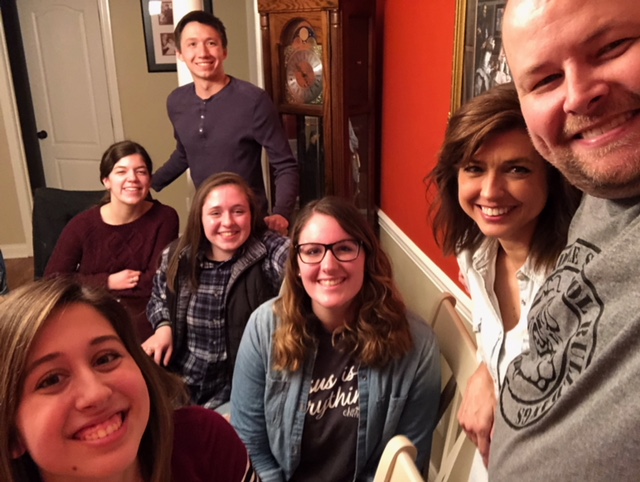
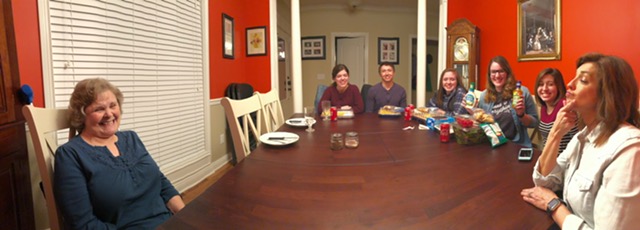
Our dinner took place in Bowling Green, KY on April 15th. Caroline, Jenny, and Zora attended. Our Kentucky Kitchen Table was a little unconventional since Zora and I were unable to have them at home with family, and I think this gave our KKT a unique college perspective! Caroline is a junior at Western Kentucky University majoring in advertising and grew up in the Lexington area. Jenny is a junior majoring in nursing originally from the United Kingdom, but moved to America when she was in elementary school. Zora is a freshman majoring in economics with aspirations to do law (also in Honors 251) and is from Bowling Green, but has moved around as both her parents are social workers. I’m from Scottsville, KY, a small town about 30 minutes south of Bowling Green. We had baked spaghetti with garlic bread, Zora brought special food as she is vegan. I made the food, but Caroline and Jenny provided their apartment and dinnerware.
We talked about what it means to be a citizen, on both a local and national level. Overall, everyone seemed to come to a consensus that citizenship is about being kind to one another. Jenny talked a lot of how her Christian faith led her to want to help and be kind to others. She wants to be a nurse, so her future is going to be centered around caring for other people. She said she wanted to be kind to people and have a good impression, because maybe one day she can share the love of Christ with them. She also talked of the difference between the United Kingdom and the United States in regard to kindness. She said in the U.K. everyone is in their own little world just trying to get from place to place, and that smiling or saying hello to a stranger would be strange. I feel like this is more of a Kentucky thing, but it made me feel good about being a U.S. citizen nonetheless.
When it came to eating around a kitchen table, Caroline and Jenny had, while Zora and I had not on a regular basis. Zora’s family has an odd schedule from both her parents being social workers, and they all have different eating habits. She said it would have been nice to have dinners together, comparing it to how she enjoys holidays with her family. For me, I lived with my single grandmother for years, and my mom and brother moved in with us when I turned 13. We all had different schedules and the kitchen table was never clean, so we had a lot of fast food and freezer meals. Because this was unconventional, we never really ate around the table together and definitely did not have any neighbors over. I always wished that that had been different, but it was hard to advocate for it at the time because no one else really wanted to. Caroline and Jenny both had positive experiences from eating at the table. Caroline said it was a sort of release to get to have that time with her family, in that it was a time to just relax and not think about anything else going on. I think eating at the table and having that conversation probably strengthens family relationships as well. If dinners have any of the same conversation that our Kentucky Kitchen Table did, they are most likely opinion shaping. I would say actually talking about these issues probably results in children having some of the same ideas as their parents, which is neither good nor bad, I just know that I have a completely liberal view on life in contrast to my grandmother, and it could be from not ever talking about it and how my opinions were shaped outside of the home.
When talking of what advice we would give to future politicians running for office our stances were centered around keeping people in mind. I feel this is odd in that political leaders should already be trying to represent the vast majority of people. Politics have become more about popularity, fame, and money than service to the country. It is sad that a group of college students are so disheartened by the government in our country, but maybe this can be some sort of fuel for change. When looking at the three questions that frame our class, I feel that this issue relates to them all. We can solve problems if we talk about the issues at hand. We can live better together push for change. We can have more of a say over our lives in just doing these things.
I also think it is interesting that everyone at the table wanted to be a good person that people respected. This seems like common sense, but how does chaos and evil break out if everyone in the world had a desire to do good? This relates to the Love Thy Neighbor readings by Peter Maass, that is surrounding the violence within the Bosnian War. Everything was normal and peaceful prior to war, a place like the United States. War was able to start out of what seems like nowhere. Misunderstanding and unresolved conflict is the core of fighting, and this dinner represents a grain of sand in the scheme of talking it out, but is still a representation of working to an understanding nonetheless.
This leads me to the overall way this dinner translated into the class for me. After a week of deliberations I realized this dinner represented something much bigger that society is lacking. The key thing that tied this dinner and deliberation together is conversation. One thing that I feel people really are not good at today is talking about issues. People never want to listen to opposing opinions. I think this has led to the younger generations just staying out of all of it, not wanting to engage in confrontation that actually should just be conversation. In the David Brook’s article If it Feels Right he talks about this, in that people just go with “what feels right” in the moment, rather than analyzing and coming up with new ideas of what is right.
Eating with my peers was refreshing, and I came out of my Kentucky Kitchen Table with a better understanding of how this small dinner can relate to the overall themes of the class. I feel like sharing this experience with college students made the dinner different, but did not affect the depth of the assignment.
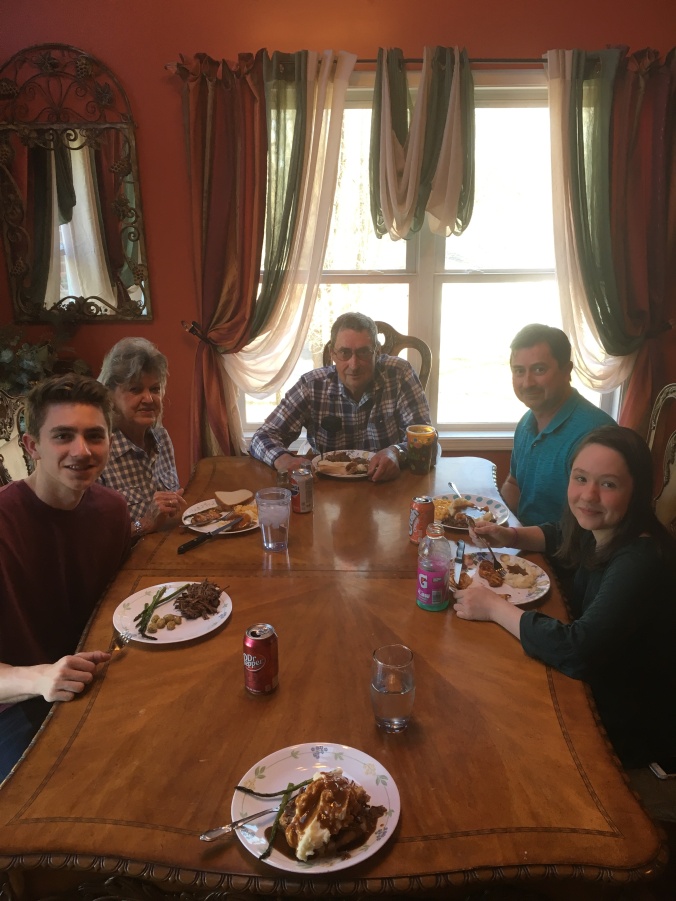
 family had a late Easter dinner on April 14, 2018 which is when I chose to engage in my Kentucky Kitchen Table Project. This took place in Calvary, Kentucky which is the birthplace of both of my great grandparents. At the dinner (my table) was myself, my grandfather, Rickie, great grandmother, Patty, and my other great grandmother, Betty. I chose to have this discussion with people who were older in order to view different generations’ perceptions on citizenship, government, e.g. Both of my great grandmothers are in their early eighties and have lived in Marion County their entire lives, Patty describes herself as wiser due to being the oldest of ten siblings. Both come from agricultural families of middle-class income. Ricky, my grandfather is in his fifties and is more engaged in politics than my grandmothers. I started off this discussion by asking the first question to them “Beyond voting, paying taxes, and following laws, what does citizenship mean to you?” To which the conversation began to center around how America allows people to earn their status based on achievement and hard work, in many cases. Patty stated “I wish I had the opportunities your generation had, I always felt like I was obligated to stay around here and do exactly what all my family did before me.” In some cases, social class can hinder one’s ability to fulfill their dreams, but when bringing this up they all agreed that although college is expensive that it is much more accessible for today’s youth. I found this as an interesting topic because in our class we always talk about how we could live better together and I feel that most people coming to college and fulfilling their dreams have some interest in learning more about others on diverse college campuses. Furthermore, another topic of discussion relating to this question was that citizenship to them means that you should contribute to society and work hard at whatever contribution you make. My grandfather is a very hard-working farmer, which he takes a lot of pride in, and said that having that contribution to society makes him feel like he is a part of something, and gives him purpose rather than focusing on the monetary incentive. This statement motivated me to move into another point of discussion on what types of people they wanted to be, and although my great grandmothers are old in age they had some very refreshing answers. My grandmother, Betty, said that she wants to be more carefree and outspoken; Grandma Betty has always been the quieter of the two, but she claimed that talking to people that she doesn’t know is still something that she forces herself to do on occasion. I found this inspiring because if all of us would go out of our way to talk to strangers and get to know other people in society I feel that could be a small start to understanding and living better together as American citizens. Furthering from her answer, the main theme of their desires was to be a person who was hard-working, religious, and honest. In my opinion, I feel that these are all qualities that I strive for and are very respected in their generation as well as this generation. Also, since they brought up religion I introduced the question of whether religious beliefs shaped how they believed we should treat others. Since they are honest people they did admit that being raised within a period where racism was more prevalent that they were not proud of how they had viewed African Americans at some points in their life, but all three of them said that because of their deep belief in God and his creations that they never treated anyone as different. They also expressed that they consciously tried to be compassionate to others and their situations due to their religious beliefs. Therefore, I believe that religious beliefs do motivate some people to disregard biases they may have been exposed to, to accept people as equal and treat people with respect.


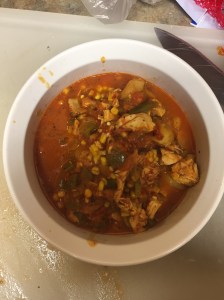


 Kentucky's Kitchen Table