Kentucky Kitchen Table: Clarksville, TN

By Thomas

KKT Pic

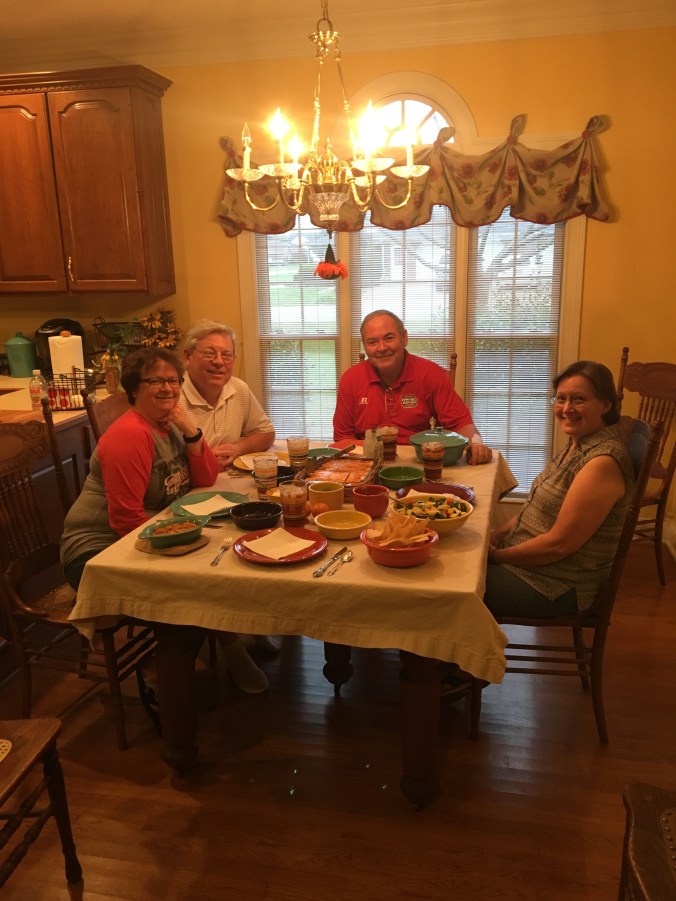
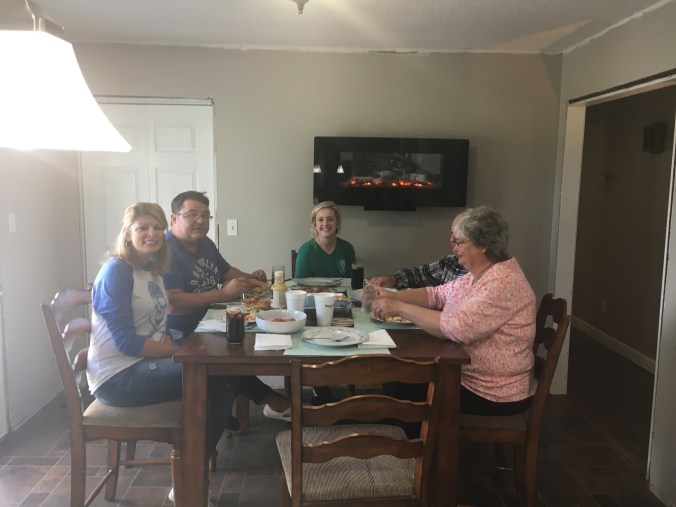
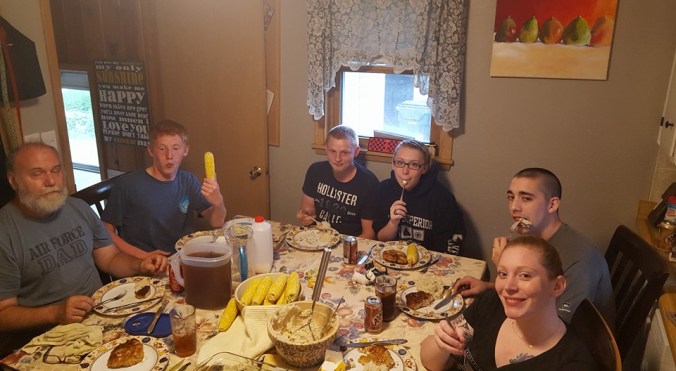
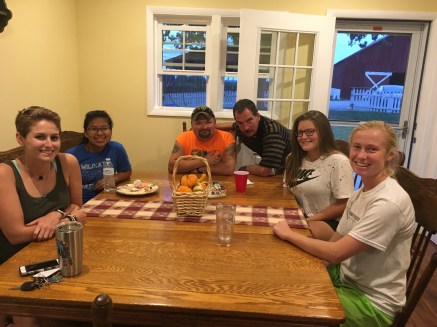
(People Starting from left: Rob, Me, Brad, Cheyenne, Daniel, Rachel. Jennifer took the Photo.)

My Dinner took place in Clarksville, Tennessee. Clarksville is a place that borders Kentucky and is very close to Fort Campbell. Fort Campbell has a strong influence on Clarksville in terms of military service. The city itself consists of many soldiers. I thought of this when I was going to my host family. I wondered if a military presence in a city had an effect on what citizenship means to the citizens living there. Along with the military presence, Clarksville is a prevalent city in Tennessee, not as big as Memphis or Nashville though. Clarksville is basically one giant suburb with Austin Pay State University as the main attraction.

The folks I had dinner were Cheyenne, Jennifer, Rob, Rachel, Daniel, and Brad. Cheyenne is 20 years old and is a current college student at Nashville State Community College; she looks to be a little shy. Jennifer is a 40 year old who went back to school for social work, she currently works at a mental health clinic. Rob is a 52 year old painter who is also in college for art. All of the people I talked to are currently in college. Rachel and Daniel are married and are both in the Air Force visiting Jennifer and Rob. Brad is Cheyenne’s boyfriend who works at an Auto Zone. I talked to them about school and they said they were a bit stressed since the semester started to pick up, but they are muddling through it. Rachel and Daniel talked about Air Force promotion board and getting ready for that. Brad told me he is enjoying his life. They told me they all get home at weird times throughout the day because of their jobs.

I began the actual Kentucky Kitchen Table with the required question, “What does a being a citizen mean to you aside from following laws, voting, and paying taxes.” This was an interesting question to start off with since the other three were not expecting to go this deep into conversation. Rob remarked when I asked this “Well this is going to be a long dinner.” I got some weird looks from the table. When I asked about the awkward silence Jennifer answered “We don’t like to talk about this kind of thing since we all have much different meanings of citizenship.” I asked the group to further elaborate and Cheyenne started off by talking about social change and how true citizens should always look out for one another from the government we live in. She continued with how a citizen is always involved within their government and always stands up for what’s right. Jennifer and Rob were a bit uneasy from this response so I asked them to share their thought on citizenry. Rob reflected how a citizen is a good worker and stays to himself most of the time unless someone needs help. “If someone has a flat tire on the road downtown, I’ll pull over to help them,” he said. “I just don’t think a citizen should be helping all the time and being involved all the time, only when it matters like if a company lays outsources a bunch of workers and stuff like that.” Jennifer seemed a bit heated but she answered in a calm fashion. “I only think a citizen should follow laws, vote for what they want, and pay taxes. People shouldn’t urge others to get involved because they don’t know about their lives and what they deal with. I think getting involved is for people who want to get into politics, I’m not a huge fan of politics.”

I noticed that Rob and Cheyenne had similar answers so I pointed that out. They found that odd between each other since they told me they were on opposite sides of the political spectrum. I followed up with a question: “Does political leaning make a different kind of citizen in your eyes?” Jennifer answered first with a solid “Yes, I do. When people take a political stance on something they probably do it to make them look more involved. I find it to be dumb since they seek out people with different opinions and bicker about why their side is right and call the others names. It seems counter-productive to me since I think people should see all sides of an argument.” Rachel and Daniel seemed to disagree with Cheyenne and Rob, leaning towards Jennifer’s side. Rachel and Daniel explained that people just have to do their jobs and don’t do stupid things like go 50 in a 20 miles per hour zone. They talked about courtesy, loyalty, and honor. It was almost similar to the values the military holds its soldiers to. Brad did not know how to answer the question since he never thought of citizenship, he said he didn’t even vote.

Cheyenne took a different stance on this question. “I agree with Jennifer to an extent.” She started talking about how political leaning does make her see people in different ways, she’s sees the bickering as debating and a healthy way of how people share ideas nowadays. When I asked Rob, he agreed with Cheyenne. Rachel, Daniel and Brad seemed to duck out of this, they seemed a bit uncomfortable about talking about political matters. I felt a need to move on.

I asked if any of them had dinner like this around the table when they were growing up. Cheyenne said a little bit but she was really busy with after school activities and homework to actually have a conversation, she mostly just took a plate to her room. Jennifer said she did have dinner together as a family when she was growing up, but they really didn’t talk much. Rob on the other hand went into full story-teller mode and told the table about he had dinner as a family every day. “Even though I had a big family, we shared our time together at the dinner table and we talked about school, sports, anything really.” Rob seemed to appreciate the nostalgia of the question. He ultimately had a good time with his family dinner experience because he had talked with his family. Rachel, Daniel, and Brad all had similar experiences like Rob’s but a little more “vulgar.” The three started cracking jokes at the table, and it lightened the mood of the table, thus the picture for this project was taken. Jennifer just had dinner and didn’t talk. Jennifer said she wished her family had talked at the dinner table. I had dinner as a family at the table and we did talk but it was mainly about how school went and future scheduling events and planning stuff for the future, I found it quite boring. I also wish that I had Rob’s dinner table experience.

The next question I asked was what the best things in the world are today. Everyone said the Internet and smartphones, this took me by surprise so I asked them all why. Cheyenne started with how it is basically a pool of information we can all take from when we need it and it keeps everyone connected through social media. Rob reflected on how the world basically revolves around the internet nowadays and that it has many methods of entertainment with Netflix and games. Jennifer agreed with both people and said that the internet has made keeping up with everything so much easier. They asked me the same question. After much thought, I agreed with them, I saw the Internet as the defining keystone of today’s society in America. Brad agreed and told me about his gaming room and his hobby of gaming.  Rachel and Daniel looked at Brad and approved of his hobby. We all started talking about one video game that somehow brought the whole table in to a new world: The Legend of Zelda.

The Legend of Zelda took a huge chunk of this conversation because everyone in the table had a connection to it. Jennifer and Rob remember playing the first one on Super Nintendo and talked about the difficulty of blowing the cartridge to make the game run better. Rachel and Daniel started talking about the newest installment, The Breath of the Wild.  We all analyzed almost every Legend of Zelda game that came out, each giving our own opinions about the storyline, graphics, characters; we were connoisseurs of the Legend of Zelda, talking about it like vintage wine. This topic made everyone look back to the halcyon of a video game about a short blond kid slaying dragons and collecting pieces of magical relics.

I then asked about the worst things in this world. Rob started off with all the arguing and hostility between other countries, he would not like to see another war happen. Jennifer said that she thinks that the abuse of children and women across the globe is the absolute worst thing she could fathom. Cheyenne remarked that discrimination against people of color and sexual orientation was the worst thing. The three started to get heated and were arguing about which worst thing they thought of was more relevant. It was at this point I realized I had to be a bit of a mediator between us since they argued for a good five minutes before realizing that there was food on the table. I then made a rule that if you feel the need to argue, you can put in your thoughts but I want everyone’s ideas together, not against each other. If you want to argue, eat. They all agreed to the rule. I told them I thought the worst thing in the world was the Internet. I saw it as a very humane way of humanity dehumanizing itself. I saw it as separating more people through social media even though it brings people together. I saw it as a huge oxymoron.

I saw this as a learning experience for all of us. After that question, we all just continued with small talk, kind of like how Rob had dinner when he was growing up. This conversation was enlightening to me since I got to see some new perspectives to look at the world. I noticed that just the word “politics” can get people’s shields up and ready to argue. It is kind of like saying a statement with “but” in it and people only listening to the part after the “but.” The conversation, excluding the argument, went at a good pace. I had a very homey vibe during the time I was there. I found myself disagreeing with them with political views, but I did not voice my opinion to progress the conversation. I found that a little shocking since I thought I would be with the status quo of college students by staying not leaning towards liberal or conservative, but I found out from Cheyenne that most colleges are mainly  liberal minded. I wouldn’t necessarily take that to be true, but I have seen that trend in a few of my classes. I initially thought the Kentucky Kitchen Table would be a waste of my time, but I actually enjoyed my time with the host family.  I unfortunately forgot to ask the question about the military and citizenship, but I had a thoughtful conversation with the group and remembered how fun The Legend of Zelda was.
A College Kid Kentucky Kitchen Table

By Ruth

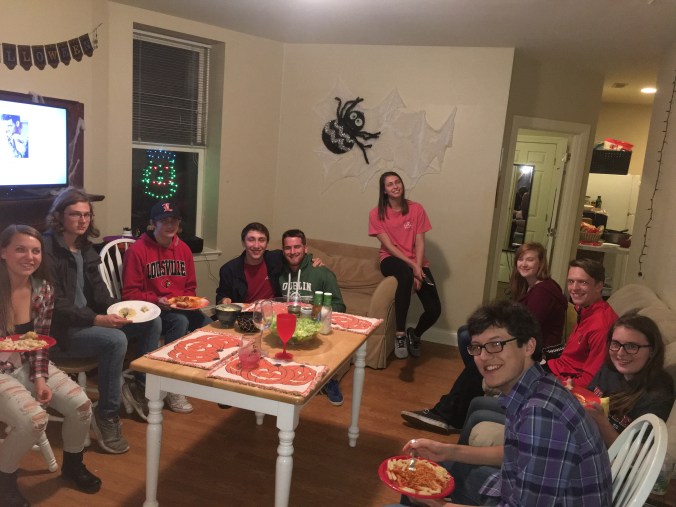
My meal took place in the city I was born and raised in: Louisville, Kentucky. I hosted my dinner at my sister’s apartment downtown, and we invited many of her friends. Everyone at the dinner attends the University of Louisville, and most of the guys were part of a fraternity. Although everyone who attended was approximately the same age, there was still an array of diversity, from sexuality to religion to upbringing.
Starting from the far left of my photo is Allison. Allison is one of my sister’s roommates and the only other person at the dinner that I knew besides my sister. Allison grew up in Bowling Green in a very conservative household with strict parents. She claims that her parents are extremely strict on some matters, such as boys and clothing, but lenient on others, such as alcohol and marijuana. Second is Joe #1. Joe #1 was extremely quiet the whole dinner, and when I asked him about himself, he said his life is “normal.” I never learned much about Joe #1 except that he is a sophomore and in the Lambda Qi fraternity at the University of Louisville. Next is Foster. Foster is a freshman, a Lambda Qi associate member. Throughout the course of the dinner, Foster was almost as quiet as Joe #1, although he did laugh a lot. I do not know much about Joe #1 or Foster, except that they smoke a lot of weed and were too high that night to give much input. Next up is Kyle, the sweetest, most respectful college-aged boy I have ever met. Kyle has very strong values and had tons of good input. After Kyle is his best friend Adam. Adam’s family grew up impoverished in downtown Louisville. He is very outgoing around people, but seemed shy when answering questions.
Next is Sophie, my older sister. Like me, Sophie grew up a preacher’s daughter, and has since, also like me, drifted away from her faith. Our parents are very conservative, but Sophie is very adventurous and independent. On the far end of the couch is Kayla. Both of Kayla’s parents came out as gay after Kayla was born. Her mother remarried a woman, and Kayla lives with them. Kayla doesn’t see or speak to her father anymore. Kayla was also very quiet the whole evening. Next to Kayla is Joe #2. Joe #2 is from Louisville; he grew up Catholic but now identifies as agnostic. Joe #2 seemed to be a very wise, in-tune person. Next is Rachel. Rachel is Allison’s cousin and is also from Bowling Green. Rachel is also a freshman, and she is openly gay. Lastly is Alex. Alex talked the most, and about a lot of things, however I never got much out of anything he said. He is from Louisville and lives at home with his parents. He grew up religious but is not so much anymore.
I started the dinner by having everyone share a little bit about themselves, and I asked follow-up questions to get to know each person better. We spent a decent amount of time doing this because I wanted everyone to get to know each other and be comfortable talking. Most everyone seemed at ease and willing to share, although some did take a slight bit of prodding. I asked the mandatory question of course, “Beyond voting, paying taxes, and following laws, what does citizenship mean to you?” I think people were a little stumped by this question and couldn’t really think of much. I got a couple answers about being there for people and supporting one another. We ended up talking about community, and being involved. The group agreed that being a part of a community is important when it comes to citizenship. I tried not to dwell on this question too much because, even though it was our one required question, it didn’t spark much conversation.
I asked a handful of the optional questions, ones that I thought would get some decent discussion. With almost every question, the conversation tended to veer back towards the idea of community. With one question, “What do you think are the best things about our world today,” Kyle said the internet. His point was how close it has made us. It has developed its own community that would otherwise not be possible. I asked if there were any downsides to the internet, and the group agreed that there is, but the benefits outweigh the negatives. They all seemed to just want to be good, loving, kind people. When I asked them if they thought they had an obligation to their community, they all immediately agreed that we all do. I found that interesting because in our class discussion on obligation, it took a while for us to decide. In class, we spent more time thinking and deliberating; we did not act upon our gut reaction.
Everyone who attended my dinner was very receptive and willing, but most of them were shy. Alex and Kyle would jump to give me a response, with the occasional initial answer from Joe #2. Once somebody answered, however, the rest of the group was more willing to give their opinion. It took a little longer to get the conversation going than I anticipated. I had to help mediate and include a few people here and there, but overall, I had a very good group.
My group was large, which I liked because it allowed for more personal side conversations. It seems strange, but I felt like everyone felt more at ease knowing they could occasionally gather in a smaller group they felt more comfortable in. It made the larger group discussions more impactful, and allowed me to listen in on the smaller discussions, getting to know everybody better. People would talk a little in a smaller group, and then come to the larger group and share their opinions. The smaller groups gave everyone a more comfortable atmosphere to come up with ideas. This reminds me of our class. We are given some time in the beginning to discuss in a pair or small group. We can gather our thoughts and then feel comfortable sharing our organized thoughts with the larger group.
If I am to be completely honest, I did not really learn much from this activity. Going into it, I had high hopes and expectations; I thought it was a cool activity and I would get a lot out of it. I know most people are the opposite, thinking this project is dumb and pointless. They then host the dinner and find that is was helpful and interesting. I, on the other hand, did not get much out of my dinner. I thought I did it correctly, and I thought we had pretty good discussion, but it just didn’t do much for me. I think I was stressing about the project too much that I didn’t allow myself to enjoy the dinner. I was worried about cooking and inviting and making sure everyone was happy when they arrived. I do, however, think the project is a good idea. Although I did not learn anything tangible, it gave me the opportunity to meet new people and hear thoughts from a diverse group.
This Kentucky Kitchen Table related to the central question of the class, “How do we live well together?” The whole discussion was geared toward the idea of community and how we can be there for those around us. A reading that closely relates is “The Empathy Exams Essays” by Leslie Jamison. This reading is about how humans want to feel cared for. We all have feelings, and we want our feelings to be validated by other people. It can be difficult to empathize with somebody, especially if you have not been through what they are going through and you do not understand their pain. We all deal with stuff, and we all expect someone to care. Caring for a struggling person can be hard when you are struggling yourself. We all must realize that we can live well together and support each other, but we cannot have unreasonable expectations of others.
The book “Citizen” by Claudia Rankine is another class reading that relates to the question “How do we live well together?” This book is all about an African American woman living in a mostly white world. She is explaining her experiences with racism and discrimination. My dinner group would say that the people in her community have an obligation to stand up to her. They should treat her equally and with respect, and should defend her in a time of need. This book is all about community and working together to improve our world.
Overall, this Kentucky Kitchen Table experience was mediocre. It was a very interesting project, and I have never done anything like it. I am grateful that I had the chance to experience something like this. It was more fun and exciting than a paper; it was a real, hands on project. It was a good thing to do and I think it benefits most people. IMG_8451

A Kentucky Kitchen Table in Sparta

By Shelby

My Kentucky Kitchen Table took place on my family farm in Sparta, Kentucky. Sparta is a very small town in rural Gallatin County, the smallest county in Kentucky. To give you a feel for my county, there is one school in the entire county and the residents create a tightknit hometown community. Local businesses paint their windows in support of the high school football team every Friday night. Nearly all of Gallatin County can be found on the Ohio riverfront every Fourth of July for a celebration and fireworks. Farmland and fields stretch for miles on the outskirts of the small towns, my home being one such farm.
Over fall break, I went home and invited coaches and players from my high school’s girls soccer team to come to my dinner. My dad started the program several years ago, and continues to coach but has recently gained two assistant coaches. It was previously agreed that my mother and I would prepare a meal of baked chicken, green beans, macaroni and cheese, garden salad, and dinner rolls, and this was shared with my parents, Rick and Shelia, as well as, Nate, Kelsey, Hannah, and Angie. Rick is a dentist and a farmer, while my Shelia works at the front desk of his dental office. Both are college graduates who moved from Louisville, Kentucky to Sparta and have become active community members through church, are involved with the local school system, and have served on various community boards. They have spent many years coaching recreational sports for youth in our community, myself and my brothers included.
Nate and Hannah are the assistant soccer coaches. This previous season was their first season of coaching, so while I was somewhat familiar with Hannah who is a teacher at the local high school, I had not met Nate prior to their season. Nate works at one of the steel manufacturing plants in Gallatin County and has been a lifelong county resident who attended school in the Gallatin County School District many years ago. His daughter, Kelsey, is a freshman at Gallatin County High School and plays on the soccer team. Hannah is a special education teacher at Gallatin County High School and is originally from Norwood, Ohio. She attended Xavier University and moved to Gallatin County upon gaining a teaching position. Angie is from Mexico and moved to Kentucky with her family several years ago. She is a high school freshman, but she attends the ILEAD Academy which is an accelerated program that allows high school students to take college courses and earn a bachelors degree within two years after graduating high school.
As none of the unrelated individuals who came to my Kentucky Kitchen Table had previously been to my house, the Kentucky Speedway across the road from my house was an immediate topic of conversation. The placement of the racetrack in Gallatin County was a controversial topic when it was established and remains as such today. Many believed that such an attraction would bring economic growth to the county, and while it has been productive in many ways, it has also brought complications to the rural county. We discussed how the Kentucky Speedway hosts only two races a year and occasionally hosts charity events such cancer walks and car shows. While the Nascar races attract fans from all over the country, boosting businesses for a few days, Gallatin County does not have the facilities nor the infrastructure to host this influx of people. Traffic is atrocious on race days and intoxicated individuals flood the roads at the conclusion of races, causing headaches for locals and the police department.
The Speedway is an example of experts who lacked the knowledge and experience of life in Gallatin County making decisions for the community. The good intention of bringing economic growth and development to the rural county actually exacerbated problems, similar to the concepts discussed in Ivan Illich’s “To Hell with Good Intentions.” Initially, my guests thought it would be fascinating to live so close to a landmark like the Speedway, but upon learning of the problems that accompany the racetrack, they decided it might not be as exciting as they originally thought.
Our discussion transitioned to school and the role of technology, as well as, its affects on how students interact and complete school work. During the 2016-2017 school year, all students in the local high school were provided with Chromebook laptops in their One to One Program. Online classrooms have since been used to post assignments, provide additional resources, and reinforce concepts taught in the physical classrooms. This has given students access to classroom materials online and allowed the school to reduce paper expenditures. The computers also serve as a method for students to gain access to unlimited information and easy communication. While these seem like beneficial results of the One to One Program, Hannah discussed how she has noticed students lacking patience that might be traced to children being taught to want immediate gratification about their inquiries as a result of technology. The computers, in combination with personal cell phones, allow students to immediately find answers to questions and problems. While this is beneficial in many regards, as Hannah mentioned, it might reduce students’ capacities for patience.
This brought me to the “Power of Patience,” article by Jennifer Roberts we read and discussed in class about the teacher who gave her students the assignment of observing a painting for three hours. In this study, patience was used as a learning tool, and Hannah agreed that while technology has a very important role in classrooms, patience is also crucial to learning, as well as, developing social skills. She actually searched for an image of the Boy with a Squirrel painting, and I explained how it was created to represent the time it was meant to endure.
Following our conversation about school and the skills students gain or fail to gain in high school, I asked my guests what citizenship meant to them, beyond voting, paying taxes, and following laws. Shelia’s idea of citizenship revolved around being an active citizen in your own community by participating in community events and programs that might include volunteering at the food pantry or organizing sports for local children. She also believes that citizens should be responsible for being aware of current events and life around them. Nate used the current situation in the NFL concerning the decision of many players to kneel during the national anthem to help explain his idea of citizenship. As a member of the Freemason Society, he felt that it was disrespectful to the American flag and to the men and women who have served in the armed forces to kneel during the anthem. This topic has become very controversial across the nation as a whole. It began as a movement to raise awareness about racial tensions, but many believe it has developed into a protest to President Trump’s comments and behavior toward athletes in the NFL. Nate felt that citizenship should encompass a certain level of respect for one’s country, its values, and those who defend those values.
Rick suggested that citizenship was based on family and helping others. He believed parents should be involved in their children’s lives, teaching them to act responsibly, and individuals should help others if they are capable of doing so. He raised the topic of the Las Vegas Shooting that had recently taken place and mentioned how some people’s first reaction was to run to safety, while others immediately looked to protect people by ushering them to safety or laying over their bodies to shield them from the raining bullets. Those who put the needs and safety of others before themselves were demonstrating true citizenship in his opinion.
This led to a discussion about moral obligation, and I asked if we were morally obligated to help others and if so, to what extent were we obligated. The general consensus was that if you are capable of helping someone in need, you should help them. However, the proximity of the issue and any possible threat to one’s own safety were critical factors to be considered. I told my guests about the video of the young Chinese girl who was run over by the van and how everyone who passed her simply left her lying in the street. Kelsey found it hard to believe that no one would help the young girl, and it was suggested that the situation would be handled differently in America and likely most other countries. It is possible that children and the obligation to help others is seen differently by varying cultures. Hannah suggested that people are much more likely to help women and children than men because of a social notion relating children and innocence. People become more conscious of their own safety when grown men are involved, thus they are less likely to help an adult male.
I questioned if there was a difference in the moral obligation of helping someone you can see versus helping, for example, those forced to work in a sweat shop in another country to support themselves and their families. My guests said they would not necessarily feel obligated to help in this situation because different cultures have different issues, values, and standards of living.
After our dinner, we all went out to our barn, and Kelsey and Angie helped me feed chickens and horses. Because I graduated before they entered high school, I did not know them very well, and they had been quieter during dinner. Feeding the animals gave me an opportunity to share some of my experiences growing up on a farm with them. This interaction seemed easier for them to relate with, and Angie told us about her experiences raising chickens when her family lived in Mexico.
My Kentucky Kitchen Table allowed me to connect with people who I did not know particularly well and gain insights about topics that I had not previously considered. I learned that citizenship can embody numerous meanings, and those meanings largely depend on individual interpretations of the word. There was a general consensus in the idea that citizenship involved helping others in the community, and this concept would allow individuals to live better together, an idea central to our class. We can be better citizens by respecting the ideas and beliefs of others, helping those in need, and being active in our community. According to our Smart Communities reading by Suzanne Morse, individuals who are engaged in community affairs are more likely to take ownership of their community. This is crucial to living well with fellow citizens and might help us cross the bridge to where society should be with communities we are proud to call home.

Not pictured in the image: Shelia

Every Community Has a “Derek”…

IMG_2548

By Kaylee

Looking back on my dinner for the Kentucky Kitchen Table, I would categorize it as a young adult view and perspective on citizenship and community. Nine people in total attended, including me, ranging from the age of 17-28. It was split pretty 50/50 on people I knew and didn’t know, which made conversation and discussion surprisingly easy.

Brayden, (17) is a student here at WKU in the Gatton Academy. He grew up in Glasgow, Kentucky and was very excited to move to Bowling Green this past August. In the discussion, he highlighted the culture difference from just 30 mins away. He was accompanied by two other Glasgow natives who got to school at WKU also. Chandlor and Jacob (18) are roommates in a freshman all boys’ dorm on campus and both work off campus.

Olivia and Hayley (18) are both seniors at Bowling Green High School, and Olivia has grown up in Bowling Green. She is involved in choral and musical activities at her school. Hayley recently moved to Bowling Green, a little less than a year ago from California. Her father was recently asked to work as the Children’s Pastor at Crossland Community Church and she has lived in different areas of California and Texas throughout her life.

Katie (21) is a senior at WKU. She is majoring in marketing and works at a local branding company in Bowling Green. She is originally from Evansville, Indiana and lives close to campus with two roommates. Cameron (21) is a local musical artist and works for Royal Music and volunteers his strengths and talents at Crossland Community Church. He did not attend college to pursue his career in music and also volunteers at one of the campus ministries, CRU, with Katie.

Melissa (28) is the volunteer director for the Center for Courageous Kids, in Scottsville, Kentucky. She grew up in Louisville and moved here to attend WKU. She is married to her husband, Nick, and they have a one-year-old child, Cullen.

This group gave a very neat perspective for me, because all were involved in a volunteer position of some sort. I invited 4 participants, who then invited the other 4 participants to join. We ate a meal together and then I started the discussion by asking the first question: “Beyond voting, paying taxes, and following the law, what does citizenship mean to you?” Answers of similar degree were spouted off such as doing more, going the extra mile, and realize the rights and responsibilities you have as a citizen locally and nationally. There seemed to be a good degree of agreement among the group so I decided to switch the conversation to what kind of community was ideal to live in. Responses were brought back to the types of citizens in the community, and Cameron mentioned a community of everyone doing their part for the community, with a sense of unity within of a common ground or goal. Melissa decided to add onto that by highlighting community involvement with a mix of individualism. And Katie thought a main value of a community should be a concern for others inside and outside the community, and others piggy backed with being accepting of everyone, while others counter placed that with making sure boundaries were made from acceptance and being aware of your morals and not letting those fall.

Other answers were similar and we concluded that in an essence we were describing a form of socialism, which is, on paper, the perfect community, but it is not an achievable goal in real life due to human error. Other qualities such as selflessness were brought up, and how the more you give the more you will receive. A concern on this topic was how in today’s society communities and neighborhoods were not as connected as they once were.

I then asked if people truly knew their neighbors. Most were sad to agree that they didn’t, even those who lived in a dorm on campus, and those with roommates said there were many times they didn’t converse regularly with their roommates. We then discussed spiritual aspects of how the two greatest commandments calls us to love The Lord your God with all your heart, mind, soul, and strength and to love your neighbor as yourself and how we must keep those in mind when interacting within our communities. Hayley made a point to also say we are called to love our neighbors and our enemies, which Chandlor piggybacked by highlighting those enemies might be your neighbors. This did lead to somewhat of a gossip conversation about neighbors (good and bad), which, at first, I was nervous about, but surprisingly led to the highlight of the conversation of the night, which surrounded this blog post.

In the gossip of neighbors, a specific Derek* a neighbor in the community was brought up, and stories were shared of how he was rude and hard to get along with. After the gossip and jokes of Derek, Chandlor brought up a good point about how communities work. He asked how many “Dereks” you would want in your community, and immediately everyone shared they wouldn’t want “a Derek,” they wouldn’t want that person of conflict. We quickly realized that everything we said about hoping for the perfect community and acceptance of all went to waste. Chandlor then shared some studies he had read of how every community “needs a Derek” and how gossip and controversy almost brings people together and builds people up. There were some agreeable statements, but Cameron was not ok with that fact being accepted. He said instead of accepting that as fact, we should strive to make it the best and “perfect” it could become, but in fact it is unavoidable. The conversation then shifted to a more grey area instead of black and white, as we concluded that there is not necessarily always the “good guy” and “bad guy” in a group of people. In movies and TV shows we see the “villain” and most all other characters’ root against them, but in real life, not one person gets ostracized as the “villain”, but in an essence, we are all “a Derek.” We all fail, we all exclude, we all fall short of sin and acceptance. At one point, whether we want to or not, the evil will come out, and we must be the ones in the community to love the “Derek” through it and accept that person’s flaws. We pointed out how we become “Dereks” or make people “Dereks” in our everyday conversations, and the only thing we can do is be better from our past “Derek” mistakes. The final question I asked was: “What kind of person do you want to be?” After some thought, characteristics were thrown out of being yourself, and making a difference, we concluded that while we might not have life figured out, we can still make an impact, which will be different for all of our lives, and we can strive towards better and away from being the “Derek”.

*Name changed

Indiana Kitchen Table: How to Live Well Together

By Gabe

My Kentucky Kitchen Table was different than most of those that were done for this project due to one simple fact: it was not done in the state of Kentucky, but rather, in my hometown of Santa Claus, Indiana. So, for the rest of this post, I will refer to the meal as the Indiana Kitchen Table. In a quick preview, the meal went very well and smoothly, and the conversations flowed well with some great content in the discussions, with credit given to the fact that while I may not have known everyone there, everyone else knew each other, which heavily contributed to the conversation not running dry. Beforehand, I was a little nervous that it wouldn’t go well at all, but in retrospect, it was a great experience to pick the brains of others when it comes to citizenship and democracy as a whole and caused me to do some reflection and deeper thinking of society.

The dinner took place at the home at the home of my girlfriend, Kate, who had family friends over who I had not gotten to meet yet. Her family insisted on making the meal rather than everyone bringing a dish (delicious Stromboli and salad), yet the family friends, who love to bake, still brought a cake for dessert. There was a total of nine people at the dinner: Kate, Ray, Denise, Spencer, Kelsey, Kylee, Ray, and Colleen. Kate is a senior at the high school I am from, and plans on attending Western next year. Ray, her father, is an eighth-grade history teacher, and Denise, Kate’s mother, works at a local hospital. Spencer is a graduate student at the University of Kentucky who is in dental school and plans on being a dentist, and his wife, Kelsey, who is one of Kate’s sisters, is also a student at the University of Kentucky and is in PA school. Both are going to graduate soon. Kylee, the other sister, graduated from WKU last year, and now is living in New York City and works at a marketing firm. There was another Ray at the dinner who works in finance, and his wife, Colleen, owns her own travel agency; Colleen and her husband have been all over the world. Ray and Colleen are close friends of Ray and Denise, and I had not gotten the pleasure of meeting them yet, nor have I had much deep conversation with her sisters and brother-in-law as they are well into their dependent lives. The dinner was a great opportunity to meet Ray and Colleen and also to get to know Kate’s family members better.

The group lacked in diversity as far as race goes, as all members are white. However, they had diversity in some other areas, such as of age, experience, field, and economic status. Ray and Denise are of middle class, while Ray and Colleen are more towards upper middle class. Kylee, Kelsey, and Spencer are all fresh into their independent lives, and Kelsey and Spencer will contract large amounts of debt due to their graduate school expenses. Ray and Denise are in their upper 40’s, along with Ray and Colleen; Spencer and Kelsey are in their upper 20’s, while Kylee is in her lower 20’s; meanwhile, Kate and I are 18 and 19, respectively.

Once dinner was served and after we all prayed as a group, we started to eat and general small talk ensued. Simple questions such as “What class is this project for? What are you going to gather from this project?” immediately were asked. After answering these, I responded with a question of my own, and decided it would be best if we addressed the main subject and effectively broke the ice before relying on some of the other questions offered on our handout packets. I delved straight into the topic at hand: beyond voting, paying taxes, and following laws, what does citizenship mean to all of you? Right away, Kate’s father, Ray, straightened up to answer. Ray strongly believes in being an active citizen, and participating in our democracy is a very important part of that belief. He spoke of several actions one is obligated to do as a citizen in his view, such as advocating for stances on issues, calling your state representative, and being educated and well read on the current state of problems and issues, among other things. Collen added on to this by mentioning that we can exercise our right to protest. These obvious suggestions did not strike me as peculiar or extensively thought provoking; while they are correct ways to be active in a democracy and a citizen, I yearned for deeper and more intricate responses. Spencer was the first person that supplied my yearning. He agreed with all of the suggestions Ray made, while also adding that one can also participate in events in their respective communities in order to make practical contributions to strengthening our society and becoming closer as a people. Once he made that comment, my brain triggered a connection already between our class and this dinner: what Spencer had said could be one of many possible answers to the central question of “how do we live well together?” I pointed this out to the group, and in reflection, this was one of my favorite points made the entire evening as it incited me to think further on this question, which I will get to further on in this writing.

After these points were made, Kelsey addressed a different side of this question: rather than ways to participate, she answered what citizenship meant to her. From her view, being a citizen is more than how one can participate in democracy. She views it as how we act in how communities, how we treat and respect one another, and what we do to be there for each other in times of struggle and prosperity. Being a good citizen is more than completing objectives as if they are on a checklist, but rather doing the intangible things, such as being kind, loving and respecting all people, regardless of views, race, sexual orientation, gender, and religion. Once again, this made me think of our central question of how do we live well together. Kylee, Kate, and Colleen agreed with this viewpoint heavily, and easily concurred with Kelsey’s opinion. The men of the group agreed, but dissented that while being kind and respectful is important, it does not practically solve the problems that our nation faces.

As I said earlier, the entire conversation provoked me to do some much deeper thought on the matter. Hearing the perspectives of other people, even those who are not familiar to me, provided insight that I had not thought of in a realistic sense. I come from a close-knit hometown where people participate and are involved, and everyone is kind and respectful of another; while I may have been living in that type of environment, I had never had the thought of what may result from applying it to communities and people all across the country cross my mind. The way that I see the current state of our nation, people get so heavily wrapped up into political parties and nationwide issues, and rather than doing practical applications to make these wicked problems better, we as a society instead get absorbed into debate. While nationwide issues are of great importance and political parties are an efficient way to channel our stances and approaches of handling issues, they are even furthermore complicated and can take extremely long amounts of time to see change and progression.

Much like Spencer pointed out, I believe that we as people rather can focus on our individual towns, counties, and cities, and involve ourselves to make more productive improvements. We can get involved in service opportunities to one another, engage in deliberative discourse, or help to organize, promote, and effectively run neighborhood events that can bind the people living in them together. Rather than waiting for a never-ending concept of “others to take action” or an overarching body to pursue these endeavors, the people who make up our individual localities can take up the mantle of progressing society in the ways such as Spencer mentioned. Once we have stronger individual communities, others can follow suit, and this could attribute to amending nationwide issues in the long run. If we can live better together through engaging in our hometowns, we can lean on one another and can collectively cooperate on the other central questions, such as how we should solve problems, and how we can have more say over ourselves.

Moreover, we can enhance our personal communities not only through how we involve ourselves in our communities, but also how we treat and respect one another in them. Much like what Kelsey said, if we give each other respect, kindness, honesty, and fairness, this can enhance how we live well together, and can make our communities closer knit and supportive, much like the one I was raised in. Through this type of relationship, solving problems, coordinating events to help solve issues, and other activities can be easier achieved, and the other two central questions can be easily addressed.

After my thoughts had been stimulated, the deep and introspective dinner conversation soon faded and formed charismatic and rich togetherness, as those who knew each other caught up and the family friends enjoyed their evening together. I felt as if we were starting the beginnings of answering that crucial central question right there through our fellowship together, and a project that initially seemed impractical and unappealing to me now was a pleasant and eye-opening experience, full of learning that I had not expected to encounter: from insight ranging on what being an active citizen looks like– according to Ray who is active in his democracy– such as writing representatives, advocating stances on issues, and being educated on the state of problems and the options to approach them; methods that may seem more time efficient and personal, much like Spencer mentioned, such as coordinating community events or serving in your respective communities and becoming involved; to what his wife, Kelsey, had to say—that being a citizen is more than performing actions or providing service, but can also include how we treat one another and truly live well together.  Life is full of learning. We must seize every opportunity we can in order to better ourselves as a society. Whether that be at formal, academic deliberations, or at simple Kentucky—or rather, Indiana—kitchen tables.


Working Past the Small Talk

By Lora

I had initially scheduled my Kentucky Kitchen Table with my best friend’s family who would have loved to participate, but unfortunately they had to cancel a week before our meeting. In a panic, I searched my mind for someone else I could have dinner with, and I decided on my high school English teacher who has a wonderful family, but on the day we were supposed to have our dinner, she canceled due to a family emergency.  At this point, I was concerned with what I was going to do. I had gone through my first option and a backup option, and I just had two days to find someone else. My last ditch effort was to sit with some people at my home church at a potluck that upcoming Sunday. I was feeling defeated, but I continued with the project and sat in front of the first  people I could. Little did I know that these people, who I wasn’t particularly close to, would give me new insight and a look into their lives. After having a meal with them, I felt a closeness and connection that was certainly not there before. Needless to say, they completely exceeded my expectations and gave me new concepts to think about.

I sat down with Mark, Ricky, Martha, and Tiffany. Mark, a local newspaper owner in his 40s, was the first to sit with me, and he seemed excited to participate in the project. Ricky, a retired mechanic, and Martha, who is an administrator, were a little less eager to participate. I told them about my project, and because we don’t know each other particularly well, I think they were a little hesitant. However, I was impressed on how quickly they came around. Tiffany, a nurse, is in her 30s practically jumped into the conversation once she knew what we were going to be talking about. I believe that this group of people is diverse because they come from different generations, and they are all in drastically different career paths. Their diversity, however, did not hinder their intellectual conversation, in fact, it may have just helped it.

“Beyond voting, paying taxes, and following the laws, what does citizenship mean to you?” With this question, Ricky and Mark did not hesitate. Their answer was “freedom” right off the bat. Mark, who went to West Point military academy and served in the army for five years, was very passionate about his answer. He felt that the sacrifice that our soldiers make to our country was the best aspect of our country, and his citizenship was based on that freedom. Ricky who served in the army as well, felt that without this freedom, our nation would be lost. Our rights of freedom of religion and speech are unique to us as a nation, and without these freedoms, citizenship would have a very different meaning.

As we progressed through the conversation and I asked some other questions, a common theme I saw was that each person believed in helping their neighbors. This wasn’t a big surprise to me because in our small town, community was everything. In 2008, a terrible tornado ripped through our town and destroyed or damaged hundreds of homes. Our community banded together and organized groups to gather, pack, and distribute supplies to the affected people. I don’t think anyone who was helping will forget the sense of community I know I felt that week of chaos. Mark shared a story of his parents and of a time when their health was going down. He said that the community helped so much by sending food and offering kind words. Tiffany shared a similar story of her mother-in-law. I steered the conversation towards a national focus, and  Ricky and Martha both felt that a good aspect of our nation is that we help each other. We talked about the efforts to help in Houston and Tiffany and Mark recalled the efforts to help in Florida and Louisiana when hurricane Katrina ripped through homes and other buildings. Martha knits prayer shawls for a ministry through our church, and she said that she finds comfort in knitting these shawls for people who needs them. I can recall the ministry sending some to Sandy Hook and many other people across the country. When I asked each person to reflect on their jobs and how that relates to their role in society, each felt that their contribution was helping others with their day to day needs. A writer helps keep citizens informed; a nurse helps people stay healthy so they can make their contribution to society; an administrator helps people stay honest; a mechanic helps people get to work to contribute to society themselves. I think this can be correlated to the central question of how can we live well together. If everyone could contribute a service, whether it be cooking a casserole or policing a town, the world would be a much better place. Every service touches someone in some way: the casserole may touch a grieving family and the police officer may find a little girl’s dog. These services, big or small, give people comfort and happiness, and I think if everyone was at least a little happy, we could start living better together.

When we started talking about obligations to others, I found that the conversation just took off. I asked the group if they felt that they had more of an obligation to their neighbors than to someone halfway across the world. In a reading that we have done, I learned that many people are more likely to be connected to something if it is in close proximity to them than farther away. I was expecting a similar answer from my group, but to my surprise they said that their obligation was the same. I was taken aback by this because it contradicted what I had previously learned, and I asked them to explain. Tiffany said that she felt the same obligation because everyone needs help and that that person on the other side of the world is somebody’s neighbor too, so we have an obligation to them as well. While on the subject of helping neighbors, we talked about some advice to give a neighbor. One common theme I saw was that they wanted their neighbors to try to help themselves before they asked for someone else’s help. I thought about this afterwards, and I thought how I would feel helping someone who really didn’t try to do anything for themselves. I think in that situation, I would feel aggravated, but then again aren’t the people who just accept their fate and don’t try to do anything about it the ones that need the most help? Someone who is driven and ambitious may just be able to make something on their own just from their sheer ambition, but someone who is hopeless needs someone to show them that same drive that can help them. Reflecting on this conversation after everything was said and done really gave me another perspective, and I think that was the main goal of this assignment.

We also talked about issues that are close to us, and Martha and Ricky, who are married, both felt very passionately about helping children who were unwanted by their families. Tiffany shared her interest in drug abuse, and I shared mine about drug companies taking advantage of senior citizens. As we each explained why these issues were important to us and posed facts and figures pertaining to these issues, I learned something. I learned a lot of things, actually. I learned a lot of things about a lot of different issues that I hadn’t thought of before just by asking to hear these people’s passions. This taught me that by simply asking we can find out information about important issues that we may have never heard before, and all it takes is one simple question! I think about friends I have who aren’t particularly passionate about any issue, but is that because they have never heard someone so passionate about something they can barely leave room for someone else to talk? What if we all had passions like the ones set before me? I think that people would find more ways to have more of a say over their lives if everyone was that passionate about issues that affect our society.

I started my meal almost hopeless because it seemed like hardly anyone was eating at the table anymore. I didn’t have very high expectations, and I was ready to get it over with. To my surprise, I emerged with a new understanding of the people that go to my church. I learned that these people who I have known for my entire life are caring and want to help other people as much as they can. I learned that they are passionate about children and drug abuse. I learned that they would help someone they did not know just as soon as they would help their next door neighbors. I learned that you don’t necessarily know someone because you see them every Sunday or you have the occasional small talk. You get to know people by asking them questions about their opinions and beliefs, and you ask them to explain so they feel understood. Through this project, I learned how to listen to my neighbors, how to discuss issues in our nation with people who may not have the same political views, and how to really get to know someone. IMG_2634

Kentucky Kitchen Table

By Brandon

Recently I hosted my Kentucky Kitchen Table project at my home in Bowling Green, KY. My mother (Marianne), father (Billy), and we hosted one of dad’s coworkers, Eddy, and his wife, Suzanne. Suzanne and Eddy brought beans and rice to go along with my mother’s chicken enchiladas that we were having for dinner. Marianne is my mother who is a physical therapist at the Medical Center. She is the youngest of nine of a Catholic raised family. Billy is my father who works as an engineer at Lord Corporation. He paid for his education through raising tobacco, and he is a strong conservative. Eddy works with Billy and he is a strong advocate of volunteering as he goes to disaster relief zones to volunteer. Much of Eddy’s philosophies are affected by the death of his older brother in the Vietnam War, when Eddy was just a child. Suzanne is Eddy’s wife who is an elementary school teacher who has strong Baptist beliefs. Even though they are all white and in their fifties, they are still different due to their beliefs and backgrounds. Because Marianne and Suzanne have differing religious beliefs in Catholicism and Baptist, they brought different philosophical ideas on how they live their life to the dinner table. Everyone at the table is from differing communities. For example, Billy lived on a rural tobacco farm where you knew your neighbors well because that is who you depended on. On the other hand, Marianne grew up in downtown Owensboro where lived a childhood being apart of a large urban family, without any dealings with rural farm work. Coming from rural or urban communities changes what on becomes because of the different hardships and opportunities that each individual and unique community provides.

When asked the question, “Beyond voting, paying taxes, and following laws, what does citizenship mean to you?” my dinner guests all came to in agreement. That being a citizen of a community is not just an administrative thing. It is part of being a common group and being part of one unit that shows unity. A unit that cares for one another just as if what is happening to others is happening to you. Marianne actually disagreed with the question because she believed that being a citizen is taking care of each other and has nothing to do with the government taking care of you through taxes and laws. Eddy had an interesting view that the others have not experienced because of his natural disaster volunteer work. What citizenship meant to him is simply sacrifice. That is to be willing to give of yourself to help your neighbor. This neighbor could be your next door neighbor or your neighbor who lives 800 miles away. With his volunteer work he gets asked questions like: why did you go to New York to help with hurricane Sandy Relief efforts? Or why did you go to Texas? He strongly believes that citizenship is giving of yourself to make somebody else’s life a little better. To Eddy a good citizen can answer the question- since you have gotten up this morning what have you done to better somebody else’s life? This is because if you better somebody else’s life, your life will be more enriched.

The best advice that that the table unanimously agreed with is that to better this world we have to show kindness. By doing they were suggesting that the world should show kindness by thinking before speaking. This was brought up because a lot of instances in today’s world, altercations or hostility have stemmed from one’s lack of kindness. Altercations have also happened due to a member of society saying something without truly thinking of the consequences of their statement.

I wanted to know what each one of them thought was the best part of the world today. When I asked Suzanne this she thought the best part is seeing the volunteers help the people who have suffered these great tragedies such as natural disasters and shootings. The ability for one to care more about somebody else’s life then their own is a much undervalued trait in our world today. It became a dark conversation when we started to reflect on how much evil has happened this year, such as Hurricanes Harvey and Irma, the flooding in Texas, and the mass shootings that have happened at multiple churches and the Las Vegas music festival. The catastrophes that this country have faced in the past year really make it apparent for people in society to try to find a solution to end the suffering. How can we ask society how to live well together? Something required for this is to get society to care about the problem to begin with. Most people watch the news and feel awful about the tragedies that are occurring, but they still do not take action because it is not affecting them and their daily lives. On the bright side, if there even is one, is the hero stories that come out of them. That one person or group of people who were willing to risk their lives in order to protect their loved ones or even complete strangers that they had never met. Our society could use more of these people whose unselfishness goes to the point of caring for somebody else’s well being more than their own.

Marianne explained how being a physical therapist for years has given her a variety of experiences that the normal person would not have. Through her work she treats people from all ways of life and all races and ethnicities. She treats extreme poverty patients and upper class. None of this matters because she treats every patient equal. She treats them as any empathetic human being would at all times especially because they are going through a hard time, such as, physical therapy. She loves her job because she gets to help these people through physical recovery and at the same time gets a mental challenge from it because no two injuries are the same.

The table agreed that the best part about living in Kentucky is the citizens’ attitudes toward each other. The term Southern hospitality came up because most people in our community are nice enough to help a fellow neighbor or casually make conversation on the street. But Billy brought up many of occasions when he has been in other places with traveling with business and if he waved or said good morning to somebody on the street they would react and almost be offended by it. They all know and believe that our community is one that cares. Eddy had a person experience with this when his older brother died in the Vietnam War. Two days before Christmas the city of Scottsville shut down for the funeral. Every business shut down and the entire town showed up to show their condolences and to show that they cared. Our community is one that genuinely cares for one another and it is a blessing for us to live in a community that cares because we live in a world that seems to have tragic events due to people not caring everyday.

After discussing what was best about our community we transitioned to social issues that were the most important to everyone. Billy brought up the lack of ability for those who need it to get help for mental health. Before, there were an abundance of mental help institutions for those people who needed it could get help, but now they are far and few in between. Billy has traveled to many big cities and even in our community today there is large amount of mental health cases that are homeless on the streets. Billy’s daughter use to live in Portland, Oregon where there is a high homeless population. He explained how in this population there are a high percentage of mental health cases that could and probably should be in an institution getting help, but instead are out on the streets. Eddy’s problem with society now is that we have become a nation of entitlement. We have moved to a society that expects the government to take care of them instead of not taking care of themselves. If society is not will to take action for themselves then we will soon be a culture that will lack the ability to solve our own problems.

I didn’t really know a lot about Eddy and his wife Suzanne before this dinner but it really opened my eyes on how much Eddy has done for others through his disaster relief volunteering. As Eddy was talking about his volunteer work I thought back to the speech “To Hell With Good Intentions,” by Ivan Illich. I asked myself, “Was the volunteer work he was doing in these disaster areas resulting in the same emotions that were explained by Illich to have happened in Mexico?” Then I realized that there should not as much emphasis on how the people there perceived the help. But it is just important that Eddy was trying to make someone else’s life better before without selfishly thinking of his own, and society could really learn a thing from that. The ability to care about someone else’s life and really take action on it answers one of the central questions of the class: How do we live well together?

To be honest I was not looking forward to this assignment considering I am more quiet during these kinds of conversations, but once I finished, I have come to the conclusion that it was  actually pretty nice. To be able to sit around the table with a couple of people that I did not know very well and to be able to get to know them a little bit better was an enjoyable experience. For us as a community to able to talk about our problems is important. As Melville outlined in “How We Talk Matters,” what we say and how we say it matters in the way that if one person shares his ideas of doing the right thing other people will be more willing to take action or deliberate on bettering idea and move forward with it. An important component to Melville’s ideal talk is not only being able to converse attentively, but also learn how to listen to each other. It was important for me to be able to sit down at the kitchen table to talk about our world’s social problems with my guests because moving forward that is how I should be able to talk openly with anybody. Rather it be in a Honors 251 classroom setting or out in the real world it is important for everyone in every community to become part of the conversation. The conversation that goes beyond the kitchen table and extends into solving our society’s major social issues. KKT

Kentucky Kitchen Table: Related, not Synonymous

By CarolineCaroline Camfield Kentucky Kitchen Table

San Diego, Switzerland, New Orleans, Charleston, Cincinnati, California, Louisville, Bowling Green: Out of everyone at my Kentucky Kitchen Table, at least two (if not three or four) had been to all of these places. Part of the reason, everyone (besides me that is) is at least related by marriage and can be tied into my jump rope coach, who hosted the dinner in her home; Julie, a 60-year-old mother of one, who after growing up in Louisville, KY and attending college at Western Kentucky University, spent several years travelling across the globe, utilizing her master’s degree in teaching to teach English as a Second Language in Europe. This is where her husband David is from (although they actually met at a hotel in California, and her sister Lynn was the one to meet him first.) David, a Swiss immigrant first came to the United States as an adult to travel and did not plan on actually moving here until he met Julie and they married. After Julie and he returned to her hometown of Louisville, David attended the University of Louisville’s Speed School of Engineering and currently works as an engineer. Julie’s sister Lynn, who is 5 years older than her sister, also grew up in Louisville and attended Western Kentucky University. After college, however, she worked in the field of social work until Julie convinced her to join her in some of her travels (which because her and her husband Paul don’t have any children they still spend a large amount of time travelling.) Currently, Lynn lives in Northern Kentucky and just recently retired from being a preschool teacher at a school in one of Cincinnati’s poorest neighborhoods. Paul grew up in California with “libertarian parents” who’s views did not necessarily align with his own; he worked in New Orleans as a cab driver for several years (before he moved to Northern Kentucky) and currently works as a substitute math teacher.  Then finally, there is Julie’s daughter, Murray, a 20-year-old college student who followed in her Aunt and Mother’s footsteps and attended Western Kentucky University and is currently a math and English double-major.

The dietary constraints at the meal were almost as diverse as the places everyone had travelled; from vegan to paleo to vegetarian, almost everyone had their own unique considerations when it came to choosing what foods to bring. However, since the two people following the vegan and paleo diets are somewhat relaxed in maintaining these diets, especially when desserts are involved, they weren’t taken into account for a few of the food choices. To the meal, I provided the first and last courses (even though not everyone ate them in that order); I brought a salad consisting of assorted greens, fresh cut corn, strawberries, tomatoes, carrots, and peppers, and individual bread pudding cups topped with bourbon sauce for dessert. For our main dish, Julie baked a layered spinach and tomato pasta dish she makes frequently enough for her daughter that I’ve had it a few times before when I was at their house. Lynn and Paul both contributed fresh fruit, cubed pineapple and chocolate-covered strawberries, respectively. David provided asiago and cinnamon crunch bagels from Panera (since he receives a free bagel everyday this month, which is quite fitting since the majority of us at the table partake in as many opportunities to receive and utilize free-food offers as we can.) And finally, Murray contributed milk to the table and while not everyone drank it, it did lead to her telling the story of how she convinced a few young jumpers from the jump rope team in Trinidad and Tobago that since she drank milk at meals other than breakfast, she calls herself a milk girl. And this was how the majority of the dinner went; sometimes ideas and beliefs were stated explicitly but mostly they were woven into the conversations through stories.

This idea became especially clear when I asked he table what their ideal community would be, because, for the most part, they answered with locations they’ve previously lived instead of descriptions of the qualities of a community like I expected. This highlights how everyone, except for Murray and me, is very well traveled and their travels have all impacted their lives in some way. Julie was first one to answer this question and declared she wanted to live in a beach community (and later changed it to an alternative beach community/co-op once hearing everyone else’s ideas.) This was another theme throughout the meal, everyone was fairly willing to change their ideas of what they wanted after someone else had an idea they liked better. This ties back into the concept of the Elephant and the Rider, discussed in the except we read in class from Haidt’s Righteous Mind, since while everyone’s elephant initially led them in one direction, the elephant was sometimes very easily swayed to another when it thought that that could be a better option (leaving the rider to adjust the justifications accordingly.) As for everyone else, Paul wanted to move back down to New Orleans because of the unique atmosphere there and the diverse group of people he encountered while working as a taxi-driver. When first asked the question, Lynn described how she’d live in a diverse community, like Paul, enjoying the variety of perspectives that subsequently arise out of diverse backgrounds (but then after hearing the rest of the table’s responses, she changed hers to a beach community, which depending on the exact location can prove to be a diverse mixture many different demographics.)

Since the overall dynamic at the table promoted the sharing of stories, which, as it oftentimes does, got off topic, preventing everyone from explicitly sharing their ideas of what they believe it means to be a citizen, the viewpoints that were shared surprisingly varied more than their answers to every other topic that was mentioned (although unsurprisingly their responses still fed off of one another quite a bit.) Lynn was the first to answer and described her belief that being a citizen gives you the right to peacefully protest, and thus influence how society is run. Paul almost directly opposed this by describing how he believed that while being a citizen gives you the ability to protest, he enjoys how you also have the ability and freedom to stay quiet if you are so inclined due to the freedom of speech. Furthermore, he emphasized how ideally, all freedoms would be granted and respected by society (which while it would eliminate the need for some protest it would depend on having an almost perfect society.) Murray then proceeded to explain that while she believes being a citizen does give you the ability to not voice your opinion if you don’t want to, she also believes speaking up for others with less privilege (and who aren’t able to do so) is an obligation. Her ideas fed off both her aunt and uncle’s, agreeing and disagreeing with ideas from both, which goes to show that while she grew up hearing their beliefs, she has still formed her own and not just conformed to the ones surrounding her. For the most part, everyone did have their own distinct beliefs concerning each topic we discussed, yet at times everyone was more than willing to adapt their ideas to someone else’s if a new idea was presented. This openness caught me by surprise a little since the dynamic in many families merely focuses on convincing others of your beliefs instead of actually listening to what everyone thought.

At this table especially, everyone brought a set of their own fairly unique experiences, which in turn influenced their opinions. When discussing social issues that were closest to our heart, Lynn mentioned that she witnessed racism occur between people of both the same race and of different ones while teaching at her school, even though the population there consisted almost entirely of African Americans. Yet through talking with other teachers and students, she was able to adapt her perspectives to accommodate their experiences that she sympathized with, yet would never truly experience. Likewise, Paul felt that education was important to him, stemming from his current job, and David said that the decreasing middle class was an issue needing to be addressed since he is a part of that demographic. Murray followed this trend by saying, somewhat indecisively, that animal rights and sustainability were both issues she felt connected to (especially animal rights since, as she explained, it was only after learning that animals were treated so poorly before they were processed into food for consumption that she eliminated the already minimal amount of meat from her diet.) She then followed up with the statement that while these two issues matter to her, she realizes they aren’t the most pressing issues faced by society; in addition, she also believes that LGBTQ rights and feminine equality are important, even though she may not be able to influence the causes as directly as she can with the other two. Out of everyone’s responses, Murray was the only one who mentioned an example of actually making an effort to combat the social issue they felt closest to, and although this could be because some of the other issues are broader and could be more intimidating to tackle, it may also signify a generational change, or a combination of both if young adults today are standing up not for the broader issues, but for more specific ones, and by doing so they feel more able to make an impact and thus are attempting to do so.

Kentucky Kitchen Table: Georgia On My Mind

kkt pic

By Lauren

It is often a wonder how we all came to be here, in this exact spot, at this exact moment. I could trace a whole family tree up to my great-great-great-grandfather, a Revolutionary War veteran, but that’s not imperative for the story. Somehow, Eyvonne and Edward met at church when they were just teenagers and married some years later. He chose to attend some big-wig school to study engineering, but the Vietnam War was raging, and Edward had almost no choice but to enlist in some branch of the military – so he chose the Air Force. They settled in couples housing at an Air Force base, and during the same year of the first Moon landing, Lynn, their first child, was born. Sixteen years and several more moves later, Edward was finally an engineer, Eyvonne was a school teacher, and Lynn was a high school student, and it was then that Lynn met Jim. They would be friends for a long time before they would look at each other romantically, but in Lynn’s last year of college, Jim and Lynn went on their first date. A year later, they would marry, and seven years later, I was born. And now, we are here: a Saturday night in October, in a cabin almost like Heaven, nestled in the rolling mountains of Blue Ridge, Georgia.

The day was unusually hot, and to our dismay, the leaves had not yet begun to change for autumn, and were still a Summery, dry green. Nonetheless, this was Fall Break, and the family tradition was to drive four hours southeastward to stay in the rural town of Blue Ridge, and we would enjoy this vacation, even without the chill and color of autumn. Edward was manning the grill, being much more skilled at grilling steaks than the oft-impatient Jim, while Eyvonne, Lynn, and I were busy in the cabin kitchen, preparing baked potatoes, salad, and dinner rolls.

There seemed to be some nervousness at the prospect of tonight, for Eyvonne was quite under the impression that this was to be a performance, despite my reassurances that this was a relaxed chat not unlike any that the five of us had shared before. To assuage her, I provided some sample questions, so she could begin thinking of answers, which seemed to calm her nerves. Lynn, however, seemed to be excited. When I came to her months before and proposed that we do the Kentucky Kitchen Table while we were in Blue Ridge, she was supportive of the idea, if not even a little curious, for she found the BlogSpot and read through some of the entries with interest. Meanwhile, Jim and Edward didn’t know what to expect, nor did they seem to be worried, and were happily conversing on the deck as Edward watched the steaks with vigilance.

Finally, when the table was set and the steaks, potatoes, rolls, and salad were all done, the five of us took our places at the table. I didn’t want to force the conversation, so I waited for a while as we all heaped the food onto our plates. There was, however, a general sense of nervous feeling (or maybe, that was just me) as we built our baked potatoes, and after a little while of munching, I launched into the first question: “Beyond voting, paying taxes, and following laws, what does ‘citizenship’ mean to you?” I was sure there’d be a few moments of silence while Edward, Eyvonne, Jim, and Lynn contemplated this question, but almost immediately, Edward cleared his throat, leaned a bit forward in engagement, and said very simply, “Contribution.”

The rest nodded in agreement, and he continued, “Being a United States citizen means being active in contributing to the nation’s society and its economy.” I wasn’t the least bit surprised by this answer, but I was somewhat puzzled as to how contribution didn’t necessarily mean voting or paying taxes. In seeing my puzzled look, Jim elaborated. Jim, a finance manager, said that he contributes by helping to sell cars, thus contributing to society. Lynn interjected. Lynn, a quality assurance specialist for a software company, said that she contributes by analyzing software that is distributed to many of the nation’s retail stores for bugs, thus contributing to society.

“But ‘contribution’ doesn’t have to mean employment,” Edward replied, with a genial smile. He and Eyvonne were long retired. Gesturing to himself and his wife, he said, “We contribute to society by assisting our grandchildren in their education.” I chuckled, and nodded my head, remembering the many nights I spent on the phone with him as he explained a difficult statistics problem, or even recently, when I went to him for advice on an astronomy lab. I couldn’t help but think at that moment of one of our three central questions: “How do we solve problems?” 1) The economy is in need of cars. Jim can help supply those cars. 2) The economy is in need of retail software. Lynn can help supply the software. 3) The economy is in need of well-educated adults. Edward often assists me in becoming well-educated adult. Where there is a need demanded, there always appears to be someone supplying. Problems are solved by contribution, making contribution key to citizenship.

However, as I sat at that table, I did not take the time examine what I thought was necessary to citizenship. What do I believe to be a key part of citizenship? The definition of “citizen” is more ambiguous than one might initially believe. I’ve pondered the meaning quite recently, questioning why some citizens born to the U.S. struggle to name the three branches of government, and yet have to privilege to be considered citizens. To me, knowledge of our history and government is vital to citizenship, because a knowledgeable citizen can be an active and deliberative citizen.

Moreover, I question now why it is so difficult, even in 2017, for some to see their fellow citizens as people rather than adversaries. Gender relations and, even more specifically, race relations continue to take a virulent forefront in our political discourse, as we see in Citizen: An American Lyric by Claudia Rankine. Rankine’s book highlights the many ways racial tensions still affect the lives of African Americans today through instances of microaggression, racial profiling, and so on. To me, there is much more to being a citizen than contributing time and resources. We can live well together contributing kindness and understanding, as well as time and resources. Yet I digress.

The subject of contribution seemed to be exhausted, so I moved on to a new topic of conversation; I asked, “Did you ever have meals around the table with your family or neighbors growing up?” There was a raucous response to this question, as all four of them burst into warm laughter.

Jim recalled that he and his family rarely ever went out to eat at restaurants when he was growing up. Every meal was home-cooked, prepared by his mother. But concerning our family, he said, “Sure, we eat out, but there was rarely a day where we did not eat together.” And I was reminded suddenly of another one of our central questions: “how do we live well together?” He explained further: because we spent that time around a table, talking and debriefing, a strong bond had formed between the three of us over eighteen years, just from having that time to talk and the freedom to confide in each other.

Eyvonne interjected, grinning, “Honey, we never ate out when I was growing up.” Certainly, Eyvonne and I grew up quite differently. When Eyvonne was ten, her father passed away, and so her mother became the primary provider, working several jobs. In fact, Eyvonne’s mother hired a help to watch over Eyvonne and her two sisters, as well as cook and clean, and the family never went to a restaurant – dinner was always around a kitchen table. “It was a different time,” Eyvonne said, and I couldn’t agree more.

Indeed, the city which we all called home up until the last decade or so had changed drastically from when Edward and Eyvonne were kids, or even when Jim and Lynn were kids. Throughout the years, the city had continually lost its luster and appeal, with high crime rates, unemployment, and corruption running rampant. Eyvonne and Edward were glad to have moved to my little town. Eyvonne said of their new abode, “Here people smile, and say, ‘hello,’” demonstrating another (very simple) way to live well together: common courtesy. This can be as easy as opening the door for others, being on time (or even early! As Jim would say, “There’s no downside to early!”), or paying attention to someone when they are speaking to you, rather than texting or checking Twitter (something that I am often guilty of). Common courtesy is somewhat of a lost art in this millennial age.

And indeed, the differences between generations seems much more evident than ever before. Despite, Edward and Eyvonne being my grandparents, and Jim and Lynn being my parents, I learned things that night that I had previously never knew before, especially concerning their younger days. And yet, every single day of their lives culminated in all of us being there that night, discussing what it means to be a citizen. Whether contribution means the donation of time and resources or kindness and understanding to our fellow citizens, we can all make steps toward living well together.


Kentucky Kitchen Table: A Dinner with Diversity

IMG_2420By Emily

Coming from a small town, it can be hard to find diverse individuals. When I first looked over the Kentucky Kitchen Table project, I was absolutely clueless as to who I could invite. Yet, when I really started to look, I found a large amount of diversity in the least likely of places. The dinner was one in which gave me hope for the future of our country and of our world. Having the opportunity to discuss varying topics with many interesting and diverse individuals made me an aware and open-minded citizen, and I cannot wait to share just how much I learned!

My Kentucky Kitchen Table took place in my hometown: Marion, Kentucky. I decided to invite some family friends of ours who have deep Italian, Croatian, and Catholic backgrounds. Johnny and Tiffany are a young couple with two daughters that are the same age as my sister. Johnny’s parents came from Italy and raised his siblings in Chicago for most of their lives. They then moved to Marion where they had Johnny. Johnny’s wife Tiffany, an English teacher at the local middle school, was born in Marion but has experienced many interesting and large family gatherings full of Italian and Croatian culture. She is an only child, so Johnny’s Italian family was a bit overwhelming for her at first, and even still is today. Johnny and Tiffany brought alfredo, spaghetti, and lasagna to the dinner. I then decided to invite some friends of my mother’s, of whom I had never met before. Rudy and Arlena are an older couple who have traveled the world because of Rudy’s twenty-three and half years in the military. They have lived in Holland, Germany, and Korea. Arlena prepared a special dessert dish from Holland that is popular on New Year’s Day. It was called oilbollen, a sort of powdered Dutch donut. Lastly, my father decided to join our dinner and prepared a large salad for the meal.

Throughout the dinner, we discussed many pressing issues regarding democracy and citizenship. Rudy, Arlena, Tiffany, and Johnny were all extremely active in discussing each question I asked. I began by asking the required question “Beyond voting, paying taxes, and following laws, what does citizenship mean to you?” They all responded similarly. Above all, they believed each American citizen should also have great respect. “We should all have respect for each other, respect for the flag, respect for those who have served, and respect for the elderly. This is an amazing country, and we’re very blessed to live here,” replied Rudy. Everyone agreed, especially Johnny. With family who immigrated to America, they often stressed how important it was to have respect for our country. Johnny’s grandfather took extremely huge pride in being an American citizen because of how hard he had to work to get here. Growing up, Johnny was accustomed to seeing both sides of being an American citizen. One from an immigrant’s point of view, and one from a natural born citizens’.

This led to the next question about the best things about our world today. They were all hesitant to answer at first, even mentioning that it was a difficult question. They loved the idea of the internet. Growing up, Arlena’s grandmother always used a special set of encyclopedias to research and discover new things. She would have loved how convenient and easy the internet makes our lives. “It has made the world a smaller place, one where it’s much easier to communicate,” said Arlena. With both children in the military, it was easy to communicate through Skype. However, above anything else, they believed the best thing about the way we live is our freedom of choice. From personal experience, they have seen the way other countries operate. They were grateful that they have the choice to do what they want when they want. They can choose to live where they want, to worship who they want, say what they feel, and wear what they want. That is why they believe more of us should have respect for our country. “Sometimes I think we forget how truly lucky we are. We like to focus on all the negative, when really we have great lives compared to many overseas,” replied Rudy. Everyone at the table agreed that they were very lucky to live the way they do with who they do.

Living in small town, it isn’t uncommon to build relationships with your neighbors, coworkers, and acquaintances. Growing up in Marion, I remember many times in which our community would come together to help others and support those who were going through a tough time. Rudy regularly visits many elderly widows that live close by, often mowing their grass, bringing them dinner, and checking in on them. Recently, Tiffany started a Consignment Closet at the middle school to help children who cannot afford nice clothes and shoes. All items and clothing are free to students and they can take as much as they want or need. “When something bad happens, people of our town come together to support one another. If one of us hurts, we all hurt. People here stop and take time to get to know you. It’s a place where you feel safe.” As an educator, Tiffany believes her career relates a great deal to being a citizen. She takes part in raising the children of our community to be respectful and caring citizens. She was amazed by how much she influenced the lives of those children. She proceeded to tell a story regarding a young boy in which she had had in class. This child was always getting in trouble and always fighting with her. She punished him for misbehaving and worked endlessly with him to improve his grades. Close to six years later, after he had graduated high school and left for college, she received a call from the same young man. While he was on the phone he apologized for the way he had treated her, but he also wanted her help. He began to tell her that he’d worked hard in college and that he had found a girl whom he loved very much. Coming from a bad home life, he didn’t have a mother to ask for help in proposing to the woman he loved. He wanted Tiffany’s help in choosing the ring. All the fighting and stress that had come six years earlier, suddenly made Tiffany realize that she had done something right. The young man respected her for how hard she had worked for him. Much like Tiffany’s career, Rudy’s career in the military obviously played a great deal in his part as a citizen. He served twenty-three years in the military and eighteen years in the Department of Correction. His son served four years in the Air Force and his daughter served twelve years. Even his son-in-law has served in the military. Because of this, he is full of appreciation and respect for those who have fought.

I then proceeded to tell the group about the video we watched in class of the little girl in China who was ignored by others after being run over. They were all mortified. We discussed the question about whether or not they believed their religion had anything to do with helping others. To all of them, it wasn’t just religion that influenced them to help, but human nature. They all believed that they had a moral obligation to care and watch out for others. Arlena told us about the Bible study she leads at the correctional complex for women. She believes in making sure these women realize that they are still capable of doing good in our world. She was positive that even if she wasn’t religious she would still try to help these women and many others living in her country. My father finally jumped in, saying he couldn’t help but want to help others if they were in trouble or hurting. That was just the way he was taught growing up. However, it’s important to realize that in other cultures it may not be the same. We then moved to the next question: Did you have meals around the table growing up? Did you enjoy them? Johnny’s Italian family takes meals very seriously. Every Sunday they eat meals after church at his parent’s house where it isn’t uncommon to have nearly forty people in attendance. He loved growing up with such a large family and still loves it to this day. It is what truly molded him into who he is and how he teaches his own children. The dinner finally wrapped up a great deal later, after discussing many overseas adventures and childhood memories.

With the theme of respect in my Kentucky Kitchen Table, I think this relates a great deal to our class as a whole. In order to solve problems, live well together, and have more say over what our lives look like, we must have respect for others. We must have respect for their beliefs and their opinions. In Keith Melville’s “How We Talk Matters,” he explains, saying “Talk is the essential ingredient of politics. It not only shapes decisions, it shapes us — our thinking, and our understanding of ourselves and others, our way of dealing with conflict and differences.” Throughout the dinner, each individual talked in a way that respected the others’ beliefs and they whole heartedly agreed that it was essential in order for our country to move forward. It was an amazing experience to have the opportunity to see a group of diverse individuals come together and talk in way that represented the very core of our class. They all discussed each topic with respect for one another and their opinions, leading to a dinner that lasted well over two hours. I learned a great deal about what is was like to grow up in a time where they did not have the technological advances we do today, and also of other cultures around the world. Overall, I thoroughly enjoyed my Kentucky Kitchen Table. This was an incredible experience!