A Suburban Gathering (as Diverse as I Could Get It)

By Dana

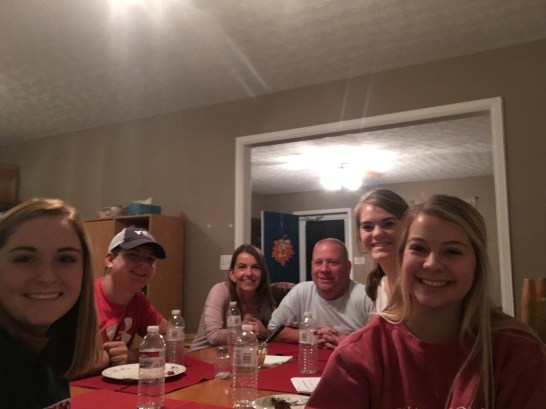
Over fall break, at my home in Pittsboro/Brownsburg, Indiana, I gathered the most diverse group I could on notice and had dinner with them. This group consisted of my dad and mom, Steve and Diane, and two of my closest friends from high school Mallory and Mackenzie. It should be noted that although we all live in Brownsburg, my mom and dad are from rural Northern Indiana. Mallory, Mackenzie, and I graduated with 560 in our class, while my parents graduated with about 100. Between the three college freshman, we each have experienced something a little different so far. Mallory goes to Butler University in Indianapolis, a small-ish liberal arts school where she studies Pre-Pharmacy. Mackenzie attends Purdue University in West Lafayette, Indiana, a very large school, studying biology and Spanish. Obviously I attend WKU, which is a school of the in between size, studying Sport Management. All three of us were raised in the Christian church. My dad and mom grew up in a farming community with approximately 4 stoplights between the 2 towns they were in most. They went to Butler University and University of Indianapolis, respectively, so they received an education similar to Mallory’s. My dad works from home as an underwriter for an insurance company. My mom has an accounting degree, but she has run her own consulting business out of our basement for 15 years and is very successful at her job. Each of us, although coming from very similar places, have slightly different views on our country and the world.

One thing that has consistently struck a chord with me in class is the idea of being a global citizen. When I mentioned this over our burgers and potato chips, Mackenzie said that we should be able to see another country through the eyes of our own, not judging the people there or thinking of their culture or government as strange. Mallory built on that by mentioning that we look at our countries’ governments and think ‘they don’t have a democracy, we should fix that’ when in reality, that may not be the best thing for them, which creates conflict. Being a global citizen should entail accepting not only cultures but governments, choices, and ideas of other countries. My mom said that, in terms of the United States and the world, citizenship means service and participating in your community. My dad said knowing your neighbors, being involved in the community, and taking pride for where you live are all important aspects of citizenship as well.

The thing that stuck with me the most was when we talked about the diversity that each of us has encountered with a specific person. Mackenzie talked about how she has talked to a girl in her sociology class who absolutely, genuinely hates her parents. Coming from a very put together and close knit home, Mackenzie was fascinated by this. This girl is also a part of the LGBT community, and made a point to tell Mackenzie this because she knew Mack is a Christian. Mackenzie said she never would’ve guessed that this outgoing and neat girl had so much baggage that she carried around with her, especially because at the surface she seemed very similar.

My dad coaches middle school basketball and has interacted with several young kids in single parent situations or rough family life, so he is more familiar with diversity in that sense. My dad has also worked with several people who grew up outside of America, but have adapted to speak fluent English and work well within the company. He made the point that as long as someone is a hard worker, you can assimilate anywhere.

Mallory has gone through a major encounter with diversity this year as one of her roommates in Amish. She is very conservative in her values and views, and she is still adapting to being outside of her normal community. Amish people live in southern Indiana mainly, so none of us have had a lot of interaction with Amish, so it was interesting listening to Mallory talk about it. One of Mal’s other roommates is black from Chicago. Her whole apartment is a very diverse location. She’s also been exposed to an interesting type of diversity at Butler, which really dug deeper into our conversation about diversity, especially in education. As a liberal arts school, with a renowned school of dance and music, Butler is thought to be and is advertised as very diverse. Although Mallory says there are even more LGBTQ+ students than there were at our high school (which was probably more than the average Indiana high school), there’s not much diversity besides that factor. Butler is a very expensive school, so the majority of the students there are middle to upper class and white. It was fascinating to her talk about this gap between what the school would seem like and what it really is. They don’t offer many scholarships, so even though its proximity in the heart of North Indianapolis should attract more inner city students, it doesn’t because they can’t afford it. Almost all the students are not first generation college students, so those who are become frustrated, according to Mallory. She has had lots of work in the inner city with the public elementary schools. She says Butler is “a close minded place that pretends to be very open minded”.

My mom also had a very interesting interaction with diversity. She grew up on a family farm working alongside migrant Mexican workers. They stayed at the farm and my mom grew up right with them. She walked the halls with them while they were bullied at school for being her “family’s Mexicans”. She knew what it must have felt like for them. When my uncle came out as gay a few years ago, my grandmother really struggled with it and didn’t understand how my mom was so accepting of it. My mom reminded her mom that she grew up with those kids who were different than her, who were teased by others for being different, and that my uncle could probably relate a little bit to that on the inside.

In this discussion around my kitchen table in Pittsboro/Brownsburg, Indiana, I learned most about diversity. I learned that sometimes diversity can be falsified and other times it can be very, very hidden. We don’t know someone’s story until we hear it for ourselves. I think in this very divided world, we often forget the age old rule that no two people are alike. No matter how many similarities they have on the outside, their insides may be completely different. They may be screaming the opposite on the inside. But we would never get the chance to know that if we assumed they were the same as us. I didn’t know some of these things about my parents and my best friends. I heard stories that would may have never been brought up if it weren’t for this project, and I’m very grateful for that.

In terms of Citizen and Self, it became very real for me that we all have different bridges. We may all want to be in the same place, or we may want to be in a different place, but regardless the steps each of us wants to take to get there is different. And we also must keep in mind, that the steps each of us NEEDS to take to get there will be different as well. Because we each have our own story, we each have our path, we each have our own ideas, and we each have our own passions, there’s no possible way that we can each take the same steps across that bridge to get to our desired outcome. But at the very least, I think we can all hope that we end off better than where we started with each step we take no matter what it may be.
kkt

Goat Caramel and Getting Dress Coded: My Experience at a Stranger’s Kitchen Table

idk.jpg

By Kaylin

As someone who comes from a family who only uses their dining room on Thanksgiving and Christmas, the Kentucky Kitchen Table project sounded to me like something I would have rather kept at the bottom of my to-do list (at first). When I heard that we would be eating dinner at Alison’s house, along with Leila, I was even more apprehensive. Entering the home of any stranger would be slightly uncomfortable, but entering the home of professors at my university sounded a lot weirder.

When Danielle, Amy, and I began our walk from campus to Alison’s home, we laughed about what we might be eating that night. “If it’s tofu, we’re going out to eat after this,” I suggested. Alison, our host, teaches in the English department at WKU. Leila, another guest, teaches Citizen and Self at WKU. Both professors seemed like they had more than a lifetime of experience already. Danielle, a freshman, comes from a town much larger than mine, but we share a lot of the same values. Amy, on the other hand, is a sophomore and is from Tennessee. I could tell she and I thought differently on a lot of issues, but we also have a lot of the same values. After guessing about which door to come in, we settled for the back door. We were greeted by Hazel, the yellow lab. I was relieved to see tacos on the stove.

The awkwardness was toned down a bit when Alison asked for our help in the kitchen. I chopped the cabbage while Danielle and Amy set the table. I was glad she was designating some responsibility to us so we didn’t have to wait in the kitchen and stare at her, especially since they had decided to provide the entire meal. Alison and Leila introduced themselves to us and asked us about our majors and how long we have been at WKU.  Things were still a little weird at this point, but I was starting to feel more comfortable.

When we sat down to eat we went through more motions trying to make small talk, but eventually this led into real conversations. The two professors, I quickly learned, have been well-cultured. Alison’s advice to us was to take the unforeseen opportunities which come our way. For her, this was teaching English to students overseas. She spent two years in Japan doing this and eventually did the same thing in European countries. I found this to be quite admirable. Both professors seemed to know a lot about ethnic food, which I envied. I decided to make it a goal of mine to try foods from other cultures whenever I could.

After talking about different places in Bowling Green we should go to eat, we finally started discussing things that felt like they really mattered – not just things that would help me out when my stomach started growling. When I asked the two professors what citizenship means to them, Alison said “recognizing that everyone is dealing with something.” I immediately made the connection to our empathy readings. In order to successfully deliberate, in order to live well together, we must put ourselves in the shoes of others on a regular basis. We must always give one another the benefit of the doubt. Alison meant noting that someone may behave a certain way because they are having a bad day, or going out of your way to help others simply because you can. This can also mean asking yourself why someone believes the things they do, or said the thing they said about it.

Leila laughed when asked this question, saying that she should have a good answer to it because she teaches the class. She ended up agreeing with Alison, and then we got sidetracked by talking about dress codes in high schools. This led to interesting points about feminism. Amy, a fellow student, explained that her high school stationed staff members at the doors to examine outfits and determine whether they were “appropriate.” We noted that dress codes typically only effect girls. Leila said to, “imagine if these authorities spent this much energy teaching men about consent,” referring to how much time they spend trying to enforce a dress code.

My favorite part of the dinner’s conversation came up accidentally and correlates very clearly to Honors 251. After talking about the dress code, we began discussing how many people who claim they are not feminists hold feminist values.  We said that many times, people simply don’t know how to say what they think. I brought up the example of when I was riding in the car with my at-the-time boyfriend and his mother and somehow ended up talking about abortion. His family are devout Baptists, so I was surprised when his mother stated that she would consider an abortion in some extreme cases. I was less surprised when she followed this statement with, “like if I were raped by a black man.” When my boyfriend asked her why specifically a black man, she went on to say that she doesn’t believe in interracial relationships, or, in this hypothetical case, conception. After further questioning of the issue, it became clear that she didn’t actually “not believe in” it, she just doesn’t see it fitting for herself. “I wouldn’t shun or look down on anyone else for it,” she explained. While I still don’t love what she had to say, my view of her was much better once she elaborated.

Had that conversation developed no further than her statement that she doesn’t believe in interracial relationships, I would have left that day thinking she was bigoted and kind of terrible. Afterwards though, I could recognize that she just didn’t know how to verbalize what she meant properly. Everyone at the dinner table agreed that this is not uncommon today, and that this is why we must properly deliberate and give others the benefit of the doubt.

When we began wrapping up our conversations, Alison remembered the dessert she had. We ate English cookies with Nutella and Mexican goat caramel (an example of how much they experiment with food). From the evening, I learned that there are way different people than the ones I spend most of my time interacting with, and that in some cases, they could be right in front of me. I ended up enjoying a lot of the conversations we had, and plan to Leila’s help when planning my study abroad ventures for spring of 2018.

The best part of the meal was that no one was on their cell phones. This was a refreshing change. Once we broke through the barrier of unclear expectations, we had meaningful conversation and a very enjoyable evening. In that hour and a half I learned about food, people, and tried two new things: green tea with brown rice and goat caramel. Who knew?

Kentucky Kitchen Table in Bowling Green

By Hannah

img_3770

Kentucky Kitchen Table I was accompanied by four other individuals. The participants came from a variety of cities as well as economic classes. First was Lyn Dawson who is a young adult from Glasgow, Kentucky and is a member of the Honors College at WKU. She is a positive person who typically sits quietly to herself but has many intriguing thoughts. Next was Scott who is from Louisville. Scott is someone who is independent in his thoughts and has strong founded opinions. He is talkative and has an upbeat personality. Next is Tami from Bowling Green who is selfless and works hard to help assist her family. She is a quiet individual who aims to please others. Then there was David from Bowling Green who enjoys sharing his many experiences of life. He believes that everyone should be treated equally and does all he can to provide for the people in his life. Lastly, there is Megan from Bowling Green who is an individual who is constantly thinking and wishes to do her best in all situations. She is a positive person who is independent and is strong in her thoughts and beliefs. When around the table, we started with what being a citizen is besides the obvious rights and responsibilities that we hear about growing up. It was anonymous at the table that everyone believed being a better citizen means listening to those around you and just trying to do your part in your community. This question mostly set the mood for the conversation and gave people a sense of what the conversation was going to be like. Next, we talked about how our future jobs or current jobs play a role in the community or how we want to use our job to better the community. Although the jobs varied with the chosen profession, the younger adults at the table wanted to make a change. This included changing the culture of politics, media, or pediatric mannerisms. This was interesting because although each individual was realistic in the small ability to change everything, they each realized they could control the way they behaved. This intrigued me to believe that if everyone looked at themselves first before the outside world, the world would start becoming a better place. These issues start on the inside and work themselves out. The older adults at the table realized that where they are in life may not be the biggest dreams they thought of in childhood, but they realized the importance of what they do. For Tami she works in healthcare, returning money to those who paid too much. She saw that although healthcare has such a negative connotation, she still works hard to be the part of healthcare that brightens people’s day. David’s official title is “Engineering Specialist” which means he takes care of the building where Tami works. He found in his position that no matter who he runs into through the day that he can teach a sense of equality and self-worth. He expressed that everyone, no matter if you clean the toilet or run the company, that everyone has an equal part. It is not about treating only high authority with respect but the people that are not thought about every day. These are individuals that society has defined as “unimportant”. The way this question was answered also reminded me of one of the central questions of the class that related to how we can solve problems. This ultimately shows that to cross the theoretical bridge, the first step we take is to recognize our part in society. The next topic that we discussed was how our neighbors played a role in how we live. This included what we could do to become better neighbors and how we currently may be interacting with our neighbors. As everyone spoke, it appeared that when we were younger or when their kids were younger, that interaction with neighbors was more prominent. Scott spoke about how before he moved houses that they could leave their doors unlocked and him and his neighbors had an open door policy. However, when he moved he found this was not as easy with his new neighbors. This connection was lost because his neighbors did not have kids and were typically were older, it was harder to form a bond and trust each other. This almost appeared as a microcosm for society of how when we are different from people it is harder to get along. This may not necessarily be because of bias but possibly because of human nature. I related Scott saying this to the reading “Paying for the Party.” Individuals typically do not have the grounds to get along if they do not come from similar backgrounds. Everyone at the table then agreed that especially with today’s changing world that trust and respect has most definitely changed which could affect our relationship with our neighbors. The conversation then shifted to the controversy with police officers and racial biases. Again the table agreed that although there may be corrupt officers in the system that typically most officers had good intentions. I wondered how this conversation may have changed if there was someone of minority in the group. The next question brought up at dinner had both surprising and comforting answers. The question was what advice one would give to those running for office. Everyone was careful to try and not relate the advice they would give to a specific candidate running in this current election. The table was clearly diverse in who they believed should win this current election but they tried not to let that come into play. First thing mentioned was by David who said he believed any president should have military backgrounds in consideration that they would be commander and chief of the United States military. Next Megan mentioned that the president should be someone with business experience. Although this was agreed upon, how a business person should act as president was differentiated. The majority opinion was that when being president it is important that you have the people skills to talk to other nations and remain peaceful with allies. You do not necessarily need to be a nice, easy going person, but you need to be respected. This is especially important with the recent hostilities going on and so many relationships are on the line. After sitting at the table I learned that although we come from many different backgrounds, that individuals in this country just want the best for everyone. At my table people realized that most situations could not be fixed with radical changes, but to fix things we just need to start with a basis of respect.