Kentucky’s Kitchen Table: “Finding Your Identity”

By Luke

After several weeks of scheduling conflicts and procrastination, our group was finally able to meet at our host Emily’s home for our Kentucky’s Kitchen Table project, which, to my enjoyment, ended up being a chicken taco night. After consuming an unsafe amount of Mexican food – as well as a delicious West 6th Amber Ale – it was finally time to have our discussion, which began of course with brief introductions.

Our host for the evening was Emily, a Bowling Green native currently completing her graduate degree at WKU involving an intricate combination of humanities courses. Dubbing herself as “Elisabeth Gish’s protégé”, Emily plans on living in a Chicago-based commune for approximately 9 months following graduation, and eventually hopes to attend divinity school in the Boston area.

Next around the circle was Daniel, a freshman on the path to nursing school. He briefly described his catholic-school upbringing in Louisville, which concluded with attendance at Saint Xavier High School. Like myself, Daniel enjoys reading and Netflix, but he also mentioned his heavy involvement with theater in high school. Volleyball is another of Daniel’s hobbies.

Ethan, another freshman honors student, was also in attendance. His interest in the broadcasting program brought him to WKU from Nolensville, TN, and his primary hobby involves working with the WKU-PBS television station. In addition, Ethan enjoys Netflix and hanging out with friends. He also mentioned being a baptist, although not extremely devout (this adjective described nearly all of our religious affiliations, aside from Emily’s).

The final member of our dinner/discussion was Alex, a fellow senior, who is wrapping up her degree in Agriculture this semester. Originally from the small town of Gallatin, TN, Alex enjoys horseback riding (specifically “barre racing”), kayaking, working on her truck & car, and shooting guns at the range with her father. She mentioned playing volleyball in high school, and identified as a southern baptist.

Only one of the “conversation starters” listed in the handbook (the required question) was officially addressed; however, our nearly two hour discussion encompassed several of the other questions indirectly. When asked about what “citizenship meant to her” (aside from voting, paying taxes, and following laws), Emily began detailing her somewhat abstract, yet immensely intriguing perspective on citizenship, which I’ll attempt to recollect.

She began by stating that we as individuals are citizens of several communities simultaneously. Some are obvious and based merely on residential locations such as hometowns, home-states and national residence (think “American citizens”). Others are more personal and greater in number/variety: extra-curricular clubs or groups, churches and other religious congregations, athletic teams at varying levels of competition, family units (whether traditional or not), friend groups, etc. As a result, human beings develop varying “identities” generated through association with varying communities (your personality/behavior around friends or colleagues changes when around parents and family, for example). According to Emily, as we grow and progress through the numerous chapters of our lives, we change how we prioritize the communities we belong to, and this in turn changes our identities over time. As a result, though any person at any given time may belong to a diverse collection of communities, one generally takes precedence over others and is responsible for what Emily referred to as that person’s “primary identity.” Think of it this way: when someone asks you to “tell a little about yourself,” the community associated with the majority of your description is your main priority (at the time) and is responsible for generating your primary identity as an individual.

For example, everyone in attendance other than Emily mentioned that practicing religious faith (i.e. our “religious community”) had become less of a priority since beginning school at WKU – an example of how priorities change in regards to communities we are citizens of. Personally, my social fraternity has been the most important community in my undergraduate career until now, and had previously generated my primary identity. However, as I prepare to graduate and move on to veterinary school in the fall, I’ve found that my primary identity has shifted, and the communities involving my girlfriend and select close friends have taken precedence. I’m sure that once I begin classes at Auburn this fall my “academic community” will become much more of a personal priority and change my primary identity. Being able to apply Emily’s theory to my own life helped it resonate all the more.

To conclude, Emily encouraged us to examine our own lives and practice articulating what our primary identities may be at the present time. This reminded me not only of Martha Nussbaum’s reading from Week 1 titled “Socratic Pedagogy: The Importance of Argument” that encouraged self-examination, but also Jonathan Haidt’s “The Intuitive Dog and Its Rational Tail” from Week 2 that urged readers to try and pinpoint the sources (i.e. the communities) of their own intuitions as a way to aid in debate and discussion. Discovering what motivates the decisions you make and the opinions you possess is critical to understanding yourself and properly empathizing with those around you, and I believe Emily’s theory attempts to get at the heart of what makes us who we are as individuals. If we find that we are satisfied with our primary identity, we should work to cultivate it and give our best to the communities responsible for its formation. If we are unsatisfied, however, perhaps we should begin to shift our priority to communities that can help us become the best versions of ourselves and support others in doing the same.

thumbnail_IMG_2302

Back row (from left to right): Ethan, myself, and Daniel. Front row (from left to right): Alex and Emily.
 

Kentucky Kitchen Table in Bowling Green

by Savannah

My classmate, Davis, and myself ate dinner with our host, Jennifer, here in Bowling Green, KY on Thursday, April 21st. Davis is a freshman at WKU as well, and he is interested in studying anthropology and the cultures of other countries, as well as science. Jennifer, our host, is a school teacher whom has teenagers and young adults at home. She is interested in religious life and is back in school to study such. Overall, we had a highly diverse table, yet we shared many things in common.

Our conversation was diverse as well, and we talked about a variety of issues. We mentioned the current political issues in our country, including the impending Presidential election. We talked about the importance of knowing the candidates and who one is voting for. Not only this, but we talked about the importance of having empathy, which is something certain Presidential candidates lack. This related to our talks of empathy in class, through our “Empathy Exams” readings. I referenced the video clip we watched during one of our first classes, regarding the little girl that was run over with no one stopping to help. I talked about how in our discussion, some people said that we did not have an obligation to help the little girl, and that we are not obligated to help anyone. I mentioned that I disagreed with this statement, and our table talked about how we all agreed we do have an obligation to help others out. We believe that this is a crucial part of being a good citizen, as we cannot simply ignore others’ problems when they do not affect us directly.

The idea of being a “good citizen” also was addressed in our conversation. As aforementioned, we discussed empathy as a crucial aspect of being a citizen. Aside from voting and truly knowing who one is voting for, we also decided that being concerned with the people around you is part of being a citizen. This does not only include the people that are “fellow citizens.” This includes the refugees entering this country, and those considered “illegal immigrants.” We must have compassion for all people if we intend on being true citizens. We cannot decide to live in ignorance of other people’s problems and other people’s pain by deciding that we have no obligation to them.

I learned a great deal during our Kentucky Kitchen Table, but one of the most important things I learned was regarding higher education and the different paths that people take. We talked about not forcing children to choose careers when they are young, or forcing them to go to college, as that is not always the best path for everyone. I learned from Jennifer that it is also never too late to go back to school if you find it is time for a different calling in your life. We discussed that learning how to relate to other people is also immensely important in both professional life and personal life, and this is something we learn through our interactions with diverse groups of people. These interactions could take place at a service trip, such as one that Davis attended, or in religious classes, such as ones that Jennifer is currently taking. It is important to interact with diverse groups of people and work together with them, as there is a plethora of new perspectives available to use in this way.

Overall, our Kentucky Kitchen Table was an enriching opportunity that allowed all of us to connect, despite not knowing each other prior. It fostered new ideas because of our unique perspectives on life. I truly felt like completing this assignment at the end of the year helped to sum up what I have learned in Honors 251. This became a physical manifestation of many of the ideas learned in our class through the readings and lectures. We were able to incorporate class concepts into our discussion, and it was interesting to hear everyone’s ideas regarding such. I hope that I can engage in such a dinner another time, because it made me realize the value in actual conversations about world events with other people.

Emily, KKT in Florida

By: Emily

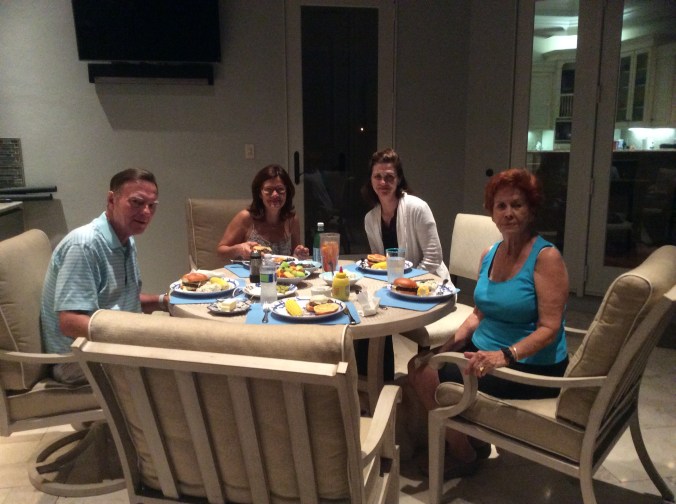
I put on my dinner with three generations of my extended family: my aunt Lisa, uncle Merle, grandmother, mother, and myself. My aunt and uncle are the wealthiest people I know. They are also the only liberally minded people in all of my family. My grandmother is seventy-nine years old, and with her comes some antiquated ideals, but she makes efforts to be contemporary and open minded. My mother is the kindest woman I know, but she is very sensitive to things outside of her comfort zone. I did this project while on vacation in Naples, Florida. All of the ladies cooked sides inside, while my uncle grilled out burgers. We ate while looking out on the bay behind their home. I opened up conversation with the required question, yielding interesting results.

I did not realize that just by asking “Beyond voting, paying taxes, and following laws, what does citizenship mean to you,” I would learn so much about my own family. My mom brought up the point of being an educated voter as an important duty of citizenship. Her point was that just blindly voting is not constructive. You should vote for who or what you believe will best serve the country, but voting ignorantly for the sake of simply voting is detrimental as a whole.

On the other side of the dinner table, sat my uncle. It is rare that around Thanksgiving dinner, my uncle allows himself to offer up an unpopular opinion, out of respect of the peace. However, he thrived with the proper setting to share his opinions. His opinion was that the more people who thrive, the more our nation thrives, so our money should go toward lifting up those who otherwise cannot succeed. As someone who has grown up in a hyper conservative household, this was explained to me in a way I had never been exposed to before. Most of liberal views that I heard came from conservatives explaining them to me, which are corrupted by nature at the source. Not intentionally, necessarily, but the explanation of a stance that opposes one’s own cannot be told impartially.

I learned, through the setting provided in this project, that Democrats are not delusional, they just see things differently than I do. I have to remind myself that the average of my opinion and the opposing opinion is probably the best course of action. I cannot have all the best courses of action, even if it really feels like I am right. This projects reminds me a great deal about the “Shipyard Project,” a chapter we read in Better Together. Even though the concept is strange when first heard, the Shipyard Project created new space for ideas and conversations to breathe. In the same way that conversations among veterans and civilians arose out of those performances, without this project, I would lack insight into not only the mindset of a democrat, but into this taboo realm of political talk. Essentially, I feel like I learned how and where to start tough conversations and why it is important to have them.IMG_1458

KKT Project Reflection

By Alex

For the Kentucky Kitchen Table project, I was grouped with Luke, Daniel, and Ethan. We had a wonderful dinner with Emily, a former Citizen and Self student and peer mentor who has graduated from the Honors College and with a Masters of Religion at WKU and is headed on to graduate school.  We decided to potluck ingredients for tacos, and make the actual dinner together, to help cut down on having to spend extra time prepping food, but also to have some casual conversation and get to know each other a little before the actual dinner. Ethan is a broadcasting major from Tennessee. He works at the TV station on campus and in his spare time enjoys Netflix and hanging out with friends. Daniel is a nursing major from Louisville who enjoys theater, Netflix, reading, and volleyball in his spare time. Luke is a Biology/ pre-vet major from Harrodsburg, Kentucky. He is a Sigma Chi, and enjoys sports, reading and Netflix.  We had an awesome conversation which we decided to begin with our question, “What does it mean to be a citizen?”  From there we went on to talk about a more personal aspect of citizenship, and what that looks like in varying identities. We talked about how we identify as individuals, and what types of things truly define us. Emily spoke a lot about personal reflection, and encouraged us to really think about what specific communities we identify ourselves in, and whether we are putting one hundred percent of ourselves into these communities. I do not think any of us left without seriously contemplating our lives as we did.  The conversation was very high level, respectful, and meaningful.

Specifically, each of us had a slightly varying view of what citizenship meant to us.  But overall the underlying principles were the same. Be active. Be involved. Help others. Do what you can. We all had an outlook of citizenship as being part of a group or community and giving your best to help and improve that community.  We discussed how this is also an inward commitment. We must choose what community, or communities we want to be defined by, and then give one hundred percent in order to be effective citizens.  Those communities are not solely our towns, states, country, etc. but also our families, social networks, workplaces, and more. We agreed there are no real set requirements for being an “effective citizen,” but that it is more about giving what you can, and giving one hundred percent in everything.  In order to make our communities what we would like to see, we must be actively involved and engaged in the activities of that community.  We also spoke briefly of these things in a religious context.  With varying religious backgrounds, (Ethan and I were raised Baptist, Danial Catholic, and Luke Methodist) we all agreed that this was a specifically good example of our community identities and how we must realize and ultimately choose which ones take precedence.

I think our conversation relates best to our class reading on the elephant and rider from Jonathan Haidt’s book The Righteous Mind. In fact, we discussed this briefly.  This is a good example of determining which is controlling which. Do we control our identities within a community, or do those identities control us? It is also a good comparison of how we function and work within our communities as active and involved citizens.thumbnail_IMG_2302